In this article
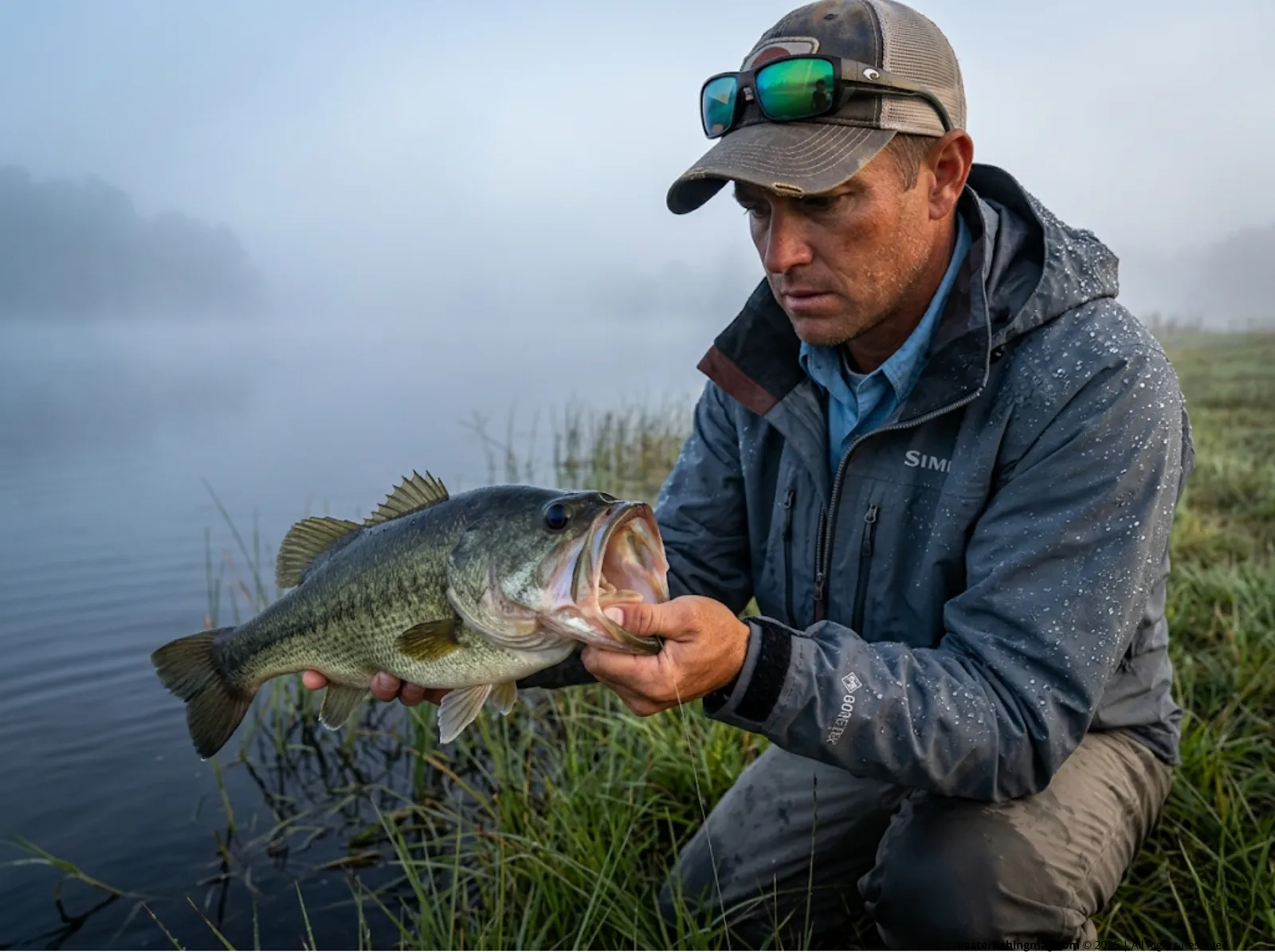
The fish rolled on its side the second you lifted it from the net. The line didn’t pull tight at the lip — it went slack somewhere behind the jawbone. You looked down and saw the hook eye sitting just at the back of the throat, barely visible, and the rest of the hook gone. The largemouth was on its side, gills pulsing fast. You had hemostats in your tackle tray, a pair of long-nose pliers, and about fifteen seconds of air time before the math started working against you.
If you’ve fished bait long enough, you’ve been in that spot. What you do next is the difference between a fish that swims back strong and one that floats up two hours later a quarter mile downstream. After years of guiding on bass and walleye water — including necropsy work on post-release mortality during fisheries surveys — I’ve seen both outcomes more times than I’d like.
This article gives you the full protocol: when to cut the line, when to attempt removal, how to run the through-the-gills technique correctly, which tools reach, and what happens to a fish’s body in the 90 seconds after you put it back.
⚡ Quick Answer: In most deep-hook situations, cutting the line and leaving the hook in place gives the fish dramatically better survival odds than attempting extraction. Research on bluegill shows a 10-day survival rate of 87.5% for line-cut fish versus 56% for those that had hooks removed. If you do attempt removal, use the through-the-gills rotation technique — grip the hook bend through the opercular opening, rotate toward the tail, and extract cleanly. If the hook isn’t free within 4–5 seconds, stop and cut the line. Keep air exposure under 15 seconds total.
The Anatomy of the Problem — Why Gut Hooks Are Not a Minor Issue
Most anglers think “deep hook” and picture an inconvenience. The fish swallowed the bait, it’s annoying to get out. That’s the wrong mental model.
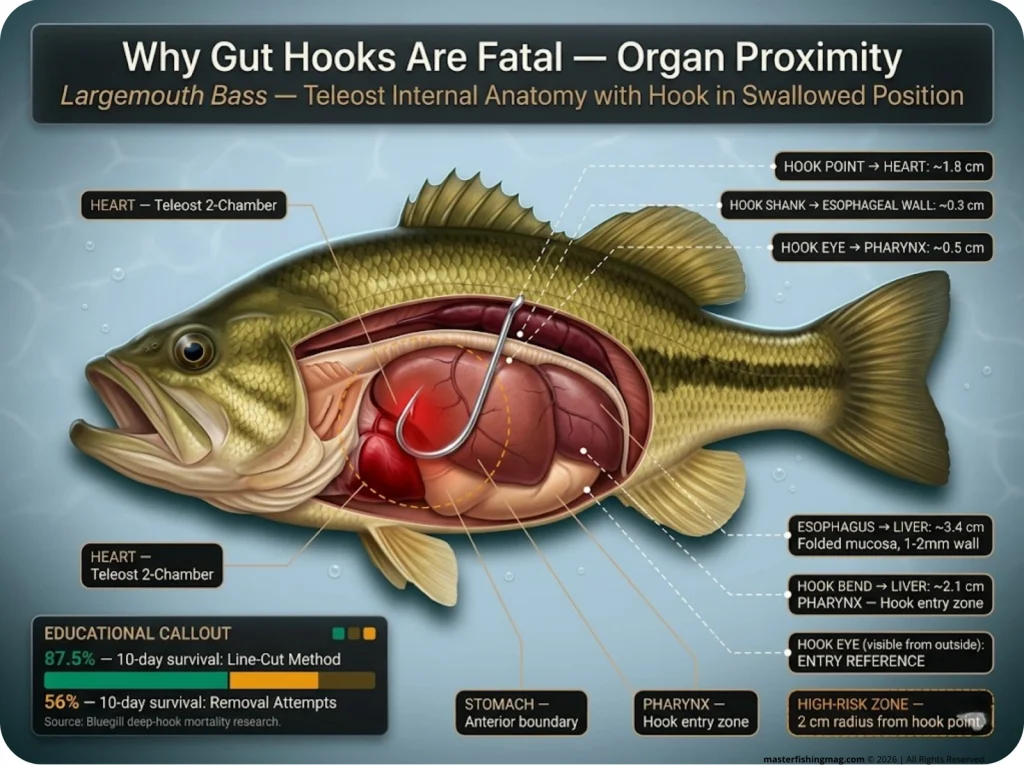
The teleost heart sits immediately posterior to the gill arches — ventral, close to the surface. In species like bluegill and largemouth bass, the esophagus and front of the stomach run within centimeters of the heart, liver, and kidneys. A hook past the oral cavity isn’t just lodged in tissue — its point is positioned next to organs that can’t take even minor puncture without lethal consequence.
Necropsy data on juvenile white seabass makes this concrete. Every recorded mortality tied directly to visceral hook damage — hook points found in liver, kidney, or cardiac tissue. And 69% of those fish had seawater inside the coelomic cavity, meaning the GI wall had been breached, triggering osmotic shock or internal infection.
Where the hook lands determines survival probability is not a debate. If any tension on the line moves the fish’s body rather than shifting the hook’s position, it has traveled past the oral cavity. You cannot see that from the outside. That’s exactly why the instinct to just yank it out costs fish their lives.
The Cut vs. Pull Decision — What the Science Actually Says
This is the part most guides skip. They teach you how to remove the hook. They rarely tell you when you shouldn’t.
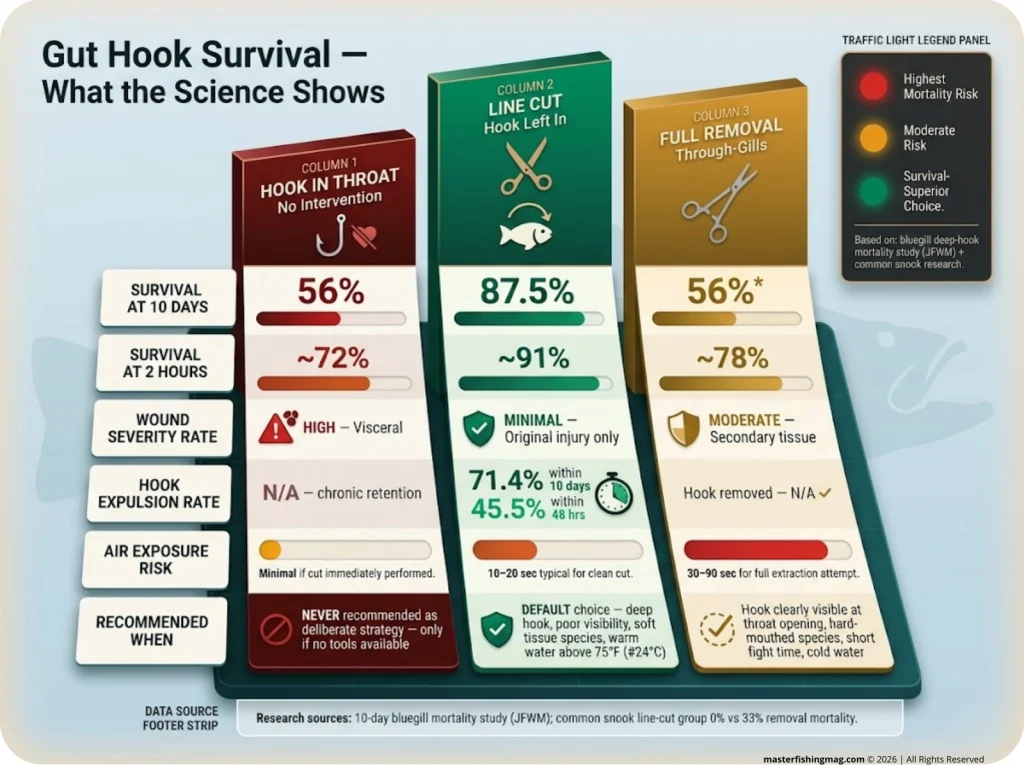
In bluegill studies, the 10-day survival numbers look like this: removal group at 56%, line-cut group at 87.5%, shallow-hook control at 96%. That’s not a marginal gap. You are functionally doubling this fish’s survival odds by cutting the line and walking away. In common snook, the split was even starker — zero mortality in the line-cut group versus 33% mortality in the removal group.
The mechanical reason is important. Pulling a hook out through the mouth drags the barb through esophageal tissue along a path it was never designed to travel. You’re not extracting the hook — you’re creating a secondary wound. On top of that, every second you spend working the hook extends air exposure time, and the cortisol clock starts ticking the moment the fight begins. By the time the fish is in your hands, metabolic acidosis is already underway.
Wound severity is the single strongest predictor of mortality. Approximately 57% of fish with moderate to severe injury died regardless of what was done afterward. If you see a pink tinge spreading from the gills into the water around the fish’s head, the outcome is largely decided. Cut the line immediately and get that fish back in the water.
The line-cut decision is not giving up. It’s the conservation-correct call in the majority of deep-hook scenarios. The hardest part of teaching this is the psychological barrier — anglers feel like cutting the line is losing the fish somehow. The data says otherwise.
Reading the Visual Indicators Before You Decide
Before you touch the hook, read the situation. If you can’t see the hook eye near the throat opening without tension on the line, it’s traveled into the pharynx or esophagus — removal is high-risk. Check the water around the fish’s head. Any faint pink tinge means vascular damage; visible wounding means cut immediately.
Factor in fight time. A fish that ran hard for three or more minutes already has compromised blood pH before it hits the net. Soft-mouthed species like crappie and perch carry thinner esophageal tissue than hard-jawed bass — higher-risk removal candidates regardless of position.
Pro tip: Use a headlamp to confirm hook eye position before touching anything. A clear visual takes less than three seconds and tells you whether you’re attempting removal or cutting immediately. Guessing costs the fish.
The Line-Cut Protocol — Doing It Right
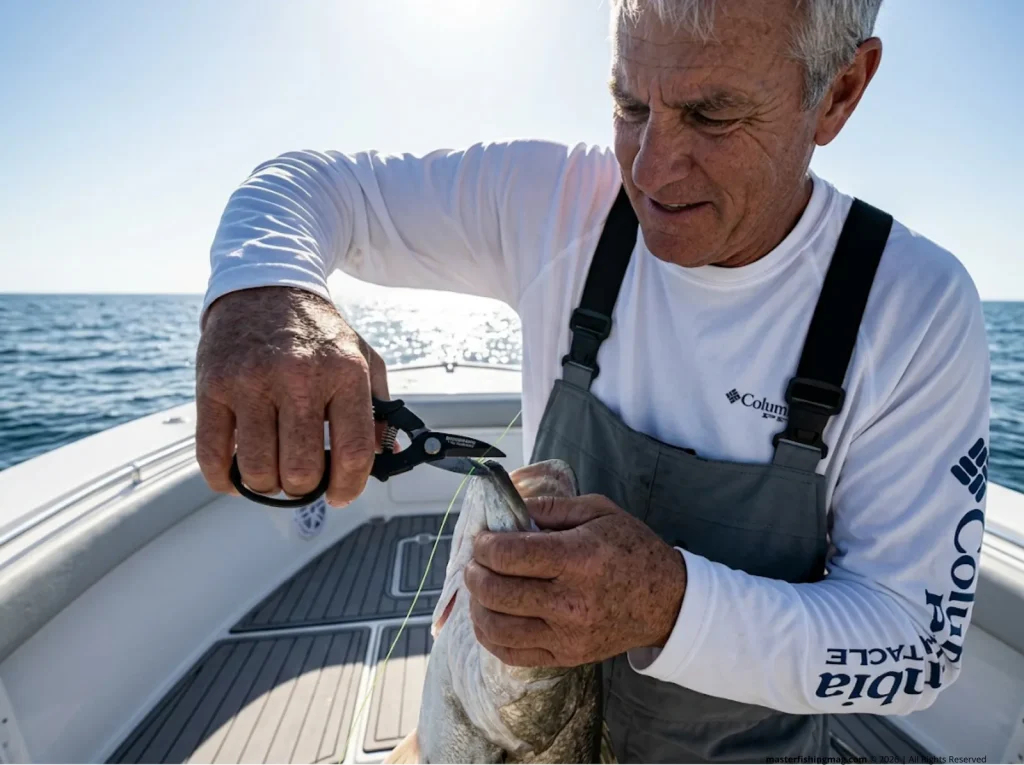
Cut as close to the hook eye as possible. More line left inside the fish increases secondary entanglement risk and slows natural expulsion. Use braid scissors or side-cutters — a clean cut is faster than twisting with pliers and reduces handling time by several seconds.
Here’s what the bluegill deep-hook mortality study comparing line-cut vs. removal outcomes showed about hook expulsion after line-cutting: 45.5% of fish expelled the hook within 48 hours, and 71.4% had shed it within 10 days. The success rate of line-cutting is built on the fish’s own biology — regurgitation, passage through the digestive tract, or gradual loosening as tissue heals around the wound. This is what the data means when it calls line-cutting the survival-superior intervention.
One material note that matters for freshwater C&R fisheries: carbon steel hooks begin degrading in saltwater within weeks, and more slowly in fresh water. Stainless steel hooks in freshwater may persist for years with minimal degradation. If you fish catch-and-release in a freshwater reservoir and you’re running stainless hooks, you’re leaving a lasting wound in every fish you deep-hook. Carbon steel or bronze construction costs nothing extra and changes the outcome entirely.
The Through-the-Gills Technique — A Physics-First Breakdown
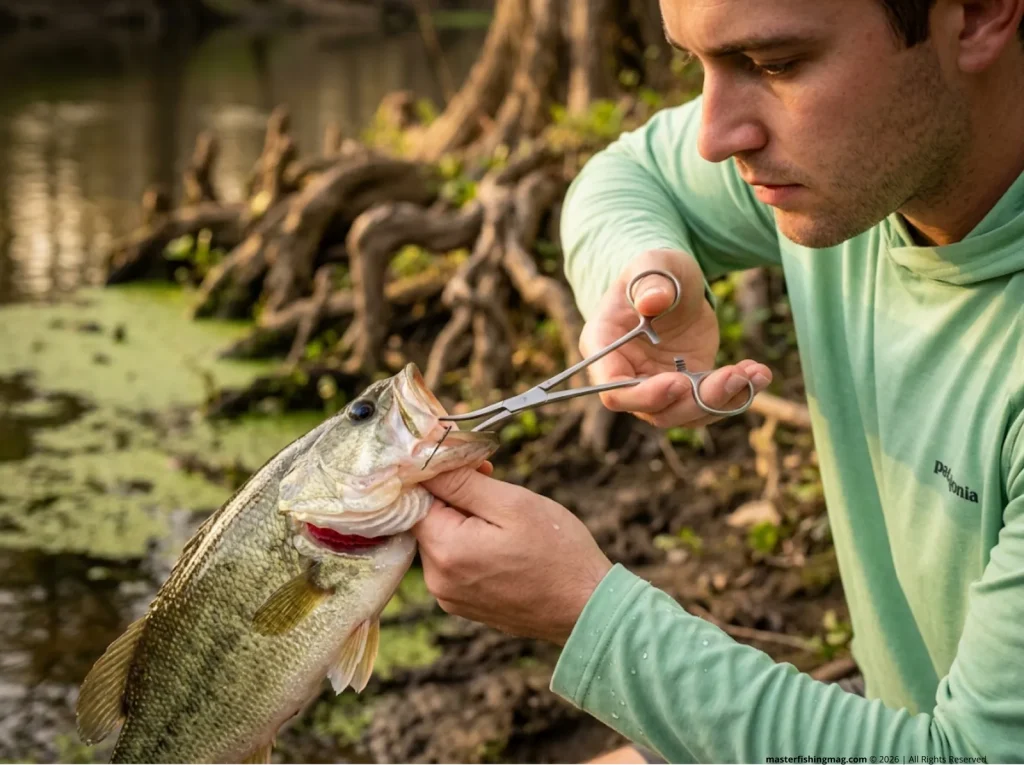
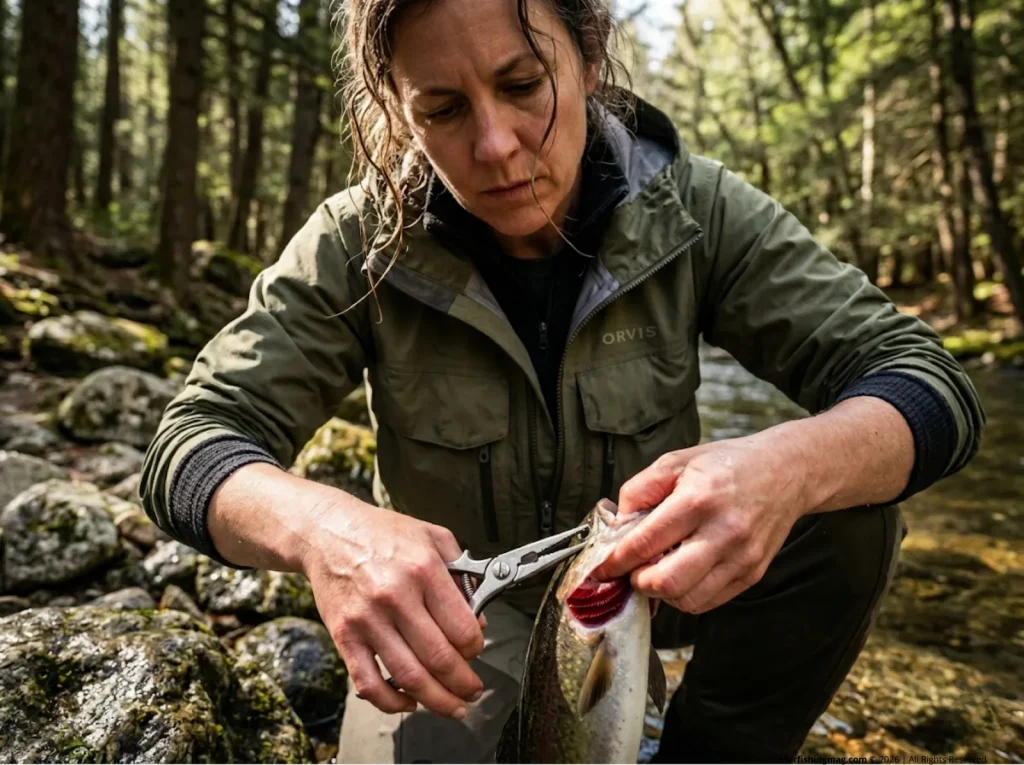
When removal is the right call — good visual confirmation of the hook eye, minimal tissue damage, hard-mouthed species, short fight time — the through-the-gills technique is the only method that works mechanically.
Understanding why requires understanding why straight pulling fails. Pulling a hook out through the mouth drags the barb forward through esophageal tissue. You’re not backing the hook out — you’re re-impaling it on every inch of the exit path. The tissue tears, air exposure extends, and the fish suffers from the extraction rather than the hook.
The retrograde pressure approach fixes this by accessing the hook through the opercular opening. Grip the bend directly — not the line, not the eye — and use the entry point as a fulcrum. Push the bend toward the tail while guiding the eye downward, and the hook traces back along the same arc it entered. The barb backs out through the tissue. This is the levers and vectors approach in practice — angler’s surgical manual thinking applied to a 15-second window.
One workaround when you lack ideal reach: the braid trick. Loop stiff braid around the hook bend and apply rotational tension. Same mechanical outcome, useful when your pliers can’t seat cleanly at depth. Some anglers also carry dedicated disgorgers — long, thin tools designed specifically for hook removal in confined spaces — though curved hemostats remain the field-reliable standard.
Time rule is non-negotiable: if the hook is not free within four to five seconds of engagement, stop. Cut the line. Prolonged attempts don’t improve odds — they extend air exposure and increase tissue trauma simultaneously.
Step-by-Step Mechanical Protocol
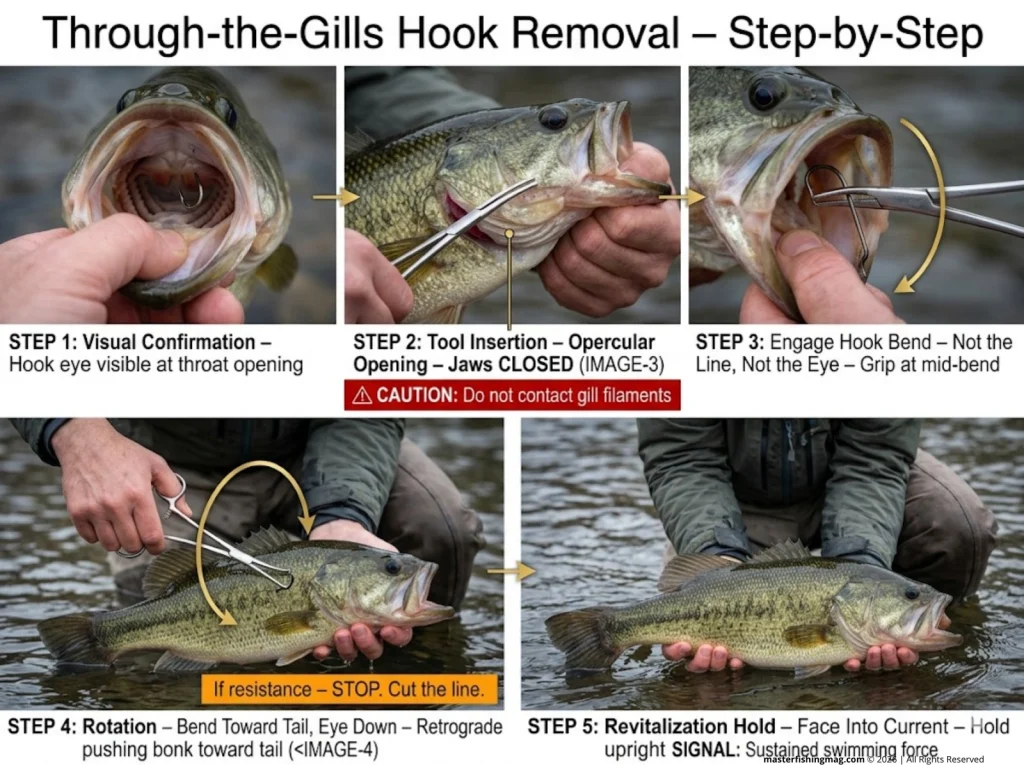
- Visual Confirmation: Gently tension the line. If the hook eye comes into view near the throat opening, proceed. If not, cut immediately.
- Tool Preparation & Insertion: Hold your hemostats or long-nose pliers closed during insertion. Pass through the opercular space between the gill arches — not through them. Gill filaments are the functional lung tissue of the fish. Contact causes respiratory compromise. Keep tools closed.
- Engage the Hook Bend: Grip the bend firmly. This is your fulcrum point. Maximum leverage for the rotational arc lives here — not at the eye, not at the line.
- Rotate, Don’t Pull: Push the bend toward the fish’s tail while the eye rotates downward. Hold the fish still. Any movement during rotation increases secondary tearing.
- Extract & Assess: Once the hook is free, remove through the gill opening or guide out through the mouth if the line is still attached. Move immediately to revitalization.
Pro tip: If you feel resistance at Step 4 and the hook doesn’t move freely, the barb is snagged on esophageal folds or is near the stomach wall. Do not add force. Stop. Cut the line. This is the moment most extraction attempts turn into extraction injuries.
Tool Selection for the Through-the-Gills Technique
6-inch vs. 8-inch forceps is a reach decision, not a cosmetic one. Six inches of working length reaches a deeply ingested hook in a two-to-three-pound bass. For species over five pounds or with longer gullets — pike, musky — eight to ten inches is the minimum. Four-inch straight-nose pliers at a gut-hook situation is the wrong tool.
Curved hemostats outperform straight pliers because they conform to the rotational arc. With straight pliers, your wrist compensates for the geometry — that reduces precision at exactly the moment precision matters. Medical-grade stainless with chrome plating handles saltwater contact and tolerates internal tissue exposure.
The Rapala Mag Spring Pliers solves one specific problem: the spring-loaded return keeps the jaws open between grips, which matters when your other hand is controlling a moving fish. For corrosion resistance ratings and jaw-lock durability across brands, the dehooking tool selection guide with corrosion resistance ratings covers it all.
Pro tip: After each session, rinse your hemostats with fresh water and manually check the jaw-lock mechanism. A worn lock slips mid-rotation — the single most common cause of this technique failing in the field. Replace before you need them, not after.
Hook Metallurgy and the Myth of “It’ll Just Dissolve”
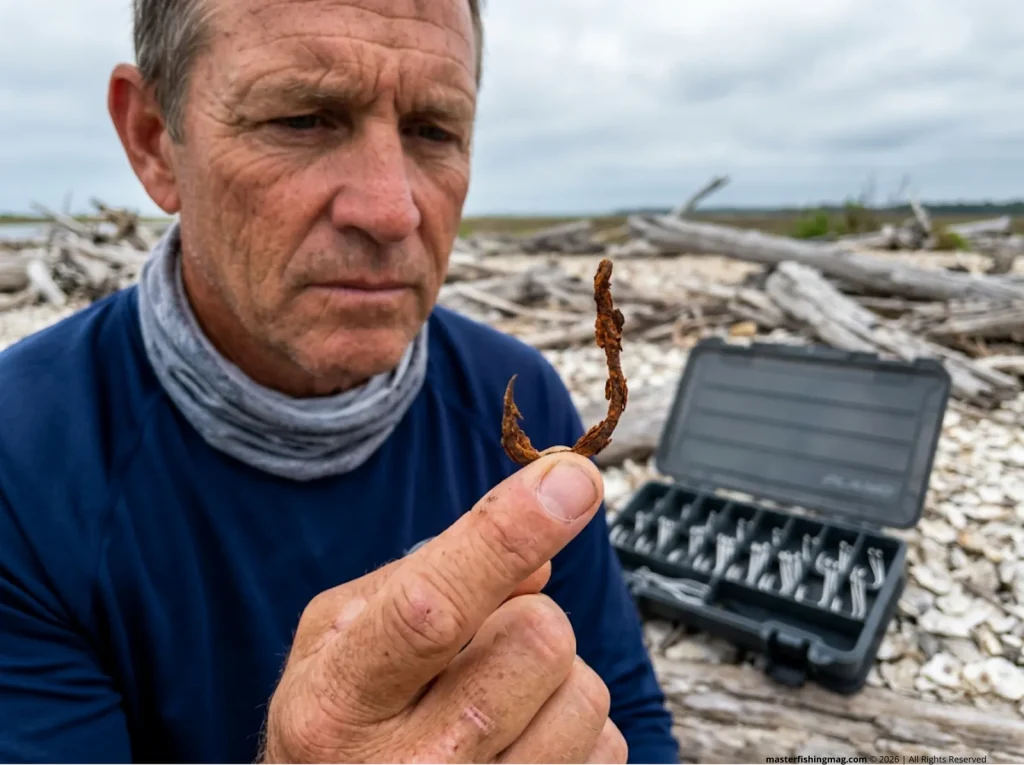
This belief lives everywhere in angling culture, and it’s partially true — which makes it more hazardous than a straight-up false belief. The accuracy depends entirely on what kind of hook and what kind of water.
Carbon steel in saltwater: degradation starts within weeks. High survival rate for the fish, rapid rusting, and expulsion or encapsulation within days to a few weeks. Carbon steel in freshwater: months to meaningful degradation, moderate survival, slow rusting. Stainless steel in saltwater: years. Low survival, chronic trauma risk as the hook persists. Stainless steel in freshwater: many years. Lowest survival, indefinite retention. Bronze/non-plated in saltwater: weeks, high survival, low toxicity.
I’ve pulled stainless hooks from fish taken during stream survey work that were clearly years old. Totally intact. No visible degradation. The fish’s body had walled it off in a calcified matrix — a process called encapsulation, where healing tissue covers the foreign object to prevent further organ contact. The fish survived. At what metabolic cost, we don’t know. But the hook the angler assumed “would just dissolve” was still sitting there, pristine, doing nothing useful.
Metallic oxidation is fastest on portions of the hook exposed to stomach acids or seawater. Portions buried deep in tissue may degrade much more slowly than the angler imagines. The NOAA guidelines on hook material and post-release survival in recreational fisheries make this clear: hook material choice in C&R fisheries is a conservation decision, not just a tackle preference.
The conservation implication is direct. If you run stainless hooks in freshwater C&R scenarios and you deep-hook a fish, you are leaving a wound that may persist for years. Switching to carbon steel or bronze costs nothing and changes the outcome dramatically. This is also where hook geometry and penetration physics intersects with the metallurgy question — the material that goes in is also the material that has to come out, one way or another.
Prevention — Gear Choices That Make This Emergency Rare

After switching to barbless circle hooks on all my C&R bass fishing, I haven’t had to run the extraction protocol in three seasons. That’s not luck. That’s the gear doing what the physics designed it to do.
Circle hook geometry is built around one mechanical principle: the inward-facing point slides over soft visceral tissue and only rotates to penetrate when it reaches the jaw corner. In white seabass studies, circle hooks secured the lip region 73% of the time versus only 41% for J-type hooks. That gap represents the majority of deep-hook events you’d otherwise spend the next two minutes trying to fix.
The rule that most anglers miss: don’t sweep-set with a circle hook. A conventional rod sweep defuses the hook’s self-positioning mechanism entirely. Raise the rod steadily or simply reel tight — let the hook do its mechanical work. Switching to circle hooks for safer, physics-driven hook placement covers the species-specific setup details that make this work across different jaw geometries.
Barbless hooks address a different problem. Removing a barbed hook requires displacing a larger tissue volume than initial penetration — the barb resists withdrawal structurally. Barbless designs eliminate that resistance. Removal becomes near-instantaneous with minimal tissue displacement. Less time on the hook means less metabolic cost of air exposure and less secondary injury. If you’re hesitant to go full barbless, press the barb flat with pliers on your current hooks — that transition takes ten seconds and gets you 80% of the benefit.
Circle Hooks — Selection and Proper Setup
Non-offset circle hooks consistently outperform offset circles in C&R survival studies. The offset angle can allow the point to bypass the jaw corner — defeating the hook’s entire geometric purpose. Gap sizing matters too: the hook gap needs to match the species’ jaw geometry. A gap too small in a large-mouthed species may not rotate cleanly into the lip corner on the hook set.
Stiff fluorocarbon leaders allow the hook to present naturally and fall away from the bait — that’s essential for the self-positioning mechanism to function on the take. If your leader is too limp and the hook is tracking close to the bait, you’ve partially disabled the circle’s entry mechanics.
The 15-Second Air Exposure Rule — Why Speed Is Conservation
The 15-second air exposure limit isn’t a suggestion. It’s a physiological threshold built around a simple fact: air exposure compounds every stressor already active in the fish’s system simultaneously. Metabolic acidosis from the fight is running. Lactate is accumulating in white muscle. Ionic balance is already disrupted. Mucosal integrity — the slime coat that blocks pathogens — starts degrading on contact with air.
The American Fisheries Society release practices and air exposure guidelines formalize the hold-your-breath rule: when you need to breathe, the fish does too. That’s the timer. It’s not a metaphor.
Water temperature determines how fast the clock runs. Above 70°F, dissolved oxygen drops and metabolic expenditure accelerates. Fish that appear fine at release can experience delayed mortality if air exposure exceeded 30 to 60 seconds in warm conditions. Every second of air exposure during a hook attempt counts against the fish’s survival budget — which is exactly why the four-to-five-second “try or cut” rule for the TTG technique is non-negotiable, not a guideline.
The Post-Release Recovery Window — Metabolic Acidosis and What Comes Next
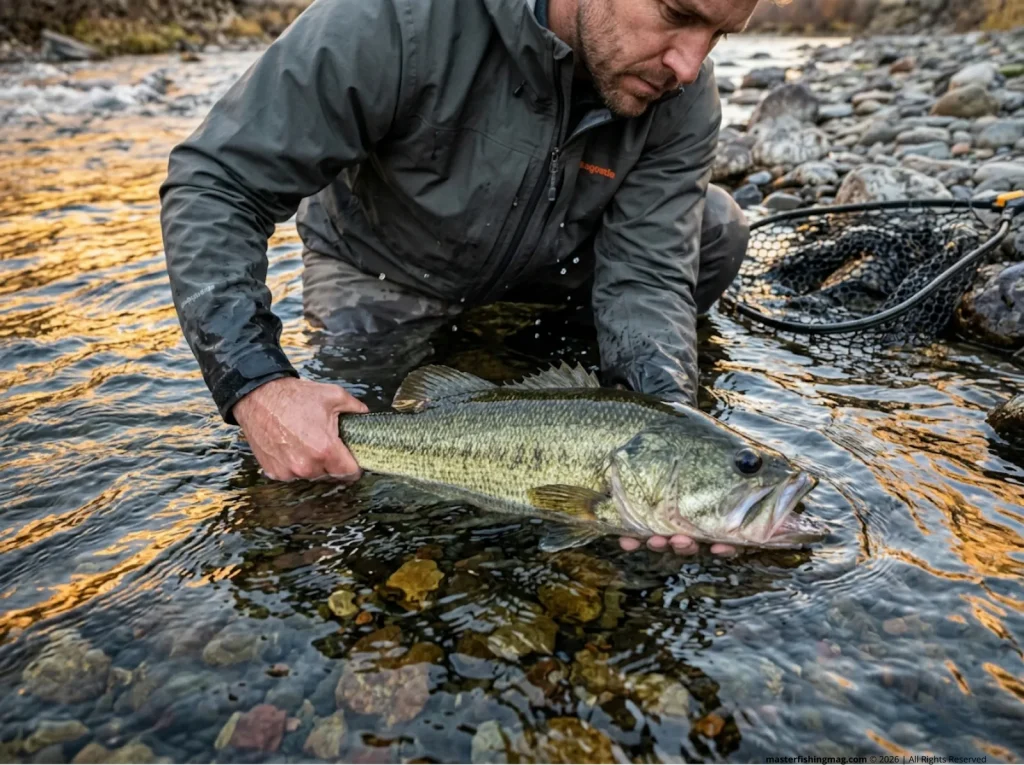
The hook is out or the line is cut. Most anglers think the job is done. It’s not. This is where the metabolic recovery window determines whether the fish actually makes it.
The anaerobic burst of a prolonged fight floods white muscle with lactate and hydrogen ions — metabolic acidosis that can be fatal if blood pH stays suppressed. In rainbow trout, blood pH returns to pre-exercise values within two to eight hours post-release. Heart rate and oxygen consumption can take up to 24 hours. During that window, the fish is still physiologically compromised even if it looks strong at the surface.
Hold the fish upright in the water — not on its side. If there’s current, face it into the flow. Oxygenated water needs to move over the gill filaments actively. No current? Move the fish forward gently. Forward only — backward motion closes the gills on the return stroke. The back-and-forth pump method looks like revival but is shutting the gills on every pull stroke. You’re working against re-oxygenation, not helping it.
Two-handed horizontal support throughout. Gripping by the tail alone compresses internal organs. Slime coat protection requires wet hands and wet surfaces. The release signal is sustained, purposeful swimming force — not a single weak kick. Keep holding until it fights you.
Pro tip: If a fish rolls belly-up during recovery hold, turn it upright immediately and restart the count. A fish that can’t maintain orientation is not ready to release, regardless of how long you’ve been holding it.
Temperature and the Survival Window
Water temperature is the master variable. Warm water means less dissolved oxygen and faster metabolic expenditure — the acidosis recovery window shrinks above 70°F (21°C). Tournament fish held in livewells for hours arrive at release already oxygen-stressed; additional handling injury compounds a compromised baseline. In warm water above 75°F (24°C), skip removal entirely and cut the line — the intervention math doesn’t favor it. For a deeper look at warm-water mistakes that cost fish their lives, warm water fish release mistakes that harm fish covers the temperature thresholds and revival techniques that apply across species.
Below 50°F (10°C), slower metabolic rates extend the handling window slightly. Cold water C&R is more forgiving, but that doesn’t make extended air exposure acceptable — the margin is wider, not absent.
Once the fish holds in current without listing and resists your grip with consistent force, it’s recovered. The complete science-based catch-and-release recovery protocol covers barotrauma, air exposure, and metabolic restoration across species for anglers who want the full treatment.
Conclusion
Three things to take out of this.
First: cut the line more often than you think you should. The science is clear and consistent across multiple species — in most deep-hook situations, leaving a carbon steel hook in place comes close to doubling or tripling survival odds compared to forced removal. Fish are biologically built to shed or encapsulate hooks. Trust that and get the fish back in the water. This is what the success rate of line-cutting actually means in practice — you’re not giving up on the fish, you’re giving it the best possible odds.
Second: if you attempt removal, use the through-the-gills rotation technique. Linear pulling is mechanically wrong. Rotational extraction via the opercular opening is the physics-correct method — grip the bend, rotate toward the tail, and you have four to five seconds to make it work. If it doesn’t, cut the line. This is the angler’s surgical manual stripped to its essentials.
Third: prevention is the permanent fix. Non-offset circle hooks and immediate hooksets eliminate the bulk of deep-hook events before they start. Gear choice in a C&R fishery is a conservation decision. Next time you rig up for a C&R session, flatten one barb per hook and swap your J-hooks for non-offset circles. That one change will do more for your fish survival rate than any extraction technique you can learn after the hook is already swallowed.
FAQ
Should I leave the hook in a deep hooked fish?
In most cases, yes. Cutting the line and leaving a carbon steel hook in place gives the fish significantly better survival odds than attempting removal. Research consistently shows 10-day survival rates of 87.5% for line-cut deep-hook fish versus 56% for fish that underwent hook removal. Fish are biologically capable of expelling or encapsulating retained hooks, with 71.4% of fish in line-cut studies shedding the hook within 10 days — especially with carbon steel designs that begin corroding within weeks.
Do fish hooks dissolve inside a fish?
It depends entirely on hook material and water type. Carbon steel hooks in saltwater begin degrading within weeks and are frequently expelled or encapsulated within 10 days. Stainless steel hooks in freshwater may persist for years with minimal degradation — which makes stainless a poor choice for catch-and-release fisheries. The it’ll just dissolve belief is only true for the right hook material in the right environment.
How do you unhook a fish that swallowed the hook through the gills?
Insert curved hemostats or long-nose pliers through the gill opening (opercular space), passing carefully between — not through — the gill arches. Grip the bend of the hook, push the bend toward the fish’s tail while the eye rotates downward. This reverses the hook’s entry path. If the hook doesn’t release within four to five seconds, stop and cut the line. Never apply linear pulling force through the mouth.
How long can a fish stay out of water during hook removal?
The functional limit is approximately 15 seconds, using the hold-your-breath rule — when you need to breathe, the fish does too. In warm water above 70°F, every second above 15 counts heavily against survival. Metabolic acidosis from the fight is already active before the fish leaves the water; air exposure compounds lactate accumulation, ionic loss, and gill desiccation simultaneously.
Are barbless hooks actually better for deep-hook prevention?
Barbless hooks don’t prevent deep hooking — they prevent the tissue displacement that occurs when a barbed hook resists extraction. Their primary advantage is near-instantaneous removal with minimal secondary injury, which dramatically reduces both air exposure time and tissue trauma. Combined with a circle hook design, barbless construction addresses both the entry mechanics and the extraction problem in one package.
Risk Disclaimer: Fishing, boating, and all related outdoor activities involve inherent risks that
can lead to injury. The information provided on Master Fishing Mag is for educational and informational purposes
only. While we strive for accuracy, the information, techniques, and advice on gear and safety are not a substitute
for your own best judgment, local knowledge, and adherence to official regulations. Fishing regulations, including
seasons, size limits, and species restrictions, change frequently and vary by location. Always consult the latest
official regulations from your local fish and wildlife agency before heading out. Proper handling of hooks, knives,
and other sharp equipment is essential for safety. Furthermore, be aware of local fish consumption advisories. By
using this website, you agree that you are solely responsible for your own safety and for complying with all
applicable laws. Any reliance you place on our content is strictly at your own risk. Master Fishing Mag and its
authors will not be held liable for any injury, damage, or loss sustained in connection with the use of the
information herein.
Affiliate Disclosure: We are a participant in the Amazon Services LLC Associates Program, an
affiliate advertising program designed to provide a means for us to earn advertising fees by advertising and linking
to Amazon.com. As an Amazon Associate, we earn from qualifying purchases. We also participate in other affiliate
programs and may receive a commission on products purchased through our links, at no extra cost to you. Additional
terms are found in the terms of service.