In this article
You’ve already missed three strikes. The worm came back naked — stripped clean off the hook again — and you have no idea why. The guy thirty feet upstream is landing fish on the same bait, same rod. The difference isn’t luck. It never is.
After more seasons guiding trout water than I care to count, I stopped blaming the fish. The mechanics of live worm rigging are specific enough that small mistakes compound fast: wrong hook wire gauge, wrong threading direction, worm stored two degrees too warm. Each error alone costs you a strike. Together they cost you the day.
Here’s exactly how to stop guessing and start engineering a presentation that actually holds through the cast, the current, and the take.
⚡ Quick Answer: The best live worm rig holds because of four compounding factors: a live, pressurized worm (stored at 5–10°C), threaded head-to-tail using setae friction geometry, on a fine-wire Aberdeen or circle hook sized 6–10, with method matched to conditions — Sock Method for current or active retrieves, Accordion for still water. Change bait every 20–30 minutes regardless of how the worm looks. After that window, the chemical signal is gone even if the bait isn’t.
The Biology of Your Bait — Why a Live Worm Is Not Just a Worm

Most anglers think of a worm as passive bait. It isn’t. A healthy earthworm is a biological signaling engine running on hydraulics, friction, and chemistry — and every rigging decision you make either keeps that engine running or shuts it down early.
The earthworm’s body is built around a hydrostatic skeleton called the coelom — a fluid-filled internal cavity that gives the worm its firmness, shape, and structural resilience. When you squeeze a fresh worm and it resists and contracts back, that’s internal pressure doing its job. When it deflates like a wet sock, the worm is already spent. That pressure is what keeps the bait secure on the hook. A dead worm doesn’t just look bad — it physically can’t hold the hook the way a live one does.
Running along the exterior of each segment are setae — 800 to 1,200 microscopic chitin bristles per worm, oriented backward toward the tail. In the soil, they act as grappling hooks. On your hook shank, they create directional friction. Thread head-to-tail and the setae geometry works with you. Thread tail-to-head and you’re fighting the biology of the animal every cast. Everyone does this wrong until someone shows them. Then it’s obvious and you can’t unsee it.
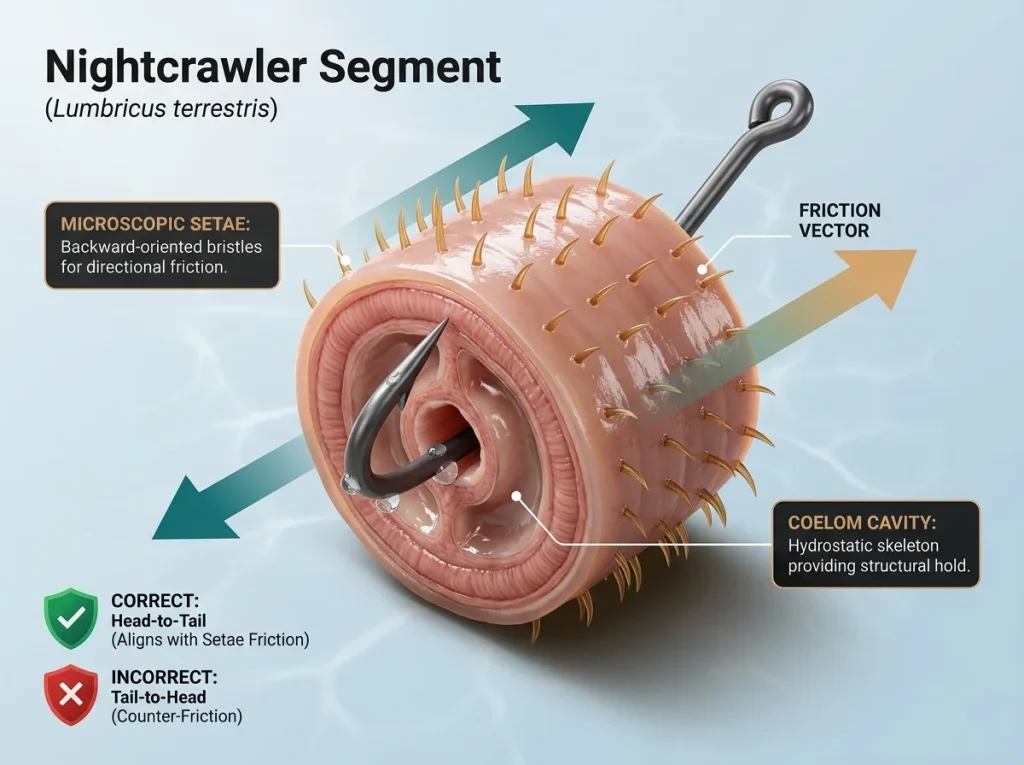
The clitellum — the raised saddle located about one-third from the head — is 2 to 3 times thicker than the surrounding segments and holds the highest concentration of proteinaceous material on the animal. That’s your best anchor point on a long-distance cast. A light pink or cream clitellum means the worm is at peak maturity. If it looks shrunken or dark, use that worm for still water only. Don’t try to muscle it across a river pool.
Understanding how hook geometry interacts with live bait starts with understanding what you’re hooking into. The setae friction, the coelom pressure, the clitellum anchor — these aren’t worm biology trivia. They’re the physics of why your bait stays on the hook or doesn’t.
Pro Tip: Squeeze the worm gently before threading. If it contracts back, it’s pressurized and ready. If it goes limp immediately, it’s past its window — use it for still water and grab a fresh one for the drift.
The Thermodynamics of Bait — Temperature Is Not a Preference, It’s Physics
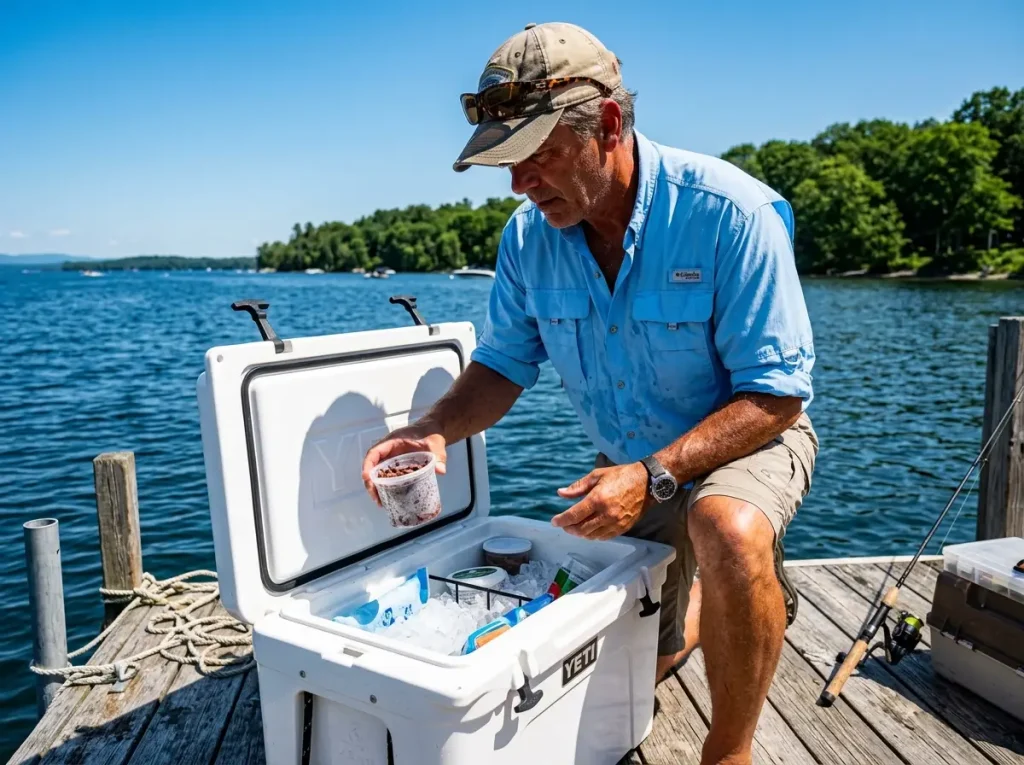
“Keep ’em cool” is the folklore version of a precise biological principle. The actual number is 5–10°C. That range is not a suggestion.
Earthworms are ectothermic — their metabolic rate is controlled entirely by ambient temperature. For many Lumbricus species, the temperature coefficient in the 5–15°C range can hit 3.76, meaning every 10°C rise roughly quadruples metabolic demand. A worm sitting at 25°C versus 10°C is burning through its energy reserves at three to four times the rate. It arrives at the water already depleted, soft, and easy to strip.
| Bait Metabolic State and Performance Guide | ||
|---|---|---|
| Temperature | Metabolic State | What You See on the Hook |
| 2–5°C | Metabolic depression | Firm but rigid; hard to thread without splitting |
| 5–10°C | Optimal | Firm, resilient, sustained activity |
| 12–20°C | Hyper-metabolism | Active but burns out fast; goes limp quickly |
| >25°C | Oxidative stress | Soft, dehydrated; already failing as bait |
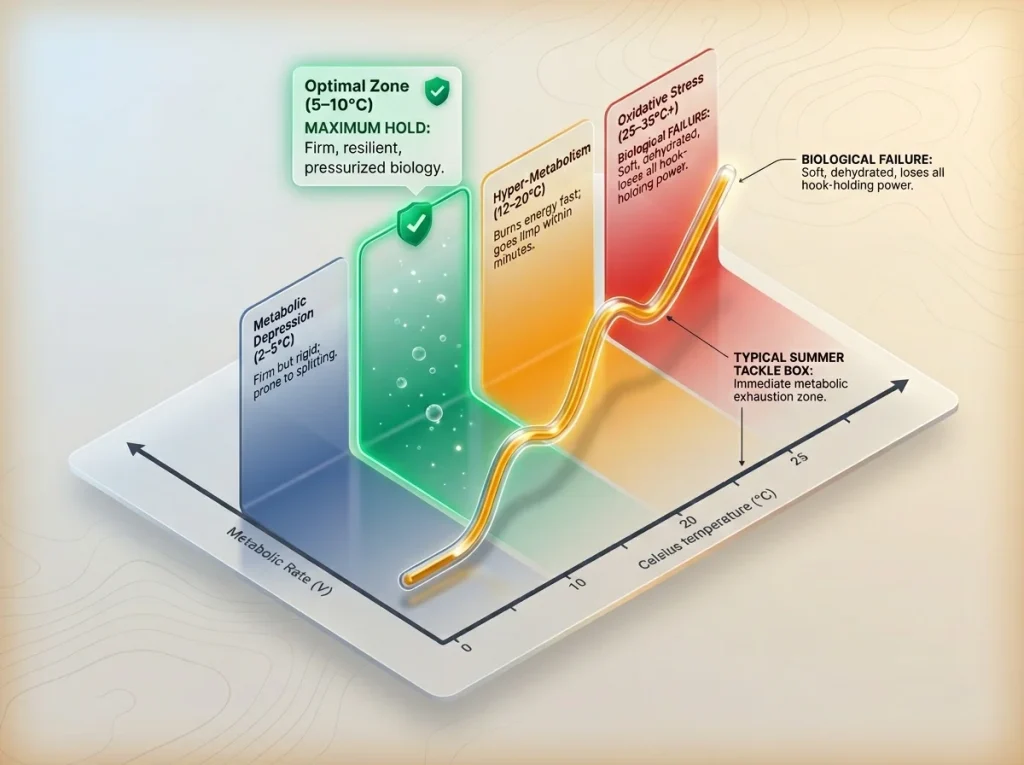
At high temperatures, the worm enters a state where it consumes its own muscle proteins for energy. By the time it hits the water, the muscle rigidity is gone completely. A $6 small bait cooler with ice water in a separate bag pays for itself the first trip you stop losing bait on every third cast.
When the worm goes into the water, a second clock starts: osmotic stress. The worm’s internal fluids are more concentrated than freshwater, so water diffuses in through the cuticle and salts leak out. Hook wounds accelerate this process. Cold water slows it. That’s the double advantage of proper dissolved oxygen and temperature management for live bait — slower osmotic exchange, lower metabolic demand, longer effective window.
The same thermal rules apply to the fish you’re targeting. How ectothermic metabolism governs fish behavior at different temperatures explains why cold water mornings often produce the sharpest strikes — not just because the worm holds better, but because the fish is metabolically primed to feed.
Pro Tip: Don’t store worms directly on ice. Subzero temperatures cause cell damage that’s just as destructive as heat. Keep them in their native soil in a cooler at 5–10°C, not on ice itself.
The Scent Science — What Fish Actually Smell

Competitors talk about “worm smell” like it’s one thing. It isn’t. It’s a specific ratio of L-amino acids that fish olfactory receptor neurons detect with precision. Understanding this changes how you manage your bait’s chemical window.
The five amino acids that matter most for freshwater predators: L-Alanine (small molecular weight, diffuses fastest — the beacon that pulls fish in from distance), L-Glutamate (universal high-protein prey signal), L-Arginine (triggers search behavior), L-Lysine (effective in warmer water), and L-Serine (highly effective for salmonids and carp). According to electrophysiological studies on fish olfactory receptors and amino acid detection, these receptors have two distinct binding sites — one for neutral amino acids, one for charged.
Here’s the part nobody writes about: when the concentrations of neutral and charged amino acids equalize, they suppress each other’s signal. The fish stops responding — not because it got smarter, but because the chemistry cancelled itself out. A freshly hooked worm releases a burst of neutral amino acids from skin wounds and charged amino acids from internal fluid leakage. That imbalance is what triggers the feeding response. As the worm dies, concentrations equalize. Olfactory cancellation sets in. The bait looks fine on the hook. It is not sending a signal anymore.
This is why 20–30 minutes is the outer limit for a rigged worm — and why the 40-minute soak you’re proud of is fishing a scent-neutral object. How olfaction and amino acid chemistry drive fish feeding responses covers the full picture. The bass that’s been holding in that pool all summer has learned what a live piscine olfactory stimulation gradient smells like versus spent equilibrium. You’re not fooling its nose with a worm that’s been in the current for an hour.
Human scent compounds — skin oils, sunscreen, hand sanitizer — can adhere to the worm’s cuticle and disrupt the natural amino acid output before the worm ever hits the water. The fix is simple: dip your fingers in the soil from the bait cup before handling. It transfers soil microorganisms that buffer the worm against skin contamination and gives you a better grip without compressing the coelom.
Pro Tip: Avoid handling worms right after applying sunscreen. These compounds persist on the cuticle for several minutes and suppress the natural scent profile. Wash your hands in stream water, not hand sanitizer, before rigging up.
Hydrodynamics — How Your Rigged Worm Moves Through Water
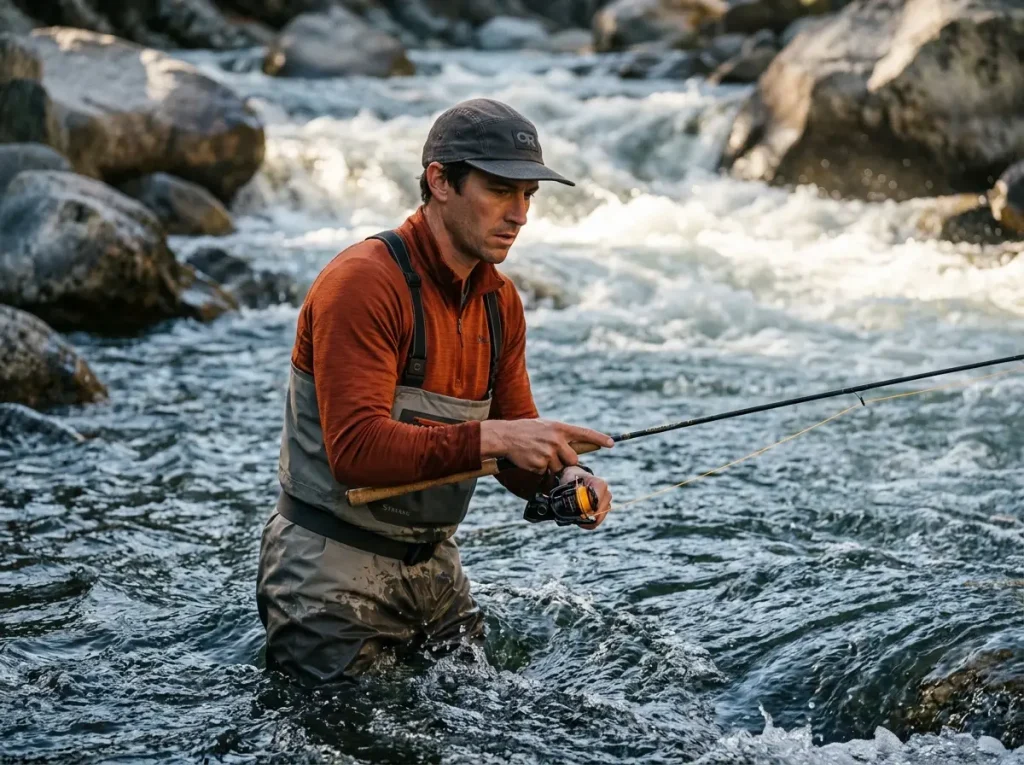
A live worm in current isn’t passive. Its segments, extended setae, and constant peristaltic contractions create surface irregularity that generates micro-turbulence as water flows over it. That turbulence is the hydrodynamic vibration signature that a fish’s lateral line detects from meters away. This is the mechanism behind a principle hydraulic engineers call Manning’s roughness — the more irregular the surface, the more energy it bleeds into the water around it.
A limp or dead worm has no surface roughness beyond its physical shape. It behaves like inert debris in the water column. Predators are tuned to reject this. A pressurized, active worm generates a complex, multi-frequency pressure wave. That’s not a metaphor — that’s the reason live bait out-fishes plastic in clear water.
The physics of current seams and how predators position in them matters here: you need to know not only how to rig the worm but where in the water column different presentations perform best. The physics of current seams and how predators position in them breaks down the hydraulic geometry guides use to read water before making a single cast. And how the lateral line detects pressure signatures from live bait explains the detection system on the other end — the fish’s sensory apparatus that registers the vibrations your rig produces.
Orientation determines everything. Longitudinal threading (the Sock Method) aligns the worm’s long axis with the current — minimal frontal drag, stable downstream drift, a presentation that looks like a worm that fell off the bank naturally. Use this in fast currents and active retrieves. Transverse threading (Wacky-style with live bait) orients the worm perpendicular to flow — maximum drag, asynchronous end-flapping, high-intensity vibration detectable from greater lateral distance. That’s still-water and slow-eddy territory. Use it in fast current and the worm spins, line twists, and your natural presentation becomes a carnival ride.
A whole worm also sinks slower than a cut section because of greater hydrodynamic drag. In still water on an unweighted fine-wire hook, a whole worm descends in a slow horizontal spiral — that’s the weightless slow descent principle, and it’s the optimal strike-zone trajectory for suspended fish. Adding split shot changes this completely. Match your weight to depth targets, not habit.
Terminal Tackle Engineering — Hook, Wire, and the Anti-Sell
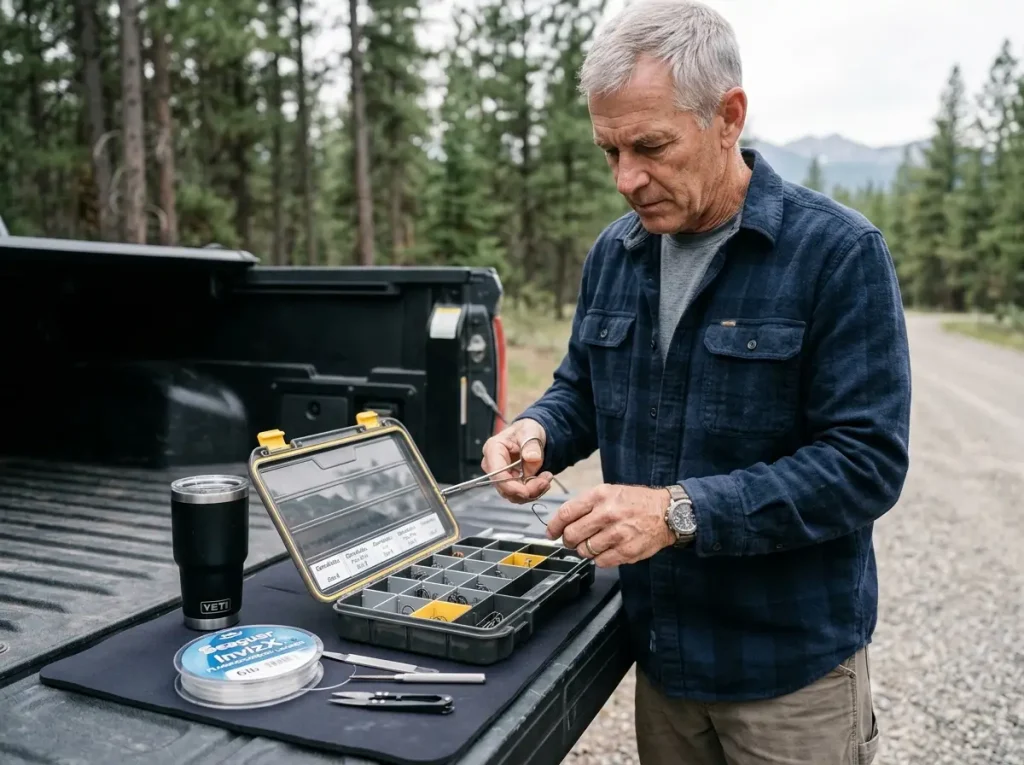
You do not need an ultra-strong hook for live worm fishing. Full stop. You’re not winching tuna. You’re threading a soft invertebrate onto light wire and landing panfish, bass, and trout in most situations where live nightcrawlers or red wigglers are the right call. The “stronger hook” marketing pitch gets the causality backwards — the most important specification isn’t strength. It’s wire gauge.
Fine wire (Aberdeen-style, 1X light) causes less tissue damage through the worm’s body. Less damage means more coelomic pressure preserved. More pressure means the bait stays firmly on the hook longer and keeps setae contact with the shank. High-carbon steel — used in hooks like Gamakatsu’s Nano Alpha series — achieves high tensile strength at smaller wire diameter. That thinner cross-section also punches through a fish’s jaw faster on the hookset. Smaller cross-section, easier penetration. The physics here are straightforward.
Hook wire gauge and gap width explained by species and bait type covers the specific sizing breakdown. The core rule: size 6–10 for most live worm presentations, long shank to accommodate multiple Accordion folds without crowding the gap, wide gap so the hook point isn’t buried in the worm’s body mass.
For circle hook applications: the point turns back toward the shank at 90°, designed to slide over soft tissue and catch at the jaw corner on exit. The technique is passive. You do not snatch-set a circle hook. You wait until the fish turns and the line loads, then let the hook geometry do the work. Active snatching pulls the point out before it seats — that’s the single most common mistake with gamakatsu circle hooks and every other circle hook on the market. Watch the line. When it starts moving laterally at weight, lift. That’s it.
The conservation case is clear: the conservation case for circle hooks in live bait applications documents the data. In striped bass fisheries, J-hooks are 21 times more likely to cause hook injuries than circle hooks. FWC data on hook-wound mortality and tackle selection for catch-and-release is equally clear on metallurgy: bronze and high-carbon steel hooks oxidize and are biologically encapsulated by the fish’s immune system in weeks. Nickel and stainless steel take years to degrade and are toxic to tissue in the interim.
If you’re releasing fish, avoid stainless. If you gut-hook a fish, cut the leader 1–2 inches from the hook and release. Don’t try to remove it. That’s how hook-wound mortality goes from 0% to 33%.
Rigging Protocols — Three Methods and When to Use Each
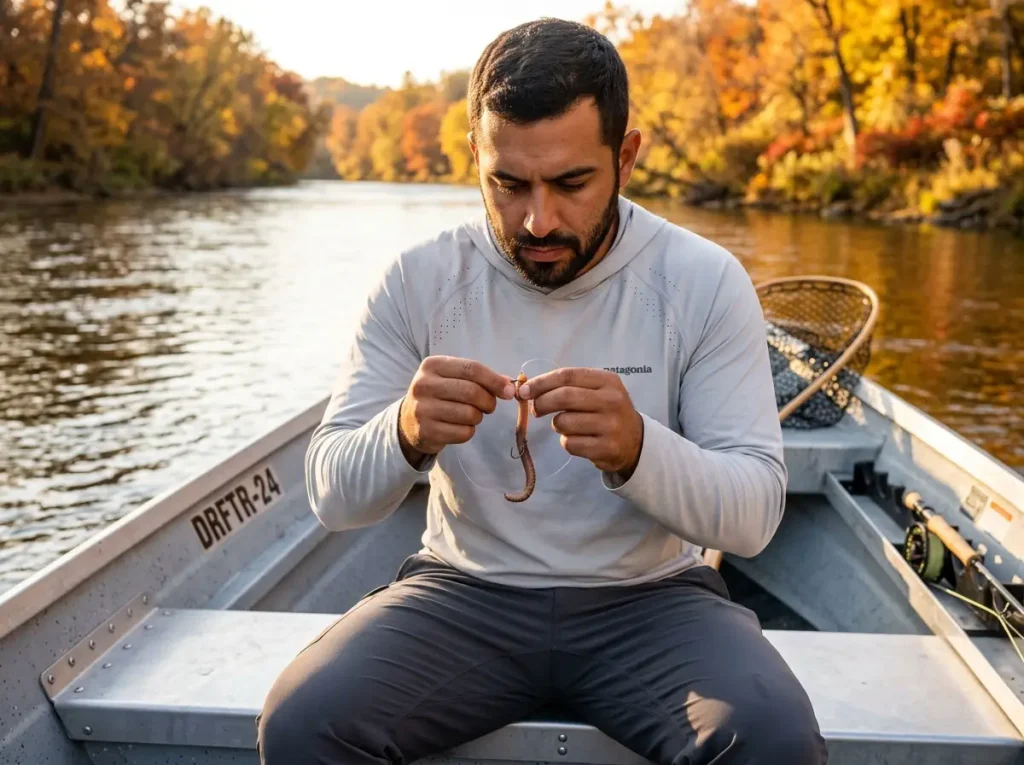
Before the step-by-step — watch this breakdown of how amino acid stimulation actually works at the receptor level. Then come back and the rigging logic will make more sense:
Every piercing is a wound that starts the metabolic decay clock. The goal of any rigging method is to maximize hold without destroying the biology that makes the bait work. Mask scent first — always dip your fingers in the bait cup soil before handling. Then choose your method based on conditions, not habit.
How hook placement affects bait action and drag forces gives the physics of where the hook sits relative to the worm’s tow point. The short version: the method you choose should match the water, not your muscle memory from twenty years ago.
The Sock Method — For Current and Active Retrieves
This is the professional standard for river fishing, trolling, and any situation where you need the hook concealed and the presentation stable. Scientific protocol for minimizing bait handling stress starts at the moment you pick up the worm.
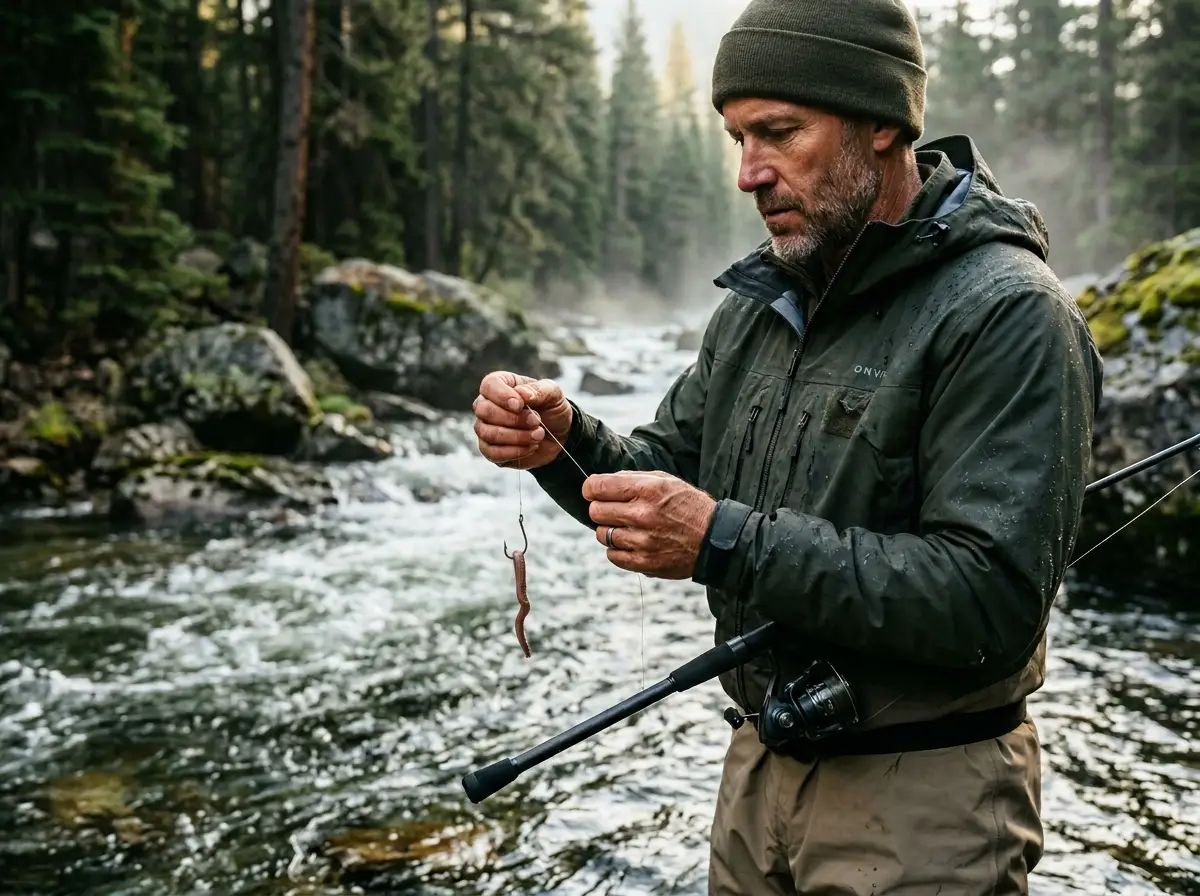
- Dip fingers in soil from the bait container to mask scent and improve grip.
- Identify the head — the darker, slightly pointier end with the prostomium — and insert the hook point 0.5 cm from the tip.
- Slowly inch the worm’s body up the hook shank, keeping the hook centered to avoid rupturing the dorsal vessel or the five pairs of aortic arches concentrated near the head.
- Allow the point to exit through the worm’s side, not the dorsal surface.
- For long casts: tie a simple half-hitch of fishing line around the worm’s head. Without it, the shank will slip on delivery.
Rushing the threading tears tissue and spills coelomic fluid. You have maybe 90 seconds to do this right. Take them. I’ve watched anglers thread a worm in four seconds and wonder why it’s gone before the rig hits the bottom. Slow is fast here.
The Accordion Method — For Still Water and Maximum Scent
Pierce the worm 3 to 5 times down its length, creating a bunched, accordion-like shape on the hook bend. Leave slack between each piercing point — that independent section movement is what creates the multi-frequency vibration signature. The critical rule: leave 1 to 2 inches of tail dangling freely past the barb. That free tail is the high-frequency visual and mechanical trigger that draws the strike.
The trade-off is honest: each additional piercing accelerates coelomic fluid loss. The amino acid diffusion rates peak early and drop fast. Maximum window with the Accordion Method is 15–20 minutes, not 30. You’re trading longevity for intensity. Know the trade-off before you make the rig.
In slow eddies and still ponds, this is the rig. In fast current, it’s a spinning mess. Match the method to the water.
The Worm Needle Protocol — For Pressured, Nip-Prone Fish
Thread the worm onto the hollow worm needle from head to tail. Place the circle or Aberdeen hook point into the needle’s end and slide the worm onto the hook, letting it travel up onto the leader. The hook hangs freely at or near the tail — the zone where bluegill, perch, and pressured bass nip first.
This rig feels overcomplicated until you use it on a bluegill flat where every fish is clipping tails and going home. The hook-up difference is immediate. Once you see it work on a pressured spot, the Accordion starts collecting dust for those conditions. The Worm Needle protocol solves a specific problem: fish that inhale the tail and miss the hook. Put the hook in the tail.
Pro Tip: With the Worm Needle, you can use a smaller circle hook than you’d normally consider. Because the hook rides at the nip-zone, you don’t need gap clearance for a full-body strike. A size 8 circle outperforms a size 4 J-hook in this presentation, especially for panfish.
Conservation and Biosecurity — The Jumping Worm Problem

Two years ago I found jumping worms in a bait container I bought from a shop that had no idea what they were stocking. The state extension service confirmed the ID in 24 hours. The experience changed how I buy bait.
Jumping worms (Amynthas spp. and Metaphire spp.) are spreading across North America through the horticultural trade and fishing bait supply chains. Unlike European nightcrawlers that aerate soil through deep tunneling, jumping worms strip the leaf litter layer and leave the soil surface sterile and prone to erosion — it looks like coffee grounds. Once a forest floor is colonized, recovery is measured in decades.
Identification is straightforward: look for a flat, milky-white clitellum that wraps entirely around the body — not the raised pinkish saddle of a European nightcrawler. Their movement is violent and snake-like when disturbed. They can detach their own tail as a defense; don’t mistake the twitch of a tail fragment for a dead worm. The Wisconsin DNR identification and management guide for jumping worms covers the definitive ID protocol.
The vector that matters most to anglers: egg cocoons the size of poppy seeds that hitchhike on muddy boots, vehicle tires, and worm containers. Releasing unused bait into the woods or water is the single highest-risk behavior. If you identify jumping worms: seal the container in a plastic bag. Leave it in direct sunlight until the internal temperature exceeds 40°C. Then bag it again and trash it. Never into the ground, never into the water.
Buy from reputable suppliers who source-verify their worm stock. That’s not paranoia — it’s part of the full angler’s field guide to aquatic invasive species and prevention. The ecosystems you fish in took thousands of years to build. A single bait cup dumped in the wrong place can start a process that takes decades to express itself. Nobody who’s watched a healthy forest floor turn to coffee grounds thinks the prevention protocol is excessive.
Putting It Together
Three takeaways that change how you rig:
Temperature is not optional. Keep worms at 5–10°C. Everything downstream — natural presentation, hold duration, live bait presentation effectiveness, vibration output — depends on metabolic slowing bought by proper storage. A $6 bait cooler is the highest-ROI purchase in your tackle bag.
Your hook selection is a conservation decision. Fine-wire Aberdeen or circle hook on bronze or high-carbon steel. Not stainless. Not nickel. The worm lives longer on the hook, the fish survives the catch, and the hook dissolves in weeks rather than years. That’s not idealism — that’s engineering.
Match the method to the water. Sock Method for current and active retrieves. Accordion for still water and slow drifts, with a hard 20-minute window. Worm Needle for the spots where fish are nipping tails and your hook-up rate is embarrassing you.
Run one controlled session with worms stored at 5–10°C against your current method. Compare bait lifespan on the hook, strike frequency, and how fast each worm goes limp. The data you collect in that one session will change how you buy, store, and rig live bait for good.
FAQ
What is the best hook for live worm fishing?
A fine-wire Aberdeen in size 6–10 is the technical standard — it minimizes tissue trauma, preserves the worm’s internal coelomic pressure, and sets faster because the smaller cross-section cuts through easier. For catch-and-release, pair fine-wire Aberdeen geometry with a circle hook presentation. That combination cuts gut hooking rate dramatically while extending bait life on the hook.
Do you cover the whole hook with the worm?
In the Sock Method, yes — the shank is fully threaded and the point exits through the worm’s side, concealing the hardware and maximizing hold through the cast. In the Accordion and Worm Needle methods, the hook bend or gap stays exposed intentionally. That’s not a mistake — it improves hookset geometry on fish that nip rather than fully inhale the bait.
How do you keep live worms alive and on the hook longer?
Store at 5–10°C in native soil. This slows metabolic demand, retains hydrostatic pressure, and keeps the cuticle hydrated. At room temperature on a summer day, the worm is already burning through energy reserves before you hook it. Change bait every 20–30 minutes regardless of visual appearance — after that window, the amino acid diffusion rates have equalized and the worm is no longer producing an effective chemical signal. It looks fine. It’s done.
Can fish smell humans on worms?
Yes. Fish olfactory receptor neurons are tuned to detect specific L-amino acid profiles from prey. Human skin oils, sunscreen, and sweat can adhere to the worm’s cuticle and suppress or contaminate the natural piscine olfactory stimulation gradient. Rubbing fingers in the worm’s native soil before handling provides a physical buffer. The soil microorganisms help neutralize surface contamination before the worm goes in the water.
What’s the difference between nightcrawlers and red wigglers for fishing?
Nightcrawlers (Lumbricus terrestris) are larger, have a more developed clitellum anchor point, and thread more durably — preferred for larger target species and longer casts. Red wigglers (Eisenia fetida) are smaller and faster-moving, and produce a more intense amino acid release per unit of body mass — effective for panfish and trout in small stream settings. Match worm size to target species and hook gap width. Using a #4 hook with a red wiggler is threading a garden hose onto a toothpick.
Risk Disclaimer: Fishing, boating, and all related outdoor activities involve inherent risks that
can lead to injury. The information provided on Master Fishing Mag is for educational and informational purposes
only. While we strive for accuracy, the information, techniques, and advice on gear and safety are not a substitute
for your own best judgment, local knowledge, and adherence to official regulations. Fishing regulations, including
seasons, size limits, and species restrictions, change frequently and vary by location. Always consult the latest
official regulations from your local fish and wildlife agency before heading out. Proper handling of hooks, knives,
and other sharp equipment is essential for safety. Furthermore, be aware of local fish consumption advisories. By
using this website, you agree that you are solely responsible for your own safety and for complying with all
applicable laws. Any reliance you place on our content is strictly at your own risk. Master Fishing Mag and its
authors will not be held liable for any injury, damage, or loss sustained in connection with the use of the
information herein.
Affiliate Disclosure: We are a participant in the Amazon Services LLC Associates Program, an
affiliate advertising program designed to provide a means for us to earn advertising fees by advertising and linking
to Amazon.com. As an Amazon Associate, we earn from qualifying purchases. We also participate in other affiliate
programs and may receive a commission on products purchased through our links, at no extra cost to you. Additional
terms are found in the terms of service.