
In this article
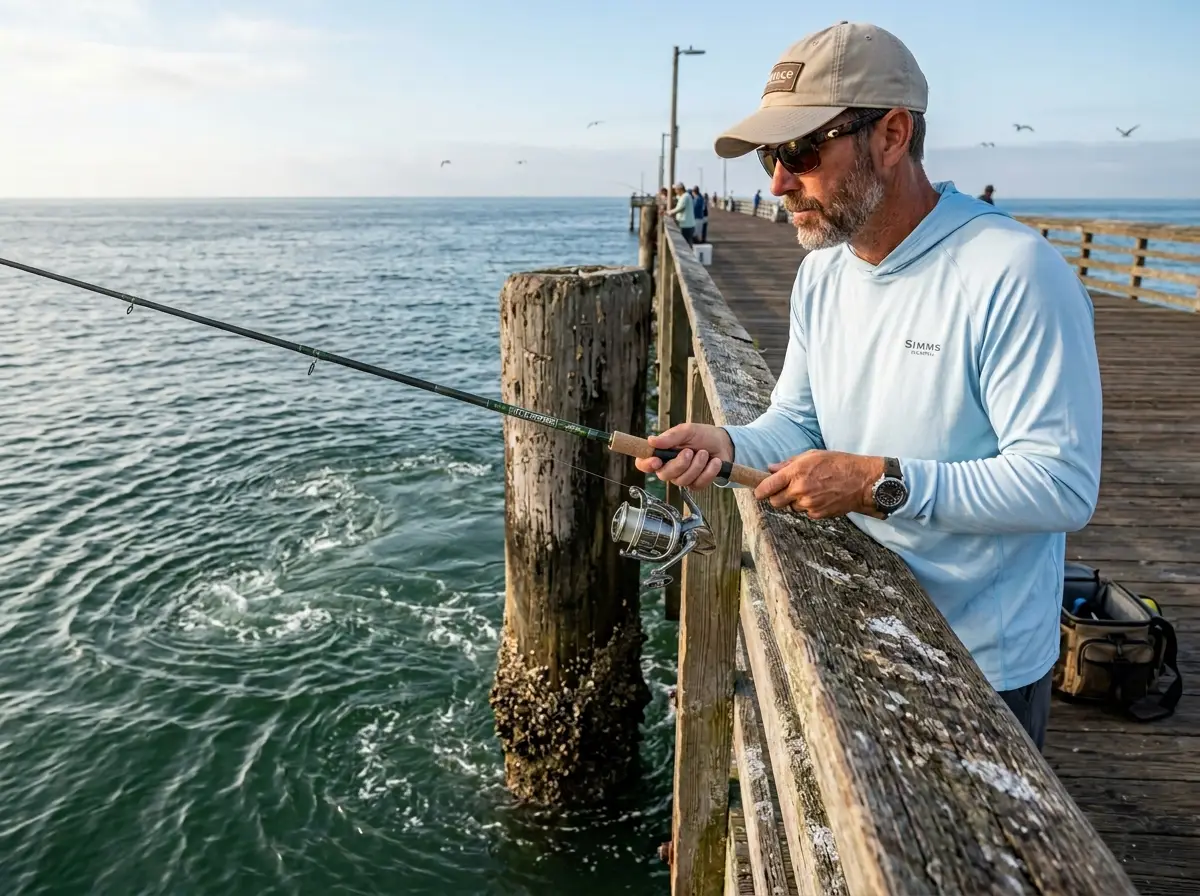
The fish took a step backward, and I felt it before I saw it—a tap so soft it barely registered through 50 feet of braid. Then another. I’d been standing at that piling for twenty minutes with nothing. The guy three pilings down was reeling in his fourth sheepshead. Same tide. Same bait. Different universe. Later he showed me what he was doing: scraping barnacles off the piling with a knife, dropping crushed shell into the current, and positioning his rig in a shadow line I couldn’t even see from where I stood.
That moment is why I wrote this. Most pier fishing guides tell you what to do. Cast near the pilings. Use live shrimp. Check the tide chart. That’s Level 1 information—the stuff Google finds anywhere. What they skip is the physics and biology behind why any of it works, and that gap is exactly where the difference between the guy reeling in sheepshead and the guy watching him lives.
⚡ Quick Answer: Pier fish stack in the low-shear wake zone directly behind pilings—roughly 40% reduced current velocity—where they harvest energy from structural vortices without fighting the flow. Target this zone by casting upcurrent and drifting your bait in. On older, barnacle-encrusted wooden pilings, scrape 2–3 feet of shell material into the current to create a natural chum lane that draws sheepshead and drum. Use an Up-and-Over ledger rig with 80 lb mono rig body, fluorocarbon leader (RI 1.31), and soft bronze Mustad Viking hooks rated for piling snag recovery. For fish over 1.5 kg, never hoist on the line—deploy a drop net.
The Pier as a Hydrodynamic Machine
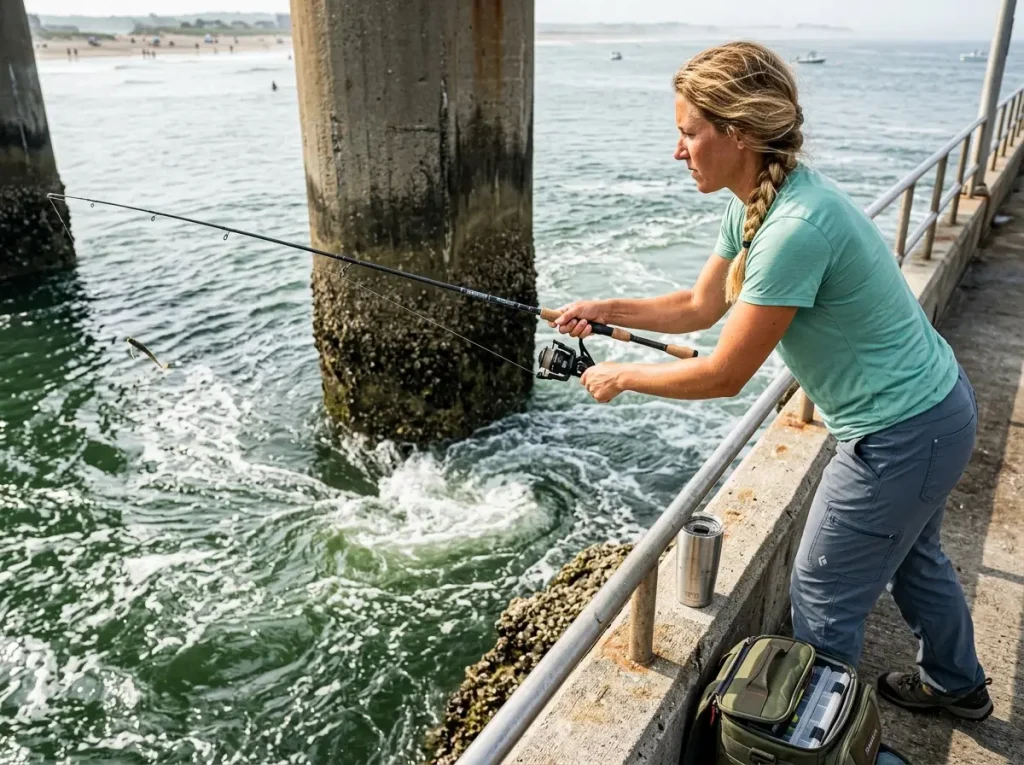
Stop thinking of a pier as a location. It’s a machine, and the pilings are where it does its work.
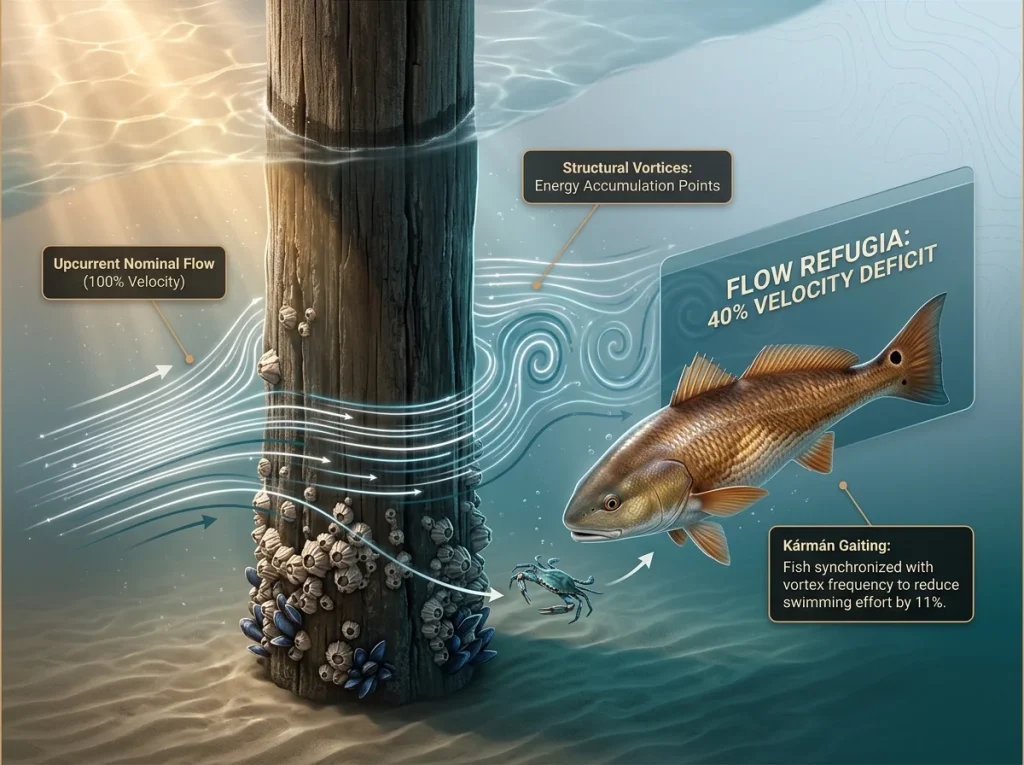
When tidal current hits a cylindrical piling, the water can’t go through it—it separates around both sides and generates a staggered series of alternating pressure pockets downstream. Fluid mechanics people call this a Von Kármán vortex street, and for the angler, it means one thing: there’s a specific zone behind every piling where the current slows by roughly 40%, and that’s exactly where the fish are sitting.
Predatory fish don’t fight the current. They use it. Red drum, snook, and trout synchronize their lateral body movements with the vortex shedding frequency, extracting energy from the flow rather than burning their own. Research on hydrodynamics of fish swimming in Kármán vortex streets confirms this behavior cuts their energy cost of swimming by more than 11%—which means they can hold station longer and strike faster when prey drifts through. Recent Harvard lab work on vortex surfing and hydrodynamic power expenditure goes even further, showing how fish actively surf structural wakes to maximize efficiency.
The practical takeaway: cast upcurrent of the piling, not at it. The drift carries your bait through the low-shear zone naturally. That’s where the fish are waiting, facing the flow, expecting food to arrive exactly that way. The same hydrodynamic logic that governs current seam physics and fish positioning applies here—but compressed into a few feet around a single vertical obstacle.
Pro tip: Watch debris drift to estimate current velocity. Fast drift means the fish are sitting very tight to the piling—within a foot or two. Slow drift means they may roam a couple of feet wider. Estimate before your first cast, not after the fifth retrieve.
Von Kármán Vortex Street and the 40% Velocity Deficit
The vortex street creates alternating low- and high-pressure pockets downstream. Fish use the low-pressure side—what you can call flow refugia—to sit without burning energy. The prime zone is typically 3–5 piling radii downstream.
Larger pilings create wider, more stable refugia. A big wooden piling holds more fish than a narrow steel one, all else equal. And here’s the timing piece most guides skip entirely: at slack tide, the vortex street collapses. There’s no pressure difference, no refugium, no reason for the fish to stay put. This is why bites often go “lockjaw” at peak slack. When that happens, move to the next active piling rather than waiting it out. Slack water is transition time, not fishing time.
Kármán Gaiting and the Single Best Piling
Only one fish can effectively surf the wake at any given vortex node on a piling. That fish is the biggest, most dominant predator on that structure. Everything else is roosting around the edges.
This is why the 20-minute rule exists. Spend at least 20 minutes observing a piling before you move. Ambush species like snook and drum don’t make constant movement—they hold, they wait, and one strike every 20 minutes is a productive day for them. Anglers who move every 5 minutes never give the fish time to commit. If you feel a subtle repetitive tap pattern without a full take, there may be a second predator chasing the alpha off your bait. Apply immediate pressure and try to turn the fish away from the piling before it wraps you.
Acoustic Footprint and Pier Traffic Windows
Heavily trafficked piers generate mechanical vibration and operational hum that creates what researchers studying offshore structures have described as an acoustic shield—a layer of noise that disrupts fish navigation and communication. Pelagic species like mackerel and herring disappear from these zones. The fish that remain show tight shoaling behavior, which is a stress response, and stressed fish don’t eat.
Low-traffic windows—early morning, mid-week, and after-hours—produce fish that are behaviorally relaxed and commit to a bait with minimal hesitation. If you have to fish a crowded pier, lateral movement to the end section or the pilings farthest from foot traffic consistently outperforms the middle of the structure.
Biological Succession of Pilings and the Barnacle Strategy
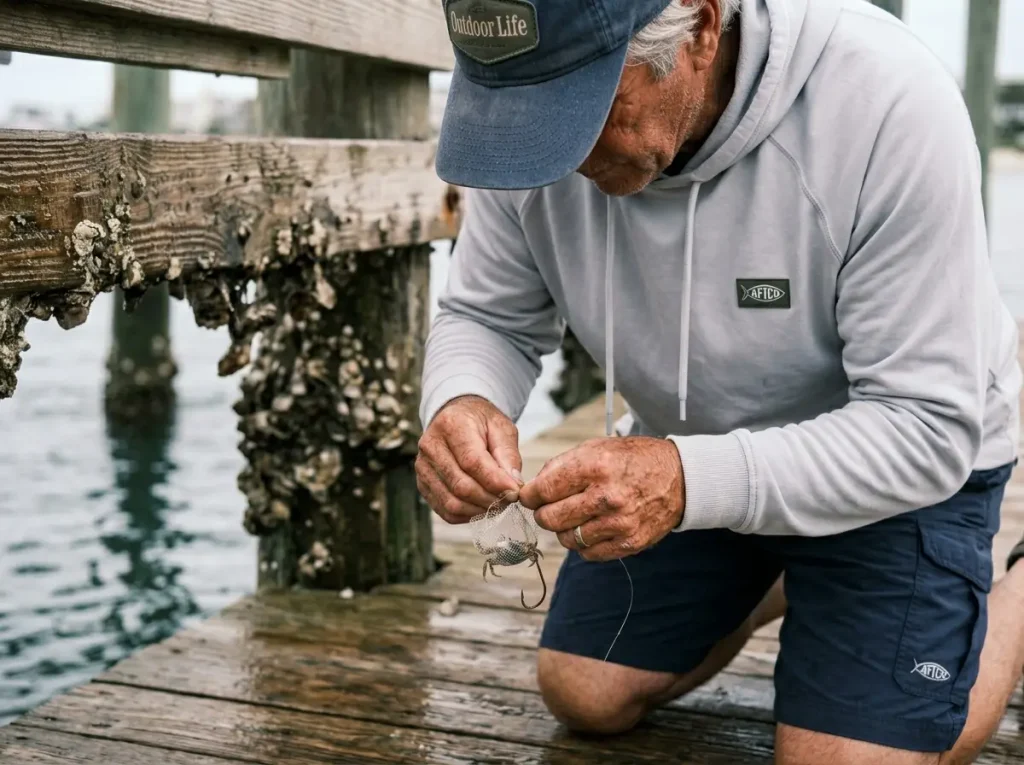
Here’s the thing about barnacles that no guide explains: they don’t just sit there. They change the hydraulic properties of the piling itself, and that changes where the fish hold and what they eat.
Piling colonization follows three stages. Early pilings show biofilm and green algae. Mid-age pilings develop barnacles (Balanus glandula) and blue mussels (Mytilus edulis). Old wooden pilings reach a climax community of eastern oysters (Crassostrea virginica), tube-building polychaetes, and bryozoans. The rougher the piling, the more it disrupts the surrounding water, creating deeper low-pressure pockets downstream and concentrating more potential prey in one place.
Barnacle adhesive cement holds 22–60 PSI, which is why standard 20 lb fluorocarbon fails against it. But the biological angle matters just as much. Sheepshead (Archosargus probatocephalus) have specialized human-like teeth designed to crush calcareous prey. When you scrape barnacles off a piling and let the debris drift downtide, you’re releasing the natural juices and proteins that trigger the sheepshead crushing reflex. It’s precision chumming, not guesswork. To understand how much force a drum or sheepshead applies to barnacle shells—and why your bait presentation matters—read how drum and sheepshead crush barnacles with pharyngeal teeth.
Pro tip: Ask pier staff which pilings are oldest. In most cases, the oldest, roughest pilings have the least angler traffic and the most productive crustacean colonization. Other anglers avoid them because they look snaggy. That’s exactly why you want them.
Reading Piling Age and Succession Stage for Bait Selection
Wooden pilings almost always host the most advanced climax communities—highest productivity for sheepshead, black drum, and tautog. Concrete pilings run mid-to-early succession. They’re better for migratory species using the structure as a navigation waypoint rather than a feeding station.
The visual read: look for barnacle density, oyster clustering, and a green algae fringe at the water line. More biological coverage means more productive piling. The mechanical characteristics of acorn barnacles include adhesion strong enough to shred standard rigs, which is why gear selection changes entirely on these structures.
The Barnacle Bag Rig and Extended Bite Windows
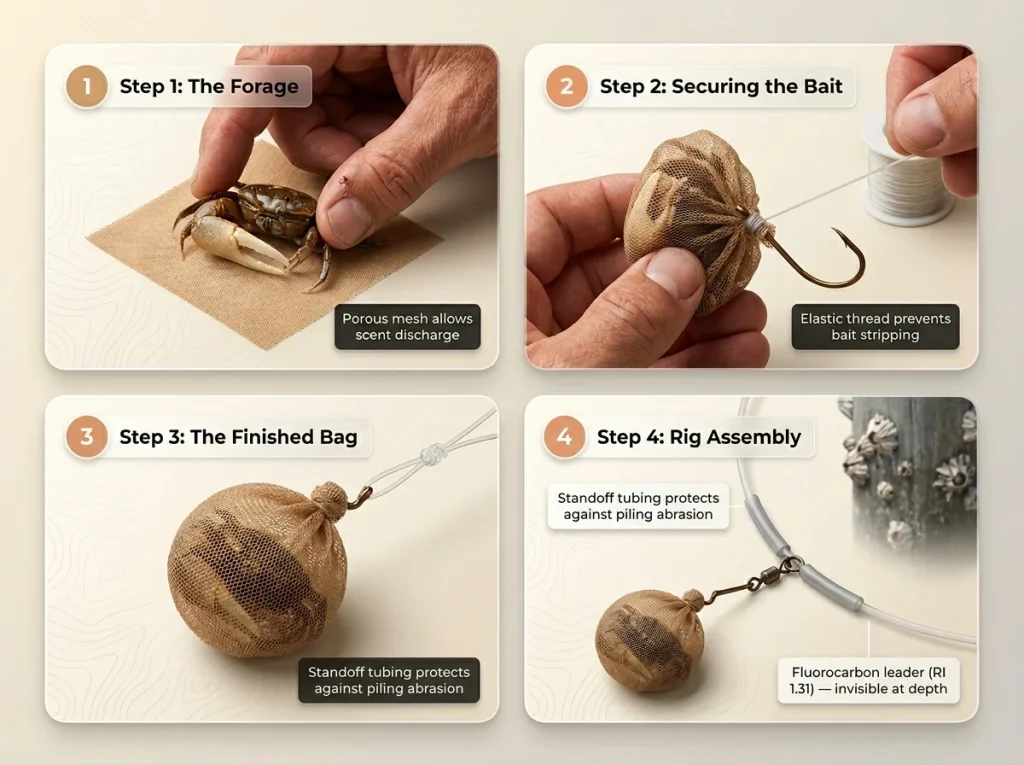
Soft baits in high-current, high-traffic pier environments get stripped by nuisance fish before sheepshead can commit. The fix is the Barnacle Bag—wrapping your bait in nylon mesh (pantyhose material creates the right porosity) so the sheepshead has to chew through the enclosure. This converts ambiguous tap-taps into detectable bite sequences.
The lug-and-squid wrap—lugworms bound to squid with elasticated thread—adds another layer. The lugworm delivers a wide scent trail carried horizontally by the current. The squid provides structural durability against crushing bites. Don’t wrap too tightly. Compressing the lugworm cuts off its scent channels, and that defeats the point of using it.
Scraping and the Downtide Chum Lane
Scraping works best at moderate current velocities—slow enough to hold the scent plume in a detectable band, not blow it apart. Two to three feet of piling surface per session is the conservation limit. Strip more than that and you’re removing the very habitat that made the piling productive in the first place.
The debris trail concentrates downtide, drawing sheepshead and snapper upcurrent into the strike zone. It’s not about attracting fish from across the pier—it’s about pulling the fish that are already holding nearby out of cover and into feeding posture.
The Shadow Line Method — Applying Snell’s Law
Most anglers casting to the shadow line are casting to the wrong place. Not slightly wrong—significantly wrong.
The pier deck creates a light-dark boundary at the water surface. Predatory fish like snook and tarpon hold inches from this line, using the shadow as a silhouette shield to ambush prey moving through the lit zone. The mistake is casting to the visible surface shadow. Light refracts when it crosses the water surface, which means the shadow you see from above is not where the shadow actually falls at depth. At 10 feet of water, the real ambush zone is 15–16 feet from the piling—not at the surface shadow line. At 20 feet, it’s 30–32 feet out. Casting to the visible line puts your bait in the lit zone where the fish can see it and reject it.
The same tidal logic that moves predators up and down the light boundary applies to how tidal coefficients position predators along structural edges. Aim for 10–15 feet beyond the visible surface shadow at 10 feet of depth to land in the actual ambush zone.
There’s a thermal dimension too. The shadow line can generate up to a 2°C temperature difference across the boundary. In cold months, snook and trout hold on the warmer side of that line—not necessarily the darker side. Temperature gradient often overrides visual preference when water is cold.
Pro tip: Note the shadow angle at your intended fishing time. Morning light creates a different shadow angle than afternoon light. The underwater offset shifts accordingly. What worked at 6am is a different cast at 2pm.
Reading the Surface Shadow and Calculating the Depth Correction
The cast correction increases with depth and light angle. At 5 feet of water, aim 7–8 feet from the piling. At 10 feet, aim 15–16 feet. At 20 feet, aim 30–32 feet. These are the actual ambush zones—where the density boundary between light and dark falls underwater.
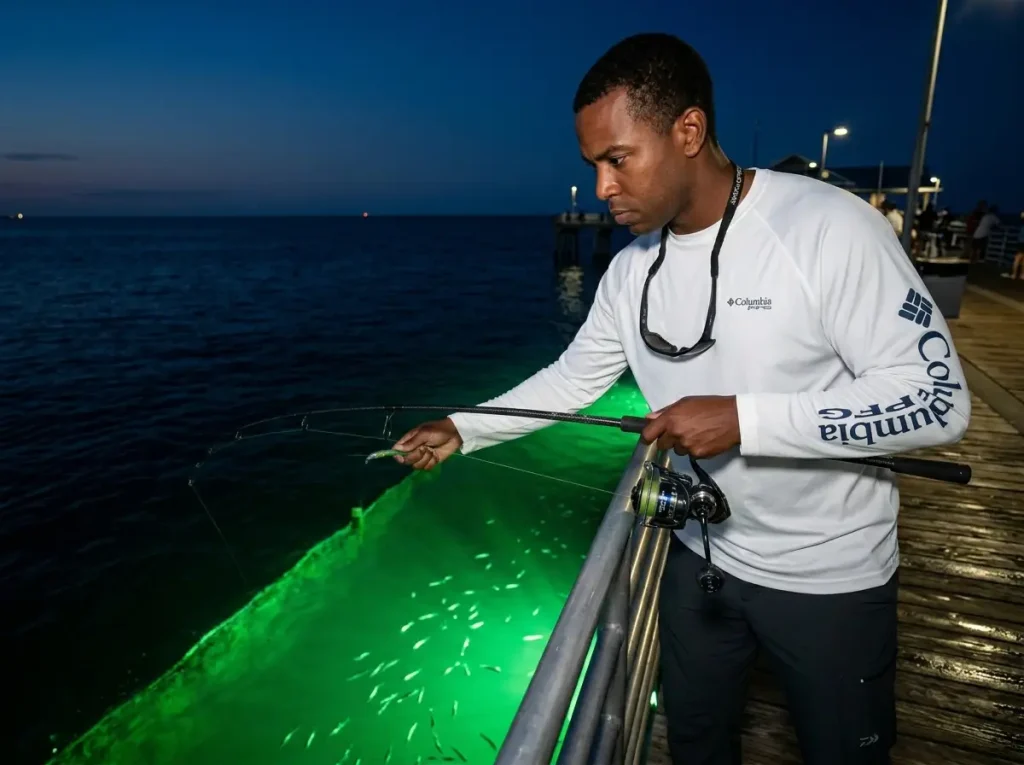
Night fishing flips the logic. Underwater LED lights pull the food chain in sequence: plankton first, then baitfish, then predators. Green wavelengths penetrate deepest and produce the least surface glare—they’re the right call for pier night lights. Predators face the light-dark transition, striking from darkness into the lit zone. Position your bait 2–3 feet into the lit zone and let the predator come from the dark side.
Night Fishing the Shadow Line — LED Light Strategy
Dark-finish presentations—black and deep purple—show the best silhouette contrast in the transition zone. The predator is looking up and toward the light, reading silhouettes. Don’t use bright lures at night; they advertise your bait in 3D, not as a natural silhouette. Keep it dark and keep it moving.
Terminal Tackle for Vertical Environments
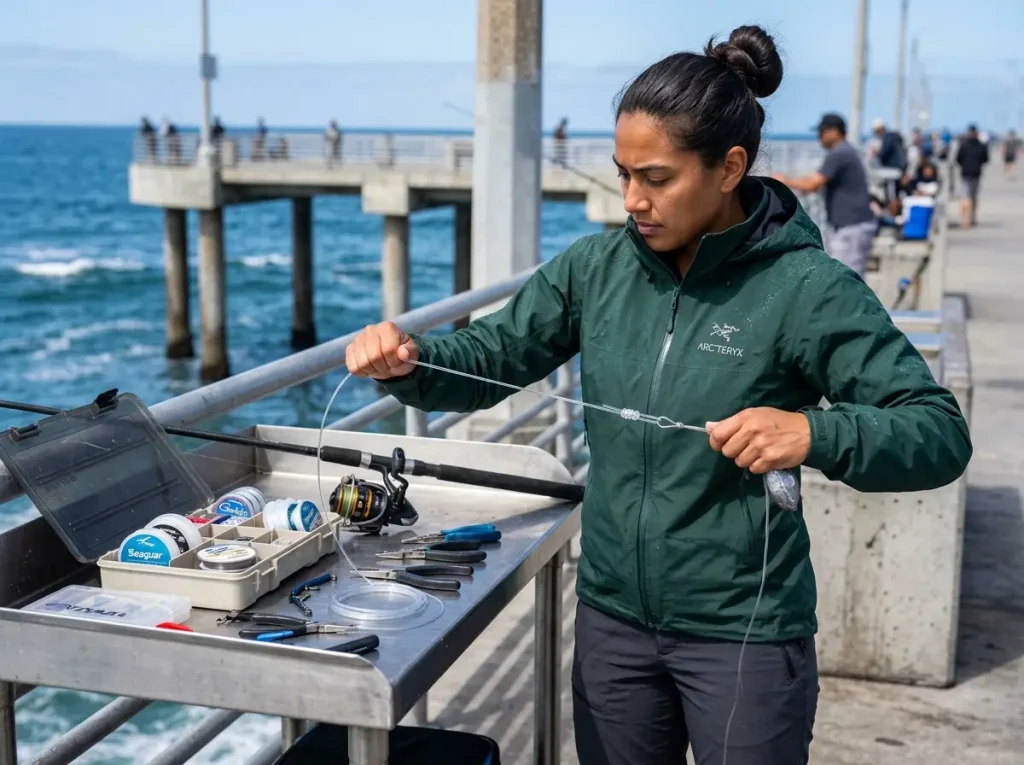
Standard surf rigs fail at the pier. Not occasionally—consistently. The reasons are specific and mechanical.
Texas rigs and basic Carolina rigs fail for three reasons in pier environments: lead sinker abrasion against barnacles destroys the rig body, long hook traces tangle during vertical-drop casts (the helicopter problem), and they lack the structural standoff to keep line away from the structure. The solution to all three is the Up-and-Over Ledger Rig.
The rig body is 12–16 inches of 80 lb monofilament—stiff enough to act as a piling buffer and soft enough to absorb impact. An impact clip holds the hook trace behind the sinker during the cast. At water contact, the release allows the hook to settle as a running ledger. You get maximum sensitivity for bony-mouthed biters with minimum tangle risk. For a complete breakdown of how these tackle components function as an integrated mechanical system, see terminal tackle system engineering for high-abrasion environments.
Hook selection is not optional: Mustad Up Tide Viking (70515) bronze hooks are the right call because they’re deliberately soft. If you snag a barnacle cluster—and you will—the 80 lb rig body lets you apply enough force to physically bend the hook open and retrieve the rig. You lose a hook. You don’t lose the whole rig. Reshape and re-sharpen, and you’re back in. High-carbon hooks don’t give you this option.
For the physics behind why fluorocarbon refractive index makes it the only viable pier leader, the optics tell the story. Fluorocarbon has a refractive index of 1.31, which nearly matches seawater at 1.33. Monofilament sits at 1.50—highly visible, especially in clear water. Braided line shears on barnacle edges through molecular thread gaps. In high-barnacle environments, fluoro is the only leader material that handles both invisibility and abrasion simultaneously.
The Up-and-Over Ledger Rig — Step-by-Step Construction
- Connect 30–50 lb braided main line to 80 lb mono rig body via FG Knot or Double Uni.
- Rig body: 12–16 inches of 80 lb mono, terminated at a swivel.
- Clip the hook trace behind the sinker with a standard snap swivel for a streamlined cast.
- Hook trace: 12–18 inches of 30–50 lb fluorocarbon to Mustad Viking 70515.
- Slip 3–4 inches of silicone rig tubing over the swivel before tying—it acts as an abrasion standoff between the rig body and the piling surface.
Cast at a 45° angle to the piling rather than directly over it. The swing arc carries the rig into the low-shear zone more naturally than a vertical drop.
Leader Selection and Knot Heat Management
Wet your knots before seating. Every time, without exception. Dry-cinched fluorocarbon loses 15% of its rated strength from the heat generated during the cinch. A knot that tests at 80 lb dry tests at 68 lb after a dry-cinched failure. In pier conditions where impact loading during the cast can reach 20–30 times the weight of the lead, that 15% matters.
Pro tip: Test leader abrasion resistance before you fish. Drag a knotted section across a rough barnacle surface under 10 lb of hand tension. If it frays within 5 drags, upsize the leader. Better to find out before the fish than during.
Sinker Geometry in High-Current Pier Environments
Pyramid sinkers anchor in sandy bottoms. Egg sinkers slide with the current—useful for sheepshead finesse presentations in moderate flow. In spring tides or fast-running water, grip leads (8 oz, wire grips) are the correct tool. They up-tide into the piling wake and hold position despite significant flow. The British pier fishing community calls this technique “8 & Bait“—8 oz grip lead with an up-tiding angle in extreme current—and it’s entirely absent from American guides. If your sinker bounces along the bottom, size up 1–2 oz until it anchors.
Live Bait Logistics and the Sabiki System
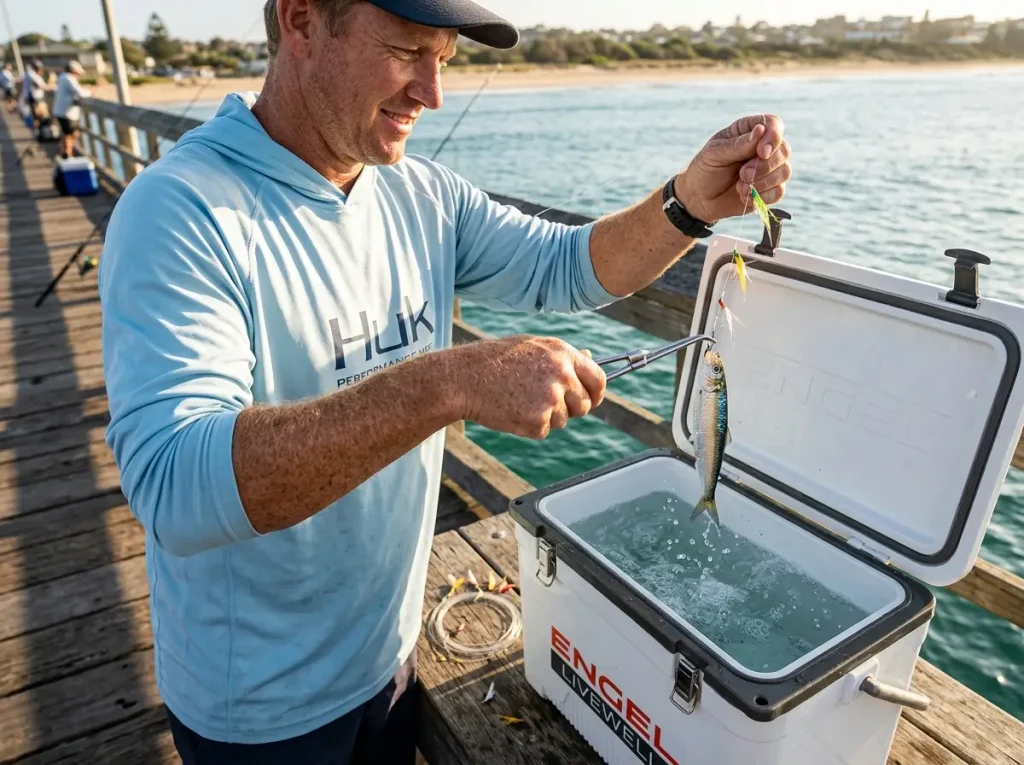
A dead, listless baitfish is just expensive cut bait. The entire point of live bait is the Frisky Factor—the vibration frequency, the scent signature, and the visual flash of a healthy baitfish that triggers the strike reflex in apex predators.
The Frisky Factor starts at the moment you hook the bait. Any hand contact strips the slime coat and alters the bait’s pH. After contact, that baitfish is half as effective as one that went from hook to livewell via a Sabiki dehooker without a single touch. Preserving the frisky factor starts with slime coat management, but it’s finished by optimal hook placement to preserve live bait action and natural swimming.
Hayabusa Sabiki rigs are the standard for good reason—they’re tied with real fish skin rather than synthetic material, and real skin produces strikes when synthetic fails. This is not marketing; it’s something you notice after a few side-by-side sessions. Run 6–8 flies per string. Use a soft-action spinning rod rated medium-light to protect the light hook traces from pulling through mackerel and herring’s soft lips.
Catching Live Bait On-Site with Sabiki Rigs
Drop the sabiki rig vertically to mid-column—pilchards, herring, and mackerel school at mid-depth near structure when current is moving. Jig with very short 3–4 inch lifts. Bigger jig strokes spook compact schools. Once baitfish are hooked, retrieve at steady pace. Violent cranking tears lips and loses fish.
The better technique: cast upcurrent and let the sabiki drift into the piling wake. Baitfish in flow refugia concentrate near structure, and your descending rig intercepts them in the drift rather than requiring you to find them.
Livewell Management and the Ammonia Clock
Ammonia from baitfish waste builds exponentially in confined water. At 0.5 ppm, baitfish become lethargic and lose the Frisky Factor. At that point, your live bait is underperforming. The fix is water exchange—aeration alone doesn’t cut it. Partial water exchange every 30–45 minutes in hot conditions is the management protocol. Target dissolved oxygen above 7 mg/L. Below 5 mg/L, baitfish surface-swarm and gasp, which predators read as distressed and ignore.
Water temperature in the livewell must stay within 2°F of ambient pier water. Cold tap water in a warm environment causes immediate respiratory distress. For a complete guide to dissolved oxygen management and bait survival protocols, the variables include ammonia timing, temperature, and aeration systems.
Mastering the Vertical Lift — Landing Physics from Height
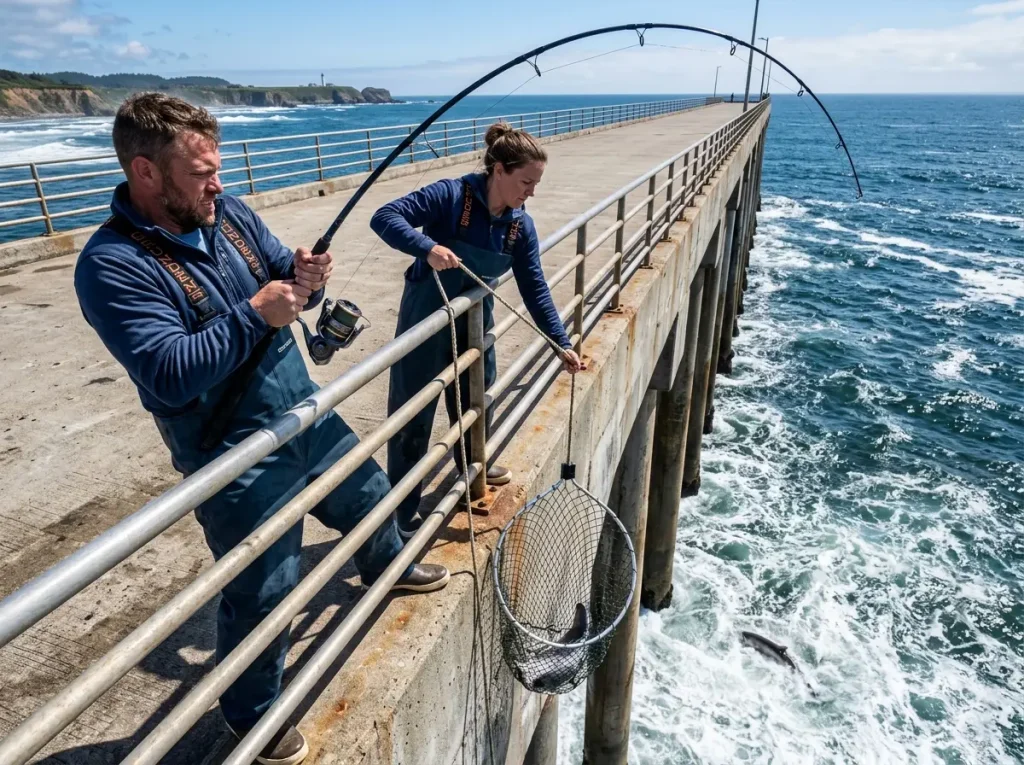
More fish are lost at the railing than at the hook-set. This is where pier fishing ends sessions and returns fish to the water involuntarily.
The mechanical problem: lifting a fish from a pier deck converts the horizontal fight into a vertical work-energy situation. When you apply upward rod acceleration to a fish, the tension in the line is not just the fish’s weight—it’s weight plus the upward force of the rod. A modest acceleration on a 2 kg fish spikes effective tension well above what the terminal tackle was tested for in static conditions. The rod tip is the weakest structural point. Holding the rod straight up places full load on the tip section. Drop the rod to 45° or below and the load transfers to the thick butt section where the blank is structurally designed to work.
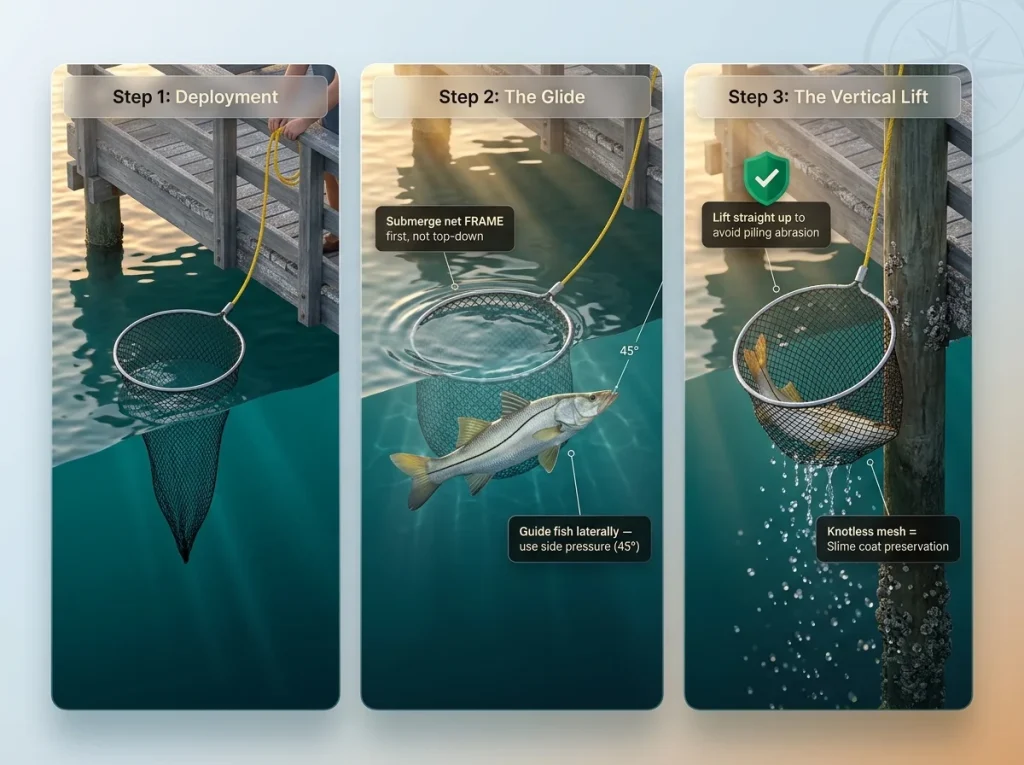
The drop net is not optional equipment. Any fish above 1.5 kg (roughly 3.3 lb) should not be hoisted on the line. Lower the net to water level, guide the fish alongside the net frame, then lift the frame—never the fish directly. The complete phase-by-phase breakdown of how drag, rod angle, and fight duration interact is in this phase-by-phase playbook for fighting large fish from elevated positions.
“You need heavy line to control the fish and not get frayed off on the pilings,” Greene, an experienced bridge and pier angler, told Game & Fish. “I’ve lost as many as 30 to 40 snook in one summer on 100-pound test.” That number is not a gear problem—it’s a leader failure problem compounded by piling geometry. Leader selection at the pier is a structural survival problem, not a visibility tradeoff.
Rod Angle Physics and the 45° Transfer Rule
At 90°, the rod tip absorbs 100% of load. At 45°, load transfers to the butt and reel seat—structurally superior for the blank and more effective for drag engagement. Side pressure (rod parallel to water surface) is the most effective angle for turning fish away from pilings. Apply side pressure the moment the fish takes the bait. Every second it holds in the vortex wake, it’s recovering energy from the structural vortex while your line sits under load. Turn it out of the wake column before it reaches the barnacle surface.
The Drop Net Protocol — When to Deploy and How
Minimum drop net specs: 24–36 inch diameter, knotless mesh to protect the slime coat, metal frame (not a flexible hoop) for controlled descent. Deploy before the fish surfaces. A fish that sees air often makes a final run that breaks tackle. Lower the net to water level with the fish alongside—do not try to encompass a fish from above. Never gaff a fish you intend to release. Gaffing destroys the slime coat and creates muscle damage that fish don’t survive after release.
Conservation, Safety, and the Pier Angler’s Obligation
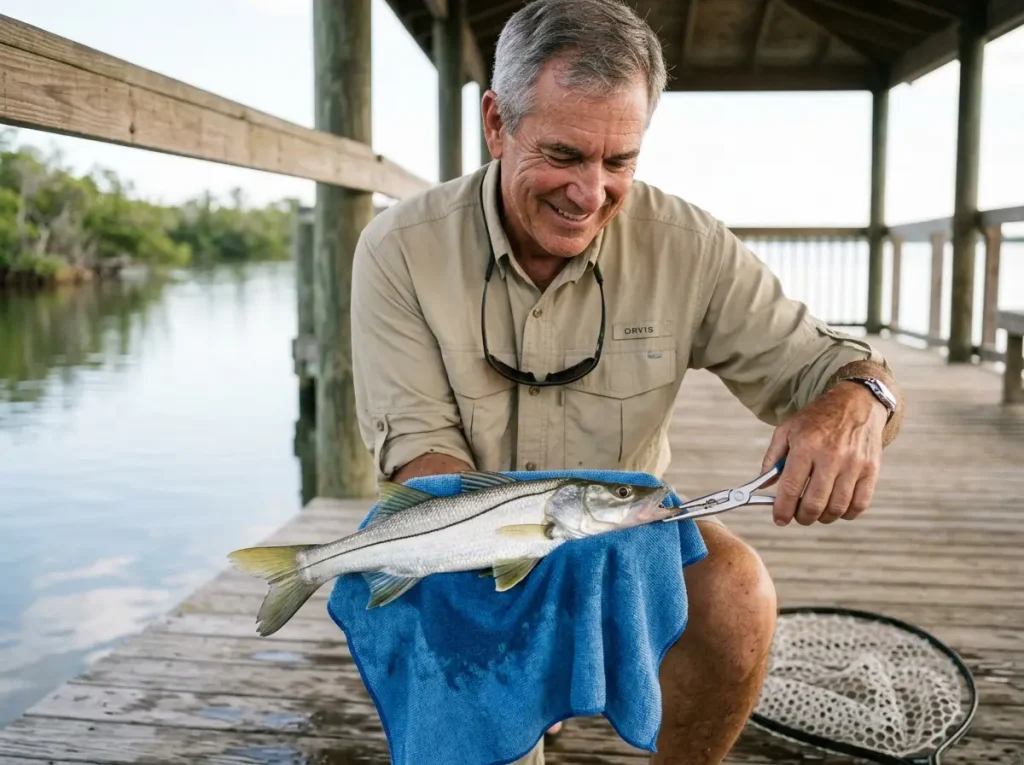
The pier concentrates fish. It also concentrates pollutants and human pressure. Understanding both sides of that equation is part of what it means to fish here responsibly.
Larger apex predators—king mackerel, greater amberjack, large red drum—accumulate methylmercury through the food chain. According to mercury bioaccumulation and fish consumption advisories from the EPA, adults should limit consumption of these species to one serving per week, with further restrictions for children and pregnant women. The practical rule: the bigger and older the fish, the more mercury it carries, and the more it costs you to eat it.
Excessive pier construction can reduce local aquatic plant diversity by up to 20 times due to shading. The same structure that holds your fish also degrades surrounding habitat. Fishing it comes with an obligation to understand what you’re using. If you’re releasing your catch, the physiological stressors of a pier fight make proper handling critical—the science-based catch and release protocols for pier-caught fish cover slime coat, air exposure limits, and barotrauma recovery.
Three species require specific handling protocols. Sheepshead have heavy, sharp spines on the dorsal and anal fins—grip behind the head with palm over the dorsal surface. Snook have razor-sharp gill plates; always use wet hands or soft cloth and never lip-grip by the gill plate. Catfish (common pier bycatch) carry hollow venomous spines on pectoral and dorsal fins—use a dehooking tool, not your hands.
Mercury and the Slot Limit Logic
Smaller fish below the legal slot have less bioaccumulation time. They’re safer for consumption and sub-reproductive age. Large fish above the slot have peak reproductive value and peak mercury simultaneously—science and regulations align. Release large fish. Keep slot fish if you’re eating them.
Never consume a pier-caught apex predator over 24 inches from an urban coastal zone. Industrial run-off elevates mercury baseline in nearshore water.
Conclusion
Three things separate the angler filling the cooler from the one watching him.
First, stop thinking about the pier as a location and start thinking about the physics. The one piling holding the most fish has the most pronounced vortex wake, the highest bio-encrustation roughness, and the best shadow geometry. Find those variables and you find the fish. That’s not guesswork—it’s observation.
Second, your rig is a structural engineering problem, not a bait delivery vehicle. Every component—leader refractive index, hook hardness, sinker geometry, rig tubing standoff—is a specific answer to a specific pier problem. Generic surf rigs fail here because they were never designed for this environment.
Third, the vertical lift will end your session before the fish does if you handle it wrong. Drop nets are the engineering solution to a physics problem every pier angler eventually faces. Buy one before you need one.
On your next pier session, spend the first 15 minutes watching before you cast. Watch the debris drift. Check the piling age and encrustation. Note the shadow line angle and the time of day. Run the mental equation before the first bait hits the water. That gap between observation and action—that’s where the technical angler works.
FAQ
What is the best bait for pier fishing?
There is no single best bait—the right choice depends on target species and the biological environment of the pier. For sheepshead and black drum on barnacle-encrusted structure, barnacle, fiddler crab, and mole crab match the primary forage. For generalist inshore species like red drum and flounder, live shrimp or cut mullet provide the most reliable baseline across tidal cycles.
What size rod do I need for pier fishing?
For most pier applications, a 7–10 foot medium-heavy spinning or casting rod covers the functional range. Longer rods (9–10 ft) give better clearance over pier railings and more leverage on the vertical lift. Shorter rods (7–8 ft) deliver superior sensitivity for detecting the subtle taps of sheepshead and snapper on structure-induced turbulence rigs.
What time of day is best for pier fishing?
Tidal movement matters more than clock time. The two hours on either side of a tide transition—incoming to outgoing, or vice versa—at flows of 0.3–0.6 m/s represent peak conditions for fish to hold station in low-shear zones, which means maximum predator efficiency and strike probability. Early morning and late evening also reduce pier light-shadow lines acoustic noise, which measurably improves bite rates for pelagic species.
How do you land a big fish on a pier?
Never hoist a fish above 1.5 kg (3.3 lb) on the line alone. Lower a drop net to water level, guide the fish alongside the net frame, then lift the frame—not the fish directly. If no net is available, walk the fish laterally to a lower access point on the pier. Keep the rod at 45° or below throughout the fight to transfer load off the tip and onto the butt section.
Why do I keep losing fish to the pilings?
Because you’re not applying immediate side pressure. Every second the fish holds in the vortex wake, it recovers energy from the structural flow while your line takes linear load. Apply side pressure at 45° to the piling the moment it takes the bait—move it out of the wake column before it reaches the barnacle surface. Heavy fluorocarbon leaders (50–80 lb) and terminal tackle rig tubing standoffs are the second line of defense when the fish wins the first turn.
Risk Disclaimer: Fishing, boating, and all related outdoor activities involve inherent risks that
can lead to injury. The information provided on Master Fishing Mag is for educational and informational purposes
only. While we strive for accuracy, the information, techniques, and advice on gear and safety are not a substitute
for your own best judgment, local knowledge, and adherence to official regulations. Fishing regulations, including
seasons, size limits, and species restrictions, change frequently and vary by location. Always consult the latest
official regulations from your local fish and wildlife agency before heading out. Proper handling of hooks, knives,
and other sharp equipment is essential for safety. Furthermore, be aware of local fish consumption advisories. By
using this website, you agree that you are solely responsible for your own safety and for complying with all
applicable laws. Any reliance you place on our content is strictly at your own risk. Master Fishing Mag and its
authors will not be held liable for any injury, damage, or loss sustained in connection with the use of the
information herein.
Affiliate Disclosure: We are a participant in the Amazon Services LLC Associates Program, an
affiliate advertising program designed to provide a means for us to earn advertising fees by advertising and linking
to Amazon.com. As an Amazon Associate, we earn from qualifying purchases. We also participate in other affiliate
programs and may receive a commission on products purchased through our links, at no extra cost to you. Additional
terms are found in the terms of service.