
In this article
The skip-cast looked perfect—low, flat, skimming right toward the shadow line under the neighbor’s dock. Then the jig clipped the cross-beam, ricocheted into a boat cover, and I spent the next fifteen minutes paddling over to apologize while untangling 30-pound braid from a canvas zipper. That was dock one. By dock thirty, I’d figured out what the YouTube tutorials conveniently left out.
After two decades of residential dock fishing across Florida’s lakes and inshore flats, I’ve made every mistake worth making. This guide covers the foundational knowledge every new dock angler needs—from reading structure and choosing gear to mastering the physics of skip casting and navigating the legal gray zones of fishing near private property.
⚡ Quick Answer: Docks concentrate fish by providing shade, ambush points, and a food chain anchored to the pilings. Success requires a 7-foot medium-heavy rod with a high-speed reel (8.1:1), 30-50lb braid with a fluorocarbon leader, and mastery of the low sidearm skip-cast. Target the shadow side first, work back corners second, and always maintain respectful distance from occupied docks.
Why Docks Hold More Fish Than Open Water
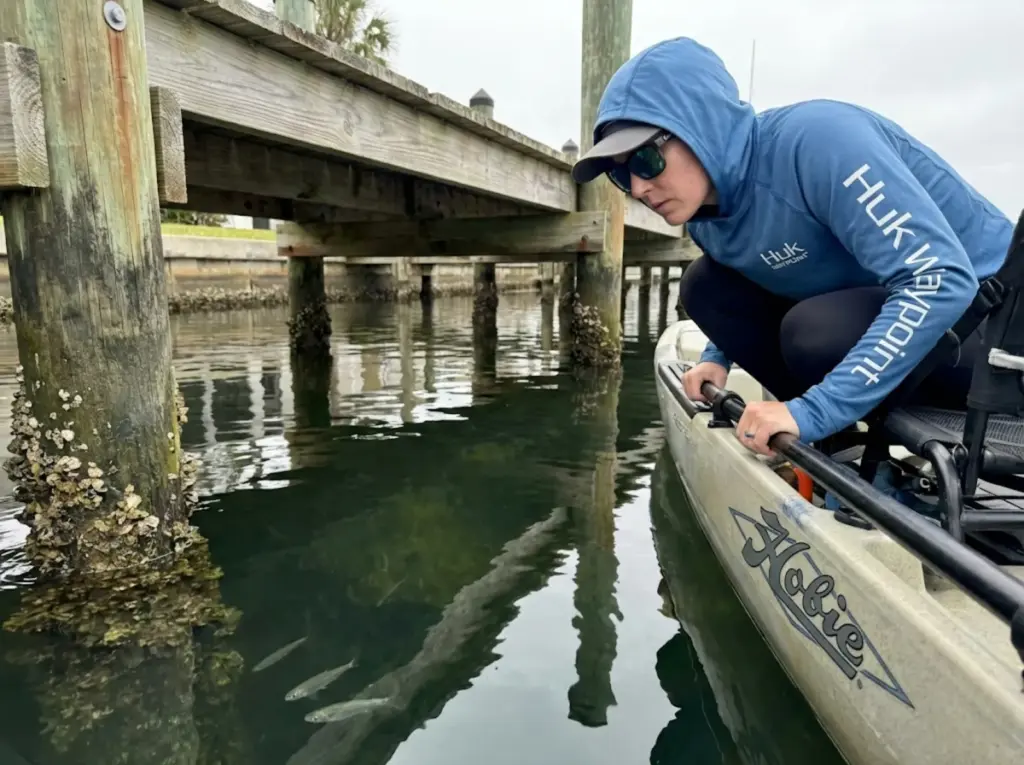
Every dock creates a micro-ecosystem that attracts baitfish and the predators that hunt them. Understanding this triangle of shade, food, and ambush position is the foundation of productive dock fishing.
The Shade-Oxygen-Food Triangle
Wooden docks and their pilings provide something fish desperately need during hot months: thermal relief. Water beneath structure runs 3-5°F cooler than exposed shallows, and for cold-blooded fish whose metabolism spikes with temperature, that difference matters. They burn less energy holding under cover than cruising open water.
The structure itself becomes a reef. Pilings accumulate algae and barnacles, which attract small crustaceans and pinfish, which pull in largemouth bass, snook, and redfish. Floating docks—the kind with pontoons or blue jugs—maintain consistent overhead cover regardless of water depth changes, making them magnets for suspended crappie and bluegill.
Pro tip: If you see baitfish showering near a dock, don’t cast to the splash—cast to the shadow line where the predator is waiting. The bait is fleeing something.
Reading Dock Anatomy: Pilings, Walkways, and Boat Lifts
Not all parts of a dock fish equally. Pilings create current breaks—fish hold on the downstream side where water velocity drops and bait drifts toward them. Walkways produce narrow shade corridors that most anglers ignore, but summer bass stack in these shallow alleys during midday. Boat lifts with complex metal frames provide visual concealment and serve as baitfish nurseries.
The back corners where dock meets shore are your highest-percentage spots. Predators trap bait against the structure here. It’s the ambush point with the fewest escape routes.
Freshwater vs. Saltwater Dock Dynamics
Freshwater dock work focuses on shade depth and forage observation—watch for shad or bluegill activity, and the bass won’t be far. Saltwater adds another variable: tidal current. Incoming tides push bait toward structure; outgoing tides concentrate fish at dock edges as water drains.
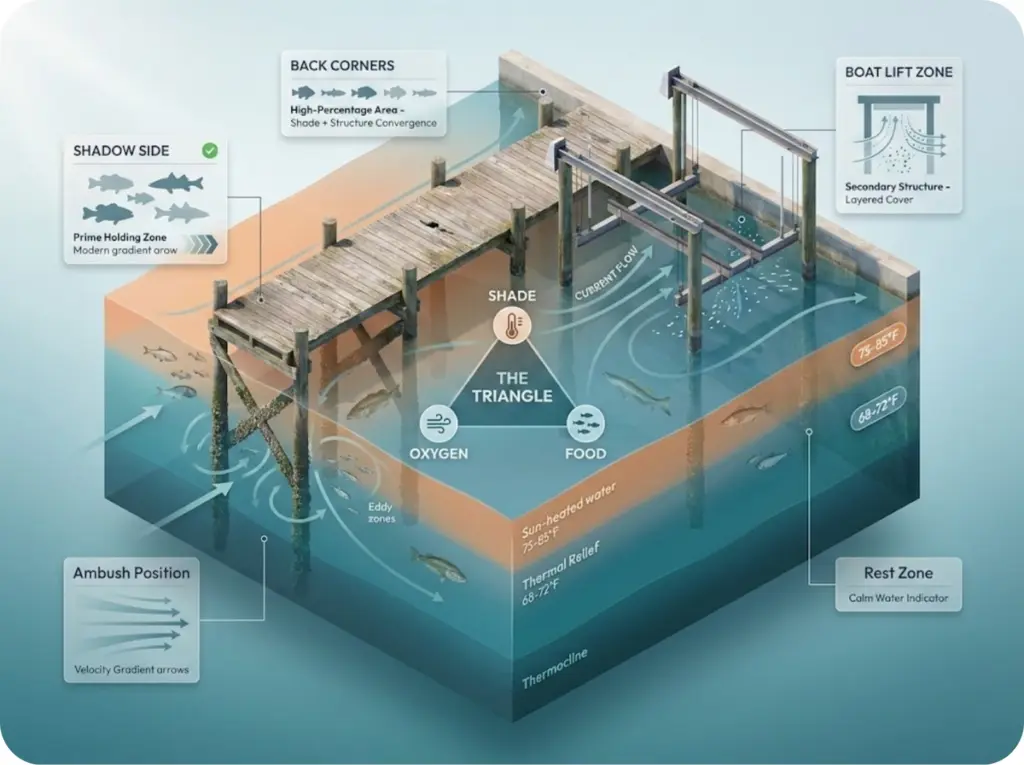
On saltwater pilings covered in barnacles, you’re targeting sheepshead, snook, and redfish. Work the side where water flows toward the structure, not away from it—that’s where predators position to intercept meals the current delivers. Understanding how current seams position predators transforms random casting into surgical strikes.
The Skip-Cast: Mechanics Most Tutorials Get Wrong
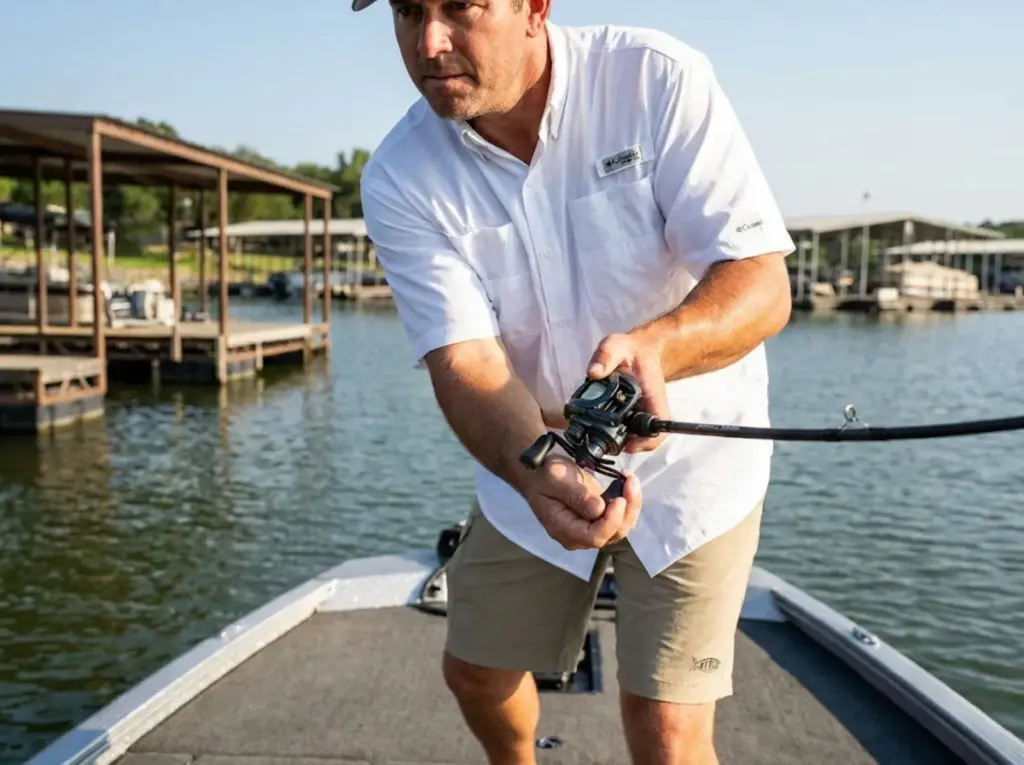
The skip-cast separates dock anglers from everyone else. It’s the only technique that puts your lure where fish feel truly safe—deep under overhead cover where birds and boats can’t reach them.
Physics of the Skip: Angle, Mass, and Energy Transfer
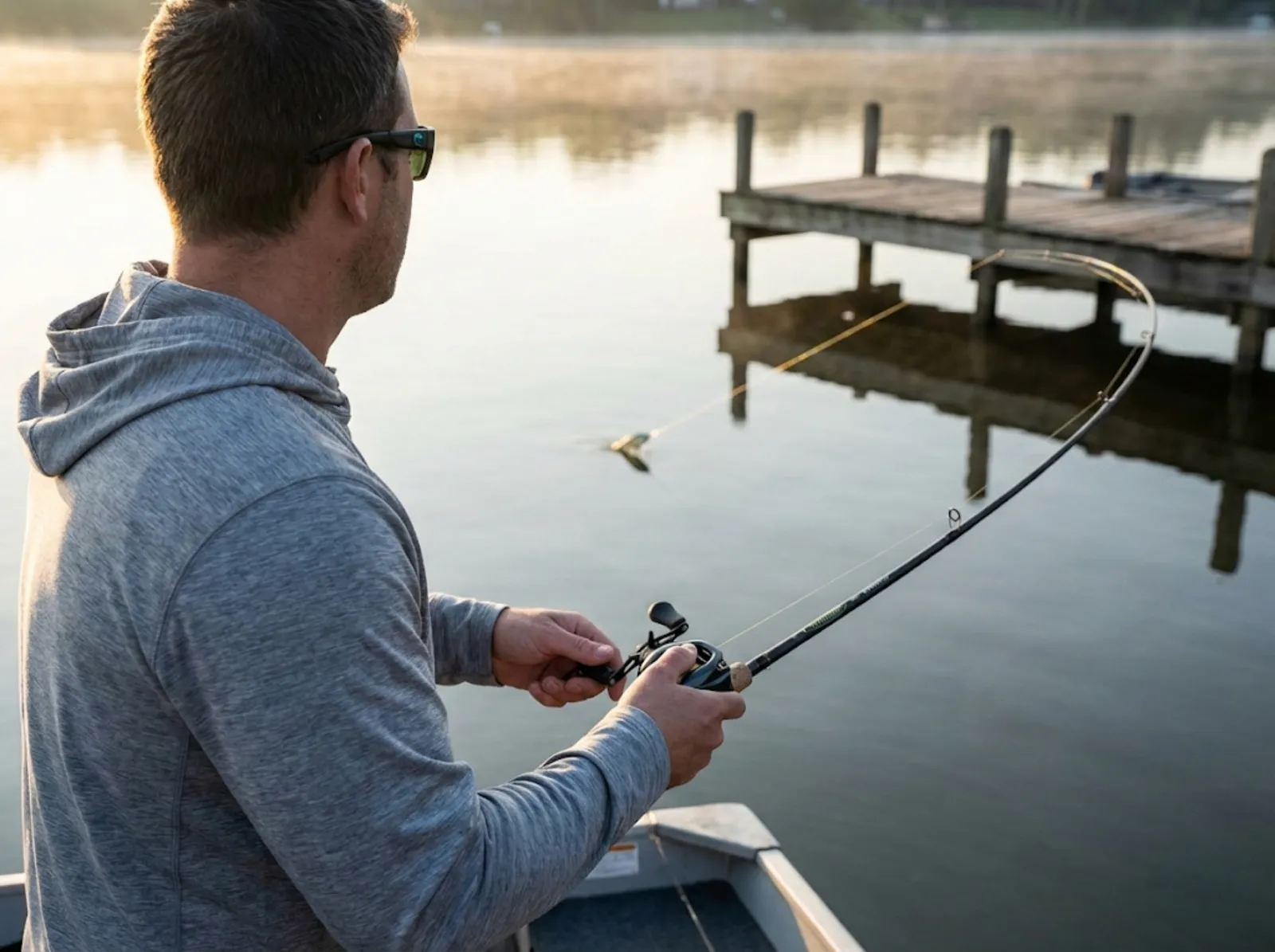
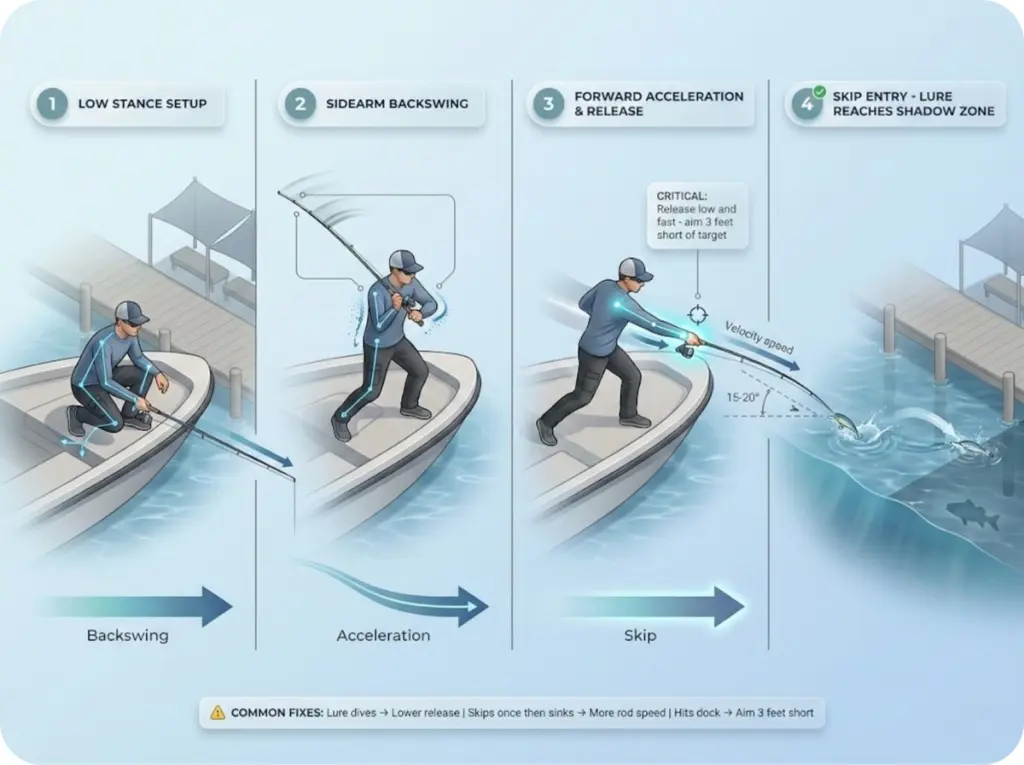
Standard overhead casts arc down into the water. Skip-casts travel parallel to the surface and bounce into the dark pockets. You need a low, sidearm release at 10-15° above horizontal, not the 45° arc of open-water casting.
A 3/8 oz jig hits the mechanical sweet spot. It’s heavy enough to maintain momentum through multiple skips but light enough to control during the sidearm swing. Lighter jigs lose energy on first impact. Heavier jigs plow into the water instead of glancing off. The lure should contact water flat-side first to maximize the glancing angle.
Rod tip speed at release—not muscle—determines distance. Accelerate smoothly through the casting stroke and let the rod load do the work.
The 3-Point Checklist Before Every Cast
Before every skip-cast, run through three checkpoints. First, alignment: position your body so the casting arc parallels the dock edge, not toward it. Second, target selection: aim for a landing zone 2-3 feet in front of the dock’s shadow line, not the dock itself. Third, brake adjustment: for baitcasters, reduce braking tension slightly for low-trajectory casts—higher tension kills momentum.
Pro tip: The biggest mistake is rushing. A few seconds spent calculating the trajectory saves a dozen snag-and-retrieve cycles. Precision beats volume every time.
Common Errors and Their Fixes
If your lure dives on first contact, you’re casting too high—lower your release point. If it skips once then sinks, increase rod tip velocity at release. If you consistently hit the dock, aim for open water 3 feet short; the skip carries it under.
For baitcast reels, line piling on the spool means you’re not feathering through the cast. Maintain light thumb pressure to keep tension on the line.
Master these fundamentals, then explore advanced skipping techniques for dock bass to add skip-pitching and roll-casting to your arsenal.
Gear That Actually Matters (And What Doesn’t)
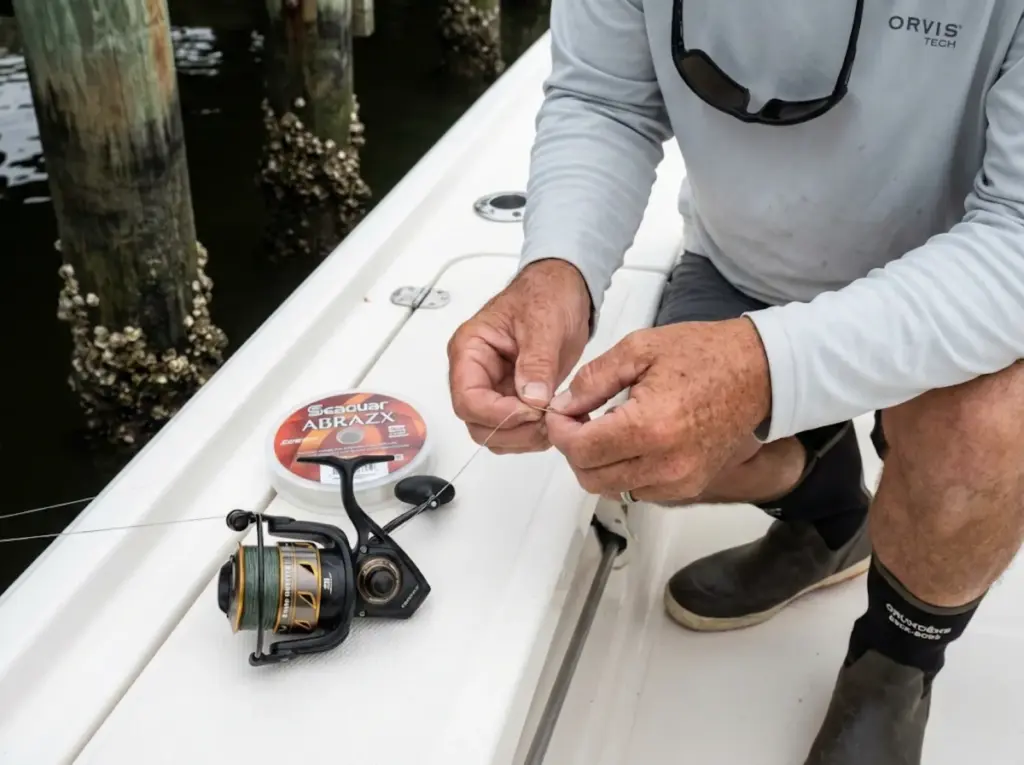
The proximity of abrasive barnacles, metal cables, and jagged wood requires gear that can extract fish from heavy structure. This isn’t finesse fishing.
Rod and Reel Specs for Dock Work
A 7-foot medium-heavy rod with moderate-fast action provides leverage for extraction while maintaining skip-cast control. The length gives you casting reach; the power prevents fish from wrapping you around pilings.
Your reel needs an 8.1:1 gear ratio—non-negotiable. When a fish strikes deep under a dock, its instinct is to run further in. A high-speed retrieve picks up slack instantly, keeping the fish’s head turned toward open water before it can bury you.
Spinning reels work for “shooting” docks—a crappie technique—but sacrifice control for bass-weight jigs. For dedicated dock work, a low-profile baitcaster with external magnetic braking offers finer adjustments for skip-cast trajectories.
Line System: The Braid-to-Fluoro Leader
Run 30-50lb braid as your mainline. Braided line provides zero-stretch hooksets and sensitivity for feeling structure contact. Its thin diameter-to-strength ratio enables longer casts and better skip-cast flight characteristics.
Add a 3-4 foot fluorocarbon leader in 20-40lb test. The fluoro adds abrasion resistance against barnacles and metal, and its near-invisible underwater profile reduces refusal rates in clear water.
Pro tip: Retie your leader after every 10-15 casts. Those micro-nicks from pilings cause break-offs on hooksets when you least expect them.
Jig Weight Selection: The 3/8 oz Sweet Spot
The 3/8 oz jig balances skip-ability with sufficient weight to punch through surface tension. Use 1/2 oz for deeper water or heavier current. Drop to 1/4 oz when targeting suspended fish in the upper column.
Choose compact soft plastics—creature baits, craws—over paddle tails. Compact profiles skip cleaner. Weedless jig heads reduce snags in brush-heavy dock environments. When matching rod action to your lure type, remember that fast tips load quickly for skip-casting but moderate tips protect against hook pulls on the fight.
Reading Weather and Pressure: What the Water Won’t Tell You
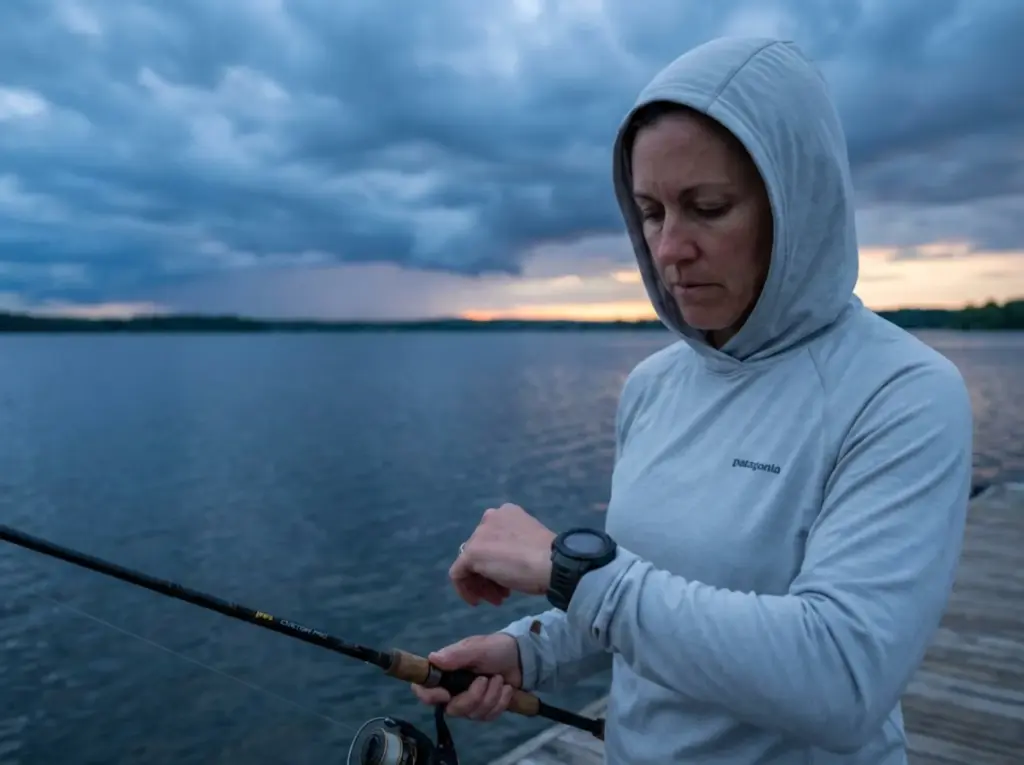
Fish respond to environmental signals you can’t see. Barometric pressure is the invisible force that determines whether docks produce aggressive bites or frustrating refusals.
The Swim Bladder Effect on Feeding Behavior
Fish use a gas-filled swim bladder to maintain neutral buoyancy, and that organ is pressure-sensitive. When the barometer falls below 29.8 inHg—often before a storm—the bladder expands, pushing fish shallower and triggering aggressive feeding. Work docks with reaction baits. Move fast. Cover water.
When the barometer exceeds 30.2 inHg—typically after a cold front—the bladder compresses. Fish become lethargic and tuck tight into cover. On those bluebird days with clear skies, you need precise, slow-moving finesse presentations that land right on their nose.
The 24-48 hours after a cold front are notoriously difficult. Downsize your lures and slow your retrieve. Understanding how barometric pressure triggers fish behavior changes gives you a strategic advantage.
Wind and Surface Conditions
Wind direction pushes bait against structure. On wind-blown banks, baitfish concentrate along docks on the windward shore—and predators follow.
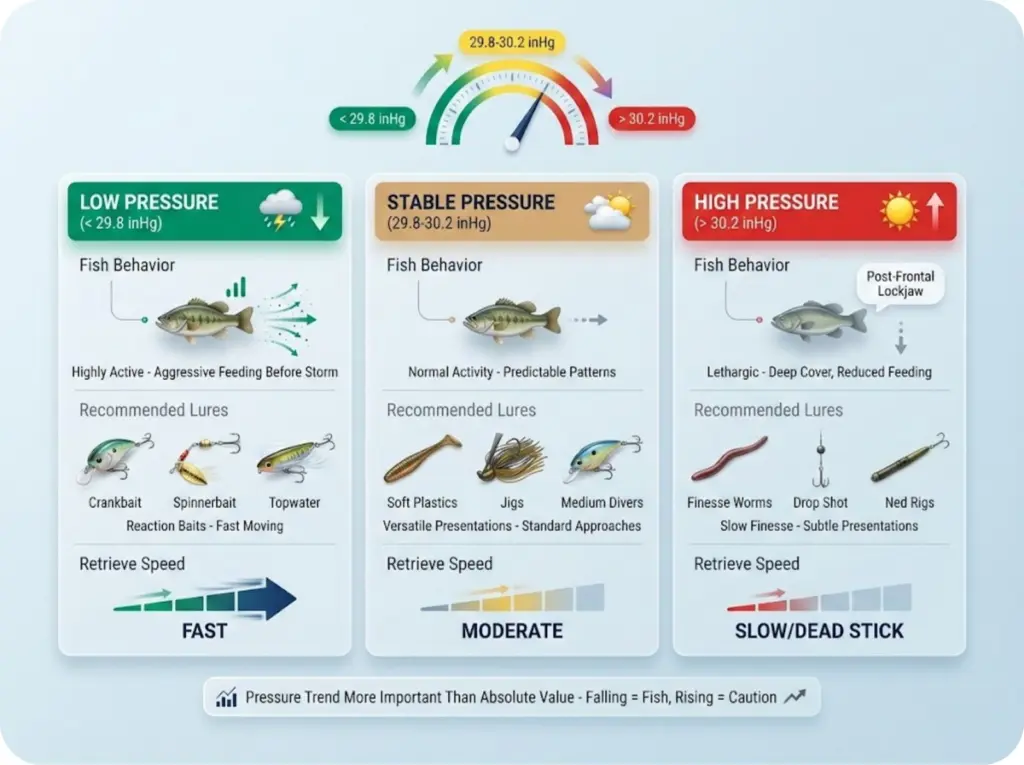
Surface chop reduces fish wariness by masking your silhouette and boat noise. Calm, bluebird conditions push fish deeper under structure. Skip farther under and expect fewer reaction strikes.
The Legal Gray Zone: Fishing Near Private Docks
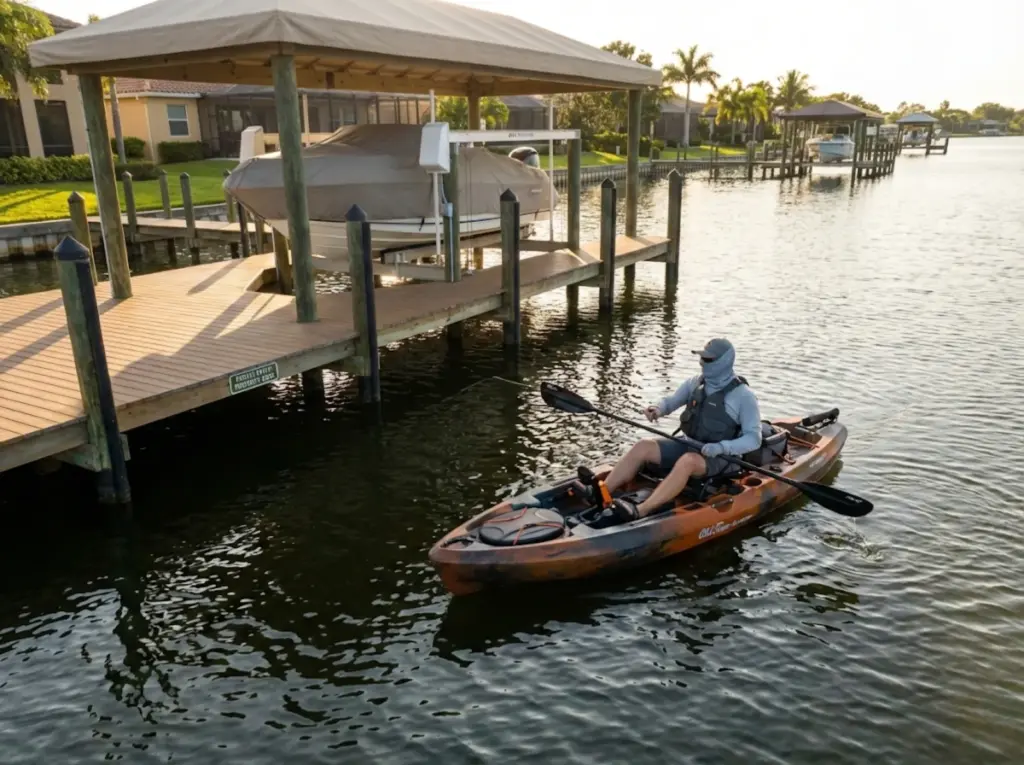
The legal right to fish around private docks is a frequent flashpoint between homeowners and anglers. Understanding riparian rights prevents confrontations and preserves access for everyone.
What’s Legal: Public Water vs. Private Structure
In most U.S. states, navigable waterways are public resources—you have a legal right to fish them. The ordinary high-water mark defines the boundary between private land and public water. According to the Florida Fish and Wildlife Conservation Commission, state regulations protect the public’s right to access navigable waters while respecting private property boundaries.
Here’s the critical distinction: the water is public, but the dock itself is private property. Touching the dock, tying to a piling, or stepping onto the structure without permission constitutes trespass. Cast your lure; don’t touch their property.
Dock Etiquette That Preserves Access
Never fish occupied docks. If someone is swimming, eating, or relaxing, move on. Precision casting only—if you’re not confident you can miss the boat, skip that dock. Maintain buffer distance and parallel the dock at 20+ feet rather than anchoring point-blank.
If a homeowner confronts you, stay calm. Explain your legal rights briefly and leave. Winning an argument loses the war—they’ll install dock ropes or rugs to snag your lures permanently.
A snagged lure on a canvas boat cover is the number one cause of homeowner anger. Carry extra jigs. Cut and go.
Advanced Scenarios: Night, Kayak, and Tough Conditions
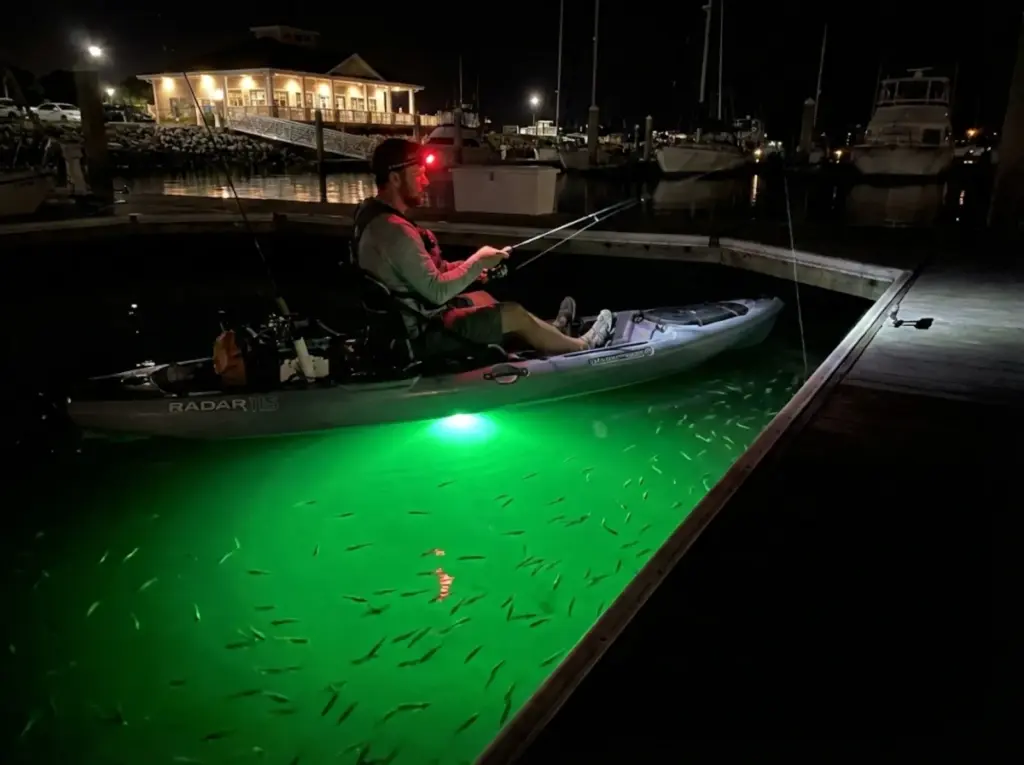
Most dock fishing content stops at the basics. These advanced scenarios fill the gaps competitors ignore.
Night Fishing Around Lighted Docks
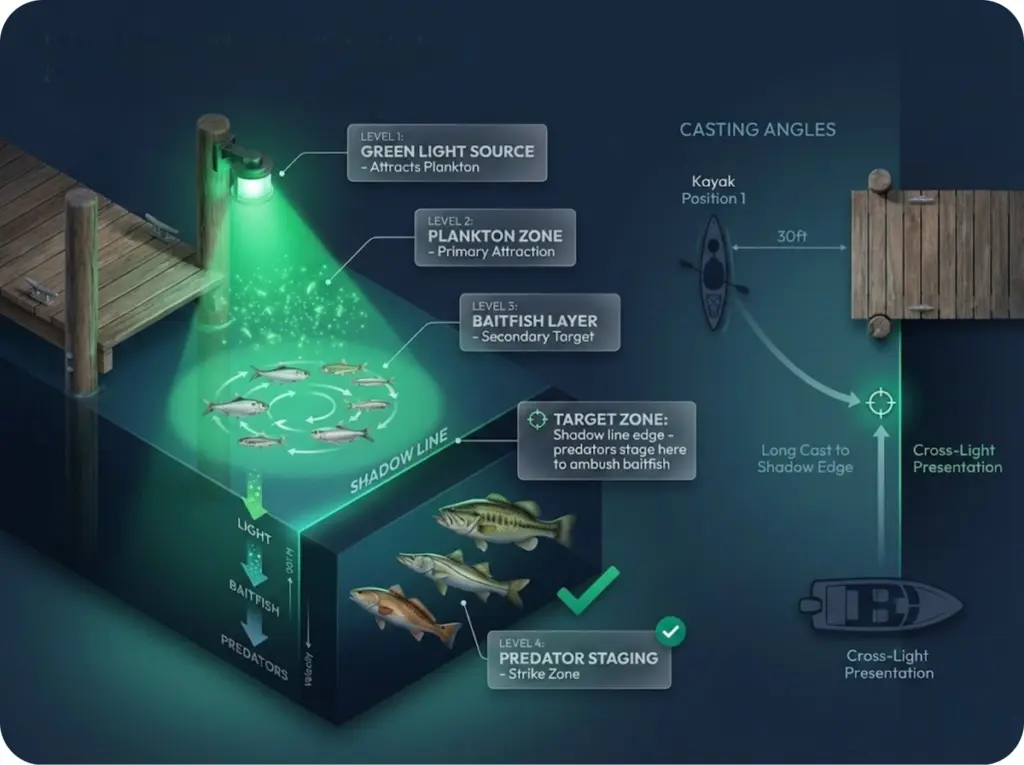
Green lights at the 530nm wavelength penetrate water most effectively and trigger a biological chain reaction. Plankton are phototactic—they swarm the light. Baitfish follow. Predators stage at the shadow line where light meets dark.
Allow dock lights to “cook” for 30-45 minutes before fishing. The food chain needs time to stack up. Cast to the boundary between light and dark, not the bright center. Reduce lure noise—fish relying on their lateral line at night are sound-sensitive.
Exploring the full scope of low-light fishing tactics expands your dock game beyond daylight hours.
Kayak-Specific Positioning for Dock Access
Kayaks offer stealth but introduce boat sway that compromises casting accuracy. Use stake-out poles in shallow flats or brush clips to tether directly to pilings. Deploy from bow and stern (double-anchor technique) to prevent rotation around a single pivot point.
“Rig to flip”—leash all gear in anticipation of capsize near heavy structure. Your low-profile kayak is invisible to powerboats; fly a hi-vis safety flag near marina docks.
Seasonal Transition Patterns
In spring, fish stage on docks near spawning flats—secondary points and interior docks produce. Summer pushes fish deep under structure centers for shade. Fall brings shad migration; hit docks on main-lake points with shad-profile baits. Winter? Warm-water discharges near docks concentrate fish when everything else goes cold.
Conclusion
Dock fishing rewards the angler who understands structure biology, masters the skip-cast, and respects legal and ethical boundaries. The shadow side holds fish. The 3/8 oz jig skips cleanest. The falling barometer triggers aggressive strikes.
Pick one dock on your home water—one you’ve passed a hundred times without stopping. Work it systematically: shadow side first, back corners second, with the skip-cast progression you’ve learned here. The fish are there. They’ve always been there. Now you know how to reach them.
FAQ
What is the best bait for dock fishing?
Compact jigs in the 3/8 oz range with craw or creature trailers skip most effectively and trigger reaction strikes from cover-oriented bass. For finesse situations, a wacky-rigged soft plastic worked vertically along pilings produces when jigs fail.
What time of day is best for dock fishing?
Dawn and dusk provide low-light conditions when fish move shallower and feed aggressively. Midday dock fishing can be productive in summer—fish compress into deepest shade when sun angle peaks.
How do you skip a lure under a dock?
Use a low sidearm cast at 10-15° above horizontal, accelerating the rod tip through release. Aim for open water 2-3 feet in front of the dock’s shadow line—the lure’s momentum carries it under the structure.
Is it legal to fish from someone else’s dock?
You cannot stand on a private dock without permission—that’s trespassing. However, you can legally fish the public water adjacent to private docks in most states. The dock is private property; the water is public.
What kind of rod do I need for dock fishing?
A 7-foot medium-heavy rod with moderate-fast action provides leverage to extract fish from structure while maintaining skip-cast control. Pair with an 8.1:1 high-speed baitcaster for instant slack pickup.
Risk Disclaimer: Fishing, boating, and all related outdoor activities involve inherent risks that
can lead to injury. The information provided on Master Fishing Mag is for educational and informational purposes
only. While we strive for accuracy, the information, techniques, and advice on gear and safety are not a substitute
for your own best judgment, local knowledge, and adherence to official regulations. Fishing regulations, including
seasons, size limits, and species restrictions, change frequently and vary by location. Always consult the latest
official regulations from your local fish and wildlife agency before heading out. Proper handling of hooks, knives,
and other sharp equipment is essential for safety. Furthermore, be aware of local fish consumption advisories. By
using this website, you agree that you are solely responsible for your own safety and for complying with all
applicable laws. Any reliance you place on our content is strictly at your own risk. Master Fishing Mag and its
authors will not be held liable for any injury, damage, or loss sustained in connection with the use of the
information herein.
Affiliate Disclosure: We are a participant in the Amazon Services LLC Associates Program, an
affiliate advertising program designed to provide a means for us to earn advertising fees by advertising and linking
to Amazon.com. As an Amazon Associate, we earn from qualifying purchases. We also participate in other affiliate
programs and may receive a commission on products purchased through our links, at no extra cost to you. Additional
terms are found in the terms of service.