In this article
Most American anglers see a carp roll at the surface and reach for a different rod. They’ll chase bass all morning in the same lake where 20-pound carp are tailing in two feet of water, completely ignored. I spent years doing the same thing before a European angler at my local reservoir showed me what I was missing — and it changed how I think about freshwater fishing. This guide covers common carp biology, seasonal behavior, and the baits, rigs, and stalking tactics that consistently put these fish on the bank.
Quick Answer: Common carp (Cyprinus carpio) are large, omnivorous freshwater fish with exceptional sensory systems that make them both challenging and rewarding to target. They feed most aggressively between 55–75°F, respond best to amino-acid-based baits like boilies and sweet corn presented on hair rigs, and can be found in lakes, ponds, and slow rivers across all 50 states. Below you’ll find the biology, seasonal patterns, and proven tactics to catch them consistently.
Common Carp Identification and Physical Traits
Body Shape, Color, and Scale Patterns
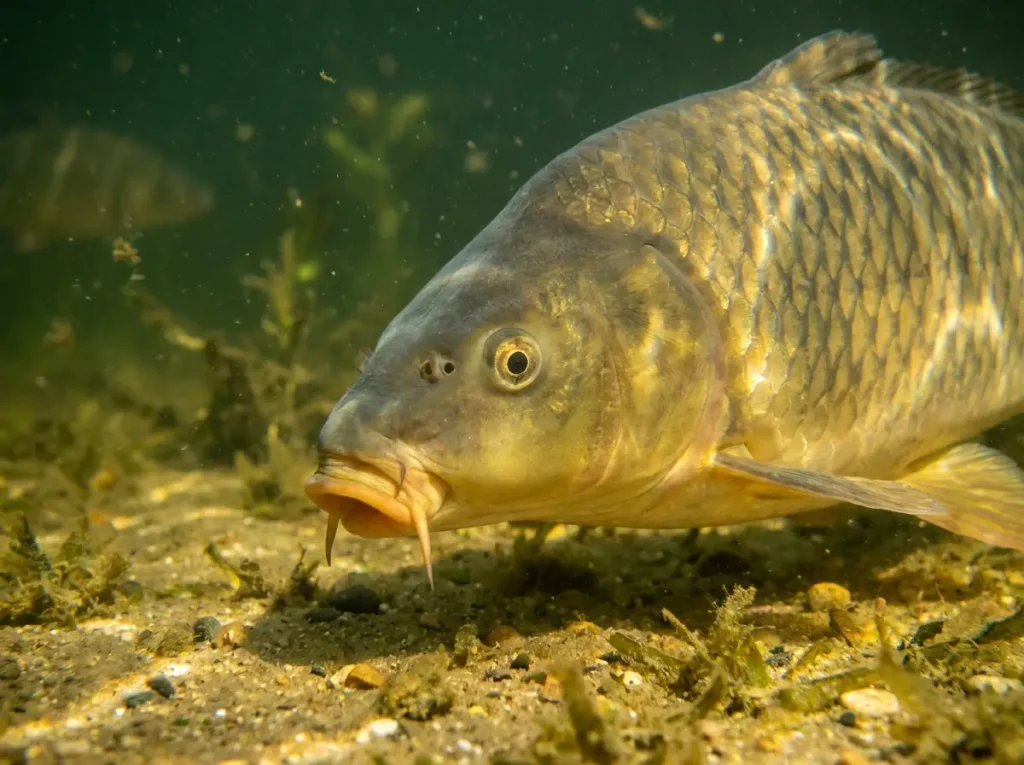
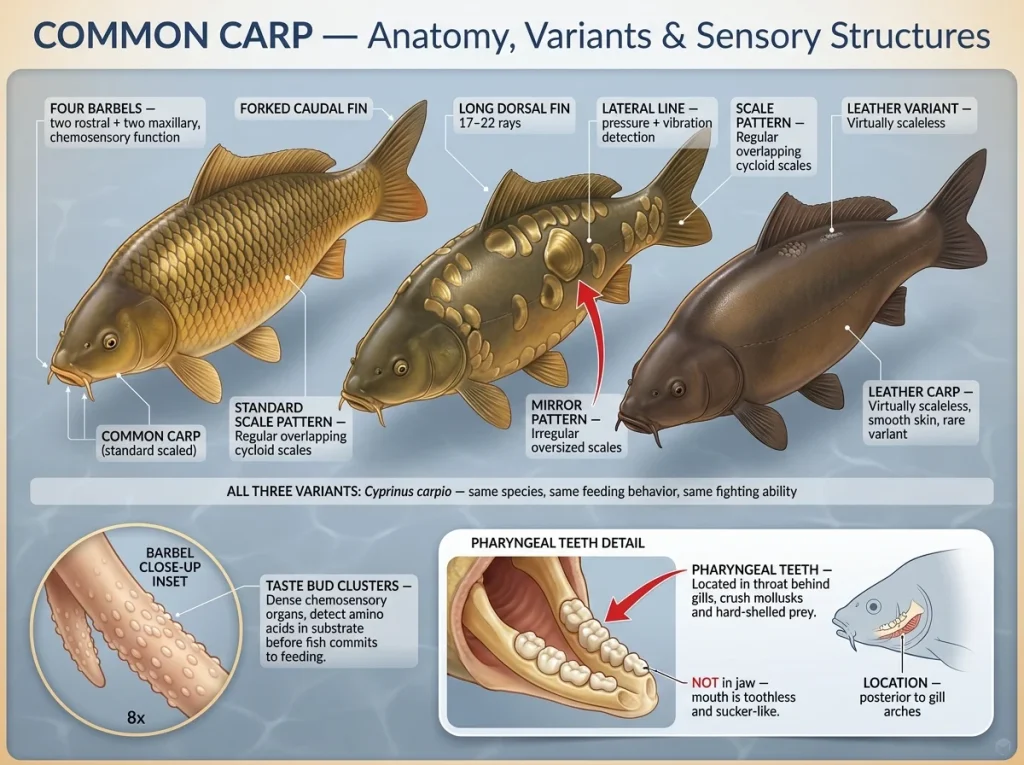
The first thing you notice about a common carp is the bulk. These fish are built like linebackers — thick through the midsection with a heavy, stout frame that averages 10 to 22 inches and 1 to 10 pounds in most waters. Trophy fish push well past 30 pounds, and the record-class specimens exceed 80.
Color runs from deep bronze to brassy gold depending on water clarity and diet. Each large scale is distinctly outlined in a darker shade, giving the fish an almost armored appearance. You won’t confuse one with a bass once you’ve held one — the heft and scale structure are completely different.
Barbels, Mouth Structure, and Pharyngeal Teeth
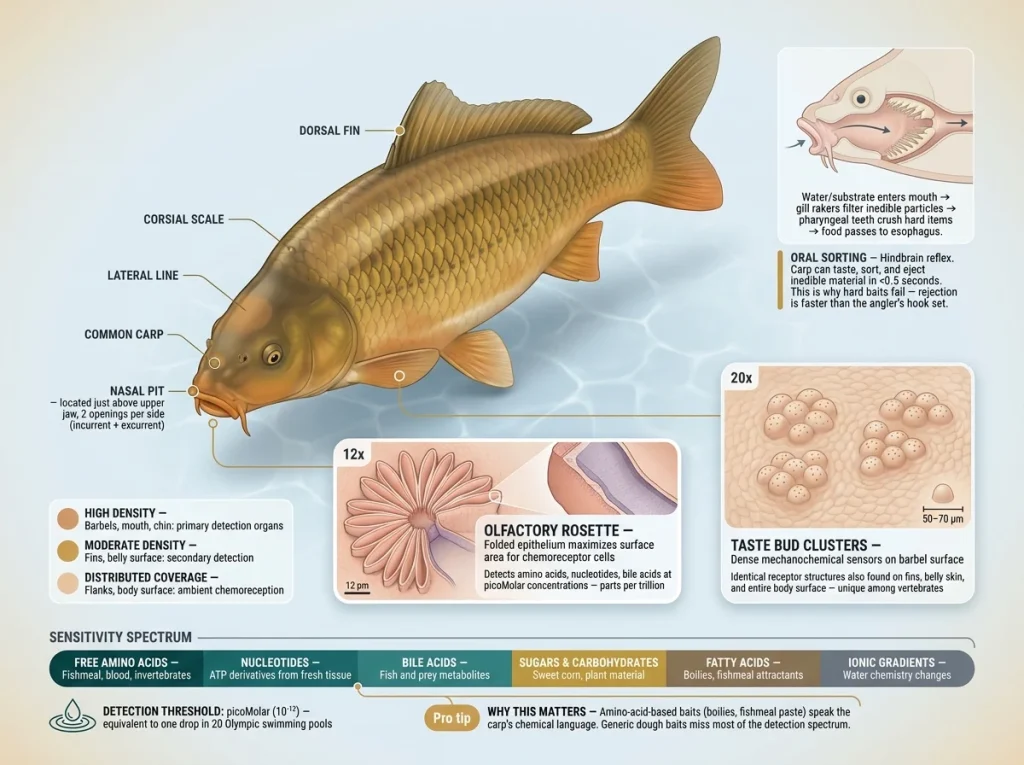
The two pairs of barbels flanking the upper jaw are the instant identification marker. They look like short catfish whiskers, but they function differently — these are chemosensory organs packed with taste buds that the fish uses to probe the bottom substrate before committing to a bite.
The mouth itself is toothless and sucker-like, designed for bottom feeding. But carp aren’t defenseless when it comes to processing food. They have pharyngeal teeth — bony plates in the throat that crush hard-shelled prey like mollusks and snail shells. That crushing power is why you’ll feel a distinct head shake when a carp takes your bait — the fish is testing and sorting what it just picked up.
Mirror Carp, Leather Carp, and Koi Variants
Not every carp you catch will look the same. Mirror carp have irregularly placed oversized scales scattered across an otherwise smooth body — some anglers think they’re deformed the first time they land one. Leather carp are nearly scaleless, with smooth dark skin that feels different from any freshwater fish you’ve handled. Koi are the ornamental variety with bright orange, white, and red patterns — and yes, they’re the same species (Cyprinus carpio), just selectively bred for color. All four variants share the same biology, feeding behavior, and fighting ability.
If you’re trying to distinguish common carp from other USGS-classified invasive carp species, the barbels are your quickest field marker. Grass carp and bighead carp lack them entirely.
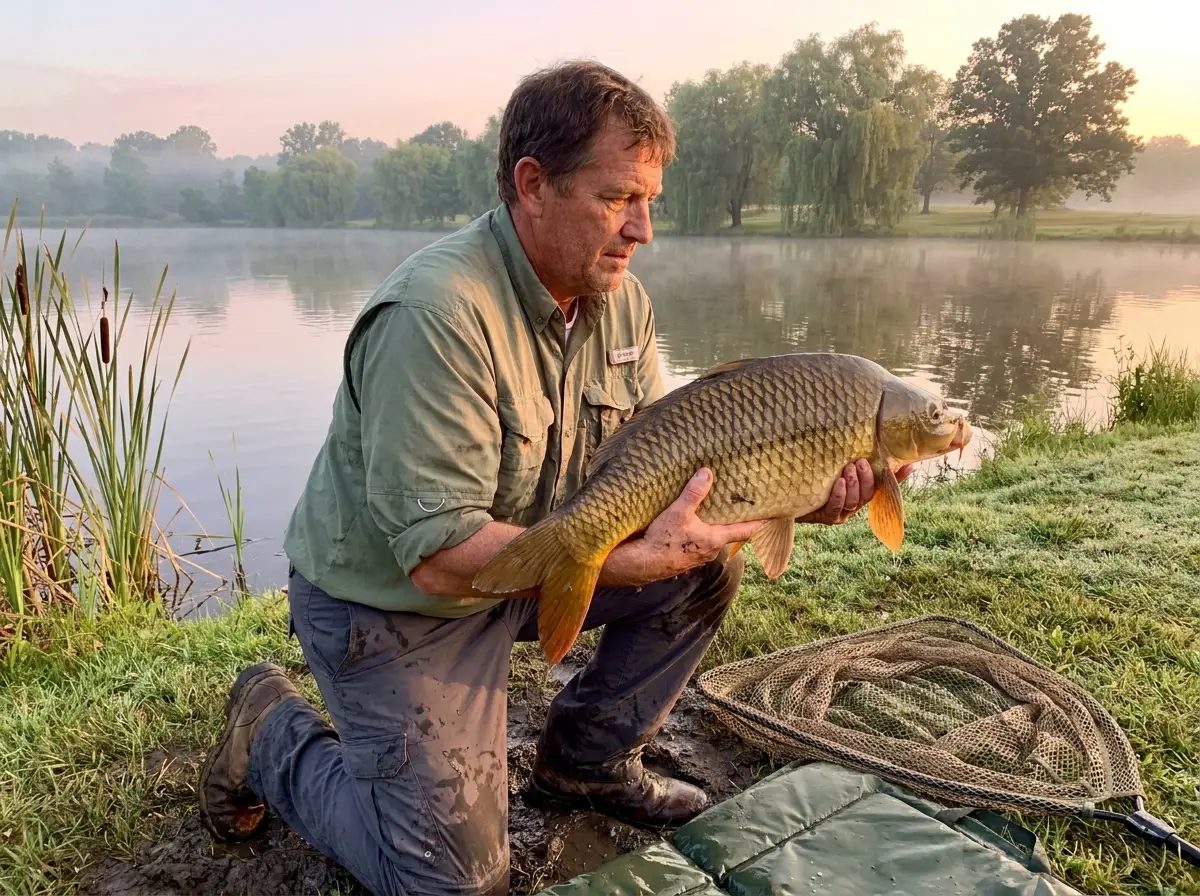
Pro tip: When you handle a carp for the first time, support it horizontally with both hands — one under the belly, one ahead of the tail. These fish are heavy and their weight can damage internal organs if you hold them vertically by the lip like a bass.
For more on the species-specific approaches most anglers miss, check out these carp fishing techniques most North Americans overlook.
Where Common Carp Come From and How They Spread
Native Range and the Danube Connection
Common carp are native to the Danube River drainage system spanning parts of Europe and Central Asia. They’ve been cultured as food fish for centuries — the Romans raised them in ponds, and medieval monks bred the first mirror carp varieties for easier scaling in monastery kitchens.
The fish’s original native populations are now questionable. Centuries of transplanting, breeding, and hybridization have muddied the genetic picture so thoroughly that researchers struggle to identify truly wild populations even in their home range.
The 1800s US Stocking Campaign
Here’s where the story gets strange for American anglers. The U.S. Fish Commission actively promoted carp as a solution to protein shortages in the 1870s and 1880s. By 1885, they were shipping carp by rail to stock lakes and rivers across the country — citizens literally received carp through the mail to stock their local ponds.
The plan worked too well. Common carp established self-sustaining populations in virtually every state, spread through connected waterways, and now rank among the world’s worst invasive species according to the Global Invasive Species Database. They’re present on every continent except Antarctica.
Young carp resemble baitfish, which creates another spread vector — anglers unknowingly use them as live bait and introduce them to new waters. In Pennsylvania, it’s unlawful to release unused live bait for exactly this reason. If you’re concerned about preventing further spread, understanding decontamination protocols that prevent invasive species spread matters more than most anglers realize.
Habitat Preferences and Seasonal Movement
Preferred Water Types and Structure
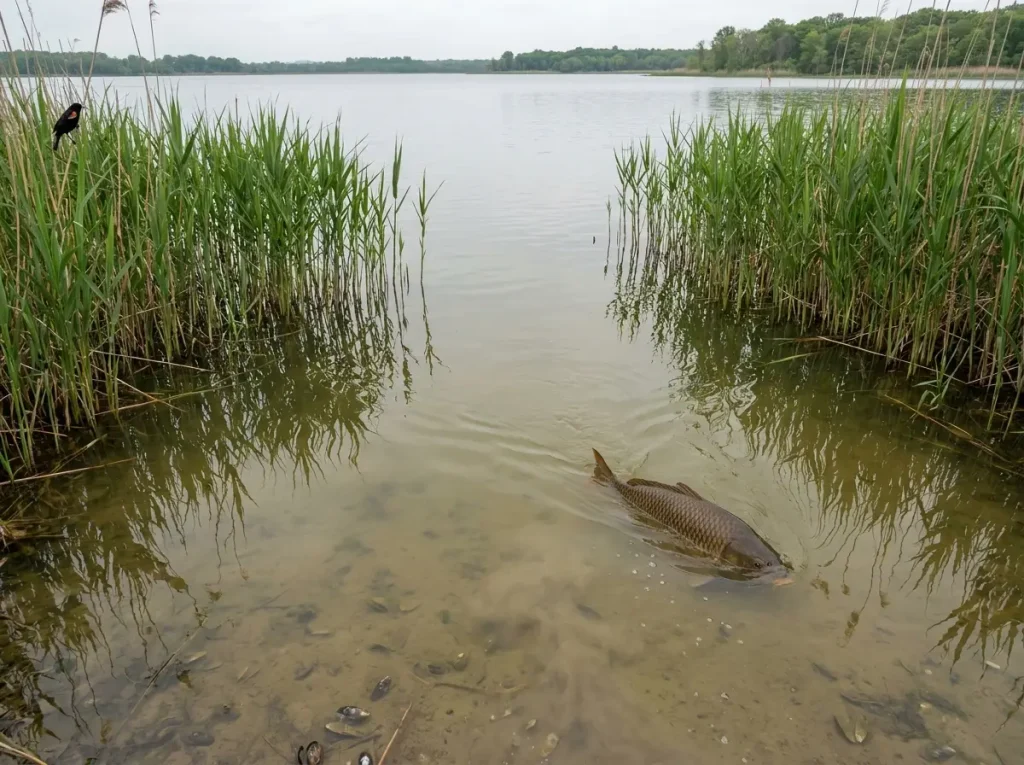
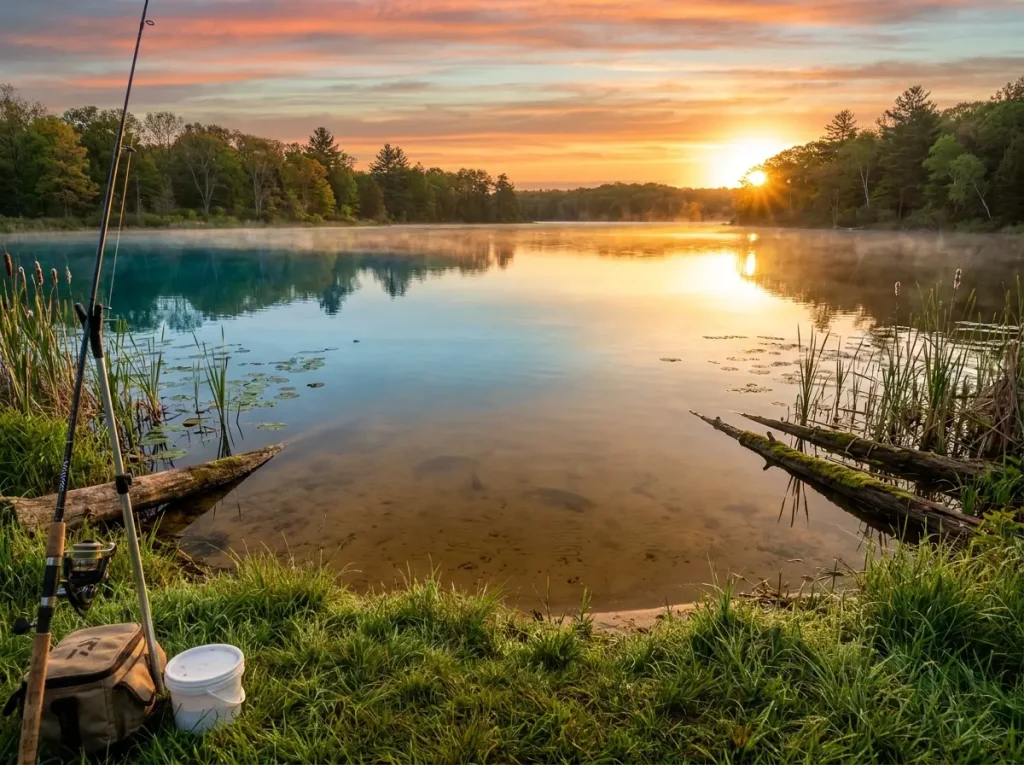
Carp thrive where most gamefish anglers don’t bother looking. They prefer turbid, slow-moving water — think farm ponds, municipal reservoirs, shallow lakes with soft bottoms, and sluggish rivers receiving agricultural runoff. They tolerate low dissolved oxygen levels that would stress bass or trout, which is why you’ll find them in water conditions other species avoid.
Structure means something different for carp than for bass. Instead of rock piles and drop-offs, look for soft mud bottoms near vegetation edges, submerged logs in shallow bays, and creek inlets where organic matter collects. Carp follow the food, and the food accumulates in the silty margins.
Seasonal Patterns by Water Temperature
This is where most articles on carp get lazy — they’ll tell you “fish in spring and fall” without explaining why. The answer is water temperature, and the thresholds are specific.
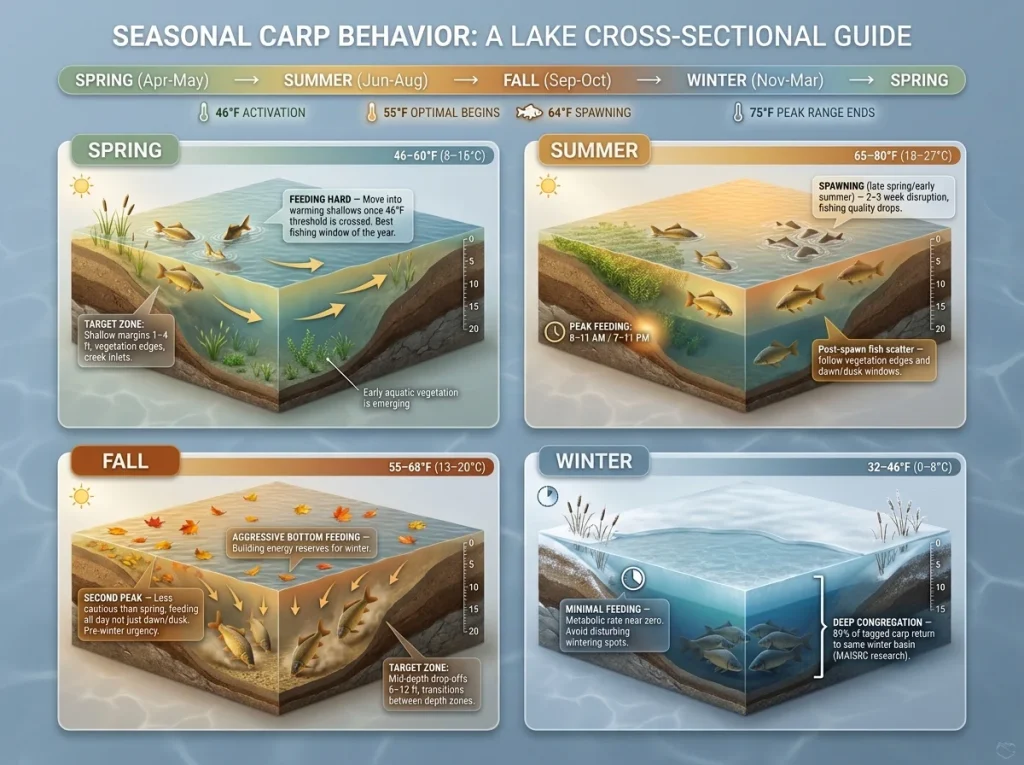
Carp become reliably active once water hits 46°F (8°C). Below that, their metabolism slows to the point where feeding windows shrink to almost nothing. The optimal range is 55–75°F (13–24°C), with the most aggressive feeding between 59–72°F (15–22°C).
In spring, carp are among the first species to move into warming shallows. They’re feeding hard after winter — this is your best opportunity. In summer, spawning activity disrupts normal patterns for two to three weeks, but post-spawn fish scatter across productive areas and feed throughout the day. Fall is the second peak — carp feed aggressively to build energy reserves before winter, and they’re less cautious than in spring. In winter, activity drops sharply. Research from the Minnesota Aquatic Invasive Species Research Center found that 89% of tagged carp returned to the same deep lake to overwinter — they’re creatures of habit when it gets cold.
Pro tip: Carry a simple water thermometer. When surface temps cross 50°F in spring, start checking the shallows. Carp will be there before the bass are, and the fishing can be outstanding when nobody else is on the water yet.
Daily Feeding Windows
Carp don’t feed steadily all day. Research shows two distinct feeding peaks: morning from roughly 8 to 11 a.m. and evening from 7 to 11 p.m., during which they consume the bulk of their daily intake. In summer heat, the evening window often produces better than morning because water temperatures in the shallows moderate after sundown.
Understanding how lake turnover reshuffles the water column helps you predict when fall carp fishing will peak — it’s tied directly to thermal mixing.
Spawning Biology and Reproduction
Spawning Triggers and Timeline
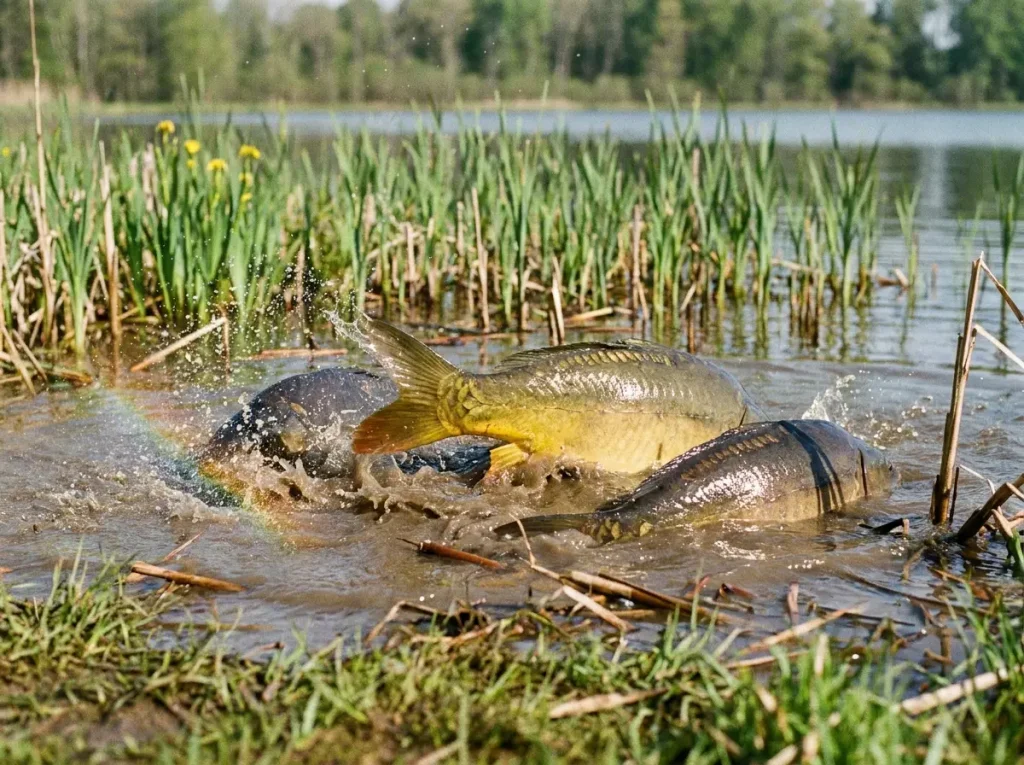
When water temperature exceeds 64°F (18°C) — typically late April through June depending on latitude — carp move into shallow marshy areas and begin spawning. You’ll know it’s happening before you see it. The sound of heavy fish thrashing in knee-deep water carries across the lake.
Spawning aggregations are chaotic. Multiple males crowd a single large female, pushing and jostling in water so shallow their backs break the surface. The vegetation gets torn up, the water turns muddy, and the whole area looks like a mud-wrestling match.
Here’s what matters for anglers: the two weeks before spawning starts are often the best fishing of the year. Carp are feeding aggressively to fuel egg production, they’re concentrated in predictable areas, and they’re less selective about bait. Once spawning actually begins, fishing quality drops fast — the fish have other priorities.
Egg Production and Juvenile Survival
A single female can produce between 100,000 and 500,000 eggs per spawning event, with some large females carrying up to 3 million. That reproductive output is a big part of why carp populations explode once established.
Juvenile carp face real predation pressure from bluegills — MAISRC research found that lakes with healthy bluegill populations had 11 times fewer carp offspring than lakes without them. That’s a significant finding for lake managers and explains why balanced predator communities help keep carp numbers in check.
Small carp ponds with robust panfish populations often stay in better ecological balance. The same principles apply to pond fishing strategies for species that stack in small water.
Diet and Sensory Biology
Omnivorous Feeding and Benthic Rooting
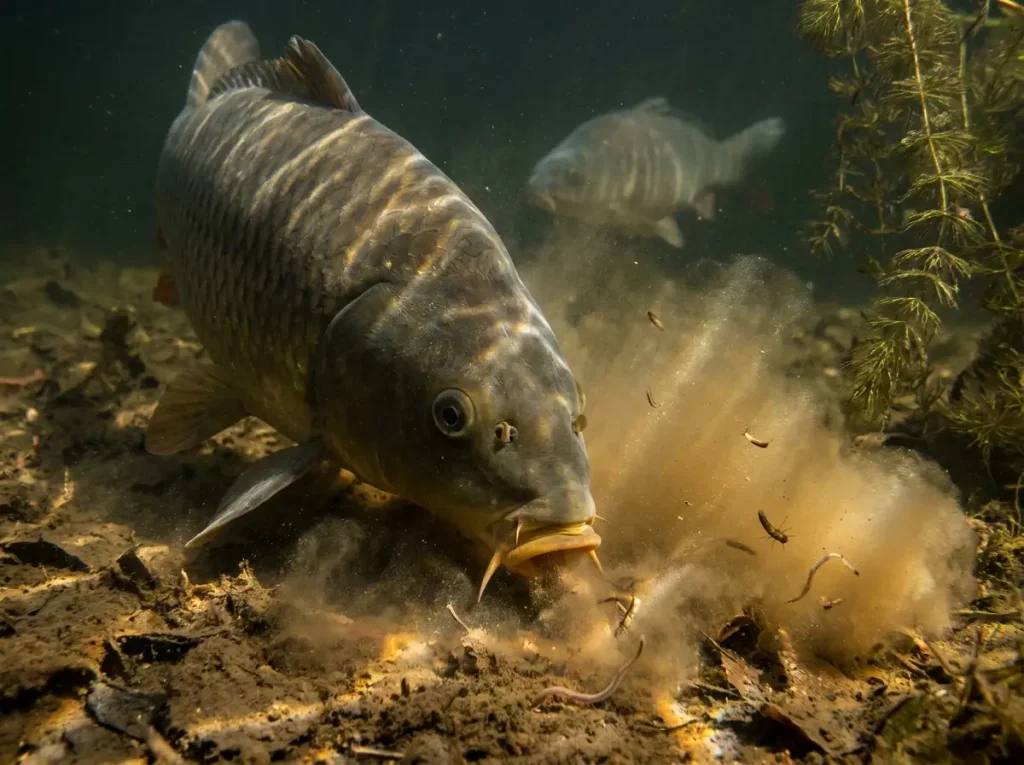
Carp eat almost everything that fits in their mouth. Their diet includes insect larvae, worms, mollusks, zooplankton, aquatic plant seeds, algae, and decomposing organic matter. They’re not picky — they’re efficient.
The feeding method is what sets them apart. Carp root through bottom sediment like aquatic pigs, sucking up mouthfuls of mud and using their pharyngeal teeth and gill rakers to sort edible material from debris. This benthic rooting is why carp-heavy lakes turn murky — every feeding carp is a small dredge stirring phosphorus out of the sediment and into the water column. That’s also why turbidity affects what fish can detect in ways that matter for your presentation.
The Chemoreception Advantage
Here’s what makes carp different from every bass or trout you’ve targeted: their sensory system is built for chemical detection at levels that border on absurd.
Carp have taste buds distributed across their entire body — not just in their mouth but on their barbels, fins, and skin. A carp swimming through your chum line is tasting the water before it ever reaches the bait. Their olfactory system detects amino acids, nucleotides, and bile acids at picoMolar concentrations — we’re talking parts per trillion. According to fish sensory capabilities research, this external chemoreception is unique among vertebrates in its distribution and sensitivity.
They also use oral food sorting — a reflex loop in the hindbrain that lets them suck in a mouthful of substrate, taste everything inside the mouth cavity, and eject inedible particles while retaining food items. This happens in fractions of a second. It’s why carp can seem impossible to hook on hard baits — they detect and reject unnatural textures faster than you can set the hook.
Why Amino-Acid Baits Outperform Generic Dough
Once you understand the chemoreception system, bait selection stops being guesswork. Boilies — those dense flavored dough balls popular in European carp fishing — are formulated around amino acid profiles that specifically trigger the carp’s olfactory and gustatory systems. They’re not random flavors. The best ones contain fishmeal, liver extract, or other protein-rich ingredients that release the exact chemical signals carp are hardwired to detect.
Generic bread dough or corn meal paste will catch carp, but amino-acid-based baits consistently outperform them because they speak the fish’s chemical language. The difference becomes obvious on pressured water where carp have learned to be selective.
Pro tip: If you’re just starting and don’t want to invest in boilies, canned sweet corn is your best budget option. The combination of sugars and amino acids from the canning process creates a chemical signature that carp respond to reliably. Thread two or three kernels directly on the hook or — better yet — on a hair rig.
Tackle and Gear for Carp Fishing
Rods and Reels
The tackle industry wants you to believe carp fishing requires a specialized European setup costing hundreds of dollars. You can start with a medium-heavy spinning rod you already own — anything in the 7 to 10-foot range with enough backbone to handle a 15-pound fish will work for your first sessions.
That said, dedicated carp rods in the 10 to 12-foot range offer real advantages. The extra length gives you casting distance to reach feeding fish on flats and the leverage for line pickup on long-distance hook sets. A 3 to 3.5-pound test curve is the sweet spot for most North American carp fishing. For a deeper breakdown of what separates a good carp rod from a mediocre one, read about what to look for in a dedicated carp rod.
The reel that changed carp fishing is the baitrunner (also called freespool). The Shimano Baitrunner is the benchmark — it runs a secondary drag system that lets a carp take line freely after picking up the bait without feeling resistance. When you engage the bail, the main drag kicks in. This dual-drag setup prevents pulled hooks and broken lines on the initial run, which is when most carp are lost.
Line, Hooks, and Terminal Tackle
Run 10 to 15-pound monofilament or braid as your mainline with a fluorocarbon leader of 2 to 3 feet. Carp in clear water are line-shy — fluorocarbon’s near-invisibility underwater makes a measurable difference.
Circle hooks in sizes 4 through 8 are ideal for carp. They hook in the corner of the mouth almost every time, which means cleaner releases if you’re practicing catch and release (and better hookup ratios overall). Wide-gap patterns work well with larger baits like boilies.
For weight, a simple inline lead of 1 to 2 ounces is enough for most situations. The weight pins the bait to the bottom where carp feed and provides the resistance needed for the bolt rig effect — when a carp picks up the bait and feels the weight, it bolts, driving the hook home.
Bankside Essentials
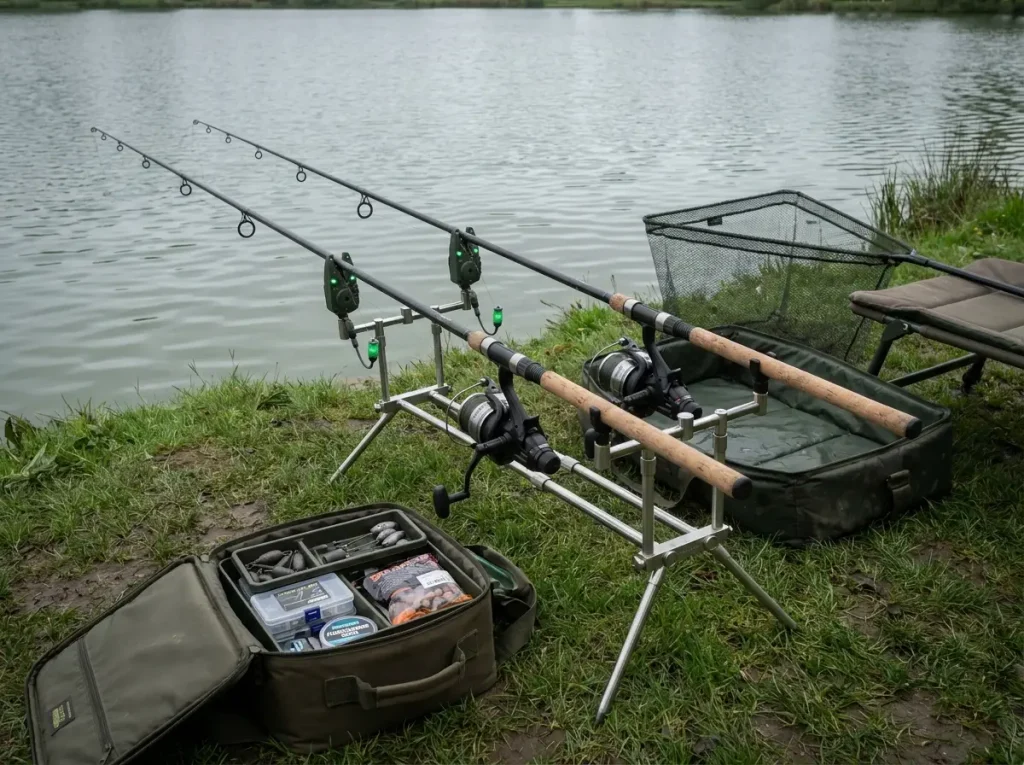
Three pieces of gear separate responsible carp anglers from everyone else. An unhooking mat protects the fish’s slime coat and scales during handling — carp are heavy, and dropping one on rocks or gravel causes real injury. A large rubber-mesh landing net with at least a 42-inch arms spread prevents the damage that knotted nylon nets cause. And a pair of forceps makes hook removal fast and clean.
Bite alarms aren’t required, but they free you to fish multiple rods without staring at your line for hours. Set them between the rod butt and front rest — they’ll beep when line pulls through the sensor.
Bait Selection and Presentation Tactics
Boilies, Sweet Corn, and Pack Bait
Three baits account for 90% of carp caught in North America.
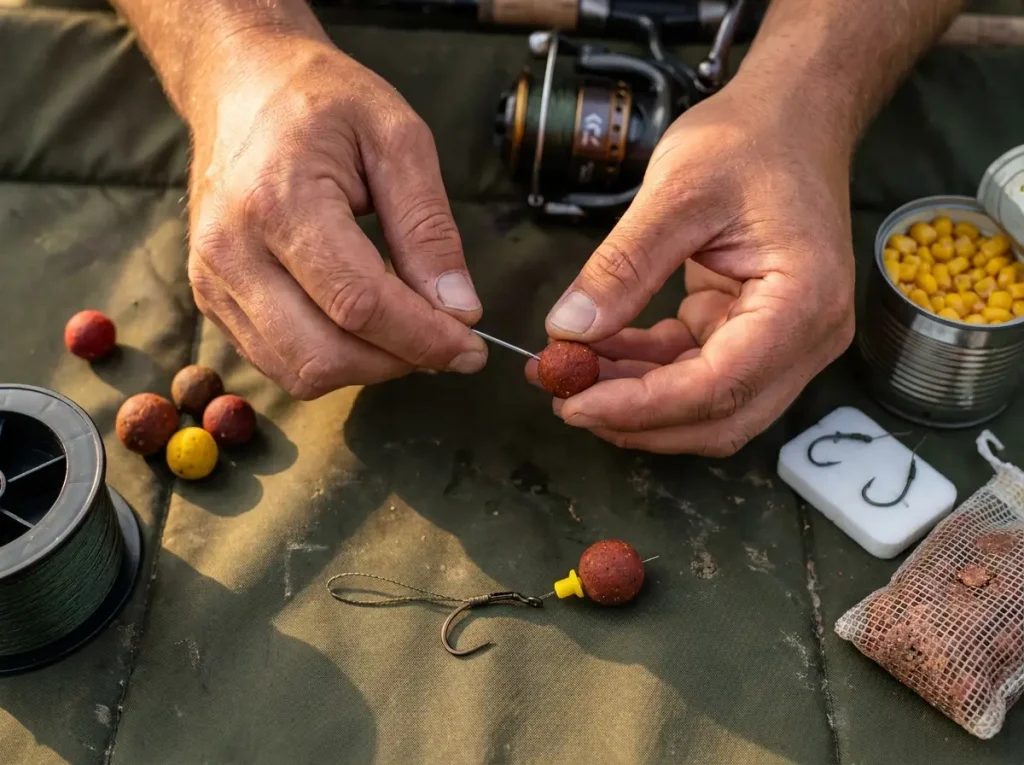
Boilies are the gold standard in Europe and increasingly popular here. Made from a base of fishmeal, eggs, and amino acid attractants, they’re boiled to harden the outer shell — tough enough to resist bait-stealing turtles and panfish but porous enough to leak scent steadily. Sizes from 14mm to 20mm cover most situations.
Sweet corn is the entry-level carp bait that never stops producing. Canned sweet corn has the right combination of sugars, amino acids, and salt to trigger feeding responses. A $1 can of corn will catch more carp than a $15 bag of soft plastics will catch bass. Thread kernels on a hair rig or directly on the hook — both work.
Pack bait (also called method mix) is a moldable paste that you compress around a weighted method feeder. It breaks apart slowly on the bottom, creating a concentrated feeding zone around your hookbait. The concept is simple: surround your hook with free food so the carp has to sort through it, and the hook finds a lip.
The Hair Rig and Method Feeder
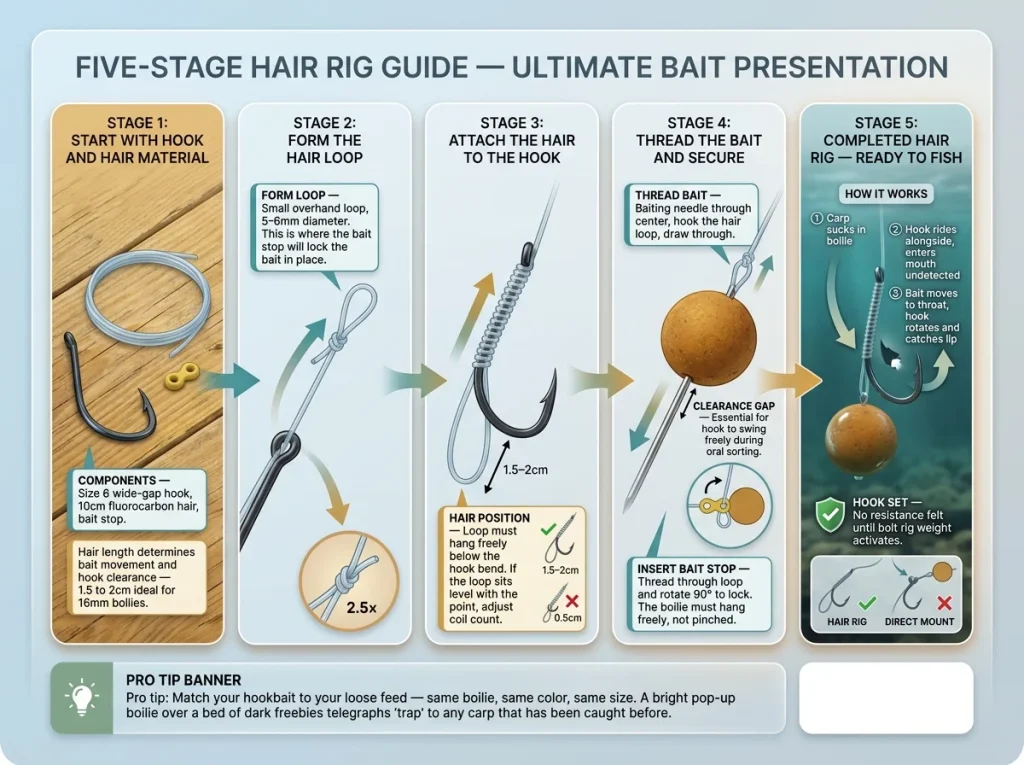
The hair rig is the single most effective carp rig ever invented, and it works because of the fish’s oral sorting behavior. Instead of threading the bait directly onto the hook, you mount it on a short piece of line (the “hair”) extending from the hook shank. When a carp sucks in the bait, the hook rides alongside it undetected. The fish sorts the bait toward the back of its mouth, and the hook catches the lip on the way in.
Tie a small loop at the end of the hair, push the baiting needle through your boilie or corn stack, hook the loop, and pull the bait down. Secure with a bait stop. The hook should hang freely about half an inch below the bait.
The method feeder combines the hair rig with a built-in chum delivery system. Pack your method mix around the feeder frame, press your hookbait into the surface, and cast. As the mix dissolves, it creates a scent trail and free food halo directly around your hook. It’s one of the most efficient carp presentations because bait and rig arrive together.
Pre-Baiting Strategy
Pre-baiting means introducing free food to your swim for one to two days before fishing it. The idea is straightforward — create a reliable food source that draws carp in and builds their confidence so they feed without caution when you finally present a hook.
Start small. A handful of boilies or two cups of corn scattered at dusk is enough. Carp remember productive feeding spots and return to them. On pressured waters, this single tactic can make the difference between blanking and catching because the fish associate your swim with safe, easy food.
The mistake most beginners make is dumping too much bait at once. On busy or pressured waters, heavy feeding can scatter carp before you get a rig in the water. Let the fish tell you what they want — start light and add more only when you see signs of confident feeding.
Pro tip: Match your hookbait exactly to your loose feed — same size, same color. Carp learn fast on pressured water. A bright pop-up boilie sitting on top of a bed of dark freebies screams “trap” to a fish that’s been caught before.
For cross-species perspective on bottom-feeding presentations, the same principles apply to bottom-feeding tactics that work across species.
Sight Fishing and Stalking Carp
Reading the Water for Tailing and Mudding Fish
Fly anglers call carp “golden bonefish” for a reason. Sight fishing for carp on shallow flats is one of the most exciting and underrated approaches in freshwater fishing, and it’s virtually absent from mainstream US angling content.
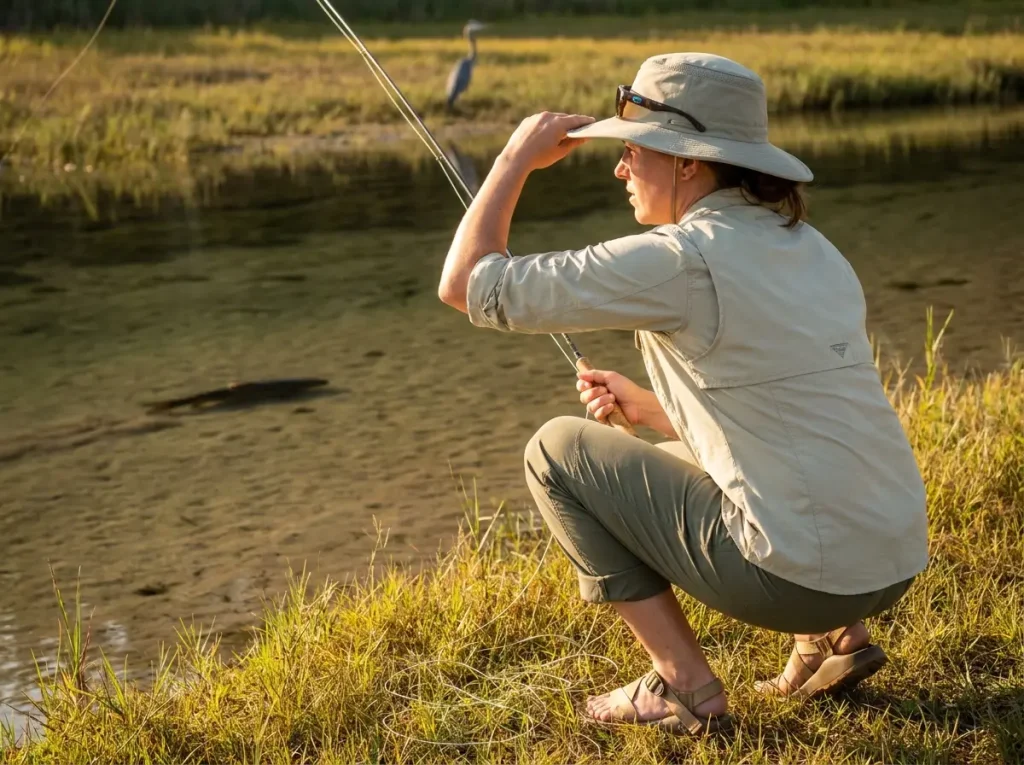
You’re looking for three visual cues. Tailing — the carp’s tail breaks the surface while it feeds head-down in shallow water, sometimes waving slowly like a golden flag. Mudding — turbidity plumes rising from the bottom where a feeding carp is rooting through sediment. And cruisers — dark torpedo shapes moving slowly along the bank or across a flat, often just inches below the surface.
The best flats are 1 to 3 feet deep with good water clarity and a tan or sandy bottom that makes dark fish shapes easy to spot. Creek mouths, sheltered bays, and lake margins where wind pushes warm surface water into the shallows all concentrate carp during morning feeding windows.
The Approach and Cast
Stalking carp is no different than stalking bonefish or redfish on a saltwater flat. Stay low. Step softly — carp detect vibration through the substrate far better than most anglers expect. Keep the sun at your back to improve visibility and hide your silhouette.
Never cast at a carp. Cast where the carp will be. Lead a cruising fish by 3 to 5 feet and let it swim to your bait. A fly or bait landing on a carp’s head ends the game instantly — they spook hard and fast in shallow water, and once one bolts, every carp on the flat knows something is wrong.
This works with conventional tackle too. A float rig with sweet corn suspended just off the bottom, cast ahead of a visible cruiser, is devastatingly effective. For fly anglers, a 7 to 9-weight rod with Woolly Buggers, Mop Flies, or crayfish patterns in sizes 2 through 8 covers most situations. Soft presentations matter more than fly selection — the fish care more about how the offering arrives than exactly what it looks like.
Conservation, Harvest Ethics, and the Invasive Reality
Ecological Impact on Native Ecosystems
Common carp do real damage to the waters they inhabit. Their benthic rooting uproots aquatic vegetation, increases turbidity, releases sediment-bound phosphorus, and triggers algal blooms that choke out native plant life. According to research from the Minnesota Aquatic Invasive Species Research Center, over 70% of lakes in southern Minnesota have lost their aquatic plant cover — carp foraging is a primary driver.
The downstream effects cascade through the ecosystem. Without vegetation, waterfowl lose nesting habitat. Native fish species that depend on clear water and plant structure — like bluegills, largemouth bass, and northern pike — decline as their habitat degrades. A single heavy carp population can shift an entire lake from clear-water state to turbid-water state, and that shift is hard to reverse.
Harvest, Regulations, and Bowfishing
Here’s the uncomfortable truth that catch-and-release culture doesn’t want to discuss: in most US waters, keeping that carp is the more responsible choice. Many states actively encourage or require carp harvest. Some have no-release regulations — once you catch a carp, it stays on the bank.
Bowfishing tournaments have emerged as a popular removal tool, combining sport with conservation. Events like annual carp slams can remove thousands of pounds of biomass from a single lake in a weekend. The U.S. Fish & Wildlife Service’s invasive carp management program has invested nearly $19 million across 18 state partners for targeted removal and population control.
Carp are also edible — they’ve been a food fish for thousands of years in Europe and Asia. The flesh is firm and mild when prepared properly, though the Y-bones require scoring or pressure cooking to soften. Smoked carp is a delicacy in many Eastern European traditions.
How Anglers Can Help
Every angler who spends time on the water is an early detection system for new carp introductions. Report carp sightings in waters where they haven’t been documented before — your state fish and wildlife agency needs those observations.
If you’re fishing waters with established carp populations, consider harvesting rather than releasing. Support local bowfishing events and carp removal tournaments. And never transport live carp between water bodies — it’s not only irresponsible, it’s against regulations in most states. For a detailed look at what works for reducing carp biomass in managed lakes, read about carp removal methods that actually restore lake ecosystems.
Conclusion
Three things change everything about how you approach common carp. Their sensory biology — taste buds across the entire body, olfactory sensitivity at parts per trillion — explains why amino-acid-based baits outperform generic offerings. Stop guessing and start matching the fish’s chemistry.
Water temperature is your location compass. Follow the thermometer: 46°F gets them moving, 55–75°F is the feeding zone, and two daily peaks (morning and evening) concentrate the action. Knowing these thresholds puts you on fish when other anglers are still searching.
In most US waters, harvesting carp is conservation — not waste. These fish reshape ecosystems, and responsible anglers have a role in managing their impact. Next time you spot a bronze back rolling in the shallows, rig up and make a cast. The fight alone is worth it.
Q1 What is the best bait for common carp?
Boilies and sweet corn are the two most reliable baits for common carp across all conditions. Boilies contain amino acid attractants that match the carp’s chemosensory system, while canned sweet corn provides a cheap alternative with natural sugars and amino acids that trigger feeding responses. Present either on a hair rig for the best hookup ratio.
Q2 Are common carp good to eat?
Common carp have firm, mild flesh and have been eaten across Europe and Asia for centuries. The main challenge is the Y-shaped intramuscular bones, which you can manage by scoring the fillets deeply before frying or pressure cooking to soften them. Smoked carp is widely considered a delicacy.
Q3 How big do common carp get?
Most common carp in North American waters weigh between 1 and 10 pounds, but fish over 30 pounds are caught regularly in productive lakes and reservoirs. The species can exceed 80 pounds in ideal conditions, with the world record standing at over 100 pounds from European waters.
Q4 Why are common carp considered invasive?
Common carp uproot aquatic vegetation, increase water turbidity, and release sediment-bound nutrients that fuel algal blooms. Over 70% of lakes in southern Minnesota lost plant cover partly due to carp foraging. Their reproductive capacity — up to 3 million eggs per female — lets populations grow fast enough to reshape entire lake ecosystems.
Q5 What time of year is best for carp fishing?
Spring and early fall produce the most consistent carp fishing. In spring, carp move into warming shallows once water hits 46°F and feed aggressively before spawning. Fall triggers a second feeding surge as fish build energy reserves before winter. Summer is productive too, especially during the morning and evening feeding windows when temperatures moderate.
Risk Disclaimer: Fishing, boating, and all related outdoor activities involve inherent risks that
can lead to injury. The information provided on Master Fishing Mag is for educational and informational purposes
only. While we strive for accuracy, the information, techniques, and advice on gear and safety are not a substitute
for your own best judgment, local knowledge, and adherence to official regulations. Fishing regulations, including
seasons, size limits, and species restrictions, change frequently and vary by location. Always consult the latest
official regulations from your local fish and wildlife agency before heading out. Proper handling of hooks, knives,
and other sharp equipment is essential for safety. Furthermore, be aware of local fish consumption advisories. By
using this website, you agree that you are solely responsible for your own safety and for complying with all
applicable laws. Any reliance you place on our content is strictly at your own risk. Master Fishing Mag and its
authors will not be held liable for any injury, damage, or loss sustained in connection with the use of the
information herein.
Affiliate Disclosure: We are a participant in the Amazon Services LLC Associates Program, an
affiliate advertising program designed to provide a means for us to earn advertising fees by advertising and linking
to Amazon.com. As an Amazon Associate, we earn from qualifying purchases. We also participate in other affiliate
programs and may receive a commission on products purchased through our links, at no extra cost to you. Additional
terms are found in the terms of service.