
In this article
Most anglers can’t tell a chain pickerel from a small pike. I’ve watched people at boat ramps argue about it while the fish dries out in the sun. Worse, the ones who do recognize pickerel usually fish for them wrong — too deep, too slow, wrong leader. After years of pulling these things out of every weedy pond from Connecticut to the Carolinas, here’s what I’ve learned that most people get backwards.
Quick Answer: The chain pickerel (Esox niger) is an aggressive ambush predator found in weedy shallows across the eastern United States, identified by its distinctive chain-link body markings and dark vertical bar under the eye. Most anglers confuse them with small northern pike, fish too deep for them, and skip the wire leader that their razor-sharp teeth demand. Below you’ll find the field identification tricks, seasonal patterns, and tackle setups that actually produce consistent catches.
What Exactly Is a Chain Pickerel
Pike Family Basics
The chain pickerel belongs to the Esox genus — the same family that includes northern pike, muskellunge, and two smaller cousins, the grass pickerel and redfin pickerel. The Latin name Esox niger translates roughly to “dark pike,” which is fitting considering how often anglers confuse the two. If you’ve ever caught a northern pike or read about muskellunge biology and fishing tactics, you’ll recognize the family resemblance — long body, duck-bill snout, ambush hunting style.
But pickerel are their own animal. They’re smaller, more widespread, and honestly more willing to eat than either of their bigger cousins.
Physical Features That Matter
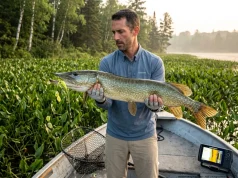
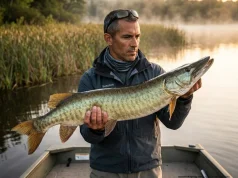
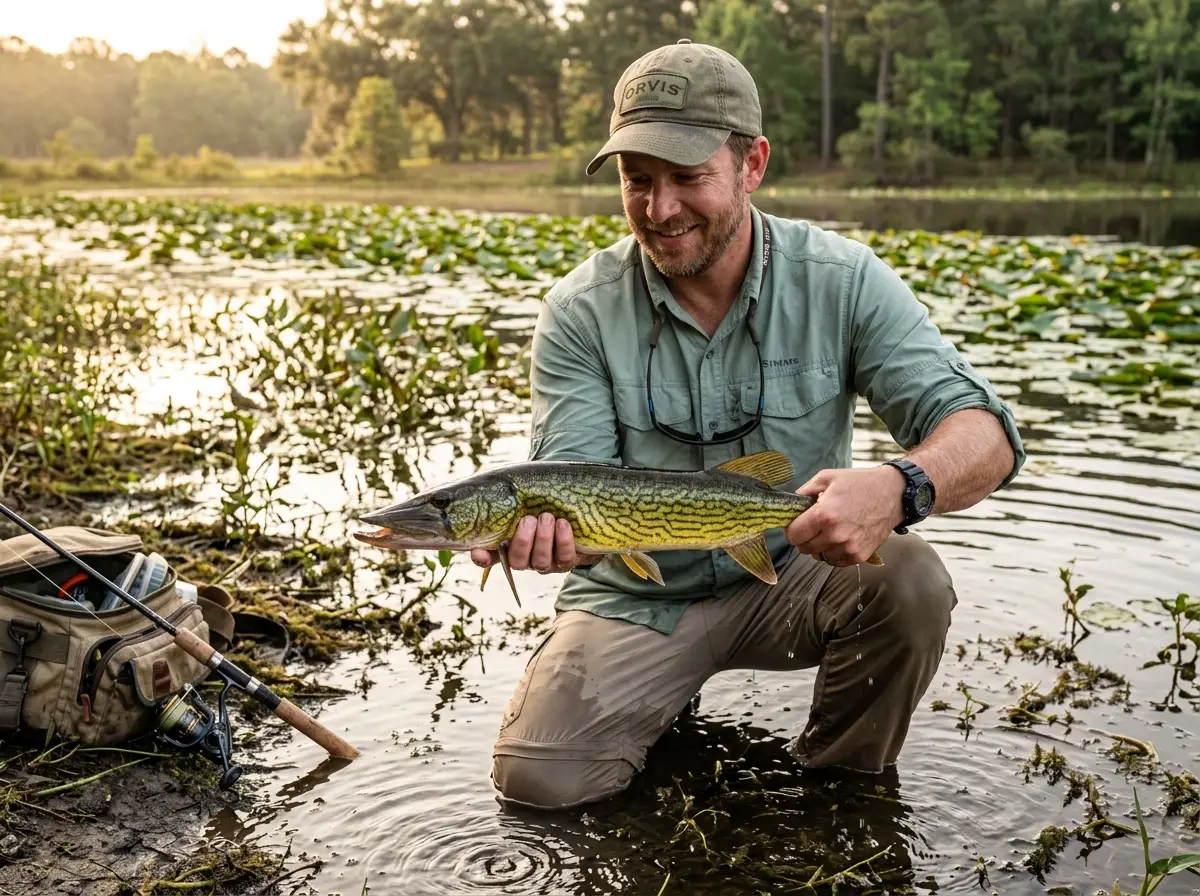
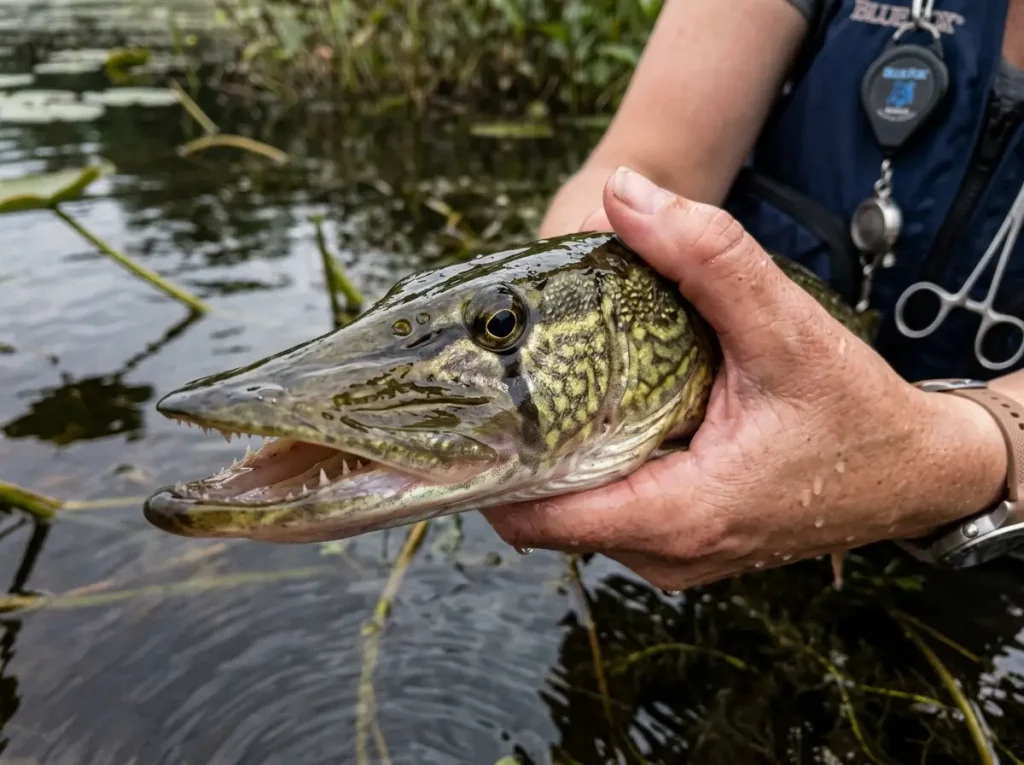
Chain pickerel get their name from the dark chain-link pattern that covers their olive-green to yellow-green sides. No other Esox species has this marking. They have a bright yellow belly, an elongated snout that earned them the nickname “duck-billed pike,” and a dark vertical bar running straight down from each eye.
The average chain pickerel you catch runs under 2 pounds and measures 15 to 20 inches. Anything over 26 inches is genuine trophy territory. The all-tackle world record — 9 pounds, 6 ounces — was caught by Baxley McQuaig Jr. in Homerville, Georgia back in 1961. That record has stood for over 60 years, which tells you something about how rarely these fish reach that size.
Anglers have given them a pile of nicknames: “jacks” down South, “federation pike” in New England, and my personal favorites — “snot rockets” and “slime darts” — courtesy of their heavy slime coat that leaves your hands looking like you reached into a bucket of wallpaper paste.
Where They Live
Chain pickerel range from southern Maine to Florida along the Atlantic Slope, west through the Gulf states to eastern Texas, and up the Mississippi Basin into Missouri. Introductions have pushed them into parts of the Great Lakes and even Colorado. The USGS Nonindigenous Aquatic Species database tracks both their native and introduced range, and it’s impressive how far these fish have spread.
What makes their range even more interesting is where they thrive. Chain pickerel tolerate warm water up to 80°F, high acidity, and even brackish water. They live happily in bog ponds, swamps, and coastal backwaters that would stress most gamefish. If there’s vegetation and shallow water, pickerel probably live there.
How to Tell Chain Pickerel From Pike and Other Look-Alikes
The Cheek and Gill Cover Test
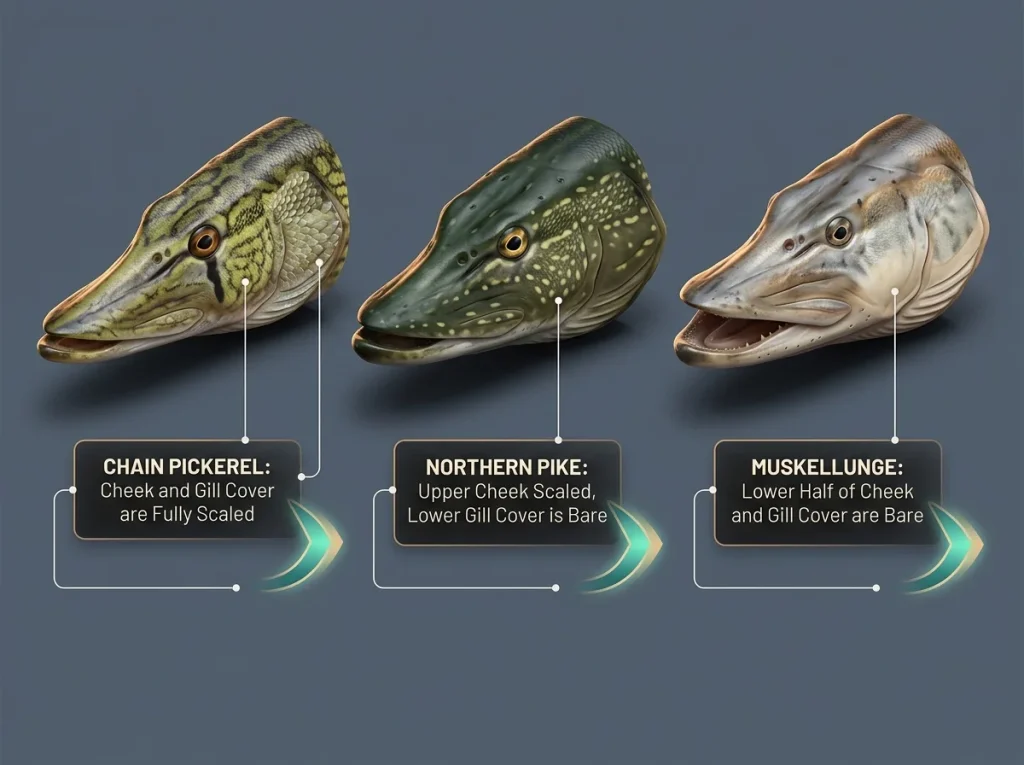
This is the single most reliable field identification method, and it takes about two seconds. Chain pickerel have fully scaled cheeks AND fully scaled gill covers. Every scale is present, top to bottom.
Northern pike have scaled cheeks but the lower half of their gill cover (operculum) is bare — no scales. Muskellunge take it further — the lower half of both the cheek AND the gill cover are bare.
That’s it. Hold the fish, look at the gill plate. Fully scaled means pickerel. Partially bare means pike or muskie. You’ll never misidentify one again. According to the University of Michigan’s Animal Diversity Web, this diagnostic is consistent across the species’ entire range.
Eye Bar and Body Markings
The dark bar under the eye is another quick tell. On a chain pickerel, that bar drops straight down vertically from the eye. On a grass pickerel, the bar curves backward toward the tail. On northern pike, there’s no distinct bar — instead, you’ll see light yellowish spots on a dark green background, the opposite of pickerel’s dark markings on a light background.
Most misidentifications happen with small pike under 18 inches. At that size, a young pike can look eerily similar to a big pickerel until you check the gill cover.
Lateral Scale Count
If you really want to be sure, count the scales along the lateral line. Chain pickerel have 120 to 135 lateral scales. Grass and redfin pickerel have fewer than 117. Any pickerel showing more than 120 lateral scales is a chain pickerel, confirmed.
Most anglers won’t bother counting scales on the water. But it’s worth knowing for that one fish that has you scratching your head. Knowing how to hold a fish properly while you’re examining it makes the whole process easier on both you and the fish.
Where to Find Chain Pickerel Year-Round
Reading Vegetation for Pickerel
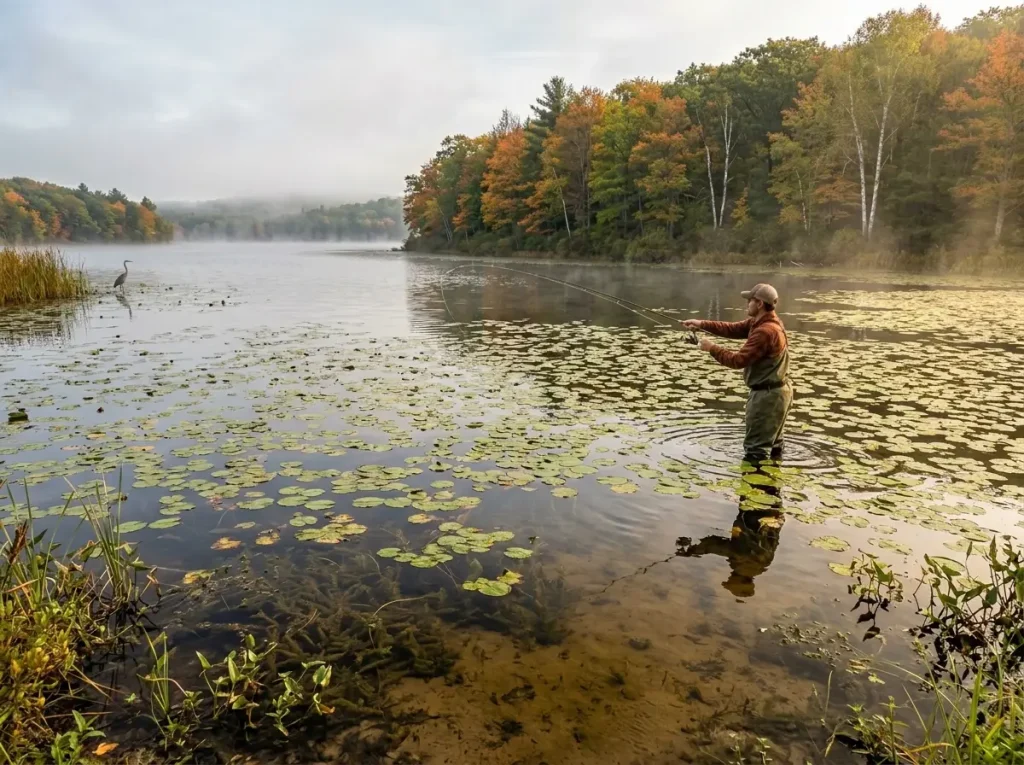
Pickerel are vegetation-oriented ambush predators. They don’t just hang near weeds — they sit inside them, motionless, facing outward toward open water, waiting for something edible to swim past. Dense vegetation types like lily pads, coontail, and milfoil all hold pickerel, but the key is finding cover dense enough for an ambush and open enough for a strike.
The edges of lily pad beds are classic spots. So are the inside pockets — those small clearings within a weed bed where a fish can explode outward in any direction. If you’re fishing for bass in shallow weed beds, you’ve been fishing near pickerel the whole time.
Seasonal Movements
This is where most articles get it wrong. They’ll say “pickerel live in shallow weeds” and leave it there. The reality is more nuanced.
Spring: When water temperatures hit the mid-to-high 40s°F, prespawn pickerel start feeding aggressively in the shallowest water available — often less than two feet deep. Spawning happens around 50°F. Females deposit up to 50,000 eggs in ribbon-like strips that adhere to submerged structure. No nest, no parental care.
Summer: As temperatures climb past 75°F, pickerel push to the edges of weed beds or tuck under lily pad canopies where shade keeps the water slightly cooler. Some move to deeper weed lines — 8 to 10 feet — but they rarely abandon vegetation entirely.
Fall: Cooling water triggers aggressive feeding as pickerel bulk up for winter. They move to the outside edges of weed beds where they can intercept baitfish moving through. This mirrors the fall pike fishing temperature playbook — related species, similar seasonal instincts.
Winter: Here’s the counterintuitive part. While bass, crappie, and most gamefish go deep and slow, pickerel move shallower. They’re often in 2 to 3 feet of water, actively feeding when water temperatures are in the 30s and 40s. They’re one of the few freshwater species that remain genuinely aggressive through winter.
Water Conditions They Tolerate
Chain pickerel are survivors. They handle warm water up to 80°F, high acidity that would stress bass, and even brackish coastal water. They’ve been documented entering saltwater in winter. If a body of water has vegetation and stays between freezing and 80°F, pickerel can live there.
Pro tip: When every other species shuts down in January, find a shallow, weedy pond and throw a jerkbait. Pickerel are in 2 feet of water, ready to eat. They’ll save your winter.
Tackle and Rigging for Chain Pickerel
Rod, Reel, and Line
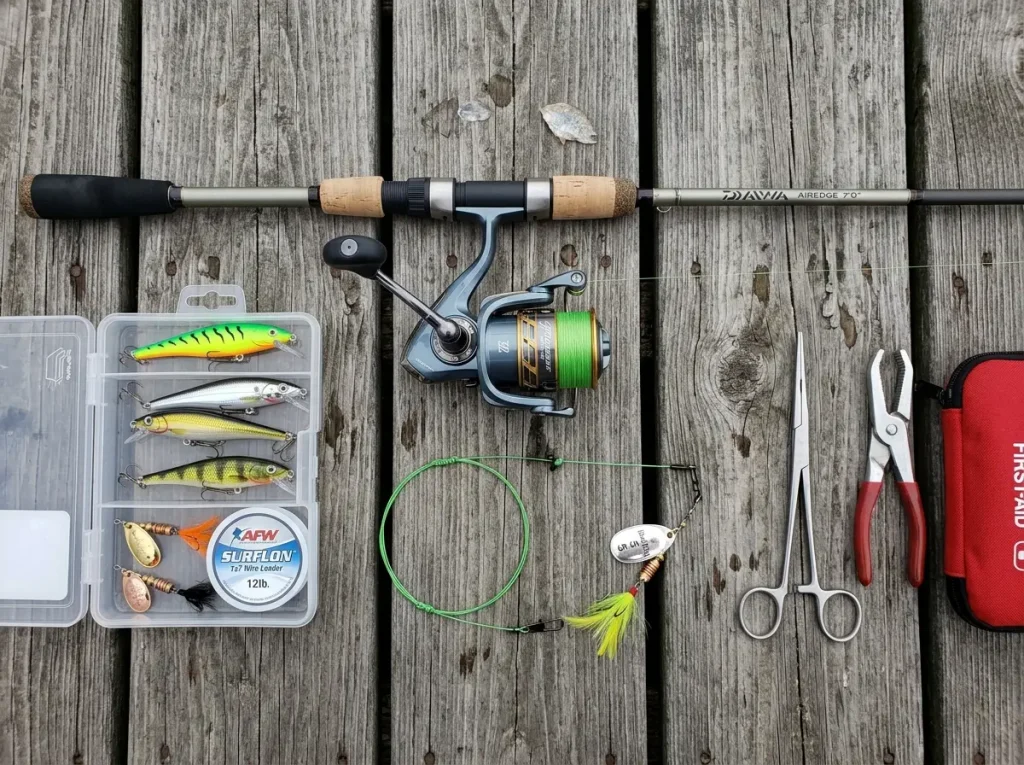
Your bass gear works fine. A 6- to 7-foot medium-light to medium action spinning rod paired with a spinning reel spooled with 8- to 12-pound monofilament or braided line covers everything. Nothing special needed.
The Wire Leader Question
This is non-negotiable. Chain pickerel have rows of needle-sharp teeth that slice through fluorocarbon — even 50-pound test — like it’s dental floss. You will lose fish and lures without a wire leader.
The best option is knottable steel wire leaders originally designed for fly fishing. Brands like AFW Surflon Nitro Extreme and Cortland Tie-able Stainless Leaders tie directly to your main line with standard knots. No crimps, no bulk. And here’s the thing — bass and other species don’t seem to mind them at all.
A 20-pound fluorocarbon shock leader works as a middle-ground option, but expect occasional bite-offs. If you’re serious about targeting pickerel, go steel.
Pro tip: Fly anglers figured this out years ago. Knottable steel wire works on spinning gear rigs too, and the fish don’t care.
Hook Selection
Single-hook lures — spinnerbaits, bladed jigs, inline spinners — make unhooking a toothy pickerel dramatically easier than treble-hook jerkbaits. If you’re planning to release the fish (and you should), single hooks reduce handling time and injury to both the fish and your fingers.
Best Lures and Presentations for Chain Pickerel
Jerkbaits and Inline Spinners
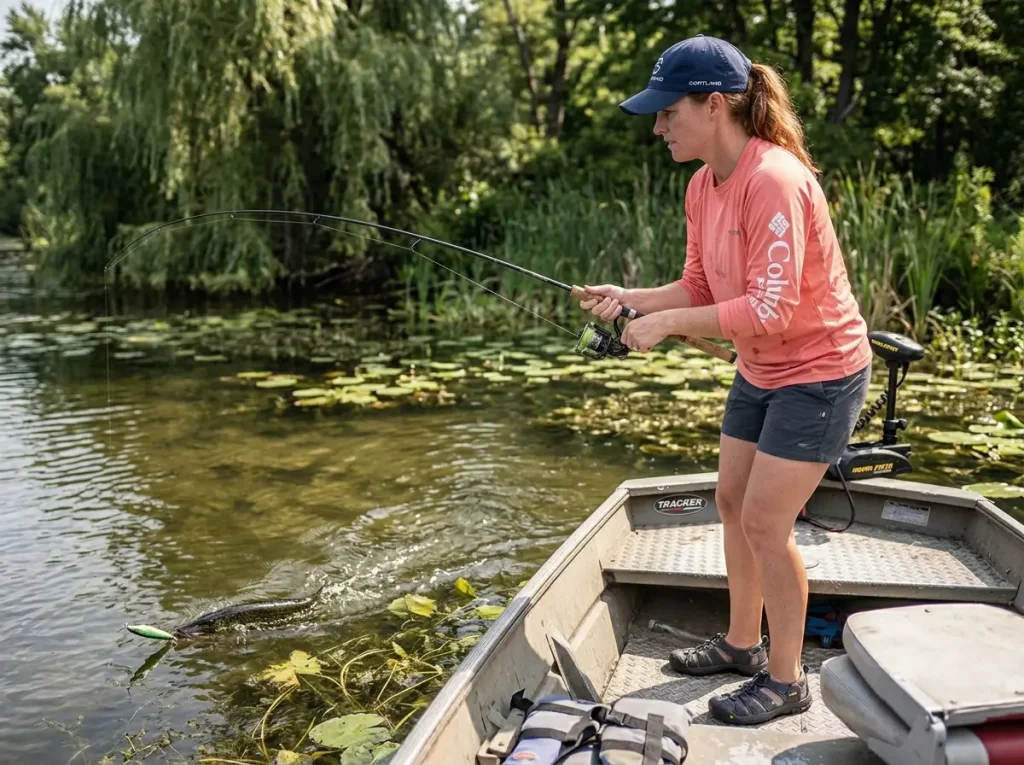
The Rapala X-Rap in size 8 or 10 is the gold standard for pickerel jerkbaits. The erratic darting action on the twitch triggers strikes, and the suspending design lets following fish commit during the pause. Use size 8 minimum — anything smaller gets swallowed whole, and you’re out a $10 lure. For more on getting the pause timing right, check out this breakdown on jerkbait cadence tips.
Blue Fox Vibrax inline spinners in size 4 to 6 with a feathered tail are the other go-to. The oversized blade throws a lot of vibration, and the feathered tail adds action that triggers both active and sluggish fish.
Soft Plastics and Swimbaits
A Keitech Easy Shiner (4-inch) or Keitech Fat Swing Impact (3.8-inch) on a 1/4-ounce ball head jig glides beautifully over submerged vegetation. The paddle tail action mimics a wounded baitfish — exactly what a pickerel wants to see. When fishing heavy vegetation, switch to weedless swimbait jigheads to avoid constant snags.
Topwater and the Double-Strike
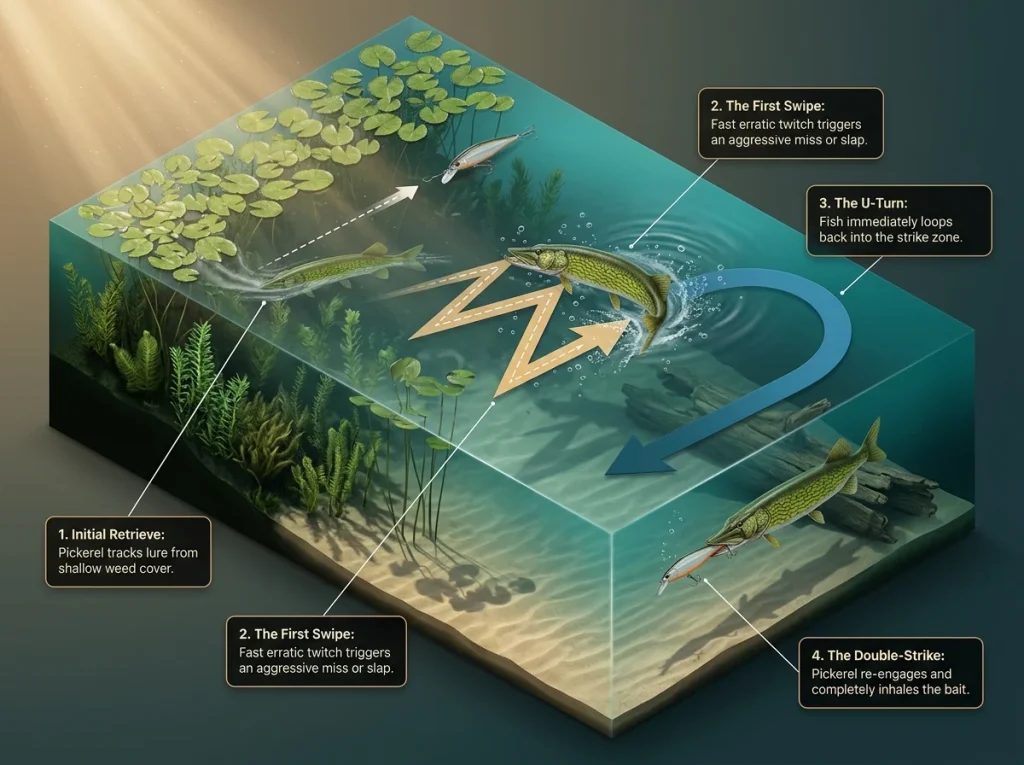
This is where pickerel fishing gets exciting. Surface lures — poppers, Gurglers, Dahlberg Divers — draw explosive strikes from pickerel hiding in weed beds. You’ll see the v-wake shoot out of the vegetation before the hit. The impact is violent, splashy, and addictive.
But here’s the thing most anglers learn the hard way: don’t set the hook on the first strike. Pickerel frequently miss the lure or slap it without getting hooked on the initial attack. Wait. They almost always turn and hit it again within a second or two. The double-strike is one of pickerel fishing’s signature moments.
Pro tip: If a pickerel follows your bait to shore or the boat and turns away, throw back immediately to the same spot with a faster, more erratic retrieve. They almost always commit on the second cast.
How to Handle and Unhook Chain Pickerel Safely
The Gill Plate Grip
Everyone warns you about pickerel teeth. Nobody explains what to actually do when you’ve got a thrashing, slime-covered fish at the end of your line.
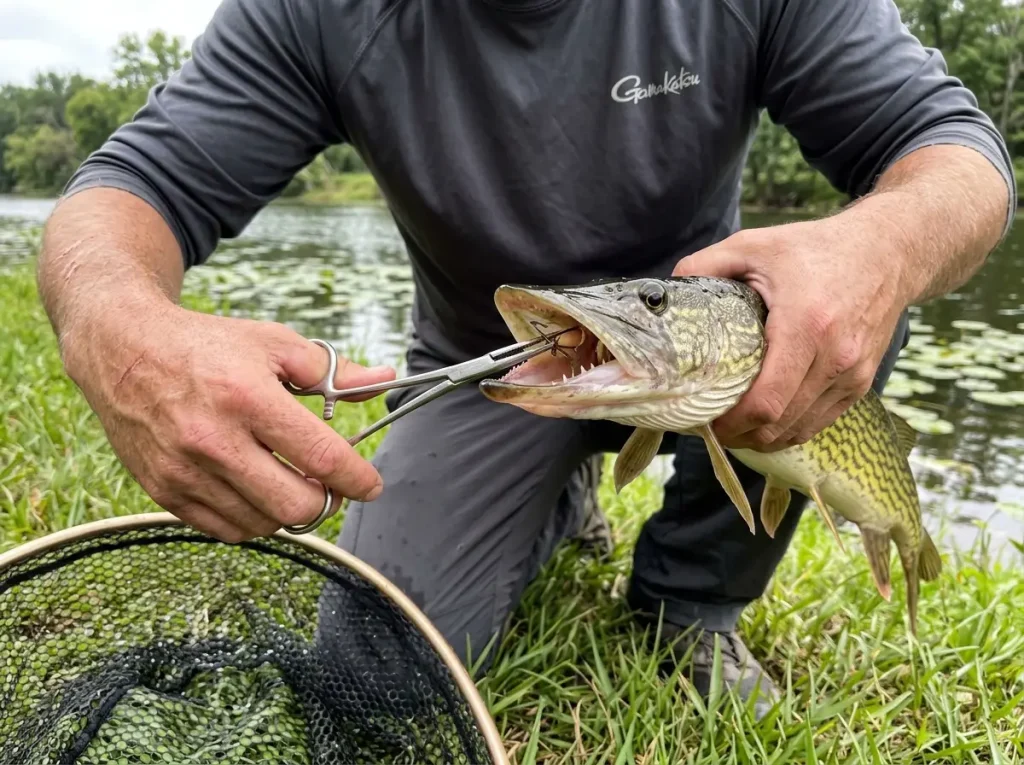
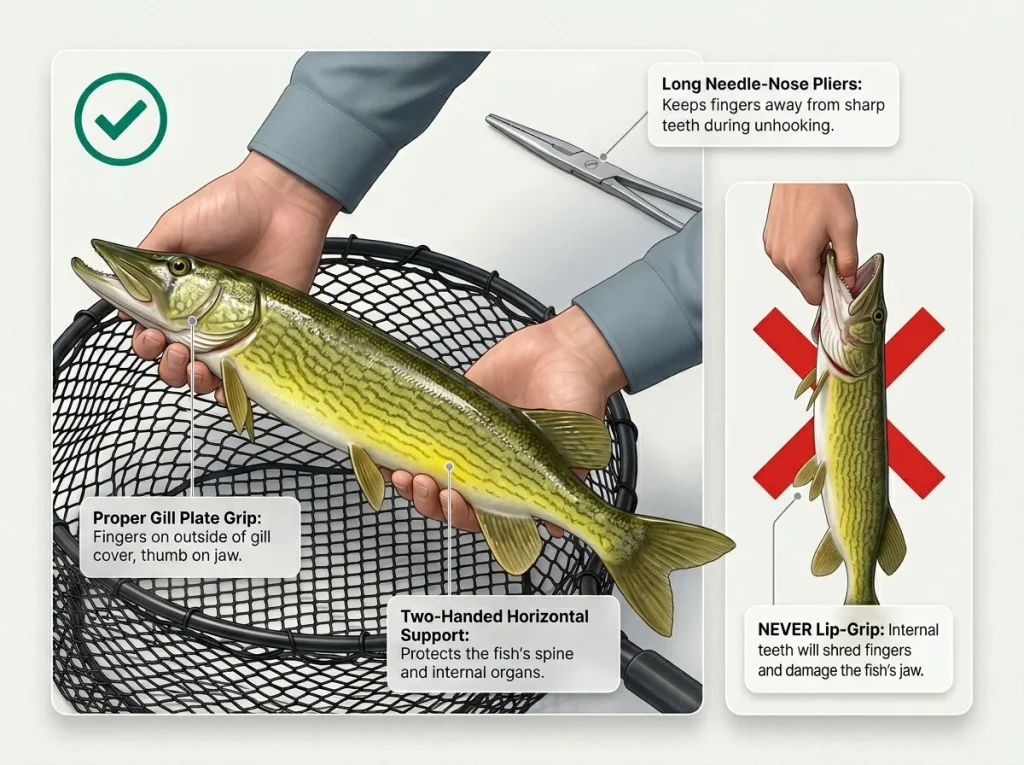
First rule: never lip-grip a pickerel like a bass. Those teeth will shred your thumb before you can react. Instead, grip the fish firmly by the edge of the gill plate — your fingers on the outside of the operculum, thumb braced against the jaw. Immediately slide your other hand under the belly to support the fish horizontally.
If the fish thrashes, gentle steady pressure on the gill plate edge usually calms them. Don’t squeeze — just hold firm. The technique is identical to handling pike and musky without getting shredded, just on a smaller scale.
Unhooking Tools
You need long needle-nose pliers — 8 inches minimum. The 4-inch pocket pliers in your vest won’t cut it. Long hemostats work even better for reaching deep hooks. A jaw spreader is worth carrying if you fish for pickerel regularly, because they clamp down hard and don’t always feel like opening up.
Barbless hooks on jerkbaits and spinners turn unhooking into a 30-second operation instead of a 3-minute wrestling match. If you won’t go barbless, at least crimp the barbs flat with pliers before tying on.
Catch-and-Release Best Practices
Minimize air exposure. Wet your hands before touching the fish — their slime coat protects against infection, and dry hands strip it off. Use a rubber mesh net, which does far less damage to the slime coat than nylon netting.
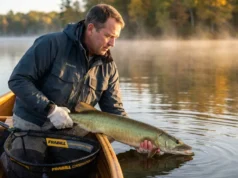
For photos, the 3-2-1 rule works well: prepare the shot first, lift the fish, get the photo in under 10 seconds, and put the fish back in the water. Hold horizontally. Support the belly. Keep it quick. Ethical fish photography makes a difference when every fish goes back.
Pro tip: Barbless hooks on inline spinners make unhooking a 30-second job. The fish barely leaves the water. If you’re serious about catch-and-release with toothy species, this is the single biggest change you can make.
Why Chain Pickerel Deserve More Respect
The Winter Savior
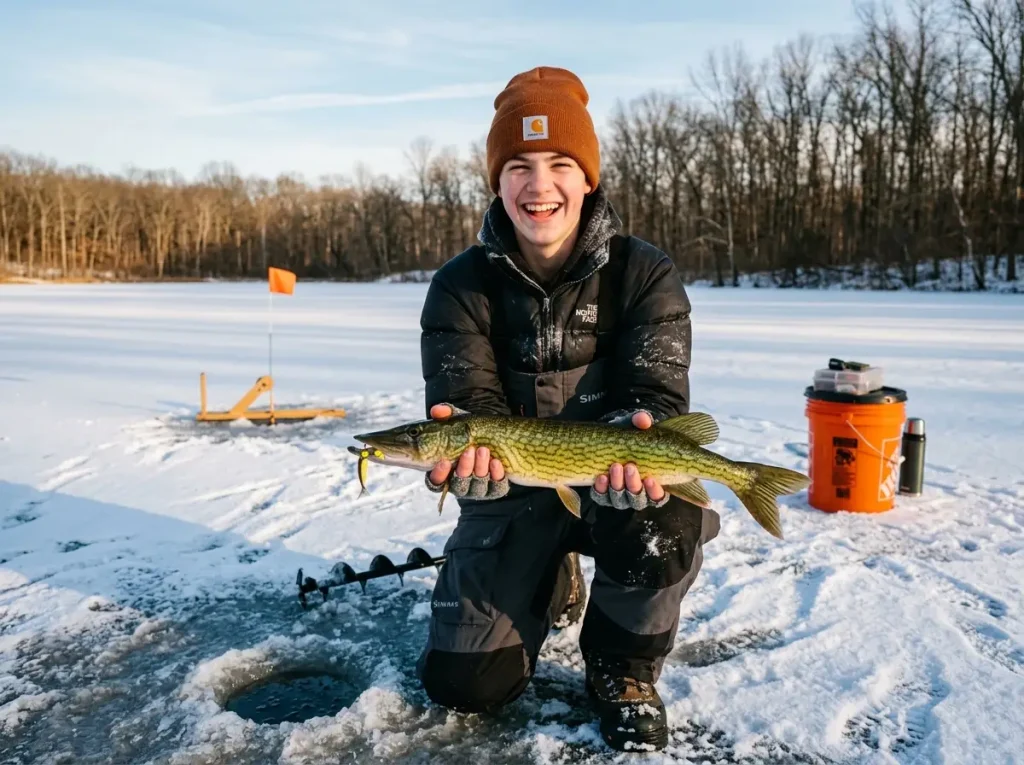
When bass go deep and lock-jawed, when crappie suspend in the thermocline somewhere unreachable, when trout streams are frozen over — pickerel are still eating. They’re one of the only freshwater gamefish that remain genuinely aggressive through winter.
Ice fishing for pickerel on tip-ups is an underrated winter activity across the Northeast. Set a live minnow under a tip-up flag in 3 feet of water near remaining vegetation, and you’ll have action that no other species can match in January. For open-water situations, the same winter bank fishing cold-water tactics that work for sluggish bass produce even better results on pickerel because they’re actively hunting while everything else sleeps.
Accessibility
You don’t need a $50,000 bass boat, side-imaging electronics, or tournament-level skill. Pickerel live in every pond, lake, and backwater on the East Coast. A spinning rod, a wire leader, a jerkbait, and a pair of wading boots are all it takes.
As one charter captain puts it: “A good bite’s where you find it.” Chain pickerel are the antidote to the skunk — the fish that reminds you why you went fishing in the first place. Whether you’re teaching a kid to fish or filling a slow January afternoon, they’ll always cooperate.
Respecting the resource matters with every species. Proper handling, quick release, and understanding your role in fish conservation apply as much to a 2-pound pickerel as to a 10-pound bass.
Conclusion
Chain pickerel are one of freshwater fishing’s best-kept secrets — aggressive, accessible, and active when nothing else bites. Three things to take from this:
Learn the cheek test. Fully scaled cheek and gill cover means pickerel. That two-second check ends the identification guessing game forever.
Wire leader, erratic retrieve, shallow weeds. That’s the formula. A Rapala X-Rap or Blue Fox Vibrax on a knottable steel leader, twitched through 2 to 8 feet of vegetation, catches pickerel year-round.
Stop treating them as a nuisance. Pickerel are the most willing fighters in freshwater. They eat when nothing else will, they live everywhere, and they’ll remind you why you started fishing in the first place.
Next time you see weedy shallows that look too thin for bass, throw a jerkbait in there. A pickerel is probably watching.
Q1 What is the difference between a chain pickerel and a northern pike?
Chain pickerel have fully scaled cheeks and gill covers with dark chain-link markings on a light background, plus a vertical dark bar under the eye. Northern pike have bare lower gill covers and light spots on a dark background. Pickerel average 1-3 pounds while pike commonly exceed 10.
Q2 Are chain pickerel good to eat?
Chain pickerel have mild, flaky white meat similar to pike. The main challenge is Y-bones — small forked bones throughout the fillets. Score the fillets in a crosshatch pattern before frying to cut through the bones, or pickle them to soften the Y-bones completely.
Q3 What is the best bait for chain pickerel?
Jerkbaits like the Rapala X-Rap in size 8-10 and inline spinners like the Blue Fox Vibrax in size 4-6 are the top producers. Live minnows on a wire leader work well too, especially through the ice in winter.
Q4 Where do chain pickerel live?
Chain pickerel live in weedy shallows of lakes, ponds, swamps, and slow rivers from Maine to Florida and west to Texas. They prefer 2-10 feet of vegetated water and tolerate warm temperatures, high acidity, and even brackish coastal water.
Q5 How big do chain pickerel get?
Most chain pickerel weigh 1-3 pounds and measure 15-22 inches. A fish over 26 inches is trophy size. The all-tackle world record is 9 pounds 6 ounces, caught in Homerville, Georgia in 1961 by Baxley McQuaig Jr.
Risk Disclaimer: Fishing, boating, and all related outdoor activities involve inherent risks that
can lead to injury. The information provided on Master Fishing Mag is for educational and informational purposes
only. While we strive for accuracy, the information, techniques, and advice on gear and safety are not a substitute
for your own best judgment, local knowledge, and adherence to official regulations. Fishing regulations, including
seasons, size limits, and species restrictions, change frequently and vary by location. Always consult the latest
official regulations from your local fish and wildlife agency before heading out. Proper handling of hooks, knives,
and other sharp equipment is essential for safety. Furthermore, be aware of local fish consumption advisories. By
using this website, you agree that you are solely responsible for your own safety and for complying with all
applicable laws. Any reliance you place on our content is strictly at your own risk. Master Fishing Mag and its
authors will not be held liable for any injury, damage, or loss sustained in connection with the use of the
information herein.
Affiliate Disclosure: We are a participant in the Amazon Services LLC Associates Program, an
affiliate advertising program designed to provide a means for us to earn advertising fees by advertising and linking
to Amazon.com. As an Amazon Associate, we earn from qualifying purchases. We also participate in other affiliate
programs and may receive a commission on products purchased through our links, at no extra cost to you. Additional
terms are found in the terms of service.