

In this article
My field logs from the James River Fall Line tell a brutally honest story. Three hours of soaking pure shrimp oil on a heavy bottom rig in 57-degree water resulted in zero bites. I switched to a suspended drift rig, swapped the congealed oil for a water-soluble amino acid matrix, and had a violent strike in under five minutes. The fish did not magically get hungry in the span of five minutes.
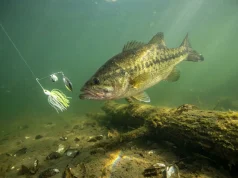
After twenty years guiding and fishing these river systems, I have seen this scenario play out more times than I can count. The aquatic environment is a high-entropy medium that constantly fights against the predator. Depth-induced light attenuation, mud, and heavy turbidity regularly degrade visual signals. This chaotic environment forces predators to rely on a much more dependable data acquisition system.
Most recreational anglers unwittingly sabotage this olfactory process without ever realizing it. You pour expensive oils on your plastics, pin them to the mud, and wonder why the bite shut down. The answer lies in the physics of the water column.
| Fish Olfactory Sensitivity to Amino Acids | |||
|---|---|---|---|
| Species | Key Amino Acid | Molar Detection Threshold | Sensory Classification |
| Channel Catfish | L-Alanine | Trace amounts | Macrosmatic (High Sensitivity) |
| Coho Salmon | L-Serine (Alarm) | Very small amounts | Macrosmatic (High Sensitivity) |
| Largemouth Bass | L-Lysine | Small amounts | Mesosmatic (Moderate Sensitivity) |
| Northern Pike | Cysteine | Moderate amounts | Microsmatic (Low Sensitivity) |
⚡ Quick Answer: Fish detect scent through water-soluble molecules that dissolve and cross the internal filters of their snout. Heavy, hydrophobic oil-based scents fail chemically because they form droplets and float away instead of dispersing cleanly through the water column. To optimize strikes, suspend your baits off the riverbed to clear bottom friction, use water-soluble amino acid gels in cold water, and scrub your hands to remove the repellent skin oils that trigger predator alarms.
The Anatomical Filter: Rosettes, Lamellae, and Nares
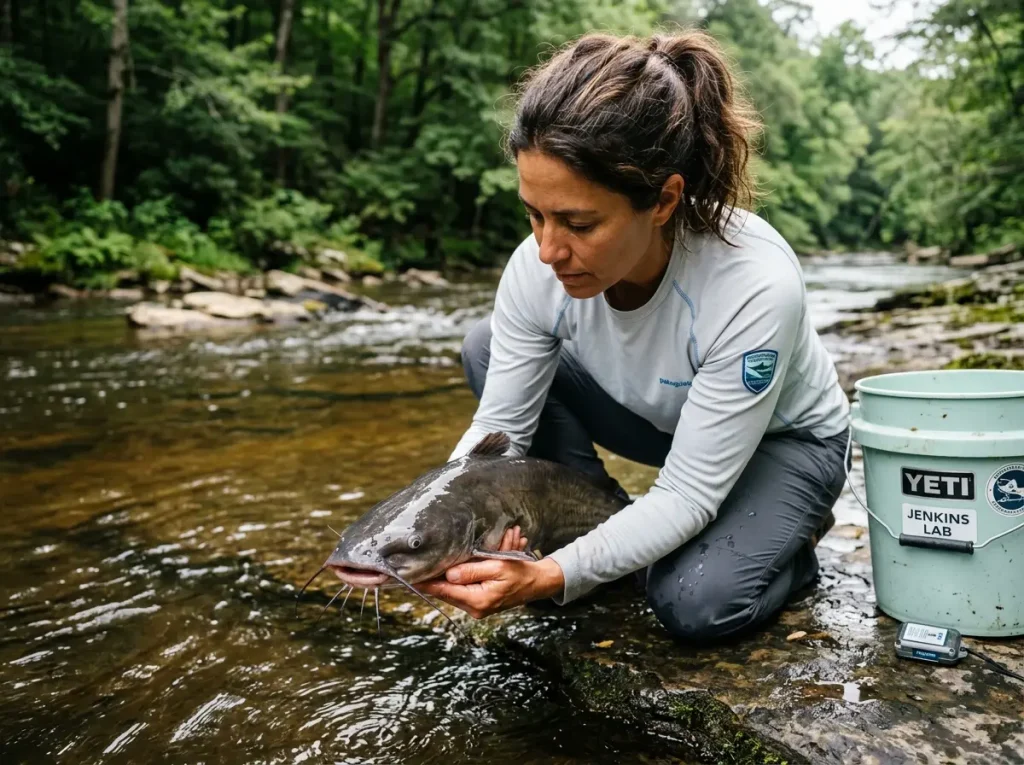
This section breaks down the physical hardware a fish uses to extract chemical signals from the water column. You must grasp this biological foundation before tossing another overpriced bottle of fish attractant into your tackle bag.
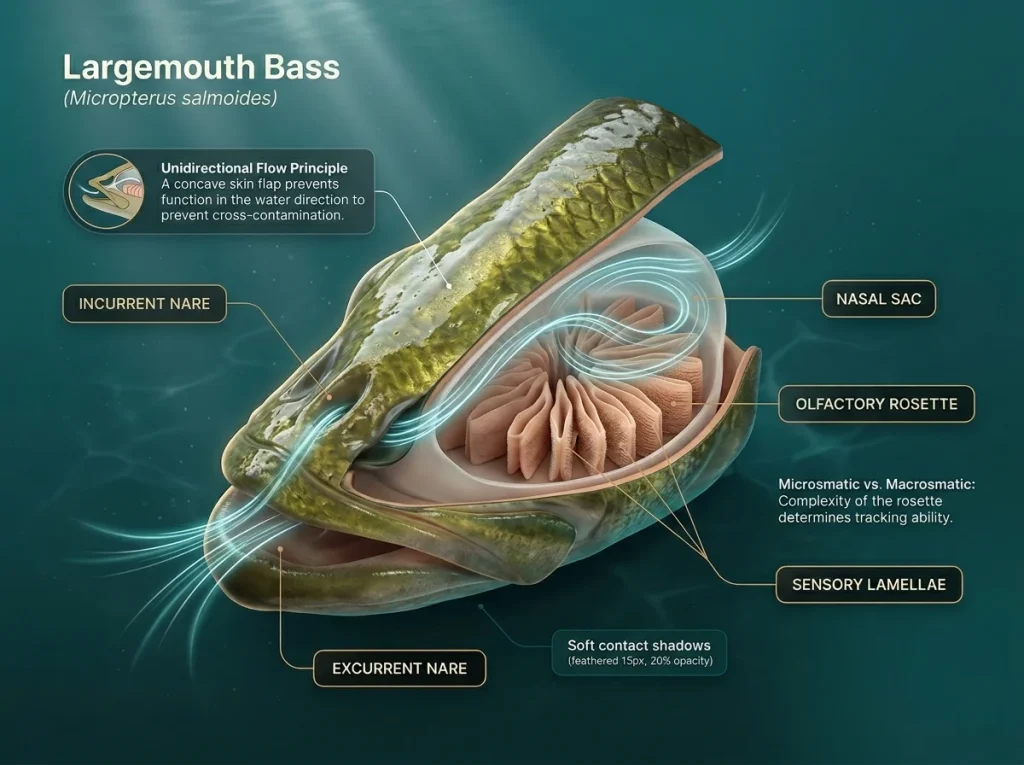
The peripheral olfactory system of every teleost fish begins with the nares. These paired cavities sit right on the snout, just forward of the eyes. Mammals use nostrils for respiration, but a fish relies on gills for breathing while keeping the nasal system separate and dedicated to environmental sampling. Taking time to understand the anatomy and function of the teleost olfactory system reveals the precise mechanical structure driving their hunts.
The Nasal Sac and Unidirectional Flow
Water moves through the incurrent opening, filling the nasal sac, and continuously flows right out the excurrent opening. A stiff, concave skin flap generally separates the two holes to prevent immediate cross-contamination.
This strict architecture creates a massive advantage because it guarantees a one-way sampling current independent of the fish’s breathing cycle. The flow must keep moving continuously to prevent internal receptor saturation and total scent blindness. If the water inside the cavity sits still, the system floods with chemical noise, and the fish loses the trail completely.
Lamellar Complexity: Macrosmatic vs. Microsmatic
Inside that nasal sac rests the specialized olfactory rosette. Picture this organ as the biological air filter of a high-performance engine. The rosette utilizes epithelial folds called lamellae.
We literally categorize predatory success by how intricate these tissue folds grow. A microsmatic fish, such as a northern pike, hunts visually and possesses poorly developed rosettes featuring flat surfaces. Conversely, a macrosmatic fish builds its entire life around its nose. This explains the specialized sensory biology of the Ictaluridae family. Any species of catfish uses dense secondary folding to enhance their effective sensory reach by nearly 500 percent.
Pro tip: When you chase a visual, microsmatic species like musky, prioritize heavy blade vibration and visual flash over scent pastes. If you are targeting a massive blue catfish, reverse your strategy and put everything you have into creating a massive amino acid cloud.
The Three-Neuronal Receptor Network
The epithelium tissue covering these lamellae physically houses millions of primary sensory receivers, known in ichthyology as the three-neuronal receptor network. They break their tracking jobs down into three hyper-specific roles.
Ciliated olfactory receptor neurons feature long dendrites designed exclusively to detect bile salts, alerting the predator to other competitive fish in the immediate area. Microvillous neurons do the heavy lifting for anglers by identifying nucleotides and dissolved amino acids, signaling raw prey proteins. Finally, unique crypt cells shoulder the responsibility for processing social and pheromones signaling during the spawning run.
Hydrodynamic Transport: Penetrating the Boundary Layer

Water pressure, surface friction, and turbulence actively dictate the actual delivery of those odorant molecules. A lot of anglers drop a scented rig into a slack lake and expect the smell to magically fill the water. However, the physics do not support that theory because pure diffusion without a driving current works far too slowly to matter on a fishing trip.
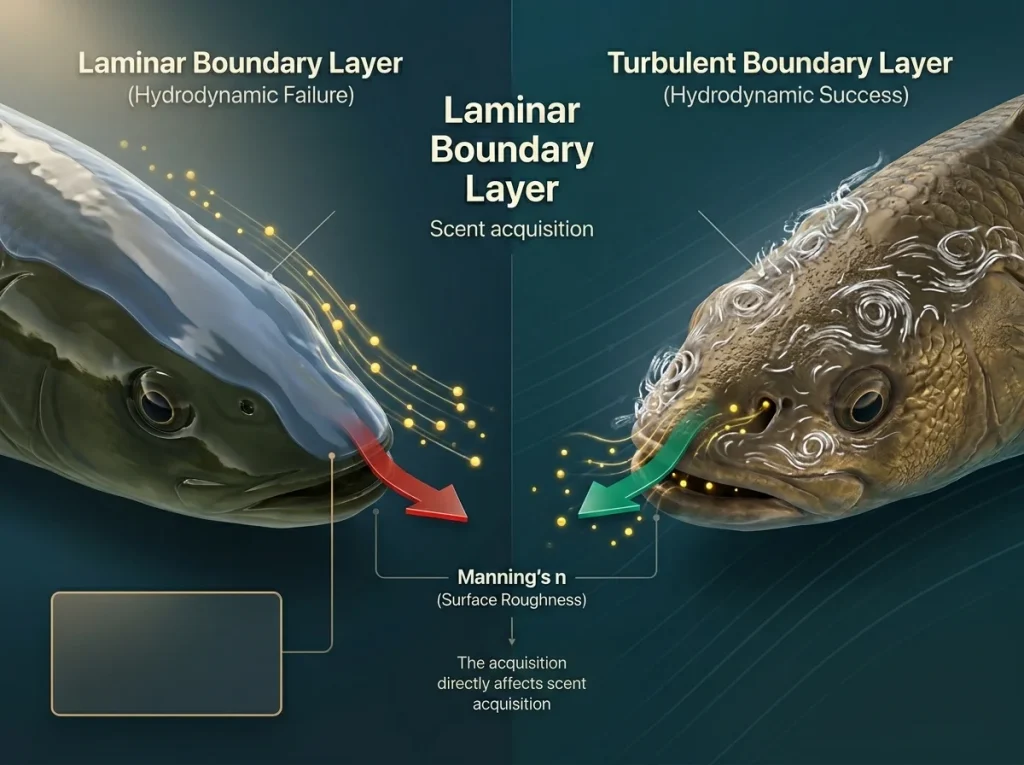
Moving a fresh scent trail rapidly from the bulk water mass straight into those microscopic lamellar channels relies on convection. The core hydrodynamic aspects of fish olfaction prove that fluid forces behave differently the closer they get to an object. The boundary layer is the viscous film of water that physically clings to the fish’s snout like glue.
Viscous Friction and Surface Friction
Engineers calculate Manning’s n to measure the hydraulic surface roughness in turbulent streams, but the same mathematical logic dictates how hard a fish works to pull scent from the current. A hydraulically smooth snout maintains a dangerously thick, laminar boundary layer that physically repels approaching odorants.
A fish possessing rougher anatomical features naturally induces micro-turbulence across its face. This specific turbulence mixes the water, tearing away the dead layer and actively bringing fresh odorants straight into the internal cavity. The intricate fluid dynamics of rivers directly mimic the fluid forces acting across the fish’s face. When you spot a fish following your swimbait in tight, aggressive S-curves, they are not pausing to think.
The Apical Gap and Internal Bypass Systems
Fast-swimming predators regularly run into a severe mechanical flaw during high-speed attacks. Driving forward at high velocity forces too much raw water pressure directly into the nares, carrying the absolute threat of severely shredding the delicate lamellar tissue in an instant. Sharks and robust ocean hunters solved this crisis through internal bypass systems.
The internal nasal architecture forms an aggressive hairpin turn. For hammerheads specifically, a pressure relief valve recognized as the apical gap safely shuttles 54 percent of the intake water straight out the exit canal. This ingenious bypass protects the tissue while dropping the internal flow speed to a safe velocity.
Active Ventilation: How Catfish “Sniff”
Most targeted game fish must swim briskly forward or post up in heavy current to adequately ventilate their nares. Pumping water passively via the river current costs them zero metabolic energy. However, specialized bottom-dwelling hunters shatter this rule entirely.
Auchenoglanidid catfishes evolved sophisticated, muscular accessory sacs that give them the power to actively pump water in and out of the nasal cavity. They physically “sniff” the water without swimming an inch. This active ventilation mechanism allows them to pinpoint stationary baitfish chunks in slack zero-current environments where a bass would swim right by blind.
The Chemistry of Attraction: Solubility Over Oil
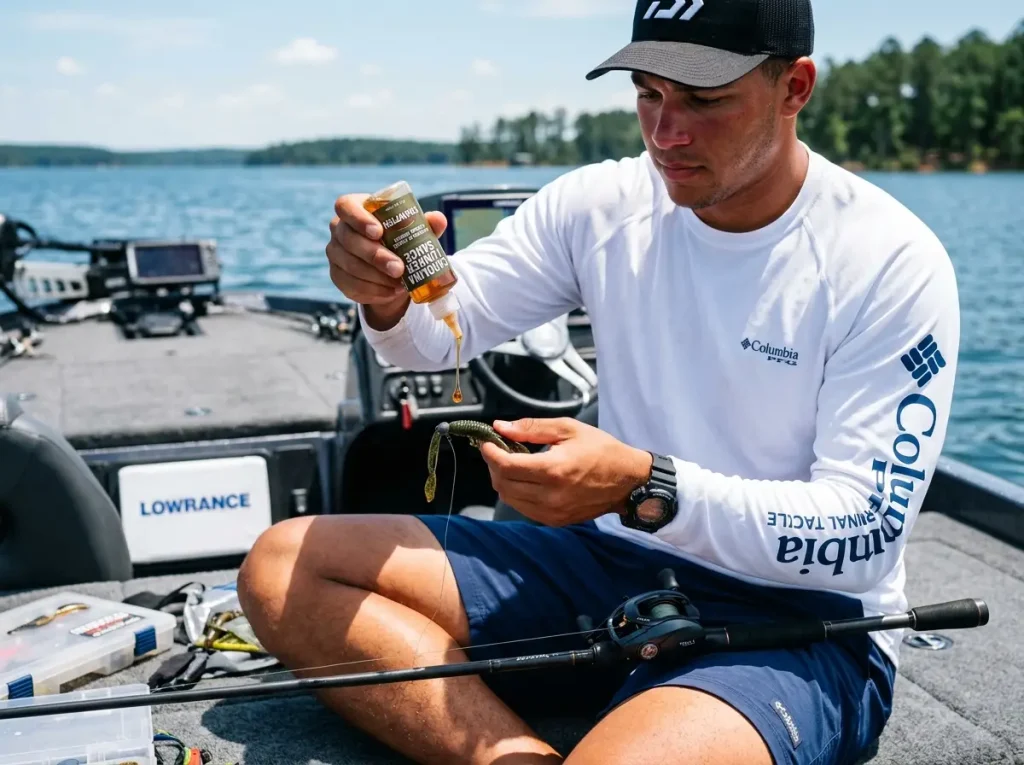
This section technically dismantles the aggressive marketing claims hiding behind old-school oil-based fishing scents. We validate the absolute superiority of water-soluble amino acids by following organic chemistry and dumping the folklore.
The single non-negotiable factor governing fish olfaction is strict water solubility. If a specific molecule cannot physically dissolve in water, the fish cannot possibly detect it. Water-soluble compounds form the entire basis of chemical attraction in the wild. Meanwhile, the tackle industry constantly sells massive bottles of pure shad oil, dense anise oil, and pressurized garlic spray. These cheap products rely on non-polar, hydrophobic formulas that are practically invisible to the biological sensors of the fish.
The Hydrophobic Failure: Why Oils Don’t Work
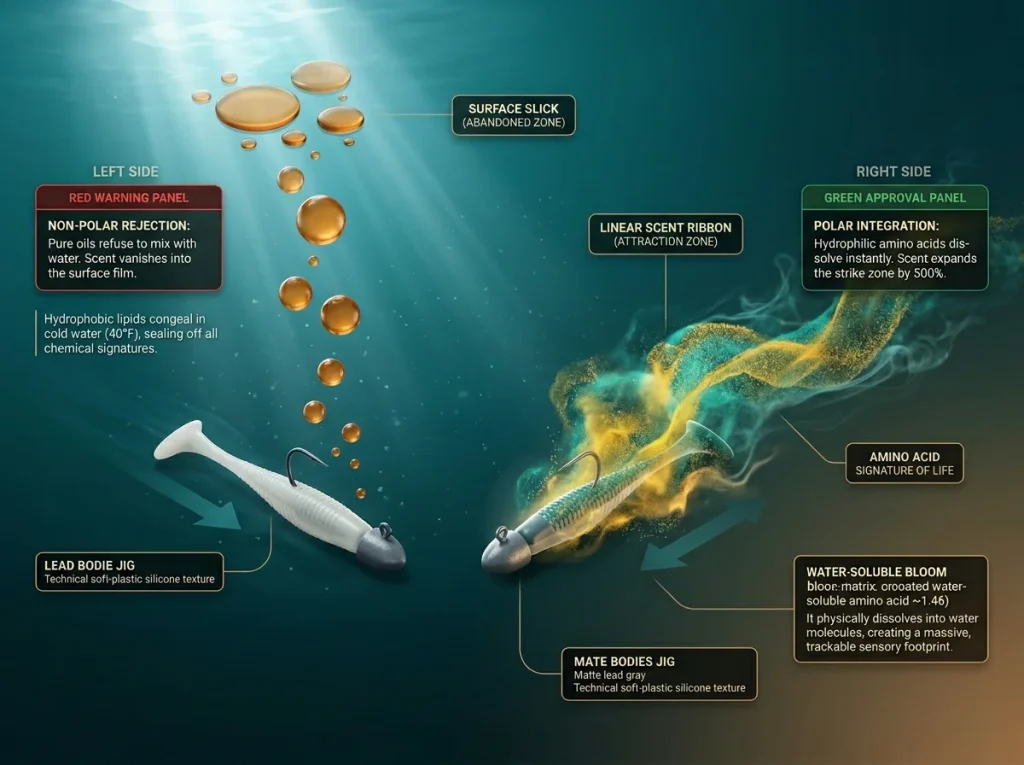
Water and heavy oil physically refuse to mix. You learn this sitting in elementary school, yet pressured anglers continue spraying aerosol oils all over their premium crankbaits. Non-polar substances cannot break down efficiently in polar water, which means they physically cannot reach the microscopic receptor pockets of the fish.
When you slather pure anise oil onto a jig, you only accomplish two negative reactions. First, the oil washes off instantly in warm conditions and floats straight up to the surface film, dragging your expensive scent out of the strike zone. Second, in freezing temperatures, the thick oil congeals into a hard grease casing that locks up the lure action entirely. Pure oils only work to provide a brief taste confirmation exactly at the moment the bait lands forcefully inside the jaws.
Amino Acids: The “Signature of Life”
Every living organism swimming in the water continuously sheds basic amino acids. They act as the universal chemical signature establishing life. Because these specific proteins remain polar, they dissolve seamlessly into the surrounding water column instantly.
Specific chemical triggers operate as effective feeding stimulants. L-Alanine and L-Cysteine possess low detection thresholds in catfish, reliably triggering a reaction from a 10^-11 molar concentration. Scent engineers recognized this and started utilizing specialized hydrophilic polymers. These advanced water-soluble gels effectively lock in the amino signatures and safely release them.
Pro tip: Stop trusting tackle shop counter displays pushing “100 percent natural oil” sprays. Check the labels furiously and only purchase attractants specifically formulated as water-soluble or amino-acid-based pastes. You pay slightly more upfront, but they physically execute the job you bought them to perform.
L-Serine: The Human Fingerprint Repellent
You chemically ghost your own lures every time you touch a piece of terminal tackle barehanded. L-serine exists as a potent amino acid that is secreted by untreated human skin. Under the surface, this chemical operates as a blaring biological warning siren.
Salmonids, including all salmon and migratory brown trout, harbor a massive evolutionary aversion to L-serine. They react with immediate, aggressive alarm behavior. A single bare-handed squeeze on a piece of cut bait transfers enough L-serine to cause a trailing fish to vigorously flare away at the last second. I sit back and watch professional guides wreck their clients’ trips daily with this exact mistake.
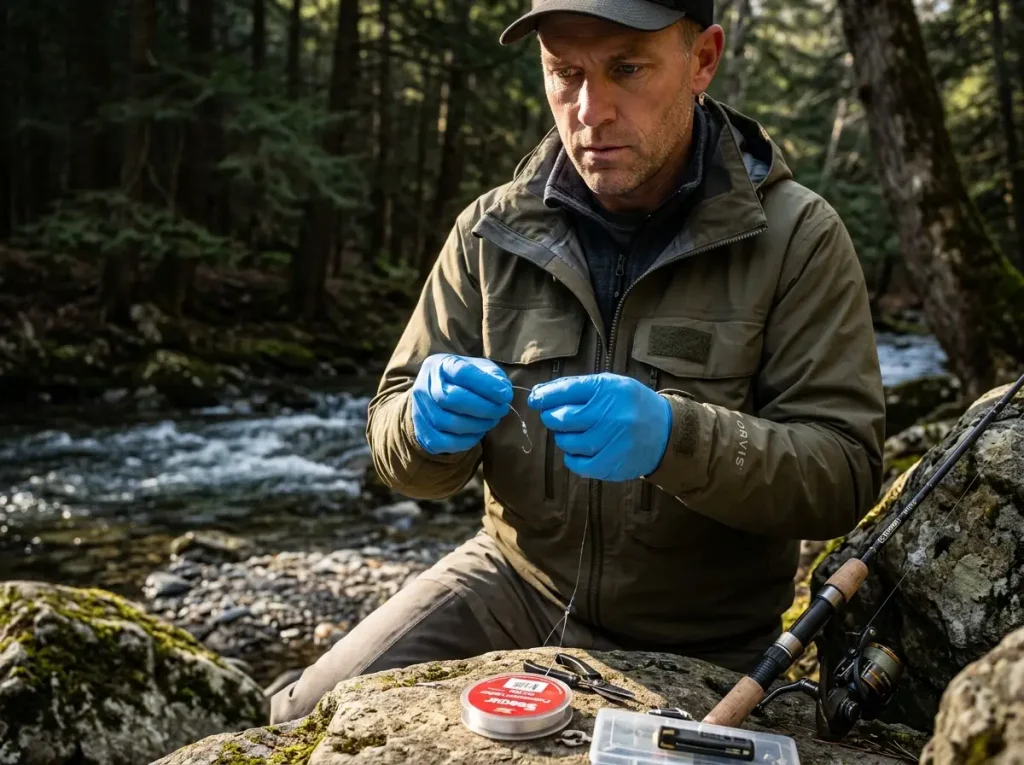
You must consistently destroy the hand-rinse deterrent. Wash your hands with natural river mud, pull on a pair of tight nitrile gloves, or relentlessly scrub your hands with an enzyme-based neutralizer before handling expensive baits.
Environmental Modulation: Temperature, pH, and Toxins
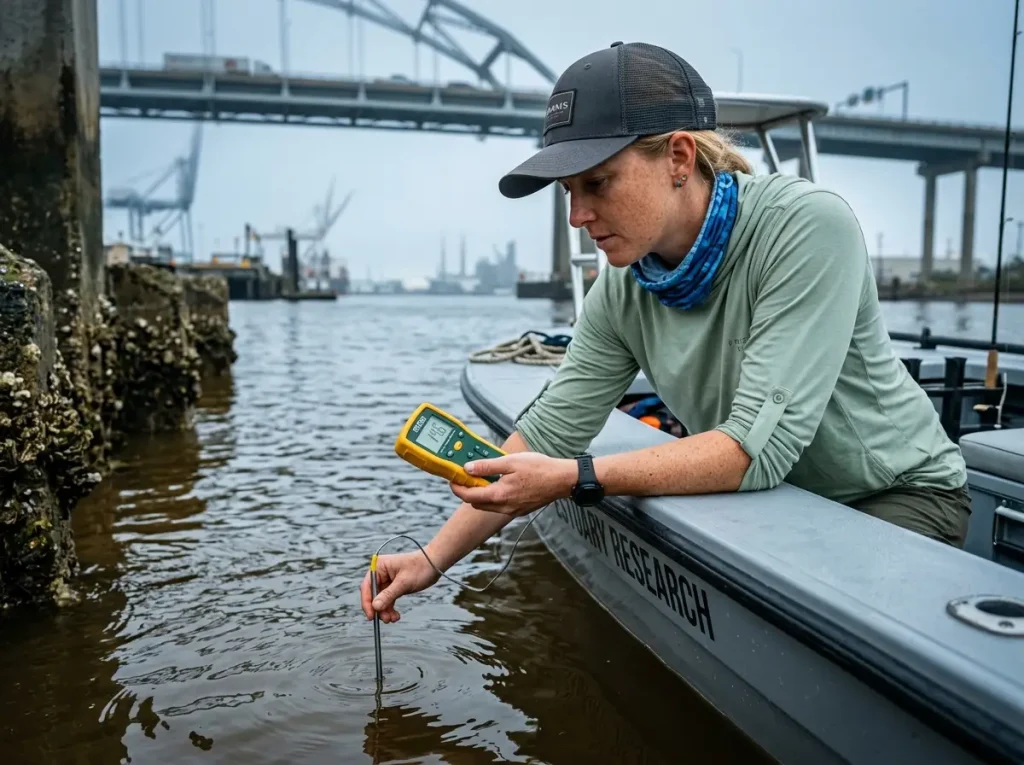
External physical states and aggressive chemical shifts within the water column actively dictate whether your scent trail succeeds or dies. You cannot fish a heavy scent system the exact same way during an August heatwave that you would during a January deep freeze.
The raw dispersion speed of any molecule relies upon the base energy state of the surrounding water. We lean on the Kinetic Molecular Theory to accurately track how thermal energy dramatically speeds up or kills the traveling odorants. Also,, unseen chemical blockades, including heavy metal runoff and volatile acidity, actively destroy the ability of the fish to smell your presentation.
Kinetic Molecular Theory and Plume Dispersion
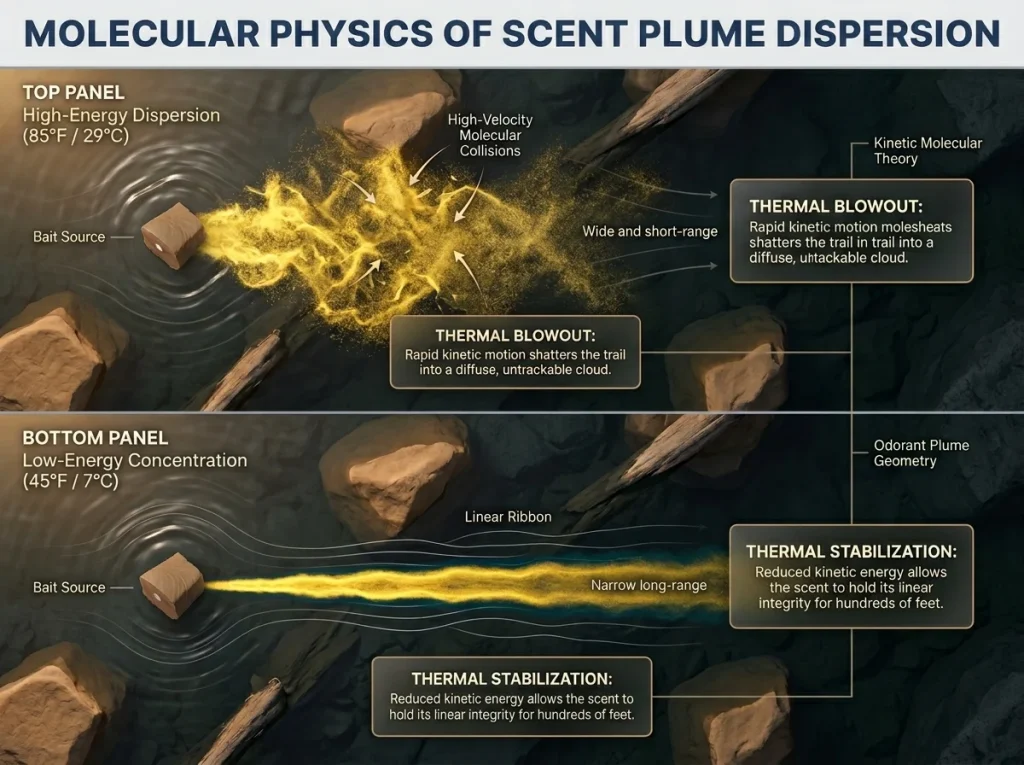
Intense thermal heat generates extremely rapid, violent molecular motion. Down in 85-degree summer swelters, the furious molecular collisions shatter your scent plume instantly. The trail blows out into a sprawling, diffuse cloud.
Frigid water operates on an different scale. When the core temperature tanks into the 40s, the molecular motion grinds to a heavy crawl. This thermal effect forces the scent to hold together securely, creating an unbelievably narrow, concentrated linear trail. If you position a correctly formulated water-soluble bait into an icy river current, the resulting scent ribbon travels securely for vast distances straight downriver.
Ocean Acidification and the Protonation Barrier
Saltwater anglers currently face a massive, creeping biological crisis concerning the fundamental chemistry of basic olfaction. Relentless ocean acidification explicitly alters the complex protonation state of all amino acid odorants in the surf.
As the environmental pH abruptly drops, wandering excess hydrogen ions forcefully bond to the fragile amino acid molecules. This brutal chemical interference effectively changes the structural shape and the vital molecular charge of the scent itself. Because the chemical “key” morphed its shape, it refuses to fit into the predator’s biological receptor “lock.” This tragic mismatch severely degrades the binding affinity, dropping the detection limits through the floor.
Heavy Metals: The Copper Blindness Effect
Massive concrete runoff zones surrounding industrial shipping hubs create localized ghost towns filled with healthy but totally “smell-blind” fish. Traces of heavy metals utterly dismantle the sensory hardware in hours.
Scientific studies tracking the acute exposure to copper rigorously prove that microscopic traces obliterate the delicate cilia standing on the olfactory neurons. The terrifying copper toxicity physically triggers cellular failure across the receptors in less than four hours. If you sit anchored near an active industrial outflow pipe, pack your scent gels back into your box.
Practical Application: Rigging for the Scent Plume
We verified the intricate anatomy, locked down the fluid dynamics, and proved the strict chemistry. Now you must rig the terminal gear accurately to leverage the physics in your favor.
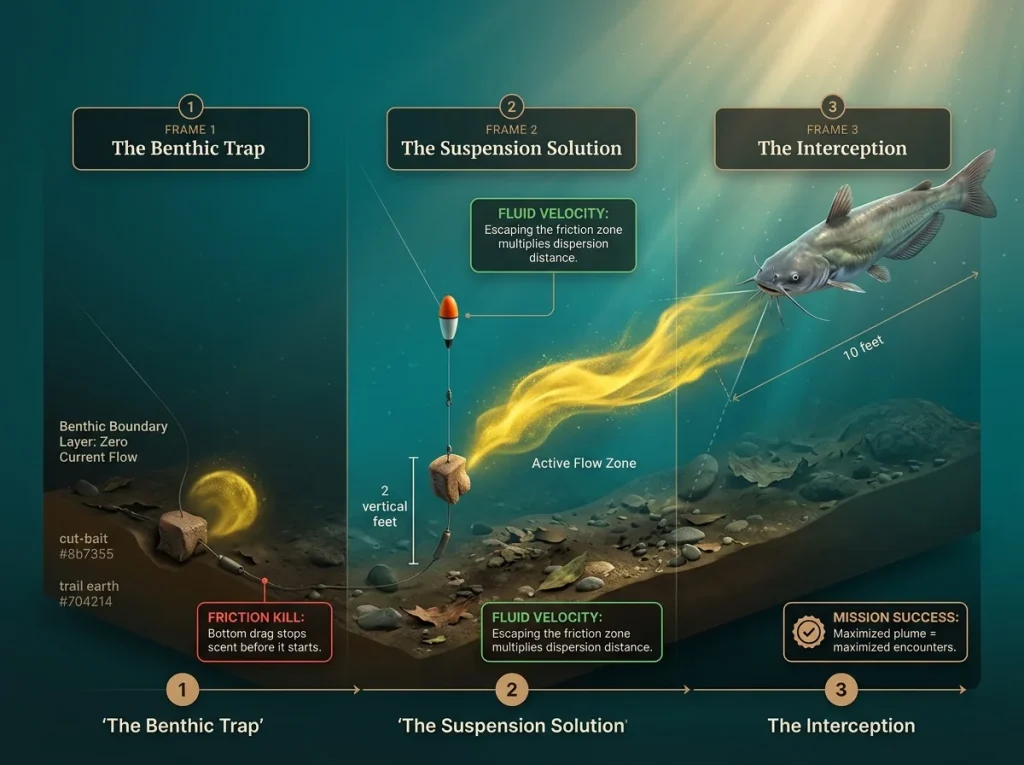
A potent, expensive scent trail that never physically leaves the bottom mud accomplishes nothing. The water column flows in distinct velocity layers, requiring you to forcefully place your bait into the optimal active zone to guarantee proper dispersion. You take extreme control over the invisible strike zone by implementing a few unshakeable rules regarding your handling protocols and presentation height, eliminating the variables that cause wasted trips.
Tactic 1: Neutralizing the Hand-Rinse Deterrent
Do not underestimate the immense chemical damage a bare human fingerprint imparts to a delicate finesse presentation. You must rigorously treat your own bare hands as an aggressive contamination threat.
If you furiously rub down with hand sanitizer, scented hotel soap, or aggressive bug spray right before rigging a complex drop shot, you sabotage the hookup ratio. Pack a dedicated, small tactical container of thick amino-based attractant paste in your chest pocket. Directly before your fingers ever touch your fluorocarbon leader material, rub a dense dab of the paste straight into your thumb and index pads.
Tactic 2: Suspending the Bait to Maximize Flow
Severe bottom friction strips the ambient river velocity down until it reaches near-zero flow. Biologists label this dead zone the benthic boundary layer. If you stubbornly drag a heavy Carolina rig and physically pin the bait straight into the silt, the extreme friction murders the current flow moving around the plastic.
You must suspend baits one to three feet vertically off the absolute bottom. Whether you construct a drop shot, a slip float rig, or a disciplined three-way swivel layout, actively elevating the presentation hauls the bait out of the stagnant boundary layer and jams it straight into the active hauling current. This fundamental rigging tweak multiplies your strike zone exponentially by ripping a long, fast-moving plume straight through the primary feeding lanes.
Pro tip: When I face a heavy, aggressive tidal flush pushing hard off the bank, I extend my leader lengths up to a full three or four feet. The more violent the current pushes, the higher the bait desperately needs to hover to effectively escape getting slammed back down into the microscopic friction zone of the mud.
Tactic 3: Temperature-Matched Carrier Selection
I witness seasoned guys freeze up continuously in deep February because they refuse to alter their bait application strategies to match the plunging temperatures. You cannot run a sloppy summer oil program in frigid January water.
Strip every last oil-based carrier out of your boat the second the core water temperature plummets below 50 degrees Fahrenheit. The oils congeal instantly into a sticky wax and destroy the soft plastic presentation entirely. In freezing river conditions, trust the agonizingly slow release of thick, water-soluble amino gels. Let the big bait soak. Fight back against the nervous urge to crank in and recast every three rapid minutes. The frigid water demands extreme patience, allowing that focused, dense linear scent ribbon enough time to stretch downriver and forcefully intercept the cruising fish.
Conclusion
The active water column represents a violent energy equation, and precise olfaction acts as the singular variable closing the frustrating gap between random blind strikes and a genuinely consistent hookup ratio. Halt the blind practice of applying greasy, hydrophobic masking sprays that just float away uselessly in the current. By transitioning to water-soluble amino acids and truly understanding exactly how brutal boundary layer physics and intense thermal motion dictate raw dispersion, you instantly gain total authority over the invisible strike zone. Attack your presentation strategy like a focused mass-transport problem.
FAQ
How far can fish smell bait in the water?
A fish’s raw scent detection distance depends on the exact water temperature and the specific current speed. In bitterly cold, actively moving water, a continuous, dense linear trail can be tracked accurately and from up to 300 feet downstream. However, in stagnant, extremely warm summer water, the identical scent blows out quickly into a wide, diffuse cloud rather than generating a long, cleanly trackable ribbon.
Do fish really avoid human scent?
Yes, raw human skin actively secretes a dense amino acid recognized as L-serine, which functions as a severe biological alarm signal in the aquatic column. Salmon and large migratory trout happen to be sensitive to this specific repellent and will abort a full-speed strike immediately upon detecting it. Intentionally washing your hands with an enzymatic soap or forcefully applying a thick masking scent directly before touching your terminal tackle effectively neutralizes this chemical deterrent.
Does WD-40 actually attract fish?
not, WD-40 fails to attract fish and dumping it into fragile waterways causes serious, lingering environmental harm. Harsh petroleum distillates operate as hydrophobic fluids, effectively rendering them invisible to a fish’s delicate internal nasal receptors. This persistent, myth manages to survive because the exceptionally heavy oil acts as a crude masking agent that just manages to cover up the negative, repelling human odors carelessly left behind by the unwashed angler’s bare hands.
Are oil-based scents effective in winter?
Heavy, oil-based attractants quickly become useless in cold water plunging abruptly below the 50-degree Fahrenheit threshold. The aggressive, heavy cold forces the non-polar lipids to immediately congeal and lock up into a hard, greasy wax. This dramatic, instant increase in total viscosity prevents the oil from releasing any sort of reasonably detectable chemical signature freely into the surrounding, freezing water column.
Risk Disclaimer: Fishing, boating, and all related outdoor activities involve inherent risks that
can lead to injury. The information provided on Master Fishing Mag is for educational and informational purposes
only. While we strive for accuracy, the information, techniques, and advice on gear and safety are not a substitute
for your own best judgment, local knowledge, and adherence to official regulations. Fishing regulations, including
seasons, size limits, and species restrictions, change frequently and vary by location. Always consult the latest
official regulations from your local fish and wildlife agency before heading out. Proper handling of hooks, knives,
and other sharp equipment is essential for safety. Furthermore, be aware of local fish consumption advisories. By
using this website, you agree that you are solely responsible for your own safety and for complying with all
applicable laws. Any reliance you place on our content is strictly at your own risk. Master Fishing Mag and its
authors will not be held liable for any injury, damage, or loss sustained in connection with the use of the
information herein.
Affiliate Disclosure: We are a participant in the Amazon Services LLC Associates Program, an
affiliate advertising program designed to provide a means for us to earn advertising fees by advertising and linking
to Amazon.com. As an Amazon Associate, we earn from qualifying purchases. We also participate in other affiliate
programs and may receive a commission on products purchased through our links, at no extra cost to you. Additional
terms are found in the terms of service.