In this article
The distant rumble started just before sunset. I was drifting over a muddy Texas channel in my kayak, headphones clamped over my ears, when the water itself seemed to come alive—a low, rhythmic throbbing that vibrated through the cable into my chest. My fish finder showed nothing but flat bottom. What I was hearing was impossibly loud: a Black Drum spawning chorus, hundreds of fish drumming in the darkness below, invisible to sonar but broadcasting their exact position to anyone who knew how to listen.
After two decades chasing redfish and drums across the Gulf Coast, active sonar has served me well. But that moment changed everything. Passive acoustic monitoring—using an underwater hydrophone to detect the sounds fish actually make—opened a dimension of fishing intelligence that traditional fish finders simply cannot access. It’s stealth reconnaissance for anglers, and it represents a fundamental shift from scanning to eavesdropping.
This guide will teach you the science of underwater soundscapes, the gear required to capture fish vocalizations, which species “talk” and what their calls mean, and the field tactics that transform acoustic data into fish on the hook. By the end, you’ll know how to deploy a hydrophone from boat, kayak, or pier—and interpret what you hear in real time.
⚡ Quick Answer: Underwater hydrophones are passive listening devices that detect fish sounds—spawning drums, courtship calls, feeding activity—without emitting any signal that spooks wary fish. Entry-level systems like the Aquarian H1a ($200) or Cetacean Research SQ26-H1 ($350) are ideal for recreational anglers. Deploy at 5-10 feet depth, listen during the dusk chorus (1-2 hours before sunset), and you can locate spawning aggregations of Black Drum, Red Drum, and Spotted Seatrout by ear long before your fish finder shows a blip.
The Acoustic Advantage: Why Sound Beats Sonar for Target Species
Active vs. Passive: The Stealth Factor
Your standard fish finder works by blasting high-frequency pulses into the water column and reading the echoes. It’s effective for structure mapping and finding suspended bait, but it has a downside: it broadcasts your presence. Some research suggests that heavily pressured fish learn to associate certain sonar frequencies with danger, becoming harder to pattern in high-traffic fisheries.
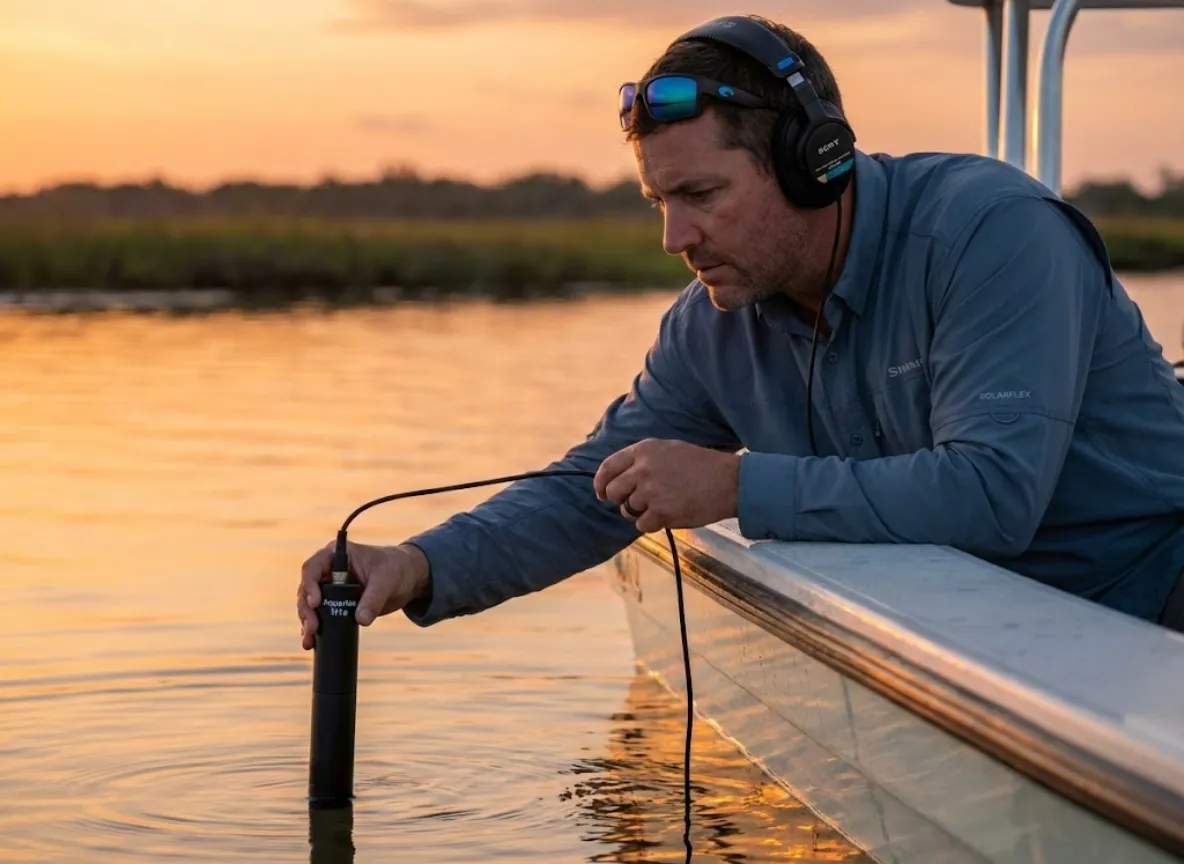
Passive sonar flips the equation. A hydrophone is an underwater microphone—it emits zero energy. Instead of pinging the fish, you listen to the sounds they produce themselves: courtship drums, territorial grunts, distress calls. Water transmits sound waves approximately 4.5 times faster than air and over far greater distances, making low-frequency fish calls an early warning system that works well beyond visual or sonar range.
Pro tip: The first time I heard a Black Drum chorus through headphones, it was so loud I thought a boat was approaching. That intensity means biomass—and you’re sitting right on top of it.
The Sciaenid Advantage: Fish That Talk
The Sciaenidae family—drums, croakers, and seatrout—evolved specialized “sonic muscles” that vibrate against the swim bladder to produce loud, species-specific calls. These sounds are tied directly to spawning behavior. Males call to attract females, meaning finding the chorus means finding the spawning aggregation.
Unlike random fish arches on your screen, acoustic monitoring tells you what is there and what they’re doing. A silent school of redfish registers the same as bait. But a drumming chorus says “trophy spawners, right here, right now.” That’s intelligence your Lowrance can’t provide. And from a conservation standpoint, passive acoustics is non-invasive—no electromagnetic disturbance, no spooking. It aligns with ethical catch-and-release fishing.
When Hydrophones Outperform Fish Finders
In turbid water—muddy Texas bays, post-storm runoff—visibility drops to zero and high-frequency sonar scatters. Low-frequency drum calls cut through murk unaffected. Below three feet, transducer cone angles create dead zones, but hydrophones work in inches of water. And during night fishing, when you can’t see bird activity or surface boils, your ears become the primary sensor. The dusk chorus is the acoustic equivalent of a mayfly hatch.
If you’re serious about mastering sonar screen interpretation, adding a hydrophone completes the picture. Active sonar shows structure; passive acoustics reveals activity state.
Hydrophone Hardware: Choosing the Right Underwater Microphone
Sensitivity and Frequency Response Explained
Hydrophone performance comes down to two specs: sensitivity and frequency response.
Sensitivity is measured in dB re: 1V/µPa. These values are negative—closer to zero means more sensitive. A hydrophone rated at -165 dB picks up faint, distant calls that a -185 dB unit would miss entirely. For fishing, you need to hear weak signals through noisy estuarine environments.
Frequency response must cover the vocal range of your target species. Black Drum calls drop as low as 70 Hz; Croaker calls reach 600 Hz. Most quality hydrophones extend well above 20 kHz, but for fishing, the sub-1 kHz “basement” is where the action lives. A “flat” response reproduces all frequencies equally—best for learning. Some DIY hydrophones have resonant peaks that boost certain bands but may miss the deep drum frequencies you’re targeting.
Entry-Level: The Aquarian H1a Workhorse ($200)
The Aquarian Audio H1a is the de facto standard for recreational and semi-professional use. Priced around $193, it features a specialized urethane jacket resistant to saltwater corrosion and UV exposure. Its high specific gravity means it sinks quickly and holds vertical in current—critical for getting below surface noise.
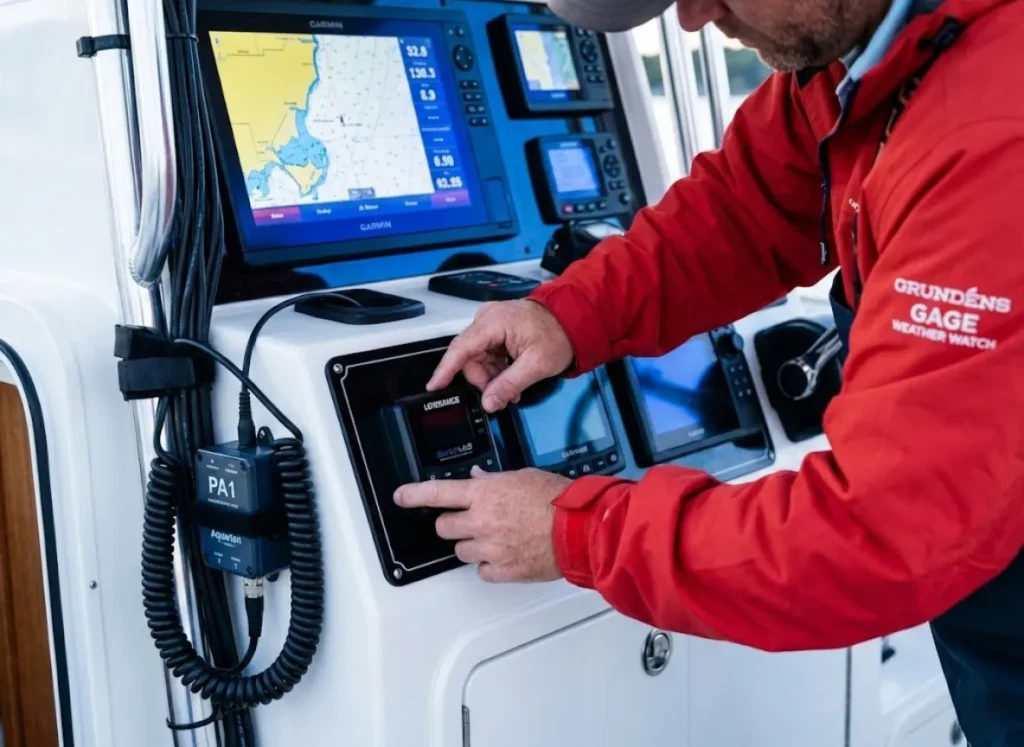
Here’s the catch: the H1a has high output impedance. Plugging it directly into a boat stereo’s AUX input creates a high-pass filter that strips out the 70-150 Hz drum calls you need most. A buffer or preamp like the Aquarian PA1 is mandatory. Skip this step and you’ll hear snapping shrimp but zero drumming—the number-one beginner mistake.
Mid-Tier: The Cetacean Research SQ26-H1 System ($350)
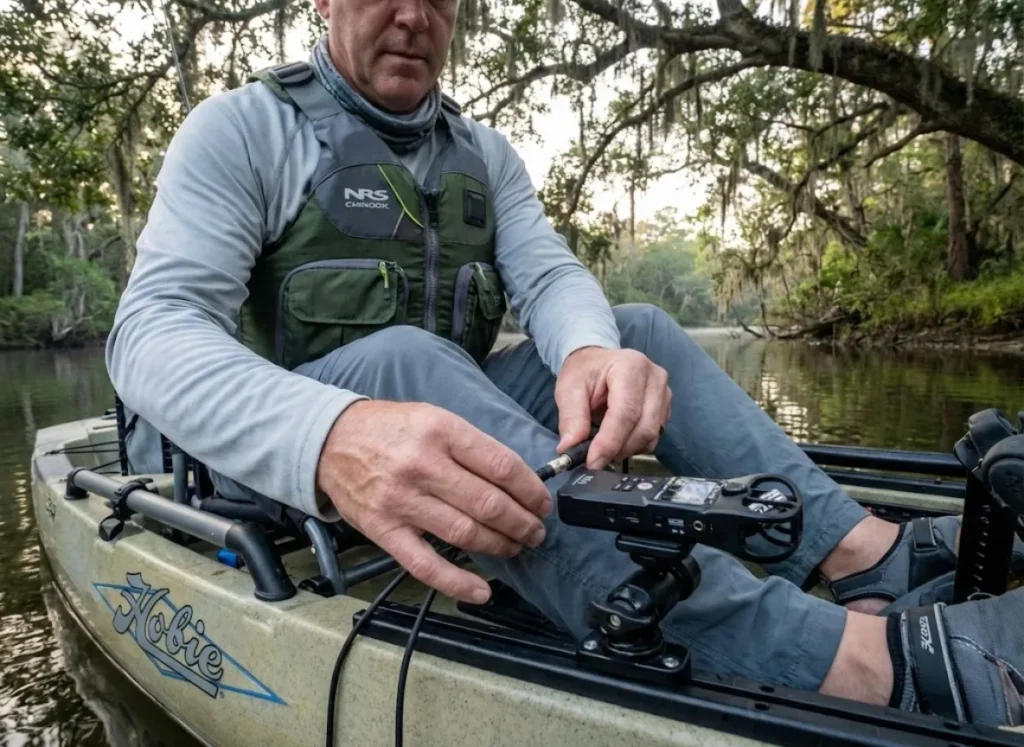
Sold as a turnkey hydrophone kit with the Zoom H1n recorder, the SQ26-H1 is ideal for kayak anglers. Plug-in power from the recorder eliminates battery boxes, and the integrated +25 dB preamp achieves -169 dB effective sensitivity—higher than the standalone H1a.
Recording sessions for post-trip analysis is the real value here. You can compare your captures to reference spectrograms and build pattern recognition over time. That’s how you graduate from “I hear something” to “that’s a Red Drum, about twenty yards off the port side.”
Professional: Ambient ASF-1 MKII ($1,500+)
For charter operations or serious bioacoustics research, the Ambient ASF-1 uses XLR connectors with 48V phantom power. The marine-grade aluminum-bronze housing shrugs off years of saltwater abuse. Flat response from 7 Hz to 100 kHz captures the full spectrum with scientific accuracy. Overkill for most recreational anglers—but if you need durability and broadcast-quality audio, this is the standard. For specifics, check the manufacturer specifications for the H1a hydrophone and compare.
If you’re running electronics in salt, be sure to review our guide to preventing saltwater corrosion in your electronics.
The Signal Chain: Getting Sound from Water to Your Ears
The Impedance Mismatch Problem
Piezoelectric hydrophones output extremely high impedance—often in the mega-ohm range. Standard audio inputs expect low impedance. Connect directly, and you create a high-pass filter: bass frequencies get stripped before they reach your speakers.
The symptoms are obvious: audio sounds thin, tinny, no bass. You hear shrimp crackle but no drumming. The fix is simple but non-negotiable: use a dedicated high-impedance buffer (like the Aquarian PA1) or a recorder with true high-Z input. Some field recorders have this; most marine stereo AUX inputs do not.
Integrating with Marine Electronics (MFDs)
Modern helm stations run on Multi-Function Displays—Lowrance HDS, Garmin, Humminbird Solix—but these MFDs don’t have direct audio inputs. They control networked stereo “black boxes” via NMEA 2000.
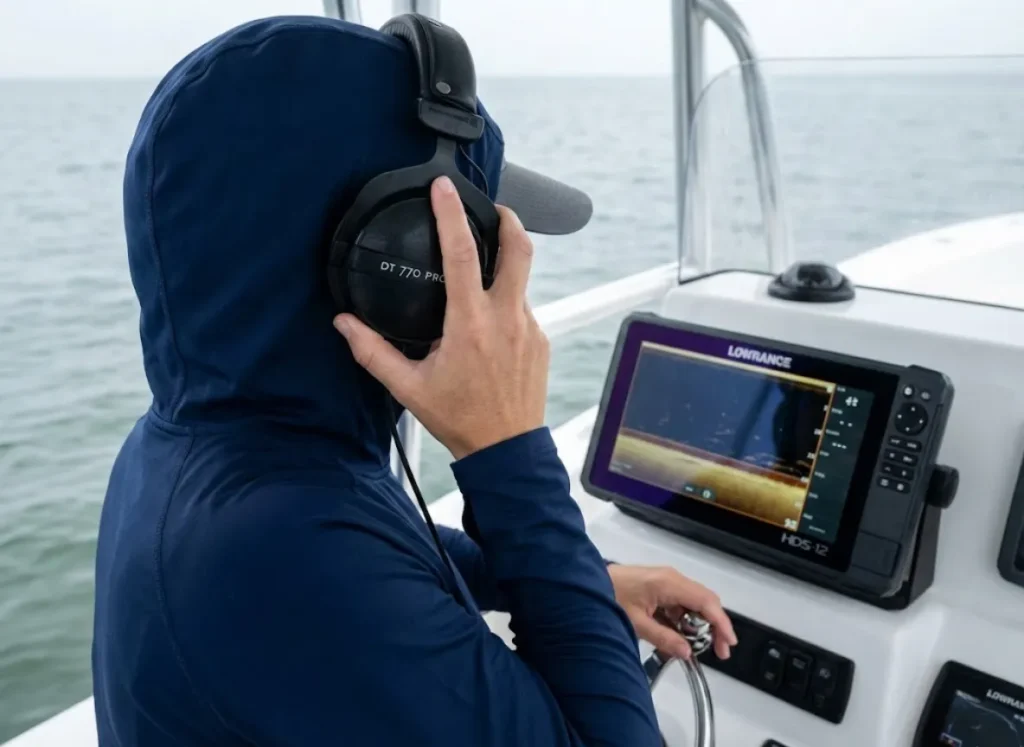
For Lowrance/Simrad, connect your hydrophone (via preamp) to the SonicHub2 AUX inputs (RCA), then select AUX source on the MFD media bar. Garmin uses Fusion-Link protocol with Apollo stereos—same workflow. But here’s the limitation: NMEA 2000 handles control data, not audio streams. You can’t display a spectrogram on your chartplotter screen. The feedback is auditory, through your boat speakers or headphones.
Pro tip: For serious acoustic fishing, closed-back headphones beat boat speakers every time. Wind, engine idle, and cooler slams drown out faint calls. Headphones isolate you in the underwater soundscape.
The Portable Alternative: Field Recorders
For kayak anglers or those without complex electronics networks, a portable audio recorder like the Zoom H1n or Tascam DR-05X is superior. Clean, low-noise preamps with gain control let you amplify faint biological signals that a marine stereo would clip. Headphone output for real-time monitoring; SD card for recording sessions to analyze later.

This is how you learn. Our section on kayak electronics integration covers compatible setups.
The Fish Vocabulary: Species-Specific Sounds and What They Mean
Black Drum: The Baritone Boomer (70-100 Hz)
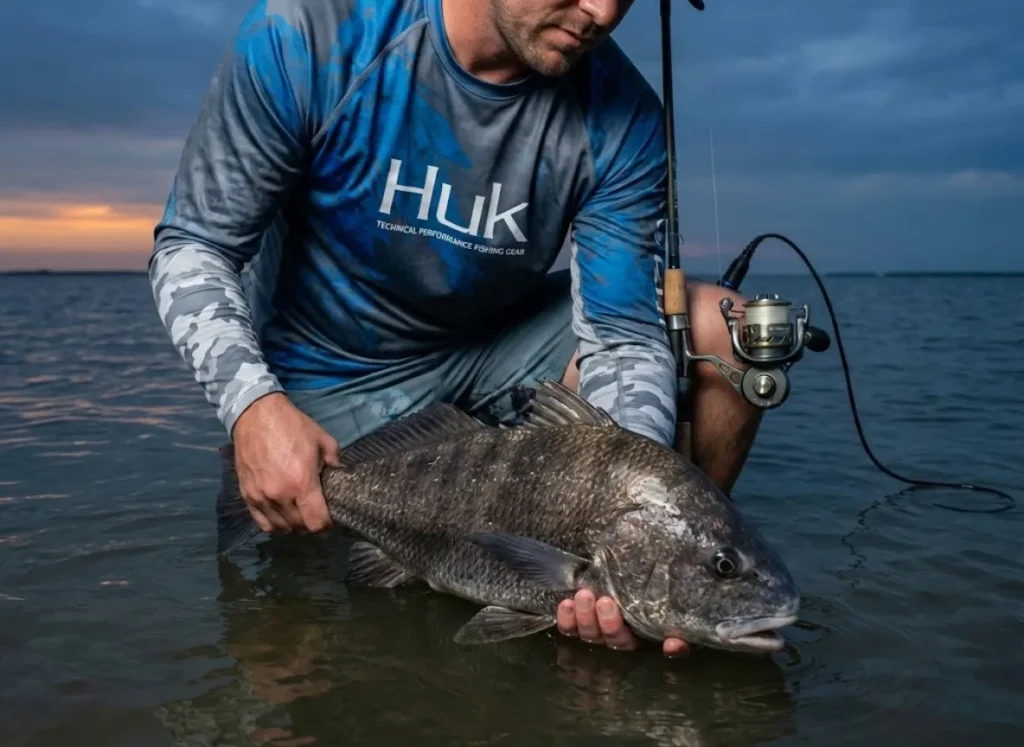
The Black Drum is the heavyweight baritone of the estuary. Its massive swim bladder and powerful sonic muscles produce calls that can be felt as much as heard—a rhythmic thumping like a distant diesel engine.
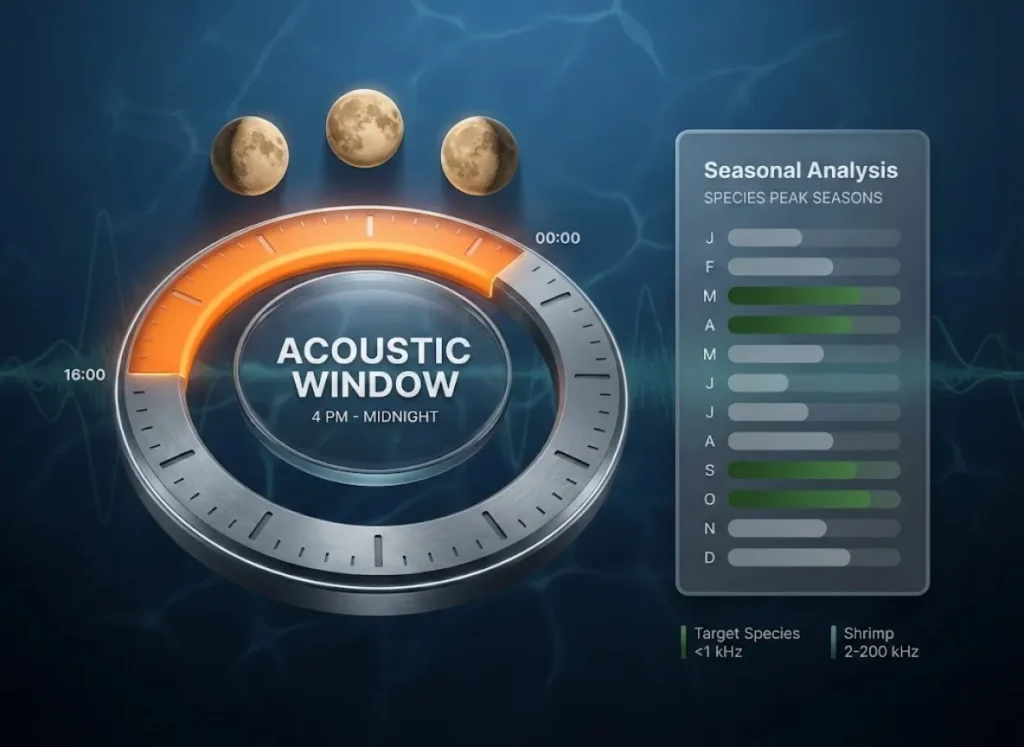
The fundamental frequency drops as low as 70-90 Hz, with harmonics at 180 Hz and 270 Hz. Source levels reach 165 dB—loud enough to hear through a fiberglass hull with the naked ear. That’s not a rumor; generations of Gulf Coast fishermen have confirmed it. During spawning season, males aggregate and call simultaneously, creating a continuous roar in the 75-200 Hz band. Locating this spawning chorus is synonymous with locating the biomass. Peak calling in Texas bays occurs January through March, especially on full moon nights.
Red Drum: The Percussive Knocking (140-160 Hz)
Only male Red Drum possess sonic muscles—females are silent. Sounds range from single knocks to prolonged drum rolls with eight or more pulses. Successful spawning correlates with high-pulse-count calling.
There’s a size-frequency relationship here: larger males produce lower-pitched calls. An experienced ear can estimate trophy potential by pitch alone. Peak season runs September through November, dusk to midnight. If you’re learning to interpret swim bladder mechanics and pressure, understanding how the swim bladder acts as a resonating chamber is the key.
Spotted Seatrout: The Rapid-Fire Heartbeat (200-300 Hz)
Males produce “staccato” calls—rapid pulses that sound like a heartbeat or a stick on a picket fence. Dense aggregations form in deep channels at sunset, and the merged calls create a continuous rumble.
Temperature is the switch: calling drops sharply below 27.7°C (82°F). If the water is warm and it’s dusk, listen for that rapid-fire rhythm. Spring and summer are prime seasonal migration timing windows.
Toadfish and Croaker: Your Habitat Indicators
The Gulf Toadfish isn’t a target species, but its “boatwhistle” call—grunts followed by a tonal hum—provides orientation data. The pitch is linearly dependent on water temperature: higher pitch means warmer water. You can estimate temperature differentials across a bay by listening to pitch variation. High toadfish density means hard bottom structure: oyster reefs, limestone. That’s prime habitat for Sheepshead and drums.
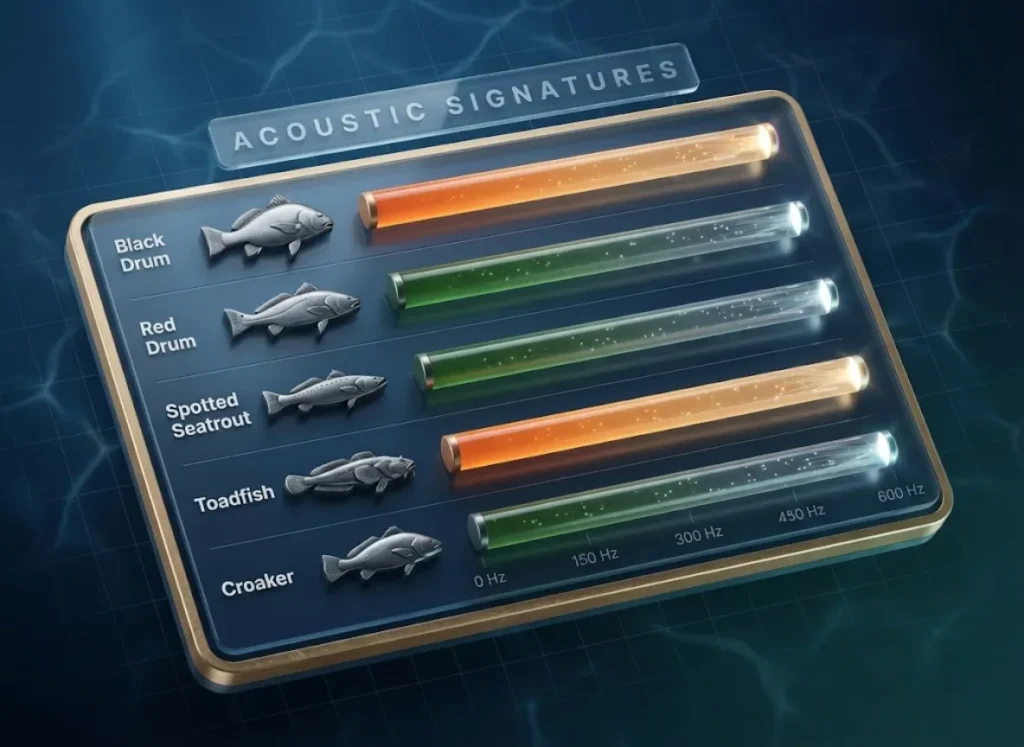
Croaker calls are higher pitched (300-600 Hz), often numerically dominant in the soundscape. A deafening croaker chorus indicates a biologically productive area—and attracts larger predators. Use them as an indirect indicator of acoustic hotspots.
For authoritative detail on species-specific acoustics, see NOAA’s research on fish acoustic behavior.
Field Deployment: From Dock to Data
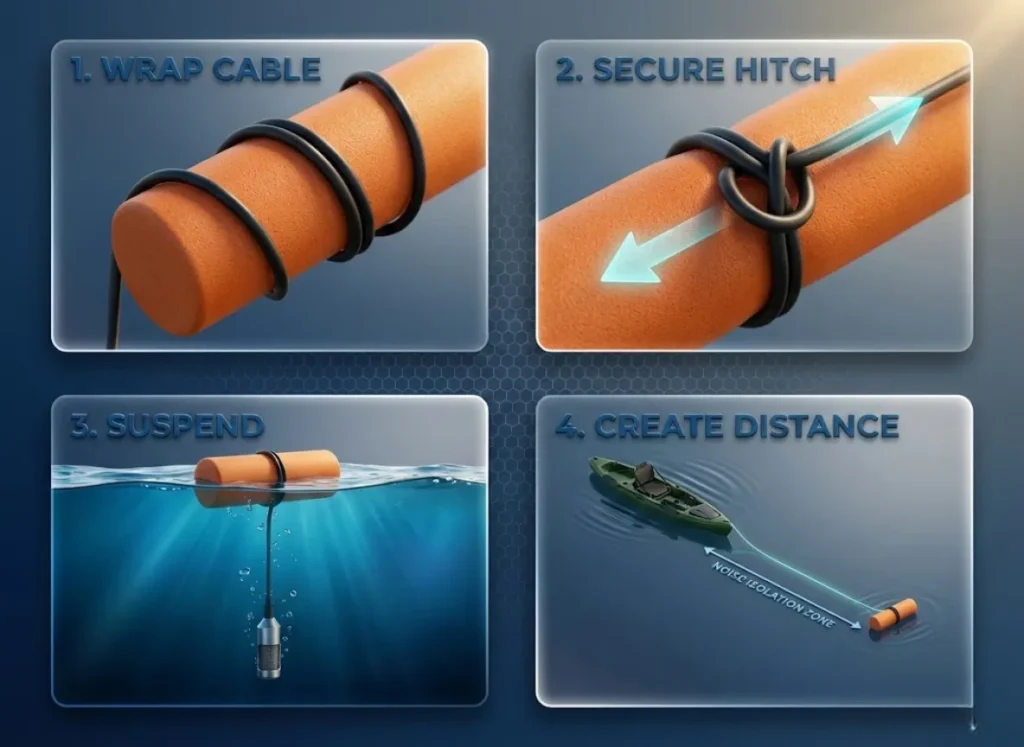
The “Noodle Trick”: Isolating Your Hydrophone from Hull Noise
Structure-borne noise is the acoustic angler’s enemy. Every footstep, hatch slam, and cooler shift transmits through the hull and cable to the hydrophone, masking biological signals.
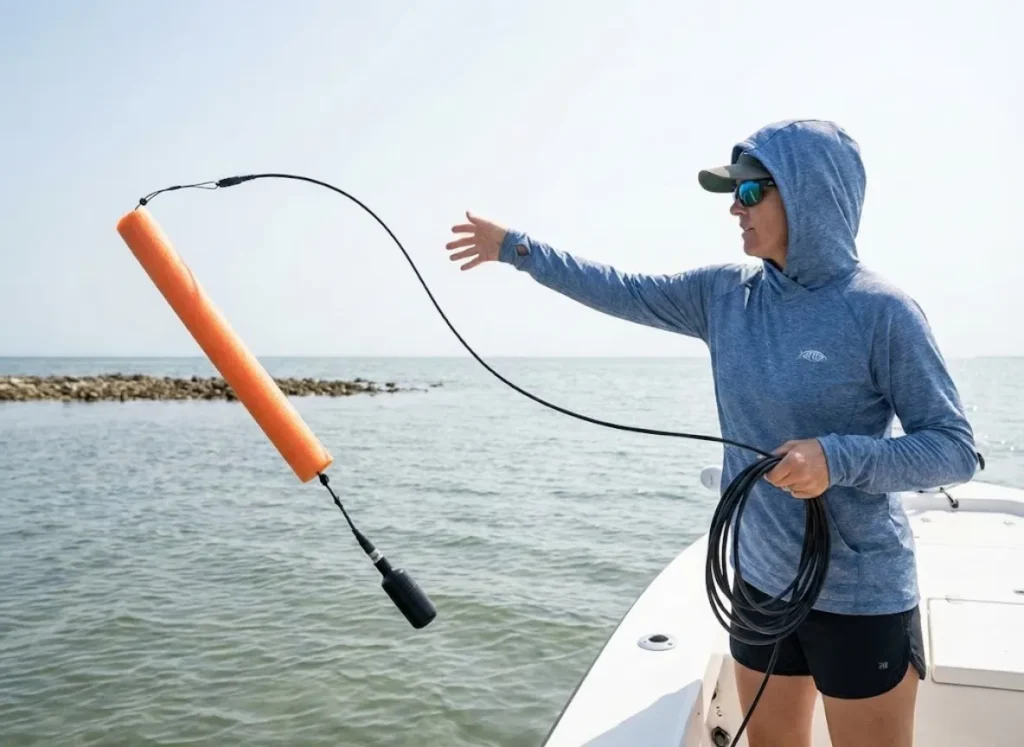
The solution is simple: a pool noodle suspension rig. Wrap the cable around a 1-foot foam noodle section, clove-hitch to secure. The noodle floats on the surface, suspending the hydrophone at 5-10 feet depth below the surface bubble layer. The foam acts as a mechanical decoupler, preventing vibration transmission. Cast the noodle away from the boat to exit the “noise shadow” created by hull slap.
Depth Matters: Getting Below the Bubble Layer
The top 3-5 feet of water contains the surface bubble layer—breaking waves, splash, wind chop—creating broadband low-frequency underwater noise that masks drum calls. Deploy at 5-10 feet minimum for a clean signal-to-noise ratio. In calm conditions, shallower works; in chop, go deeper.
Platform-Specific Considerations
A kayak’s lightweight hull is a resonator. Never mount internally—use a rigid pole mount (modified camera monopod) clamped to the side. Keep the sensor away from paddle drips and hull slap. If you’re looking for a stable platform, our guide to choosing a stable fishing kayak covers hull options.
On powerboats, internal combustion engines are deafening underwater. To fish acoustically, kill the main engine. Even trolling motors produce high-pitched vessel noise. Drift silently and listen.
Pro tip: Match your drift speed to the current. If the water mass and boat move together, relative velocity over the sensor approaches zero—killing flow noise and giving you a crystal-clear signal.
Environmental Timing: Syncing with Nature’s Broadcast Schedule
The Dusk Chorus: Your Prime Listening Window
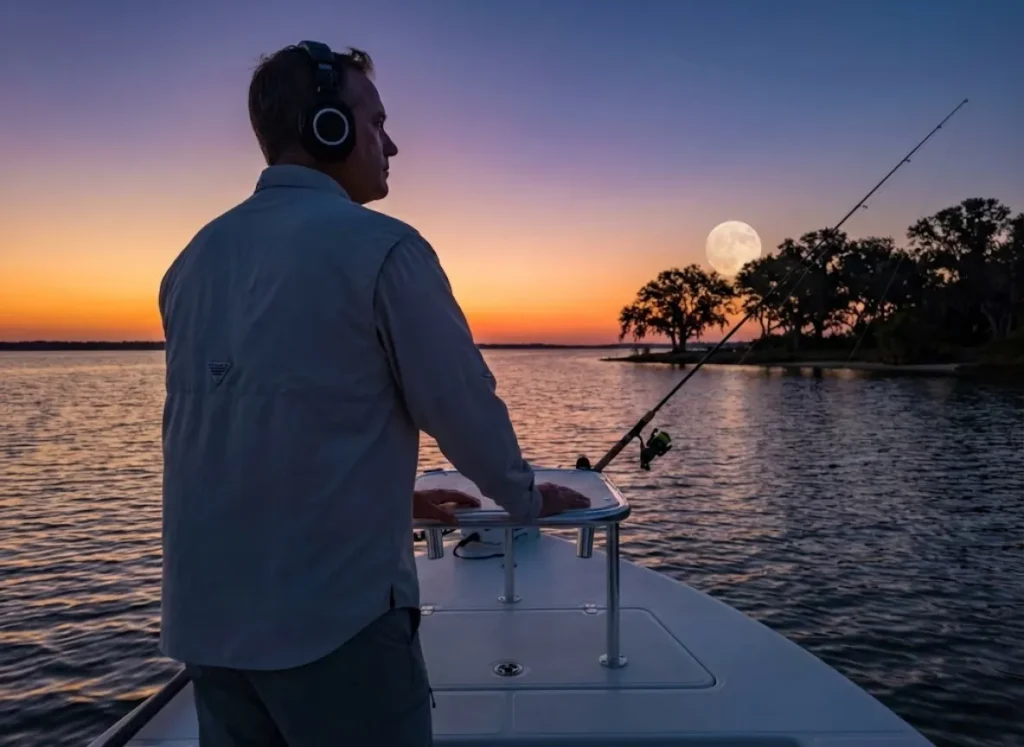
For Red Drum and Spotted Seatrout, the acoustic window opens 1-2 hours before sunset, peaks after dark, and tapers by midnight. Planning a hydrophone survey? Arrive by 5 PM in summer, 4 PM in winter. You want to be set up and listening before the first calls begin—this is the heart of pre-fishing scouting.
Lunar Phase: The Full Moon Advantage
Spawning intensity peaks during the full moon and the days immediately following. Spring tides create strong currents for egg dispersal—fish evolved to synchronize spawning with maximum tidal exchange. Plan acoustic scouting around the full moon; new moon periods show reduced chorus activity. For more on lunar strategies, see our article on solunar theory and lunar transits.
The Snapping Shrimp Baseline: Noise as Data
A healthy estuary is loud. The broadband crackle of snapping shrimp (2-200 kHz) forms constant background ambient sound. Target species occupy the VLF basement (<1 kHz); shrimp occupy the penthouse. You can mentally “listen under” the shrimp to isolate fish noise.
Silence is bad news. An area with no shrimp crackle is often biologically barren—no structure, no benthic life, no predators. Use the underwater soundscape as a habitat quality indicator and sound-to-catch interpretation tool.
Maintenance and Longevity: Protecting Your Investment in the Salt
Connector Care: The Weak Link
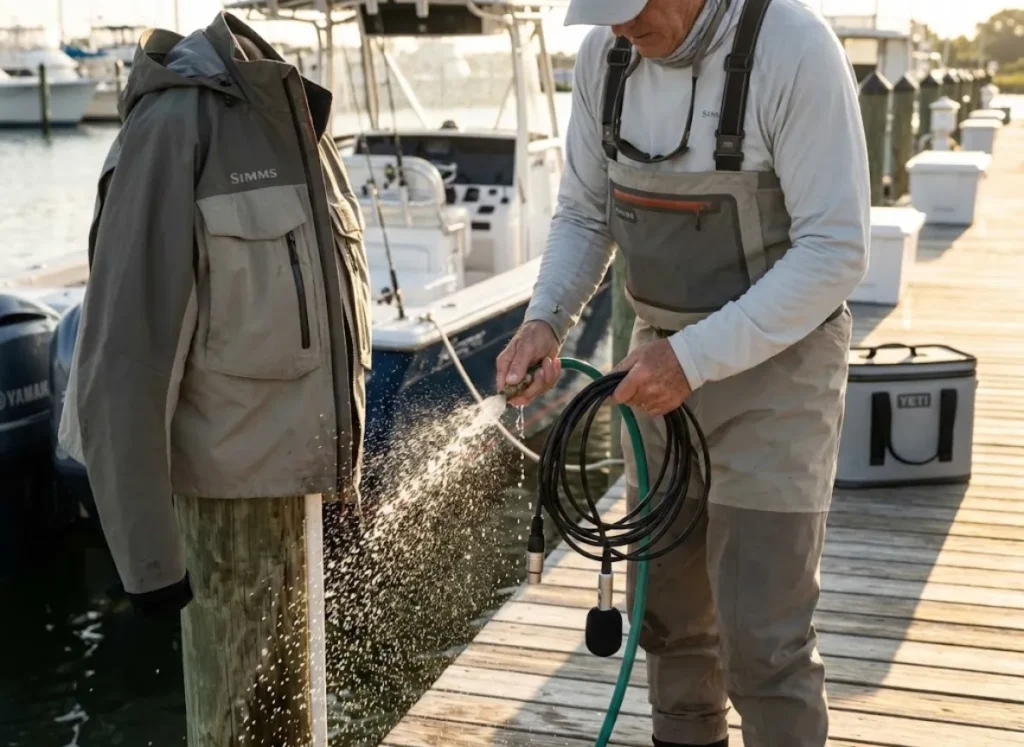
Connection points—XLR, 1/4″, RCA—are most vulnerable to oxidation. Gold-plated connectors resist corrosion best. After every saltwater session, rinse connectors with fresh water. Dried salt crystals work into micro-fissures and cause delamination. Proper connector care extends the life of your investment.
Periodically clean contacts with deionized water and isopropyl alcohol to remove oxide buildup that introduces static into the high-impedance signal path.
Cable and Housing Integrity
Hydrophone cables use specialized urethane jackets—durable, but not indestructible. Oyster shells and propeller blades will cut them. Any breach allows saltwater to wick up the shielding, changing capacitance and ruining the sensor. Proper cable management is essential.
Use the “over-under” cable wrap to prevent internal wire breakage. Store in a cool, dry location away from UV exposure. For a comprehensive approach, check the 3-tier care protocol for fishing gear.
Conclusion
The underwater world is not silent—it’s a symphony of biological signals waiting to be decoded. By adding a hydrophone to your tackle, you transform from a blind caster to an acoustic predator who can locate spawning aggregations miles before active sonar sees a blip.
Three takeaways: First, match your hardware to your platform—kayakers need portability (SQ26-H1); boaters need preamps and stereo integration. Second, timing is everything—the dusk chorus during a full moon phase is your highest-percentage window. Third, listen first, cast second—use passive acoustic monitoring to narrow your search, then deploy lures with confidence.
The next time you’re anchored over featureless mud, wondering if anything is down there, drop your hydrophone and listen. What you hear might change the way you fish forever.
FAQ
Can you hear fish with a hydrophone in freshwater?
Yes, but the species that vocalize differ. Freshwater drums produce sounds, as do some catfish and sunfish. However, the dominant soniferous fish are marine sciaenids, so hydrophones are most impactful in saltwater and brackish water.
What’s the difference between a hydrophone and a fish finder?
A fish finder uses active sonar—it emits pulses and reads echoes. A hydrophone is passive—it only listens to sounds already in the water. Fish finders show structure and presence; hydrophones reveal species identity and behavioral state like spawning or feeding.
How deep do I need to deploy the hydrophone?
Minimum 5-10 feet in average conditions to get below the surface bubble layer where wave action creates masking sounds. In calm water, shallower works; in chop, increase deployment depth.
Do hydrophones scare fish?
No. Hydrophones emit zero energy—they are purely receptive. Unlike active sonar, passive hydrophone technology is completely silent from the fish’s perspective.
Can I display hydrophone audio on my chartplotter screen?
Not currently. MFDs control audio sources via NMEA networks, but the protocol transmits control data, not audio streams. You hear hydrophone output through boat speakers or headphones; displaying a spectrogram on your Lowrance or Garmin requires specialized external equipment.
Risk Disclaimer: Fishing, boating, and all related outdoor activities involve inherent risks that
can lead to injury. The information provided on Master Fishing Mag is for educational and informational purposes
only. While we strive for accuracy, the information, techniques, and advice on gear and safety are not a substitute
for your own best judgment, local knowledge, and adherence to official regulations. Fishing regulations, including
seasons, size limits, and species restrictions, change frequently and vary by location. Always consult the latest
official regulations from your local fish and wildlife agency before heading out. Proper handling of hooks, knives,
and other sharp equipment is essential for safety. Furthermore, be aware of local fish consumption advisories. By
using this website, you agree that you are solely responsible for your own safety and for complying with all
applicable laws. Any reliance you place on our content is strictly at your own risk. Master Fishing Mag and its
authors will not be held liable for any injury, damage, or loss sustained in connection with the use of the
information herein.
Affiliate Disclosure: We are a participant in the Amazon Services LLC Associates Program, an
affiliate advertising program designed to provide a means for us to earn advertising fees by advertising and linking
to Amazon.com. As an Amazon Associate, we earn from qualifying purchases. We also participate in other affiliate
programs and may receive a commission on products purchased through our links, at no extra cost to you. Additional
terms are found in the terms of service.