


In this article
It’s 6am, you’re alone in a gravel parking lot, and the boat you bought last week weighs 77 pounds. The water is sixty yards away. Nowhere in the buying process did anyone mention that part, and it’s the part that decides whether this kayak gets fished twenty times a year or four.
The best fishing kayaks under $1000 are a real, buyable class of fishing platform with honest trade-offs, not a compromise bin you settle for until you can afford something serious. Anglers who shop this tier well end up on the water more than the ones who stretched their budget and bought a boat they can’t move alone. Below are four boats worth owning, what each one gives up, and the two things no spec sheet tells you: how you get it to the water by yourself, and what “425 lb capacity” actually means once you’re the one sitting in it.
What $1,000 Actually Buys You in a Fishing Kayak

You walk into a shop with a number in your head and no sense of where that number lands. Here’s the honest lay of the land before you look at a single boat. Under $1,000 means one thing across every brand: a paddle-only, sit-on-top kayak with a rotomolded polyethylene hull. Nothing else is in play at this budget fishing kayak tier, and the sale price you see on a holiday weekend doesn’t change the category, only the receipt.
The pedal version of the same Old Town hull featured later in this article lists around $2,599, which makes the tier boundary concrete instead of abstract. If you want to know exactly what pedal drive actually changes about a fishing day, read that separately and then come back with your budget intact.
What you do get at this price is more boat than most people expect. Real weight capacity, generally 350 to 440 pounds. Factory rod holders, usually two flush-mounts behind the seat and a molded holder or two up front. At least one rigging rail or gear track, plus molded foot braces you can set to your inseam.
A self-draining scupper hull dumps the water you take over the side instead of pooling it around your ankles, and there’s a sealed hull hatch up front for the gear you need dry. The adjustable seat is genuinely sittable for a half day now, which was not true of this price tier ten years ago. If you’re earlier in the decision than this article assumes, the pillar guide on how fishing kayaks are built and what separates the categories covers the category from the ground up.
What you give up against a $1,500-plus boat is a shorter list than the marketing suggests. Most sub-$1,000 hulls have no rudder system, though one boat here breaks that rule. You get a molded seat instead of an aluminum-frame chair, and a heavier hull because lighter plastic costs money.
On some models the transducer port is a knockout you drill yourself rather than a finished electronics pod. Worth noting that Old Town’s own spec sheet, which separates max capacity from usable capacity, publishes two different capacity numbers for the same boat, which tells you how loosely that spec gets used everywhere else.
Here’s where most buyers go wrong, and it’s a mindset problem rather than a spending problem. They treat “under $1,000” as the ceiling for the entire ownership experience instead of the ceiling for year one. Six months in they want a fish finder mount, a better kayak paddle, an anchor trolley, and they conclude they bought wrong.
They didn’t. This entry-level kayak tier is designed to be modified, and every boat below has more rail real estate than the rigging you’ll add in your first two seasons.
One number matters more than any other on the hang tag, and it isn’t capacity. Hull weight across this class runs 58 to 90 pounds, and that range decides whether you actually use the boat.
Best Overall Under $1,000 — Vibe Sea Ghost 110
Most “best overall” picks come down to a marketing bullet. This one comes down to a single hardware decision the other boats in this tier didn’t make, and almost nobody bothers explaining what that hardware actually does.

Eleven feet, 33 inches wide, a 62-pound hull, 425 pounds of capacity, and a toe-controlled rudder installed before it leaves the factory. That last spec is what earns the Vibe Sea Ghost 110 the top slot, and it’s worth understanding why, because every competitor roundup prints “rudder: yes” and moves on like the line explains itself.
A rudder’s real job is not turning the boat. You turn a kayak with a paddle stroke, and you always will. What a rudder system fixes is weathercocking, which is the single most tiring thing wind does to a kayak.
Here’s the mechanism. Your bow sits deeper and gets pinned by the water it’s pushing through, while the stern rides lighter and swings free. Crosswind hits, the stern gets shoved downwind, and the boat pivots until it’s pointed straight into the wind. It does this constantly and it does it whether you like it or not.
Paddling Magazine’s breakdown of what a rudder is actually correcting for walks through the same physics.
Without a rudder, you fix weathercocking by paddling harder on one side. All day. Every third or fourth stroke becomes a correction stroke instead of a propulsion stroke, and you burn a meaningful chunk of your energy just holding a line. Drop a rudder blade and tap a foot pedal, and the boat holds course while both arms do the same work on both sides.
Now put that on a real fishing day. The paddle out is usually with the morning wind. The paddle back is usually into it, at the end of the day, with tired shoulders and a cooler you didn’t have on the way out. That’s the leg where the rudder pays for itself.
Paddling difficulty in a crosswind is the spec nobody prints, and it’s the one you feel. If tracking is a new concept for you, the deeper explanation of why a hull that tracks well often feels less stable is the natural companion read here.
What the Sea Ghost gives up is honest. At 62 pounds it isn’t close to the lightest boat on this list. The rudder is also one more moving part, with cables and a pivot that want a freshwater rinse after every saltwater trip. Skip that rinse for a season and you’ll be replacing hardware.
You never notice a rudder’s absence while you’re fishing. You notice it on the transit legs, and by then it’s too late to do anything about it. If most of your water requires a half-mile paddle out and back, weight the rudder heavier than any other spec on the sheet.
Best for Standing and Sight-Casting — Perception Outlaw 11.5
Standing up in a kayak for the first time is a gut-drop moment. Either the platform holds you and you gain a whole new way to fish, or it wobbles once, you drop back into the seat, and you never try again. The hull and the seat decide which of those happens, and most people blame their own balance when it was the boat.

At 11 feet 6 inches with 425 pounds of capacity, the Perception Outlaw 11.5 reads like every other boat in this tier on paper. The spec that separates it gets buried three lines down: the lawn-chair seat folds away flat. Drop it and the deck becomes an open standing platform with no seatback catching the back of your legs when you shift your weight.
That sounds minor until you’ve tried to stand in a boat where it isn’t true. In a fixed-seat kayak, standing means straddling the frame, and every time you pivot to cast you catch a hip or a calf on something rigid. Standing anglers care about that more than almost any other feature on the boat, and spec sheets almost never lead with it.
Hull shape does the rest of the work. A wider platform with a flatter bottom has high initial stability, which is the technical term for “it doesn’t wobble when you first put weight off-center.” Any stability rating a brand prints is marketing; hull geometry is physics.
A tunnel hull like this one runs a recessed channel down the centerline that splits the wetted surface into two load-bearing shoulders, which is the same idea a pontoon-style hull uses and the reason both feel planted underfoot. You trade glide for it, and that’s exactly the trade a stand-up fishing angler doing sight casting wants to make. If you’re still choosing between hull categories entirely, the honest comparison of the stability trade-off between a canoe and a kayak covers that fork in the road.
Anglers describe that first stand-up attempt the same way every time. In a narrow budget hull it’s a two-second experiment that ends with you sitting back down and deciding standing isn’t for you. In a wide, flat-bottomed platform, you get past the wobble, your feet settle, and about thirty seconds later you’re scanning water you couldn’t see from the seat. Same angler, same balance, different boat.
The honest cons are structural. A wider hull is slower and catches more wind across the beam, and there’s no rudder here to help you fight it. On a windy flat you’ll work harder to hold position than you would in the Sea Ghost. That’s the price of the standing deck, and for a lot of anglers it’s worth paying.
Best for Rigging It Out Later — Old Town Sportsman 106 Solo
Every kayak angler’s boat looks different at the end of year two than it did on day one. If you already know you’re the person who adds a fish finder in March and an anchor trolley in June, buy the hull that expects it.

Ten feet six inches, a 77-pound hull, a DoubleU pontoon-style bottom, and the most honest capacity spec in this entire price tier. The Old Town Sportsman 106 Solo is rated at 440 pounds max and 363 pounds usable, and Old Town publishes both numbers side by side instead of quietly printing the bigger one.
That distinction is the most useful thing in this article for a nervous first-time buyer. Usable capacity already subtracts the hull’s own weight and rigging, so it’s the number that answers the real question: will I, plus my cooler, plus my battery, plus my tackle actually fit in this boat? Max capacity answers a much less interesting question about what the hull can float before it’s swamped.
Here’s the arithmetic nobody in this category does for you. Stay at roughly 75 to 80 percent of stated max once you total angler plus cooler plus battery plus tackle. Real-world loading tests show a 425-pound-rated hull barely notices 300 pounds.
What changes as you approach the printed number is freeboard, the height of the sides above the waterline, and that’s your entire margin before water starts coming over the gunwale in a wake or a chop. A boat sitting low doesn’t feel unstable in flat water. It feels unstable the moment a bass boat passes you.
Run the numbers on yourself before you buy, using a bathroom scale rather than a guess. Weigh yourself in the clothes you fish in, then weigh the loaded cooler, the battery, the tackle crate, the paddle and the PFD as one pile. A mid-size angler with a full day’s gear lands closer to 300 pounds than almost anyone expects.
On a 350-pound boat that’s most of the rating gone. On a 425 you’ve still got real margin. New buyers load right up to the number on the box because the box invited them to, and the boat that “holds 425 lbs” is emphatically not a boat you want carrying 400.
The pontoon hull deserves its own sentence for a reason that has nothing to do with capacity. It’s quiet. Two parallel hull sections riding the water instead of one rounded belly means less slap, and hull slap carries a long way in skinny water. Anglers who fish shallow flats say they get closer to fish in a pontoon boat than they did in a rounder hull, and that’s not a spec printed anywhere.
Rigging is the other reason to buy this hull: full-length gear tracks, a transducer-ready recess, and enough flat deck to mount things without crowding your knees. If you’re planning that build-out, the breakdown of what factory gear tracks actually get wrong will save you a bad purchase, and mounting a fish finder without drilling the hull covers the most common year-one addition. Bring a cooler that fits the tank well, too: the right cooler bag for a kayak is a different shape than the one in your truck bed.
The cost of all this is 77 pounds of hull, the heaviest boat in this shortlist, which hands you straight into the problem the next two sections are built around.
Best Budget Pick — Pelican Catch Classic 100 Angler
Plenty of people reading a “$1,000 kayak” article have $600. This is the boat that answers them without pretending the gap doesn’t exist, and its best feature is a number most reviews treat as a footnote.
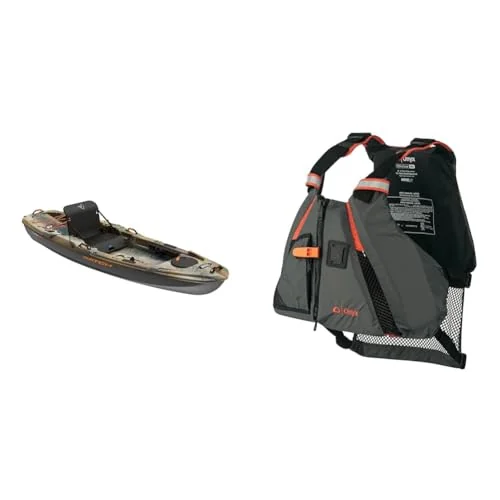
Ten feet, 58 pounds, 350 pounds of capacity, and an Ergocast dual-position seat. The number that matters on the Pelican Catch Classic 100 Angler is the 58. That’s 15 to 20 pounds lighter than the $999 boats above it, and in the specific situation where you’re alone at a truck tailgate trying to get a hull onto a roof rack, twenty pounds is not a small difference. It’s the line between a lift you make and a lift you don’t.
It also still fishes. Rod holders and a rigging rail come standard, which is what separates an actual angling kayak from a recreational hull with a fishing decal. This is throw-and-go in the angler sense: grab it, launch it, no twenty-minute rigging session at the ramp while everyone else is already catching fish.
What you lose is real and worth stating plainly. The 350-pound capacity is the lowest here, so run the 75 to 80 percent math before you assume it holds you plus gear, because it’s the one boat on this list where a big angler with a full crate genuinely might not fit. There’s no rudder. The 10-foot hull tracks less confidently in a crosswind than an 11-footer, and the seat is simpler than what the pricier boats give you.
The lightest boat in a shortlist is usually the one that gets fished the most, because the friction to use it is lowest. Nobody puts that in a comparison table, but track your own trips for a season and you’ll see it.
If this is your first fishing kayak, spend twenty minutes on what actually goes wrong on a beginner’s first kayak trips before your first launch. The mistakes are predictable and every one of them is avoidable.
Getting a 70-Pound Kayak to the Water by Yourself
Back to the gravel parking lot. You bought the boat, you’re alone, the water is sixty yards away, and your kayak weighs more than a bag of concrete. Whether you fish this boat twenty times a year or four gets decided right here, and not one competitor roundup in this category says a word about it.
Put the numbers together. The hulls in this article run 58 to 77 pounds, and the class overall reaches 90. NIOSH lifting guidance puts safe overhead-lift limits well below 50 pounds under field conditions, which means every boat in this tier is already past a safe solo overhead lift before you factor in wet plastic, an awkward grip, and a tall vehicle.
That’s not a scare number. It’s just arithmetic that nobody bothers running for you before you swipe a card, and it’s the real reason kayak fishing accessibility stalls out for so many first-time owners. Car-topping on a J-cradle is the default answer, and it’s a technique problem long before it’s a strength problem.
The fix isn’t strength. It’s technique and one cheap accessory.
Never press the whole hull overhead. Set the stern on the rear J-cradle first, then walk to the bow and slide the boat forward until it seats. You’re lifting half the weight at any given moment and your shoulders stay below your ears the entire time.
That stern-first method is the standard answer among solo paddlers, and the detailed walkthrough of the stern-first loading method for a J-rack covers the small adjustments that make it work on a taller vehicle. Add a folded moving blanket over the rear of your roof to protect the paint and the plastic while the hull slides.
The second fix is the parking-lot-to-water problem, which is a completely separate lift. A scupper-mount cart threads its posts up through the drain holes in the hull, and a 60 to 90 pound dead-lift-and-carry becomes a rolling walk.
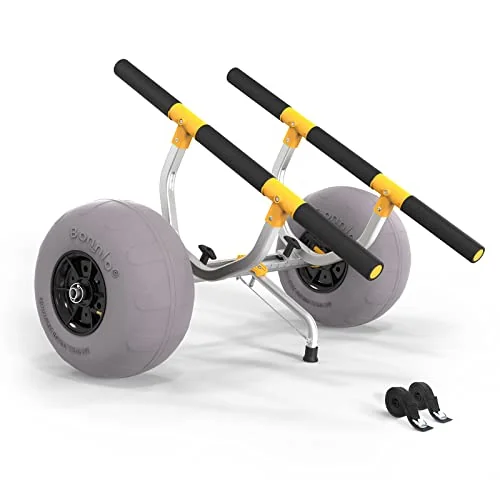
A cart pays for itself the first time you park more than 50 yards from the water, and it changes which launches you’re willing to use. Ramps with close parking get crowded; the good access points are often the ones with a walk. Load the boat rigged, strap it down with one cam strap over the seat, and roll it fully loaded instead of making three trips with gear.
This is why the 58-pound Pelican and the 77-pound Old Town are not interchangeable choices even though their capacity numbers sit in the same neighborhood. Transport reality is a real spec, and it gets skipped because it doesn’t fit in a comparison table.
Here’s the thing that only shows up after a season of ownership. The boat you can load in under two minutes without thinking about it is the boat you take out on a marginal-forecast Tuesday evening. The boat that requires a plan, a helper, or twenty minutes of setup stays on the rack, and the forecast becomes an excuse. Once you can move the boat solo, the whole map opens up, including the kayak launches worth the drive on the Texas coast that are impractical without a cart.
The PFD and Cold-Water Math Nobody Puts in a Kayak Roundup
Buying the boat and buying the vest are the same purchase. One of them gets six paragraphs of research and the other gets grabbed off a peg on the way to the register, and that mismatch is why so many kayak PFDs end up bungeed to the tank well instead of worn.
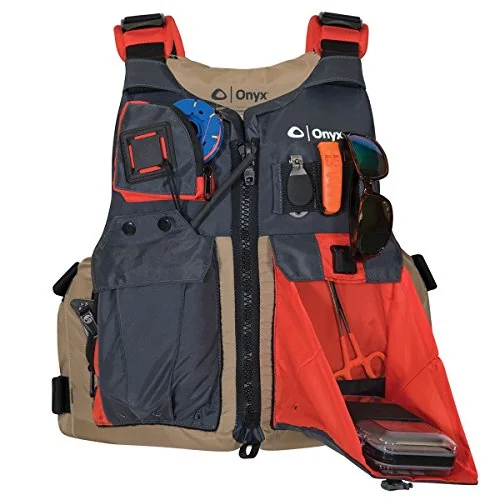
The fit problem is specific and mechanical. A generic vest has a full-height back panel. A kayak seat has a tall seatback, and on a mesh seat that back panel sits even higher off the deck. Put them together and the vest rides up your neck every time you lean into a paddle stroke, so within three trips it comes off and lives in the tank well.
A high-back cut, with the flotation moved up and out of the way of the seatback, mesh through the lower back, and front pockets for pliers and leader, is the vest you’ll actually keep on. A PFD in the hatch protects nobody.
Now the part that makes the vest matter. Cold shock is the involuntary gasp and hyperventilation that hits when you go into cold water without warning, and it peaks in water between 50 and 60 degrees. That temperature range does not feel cold when you dip a hand in from the seat. What it does is take your breathing away from you for the first sixty seconds, which is the exact window when you need to hold your breath, clear the boat, and get your head up.
The National Center for Cold Water Safety’s breakdown of what a PFD can and can’t protect you from is direct about the outcome: capsized paddlers are frequently found near their boats, having gone under before they could wet-exit. A vest you’re wearing turns that first minute into an inconvenience.
Which is why the skill matters as much as the gear. Practice how deep-water re-entry actually works in warm water, in a swimsuit, on a summer afternoon, before you need it in October wearing everything you own. It takes one session to learn and it never leaves you.
The second piece of arithmetic is the Rule of 120. Add air temperature and water temperature in Fahrenheit. If the sum is under 120, you want thermal protection, meaning a wetsuit or a drysuit, not just a vest.
NRS lays out the Rule of 120 for deciding when you need thermal protection in more detail, but the beauty of it is that it’s parking-lot math. A 65-degree April morning over 50-degree water sums to 115, and that’s a day when the air lies to you.
The vest you’d happily wear all day in July is the vest that decides whether you’re wearing anything in October. Comfort is a safety spec, not a luxury one. Buy for the hot day and the cold day takes care of itself.
This belongs in a budget kayak article specifically because of who buys in this tier. Usually new to the sport, usually fishing alone, and often launching in shoulder season when the water hasn’t caught up to the air. Add one more scenario to the list while we’re here: anchoring safely from a kayak is its own skill, and an anchor line cleated to the side of a hull in moving water is one of the most reliable ways to flip a boat that was perfectly stable a second earlier.
The Used and Demo Path to a Better Hull

Everyone shopping this tier assumes “under $1,000” means new boats whose MSRP starts with a 6, 7, 8 or 9. It doesn’t. The same budget shops a completely different shelf if you’re willing to buy a hull somebody else already unwrapped, and not one article in this SERP mentions it.
Dealers and outlet stores run two categories worth knowing in the used kayak market. “Used-Like New” means a boat that got paddled once or twice, usually a customer return, sold without warranty. A demo kayak covers show units, rental fleet boats, and pro-staff hulls at the end of a season. Both routinely land boats that cost $1,300 to $1,500 new inside a $1,000 budget, and the inventory turns over constantly at the end of summer.
The Bonafide RS117 is the obvious example of what that opens up. It’s an 11’7″ by 33.5″ hull with a hybrid catamaran deck and a YakAttack rail in the form of a MightyMount XL track, normally sitting at the very top of this price tier when new, and it’s a common entry point on the demo shelf.
The catamaran hull is worth understanding regardless of what you buy: two parallel pontoon-like humps instead of one rounded belly, which is why anglers stand and cast in that boat without the tippy feeling a rounder hull gives you at the same width. Jackson hulls turn up on the same shelves, and the pattern holds across brands whose new pricing sits above this article’s ceiling.
What you accept is real. No warranty, no returns, and a hull you need to inspect yourself rather than trusting a listing photo. Get your hands on it before money changes hands.
Check the scupper holes for hairline cracks radiating from the tube, because that’s where a hard drop shows up first. Squeeze the hatch gaskets and look for compression set or dry rot. Sight down the hull from the bow for any oil-canning, a permanent dent from being strapped down too tight on a rack.
Cosmetic scratches above the waterline are meaningless on plastic and always will be. Deep gouges below it are worth a hard look and a price argument.
What you gain is a materially better hull. Usually a real frame seat instead of a molded one, better factory rigging, and often a rudder or a rudder-ready stern that a new $999 boat won’t have. You’re trading paperwork for boat.
Whichever shelf you buy from, the point holds: this tier is year-one gear, and the upgrade path is the actual second half of the purchase. Most anglers make the seat upgrade most people make first, because eight hours in a molded seat teaches you fast. After that it’s usually a fish finder, then flush-mount rod holders worth adding, then an anchor trolley, then keeping a phone dry and mounted where you can see it for navigation and photos.
A paddle that doesn’t fight you belongs on that list too, and it’s the upgrade anglers say they should have made first. Blade design is where the money goes: a smaller, lower-angle blade in a lighter shaft costs you nothing in speed over a fishing day and saves your shoulders on every one of the thousands of strokes you don’t think about. Add a few gear loops and some bungee storage across the tank well, keep the small stuff in dry storage up front, and the boat starts feeling like yours.
Note that where you fish changes the priority order. A saltwater fishing kayak needs a freshwater rinse routine and hardware you can service, inshore fishing in current rewards the rudder more than anything else on the list, and a lake fishing kayak or a pond fishing setup can skip half of it and still fish beautifully. Match the kayak fishing budget to the water you actually have, not the water in the brochure.
The Bottom Line on Fishing Kayaks Under $1,000
These four boats split cleanly by what you actually need. Rudder and all-around capability goes to the Sea Ghost 110. A standing platform goes to the Outlaw 11.5.
Room to rig it out over two seasons goes to the Sportsman 106 Solo. The lightest hull and the lowest price go to the Catch Classic 100 Angler.
Weigh the hull weight as hard as you weigh the capacity number. The boat you can move alone is the boat you’ll actually fish, and every spec sheet in this category buries that fact under a pile of dimensions.
Treat this tier as year one, not as a ceiling. Every boat here is built to be modified, and the demo shelf is a legitimate alternative to compromising on a new-MSRP hull.
Before you buy anything, go stand next to the boat and pick up one end. That single motion in a parking lot tells you more about whether you’ll use it than any spec sheet ever will.
Frequently Asked Questions
01What is the best $1000 fishing kayak?
The Vibe Sea Ghost 110 is the strongest all-around buy at that number, mainly because it ships with a toe-controlled rudder already installed. That saves your shoulders on every wind-fighting paddle back to the ramp, and retrofitting a rudder later costs real money.
02Which kayak is the most stable for fishing?
In this price tier the widest hull with the flattest bottom wins on initial stability, which makes the Perception Outlaw 11.5 the pick. Hull shape matters more than length: pontoon-style and catamaran hulls feel steadier underfoot than a single rounded belly.
03What are the best fishing kayaks for the money?
The Pelican Catch Classic 100 Angler and the Old Town Sportsman 106 Solo sit at opposite ends of the same argument. The Pelican gives you the lightest hull with rod holders and a rigging rail intact; the Old Town gives you a quieter pontoon hull and far more rigging room.
04Can you get a pedal kayak under $1,000?
Not in 2026. The pedal version of the same Old Town hull featured here lists around $2,599, and the pattern holds across every brand. Under $1,000 means paddle-only, so budget a pedal drive as a separate purchase two or three seasons out.
05How much does a fishing kayak weigh, and can I load one alone?
Hulls in this class run 58 to 90 pounds, which is above the safe solo overhead-lift threshold in standard lifting guidance. You can load one alone, but plan for it: go stern-first onto a J-cradle, and use a scupper-mount cart for anything past 50 yards.
Risk Disclaimer: Fishing, boating, and all related outdoor activities involve inherent risks that
can lead to injury. The information provided on Master Fishing Mag is for educational and informational purposes
only. While we strive for accuracy, the information, techniques, and advice on gear and safety are not a substitute
for your own best judgment, local knowledge, and adherence to official regulations. Fishing regulations, including
seasons, size limits, and species restrictions, change frequently and vary by location. Always consult the latest
official regulations from your local fish and wildlife agency before heading out. Proper handling of hooks, knives,
and other sharp equipment is essential for safety. Furthermore, be aware of local fish consumption advisories. By
using this website, you agree that you are solely responsible for your own safety and for complying with all
applicable laws. Any reliance you place on our content is strictly at your own risk. Master Fishing Mag and its
authors will not be held liable for any injury, damage, or loss sustained in connection with the use of the
information herein.
Affiliate Disclosure: We are a participant in the Amazon Services LLC Associates Program, an
affiliate advertising program designed to provide a means for us to earn advertising fees by advertising and linking
to Amazon.com. As an Amazon Associate, we earn from qualifying purchases. We also participate in other affiliate
programs and may receive a commission on products purchased through our links, at no extra cost to you. Additional
terms are found in the terms of service.