

In this article
There’s a good fish at the side of the boat, the hook set well past the barb, and your fishing pliers won’t open. Last week’s salt dried in the hinge, the jaws are locked shut, and now you’re working a treble out with your fingers while the fish burns the clock. That’s how pliers actually fail. Not in the store, on the water, with a fish waiting. The best fishing pliers aren’t the ones with the most features printed on the handle; they’re the ones that still open on the tenth saltwater trip and cut braid clean on the hundredth. This guide covers what makes a pair fail, how to match metal and length to where you fish, the features worth paying for, and the specific pliers worth buying at every price.
What Actually Makes Fishing Pliers Fail
Every roundup lists specs. Almost none tell you how a pair of pliers actually dies, which is the thing you want to know before you spend money twice. Pliers rarely wear out slowly. They fail at one specific moment, usually with a fish on the line, and it comes down to three parts giving up.
The Hinge Seizes Before the Frame Ever Rusts
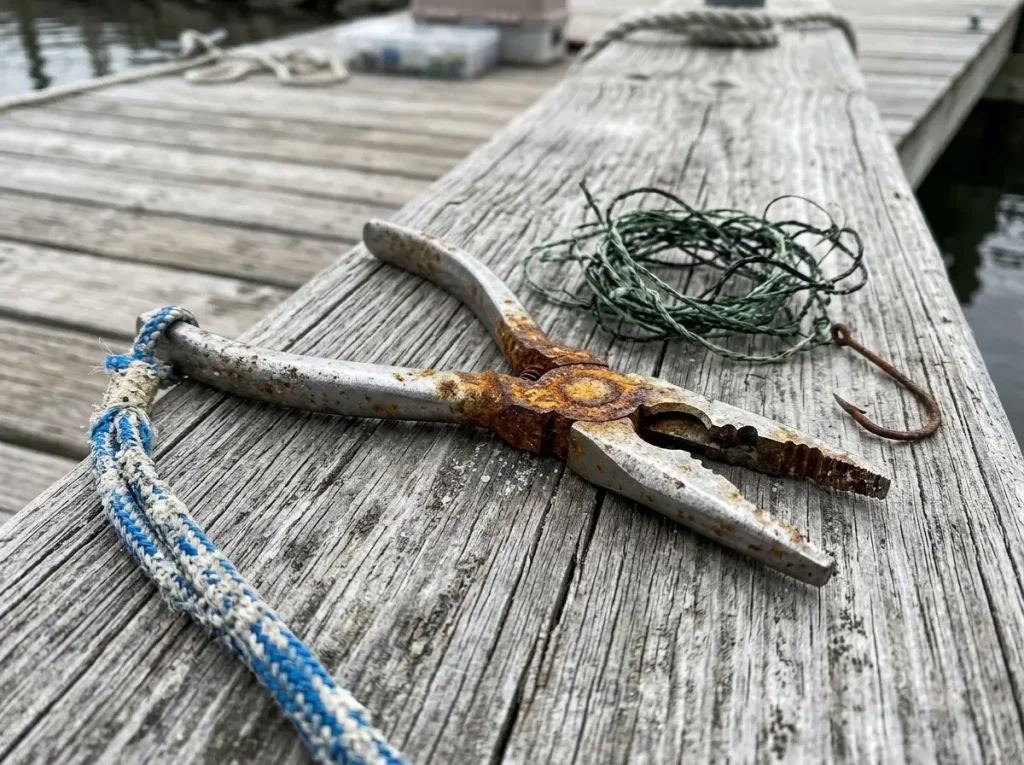
The corrosion-resistant pivot is the whole ballgame, and it’s the part cheap pliers cut. Anglers report the same story over and over on saltwater forums: the jaws still look fine, the frame shows barely a freckle of rust, and the pliers won’t open because the pivot seized. Salt dries in the hinge, corrosion creeps into the joint, and a $15 spring pivot locks up long before anything else on the tool shows wear. A quick freshwater rinse after every salt trip is the single habit that prevents it, and skipping it is why so many pliers “rust shut” in a tackle tray by midseason. If you want the full routine, the same saltwater rinse and care protocol applies to every metal tool you own.
Rinse the pivot, not just the jaws. Work the pliers open and closed a few times under fresh water so it flushes the joint, then put one drop of oil on the pin before it dries. That thirty-second habit is the difference between a pair that lasts two seasons and one that seizes by August.
A Dull Cutter Chews Braid Instead of Slicing It
The second failure is the cutter. A replaceable cutter insert can be swapped for a few dollars when it dulls. A fixed cutter can’t, and once it stops slicing braid clean it starts crushing and fraying line instead of cutting it. You notice it first on braid, then on 20-pound fluorocarbon, and by then the whole tool is done because the one part that wore out is welded into the frame. This is Level-2 knowledge every experienced angler learns the hard way, and it’s why a replaceable cutter matters more than almost any other feature.
Budget Jaws That Bend on the First Real Fish
The third failure is structural. Sub-budget aluminum pliers in the cheapest tier bend at the jaw on the first genuinely big fish, and owners report it happening on the first trip, not after years of use. A jaw that flexes can’t hold a hook shank, so it slips right when you need leverage. Corrosion and bending are two different failures, so they’re two separate things to check: how the pivot handles salt, and whether the jaw has the metal to hold up under a hard hookset. Fast, working pliers matter for the fish too, since NOAA Fisheries recommends keeping air exposure under 60 seconds during hook removal, and every second lost to a seized hinge counts against a fish you mean to release.
Titanium, Aluminum, or Stainless Steel for Salt Water
Material is the first real buying decision, and it’s the one where anglers overspend most. Here’s the honest version of the metal talk, including where you’d be paying for corrosion immunity you’ll never actually need.
Titanium Means Buy Once and Forget Rust
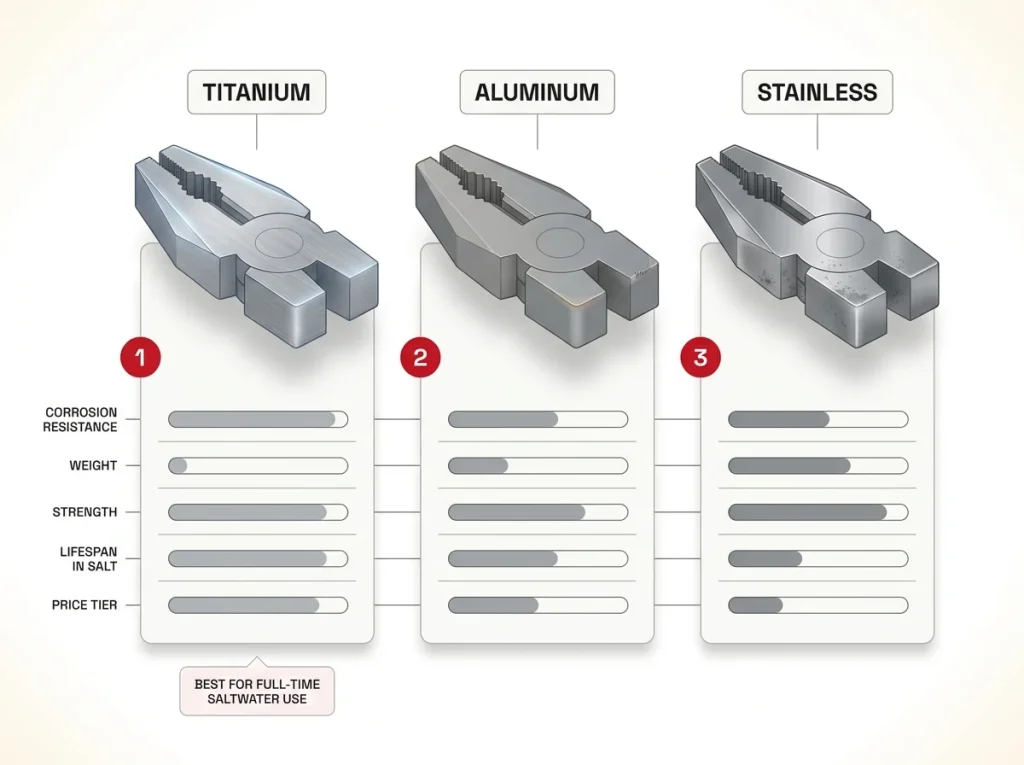
Titanium is effectively rust-proof in salt. That’s the entire pitch, and for someone who fishes the salt year-round it’s worth every dollar, because you stop thinking about corrosion completely. It’s the lightest strong option and it shrugs off the environment that eats other metals. The catch is price: titanium sits at the top of the range, and if you only touch saltwater a few times a year you’re buying immunity you won’t use.
Aluminum, the Sweet Spot for Most Anglers
Anodized 6061-T6 aluminum is where most anglers should land. It’s light, salt-resistant enough for regular use, and priced well below titanium. The one thing to understand is that the anodizing is a coating, not the metal itself, so a deep scratch through it exposes bare aluminum that can start to corrode. Treat the finish with a little respect and an aluminum pair covers the vast majority of real fishing.
Stainless Steel, Honest Budget Metal With a Shelf Life
Even “stainless” corrodes in salt eventually. Forged stainless steel survives roughly 18 months of regular saltwater abuse before performance drops off, which makes it the honest budget metal: fine for freshwater or occasional salt, not a lifetime saltwater tool. Buy stainless knowing you’ll replace it someday, and it’s a smart, cheap choice. Expect it to outlast a titanium pair and you’ll be disappointed. The same corrosion rules that govern every metal tool in your kit apply here too.
If you fish freshwater and only rarely dip into salt, don’t buy titanium. A good aluminum or stainless pair does everything you need, and the money you save covers a spare pair for the boat. Buy the metal for the water you actually fish, not the toughest spec on the shelf.
Sizing Pliers to the Fish You Actually Chase
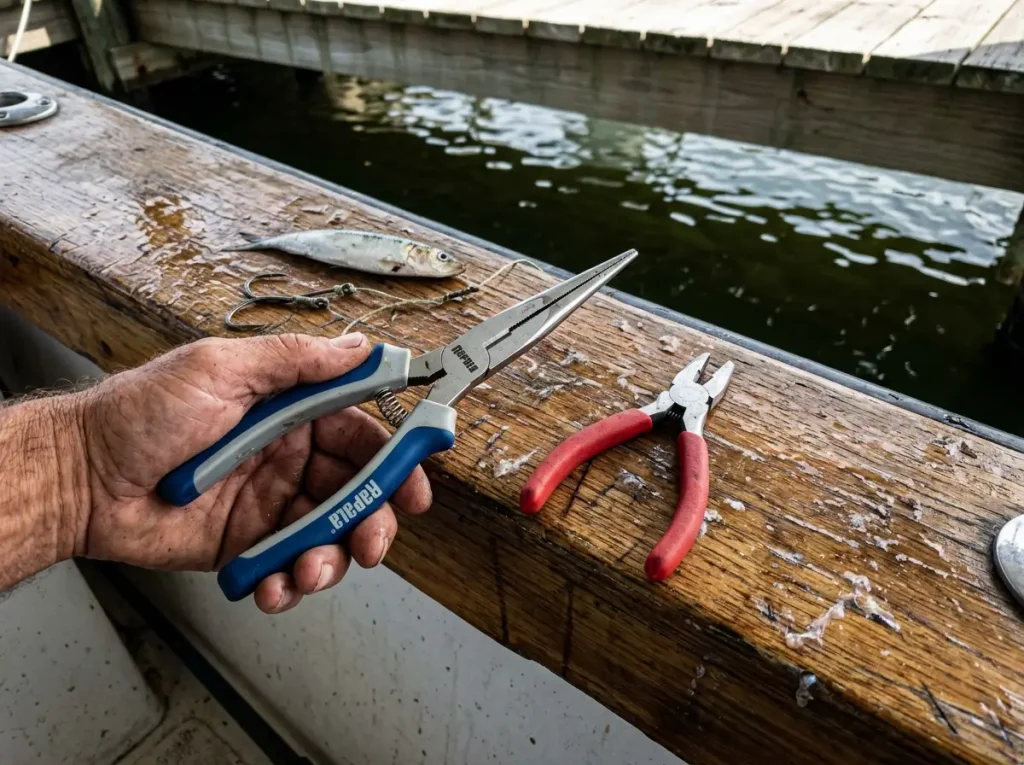
“Go bigger for big fish” is the advice everyone gives and nobody explains. Length is really a trade between leverage and reach, and the right answer depends entirely on the fish in front of you.
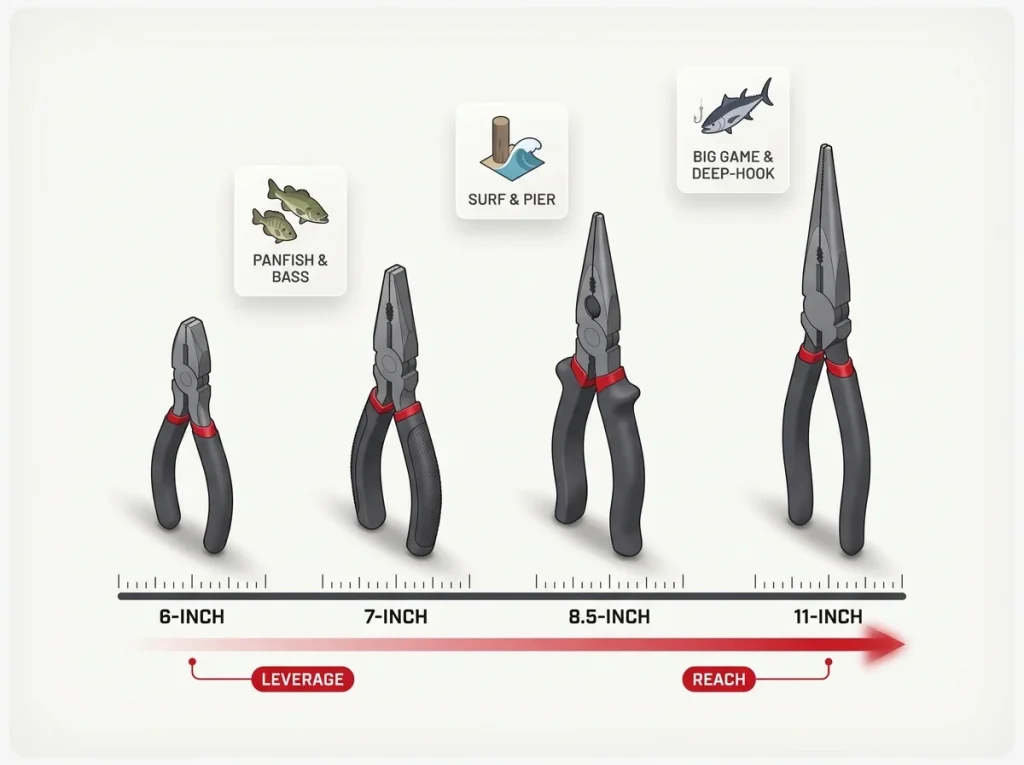
Short-Nose vs Long-Nose, Leverage or Reach
A short-nose plier gives you crushing leverage for tough jaw bone, the kind flounder and mid-range stripers have. A long-nose design trades that leverage for reach, getting a hook out from deep in a fish’s throat where a stubby pair can’t fit. Neither is better in a vacuum. One is built for power at the front of the mouth, the other for access to the back of it.
6-Inch Pliers for Panfish and Bass
For panfish and bass, a compact 6-inch pair is the right call. More precision, less weight, and it drops into a chest pack without pulling the strap sideways. Reaching for an 11-inch tool to unhook a bluegill is the sizing mistake beginners make most, chasing “bigger is better” into a plier they fight to control.
8.5-Inch and Up for Surf, Pier, and Big Game
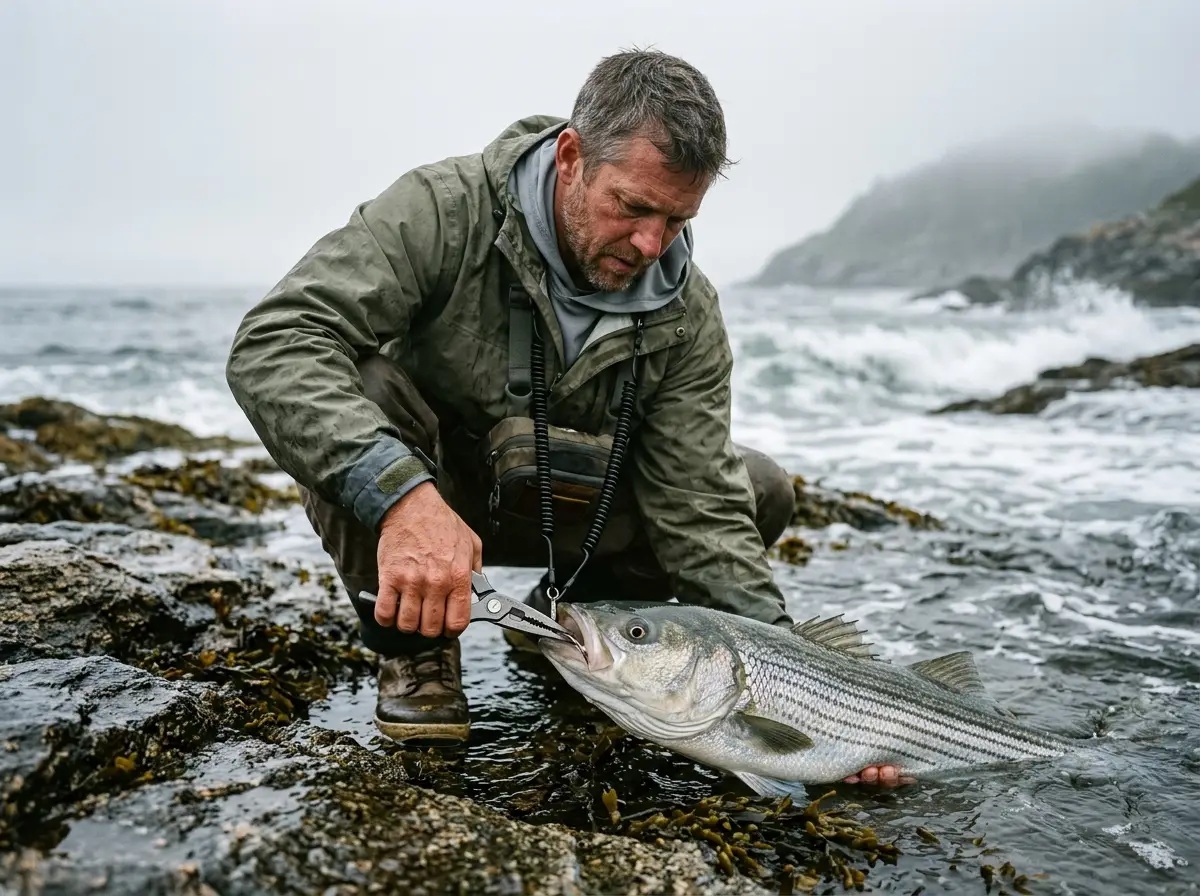
Surf, pier, and big-game work is a different job. A 7-to-50-pound fish with a 7/0 hook needs real length and leverage, which is why Van Staal builds and tests its titanium pliers pulling hooks from 50-pound striped bass in New England surf. A pistol grip frame adds control on a toothy fish like a bluefish that thrashes the second you touch the hook. For a deeply hooked fish, reach wins outright, and an 11-inch straight-nose pair like the Rapala 11-inch Long Reach Pliers gets to a hook set past the throat where nothing shorter will. That reach is also why length ties directly into safely reaching a hook set deep in the throat without forcing it.
The Features Worth Paying For (and the Ones That Aren’t)
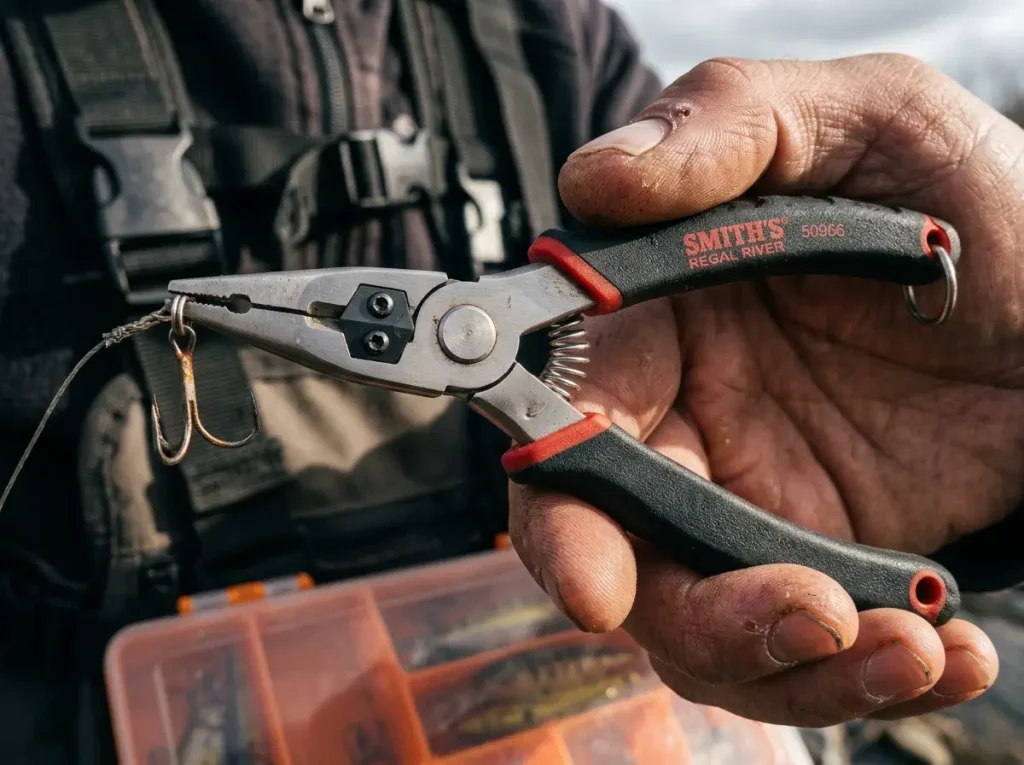
This is the part a salesperson won’t walk you through, because half of it tells you where to spend less. Some features are non-negotiable at any price. Others are marketing on the handle.
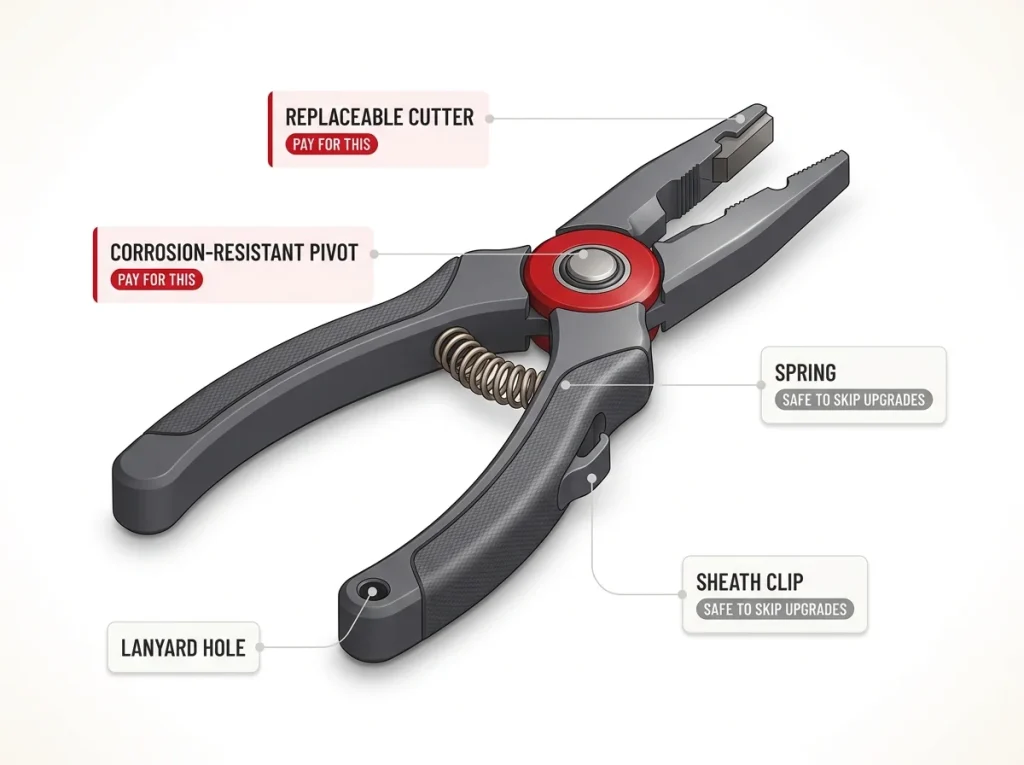
Replaceable Cutters, the One Feature You Can’t Skip
If you pay for one thing, pay for replaceable cutter inserts in carbide or tungsten carbide. A fixed cutter that dulls on braid turns the whole tool into scrap, while a replaceable insert brings a good pair back to new for a few dollars. Pair that with a corrosion-resistant pivot pin and you’ve covered the two parts that actually decide how long the pliers live. The Smith’s 50966 Regal River is a useful example of doing this at a budget price: it’s an aluminum-frame pair that still carries a hook sharpener, a crimper, and split-ring jaws, keeping the non-negotiables while cutting the stuff that doesn’t matter. The Smith’s Regal River pliers show that finish color and handle material are the safe places to save, not the cutter or the pivot.
Spring Action and One-Handed Use
Spring-loaded action isn’t a luxury feature. It lets you work a hook one-handed while the other hand controls the fish, and with the fish in the water that speed is the whole point. A pair that needs two hands to reopen is a pair that costs a released fish seconds it doesn’t have.
A Lanyard Is Not Optional
A lanyard is not an accessory, it’s insurance. Losing a pair overboard is the most common and most avoidable way anglers throw money at this gear, and a titanium pair sinks exactly as fast as a cheap one. That goes double for kayak fishing, where a pair loose in a tackle bag slides over the side the first time you lean to land a fish. A coiled tether costs a few dollars and clips to a pack or belt loop, and a coiled lanyard or retractor clipped to your pack ends the problem for good.
Clip the lanyard the day the pliers arrive, before the first trip, not after the first close call. The anglers who lose an expensive pair overboard almost always meant to add the tether “later.” Later is usually one wave too late.
Sheath and Holster, Where the Pliers Live
A sheath or holster keeps the pliers where your hand expects them and off the deck, which matters more than it sounds when a fish is thrashing at your feet. It’s also the difference between a tool that’s ready and one that’s rolling toward the scupper. Where the pliers ride day to day depends on how you carry the rest of your kit, whether that’s a chest pack or a vest. The built-in line cutter earns its keep here too, because for a deeply swallowed hook the National Park Service advises cutting the leader rather than forcing out a deeply hooked fish, which makes the cutter as important as the jaw.
Why a Store-Bought Multi-Tool Is the Wrong Call
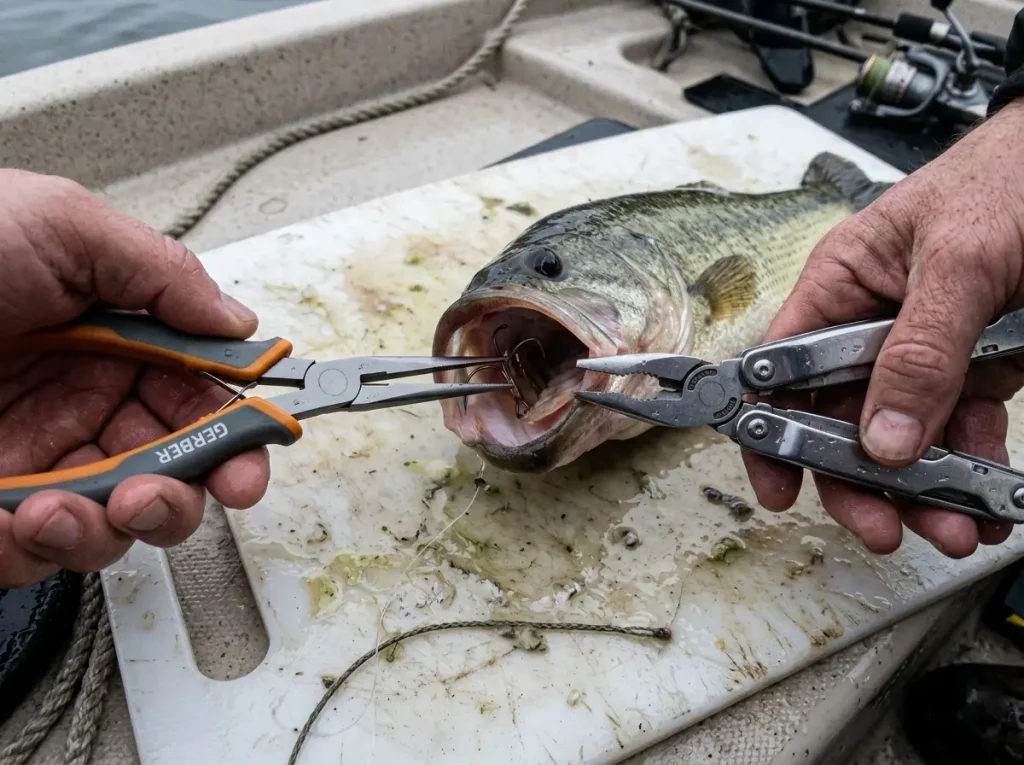
Plenty of guides quietly suggest a general multi-tool as a money-saver. It feels smart right up until there’s a hook set deep in a fish’s mouth, and then the shortcuts show.
Why Multi-Tool Jaw Geometry Fails at the Hook
A general multi-tool’s jaw geometry is built for bolts and wire, not for a fish’s throat. The jaws are too thick, the reach is too short, and there’s no leverage to crush a barb where the hook actually sits. Anglers describe the same fumble: reaching for the Leatherman already in the bag mid-fight, then struggling to get a clean purchase on a hook a slim needle-nose plier would have popped in a second. Using pliers as a hammer or a wrench, which is the multi-tool mindset, is also a named cause of early jaw misalignment even on mid-priced fishing pliers.
When a Purpose-Built Multi-Function Plier Makes Sense
Multi-function isn’t the problem. Wrong geometry is. A plier built specifically for fishing can carry extras and still get the jaw right, with a true needle-nose profile, a corrosion coating, and fishing-specific tools like a knot tie and an eyelet spike. The Gerber Gear Hemoplier is the honest version of “one tool that does more,” because it’s designed around a fish’s mouth first. Buy the tool built for the hook, and keep the general multi-tool for the trailer hitch.
Best All-Around and Budget Fishing Pliers
If you’d rather stop reading and just buy a pair that won’t let you down, start here. These two cover most anglers, and pliers are only one piece of the rest of the tools and accessories worth carrying, so think of these as the anchor of a kit rather than the whole thing.
Best Overall — KastKing Cutthroat 7-Inch
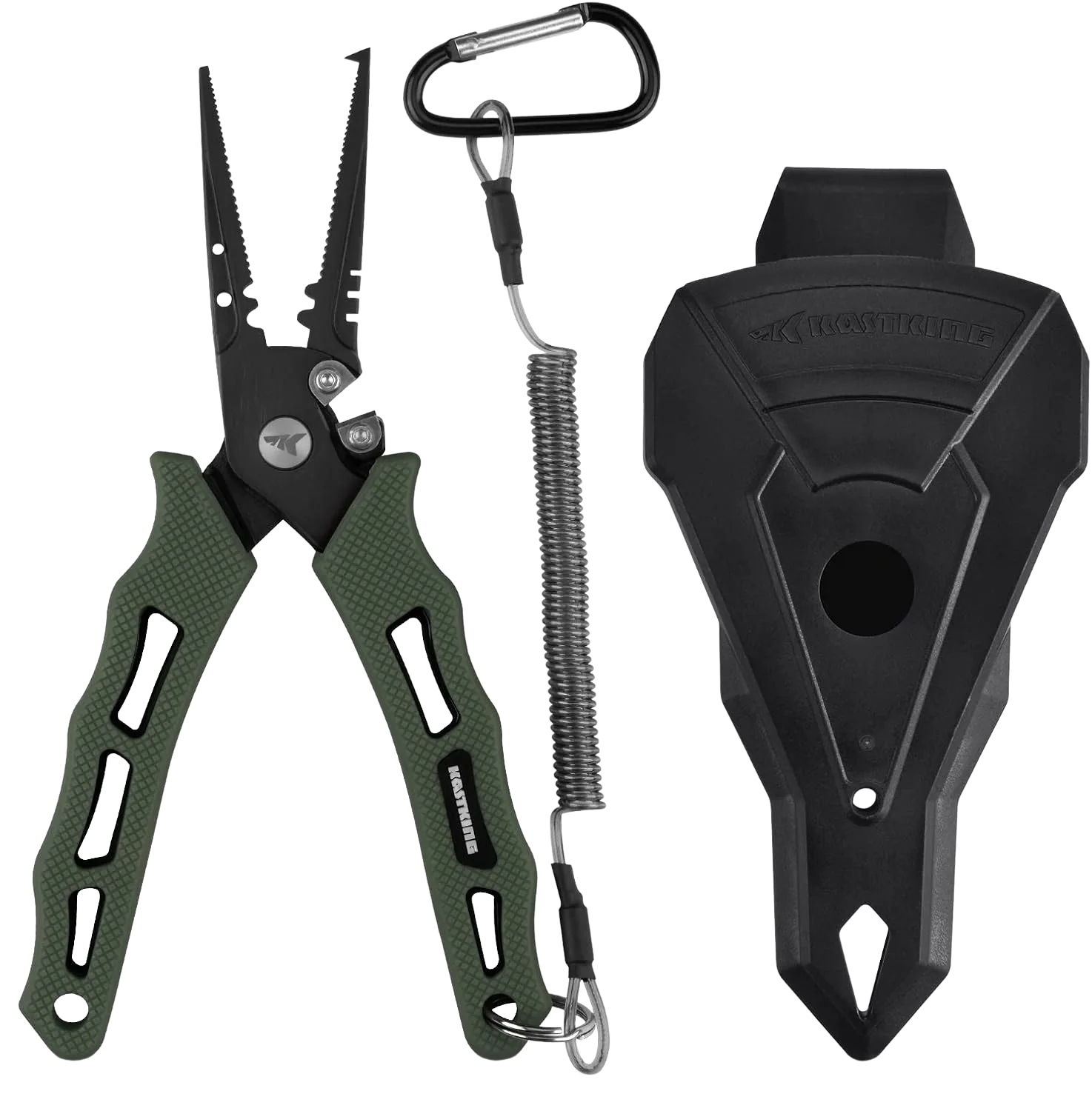
The Cutthroat earns “best overall” by getting the fundamentals right at a fair price. The replaceable cutters mean a dull blade is a cheap fix instead of a dead tool, the split-ring tip handles hook swaps, and the sheath keeps it holstered. It’s the pair a beginner can grow into, and it shows up on a beginner’s short list of gear that actually earns its place for exactly that reason. Where it stops making sense is hard saltwater and true big-game work, where titanium and more reach start to matter.
Best Budget — Piscifun Aluminum Pliers
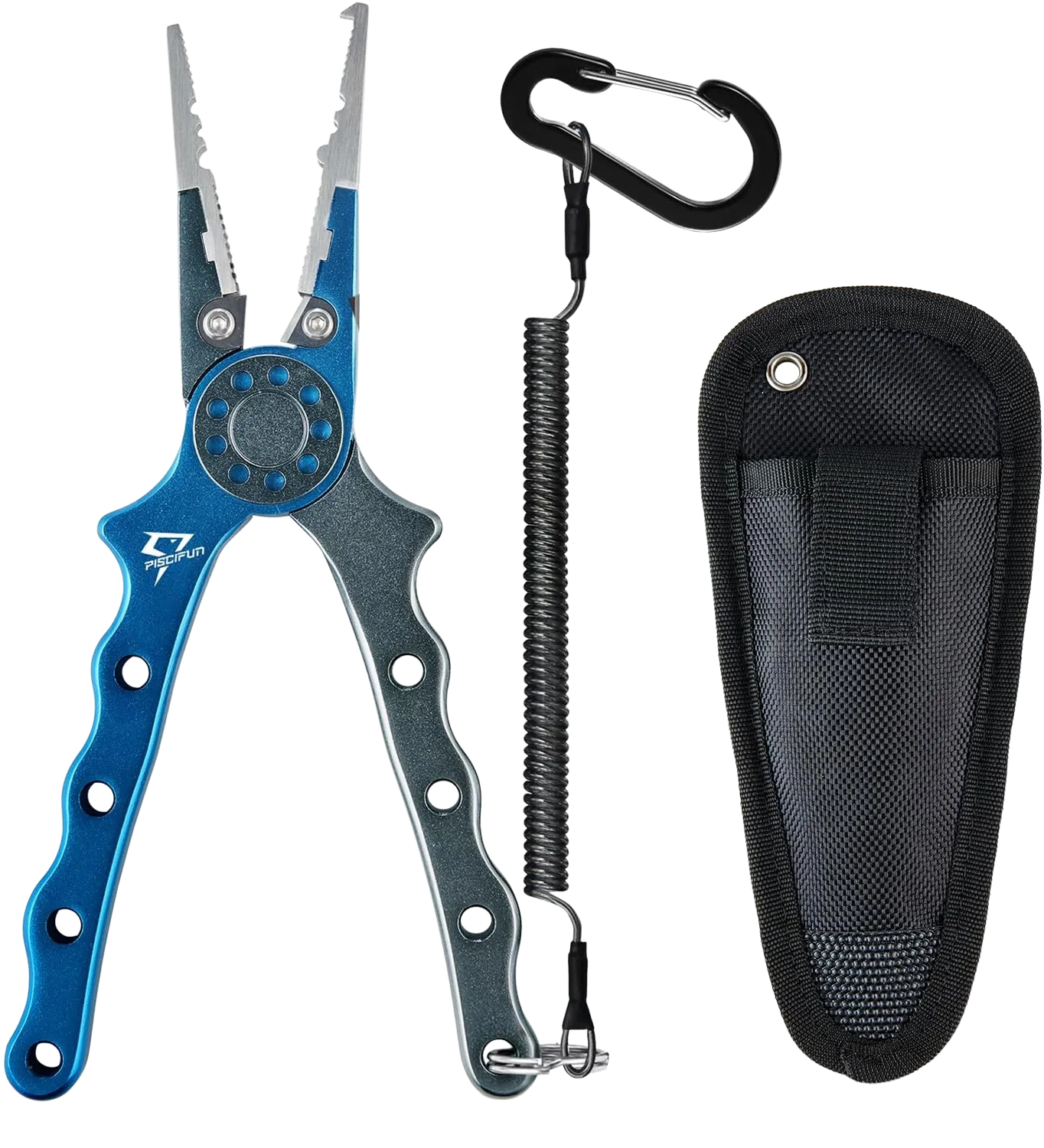
The budget pick isn’t a false economy because it keeps the parts that matter: a lanyard out of the box and a light aluminum frame that’s easy to carry all day. It’s beginner-friendly and forgives mistakes, which is exactly what a first pair should do. Just know its limits. This isn’t the pair for a year-round saltwater angler, and the aluminum wants a rinse after any salt exposure to keep the pivot honest.
Best Saltwater and Big-Game Pliers
When the fish get bigger and the water gets saltier, a cheap pair’s shortcuts show up fast. This is where paying more actually buys you something real: corrosion immunity, reach, and leverage.
Best Premium Saltwater — Van Staal Titanium 7-Inch
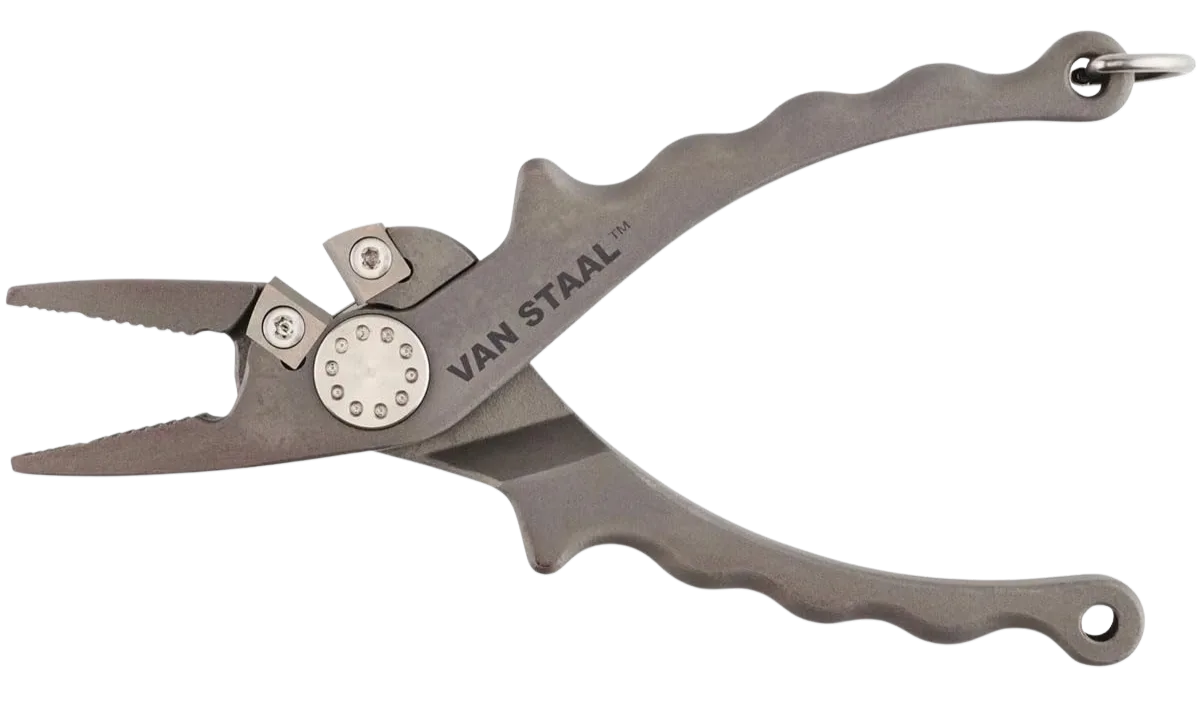
Van Staal is the pair serious surf and big-game anglers converge on, and it earns the premium tier honestly. Corrosion-proof titanium removes the one failure mode that kills saltwater pliers, and the build is proven against the exact fish that punish weak tools. The only reason not to buy it is that a freshwater angler will never stress it enough to justify the cost.
Best Titanium Split-Ring — Gomexus 7-Inch
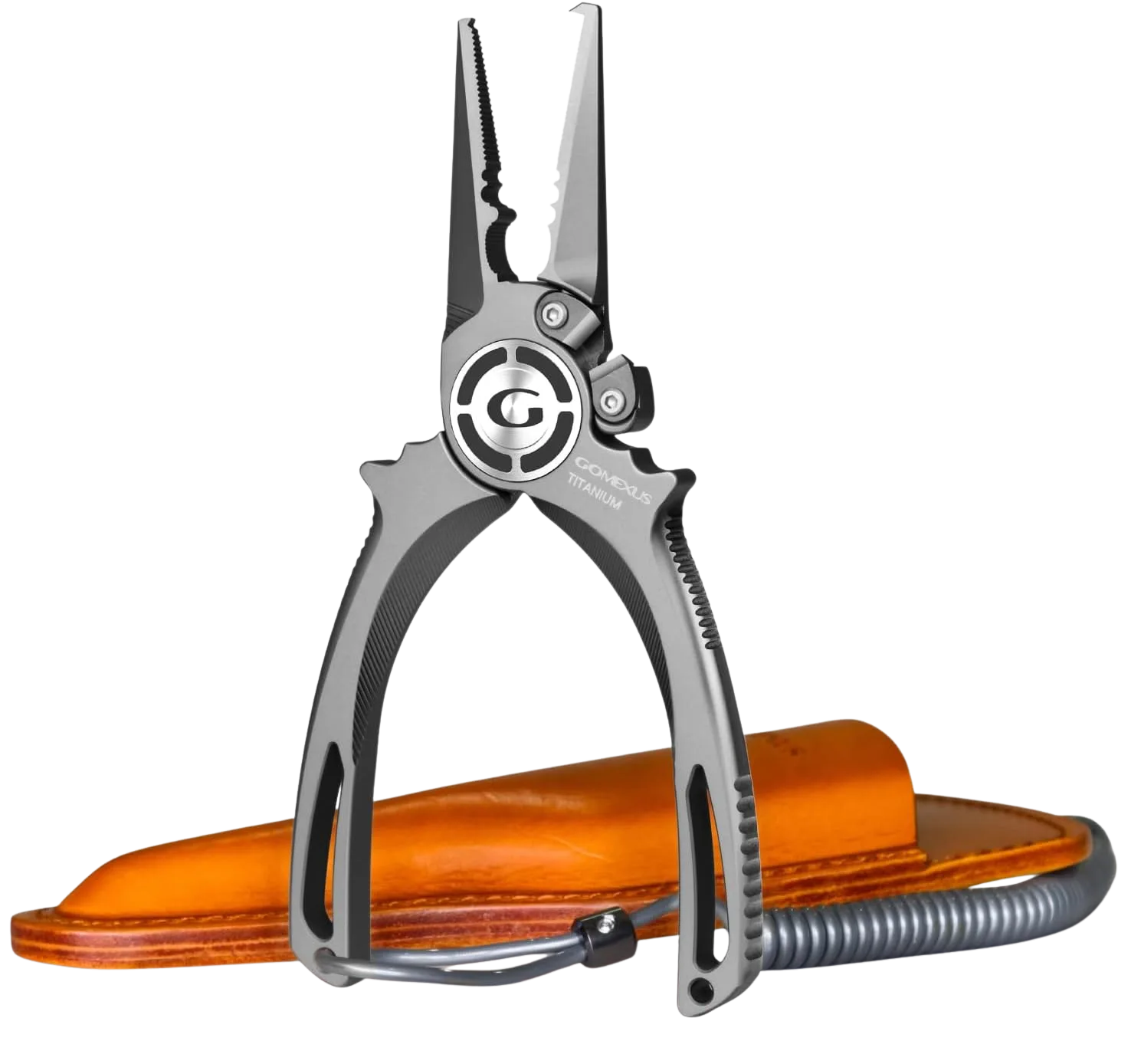
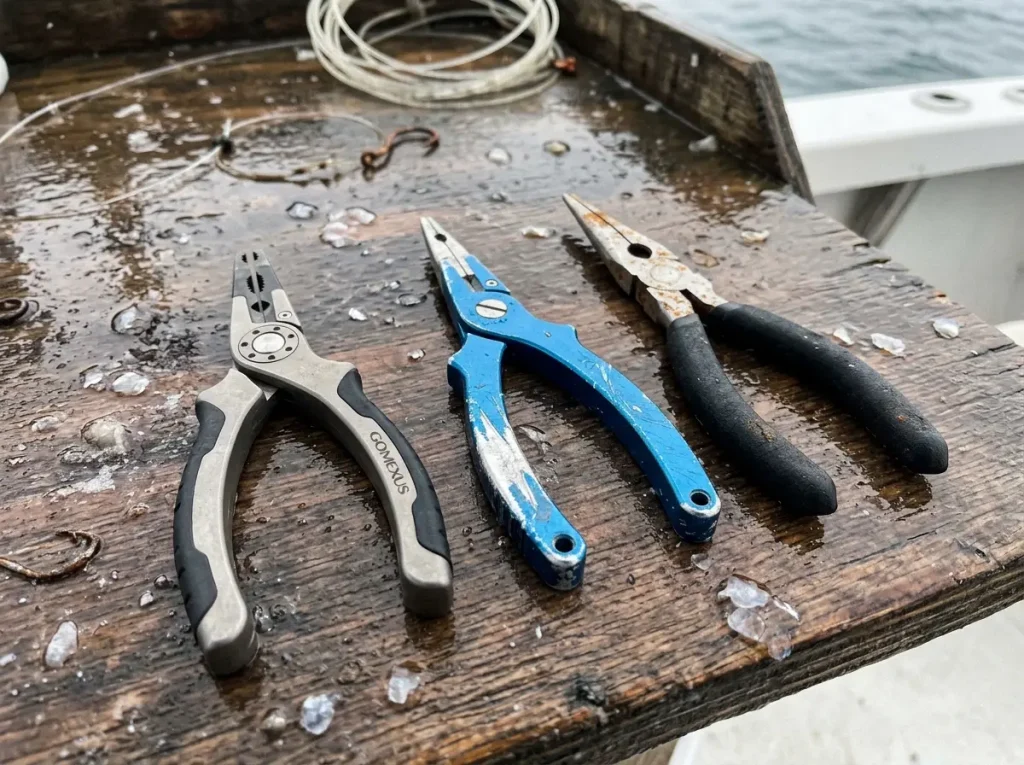
If you swap trebles and hardware as often as you unhook fish, the Gomexus makes sense over a straight needle-nose titanium pair. The split-ring nose is built in, the tungsten carbide cutters slice braid clean, and the warranty backs a tool meant to live in salt. It’s the titanium pick for the angler whose day includes as much rigging as unhooking.
Best for Surf and Pier — Bubba 8.5-Inch Stainless
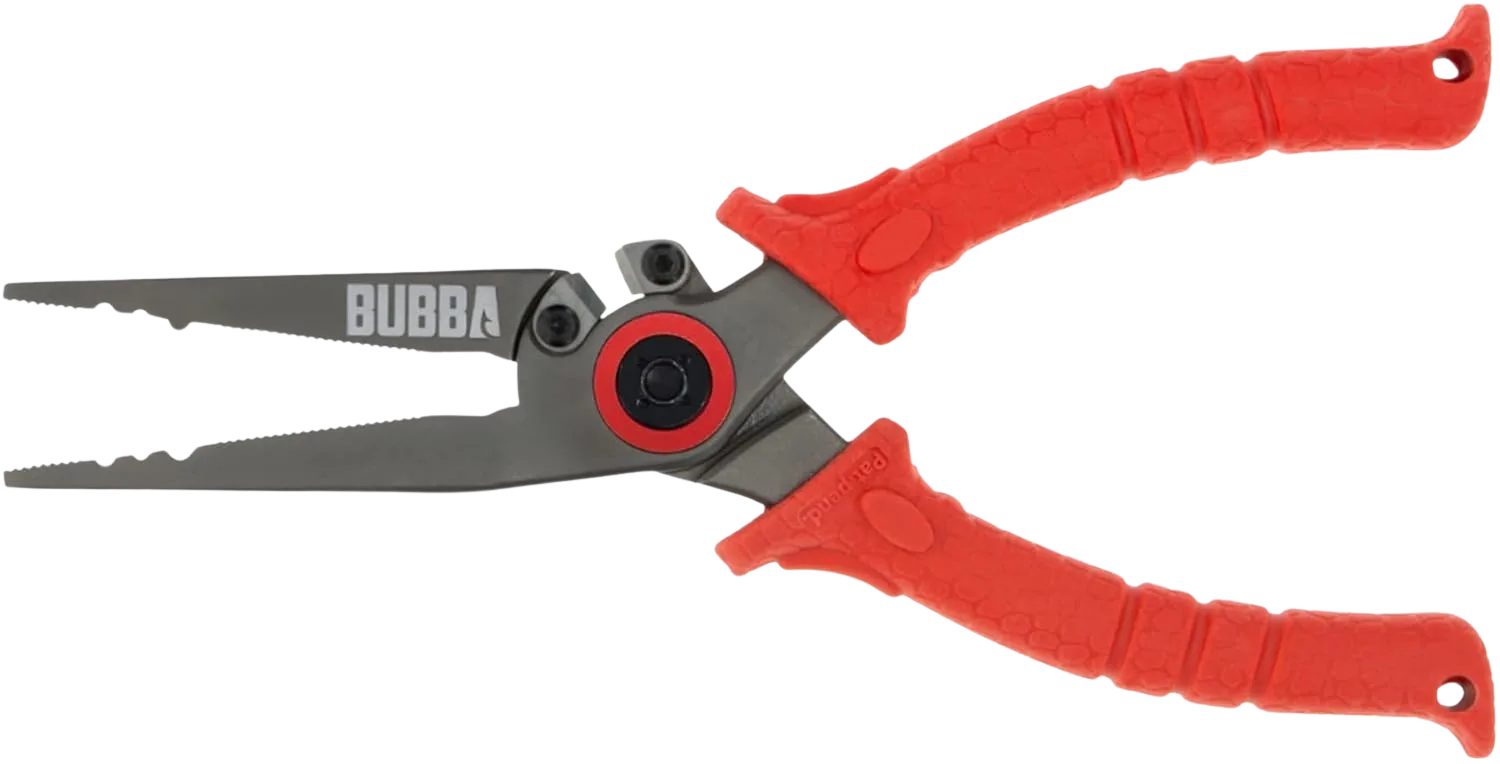
For surf and pier anglers, the Bubba hits the length that matters without the titanium price. The 8.5-inch frame gives you the reach and leverage a big fish demands, and the coated jaw adds corrosion resistance stainless needs near salt. Rinse it after every trip and it’s a lot of tool for the money. It also pairs naturally with landing and controlling a bigger fish before you ever reach for the pliers.
Best Freshwater and Split-Ring Pliers
Two jobs a general plier does poorly and a purpose-built tool does easily: light-tackle unhooking and swapping hardware. If either is a big part of your day, a specialty tool is cheap insurance.
Best Freshwater Forceps — Cuda 7-Inch
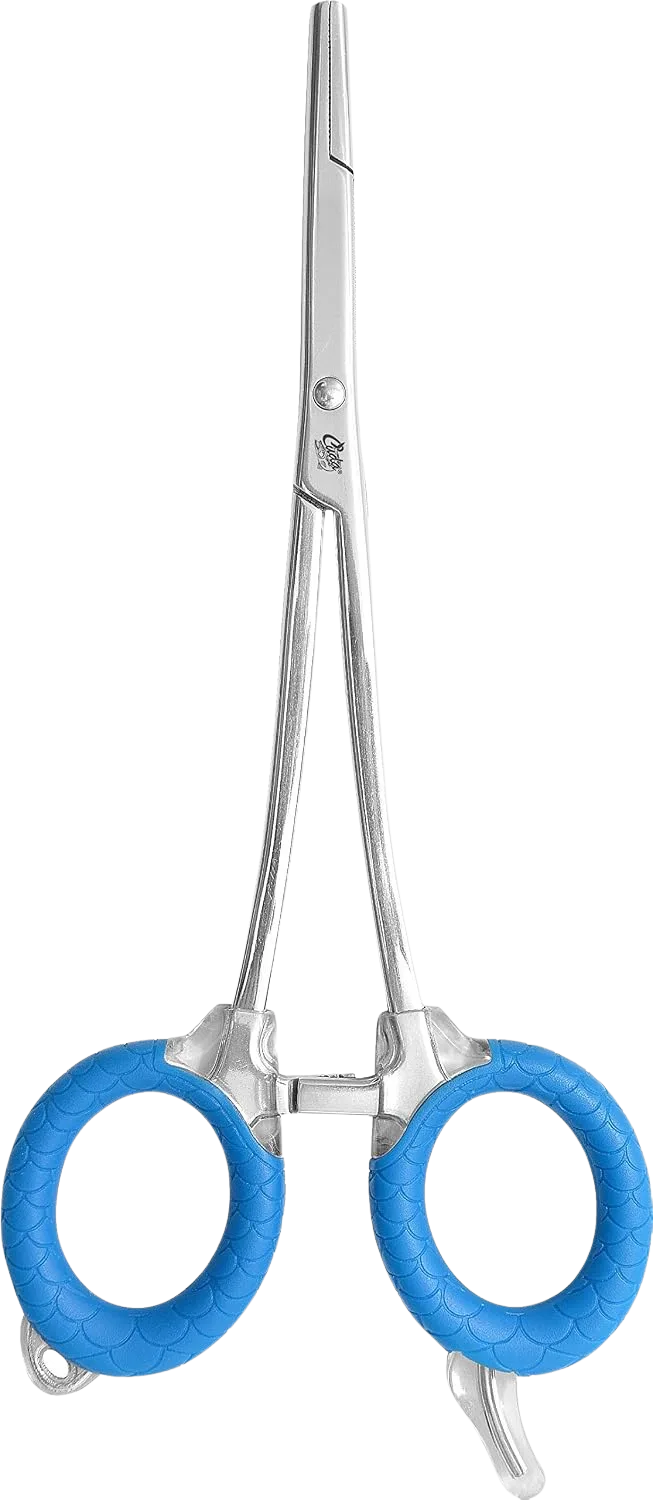
Forceps are a different tool than needle-nose pliers, and for fly and light-tackle work they’re the right one. The slim tip reaches a small hook set in a trout’s jaw and backs it out with almost no damage, which is exactly what catch-and-release fishing calls for. The built-in sharpener is a genuine bonus, since a sticky-sharp point is the cheapest upgrade in fishing.
Best Dedicated Split-Ring Tool for Frequent Swaps
Not everyone needs a dedicated split-ring tool, but if you swap treble hooks constantly, the Texas Tackle Split Ring Pliers will save your thumbnails. The jaw geometry is built for one job: sliding into the ring’s gap, spreading it cleanly, and rotating new hardware on without bending the ring or your fingers. A split-ring tip on your main pliers handles the occasional swap fine. This is for the angler who does it enough that “fine” isn’t good enough, and it pairs with matching split-ring size to your lures before you start.
Final Word Before You Buy
Match the metal to your water. Titanium for full-time salt, aluminum for most anglers, stainless for freshwater and a tight budget. Pay for the replaceable cutter and clip on the lanyard; skip the fancy handle and the gadget count. And size to the fish you actually chase, not the biggest one you daydream about on the drive home.
Do one thing with a new pair before anything else: rinse it after the first salt trip and put a drop of oil on the pivot. That single habit outlasts three pairs that never got it, and it starts before your next outing.
Frequently Asked Questions
01Can I use regular pliers for fishing?
In a pinch, yes, but regular pliers rust fast, have no line cutter, and lack the corrosion-resistant pivot that keeps fishing pliers working near water. For anything past one trip, dedicated fishing pliers pay for themselves.
02Why do you need pliers when fishing?
Fishing pliers remove hooks fast and safely, crush barbs for easier release, cut braid and leader clean, and open split rings to swap hooks. They do jobs your fingers do slowly and with more risk of a hook in the hand.
03How do I unhook a fish with pliers?
Grip the hook shank with the jaws and back the hook out along the path it went in, keeping the fish in the water the whole time. If the hook is set deep in the throat, cut the leader close instead of pulling it free.
04How do you use split ring pliers for fishing lures?
Slide the split-ring tip into the ring’s gap, squeeze to spread it open, then rotate the new hook or hardware onto the ring. A dedicated split-ring tool does this without bending the ring or your thumbnail.
05How do I keep fishing pliers from rusting shut?
Rinse them in fresh water after every saltwater trip, dry them before sheathing, and add a drop of oil on the pivot pin. The hinge seizes long before the frame corrodes, so the pivot is the part that needs the care.
Risk Disclaimer: Fishing, boating, and all related outdoor activities involve inherent risks that
can lead to injury. The information provided on Master Fishing Mag is for educational and informational purposes
only. While we strive for accuracy, the information, techniques, and advice on gear and safety are not a substitute
for your own best judgment, local knowledge, and adherence to official regulations. Fishing regulations, including
seasons, size limits, and species restrictions, change frequently and vary by location. Always consult the latest
official regulations from your local fish and wildlife agency before heading out. Proper handling of hooks, knives,
and other sharp equipment is essential for safety. Furthermore, be aware of local fish consumption advisories. By
using this website, you agree that you are solely responsible for your own safety and for complying with all
applicable laws. Any reliance you place on our content is strictly at your own risk. Master Fishing Mag and its
authors will not be held liable for any injury, damage, or loss sustained in connection with the use of the
information herein.
Affiliate Disclosure: We are a participant in the Amazon Services LLC Associates Program, an
affiliate advertising program designed to provide a means for us to earn advertising fees by advertising and linking
to Amazon.com. As an Amazon Associate, we earn from qualifying purchases. We also participate in other affiliate
programs and may receive a commission on products purchased through our links, at no extra cost to you. Additional
terms are found in the terms of service.