
In this article
The fish slides off strong, kicks once, and vanishes into the green. Looked perfect. What most anglers never connect is that the net still dripping in your hand may have already decided whether that fish is alive next week, because it doesn’t lose the fish at the boat, it loses it days later in water you’ll never see. Fisheries researchers who study catch and release survival have measured exactly how much different net meshes strip from a fish, and the gap between the right net and the wrong one is wider than the gap between most products in this guide. Here’s what actually protects your fish, how to size a net to what you really catch, the best fishing net for each way you fish, and the netting move that saves both the fish and your hooks, because the net is only one piece of a larger on-the-water tools kit worth getting right.
Rubber vs. Nylon vs. PVC Mesh: What Actually Protects Your Fish
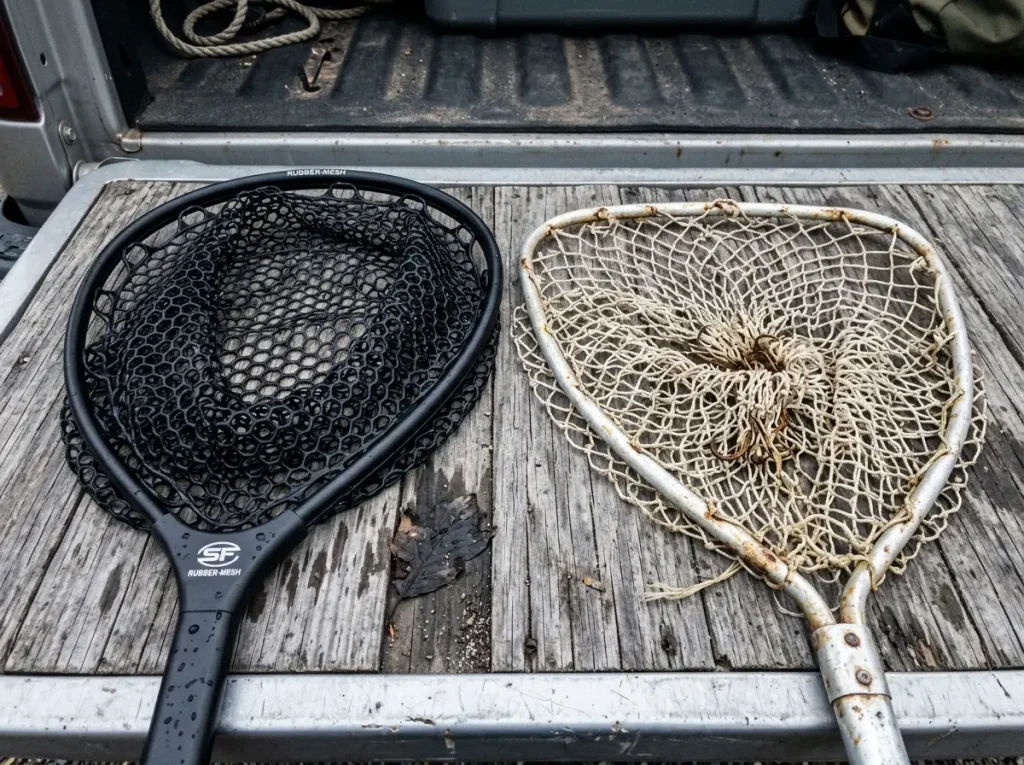
Everybody who has fished for a few seasons has owned the net nobody wants to touch. The old knotted nylon one that lived wet in the bottom of the boat all summer, went stiff and dingy, grew a rust-colored ring off a rod locker, and grabbed every treble hook you swung near it. You replace it eventually, usually because of the smell. The better reason is the fish.
Why Rubber Mesh Wins (in Plain English)
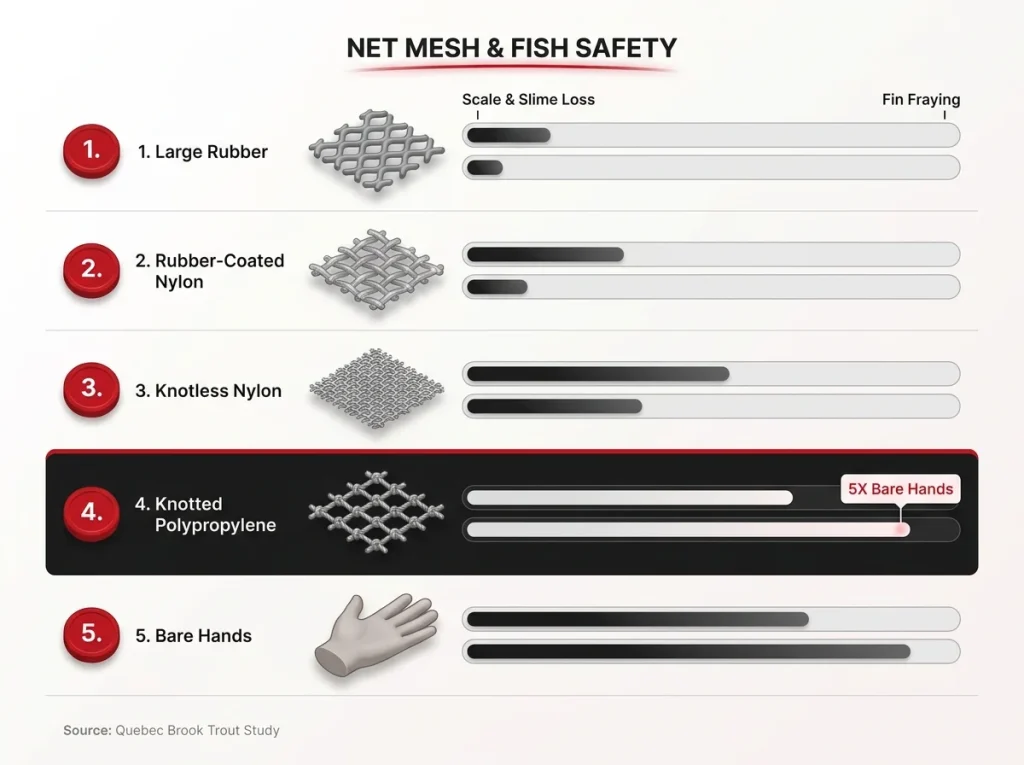
When researchers put net types head to head, the ranking is not close. A controlled comparison of net mesh types found rubber nets caused the least scale and slime loss, with large rubber mesh at the top, then rubber-coated nylon, then knotless nylon, then knotted polypropylene, and finally bare wet hands at the bottom. That last part surprises people. The cheap knotted net hanging at the gas station is measurably rougher on a fish than just grabbing it with wet hands, and the numbers back it up: knotted polypropylene caused roughly five times more fin fraying than bare hands in that testing.
Rubber does two jobs at once. It slides against the slime coat instead of scrubbing it off, and hooks don’t bury in it, so you unhook and release faster. Knotless nylon actually scored the worst for mucus loss and produced very long handling times because trebles kept snagging in the mesh while a hooked fish sat there stressing. Mesh size plays in too. A coarse, open rubber mesh with larger holes lets fins slip through instead of pinning them flat, part of why large rubber topped the testing, while a fine, tight mesh with small hole size traps more of the fish against the netting.
What Nylon Actually Does to a Fish You Release
Here is the part every competitor skips. A fish that swims off looking fine can still fail to survive, and the reason is the slime coat is not slime, it’s an osmotic barrier. Strip it and freshwater floods into the fish’s tissue through the compromised skin, the salts its cells rely on get diluted, and its gills have to burn energy running pumps to correct the balance. That is energy the fish needed to recover from the fight and stay ahead of the next predator. It swims off strong, then quietly loses the fight to infection or exhaustion days later. If you want the biology behind it, how a fish’s slime coat actually works is worth the read, but the practical takeaway fits on one line: the mesh you choose is the difference between a released fish and a delayed casualty you never see.
Where PVC and Silicone-Coated Mesh Fit
PVC-coated and silicone mesh sit in the middle. They protect the slime coat far better than raw nylon and shrug off hook snags well, which is why a lot of budget nets use them. The tradeoff is feel: coated mesh runs heavier and gets stiff in cold weather, where soft rubber stays supple. For most freshwater fishing that difference is minor, and any coated or rubber mesh beats a knotted string bag every time.
Quick field test on a net you already own: pinch the mesh and drag a hook point across it. If the point catches and the mesh feels rough and dry like clothesline, it’s knotted nylon and it’s sanding your fish. If it slides off and feels soft and rubbery, you’re good. Any net that snags a hook snags a fish.
How to Size a Net to the Fish You Actually Catch
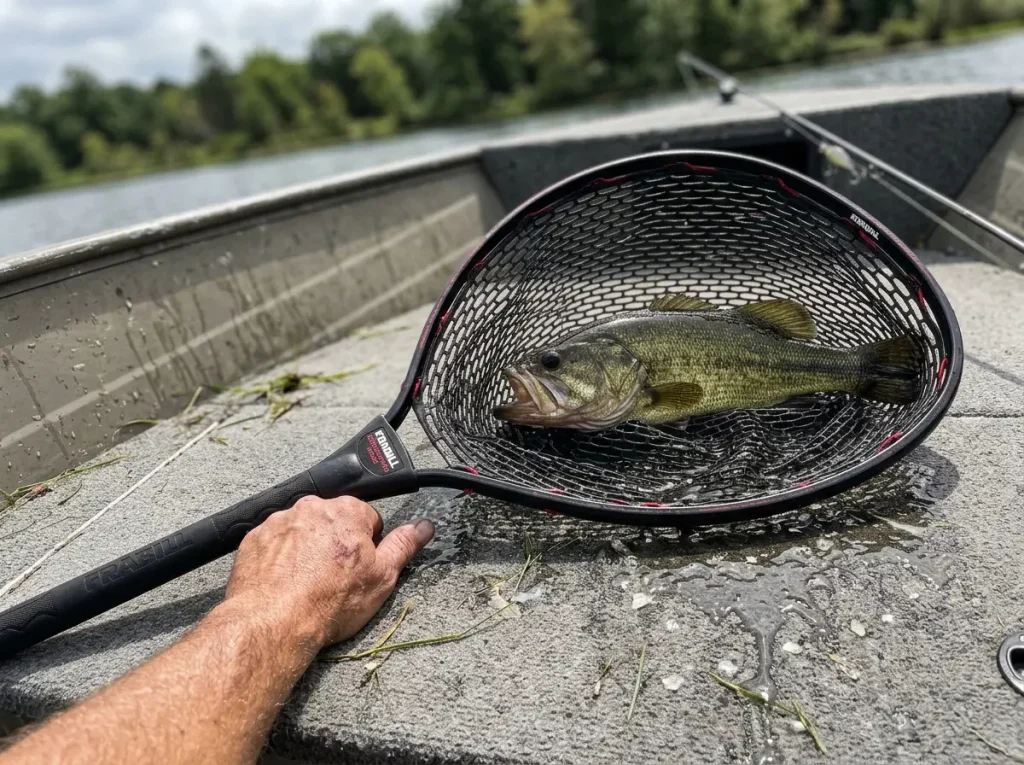
The most common net mistake at the shop is buying too big. A musky-class hoop looks like insurance, right up until you’re hauling that weight on every cast or dragging it through brush on a small trout stream. Size the net to the fish you actually catch, not the fish you dream about.
Hoop Size by Species (Real Numbers)
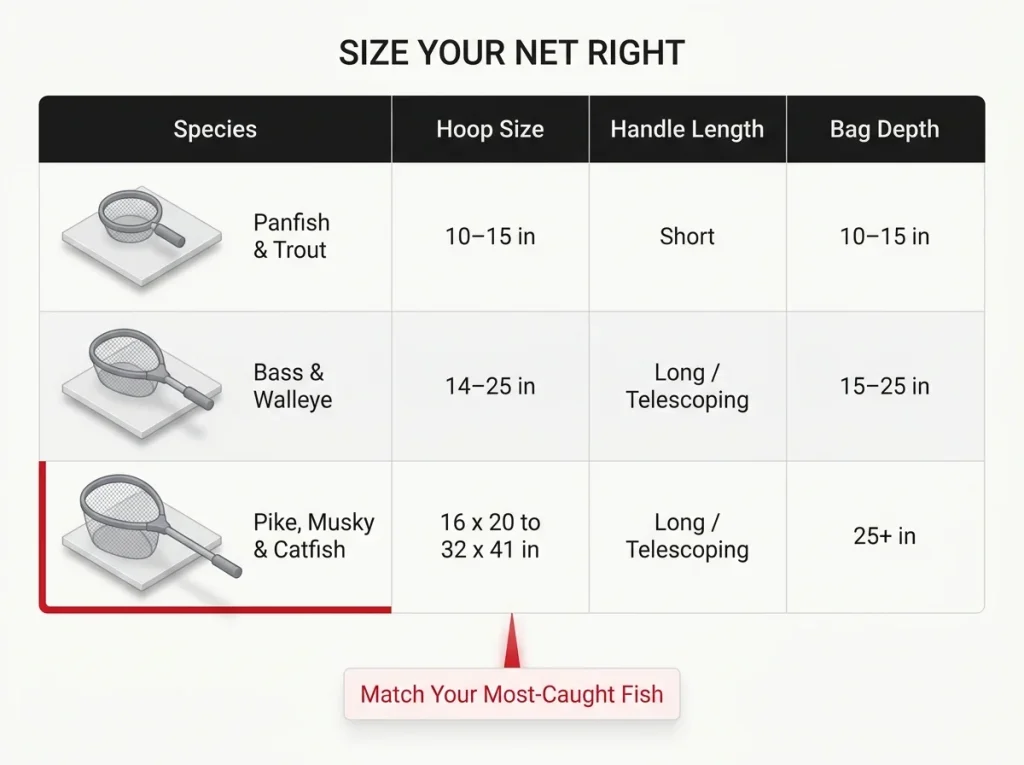
Match the hoop size to your target. Trout and panfish want roughly a 10 to 15 inch hoop for quick landings in tight spots. Bass and walleye sit in the 14 to 25 inch range. Pike, walleye, and musky run oval, from about 16 by 20 inches up past 20 by 24, and a true trophy musky or catfish net jumps to something like 32 by 41. A big hoop on a trout stream is just dead weight and drag, and it spooks fish you could have slipped a small net under cleanly.
Handle Length: Match It to Where You Fish
Handle length is about where your feet are, not how big the fish might get. Short handles win for wading and stream work because they move fast and precise in tight, brushy water. Long and telescoping handles win for boats, piers, and kayaks where you need to reach out without leaning into the drink. Buy a long telescoping handle for stream trout and it just clatters around and clubs the willows. This is also where frame material earns its keep, since the same corrosion and metallurgy that make or break any aluminum tool decide whether a telescoping handle extends smoothly or seizes. Fishing 411’s field testing flagged a real one here: thin push-button telescoping stock bends and jams under a big fish, and octagon aluminum extends more reliably than round tube that needs perfect alignment to slide.
Bag Depth and Why Shallow Bags Lose Fish
Bag depth matters as much as hoop width and gets ignored. Figure 10 to 15 inches deep for panfish and small trout, 15 to 25 for bass, walleye, and small inshore fish, and deeper still for pike and musky so a long fish doesn’t fold and catapult itself back over the rim. A shallow bag on a big fish is how you watch a giant flop out right at the net.
If you fish one species 90 percent of the time, size for that and forget the once-a-year trophy. You’ll land more fish with a net that fits your hands and your water than with an oversized hoop that’s always in the way. Rent or borrow a big net the week you chase something huge.
Best Overall Fishing Net
If you want one net that handles most of what a freshwater angler actually does, this is the category. Nothing exotic, just the right material and a size that covers bass, trout, walleye, and whatever else eats.
Best Overall: Frabill Conservation Series Net
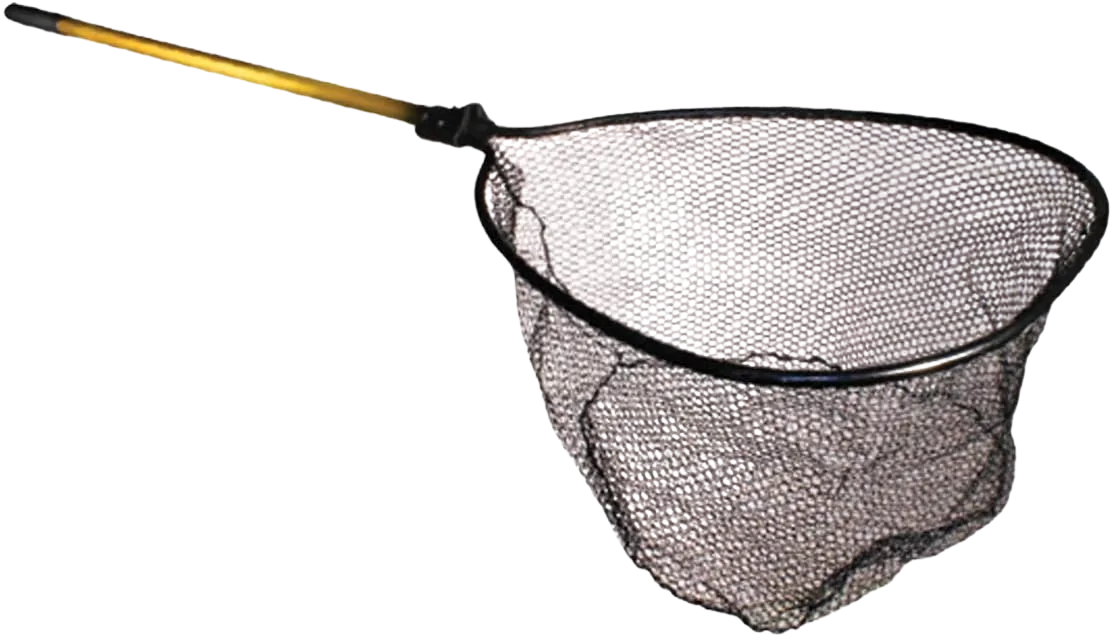
The Frabill Conservation Series earns the overall pick by getting the boring things right. The rubberized mesh ties straight back to the material section above, the telescoping handle means one net works whether you’re wading a creek or reaching off a gunwale, and the size splits the difference so it’s neither a trout toy nor a musky barge. It forgives mistakes, which is exactly what a first net should do.
A Lighter Premium Pick: Bubba Carbon Fiber
If you carry your net all day and don’t mind paying for less weight, the Bubba Carbon Fiber Landing Net offers the same rubber-mesh fish protection on a carbon fiber frame. It won’t land fish the Frabill can’t, but your shoulder notices the difference on a long day of wading, and it doesn’t overlap with the fly-specific nets further down.
Who Should Size Up or Down Instead
Skip the all-arounder if you fish one extreme. Dedicated stream-trout anglers want a smaller, short-handled net, and serious catfish or musky hunters want the big-fish reach further down this guide. The overall pick is built for the angler in the middle, which is most of us.
Best Budget Fishing Net
The myth worth busting here is that a cheap net has to mean knotted nylon. It doesn’t. You can protect fish and land them on a tight budget, and both picks below use fish-safe mesh.
Best Budget: SF Rubber-Mesh Landing Net
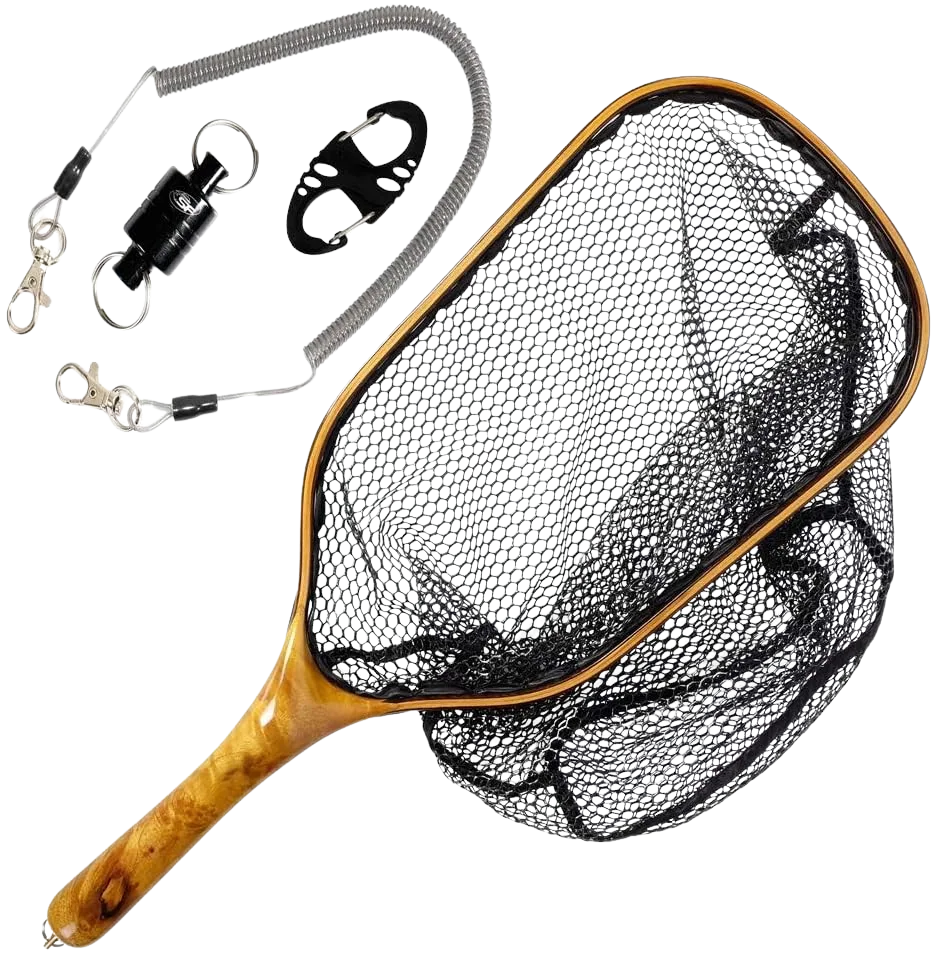
The SF Rubber-Mesh Landing Net is the direct answer to anyone who thinks protecting fish is a premium feature. It’s soft rubber mesh at a price that competes with the gas-station junk, and it lands the same bass and trout without sanding off their slime coat. For a beginner or a spare-net-for-the-truck buy, it’s hard to argue with.
Best Folding Pick: KastKing MadBite Folding Net
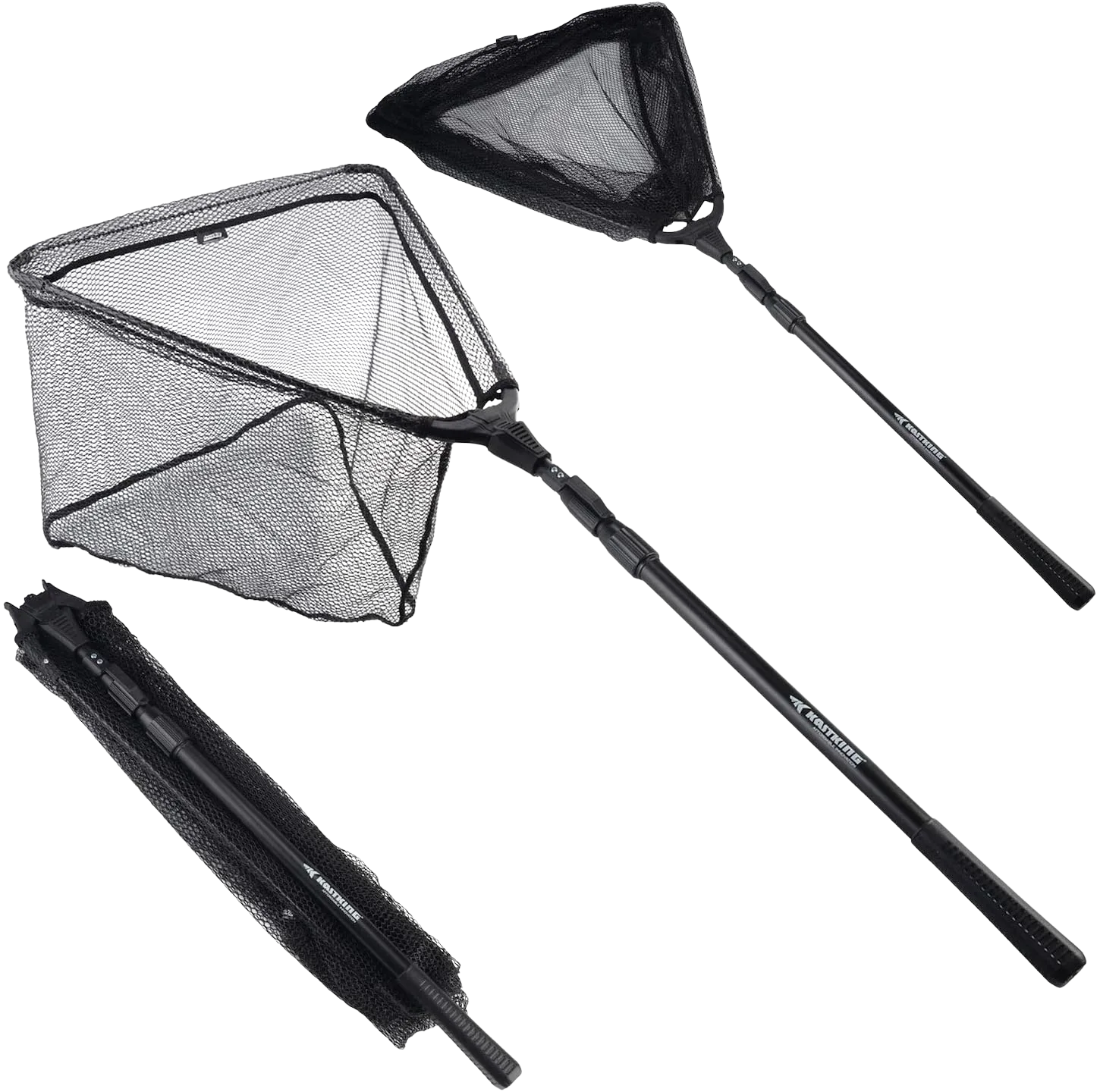
Where the SF net is a fixed frame, the KastKing MadBite folds down to almost nothing, which is the whole point. If you fish out of a kayak, hike to your water, or just hate clutter in the boat, a net that collapses into a hatch earns its spot. It gives you a second budget path that the fixed-frame SF doesn’t.
What You Give Up at This Price
Honesty check: budget nets use shorter, thinner handles and simpler frames, so they flex more under a heavy fish and won’t reach as far off a high gunwale. For panfish, bass, trout, and average walleye, none of that matters. You give up reach and heavy-fish muscle, not fish safety.
Best Net for Wading and Fly Fishing
Wading is the one place where net weight actually gets noticed, because you’re wearing it for six hours instead of setting it on a deck. Short handle, soft mesh, and light frame are the whole game, and you’re usually releasing wild trout that deserve the gentlest handling you’ve got.
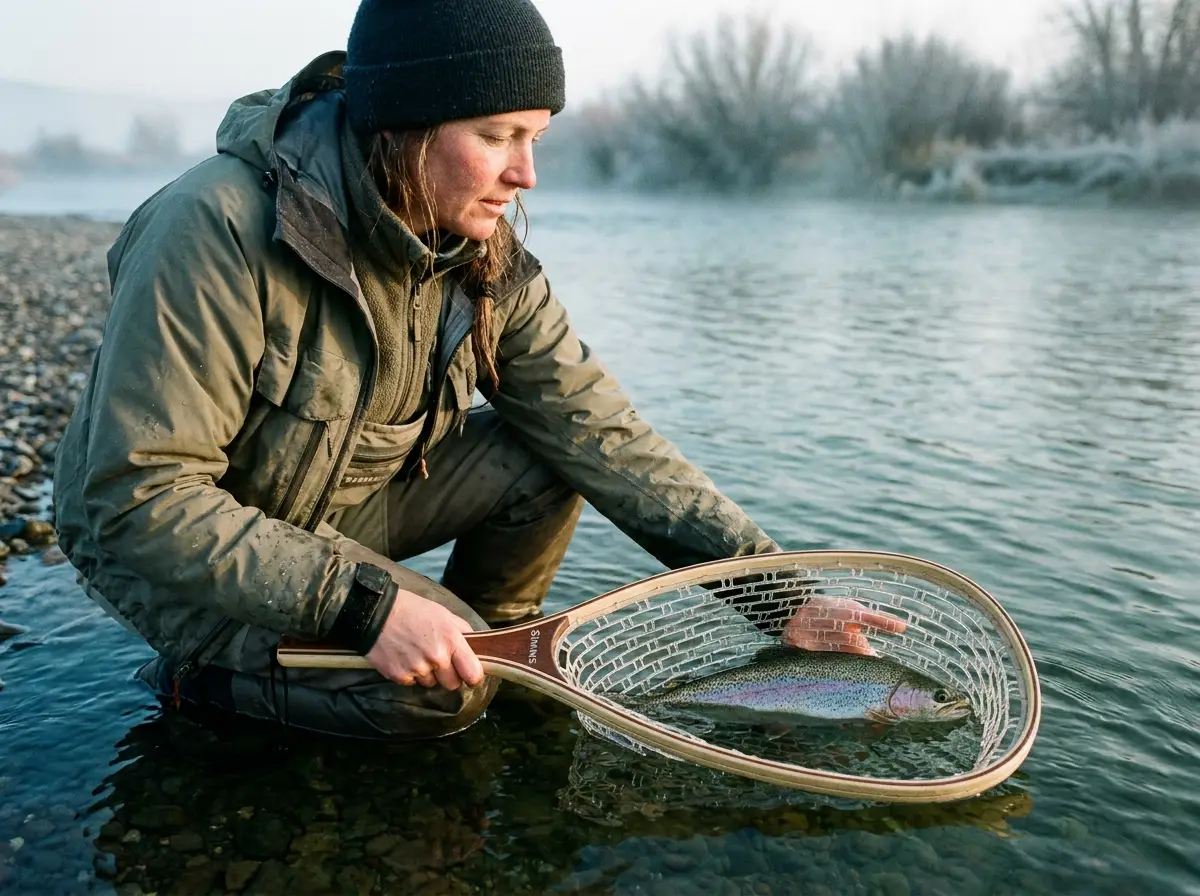
Best Wading Net: SIMMS Daymaker
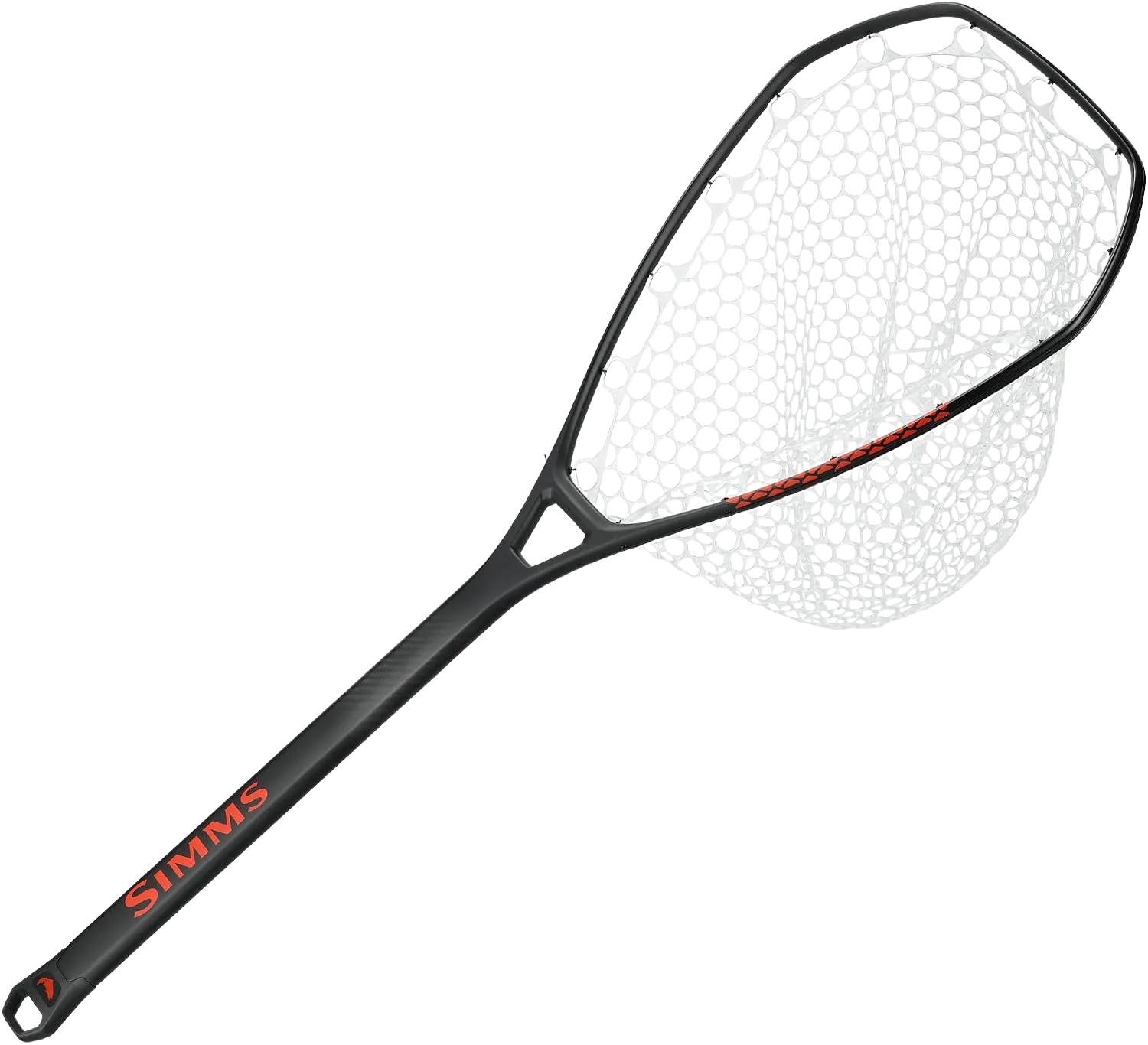
The SIMMS Daymaker is the wading net trout anglers keep pointing new folks toward, and the reasons are practical. Soft rubber mesh for fish you’re going to release, a light frame you forget you’re carrying, and a size tuned for stream trout rather than boat bass. It costs more than the all-arounder, and for a dedicated fly angler it’s worth it.
The Packable Alternative: fishpond Nomad Native 2.0
If you count ounces and want a net that rides out of the way, the fishpond Nomad Native 2.0 runs a carbon fiber and fiberglass composite frame that’s lighter than most and clips to a lanyard or pack. It’s the grab-and-go option: less net to carry, quick to deploy, and easy to keep clipped to a magnetic net release or lanyard so it rides out of the way until a fish is on.
Handle and Weight for All-Day Wading
For wading, resist the reach instinct. A short handle keeps the net quick and precise in tight, brushy water where a long pole just tangles. Every ounce you shave off the frame is one your arm doesn’t fight for six hours, which is why the composite and carbon frames are worth a look here even though they’d be overkill from a boat.
Best Net for Boat and Kayak Fishing
Boats and kayaks are opposite problems. On a boat the net is a two-person job with reach and storage to solve. On a kayak you’re doing it solo, one hand on a bent rod, the other trying to scoop a fish without capsizing. Different problems, different nets.
Best For Boats: KastKing Brutus Folding Net
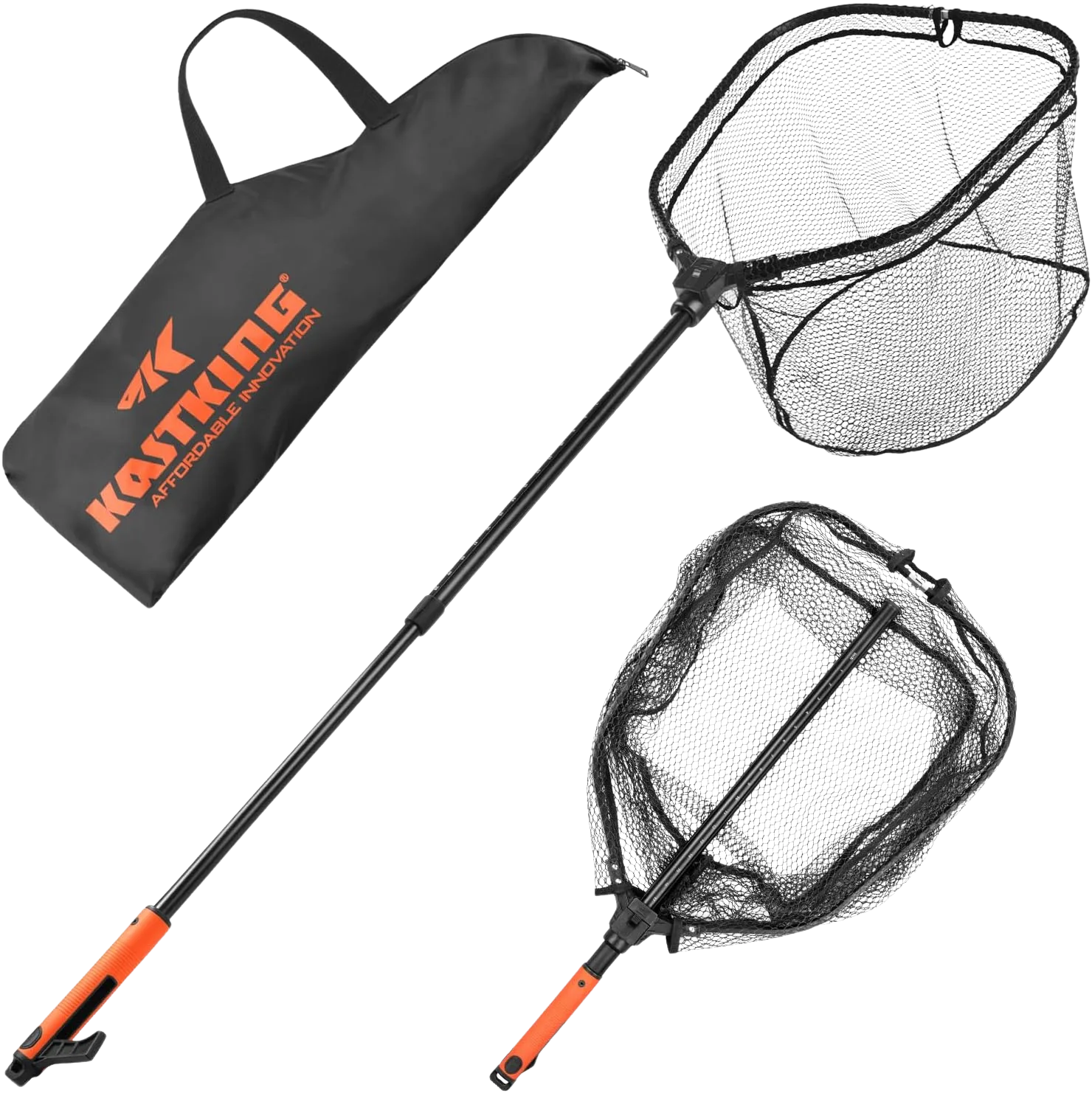
The KastKing Brutus solves the two real boat problems, storage and reach, then throws in a boat hook that actually gets used for docking and grabbing gear over the side. The folding aluminum frame stows without eating deck space, and it’s rated for the larger fish a boat puts you on. For most boat anglers it’s more net than they’ll usually need, which is the right side to err on out there.
Best For Kayaks: YakAttack Leverage Landing Net
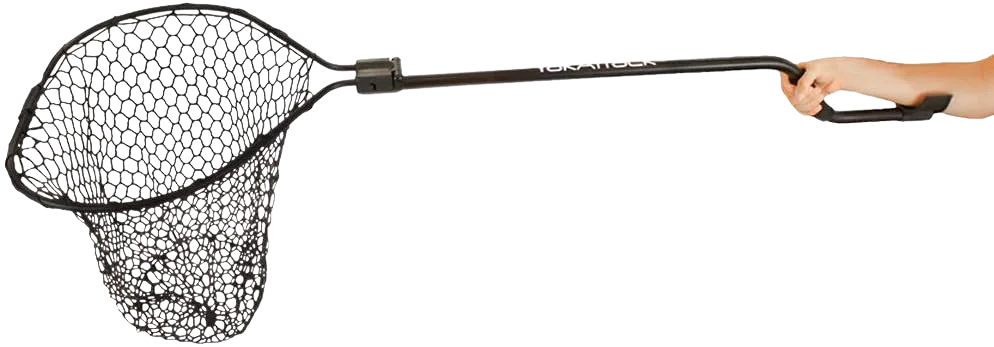
The YakAttack Leverage is the rare product where the price buys a real mechanical advantage instead of a logo. The forearm-lever design lets you swing and land a fish one-handed, which is the actual constraint in a kayak, and the full rubber netting keeps it fish-safe. It track-mounts so it’s not rolling around your hull. If you fish from a kayak seriously, this is the one that earns its keep.
In a kayak, mount the net on the side of your dominant hand, handle pointing back toward your seat. Fumbling behind you for a loose net is how fish come off. If it’s not clipped where your hand lands without looking, you’ll lose the fish reaching for it.
Reach and Storage on the Water
The theme for both is the same as the sizing section: match the handle to your reach. A boat off a high gunwale wants a longer or telescoping handle, a kayak sitting low to the water wants something shorter and quicker. Folding and track-mount features are about keeping the net out of your way until the two seconds you need it.
Best Net for Big Fish (Musky, Catfish, and Big Game)
This is where cheap gear actually fails you. A thin round-tube handle that jams with a 40-inch fish thrashing at the boat is the story every big-fish angler has heard or lived. Big fish need reach, a deep bag so the fish can’t fold out, and a frame with the weight capacity to not flex when it counts.
Best Big-Fish Net: Whisker Seeker eXtender
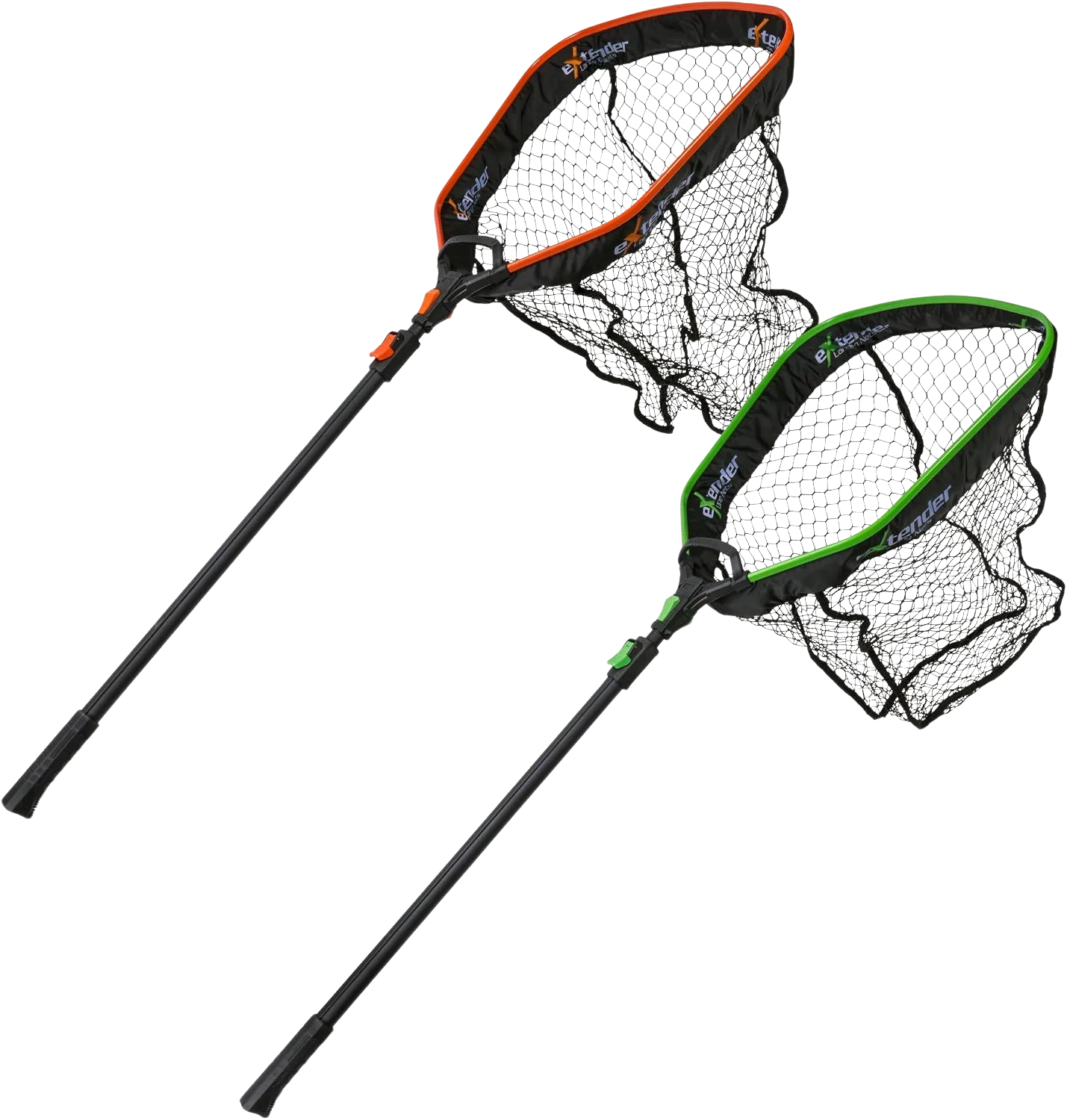
The Whisker Seeker eXtender is built for the job that punishes flimsy nets. It extends to 71 inches to reach a big catfish alongside the boat, and its handle is the heavy-duty build that field reviewers have singled out against thinner competitors that bend under load. If your target regularly tops 20 pounds, the reach and the stiff handle stop being luxuries. You can weigh a trophy without lifting it out of the net bag if you pair it with a good grip scale, which keeps a big fish supported and calmer for the photo, the small habit that adds up to real fish welfare.
The Premium Big-Trout Bag: Rising Lunker
For big trout, steelhead, and musky-class fish where a deep, gentle bag matters, the Rising Lunker Net runs a deep rubber bag on an aluminum tube frame. The deep bag is the point: it cradles a long fish so it can’t fold and flip out, and the rubber keeps a trophy’s slime coat intact for the release. It’s a premium price, which sets up the real question below.
Is a Premium Net Worth It
Here’s the honest verdict most roundups won’t give you. Premium nets earn their price in three specific situations: you regularly fish big or toothy fish, you wade all day and every ounce counts, or you fish from a kayak where the mechanics genuinely differ. In any of those, the deep bag, the light frame, or the one-handed lever pays you back on the water. Outside of them, a weekend bass or trout angler gets roughly 90 percent of the fish-safety benefit from a 30-dollar-range rubber-mesh net. The expensive net doesn’t protect the fish meaningfully better, it just fits a harder job. Buy the premium net for the job, not for the badge.
Netting Technique That Actually Saves Fish (and Your Hooks)
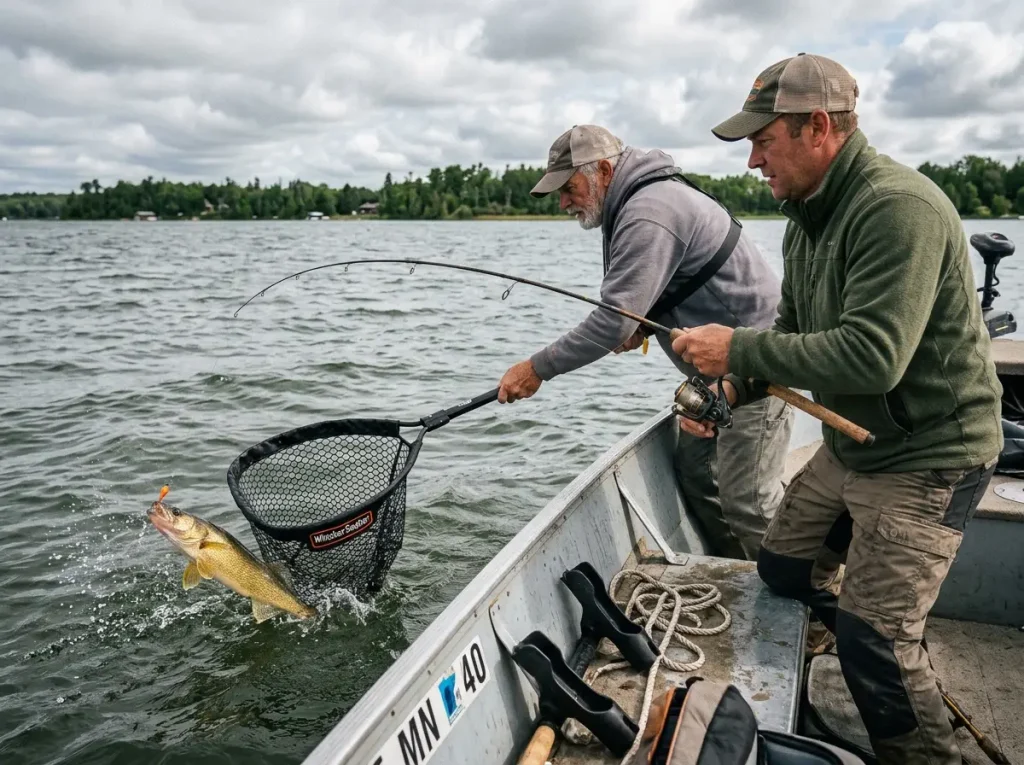
The best net in the world won’t help if you stab at the fish with it. This is the part no product page covers, and it’s where most fish get lost right at the boat. The classic “lost him at the net” moment is almost always a technique problem, not a gear problem.
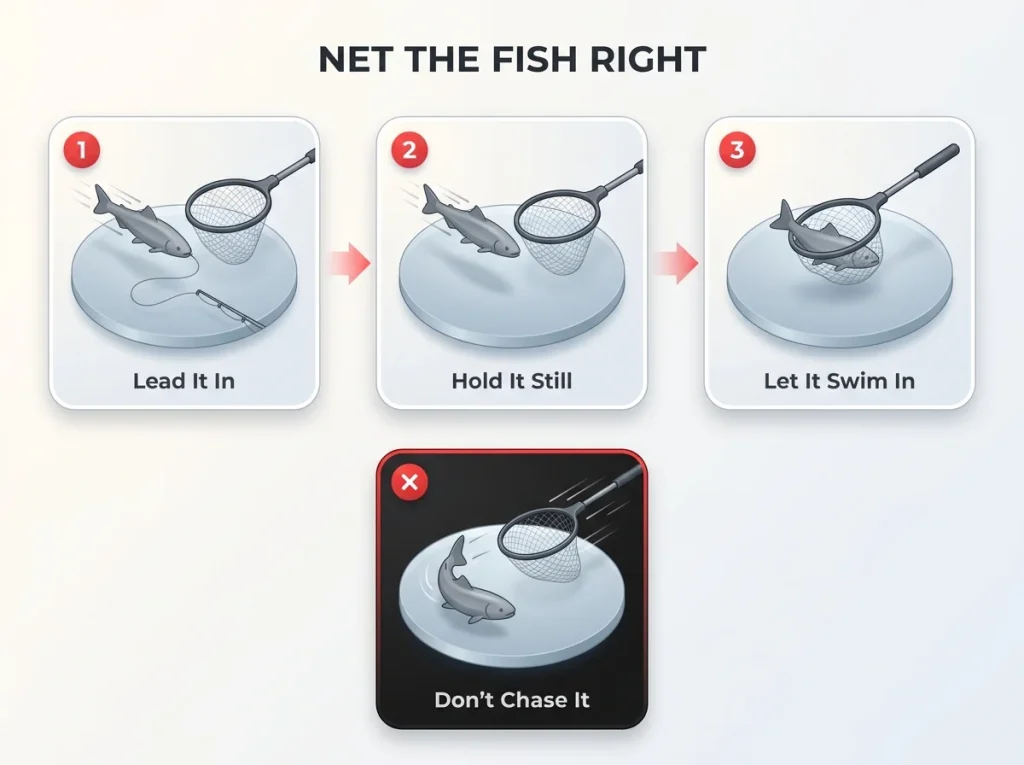
Lead the Fish In, Don’t Chase It
Fish can’t swim backward. That one fact is the whole secret. Put the landing net in the water in front of the fish and lead it in headfirst with a long, low sweep of the rod, and it swims straight into the bag. Chase it from behind or the side and you trigger one last panicked run, which is when hooks pull and fish come off. Keep the net still and let the fish come to it. The netter moves the net into position, then waits.
Net no fish before its time. Wait until the fish is tipped on its side and genuinely done fighting before you make the attempt. A green fish with its head still up and out of the water can blast free in a heartbeat; a spent fish sliding in headfirst is already caught. Early attempts are the number one way to lose a fish at the boat.
The Tail-First Mistake That Buries Hooks
Never net a fish tail-first. Scooping from behind drives the hook points straight into the mesh, and that’s how trebles end up buried in the net instead of the fish’s lip, sometimes taking your hand with them on the way. Lead headfirst and the hooks stay pointed away from the mesh. It also keeps the fish moving the direction it wants to go, so it settles into the bag instead of fighting the rim. Keep the bag submerged while you handle the fish, because clean dehooking with a good pair of pliers gets the hook out fast while the fish stays in the water and the rubber mesh doesn’t dry against its slime coat. Smooth fish handling at the net is the whole point.
Boat Netting Etiquette (Who Calls It, Who Scoops)
On a boat, netting is a two-person dance and somebody has to lead. The netter controls the net and decides when to strike; the angler’s only job is a steady lead-in, holding about a rod’s length of separation with the rod tip low, sweeping the fish along the surface instead of lifting its head. State fisheries biologists list minimizing air exposure and a non-abrasive net among the top ways to cut release mortality, and both come down to smooth teamwork at the net. Rushing a green fish and standing too close, which forces the angler to lift the rod and pull the fish’s head up, are the two mistakes that turn a landed fish into a lost one. Do it right and it’s the front end of the rest of a science-based catch-and-release routine.
Conclusion
Get three things right and the rest is detail. Material first: rubber or rubber-coated mesh, never knotted nylon, because that choice is the difference between a fish that swims off and one that quietly doesn’t make it. Size to the fish and the place you fish, not the biggest hoop on the shelf. And remember the net only works if your technique does, so lead the fish in headfirst, keep the bag wet, and let the netter call the shot.
Pick the net that matches how you actually fish, then practice the lead-in on your next trip. You’ll feel the difference the first time a spent fish slides calmly into the bag instead of bolting. And if you fish water where release is mandatory, your net choice matters most of all, because there every fish you touch is one you’re counting on to swim away for good.
Frequently Asked Questions
01Are rubber fishing nets really better than nylon for the fish?
Yes. In controlled testing, large rubber mesh caused the least scale and slime loss, while knotted nylon caused roughly five times more fin fraying than bare hands. Rubber also snags hooks far less, so you unhook and release faster.
02What size fishing net do I actually need?
Match the hoop to your target fish: about 10 to 15 inches for trout and panfish, 14 to 25 inches for bass and walleye, and larger oval hoops for pike, musky, and catfish. A hoop bigger than you need is just extra weight and drag.
03What handle length should I get for a fishing net?
Short handles suit wading and stream fishing where you want quick, precise control. Long or telescoping handles suit boats, piers, and kayaks where you need reach. Match the handle to where your feet are, not to the biggest fish you might someday hook.
04Is an expensive fishing net worth it?
Only for specific anglers. If you regularly fish big or toothy fish, wade all day, or fish from a kayak, a premium net’s depth, weight, or one-handed mechanics earn their keep. For a weekend bass or trout angler, a rubber-mesh net in the 30-dollar range delivers about 90 percent of the fish-safety benefit.
05How do I net a fish without losing it or hurting it?
Lead the fish headfirst into a stationary net with a long, low sweep, and never chase it from behind, since fish cannot swim backward and will bolt. Wait until it is tipped on its side, net it head-first, and keep the bag in the water while you unhook.
Risk Disclaimer: Fishing, boating, and all related outdoor activities involve inherent risks that
can lead to injury. The information provided on Master Fishing Mag is for educational and informational purposes
only. While we strive for accuracy, the information, techniques, and advice on gear and safety are not a substitute
for your own best judgment, local knowledge, and adherence to official regulations. Fishing regulations, including
seasons, size limits, and species restrictions, change frequently and vary by location. Always consult the latest
official regulations from your local fish and wildlife agency before heading out. Proper handling of hooks, knives,
and other sharp equipment is essential for safety. Furthermore, be aware of local fish consumption advisories. By
using this website, you agree that you are solely responsible for your own safety and for complying with all
applicable laws. Any reliance you place on our content is strictly at your own risk. Master Fishing Mag and its
authors will not be held liable for any injury, damage, or loss sustained in connection with the use of the
information herein.
Affiliate Disclosure: We are a participant in the Amazon Services LLC Associates Program, an
affiliate advertising program designed to provide a means for us to earn advertising fees by advertising and linking
to Amazon.com. As an Amazon Associate, we earn from qualifying purchases. We also participate in other affiliate
programs and may receive a commission on products purchased through our links, at no extra cost to you. Additional
terms are found in the terms of service.