
In this article
You’re holding over a rockpile in six feet of moving water, the drift is finally right, and the boat starts swinging sideways. The anchor is set, but it’s pulling from the wrong place, and now you’re broadside to current in a hull with about eight inches of freeboard.
The thing that puts kayak anglers in the water isn’t weather. It’s a rig detail, and Coast Guard paddlecraft numbers back that up. A working kayak anchor system is four parts, not one, and this walks through each of them: how to match the anchor to your water, how to rig the line so it holds, and the two things almost nobody covers, the breakaway weak link and what to do when the anchor won’t come up.
Why Most Kayak Anchor Setups Fail (And What a Real System Looks Like)
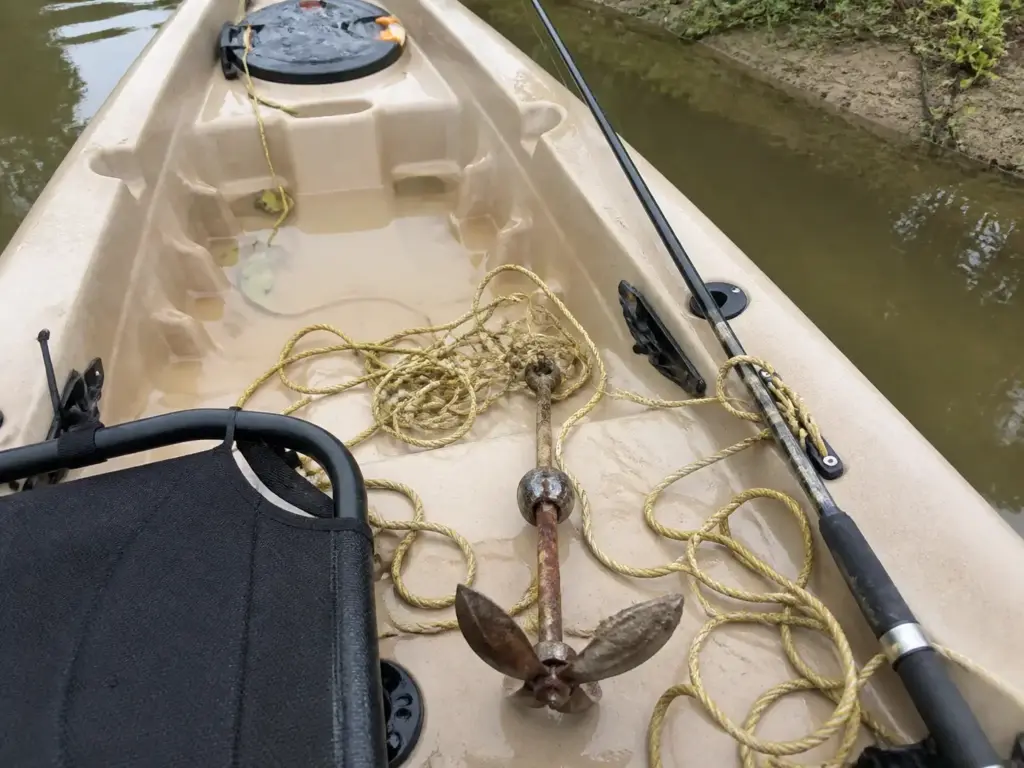
Nearly everybody starts the same way: a weight, an anchor rope, a cleat. Then the first real current shows you which parts weren’t optional.
An anchor system has four components: the trolley, the anchor, the rode (line plus a short chain), and the release plan. Each exists because the other three create a problem without it. If you’re still sorting out the boat itself, the fundamentals of choosing and rigging a fishing kayak cover the platform this system bolts onto.
Anchor tied straight to a cleat means your anchor point is wherever that cleat sits, usually near the seat. The line comes tight, the hull rotates, and you’re sideways to the flow with no way to change the pull point without paddling the boat around. It’s the mistake that shows up constantly in kayak fishing forums: clipping the ring near mid-ship because it’s within arm’s reach.
Scale is why this matters more than it does on a bass boat, which has feet of freeboard and thousands of pounds of inertia. A kayak has roughly eight inches of hull above the water and weighs less than the angler in it. Three things drive every decision from here: bottom type, current, and depth.
The Anchor Trolley (What It Is and How to Install One)
The anchor trolley separates having an anchor from controlling where your boat points. It’s also the part people put off, because installing it means drilling holes in a hull they just paid for. Do it anyway.
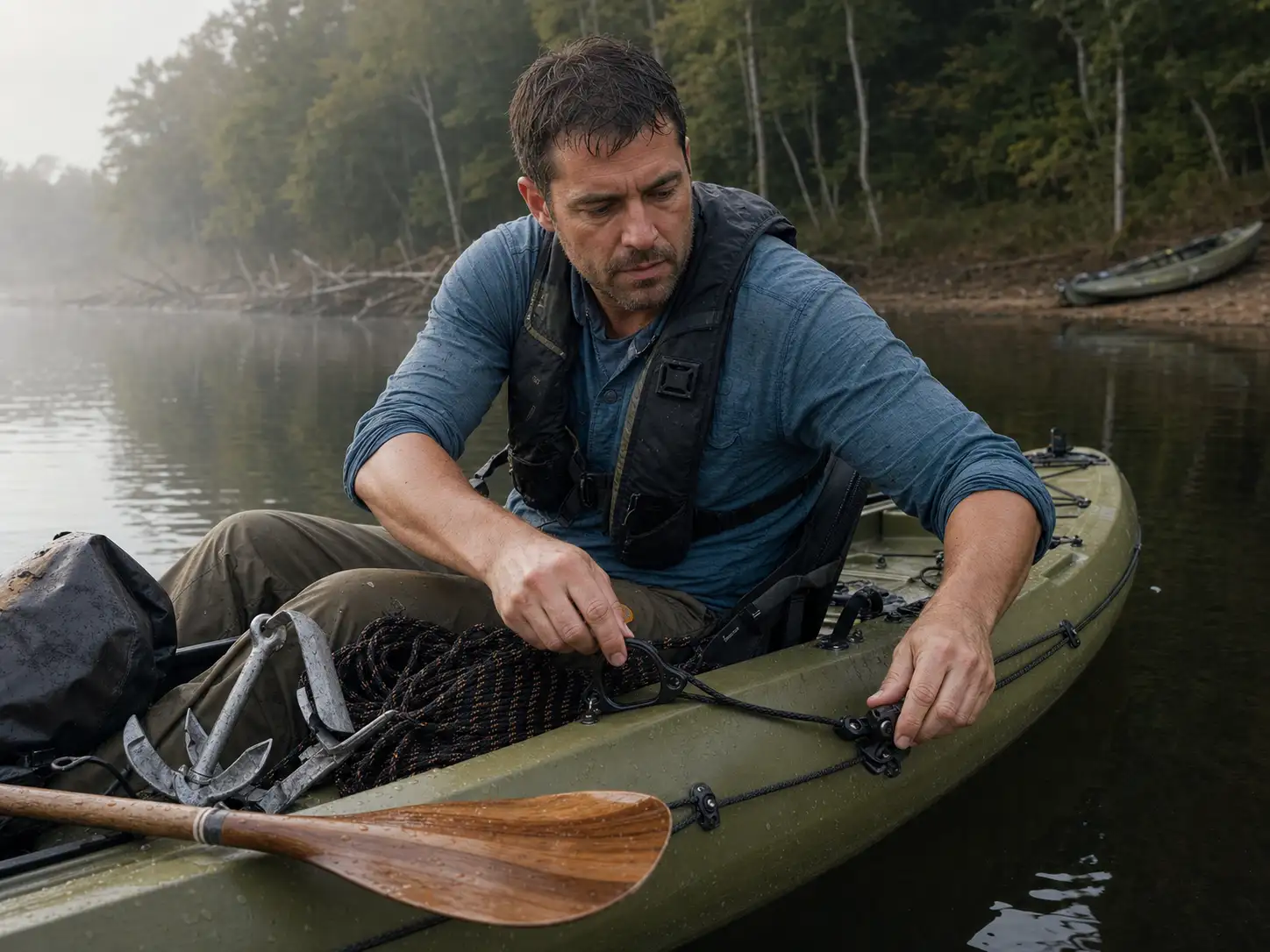
A continuous loop of cord runs bow to stern along one side, held by a pad eye at each end, with a pulley ring on the loop. British paddlers call the same setup a running rig. Your anchor line clips into that ring with a carabiner, and pulling one side of the loop from the cockpit slides it fore or aft without you leaning out over the gunwale. That’s the whole argument: a trolley moves the anchor point instead of the boat.
Installation lives or dies on hardware. Pad eyes go at the extreme ends of the run, through-bolted with backing plates where you can reach inside the hull and well-nuts where you can’t. Marine-grade stainless steel only: galvanized fittings weep rust down a white hull inside one season, and track systems and pad eye mounting matter more than most people expect.
The cleat holds the ring where you set it. A lever-lock beats a jam cleat or a standard cam cleat for one reason: one hand works it while the other has a rod in it. Some kits run a zig-zag cleat instead, which grips well but wants two hands to clear.
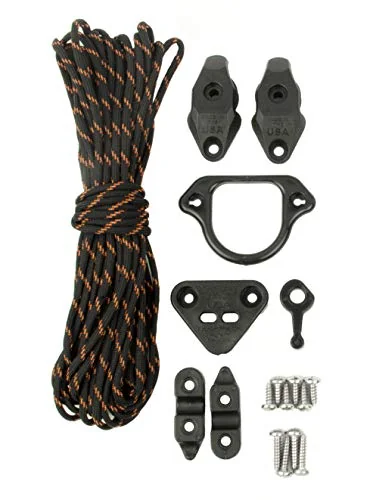
Once it’s mounted, run the ring end to end a few dozen times in flat water. You want the motion memorized before doing it one-handed with a fish on.
Mark your trolley cord at the two extreme positions. When the ring hits a mark you know it’s fully forward or aft without turning to look, and you set that ring by feel far more often than by sight.
Matching Your Anchor to the Bottom You’re Fishing
The stock answer is “buy a 3.5 lb grapnel.” Right most of the time, and wrong on a silty farm pond or a shallow grass flat. Bottom type decides this, not the brand, and the claw anchor and bruce anchor shapes you see on powerboats scale down badly to a hull this light.
Rock, Gravel and Mixed Bottoms (The Folding Grapnel)
Four folding flukes catch irregular bottom the way nothing else does. Drop a folding grapnel anchor on a rockpile and it hooks almost immediately, then releases cleanly when pulled from the opposite direction. The tradeoff: what grips rock also snags rock, which is why the weak-link rig further down is mandatory.
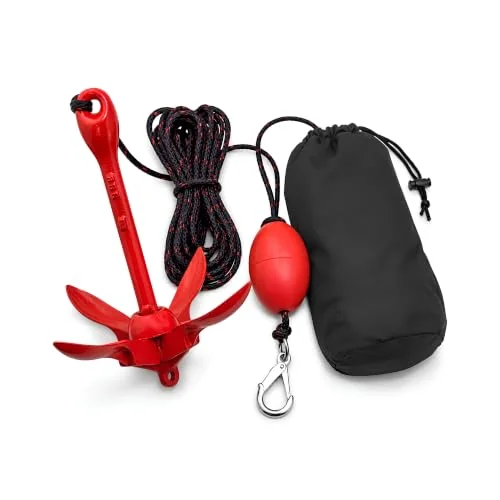
If the outlay stings, a drilled brick or a concrete-filled flowerpot on a rope holds a kayak in still water. People genuinely fish that way.
Soft Mud, Silt and Calm Lakes (Mass Beats Flukes)
In silt, flukes have nothing to bite. They plow a furrow and the boat keeps sliding. What holds in soft bottom is weight sitting in the muck, not shape catching an edge.
A mushroom anchor does this, and so does a five-pound coated dumbbell from the garage. Anything that works by mass in soft ground is a mud anchor, whatever it costs.
Shallow, Soft Bottoms (Skip the Anchor Entirely)
Under about four feet of water over mud or sand, an anchor is the wrong tool. A stakeout pole pushes through a deck scupper or track mount into the bottom and holds you: no line, no scope, nothing that can snag. It’s also quiet, and dropping metal on a shallow flat announces you to every fish in a fair radius.
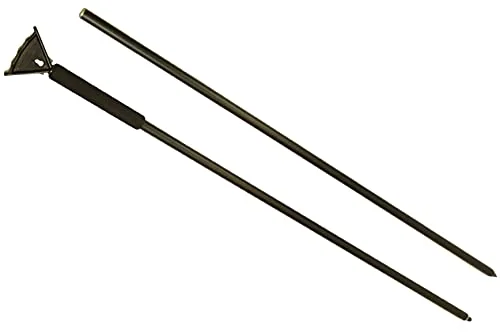
A sharpened dowel or an old broom handle does the same for nothing. It won’t float or break down for storage the way a fiberglass pole does, but it holds a kayak in three feet of mud.
The Push-Button Option Most Anglers Don’t Need
The Power-Pole Micro Anchor is the motorized anchor most kayak anglers have seen, an all-electric shallow-water unit with Bluetooth app control and a removable mount. It solves a real problem: silent, instant, repeated anchoring in skinny water. But if you set up a handful of times per trip in under eight feet, a grapnel on a trolley and a stakeout pole do the same job for a fraction of the outlay. Buy the trolley first.
How Much Anchor Weight You Actually Need
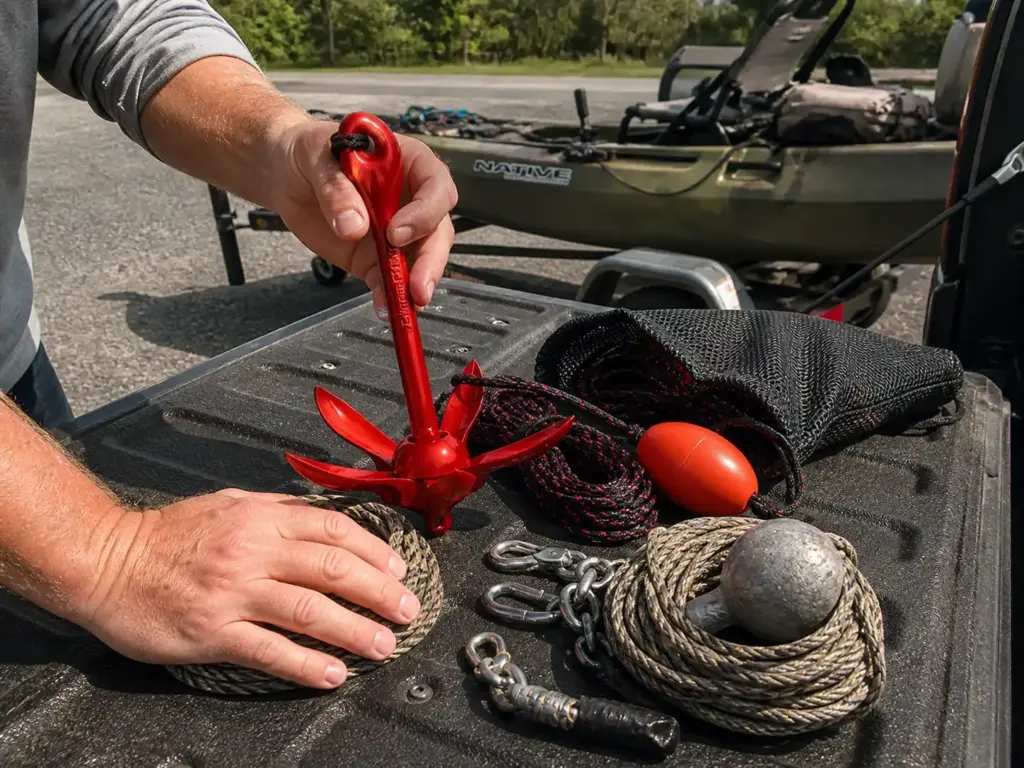
Here’s where the one-anchor-for-everything habit costs people. The anchor that’s flawless on your local pond is the one that drags you down the river.
The working ranges are narrow. Roughly 1.5 lb covers calm, shallow water where wind is the only force. Three to 3.5 lb is the coastal and tidal number, and four pounds and up is what real river current asks for.
Note what isn’t on that list: the size of your kayak. The variable is the force trying to move you, and current dominates, then wind, with depth a distant third. Sand bottom and mud bottom change which anchor you reach for, but not much about the weight.
Weight and holding power aren’t the same thing. A short section of chain between rope and anchor buys more bite than a full extra pound of anchor, because it changes how the anchor sits on the bottom rather than how hard it presses in. That’s the same ground tackle physics that govern anchoring a powerboat, identical mechanics at a different scale.
Before buying a heavier anchor because yours drags, add two feet of chain and try again. It costs almost nothing and fixes the problem more often than extra weight does. Skip it and you end up hauling a five-pound anchor that a three-pounder with chain would have out-held.
For most people the answer is two items, not five: one 3 to 3.5 lb grapnel for the majority of water, plus a stakeout pole for the shallow end. Everything else is a specialty purchase you make later if your water demands it.
Line, Chain and Scope (The Numbers That Actually Matter)
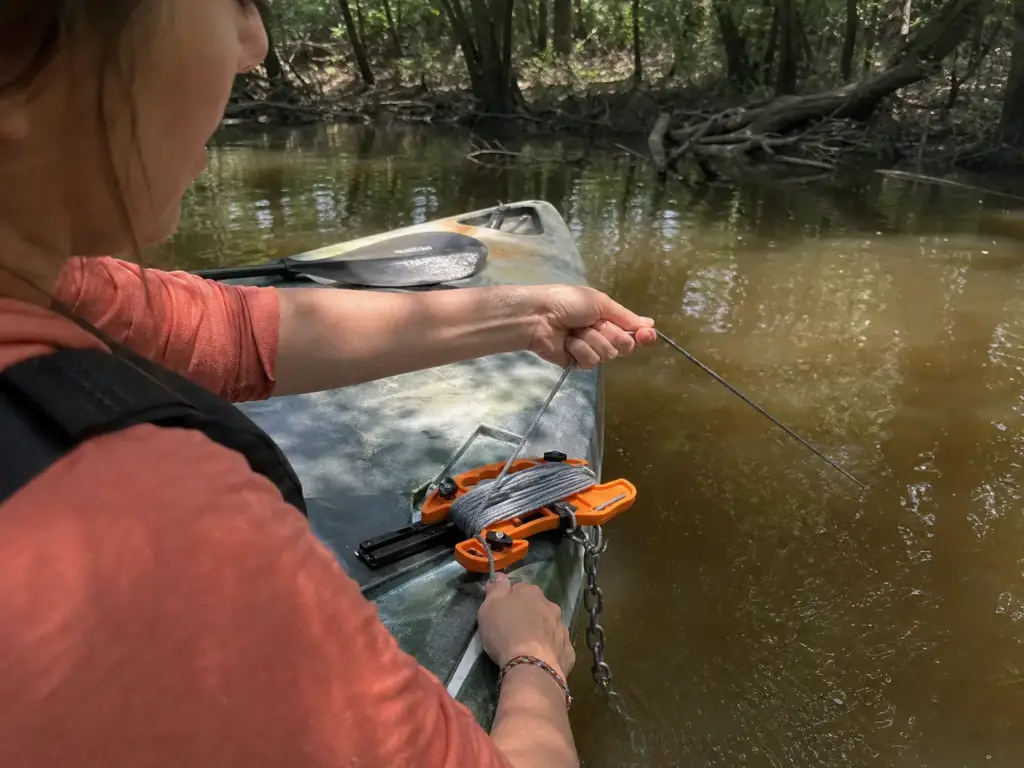
“Let out some line” is how most kayaks get anchored. Scope is a ratio, and misjudging it is why a perfectly heavy anchor still slides.
Scope is the line you’ve paid out divided by the water depth. BoatUS’s scope calculation guide recommends a 7:1 rope-to-depth ratio for reliable holding, with 10:1 in storm conditions.
For most kayak fishing, 3:1 to 5:1 works, because you’re anchoring for an hour rather than riding out weather overnight. In ten feet of water that’s thirty to fifty feet of line, closer to seventy when it’s rough. Not “some.” That amount.
It works because of geometry. Scope changes the ANGLE the line pulls at: short scope pulls upward, lifting the shank so the flukes never dig, while long scope pulls almost horizontally and drives them in. A couple of feet of galvanized chain between rope and anchor does the same job from the other end, laying the shank flat so the flukes bite. Cheaper and more effective than buying up a weight class.
Line material matters less than people think, with one exception. Nylon rope stretches slightly under load, which takes the shock out of a gust, and paracord does the same in a smaller diameter. A floating rope or cheap polypropylene cord stays on the surface where it can foul a paddle blade or a rudder, so most kayak anglers skip it despite the price. A pickup buoy on the tag end is the useful surface float, not the line itself.
Then the part nobody warns you about: fifty feet of loose paracord in a cockpit finds every rod tip, foot and cleat you own. When you’re sitting inside the tangle, loose line is a hazard rather than an annoyance. A track-mounted kayak anchor line reel with 50 ft of paracord keeps it spooled and fits the GearTrac, Scotty, RAM and YakGear rails most kayaks carry. A hand-wound loop in a mesh pocket does the same for free.
Deploying and Retrieving Without Getting Yourself in Trouble
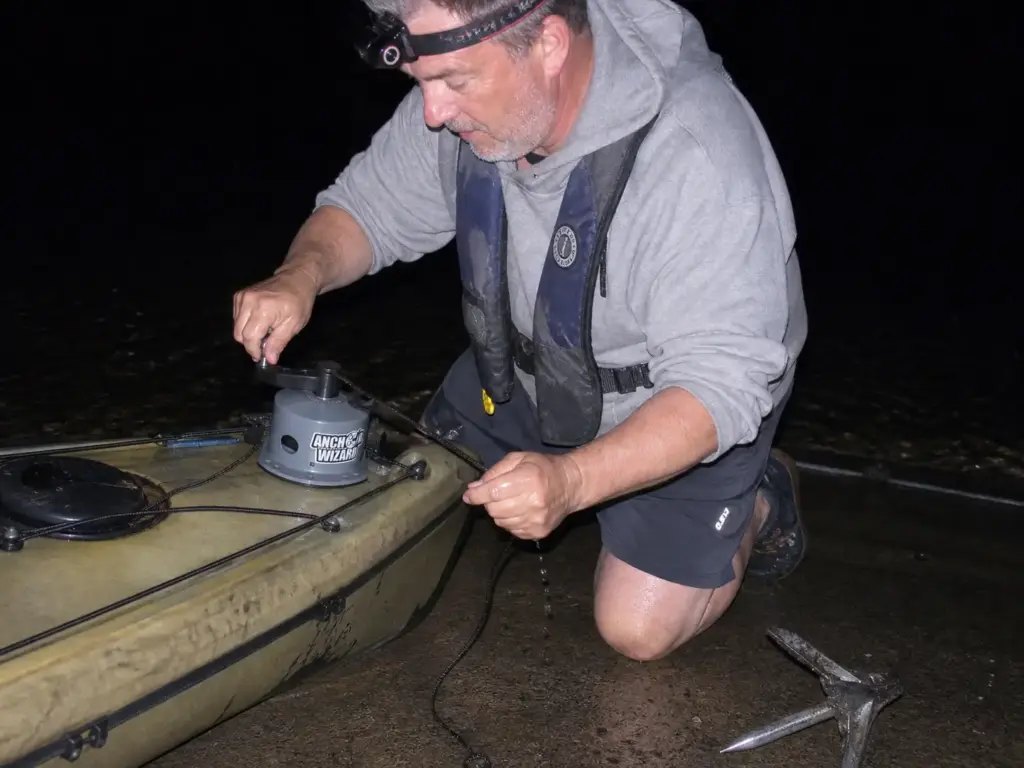
The rig can be perfect and the sequence can still put you in the water. This part only really gets learned by doing it wrong in current once.
The order matters. Slide the trolley ring to the end you want to anchor from, first. Lower the anchor, don’t throw it. Pay out to your scope, then cleat off.
Let the boat swing and settle before you pick up a rod, because whatever the hull is going to do, it does in the first seconds. That settle is also your quick release anchoring rehearsal: if the boat does something you don’t like, you want the line off the cleat before you think about it.
Lowering instead of throwing isn’t fussiness. A thrown anchor lands with a pile of slack behind it, and slack line under a moving kayak finds your rudder, your paddle leash, or your feet.
Retrieval reverses the logic. Paddle up over the anchor so you break it straight up, then haul. Hauling from downstream fights the bottom and the current at once while pulling your stern toward the water. Both hands are busy, so somewhere secure to park the rod is part of the system.
Hand hauling is enough for most anglers in most water, and anyone who says otherwise is selling something. Where that stops being true is repeated anchoring in deeper water: set and pull a dozen times in twenty feet and hauling cold wet rope gets old fast.
That’s the case for reel hauling. The Anchor Wizard Low Profile Crank sits in that gap, a hand-crank anchor reel holding up to 45 ft of 1/8-inch rope on a low-profile deck mount. A comfort upgrade for a specific habit, not a requirement.
Run the full sequence (deploy, cleat, retrieve, emergency release) in calm shallow water before you ever do it in flow. In current you get one attempt and no time to think about what your hands should be doing.
Where to Clip the Trolley Ring (The Mistake That Flips Boats)
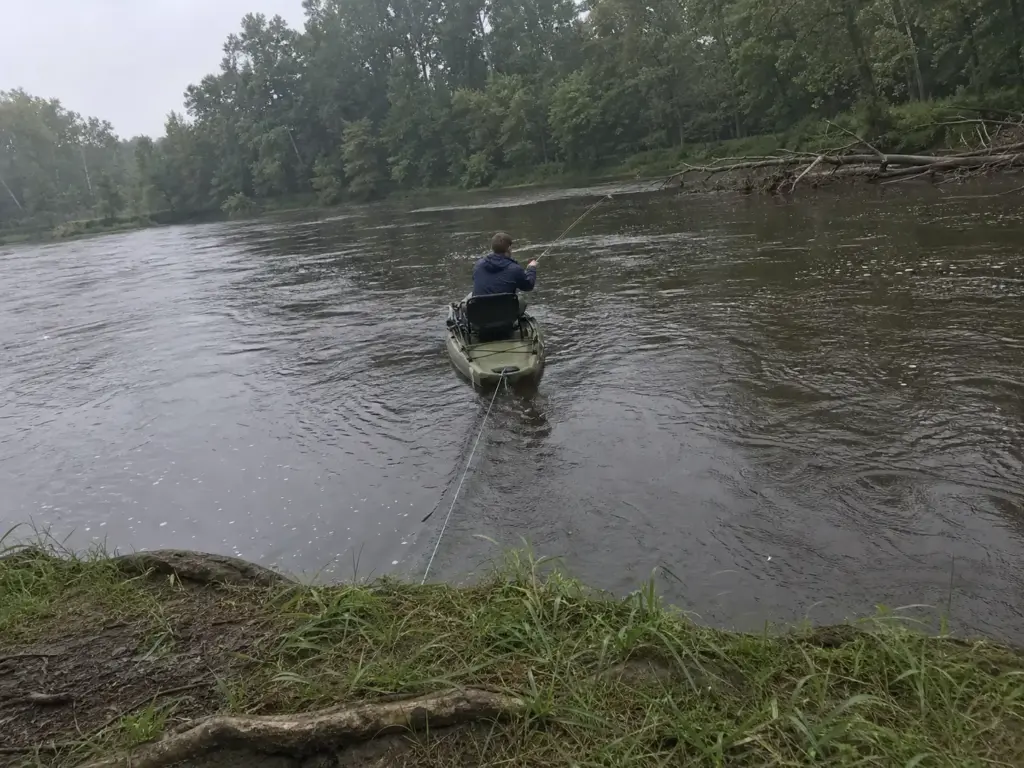
Every guide says never anchor from the middle. Almost none say why, and a rule you don’t understand is one you bend the moment it’s inconvenient. Here’s the mechanism.
An anchor line pulling from mid-ship attaches the force at the center of the hull, roughly its pivot point. Current pushes the boat downstream, the line holds the middle in place, and the two ends rotate freely. Within a second or two the kayak is broadside and the full length of the hull becomes a dam across the flow.
That’s uncomfortable on a bass boat. On a kayak it’s a capsize risk, and the reason is freeboard. Water piles against the upstream side and comes over the rail almost immediately; once a few gallons are aboard the boat sits lower, which lets more in faster.
There’s no reserve of hull height buying you a window to react. Hull alignment is the entire defense, and how hull shape determines what your kayak does when it gets pushed sideways covers the stability geometry underneath this.
This isn’t a dramatized risk. The U.S. Coast Guard’s recreational boating statistics show capsizing is the leading cause of paddlecraft fatalities, and the majority of the vessels involved were manually propelled craft.
It’s not storms doing that. It’s boats ending up sideways to a force they weren’t pointed into.
The fix is positional and free. Put the ring at the extreme bow or stern and the boat weathervanes: it swings until its long axis lines up with current and wind, presenting the narrow end to the flow. A correctly anchored kayak does this on its own within seconds of the line coming tight. You feel it settle, and that settling is the confirmation your rig is right.
The habit that undoes it is small and human: clipping the ring near the seat because it’s the part of the trolley you can reach without turning around. Set a physical stop at the very end of the track and use it. “Close enough to the bow” is close enough right up until the current comes up.
Bow-forward is the standard end, because the bow is shaped to part water and pointing the stern into hard current puts the flatter transom upstream. On a calm lake either end works.
The Breakaway Rig That Saves Your Anchor (and Your Boat)
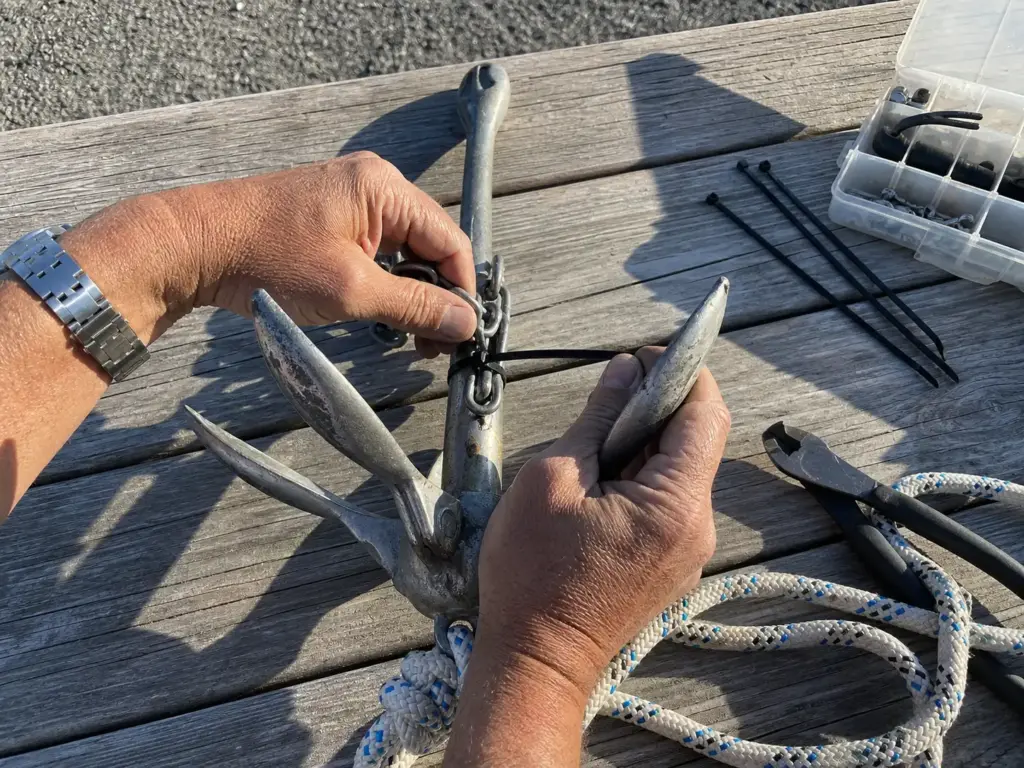
A snagged anchor on a powerboat is an annoyance you solve with the motor. A snagged anchor on a kayak in current is a fixed point tethered to a hull with eight inches of freeboard and no engine. So the rig gets designed to fail on purpose.
The build takes about ninety seconds and one zip tie. Tie your main rode to the anchor’s CROWN, the hole at the bottom of the shaft, opposite the ring you’d normally use. Run the line up along the shank, then secure it to the SHANK’s normal attachment point with an 11-inch cable tie rated around 50 lb tensile.
That’s the whole anchor weak-link, a technique that circulates widely in the saltwater kayak fishing community. You’ll also hear it called a trip-link, and rigged with a short anchor bridle it does the same thing on anchors with two attachment points.
Day to day, you lose nothing. Under normal load the tie holds easily, so the pull comes from the shank exactly like a standard rig and the anchor sets the way it’s designed to. Normal holding loads on a kayak anchor live well under 50 lb.
When the anchor snags, the physics reverse. Change your pull angle, load the line hard, and the tie snaps. The attachment point shifts from the shank to the crown, flipping the direction of force on the flukes: instead of pulling them deeper into whatever they’re hooked on, you’re pulling them out backward, the same way they came in. Most snags let go on the first or second attempt.
The detail that makes it work: pull from an angle, not straight up and down. A vertical yank just loads the flukes harder against the snag. Paddle off to the side or up-current, then load it. That’s the advice repeated most often by anglers who fish rocky bottoms.
Keep a handful of spare zip ties in the tackle box. A broken weak link becomes a two-minute re-rig instead of an anchor you fish without all day. Anglers who carry them break the link freely; anglers who don’t hesitate at exactly the wrong moment.
Rating discipline gets missed in both directions. Too strong and the tie won’t break when you need it; too weak and it snaps while you’re simply anchored, sending the pull to the crown and letting the anchor skate. Keep a pair of side cutters within reach so re-rigging on the water isn’t a fight with a stubborn tie and cold fingers.
When the Anchor Won’t Come Up
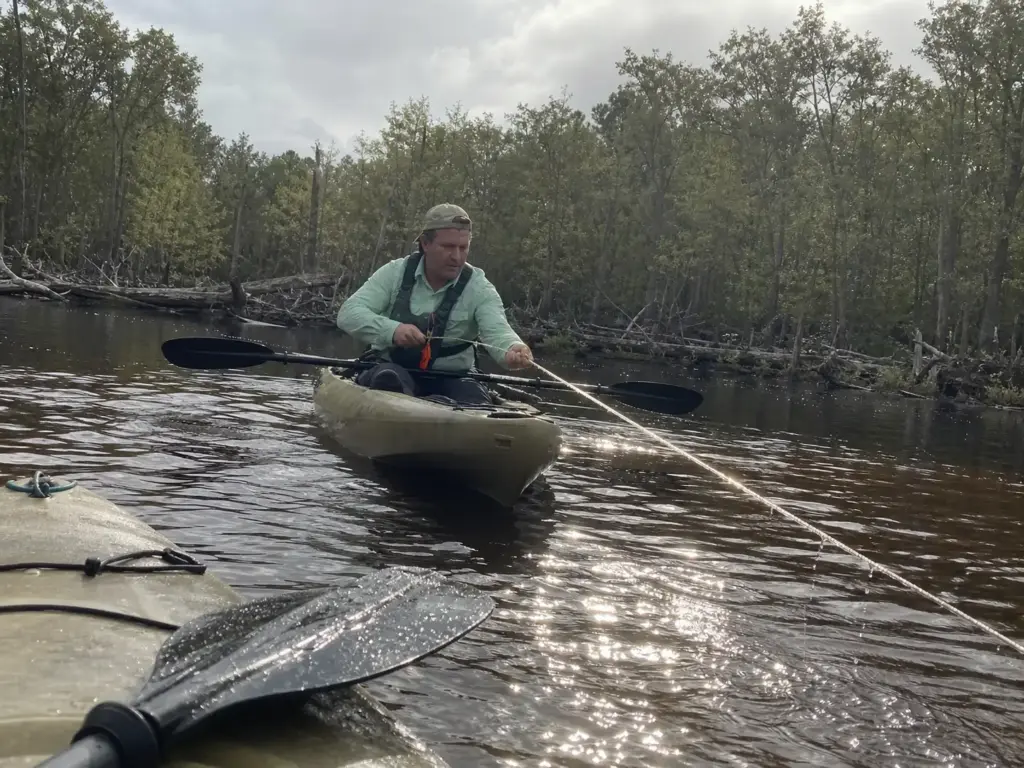
The instinct is the wrong move. Everyone’s first reaction to a stuck anchor is to paddle away and pull harder, which is exactly how you take water over the stern.
Step one never changes: stop pulling and get the boat directly over the anchor. Pulling from downstream loads the line at the worst angle available, driving your stern down and dragging the flukes deeper.
Then change the angle. Paddle up-current past the anchor and load the line from the opposite side of the snag. Most snags release when the direction of force reverses, because the anchor backs out along the path it went in.
Same principle the weak link uses, applied by hand. If the anchor carries one, that angled load is what snaps the tie.
Ask anyone who’s had a grapnel bury itself in submerged timber: the instinct is to paddle straight back and haul, and the fix is to paddle upstream first and change the angle. It feels like giving up ground. It’s the move that works.
The last resort should be an easy decision made in advance. Cut it. An anchor is a replaceable expense; a tethered kayak in current is not worth negotiating with. Carry a line cutter where one hand can reach it without looking, which is part of the safety kit that belongs on every kayak.
One absolute rule: never wrap the anchor line around your hand, arm or wrist for leverage. Pull with an open grip. If it won’t move with an open grip, it isn’t coming up that way.
River, Lake or Tidal (Three Different Systems, Not One)
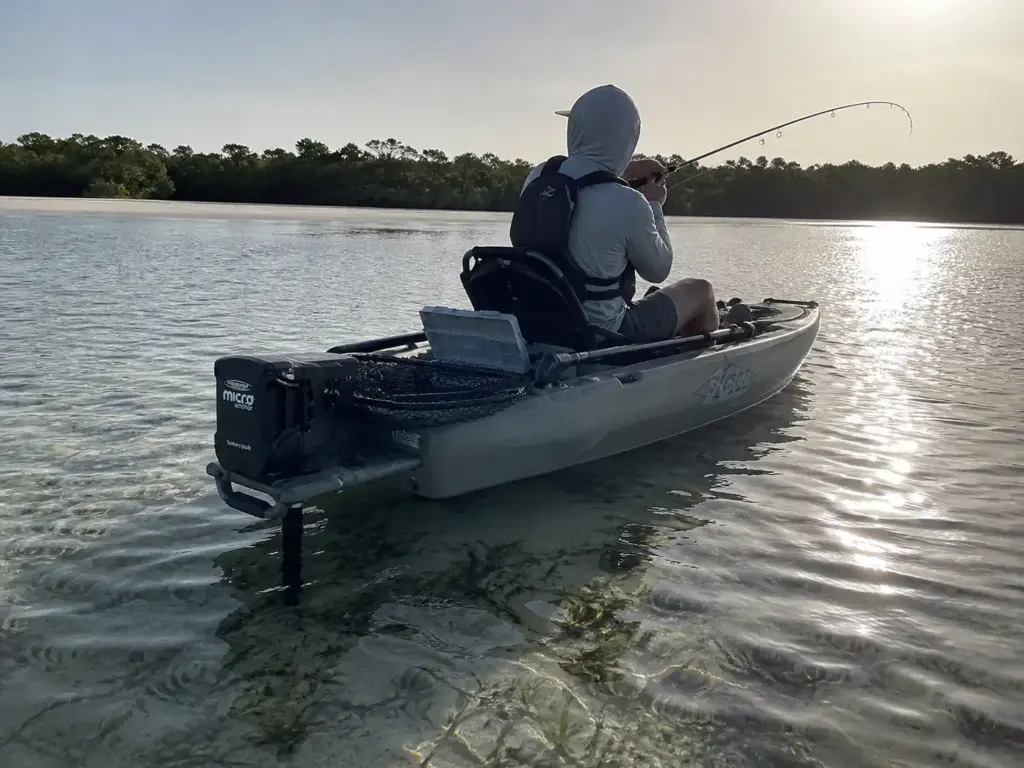
Advice written for a Florida flat and advice written for a Michigan river contradict each other, and both are correct. River anchoring, lake anchoring and tidal anchoring are three different systems that happen to share a name, and which one applies to you changes the whole rig, not just the anchor weight.
Rivers and Moving Water
Hard-setting an anchor in real current is the highest-risk version of this whole activity, and plenty of experienced river anglers simply don’t do it. That’s worth sitting with before you buy a heavier anchor.
The alternative most of them use is a drag chain: roughly two feet of 7/16-inch chain wrapped in an old bicycle inner tube so it doesn’t clatter on the hull, tied to about twelve feet of rope. It doesn’t stop you, it slows you, so you fish a run at a controlled speed instead of parking in it.
The other river-specific choice is running the line straight off the stern rather than through the trolley, a short direct run you can release instantly. The fewer steps between “this is going wrong” and “the line is gone,” the better. High water changes what current does to an anchored boat, which makes spring the worst time to experiment. If you do hard-set in a river, use 4 lb or more, and the weak link stops being optional.
Lakes and Calm Water
The forgiving case. Wind is the only real force, and it doesn’t reverse without warning the way tide does. Mass-based anchors do their best work here, because lake bottoms trend soft and weedy: a mushroom, a coated dumbbell, anything that holds by sitting rather than hooking. Lighter weights around 1.5 lb are fine, and shorter scope works because the load is gusts rather than constant flow.
This is also where over-buying happens most, when someone reads a river guide and rigs a 5 lb grapnel for a lake twelve feet deep. On open water, wind is the force you’re fighting, and sometimes a drift sock and no anchor at all is the better answer.
Tidal and Coastal
The complication in coastal anchoring is that the force reverses. A rig set on an outgoing tide gets loaded from the opposite direction hours later, and an anchor that was holding beautifully breaks out, drags, and either resets or doesn’t.
Weight lands in the 3.0 to 3.5 lb range, and scope gets planned for the depth you’ll have at high water, not the depth under the hull now. Six feet becomes ten, and the scope you paid out for six is suddenly a short-scope rig pulling upward on the shank. Stainless isn’t a preference in salt, either: the failure with galvanized fittings isn’t gradual and visible, it’s a pad eye that looks fine and pulls out under load.
Safety Rules That Come Before Any of This
Anchoring is the one kayak fishing activity that deliberately ties you to a fixed point. That changes the safety math enough to be blunt about it.
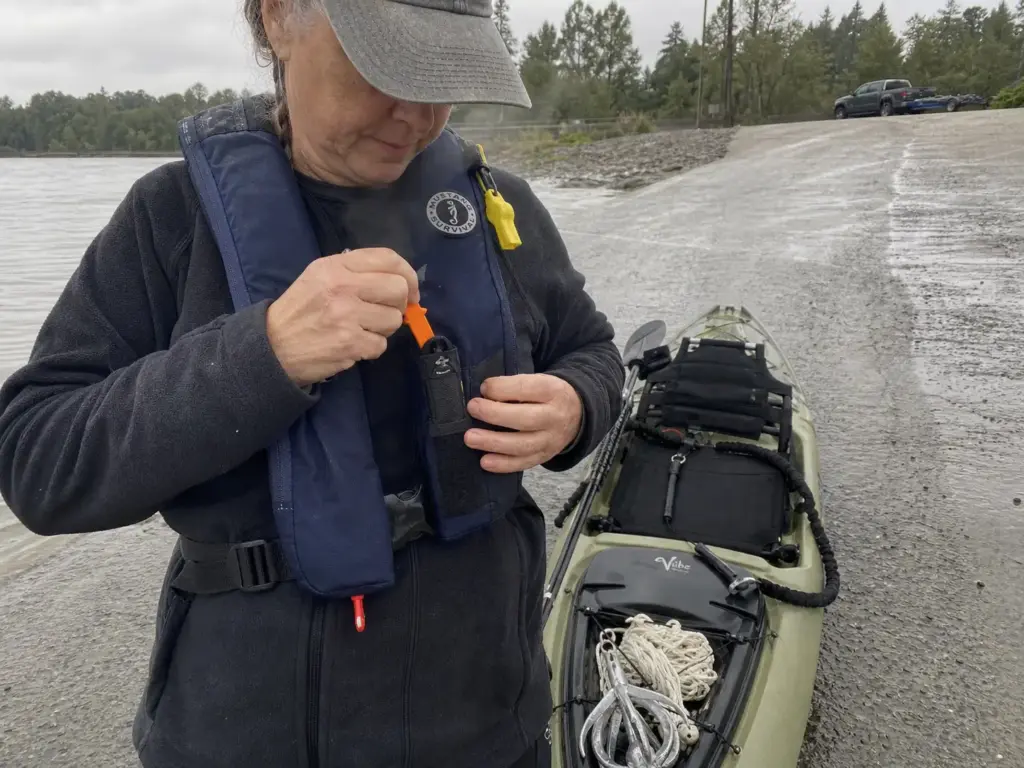
The PFD is worn, not stowed under the seat where it does nothing. An anchored capsize gives you no warning and no swim time; it happens in a couple of seconds while you’re seated and possibly holding a rod.
The line cutter or safety knife goes where one hand can find it without looking. Tethered and unable to cut is the worst case in this article, and it’s preventable with hardware that costs less than a pack of hooks. Mount it on the PFD, not in a hatch.
Cold water shock deserves its own line. Below 60°F water, with an air-to-water gap over 15°F, an unplanned swim triggers an involuntary gasp reflex no matter how well you swim. Spring and fall anchoring carries a risk the same rig in July doesn’t.
Practice the whole sequence in calm shallow water first: deploy, cleat, retrieve, break the weak link on purpose. The USCG Auxiliary’s Paddlecraft Safety Program handbook recommends every paddler assume they will capsize at some point and train for it. If it happens, getting back into the boat in deep water is a skill you want to already have.
Where you anchor matters as much as how: an anchored kayak in a channel is a fixed obstacle other boats have no reason to expect, sitting low and hard to see.
And know the sleigh ride before it happens, hooking a fish big enough to tow you while still anchored. Decide now how you’d release that line one-handed. The decision takes ten seconds at the ramp and zero on the water.
Conclusion
Clip the trolley ring at the extreme bow or stern. Every other choice in this article matters less than that one, and it’s free.
Rig the weak link before you need it. An 11-inch zip tie is the cheapest insurance on the boat, and the day you need it, nothing else substitutes.
Match the anchor to the bottom and the weight to the current, not to whatever a gear guide ranked first. A grapnel and a stakeout pole cover almost everything most anglers fish.
Then go rig it in the driveway and run the whole sequence in water shallow enough to stand up in: deploy, set, retrieve, snap the weak link on purpose so you know what it feels like. The system you’ve practiced is the one that works when the drift is finally right.
Frequently Asked Questions
01What size anchor do you need for a fishing kayak?
A 3 to 3.5 pound folding grapnel covers the majority of kayak fishing situations. Drop to around 1.5 pounds for calm, shallow lakes and go to 4 pounds or more for rivers with real current. The deciding factor is the force trying to move you, not the size of your kayak.
02How much anchor line do you need for kayak fishing?
Plan on three to five times the water depth, so 30 to 50 feet of line in 10 feet of water. BoatUS puts the standard scope at 7:1, and heavy current pushes it toward 10:1. Scope controls the pull angle, which is what actually makes an anchor hold.
03Where should the anchor trolley ring be when you anchor?
At the extreme bow or stern, never near the middle of the kayak. A mid-ship anchor point creates a lever arm that turns the hull broadside to current, and a kayak’s low freeboard means water comes over the rail almost immediately.
04How do you free a kayak anchor that is stuck?
Paddle up over the anchor and pull from the opposite direction. Changing the angle releases most snags, while pulling from downstream just loads your stern down. If the anchor carries a breakaway weak link, that angled pull snaps the tie and backs the flukes out. If nothing works, cut the line.
05Do you really need an anchor trolley, or can you tie off to a cleat?
You can tie off to a cleat, and it works right up until conditions change. Without a trolley you cannot move your anchor point without repositioning the whole kayak, which in current is the scenario that puts the boat sideways to the flow.
06Can you anchor a kayak in a river?
You can, but many experienced river anglers deliberately avoid hard-setting an anchor in current. They use a drag chain to slow the drift instead, or run the line straight off the stern for instant release. If you do anchor in moving water, a weak link stops being optional.
Risk Disclaimer: Fishing, boating, and all related outdoor activities involve inherent risks that
can lead to injury. The information provided on Master Fishing Mag is for educational and informational purposes
only. While we strive for accuracy, the information, techniques, and advice on gear and safety are not a substitute
for your own best judgment, local knowledge, and adherence to official regulations. Fishing regulations, including
seasons, size limits, and species restrictions, change frequently and vary by location. Always consult the latest
official regulations from your local fish and wildlife agency before heading out. Proper handling of hooks, knives,
and other sharp equipment is essential for safety. Furthermore, be aware of local fish consumption advisories. By
using this website, you agree that you are solely responsible for your own safety and for complying with all
applicable laws. Any reliance you place on our content is strictly at your own risk. Master Fishing Mag and its
authors will not be held liable for any injury, damage, or loss sustained in connection with the use of the
information herein.
Affiliate Disclosure: We are a participant in the Amazon Services LLC Associates Program, an
affiliate advertising program designed to provide a means for us to earn advertising fees by advertising and linking
to Amazon.com. As an Amazon Associate, we earn from qualifying purchases. We also participate in other affiliate
programs and may receive a commission on products purchased through our links, at no extra cost to you. Additional
terms are found in the terms of service.