
In this article
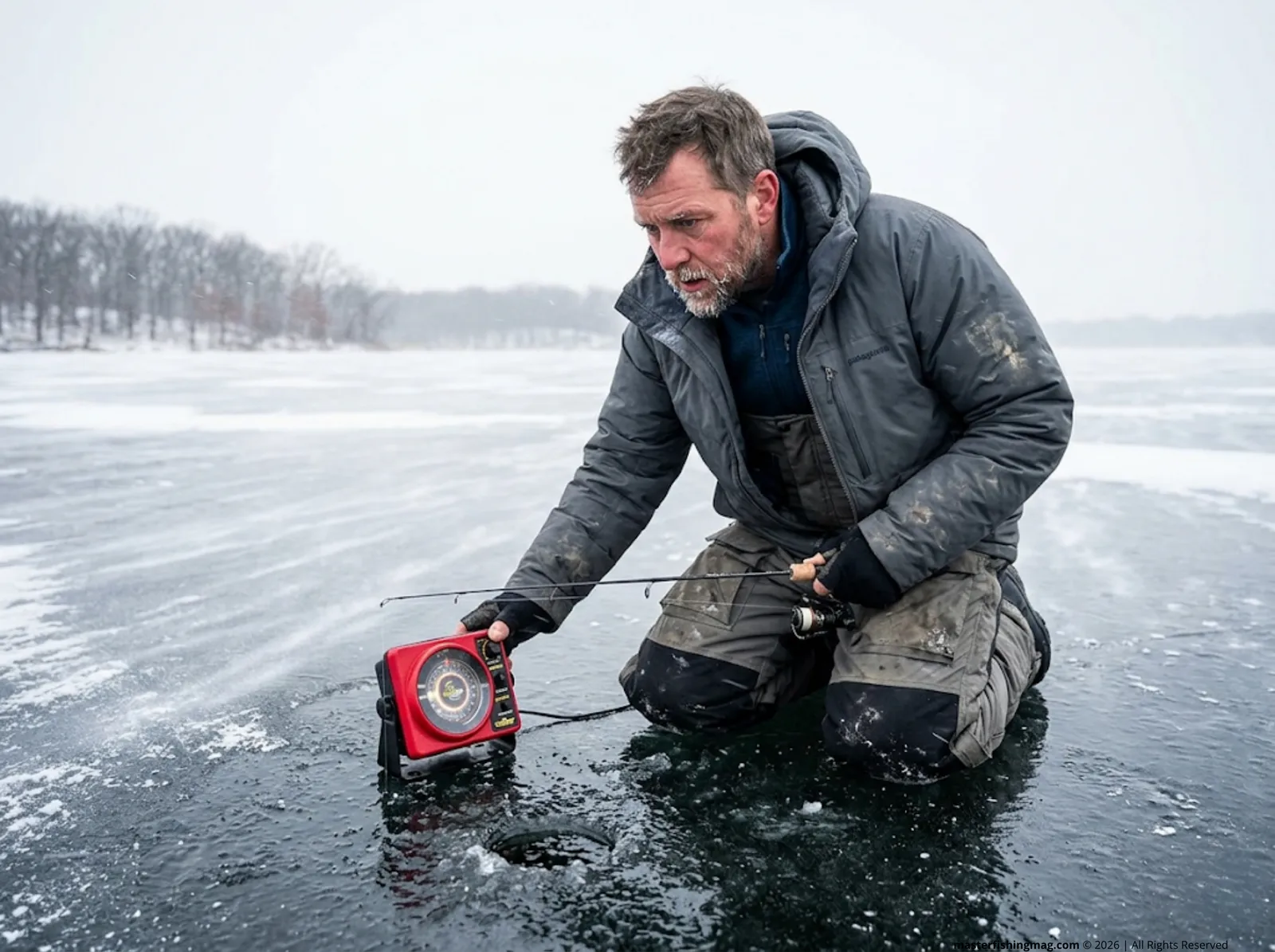
It was 6 a.m. on a frozen February reservoir, and every hole I drilled over the weed flat came back dead. The flasher read 14 feet of water and nothing — no fish, no marks, not even a flicker. Three hours earlier, a guy two hundred yards out over the basin had quietly limited on crappie and slipped away before sunrise. He wasn’t fishing harder. He wasn’t running better gear. He knew something about that lake that I didn’t yet: the weeds were suffocating, and every fish with a functional swim bladder had already moved.
That was the morning I stopped drilling by habit and started drilling by chemistry.
This article is a technical manual for the inverse-stratified winter lake. By the end, you’ll understand exactly why bluegill and crappie abandon weed flats mid-winter — dissolved oxygen thresholds, not temperature preference — how to locate the oxygen refugia they move to using 2D flasher gain settings, and which gear decisions actually change your catch rate at 25 feet.
⚡ Quick Answer: Winter panfish — bluegill and crappie — leave weed beds when dissolved oxygen drops below 4.0 mg/L, typically triggered by snow cover blocking sunlight. Find the oxygenated water column above the deep basin floor (15–25 feet), tune your flasher gain until you can see the zooplankton cloud in mid-column, then position a 1/64 to 1/32 oz tungsten jig 2 feet above it. Use 2 lb fluorocarbon. Dead-stick for neutral fish. Keep everything you catch from depths over 30 feet — releasing deep-basin panfish does more harm than keeping them.
Why the Oxygen Squeeze Happens — The Limnology of Constraint
Here’s where most ice anglers get the winter lake wrong. They think fish go deep because it’s warmer down there. It’s not that simple.
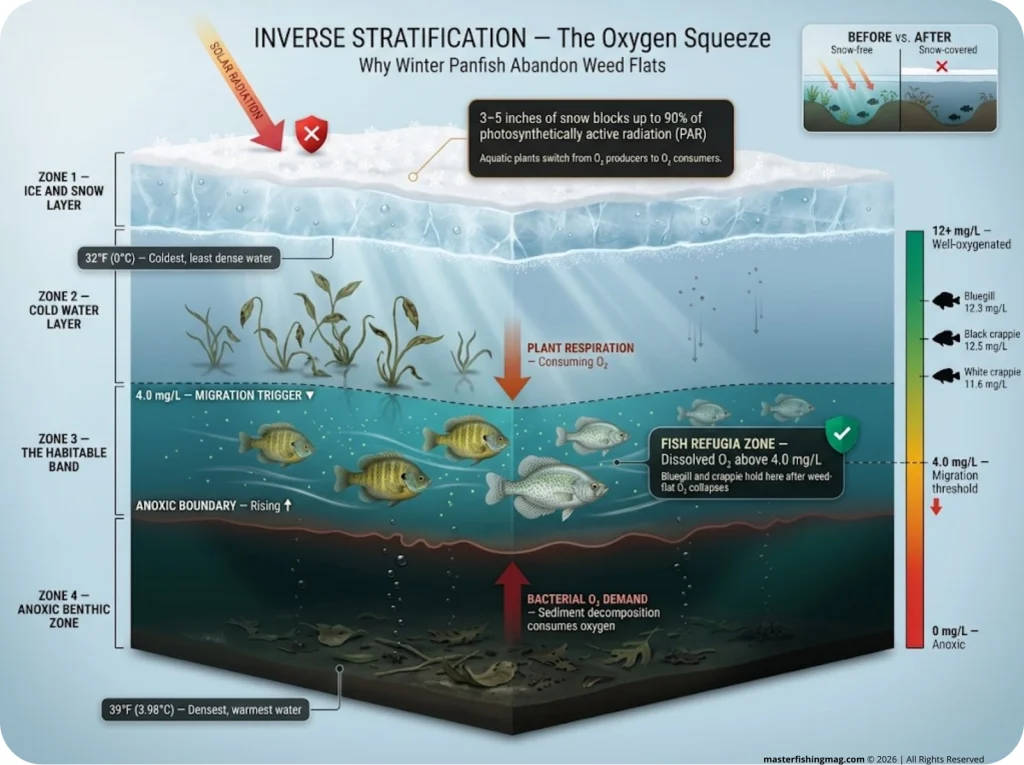
Water hits maximum density at 3.98°C — roughly 39°F — not at freezing. That single property flips the lake upside down in winter. The coldest water sits directly under the ice at 32°F, while the densest, warmest water settles at the bottom. This is inverse stratification, and it means the lake is sealed from the atmosphere the moment ice forms. The oxygen budget locked in at freeze-up is all you get until spring thaw.
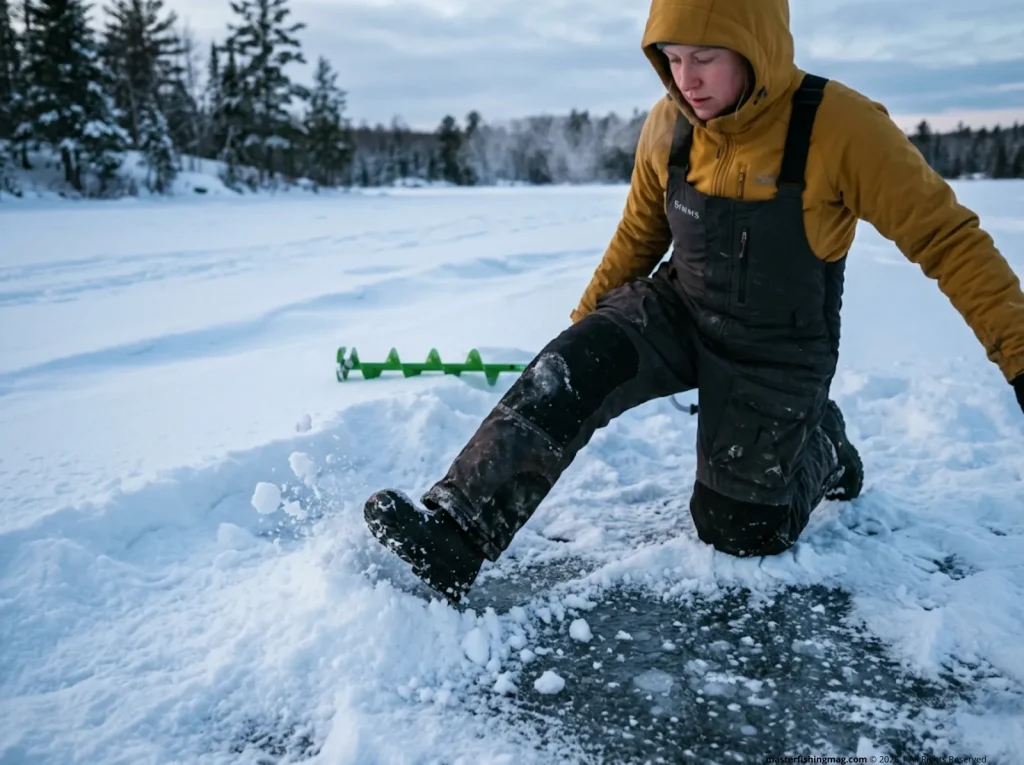
Two forces then work together to compress the livable zone. From the bottom, bacterial decomposition of organic matter — measured as sediment oxygen demand — creates an expanding anoxic layer rising from the benthos. From the top, snow blocks solar radiation. Three to five inches of opaque snow cover blocks up to 90% of photosynthetically active radiation (PAR), according to primary limiting factors for fish oxygen levels under ice and snow. When that happens, aquatic plants stop photosynthesizing and flip to 24-hour oxygen consumers. A weed bed that held fish in early ice can become a hypoxic zone within days of a heavy snowfall.
This is what the oxygen squeeze actually is: a vertical constriction of habitable water, driven by chemistry and physics, not by the fish’s preference for depth.
Telemetry data from the Iowa DNR tracked bluegill and crappie through multiple winters. Fish tolerated declining DO until the 4.0 mg/L threshold — then they moved decisively toward metabolic strike windows defined by dissolved oxygen. They weren’t wandering. They were following a chemical gradient.
Pro tip: Before you drill a single hole, look at the lake surface. Three inches of fresh snow after a mid-January storm is your signal to skip the flats entirely and find basin structure on your Navionics or LakeMaster map.
Inverse Stratification — The Physics Every Ice Angler Must Know
Unlike most substances, water is least dense approaching the freezing point. Below 39°F, water gets lighter as it cools toward 32°F. So in winter, the lake is thermally flipped: warmest water on the bottom, coldest water at the top. No wind, no convection — nothing to mix it. That stratification just sits there, stable, slowly consuming the oxygen budget it started with at freeze-up.
In a productive lake with heavy weed beds — what limnologists call a eutrophic system — this depletion happens fast and shallow. In a clear, cold, low-nutrient lake (oligotrophic), it’s slower and hits deeper. Knowing your lake type tells you how urgently you need to move off the flats.
The Snow Threshold — When Weed Beds Turn Against the Fish
You can watch this happen on your flasher in real time. A weed flat that lit up in early ice goes completely dark. No weather change, no pressure system, nothing obvious. Just chemistry. The snow got deep enough, PAR dropped below the plant threshold, and the weeds switched from oxygen sources to oxygen sinks.
White crappie show the highest hypoxia tolerance of the three species — Iowa DNR telemetry recorded them at dissolved oxygen as low as 0.9 mg/L. But those fish are surviving, not feeding. The catching happens at the edge between the hypoxic flat and oxygenated basin water. That edge is your target.
Quantitative Thresholds — Reading Migration Triggers Like Data
The Iowa DNR telemetry study gives precise numbers: bluegill mean winter DO at 12.3 mg/L, black crappie at 12.5 mg/L, white crappie at 11.6 mg/L. All three species triggered migration below 4.0 mg/L. Half of tracked fish moved less than one mile between summer and winter habitat preferences of adult bluegill and crappie. Ninety-one percent moved less than 3.5 miles. The fish are not traveling far — they’re shifting position within the same system.
Mean temperature of winter backwater habitats in the study was 35.1°F — only 2 to 5 degrees warmer than main channels. Temperature is not the driver. Oxygen is. Fish select areas with flow velocity under 0.1 feet per second: enough oxygenation to survive, low enough energy cost to sustain.
The Physics of Finesse — Tungsten, Drag, and the Fall Rate
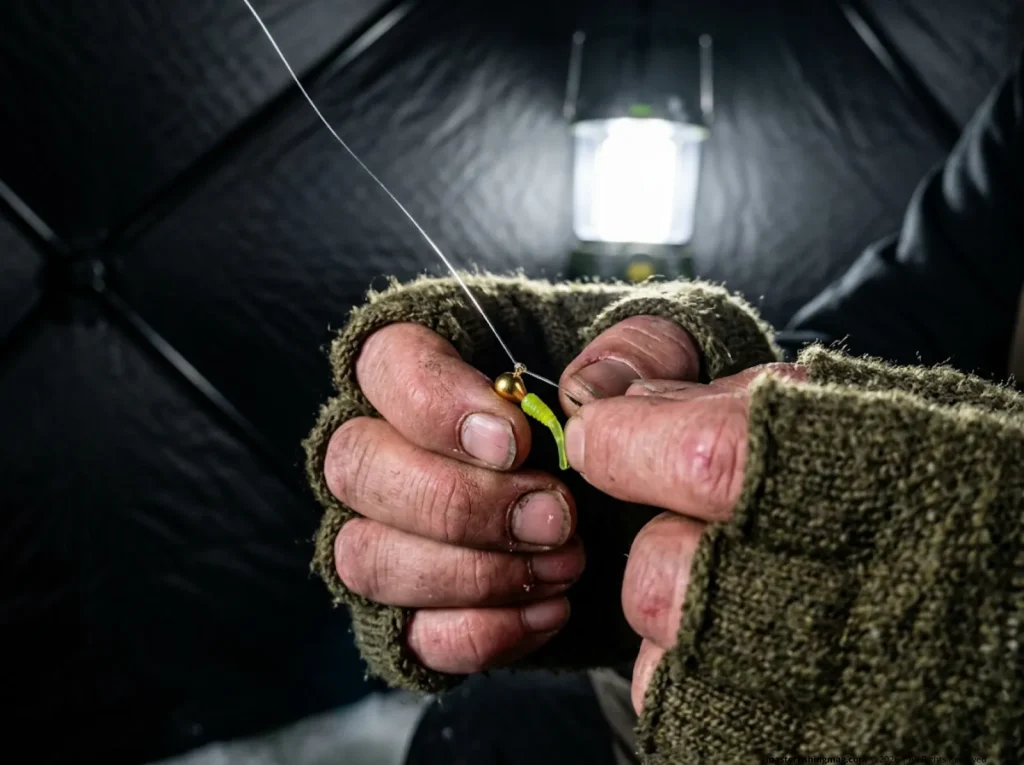
This is where the gear decision actually matters — and not in the way most anglers think about it.
Winter panfish are operating at roughly 15% of their summer aerobic capacity. At 5°C, bluegill aerobic scope drops to about half the summer value — they hit a ceiling on how much energy they can mobilize per hour. They are not lazy. Their biochemistry physically cannot support burst activity. A fish that has to chase a fast-moving lure is going into oxygen debt just to bite it.
So you need the jig to come to the fish, not the other way around. That’s where tungsten earns its keep.
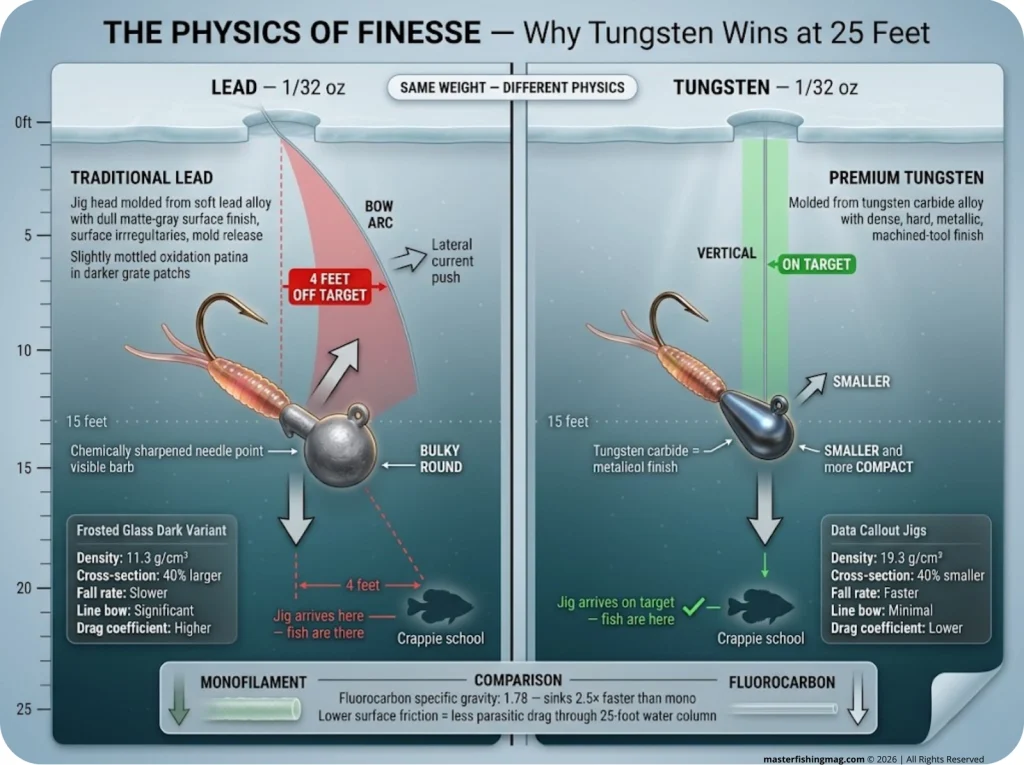
Tungsten’s density — 19.3 g/cm³ compared to lead’s 11.3 g/cm³ — lets you pack the same mass into a 40% smaller jig body. That reduced cross-section means less drag working against the jig during the fall. The jig punches through sub-ice slush faster, reaches suspended crappie schools before they drift through the sonar cone, and hangs more vertically than an equivalent lead jig. And how tungsten’s weight geometry changes the physics of your presentation is the reason guides switched — not marketing, geometry.
There’s also the tactile advantage. Tungsten is hard. Lead is soft. Vibration transmits more efficiently through the harder material into your high-modulus rod blank. You feel the contact, not just see it.
One honest note for the conservation-minded angler: tungsten is non-toxic to waterfowl. Lead jig ingestion is a documented cause of serious harm for loons and diving ducks. If you’re fishing catch-and-release on deep-basin panfish, consider that using tungsten is consistent with what you’re trying to protect.
Line Friction — The Part Nobody Talks About
Most articles stop at the jig. They ignore the line.
In 25 feet of water, fluorocarbon line matters as much as the jig weight. Fluorocarbon has a specific gravity of 1.78 — it sinks at 2.5 times the rate of monofilament. That difference isn’t just density. It’s surface friction. Monofilament’s rougher surface creates parasitic drag along the 25-foot line column that fights against your already-tiny jig. With a 1/64 oz jig, this can mean the difference between your presentation reaching the strike zone and hanging 3 to 5 feet above it.
Learn how fluorocarbon outperforms monofilament in sub-freezing water column conditions and you’ll never go back to mono for deep midwinter presentations.
Pro tip: In 25+ feet of water, 2 lb fluorocarbon — Sunline FC Sniper is the benchmark — isn’t optional. The line is part of the presentation system. Treat it that way.
The Up-Bite — What You’re Actually Watching For
Most anglers understand they’re supposed to watch for a bite. Fewer understand what winter panfish bites actually look like.
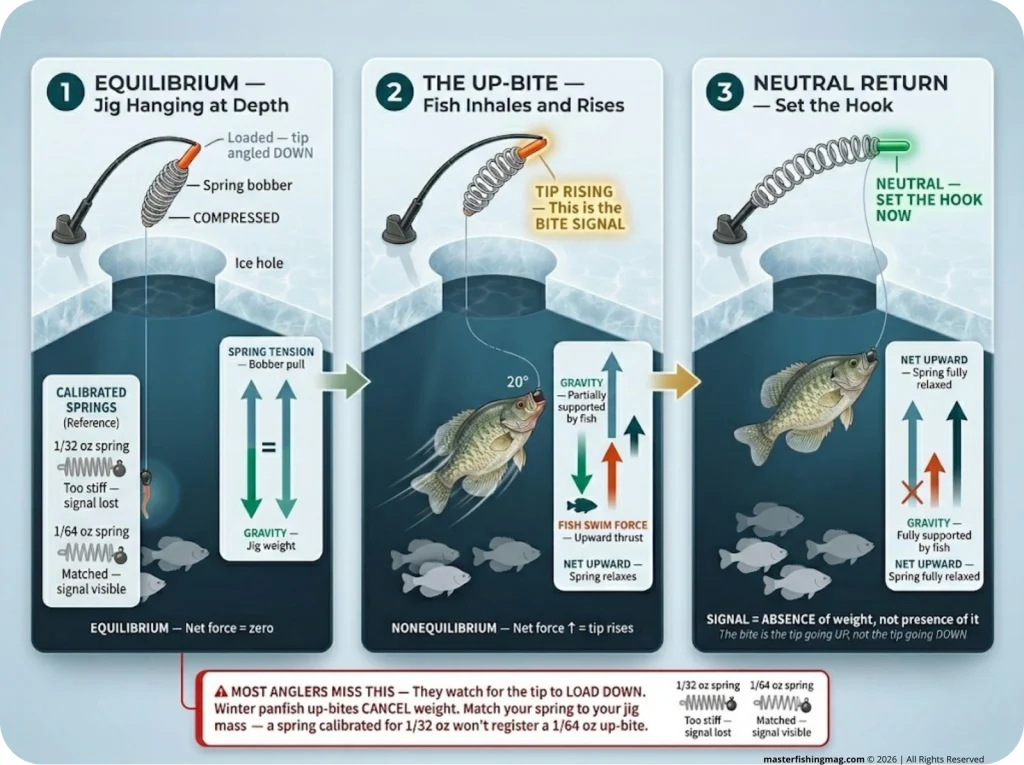
A neutral-buoyancy jig hanging at depth is in equilibrium: gravity pulls it down, your rod tip or spring bobber holds it up. When a crappie or bluegill inhales the jig and swims upward, it temporarily cancels the downward component. Your spring bobber floats back to its neutral position. The signal is the absence of weight, not the presence of it.
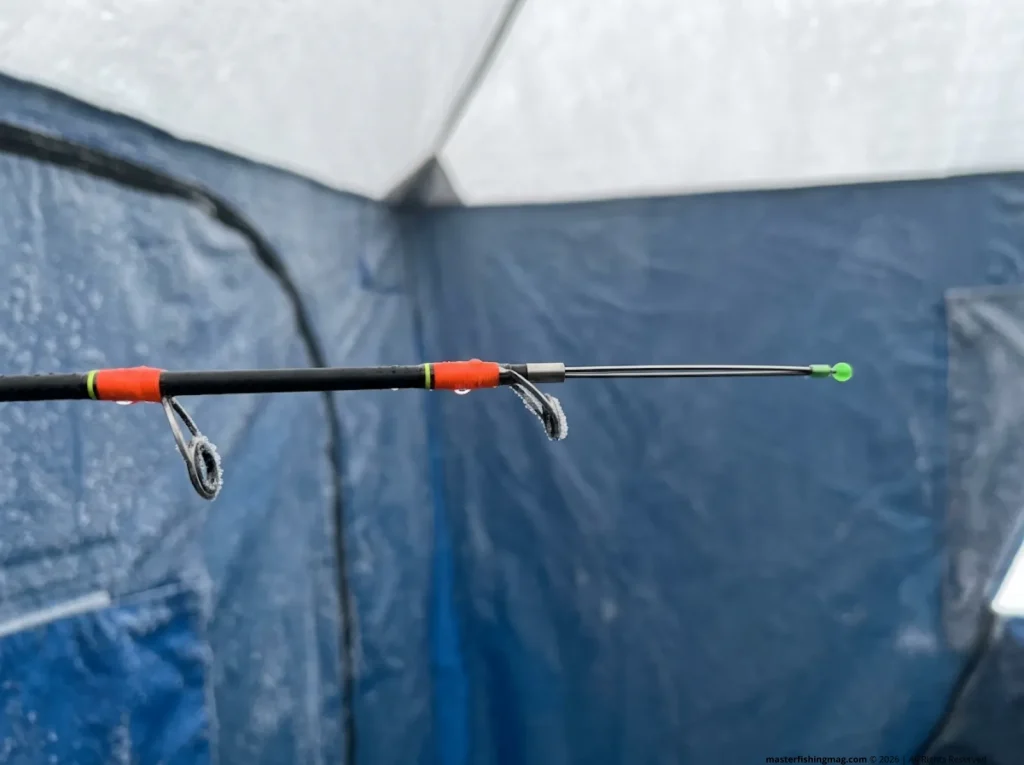
This is the up-bite detection signal, and casual anglers miss it constantly because they’re watching for the rod tip to load. Your spring bobber must be matched to jig mass. A spring calibrated for a 1/32 oz jig won’t register the up-bite on a 1/64 oz tungsten because the tension differential falls below its threshold.
Reading the Water Column — Sonar Mastery for the Analytical Angler
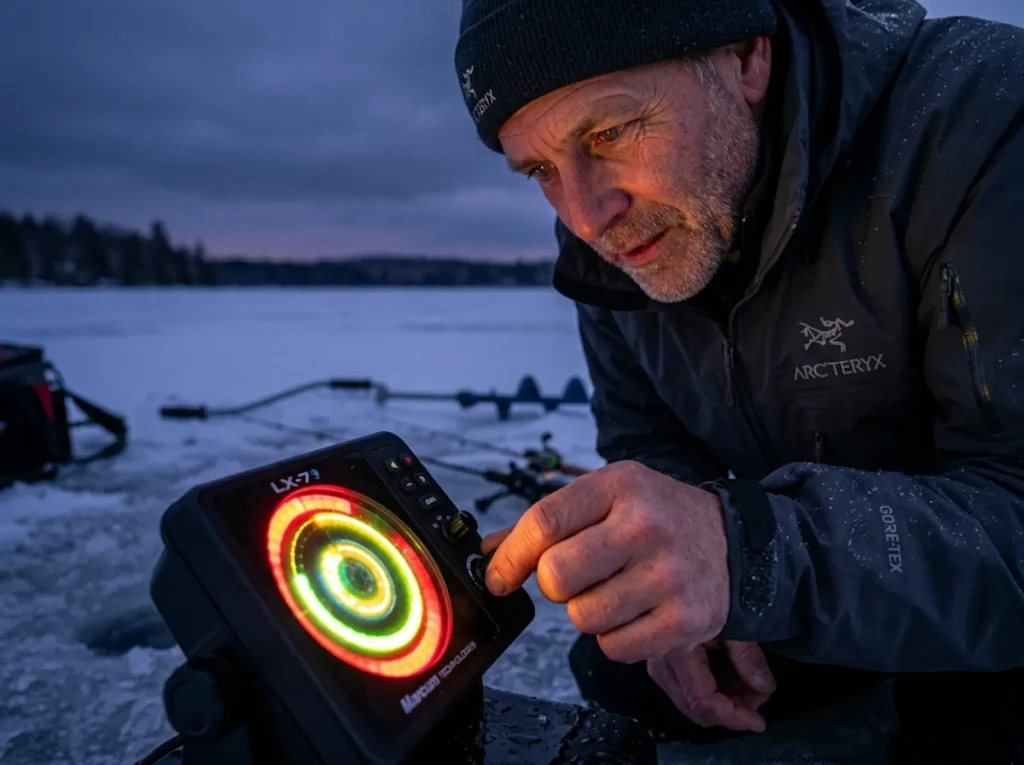
Your 2D flasher is a scientific instrument in this context. Most anglers use it as a fish-finder. The difference between those two approaches determines whether you find the bite.
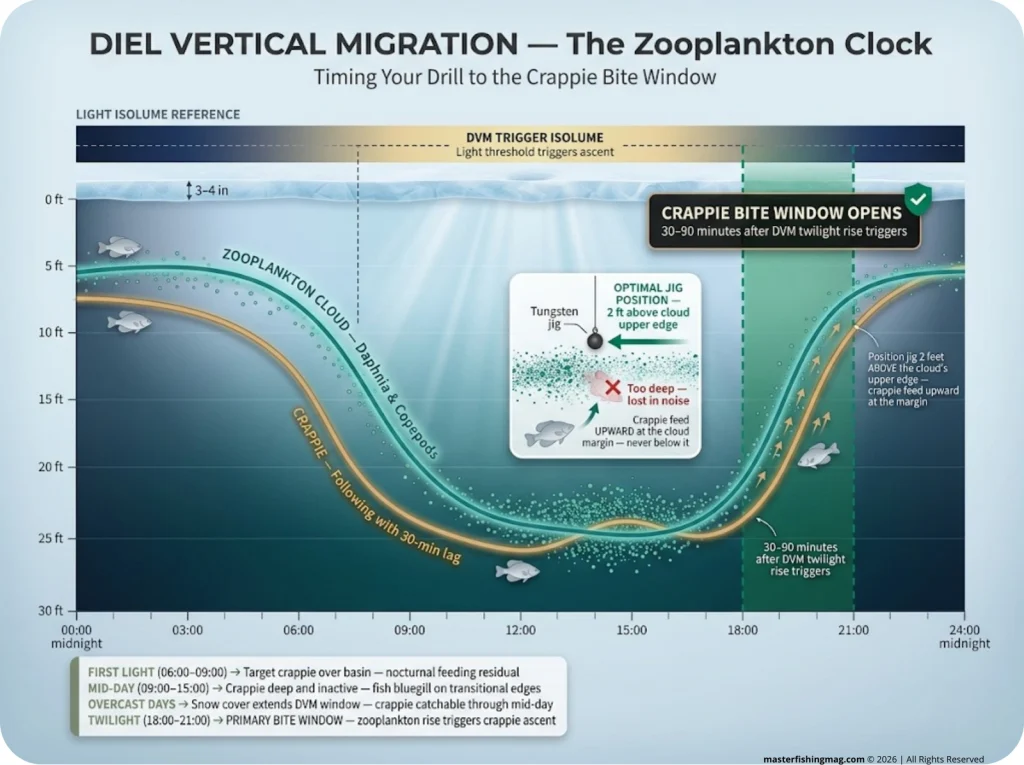
The critical skill is gain adjustment for plankton. Winter crappie feed on zooplankton — primarily Daphnia and copepods — that migrate vertically through the water column. These organisms descend during daylight to avoid UV damage and rise at twilight, triggered by a specific light threshold called an isolume. Under ice with snow cover, that threshold shifts — the DVM window can extend through mid-afternoon on overcast days.
When you increase flasher gain past the point where your jig is visible, you’ll see a thickening of signal in mid-column as zooplankton rise. That cloud is your feeding clock. When it appears, crappie activity follows within minutes. Learn to read reading fish arches and bottom composition on 2D sonar and this mid-column biomass becomes as readable as any fish arch.
Set gain manually — not on Auto-Gain. A common mistake is gain set too high, which buries actual fish signals inside vegetation and zooplankton noise. Set it just high enough to see your jig clearly, then bump incrementally until mid-column biomass appears.
Finding the Oxygen Refugia — Basin Structure vs. Weed Flat Logic
Stop drilling where you drilled last year if the bite died mid-winter. Use your bathymetric map — LakeMaster or Navionics — to find hard-bottom flats adjacent to the deepest basin on your lake.
The sweet spot is not the absolute deepest point. The deepest water is typically anoxic at the benthos. The habitable zone is 2 to 5 feet of water column above the anoxic layer, often at 15 to 25 feet. Telemetry data confirms fish select areas with near-zero flow velocity. In lakes without inlet flow, a subtle groundwater upwelling or basin tilt concentrates fish.
Pro tip: Cold productive days often have fish suspended 2 to 4 feet above hard bottom. Run your flasher in zoom mode. If you see a distinct echo just above the bottom signal, those are fish — not rocks.
The DVM Window — Timing Your Drill to the Zooplankton Clock
Diel Vertical Migration is the mechanism that unlocks nocturnal crappie feeding. Put your jig at the upper edge of the zooplankton cloud — not below it. Crappie feed upward at the cloud margin. If you bury your jig inside the cloud, it disappears in the noise. The productive window runs 30 to 90 minutes once triggered. Hole-hop to stay over active fish.
Reading Fish Mood — Negative vs. Positive Fish Identification
A positive fish on the flasher rises when your jig descends, pegs the lure signal at depth, then ascends. It’s active. A negative fish holds stationary regardless of what you do.
For negative fish: dead-stick at their depth for 10 to 15 seconds, then an almost imperceptible 1 to 2 inch lift, slow return. Match the fish’s energy budget, not your patience level. “Dancing bottoms” — where the bottom signal flickers rapidly — are not fish below the bottom. They’re transducer misalignment, gain set too high, or a school passing through the sonar cone.
The Sensory Science — Why Bluegill Feed Upward and How to Exploit It
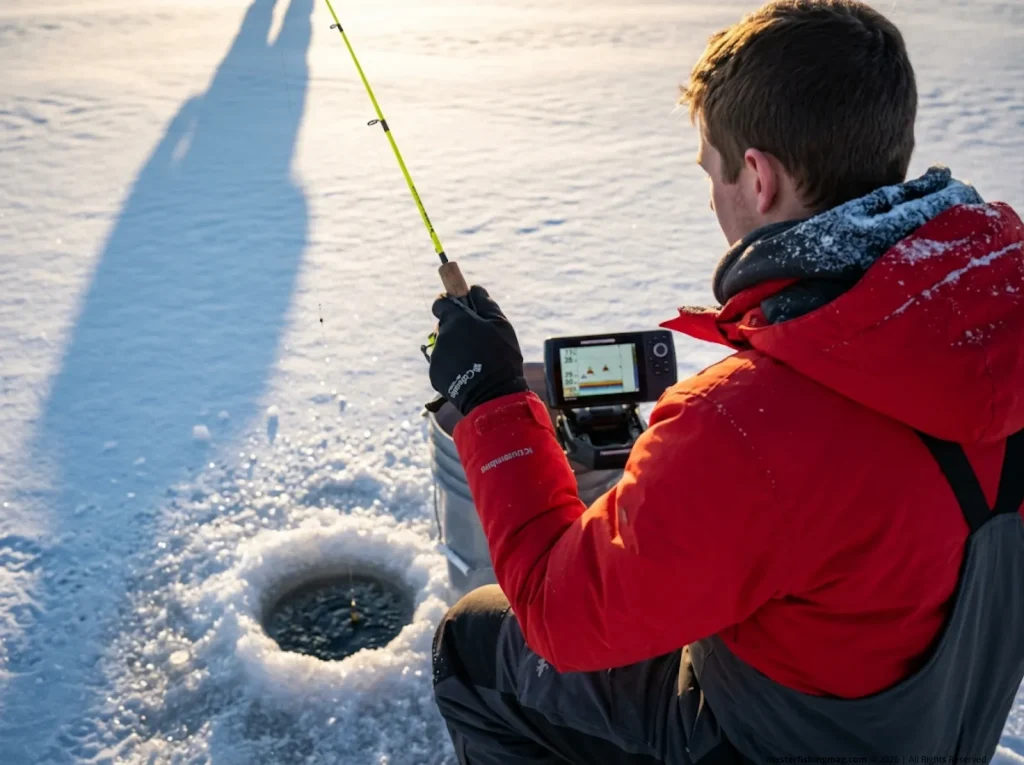
Guides tell anglers to jig above the fish. Here’s why that works at the physiological level.
Bluegill are primary sight feeders, but their visual field is not uniform. The fovea — the area of highest cone cell density in the retina — sits in the upper portion of the eye, creating a distinct upward feeding bias. A jig positioned 6 inches below a bluegill’s eye level is outside its zone of acute vision. The fish might detect it via lateral line vibration, but it cannot lock on visually in the same way.
A jig held 4 to 8 inches above the fish’s midline is inside the optimal foveal window. The fish can assess the lure, evaluate color and detail, and commit to a strike. Dr. Keith Jones at Pure Fishing confirmed that bluegill retinal cone cells favor looking slightly upward — consistent with their natural foraging along the underside of vegetation and the under-ice interface.
That’s why the sonar observation makes sense: a positive fish “rising to meet” your jig is not being aggressive. It’s repositioning its eye to place its fovea on the target. See resources on how light attenuation and species-specific vision affect lure color selection for a deeper breakdown of what this means for color choice.
Pro tip: Locate fish on the flasher, then lower your jig 2 feet below them and retrieve slowly upward into the foveal zone. Don’t drop the jig into the school — raise into it.
Species-Specific Vision — Crappie vs. Bluegill in Low-Light Conditions
Crappie have larger eyes relative to body size and higher rod cell density — better scotopic, or low-light, vision compared to bluegill. This supports their nocturnal DVM-linked feeding pattern.
The tactical split: at first light, target crappie over basin structure — they’ve been feeding on the zooplankton rise all night. As light levels rise after 9 a.m., shift toward bluegill on the transitional zone between flat and basin. On overcast days under heavy snow cover, crappie stay catchable through mid-day. Bluegill activity drops when PAR falls below their cone receptor threshold.
The Metabolism Mandate — What Aerobic Scope Tells You About Cadence
Here’s what fish metabolism actually means for your jigging hand.
At 5°C water temperature, bluegill have less than half the energy budget available for activity compared to summer. Standard metabolic rate — the cost of just being alive — eats up the baseline. What’s left for chasing prey, responding to lures, recovering from a fight is a fraction of what the same fish can do in July. This matters directly for how water temperature governs lure cadence through aerobic scope.
Research from the University of Illinois fisheries lab shows that after exhaustive exercise at 5°C, bluegill need 0.95 to 6.65 hours to recover just 50% of their aerobic scope — see metabolic response of bluegill to exhaustive exercise at cold water temperatures. The Arrhenius effect on fish enzymes explains why: every 10°C drop roughly halves the rate of metabolic recovery. Cold doesn’t just slow the fish — it slows how quickly they can repay the energy cost of any exertion.
Pro tip: Optimal jigging cadence for neutral mid-winter fish — 2-inch lift, 3-second pause, 1-inch drop, 5-second dead-stick. This matches the fish’s cost-benefit threshold for responding. Power jigging in February is fishing for fish that aren’t there.
EPOC and the Conservation Ethics of Deep-Basin Fishing
Excess Post-Exercise Oxygen Consumption (EPOC) is the oxygen debt a fish repays after a fight. Exhaustive exercise at 5°C increases EPOC by 25.5% versus light exercise. For a bluegill caught at 30 feet and fought to exhaustion — even in 45 seconds — that recovery window stretches toward the 6.65-hour end.
The conservation math is direct. A fish reeled from 30 feet sits directly above the anoxic zone when released. If it can’t maintain swimming posture long enough to escape that zone before its aerobic scope runs out, it doesn’t survive.
There’s also the barotrauma reality. Panfish are physoclistous — they lack the pneumatic duct that would let them vent expanding gas from their swim bladder. A fish brought up from 30 feet (2 atmospheres) to the surface experiences swim bladder volume doubling. That expansion pushes the stomach into the mouth and causes internal injury. The physiological effects of rapid pressure changes in deep-water fish confirm that survival probability for released deep-water panfish is low.
The analytical angler’s protocol: once your limit is attained from deep-basin fish, move to shallower structure or end the session. This isn’t sentimentality. It’s arithmetic.
Three-Phase Tactical Calendar — Early, Mid, and Late Ice
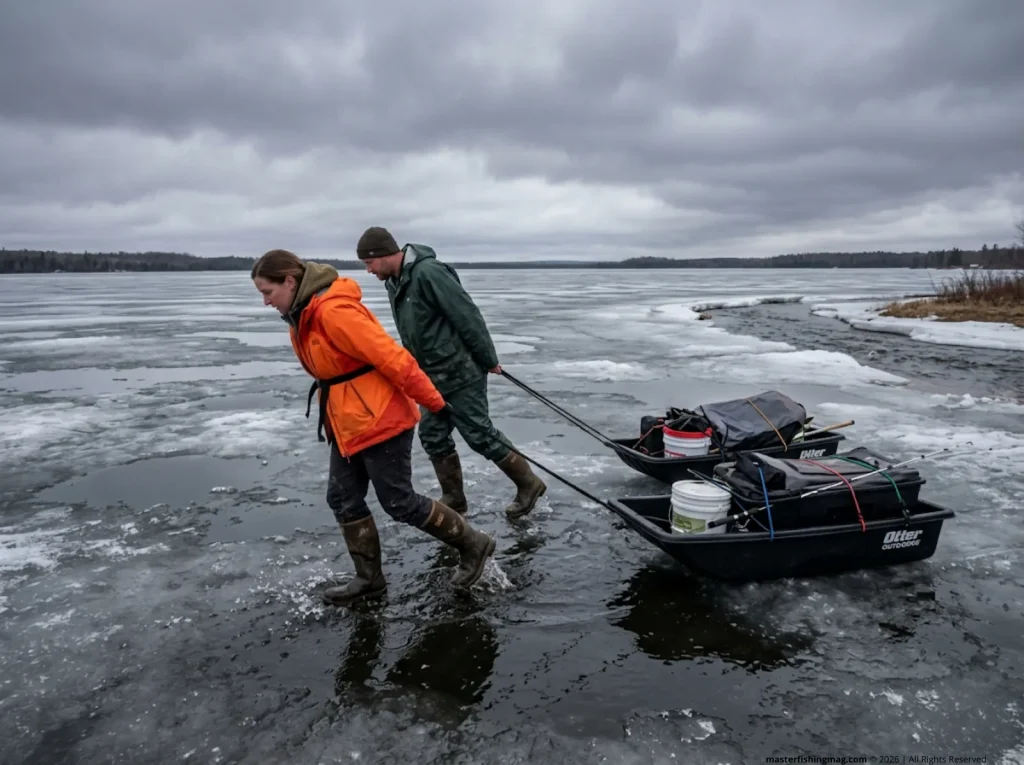
The winter season is three separate fisheries, not one. Anglers who run a single spot through all three phases are right once and wrong twice.
Early ice — freeze-up to 6 inches of ice cover — fish are still working weed edges. Dissolved oxygen is adequate throughout the water column. Target the weed-to-basin interface at 8 to 15 feet. Moderate cadence, 1/32 to 1/16 oz tungsten jigs. Watch DO trends carefully: if the bite on a weed edge dies completely with no weather change, the chemistry crossed the threshold. Move immediately.
Mid-winter — 6+ inches of ice, full snow cover — this is the phase this article’s complete system addresses. Basin structure, 15 to 25 feet, zoom mode on the flasher, 2 lb fluorocarbon, 1/64 to 1/32 oz tungsten, dead-stick cadence. This is where most ice anglers struggle and where most information fails them.
Late ice — warming surface, meltwater beginning — fresh oxygen enters via inlet flows and snowmelt runoff. Meltwater is at or near atmospheric saturation, and fish respond to these oxygen gradients within 24 to 48 hours of a significant melt event. They pull off basin refugia and move toward inlet structures, channel mouths, and shallow flats. Shift your jig size up slightly (1/32 oz), loosen your cadence, and follow the post-ice-out pre-spawn panfish window that follows winter into the next phase of the calendar.
Pro tip: Late-ice transition is signaled by “soft corners” — the ice near inlets and banks honey-combs and weakens before the main basin. When you start seeing that, panfish are back in 8 to 10 feet. Read the ice conditions as your migration map. And carry ice picks. Late ice pulls anglers into serious hazards every season — those who trust structure they walked on in January don’t always make it out.
Mid-Winter Basin Approach — The Full Technical System
Bathymetric map → identify main basin → drill on the hard-bottom flat adjacent to the deepest point, not at the deepest point. Target 15 to 25 feet. Run flasher in zoom mode, gain adjusted to show the plankton cloud. Two-pound fluorocarbon, 1/64 to 1/32 oz tungsten with a horizontal-hanging trigger profile.
Monitor the flasher continuously. When zooplankton cloud appears in mid-column, raise your jig to 2 feet above the cloud’s upper edge. Wait for a positive fish signal — mark rising toward your lure, not sitting stationary. Apply dead-stick cadence for neutral fish. Keep all fish from deeper than 30 feet.
Conclusion
Three things to take back to the ice:
First, find oxygen before you find fish. Snow depth, mid-winter date, and the absence of inlet flow are your pre-drill intelligence. When weed-flat activity dies, the chemistry changed. The fish aren’t gone — they moved to where the oxygen still is.
Second, your gear system is a physics problem. Tungsten’s density reduces drag force and keeps the line vertical. Fluorocarbon’s lower surface friction minimizes parasitic drag through the water column. These are measurable effects, not marketing claims. Build your system to fit the physics of 25 feet of cold water, not to fit what’s in the bargain bin.
Third, winter fish operate on a metabolic wire. Their aerobic scope is roughly 15% of summer capacity. Your cadence, your fight duration, and your decision to keep or release must account for EPOC recovery time. The fish’s energy budget is not negotiable. Yours is.
Next time you’re set up on a frozen lake and the weed-flat bite dies, don’t change jig colors. Pull out your bathymetric map. Find the basin edge, tune your flasher until you see the mid-column plankton signal, and position your tungsten jig 2 feet above it. That’s not luck. That’s limnology.
FAQ
What depth are bluegills in winter?
In mid-winter, bluegill typically hold between 15 and 25 feet in the oxygenated water column above the anoxic basin floor — not at the absolute bottom. They migrate from shallow weed beds when dissolved oxygen drops below 4.0 mg/L and settle into the habitable band above the oxygen-depleted benthos. In early and late ice phases, they may be found in 8 to 15 feet near weed edges.
Do crappies bite at night under the ice?
Yes. Crappie are the primary beneficiaries of Diel Vertical Migration. Zooplankton — their main forage under ice — rise toward the under-ice layer at twilight, triggered by a specific light isolume. Crappie follow this movement, creating a reliable nocturnal crappie feeding window. A flasher with gain set high enough to show the zooplankton cloud in mid-column is the most reliable indicator of when this bite begins.
Why are fish not biting my jig under the ice?
Three likely causes in order of probability: you’re in the wrong location — fish have migrated to oxygenated basin edges and you’re still drilling dying weed beds; your cadence is too fast — fish at 15% aerobic scope cannot chase a fast-jigged presentation; or your jig is below the fish — bluegill foveal directionality creates an upward feeding bias, and a jig more than 6 inches below their eye level falls outside their acute visual zone.
What is the best bait for crappie through the ice?
Small minnows — 1 to 1.5 inch fatheads or golden shiners hooked through the dorsal — remain the most consistent producer because they match the protein-dense forage crappie target to offset their suppressed metabolic rate. Clam Maki Plastics and Northland Impulse in white or chartreuse work well dead-sticked directly in the zooplankton cloud layer. Waxworms on a tungsten teardrop are a reliable fallback when fish are extremely finicky and need a scent trigger.
Is catch-and-release safe for panfish caught in deep water under ice?
No — not for fish caught deeper than 30 feet. Panfish are physoclistous, meaning they lack the duct needed to vent expanding gases from their swim bladder during rapid ascent. A fish reeled from 30 feet to the surface experiences swim bladder volume doubling, frequently causing internal injury. Combined with the 0.95 to 6.65 hour EPOC recovery window at 5°C, releasing deep-basin panfish does more harm than keeping them. Once your limit is reached from deep water, move to shallower structure or end the session.
Risk Disclaimer: Fishing, boating, and all related outdoor activities involve inherent risks that
can lead to injury. The information provided on Master Fishing Mag is for educational and informational purposes
only. While we strive for accuracy, the information, techniques, and advice on gear and safety are not a substitute
for your own best judgment, local knowledge, and adherence to official regulations. Fishing regulations, including
seasons, size limits, and species restrictions, change frequently and vary by location. Always consult the latest
official regulations from your local fish and wildlife agency before heading out. Proper handling of hooks, knives,
and other sharp equipment is essential for safety. Furthermore, be aware of local fish consumption advisories. By
using this website, you agree that you are solely responsible for your own safety and for complying with all
applicable laws. Any reliance you place on our content is strictly at your own risk. Master Fishing Mag and its
authors will not be held liable for any injury, damage, or loss sustained in connection with the use of the
information herein.
Affiliate Disclosure: We are a participant in the Amazon Services LLC Associates Program, an
affiliate advertising program designed to provide a means for us to earn advertising fees by advertising and linking
to Amazon.com. As an Amazon Associate, we earn from qualifying purchases. We also participate in other affiliate
programs and may receive a commission on products purchased through our links, at no extra cost to you. Additional
terms are found in the terms of service.