
In this article
You’re standing in the tackle aisle with a basket in one hand, staring at a wall of four thousand lures, and the quiet panic sets in: which of these do I actually need to catch a fish? Ask anyone who’s spent real time at the boat ramp and the honest answer surprises people, because it’s a number, not a list. You need about seven things, not seventy, and a few of those even come bundled together. Here’s exactly how much fishing gear a beginner needs, what each piece does, what the store wants to sell you that you can skip, and how to fish your first trip for close to nothing.
The Short Answer: About Seven Things, Not Seventy
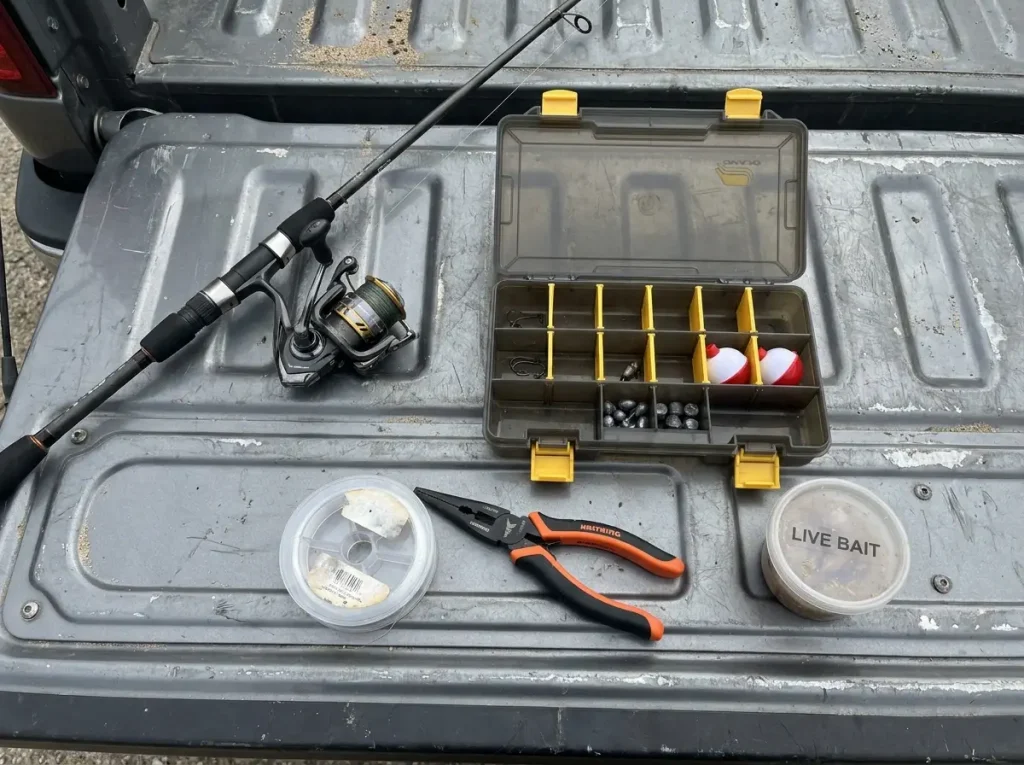
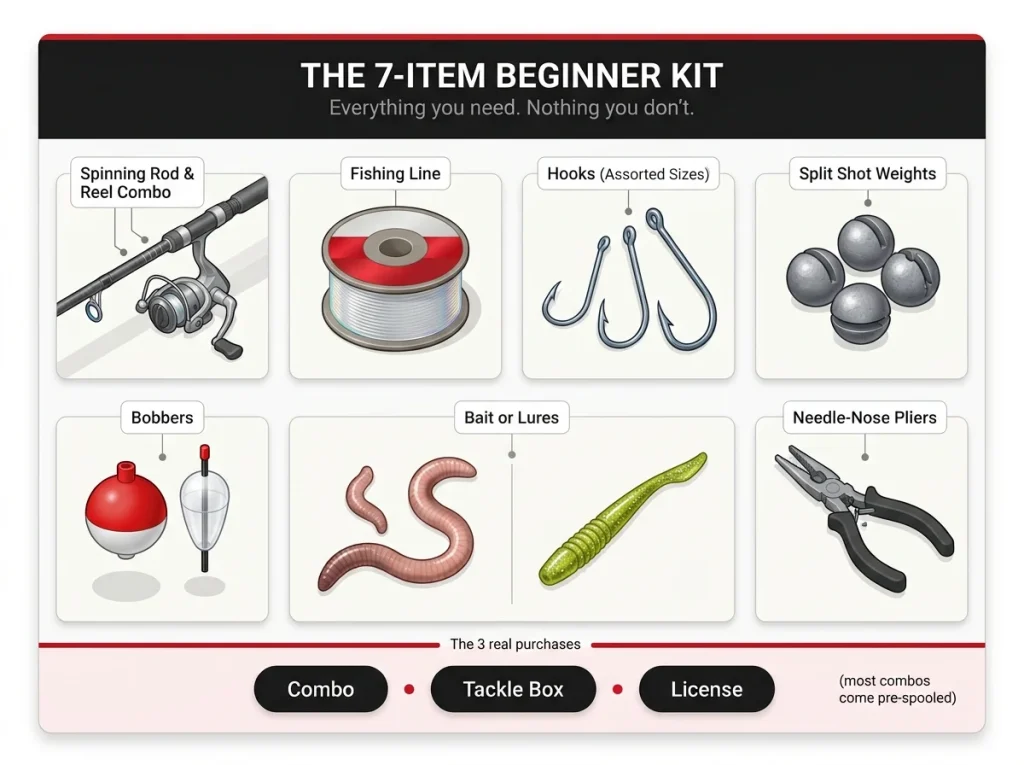
The question “how much fishing gear do I need” almost always gets answered with a list so long it sends a beginner back to the couch. The better answer is a count you can finish. About seven things gets you catching fish, and once you see them laid out, the wall of tackle stops looking like a requirement and starts looking like what it is: a store hoping you’ll overbuy.
The Seven Things (And Why It’s Really Three Purchases)
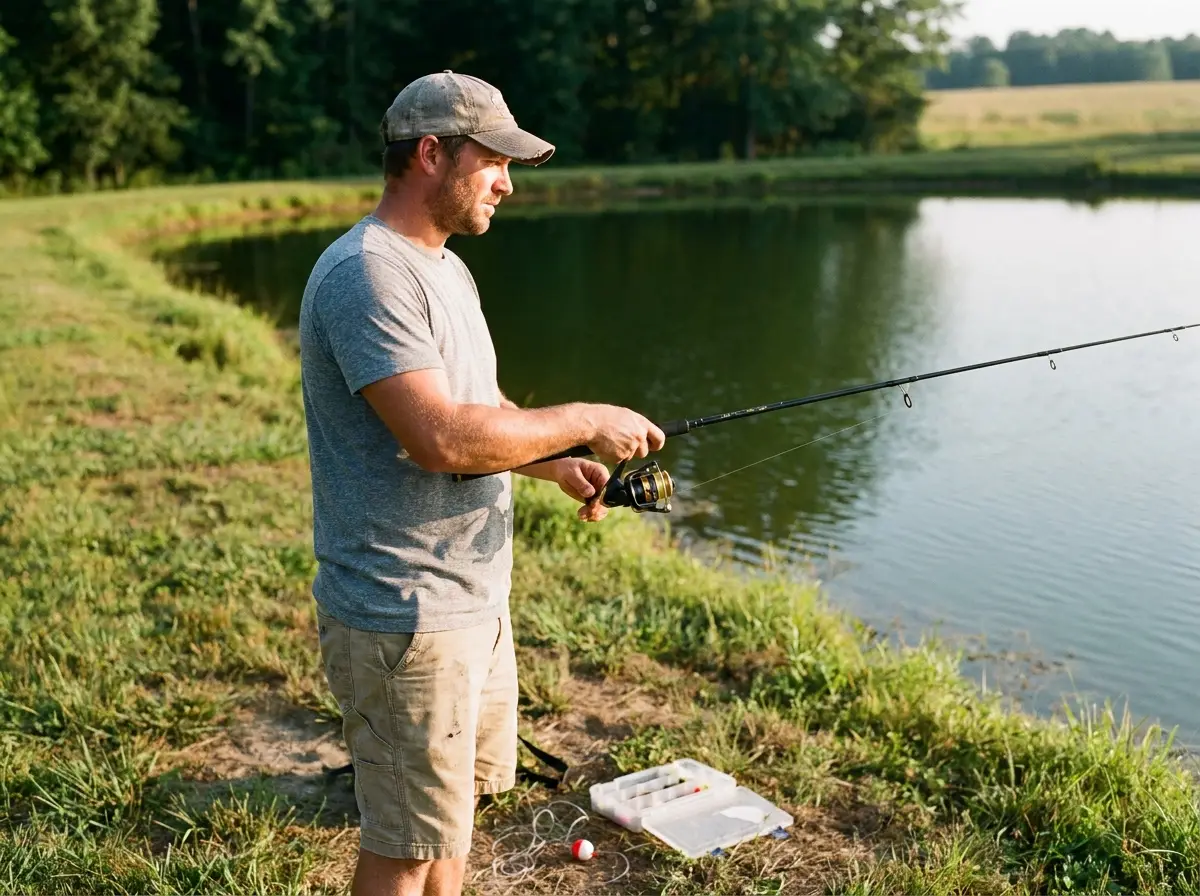
Here’s the whole kit: a spinning combo, fishing line, hooks, split shot weights, bobbers, a small bait or lure set, and pliers, plus a tackle box to hold it and a fishing license to do it legally. That reads like nine items, but the trick nobody mentions is how few separate things you actually buy. A pre-spooled combo already has line on it. A single assortment kit bundles your hooks, split shot, and bobbers into one cheap box. So the real number of trips through the checkout line is closer to three: the combo, the tackle, and the license.
If you want the bare bullet version, our companion piece breaks down a plain checklist of what gear to start fishing item by item. This article is about the quantity, because that’s the part that keeps beginners stuck in the aisle.
Why Less Gear Catches More Fish
This sounds backward until you’ve watched it happen. The angler with one rod and a handful of hooks spends the day with bait in the water. The one who bought the giant tackle box spends it deciding which of thirty lures to tie on, retying, second-guessing, and fiddling with a drag they never set right. Fish get caught by lines that are wet, not by gear that’s impressive. A smaller kit removes the decisions that keep your hook out of the water.
There’s reassurance in the numbers too. Roughly 57.9 million Americans went fishing in 2024, an all-time high, and the overwhelming majority of them started with far less than the tackle shop implies. For a second opinion from outside the retail world, the RBFF’s beginner gear breakdown lands on the same short list. The barrier to entry is mostly in your head, not your wallet.
The Kit Assumes Freshwater
One caveat before we go deeper: this list assumes you’re fishing freshwater, a pond, a lake, or a slow river for panfish and bass. Saltwater corrodes gear and fights harder, so it changes a few things about line, hooks, and reel choice. For the average first-timer heading to the local pond, the freshwater kit below is all you need.
The One Combo That Does It All
If there’s a single purchase that does ninety percent of the work, it’s the rod and reel. And the good news for a beginner is that you don’t pick a rod and then pick a reel and then pick line. You buy one pre-spooled combo, ready to fish out of the box, and it covers everything from a bluegill to a respectable bass.
What the Numbers on the Rod Mean
The label on a beginner rod looks like a license plate: 6’6″ ML, fast action. It’s simpler than it reads. Length around six to seven feet gives you easy casting without being unwieldy. Medium power, or medium-light, handles small fish without snapping and bigger ones without folding. A 2000 to 3000 size spinning reel (a 2500 is the classic all-rounder) balances that rod and holds plenty of 6 to 8 pound line. If you want the full decoder ring, here’s what the numbers on a rod actually mean, but those three specs are all you need to shop confidently.
Why Pre-Spooled Saves You a Knot (and Money)
A pre-spooled combo comes with line already wound on the reel, which quietly solves two beginner headaches. You skip buying line separately, and you skip the arbor knot that attaches line to a bare spool entirely. That leaves exactly one knot to learn before your first trip. It’s also why this combo is the foundation that our complete guide to your first fishing setup builds the whole balanced rig around.
One more reason to start with spinning gear: it just works. A baitcaster looks pro on the shelf and rewards beginners with backlash bird’s nests they’ll spend the day picking out. Spinning and spincast reels resist that tangle, which is why spinning isn’t always the only answer but is almost always the right one to start with.
Set your drag before you ever cast. You’ll know it’s right when a decent fish can pull line off in short bursts instead of snapping it. Most beginners never touch the drag and lose their first good fish to it, and no amount of expensive gear fixes a drag set like a rock.
The One Combo Worth Starting With
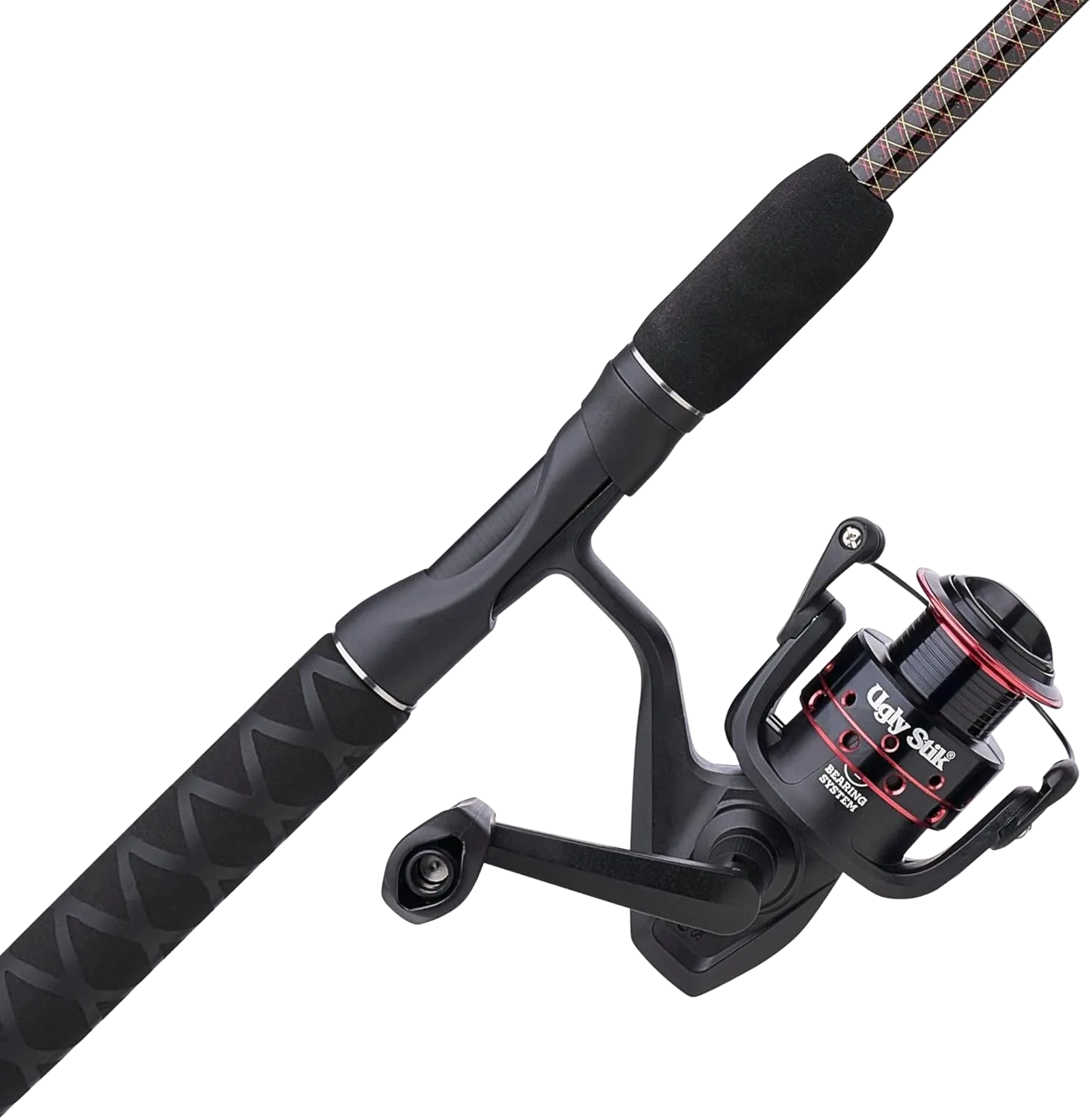
The Ugly Stik GX2 spinning combo earns its reputation honestly. It’s not the lightest or the most sensitive rod made, and a seasoned angler will eventually want something more refined. But for a first rod that survives being left in a hot truck, stepped on, and high-sticked into a tree, nothing matches it. This is the rod that lets you learn without babysitting your equipment. Skip the step-up rods like the St. Croix Bass X for now; they’re better blanks, but they’re solving problems you don’t have yet.
If you’d rather watch someone lay out the minimal kit and rig a basic setup before you buy, this short video walks through it on camera.
Line, Hooks, and the Tiny Stuff That Matters
This is where beginners overspend the most for the least reason. The small stuff at the end of your line, the terminal tackle, costs a few dollars total, but the aisle is built to make you think you need a hundred of everything. You don’t. You need a small assortment and the discipline to ignore the rest.
One Box of Terminal Tackle
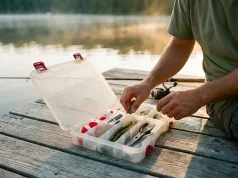
Hooks, split shot (sinkers), swivels, and bobbers are the bits that actually connect you to a fish, and the smartest beginner buy is a single assortment kit that bundles them all. One box gives you a range of hook sizes for everything from bluegill to bass, a handful of weights, and a few floats, for the price of a fast-food lunch. You’ll use maybe ten percent of it your first season, and that’s fine; it means you’ll never stand at the counter wondering if you grabbed the right size.
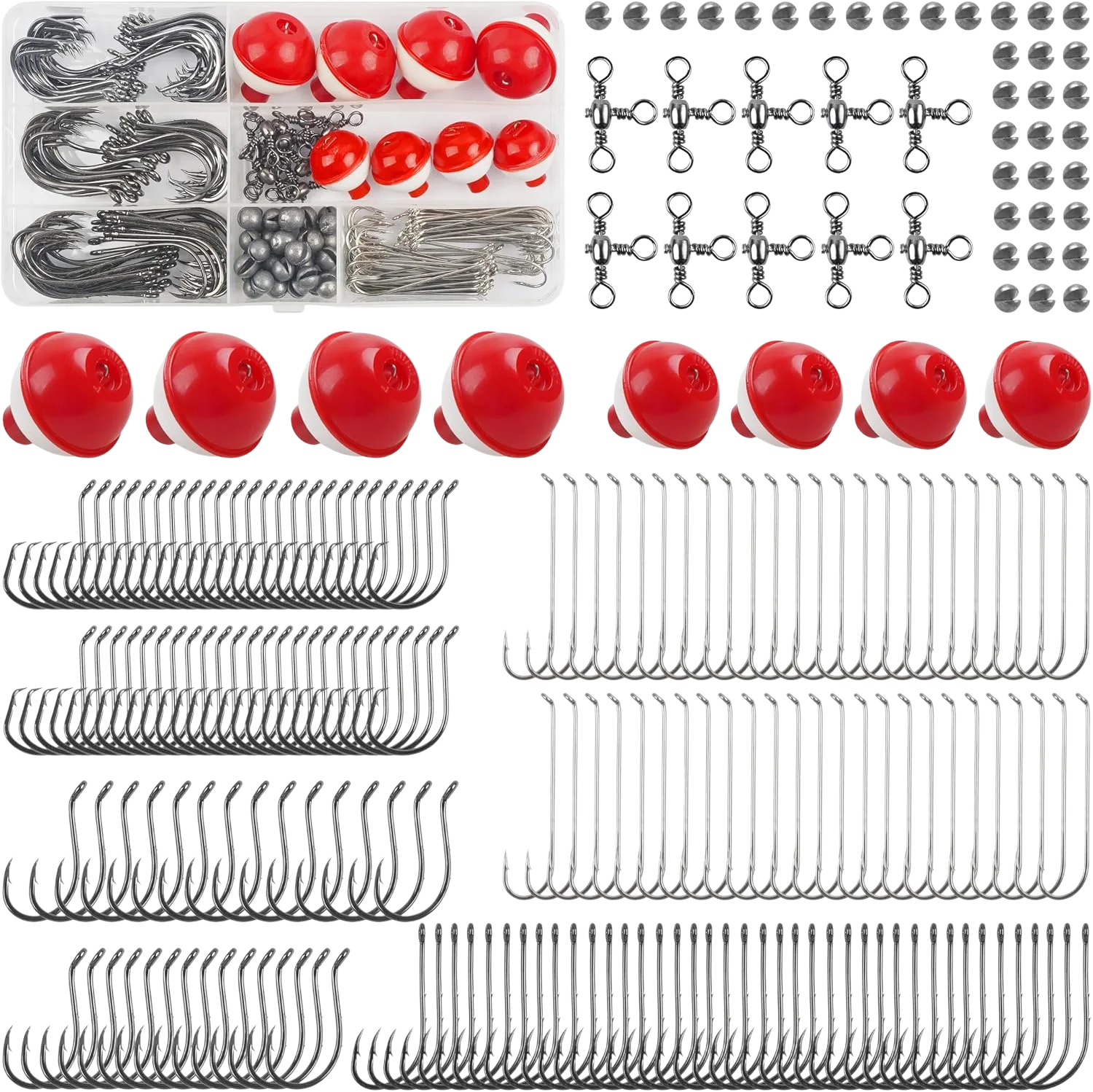
The AGOOL 223-piece tackle kit is the kind of buy that looks too cheap to be useful and turns out to be all you need. Pull out a few hooks, two bobbers, and a couple of split shot, and you can fish. Leave the rest in the box for the next trip.
The Box That Holds It All
You need somewhere to keep the tiny stuff, and this is the single most overbought item in fishing. Beginners reach for the giant 30-compartment box because it looks serious, then carry the same two hooks and a bobber around in it all season. A 3600-size tackle box holds the entire minimum kit with room to grow, and it’s the deliberate antidote to the tackle suitcase.
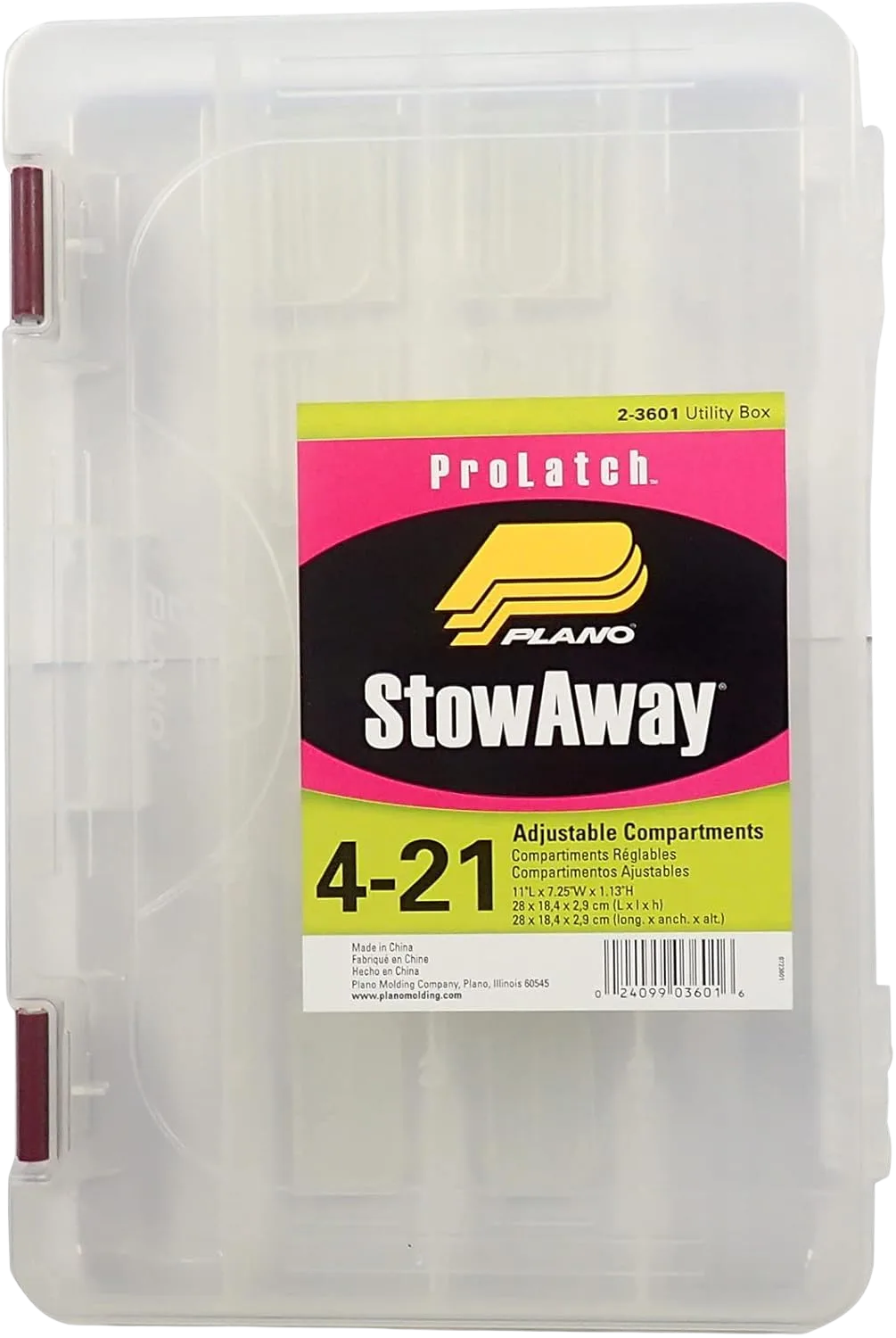
The Plano 3600 StowAway is boring in the best way. It’s the size most anglers settle on for everyday tackle, it locks shut, and it slides into a backpack or a five-gallon bucket. Buy this one box and resist the urge to upgrade to the giant one until you’ve genuinely outgrown it, which takes most people a couple of seasons, if ever.
Line, Pliers, and the One Knot
Because your combo comes pre-spooled, you probably won’t buy line at all to start. When you do need to respool, monofilament line in 6 to 8 pound test is the beginner’s friend: it stretches, which forgives the panicked hooksets and over-tightened drags that snap stiffer lines, and it ties easily. A spool of Berkley Trilene XL is the standard low-memory mono most people respool with. There’s a real case for why mono beats braid and fluoro starting out, and the pound-test number on the spool just tells you how much force the line takes before it snaps.
The one tool that’s genuinely non-negotiable is a pair of needle-nose pliers. A fish that swallows the hook, a barb stuck in the net, a knot you need to cinch, all of it goes easier with KastKing Cutthroat pliers that double as a line cutter. Pliers are also the safe way of getting a hook out of a fish without hurting it, which matters the first time one gets hooked deep.
As for knots, you need exactly one to start. A clinch knot, a Palomar knot, or a uni knot ties your hook to the line, and any of them holds fine. Learn that single knot well and skip the rest until you need them.
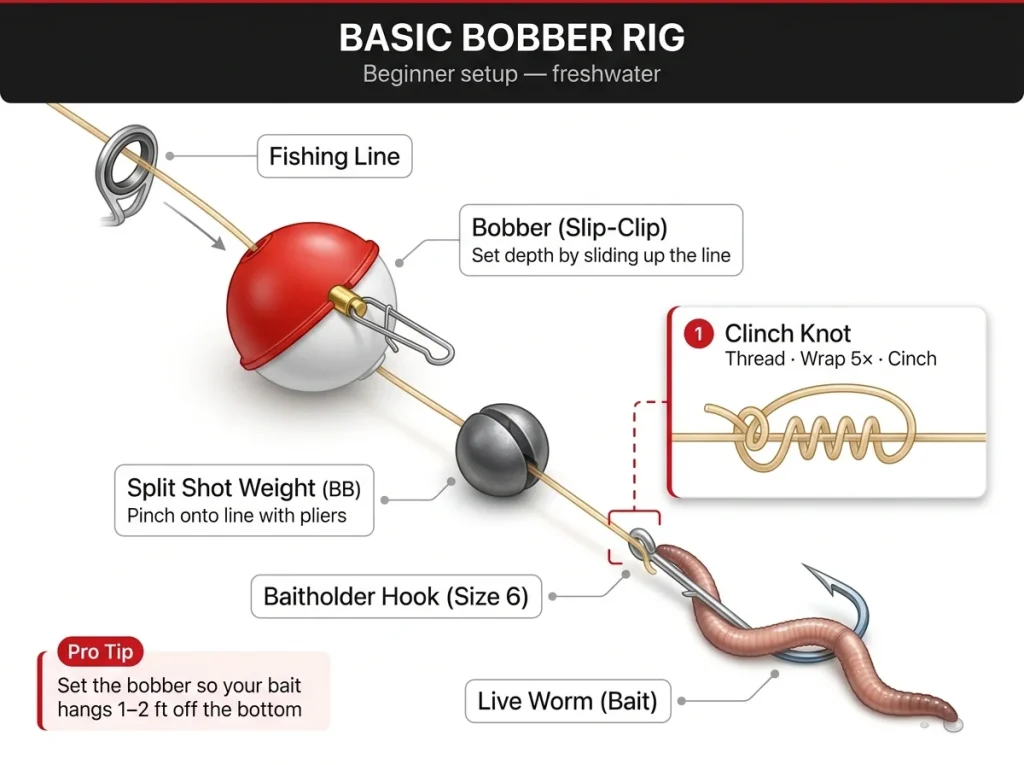
One combo, one box, one knot. If you can tie a clinch knot and clip a bobber and a split shot onto your line, you can fish a pond all day. Everything past that is a refinement you add when a real reason shows up, not before.
Bait vs. Lures: How Few You Really Need
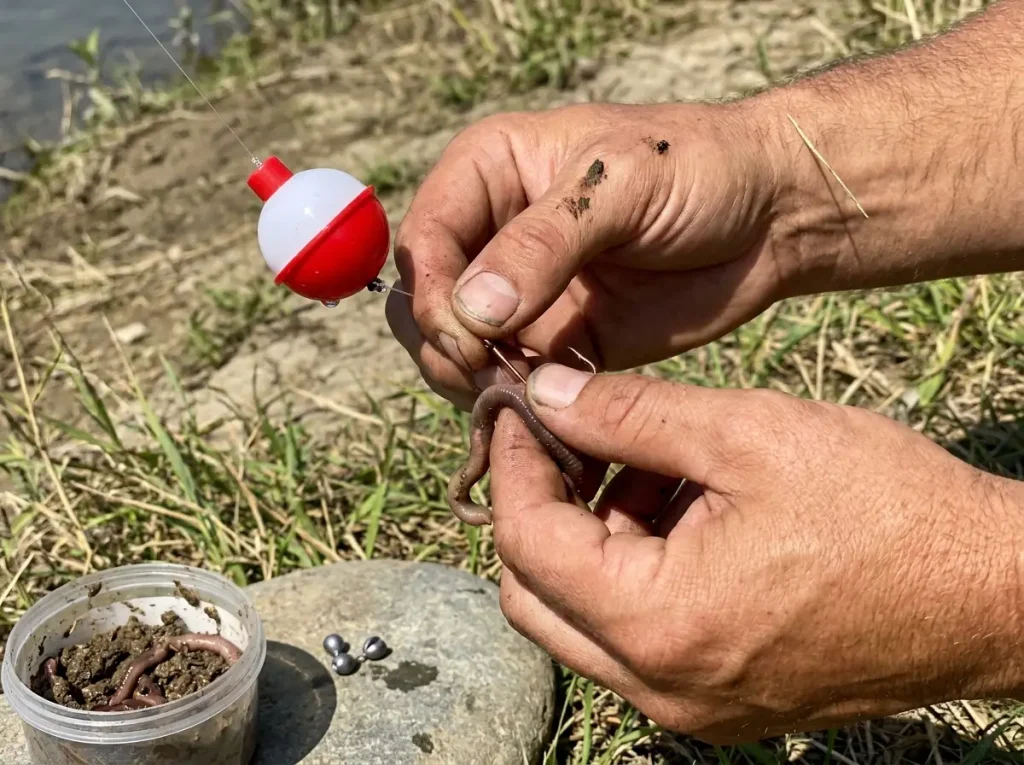
This is the part of the aisle that swallows the most money for the least return. The wall of four thousand lures is the single biggest overbuy trap in fishing, and the honest truth is that a tub of worms out-fishes most beginners’ lure boxes.
Why Live Bait Is the Beginner’s Edge
Live bait removes the hardest beginner question, which is “am I working this lure right?” A worm or a minnow under a bobber just sits there looking like food, and panfish like bluegill and crappie, along with most freshwater species, eat it without you doing anything clever. It’s the highest-confidence way to actually feel a fish pull, which is the thing that hooks you on the sport in the first place. If you go this route, here’s rigging a live worm so it actually stays on instead of flying off on the first cast.
The Two or Three Lures Worth Owning
If you’d rather throw artificials, you still don’t need the wall. Two or three covers it: a couple of soft plastic worms, one spinnerbait, and one crankbait will catch fish across most water you’ll start on. That’s a starter set, not a collection. Add to it only when you keep targeting a species the basic set isn’t reaching.
The 4,000-Lure Trap
Here’s the scene every veteran has watched: a new angler buys a 30-lure box before catching a single fish, then lands everything that day on a plain hook, a split shot, and a worm anyway. More lures means more time deciding and retying, and less time with bait in the water. Fewer choices on the bank is a feature, not a limitation.
The License (and the Free-Fishing-Day Loophole)
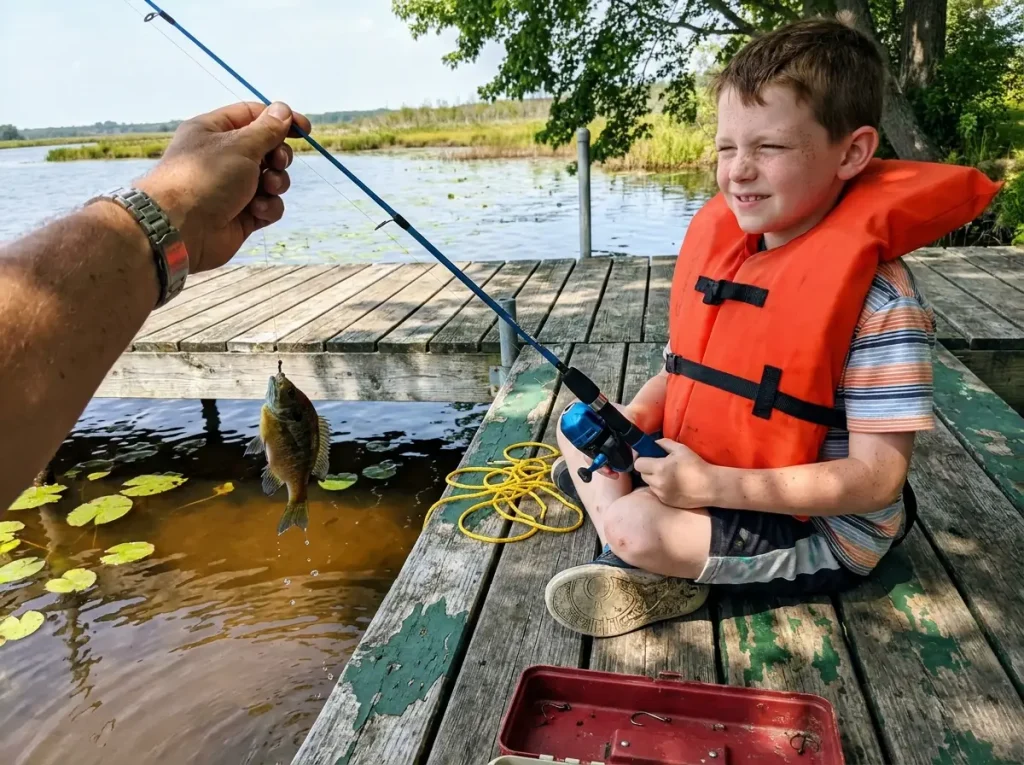
A fishing license is the one item on this list you can’t skip, and it’s also the one that opens up the cheapest possible start to the sport. Most beginners assume the cost floor is whatever the gear adds up to. It’s actually lower than that, sometimes zero.
The License You Actually Need
In most situations you need a license before you fish, and you buy it online through your state’s fish and wildlife agency in about five minutes. There are real exemptions worth knowing: anglers under 16 fish without a license in most states, and a number of states discount or waive the fee for seniors. The same license comes with the local size limits and bag limits, the rules on how big a fish has to be to keep and how many you can take, and they are worth a two-minute read before your first trip. Once you do start buying gear, the total stays modest, and if you want the full spend-vs-save breakdown, that’s its own topic; here, the point is just that the license is the floor, not a fortune.
Free Fishing Days and the Under-16 Rule
Here’s the part the tackle shop won’t mention. Most states hold Free Fishing Days, often during National Fishing and Boating Week in early June, where nobody needs a license to fish public water. Maryland’s wildlife agency lays out how Free Fishing Days let you skip the license entirely on public water, and the same pattern holds in most states. If you’re taking a kid along, that’s already one fewer license to buy, and a simple tangle-free pole keeps the day about fishing instead of unpicking knots.
Borrow the Whole Kit for Free
You can drop the cost floor to nothing. Many states run a tackle loaner program that lends rods, reels, and basic tackle library-style: you register, get a card, and check out a kit. North Carolina runs it at 11 state parks, Maryland at 25 sites including public libraries, and Massachusetts lets you borrow a rod with a library card. North Carolina’s wildlife agency confirms that many states run a free tackle loaner program that lends rods and tackle library-style. Pair a loaner kit with a Free Fishing Day and your first trip costs literally nothing, gear and license both waived. It’s the smartest way to find out whether you even like fishing before spending a dime, and a local club or a fishing mentor can put a rod in your hand even faster.
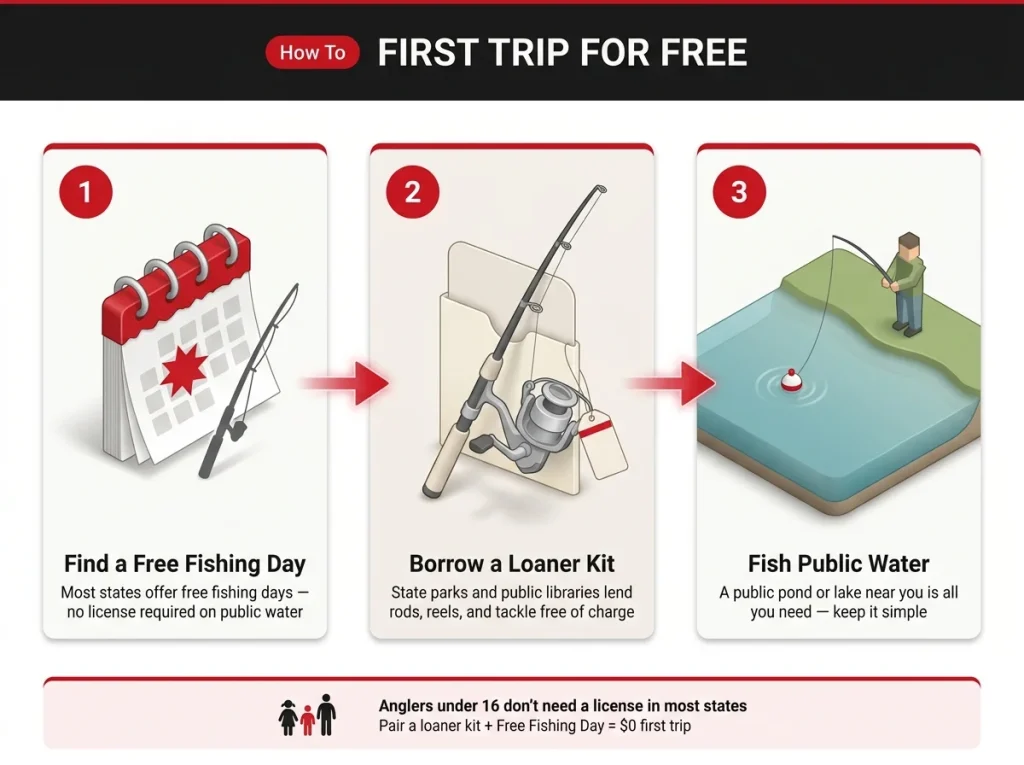
Borrow before you buy. Check your local library or a nearby state park for a loaner kit and fish a Free Fishing Day first. If the sport sticks, you’ve lost nothing; if it doesn’t, you just saved yourself a garage full of gear.
Gear That Collects Dust: What to Skip For Now
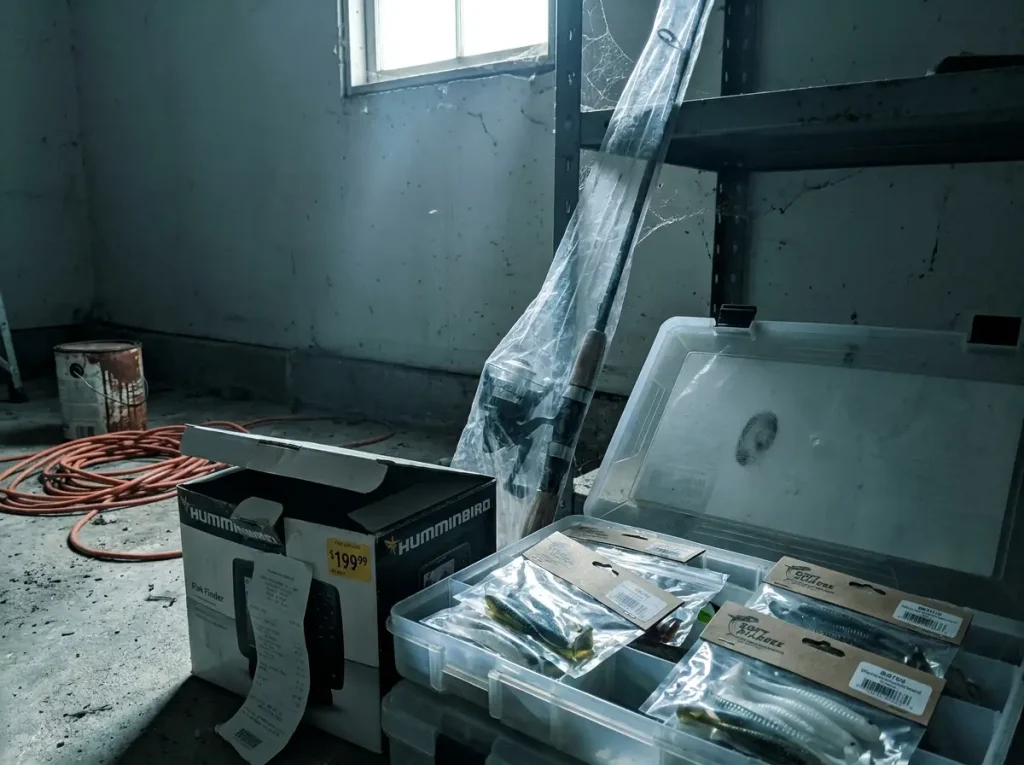
Every experienced angler can give you the same garage tour: a second rod still in its factory plastic, a fish finder that never got mounted, and a 30-compartment lure box missing only the two hooks they actually use. This is the gear that collects dust, and naming it is the most useful thing this article can do.
The Overbuys to Skip (and Why)
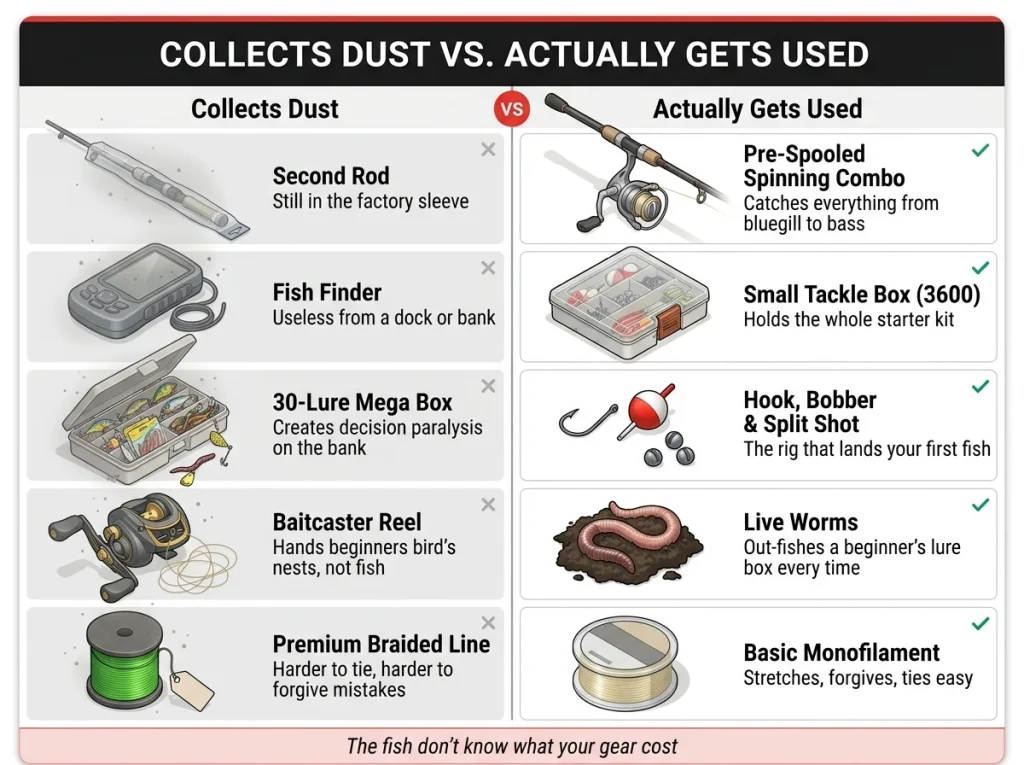
Here’s the skip list, with the reason each one waits. The 30-lure mega box, because you’ll fish a hook and a bobber all season. A second rod, because one combo already covers everything you’ll catch. A fish finder, because it does nothing for you from a dock or a bank. Expensive braided line, because mono is more forgiving and ties easier while you’re learning. And a baitcaster, because it hands beginners backlash tangles instead of fish. Even a special travel rod falls in this pile until you have a trip that calls for it.
Why a Bloated Kit Out-Fishes Worse
This is the part competitors skip, so it’s worth slowing down on. Overbuying doesn’t just waste money; it actively lowers your catch rate. A wall of lures creates decision paralysis on the bank, so your bait spends the day in the box instead of the water. An untuned drag on a fancy reel snaps your line on the first decent fish. Wrong-size hooks bought “to be safe” miss the small panfish you’re actually casting to. The simple kit out-fishes the bloated one because it keeps you fishing instead of fiddling. More gear adds more ways to get it wrong.
The Store Profits, the Fish Don’t Care
There’s no conspiracy here, just incentives. The store does better when you walk out with seventy things, and the display is built to make seven feel inadequate. The fish, meanwhile, have no idea what your gear cost. A pristine tackle box and a tangled spool is the tell of someone who spent their money in the wrong place. Spend it on a license and a trip instead.
What to Add After Your First Few Trips
A minimum kit gets you fishing; it doesn’t mean you’ll never buy anything again. The difference between a smart upgrade and another dust-collector is timing. Let your trips tell you what you’re missing instead of guessing in the aisle.
Let Your Trips Write the List
The rule is simple: fish your first few trips with the seven-item kit and nothing else. Pay attention to what you actually run out of or wish you had. That real friction, not a YouTube video and not the store display, is what should write your next shopping list. Most beginners discover they need far less than they expected, and the one or two things they do add are genuinely useful because the water proved it.
The Add-Later Order
When you’re ready, here’s the order most anglers actually need things. First, a landing net if you’re releasing fish, because soft rubber mesh doesn’t strip a fish’s slime coat or tangle your hooks the way knotted nylon does. The SF rubber-mesh landing net is the textbook add-later item: genuinely useful, but optional for your first few trips, not day-one gear. After that, polarized sunglasses to cut glare and protect your eyes, then a second lure type for whatever species you keep chasing, and eventually a backup spool of line to respool your combo with down the road.
Still Seven Things, Just Over Time
None of this breaks the seven-things philosophy; it just spreads the additions out instead of panic-buying them up front. You’re still running a lean kit, only now every piece in it earned its spot. Once your core kit is set, the natural next step is to plan out your first trip so the gear actually gets wet.
Keep a running note on your phone of anything you wished you had on the water. After three trips, that list is your real upgrade path, and it’ll be a lot shorter and smarter than anything the tackle aisle would have sold you.
The Bottom Line on Your First Kit
It comes down to three things worth remembering. First, the answer to how much beginner fishing gear you need is about seven items, and really only three purchases: a combo, a box of tackle, and a license. Second, the simple kit out-fishes the bloated one because it keeps your bait in the water and your drag honest. Third, you can fish your first trip for nearly nothing by pairing a loaner kit with a Free Fishing Day.
Grab a combo, a box of tackle, and your license, then go catch a bluegill before you buy anything else. Let the water tell you what’s next.
Frequently Asked Questions
01Do you really need a fishing license as a beginner?
In most cases, yes, a license is required before you fish, and you buy it online from your state wildlife agency in minutes. But anglers under 16 need no license in most states, and most states hold Free Fishing Days when no license is required on public water.
02What size rod and reel is best for a beginner?
A 6 to 7 foot medium or medium-light spinning combo with a 2000 to 3000 size reel covers almost everything a beginner will catch. Buy it pre-spooled with 6 to 8 pound monofilament and you can skip buying line separately.
03How many lures do beginners actually need?
Almost none to start, since live bait out-fishes a beginner’s lure box most days. If you want lures, two or three (a soft-plastic worm, a spinnerbait, and a crankbait) is plenty for your first season.
04Can you start fishing without buying any gear?
Often yes. Many states run free tackle loaner programs through state parks and public libraries that lend a rod, reel, and basic tackle, so you can test the hobby before spending a dollar.
05Is monofilament or braided line better for a beginner?
Monofilament, easily. The stretch forgives bad hooksets and beginner mistakes, it ties easier, and it costs less. Braid and fluorocarbon are upgrades you can make later once your skills catch up.
Risk Disclaimer: Fishing, boating, and all related outdoor activities involve inherent risks that
can lead to injury. The information provided on Master Fishing Mag is for educational and informational purposes
only. While we strive for accuracy, the information, techniques, and advice on gear and safety are not a substitute
for your own best judgment, local knowledge, and adherence to official regulations. Fishing regulations, including
seasons, size limits, and species restrictions, change frequently and vary by location. Always consult the latest
official regulations from your local fish and wildlife agency before heading out. Proper handling of hooks, knives,
and other sharp equipment is essential for safety. Furthermore, be aware of local fish consumption advisories. By
using this website, you agree that you are solely responsible for your own safety and for complying with all
applicable laws. Any reliance you place on our content is strictly at your own risk. Master Fishing Mag and its
authors will not be held liable for any injury, damage, or loss sustained in connection with the use of the
information herein.
Affiliate Disclosure: We are a participant in the Amazon Services LLC Associates Program, an
affiliate advertising program designed to provide a means for us to earn advertising fees by advertising and linking
to Amazon.com. As an Amazon Associate, we earn from qualifying purchases. We also participate in other affiliate
programs and may receive a commission on products purchased through our links, at no extra cost to you. Additional
terms are found in the terms of service.