

In this article
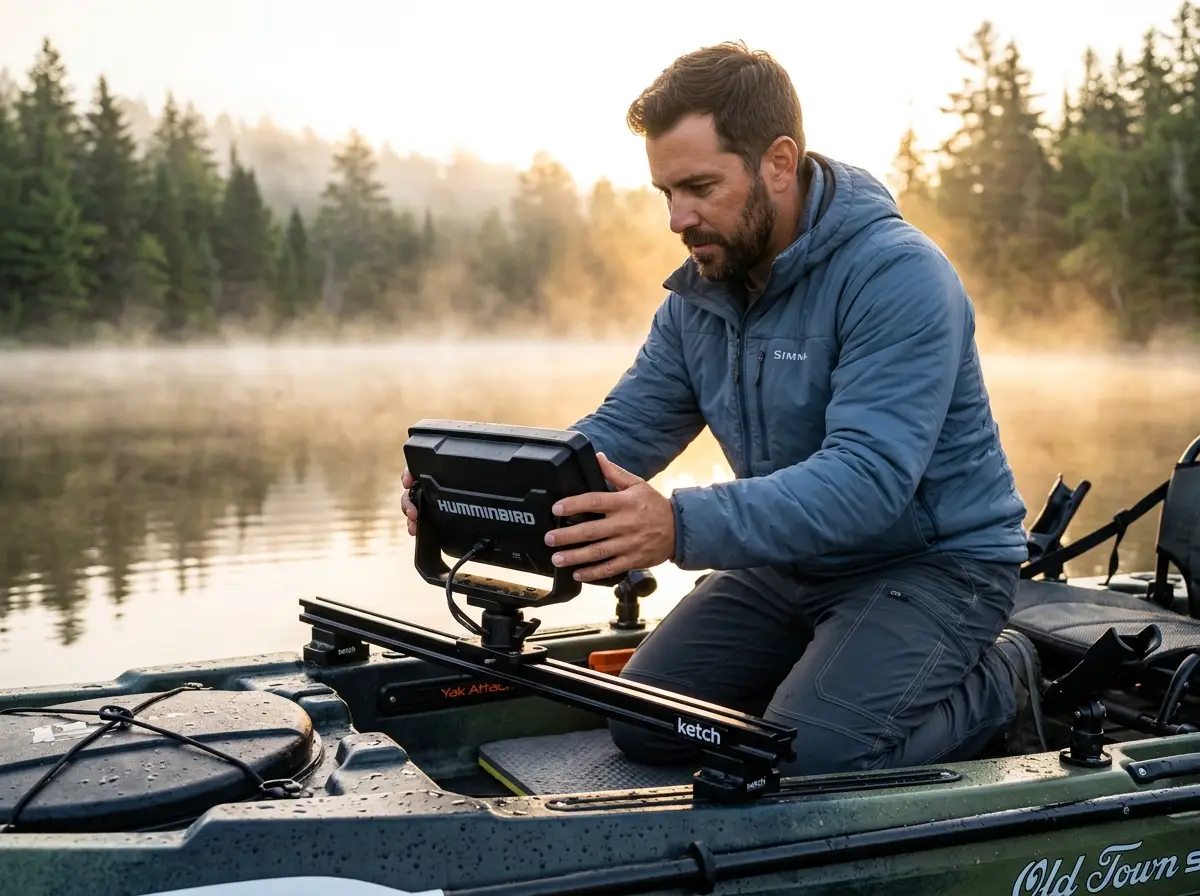
The rod holder ripped straight through the plastic rail — not during a fight, not on the water, but on the drive home. A 12-inch graph arm had been sitting in a factory track since spring, and by August, the combination of highway vibration and a 100°F parking lot had crushed the HDPE slot into something closer to putty. Three grand of electronics hit the pavement doing 70 mph. That track came stock on a $4,200 kayak.
I’ve rigged kayaks from Old Town, Jackson, and Wilderness Systems for clients at every skill level. The factory rail is always the first thing that gets replaced — not because of personal preference, but because it’s structurally inadequate for professional use. The mismatch between what modern anglers put on these boats and what the OEM track was designed to hold isn’t a minor oversight. It’s a physics problem, a chemistry problem, and an engineering problem all at once.
This article breaks down all three — and gives you the framework to build a mounting foundation that won’t fail.
⚡ Quick Answer: Most factory kayak tracks are built for light recreational use — cup holders, maybe a single rod holder — not the heavy graphs, extension arms, and downrigger bases that serious anglers run. The core failures are material creep in HDPE polymer slots, torsional loads from long accessory arms, and galvanic corrosion at stainless-aluminum interfaces. The fix is hard-anodized 6061-T6 aluminum tracks, through-bolts with backing plates, and marine-grade Tef-Gel on every hardware thread. Do those three things and your foundation lasts.
Why Factory Tracks Are the Weak Link on a $4,000 Kayak
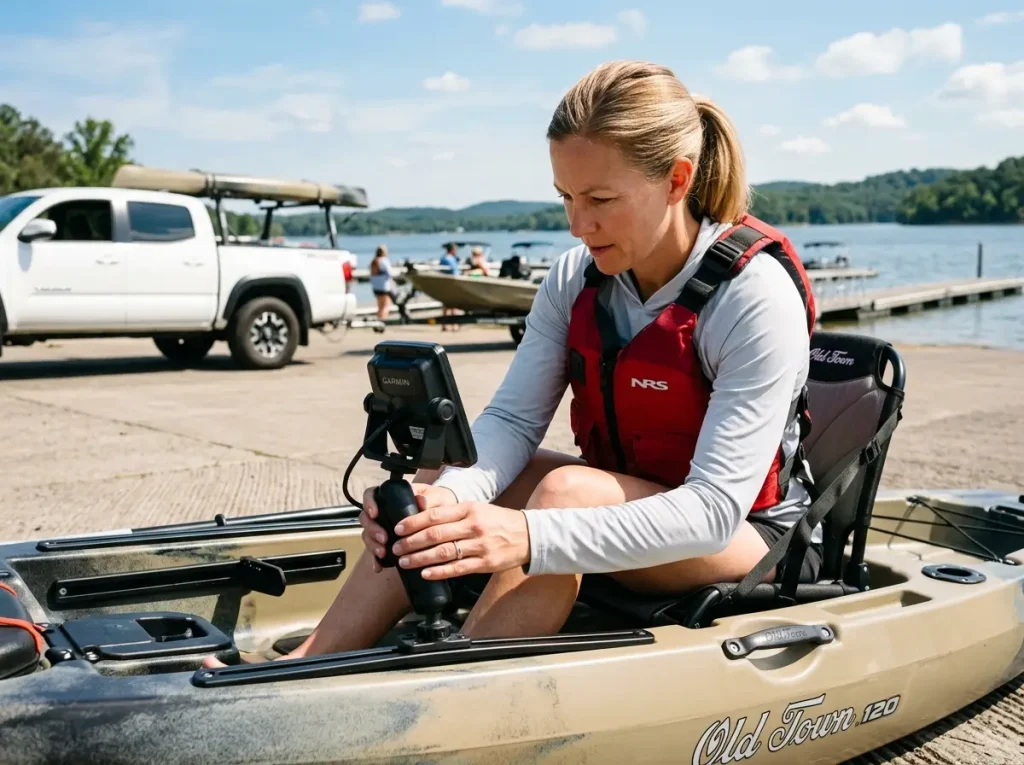
The price tag on a high-end fishing kayak doesn’t track with the quality of its mounting rails. A $4,200 hull can ship with a $14 factory track — and that gap is where rigs fail. Most OEM modular track systems are spec’d for recreational light-duty loads: small rod holders, water bottles, maybe a fish finder on a short arm. They were not engineered for a 12-inch Humminbird HELIX on a 6-inch RAM extension generating multi-g wave impacts.
The construction tells the story. Factory tracks use thin-wall stock and soft, non-heat-treated aluminum or HDPE. They lack the flexural modulus that high-torque rigging demands. The fasteners that secure them to the hull are typically self-tapping screws driven into rotomolded plastic — what riggers call “blind” fastenings. They have no threading to resist pull-out forces when moment-arm loads yank upward or sideways. When you understand choosing a mod-ready fishing kayak chassis, you start to see that not all hulls are equally upgradeable — and the track situation is almost always the first constraint you hit.
Tournament riggers call factory rails the weakest link in a chain that includes thousands of dollars in electronics. That’s not an opinion. The Brinell hardness numbers back it up.
The rotomolded hull problem — why LLDPE complicates everything
Kayak hulls are made from rotomolded Linear Low-Density Polyethylene — LLDPE — which is a viscoelastic material. Under constant pressure, it flows. That’s the technical definition of “creep,” and it’s exactly what happens when a mount knob stays clamped for a full season.
LLDPE also expands and contracts at a rate roughly 10 times faster than aluminum. A 12-inch track bolted rigid to a hull in a 100°F parking lot will stress the mounting screws every single day as the hull flexes and the track doesn’t. Over time, those screws lurch inside the plastic, creating micro-cracks that are invisible until they become a leak. The rule is “snug, not tight” — and that’s not vague: for #10-32 screws into 1/4-inch HDPE, you want 10 in-lb. Failure starts around 25.
Rigging as structural engineering, not accessory attachment
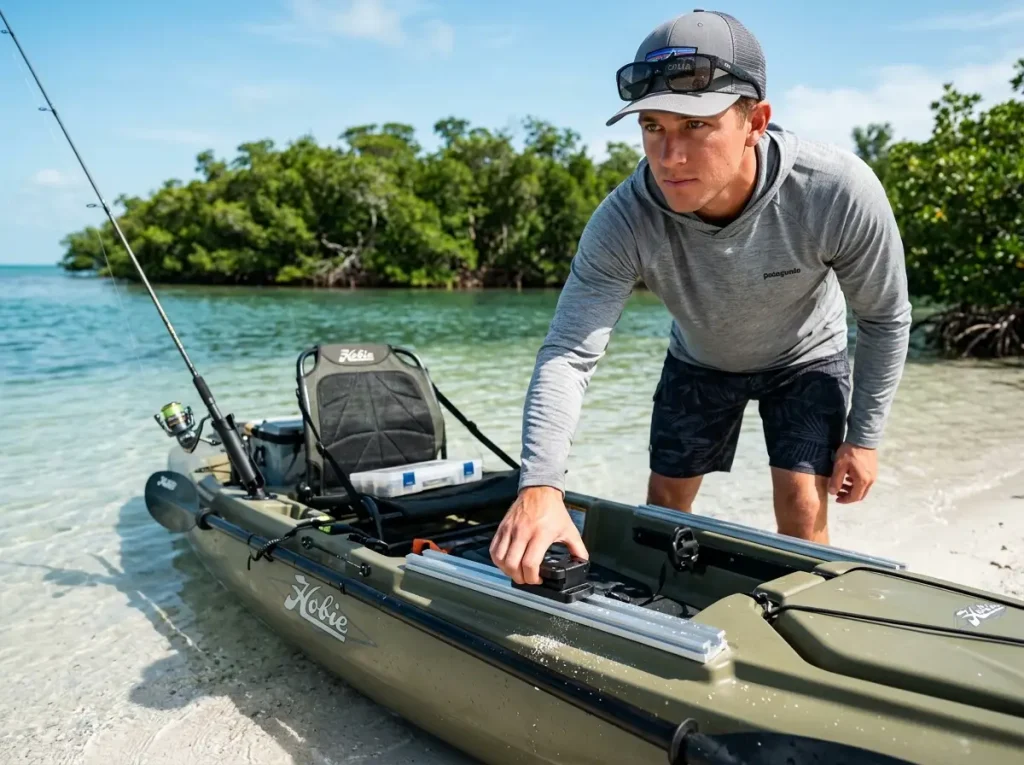
The right mental model for a track system isn’t “mounting holes.” It’s a secondary structural backbone — a universal platform that lets you reconfigure gear without drilling new holes each time. Every new penetration in rotomolded plastic is permanent and weakens the hull’s structural integrity. End-loading tracks and top-loading tracks built from proper materials eliminate that tradeoff entirely.
Spend three or four trips on the water before you drill anything. Map where your paddle arc sweeps every stroke. Note where the deck stays wet. Then plan the layout. The best riggers I know do this without exception.
Pro Tip: Before you mount anything permanently, sit in the kayak in your driveway with your full fishing loadout. Run through paddle strokes and mark every spot your elbows or knuckles track through the air. Those are rigging exclusion zones.
The material science showdown — 6061-T6 aluminum vs. factory polymers
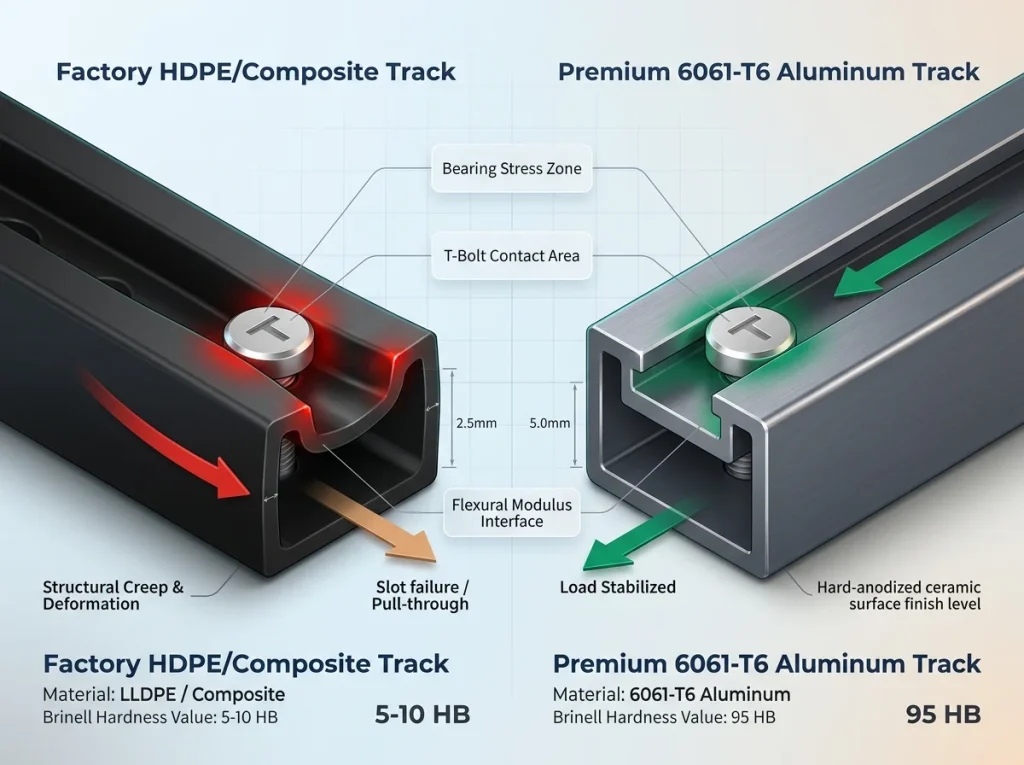
6061-T6 is where the serious conversation about track materials starts and mostly ends. It’s a precipitation-hardened aluminum alloy — magnesium and silicon as the primary alloying elements, solution heat-treated and artificially aged to maximum yield strength. The numbers: yield strength of 240–275 MPa, elastic modulus of 68.9 GPa, and a Brinell hardness of 95 HB. Compare that to soft factory aluminum running somewhere around 5–10 HB, which strips under stainless hardware the moment you put serious torque on it. The ASM Material Data Sheet for 6061-T6 Aluminum doesn’t have a degradation timeline because hard-anodized aluminum doesn’t have one.
A client showed me a factory Wilderness Systems Traxtech rail after two seasons. The composite had gone chalky white and the slot had opened up enough that his RAM ball would rotate under load. That chalking isn’t cosmetic — it’s photo-oxidation, the visible sign that the polymer chain has already lost most of its structural integrity. UV is simply not a factor with anodized aluminum. You also need to understand the metallurgical principles behind saltwater corrosion to see why the anodized surface matters beyond just hardness.
Glass-filled nylon is worth knowing about because it sounds impressive. With 10–40% fiber loading it gets close to some metals in flexural modulus. But it has lower fracture toughness than 6061-T6 — it cracks under sudden impact loads, like a hard strike from a large redfish. And after 36 months of full sun exposure, nylon track can lose 50–60% of its original strength to UV-induced photo-oxidation. The damage happens invisibly before surface chalking appears.
Why “Heavy Duty” means nothing without wall thickness data
“Heavy Duty” is marketing copy. The real number is wall thickness, which determines how well the track resists bearing stress under T-bolt clamp load. Ketch X-Aktrak HD uses intentionally thicker walls to keep that stress below the yield point of the material. Factory tracks use minimal wall thickness, which concentrates load and causes the slot to deform at the bolt interface.
A 12-inch graph on a 6-inch RAM arm generating a 3g wave impact creates prying torque on the T-bolt slot that thin-walled polymer tracks can’t contain. The slot opens. The bolt head eventually pulls through. You’ve seen the photos on r/kayakfishing. That’s the mechanism.
Polymer alternatives worth knowing (and when they’re wrong)
If budget forces a composite track, choose glass-filled nylon over straight HDPE. HDPE is a hull material — its viscoelastic creep properties make it fundamentally wrong for sustained load-bearing. GFN is better but still cracks under sudden impact and degrades in UV faster than aluminum.
Carbon fiber reinforced nylon has a specific strength about 55% higher than aluminum at lower density — but current cost makes it impractical for aftermarket tracks. That’s the future. Right now, for anything beyond lights or flag holders, 6061-T6 is the answer.
Pro Tip: If budget forces a composite track, plan to replace it after two or three seasons in full sun. And never run a heavy graph arm on it.
The physics of torque — what your rod holder is actually doing to your track
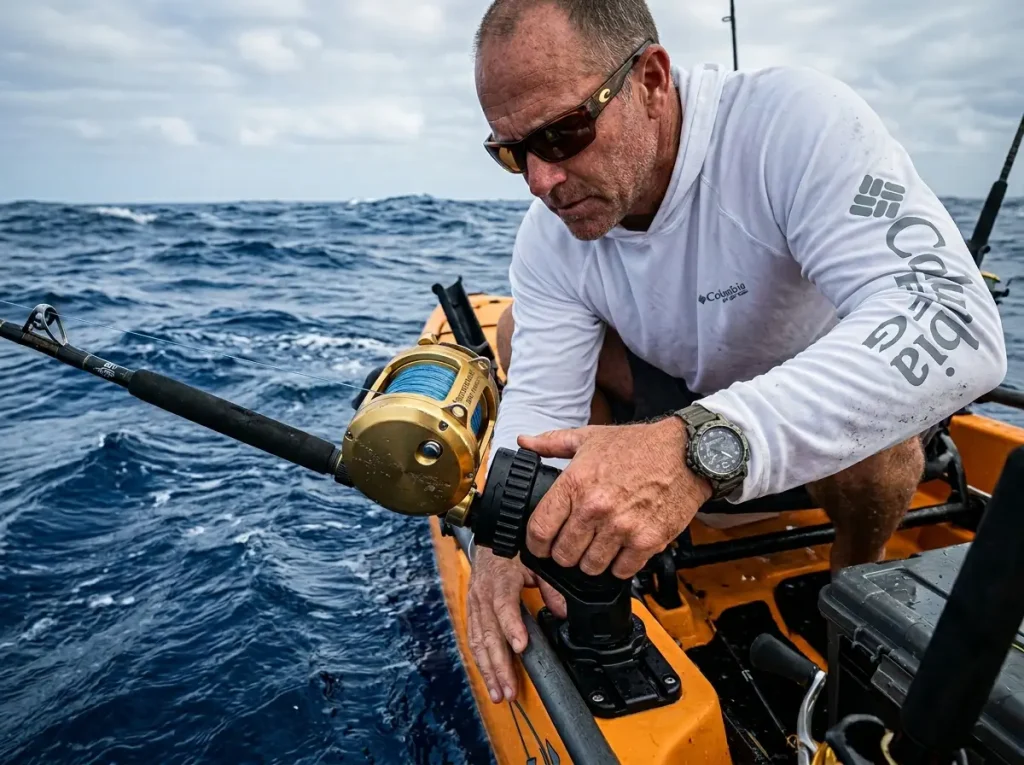
Every accessory mounted on a kayak track is a lever arm. The longer the arm, the more torque it applies to the T-bolt head and the slot walls.
Run the numbers on your heaviest mount: a Humminbird HELIX 7 weighs 2.3 lb. On a 9-inch arm, a 2g wave impact generates roughly 41 in-lb at the T-bolt head. Most polymer track slots start deforming around 15–20 in-lb. That’s why aluminum HD tracks rated for 50+ in-lb aren’t overkill — they’re the correct engineering specification for this application.
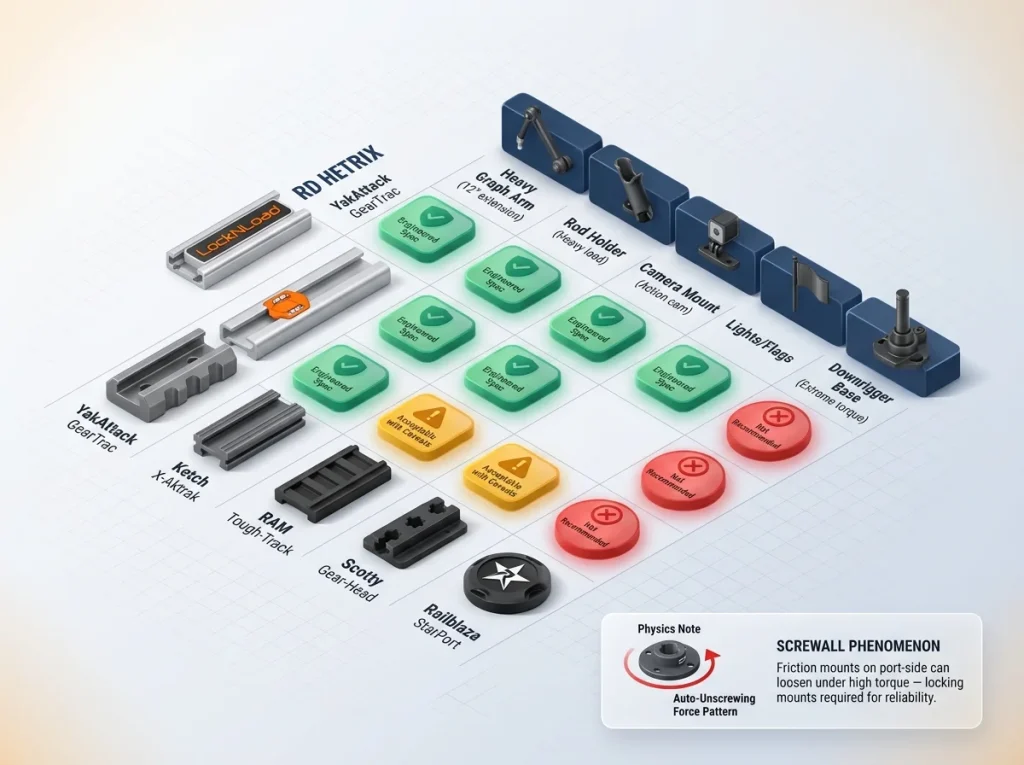
The scenario nobody talks about: the “Screwall” loosening phenomenon on port-side mounts. A fish strike pulling on a port-side rod holder exerts counter-clockwise rotational force. A RAM ScrewBall is a friction mount. Counter-clockwise rotation on a port-side friction mount slowly unscrews the ball from the track — automatically, over the course of the fight. I’ve had clients lose complete port-side graph mounts on big stripers because the physics worked against them. Choosing the right fish finder mount system for your track setup takes this failure mode into account from the start.
YakAttack LockNLoad and the Scotty 343 use physical teeth that prevent rotation regardless of force direction. On port-side applications with any load worth worrying about, locking mounts aren’t optional.
Calculating the real load on your largest mount
Weight your heaviest accessory on a kitchen scale. Multiply by the arm length in inches. If that number breaks 20 in-lb, you need a hard-anodized aluminum HD track. If you’re hitting 40+, you need to be looking at Ketch X-Aktrak or YakAttack GearTrac mounted on backing plates.
Pro Tip: Weight every item before it goes on the boat. Ignorance of the math doesn’t change the physics — the slot doesn’t know you didn’t calculate the load.
Weight distribution and why your accessory track installation affects paddling efficiency
Dual graphs and a battery box mounted forward of the seat raise the bow, increase frontal submerged surface area, and raise wavemaking drag. At typical kayak paddle speeds, you’re already near your hull’s displacement limit. Shift that weight forward and you’re fighting your own rig with every stroke.
Skin friction drag accounts for 60–68% of total passive drag on a kayak. Any external accessory track installation near the waterline adds to that number and hits your battery runtime on motor-driven setups. The rule is: heaviest items low and stern-biased.
Galvanic corrosion — the silent failure you won’t see until it’s too late
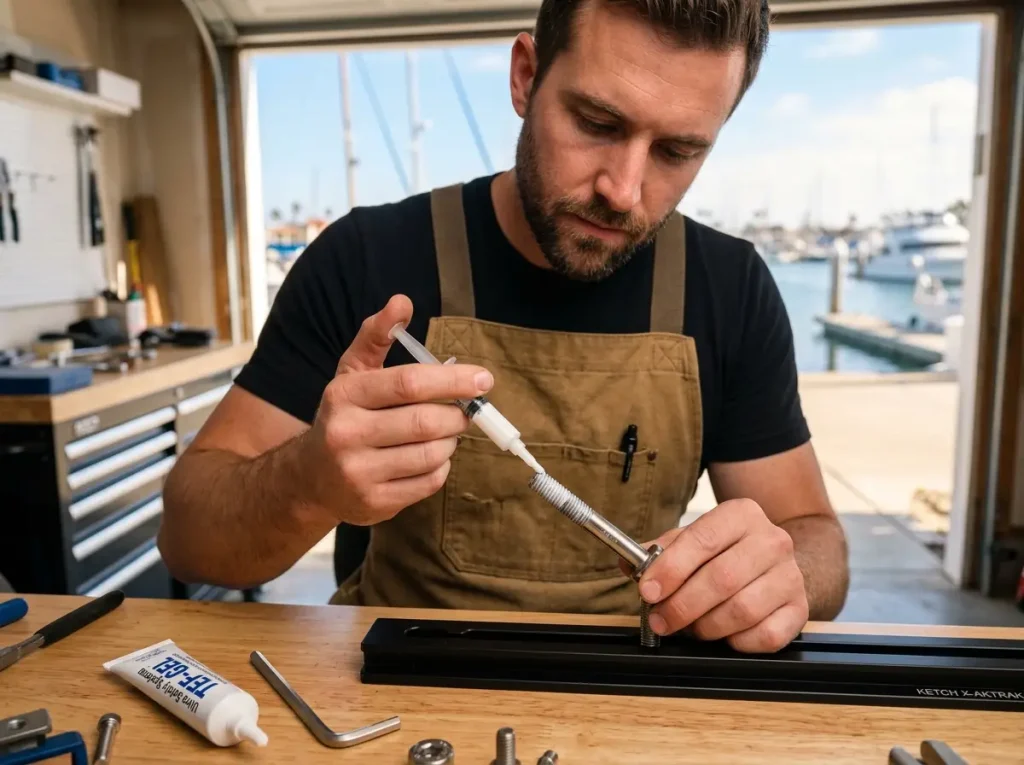
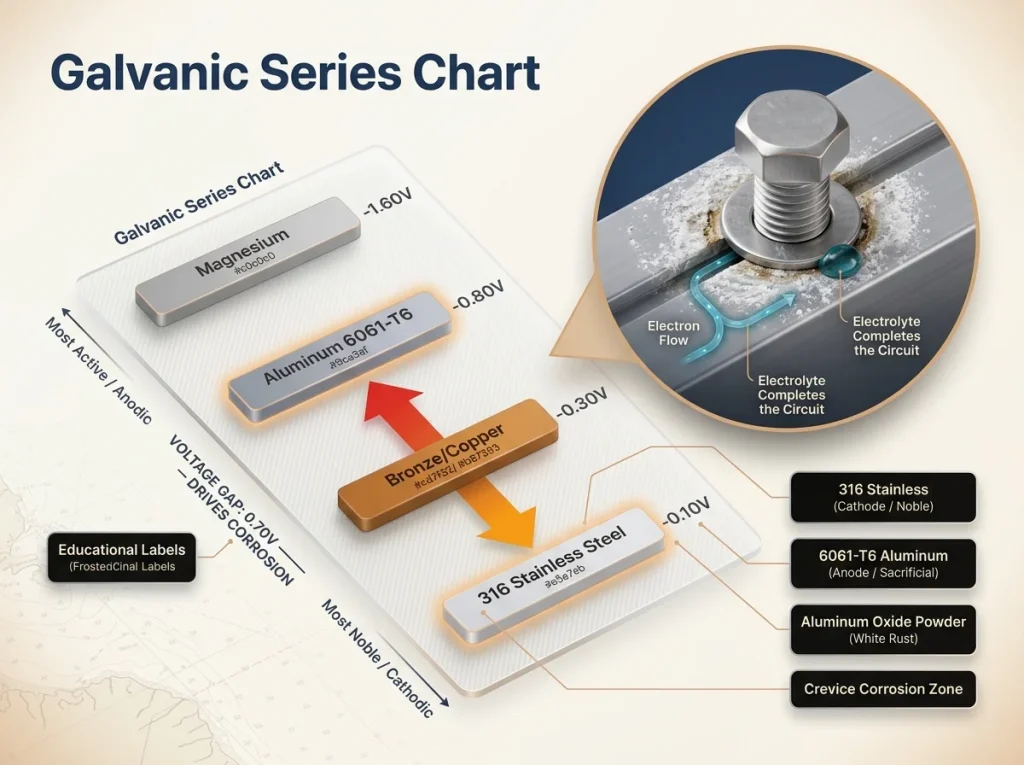
Stainless steel is noble. Aluminum is not. Put them in contact in saltwater and you have a galvanic cell — the aluminum becomes the sacrificial anode and slowly turns to powder.
316 stainless sits at roughly -0.05 to -0.10V in seawater. Aluminum alloys land between -0.70 and -0.90V. That voltage gap drives fast aluminum oxidation. The first sign is white powdery residue around fastener heads — what riggers call “tea staining.” By the time you can see it, the mechanical cross-section is already partly gone.
Pull your track fasteners after two seasons in saltwater without marine-grade Tef-Gel and you’ll find what looks like a bolt wrapped in white fuzz. That fuzz is your track wall dissolving into aluminum oxide. The bolt threads underneath are already compromised. According to corrosion risks between stainless steel and aluminum in marine environments, the area-ratio configuration most riggers run — a small stainless fastener in a large aluminum track — is actually the safer geometry, because the galvanic current spreads over a larger aluminum surface area, slowing the depth of pitting. But crevice corrosion in stagnant water trapped between the track and hull can still compromise bolts even in this configuration.
Building a solid corrosion prevention routine also means understanding saltwater corrosion prevention protocols for rods and reels — the same chemistry applies across all your marine metal interfaces.
Tef-Gel — the professional standard and why standard grease fails
Ultra Safety Systems Tef-Gel is what professional riggers use. Not standard marine grease. Not anti-seize compound. Tef-Gel contains 40% solid PTFE with no volatile solvents. It blocks the capillary action that draws saltwater into bolt joints, and it prevents galling — the cold-welding phenomenon where stainless threads seize to aluminum during tightening, making future removal destructive.
Standard marine grease leaches out in 6–12 months in a salt environment. Tef-Gel doesn’t dry out, evaporate, or cold-flow. It stays at the thread interface for years. Reapply annually on any frequently adjusted positions.
Physical isolation methods — breaking the galvanic circuit
Nylon or Delrin washers between the stainless bolt head and the aluminum track create a physical break in the electrical path. Simple and critical. Epoxy primers (DTM coatings) can shield metal surfaces from the electrolyte before installation.
Hard-anodized tracks like the Ketch X-Aktrak have a thickened aluminum oxide layer that creates a non-conductive ceramic surface — but scratches in the anodizing create localized galvanic cells where corrosion concentrates. Protect that finish. Never use a steel drill bit to install aluminum tracks — use titanium nitride-coated bits to prevent galvanic contamination at the cut edge.
Pro installation — backing plates, through-bolts, and getting it right once
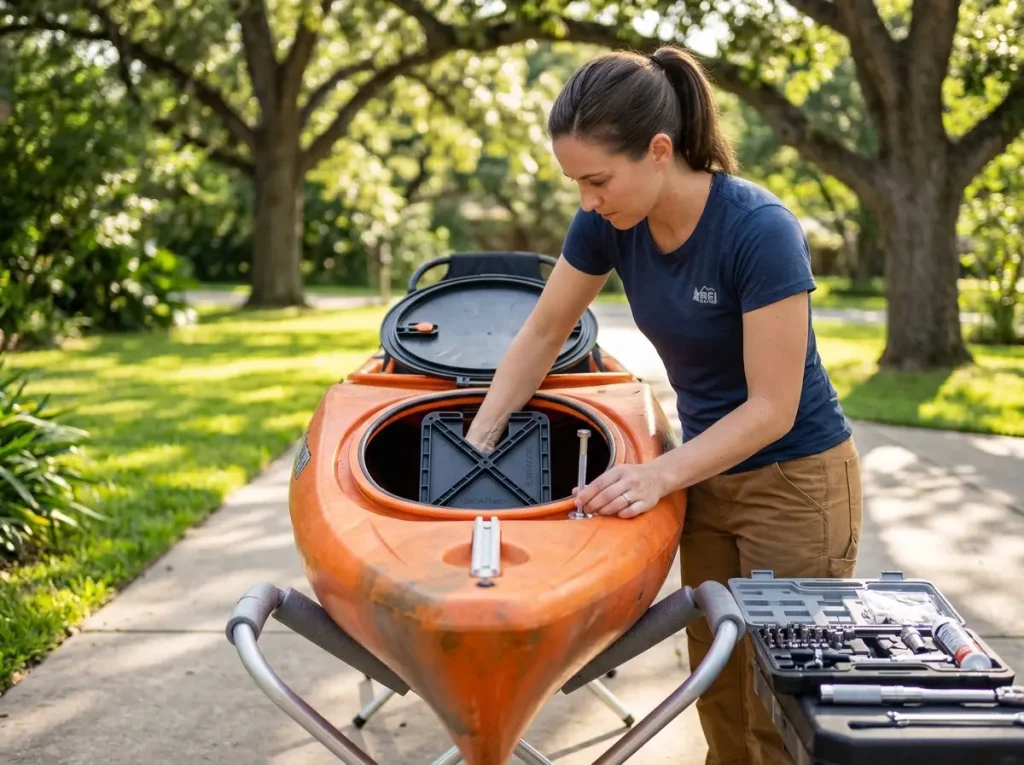
Self-tapping screws into rotomolded LLDPE work fine for cup holders. They don’t work for anything that sees real load. Through-bolting with 316 stainless steel bolts and lock-nuts into a 1/4-inch backing plate — PVC, aluminum, or reinforced polymer — transforms the deck from a flexible shell into a structural member.
Backing plates distribute the point load of a fastener across a significantly larger surface area. This eliminates the pull-out failure mode that kills self-tapping installs. For anchor trolley pulleys and heavy-duty mounts, the structural gain from backing plates is roughly equivalent to adding a deck rib to the kayak. The 3-point kayak anchor system setup that uses the same through-bolt principles gives you the complete methodology — the structural logic carries across every high-load rigging application.
If you’re on an Old Town Sportsman — 106, 120, PDL, AutoPilot — the Ketch OT-1 X-Aktrak is a no-drill replacement that uses the factory bolt pattern and swaps from polymer to 6061-T6. Zero new hull penetrations, zero warranty exposure, and the screen vibration that was distorting your sonar during high-speed runs goes away.
Pro Tip: Torque specs matter. #10-32 screws into 1/4-inch HDPE: 10 in-lb recommended, failure around 25 in-lb. If you don’t have a torque wrench in your rigging kit, get one. A stripped hull costs more than the tool.
The paddle-first rule — why you should wait before drilling
Take three or four water sessions in a new kayak before making any permanent modifications. The “paddle sweep” zone — where your blade passes the hull during a standard forward stroke — is the single most common location for poorly placed track mounts. Obstruction there increases capsize risk and can cause blade contact with gear. Both outcomes are bad.
The Head-Tracking Rule: where the head goes, the kayak follows. Mounts that force you to lean significantly outside your center of gravity to access rod holders or screens are stability hazards, not conveniences.
The compatibility matrix — can your mounts actually fit your tracks?
There is no ISO standard for “1/2-inch T-track.” Slot geometry varies between brands enough that security under dynamic load is not guaranteed.
YakAttack GearTrac runs a standard 1/2-inch slot with LockNLoad/MightyMount locking — the universal heavy-duty foundation. Ketch X-Aktrak uses a precision HD slot with Du-Bro T-Bolts, built for tournament rigging. RAM Tough-Track is acceptable for electronics on short arms but problematic on port side under load because of the Screwall phenomenon. Scotty Gear-Head uses a star/spline locking system — excellent for geared rod holders. Railblaza StarPort: lightweight modularity, correct for lights and flags, wrong for heavy electronics.
“Compatible” in marketing means it will fit. It does not mean it will hold under load. A RAM ScrewBall enters any 1/2-inch slot; whether it stays during a 3g impact with a 12-inch arm is a function of wall thickness and locking mechanism. For best flush-mount rod holders for kayak tracks the mounting interface is half the equation — the track it goes into is the other half.
Post-season maintenance — keeping the foundation investment alive
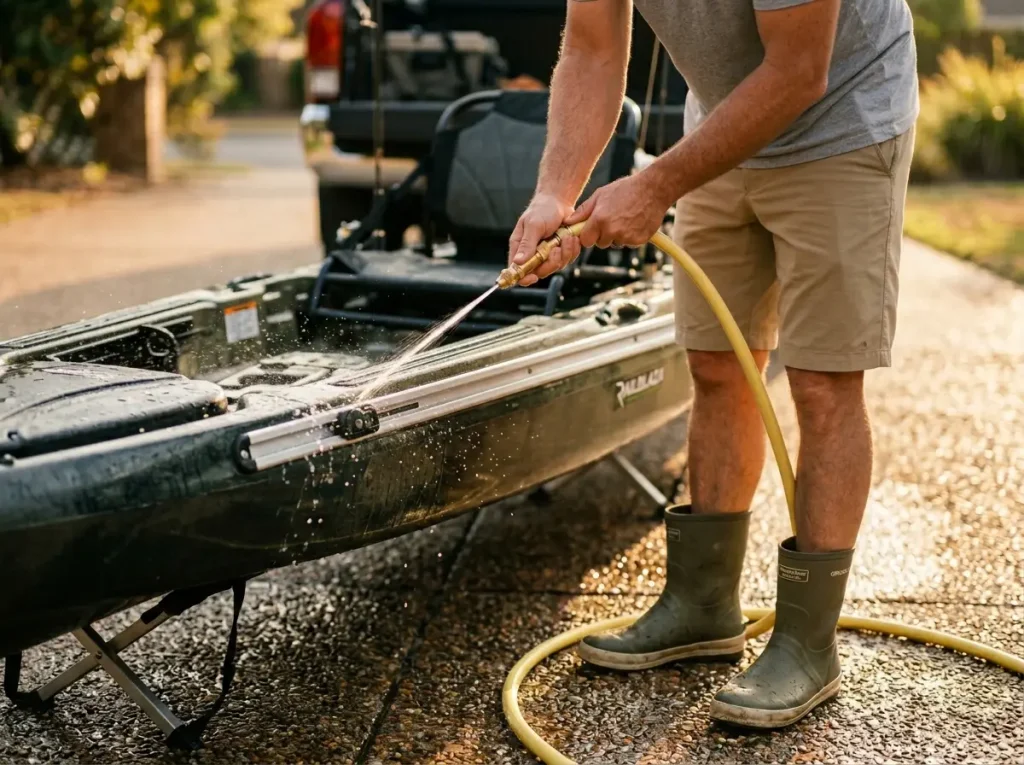
Hard-anodized 6061-T6 doesn’t take care of itself. Even the best track requires a consistent maintenance protocol. I tell people every spring: the cost of 30 minutes of torque checks and fresh Tef-Gel is about $8 in materials. The cost of a pulled track in tournament conditions — plus downtime and re-rigging — is measured in hundreds of dollars and your worst day of the season.
The kayak fish finders most affected by poor track maintenance are exactly the electronics worth protecting. Screen vibration from loose track mounts distorts sonar readings at speed. That’s not a minor inconvenience — on a tournament day, you’re fishing partially blind.
Monthly torque checks are not optional. Highway trailering and wave impacts progressively loosen fasteners. A calibrated torque wrench isn’t a luxury item for a serious rig.
The saltwater rinse protocol — sequence and why order matters
Start at the track-to-hull interface and use a needle-nose nozzle to force fresh water into the gap. Move to fastener heads, then flush the T-slot channel. Let it air dry completely before storage — trapped moisture in a sealed track channel is more corrosive than direct saltwater exposure during a trip. Don’t use a pressure washer. At 2,500+ PSI you drive water through anodizing micro-pores and accelerate the corrosion you’re trying to prevent.
End-of-season deep inspection checklist
Remove all accessories. Inspect T-slot channels for deformation and corrosion products. Pull every fastener and check threads under magnification — a loupe or phone macro lens works fine. Replace anything showing white oxidation or thread deformation. Apply fresh Tef-Gel to all reinstalled hardware. Check anodized surfaces for scratches or dark spots indicating subsurface galvanic activity. Store the kayak out of direct UV with a quality deck cover — UV continues to degrade polymer accessories and rubber seals even when the aluminum tracks are fine.
Conclusion
Three things to take from this:
First, factory tracks are a liability, not a feature. HDPE creep, polymer UV degradation, thin-wall bearing stress limits — the material science makes them inadequate for any serious modern rigging load. Replace them early, not after a failure.
Second, torque and corrosion are the two physics problems you have to solve. Calculate moment-arm forces before you mount anything heavy. Apply Tef-Gel to every stainless-aluminum interface before you thread a single bolt. Do this once and you’re done.
Third, a track system is a structural component. Backing plates, through-bolts, and proper torque values are not optional refinements. They’re the minimum standard for a rig that holds when conditions get ugly.
Before your next trip, put a torque wrench to every track fastener on the boat. If any of them move before you hit spec — or if you don’t know the spec for your hull material — that’s your homework. It’s cheaper than a $300 graph hitting the water at 70 mph.
FAQ
Are all kayak tracks the same size?
No — and that matters under load. Most aftermarket tracks use a nominal 1/2-inch T-slot, but slot geometry varies enough between brands that security under dynamic load is not guaranteed. A RAM ScrewBall will enter most 1/2-inch slots, but for high-torque applications — graph arms, downrigger bases — wall thickness and the locking mechanism determine whether it holds, not just whether the bolt fits.
How do you install accessory tracks on a kayak without voiding the hull warranty?
Drilling is the risk, not the track. Through-bolt installations with 1/4-inch backing plates distribute load correctly, but improper torque — exceeding roughly 31 in-lb for 1/4-20 screws into 1/4-inch HDPE — can cause micro-cracking that voids structural warranties. Drop-in replacements like the Ketch OT-1 for Old Town kayaks use factory bolt patterns — zero new hull penetrations, zero warranty exposure.
Can you mount a fish finder on a gear track?
Yes, but the mount system matters more than the track itself. A friction-based RAM ScrewBall on a composite track handles a HELIX 5. Add a 9-inch extension arm and a 3g wave, and you’ll likely see slot deformation within a season. For graphs on extension arms, use a locking-style mount — YakAttack LockNLoad or Scotty 343 — in a hard-anodized 6061-T6 track. Both components are load-bearing. Engineer both to spec.
What is the difference between top-loading and end-loading kayak tracks?
End-loading tracks require accessories to slide in from the terminus — slower to adjust, but structurally more secure because the slot geometry can be tighter. Top-loading tracks let accessories clip in from above, enabling faster rigging changes but requiring slightly wider slot tolerances and marginally less bearing surface contact under torsional load. For tournament rigs where failure isn’t acceptable, end-loading HD aluminum is the correct choice.
Why do some kayak anglers prefer composite tracks even after learning about aluminum?
Weight and cost are the legitimate arguments. A full-length GFN composite track weighs roughly 40–60% less than equivalent 6061-T6 aluminum, which matters in performance kayaks sensitive to hull trim and hydrodynamic drag. For lighter accessories — rod flag holders, camera mounts under 1 lb, LED lights — a quality composite track from Railblaza or Wilderness Systems Traxtech is a defensible choice. The mistake is running light-duty composite under heavy-duty loads because the tracks came with the boat.
Risk Disclaimer: Fishing, boating, and all related outdoor activities involve inherent risks that
can lead to injury. The information provided on Master Fishing Mag is for educational and informational purposes
only. While we strive for accuracy, the information, techniques, and advice on gear and safety are not a substitute
for your own best judgment, local knowledge, and adherence to official regulations. Fishing regulations, including
seasons, size limits, and species restrictions, change frequently and vary by location. Always consult the latest
official regulations from your local fish and wildlife agency before heading out. Proper handling of hooks, knives,
and other sharp equipment is essential for safety. Furthermore, be aware of local fish consumption advisories. By
using this website, you agree that you are solely responsible for your own safety and for complying with all
applicable laws. Any reliance you place on our content is strictly at your own risk. Master Fishing Mag and its
authors will not be held liable for any injury, damage, or loss sustained in connection with the use of the
information herein.
Affiliate Disclosure: We are a participant in the Amazon Services LLC Associates Program, an
affiliate advertising program designed to provide a means for us to earn advertising fees by advertising and linking
to Amazon.com. As an Amazon Associate, we earn from qualifying purchases. We also participate in other affiliate
programs and may receive a commission on products purchased through our links, at no extra cost to you. Additional
terms are found in the terms of service.