


In this article
The buzzbait was making zero sound. Not a gurgle, not a clack — nothing. A half-ounce head with a factory-painted blade spinning through pre-dawn murk like a coin dragged on glass. Then something rolled on it, shook once, and disappeared. Not a hookset. A rejection. The bass clocked it as fake before I could react, and by the time I’d processed what happened, three or four more fish had followed suit on the same retrieve. That was the morning I stopped treating a buzzbait like a toy and started treating it like a mechanical assembly with variables I could control.
After years of fishing buzzbaits in tournament and recreational contexts, the same four mistakes keep showing up — even from anglers who’ve thrown them for decades. These aren’t beginner errors. They’re the kind of wrong that hides inside conventional wisdom, the kind you inherit from a guide who learned from another guide who never questioned the factory setup. This article breaks down the four blade modifications that matter, grounded in what’s happening mechanically between the blade, the rivet, and the water — not guesswork.
⚡ Quick Answer: The four buzzbait blade mods most guides execute incorrectly are: (1) failing to crimp the rivet stationary so that all frictional energy converts to squeal, (2) skipping paint removal from the blade hub, which muffles stick-slip vibration, (3) over-treating or skipping the high-velocity break-in that seats blade surfaces together, and (4) using a blade sized to the head weight rather than inverting the ratio to enable slow retrieves. Fix these four variables and the same lure you’ve been fishing quietly will start making noise that carries across the water column.
The Mechanical Assembly — Understanding the Buzzbait as a System
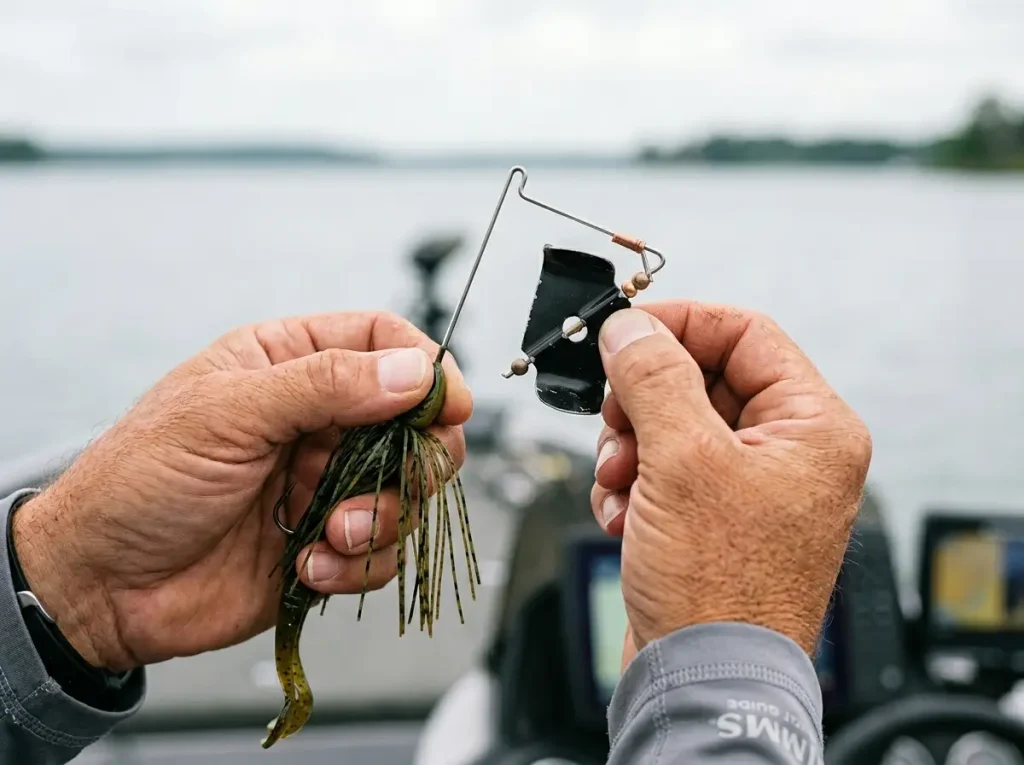
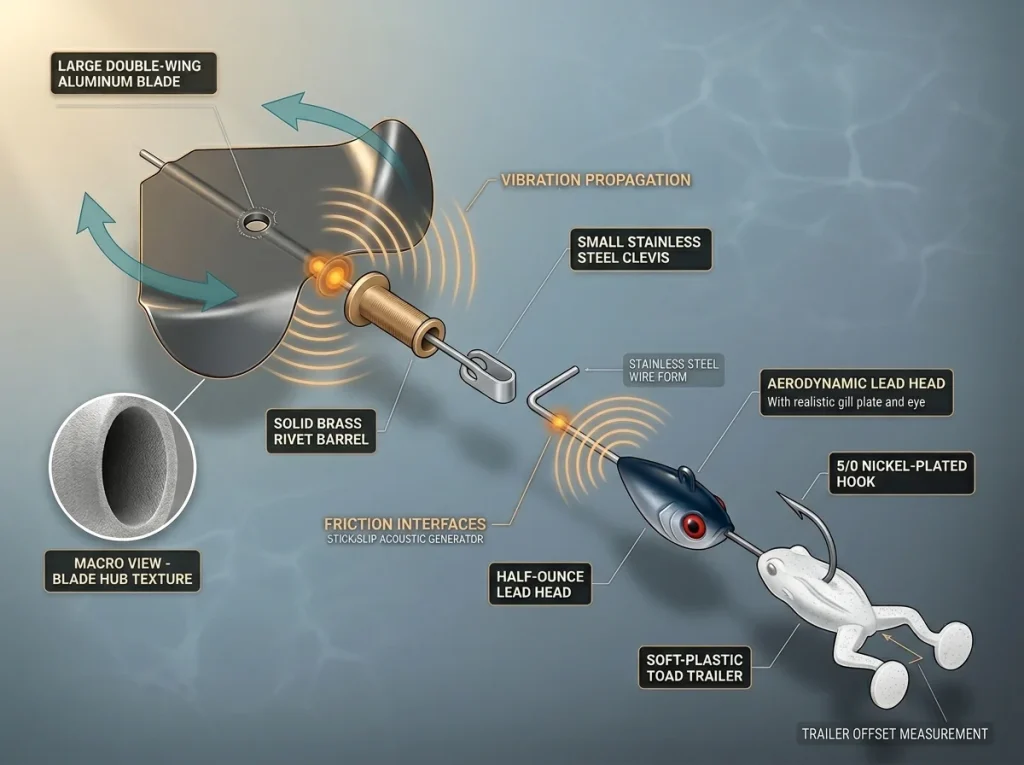
Every modification you make to a buzzbait interacts with every other part. Ignore that and you’ll fix one variable while quietly breaking another. The blade is a rotating lifting surface — it generates the vertical force that keeps the lead head on plane. The rivet and blade hub together form the frictional acoustic generator — the mechanism responsible for that squeak bass respond to. The wire arm transmits vibration, the clevis connects the blade to the wire, and the trailer creates drag that directly affects the lure’s tracking vector.
Wire gauge is the variable nobody mentions at the boat ramp. Thin wire at 0.035″ produces high resonance and flexible response but fatigues fast near the head after repeated contact with heavy cover. Standard 0.040″ wire balances resonance and durability. Heavy 0.051″ dampens vibration significantly — more durable, quieter. Most anglers fish whatever gauge came stock and never question it. That’s a missed tuning opportunity. After crimping or bending near the head, inspect the wire for stress whitening — those micro-cracks are the early warning sign of fatigue fracture.
The clevis — the small loop that connects the blade to the wire — is a friction articulation point that every guide article ignores. A bent or deformed clevis causes irregular blade seating. The blade won’t sit flush against the rivet consistently, which eliminates the acoustic contact needed for a clean squeal. Use needle-nose pliers to gently open or close the loop. Crimpers deform it asymmetrically. Spin the blade with your fingernail: it should rotate freely and stop immediately when you remove pressure. Any flywheel effect means the clevis is too loose.
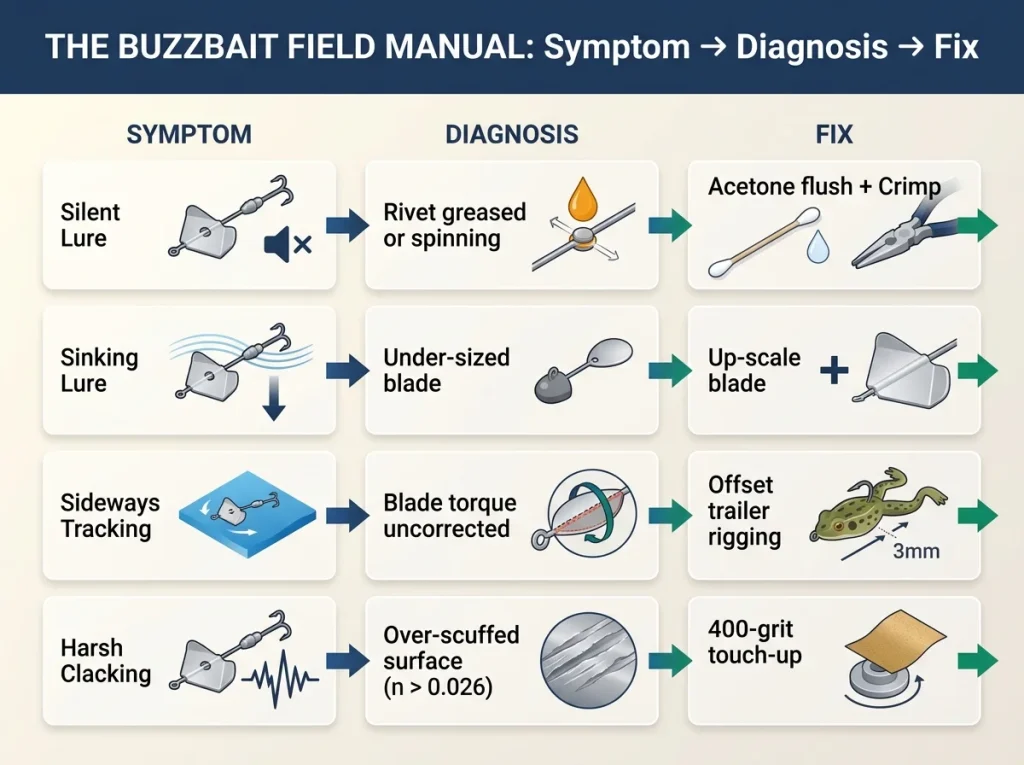
Trailer choice matters too. A symmetrically rigged toad doesn’t track straight — blade rotation generates a lateral torque on the lure body, and a symmetric trailer compounds that drift. Push the hook point 3–4mm toward the side opposite the blade’s rotational pull. Mark the underside of the hook with a paint pen so you never rig it backwards again. That small adjustment counter-steers the torque and lets the lure run true under docks and along grass edges where big bass hold.
The field diagnostic is simple: hold the lure at rod-tip depth and drag it slowly forward. A tuned buzzbait vibrates audibly in your hand. An untuned one feels dead. You want to understand the same hydrodynamic balance principles that govern crankbait tuning — the same physics apply here, just on the surface.
Pro tip: Replace stock wire annually if you fish heavy cover more than 20 days per season. Wire fatigue is invisible until the wire snaps mid-fight.
Modification 1 — Stationary Rivet Compression (The Elam Protocol)

Here’s where most anglers — including tournament-level fishermen — are leaving decibels on the table. In a stock buzzbait, the rivet often rotates alongside the blade. That means frictional energy is distributed across two interfaces: blade-to-rivet and rivet-to-wire. Splitting the friction load cuts the available sound pressure level roughly in half. The buzzbait is technically working, it’s just working at half volume.
The fix is stationary rivet compression. Elite Series professional James Elam developed this method after documenting that dual-rotation was endemic even among touring pros. The process: use 8″ needle-nose pliers — the right pair of needle-nose pliers for this job — and crimp the rivet barrel laterally onto the stainless wire. Not a tap. You need enough force to deform the rivet metal into the wire’s micro-gaps. Zero rotational movement is the goal. When it’s done right, you can try to spin the rivet with your finger and it won’t budge.
Before crimping, check the rivet face for casting burrs. Mass-produced rivets come out of molds with uneven faces — a microscopic ridge here, a flat spot there. File the face smooth with a fine-tooth file or 400-grit paper. Any burr creates a dead zone where the blade hub lifts off the rivet during rotation, and that momentary separation stops the squeal at that degree of rotation. After filing, confirm hub contact by pressing the blade face against the rivet and inspecting for visible gaps under direct light. A gap means the hub section needs to be straightened — use finger pressure, not heat. Heating anneals the metal and reduces resonance permanently.
Then check hub alignment. If the blade is bent at the hub, it only contacts the rivet for a fraction of each revolution. Straighten the hub section with your fingers and check for flush contact by pressing the blade face against the rivet and inspecting for visible gaps under direct light. A gap means more work is needed.
The physics behind the squeal — friction-induced stick-slip vibration — is the same mechanism that causes train wheels to squeal on curves. Surfaces bond under static friction, slip when rotational torque exceeds the bond, then rebond. Fast alternation produces high-frequency vibration that propagates through the wire arm and into the water. Research on friction-induced stick-slip vibration in metal contact surfaces confirms this is a well-understood tribological phenomenon, not fishing folklore.
Metal pairing matters too. Aluminum blade paired with a brass rivet produces a bright, high-pitched squeal targeting the frequency range bass respond to. Most stock buzzbaits use cheap pop-metal rivets with inconsistent friction coefficients. Swapping in solid brass rivets is the cheapest performance upgrade per dollar on the market. Carry a few in your box.
Pro tip: If the lure goes silent at high speed but squeals on deceleration, you’ve hit the hydrodynamic lubrication transition point. Slow your retrieve 15–20% and the metal surfaces re-engage. That’s the boundary lubrication zone — water present but no film separating the metals — and that’s where the squeal lives.
Modification 2 — Manning’s n Surface Roughness (The Science of Scuffing)
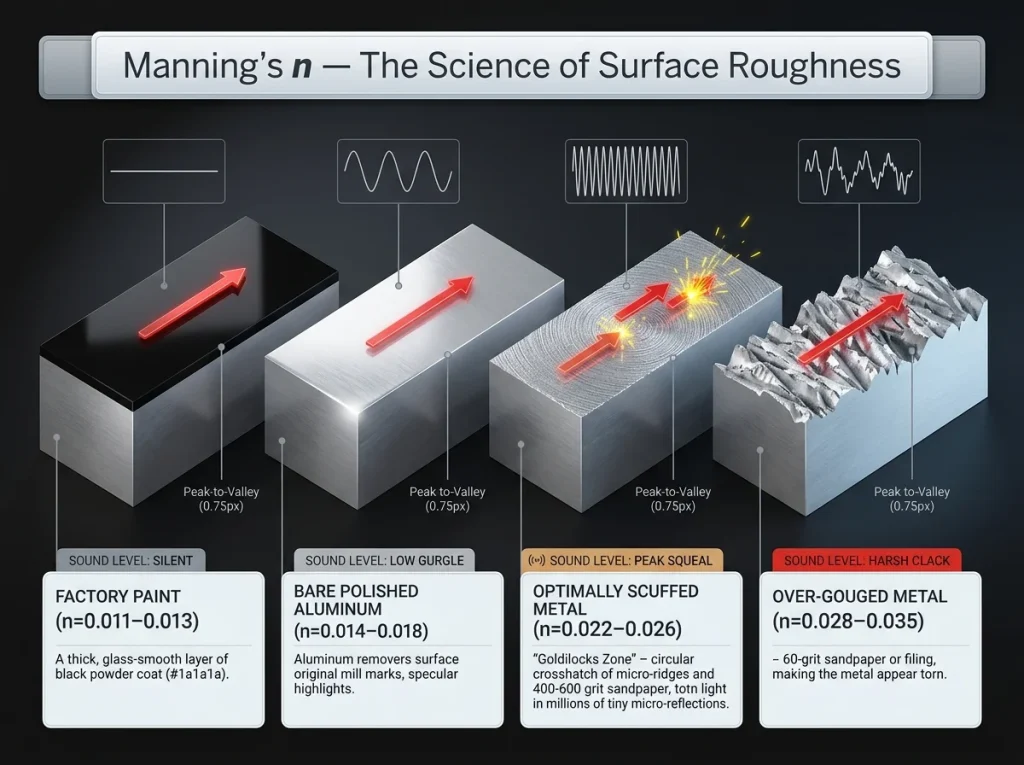
Factory buzzbaits come with powder-coated or painted blades. That coating isn’t cosmetic — it’s a polymer that functions as a solid lubricant at the blade/rivet interface. The Manning’s roughness coefficient for factory powder coat runs 0.011–0.013, which is nearly frictionless at microscopic scale. You’re trying to generate stick-slip vibration, and the factory paint is actively suppressing it before the first cast.
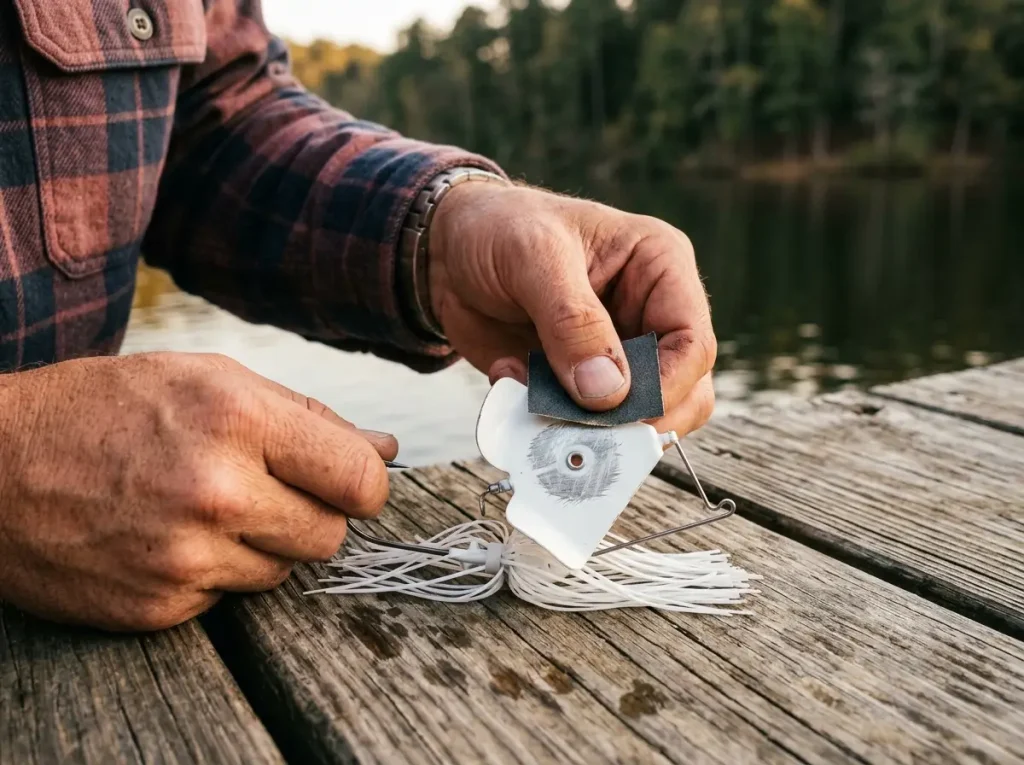
Strip the paint. That’s the modification. Specifically, strip the hub area of the blade — the zone that contacts the rivet — and apply 400–600 grit sandpaper in a circular scuffing motion. Not straight back-and-forth. Circular crosshatch creates micro-ridges that intersect at varying angles throughout the full 360° of rotation, which means consistent frictional engagement and a more complex harmonic output. Linear scuffing creates parallel grooves that only engage at specific rotational alignments — intermittent squeal.
The target roughness is Manning’s n of 0.022–0.026. That’s the range where bare scuffed metal produces a sharp, consistent, high-frequency squeak. Go coarser — 60–80 grit, or deep gouges — and you overshoot to n = 0.028–0.035, which produces harsh clacking instead of squeal. Above 800 grit, the ridges are too fine to trap the stick-slip cycle. The grit window (400–600) is narrow, and it’s the detail no competing guide spells out.
Start with acetone or 91% isopropyl alcohol to soften the powder coat before sanding. The solvent prevents paint residue from clogging the abrasive. Scuff the blade hub face and the rivet face simultaneously. Some anglers only scuff the blade and leave the rivet face polished — that cuts effective Manning’s n in half. Both surfaces need texture. Apply firm pressure for 30–40 circular passes, then inspect under direct light: the surface should appear uniformly matte with no shiny patches remaining.
Wet the sandpaper with a drop of water during the circular passes. This prevents metal micro-particles from re-embedding in the surface — what machinists call swarf recycling — which would re-smooth the surface you’re trying to roughen.
I stripped a War Eagle blade down to bare aluminum last season, hit it with 600-grit in circular passes, and ran it against an identical stock lure. Same wire, same rivet, same head weight and retrieve speed. The scuffed blade squealed at 0.6 mph. The factory-painted one was silent at that speed. That’s not a small difference. That’s the difference between a fish and a skunk. This is identical to the lure modification mindset that treats factory finishes as starting points, not final products — the finish is a variable you control.
Long-term: light oxidation (gray haze within two or three trips) is beneficial. It increases surface roughness naturally. Heavy corrosion — brown or green buildup — is detrimental. If the blade seizes after oxidation, run a short high-RPM break-in to re-seat the surfaces through micro-lapping before forcing it to spin by hand.
Pro tip: Store scuffed buzzbaits separately from soft plastics. ElaZtech and Plastisol materials can coat bare aluminum with a thin lubricating film that re-introduces the exact dampening effect you just removed.
Modification 3 — Tribochemical Break-In (The Physics Behind the “Car Window Trick”)

The “car window trick” has the reputation of fishing folklore — the kind of thing your uncle swears by without knowing why it works. It works. The mechanism is tribochemical wear: surface modification through repeated high-velocity mechanical stress. New buzzbaits have blade/rivet interfaces that have never been mated. At microscopic level, the surfaces don’t match — there’s contact at peaks but gaps at the valleys. Sound output is inconsistent because frictional contact is inconsistent.
At 60 mph with the lure hanging out the window, the blade undergoes thousands of rotations per minute. Three things happen simultaneously. Work hardening: repeated impact stress causes dislocation movement in the metal, making it harder and more resonant. Micro-lapping: airborne dust particles act as a fine abrasive compound, polishing blade and rivet into 100% surface-area conformance. Heat generation: localized friction at the hub causes minor thermal expansion, allowing components to seat more deeply than cold water allows.
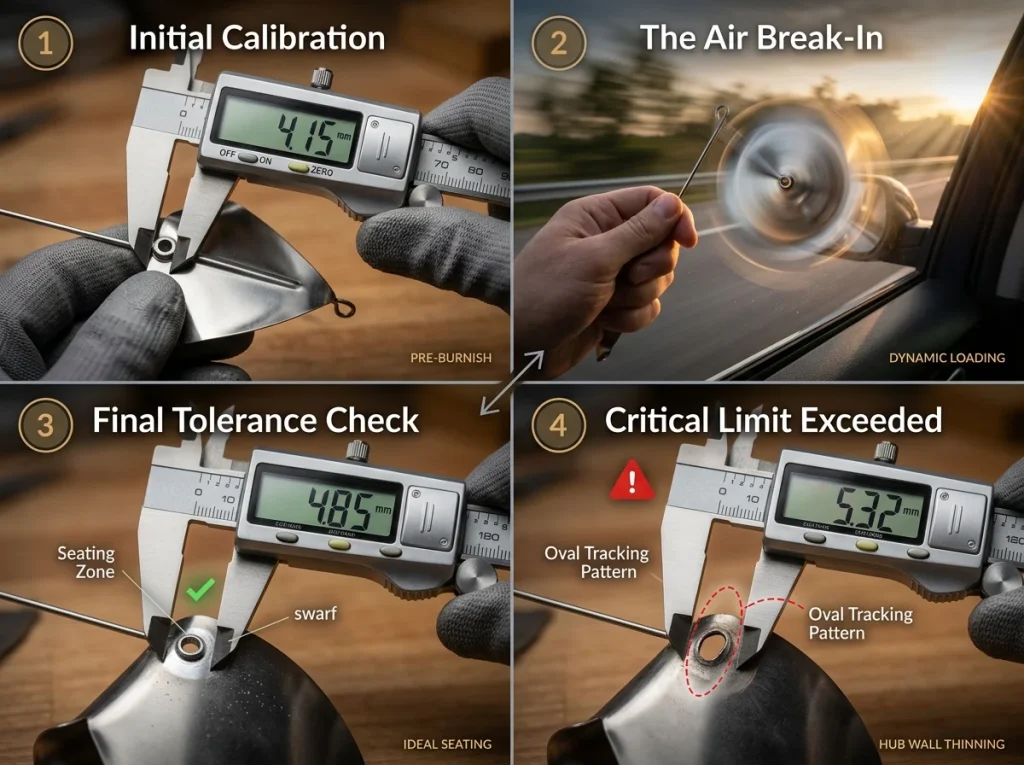
The critical constraint is distance. Elam recommends 5–10 miles of highway travel. Beyond that, hub wall thinning occurs — the blade’s hole enlarges to the point where the blade wobbles or cavitates excessively, ruining the lift-to-drag balance. The tell is a visible lateral wobble in the blade’s rotation plane on retrieve, or a soft thump replacing the squeal. Once you see the wobble, the hub wall is compromised. Blade swap is the only fix — remove the stock blade with split-ring pliers and install a replacement. The swap itself takes under two minutes.
You can measure hub hole diameter with a digital caliper before and after break-in. Stock hub holes typically run 4.0–4.5mm. If it exceeds 5.0mm after break-in, the blade has been over-worked. This is a quick check that saves you from deploying a compromised lure on the water.
You can achieve the same result in water by running the lure at high retrieve speeds for 45 minutes using an 8.1:1 or faster gear ratio reel — though the controlled air environment breaks surfaces in more quickly and consistently. Speaking of gear ratio: matching retrieve speed to the lure’s mechanical requirements is not optional if you want the blade tuning to actually translate to performance on the water.
I over-broke three buzzbaits in one season before I quantified the distance limit. Two of them, I didn’t notice the hub wall thinning until I was on the water and the lure refused to stay on plane. The third, I caught it at home: the blade tracked in a slight oval instead of a circle. All three were technically salvageable with a blade swap, but that’s time and money spent on an avoidable mistake.
Pro tip: Break in newly scuffed buzzbaits before the trip, not the morning of. The combination of manual scuffing (Modification 2) plus highway break-in produces a faster and more consistent acoustic result than either method alone.
Modification 4 — Hydrodynamic Blade Scaling and Off-Center Hole Drilling
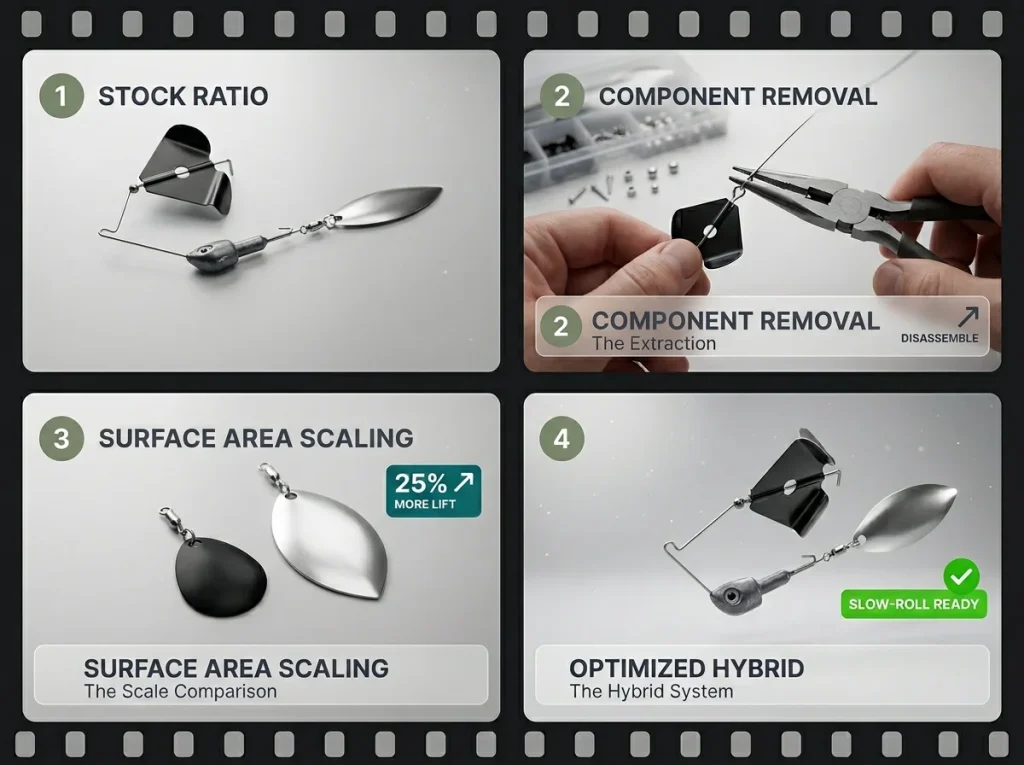
Standard manufacturing pairs head weight and blade size proportionally — heavy head, large blade; light head, small blade. Tournament anglers and guides treat this pairing as fixed. It’s not. The most effective modification for slow-rolling in high-pressure or cold-water situations is inverting the ratio: up-scale the blade while down-scaling the head weight.
The physics are straightforward. Lift is proportional to blade surface area. A larger blade on a lighter head allows the lure to stay on plane at a minimum retrieve velocity approximately 25% lower than a matched-pair stock setup. That means you can crawl the lure across a flat at 0.55 mph and it stays in the strike zone instead of diving.
A larger blade also displaces more water per revolution, which increases the low-frequency pressure wave that triggers the fish’s lateral line. In cold water, bass have lower metabolic rates — they need a target that represents a low-caloric-cost strike. A slow-moving, loud lure is exactly that: a high-probability target for minimal energy expenditure. Understanding metabolic cost optimization in predatory fish strike behavior is the biological explanation for why conditioned, pressured bass hit a slow-rolled buzzbait that they ignore when it’s moving fast. The same logic applies to pressured fish in summer that have seen a thousand fast-moving lures — drop the speed, keep the noise, and you’re presenting something different.
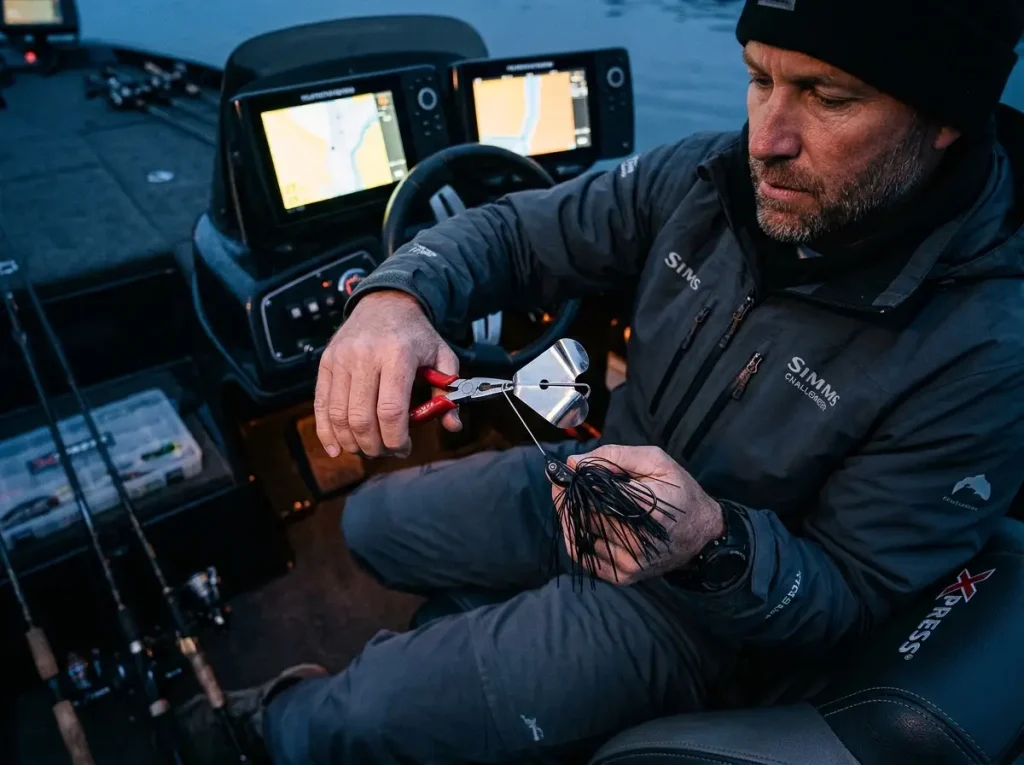
To execute the swap: remove the stock blade with split-ring pliers, source a replacement from a heavier model — River2Sea or War Eagle 1/2 oz models are good donor blades — and install it on your 3/8 oz frame. Check the blade attachment hole diameter before committing. Larger blades from different manufacturers sometimes have wider hub holes that don’t seat correctly on the original wire and clevis. Adjust the clevis as needed. Carry 3–4 unrigged large blades in your box — mid-session water temperature collapses from cloud cover or wind shift can make the blade swap a field-adjustable solution. This swap is connected to the same blade surface area and flash dynamics that govern spinnerbait selection — the underlying physics of lift, vibration frequency, and water displacement are the same across both lure families.
I tested a 1/2 oz blade on a 3/8 oz frame in 52°F water against the stock matched-pair setup. The up-scaled blade held plane at 0.55 mph. The stock configuration dove at the same speed. Three strikes in 20 minutes on the modified lure versus two half-hearted follows in two hours on the stock. February bass. It wasn’t a fluke — it was the lift equation playing out exactly as the physics predict.
Off-center hub drilling is the second half of this modification. Use a 1/16″ cobalt drill bit and drill a secondary hole 2–3mm off-center from the original hub center. The off-center mass creates imbalanced rotation: a rhythmic, side-to-side wobble that mimics a wounded baitfish. Minor off-center produces slight rhythmic pulsing — that’s the target. Mark the drill location with a paint pen before drilling; a 2mm deviation from the intended off-center point changes the wobble profile significantly. Test tracking at multiple speeds before fishing the modification. An extremely unbalanced blade causes the lure to roll or dive at faster retrieve speeds.
For wing perforation: drill 3–5 small holes (3/32″ bit) in the blade’s wing surface — not the hub. Space them evenly across each wing for consistent bubble production. Clustering holes creates turbulent flow dead zones where no cavitation occurs. These holes act as cavitation nucleation sites. Low pressure behind each hole triggers vapor bubble formation and collapse, creating a white-water trail with a continuous hissing acoustic signature. Run a perforated and non-perforated blade side by side in clear water. You can watch the perforated blade’s bubble trail from the boat. That’s the lateral line trigger in real time.
The Guide Fallacy — 4 Common Mistakes That Destroy Tuning

Watched a touring angler apply WD-40 to his rivet tableside at a tournament weigh-in, explain it as a “pro tip,” and then go fish a lake he’d prepped for three days with a silent buzzbait. That single bottle of lubricant undid every surface modification on the lure. Understanding why that matters is what separates the analytical angler from everyone else at the ramp.
Guide Error 1 — The greased axle. Applying oil or grease to the rivet shifts the blade/rivet interface into hydrodynamic lubrication — a continuous water film separates the metal surfaces and stick-slip vibration stops entirely. The lure goes silent. Even one WD-40 application persists across three to five fishing sessions as a residue film. Recovery requires an acetone flush on a cotton swab, followed by a 10-minute water break-in to re-establish the stick-slip cycle. Research on tribology of boundary lubrication and friction coefficient reduction makes clear that lubrication and acoustic output are mutually exclusive in this system. The buzzbait interface must stay dry.
Guide Error 2 — Low gear ratio. A 5.4:1 reel on a buzzbait requires the angler to move their hands at an unsustainable pace just to keep the lure on plane. You can’t control minimum retrieve speed precisely, which means you can’t stay in the boundary lubrication zone consistently. A 7.5:1 to 8.1:1 reel at moderate crank speed produces roughly 450 blade RPM — right in the boundary lubrication window for a properly scuffed blade. A 5.4:1 at the same hand speed produces around 324 RPM — too low for consistent stick-slip engagement on most setups. Dedicate a high-speed reel to your buzzbait. The blade tuning and the gear ratio are one system. A high-speed reel also enables instant lift-off — the ability to jump the lure to surface plane on the first crank, before the fish sees the lure dropping near shallow cover.
Guide Error 3 — Symmetric trailer rigging. Bass buzzbait blades rotate clockwise when viewed from behind. That generates a leftward lateral torque on the lure body. A symmetrically rigged toad compounds the lateral drift instead of correcting it. Offset the trailer hook 3–4mm toward the side opposite the blade’s rotational pull. That shift corrects the torque and allows straight-line tracking — specifically the tracking accuracy needed to run the lure tight under docks, along pilings, and over shallow vegetation. Understanding how the lateral line processes the pressure waves your buzzbait generates is the biological reason why consistent vibration frequency from a properly tracking lure is more effective than an erratic, torque-drifting presentation.
Guide Error 4 — Kinked wing bends. When bending blade wings to increase lift or cup, most guides apply pliers and create hard creases in the metal. The Kutta condition in fluid dynamics requires a smooth trailing edge for optimal circulation and lift. A kinked blade creates flow separation at the kink point — turbulent drag increases but lift doesn’t. All wing bending should be done with a smooth-faced bending tool across a 15–20mm radius. Think rolled sheet metal, not folded paper. After bending, inspect under direct light for reflection inconsistencies across the blade surface — those are kink points, and they need to be corrected before the lure sees water.
Pro tip: If you inherit a lube-contaminated buzzbait, flush the hub with acetone on a cotton swab, let it dry, then run a 10-minute water break-in at high retrieve speed. The stick-slip cycle re-establishes within a few minutes. Don’t discard lures that have been greased — they’re recoverable.
Conclusion
Three things to take from this.
First: the buzzbait is a mechanical system. The blade, rivet, wire, head, and trailer all interact. Modifying any single part in isolation without accounting for the others is how you end up with a “tuned” lure that still underperforms.
Second: the squeal is a tribological phenomenon. Stationary rivet plus scuffed bare metal at 400–600 grit plus the correct boundary lubrication regime equals the acoustic profile that makes bass commit. Grease, factory paint, and low-friction polymer coatings all work against you. The lure should be dry and abrasive at the hub interface.
Third: blade up-scaling — larger blade, lighter head — is what makes slow-rolling actually work in cold or pressured water. It reduces minimum plane velocity, increases the lateral line pressure wave, and gives conditioned bass a low-energy, high-probability strike opportunity. Standard matched-pair setups physically cannot do this at slow retrieve speeds.
Pull three buzzbaits from your tackle box tonight. Crimp the rivet on one, strip and scuff the blade on another, and blade-swap the third with an oversized wing. Fish all three tomorrow morning and listen. The difference between a properly tuned buzzbait and a factory-stock one is audible from 20 feet away before the first cast.
FAQ
How do you make a buzzbait squeak consistently?
Crimp the rivet completely stationary with needle-nose pliers, strip all factory paint from the blade hub, and scuff the bare metal with 400–600 grit sandpaper in a circular motion. That combination achieves the boundary lubrication regime where stick-slip friction produces a consistent, high-frequency squeal throughout the retrieve. Skipping any one of the three steps noticeably reduces the result.
How do you tune a buzzbait to run straight?
Offset your trailer hook slightly toward the side opposite the blade’s rotational pull direction, and verify your wire arm is straight from crimp to hook eye. Blade rotation generates lateral torque — trailer offsetting counter-steers that force and allows the lure to track straight even at slow retrieve speeds near cover.
Does aluminum or plastic blade squeak better on a buzzbait?
Aluminum is superior. Paired with a brass rivet, aluminum produces a bright, high-pitched squeak with an acoustic emission profile that targets bass hearing frequencies. Plastic blades absorb frictional energy rather than transmitting it as vibration — the result is a softer, inconsistent, less strike-triggering sound signature.
Why does my buzzbait sink at slow retrieve speeds?
The blade surface area is insufficient relative to head weight. Up-scale the blade by swapping to a larger wing from a heavier model buzzbait, and the added surface area generates enough lift to keep the lighter head on plane at lower retrieve velocities. More surface area means the lure can stay on top at speeds where the stock blade would dive.
Do you need a trailer hook on a buzzbait?
Depends on how the fish are striking. Short-striking bass — rolling on the lure without committing — benefit from a trailer hook. Rig it on a surgical tubing sleeve to prevent wild swinging, which causes tissue damage and reduces survival rates for released fish. In heavy vegetation, remove the trailer hook entirely. It catches debris and ruins the presentation.
Risk Disclaimer: Fishing, boating, and all related outdoor activities involve inherent risks that
can lead to injury. The information provided on Master Fishing Mag is for educational and informational purposes
only. While we strive for accuracy, the information, techniques, and advice on gear and safety are not a substitute
for your own best judgment, local knowledge, and adherence to official regulations. Fishing regulations, including
seasons, size limits, and species restrictions, change frequently and vary by location. Always consult the latest
official regulations from your local fish and wildlife agency before heading out. Proper handling of hooks, knives,
and other sharp equipment is essential for safety. Furthermore, be aware of local fish consumption advisories. By
using this website, you agree that you are solely responsible for your own safety and for complying with all
applicable laws. Any reliance you place on our content is strictly at your own risk. Master Fishing Mag and its
authors will not be held liable for any injury, damage, or loss sustained in connection with the use of the
information herein.
Affiliate Disclosure: We are a participant in the Amazon Services LLC Associates Program, an
affiliate advertising program designed to provide a means for us to earn advertising fees by advertising and linking
to Amazon.com. As an Amazon Associate, we earn from qualifying purchases. We also participate in other affiliate
programs and may receive a commission on products purchased through our links, at no extra cost to you. Additional
terms are found in the terms of service.