
In this article
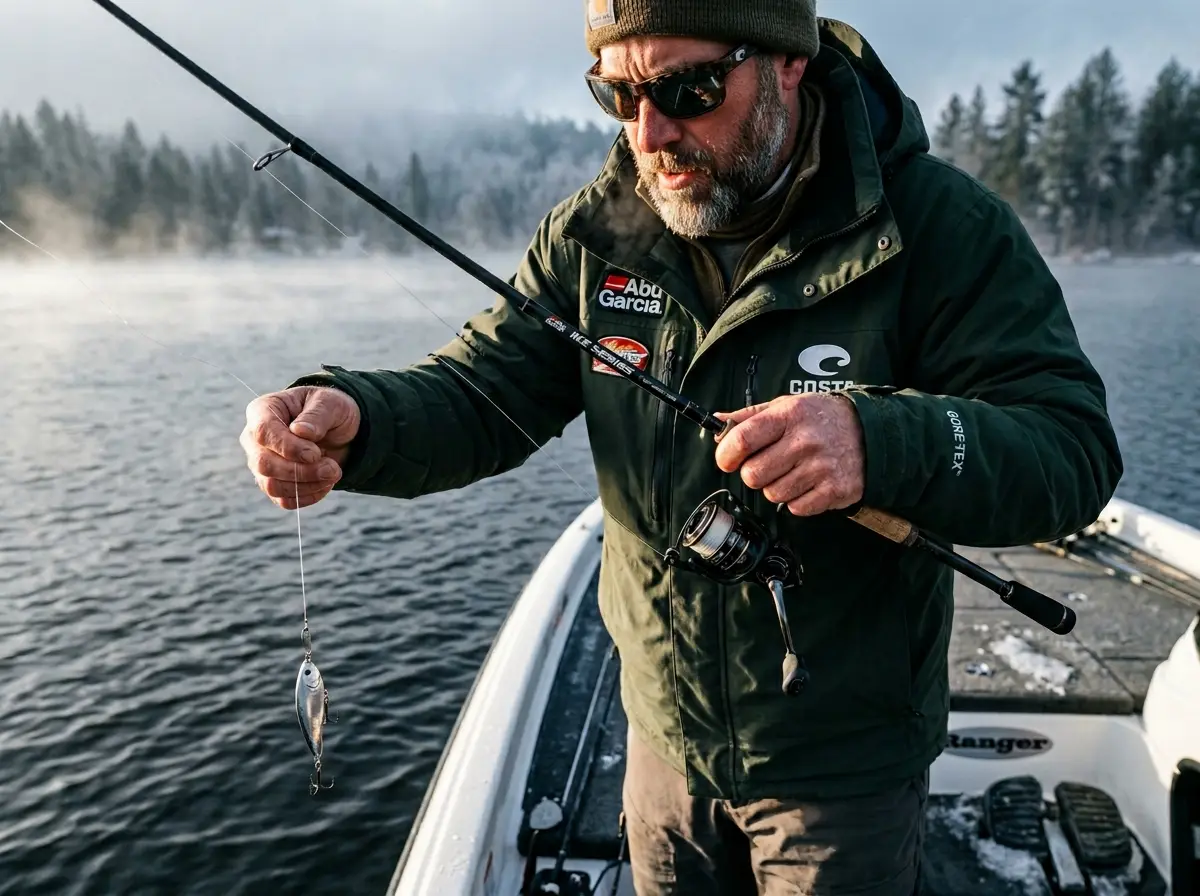
The 11-pounder was a ghost in an icy December reservoir. I stared at the sonar, pinned tight against a hard rock edge in ninety feet of water. That is when I tied on a half-ounce raw metal blade, plummeted it down, and initiated three sharp vertical thumps. The fish hit so forcefully it knocked slack into my braided line.
After twenty years guiding on these frigid waters, I watch capable anglers fail in this exact scenario. They buy electronics to find bottom-oriented fish, only to blow the presentation by ripping lures three feet off the mud. To command the strike zone when the water turns to ice, you must abandon casual yo-yo retrieve folklore.
⚡ Quick Answer: Blade bait fishing for winter bass and walleye requires strict vertical discipline and short lift-and-drop cadences to trigger involuntary reaction strikes from lethargic fish. Instead of large sweeps, tight 6-inch vertical hops precisely mimic a dying shad. Maintaining continuous bottom contact is non-negotiable.
| Optimal Cadence and Substrate Resistance by Water Temp | |||
|---|---|---|---|
| Water Temp Range | Optimal Cadence | Strouhal Number (St) | Substrate Resistance (n) |
| 35°F – 39°F | 1-2 Thumps (Max 6-inch lift) | ~0.22 | 0.025 (Sand) |
| 40°F – 44°F | 2-3 Thumps (6 to 9-inch lift) | ~0.22 | 0.040 (Gravel) |
| 45°F – 50°F | 3-4 Thumps (9 to 12-inch lift) | ~0.22 | 0.075 (Boulders) |
The Thermodynamics of the Strike in Winter
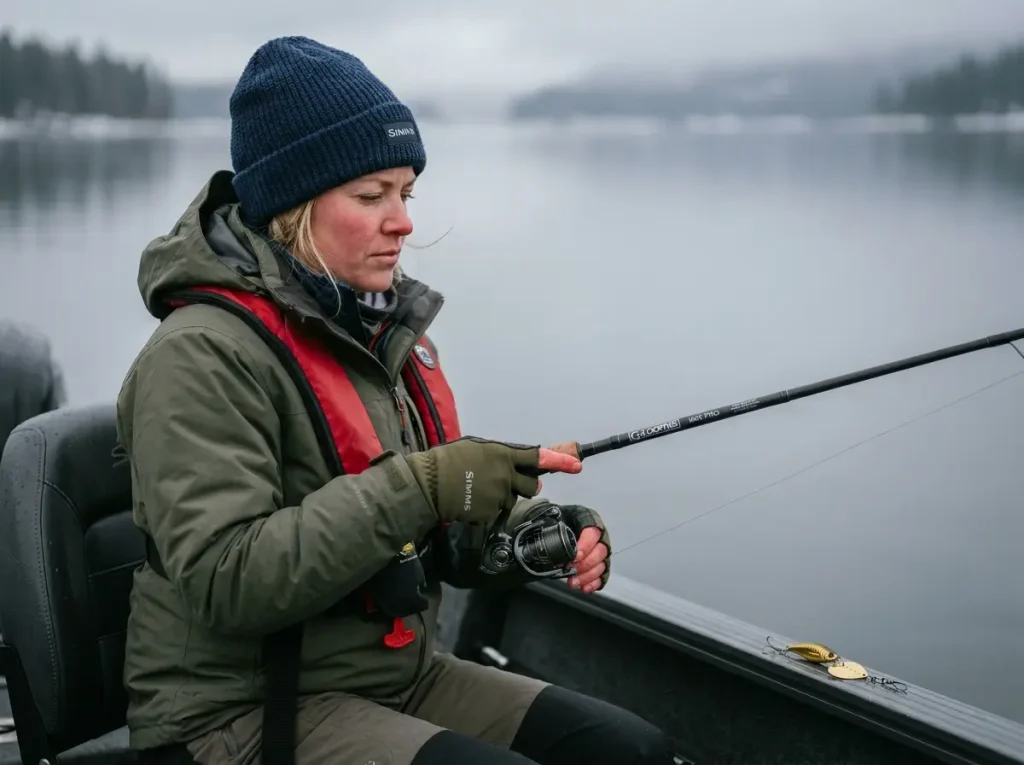
Success in January relies entirely on recognizing how cold water shuts down a fish’s engine.
The Q10 Temperature Factor and Winter Lethargy
During winter, bass and walleye seek deep thermal refuges near the bottom where water holds steady around 39°F. This shutdown is governed by the Q10 temperature factor, a rule dictating that ectothermic metabolic processes increase 2- to 3-fold with every 10-degree rise.
Because water temperature dictates fish metabolism, these predators cannot digest food fast enough to hunt. A largemouth suspended under fifty feet of sub-40°f water is essentially hibernating. Any reaction strike you earn here is an involuntary neurological reflex resulting from cold-water limnology, targeting the lateral line.
The Disadvantage of the 3-Foot Lift
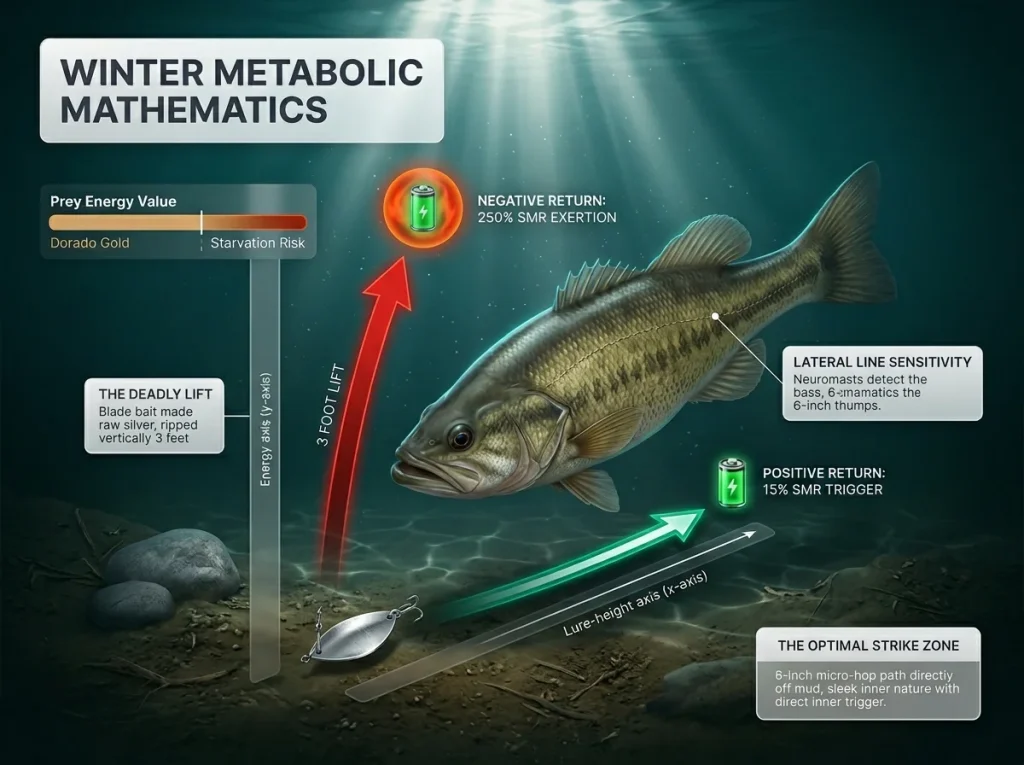
Weekend anglers routinely ruin their chances by fishing a blade bait like a summer crankbait. They execute a giant lift height and wonder why their livewell stays empty. Lifting a lure three feet vertically creates a massive metabolic cost of strike. Swimming upwards to grab a solitary piece of metal demands more calories than the prey provides. It is an energy-negative meal.
Why Pinned to Bottom is Non-Negotiable
You must keep your lure practically glued to the substrate. I catch ten fish to my partner’s one because I minimize my lift stroke and dead-stick the bottom. When you drop the rod tip, allow the heavy bait to crash hard into the silt layer. Let it sit perfectly still. That long pause simulates a wounded baitfish giving up. When a smallmouth stares at that lifeless chunk of metal for ten continuous seconds, the split-second you twitch it off that mud bottom, the sheer surprise forces the jaw to snap shut.
Fluid Dynamics: The Physics of The Thump
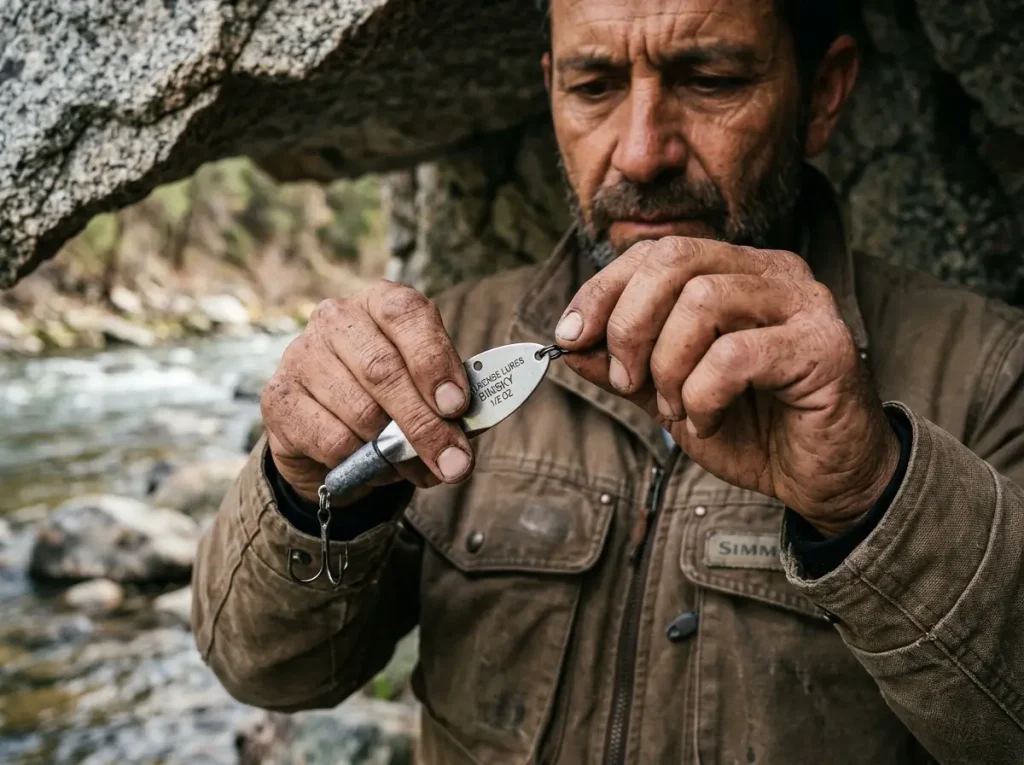
Blade baits rely strictly on reaction-strike metallurgy—how that raw metal slices through hydraulic pressure to generate a frantic, high-frequency thump.
Vortex Shedding Frequency
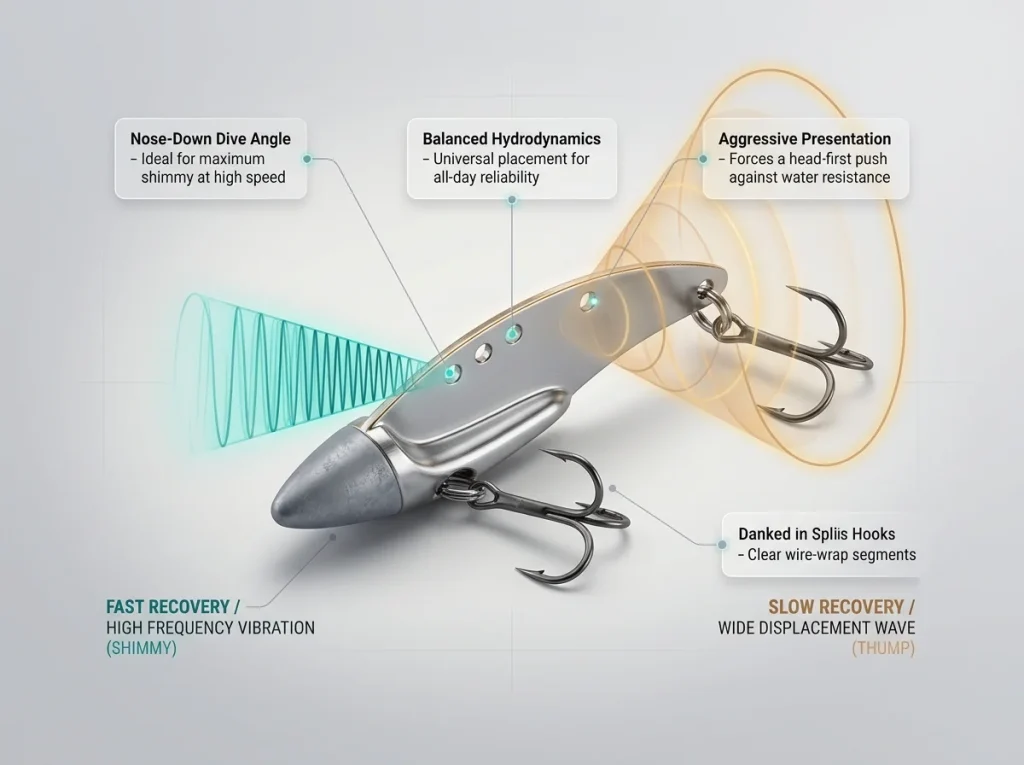
The distinct vibration radiating down your rod blank is generated by fluid dynamics called vortex shedding. As you pull the thin metal plate upwards, it cleaves the fluid, creating alternating swirls of low-pressure water tumbling off the trailing edges. The vibration frequency you achieve is governed by the Strouhal Number, a roughly constant metric around 0.22 for this lure profile. You dictate the physics of vortex shedding frequency with your wrist. A sharp pop creates the erratic panic response that triggers predators.
Hole Placement and Dive Angle
If you look closely at a Silver Buddy or a classic Molix Trago Vib, you notice drilled holes along the dorsal spine. These hole placement options alter the lure’s dive angle and how it fights water resistance. Using the front hole creates an aggressive vibration cone with a high frequency shimmy. Switching your snap to the rear dorsal hole forces the metal face forward, throwing a low frequency but wider displacement wave. Adjusting these attachment points proves that hydrodynamic balance determines swimming action.
The Anti-Sell: Paint vs. Raw Metal
Tackle shop shelves are loaded with heavily painted blades boasting premium Firetiger airbrush jobs. They catch fishermen walking the aisles, but they dampen your catch rate. Thick coat finishes and paint mute vortex shedding. Stick to unpainted polished silver or raw gold plating. The silver/gold flash bouncing vividly off naked metal provides maximum hydrodynamic clarity.
I threw beautiful custom-painted blades for years before I realized the raw metal out-fished them three to one. Once that thick epoxy dulls the stamped edge, the lure pushes water instead of slicing it.
Hydro-Acoustics and Predator Sensory Reception
In the low light of deep winter basins, visual tracking fails. The blade bait abuses those sensory organs by pumping out distress frequencies.
The Lateral Line’s Resonance Frame
A fish’s primary tracking mechanism is the lateral line, packed with sensitive neuromasts designed strictly to detect water displacement. This low-frequency vibration detection system dominates their spatial awareness. When you snap a half-ounce plate of raw metal upward, it displaces water, matching the 1 to 200 Hz resonance frame. By utilizing the lateral line system, you force the fish to track the erratic motion even in profound darkness.
Otoliths and High-Frequency Metallic Ticks
While the lateral line feels the push of the water, the inner ear bones—the otoliths—handle auditory sound. Those hidden inner ears detect higher frequencies ranging from 100 Hz up to well past 2,000 Hz. As the lure gently shudders, the metal split rings and heavy treble hooks constantly clatter against the raw body plate, creating a harsh, metallic ticking sound.
Matching the Acoustic Signature of Winter Bait
This dual-threat profile mimics precisely a wounded baitfish throwing its final failing twitches. A dying cisco or shad flutters violently in the water column, stalls out, and then shudders randomly. The erratic ticking and thumping of the heavy blade matches that organic failure flawlessly.
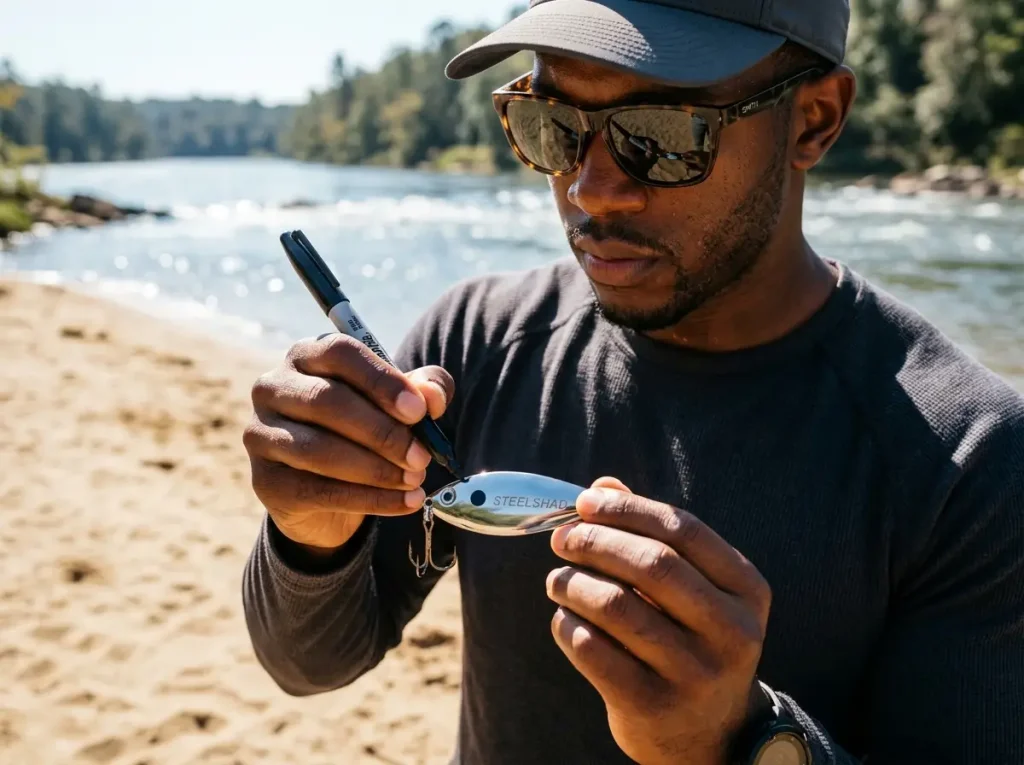
Pro-Tip: Take a thick permanent marker and draw a distinct black dot on the lead head right near the front weight. This explicitly gives predators an acoustic and visual “head-first” strike target, vastly improving your hook-up ratios on walleyes that swipe blindly at the vibration rather than engulfing the bait.
River Current Seams and Hydraulic Drag Vectors
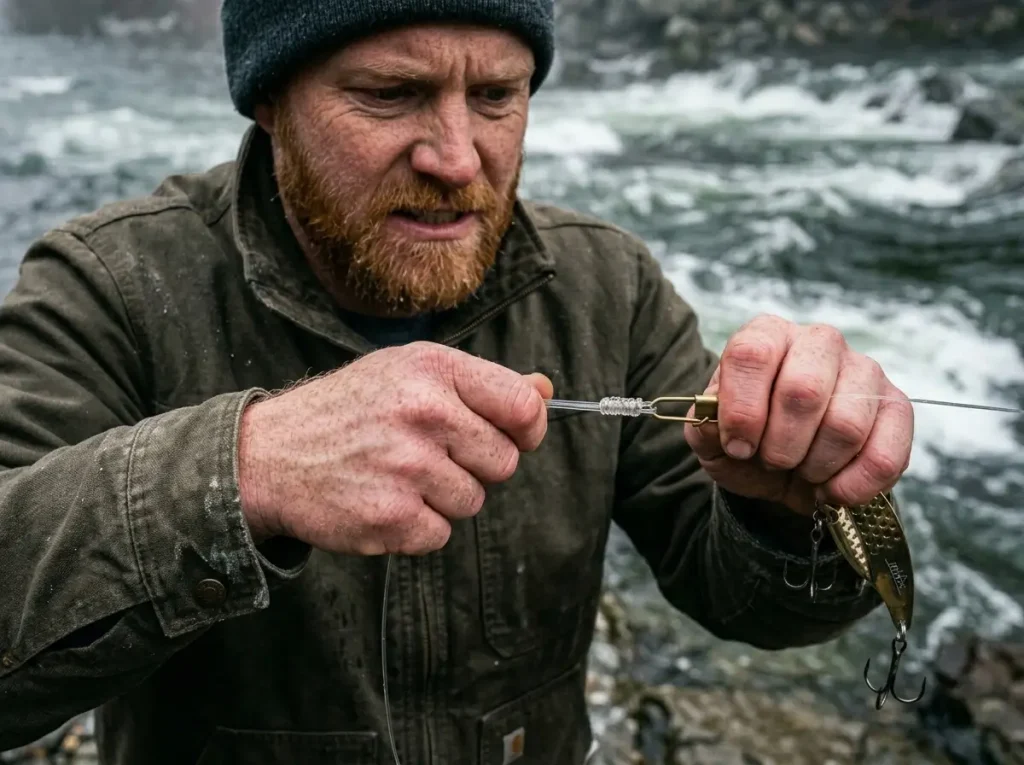
Lake structure is stationary and predictable, but rivers are living machines. Throwing 1/4 to 1/2 oz metal in a calm lake is simple arithmetic. Throwing it into fast-moving current requires an understanding of hydraulic resistance.
Calculating Drag Vectors with Substrate Roughness
River flow is never uniform. Water tumbling over sharp rocks moves much slower than water skating across the surface. Engineers measure this friction using Manning’s roughness coefficient for natural channels. A smooth sand bottom offers minimal resistance, whereas massive boulder fields create intense friction. When your thin mainline drops through these zones, chaotic eddies grab the braided line and drastically increase drag vectors.
Defeating the Substrate Wash Out Effect
While actively dredging heavy winter seams, the river uses that bottom friction layer to artificially lift your bait. This wash-out effect steals all tactile sensation. The complex hydrodynamics of current seams will humble a sloppy presentation. By boat casting or shore casting slightly upstream onto a current seam and feathering the spool on the descent, you allow the heavy blade to blindly sink on a controlled arc.
Upsizing Weights to Pierce the Boundary Layer
Overcoming violent river flow effectively means aggressively upsizing your terminal tackle. You must eagerly step up to a heavy three-quarter ounce blade setup specifically to mechanically chop through the hydraulic wall. You might switch to a Reef Runner cicada style or a Damiki Vault. A heavy SteelShad or an oversized Binsky gives you the authoritative weight required to crash through the cross-current and slam directly into the mud.
The Material Science of Rods and Cold-Weather Lines
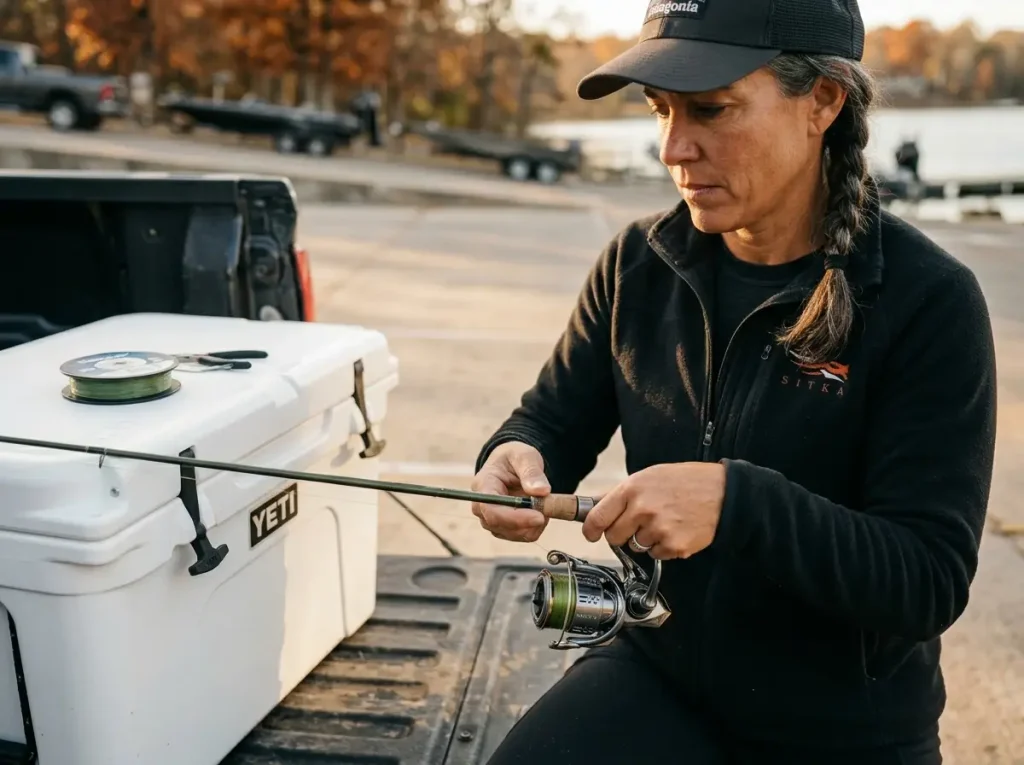
Freezing conditions brutalize material science, pushing simple polymers past breaking points and turning stiff rods into fragile glass.
Graphite Transmission Efficiency is Key
Feeling a highly lethargic walleye gently inhale a blade in sixty feet of dark water requires immense raw sensitivity. You desperately need the tactile transmission efficiency of a high-modulus graphite rod that balances tip speed vs power. However, high modulus of elasticity comes with a terrifying mechanical trade-off. Those rigid carbon blanks possess very little flex, making them alarmingly brittle when outdoor air temperatures severely drop below freezing.
Line Density vs. Freezing Point Mechanics
Choosing between line types is heavily debated among professionals. Standard nylon monofilament acts exactly like a sponge in the water. In freezing temperatures, that absorbed water freezes solidly internally, while mono-leader stretch destroys any chance of driving out the hook. Fluorocarbon is highly dense, accelerating the sink rate without bowing out the long line. However, fluorocarbon brittleness is a severe issue in intense ambient cold. By acknowledging these precise cold water line performance limitations, we adapt our standard rigging.
The Braid-to-Fluoro “Top-Shotting” Strategy
The undisputed elite tackle setup for this deep technique is top-shotting. You run a high-vis braided mainline connected to a massive, thirty-foot fluorocarbon leader. This strategy handles light penetration requirements in deep basins while preserving sensitivity. The tightly knitted braided line drives sharp hooks immediately. The extended fluorocarbon section mitigates the sudden shock of the aggressive hookset and virtually eliminates ice buildup on your rod guides.
Pro-Tip: Run your heavy fluorocarbon leader slightly longer than the precise depth you are fishing today. If you’re dropping deeply into forty feet of rocky water, tie a forty-five-foot long leader. This keeps your knot buried safely in the reel spool during the initial hookset.
Technical Execution and Snag Extraction Phase
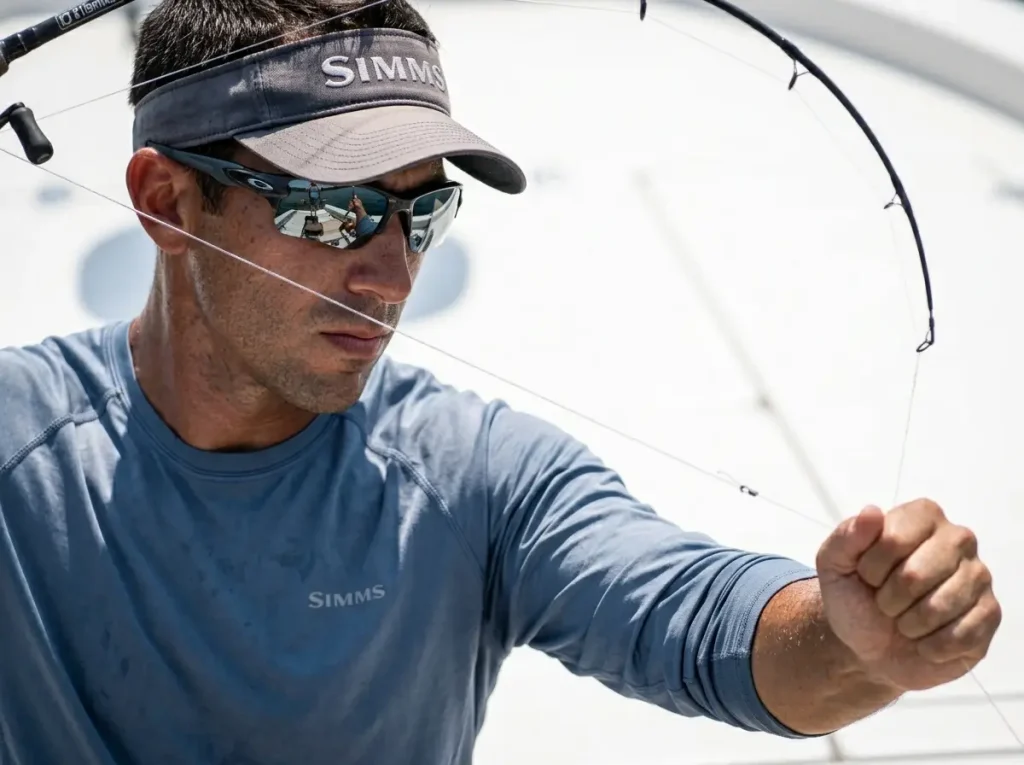
Owning the right expensive gear means absolutely nothing if your actual presentation is a mess in the water.
Phase 1: The Strictly Measured Lift
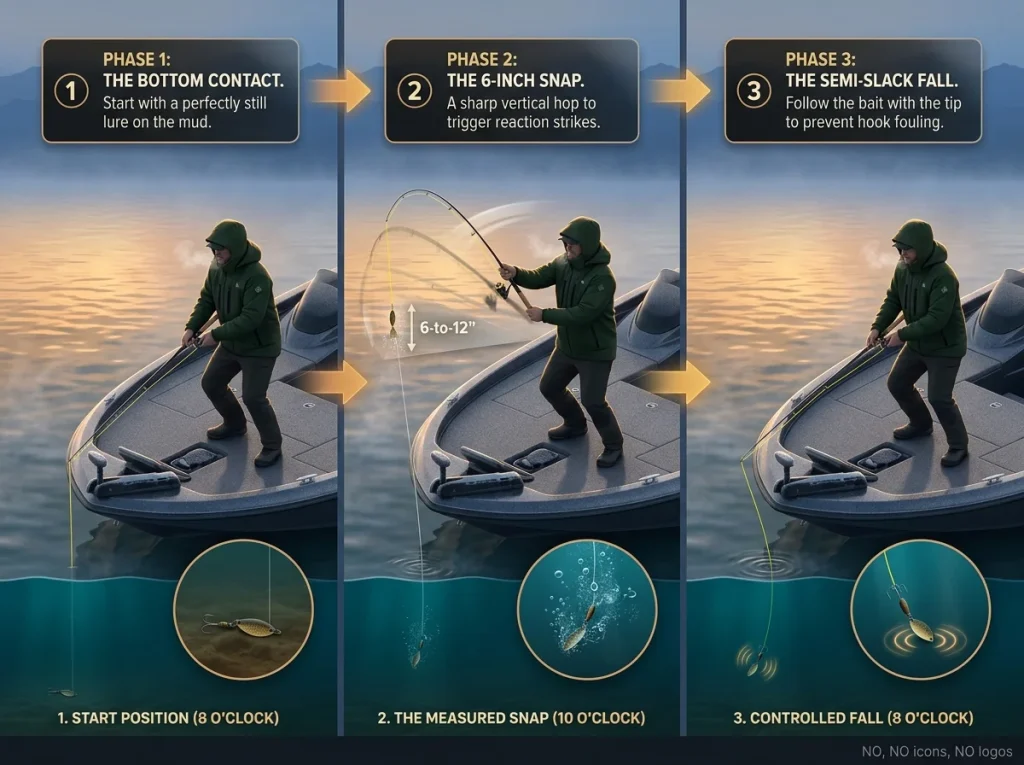
Your retrieval started with a brutally strict wrist snap. You forcefully pull the rod tip upward just enough to barely feel the heavy blade positively jump—precisely between six and twelve inches high off the rocks. Moving the tip too aggressively will wildly overload the optimal Strouhal shed frequency. To match the lethargic cold-blooded reality of establishing a reliable jigging cadence, you must force yourself to slow down.
The biggest mistake I see clients make isn’t the lure they use, but the aggressive stroke length. If your elbow leaves your side, your stroke is too big.
Phase 2: The Semi-Slack Controlled Fall
Ninety percent of your massive strikes happen entirely on the downward fall. You must learn the semi-slack line drop technique. If you poorly introduce total line slack, the heavy lead nose plummets instantly. The sharp treble hooks flip upward, grabbing your clear fluorocarbon securely. To ensure reliable hook fouling prevention, strictly follow the sinking bait gracefully down with your moving rod tip in a semi-tight line fall.
Phase 3: The Bow and Arrow Safe Extraction
Because you loosely drag exposed raw trebles through heavily chunked gravel pits, snagging the bottom is guaranteed. Winterizing your blade with proper hook swaps—like inward-bending Triple Grips—helps significantly. And remember: snap-link quality securely matters. Smartly employ the highly effective “Bow and Arrow” snap. Pull the braided line entirely taut, grab it securely, stretch it forcefully sideways heavily, and release it sharply. That sudden violently kinetic reverse-shock wave pops the heavy metal nose backward, gracefully freeing the rig.
Pro-Tip: The traditional method turns a heavy lead chunk directly into a dangerous projectile traveling extremely fast straight back at your face. Wear quality impact-rated eye protection consistently when boldly ripping out deep heavy snags.
Conclusion
Finding success strictly demands viewing the brutal winter water precisely as an unforgiving mathematical equation. When seasonal temperatures plummet, fish lethargy is bound fiercely by the cold laws of biology. You absolutely cannot force them to feed, but you can confidently force a physical reaction by tapping into their lateral line.
Precisely tune your exact vibration count strictly using raw, unpainted metal, and command your extremely short vertical hops to keep the presentation energy-positive for the reluctant predator. Heavily dial in your exact hydro-acoustic signature directly on your next freeze-out winter trip. You will definitely be out there slamming the aggressive giants others assume are impossible to catch. Stop relying on dumb luck, firmly fix your sloppy cadence, and violently control the deep strike zone.
FAQ
What is the optimal gear ratio for blade bait fishing winter bass or walleye?
A slower gear ratio like 6.3:1 or 5.2:1 is vastly superior to standard high-speed burning models. A slower reel physically prevents you from over-working the moving bait forcefully on the pickup and forces you down into the meticulously slow rhythm required in sub-40-degree water depths.
Why does my blade bait keep tangling on my fishing line during the cast?
Fouling occurs when the heavy lure is loosely allowed to tumble deeply in freefall without tension. Always firmly stop the peeling line safely with your thumb directly before the fast lure crashes into the cold water, and accurately manage a proper tight line fall down entirely through the deep water column so hooks stay trailing comfortably behind the weighted nose.
Are blade baits effective in heavily stained or muddy winter water?
Yes, absolutely, but the mechanical vibration output firmly must be intelligently maximized. Confidently move your heavy snap directly to the rear dorsal hole to effectively widen the precise angle of attack and aggressively increase lateral water displacement. This simple modification allows the struggling fish’s sensory organs to track the passing lure effectively despite zero underwater visibility.
Should I tie my main line directly to a blade bait?
Never. The roughly stamped metal edges exactly at the small tie-off point will quickly sever fluorocarbon or weak monofilament violently under the brutal shock of a deep hookset. Always utilizing a high-quality perfectly rounded snap or heavy-duty split ring is strictly required.
Risk Disclaimer: Fishing, boating, and all related outdoor activities involve inherent risks that
can lead to injury. The information provided on Master Fishing Mag is for educational and informational purposes
only. While we strive for accuracy, the information, techniques, and advice on gear and safety are not a substitute
for your own best judgment, local knowledge, and adherence to official regulations. Fishing regulations, including
seasons, size limits, and species restrictions, change frequently and vary by location. Always consult the latest
official regulations from your local fish and wildlife agency before heading out. Proper handling of hooks, knives,
and other sharp equipment is essential for safety. Furthermore, be aware of local fish consumption advisories. By
using this website, you agree that you are solely responsible for your own safety and for complying with all
applicable laws. Any reliance you place on our content is strictly at your own risk. Master Fishing Mag and its
authors will not be held liable for any injury, damage, or loss sustained in connection with the use of the
information herein.
Affiliate Disclosure: We are a participant in the Amazon Services LLC Associates Program, an
affiliate advertising program designed to provide a means for us to earn advertising fees by advertising and linking
to Amazon.com. As an Amazon Associate, we earn from qualifying purchases. We also participate in other affiliate
programs and may receive a commission on products purchased through our links, at no extra cost to you. Additional
terms are found in the terms of service.