
In this article
Three bass in a row. All solid strikes on a Rapala DT6 running the 8-foot ledge. And three bass spit the bait before I could turn a single one. The factory hooks were bending open on fish that barely broke two pounds.
After twenty-plus years of cranking reservoirs from Texas to Tennessee, I’ve seen this play out hundreds of times. The hooks that come stock on your crankbaits are built to a price point, not a performance standard. And it’s costing you fish every single trip.
Here’s the exact sizing formula, hook styles, and step-by-step swap process that professional anglers use to boost their landing percentage by 20% or more — without killing lure action.
⚡ Quick Answer: Upsize the belly hook by one full size and the tail hook by a half-size using short shank round bend or short shank EWG trebles. This increases the hook gap for better holding power on hard bass mouths while preserving crankbait action preservation. Always test in water after every swap. This simple crankbait hook upgrade can improve your landing rate by 15-20%.
Why Factory Crankbait Hooks Fail You
 Owner Stinger ST-36 short-shank replacement” class=”wp-image-10973″/>
The Cost-Cutting Truth Behind Stock Trebles
Every crankbait that rolls off the assembly line carries a dirty secret. Those shiny factory treble hooks are the cheapest component on the entire hard-bodied lure. Manufacturers use thin wire gauge and narrow gaps to save pennies per unit — not to help you land fish.
The stock treble size is chosen for one thing: making the bait swim right out of the package. That’s it. Nobody in the factory is thinking about whether that treble hook will hold a four-pound largemouth that hammers the bait on a fast burn.
Pro tip: If you’ve ever pulled a factory hook off a crankbait and bent the point with your thumbnail, that tells you everything. Those beat-up factory hooks were never built for the fight.
How Undersized Gaps Cost You Fish
The hook gap — that distance between the point and the shank — is what decides whether a bass stays buttoned or throws the bait at the boat. A narrow gap gets less bite into a hard, bony bass mouth. On reaction strikes where the fish barely opens up, a small gap misses the corner hookset entirely.
Understanding the physics of hook penetration force makes the fix obvious. A wider gap gives the point more room to grab meat. More grab means less force needed to punch through, and better hooking potential once the fish is on. It’s the single biggest variable you can control.
The 20% Landing Increase That Changed Everything
Bassmaster Elite pro Michael Iaconelli documented something that changed how serious anglers fishing crankbaits think about their hardware. After switching to upsized short shank round bend trebles on his DT-series crankbaits, he tracked a 20% increase in landing percentage.
The formula was specific — not just “go bigger.” He upsized the belly one full size and the tail a half-size on his Rapala DT6 (stock #6 belly to #4, tail to #5). That differential approach is now the standard among tournament pros. And according to National Park Service catch-and-release guidelines, proper hook selection also plays a critical role in fish survival during release.
The Belly-Tail Differential Rule
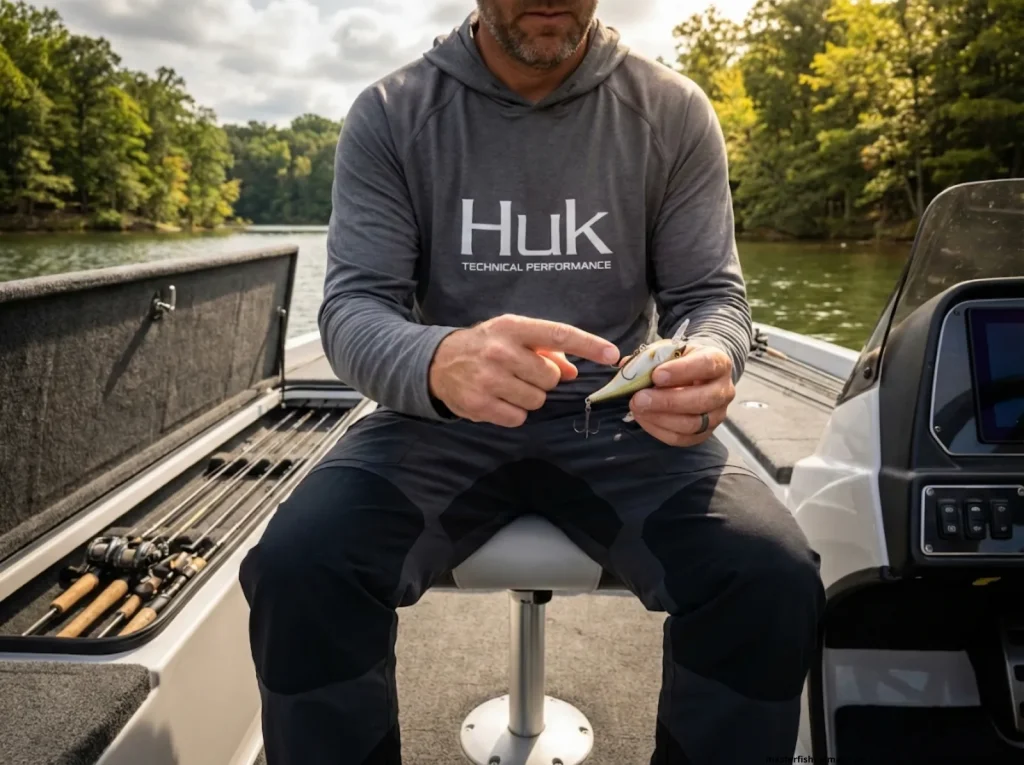
Why the Belly Hook Gets +1 Full Size
The front hook hangs directly behind the crankbait’s bill, which acts as a physical deflector during the fight. Because the bill shields it, a larger belly hook adds hook gap width without creating drag problems or tangling issues.
Going up one full size (stock #6 to #4, for example) gives you measurably better holding power on fish that hit from below or head-on. But here’s the non-negotiable part: it must be a short shank design. A standard wire one-size-up will tangle with the tail hook on every cast. The shorter shank prevents the bigger hooks from fouling, and does not affect the action of the bait.
Understanding how bill angle affects dive depth and deflection helps explain why the belly position tolerates more aggressive upsizing. The bill protects the larger hook from snagging bottom on deeper presentations too.
Why the Tail Hook Gets Only +½ Size
The tail hook sits at the balance point of every hard bait. No bill protection. No deflector. Over-upsizing here kills the wobble that makes a crankbait catch fish in the first place.
Half-size tail increments are the sweet spot — enough extra gap for better hook penetration, minimal impact on lure balance. Take that same DT6: stock #6 tail goes to #5. That’s it. Push to #4 on the tail and the bait runs nose-heavy, especially on slow rolls.
Pro tip: If you’re running a yo-yo retrieve or any vertical presentation, the tail weight matters even more. Some tournament pros keep the tail at stock treble size on yo-yo applications and only upsize the belly hook.
Size-by-Crankbait-Class Quick Chart
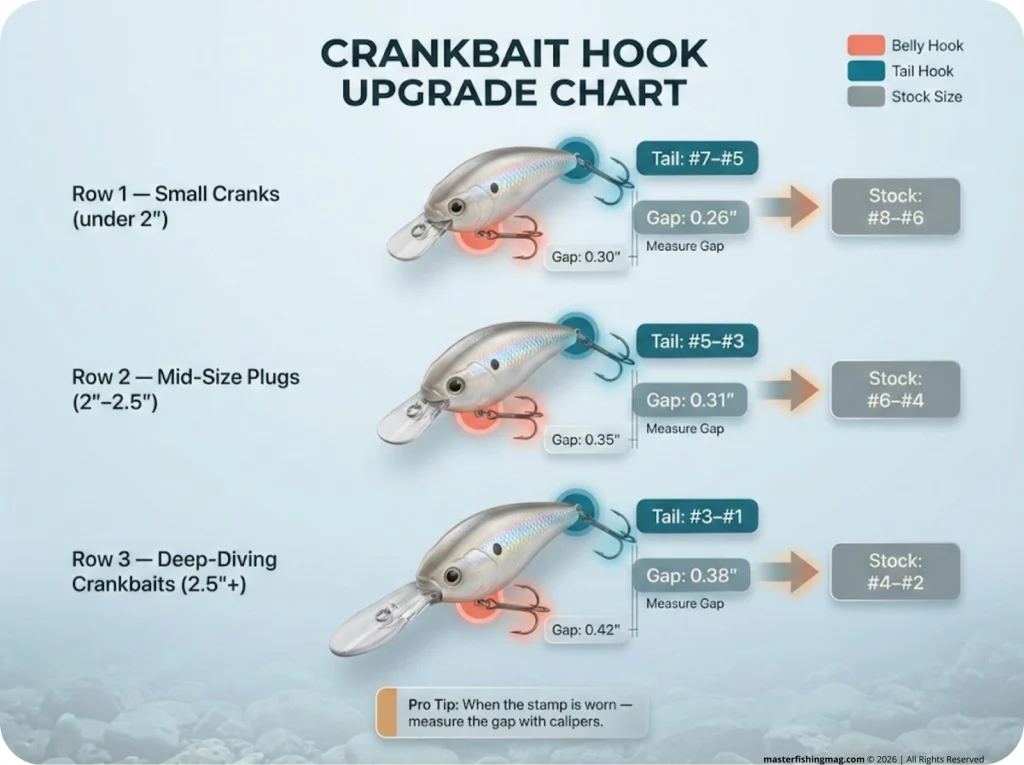
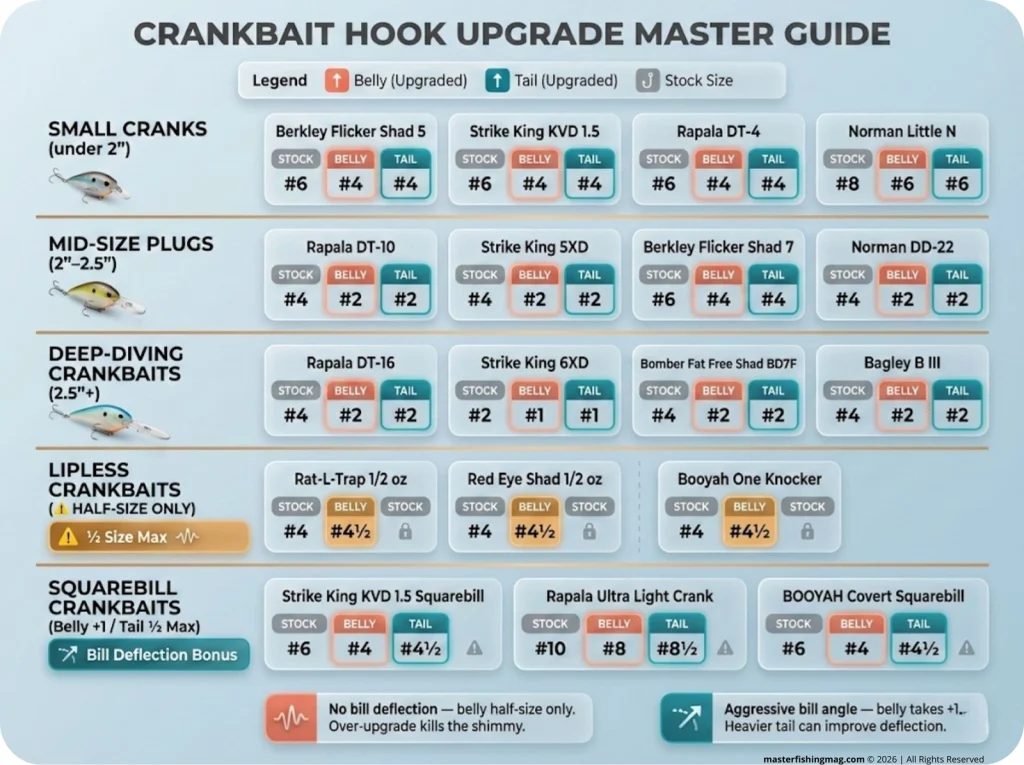
Here’s the breakdown by crankbait class. These are the ranges that work consistently across most lure manufacturers:
- Small cranks (under 2″): Stock #8–#6 → Belly to #6–#4, Tail to #7–#5
- Mid-size plugs (2″–2.5″): Stock #6–#4 → Belly to #4–#2, Tail to #5–#3
- Deep-diving crankbaits (2.5″+): Stock #4–#2 → Belly to #2–#1/0, Tail to #3–#1
When the hook size chart stamp is worn or missing, measure the gap with calipers. Guessing costs you the wrong size every time.
Choosing the Right Hook Style for Your Water
Short-Shank Round Bend for Open Water
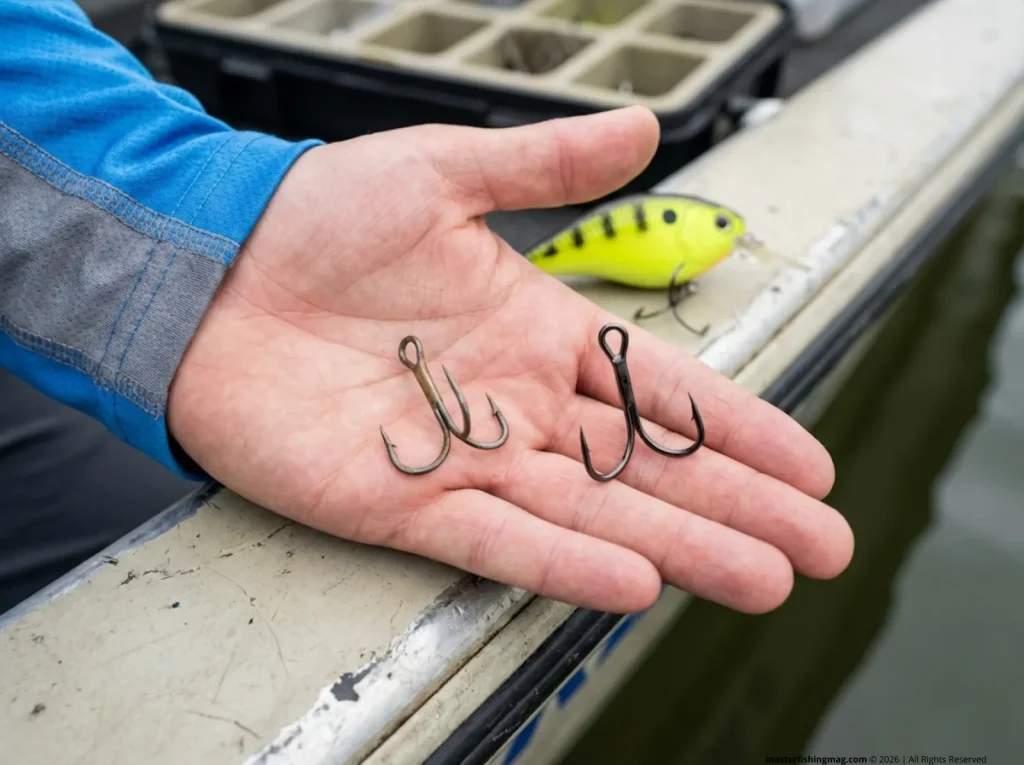
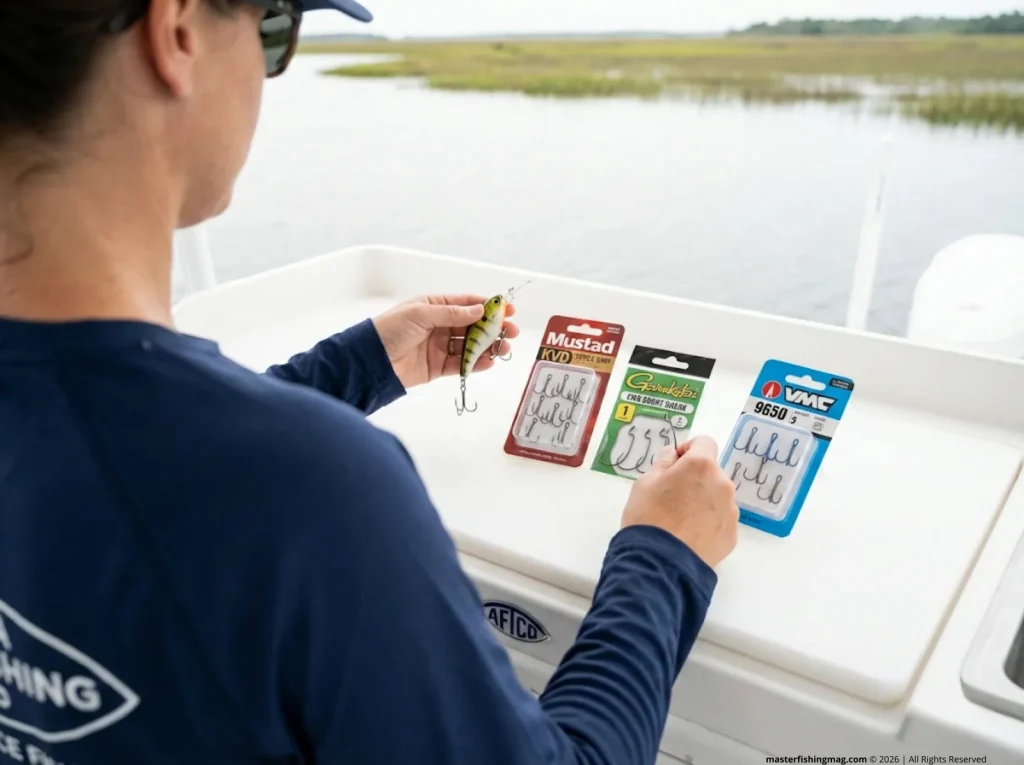
Gamakatsu Round Bend and Owner Stinger ST-36 trebles have the point angled away from the shank. That angle allows easier penetration on tentative bites — the kind you get on cold-front days or in cold, clear water where bass slap the bait instead of committing.
The short shank design is what makes upsizing work. Without it, a bigger hook tangles with its neighbor every cast. For open-water cranking on reservoirs, short shank round bend trebles in 1X wire are the standard. The VMC 9650BN is the budget workhorse if you’re outfitting a whole lure box at once.
EWG Short Shank for Grass and Cover
When you’re burning a squarebill through milfoil or hydrilla, round bends aren’t enough. Gamakatsu EWG Short Shank and Mustad KVD 1X Strong Triple Grip trebles have inward-bent points that grip harder once set. They won’t let go when a bass heads for the nearest laydown.
The trade-off is real, though. EWG requires more force to penetrate initially, which means you’ll miss some of those light, tentative bites. In grass and cover where fish hit hard and run, that’s a trade worth making. In open water, stick with round bend.
You can also consider converting trebles to inline single hooks for catch-and-release waters where regulations push you toward less hardware in a fish’s mouth. As Connecticut DEEP recommends, modifying treble hooks on hard baits reduces fish injury during release.
When Inline Trebles Make Sense
Inline trebles have the eye welded in line with one point instead of centered. They resist torque-pulls during the fight — the kind of head-shakes that throw standard trebles on spotted bass and current-fighting smallmouth.
Owner Stinger ST-35 is the benchmark here. Less common for standard bass cranking, but growing in popularity for single-hook conversion applications and light-biting species. Each point on an inline treble penetrates independently, which gives you a cleaner release every time. Look for models with corrosion-resistant finishes if you’re cranking anywhere near salt.
The Swap Process Step by Step
Tools You Need (And One You’re Skipping)
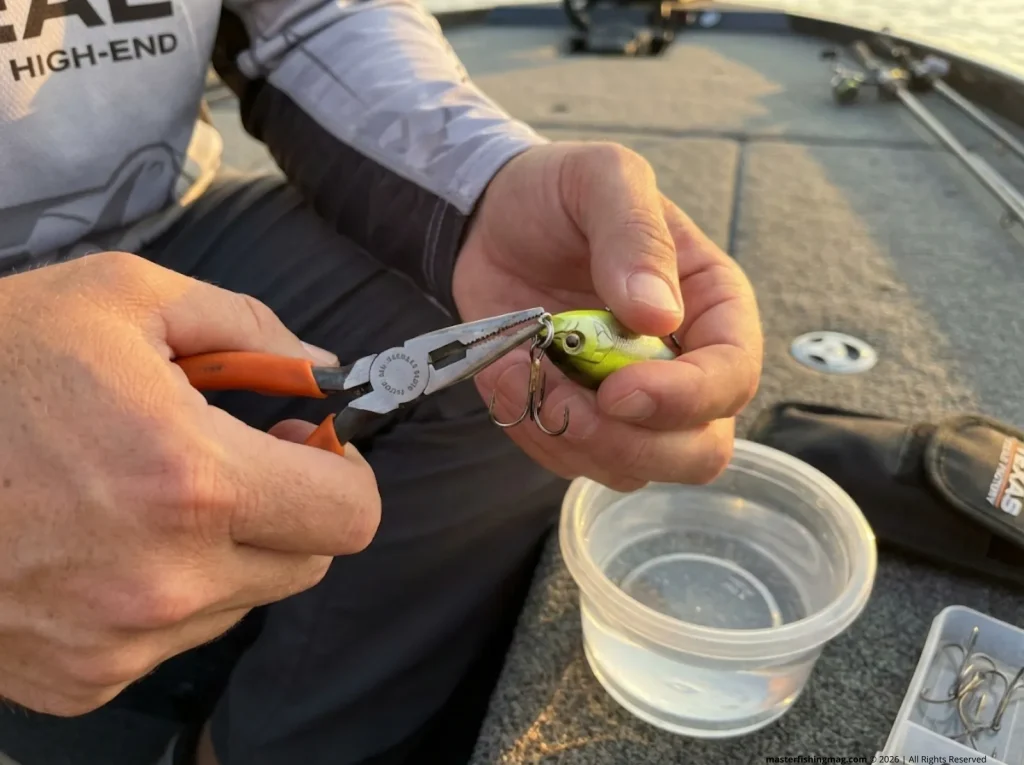
Texas Tackle Split Ring Pliers are the single most important tool for this job. Don’t try it with needle-nose — you’ll deform the ring, scratch the lure, and probably stab yourself. Get the right tool.
Beyond pliers, you need three things most people skip: eye protection (split rings launch), digital calipers (measure the existing gap when the stamp is worn), and spare split-ring upgrades one gauge heavier than stock. When you go up a hook size, the stock ring may not hold under load.
Removing Factory Hooks Without Damage
Open the split ring on the lure eye, not the hook eye. Less risk of bending the wire hanger. Rotate the old treble hook off completely before starting the new one — never have two hooks on one ring at the same time.
Inspect that split ring after removal. If it’s deformed at all, replace it now. A weak ring will open under a four-pound bass, and you’ll lose both the fish and the upgrade hook you just paid for.
Installing Upgraded Hooks and Testing Action
Thread the new hooks onto the split ring point-side in, rotating smoothly until the ring closes flush. Install the belly hook first — it determines the balance center, so you need to confirm it before setting the tail hook.
Here’s where most people fail: they skip the water test. Drop the crankbait in water and retrieve at three speeds — slow roll, medium crank, and burn. Watch for nose-heavy tilt or reduced wobble. If the bait doesn’t run true, drop the tail back to stock before going smaller on the belly. Learning to tune a crankbait to swim true after modifications is just as important as the hook swap itself.
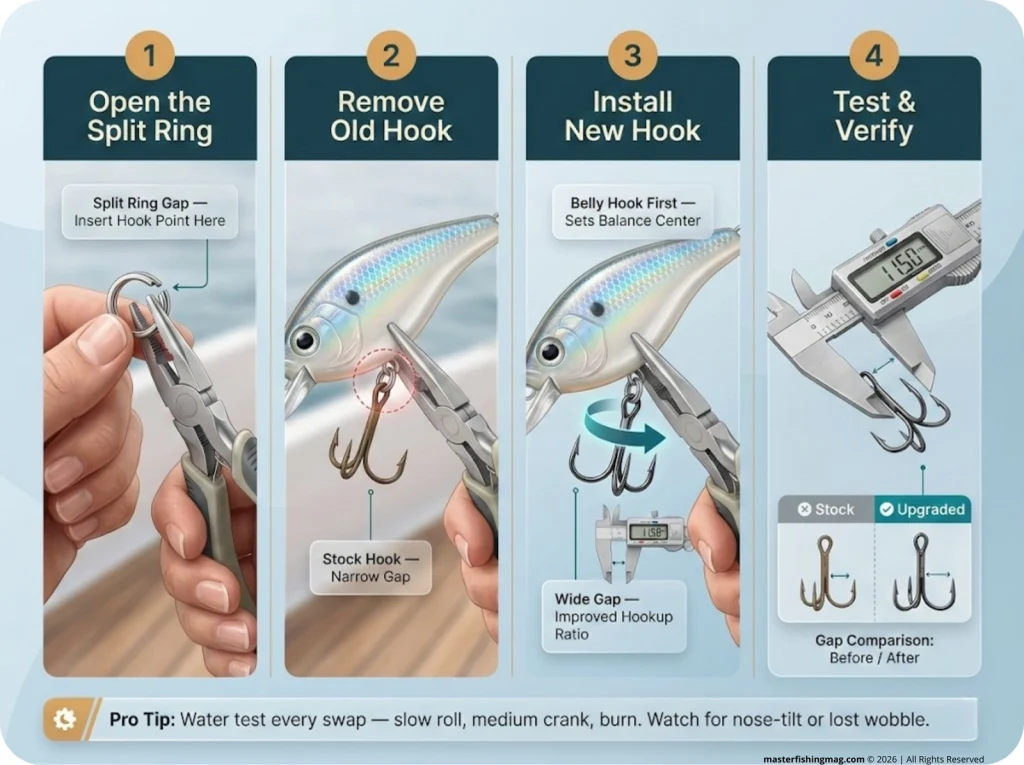
Pro tip: Carry a small container of water in the boat to test in water immediately after every swap. Don’t wait until you’re on a fish to find out your new crankbait setup runs crooked.
The Crankbait Hook Upgrade Matrix
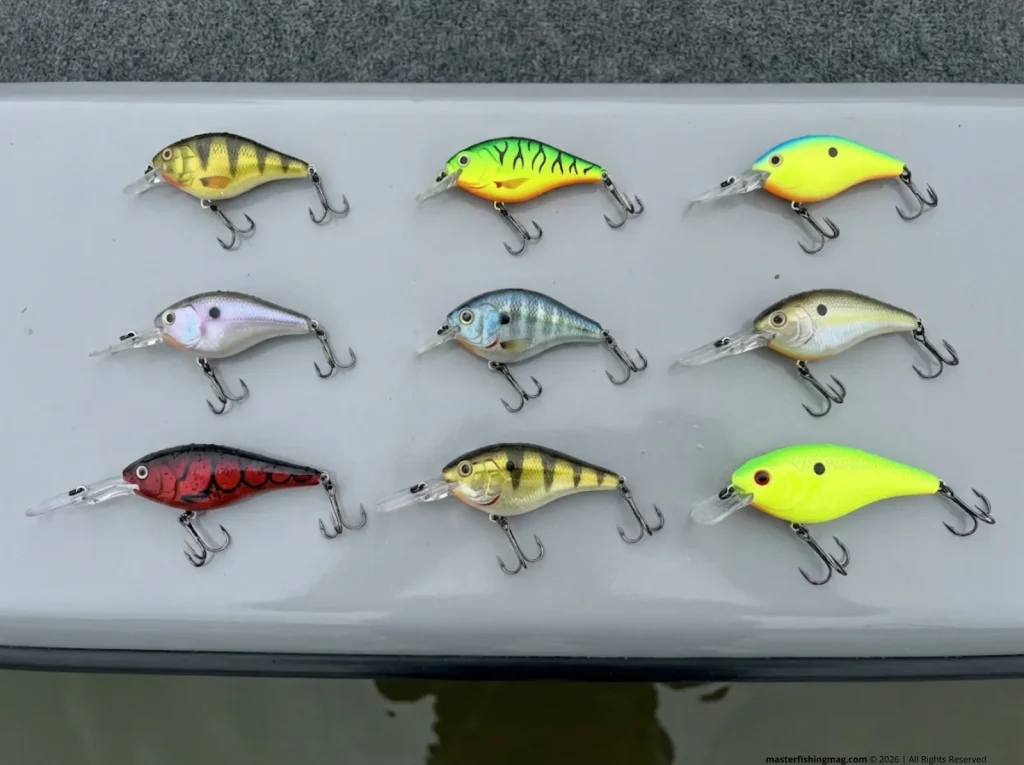
Small and Mid-Dive Crankbaits
This is the reference table nobody else has published. Every crankbait below follows the belly+1/tail+½ rule, confirmed across multiple seasons of testing. Match the size and weight of the original hook as your starting baseline, then apply the differential.
The Rapala DT6 with stock #6 VMC trebles gets belly #4 and tail #5 — exactly the Iaconelli formula. The Strike King KVD 1.5 squarebill ships with #6s and takes belly #4, tail #5 in short shank designs. Baby 1-Minus runs best with #6 belly and stock #8 on the tail. The Berkley Fusion19 hook line works as budget replacements across all of these.
For the Lucky Craft LC 1.5 and LC 2.5, stock #6 goes to belly #4 with Gamakatsu EWG Short Shank — particularly effective since these lures are popular in grass-heavy lakes. Whether you’re choosing a snap swivel or direct tie on your crankbaits, the connection hardware matters just as much as the hook swap for preserving lure action.
Deep-Diving and Magnum Crankbaits
Deep-diving crankbaits like the Rapala DT14 and DT16 tolerate more aggressive belly upsizing because the bill provides even more protection at depth. Stock #3 VMC trebles on a DT14 handle a jump to #2 belly, with the #3 tail staying stock.
On magnums like the Strike King 6XD and 8XD, the stock hooks are already #2. Going to #1/0 on the belly requires split ring verification and a full tank test. Wire strength matters more here — 1X wire minimum, 2X wire if you’re targeting stripers or big hybrids on heavy trolling applications with these plugs.
Lipless and Squarebill Special Cases
Lipless crankbaits have no bill deflection. That means the belly only gets a half-size increase — not a full size. On a Rat-L-Trap or Red Eye Shad with stock #6, the belly goes to #5 and the tail stays stock. Push it further and you’ll kill the tight shimmy that makes lipless crankbaits work.
Squarebill crankbaits are the opposite. The aggressive bill angle means the belly can safely take a +1 upgrade, but the tail hook must stay stock or go up a half-size maximum. Heavier hooks can actually improve the bottom-bouncing deflection that makes squarebills so effective in shallow cover.
Keeping Your Upgraded Hooks Sharp and Sustainable
When to Sharpen vs. When to Replace
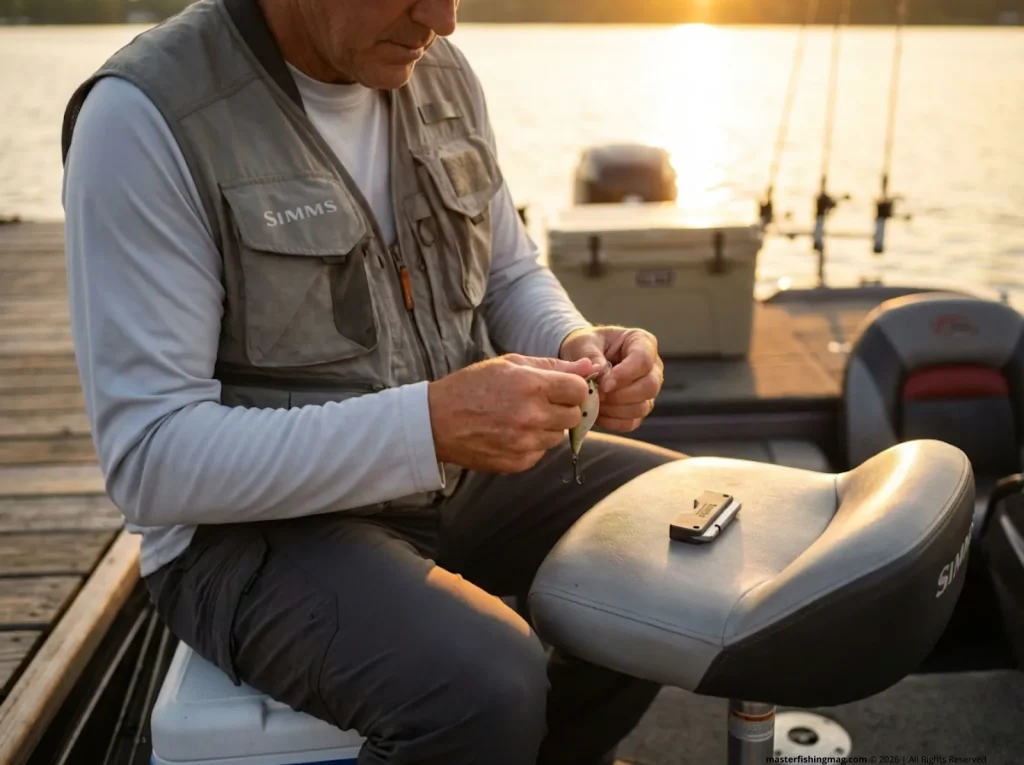
Premium hooks from Owner, Gamakatsu, and Mustad hold their edge three to five times longer than factory hooks. But they’re not permanent. Test sharpness by dragging the hook point across your thumbnail — if it doesn’t dig in immediately, it’s dull.
Here’s the honest truth about chemically sharpened hooks: they’re harder to re-sharpen than mechanically sharpened ones. Replacement usually beats resharpening on premium hooks. For more on technique and angles, check out our full guide to sharpening fish hooks. Budget VMC bulk packs are meant to be treated as consumables — swap them every few trips and don’t look back.
The Conservation Case for Quality Hooks
Better hooks mean fewer lost fish with hardware in their mouths. Every straightened treble hook that pulls free during a fight is a potential mortality event for that bass. Fewer thrown hooks means fewer gut-hooked fish dying three days later.
Durable hooks also mean fewer lures snagged and lost with worn-out components. Less tackle in the water means less environmental waste. According to Louisiana Wildlife and Fisheries best fishing practices, using quality hooks and proper release tools is a core recommendation for responsible catch-and-release.
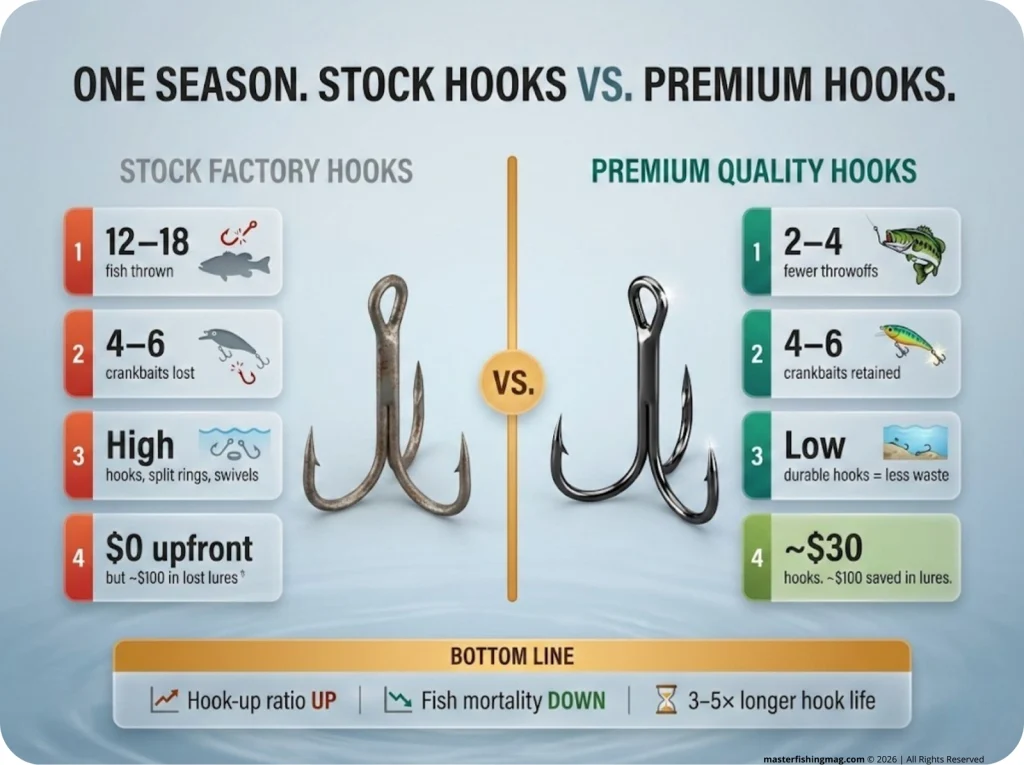
Pro tip: I spend about $30 a season on premium hooks and save at least $100 in lost crankbaits. The hook-up ratio goes up, the fish mortality goes down, and the hook life lasts three to five times longer than stock. That math works every time.
Your Next Move
Three things to remember from this entire process. First, factory treble hooks are built to a price point, not a performance standard — swapping them is the single highest-return modification you can make to any crankbait. Second, the belly+1/tail+½ rule with short shank trebles is the proven formula: bigger hook gap where the bill protects it, conservative on the tail to preserve lure action. Third, always test in water after a swap. If the bait doesn’t swim right, it won’t catch fish — no matter how premium the hooks are.
Grab five crankbaits from your lure box tonight. Check the hook stamps. Order the short shank replacements. The next time that three-pounder commits on a DT6, she’s staying buttoned.
FAQ
What size treble hooks come stock on most crankbaits?
Most small crankbaits ship with #8–#6 treble hooks, mid-size plugs with #6–#4, and large deep-diving crankbaits with #4–#2. The exact size is usually stamped on the hook shank. If the stamp is worn, measure the hook gap with calipers to confirm the stock treble size before ordering replacements.
Do bigger hooks affect crankbait action?
They can if you upgrade both hooks equally or use standard-shank designs. The belly+1 or tail+½ rule with short shank trebles preserves the factory wobble while adding meaningful gap width for better hook penetration. Always test in water at three retrieve speeds after any swap.
Should I upsize hooks on lipless crankbaits too?
Yes, but conservatively. Lipless crankbaits have no bill deflection, so the belly only gets a half-size increase instead of a full size. The tail hook stays stock or goes up a half-size maximum to preserve the tight shimmy that triggers strikes.
What’s the best treble hook brand for crankbaits?
For freshwater bass, Owner Stinger ST-36, Gamakatsu EWG Short Shank, and Mustad KVD 1X Strong Triple Grip are the pro standards. VMC 9650BN is the best budget option. All must be short shank designs for proper crankbait action preservation.
Do I need to replace the split rings when upgrading hooks?
Often yes. Stock split rings are sized for factory hooks — a larger, heavier treble hook puts more stress on the ring during the fight. Split-ring upgrades to the next gauge are recommended whenever you go up a full size on the belly hook.
Risk Disclaimer: Fishing, boating, and all related outdoor activities involve inherent risks that
can lead to injury. The information provided on Master Fishing Mag is for educational and informational purposes
only. While we strive for accuracy, the information, techniques, and advice on gear and safety are not a substitute
for your own best judgment, local knowledge, and adherence to official regulations. Fishing regulations, including
seasons, size limits, and species restrictions, change frequently and vary by location. Always consult the latest
official regulations from your local fish and wildlife agency before heading out. Proper handling of hooks, knives,
and other sharp equipment is essential for safety. Furthermore, be aware of local fish consumption advisories. By
using this website, you agree that you are solely responsible for your own safety and for complying with all
applicable laws. Any reliance you place on our content is strictly at your own risk. Master Fishing Mag and its
authors will not be held liable for any injury, damage, or loss sustained in connection with the use of the
information herein.
Affiliate Disclosure: We are a participant in the Amazon Services LLC Associates Program, an
affiliate advertising program designed to provide a means for us to earn advertising fees by advertising and linking
to Amazon.com. As an Amazon Associate, we earn from qualifying purchases. We also participate in other affiliate
programs and may receive a commission on products purchased through our links, at no extra cost to you. Additional
terms are found in the terms of service.