
In this article
The first thirty casts looked perfectly fine. Clean upstream angle, decent entry, textbook arc downstream. But my bait shot through that run like it was late for something — bouncing twice, then nothing. No ticks, no pauses, no fish. I kept adding weight, convinced the problem was depth. It wasn’t. I was matching surface speed instead of what the current was actually doing near the bottom, and that one mistake burned through an entire morning on the Madison River.
Then I stripped two inches of pencil lead off my rig, flipped the weight formula I’d been using for years, and the next cast ticked five times in eight feet. Two drifts later, a winter steelhead buried the Lil Corky and nearly ripped the rod out of my hands. That was the day I learned a rule that professional guides have known for decades — one that most drift fishing content gets completely wrong.
This article breaks down that rule. You’ll learn why your eyes lie about current speed, how to tune your weight to the actual subsurface flow, and a strike-zone extension technique that competitive anglers use but almost nobody teaches. Everything here is backed by state fish and wildlife agencies and field-tested on rivers from Montana to the Sacramento.
⚡ Quick Answer: Your bait must drift at the river’s subsurface current speed — not the surface speed you can see. If you can’t match it exactly, go slightly slower rather than faster. Cast upstream at a 30-45° angle, adjust weight until your bait ticks bottom every 1-2 feet, and set the hook hard on any hesitation. That’s the entire system.
How River Current Actually Moves (And Why Your Eyes Lie)
Surface Speed vs. Bottom Speed — The Gap That Costs You Fish
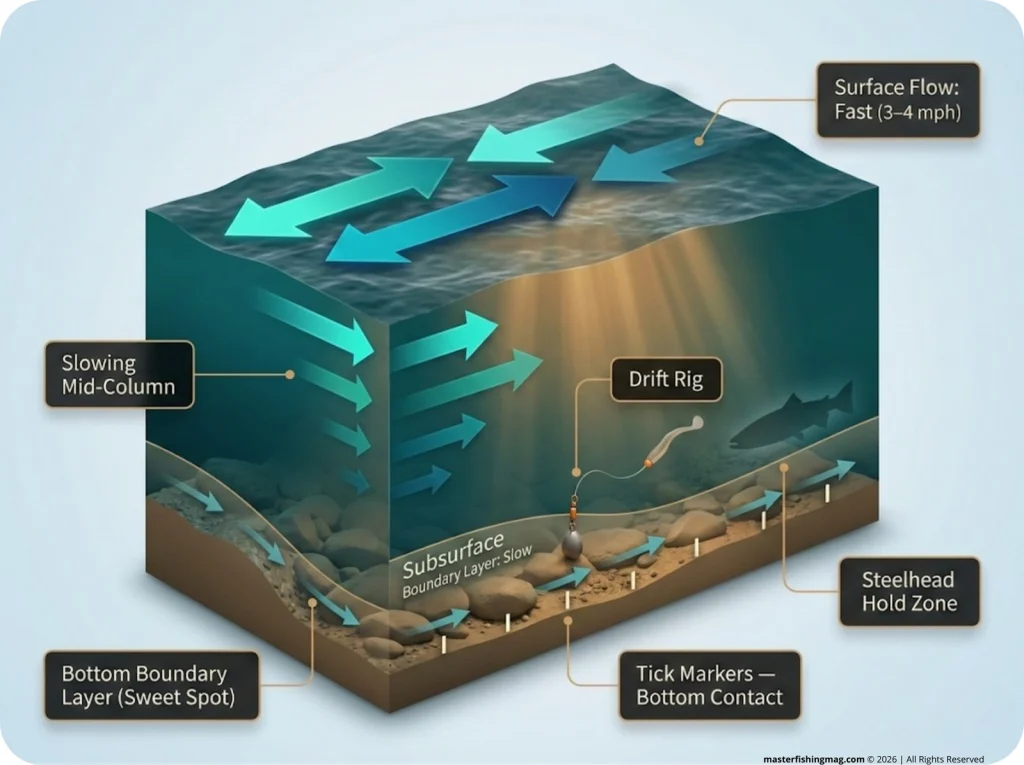
Here’s what nobody tells you when you start drift fishing: the water you’re looking at isn’t the water your bait is traveling through. Surface current runs significantly faster than the subsurface layer where your bait actually drifts. Friction from the riverbed creates a boundary layer that slows everything near the bottom — sometimes by 20-40% compared to what’s happening on top.
If you calibrate your weight to surface speed, your bait anchors on the bottom instead of ticking naturally. You’ll snag constantly, assume you need less weight, and end up with a bait presentation that either drags or floats — neither of which catches fish.
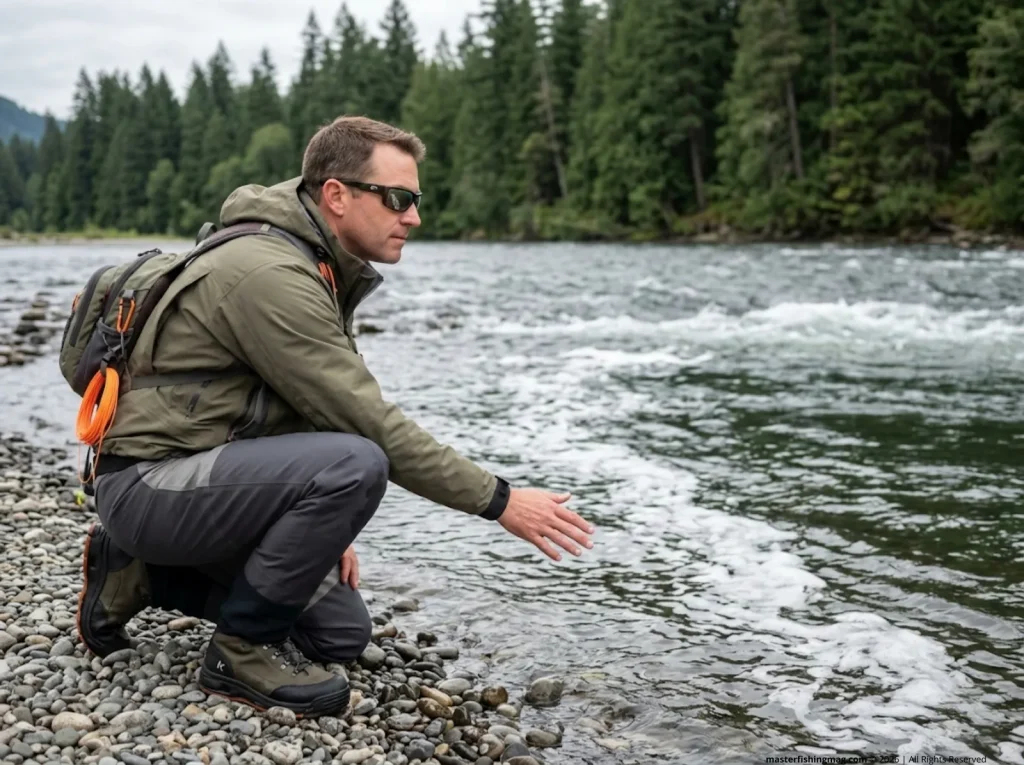
Pro tip: Toss a small stick onto the surface and watch how fast it moves. Then watch your line tip. The stick will always travel faster than what the fish are experiencing below. That gap is your weight calibration window.
Eddies, Seams, and Tailouts — Where Current Speed Changes Dramatically
Current seams — the visible lines where fast water meets slow water — are where fish park themselves. They sit right on that speed break, spending minimal energy while intercepting food that the faster waters push past them. You can often spot seams by looking for foam lines on the surface.
Eddies reverse flow direction entirely, so your bait drifts upstream inside them. Tailouts accelerate as the pool shallows, which means you may need to remove weight mid-drift as your rig picks up speed. And riffles — those bubbly, fast, shallow sections — often hold trout in just two feet of broken water behind rocks. For the full breakdown of how these structures work together, the guide on reading riffles, runs, and pools is worth studying.
Reading “Walking Speed Water” — The Steelhead Sweet Spot
According to Washington Department of Fish & Wildlife drift fishing guidelines, ideal steelhead water runs 4 to 8 feet deep at roughly walking speed — approximately 3-4 mph. That’s your textbook target. King salmon prefer deeper, slower-moving water: 10 to 20 feet with flat bottoms, especially on the Sacramento River.
Trout hold in water as shallow as two feet if current is broken by boulders. Species-specific speed preferences determine where you should target — not just where the water “looks fishy.”
The Slower-Better Rule (And Why Most Anglers Get Weight Backward)
Why “Slightly Slow” Beats “Slightly Fast” Every Time
Jeff Goodwin, a professional guide with 30+ years on the Sacramento River, puts it bluntly: “It’s very important that the baits drift through King salmon holding water at the same speed as the river current so it makes the baits look like they are drifting along the river bottom naturally. If you can’t match drift speed to current, it’s better slower than faster.”
A bait that races through a run passes fish too quickly for them to react — especially in cold water when metabolisms slow. A slightly slow bait mimics a struggling or dying organism. That’s a natural trigger. Too slow and it just sits on the bottom, which is equally wrong. You need the rhythmic tick-tick-tick of a bait tapping bottom every foot or so as it moves downstream.
The Weight Adjustment Protocol — How to Find the Perfect Tick
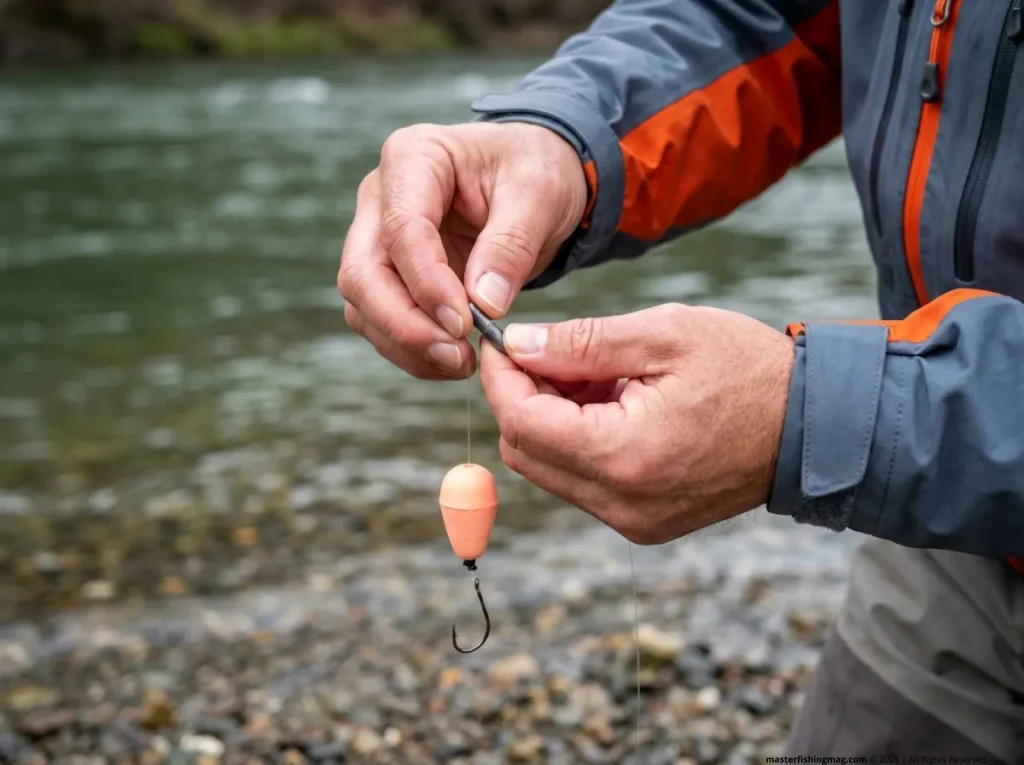
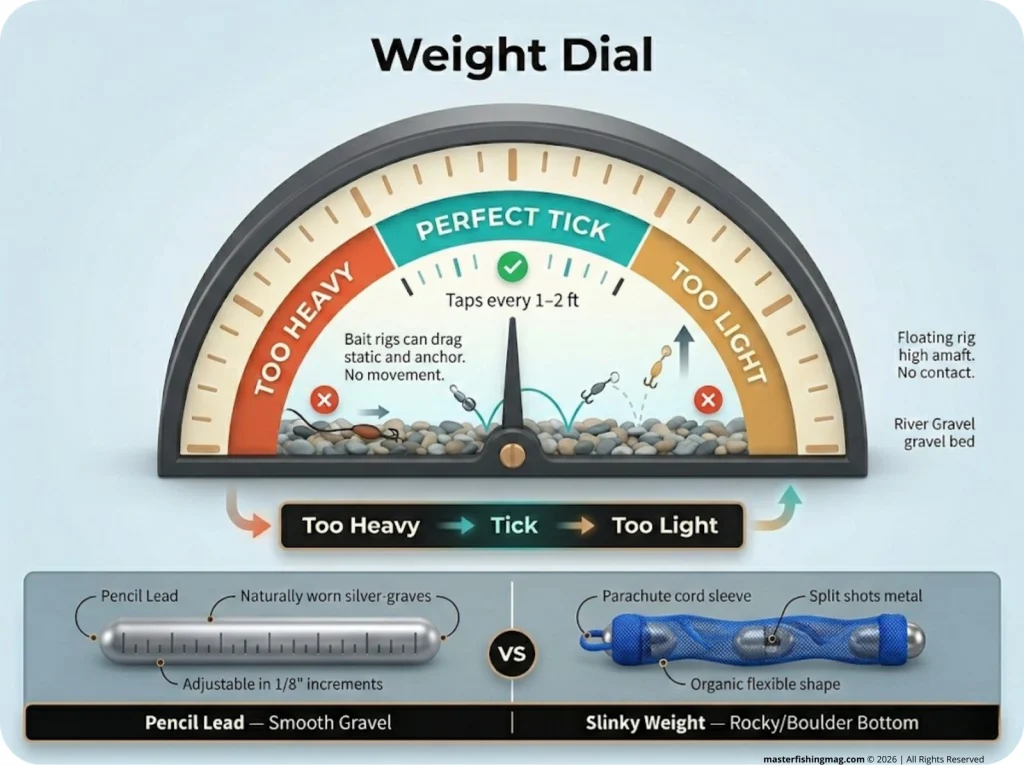
Start with slightly more weight than you think you need. If your bait anchors or drags, remove pencil lead in 1/8-inch increments. If it doesn’t tick the bottom, add weight in 1/8-inch increments. Your target is a bottom-tick every 1-2 feet as the bait drifts downstream.
WDFW’s guideline is straightforward: use just enough weight so the sinker taps the bottom every few yards — never so much that it drags or stops.
Pro tip: Mark your pencil lead every 1/8 inch with a Sharpie before you hit the water. That way you can make precise weight adjustments in seconds without guessing or eyeballing it in the field.
Pencil Lead vs. Slinky — The Right Weight for the Right Bottom
Pencil lead is easy to cut and adjust, rolls smoothly with the current, and gives precise tick feedback on smooth gravel. But it wedges between rocks. Slinky weights — parachute cord filled with split shot — slide over boulders and snags with far fewer hang-ups. On rocky bottoms, slinkies save terminal tackle and frustration. On clean gravel, pencil lead wins for sensitivity.
Mad River Drifter weights split the difference for anglers who fish both types of bottom regularly. The full guide on choosing the right weight type for your bottom composition covers how different weight geometries affect snag resistance and bottom contact.
Bait Selection by Current Speed, Clarity, and Species
Live Bait vs. Artificial — When Current Decides for You
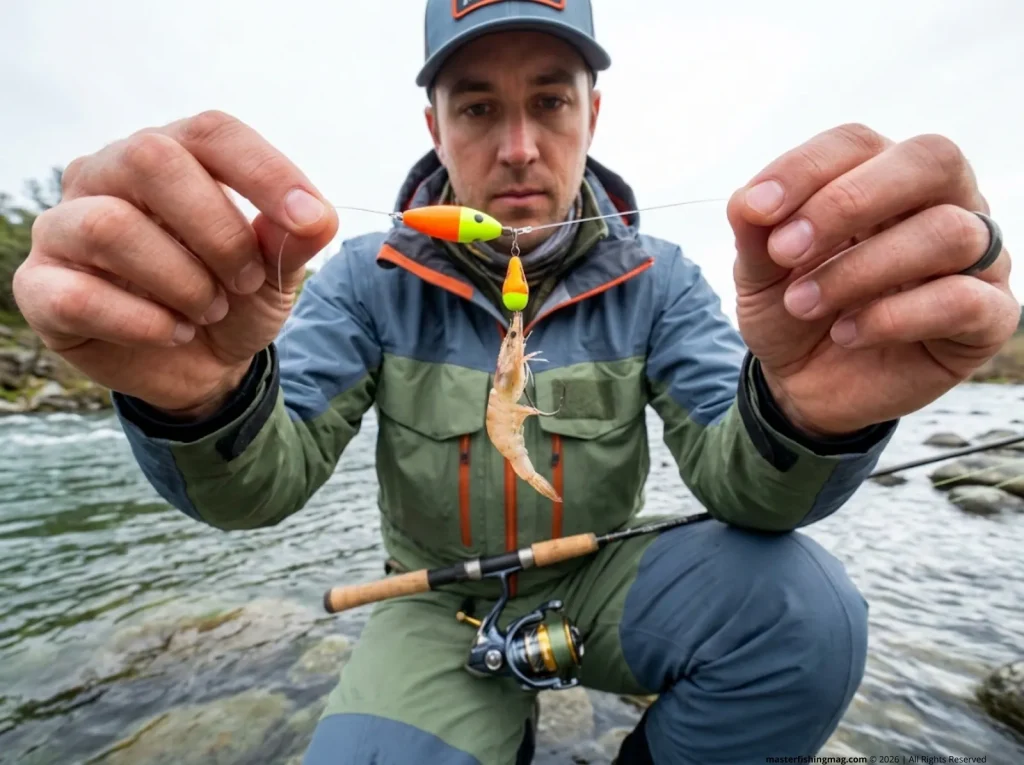
Fast current (3+ mph) rips soft baits off hooks. Sand shrimp, salmon roe clusters, and Spin-N-Glo rigs hold up much better in heavy water. Moderate walking speed current is the sweet spot for classic drift bobber setups — Lil Corkies with yarn, cured eggs on Gamakatsu #2 Octopus hooks, or worm-and-Corky combos that pulse naturally in the flow.
In slow currents under 2 mph, live bait like minnows, shiners, and crayfish work best because the slower flow lets subtle natural movement do the attracting. Drift bobbers add buoyancy that keeps your hook riding just above the snag zone while the weight ticks along the bottom below.
Color Selection by Water Clarity
In clear water with 3+ feet of visibility, go with natural tones — peach, soft pink, chartreuse-green combinations. Stained water (1-3 feet visibility) calls for fluorescent orange, hot pink, or bright chartreuse. And in muddy water under one foot visibility, maximize contrast with black-chartreuse combos or lean on scent-heavy baits since visual presentation barely matters.
Buzz Ramsey from Yakima Bait recommends rotating colors every 20-30 minutes when fish are present but not committing. Adjust leader lengths too — 30 to 48 inches of STS fluorocarbon in clear water, down to 12-18 inches in stained conditions. The guide on how turbidity changes what fish can actually see explains why these adjustments matter.
The Cast, the Drift, and the Extended Strike Zone
The 30-45° Cast and Natural Entry
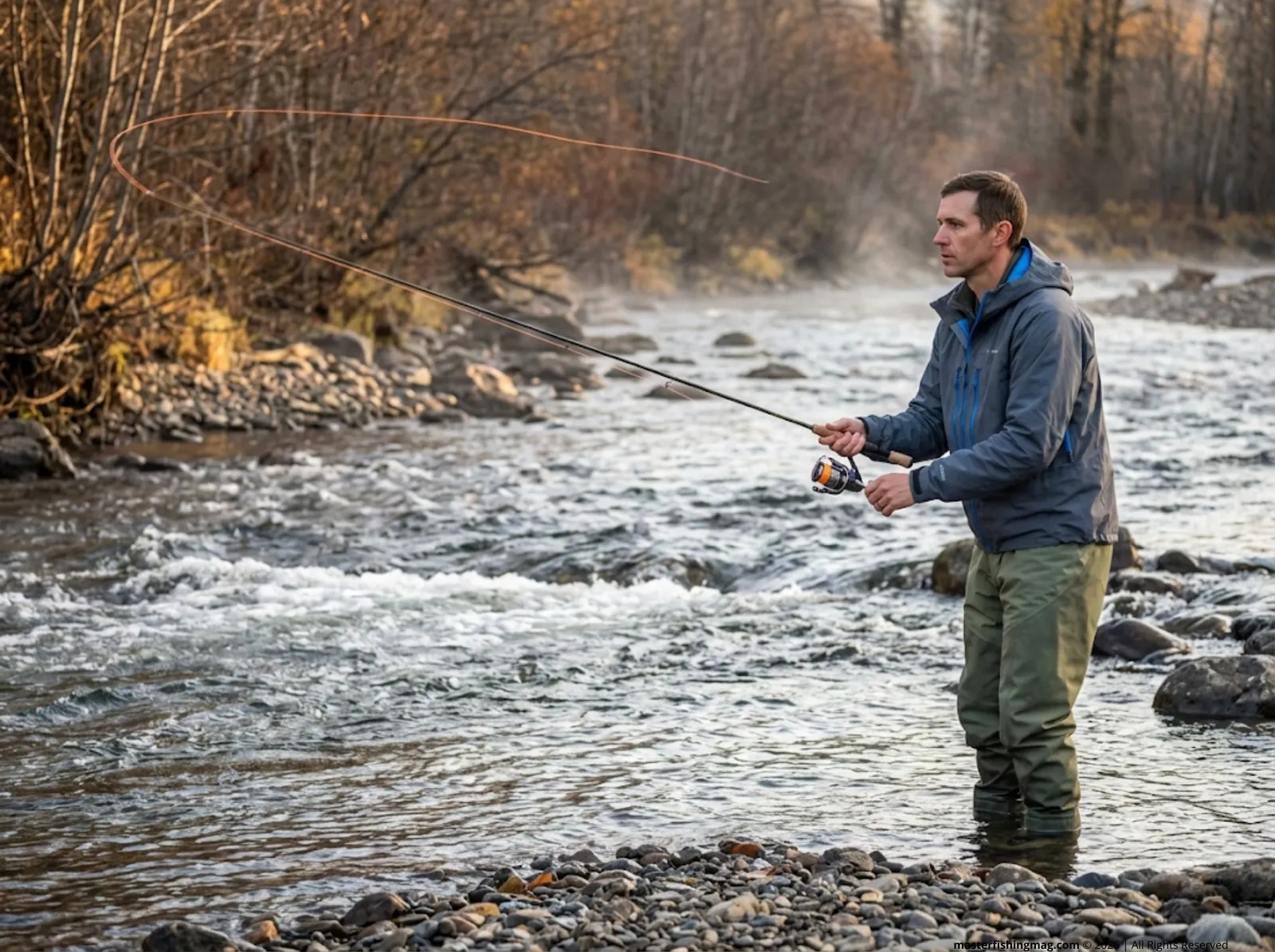
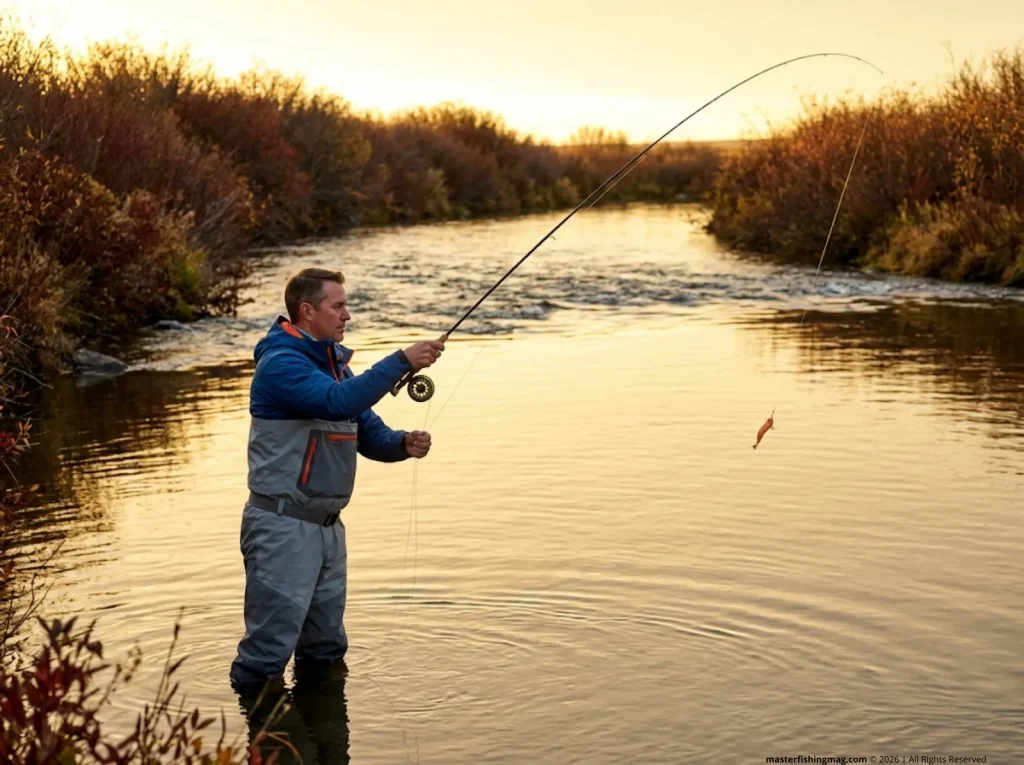
Cast upstream at a 30-45° angle relative to your position. Let the bait sink and begin bottom-ticking before it reaches you — that’s your loading zone. The productive strike zone starts at your position and extends 30-45° downstream. Reel slack as the bait approaches, then track it with your rod tip as it passes.
Never cast straight across. A perpendicular cast creates instant line belly — a downstream bow in your line that adds drag and kills your natural drift within seconds.
Following the Drift — Rod Tip as Current Guide
Keep your rod tip at 10 o’clock as the bait moves downstream. Follow the bait’s path so the line stays tight but not pulling. The moment you see a downstream bow forming in your line, mend upstream by flipping the line with your rod tip. That belly is the number-one drag-free drift killer.
Dead drift means your bait and line move at the same speed as the subsurface current, with zero tension from you. If the line tightens against the bait at any point, you’ve lost the drift.
Extending the Drift — The Technique Nobody Teaches
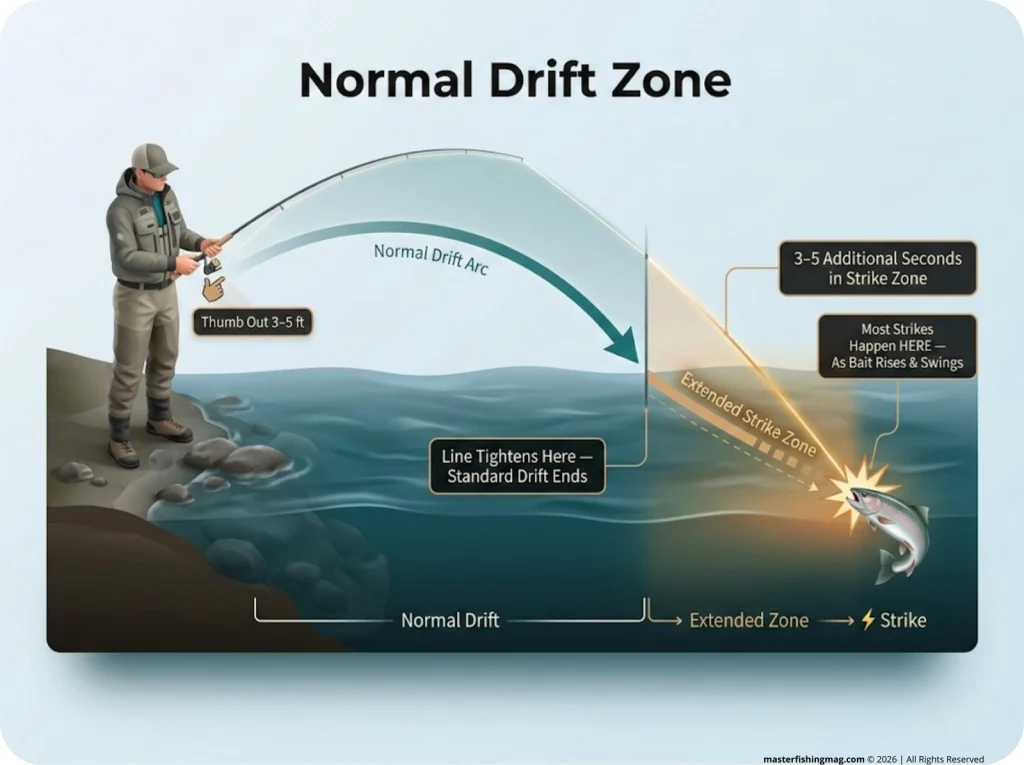
At the end of your natural drift arc — when the line tightens and the bait starts to swing — thumb out 3-5 feet of extra line in controlled sections. This keeps your bait in the strike zone for 3-5 additional seconds. Many strikes from steelhead and salmon happen in the last few feet of a drift, right as the bait starts to rise and swing.
This technique comes from Buzz Ramsey at Yakima Bait and is almost never mentioned in beginner drift fishing guides. It’s the kind of thing you learn from watching professional river anglers who’ve refined their systems over decades.
Pro tip: Extend your drift by thumbing out extra line at the end. Those additional seconds in the strike zone have accounted for some of the biggest fish I’ve landed — they hit right when I thought the drift was over.
The New York State DEC stream trout drift techniques manual confirms that presenting bait naturally just off the stream bottom using minimal weight is the foundation of productive river fishing.
Shore vs. Boat — How Your Platform Changes the Drift Equation
Shore and Wading Drift Control
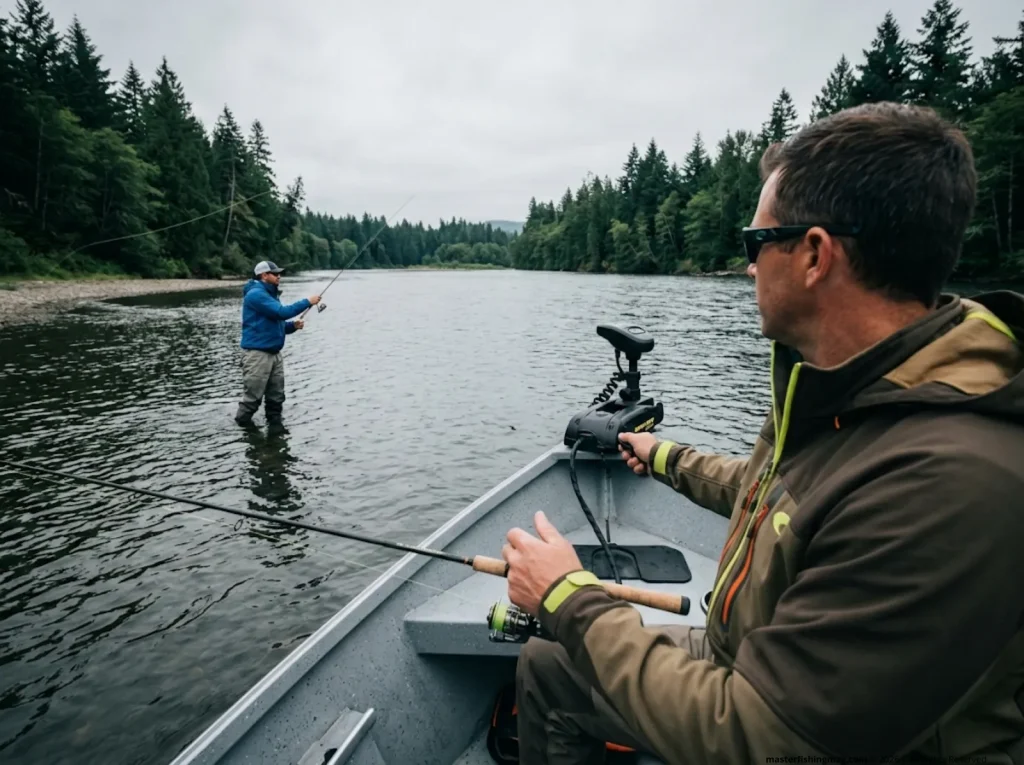
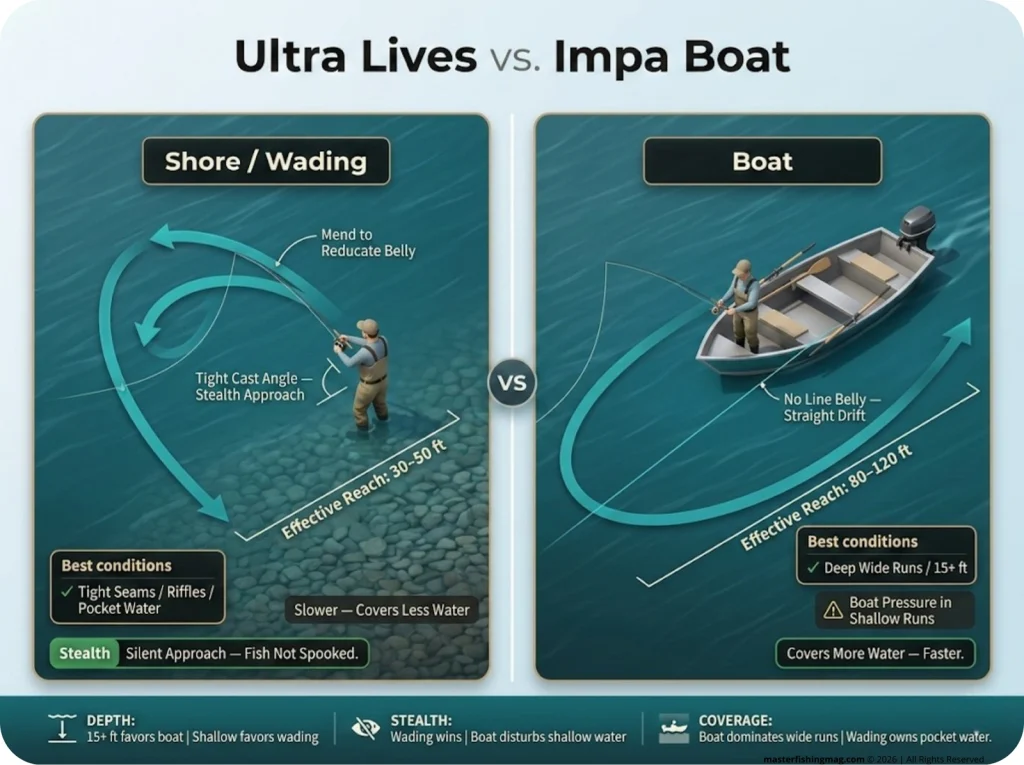
From shore, you control drift speed entirely through weight and mending — there’s no boat to bail you out. Wading into the current seam gives you a shorter cast and better belly management. Position yourself upstream of the target hold, casting at 30-45° down into the slot.
In wide rivers, shore anglers are limited to water within 40-50 feet. Beyond that, line belly becomes nearly impossible to correct, and your drift degrades fast.
Side Drifting (Boondogging) from a Boat
Side drifting — also called boondogging — is the ultimate drift fishing platform. The boat sits bow-upstream, drifting at exact current speed. You cast upstream from the moving boat, and your bait drifts naturally along the bottom while the boat follows at the same pace. Zero line belly, because the boat eliminates the speed difference between you and your bait.
Mark and Jake Romanack from Fishing 411 TV demonstrated a method where a trolling motor holds the boat at or just slightly faster than current for a “perfect drift” you can sustain through an entire run. Jeff Goodwin uses this same approach for king salmon on the Sacramento River, targeting 10-20 foot deep water runs with flat bottoms. The guide on mastering boat and shore positioning in river current takes this concept further.
When the Boat Wins and When It Doesn’t
Boats dominate in deep, wide runs (15+ feet) and when you need to cover lots of water. Shore and wading win in tight seams, riffles, and wadeable pocket water where stealth matters more than reach. Boats cover more water but can push fish in shallow water runs. Wading is slower but quieter.
The Golden Hook-Set Rule (And 4 Other Mistakes That Kill Your Hookup Rate)
Mistake #1 — Waiting Too Long to Set the Hook
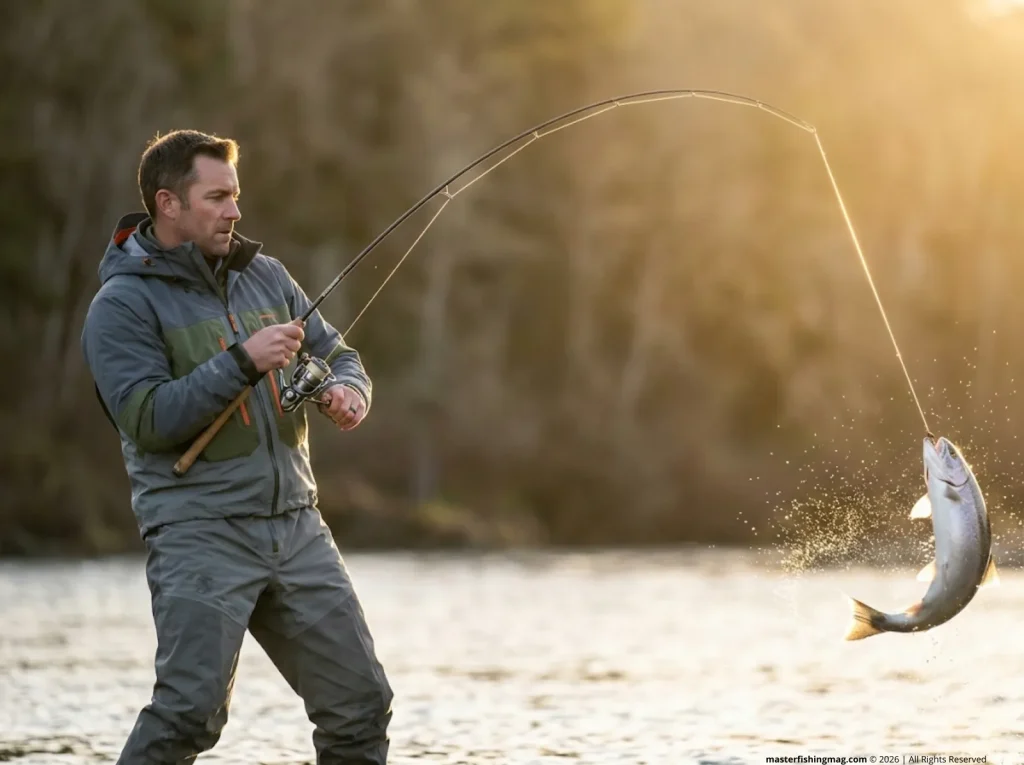
This is the single most important rule in drift fishing, and it comes from Buzz Ramsey at Yakima Bait: if your outfit stops, pauses, or hesitates at ANY point during the drift, set the hook hard. Immediately. No thinking, no second-guessing.
Most anglers hesitate because it “feels like bottom.” But bottom doesn’t pause your drift. Fish do. In cold water, steelhead and salmon mouth the bait and hold it without moving. That pause is your only signal. Miss it, and the fish spits the bait before you ever knew it was there.
Understanding the physics of setting the hook at the right moment will help you develop the muscle memory to react on instinct rather than hesitation.
Mistake #2 — Too Much Weight
Overweighting is the most common beginner error. When your rig anchors on the bottom and stops moving, it’s not drift fishing anymore — it’s bottom fishing with extra steps. Your bait should never sit still. It needs to be in constant tick-tick-tick motion, bumping along at current speed.
If you’re snagging every other cast, strip weight. That stuck-on-the-bottom feeling isn’t the river being too fast. It’s your rig being too heavy.
Mistake #3 — Casting Downstream or Straight Across
A downstream cast creates instant drag as the current grabs the line. A straight-across cast creates massive line belly within seconds. Only upstream angles — 30-45° — allow the bait to reach natural drift speed before the line begins to tighten. Cast angle determines whether your drift works before any other variable comes into play.
Mistake #4 — Ignoring Line Belly
Line belly forms when the current pushes a downstream bow into your line. That bow pulls the bait faster than the current — breaking the entire “match the current speed” rule. The fix is an upstream mend: flip the line upstream with your rod tip every time you see belly forming. From a boat, the drift speed eliminates belly automatically, which is exactly why side drifting is so effective.
Pro tip: Watch your line like a hawk and set on ANY hesitation — even if it feels like bottom. You’ll miss some rocks, but you’ll land fish you’d otherwise never feel. That’s a trade every experienced river angler takes gladly.
Conclusion
Three things separate anglers who drift fish from anglers who actually catch fish on the drift.
First, match subsurface speed, not surface speed. The water your bait travels through is slower than what your eyes see on top. Adjust your weight to the bottom layer, not the surface.
Second, slower beats faster. If you can’t perfectly match the current, err on the side of a slightly slower presentation. A racing bait catches nothing. A bait that’s a touch slow still looks like food.
Third, set the hook on any hesitation. The Golden Rule will put more fish in your net than any gear upgrade ever will. Bottom doesn’t pause your drift. Fish do. React accordingly.
Next time you’re on the river, strip your rig down to the lightest weight that still ticks bottom. Count the ticks per drift. Adjust. When the bait taps four or five times in a single pass without dragging, you’ve found the sweet spot. That’s when the bites start.
FAQ
What is drift fishing?
Drift fishing is a technique where you cast weighted bait upstream at a 30-45° angle and let it bounce along the river bottom at the speed of the current. The natural presentation mimics food drifting downstream, triggering strikes from salmon, steelhead, trout, bass, and walleye.
How much weight should I use for drift fishing?
Use the minimum weight needed so your bait taps the bottom every 1-2 feet as it drifts downstream. Start slightly heavy and remove weight in 1/8-inch increments of pencil lead until you achieve a steady tick without dragging or anchoring.
What is the best bait for drift fishing rivers?
It depends on current speed and species. In moderate walking-speed current, cured salmon eggs, Lil Corkies with yarn, and sand shrimp are proven producers. In slow current, live minnows and worms work well. Fast current favors tougher baits like roe clusters and Spin-N-Glos that stay on the hook.
How do you match drift speed to river current?
Your bait should move at the same speed as the subsurface current — slightly slower is better than faster. Adjust weight until the bait ticks bottom rhythmically, follow it with your rod tip to prevent line belly, and mend upstream whenever drag forms.
What is side drifting (boondogging)?
Side drifting is a boat-based drift fishing technique where the boat drifts downstream at current speed with the bow pointed upstream. Anglers cast upstream from the moving boat, achieving a perfectly natural bait presentation because the boat eliminates line belly automatically.
Risk Disclaimer: Fishing, boating, and all related outdoor activities involve inherent risks that
can lead to injury. The information provided on Master Fishing Mag is for educational and informational purposes
only. While we strive for accuracy, the information, techniques, and advice on gear and safety are not a substitute
for your own best judgment, local knowledge, and adherence to official regulations. Fishing regulations, including
seasons, size limits, and species restrictions, change frequently and vary by location. Always consult the latest
official regulations from your local fish and wildlife agency before heading out. Proper handling of hooks, knives,
and other sharp equipment is essential for safety. Furthermore, be aware of local fish consumption advisories. By
using this website, you agree that you are solely responsible for your own safety and for complying with all
applicable laws. Any reliance you place on our content is strictly at your own risk. Master Fishing Mag and its
authors will not be held liable for any injury, damage, or loss sustained in connection with the use of the
information herein.
Affiliate Disclosure: We are a participant in the Amazon Services LLC Associates Program, an
affiliate advertising program designed to provide a means for us to earn advertising fees by advertising and linking
to Amazon.com. As an Amazon Associate, we earn from qualifying purchases. We also participate in other affiliate
programs and may receive a commission on products purchased through our links, at no extra cost to you. Additional
terms are found in the terms of service.