
In this article
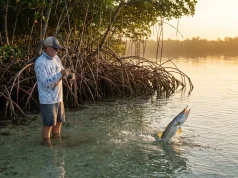
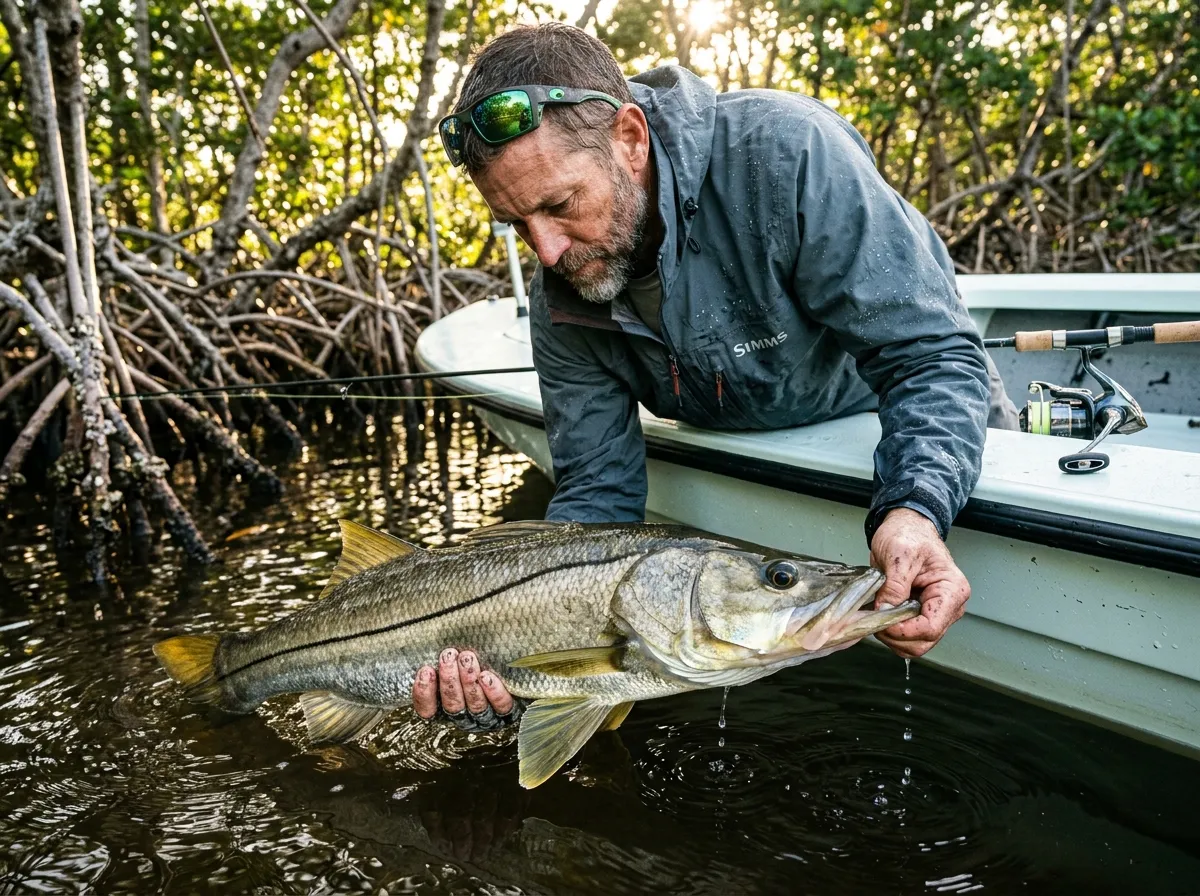
The cast landed three feet from the mangrove root, the fluorocarbon leader vanishing into black water before the tide could sweep it away. Twenty seconds. Then the line went tight with the kind of violence that only a spawning-run snook delivers — a fish that had been sitting motionless in a piling’s shadow, burning almost no calories, letting the current do the hunting for both of us. I had read the situation right. That fish didn’t bite out of reflex. It bit because everything aligned.
After more than two decades fishing Florida’s inshore waters, I’ve watched a lot of anglers work hard at this species and come up empty. Not because they’re bad fishermen. Because they’re fishing folklore. This article is a 20-year field audit of why snook are where they are — the water temperature rules, the current mechanics, and the biology that turn random encounters into predictable outcomes. By the end, you’ll have a seasonal positioning playbook, a terminal tackle decision grounded in real optics, and a conservation protocol that keeps these fish in the water where they belong.
⚡ Quick Answer: Snook location comes down to three things: water temperature, current structure, and season. Below 65°F, they stop feeding and pack into warm-water refuge spots. In summer (July–August), roughly 70% of the mature population concentrates at coastal inlets for spawning. In fall (October–November), they chase the mullet run at river mouths and mangrove points. For leader: use 30–50lb fluorocarbon in clear water and daytime conditions — it’s less visible than mono in those situations. Fight fish hard and fast, minimize air exposure, and always release horizontally.
The Biology of Centropomus undecimalis — What Makes Snook Different
Morphology as a Predatory Blueprint
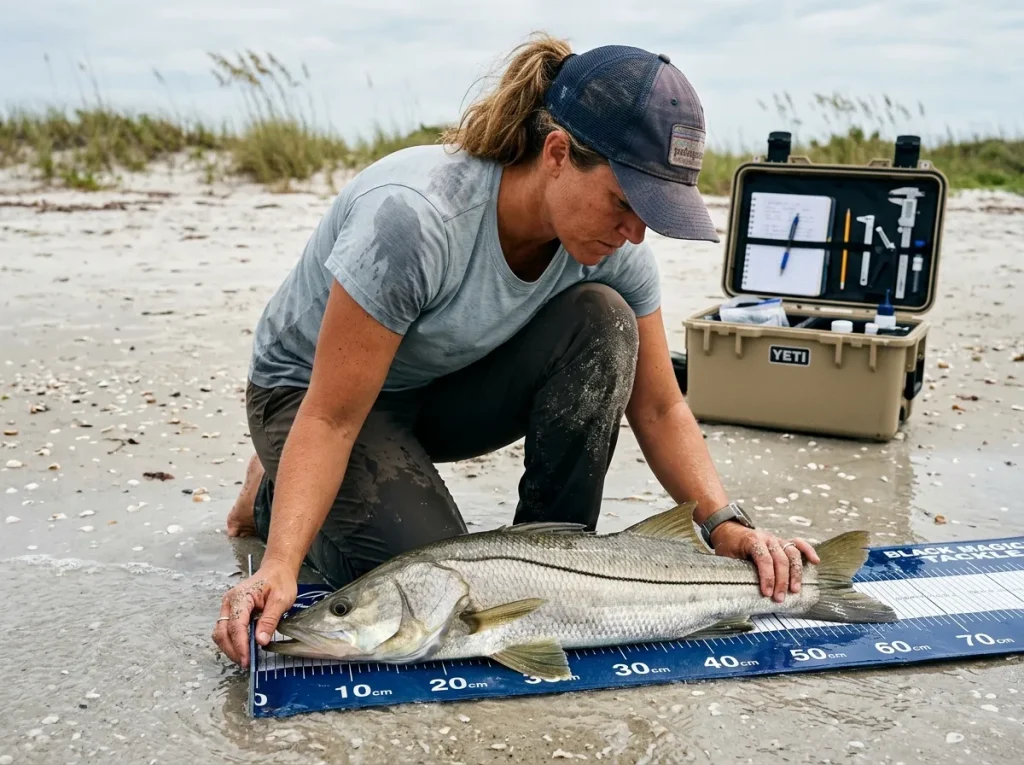
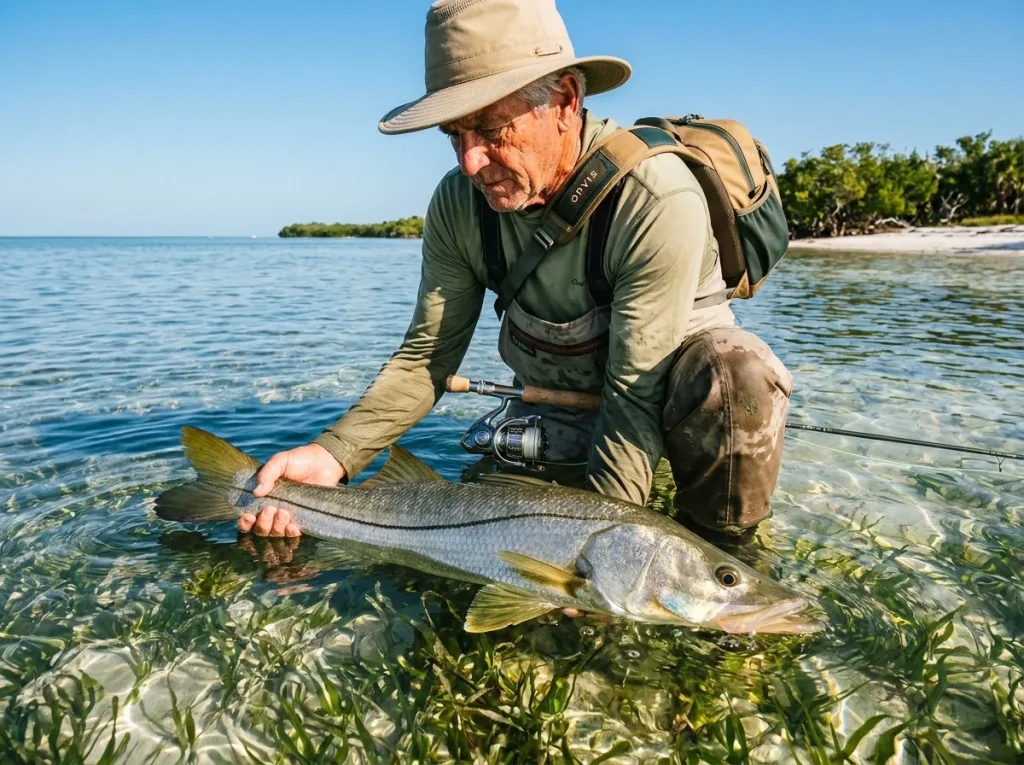
Common snook reach 48 inches and 38 pounds in Florida waters, with world-record fish topping 53 pounds in Central American habitats. That sloping forehead is built for upward-striking ambush. The protruding lower jaw drives what’s called a suction-feeding mechanism — picture a rapid vacuum event that inhales water and bait simultaneously. Mullet don’t get eaten by snook. They get inhaled.
The characteristic black lateral line does more than most anglers realize. It’s a packed array of pressure sensors that detect disturbances in the water column. A prey item’s bow wave registers before the fish ever makes visual contact. The first time you watch a snook rise from a piling shadow to intercept a mullet without the baitfish ever seeing it, you realize you’re watching a machine tuned by evolution for exactly this environment.
There are actually five Centropomus species in Florida waters — most anglers fish their whole careers without knowing or caring about the other four, which matters because misidentification has regulatory consequences. The large-scale fat snook (C. mexicanus) was only confirmed in Florida waters in 2006, restricted to the east coast between Sebastian and Jupiter Inlets. The Florida Museum of Natural History common snook species profile lays out the identification differences clearly, and the salinity zones that define each species’ preferred territory matter if you’re fishing the upper estuary and wondering why that snook looks slightly off.
Protandric Hermaphroditism — The Sex Change That Manages Population
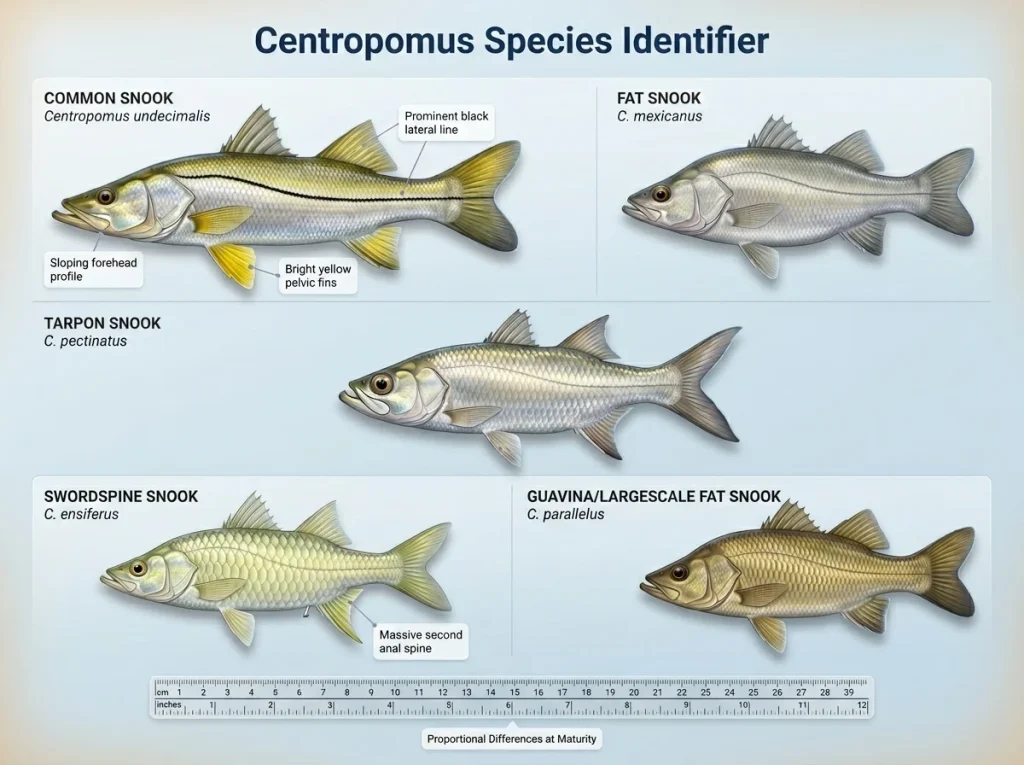
All snook are born male. A significant portion transitions to female between ages one and seven, often triggered after the fall spawning period — the change can be complete in about 90 days. Half of all males reach maturity at 18 inches and roughly two years. Half of all females don’t mature until 30 inches and five years in.
Here’s the number that should stop every angler who grabs a 38-inch fish for a photo: that fish is almost certainly female. A single large female can spawn every two days at peak season, releasing roughly 1.25 million eggs per episode. Every time I watch someone pocket a trophy-class snook, I run the math on lost egg production. Twenty years of data — it never favors the angler. Females live up to 21 years; males typically reach 15. The population’s backup system is written directly into their biology.
Pro tip: Every snook over 34 inches is statistically female. The two-fish bag limit doesn’t make keeping a 40-inch fish a good idea — it just makes it legal. There’s a difference.
The Thermal Playbook — Reading the Temperature Matrix
The Thermal Deadline — What Below 60°F Does to a Tropical Fish
This is where most snook content falls apart. Articles tell you snook “move to warmer water in winter.” That’s about as useful as telling someone to drive toward the highway.
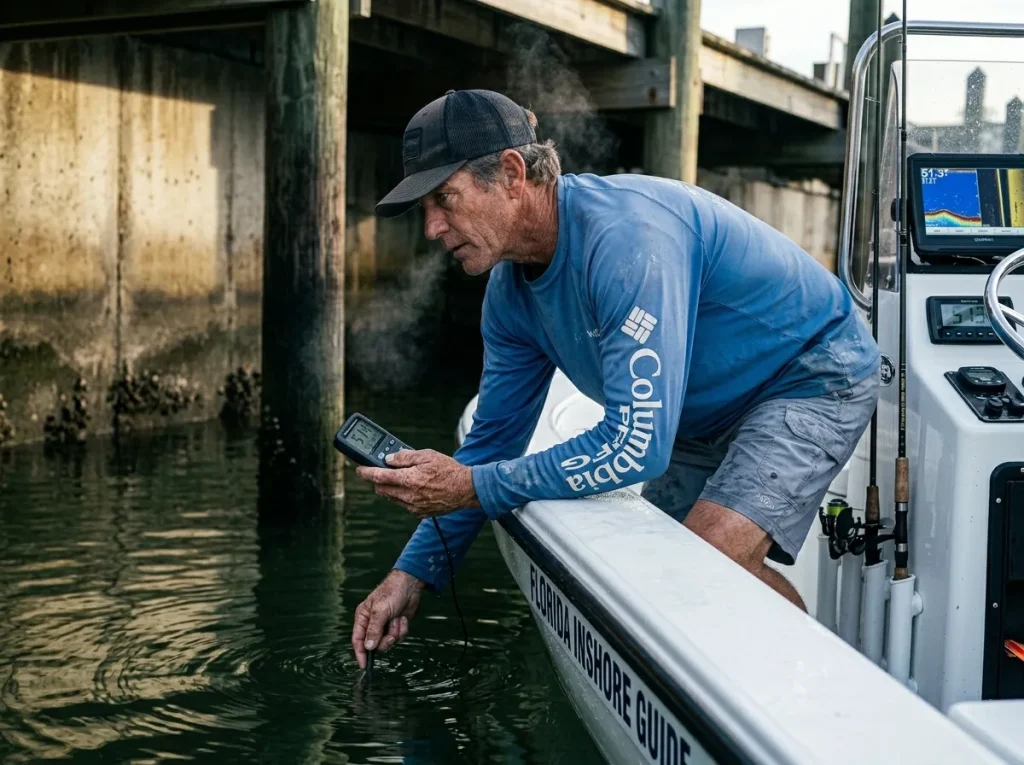
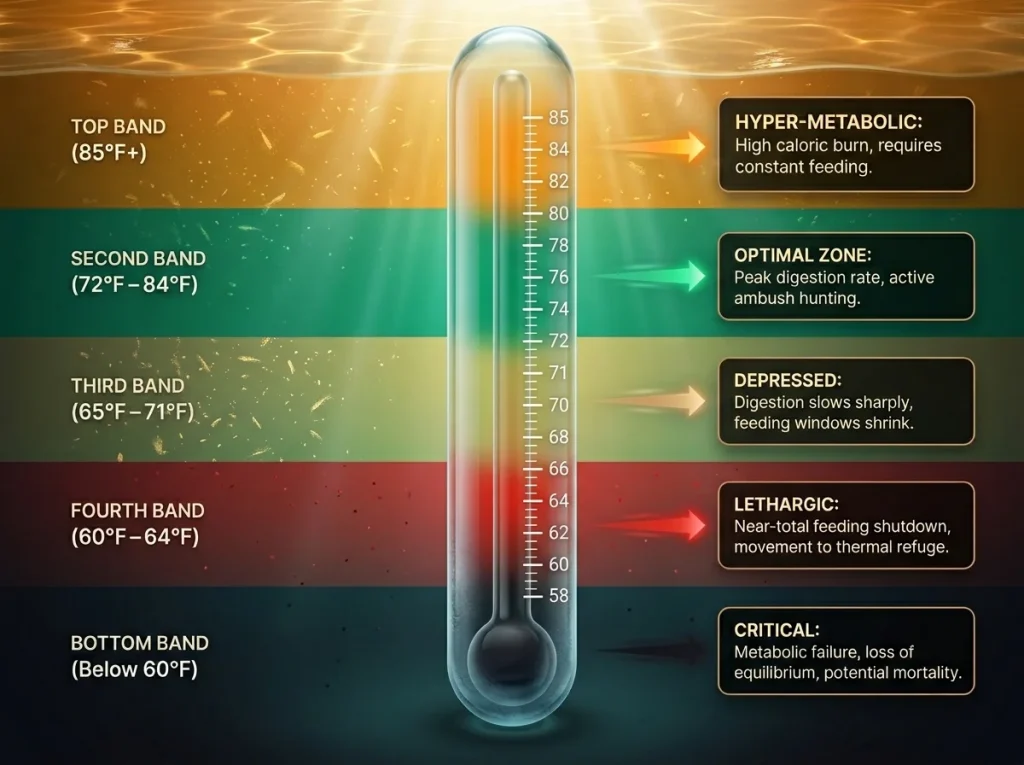
Here’s what’s actually happening. Below 65°F, the fish’s digestion slows to a crawl. Field samples of winter snook stomach contents show a 75% reduction in volume compared to summer samples. The fish isn’t “less hungry” — its entire caloric math has changed. Understanding how water temperature throttles a fish’s metabolic rate is the foundation of reading winter structure correctly.
The thresholds that matter:
- Below 65°F: feeding slows sharply; fish begin moving toward warm-water refuges
- 60°F–64°F: near-total feeding shutdown
- Below 60°F: metabolic failure, loss of equilibrium — can be lethal within 24–48 hours
The adult lethal threshold sits between 42.8°F and 53.6°F. For juveniles, lacking the body mass of larger fish, it’s even worse — 48.2°F to 57.2°F. The 2010 winter cold event became the defining data point: massive die-offs across Tampa Bay and the Space Coast, with populations not showing significant rebound until 2013. The UF/IFAS Extension thermal physiology data on common snook documents the tiered temperature thresholds in full.
I found a stack of snook in a residential canal in south Tampa in January when the flat water was running 58°F. The fish weren’t feeding. They were surviving. If you’re going to target them there, fish light, fish slow, fish one time — and leave. Thermal refuges — deep-water holes, residential canals, freshwater springs — trap slightly warmer water in pockets where wind-driven cooling is reduced. The fish know this before you do.
The 12-Month Migration Matrix — Four Biological Phases
The snook seasonal migration is not a continuous swim. It’s punctuated movement driven by specific triggers. Acoustic telemetry research in the Indian River Lagoon documented a stop-and-start cadence — fish move 5–15 miles, hold on a spoil island or dock complex for several days, then move again. Here’s the framework:
Phase 1 — The Overwintering Refuge (December–February): 80% of the population concentrated in rivers, creeks, and canals. Temperature stability is the only driver. They’re not there to eat.
Phase 2 — Spring Transition (March–May): That bouncing cadence kicks in across the estuary during April and May, with fish holding on intermediate structure along the migratory corridor. These are often the best slot fish of the year — on the move, actively feeding after months of suppressed appetite, and sitting on structure nobody else is fishing.
Phase 3 — Summer Spawning Aggregation (June–August): Roughly 70% of the mature population concentrates at coastal inlets. Salinity above 24 parts per thousand is required for fertilized-egg buoyancy — eggs hatch in about 28 hours and larvae drift into estuarine nurseries on incoming tides. Don’t fish the inlets in July and August unless you want to watch fish. If you want to catch them, work the intermediate spoil islands and dock complexes on the migratory corridor. The FWC common snook biological sketch and migratory data has the population distribution numbers behind this.
Phase 4 — Fall Gorge (September–November): Snook return to river mouths and mangrove points to exploit the southward mullet run (Mugil cephalus), loading calories for winter. This is the most productive window for the serious inshore angler. Water temperature is still in the right range, the bait is concentrated, and the fish are feeding hard. Think about predicting which tidal phase delivers baitfish into the snook’s strike zone — the fall gorge window is where tidal positioning matters most.
The transition windows between phases — the two to three weeks when fish are actively moving — are the highest-productivity periods of the year. The fish are fueling the next leg of the migration. That’s the window to be on structure near the mouth of the first river heading toward the inlet.
One more data point worth knowing: a cross-peninsula migration has been documented. Snook tagged at Jupiter Inlet have been recaptured in Charlotte Harbor, using the St. Lucie–Caloosahatchee Waterway. The habitat range of this species is broader than most anglers assume.
Fluid Dynamics — How a Snook Reads Current
Manning’s n — The Energy Equation of an Ambush Point
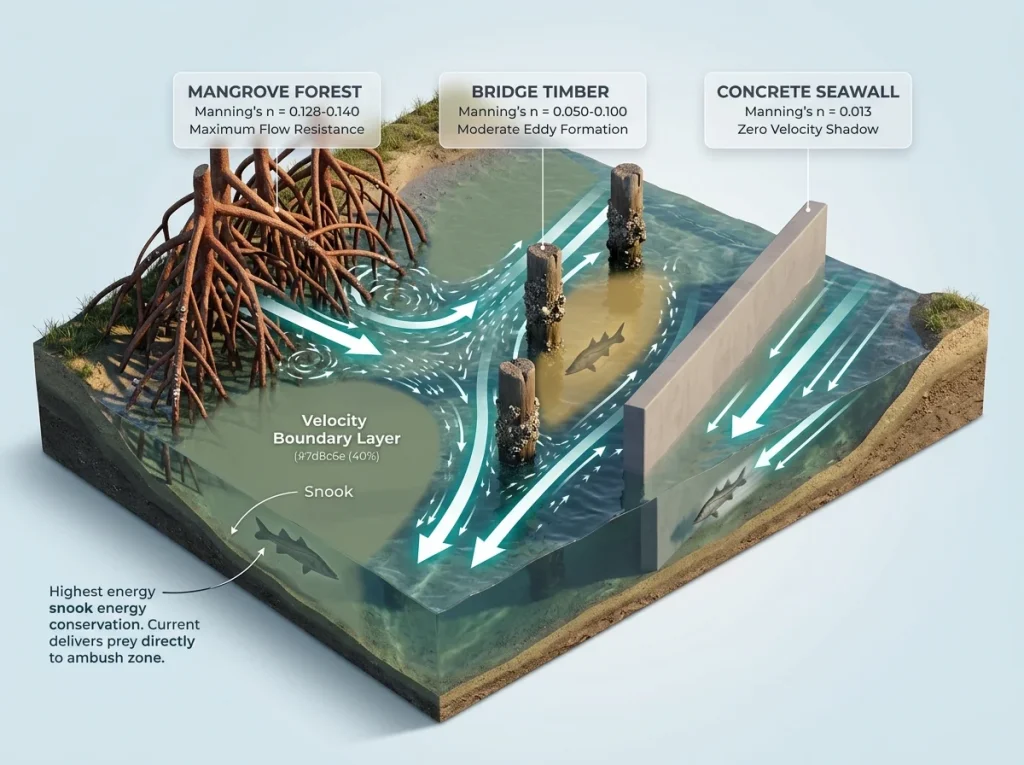
Every angler knows snook like structure. Almost no one can explain why a specific spot produces fish while a different one, 50 yards away, doesn’t. The answer is a measure of flow resistance called Manning’s roughness coefficient — basically a number that tells you how much a surface slows down moving water.
Mangrove shorelines score around 0.128 on that scale. Dense mangrove forests push higher, to 0.138–0.140. A concrete seawall sits at 0.012–0.015. Bridge timber structures — depending on barnacle load and depth — run 0.050–0.100. As roughness increases, water velocity in the immediate boundary zone drops. A snook holding in the velocity shadow behind dense prop roots burns a fraction of the energy of a fish trying to hold in open water against the same current. The hydraulic roughness coefficients for mangrove shorelines in estuarine systems are documented in peer-reviewed marine research that most fishing forums will never reference.
A concrete seawall doesn’t give a snook any roughness benefit. The fish at a lit dock over a seawall are there because the light concentrates prey — phytoplankton first, then zooplankton, then baitfish, then snook. That’s phototaxis at work, not energy conservation. The concrete does nothing. That distinction changes how you approach the drift. If the structure is a mangrove point on a moving tide, the fish is there for both reasons. If it’s a seawall, the fish vanishes the second the light goes off. After understanding how tidal conditions determine which structure produces the optimal boundary zone, you’ll stop fishing concrete on a dead tide.
Pro tip: On a new moon, the dock light effect is maximized because there’s no competing ambient light. On a full moon, snook disperse — the dock’s advantage shrinks significantly when the whole flat is illuminated. Time your dock sessions to the moon phase, not just the tide phase.
Reading the Current Seam — Where to Position the Lure
A current seam sits at the boundary between fast and slow water. Snook hold in the slow side and redirect their strike into the fast lane where prey gets carried. Cast upstream of the structure and let the current sweep the lure naturally into that seam. A retrieved lure fighting current is working against the snook’s entire ambush setup. The mechanics of current seams and the Kármán vortex effect behind structure break down what’s happening in the water column below you.
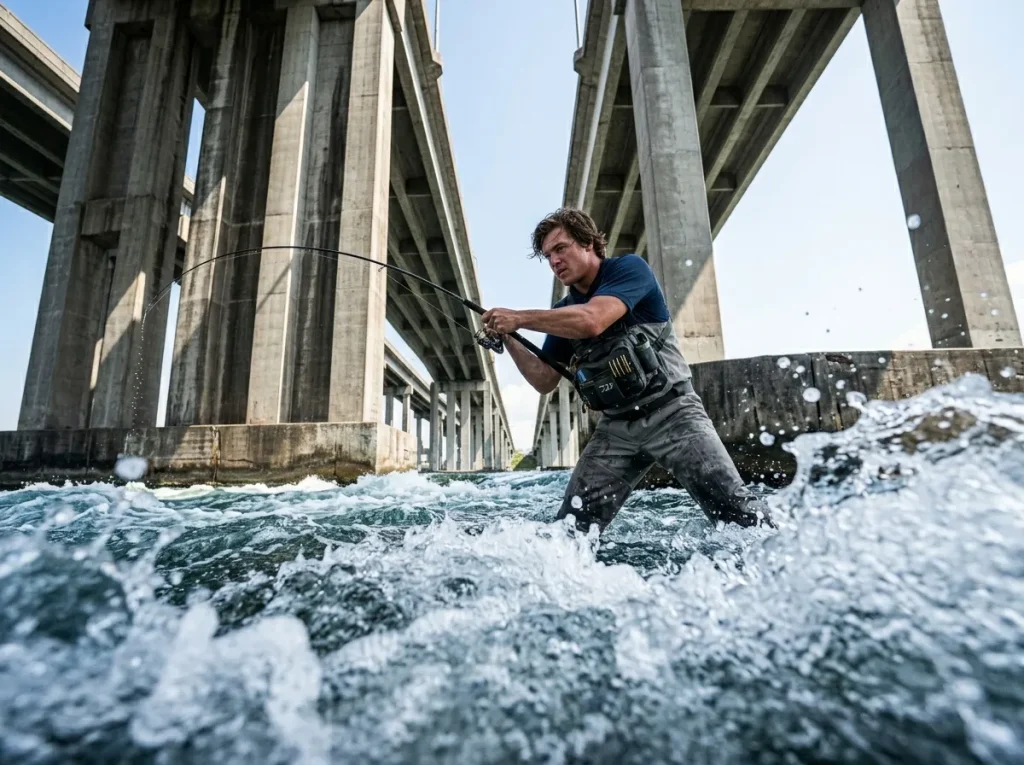
Here’s where most anglers lose fish they don’t even know were there: on the outgoing tide, the seam flips. The prey delivery direction reverses 180 degrees, and the fish repositions to the opposite fender face. The swimming energetics research on juvenile Centropomus undecimalis documents why oxygen consumption rises sharply with swimming speed — the biological reason snook won’t fight current they don’t have to fight. A lot of anglers fish a bridge correctly on the incoming then abandon it on the outgoing. The fish haven’t left. They’ve just moved to the other side.
Terminal Tackle Science — The Physics of the Leader
Refractive Index — Why Fluorocarbon Is Not “Invisible”
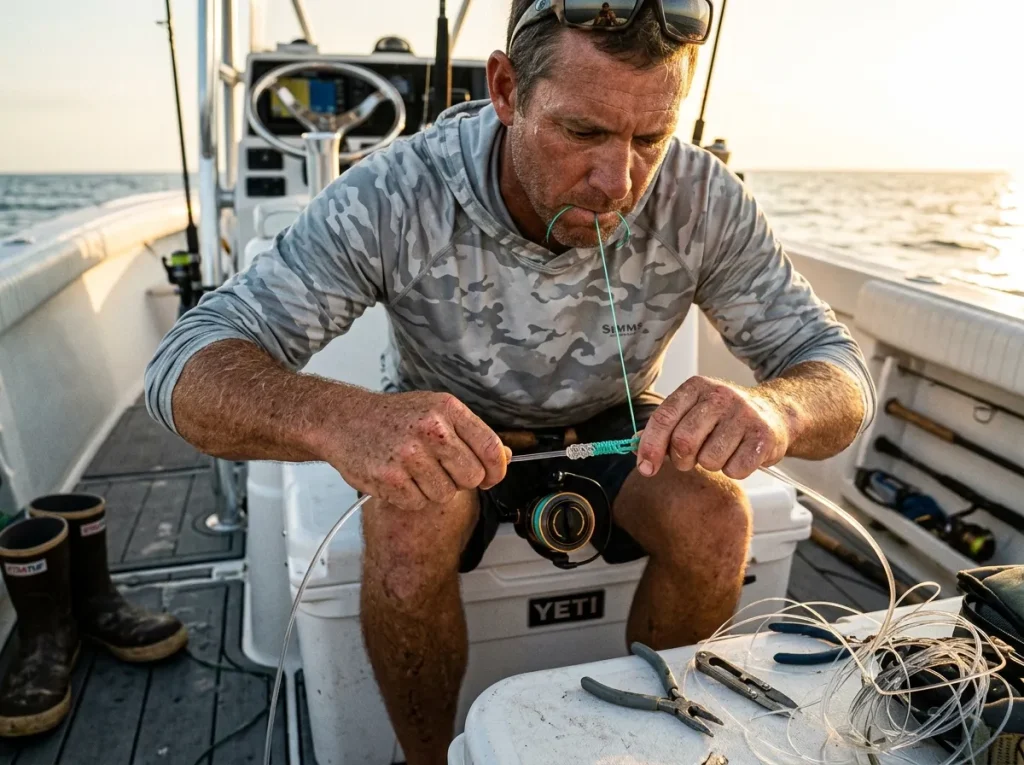
The numbers: seawater bends light at a measurable index — call it 1.33 on the optical scale. Fluorocarbon (PVDF) comes in at 1.42. Nylon monofilament sits at 1.55–1.62. Fluorocarbon’s number is closer to seawater’s, which is why it’s less visible in the water column — but “less visible” is not the same as invisible. Don’t let the marketing tell you otherwise.
In high-pressure situations at Sebastian and Jupiter Inlets, switching from a 40lb mono leader to a 40lb fluorocarbon leader produces a measurable lift in strike frequency under clear-water, daytime conditions. I’ve lost fish at Sebastian Inlet on mono that I’m confident I’d have landed on fluoro — not because of abrasion, but because the leader glint triggered an abort a millisecond before the strike committed. The full optical story of fluorocarbon’s visibility limits explains why this effect is real but context-dependent.
Fluorocarbon also sinks. Mono is near-neutral buoyancy. In a fast tide, fluorocarbon gets the lure deeper into the strike zone faster. On slack water, the difference matters less. Clear water plus daytime plus low-tide visibility makes fluorocarbon mandatory. Stained water plus night plus moving tide gives the optics advantage much less weight — a quality mono leader is a defensible choice in those conditions.
Abrasion Resistance and the Drag System
Fluorocarbon is denser and harder than nylon, which gives it better resistance to the initial nick from a snook’s abrasive jaw or a barnacle-crusted piling. That initial nick is a stress point — once it’s there, the line can fail at a fraction of its rated strength. Independent pull tests show that quality mono actually has a higher cycle count before total failure at equal diameters. Fluoro wins on preventing the nick; mono holds up better once the nick exists. For piling fishing with heavy barnacle load, run 50lb-class fluoro minimum. For seagrass flats where the threat is low-intensity repeated contact, quality mono is competitive.
Pro tip: Inspect your leader every 20 minutes when fishing pilings. A micro-nick you can’t see with the naked eye can drop effective break strength by 30%. You won’t feel it until you lose the fish.
Nylon mono stretches up to 20% before breaking — that stretch absorbs the violent headshakes that come at the start of every snook’s run, protecting knots and rod tips. Fluorocarbon has minimal stretch, which means the drag system absorbs everything the line won’t. Set drag at 25–30% of line breaking strength — tight enough to control runs toward structure, loose enough to survive the headshake. A sticky drag is far more problematic on fluoro than on mono. If your drag hesitates then releases, that momentary spike goes straight to the knot. The specific gravity and stretch data across all three line types is worth reading before you spool up for inlet season. The recommendation: 30–50lb fluoro leader paired with the smoothest drag system you can afford.
Spawning Aggregation Science — The Inlet in July
Salinity, Buoyancy, and the Egg’s Requirement
Common snook require salinity above 24 parts per thousand for fertilized egg buoyancy. The eggs are slightly denser than freshwater but achieve neutral buoyancy in full marine salinity — which is why spawning aggregations form at coastal inlets, not in the backcountry and not on the offshore reef. Roughly 70% of the mature population concentrates at inlets during July–August peak. Moon phase drives timing — spawning activity intensifies around full and new moon cycles, maximizing larval dispersal on the outgoing tide. Eggs hatch in about 28 hours, then larvae drift into the seagrass nursery systems where snook larvae settle after the inlet spawn.
At Sebastian Inlet in mid-July at 10pm on a new moon, you will see more big snook in one hour than most anglers see in a year. That’s not an exaggeration. It’s also simultaneously the best time to observe the species and the worst time to target it. They are there to spawn. NIH/PMC peer-reviewed research on snook spawning site selection and contingent behavior documents the salinity-driven aggregation and site-selection behavior in detail.
FWC Slot Limits and the Conservation Math
The regional slot limit system exists because Florida’s inshore snook fishery is not uniform. Environmental pressures differ significantly between Tampa Bay, the Southwest Coast, and the Indian River Lagoon.
- Indian River Lagoon: open February–May and September–December; 28″–32″ slot; 1-fish bag limit
- Southwest Coast: open March–April and October–November; 28″–33″ slot
- Tampa Bay: open March–April and September–November; 28″–33″ slot — still working back from the 2021 red tide
Every snook over 34 inches is statistically female. Every slot-legal fish kept within season is likely a fish that has survived five or more years and is in or approaching the female transition zone. The FWC current snook regulations, slot limits, and season dates by region are the authoritative source — know your exact region’s rules before launching. A fish legal on the Gulf coast may not be legal on the Atlantic coast. Understanding the conservation logic behind protected slot limits explains why slot limits — not just bag limits — are the right management tool for protecting the reproductive core of the population.
A behavioral shift worth knowing: over the last five years, documentation has accumulated that a contingent of large breeding females has moved to nearshore reefs and wrecks in 60–80 feet of water and stayed there year-round. These fish are insulated from inshore temperature crashes. If you’re hooking snook on offshore structure, you’re almost certainly dealing with a large female. Pressure change from rapid retrieval is a real concern — use a descending device to ensure the fish can return to depth. This is not optional.
The 20-Year Population Arc — Collapse, Recovery, and the Red Tide Variable
The 2010 Benchmark — Cold Event and Recovery
The 2010 winter cold event is the defining moment of the modern snook fishery. Record-low temperatures caused massive die-offs in Tampa Bay and the Space Coast — not dozens of fish along the mangrove lines, but hundreds. I was on the water in Tampa Bay three days after the cold snap. That image is why I’ve never kayak-fished a winter flat without first checking the 65°F isotherm forecast.
FWC fishery-dependent and fishery-independent surveys both showed sharp decline. But the fish that survived — those that had access to deep-water thermal refuges — reproduced at above-average rates from 2011–2013. By 2015, the rebound was pronounced. From 2015–2022, the fishery saw some of its highest recorded abundance levels in the modern era, with a significant wave of sub-adult fish entering the population. The Oxford Academic peer-reviewed analysis of long-term snook abundance patterns backs this longitudinal data.
The lesson: the snook’s evolutionary thermal strategy — seeking depth and freshwater when surface temperatures crash — is the population’s survival mechanism. It’s also why winter reef fishing isn’t just a recreational curiosity. The fish that hold at depth in winter are the fish that seed the next rebound.
The Red Tide Variable and the Angler’s Responsibility
The 2021 red tide event (Karenia brevis) hit Tampa Bay hard. FWC has moved the region into restricted seasons as a result. Red tide operates through a different mechanism than a cold event — brevetoxin causes neurological impairment in snook at sub-lethal concentrations, reducing a fish’s ability to evade predation even when it survives the initial exposure. Recovery timelines after red tide events run longer than after cold events because the toxin also degrades the invertebrate community supporting the prey base.
Indian River Lagoon currently leads statewide in snook landings — its role as both nursery and migratory corridor drives that stability even under ongoing seagrass pressure. The Gulf inshore dynamics where red tide and harvest pressure intersect gives broader context across Gulf inshore species.
For Tampa Bay: voluntary restraint matters even during open seasons. Regulatory compliance and voluntary restraint are different conservation tools, and right now only one of them is doing enough work.
The math on trophy fish: a 40-inch female releases roughly 1.25 million eggs every two days at peak spawn. Remove her, and you’ve cost the population 87+ million eggs across a 70-day spawning season. No photo is worth that if the fish is mishandled. Lactic acid buildup from prolonged fight times is the primary inshore release-mortality mechanism — a snook that swims away after a 10-minute battle can be gone within an hour from accumulated muscle acid in warm water. The temperature threshold data that determines exactly how long you have before that process becomes irreversible is specific and actionable. The protocol: fight fish on tackle heavy enough to land them in under five minutes (20–30lb class), minimize air exposure, handle horizontally, revive facing the current.
Pro tip: Fight the fish on tackle that respects its time. A 12lb leader on a 30-inch snook is not sportfishing. It’s a prolonged endurance test that benefits no one — not you, not the fish, not the fishery.
Conclusion
Three things the last 20 years have made clear:
Temperature is the master variable. Every snook location decision — from the winter canal to the summer inlet — is a response to a temperature gradient. Check the 65°F threshold before any winter trip. It tells you whether you’re fishing or wasting time.
Structure is an energy calculation. A snook holding behind a mangrove root system isn’t there because it “likes” roots. It’s there because that roughness minimizes caloric burn while the current does the hunting. Find the highest-resistance structure in a moving tide and you’ve found the fish.
The biggest snook are the most valuable alive. Every trophy female represents 87+ million eggs per season. Fish the slot, fight hard and fast on appropriate tackle, and release correctly. The 20-year pattern holds because snook are resilient. They’ll stop being resilient if anglers aren’t.
On your next inshore trip, bring a thermometer alongside the fish finder. Take the water temperature at depth before you pick a location. Let the 65°F boundary tell you where fish are concentrated. Then pick your structure by roughness, not by habit. The data is already in the water. Learn to read it.
FAQ
What is the best bait for snook inshore?
Live mullet and live pinfish are the highest-percentage baits because they match the two dominant forage items in the snook’s caloric loading windows. During the fall mullet run, a 4–6 inch live finger mullet on a 1/0 circle hook with a 40lb fluorocarbon leader is the single most effective presentation. In summer at dock lights, a live pinfish under the light-shadow boundary outperforms artificial lures in pressured conditions.
What month is best for snook fishing in Florida?
October and November are the highest-productivity months for inshore anglers — the Fall Gorge phase, when snook are actively loading on the mullet migration at river mouths and mangrove points, with water still in the optimal 72°F–80°F range. April and May are the second-best window, as the Spring Transition disperses slot-size fish throughout the estuary on the migratory corridor to the inlets.
Where do snook go in the winter?
When water temperatures fall below 65°F, snook concentrate in thermal refuges — deep-water holes, residential canals, freshwater rivers, and springs where temperature is more stable than on the exposed flats. On the east coast, the Indian River Lagoon’s deep navigation channels hold the bulk of the winter population. On the Gulf coast, freshwater creeks feeding into Charlotte Harbor are the primary spot. Below 60°F, the fish aren’t feeding. They’re surviving.
What is the best tide for snook?
The moving tides — specifically the first two hours of the incoming and the first two hours of the outgoing — are the highest-percentage windows. Moving water activates the prey delivery system that snook’s ambush strategy depends on. The exact phase depends on the structure: incoming tides push bait into mangrove systems and against the current-facing side of bridge fenders; outgoing tides push bait out of backcountry creeks and against the opposite fender face. Slack tide is the least productive. The energy equation collapses when the delivery system stops.
Is fluorocarbon leader really necessary for snook?
Under most inshore conditions — clear water, bridge structure, daytime fishing — yes. The optical properties of fluorocarbon make it measurably less visible than nylon monofilament in the water column. At Sebastian and Jupiter Inlets under high-pressure conditions, field observations document increased strike frequency on fluorocarbon. At night in stained backwater, the visibility advantage drops significantly, and a high-quality mono leader is a defensible choice.
Risk Disclaimer: Fishing, boating, and all related outdoor activities involve inherent risks that
can lead to injury. The information provided on Master Fishing Mag is for educational and informational purposes
only. While we strive for accuracy, the information, techniques, and advice on gear and safety are not a substitute
for your own best judgment, local knowledge, and adherence to official regulations. Fishing regulations, including
seasons, size limits, and species restrictions, change frequently and vary by location. Always consult the latest
official regulations from your local fish and wildlife agency before heading out. Proper handling of hooks, knives,
and other sharp equipment is essential for safety. Furthermore, be aware of local fish consumption advisories. By
using this website, you agree that you are solely responsible for your own safety and for complying with all
applicable laws. Any reliance you place on our content is strictly at your own risk. Master Fishing Mag and its
authors will not be held liable for any injury, damage, or loss sustained in connection with the use of the
information herein.
Affiliate Disclosure: We are a participant in the Amazon Services LLC Associates Program, an
affiliate advertising program designed to provide a means for us to earn advertising fees by advertising and linking
to Amazon.com. As an Amazon Associate, we earn from qualifying purchases. We also participate in other affiliate
programs and may receive a commission on products purchased through our links, at no extra cost to you. Additional
terms are found in the terms of service.