In this article
The first time I clipped on a bottom bouncer, I spent twenty minutes tangled in my own snell before the guy in the next boat told me I had the whole thing backwards. That was ten years and a lot of walleye ago. Bottom bouncing looks awkward, feels clunky at first, and tangles like nothing else if you don’t know the tricks. But once you get it dialed in, it’s probably the single most consistent way to put walleye in the boat from late spring through fall.
Quick Answer: Here’s how to set up and fish a bottom bouncer for walleye:
- Choose a bouncer weight using the 1-ounce-per-10-feet rule
- Attach a 4-6 foot snell with a spinner harness, bent-shank spiral hook, or plain hook
- Use a 6’6″-7′ medium-heavy rod with braided line for sensitivity
- Troll at 1.0-1.6 mph while maintaining a 45-degree line angle
- Let the wire tick bottom — don’t drag it, feel it bounce
- Set the hook when the rod loads up or you feel a distinct thump
What Is a Bottom Bouncer and Why Walleye Anglers Swear by It
The Basic Design
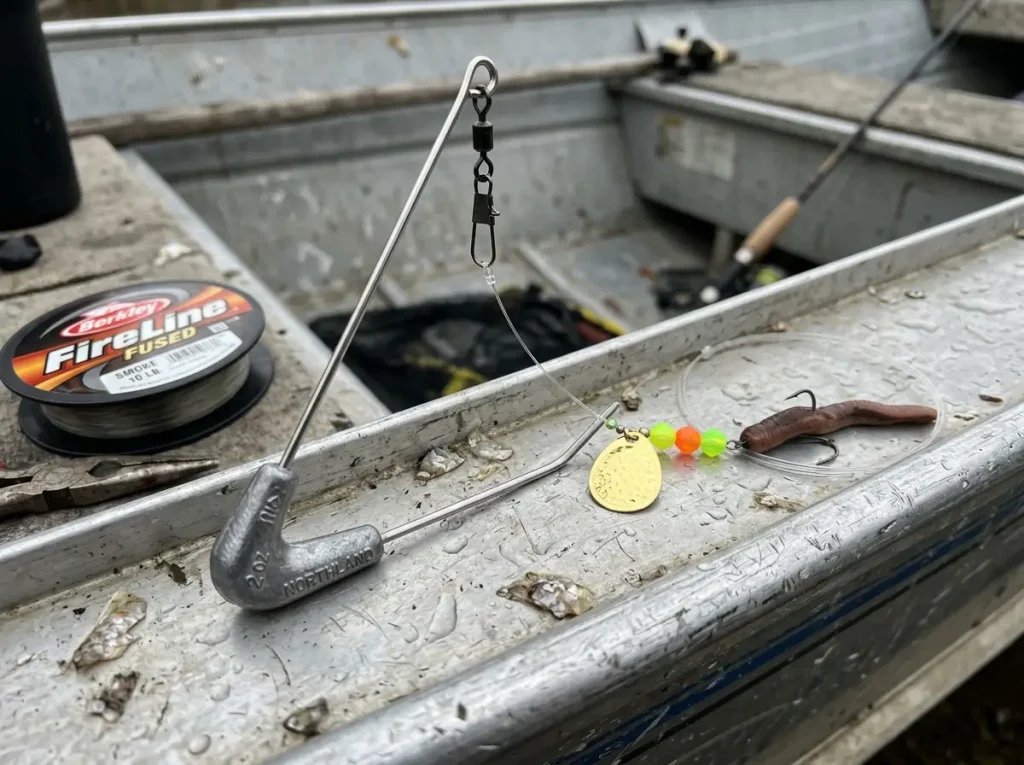
A bottom bouncer is an L-shaped wire rig with a lead weight molded at the bend. The lower wire arm — usually 8 to 12 inches long — acts as a feeler that ticks along the bottom while keeping your presentation above the rocks and snags. The upper wire arm connects to your main line and has a snap swivel at the top where you attach your snell and bait.
The design came out of South Dakota’s Missouri River reservoirs decades ago, and it changed walleye fishing forever. The Nebraska Game and Parks Commission calls it one of the most significant innovations in walleye tactics. Before bottom bouncers, trolling live bait near the bottom meant constant snags, lost rigs, and frustration. The wire arm solved all of that by acting as a weed guard and snag deflector while keeping your bait in the strike zone.
Why It Works So Well
Bottom bouncers are the most versatile trolling rig in walleye fishing. You can speed up past 2 mph to cover water and trigger reaction strikes, or slow down below 1 mph for finesse. You can fish 10 feet or 40 feet. You can run spinner harnesses for flash and vibration, bent-shank spiral hooks for a subtle rotation, or plain snells with live bait for clear-water finesse.
The wire transmits bottom composition straight to your rod tip — rock, gravel, sand, mud, transitions. That feedback loop teaches you more about what’s below the boat than any fish finder can. Veteran walleye trollers say bottom bouncers are the best tool for learning a new lake, and they’re right.
Pro tip: If you’re new to walleye fishing and can only learn one trolling technique, learn this one. Bottom bouncers work on more water types, more depths, and more seasonal patterns than any other single rig.
What It’s Not
A bottom bouncer is not a Lindy rig, though beginners confuse them constantly. A Lindy rig uses a sliding sinker that lets a fish pick up the bait and run without feeling resistance. A bottom bouncer has the weight fixed on the wire — the fish feels the rig. That’s actually an advantage when trolling, because the fish hooks itself against the resistance. We’ll cover when to use each rig later.
If you’re starting from zero with walleye, the walleye facts that change how you fish guide covers the biology and behavior patterns that make bottom bouncing so effective.
Choosing the Right Bottom Bouncer Weight
The 1-Ounce-Per-10-Feet Rule
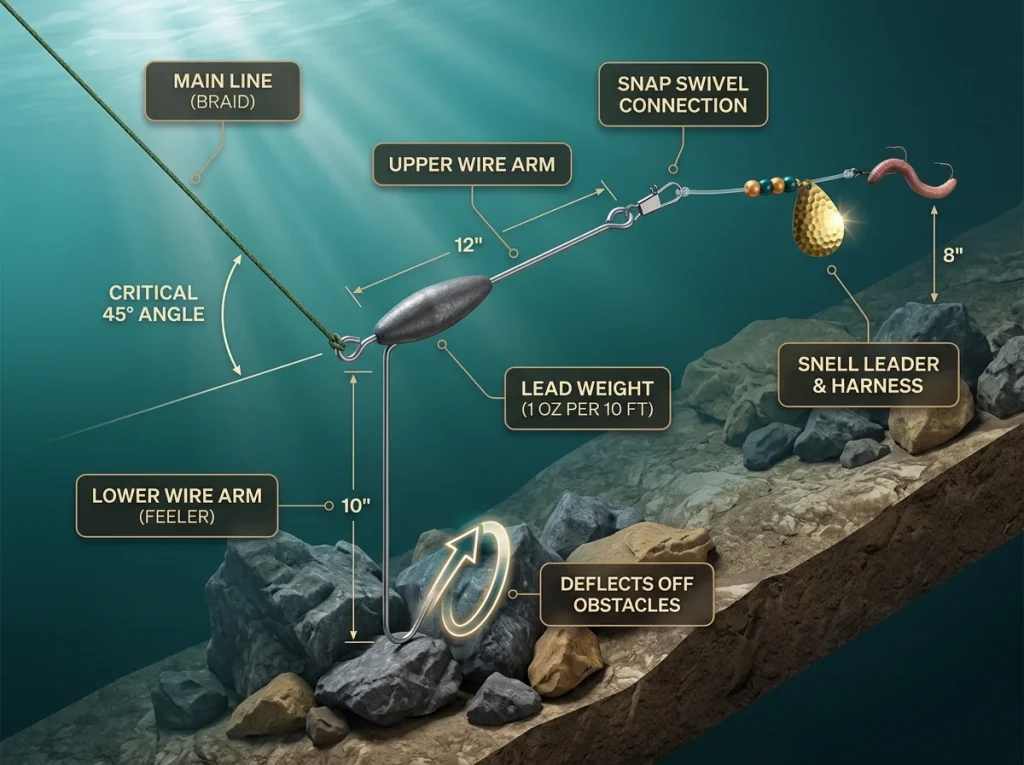
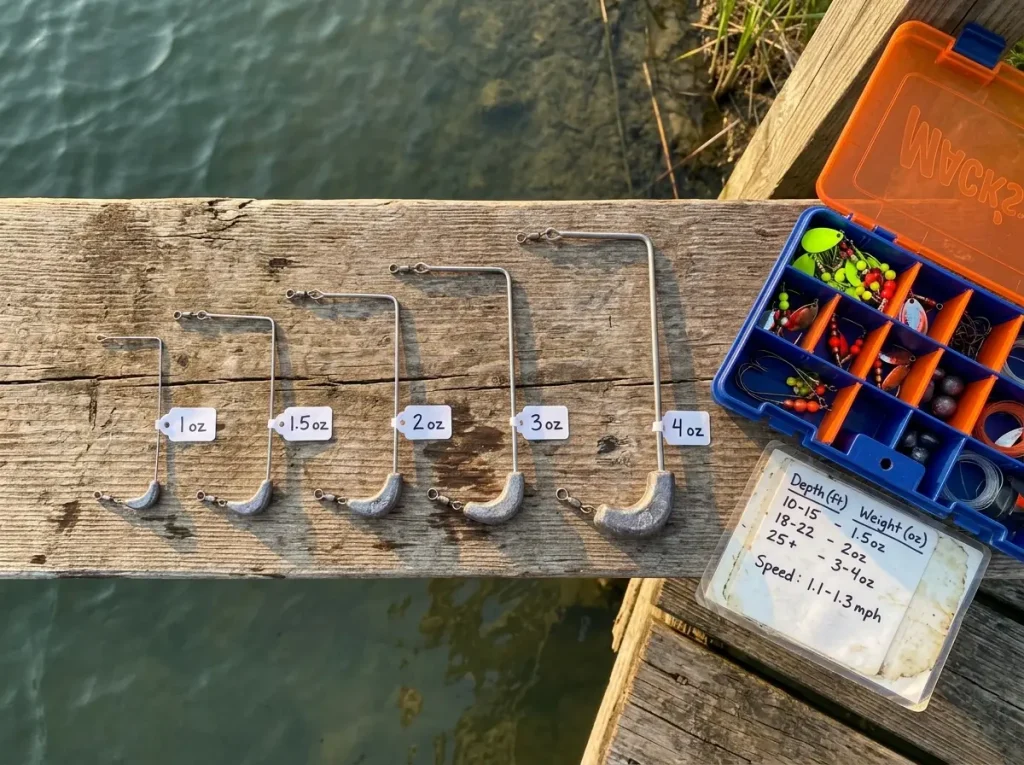
This is the starting point every walleye angler learns: use 1 ounce of lead for every 10 feet of water depth. Fishing 20 feet? Start with a 2-ounce bouncer. At 30 feet, grab a 3-ounce. The goal is to maintain a 45-degree angle between your rod tip and the point where the line enters the water. That angle keeps your presentation close to what your electronics show and gives you the best feel for bottom contact.
The rule works as a baseline, but conditions change it. Stronger current or higher trolling speeds demand heavier weight. Calm water with a slow troll can get away with lighter. When in doubt, go heavier — a slightly heavy bouncer is far more forgiving than one that’s too light. A too-light bouncer drifts behind the boat at a shallow angle, and you lose bottom contact constantly.
When to Break the Rule
There are situations where lighter bouncers outperform the formula. On shallow flats under 15 feet, running a lighter bouncer at faster speeds lets the rig plane slightly above the bottom, covering water quickly while still triggering strikes. Some guides run a 1-ounce bouncer in 15 feet at 1.8 mph and let it sweep just above the rocks rather than ticking every one.
On the other end, deep water past 30 feet in current demands going heavy — sometimes 4 ounces or more. The Missouri River reservoirs where bottom bouncing was born often require 3- to 4-ounce weights in 25 to 35 feet of current-swept structure.
Rod, Reel, and Line for Bottom Bouncing
Rod Selection
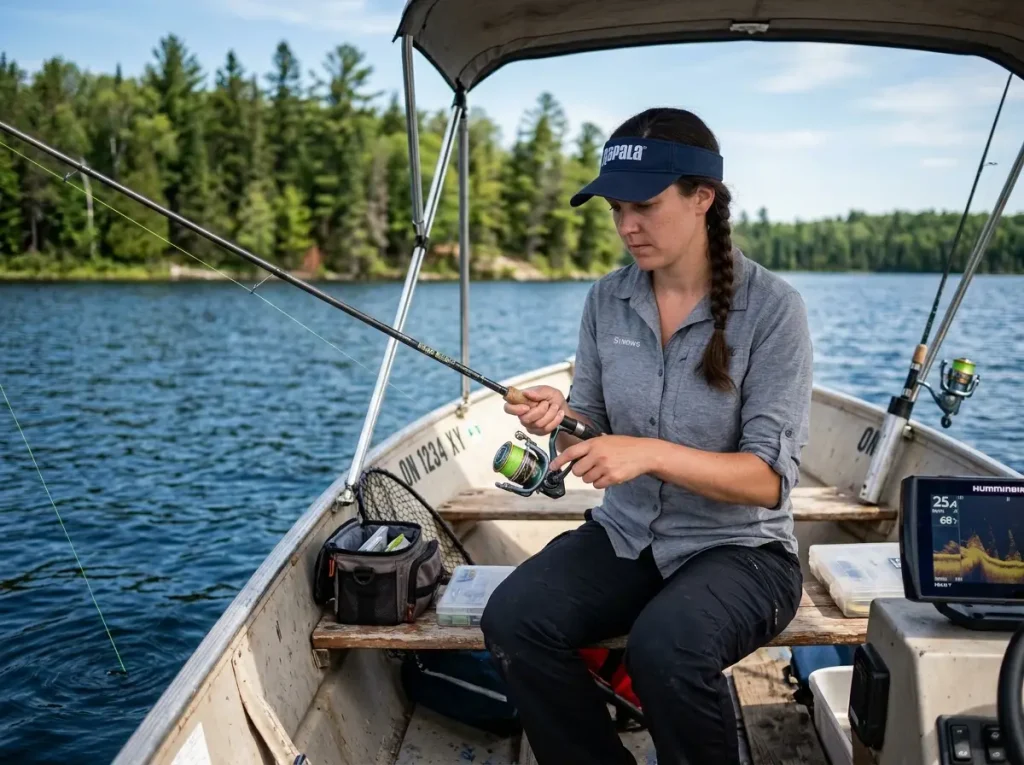
A 6’6″ to 7′ medium-heavy action spinning rod with a moderate or fast taper covers most bottom bouncing situations. The rod needs enough backbone to pull the bouncer without folding over, but enough tip sensitivity to feel strikes and bottom changes. Walleye-specific trolling rods in this range work well, but a general-purpose medium-heavy spinning rod gets the job done.
Line Choice — Braid vs Mono
Braided line is the clear winner for bottom bouncing. The zero-stretch properties of braid — specifically Berkley Fireline in 8-12 pound test is the go-to — let you feel every pebble the wire ticks across and detect even the lightest bites. Monofilament stretches too much at the line lengths used in trolling, which means you miss subtle strikes and lose feel for the bottom.
Run your braid directly to the bottom bouncer’s clip. No need for a mono or fluorocarbon leader between your main line and the bouncer — that’s a different rig. The leader material matters on the snell side, behind the bouncer.
Reel Considerations
A standard medium-sized spinning reel works. Nothing fancy needed. Some anglers prefer line-counter reels (baitcasters with digital counters) so they can replicate exact depths when they find fish, but a spinning reel with a mental note of how much line you let out works fine for most situations.
Spinner Harnesses, Spiral Hooks, and Plain Snells
Spinner Harnesses — Flash and Vibration
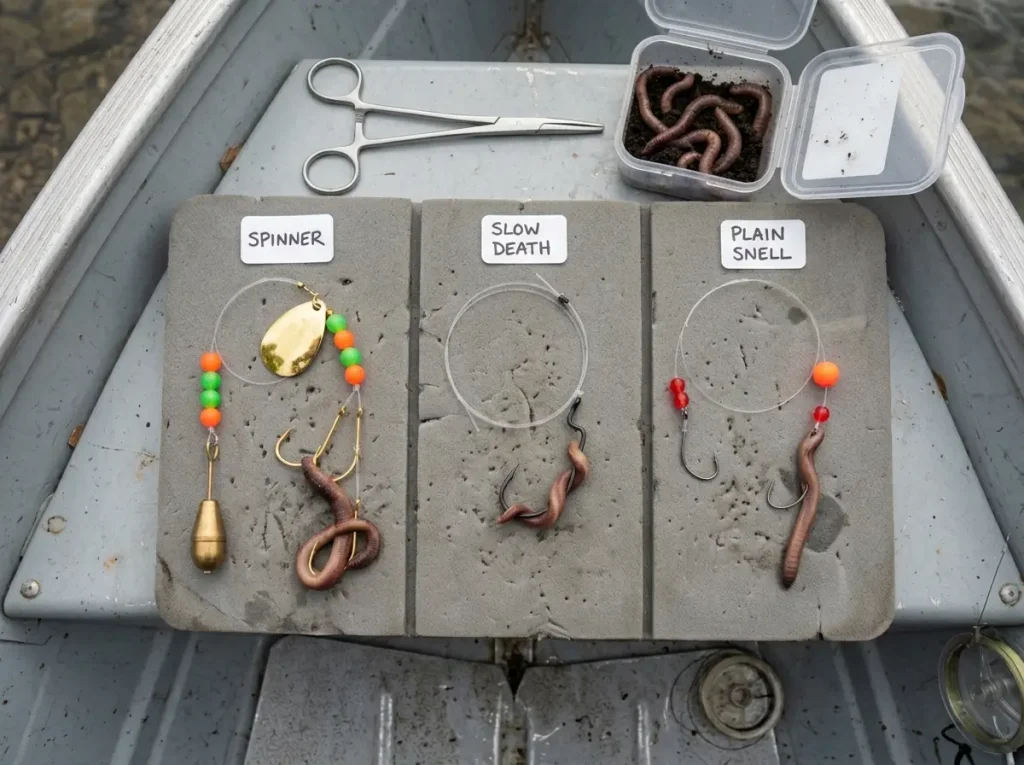
The classic crawler harness is what most people picture when they think about bottom bouncing: a snell with beads, a spinner blade, and two hooks in tandem threaded with a nightcrawler. The spinner blade provides flash and vibration that pulls walleye in from a distance, making it the best search tool for covering water.
Blade choice matters. Colorado blades spin wide with heavy thump — best for stained water and slower speeds. Indiana blades split the difference between thump and flash. Willow blades spin tight and fast, producing more flash than vibration — best for clear water and higher speeds.
Northland Butterfly Blades and Wingnut Blades represent the newer trend — small, subtle prop-style blades that turn at much slower speeds than traditional spinners. They’re lethal when you need to slow down for turns around structure or when walleye are being finicky in clear water.
Bent-Shank Spiral Hooks — The Subtle Rotation
Bent-shank spiral hooks (sometimes called “slow-roll” hooks) changed the game when they hit the market. The offset shank creates a slow, spiraling rotation when threaded with a half-crawler — no spinner blade needed. This presentation works when walleye want something subtler than a full harness, which happens more often than most anglers expect.
Run spiral hook rigs on a shorter snell — 3 to 4 feet instead of the standard 5 to 6 feet. The shorter length keeps the spiral tighter and prevents the telltale tangling that plagues longer spiral snells at speed.
Plain Snells — Clear Water Finesse
A plain snell — single hook, a few beads, maybe a small float — is underrated and overlooked. In clear water, a plain snell with a live nightcrawler or leech trailing behind a bottom bouncer catches walleye that ignore spinner harnesses completely. The absence of hardware is the advantage.
Use fluorocarbon for plain snells. Its near-invisibility in clear water makes a measurable difference, and the slight sinking tendency keeps the bait in the strike zone. Offset the sinking with a small float bead in the snell to control your bait’s depth behind the bouncer.
Pro tip: Match your snell weight to your speed, not your finesse instinct. If your harness or snell keeps twisting, you’re using line that’s too light. Fourteen- to twenty-pound snells track straighter at trolling speeds and tangle far less than 8-pound leaders. This isn’t the time for finesse.
Trolling Speed, Depth, and Boat Control
Speed Ranges That Produce
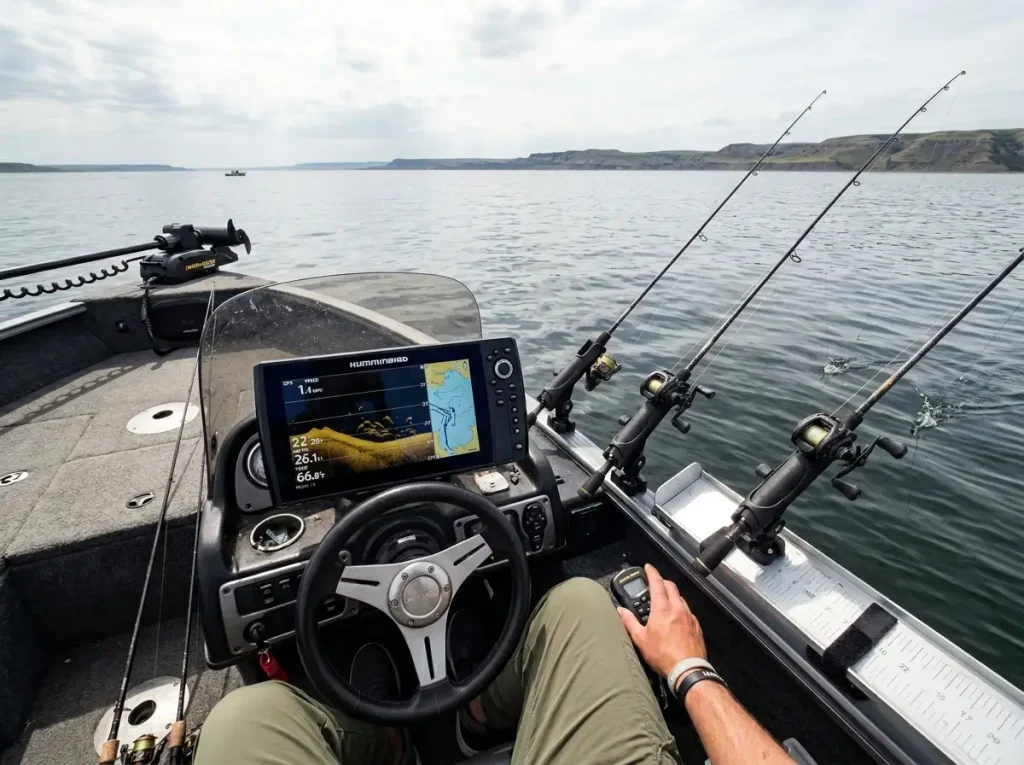
The sweet spot for most bottom bouncing situations falls between 1.0 and 1.6 mph. Within that range, spinner blades turn consistently, spiral hooks spiral properly, and you maintain solid bottom contact.
But don’t treat those numbers as gospel. Some of the best walleye guides troll bouncers at 2.0 mph or faster to trigger reaction strikes from lethargic fish, especially in summer when walleye can see the rig coming and choose to ignore it. The speed increase forces a decision — eat it or let it go. Aggressive walleye almost always eat.
On the slow end, 0.8 mph works when walleye are tight to structure and won’t chase. Switch to a spiral hook or plain snell at these speeds — spinner blades need at least 1.0 mph to turn properly.
The 45-Degree Rule
Your line angle tells you everything. When the line from your rod tip to the water entry point is at 45 degrees, you’re in the zone. The bottom bouncer is directly below your presentation, your electronics reading matches your bait’s actual position, and you have maximum feel.
If the angle goes too steep (nearly vertical), you’re too heavy or too slow. If it goes too shallow (line streaming way back), you’re too light or too fast. Adjust weight, speed, or line length to bring it back to 45.
Boat Control Fundamentals
Use a bow-mounted trolling motor to control speed and direction precisely. GPS-controlled motors like the Minn Kota i-Pilot make bottom bouncing dramatically easier — set a track along a contour line and let the motor hold it while you focus on feel and presentation.
When fishing structure with curves — points, reefs, inside turns — the inside rod speeds up on turns and the outside rod slows down. On tight turns, the inside rig may stop spinning entirely while the outside rig speeds past 2 mph. Manage this by shortening line on the inside rod and lengthening it on the outside, or simply reel in the inside rod during tight turns.
For more on controlling your boat in current, the drift speed rule that applies to dock and bank presentations translates to trolling as well — matching your speed to what the fish want to see.
Pro tip: When you catch a fish, mark the GPS waypoint immediately. Then make a U-turn and troll the same contour line through the same area. Walleye school on structure. Where there’s one, there are usually more.
Reading Bottom Composition Through the Wire
What the Rod Tip Tells You
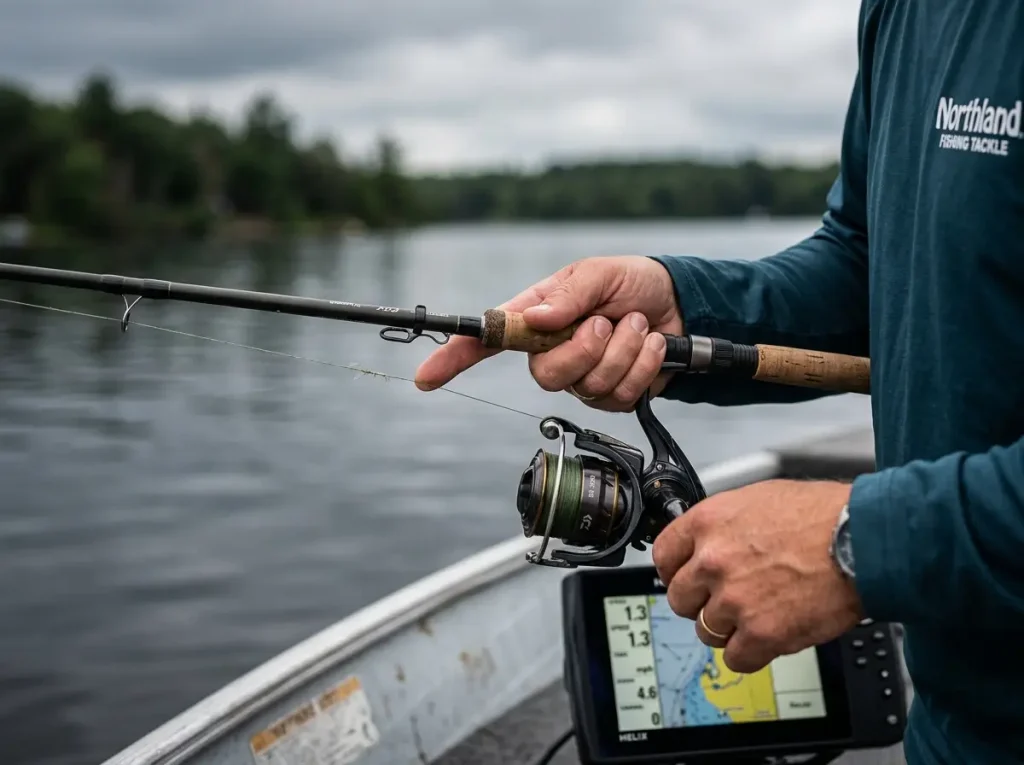
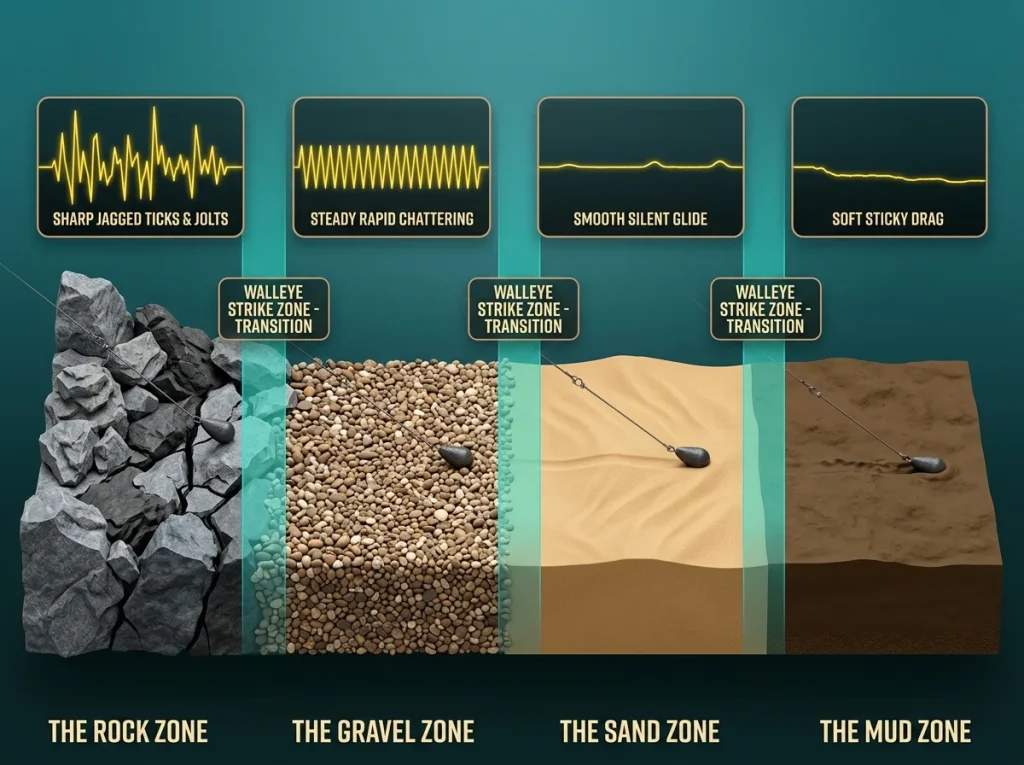
This is the part nobody writes about, and it’s the part that separates anglers who catch walleye consistently from those who catch them by accident. The bottom bouncer’s wire arm is a probe. Every vibration it transmits to your rod tip is information.
Rock: Sharp, irregular ticks with occasional hard jolts. The rod tip bounces erratically. Walleye love rock transitions, especially where rock meets gravel or sand.
Gravel: Steady, rapid chattering — like dragging a stick across a washboard. Consistent vibration that you feel more in your hand than see in the rod tip. Prime walleye habitat.
Sand: Smooth, almost silent. The bouncer glides with occasional soft thumps. You might think you’ve lost bottom contact, but you haven’t — sand just doesn’t transmit much.
Mud: Soft, muted, occasionally sticky. The bouncer slows slightly and the rod tip feels heavy rather than bouncy. Walleye generally avoid mud unless there’s bait holding on a nearby transition.
Transitions Are Everything
The moment the feel changes — rock to gravel, gravel to sand, sand to rock — that’s where walleye position. They sit on the hard side of the transition, facing the soft side, waiting for food to drift by. When your rod tip goes from steady chattering to sharp ticking, you just crossed a transition. Mark it, troll through it again, and again. That’s where the fish are.
This is why experienced bouncer trollers say the rig teaches you a lake. After a few passes, you know the bottom better than your fish finder shows it, because you’ve felt every change.
If you’re trying to build a mental map of what’s under the boat, your fish finder depth readings give you the vertical picture, but the bottom bouncer gives you the texture — and texture is what walleye care about.
Common Bottom Bouncer Mistakes and How to Fix Them
Tangling the Snell
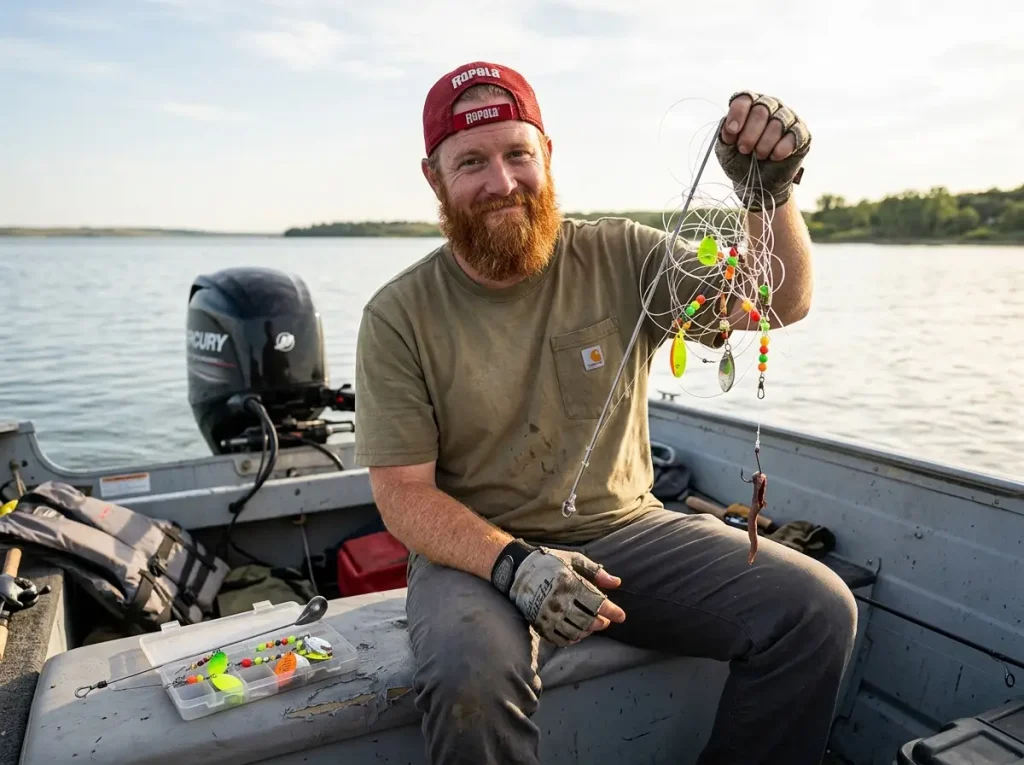
The number one frustration with bottom bouncers. The snell wraps around the wire arm on every deployment, every turn, and every time a wave lifts the rig off bottom. Three fixes:
First, heavier snell material. Fourteen- to twenty-pound monofilament or fluorocarbon tracks straighter and resists twisting. If your snell tangles constantly, the line is too light for your speed.
Second, deploy correctly. Lower the bouncer to the water surface first, let the snell and harness trail out behind the boat in the current, then slowly lower the whole rig to the bottom. Never drop the bouncer and snell into the water at the same time — that’s a guaranteed tangle.
Third, shorter snells for spiral hook rigs. The spiraling action of a spiral hook amplifies tangling on long snells. Cut it to 3 feet and the problem mostly disappears.
Losing Bottom Contact
If you keep losing the bottom, you’re either too light, too fast, or letting out too much line. The fix is almost always a heavier bouncer, not more line. More line means a shallower angle, less feel, and worse hooksets.
Wrong Rod Angle
Pointing the rod straight up pulls the bouncer off the bottom. Pointing it straight back gives you no hookset leverage. Hold the rod at roughly 10 o’clock with the tip low and forward. This keeps the bouncer tracking properly and gives you room to sweep-set when a fish hits.
Ignoring Speed Changes on Turns
Every turn changes the speed of your inside and outside presentations. Inside slows down, outside speeds up. If your inside harness stops spinning on turns, you’re fishing a dead bait through the best part of the structure. Either shorten that line, speed up slightly, or switch to a spiral hook that works at any speed.
Pro tip: Carry spare pre-tied snells in a small leader wallet. When a snell tangles badly mid-troll, cut it off and clip on a fresh one in 30 seconds instead of spending 5 minutes untangling on the water. Time on the water is time catching fish.
When to Use a Bottom Bouncer vs Other Walleye Rigs
Bottom Bouncer vs Lindy Rig
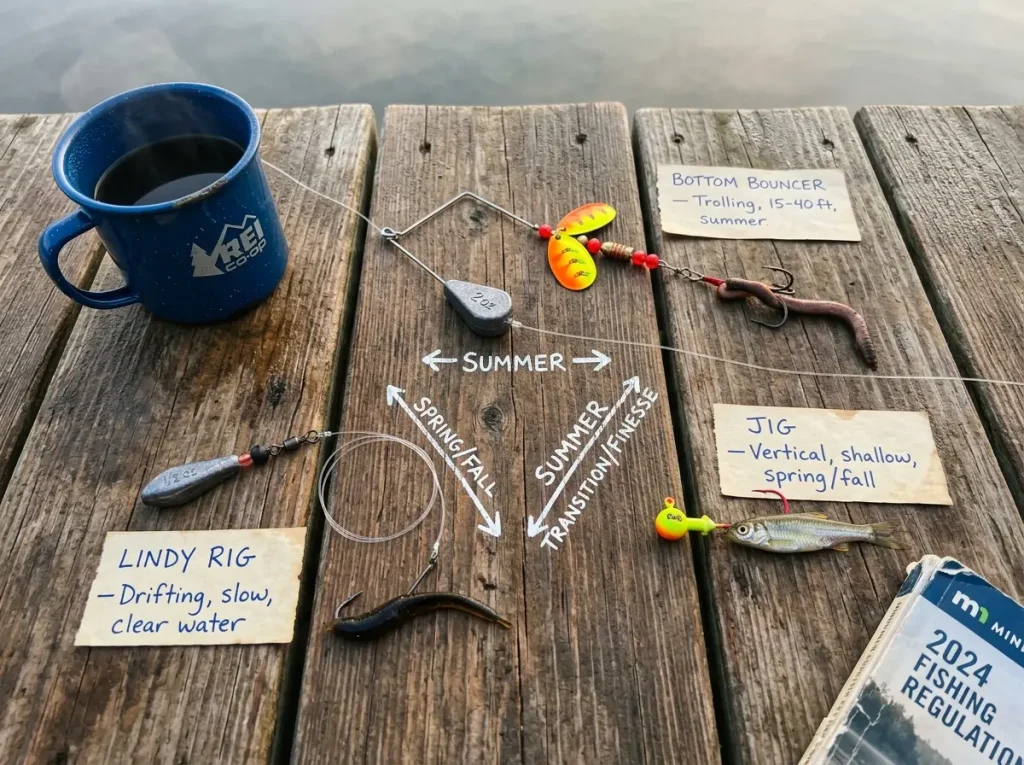
The Lindy rig uses a sliding sinker that lets walleye pick up the bait without feeling weight. It’s better for finesse situations: clear water, post-frontal conditions, spooky fish that drop bait at any resistance. Lindy rigs also get closer to the bottom than bouncers, which is an advantage when walleye are hugging structure tight.
Bottom bouncers win when you need to cover water, troll at speed, or fish structure with snag potential. The wire arm deflects off rocks and weeds that would hang up a Lindy rig constantly. If you’re searching for fish, use a bouncer. If you’ve found them and they’re finicky, switch to a Lindy.
Bottom Bouncer vs Jig
Vertical jigging is the go-to in spring and fall when walleye are on specific spots — river current seams, sharp breaklines, wingdams. Jigs give you pinpoint control that bouncers can’t match. When you need to hold on one rock pile and work it, jig.
Bottom bouncers excel in summer and early fall when walleye spread along extended structure — long points, sprawling flats, miles of shoreline break. That’s when covering water matters more than pinpoint accuracy, and bouncers do it better than anything else.
For the spring jigging side, the spring river walleye pre-spawn tactics guide covers when vertical presentations beat horizontal ones.
The Seasonal Framework
Think of it this way:
Spring (pre-spawn/spawn): Jig or Lindy rig. Fish are concentrated, water is cold, slow presentations win.
Late spring through summer: Bottom bouncer. Fish spread out along structure, water warms, speed triggers strikes.
Fall: Start with bouncers, transition to jigs as walleye concentrate on fall feeding spots.
Ice-up: Neither. Switch to the blade bait or jigging spoon playbook entirely.
If you’re chasing walleye on Lake Erie specifically, bottom bouncers with crawler harnesses are the dominant tactic from May through August on the central and western basins.
Conclusion
Bottom bouncing is one of those techniques that looks simple but rewards attention to detail. Three things to take from this:
Get the weight right. One ounce per ten feet of water, maintain the 45-degree angle, and go heavier when in doubt. A heavy bouncer that tracks the bottom beats a light one that drifts behind the boat every time.
Listen to the wire. The bottom bouncer is a probe, not just a weight. Learn what rock, gravel, sand, and mud feel like through the rod tip, and you’ll start finding walleye on the transitions instead of just trolling blind.
Match the presentation to the mood. Spinner harnesses for searching and aggressive fish. spiral hook for subtle bites. Plain snells for clear water. Having all three pre-tied and ready to swap is what separates a good day from a great one.
Next time you’re staring at a walleye flat and wondering where to start, clip on a bouncer, point the bow at the break, and start trolling. The wire will tell you where the fish are.
Q1 What speed do you troll bottom bouncers for walleye?
Most walleye respond best to bottom bouncers trolled at 1.0-1.6 mph. Speed up to 2.0 mph to trigger reaction strikes from lethargic summer fish. Slow down to 0.8 mph for post-frontal conditions, but switch to a spiral hook or plain snell at that pace.
Q2 How much weight should a bottom bouncer be?
Use 1 ounce of weight for every 10 feet of depth as your starting point. Fishing 25 feet deep means a 2.5-ounce bouncer. Go heavier in current or wind, and always err on the heavy side — a slightly heavy bouncer maintains better bottom contact.
Q3 What is the best line for bottom bouncing walleye?
Braided line in 8-12 pound test is the best choice. Berkley Fireline is the industry standard. The zero-stretch properties let you feel every pebble and detect the lightest bites. Monofilament stretches too much at trolling distances.
Q4 When should you use bottom bouncers for walleye?
Bottom bouncers work best from late spring through early fall when walleye spread along extended structure. They excel in 15-40 feet of water over hard bottom. Switch to jigs in early spring and late fall when fish concentrate on specific spots.
Q5 What is the best snell length for bottom bouncers?
Standard spinner harnesses run on 5-6 foot snells. spiral hooks work better on shorter 3-4 foot snells to prevent tangling. In clear water over soft bottom, try 8-12 foot snells for a more natural presentation that keeps bait away from the bouncer’s wire.
Risk Disclaimer: Fishing, boating, and all related outdoor activities involve inherent risks that
can lead to injury. The information provided on Master Fishing Mag is for educational and informational purposes
only. While we strive for accuracy, the information, techniques, and advice on gear and safety are not a substitute
for your own best judgment, local knowledge, and adherence to official regulations. Fishing regulations, including
seasons, size limits, and species restrictions, change frequently and vary by location. Always consult the latest
official regulations from your local fish and wildlife agency before heading out. Proper handling of hooks, knives,
and other sharp equipment is essential for safety. Furthermore, be aware of local fish consumption advisories. By
using this website, you agree that you are solely responsible for your own safety and for complying with all
applicable laws. Any reliance you place on our content is strictly at your own risk. Master Fishing Mag and its
authors will not be held liable for any injury, damage, or loss sustained in connection with the use of the
information herein.
Affiliate Disclosure: We are a participant in the Amazon Services LLC Associates Program, an
affiliate advertising program designed to provide a means for us to earn advertising fees by advertising and linking
to Amazon.com. As an Amazon Associate, we earn from qualifying purchases. We also participate in other affiliate
programs and may receive a commission on products purchased through our links, at no extra cost to you. Additional
terms are found in the terms of service.