In this article
The GPS waypoint read correctly. The depth sounder had the wreck sitting at exactly 31 feet. But the bait kept landing 80 feet off the structure — every single drop. Not because of bad gear. Not because of bad luck. Because of one number nobody bothered to calculate: the bow height they’d left out of the scope math.
I’ve watched anglers run this same problem for years. You get the chart right, you find the structure, you drop the hook — and then you spend the rest of the morning creeping back upcurrent, wondering why you’re not marking fish. The answer is almost always the math, and the math is never where most guides tell you to look.
This article treats anchoring as an engineering problem. By the time you’re done, you’ll know how to calculate your exact drop point, why scope-to-depth ratio is only half the equation, how seabed roughness affects your hold before the flukes ever dig in, and when two anchors beat one.
⚡ Quick Answer: To hold precisely over structure, calculate your Total Vertical Depth (TVD) by adding bow height to water depth, then multiply by your target scope ratio (7:1 for moderate conditions, 10:1 for rough). Deploy your anchor that many feet upcurrent of the target using a calibrated Productive Drift Line. On sandy bottoms with a 35-ft boat in 40 knots of wind, your ground tackle is absorbing roughly 900 lbs of load — size your rode for gusts, not averages. If the boat yaws off the wreck, rig a stern bridle or set a Bahamian Moor.
The Physics of Why Boats Drift — Load Vectors Explained
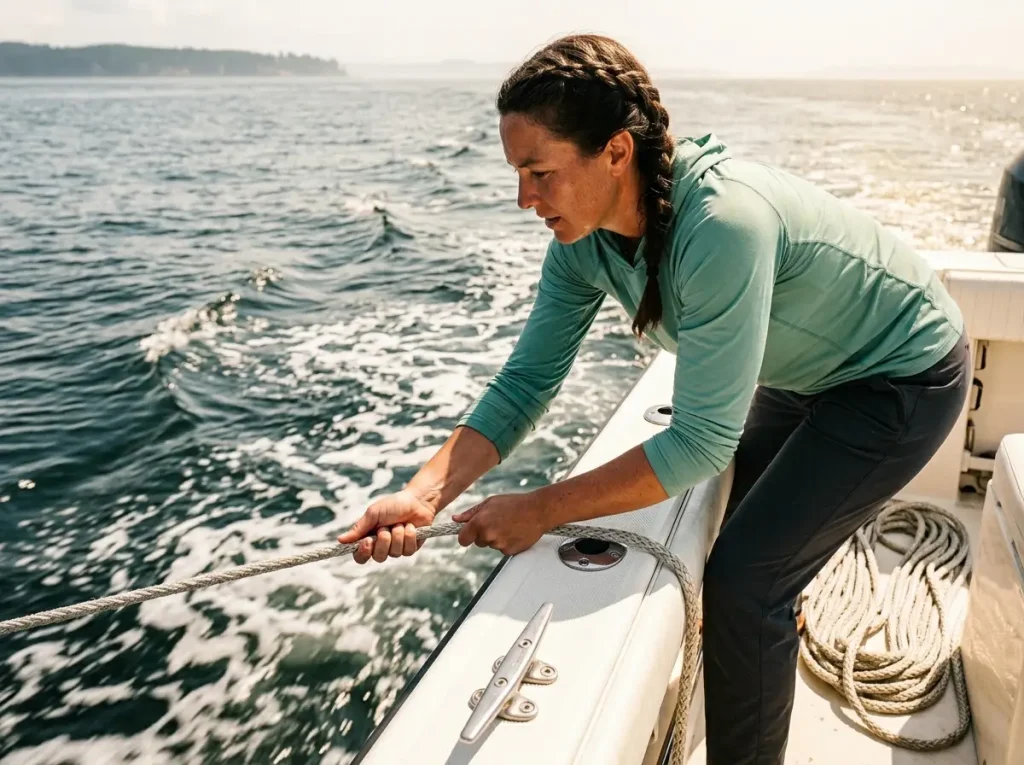
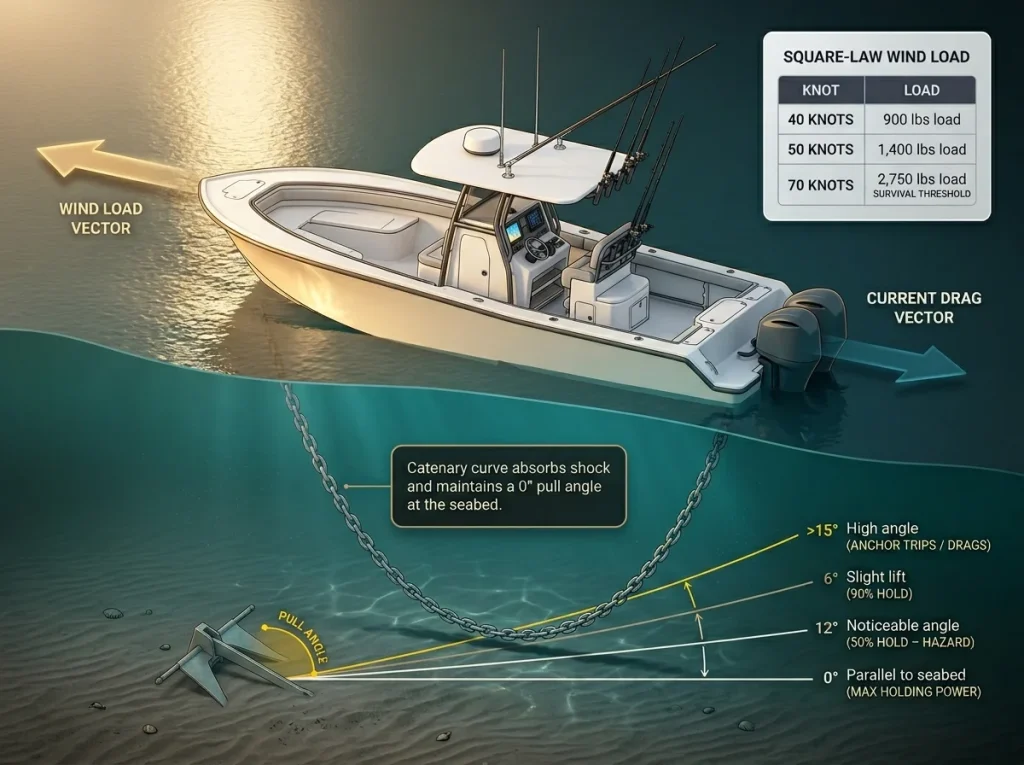
Here’s the part most boat ramp conversations skip entirely: wind load doesn’t scale the way people think. Double the wind speed and you don’t double the force — you quadruple it. That square-law relationship is why a 35-foot boat sitting comfortably in 40-knot conditions is suddenly in genuine trouble at 70 knots. At 40 knots sustained, your horizontal load vector on the ground tackle runs around 900 lbs. At 70 knots — the kind of squall that builds fast on an offshore wreck — you’re past 2,000 lbs. That’s not bigger, that’s a different category of load.
The other number nobody respects is current. A 5-knot current pushing on a 40-foot boat generates roughly 300 lbs of drag vectors — the same as a sustained 15-knot wind. You can see wind. You can’t see current, and that invisibility causes a lot of dragging anchors. When you’re stacking current and wind from different directions, the vectors add. Your ground tackle is fighting both at once.
The thing that actually keeps you in place is the catenary curve — the arc the chain forms between the bow roller and the bottom. That arc is your shock absorber. More importantly, it’s what keeps the pull on the anchor shank close to horizontal. As long as chain is lying on the seabed, the rode-to-bottom angle stays near zero degrees, and holding power stays near maximum.
When load lifts that chain off the bottom entirely, the angle at the shank rises and holding power drops. At a 12° pull angle — the kind you see at 5:1 scope in a strong gale — you’re down to about 50% of your system’s rated hold. Most guys tie off and walk to the stern. What they don’t see is the catenary going bar-tight under a passing charter boat’s wake. That’s the moment the anchor starts to walk.
If you want to understand when to rig additional boat control in wind as an alternative to anchoring, conditions where the catenary is already taut are where that conversation starts.
Pro tip: Before you drop the hook, watch a floating piece of weed or foam for 60 seconds. It tells you exactly what the current is doing at the surface, and surface current is what’s going to load your system once the catenary tightens.
Seabed Science — Manning’s n and the Substrate You’re Anchored In
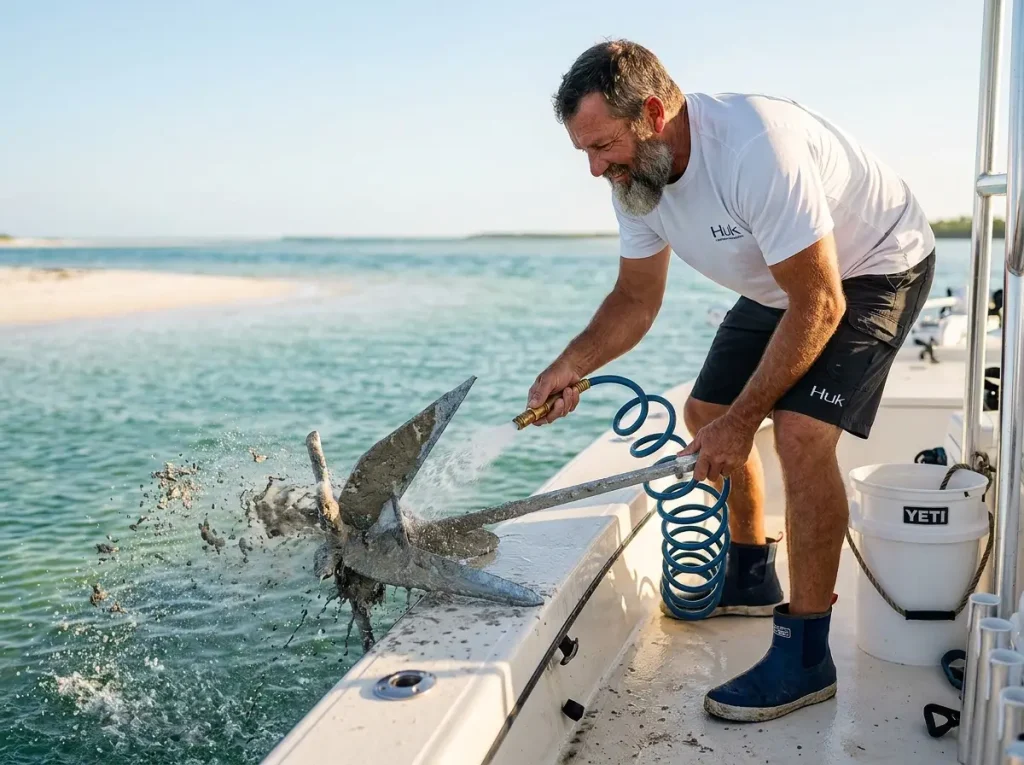
Most fishing guides jump straight to anchor selection. What they don’t cover is the seabed itself — and the seabed is half your holding system before the flukes even dig in.
The Manning’s n coefficient is a number from hydrodynamic modeling that measures how much friction a substrate offers to flow. For an anchored vessel, it tells you how much the chain “grips” the bottom on its own, supplementing whatever the flukes are doing. Smooth alluvial sand (n = 0.018) offers low chain friction — your rode is basically sliding on glass, which is why sand requires the most scope (10:1) to stay stable. Uniform gravel (n = 0.025) offers moderate friction and good seabed penetration for fluke-style anchors. Cobble and rock mix (n = 0.040) provides high friction but also high fouling risk. Densely vegetated substrate — seagrass beds — runs n = 0.100 and above, which sounds like it would be great for holding, but the root mat completely prevents fluke burial. You’re not set. You’re resting.
This matters because you can get a false set. The boat stops moving, the line feels tight, and you figure you’re good. What actually happened is the chain got friction from the rough bottom and the flukes never grabbed anything. One swell lifts the chain, the friction disappears, and the anchor drags immediately. I snorkeled my anchor after a weekend trip in the Keys and the danforth flukes were sitting flat on top of the grass — not in it. The boat had “held” on chain tension alone. I’d been lucky, not good.
The conservation and the practical argument are the same argument here. Anchoring in seagrass is both ecologically destructive and mechanically unreliable. Those beds are primary nursery habitat for the inshore species you’re after. Moving to a sand patch means you get a real set and the grass recovers. Check Manning’s roughness coefficients for benthic substrates from the Army Corps of Engineers when you’re trying to match tackle to unfamiliar bottom — those tables cover every substrate type in detail.
If you’ve run into substrate friction and Manning’s n before in the context of freshwater bottom-fishing applications, the same principles apply across disciplines. The physics doesn’t change with the species. You can see how it shows up in carp fishing techniques — the same substrate science transfers directly.
The Geometry of the Perfect Set — Calculating Your Exact Drop Point
The Total Vertical Depth Error Most Anglers Make
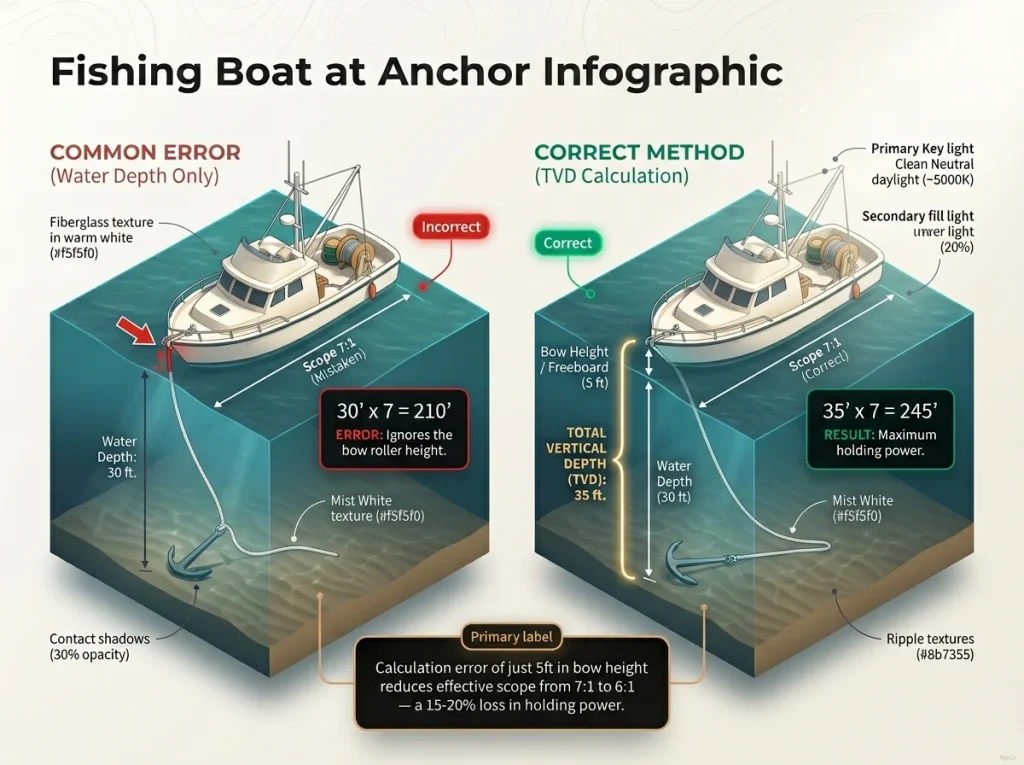
Here’s where everyone gets the math wrong: you’ve read “multiply your water depth by 7” a hundred times. That calculation ignores the bow height, and that single omission produces cascading errors in your entire scope-to-depth ratio.
Your anchor rode doesn’t leave the boat at the waterline. It leaves at the bow roller — and that bow roller on a typical fishing boat sits 4 to 6 feet above the water. In 30 feet of water with a 5-foot bow height, your Total Vertical Depth is 35 feet. At 7:1 scope, you need 245 feet of rode. If you calculated off the water depth alone, you deployed 210 feet — and you’re actually sitting at 6:1, which cuts your holding power by 15 to 20% and increases the odds that a swell lifts the catenary.
The numbers scale fast. At 50 feet of water plus a 6-foot bow at 10:1, you’re looking at 560 feet of rode. Tide variation adds to TVD too — in a 3-foot tidal swing, your effective depth increases by 3 feet at high tide, effectively reducing your scope ratio if you don’t compensate.
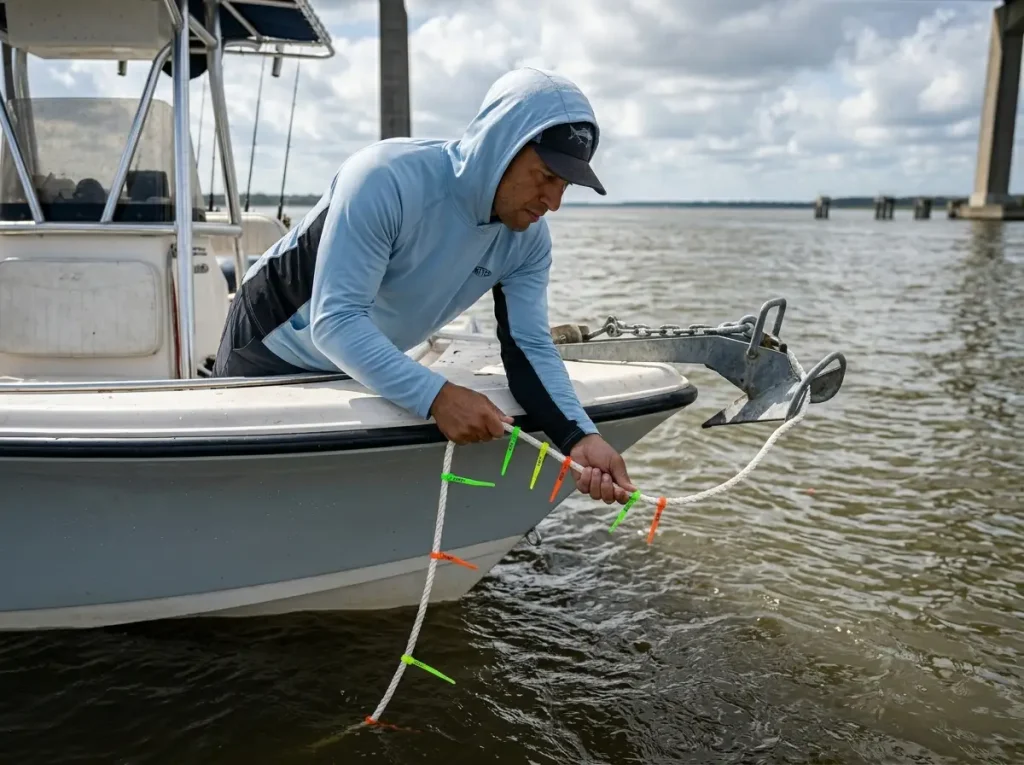
Mark your anchor rode at 50-foot intervals with colored zip ties before you leave the dock. You cannot run reliable scope math if you’re guessing how much line is in the water. This is the kind of thing that sounds obvious until you’re at the railing in 30 knots of wind trying to count wraps.
Calculating the Horizontal Drop Distance
The drop point is never directly over the target. When you drop the hook, the boat drifts. The anchor travels horizontally as it descends and as you pay out rode. The distance from where you drop to where the anchor lands is a geometry problem — the horizontal leg of a right triangle where the rode is the hypotenuse and the TVD is the vertical leg.
At 30-foot TVD and 245 feet of rode, the anchor lands roughly 242 feet from your drop point. That means you’re motoring 242 feet upcurrent of the wreck, dropping the hook there, and paying out scope as the current carries you back. Use your GPS’s MOB (man overboard) function to pin the target structure, then navigate to a point 242 feet up along the current vector and drop. Watch the video below from The Fish Locker for a solid visual on anchoring wreck structure — it also covers the Alderney Ring method for retrieving stuck anchors, which every offshore angler should know.
Current Offset — Adjusting for Moving Water
In a strong current the boat doesn’t drift in a straight line from the drop point — it moves laterally too. The current offset is the distance the vessel travels sideways while you’re paying out rode, and ignoring it means your bait is landing beside the wreck, not over it.
The fix is your Productive Drift Line. Before you drop anything, let the boat sit for 60 seconds and watch where she goes. Mark the start and end points in the GPS. That line is your actual drift vector — driven by both wind and current combined — and the drop point needs to be that many feet up-vector from the target, not just straight upwind.
In a 2-knot current you’ll see approximately 30 to 40 feet of lateral drift per minute of scope deployment. In a 4-knot inlet current running against the wind, that number climbs fast. Tidal velocity — not height — determines your current offset, and if you want to predict how hard the current will be running when you arrive at the spot, the science behind that prediction starts with tidal velocity for fishing success.
Pro tip: Anchor the wreck on a falling tide into flood transition when possible. The tidal velocity drops near zero at the turn, which gives you the cleanest drop with minimal current offset.
Gear Analysis — Rode, Chain, and the Anti-Sell on Off-the-Shelf Kits
3-Strand vs. 8-Plait Nylon — What the Construction Actually Means
Both are nylon. Both absorb shock. But their construction behavior is genuinely different and the distinction matters in real-world conditions.
3-Strand twisted nylon stretches 12% under working load, which is excellent shock absorption. The problem is hockling — permanent twisting damage that sets in after repeated heavy loading in saltwater. Once a 3-strand rode is hockled, the internal fibers have shifted and its breaking strength drops unpredictably. A 3/8-inch 3-strand rode breaks at around 2,500 lbs new. After a season of hard use in a salty windlass, that number is lower, and you don’t know by how much.
8-Plait braided nylon only stretches about 4%, but it doesn’t rotate under load. Its non-rotational construction means zero twist accumulation — it flakes cleanly straight down into a vertical anchor locker without jamming. Breaking strength at 3/8-inch runs around 6,200 lbs. If you’re running a vertical windlass for offshore work, 8-plait elasticity and its resistance to hockling makes it the only real choice. The price difference between 3-strand and 8-plait is negligible compared to the cost of dragging anchor at 3 AM.
Chain-to-Rope Ratios and the False Catenary Problem
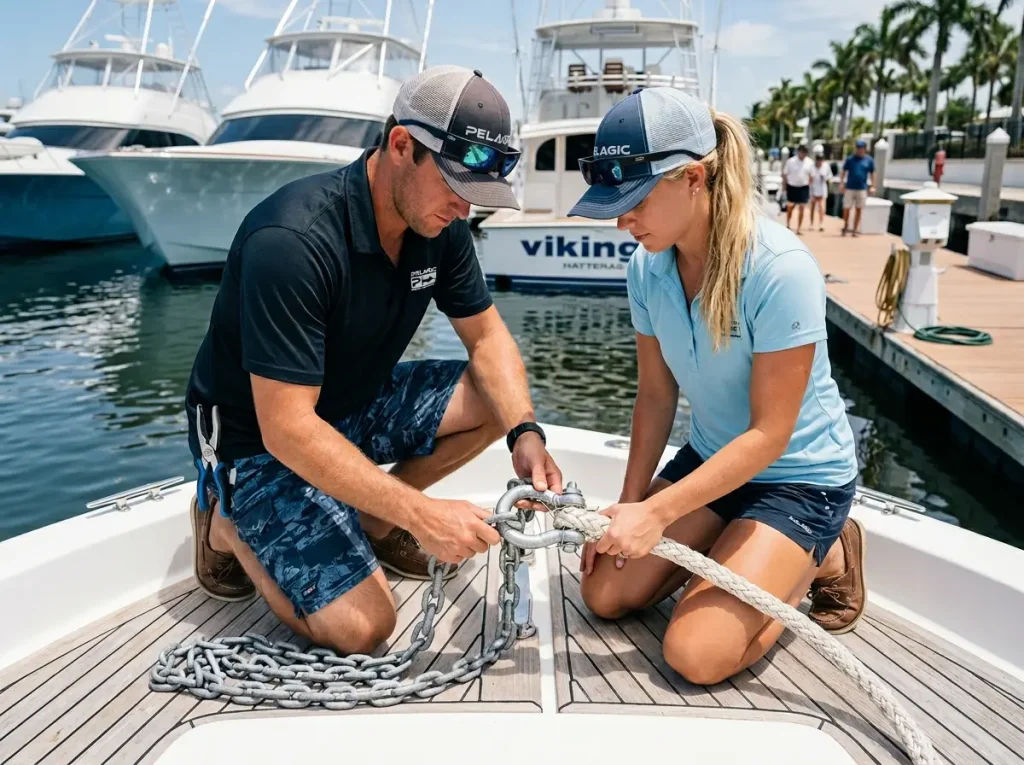
The hybrid approach — a chain leader attached to a nylon rode — gives you both: the chain weight creates the catenary curve offshore while the nylon absorbs surge loads that would otherwise jerk the shank. Minimum recommendation for offshore work is 5 to 6 feet of chain per foot of boat length.
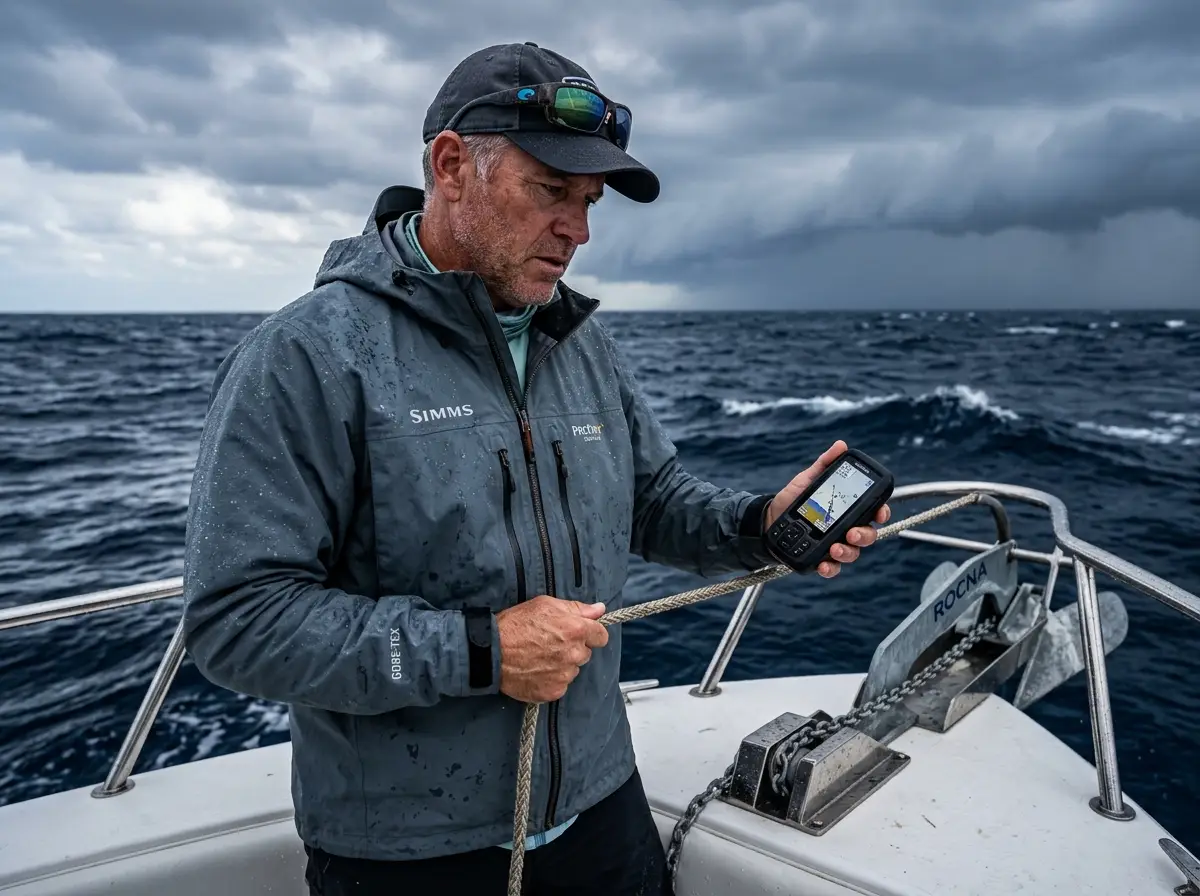
Peter Smith, who designed the Rocna anchor, made something clear that most guides won’t tell you: in 40 to 50 knots and above, even heavy chain goes bar-tight. The catenary disappears completely. At that point it’s scope alone that controls whether the anchor holds. This is why you size your tackle for survival gusts, not comfortable conditions. Inspect your shackle pins and thimble connections before every offshore trip. Mouse all shackle pins with safety wire. The pin that works 99 times is already past its inspection date.
The same scope ratio principles apply whether you’re in a kayak or a 30-footer — the physics of catenary, chain weight, and pull angle are identical. The scale is smaller but the math is the same.
The Anti-Sell on Big-Box Anchor Kits
Pre-packaged anchor kits photo well and stack neatly on retail shelves. They’re sized for average conditions, which in practice means protected lake anchoring in 15 knots of wind. A 35-foot offshore vessel in 40 knots is generating roughly 900 lbs of load on your ground tackle. Most big-box kits include chain rated to a 1,200 lb Working Load Limit — which sounds like margin until you do the math. At a 33% safety factor, the design load is 800 lbs. You’re above that before the squall line arrives. Buy anchor components separately. Size everything for 70 knots, the survival threshold, and treat it as insurance you’ll never need to collect on.
The Nautical Institute, the global professional body for seamanship, has published the science of anchoring as a technical resource — their analysis of rode sizing and load factors is worth reading before your next gear purchase.
Anchor Selection by Bottom Type — The Anti-All-Rounder Assessment
Fluke (Danforth) — The Sand and Mud Specialist
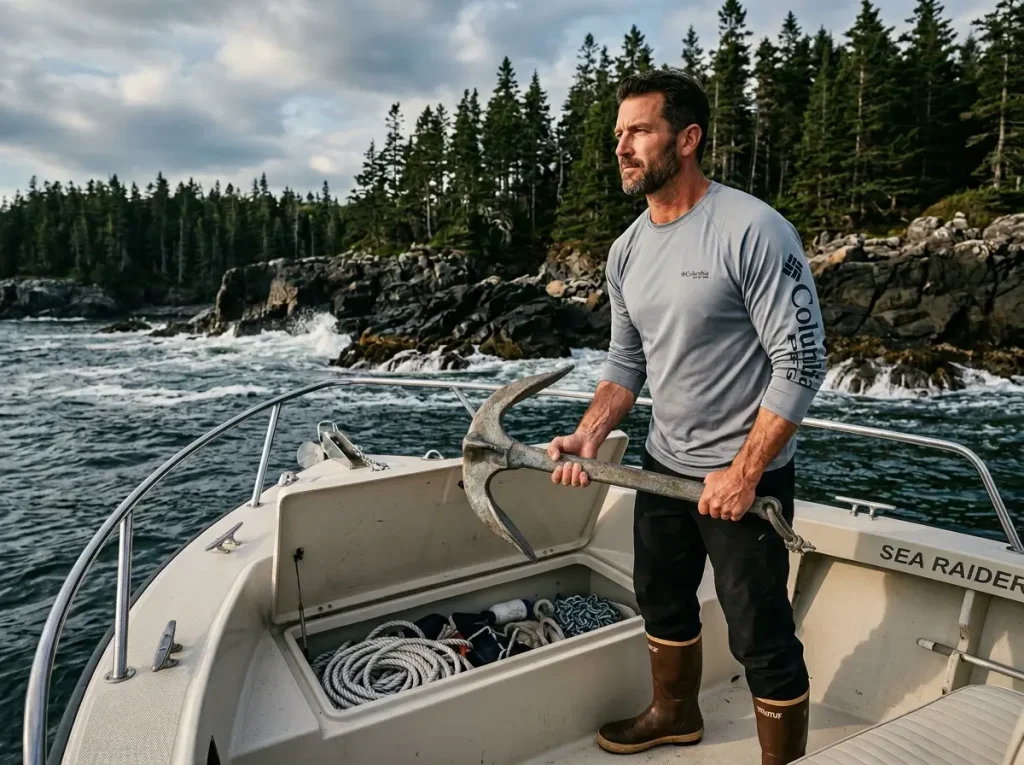
The danforth anchor’s highest holding-to-weight ratio exists in flat, soft substrate — sand, mud, clay — where the flukes can pivot and bury deeply under load. In those conditions, nothing in its weight class holds as well. On rock or heavy weed it’s decorative hardware. The thin shank and pivot-point design that gives it sand performance works against it the second the flukes can’t bite. Many anglers run a Danforth on a rocky reef simply because it came included in a kit. That anchor is doing nothing for them except giving a false sense of security.
New-Gen (Rocna / Mantus) — The High-Performance Standard
The roll-bar design of new-generation anchors like the Rocna and Mantus forces the anchor right-side-up on contact with the seabed, enabling near-instant sets in almost any substrate. After a 60-degree yaw the boat reloads, and these anchors reset reliably — which is where plow and cqr designs frequently trip in soft sediment under surge. The high-surface-area fluke holds well under surge loads that would skip a standard fluke anchor. The honest anti-sell: they’re often oversized for small-boat anchor lockers. Measure your chain locker before ordering.
Plow (CQR / Delta), Claw (Bruce), and the Honest Assessment
Plow anchors are predictable all-rounders. They reset when the boat yaws, which makes them reliable in mixed-substrate anchorages where you can’t guarantee the flukes set clean the first time. The known failure mode: they trip in soft mud under extreme loads because of the pivot-point design. You know they’ll reset. You also know they’ll give up in 45 knots of chop. Plan for both.
The claw (Bruce) has low holding power per pound. It’s saved by one characteristic: it resets itself exceptionally well in mixed bottom. For light-duty inshore fishing in unpredictable substrate it’s acceptable. For offshore wreck fishing in serious conditions, it’s not in the conversation.
When mechanical anchoring isn’t viable — shallow water, rocky pinnacles, current-swept structure — the case for Spot-Lock when mechanical anchoring isn’t viable becomes relevant. Power-Pole and similar spot-lock systems fill the gap where traditional ground tackle fails on the bottom.
Pro tip: Carry two anchors with different designs when you’re fishing varied structure. A Danforth for the sand flat, a Rocna for the reef. Switching between them takes two minutes and it’s the difference between a real set and an educated guess.
Advanced Station-Keeping — The Bahamian Moor and Breakaway Rigs
The Yawing Problem — Why One Anchor Isn’t Always Enough
Yawing — the boat swinging in a wide arc around the anchor — multiplies the effective load on your system by up to 3 times. That’s not a fudge factor; it’s the Yawing Load Multiplier that maritime engineers use when sizing tackle for single-anchor scenarios. On a wreck in cross-current with any wind, a single anchor lets you swing 40 to 60 degrees off target, dragging baits across the structure unpredictably.
Plow and fluke anchors are worst for yawing because their high surface area creates aerodynamic drag on the boat’s hull as it swings. The partial fix without a second anchor is a bridle — running a secondary line from the stern cleat to the anchor rode, which shifts the pivot point and stabilizes heading. It’s not perfect, but it’s fast and it works in moderate cross-current situations.
The Bahamian Moor — Step-by-Step for Wreck Fishing
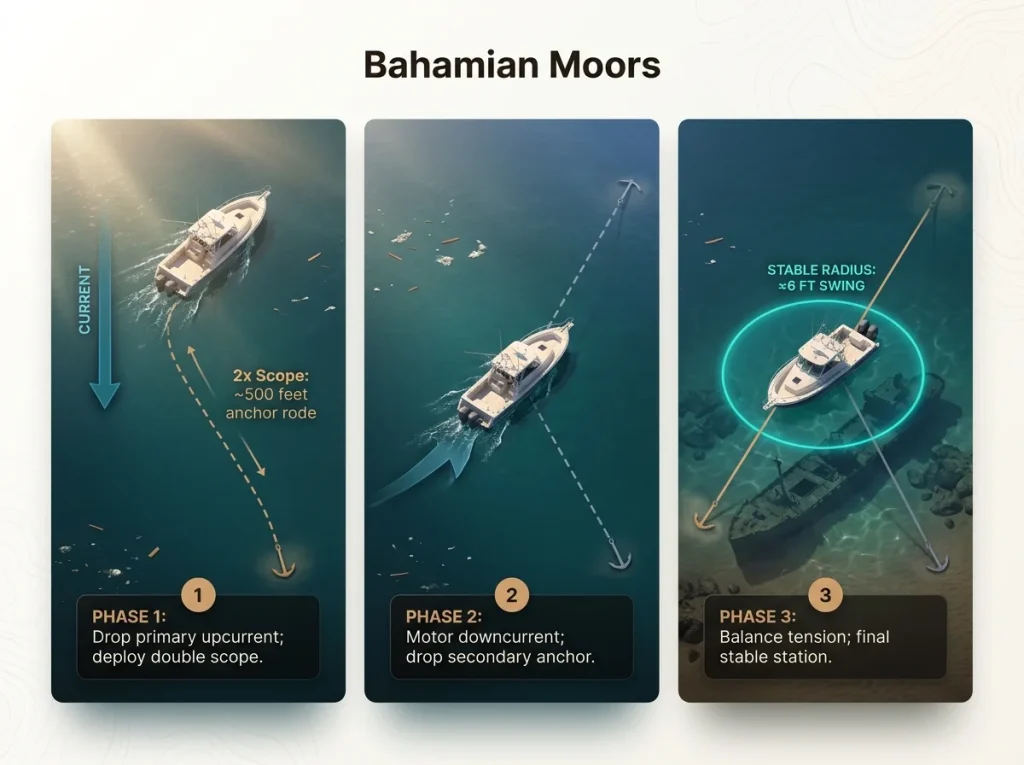
The Bahamian Moor is the definitive solution for tidal reversals, crowded reefs, and anywhere you need the boat locked down regardless of current direction. It uses two anchors set 180 degrees apart, suspending the boat at the midpoint with a swing circle of about 6 feet.
Phase 1: Drop the primary anchor upcurrent and pay out double the scope you’d normally use — so for a 7:1 set in 35 feet of TVD, you’re paying out 490 feet of rode.
Phase 2: Motor downcurrent and drop the secondary anchor.
Phase 3: Retrieve the primary rode until the boat sits centered between the two anchors.
The result: the boat rotates around a central point on a roughly 6-foot radius, regardless of whether the tide turns and reverses the current direction. Baits stay locked on the structure, and when the flood pushes against the ebb you don’t have to reset. Re-check your position every 30 minutes on a fast-moving tide — a strong flood can lift the secondary anchor if scope is marginal.
Knowing tidal coefficient and current strength at your anchoring site before you set the moor tells you which anchor to weight as primary and whether you need extra scope on the secondary side.
The Breakaway Rig — Insurance for High-Relief Wrecks
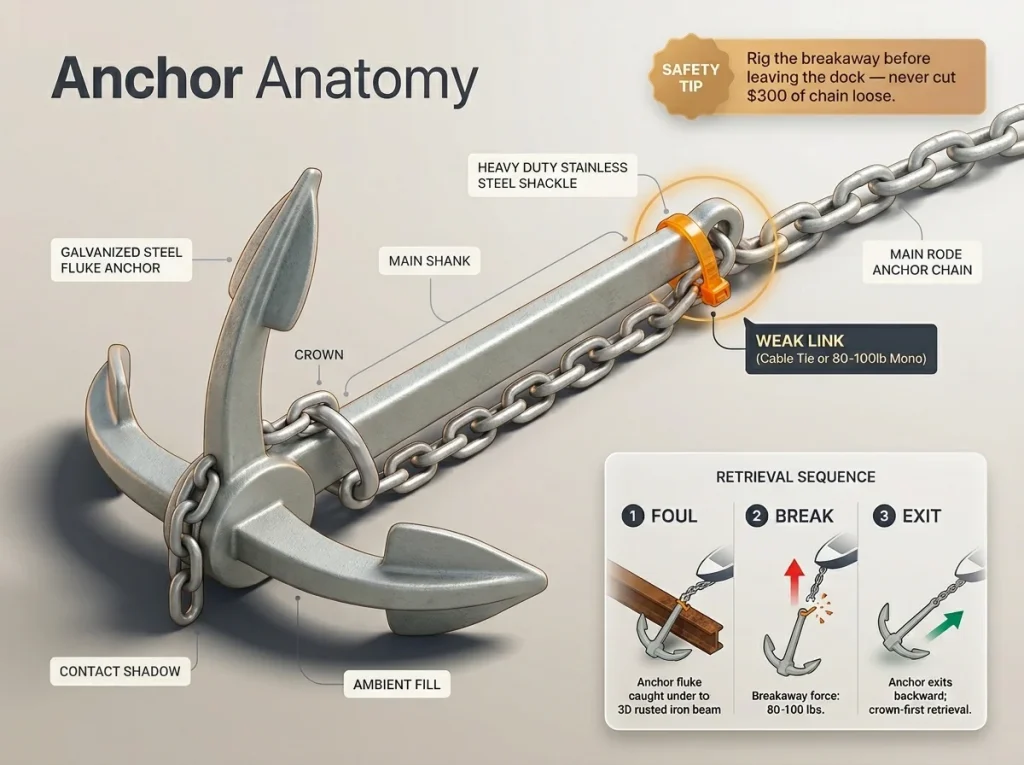
High-relief wrecks — freighters, warships, anything with significant vertical structure — carry a real risk of permanent foul. The breakaway rig is the answer, and it’s standard practice in professional offshore guide services while being virtually unknown to weekend anglers.
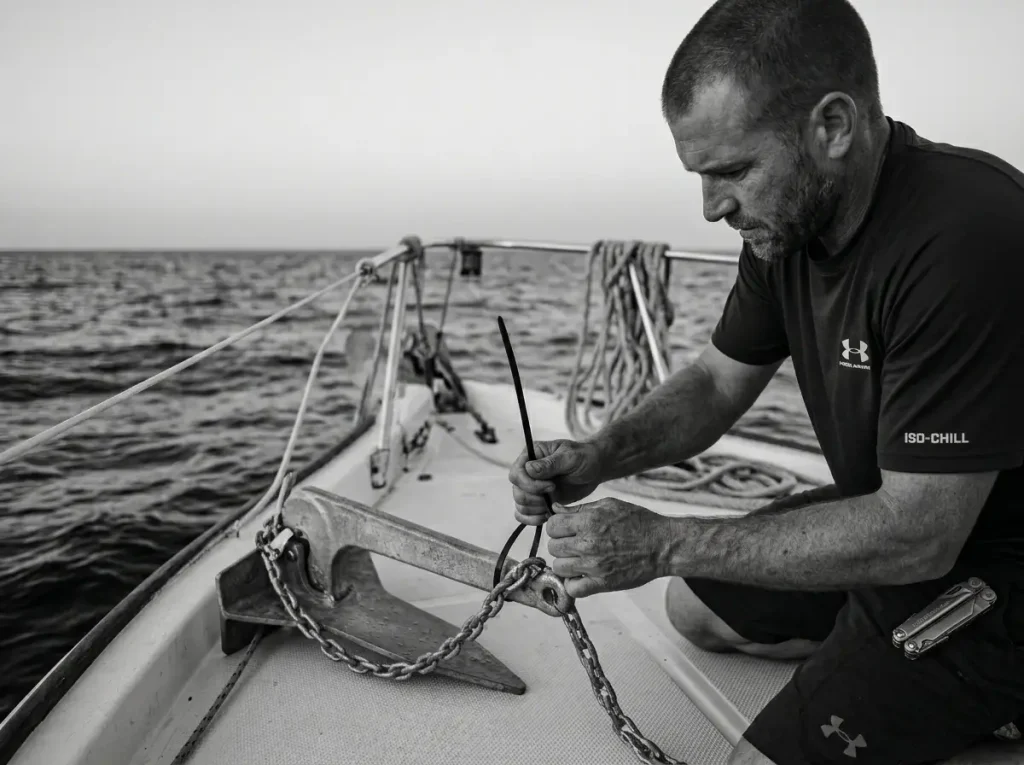
The setup is simple: a sacrificial weak link — a heavy-duty cable tie or 80 to 100 lb monofilament — secures the chain to the anchor crown. If the anchor fouls on structural steel, you motor directly over the anchor position to create slack, then reverse hard. The upward pull breaks the weak link at the crown, and the anchor backs out free. The crown exit is why it works — you’re pulling the hook backward out of whatever it’s snagged on.
I’ve watched anglers cut $300 of chain loose because they didn’t have a 12-cent cable tie in the right place. Rig the breakaway before you leave the dock. It weighs nothing and costs nothing and it’ll save you tackle when you need it most.
Safety, Compliance, and Conservation
Stern Anchoring — The Most Hazardous Habit in Fishing
Anchoring from the stern is the most common serious mistake I see from recreational anglers, and it’s genuinely hazardous. Fishing vessels are designed to meet waves with the bow — the deepest, most reinforced point of the hull. When you anchor from the stern, you’re forcing the transom, which is the lowest point, directly into the dominant environmental force.
In a current-over-wind scenario — common in tidal inlets — the stern gets pushed down. Boats have been swamped from stern anchoring dangers in as little as 7 minutes. The only legitimate use of a stern anchor is as the secondary in a Bahamian Moor, and even then, the rode is managed at the bow before being paid aft, not cleated to the stern directly.
If the crew argues that it’s easier to fish from the back, have the conversation once, clearly, and make it non-negotiable. Never cleat anchor rode to the stern cleats on a fishing vessel under any conditions.
COLREGS Compliance for Anchored Fishing Vessels
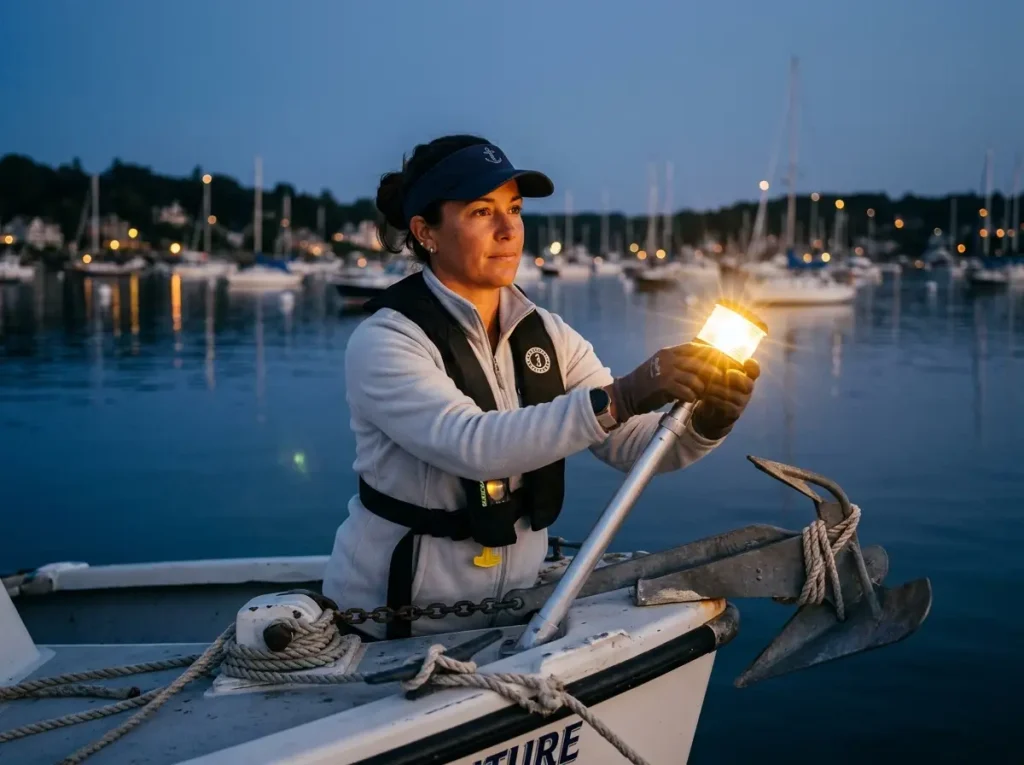
COLREGS Rule 30 anchor display requirements are not suggestions. According to the official USCG Navigation Rules, any vessel at anchor must display a white all-around light and, during daylight hours, a black ball shape at the forward part of the vessel. In low-visibility conditions — fog, heavy rain — a passing vessel that can’t see your anchor light is a survival problem, not a paperwork problem.
In a Bahamian Moor you’re still “at anchor” under the rules. Same lighting requirements apply. Install an all-around LED anchor light on an extendable pole that deploys in under 30 seconds. Non-compliance in clear weather is a citation; non-compliance in a squall is a collision risk.
Pro tip: anchor lights draw almost no power on modern LED fixtures. Leave yours on from the moment you hook up to the anchor rode until you’ve retrieved it completely. There’s no reason to cut corners on this.
Conservation — Why Seagrass Beds Are Off-Limits
Anchoring in seagrass destroys root mats that can take years to recover. Each drag cut puts a physical scar in the bottom that compounds every season. More to the point: you’re not set in grass anyway, as we covered in the Manning’s n section. The conservation and the station-keeping arguments are the same.
Seagrass beds are primary nursery habitat for most inshore game fish. Destroying them is the fisheries equivalent of damaging a hatchery — you’re degrading the resource you came out here to fish. Move to a sand patch. You get a real set, the ecosystem recovers, and you spend the afternoon in an actual strike zone instead of drifting over dead bottom.
Before you leave the dock, review the full boating safety protocols that cover anchoring alongside the rest of your on-water safety toolkit.
Conclusion
Three things to take away.
First, anchor load is not linear — size for gusts. A 70-knot squall generates more than twice the load of a 50-knot run. If your ground tackle is rated for average conditions, it fails exactly when conditions aren’t average.
Second, the drop point math is not optional. Add bow height to water depth. Calculate TVD. Multiply by your scope ratio. Compute the horizontal distance to the drop point. Observe your Productive Drift Line for the current offset. Every step has a number; none of them are guesses.
Third, the seabed is part of your anchoring system. Chain friction on substrate (Manning’s n), fluke penetration depth, and seagrass avoidance all determine whether you’re actually holding or simply hoping the conditions don’t change.
Before your next offshore trip, calculate the TVD for your vessel in the depth you’re planning to fish. Mark your rode at the correct scope for that depth. Then mark it again at 10:1. Do the math once in the driveway and you’ll never miscalculate scope at the railing when it matters most.
FAQ
Can you anchor a fishing boat from the stern?
No — anchoring from the stern is unsafe and should not be done. The transom is the lowest point on most fishing boats, and a stern-anchored vessel in current or following seas can be swamped in minutes. Always anchor from the bow, where the hull is built to meet environmental forces head-on.
How much rope do I need to anchor in 20 feet of water?
More than most guides say. At 7:1 scope, you need 7× the Total Vertical Depth — not water depth alone. A boat with a 4-foot bow height in 20 feet of water has a TVD of 24 feet, requiring 168 feet of rode at minimum. Add extra footage to account for current and tidal swing during your anchoring window.
What is the best anchor for a fishing boat on sand and rock bottoms?
No single anchor excels on both. For sand and mud, a Danforth (fluke) gives you the best holding-to-weight ratio. For rock or mixed bottoms, a new-generation roll-bar anchor like a Rocna or Mantus sets more reliably and resets better after the boat yaws. If you fish both types of structure regularly, carry both and switch based on what the bottom looks like.
How do I stop my boat from swinging at anchor?
A stern bridle — a secondary line from the stern cleat to the anchor rode — shifts the boat’s yaw pivot point and stabilizes heading without a second anchor. For tidal reversal situations where the current flips direction, the Bahamian Moor (two anchors set 180° apart) eliminates swing entirely and keeps baits on structure regardless of tide direction.
What does scope mean and why does the ratio matter?
Scope is the ratio of deployed rode length to Total Vertical Depth. At 7:1 you’re at roughly 85% of maximum holding power. At 5:1 — what most anglers actually use — you’re at about 50%. At 3:1 you’re in the hazard zone and likely to drag under any real load. The ratio controls the pull angle at the seabed: lower the angle, the higher the holding power, and the catenary curve is what keeps that angle low.
Risk Disclaimer: Fishing, boating, and all related outdoor activities involve inherent risks that
can lead to injury. The information provided on Master Fishing Mag is for educational and informational purposes
only. While we strive for accuracy, the information, techniques, and advice on gear and safety are not a substitute
for your own best judgment, local knowledge, and adherence to official regulations. Fishing regulations, including
seasons, size limits, and species restrictions, change frequently and vary by location. Always consult the latest
official regulations from your local fish and wildlife agency before heading out. Proper handling of hooks, knives,
and other sharp equipment is essential for safety. Furthermore, be aware of local fish consumption advisories. By
using this website, you agree that you are solely responsible for your own safety and for complying with all
applicable laws. Any reliance you place on our content is strictly at your own risk. Master Fishing Mag and its
authors will not be held liable for any injury, damage, or loss sustained in connection with the use of the
information herein.
Affiliate Disclosure: We are a participant in the Amazon Services LLC Associates Program, an
affiliate advertising program designed to provide a means for us to earn advertising fees by advertising and linking
to Amazon.com. As an Amazon Associate, we earn from qualifying purchases. We also participate in other affiliate
programs and may receive a commission on products purchased through our links, at no extra cost to you. Additional
terms are found in the terms of service.