
In this article
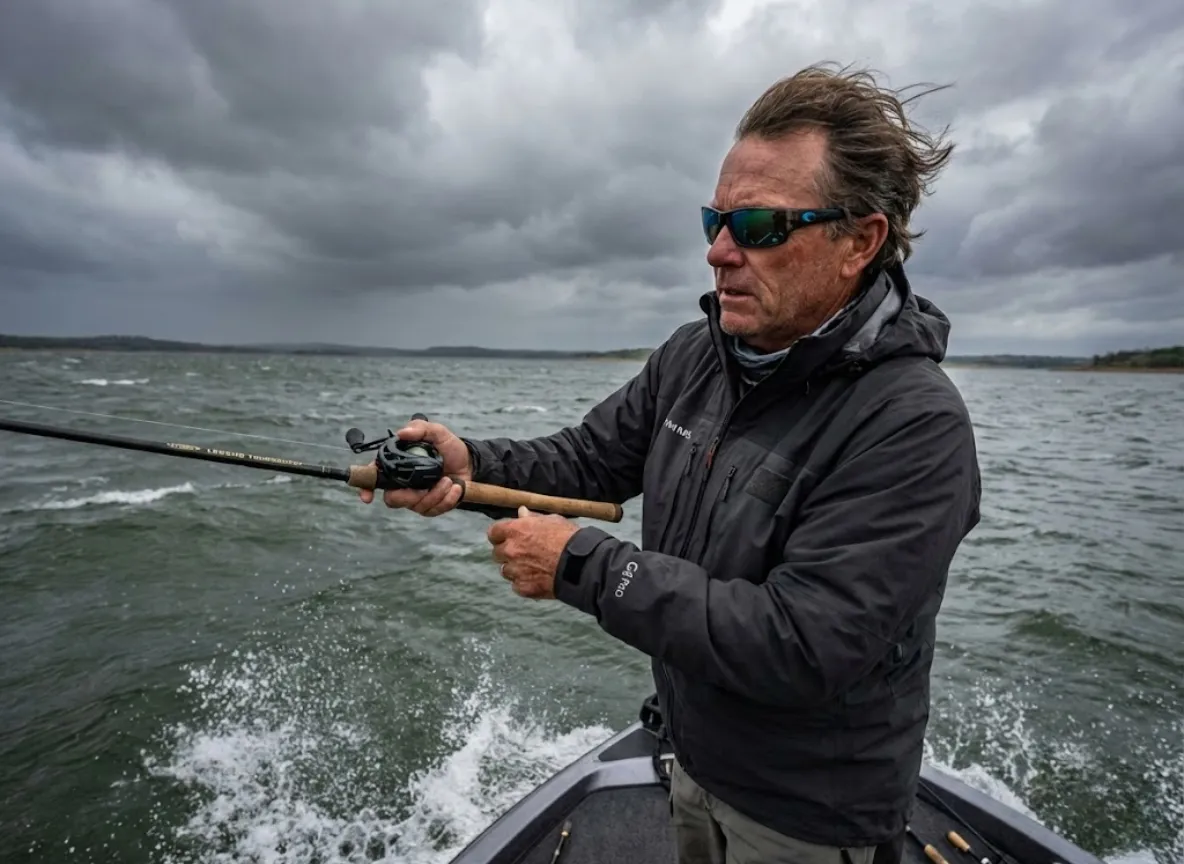
The 25 mph gusts slammed the gunwale sideways, my carefully aimed cast landed 40 feet left of the target, and the trolling motor screamed at 80% thrust just to hold position. Most anglers would’ve packed it in. But the wind-blown point ahead was stacked with bass—I’d watched the mudline forming, baitfish piling against the structure. The fish were eating. I just couldn’t reach them.
That day taught me a brutal lesson: wind isn’t your enemy—your lack of preparation is. After twenty years fishing everything from tournament circuits to backcountry lakes, I’ve learned that the anglers who cash in on windy days aren’t fighting the elements. They’re using them.
Here’s the complete system for mastering boat control and casting accuracy when the wind picks up. You’ll learn the techniques that punch casts through headwinds, the electronic and mechanical systems that hold your position, and why fish feed more aggressively when conditions get rough.
⚡ Quick Answer: To fish effectively in wind, lower your casting trajectory using a sidearm stroke and two-handed fulcrum grip to cut through air resistance. Control your boat with GPS anchoring (Spot-Lock), shallow water anchors (Power-Pole, Raptor), or drift socks sized to your hull. Fish windward shorelines where baitfish concentrate—falling barometric pressure triggers aggressive feeding in species like bass and walleye.
The Physics of Casting in Wind: Aerodynamics That Actually Work
The Boundary Layer Advantage: Why Your Rainbow Cast Fails
Here’s something most anglers never consider: wind speed isn’t uniform from water level to rod-tip height. There’s a slower layer of air right above the water’s surface—the boundary layer. Friction between wind and water creates this cushion of calmer air.
When you throw that high, arcing “rainbow cast,” you’re lobbing your lure into the fastest-moving air possible. The result? Your braided line catches the wind like a sail, creating a massive bow that kills your accuracy and cuts your distance by 30-40%.
The fix is the line drive trajectory—a low, flat cast that keeps your lure within that boundary layer. Your rod tip needs to travel in a straight line toward the target during the forward stroke, not arc upward. The stop at the end must be abrupt, snapping energy into forward momentum rather than vertical lift.
When you understand unified casting logic, you realize it’s all about controlling that rod tip path.
Sidearm Orientation and the Crosswind Drill
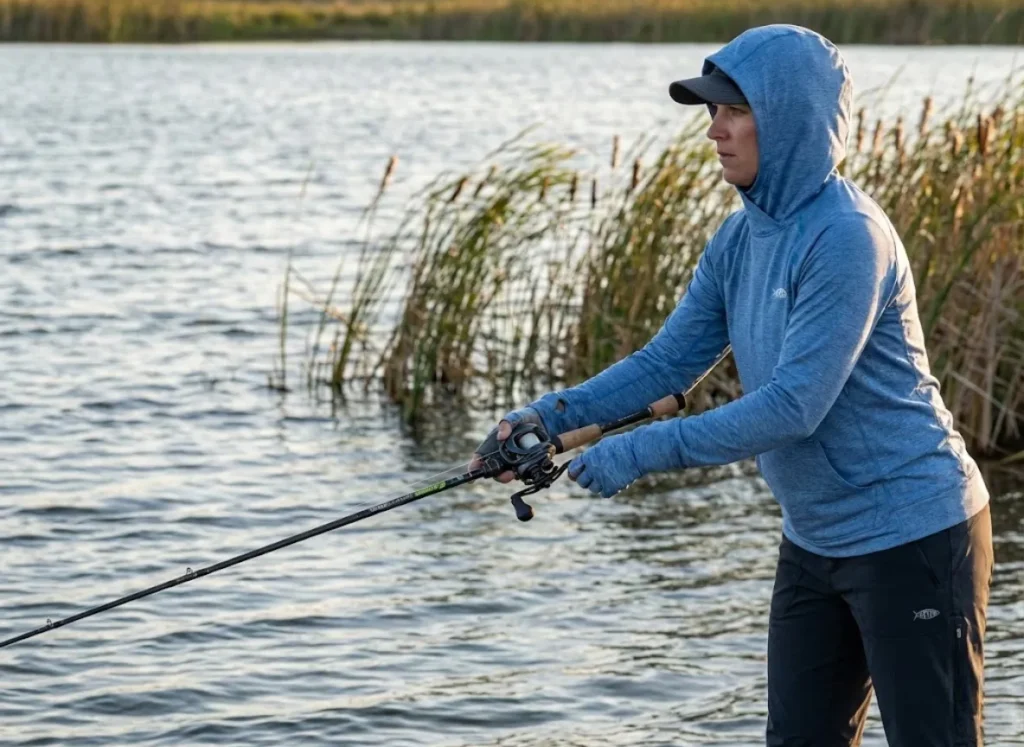
Rotating your casting plane from vertical to horizontal does two critical things. First, it lowers the entire trajectory closer to the water. Second, it reduces the lateral surface area your line exposes to the wind.
For right-handed anglers dealing with a left-to-right crosswind, the crosswind backhand casting technique puts your rod on the downwind side. This keeps the line from blowing across your face and tangling. Left-handed anglers flip this for right-to-left crosswinds.
Pro tip: In extreme headwinds over 20 mph, shorten your target distance rather than fighting for maximum range. A 40-foot accurate cast beats a 70-foot disaster every time.
The Double-Handed Fulcrum: Generating Power Against Resistance
Single-handed casting falls apart in heavy wind. There’s simply not enough leverage to generate the tip speed you need to punch through that air resistance.
The solution uses basic lever action. Grip the reel seat with your dominant hand and the rod butt with your other. When you cast, your bottom hand snaps the butt toward your body while your top hand pushes forward. This push-pull motion creates a fulcrum that generates serious torque.
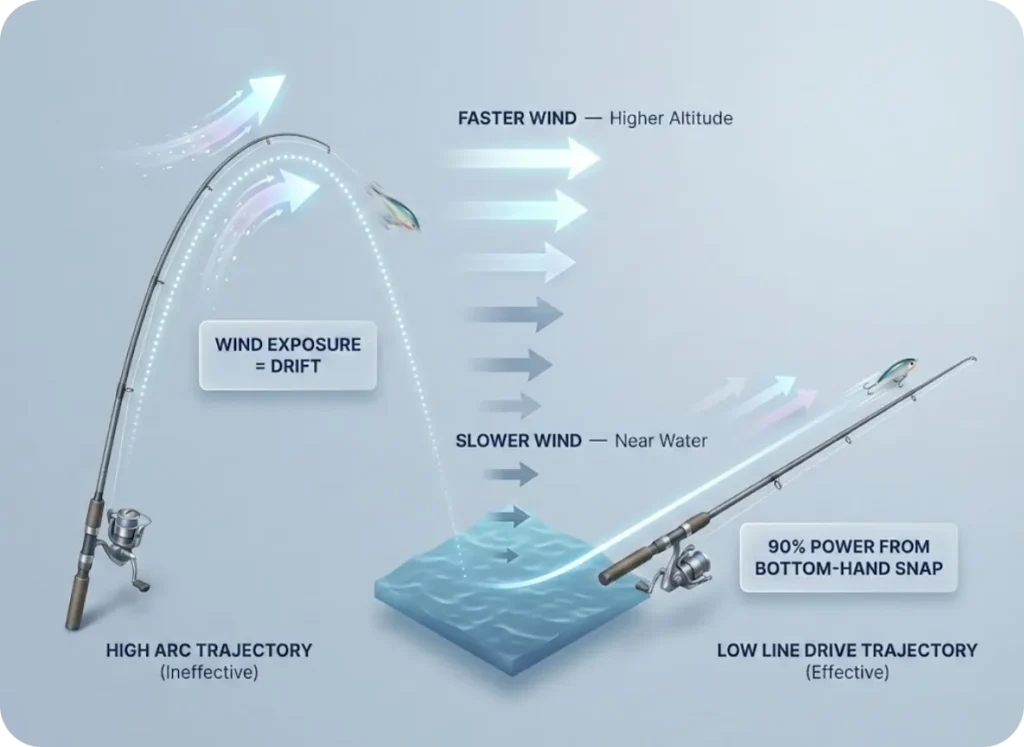
About 90% of the power in a proper wind cast comes from that bottom-hand snap. The result is dramatically higher rod tip velocity—your lure punches through the wind instead of drifting with it, maintaining a flat trajectory with minimal air time.
Defeating the Wind Knot: Spool Management Protocol
The Anatomy of the “Wind Knot”
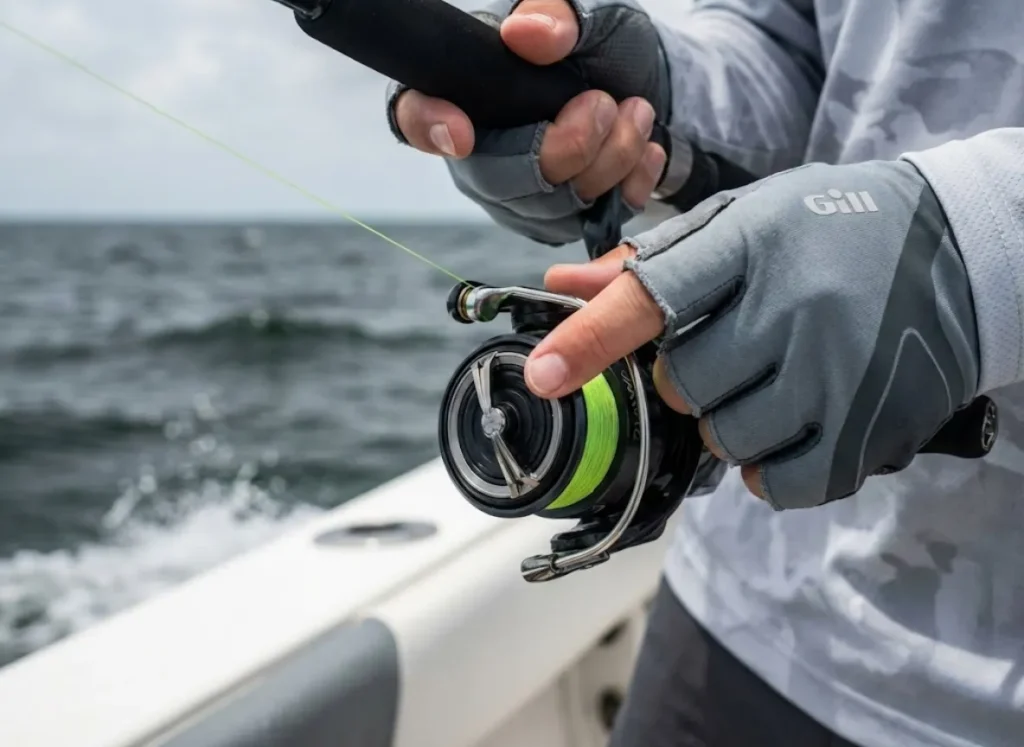
Let’s clear something up: that tangled mess you blame on the wind isn’t actually caused by wind tying your line in knots. It’s a spool management failure that happened on your previous cast.
Here’s the mechanism. When you retrieve a lure with insufficient tension—common with light baits in a tailwind—the line winds loosely onto your spool. On your next cast, the rapid spool acceleration causes those loose outer loops to grab the underlying coils. The whole mess pulls off together and jams in your first guide.
This is why wind knots plague braided line more than monofilament. Braid’s limpness makes loose wraps more likely. The fix isn’t switching line types—it’s fixing your technique.
Pro tip: I lost a tournament fish to a wind knot once. Now I feather every single cast—muscle memory saves money.
The Three-Step Prevention Protocol
First, manual bail closure. Never rely on the automatic bail trip on your spinning reel. That mechanism requires a handle turn to engage, leaving a loop of slack that wind instantly grabs. The moment your lure hits the water, flip that bail yourself.
Second, finger feathering. As your lure approaches the water, extend a finger to the spool lip. This brakes the line flow precisely at splashdown, preventing any overrun.
Third, immediate tension. Start your retrieve instantly. If there’s any slack, run the line between your fingers for the first few cranks to ensure those initial spool wraps are tight. This prevents the loose-wrap condition that causes your next wind knot.
Understanding line memory and twist issues helps you see how spool tension affects everything.
The Boat Control Trinity: Electronic, Physical, and Hydrodynamic Systems
GPS Anchoring: Spot-Lock and the Heading Sensor Revolution
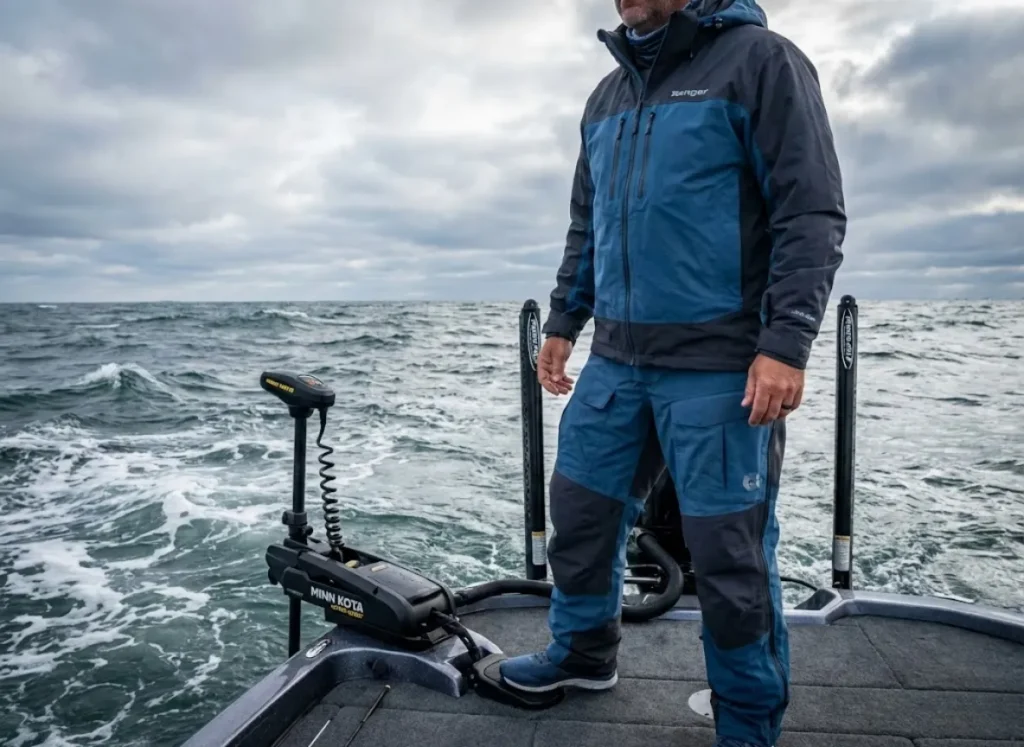
GPS-enabled trolling motors have transformed wind fishing from a constant battle into a manageable challenge. Systems like Minn Kota Spot-Lock, Garmin Anchor Lock, and Lowrance Anchor Mode use satellite triangulation to hold your boat on a specific geographic coordinate.
The critical upgrade in modern systems is the external heading sensor—that small “puck” mounted on your stern. This sensor detects your keel’s magnetic orientation independent of your GPS course over ground. In wind, your boat might show zero movement on GPS while your bow swings wildly. The heading sensor catches this rotation and micro-adjusts the motor to keep you aligned.
The “Jog” feature lets you shift your locked position in 5-foot increments to work down a bank without disengaging. And if you’re running an all-day session in heavy wind, brushless motors like the Garmin Force or Minn Kota Ultrex Quest offer 30-40% longer runtime than older brushed motors—critical when you’re at 70-80% thrust for hours.
For a detailed comparison, check our Spot-Lock vs shallow water anchor decision matrix.
Shallow Water Anchors: Silent Static Positioning
GPS anchoring has one significant drawback in shallow water: propeller wash. That constant motor correction disturbs sediment and spooks fish that feel the pressure waves.
Shallow water anchors like the Power Pole Blade and Minn Kota Raptor solve this with silent, static positioning. These hydraulic systems drive a composite spike into the substrate, holding you motionless without any motor noise or turbulence.
The Raptor shallow water anchor features “Active Anchoring”—the system monitors hydraulic pressure and automatically re-drives the spike if slippage is detected. In soft mud during heavy wind, this autonomous monitoring is invaluable.
Using dual anchors—one port, one starboard—eliminates the “weathervane effect” where your boat spins around a single pivot point. With both deployed, your hull orientation locks solid.
Drift Socks: Hydrodynamic Drag Control
When your strategy calls for covering water rather than spot-locking, the drift sock becomes your primary control surface. This cone of fabric creates water resistance that counteracts wind force on your hull—essentially a sea anchor that slows your drift.
Sizing matters enormously. An undersized sock lets you drift over 1.5 mph—too fast for effective presentations. For a 20-22 foot bass boat in 15-20 mph wind, you need a 48-50 inch diameter sock. In heavy wind over 20 mph, step up to 54-60 inches.
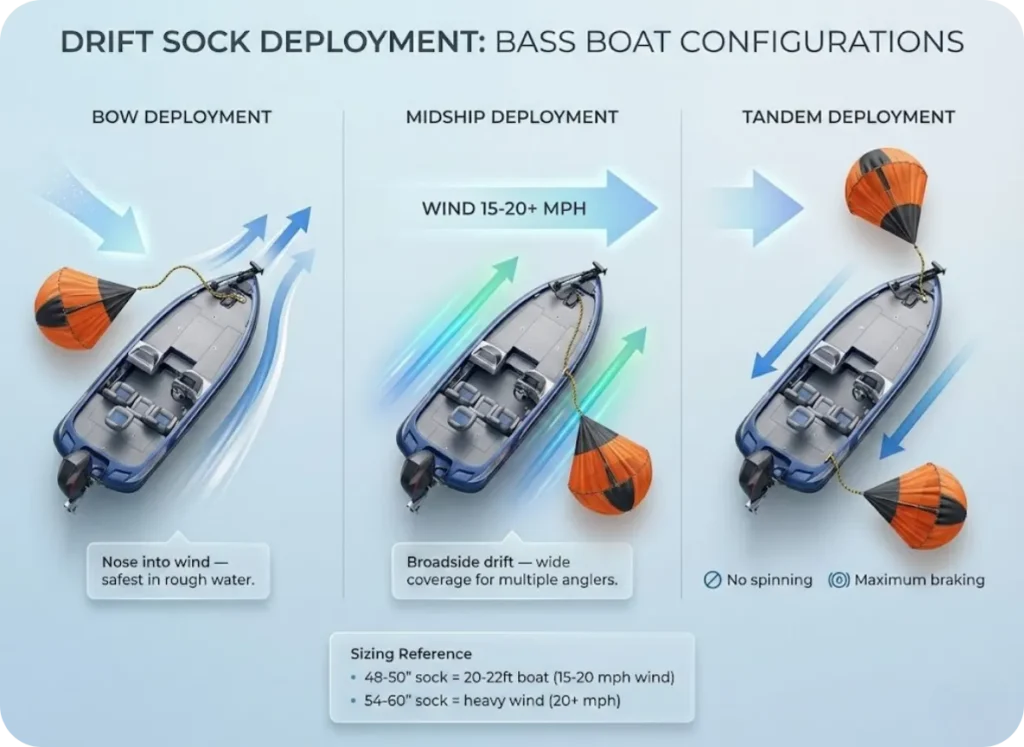
Attachment point determines your drift angle. Bow deployment keeps your nose into the wind—safest in rough water. Midship deployment lets you drift broadside, creating a wide swath for multiple anglers. Tandem deployment with two socks prevents spinning and provides maximum braking.
Understanding windage and yaw dynamics helps you predict how your hull will react.
Why Fish Bite in Wind: The Barometric and Biological Triggers
The Barometric Trigger: Physoclistous Fish and Pressure Phases
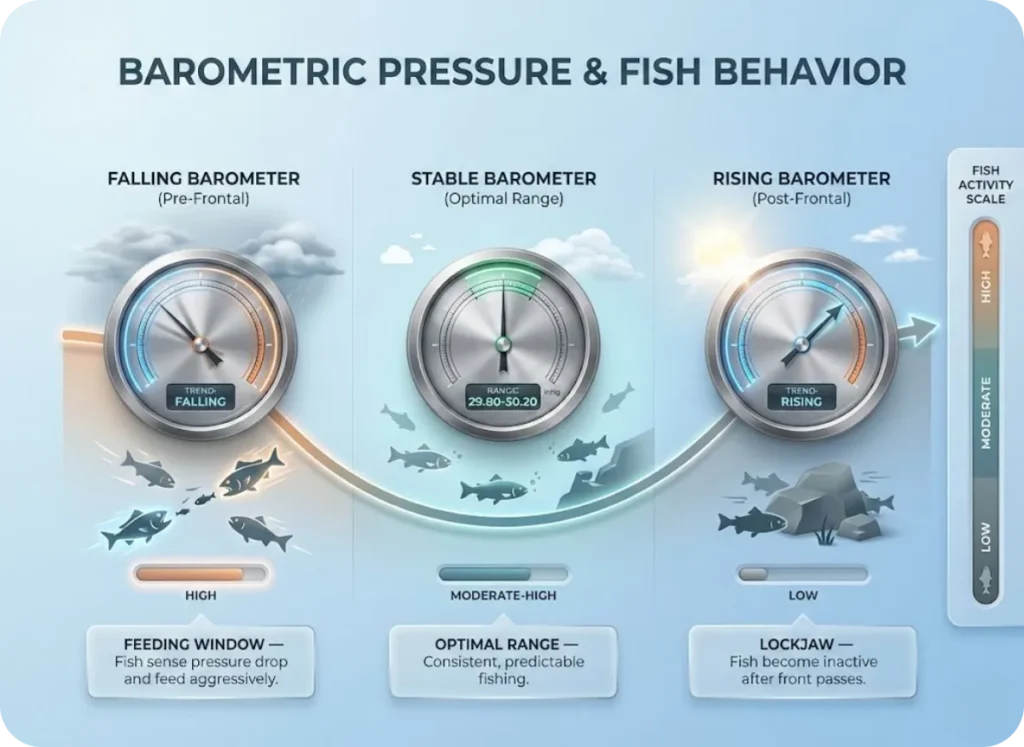
Bass, walleye, and perch belong to a group called physoclistous fish—they can’t quickly adjust their swim bladder pressure because they lack the direct gut connection that trout and pike have. When barometric pressure changes, these species feel it.
As a storm system approaches with a falling barometer, something triggers in these fish. That pre-frontal low creates a feeding frenzy—an instinct to gorge before conditions deteriorate. This is your window.
After the front passes and high pressure settles in (those “bluebird skies” everyone loves), the rapid pressure rise can leave physoclistous fish feeling bloated. They move deeper or tighten to cover, using water pressure to compress their bladders. The result is that infamous “lockjaw.”
The sweet spot sits between 29.80 and 30.20 inHg, especially when the trend is stable or slowly falling. Research from barometric pressure fishing studies confirms readings above 30.20 typically correlate with tough fishing.
Connecting this to your overall strategy, understanding barometric pressure and swim bladder physics gives you the complete picture.
The Trophic Cascade: From Plankton to Predator
Wind rearranges the entire food chain. Surface currents push phytoplankton and zooplankton toward windward shorelines. The planktivorous baitfish—shad, alewives, herring—follow that drift to feed. And the predator fish position on wind-blown points, current seams, and mudlines to ambush the buffet.
Wind essentially creates a conveyor belt delivering food to specific structural elements. Fish those windward banks, not the comfortable leeward side where nothing’s happening.
The Optical Advantage: Why Chop Triggers Reaction Strikes
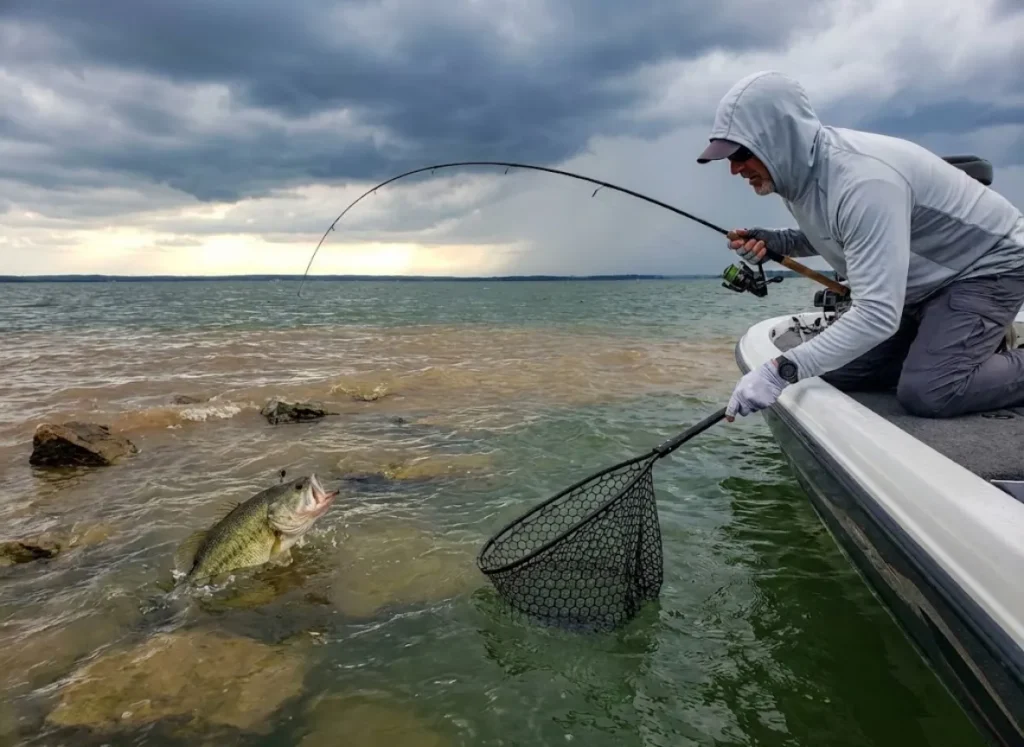
Clear, calm water makes fish cautious. They scrutinize your line, study your lure, and often refuse. Wind-generated surface chop refracts incoming light into a fluctuating mess of underwater “optical noise.” Fish can’t clearly inspect your presentation.
The implication? In wind chop, you can throw reaction baits and faster retrieves that would spook fish in flat conditions. The surface disturbance becomes your cover.
Pro tip: I throw reaction baits I’d never try in flat water—chatterbaits, lipless cranks, big Colorado spinnerbaits. The chop is my cover.
Lure Selection and Presentation Adjustments for Wind
Aerodynamic Lure Selection: Density Over Profile
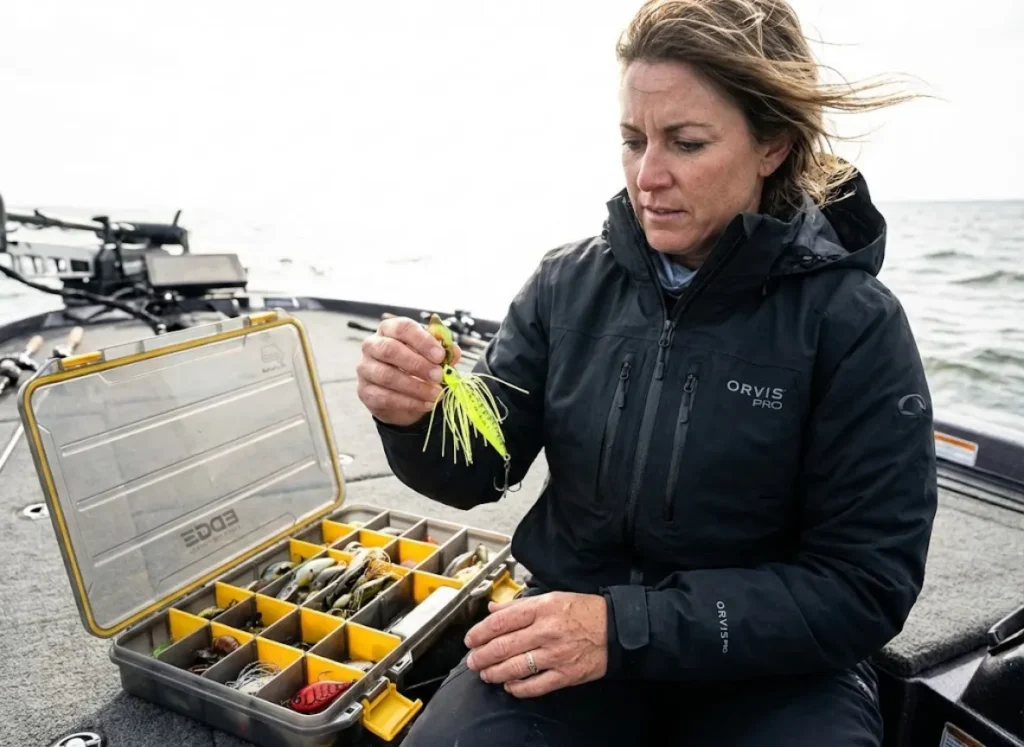
Large, bulky lures act as sails in wind—hollow-body frogs and buzzbaits catch air and go nowhere. You need dense, compact profiles with superior ballistic characteristics.
Lipless crankbaits, blade baits, and tail-spinners cut through wind. They’re heavy for their size with minimal surface area. In extreme headwinds, switching from a wide-wobble crankbait to a slender jerkbait or metal spoon restores your casting distance.
Don’t be afraid to upsize. Adding 1/8 to 1/4 ounce to your lure weight often restores your range without changing presentation character. Check our tungsten vs lead density comparison for the weight trade-offs.
Reaction Baits: Winning the Sensory Competition
Finesse presentations don’t work in wind. The line bow in your braided line kills sensitivity—you can’t feel the subtle tap of a drop shot bite. And why would you finesse when fish are feeding aggressively anyway?
Wind creates background noise underwater. To compete, your lures need strong vibration signals. Spinnerbaits with large Colorado or Willow blades produce vibration fish track through turbulence. Their lateral line detection mechanics pick up these displacement patterns even when they can’t see clearly.
Chatterbaits are premier wind baits. The vibrating blade provides feedback through your rod while triggering lateral line responses. And lipless crankbaits combine density (good casting), loud rattles (sensory signal), and speed (reaction strikes) into one package.
Seamanship and Safety: Operating in High-Energy Conditions
Wave Negotiation: The Quartering Technique
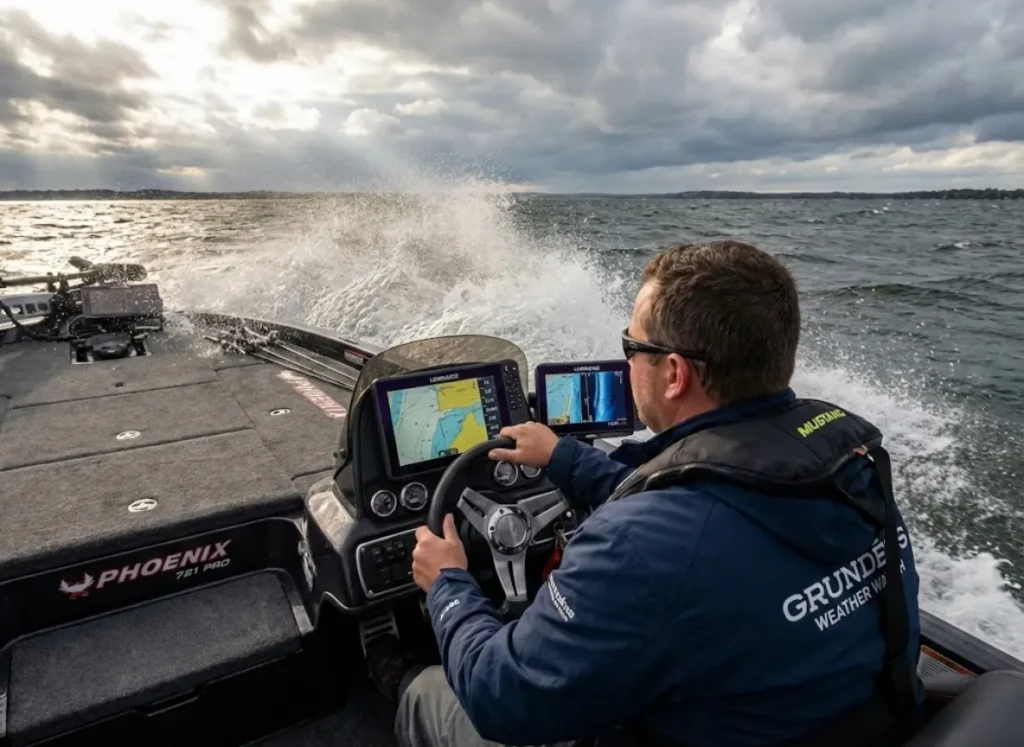
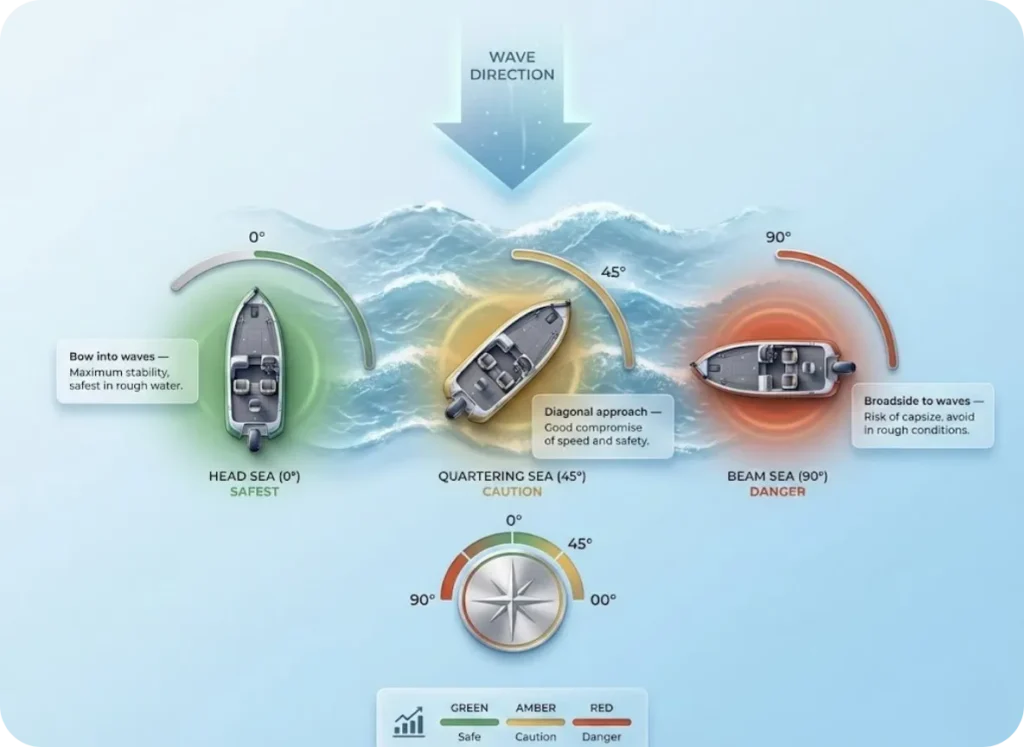
Running directly into waves causes your hull to slam—risking structural damage and throwing passengers. Running parallel risks capsizing. The answer lies in between.
Quartering means traversing waves at a 45-degree angle. This effectively lengthens the wave period relative to your hull length, letting your V-hull slice through rather than slam flat. You convert vertical impact into manageable lateral rolling.
In following seas with waves behind you, trim your motor up to keep the bow high. The last thing you want is a wave pushing your nose into the trough ahead. According to NOAA marine weather guidance, strong wind gusts of 34 knots or more are powerful enough to capsize small boats—always check forecasts before heading out.
Throttle and Trim Management
You can’t set a single throttle position and maintain it through rough water. Wave navigation requires constant adjustment.
Climbing a wave face demands throttle to keep your bow elevated. Cresting requires you to chop power instantly—launch off the top and you’re asking for trouble. The goal is landing softly on each backside.
Understanding essential boat safety protocols covers these principles in detail.
Windward vs Leeward: Strategic Positioning
Fetch—the distance wind travels over open water—determines wave size. Long fetch equals bigger, more organized waves. Understanding this helps you predict which areas become unfishable.
Here’s the tactical reality: the windward shore (where wind strikes) is where the food chain activates. That’s where you catch fish. The leeward side is comfortable but biologically quiet. Launch from the protected side, fish the blown side.
And this isn’t optional—always wear your PFD in rough water. Chaotic wave conditions make swimming nearly impossible if you’re ejected.
Conclusion
Master the Low Trajectory. Lower your casting plane, use sidearm casting with the double-handed fulcrum, and keep your lure in the boundary layer. You’ll punch through headwinds that stop other anglers cold.
Control Your Platform. Match your system to the situation—GPS Spot-Lock for mobility, Power Pole for stealth in shallow water, properly-sized drift socks for controlled coverage. Don’t fight the wind when technology can do it for you.
Fish the Biology. Wind isn’t just annoying—it’s an activator. Position on windward structure, throw reaction baits, and exploit the optical advantage when wind chop covers your presentation.
Next time the forecast shows 15-20 mph winds, don’t cancel your trip. The anglers who understand these systems aren’t hiding from the blow. They’re cashing in on it while the fish are eating. Gear up and own the wind.
FAQ
Should I cast into the wind or with the wind?
Cast with the wind at your back whenever possible—let it assist rather than fight you. To position correctly, approach from the downwind side and use boat control systems to hold position while casting downwind toward target structure.
What size drift sock do I need for a 20-foot bass boat?
For a 20-22 foot boat in moderate wind (15-20 mph), use a 48-50 inch diameter sock. In heavy wind over 20 mph, step up to 54-60 inches. An undersized sock creates drift speeds too fast for effective presentations.
Why do fish bite better when it’s windy?
Falling barometric pressure triggers pre-storm feeding responses, wind-driven currents concentrate baitfish on windward structure, and surface wind chop creates optical noise that reduces fish wariness—triggering more aggressive, reactionary strikes.
How do I prevent wind knots in braided line?
The fix is spool management: manually flip the bail closed immediately when your lure lands, feather the spool with your finger as the lure descends, and begin retrieval instantly with tension on the line. Zero slack at any point is the goal.
At what wind speed should I stop fishing and seek shelter?
Most experienced anglers consider 25+ mph sustained winds the threshold for seeking shelter, especially on open water with significant fetch. Between 20-25 mph is demanding but fishable with proper equipment. Always prioritize safety—no fish is worth capsizing.
Risk Disclaimer: Fishing, boating, and all related outdoor activities involve inherent risks that
can lead to injury. The information provided on Master Fishing Mag is for educational and informational purposes
only. While we strive for accuracy, the information, techniques, and advice on gear and safety are not a substitute
for your own best judgment, local knowledge, and adherence to official regulations. Fishing regulations, including
seasons, size limits, and species restrictions, change frequently and vary by location. Always consult the latest
official regulations from your local fish and wildlife agency before heading out. Proper handling of hooks, knives,
and other sharp equipment is essential for safety. Furthermore, be aware of local fish consumption advisories. By
using this website, you agree that you are solely responsible for your own safety and for complying with all
applicable laws. Any reliance you place on our content is strictly at your own risk. Master Fishing Mag and its
authors will not be held liable for any injury, damage, or loss sustained in connection with the use of the
information herein.
Affiliate Disclosure: We are a participant in the Amazon Services LLC Associates Program, an
affiliate advertising program designed to provide a means for us to earn advertising fees by advertising and linking
to Amazon.com. As an Amazon Associate, we earn from qualifying purchases. We also participate in other affiliate
programs and may receive a commission on products purchased through our links, at no extra cost to you. Additional
terms are found in the terms of service.