
In this article
The 60-pound blue had followed my scent trail for thirty yards. I watched it on the Livescope—a massive arc gliding toward my fresh skipjack chunk suspended 18 inches off the bottom. Then, two feet from the bait, it stopped. Hovered. And turned away. No tap. No bump. Just… rejection.
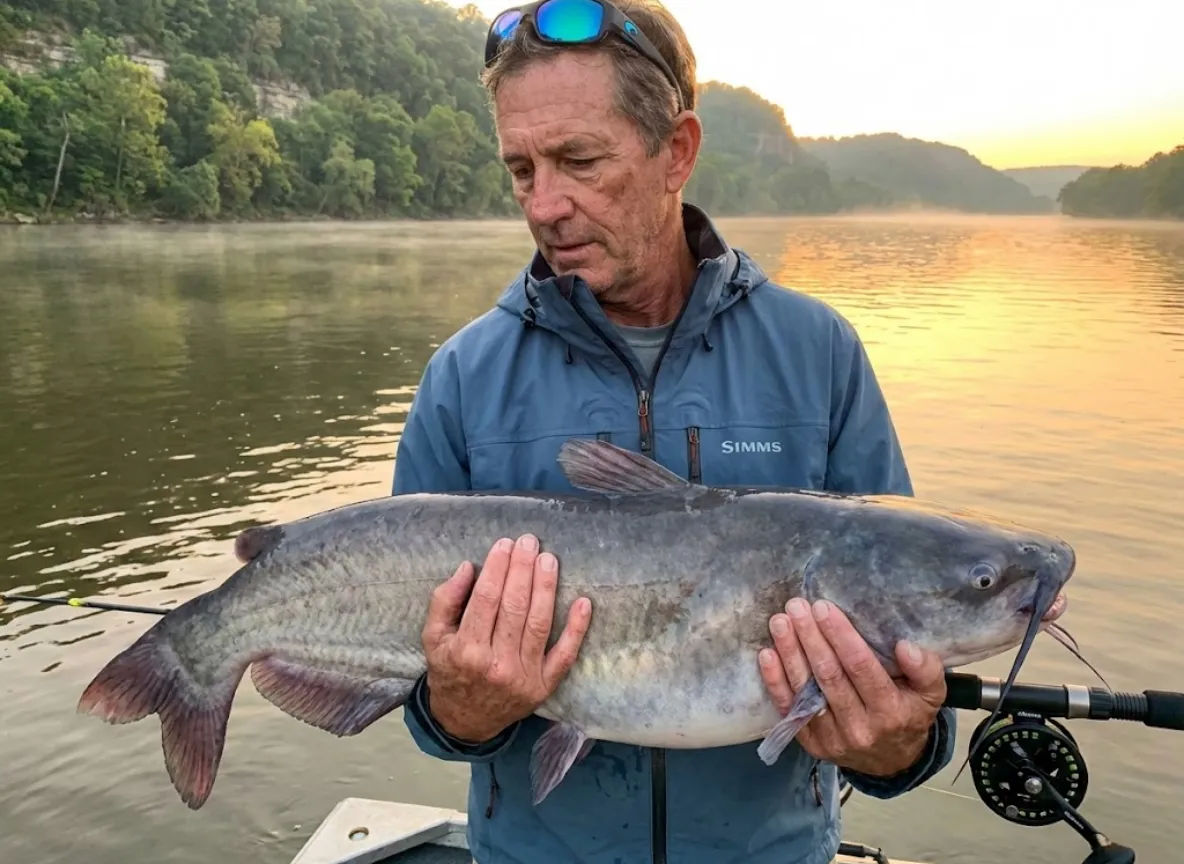
That fish taught me more about blue catfish biology in ten seconds than a decade of “fresh is best” advice ever did. After 20 years of targeting trophy blues on the Tennessee River and Missouri River, I’ve seen this scenario repeat hundreds of times. The truth is, blue catfish don’t just prefer fresh cut bait—they’re chemically programmed to reject anything that isn’t.
This article explains the biological mechanisms behind bait rejection in trophy Ictalurus furcatus and delivers the tactical fixes—bumping technique, Santee Cooper rigs, and thermodynamic bait handling—that transform rejection into hookups.
⚡ Quick Answer: Blue catfish reject cut bait due to their extraordinarily sensitive chemoreceptors, which detect the bitter byproducts of ATP degradation within hours of bait death. Fresh bait kept in an ice slurry, combined with active presentation techniques like bumping (drifting at 0.5 mph drift), generates both the chemical profile and hydrodynamic vibration that trigger strikes. The “bait freshness window” is roughly 2 hours in cold conditions but shrinks to 20-30 minutes in summer heat.
The Science of Rejection: Why Blue Catfish Refuse Your Bait
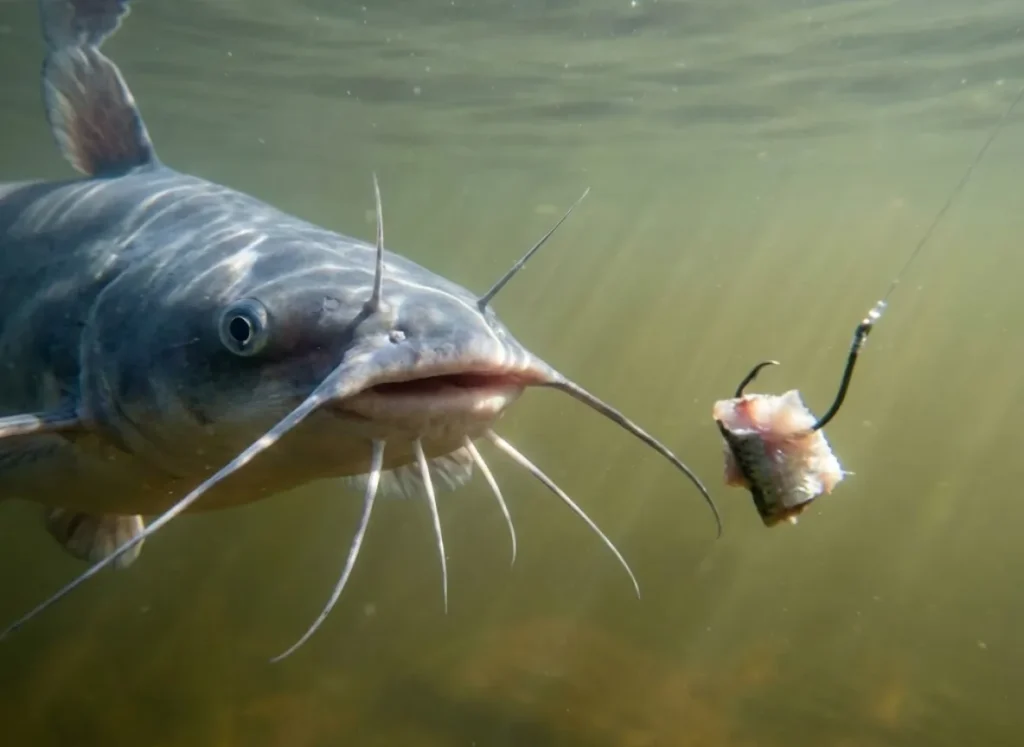
Blue catfish possess chemoreceptors 1,000 times more sensitive than bass. Their olfactory system detects amino acids—specifically L-alanine and L-arginine—at concentrations as low as one part per 10 billion parts water. Scientific research on catfish amino acid detection confirms that catfish can smell some compounds at one part to 10 billion parts of water, as Dr. John Caprio of Louisiana State University famously documented.
This extreme sensitivity isn’t just about finding food. It’s about discriminating between food that’s safe and food that’s toxic. Understanding how fish use their lateral line system gives you half the picture. The other half is chemical—specifically amino acid scent dispersion.
The ATP Degradation Cascade—Why Yesterday’s Bait Fails
When a baitfish dies, a predictable chemical countdown begins. ATP (the cell’s energy currency) degrades through a cascade: ATP breaks down into ADP, then AMP, then IMP—which is the compound responsible for that fresh, savory “umami” scent that triggers feeding.
Here’s the problem. IMP doesn’t last. It continues degrading into Inosine and finally into Hypoxanthine—a compound with an intense bitter taste. Research on ATP degradation in fish shows Hypoxanthine levels increase by nearly 950% over time, transforming attractive cutbait into something chemically repulsive. For a catfish that can taste bitterness at nanomolar concentrations, a piece of cut bait that’s been dead for several hours presents a clear “don’t eat” signal.
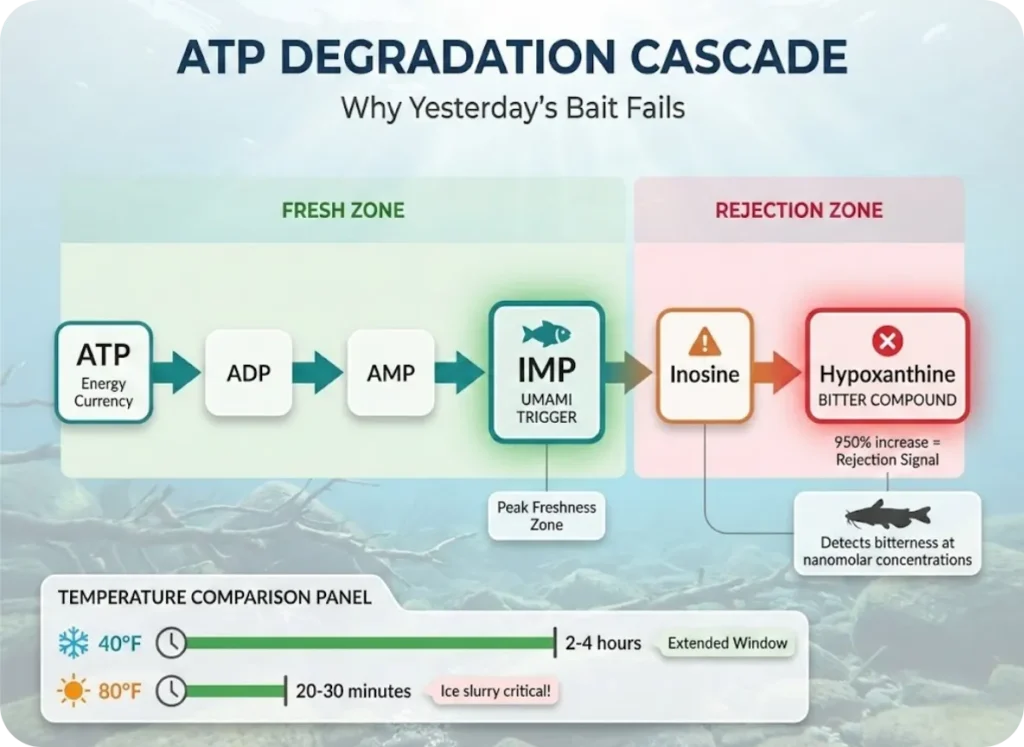
At 80°F air temperature, Gizzard shad loses its optimal chemistry within 20-30 minutes without an ice slurry. At 40°F, that window extends to 2-4 hours. The difference between a fish that commits and one that turns away often comes down to temperature control.
Histamine Toxicity—The Biological Warning Signal
Baitfish like shad, Skipjack herring, and menhaden share a trait with tuna and mackerel: they’re prone to rapid histamine formation. When these fish die, bacteria in their gut convert the amino acid histidine into histamine—a toxic compound that’s heat-stable and dangerous.
When histamine levels exceed 200 mg/kg, the bait signals advanced decomposition to any creature sensitive enough to detect it. Blue catfish, with their hyper-tuned chemoreceptors, register this as a biological “toxic” warning. The bait might look fine to your eyes, but to the fish, it’s screaming danger.
Pro tip: Red-fleshed baitfish (skipjack, shad) spoil faster than white-fleshed species like bluegill. If you’re fishing all day in summer, plan to refresh your bait every 30-45 minutes—the 30-minute skipjack rule exists for good reason.
Lateral Line Rejection—When Your Bait Doesn’t “Move”
Even if your bait’s chemistry is perfect, you can still get rejected. The lateral line detection system—those sensory organs running along the catfish’s flank—detects low-frequency vibrations and pressure gradients. Blue catfish evolved hunting active, struggling prey in current. A stationary piece of cut bait lying flat on the bottom produces no vibration.
Dr. Caprio’s research confirms this: “This ‘vibrational’ sense is very well developed in catfish… Catfish can detect days in advance a lot of earthquakes because they have an ultra-sensitivity to low frequency vibrations.”
A drifting or struggling prey creates a hydrodynamic wake that the catfish tracks. Without that movement signature, your bait becomes invisible to its mechanosensors—even if the scent is perfect. This is why learning how to use scent to trigger strikes is only half the equation. Motion matters equally.
The Bumping Technique—Defeating Rejection Through Motion
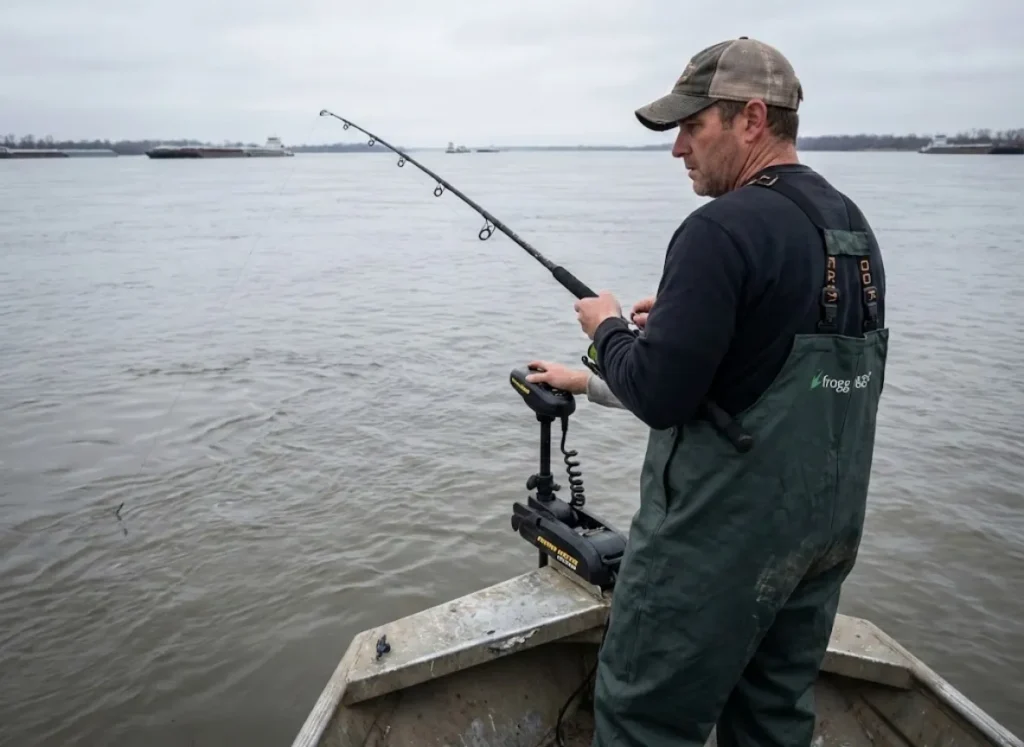
Bumping—also called back-bouncing or controlled drift—is the premier technique for targeting trophy blue catfish in river systems. It solves the stagnation problem by keeping your bait perpetually moving through current seams and deep holes.
The mechanics are simple. Position your boat with the bow facing upstream. Use your trolling motor to provide thrust against the current, slowing your downstream drift to approximately 50% of the river surface velocity. If the river flows at 3 mph, you drift at 1.5 mph.
This drift speed calibration is everything. By moving slower than the water, current rushes past your boat and bait. That hydraulic pressure lifts the bait off the bottom, causing it to flutter and stream behind the sinker—exactly like a struggling fish. Research on lateral line sensory perception confirms why movement triggers strikes. Understanding boat control in heavy current is essential for executing this technique.
As guide Jason Schneiderhahn explains: “This is not sitting down anchored fishing… we’re drifting the boat, walking the bait back behind the boat, feeling the bottom constantly.”
Gear Setup for Bumping Success
The feedback loop in bumping—feeling the difference between rock and fish—requires specific gear. A 7’6″ fast-taper heavy rod gives you a sensitive tip to detect the “mushy” feeling of a bite versus the hard “tick” of structure, with enough backbone to set the hook.
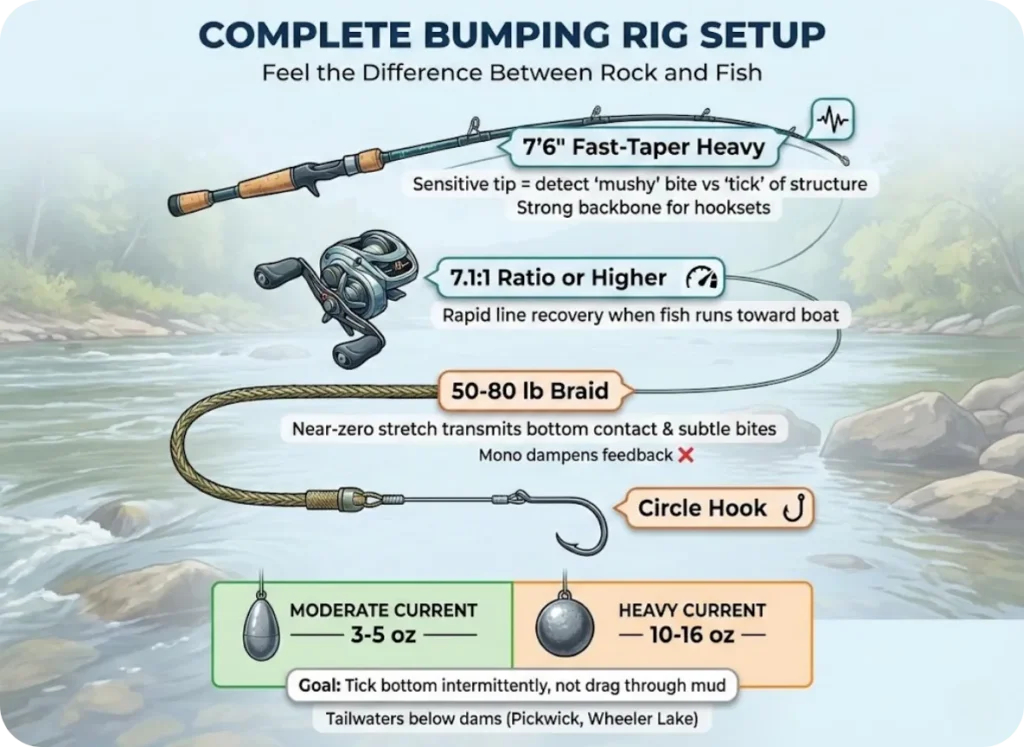
Your reel needs a high gear ratio—7.1:1 or faster—for rapid line recovery when a fish runs toward the boat. Main line should be 50-80 lb braid line—its near-zero stretch transmits bottom contact and subtle bites that monofilament would dampen.
For weights, use 3-5 oz sliding egg sinker or cannonball sinker in moderate current and 10-16 oz in heavy tailwater flows below dams like Pickwick Dam or Wheeler Lake. The goal is to tick the bottom intermittently, not drag through mud.
Reading the Bite—Tick vs. Mush
A rock produces a sharp “tick” through the rod tip. A big trophy catfish inhaling your bait creates a “mushy” resistance—softer, heavier.
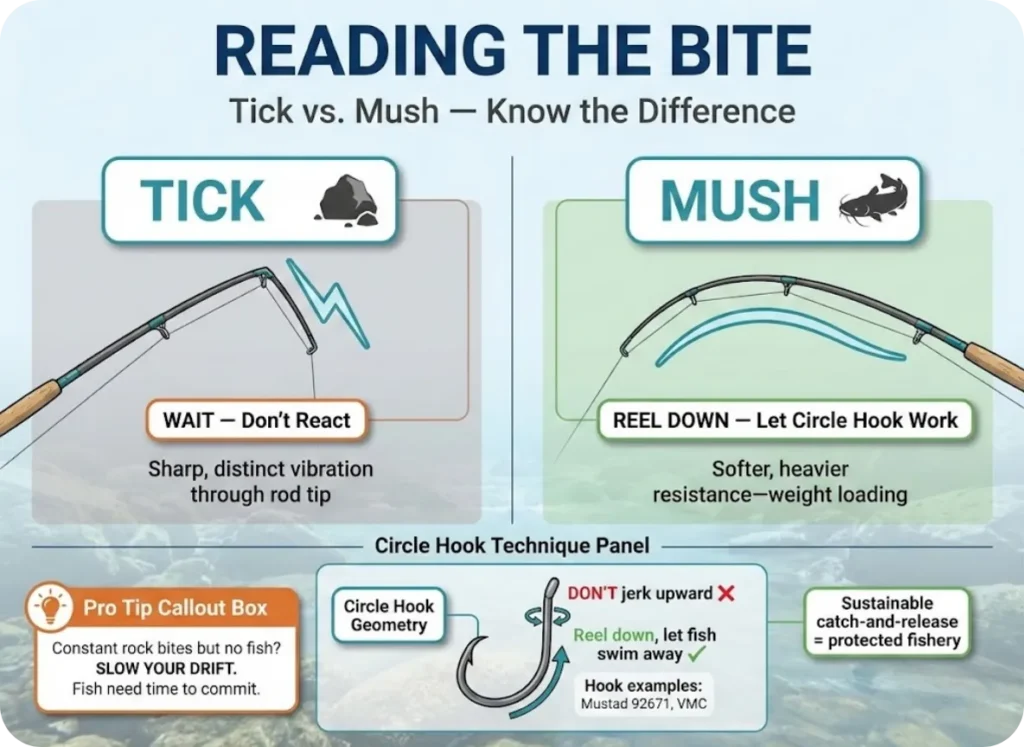
The mistake most anglers fishing make is jerking the rod on any sensation. Trophy fish require patience. With circle hooks (like Mustad 92671 or VMC hooks), “reel down” into the fish rather than snapping upward. The hook rotates into the jaw corner as the fish swims away—let the geometry work. Understanding circle hooks for sustainable catch-and-release prevents lost fish and protects the fishery.
Pro tip: If you’re getting constant rock bites but no fish, slow your drift. You’re moving too fast for the fish to commit. Adjust your drift speed calibration until you feel consistent bottom contact.
The Santee Cooper Rig—Suspension Tactics for Reservoirs
In reservoirs and slow river sections where current is insufficient for bumping, the Santee Cooper rig solves the suspension problem. The defining component is a peg float attached to the leader 2-3 inches from the hook.
That small float counteracts the weight of heavy cut bait and your 8/0-10/0 steel circle hook. Without it, your bait drags along the substrate, potentially burying in silt. With the float, bait suspends 6-18 inches off bottom—directly in the blue catfish’s upward-feeding strike zone at the optimal feeding height.
Optimal drift fishing speed sits between 0.5 and 0.8 mph. Speeds above 1.0 mph cause the bait to spin unnaturally; below 0.3 mph fails to generate enough lift for the float to work. Learning how to tie a leader properly ensures your rig doesn’t fail at the connection.
Rigging the Santee Cooper Step-by-Step
Start with your main line running through an sliding egg sinker (2-4 oz), then tie to a three-way swivel rig or barrel swivel. From the swivel, run 18-24 inches of 50-80 lb mono or fluorocarbon leader. Position your peg float (many guides prefer the FATKAT Bobber System or similar) 2-3 inches above the hook—adjust based on water clarity. Finish with an 8/0-10/0 offset circle hook.
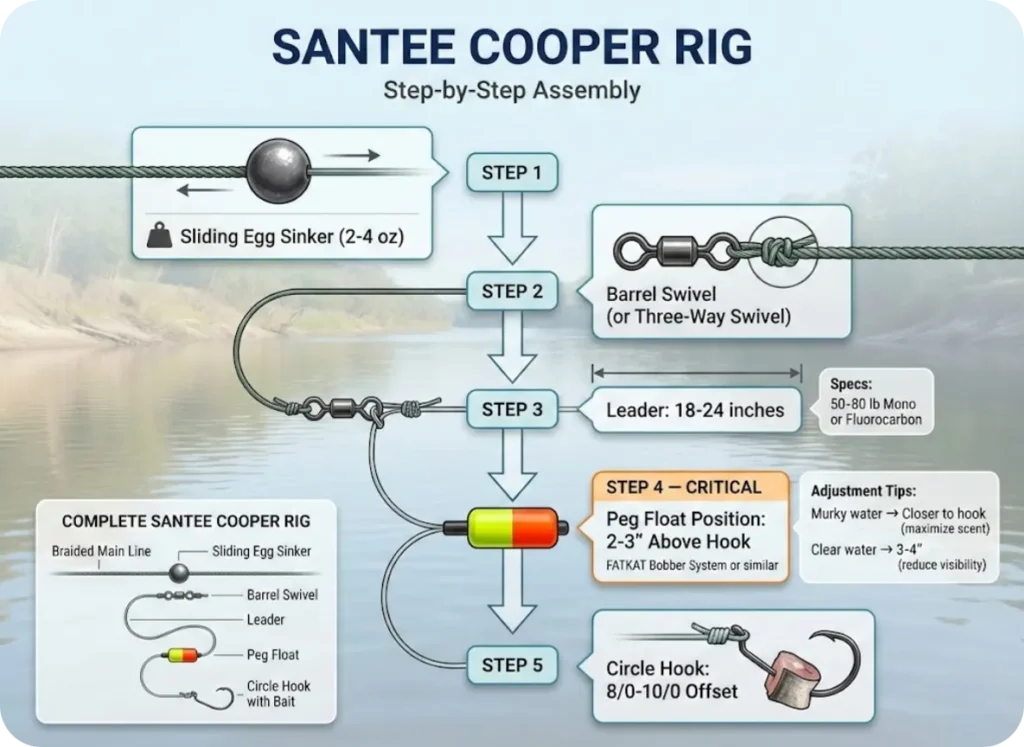
In murky water, position the float closer to the hook to maximize scent concentration. In clear water, extend to 3-4 inches to reduce float visibility.
Drift Control Without Bumping
Use a trolling motor or drift sock to maintain 0.5 mph drift. Drift parallel to ledges and channel breaks—prime blue catfish staging areas in lakes like Kerr Lake or Wilson Lake. Planer boards let you spread multiple Santee rigs laterally, covering more structure. GPS spot-lock anchoring enables hovering over specific deep holes once you locate fish on forward-facing sonar. Compare options in our guide to shallow water anchor vs spot lock.
Bait Selection and The 30-Minute Rule
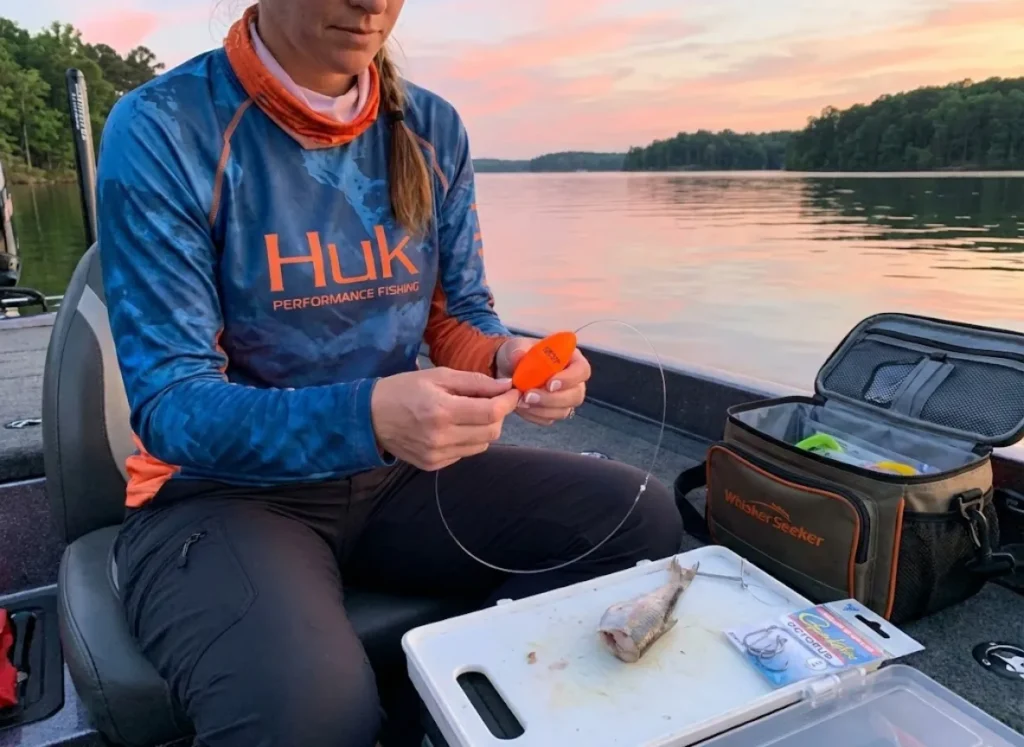
Your bait choice matters, but handling matters more. The hierarchy starts with Skipjack herring—the gold standard across Tennessee River and Missouri River valleys. Its extremely high oil content and bloody flesh create a massive scent corridor that blues can track from distance.
Gizzard shad works excellently in reservoirs where it’s the primary forage. Threadfin shad is smaller and less durable—better for eater-class fish than trophy catfish hunting. Match the local baitfish: skipjack on the Tennessee, gizzard shad on the James River, menhaden on Potomac River and Chesapeake tidal water.
North Carolina State Record holder Zakk Royce (105 lbs) puts it bluntly: “Channel cats may like stinky, rotten baits, but… blues and flathead catfish want as fresh as you can get! I’ve watched some pretty giant catfish turn up their noses at baits that were a few days old while drifting with my Livescope.”
The Ice Slurry Protocol—Thermodynamic Preservation
An ice slurry—crushed ice, water, and rock salt—cools bait core temperature faster than dry ice alone. The goal is to arrest the ATP degradation cascade before IMP converts to Hypoxanthine.
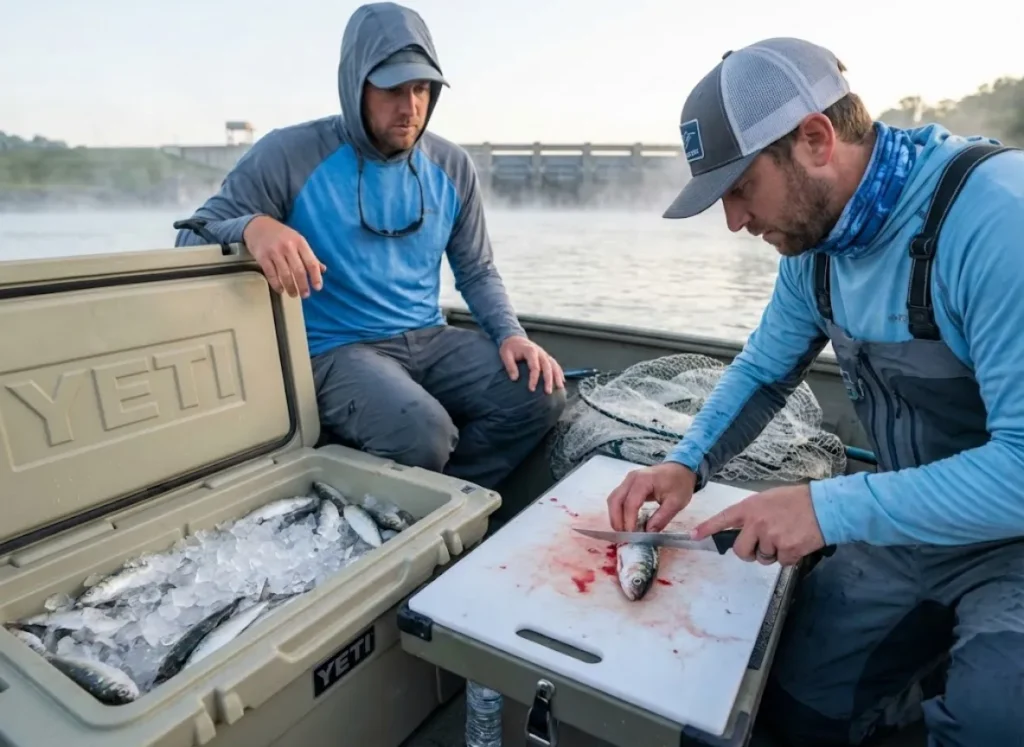
Store fresh cut bait submerged in slurry, not piled on top of ice. Surface exposure causes freeze-thaw damage while the center stays warm—the worst of both worlds. Replace your slurry every 2-3 hours in summer. Understanding how to keep bait alive applies here: the principles of temperature control for live bait transfer directly to cutbait.
Pro tip: Add rock salt to your slurry. Salt lowers the freezing point, getting bait colder faster without forming ice crystals that damage tissue. This extends your bait freshness window significantly.
Cutting Technique—Chunks vs. Fillets vs. Steaks
Chunk cuts (1-2 inch sections with skin and backbone) are durable and release scent steadily—ideal for drift fishing. Fillet cuts expose maximum flesh—great initial scent burst, but they wash out quickly. Steak cuts (cross-sections) balance durability with scent and work well for bumping technique.
Whatever cut you choose, bleed the bait immediately by slashing the gills. Amino acid-rich blood enhances your scent trail significantly. Keep a sharp knife—see our best fillet knives for precision work.
Bank Fishing Tactics—The Shore-Bound Challenge
Without a boat, you can’t generate movement through drift. You rely on current to move scent toward fish—which demands strategic positioning. This is where the bank fisherman’s cut bait drift rig becomes essential.
Heavy bank sinkers (8-16 oz) are mandatory in tailwaters and dam fishing to hold bottom. No-roll sinkers use hydrodynamic pressure to anchor rather than tumble downstream. Cast into the “slow” side of current seams; the current carries your scent downstream into holding areas. Our complete shore fishing guide covers positioning in detail.
Current Seam Selection for Static Presentations
Current seams form where fast water meets slow—they’re natural scent concentration zones. Target inside bends, rock piles, and submerged structure that creates slack pockets. For bank access in rivers like the Susquehanna River, depths of 6-15 feet are optimal. Deeper deep holes may be unreachable without boat positioning.
Understanding current seams and hydrodynamics gives you the physics behind this catfishing technique.
Adding Vibration to Stationary Rigs
Since you can’t move your bait, add noise instead. Whisker Seeker Rattler or Versa-Rattle inline rattle floats clipped to your leader emit sound in current. Weighted rattles bounce with water movement, mimicking distressed prey vibration. Position rattles 12-18 inches from the hook to separate sound from scent.
In completely slack water, even rattles won’t compensate—target areas with at least minimal flow near thermal discharge locations or dam outflows.
Common Mistakes and How to Fix Them
Mistake #1—Using Frozen/Thawed Store-Bought Bait
Frozen cutbait has lost its essential oils and amino acid profile through ice crystal damage. If you’re consistently getting skunked while others catching fish, check your bait source.
Fix: Catch fresh caught bait with a cast net or source locally the same day. Even “fresh-frozen” vacuum-sealed baits underperform significantly compared to fresh cut bait.
Mistake #2—Jerk-Setting Circle Hooks
Bass anglers fishing instinctively snap the rod and reel upward. With circle hooks (including offset circle hooks like Eagle Claw 84), jerking pulls the hook out before it can rotate into the jaw corner.
Fix: When you feel weight, point your rod tip at the fish and maintain steady reel pressure using proper snelling technique. Let the hook set itself.
Mistake #3—Vertical Line Angle Under the Boat
Beginners let line hang straight down from their boat. The bait drags directly in mud, failing to generate lift or scent trail from suspended bait.
Fix: Maintain a 45-degree line angle downstream. This separates bait from the sinker’s disturbance and lets current stream it naturally.
Mistake #4—Fishing Too Heavy for Current
Too heavy: fish feel resistance and drop bait. Too light: you lose bottom contact.
Fix: Use “just enough” weight to tick bottom intermittently. As veteran catfishermen say, “If you fish too heavy, fish will feel the weight and drop the bait.”
Conclusion
Blue catfish rejection isn’t mysterious—it’s biochemistry and physics. Their chemoreceptors detect spoilage at the molecular level through amino acid scent dispersion, while their lateral line detection demands movement. The fix is equally precise: ice slurry preservation keeps bait in the bait freshness window; bumping technique and Santee Cooper rigs generate the hydrodynamic signatures that trigger predatory response.
On your next fishing trip, try controlled drift at 0.5 mph drift with same-day cut skipjack. Feel the difference between tick and mush. When that trophy catfish finally commits instead of turning away, you’ll understand why “fresh cut bait” advice barely scratched the surface. Remember to practice ethical harvest and check local consumption advisories before keeping river giants.
FAQ
How fresh does cut bait need to be for blue catfish?
Blue catfish prefer bait within 2 hours of death under cold conditions—the 30-minute skipjack rule applies in summer when the window shrinks to 20-30 minutes. Use an ice slurry immediately to maximize your bait freshness window.
Do blue catfish feed on the bottom?
Contrary to popular belief, blue catfish often feed 6 inches to 3 feet above the bottom at optimal feeding height, not on it. Suspended bait presentations like the Santee Cooper rig outperform flat-bottom rigs in many situations.
What is bumping for catfish?
Bumping is a controlled drift fishing technique where the boat moves downstream at 50% of river current speed. This drift speed calibration causes bait to flutter behind the sinker, generating vibrations that stimulate the catfish’s lateral line detection while dispersing scent effectively.
What size circle hook for blue catfish cut bait?
Use 8/0 to 10/0 heavy-gauge wire circle hooks (VMC hooks, Mustad 92671, or Eagle Claw) for blue catfish. This size accommodates 2-3 inch bait chunks while providing sufficient gap for jaw-corner hookset on trophy fish.
Can I use frozen shad for blue catfish?
Frozen cutbait works but significantly underperforms fresh bait. Freezing causes ice crystal damage that releases amino acids prematurely and destroys texture. Expect 60-70% fewer strikes compared to fresh cut bait prepared same-day.
Risk Disclaimer: Fishing, boating, and all related outdoor activities involve inherent risks that
can lead to injury. The information provided on Master Fishing Mag is for educational and informational purposes
only. While we strive for accuracy, the information, techniques, and advice on gear and safety are not a substitute
for your own best judgment, local knowledge, and adherence to official regulations. Fishing regulations, including
seasons, size limits, and species restrictions, change frequently and vary by location. Always consult the latest
official regulations from your local fish and wildlife agency before heading out. Proper handling of hooks, knives,
and other sharp equipment is essential for safety. Furthermore, be aware of local fish consumption advisories. By
using this website, you agree that you are solely responsible for your own safety and for complying with all
applicable laws. Any reliance you place on our content is strictly at your own risk. Master Fishing Mag and its
authors will not be held liable for any injury, damage, or loss sustained in connection with the use of the
information herein.
Affiliate Disclosure: We are a participant in the Amazon Services LLC Associates Program, an
affiliate advertising program designed to provide a means for us to earn advertising fees by advertising and linking
to Amazon.com. As an Amazon Associate, we earn from qualifying purchases. We also participate in other affiliate
programs and may receive a commission on products purchased through our links, at no extra cost to you. Additional
terms are found in the terms of service.