
In this article
The rod buckled so hard the tip touched the water. Forty pounds of flathead catfish bulldogged straight into a submerged oak on the outside bend, and the 65-pound braided line sang like a bowstring in the dark. Three seconds later—silence. Snapped at the knot. That was the night I stopped guessing and started building a system.
After years of losing trophy flatheads to river structure, busted tackle, and dead bait, I finally mapped the pattern that connects thermal triggers, current seams, and predatory feeding behavior into one repeatable method. This is the complete river flathead system I use now—from reading water and rigging heavy tackle to keeping bait kicking and timing the bite window that most anglers sleep through.
⚡ Quick Answer: Flathead catfish in rivers are obligate predators that reject dead or prepared baits—you need live bluegill, sunfish, or suckers fished on a slip-sinker rig with 8/0–10/0 circle hooks and 50–100 lb braid near submerged log jams on outside bends. Fish after dark through the dawn catch-up window (4–8 AM) when water temperatures sit between 65–80°F for the most consistent action.
Why Flatheads Break Every Rule You Learned Catching Channel Cats
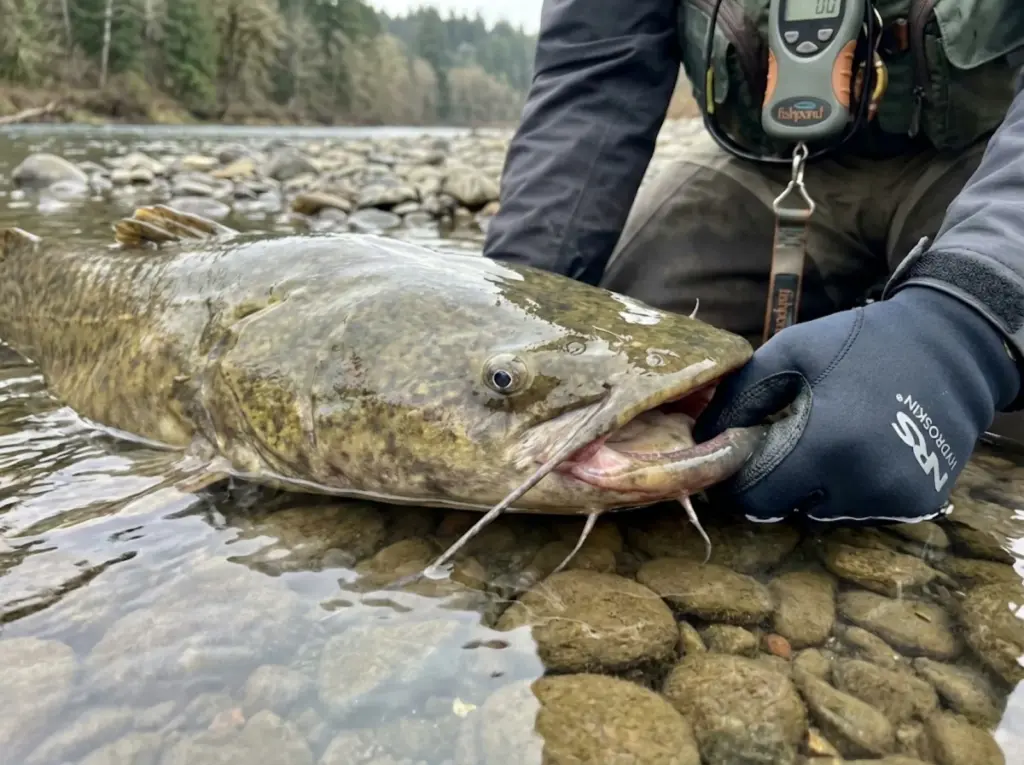
If you’ve spent any time pulling channel cats on stink bait and chicken liver, I need you to forget most of it. Flatheads operate on a completely different biological script—and understanding that script is the reason everything else in this system works.
The Predator vs. Scavenger Divide
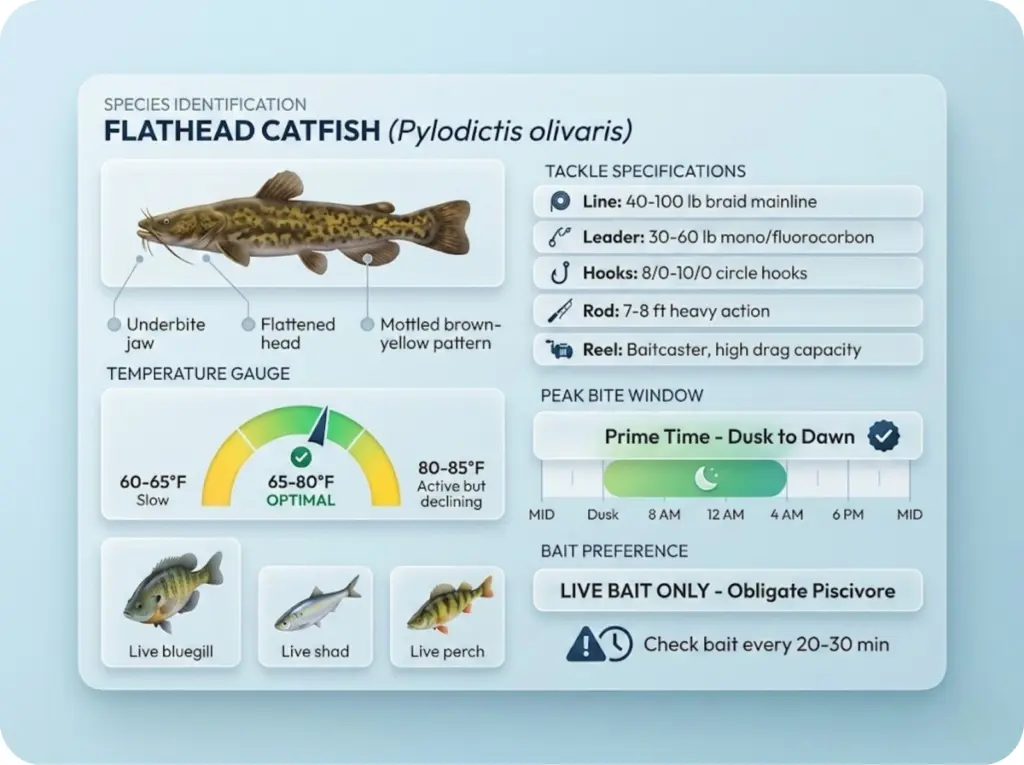
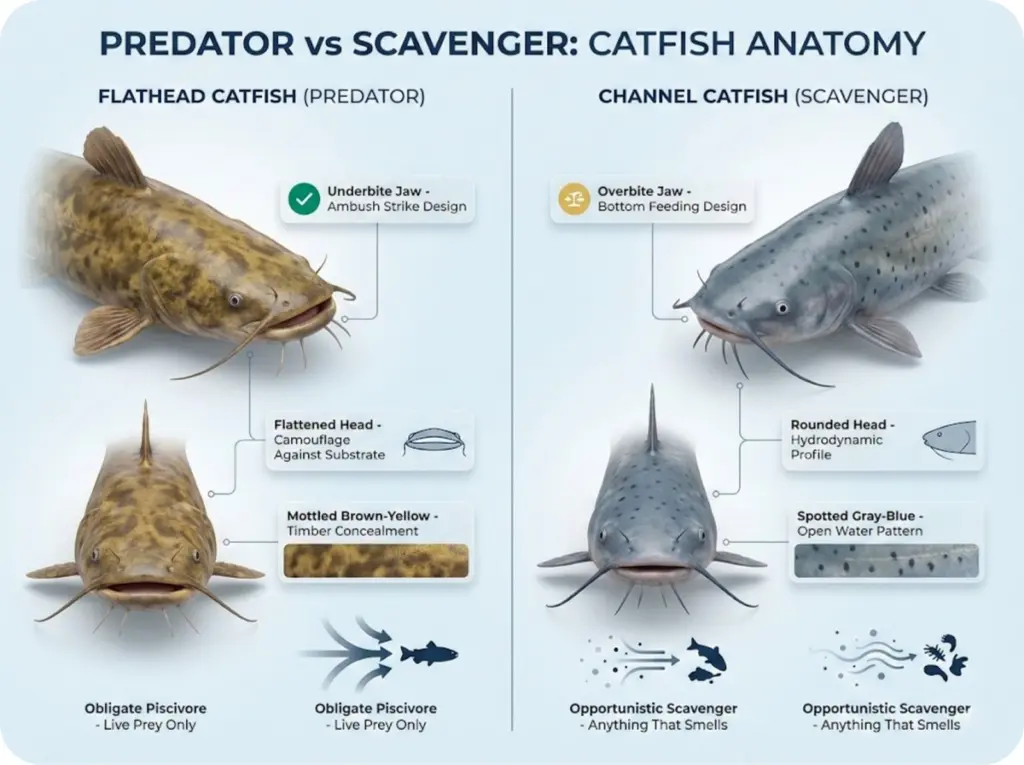
Flatheads (Pylodictis olivaris) are obligate piscivores in every river system they inhabit. Where channel catfish scavenge the bottom for almost anything that smells, flatheads actively hunt live prey. Their lateral line system detects low-frequency vibrations from struggling baitfish at considerable distances, which is exactly why a lively bluegill outperforms stinky baits every single time.
Look at a flathead’s skull and the design tells the story. That distinctive underbite jaw and flattened head are built for explosive, short-range ambush strikes—not sustained chasing. The mottled brown-yellow camouflage makes them nearly invisible against submerged timber and dark river substrate, so they sit motionless against a log jam and wait for forage to swim within strike range.
This distinction matters at every level of your approach. The bait must be alive. The presentation must put that live bait within the flathead’s ambush radius. And if your bluegill goes limp on the hook, you’ve gone from fishing to soaking dead weight.
Pro tip: Check your bait every 20–30 minutes and swap out anything that’s stopped kicking. A flathead won’t eat what a flathead can’t detect.
The National Park Service flathead catfish profile confirms what every serious flathead angler already knows from experience: this species sits at the top of the freshwater predatory chain.
Size, Growth, and Trophy Potential
Flatheads are among the fastest-growing freshwater fish in North America. In major river systems—the Mississippi River, Ohio, Susquehanna River, and Delaware River—they routinely exceed 50 pounds and can push past 100. A 40-inch flathead typically weighs around 29 pounds. A 50-inch fish pushes 59 pounds. Those numbers climb fast once the fish crosses the 45-inch threshold.
That growth rate depends heavily on forage availability and water temperature, which is why certain stretches of river produce monsters year after year while neighboring stretches produce nothing over 20 pounds. Understanding the length-to-weight relationship helps you gauge the quality of a fishery before you commit hours on the bank.
Nocturnal Hunters and the Dawn Catch-Up Window
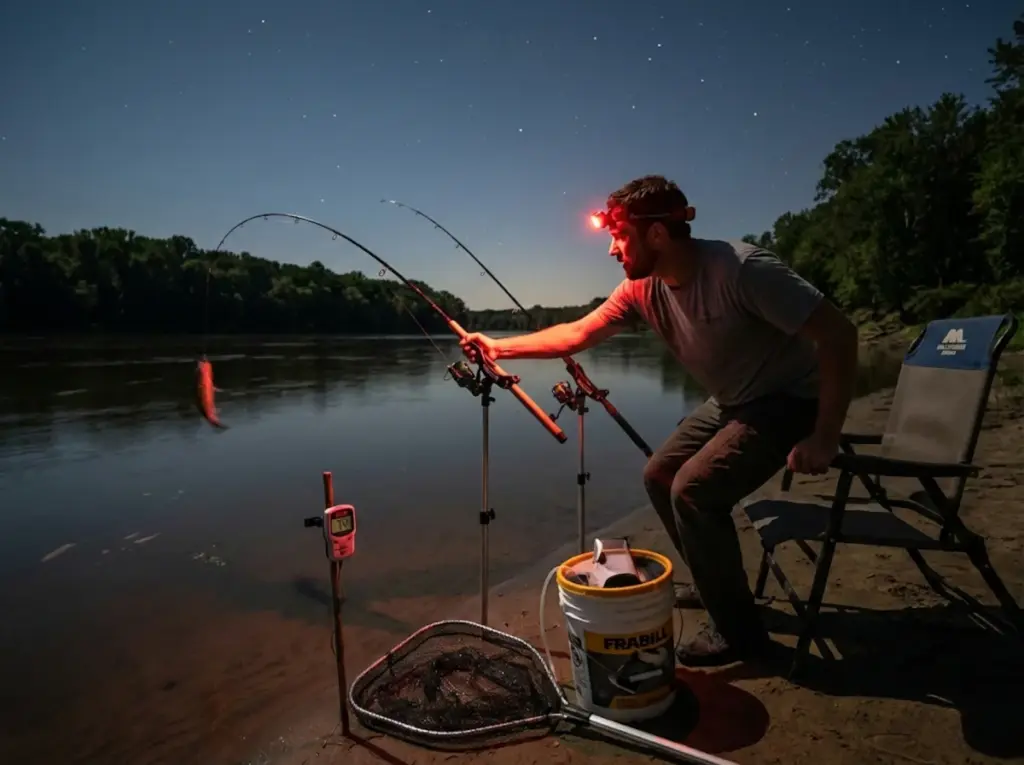
Flatheads feed primarily after dark. They spend daylight hours wedged into the tightest crevices of log jams and brush piles, nearly motionless. After sunset, they vacate those daytime refuges and move to shallow hunting grounds—current seams, sand flats adjacent to deep structure, feeder creek mouths.
But the real window most anglers miss is the dawn catch-up period between 4 AM and 8 AM. During that low-light twilight, flatheads gain a visual advantage over prey species. It’s the intersection of their ambush instinct and just enough light to make the attack precise. Some of my biggest fish have come at 5:30 AM, right when I was ready to pack it up.
Moon phase plays a role too. Experienced flathead guides prefer dark-of-the-moon nights, when reduced ambient light forces prey to rely on non-visual senses—tipping the ambush advantage even further toward the predator. Full moon nights tend to make fish more cautious and prey harder to trap.
Reading River Structure Like a Flathead
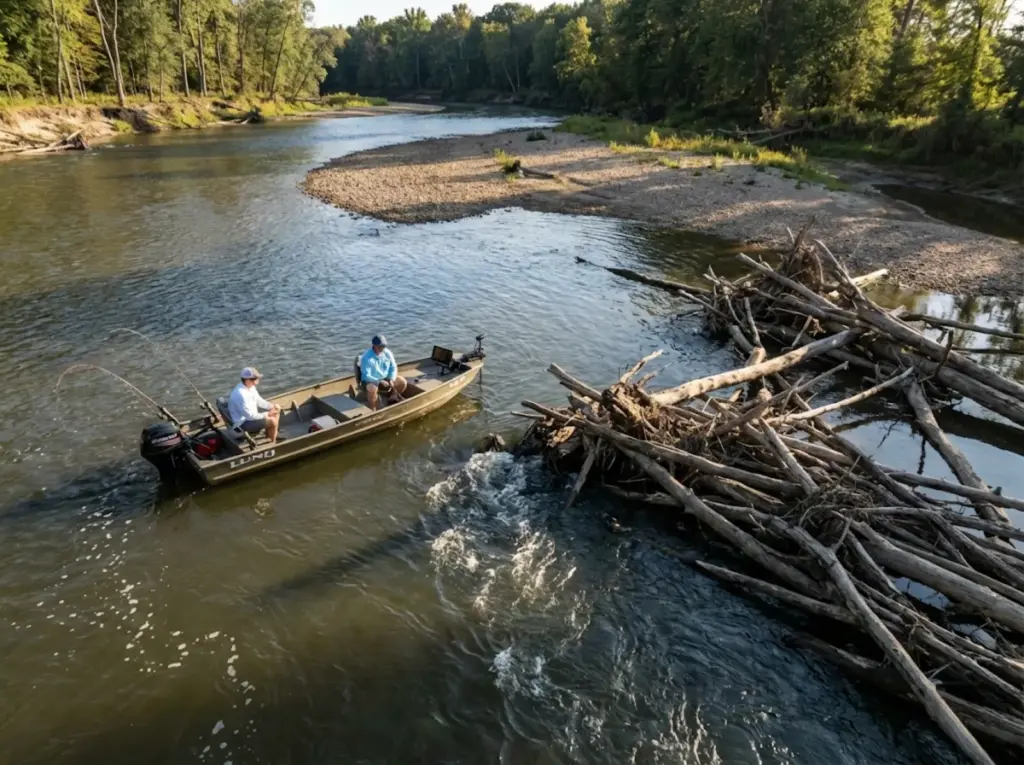
You can have perfect bait, perfect tackle, and the right lunar phase—but if you’re fishing the wrong water, none of it matters. Structure reading is the single biggest variable in consistent flathead catches, and it’s the skill that separates people who occasionally catch a flathead from people who catch them every trip.
Outer Bends, Scour Holes, and Log Jams
The outer bend of any river meander is where centrifugal force carves the deepest holes and deposits the heaviest woody debris. This is prime flathead territory. Scour holes form when current accelerates around obstructions like massive log jams or rock ledges, digging deep pockets into the riverbed that flatheads treat as home addresses.
In most river systems, flatheads prioritize woody cover over rock. A submerged oak tree on an outside bend with 15 feet of scoured-out depth beneath it is the textbook flathead lair. Look for foam lines and debris accumulation on the surface—they point to subsurface current breaks and structure below.
Sonar is non-negotiable for marking these features. Scan potential holes with a quality fish finder before anchoring or setting bank rods. I’ve wasted entire nights fishing spots that “looked right” from the surface but held nothing below. The investment in electronics pays for itself in sessions you don’t waste.
For a deeper framework on identifying productive river features, the guide on reading river structure for fish breaks down pool-riffle sequences, thalweg paths, and benthic contours in detail.
Current Seams—The Invisible Highway
A current seam is the boundary where fast-moving water meets slower water or a reverse eddy. These seams function as travel corridors for predatory fish moving between daytime refuges and nighttime feeding grounds.
Anglers like Brian Klawitter and Dale Broughton use what amounts to a “seam highway” strategy: spread three or four lines across the fast water, the seam itself, and the slow water behind it to intercept fish at different activity levels. The seam isn’t static—it shifts with water level changes, dam releases, and seasonal flow variation. Surface indicators include visible foam lines, color changes in the water, and floating debris accumulating along a visible boundary.
Understanding current seam dynamics at the physics level—where laminar flow meets turbulent eddies—gives you a predictive advantage that goes beyond pattern matching.
Tailwater Tactics Below Dams
Tailwaters below dams concentrate baitfish and provide elevated dissolved oxygen levels, making them magnets for trophy flatheads. But current dynamics shift depending on which dam gates are open. Center gates push the main flow to the middle of the channel, creating seams toward the banks. Shore gates produce fast water along the walls with seams forming in the center.
Scour holes below dams change every year due to high-flow events. Last year’s 20-foot depression might be a shallow gravel bar after spring floods. Monitor gate openings, turbine schedules, and CFS flow rates through USGS stream gauges to time your trips around optimal conditions.
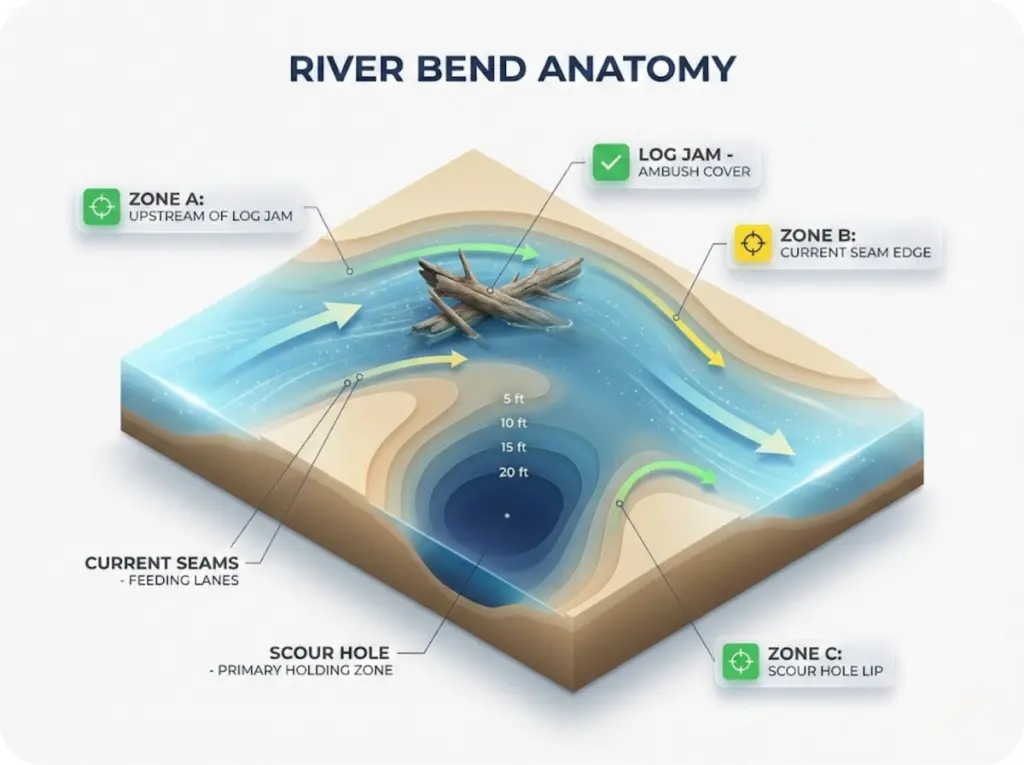
The reality of fishing heavy current effectively comes down to matching your sinker weight and line angle to the flow velocity—too light and your rig tumbles downstream into snags; too heavy and the bait sits pinned in dead water where no fish patrols.
Heavy Tackle Engineering—Gear That Won’t Quit
A 50-pound flathead inside a submerged log jam doesn’t negotiate. She turns, digs, and bulldogs into the heaviest cover available within the first five seconds of the fight. If your tackle can’t stop that initial run, you lose the big fish. Period. This isn’t a section about preference or brand loyalty—it’s about mechanical survival.
Rods, Reels, and Line—The Non-Negotiable Specs
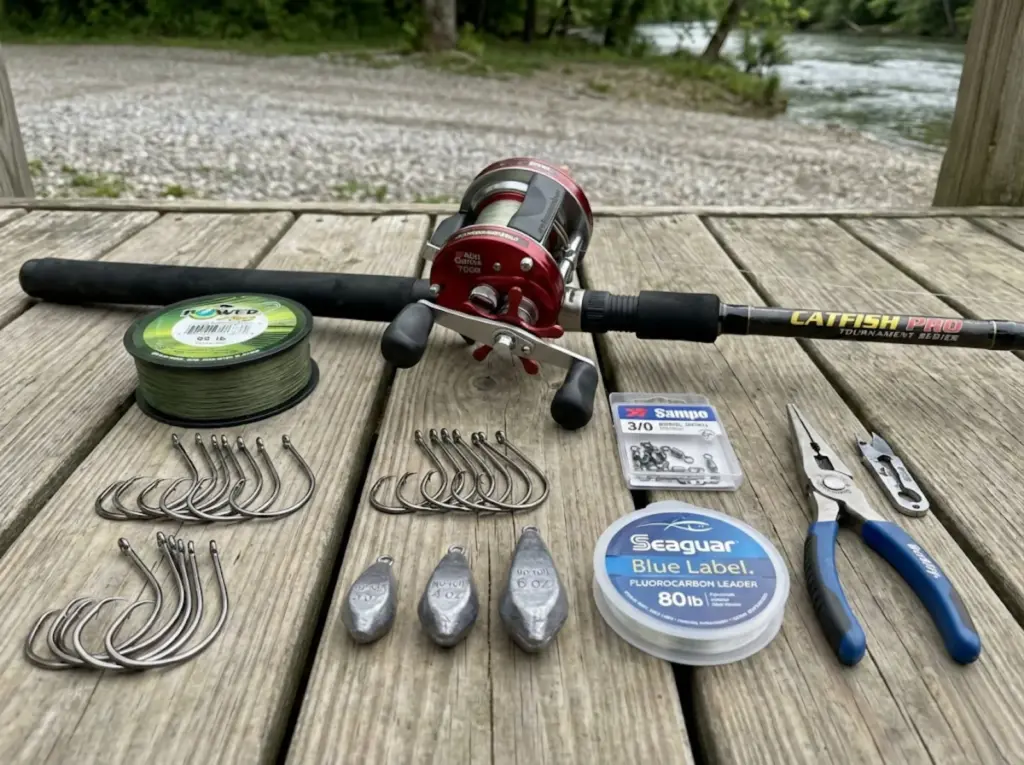
Rod: 7–8 foot heavy-action rod with moderate-fast action. S-glass or S-glass composite provides the sensitivity to detect subtle pickups while maintaining enough backbone to horse big fish away from brush piles before they bury you. Pure graphite rods are too brittle for this application.
Reel: The Abu Garcia Ambassadeur 6500 handles medium rivers and fish up to 30 pounds. For big water and 40-plus-pound targets, step up to the Ambassadeur 7000. The bait clicker system is critical—it lets fish take line with minimal resistance before you engage the drag, which dramatically improves hookup ratios with circle hooks.
Line: 50–65 lb braided line minimum. In heavy timber, some anglers go up to 100 lb braid without apology. Attach a shock leader with an FG knot or Alberto knot—the leader absorbs the initial strike impact and provides abrasion resistance where the line contacts structure. The guide on selecting the right braided line breaks down carrier count, coating durability, and diameter-to-strength ratios in detail.
The moderate action on the rod matters more than most anglers realize. It allows the rod to “load up” slowly, which gives circle hooks time to rotate and seat properly in the corner of the jaw. Fast-action rods yank the bait away before the hook can do its job.
When connecting braid to your mono shock leader, the FG knot method passes through guides cleanly and maintains nearly 100% line strength at the connection point.
Terminal Tackle—Sinkers, Hooks, and the Short-Leader Secret
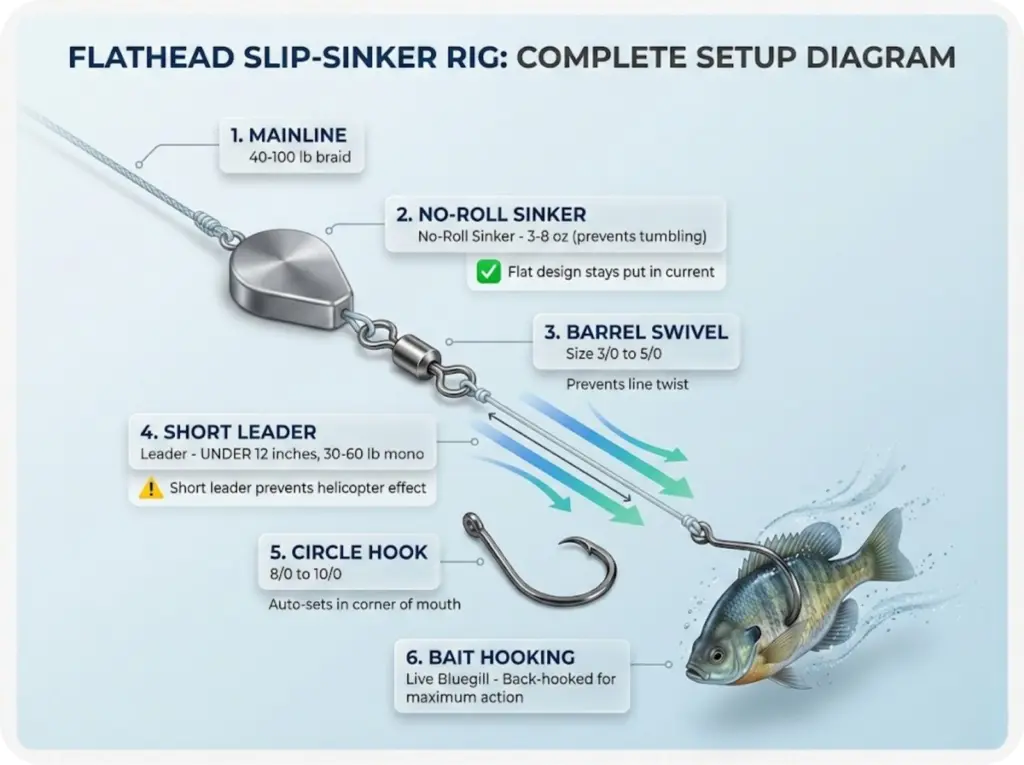
The slip-sinker rig is the foundation of flathead fishing. Sliding weight above a swivel, short leader to the hook—that’s it. But the details inside that simple framework make the difference between landing fish and losing them.
No-roll sinkers prevent your rig from tumbling and rolling into snags. Standard round egg sinkers are the number one cause of lost rigs in rocky current—they spin, roll, and wedge into crevices. No-roll designs sit flat on the bottom and stay where you put them. For a breakdown of sinker geometry and weight selection, see the fishing weights guide.
Circle hooks in 8/0 to 10/0 hook automatically in the corner of the mouth as the fish turns away with the bait. This eliminates gut-hooking, facilitates safe release on trophy fish, and actually improves hookup rates once you train yourself to stop setting the hook with a hard sweep. Just reel tight and let the rod load. The mechanics of how circle hooks improve catch-and-release survival are worth understanding before you commit to the switch.
The short-leader secret: Keep your leader under 12 inches. Most online rigs show 24–30 inch leaders, but in current, long leaders create a “helicopter effect”—the live baitfish spins, the line twists, and the bait eventually helicopters right into the very structure you’re fishing near. Short leaders keep the bait close to the sinker, reduce spin, and keep presentation in the target zone.
Pro tip: For high-current tailwater spots, swap to sputnik sinkers with wire legs that grip the bottom. They resist rolling in flows where even no-roll designs struggle.
Bait Management—Keeping Your Edge Alive
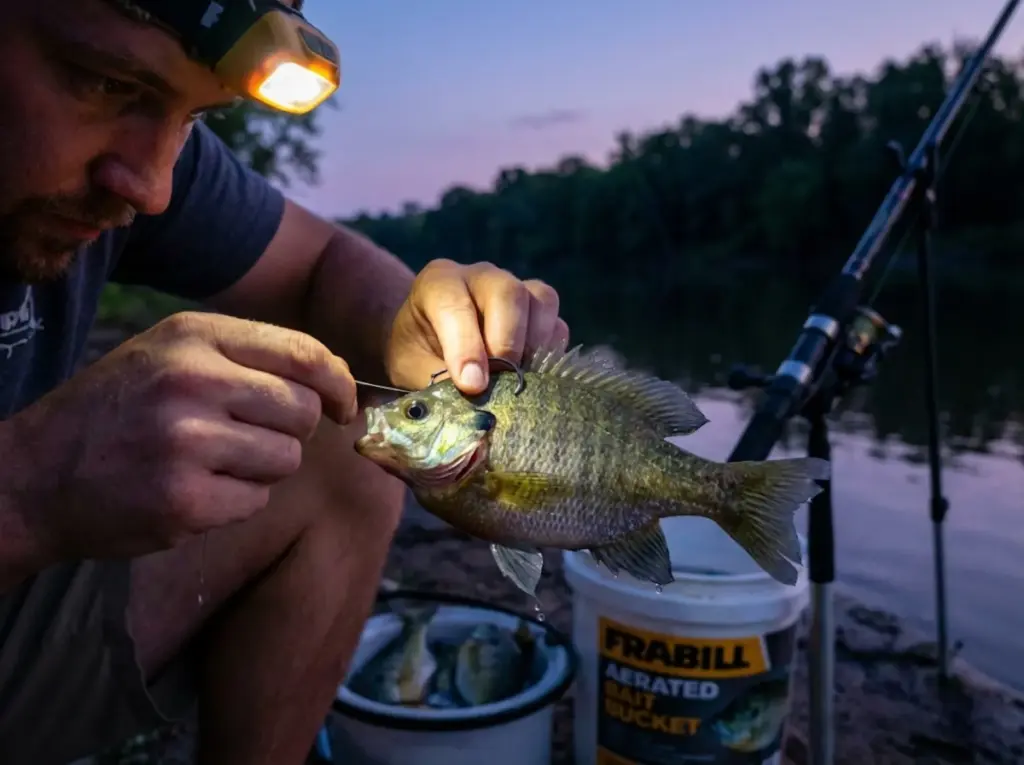
I’ve said it twice already, and this is where I prove it: live bait is the single most controllable variable in this system. The structure won’t move. The thermal triggers won’t change. But the liveliness of your bait is 100% within your control every single session—and it directly determines whether a flathead commits to the strike.
Choosing the Right Forage Species
Bluegill and sunfish are the workhorse baits for river flatheads. They’re hardy, widely available, easy to keep alive for hours, and produce exactly the low-frequency vibration that triggers the flathead’s lateral line response. Hook them through the back, behind the dorsal fin, to maximize natural swimming action.
Large suckers (8–10 inches) are the top-tier trophy bait. Their size and vigorous swimming action produce maximum vibration at distance, but they’re less hardy than bluegill and burn through oxygen faster in a bucket.
Bullheads are nearly indestructible on the hook. They stay alive and active for hours, and they’re a natural competitor that flatheads encounter and eat regularly in river systems.
Gizzard shad carry high oil content and broadcast scent effectively, but they’re fragile in bait tanks and require careful temperature and oxygen management.
Match bait size to target size. Four-to-six-inch baits produce average-class flatheads. Step up to 8–10 inch baits when you’re hunting legitimate trophies. The guide on proper live bait hook placement covers the specific insertion angles and positions that maximize swimming action for each forage species.
DIY Bait Tank Systems for Extended Sessions
A bucket with a battery aerator handles a single night of fishing. But for multi-day trips or keeping large suckers alive for extended periods, you need an actual bait management system.
Dechlorination comes first. Municipal water kills baitfish. Use a product like Seachem Prime to neutralize chlorine and chloramine before adding bait to any container filled from a tap or hose.
Aeration vs. oxygenation: Standard battery aerators provide surface gas exchange, which works for small batches. When keeping high densities of large baitfish, a diffused oxygen system keeps dissolved oxygen elevated even as the fish consume it faster.
Thermal management is the piece most anglers skip entirely. Keep water under 65°F—cold water holds more dissolved oxygen and slows the fish’s metabolism, reducing ammonia buildup. A frozen water bottle rotated every few hours is the simplest temperature fix that actually works.
Bio-filtration. Large baitfish produce significant nitrogenous waste. A simple sponge bio-filter processes ammonia before it reaches toxic levels. Without one, ammonia spikes will kill your bait before you reach the river on hot days. Add one tablespoon of non-iodized salt per five gallons to reduce osmotic stress during transport.
For the full system on keeping bait alive for extended fishing sessions, including container sizing, pump selection, and water chemistry benchmarks, the dedicated guide covers everything beyond what I can fit here.

Pro tip: A frozen water bottle dropped into your bait bucket doubles as a temperature regulator and a slow-release cold source. Swap it out every three hours on summer nights.
Timing the System—Seasons, Temperature, and the Bite Calendar
Flathead behavior runs on a thermal clock. Water temperature dictates when they feed, where they position, and how aggressive they are. Ignoring this calendar means you’re fishing for luck instead of fishing for fish.
The Pre-Spawn Feeding Frenzy
As water temperatures climb through the mid-50s and into the 60s°F, flatheads emerge from deep wintering holes and begin feeding with real aggression. This pre-spawn window is the best time of year for trophy flatheads—they’re actively hunting and less selective about bait size or presentation.
Focus on transition zones between deep holes and shallower spawning flats. Fish stage here before committing to the shallows. Creek arms that warm faster than the main river channel draw early-season flatheads looking for warmer water and concentrated forage.
Spawn Shutdown and the Summer Pattern
Spawning begins at approximately 70°F. At this point, fish focus on nesting, egg protection, and territorial defense rather than feeding, and catch rates drop sharply.
After the spawn wraps (typically mid-summer), fishing rebounds as flatheads resume aggressive feeding to recover body condition. Summer nights are the prime time: water temperatures peak, metabolic demand runs high, and flatheads patrol shallow structure hunting live prey after dark. Position your baits near outer-bend log jams and deep scour holes adjacent to shallow feeding flats.
For the summer pattern specifically, summer night catfishing patterns covers the tactical details of positioning, timing, and bait selection during the warmest months.
Fall Transition and Winter Dormancy
As water drops below 60°F in fall, flatheads begin consolidating into deeper water. Feeding becomes more sporadic, but individual meals are larger. This is a second trophy window—fish bulk up for winter and willingly eat oversized baits.
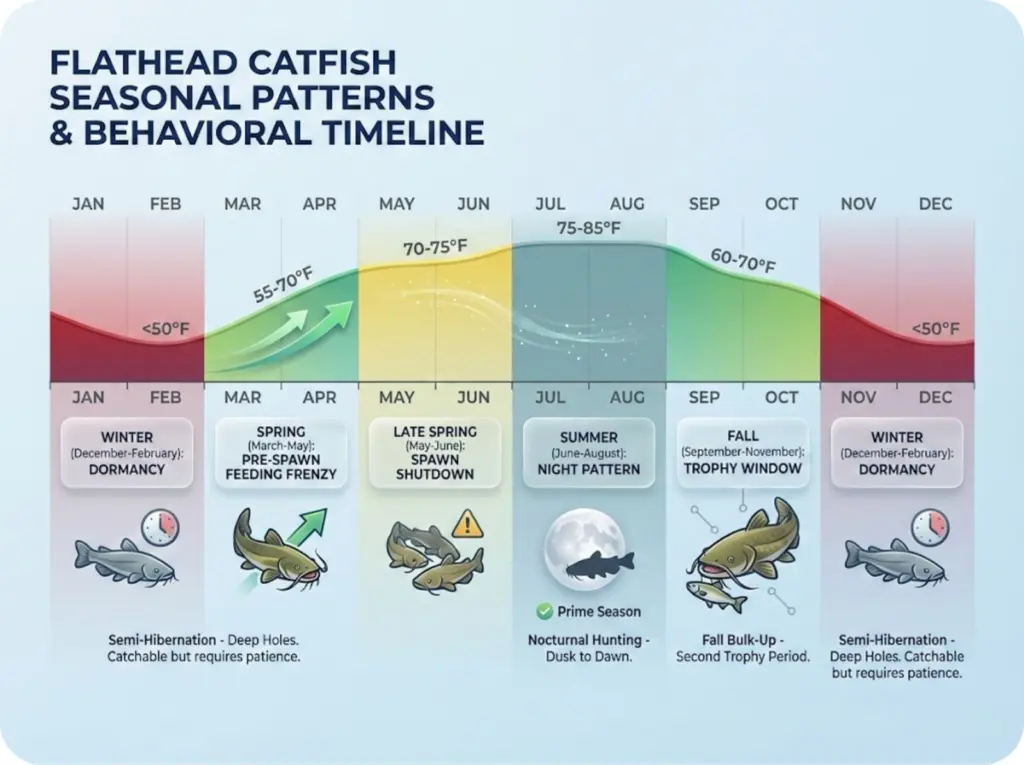
Below 50°F, flatheads enter semi-hibernation in deep river holes, sometimes congregating in groups of five or more. They’re catchable but require placing live bait directly in front of their faces and exercising genuine patience. Winter flathead fishing is the slowest game in freshwater angling—but the fish that bite tend to be the biggest residents in the hole.
Bank Fishing, Safety, and Handling Big Fish Right
Most high-authority flathead content assumes you own a jet drive boat with sonar and a trolling motor. I’ve caught plenty of trophy flatheads from shore, and the system works identically from the bank if you pick your access points with intention.
Bank Access and Shore-Based Trophy Hunting
Target outside bends where deep water comes close to the bank, especially where submerged timber extends from the shoreline. These spots put you within casting distance of the same structure that boat anglers run over with side-imaging.
Scout access during daylight. Check parking areas, trails to the water, property boundaries, and the actual bank footing before committing to a night fishing session. I’ve shown up at spots after dark that looked fine on satellite imagery and found a 10-foot vertical mud bank with no safe access to the water.
A headlamp with red-light mode preserves your night vision and keeps you from stumbling on uneven terrain. For a tested breakdown of night fishing safety protocols, including gear checklists and emergency preparation, that guide covers the non-fishing side of staying out all night. The best headlamps for night fishing review compares lumen output, battery life, and red-light mode quality side by side.
Handling and Releasing Trophy Flatheads
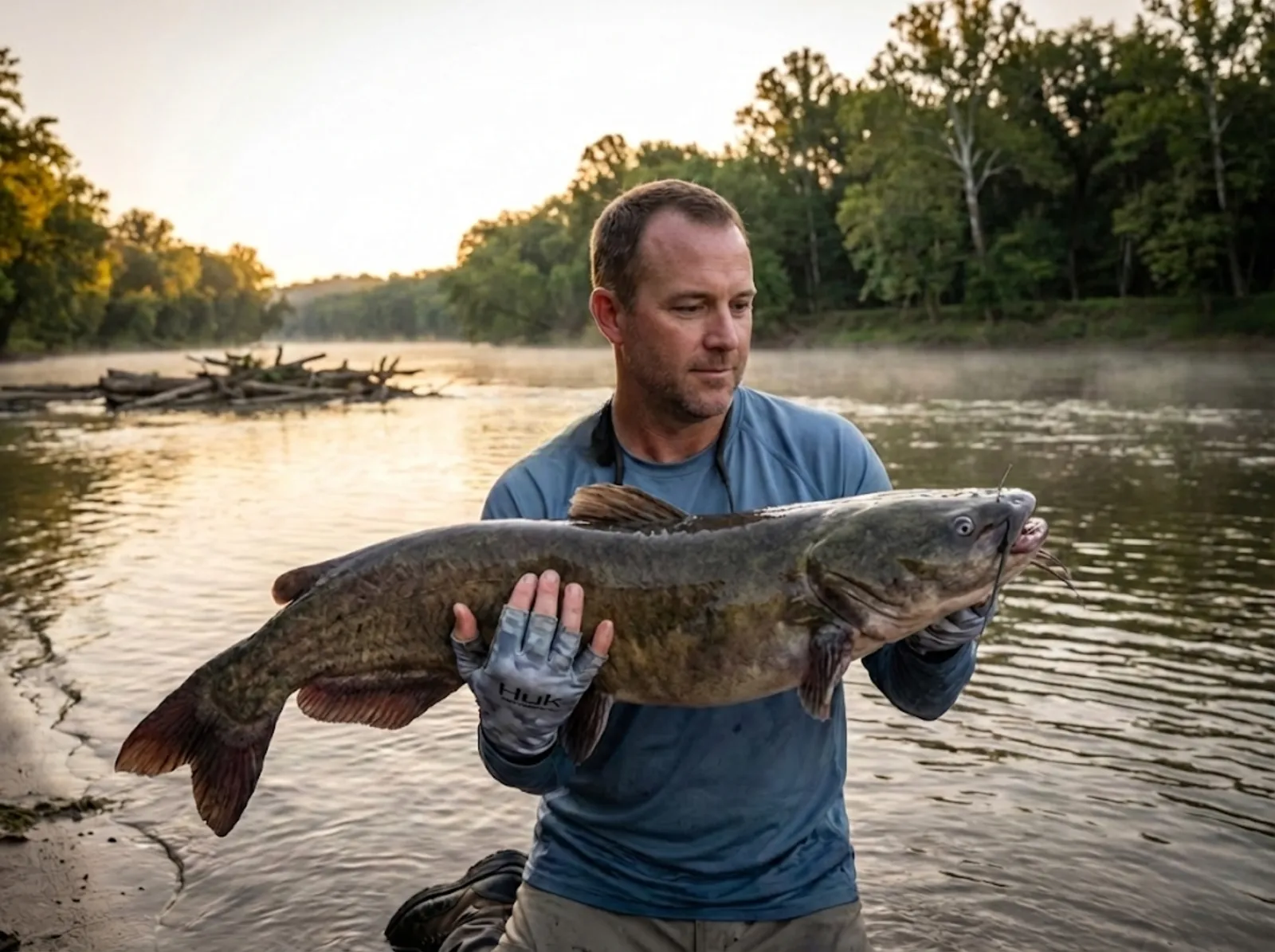
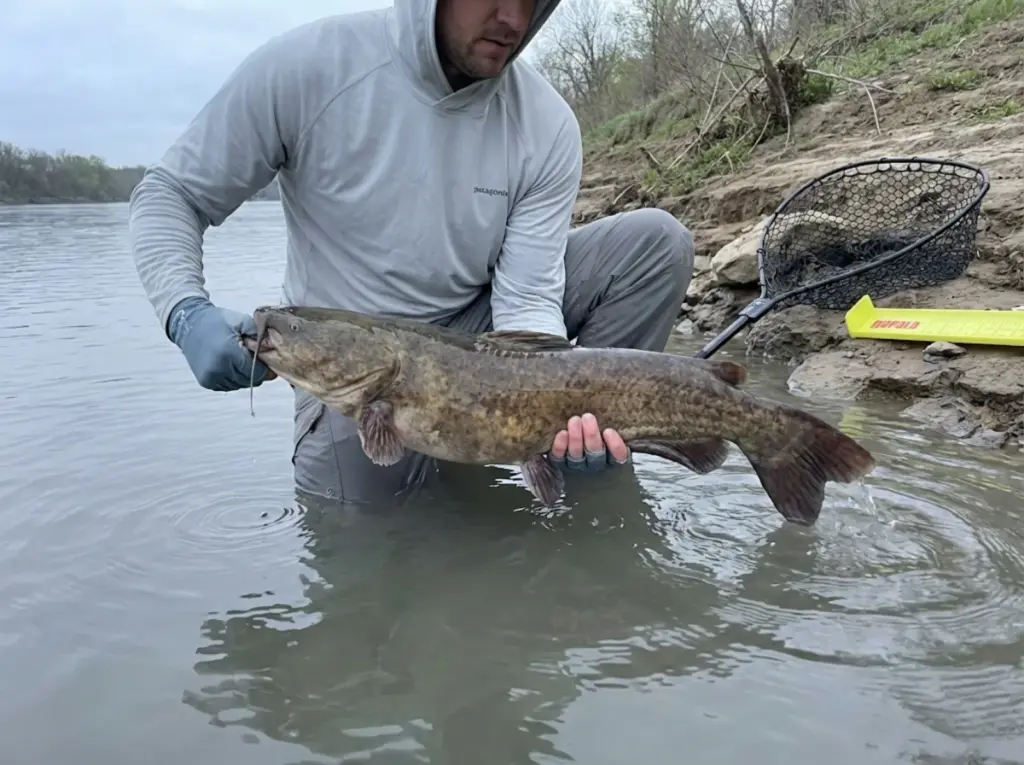
A 50-pound flathead is potentially 20 years old. Mishandling one removes a keystone predator from the ecosystem for two decades of lost reproductive output. Use a heavy-duty landing net or fish tailer to control the fish—never attempt to lip-grip a large flathead, as the abrasive jaw pads will shred your thumb.
Support the body horizontally with both hands: one under the jaw, one supporting the belly. Never hold a big catfish vertically by the jaw alone—the spine load can cause internal injury that kills the fish days after release. Wet your hands before contact to protect the slime coat. For the full breakdown on safely handling catfish spines, including pectoral fin lock-out positions, that guide covers the anatomy.
Invasive Species Context and Selective Harvest
Flatheads are native to the Mississippi River basin and Gulf Coast drainages, but they’ve been introduced into Atlantic slope rivers—the Delaware River, Schuylkill River, Susquehanna River, and several others—where they devastate native fish populations by out-competing and consuming native catfish species, sunfish, and other game fish.
In states like New Jersey and Pennsylvania, wildlife agencies encourage or require selective harvest of flatheads from Atlantic drainage rivers to protect native species. If you’re fishing a system where flatheads are invasive, keeping fish is a conservation act—not just a dinner decision. The invasive fish species identification and management guide provides the broader context for understanding which species require harvest-oriented management and which deserve release.
When processing large river catfish for the table, remove the dark “bloodline” strip running along the lateral line of each fillet. This tissue concentrates higher levels of environmental contaminants—PCBs, mercury, and heavy metals—found in large, long-lived river predators. The flathead catfish range and conservation context documented by the National Park Service provides additional information on range expansion and invasive status.
Pro tip: Check state fishing regulations before targeting flatheads in any system. Size limits, bag limits, and harvest expectations vary drastically depending on whether the fish is native or invasive in your watershed.
Put the System to Work
Three things make this approach work, and none of them are optional. First: flatheads are predators, not scavengers—forget stink bait, forget dead baits, forget everything that catches channel catfish. Live bait or nothing. Second: the system connects thermal triggers to structure to timing. Water temperature tells you when, current seams and scour holes tell you where, and lively baitfish on a short leader tells the fish it’s time to eat. Third: whether you’re fishing from a boat anchored above a log jam or banking it on an outside bend at 4 AM, the approach is identical—find deep structure near current, keep your bait alive, and let the circle hook do its job.
Pick one river bend with submerged timber, set up after sunset with the liveliest bluegill you can find, and fish the system through that dawn catch-up window. That first rod-buckling strike in the dark will tell you everything this article can’t.
Frequently Asked Questions
Can you catch flathead catfish during the day?
Yes, but your odds drop significantly. Flatheads are primarily nocturnal feeders that spend daylight hours buried deep in log jams and brush piles. If you fish during the day, position your bait directly in front of known structure where a flathead is holding—vertical presentations tight to cover are your best shot at a daytime bite.
What is the best bait for flathead catfish in rivers?
Live bluegill or sunfish hooked behind the dorsal fin is the most consistently effective bait for river flatheads. For trophy fish over 40 pounds, step up to 8–10 inch suckers. Flatheads are predators that reject dead, frozen, or prepared stink baits—if it isn’t alive and kicking, you’re fishing for channel cats, not flatheads.
What size hook do I need for flathead catfish?
Use circle hooks in sizes 8/0 to 10/0 for targeting large flatheads. Circle hooks set themselves in the corner of the fish’s mouth as it turns away with the bait, which reduces gut-hooking and makes safe release far easier. Pair them with a heavy-action rod and a short leader under 12 inches.
Where do flathead catfish hide in rivers?
Flatheads hold in deep scour holes associated with heavy woody structure—particularly log jams on the outside bends of river meanders. They wedge into the tightest gaps in submerged timber during the day and move to adjacent shallows and current seams to hunt after dark. Use sonar to locate these structure-rich deep holes before setting lines.
Do flathead catfish bite in winter?
Flatheads feed very little in winter. When water temperatures drop below 50°F, they enter semi-hibernation in deep river holes, sometimes grouping together. They’re catchable, but you need to place live bait directly in front of their faces and exercise extreme patience. Most dedicated flathead anglers focus their effort on the pre-spawn and post-spawn windows instead.
Risk Disclaimer: Fishing, boating, and all related outdoor activities involve inherent risks that
can lead to injury. The information provided on Master Fishing Mag is for educational and informational purposes
only. While we strive for accuracy, the information, techniques, and advice on gear and safety are not a substitute
for your own best judgment, local knowledge, and adherence to official regulations. Fishing regulations, including
seasons, size limits, and species restrictions, change frequently and vary by location. Always consult the latest
official regulations from your local fish and wildlife agency before heading out. Proper handling of hooks, knives,
and other sharp equipment is essential for safety. Furthermore, be aware of local fish consumption advisories. By
using this website, you agree that you are solely responsible for your own safety and for complying with all
applicable laws. Any reliance you place on our content is strictly at your own risk. Master Fishing Mag and its
authors will not be held liable for any injury, damage, or loss sustained in connection with the use of the
information herein.
Affiliate Disclosure: We are a participant in the Amazon Services LLC Associates Program, an
affiliate advertising program designed to provide a means for us to earn advertising fees by advertising and linking
to Amazon.com. As an Amazon Associate, we earn from qualifying purchases. We also participate in other affiliate
programs and may receive a commission on products purchased through our links, at no extra cost to you. Additional
terms are found in the terms of service.