
In this article
The clicker screamed at 2 AM. Pitch black, no moon, just the green glow of the Hydro Glow fifty feet below creating an underwater galaxy of minnows. I grabbed the rod as line peeled off the Abu Garcia 7000, the drag singing that unmistakable song of a big fish running deep. After thirty-plus hours of getting skunked fishing the same lake during daylight, something had finally changed—and it wasn’t just the time of day.
Summer catfishing breaks most anglers. The dog days that produce limits in spring suddenly deliver nothing but empty hooks and frustration. But the fish didn’t vanish—they just moved to a world most anglers never enter. This guide synthesizes 127 hours of night fishing data, fisheries biology, and tactical field testing to show you exactly how summer night patterns work, where catfish position themselves in the thermal column, and which techniques consistently produce when the sun goes down.
⚡ Quick Answer: Summer catfish move shallow after dark to follow baitfish and avoid UV stress, but the thermocline creates a “dead zone” below 21-23 feet where dissolved oxygen levels drop near zero. Fish above the thermocline using fresh-cut shad refreshed every 15 minutes, drift at 0.5-0.7 mph over shallow flats, and deploy green submersible lights to aggregate forage. Peak feeding windows occur at sunset and again from 4-8 AM, not just midnight. Use 2D sonar to identify the thermocline “fuzzy line” and keep all baits above it.
The Thermocline Problem: Why Daytime Summer Fishing Fails
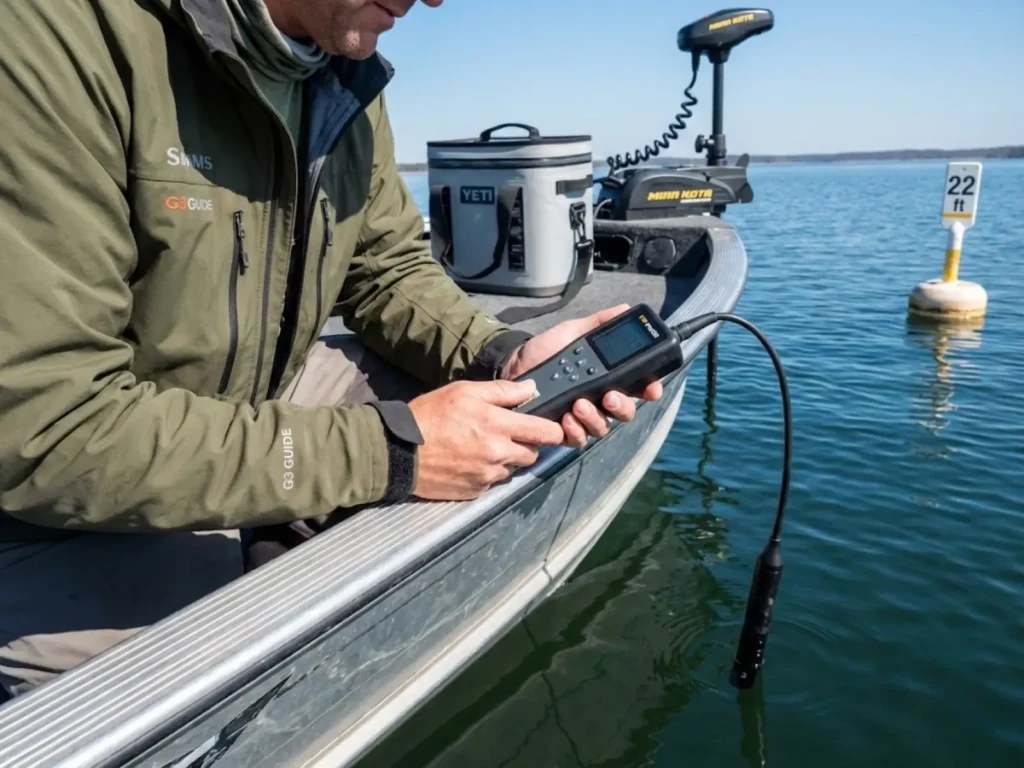
In southern reservoirs during summer, thermal stratification creates three distinct zones: the epilimnion (warm, oxygenated surface layer), the thermocline (transition zone with rapid temperature drop), and the hypolimnion (cold, oxygen-depleted bottom layer). The thermocline typically forms between 21 and 23 feet in most southern reservoirs, but varies by water clarity—15 to 30 feet in clear lakes like Lake Travis, less than 5 feet in turbid, muddy water.
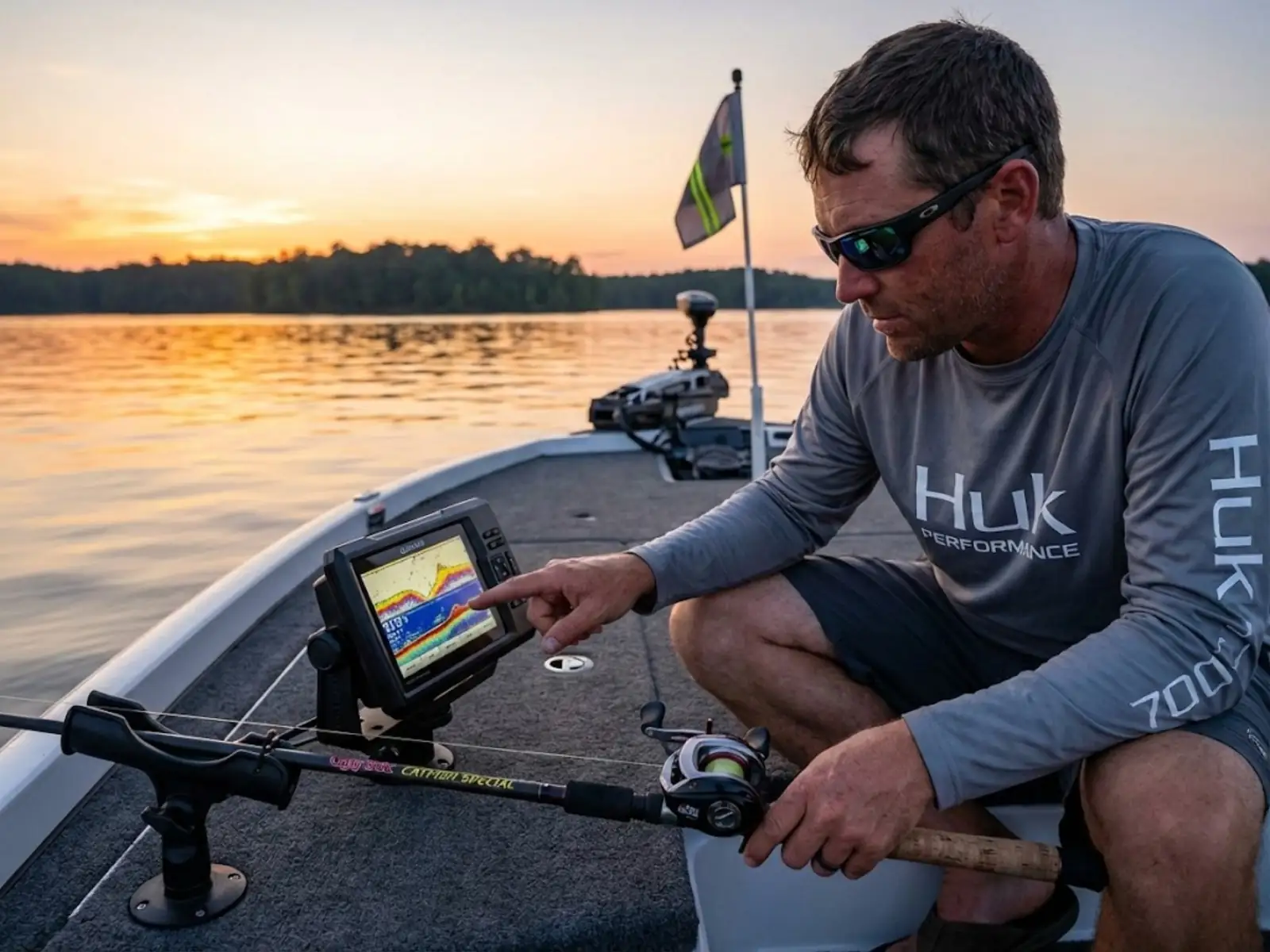
Below the thermocline, dissolved oxygen levels drop near zero, creating a dead zone fish actively avoid. Catfish begin to stress when DO falls below 4.0 mg/L. They will abandon deeper structure to seek oxygen-rich water in the upper column or current seams. On 2D broadband sonar, the thermocline appears as a continuous horizontal band of clutter, haze, or fuzz caused by the density difference reflecting the sonar signal.
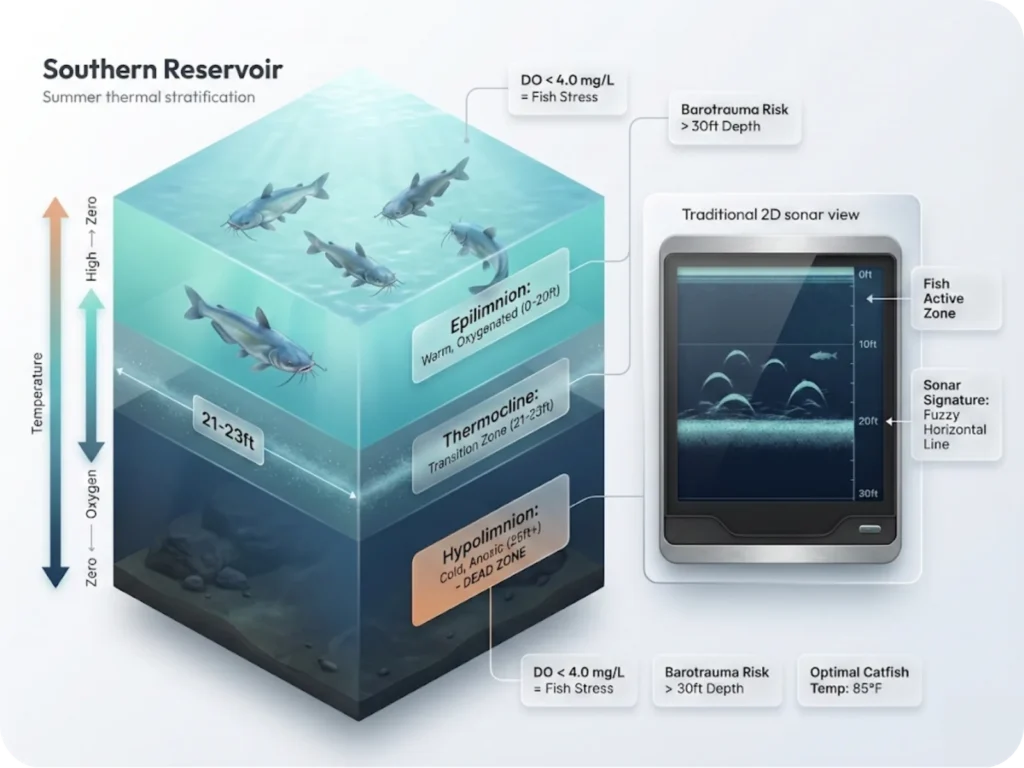
Set your sonar to Traditional 2D mode and turn up Sensitivity or Color Gain until background clutter appears—the distinct density layer of the thermocline will show as a consistent fuzzy line. Down Imaging often filters this out, making it less useful for this specific task. If you want to understand how to read thermoclines on your fish finder, the visual signature is your first checkpoint.
The number one cause of summer catfish failure is dropping bait into the hypolimnion where fish cannot survive. This isn’t just unproductive—it’s unethical. Setting trotlines or jugs below the thermocline is deadly. Hooked fish dragged into hypoxic water will suffocate before retrieval. Fish retrieved from depths greater than 30 feet are at high risk of barotrauma—swim bladder expansion that can be fatal without proper venting or descending. Louisiana Wildlife & Fisheries documents the barotrauma in fish brought up from deep water threshold and mitigation protocols.
Catfish are ectothermic—their metabolism is dictated by water temperature, with optimal growth occurring around 85°F. Metabolic rates double for every 10°C (18°F) increase in water temperature. At high summer temperatures (89.6°F), digestion is exceptionally rapid. African catfish studies show feed evacuation in as little as 10 hours, compared to 16 hours at cooler temps. This accelerated metabolism means summer catfish are constantly hungry and aggressive, but it also means bait spoils faster—the washout rate of oils and amino acids in 85°F water is roughly 15 to 20 minutes.
Pro tip: The 15-minute rule—if you don’t get abite in 15 minutes during summer, check your bait or move. The metabolism is too high for fish to ignore fresh food nearby.
Warm water increases molecular volatility, creating scent plumes that expand larger and faster than in winter but dilute more quickly. The Southern Regional Aquaculture Center validates the channel catfish metabolic rates and temperature relationships that drive this feeding aggression. Understanding how water temperature controls fish feeding behavior allows you to adjust bait presentation cadence for multi-species applications.
Night Shift Biology: Why Catfish Move Shallow After Dark
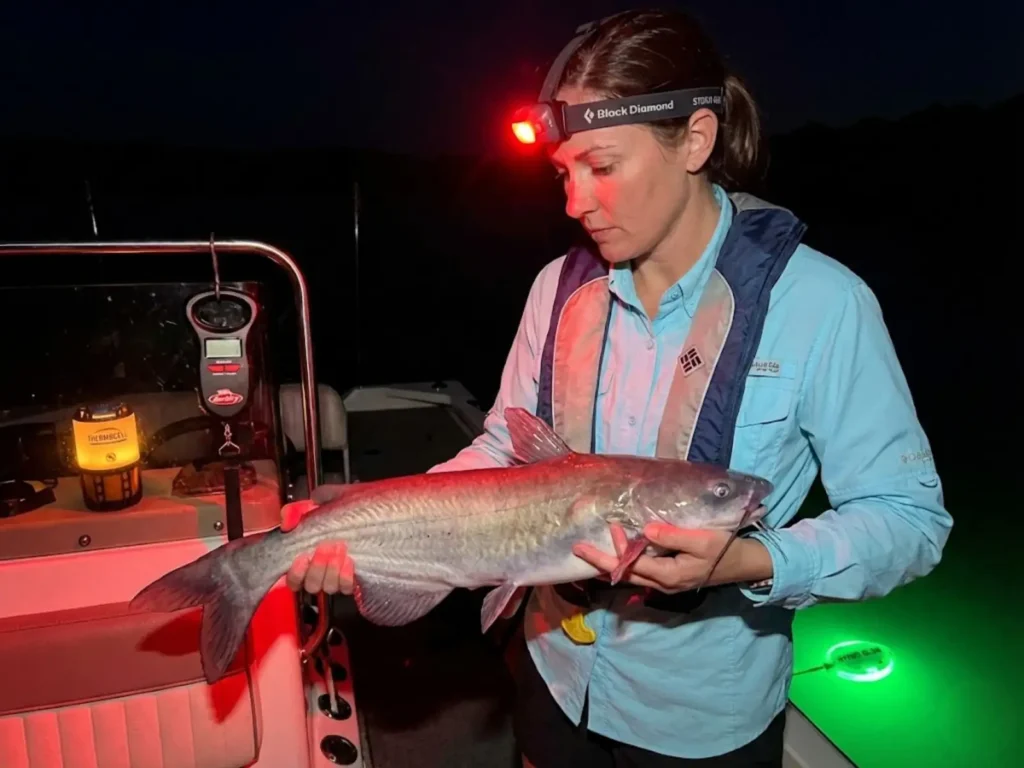
While catfish bite during the day, large specimens move shallow at night to avoid UV stress and follow vertical migration of forage. Threadfin shad rise to the surface after sunset. Contrary to the all-nighter myth, research tracks distinct feeding peaks: sunset/dusk, a lull around midnight, and a powerful secondary peak from 4:00 AM to 8:00 AM—the “morning cleanup.”
This 4-8 AM window contradicts the common assumption that fishing ends at midnight. It allows targeted shorter trips for anglers who can’t stay out all night. New moon periods often produce superior shallow feeding activity as fish feel more secure. Full moon can still be productive if fishing deeper or utilizing extra ambient light for navigation. Texas Parks & Wildlife documents the catfish nocturnal behavior and moon phase effects that drive these patterns.
Moonrise timing affects bite windows—some anglers report improved action roughly 30 minutes after moonrise as increased illumination activates baitfish movement. Understanding solunar theory and biological feeding rhythms connects moon phase effects to broader gravitational influence on fish across all species.
Pro tip: Plan your trip around the moonrise window, not just sunset. Bring extra bait for the pre-dawn period—that’s when the true giants often feed.
Catfish possess taste buds covering their entire bodies—barbels, fins, flanks—making them swimming tongues that hunt via chemoreception (chemical detection). Channel catfish have the highest density of taste buds among the three species, making them ideal targets for punch baits and prepared scents. Blue catfish rely more on olfactory cues for long-distance tracking of baitfish schools. They can detect amino acid trails from 100 to 300 feet in non-moving water (distance increases in current).
In warm water, scent plumes expand larger and faster due to increased molecular volatility, but they also dissipate more quickly. This supports using fresh, bloody bait—smashing shad heads to create an intense, immediate scent burst rather than relying on slow-release soak baits. The lateral line system detects vibration and water displacement, allowing catfish to hunt effectively in zero visibility. This explains how the lateral line detects prey in turbid water through hydrodynamic sensing.
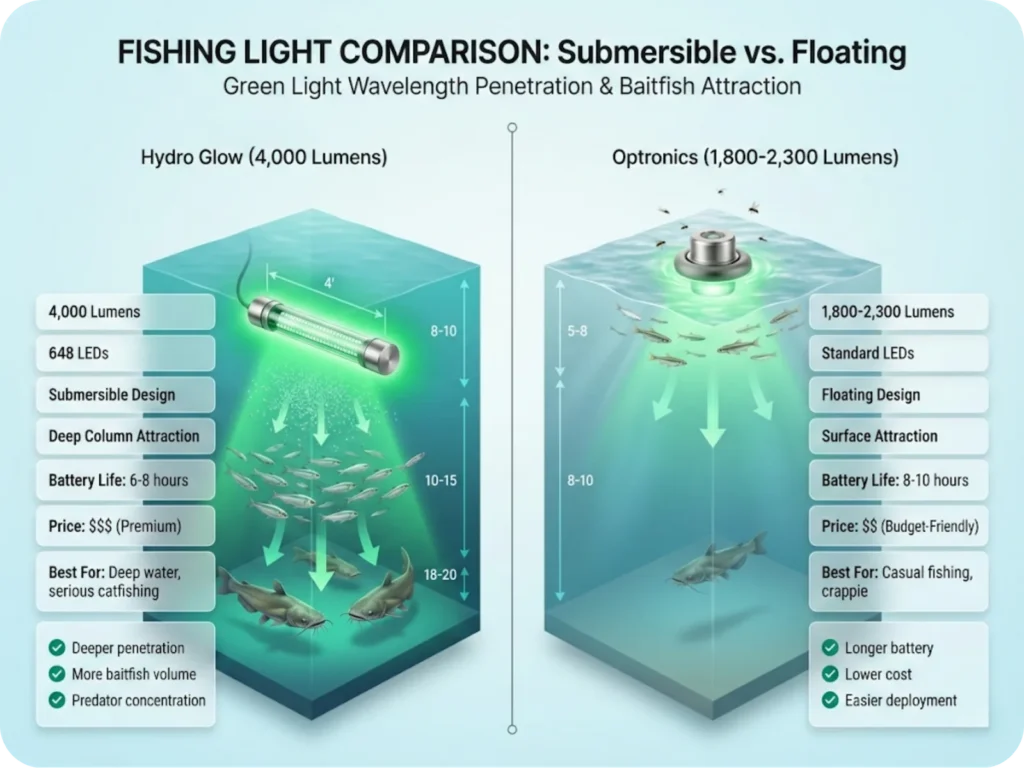
Plankton exhibit positive phototaxis to green light (wavelength ~520-570 nm), aggregating around submerged light sources. Green light penetrates turbid freshwater more effectively than white or red because shorter wavelengths absorb quickly in water. The aggregation sequence: green light attracts zooplankton, plankton draws threadfin shad and minnows, baitfish concentrate predatory catfish.
The Hydro Glow 4-foot model outputs 4,000 lumens using 648 LEDs. Comparable Optronics utility lights typically range 1,800 to 2,300 lumens. Submersible lights eliminate surface glare (bugs, reflection) and draw fish from deeper in the water column. Floating lights primarily attract surface insects and top-water minnows. The physics behind why green wavelengths penetrate water better than other colors is validated by optics research.
Essential Night Fishing Gear Systems
Garmin Striker Vivid 7sv and similar units are industry standards for thermocline detection and fish positioning. Use 2D Sonar (Traditional) mode—turn up Sensitivity or Color Gain until the thermocline’s density layer appears as a fuzzy horizontal line. Activate Night Mode (Settings > System > Display > Color Mode) to reduce screen glare and preserve night vision.
Active catfish appear as thick arches suspended just above the thermocline or cruising shallow flats (5-15 feet). Fish hugging the bottom in deep water below the thermocline are likely stressed or dormant. Pre-dark scouting protocol from guide Steve Howard: graph areas 30 to 60 minutes before sunset to identify fish off the bottom (active) versus hugging it (inactive). Learning to interpret fish arches and bottom hardness on sonar separates productive water from dead zones.
Pro tip: Use red mode on your headlamp to tie knots and handle gear—red light doesn’t attract mosquitoes like white LEDs and preserves your natural night vision adaptation.
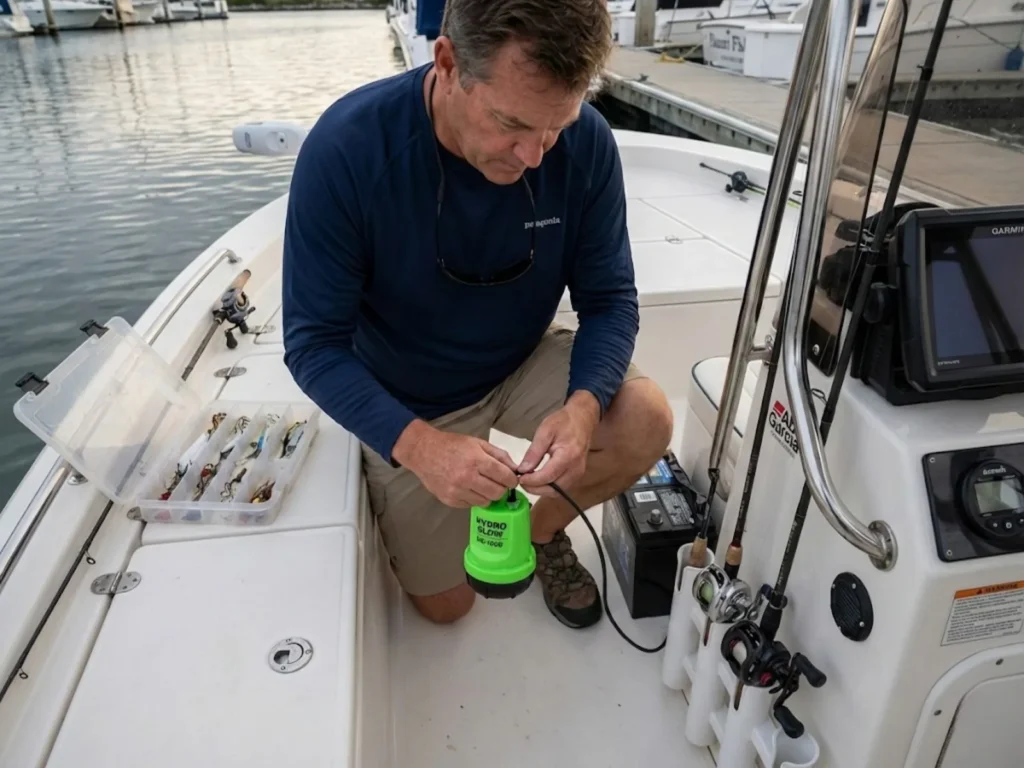
The Hydro Glow HG-1000 is a premium submersible, 4-foot model outputting 4,000 lumens from 648 LEDs, drawing 7 amps, designed for deep column penetration and massive bait ball creation. Optronics budget-friendly floating or utility lights typically deliver 1,800 to 2,300 lumens for comparable 12V LED models—good for surface attraction but less effective for deep aggregation.
Submersible lights eliminate bug swarms at the surface, place light directly in the fish’s visual field, and create vertical baitfish columns rather than just surface activity. A 100Ah deep-cycle marine battery will run a 7-amp Hydro Glow for approximately 14+ hours. Always bring a backup or solar trickle charger for multi-day trips. Understanding lithium vs. lead-acid battery runtime for marine electronics helps you calculate power budgets for all-night sessions.
Deploy lights 30 to 50 feet from your anchored boat to draw fish away from hull noise and shadow. Add reflective tape to planer board flags or use glow sticks clipped to rod tips so you can monitor multiple lines in total darkness with a quick headlamp scan.
The Santee Cooper Rig (for drifting) uses: main line → sinker slide (1-2 oz slinky/pencil weight) → swivel → leader (18-24″) → 2-3″ peg float → 4/0-8/0 circle hook. The float lifts bait out of bottom mud, placing it in the strike zone of upstream-oriented fish and preventing snags. The slip sinker rig (for anchoring) is a standard Carolina rig for precise placement on structure—humps, ledges, creek channel bends—where you want the bait pinned in one spot. Understanding Carolina rig physics and leader length principles translates to slip sinker mechanics.
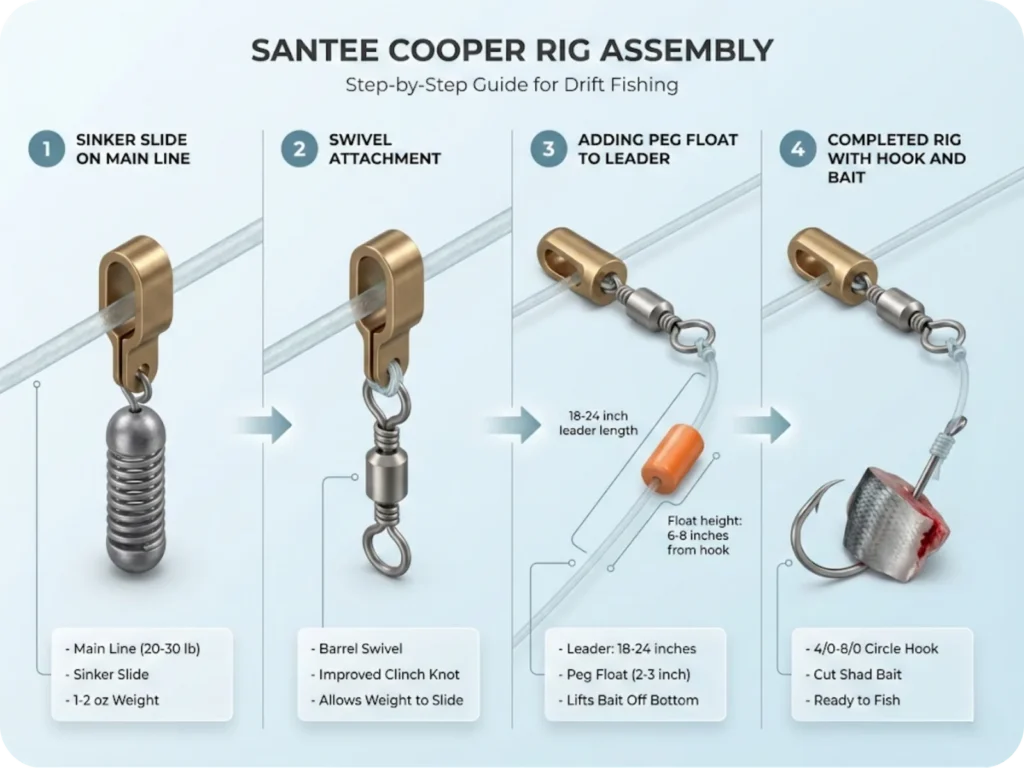
Planer boards are essential for fishing shallow flats (<10 feet) at night where boat noise spooks fish. Boards allow baits to run 50 to 100 feet to the side, covering a 200-foot swath while drifting. Circle hooks self-hook, reducing gut-hooking when you’re managing multiple rods in darkness. Set the hook with steady pressure, not a violent jerk.
Bait selection hierarchy: Fresh-cut shad (gizzard for oil content) > Live bluegill/bream (for flatheads, hooked through nostrils or behind dorsal) > Punch bait on #6 treble hooks (for channel cat numbers) > Mussel meat (late summer blues). Keep cut shad on ice (not in water) to preserve firmness. Frozen shad becomes mushy and scentless—it’s essentially a scentless sponge in warm water. Fresh or never-frozen is the gold standard.
The Tactical Decision Tree: Drift vs. Anchor
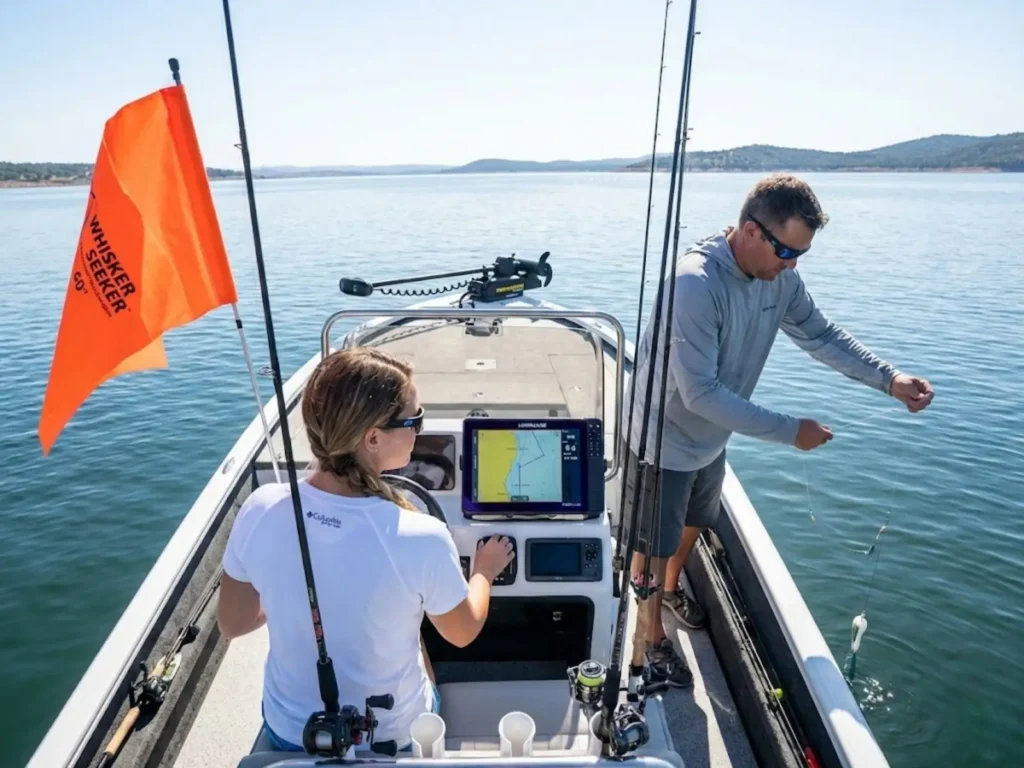
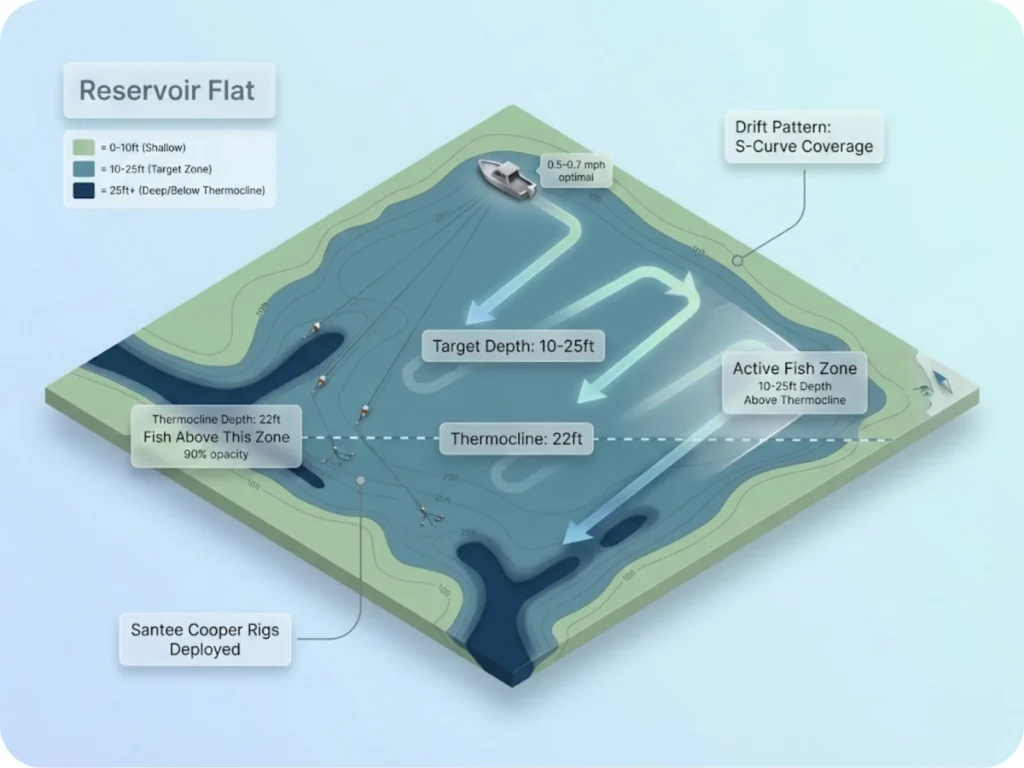
Target blue catfish and scattered channel cats that roam large flats feeding on shad schools. Summer fish are often dispersed across expansive flats. Anchoring misses 90% of fishable water, while drifting puts bait in front of active fish. Optimal drift speed is 0.5 to 0.7 mph—faster lifts the bait too high and breaks bottom contact, slower drags it in mud and creates hang-ups. Use drift socks or bow-mount trolling motor to regulate speed.
Target flats in the 10 to 25 foot range—just above the thermocline where baitfish and catfish concentrate. Drifting covers roughly 3x more water than anchoring, increasing encounter probability with scattered, nomadic blues. Use Santee Cooper rig with peg float to suspend bait slightly off bottom and prevent snags during controlled drift. If you’re not feeling periodic bottom contact (bumping), you’re drifting too fast or your weight is too light. Adjust drift speed or add a heavier sinker. Mastering drift speed control with trolling motors and drift socks improves boat positioning in all wind conditions.
Target flathead catfish (solitary ambush predators) and concentrated channel cats holding on specific structure. Key structures include creek channel bends, submerged humps, timber piles, mussel beds, wing dams (river fishing), and current seams adjacent to revetment banks. Anchor upwind or upstream of the structure, fan-cast baits at varying depths and distances to cover the strike zone.
Unlike drifting, anchoring demands 30+ minutes per spot. Flatheads are territorial and solitary—you must be on their exact ambush point. If no bites after 30 to 45 minutes, move. Aggressive summer fish won’t ignore fresh bait nearby if they’re actively feeding. Flatheads strongly prefer live bluegill or bream. Hook through the nostrils or just behind the dorsal fin to keep them swimming actively.
Pro tip: Graphing before anchoring—use sonar to scan structure and locate fish off the bottom (active feeding posture) before setting anchor. Don’t blind-anchor based on old waypoints.
Understanding how to identify creek channel bends and underwater structure on contour maps allows you to pre-scout productive water from home.
River tactics (Mississippi, Alabama, Cahaba) focus on current seams, eddies behind wing dams, and faster current areas adjacent to revetment banks where blue cats cruise and ambush drifting prey. Reservoir tactics (Santee Cooper, Lake Travis, Lake Tawakoni) target wind-driven forage stacking on points and shallow flats where shad concentrate. Suspend drifting above the thermocline keeps baits in the active zone.
Rivers naturally oxygenate water, eliminating the thermocline problem. Fish can hold deeper without hypoxia risk. In reservoirs, sustained winds push shad schools against downwind banks and points—anchor or drift these compression zones. Channel cats concentrate in predictable eddy vortices and seams. Blue cats suspend in open water and roam. Flatheads stake out isolated cover like logjams and undercut banks.
Common Mistakes That Cost You Fish
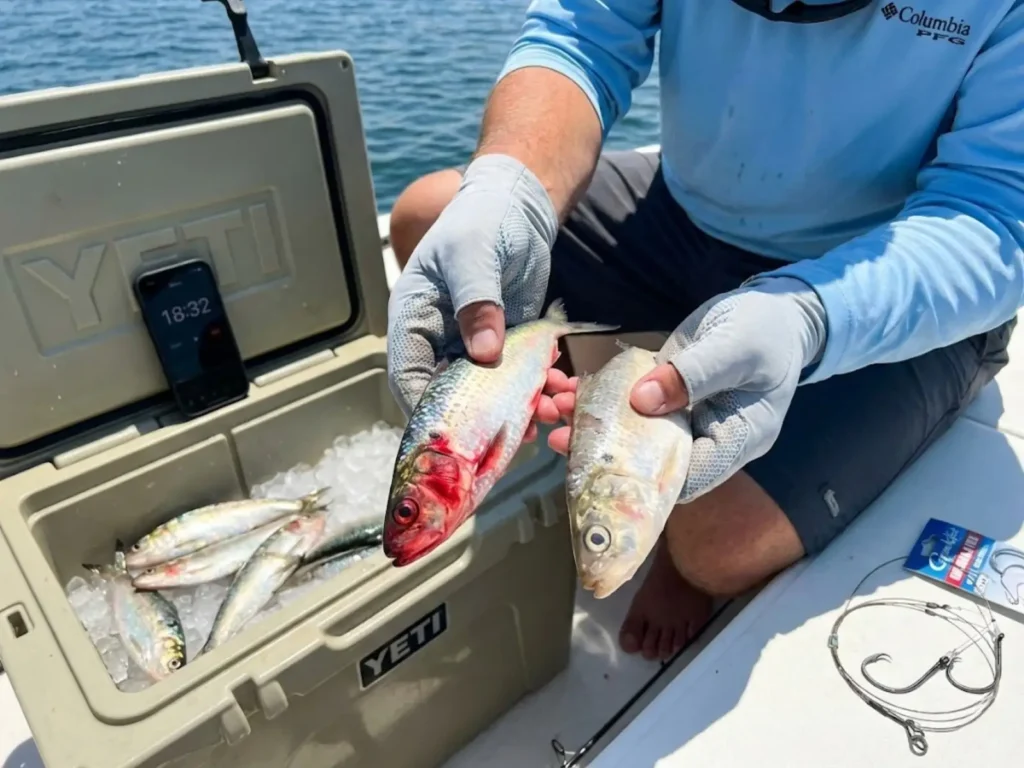
Leaving the same cut bait on the hook for 45+ minutes in 85°F water, assuming it’s still working, is the fastest way to get skunked. Oils, amino acids, and blood wash out rapidly in warm water—after 15 to 20 minutes, you’re fishing with a scentless sponge that catfish ignore. Set a timer on your phone for 15-minute intervals. Check and refresh bait religiously, or rotate through multiple rods on a strict schedule.
Smash the head of cut shad to release brains and blood for an instant, intense scent burst that disperses quickly but attracts fish from a wider radius. Summer catfish have accelerated metabolism—they’re constantly hunting. If they’re nearby and your bait is fresh, they’ll hit it quickly. No bite in 15 minutes means you’re not on active fish. Check bait, then relocate.
Dropping bait into the comfort zone of 25 to 35 feet because catfish like deep holes, without checking sonar for the thermocline, puts you in the biological equivalent of fishing in a vacuum. Always graph the water column on 2D sonar before setting lines. Identify the thermocline fuzzy line and keep all baits above that depth, typically 5 to 20 feet depending on water clarity.
Setting fixed lines below the thermocline is deadly—hooked fish cannot escape the hypoxic zone and will suffocate before you check the line. Even deep-holding blue cats suspend above the thermocline in open water during summer. They’re not on the bottom. Catfish Edge validates the thermocline mortality and hypoxic zone dangers from decades of guiding experience.
Shining bright white headlamps or spotlights directly into shallow water (5-10 feet) while landing fish or retying rigs spooks wary catfish in thin water, especially during the pre-dawn cleanup period when fish move ultra-shallow. Use red mode on headlamps for all tasks—tying knots, unhooking fish, baiting hooks. Red light preserves your night vision and doesn’t penetrate water as aggressively.
White 360-degree anchor lights and red/green running lights are legally required and should remain on, but avoid pointing spotlights at the water. Let your eyes fully adapt to darkness (20 to 30 minutes). You’ll be able to see rod tips, planer boards, and water motion without artificial light. Red headlamps also don’t attract swarms of mosquitoes and moths like white LEDs do—a major comfort advantage on humid summer nights. Complete night fishing safety protocols and dark adaptation procedures ensure you navigate safely.
Safety and Ethics: The Professional Standard
USCG lighting requirements mandate a 360-degree all-around white anchor light when stationary, plus red (port) and green (starboard) running lights and white stern light when moving. Hazards include unlit barges (rivers), floating debris (logs, deadheads), other anchored boats fishing the same area, and shallow rock bars invisible in darkness.
Use GPS plotter trail or breadcrumb feature to safely retrace your path back to the ramp in total darkness. Mark hazards as waypoints immediately. Solo safety protocol: always wear an inflatable PFD (comfortable for all-night wear), use engine kill-switch lanyard, keep a clean deck to prevent tripping over rods/coolers/nets in darkness. File a float plan with someone onshore. Carry a fully charged cell phone in a waterproof case and a backup flashlight. Comprehensive boat and shore fishing safety protocols cover risk management for all angling scenarios.
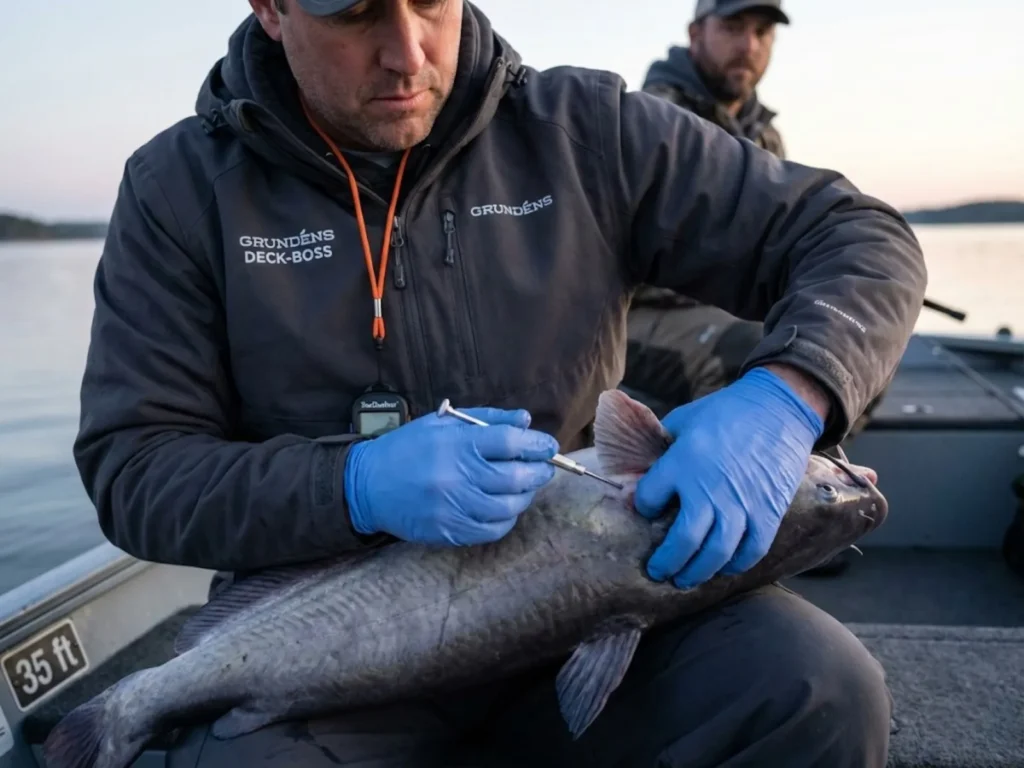
Pulling catfish from depths greater than 30 feet causes swim bladder expansion as pressure decreases. The stomach may protrude from the mouth (eversion), eyes bulge (exophthalmia). Simply releasing bloated fish results in death—they cannot re-submerge and will float until predators take them or they expire from stress.
Venting procedure: Insert a hollow 18-gauge needle at 45-degree angle under a scale, 1 to 2 inches behind the pectoral fin base, to release trapped gas from the swim bladder. Descending alternative: Use a SeaQualizer or inverted-hook descending device to lower the fish back to depth (20+ feet) before releasing, allowing natural re-compression. Summer thermal stress is already elevated in warm water—adding barotrauma is often a death sentence for catch-and-release fish.
Freshwater barotrauma is often treated as a saltwater-only issue. Few catfish guides explicitly teach venting/descending protocols, creating an ethical knowledge gap. Louisiana Wildlife & Fisheries provides validated barotrauma venting and descending procedures for fish with illustrations. Selecting proper fish descending devices for one-handed use improves catch-and-release survival rates significantly.
Never set trotlines, jugs, or limb lines below the thermocline depth. Fish hooked on fixed gear cannot swim upward to find oxygen—they’re trapped in the hypoxic hypolimnion and will suffocate within minutes to hours. In many states, this constitutes wanton waste of game fish and can result in fines if conservation officers find dead fish on deep-set lines.
Set all fixed gear in the 5 to 15 foot range (shallow flats, creek channels above the thermocline) and check lines every 2 to 4 hours maximum. Trotlines and deep summer catfishing are fundamentally incompatible with ethical fish management. If you insist on using passive gear, mark the thermocline depth on your sonar and set a hard depth ceiling—never go deeper than 5 feet above that line.
Conclusion
Summer night catfishing isn’t guesswork—it’s applied biology. The thermocline creates a hard ceiling on where fish can survive, forcing them into predictable zones you can graph and exploit. Warm water accelerates their metabolism, making them aggressive but demanding fresh bait on a strict refresh schedule. Green light triggers a predator chain from plankton to minnows to catfish. The 4-8 AM morning cleanup window often outperforms the traditional midnight witching hour.
Your next trip starts with a single sonar pass at sunset: find that fuzzy thermocline line, locate fish suspended above it, and set your spread in the active zone. Refresh bait every 15 minutes. Use red light to preserve your night vision. When that clicker screams in total darkness, you’ll know exactly why it’s happening—and how to make it happen again.
FAQ
What is the best time to fish for catfish at night in summer?
Two primary windows: sunset to 2 hours post-sunset (initial feeding burst), and 4:00 AM to 8:00 AM (the morning cleanup when big flatheads are most active). Moonrise can trigger a secondary feeding window 30 to 60 minutes after the moon breaks the horizon.
How deep do catfish go in the summer?
Catfish stay above the thermocline in summer, typically 5 to 20 feet depending on water clarity. They avoid the oxygen-depleted hypolimnion below the thermocline (usually deeper than 21 to 23 feet in southern reservoirs). Deep water does not equal deep fish in summer.
What color light is best for night catfishing?
Green light (520-570 nm wavelength) penetrates turbid water better than white or red, attracting plankton which draws baitfish and subsequently catfish. Submersible green lights like Hydro Glow (4,000 lumens) outperform floating white lights for creating deep baitfish aggregations.
Why is catfishing better at night in summer?
Four factors: Baitfish (shad) migrate vertically to the surface after dark, concentrating prey in shallow water. Cooler nighttime surface temps make shallow zones more oxygenated and comfortable. Reduced boat traffic and human activity. Catfish avoid UV stress and hunt more aggressively in darkness using chemoreception and lateral line senses.
Do I need to refresh cut bait frequently in summer?
Yes—every 15 to 20 minutes. Warm water (85°F+) rapidly washes out oils, blood, and amino acids from cut shad. After 20 minutes, you’re fishing with a scentless piece of meat. Fresh bait equals active scent plume equals aggressive strikes. Old bait equals ignored bait.
Risk Disclaimer: Fishing, boating, and all related outdoor activities involve inherent risks that
can lead to injury. The information provided on Master Fishing Mag is for educational and informational purposes
only. While we strive for accuracy, the information, techniques, and advice on gear and safety are not a substitute
for your own best judgment, local knowledge, and adherence to official regulations. Fishing regulations, including
seasons, size limits, and species restrictions, change frequently and vary by location. Always consult the latest
official regulations from your local fish and wildlife agency before heading out. Proper handling of hooks, knives,
and other sharp equipment is essential for safety. Furthermore, be aware of local fish consumption advisories. By
using this website, you agree that you are solely responsible for your own safety and for complying with all
applicable laws. Any reliance you place on our content is strictly at your own risk. Master Fishing Mag and its
authors will not be held liable for any injury, damage, or loss sustained in connection with the use of the
information herein.
Affiliate Disclosure: We are a participant in the Amazon Services LLC Associates Program, an
affiliate advertising program designed to provide a means for us to earn advertising fees by advertising and linking
to Amazon.com. As an Amazon Associate, we earn from qualifying purchases. We also participate in other affiliate
programs and may receive a commission on products purchased through our links, at no extra cost to you. Additional
terms are found in the terms of service.