
In this article
The drift boat was already in the run when I arrived—two anglers working streamers downstream, methodical and focused. I’d hiked three miles to fish this pool. The question wasn’t whether I had a right to be there. The question was: how do I fish this water without being the jerk who ruins everyone’s morning?
That moment—standing on the bank, rod in hand, watching other anglers work water you want to fish—is where river etiquette stops being abstract and becomes brutally practical. You can know all the “unwritten rules,” but if you can’t translate them into real-time decisions about distance, communication, and movement, you’re just another angler creating friction on crowded public water.
This guide breaks down fishing etiquette into a systematic framework: the 3C Code (Calculate, Communicate, Circulate). You’ll learn how to quantify spacing requirements based on technique and gear, use specific communication protocols to avoid conflict, and apply rotation strategies that let multiple anglers fish productively without stepping on each other’s water. By the end, you’ll have the tools to navigate crowded rivers with confidence—and the respect of every angler you encounter.
| Fishing Etiquette Guidelines | |
|---|---|
| Rule | Guideline |
| Fly Fishing Buffer | 80-150 ft (rod weight dependent) |
| Gear Fishing Buffer | 50-80 ft (technique dependent) |
| Boat vs. Wade | Wade angler always has right-of-way |
| Low-Holing | Stepping in downstream of a moving angler |
| High-Holing | Stepping in upstream within sight/spook range |
| The Ask | “Are you working up or down?” before entering water |
⚡ Quick Answer: The 3C Code (Calculate, Communicate, Circulate) gives you a systematic approach to sharing water with other fishermen. Calculate your spacing based on casting radius (80-150 feet for fly fishing, 50-80 feet for gear fishing). Communicate before entering occupied water—ask “Are you working up or down?” Circulate by rotating through runs or yielding space when stationary. Wade anglers always have right-of-way over boats, and the first-arriver principle applies in all situations.
The 3C Framework: Calculate, Communicate, Circulate
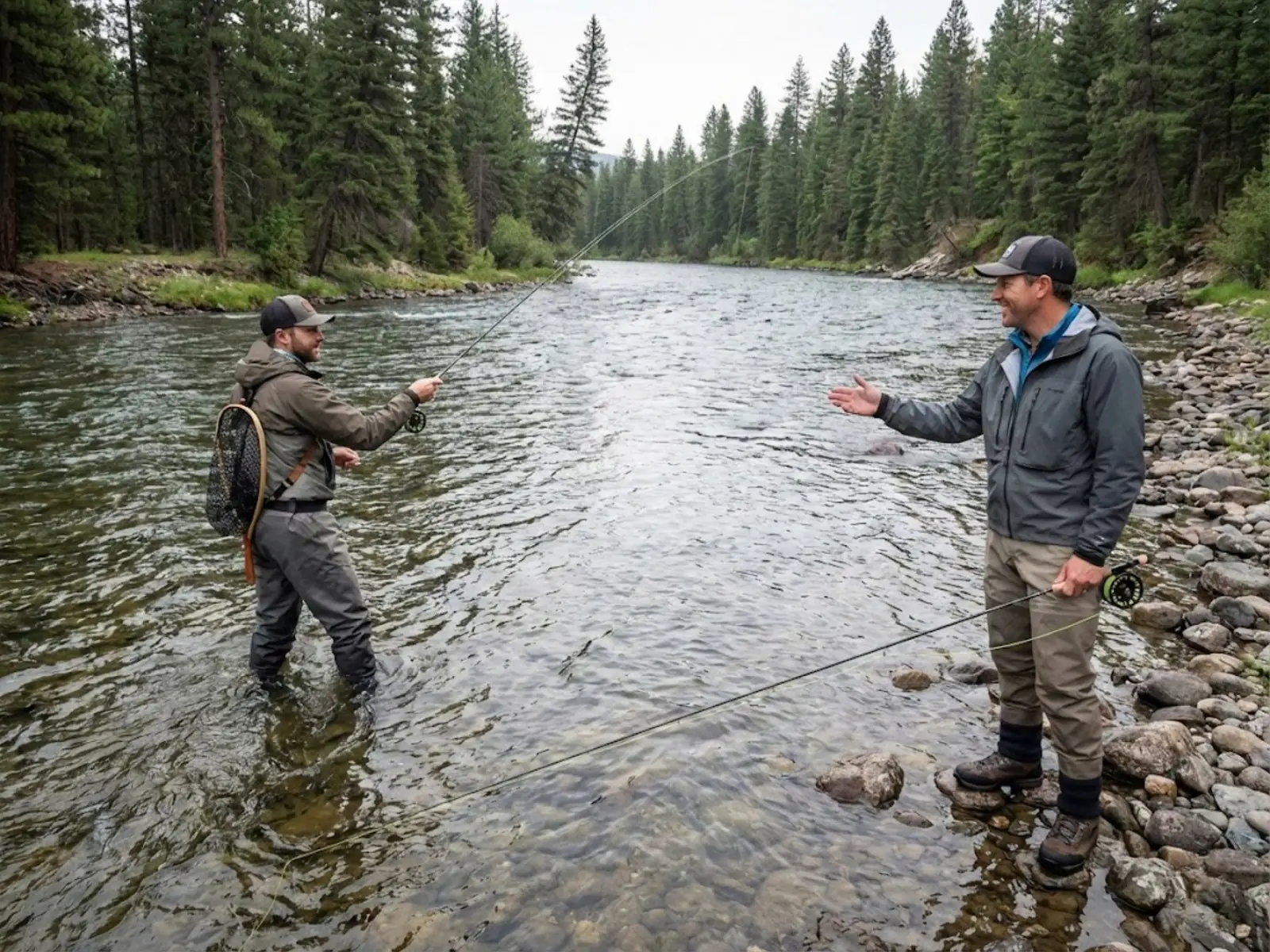
The 3C Code isn’t just a set of rules—it’s a framework for resource optimization. When anglers apply it, everyone catches more fish. When they ignore it, everyone loses.
Calculate refers to the geometry of fishing. An angler doesn’t just occupy where they stand, but the entire “casting radius” plus the “drift lane” required for their technique. A steelhead angler swinging a spey rod claims 150+ feet of river. A bait fisherman stationary in a hole claims that specific spot but not the water around it.
Communicate is the verbal and non-verbal interface that removes ambiguity. Research from the Washington Department of Fish and Wildlife’s official angling etiquette guidelines shows most on-water disputes arise from assumptions, not malice. A simple “Are you working up or down?” before stepping in prevents 90% of conflicts.
Circulate addresses the temporal dimension—how long is too long on one spot, and when does “fishing a run” become “camping a hole”? Rotation culture varies by region (Pacific Northwest vs. Southern Appalachia), but the principle is universal: keep moving or yield space.
The physics of sharing are straightforward. Fish hold in specific current seams, depth transitions, and structure. Multiple anglers can fish the same stretch if they understand understanding current seams and fish-holding water—where fish expend the least energy for maximum food intake—and position themselves to avoid overlapping those zones.
I’ve watched a single low-holer shut down an entire tailwater run for a dozen anglers. I’ve also seen six fly fishermen rotate through a 200-yard pool in perfect harmony, each catching fish, because they communicated and calculated their spacing. The difference wasn’t luck—it was competence.
Pro tip: Before stepping into any occupied water, spend 2-3 minutes watching the current angler’s movement pattern. Their pace and direction tell you everything you need to know about where you can (and can’t) position yourself.
Calculate: The Geometry of Casting Radius
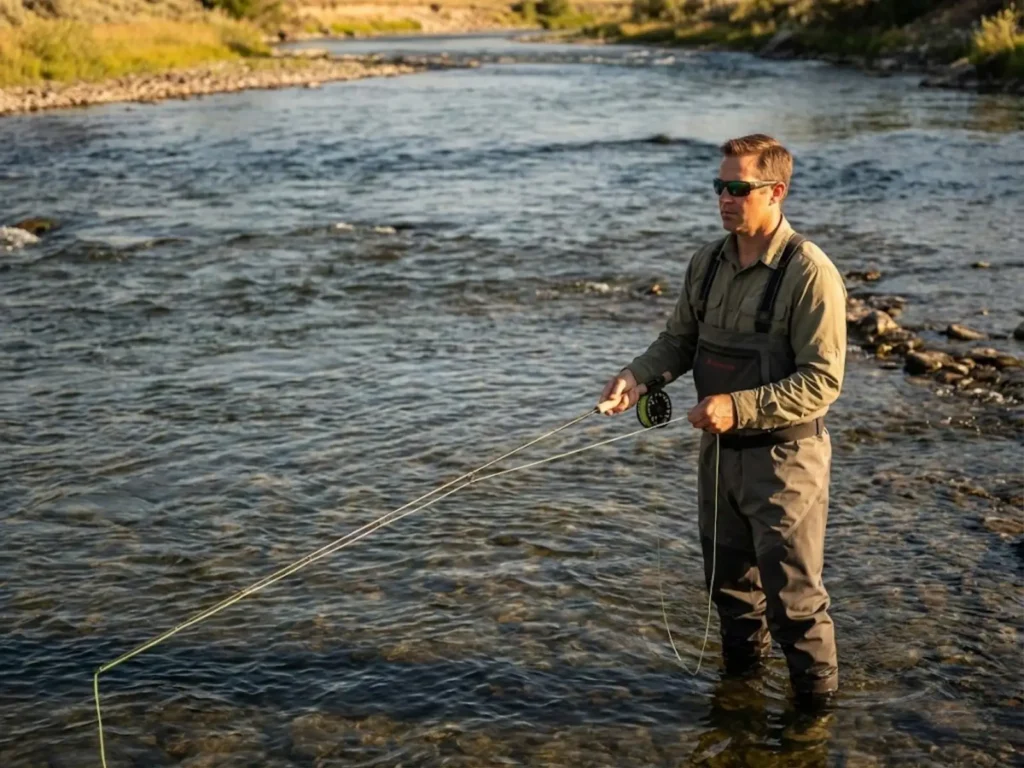
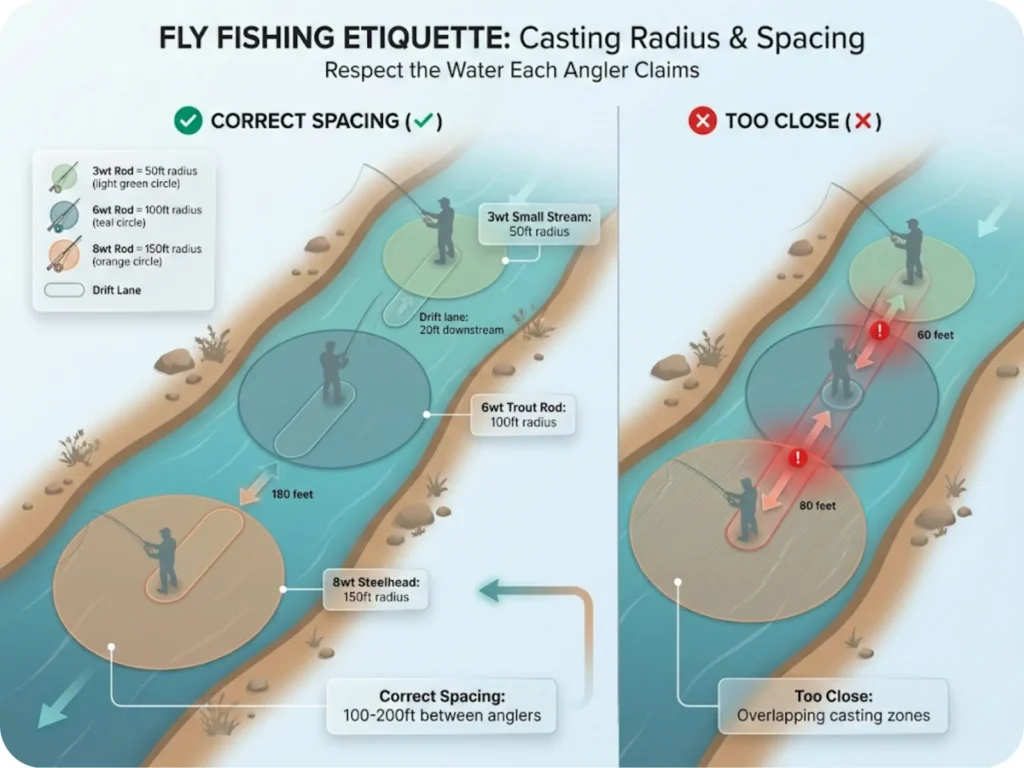
You don’t just own where you stand—you claim the water you can effectively fish. An intermediate fly caster averages 30-60 feet. An advanced caster reaches 60-80+ feet. Add the drift (20-40 feet beyond the landing point for nymphing or dry flies), and you’re claiming 80-120 feet of water. Entering within that radius physically interferes with another angler’s ability to fish.
Rod weight determines buffer zones. A 3-weight small-stream rod claims roughly 50 feet. A 6-weight general trout rod claims 80-100 feet. An 8-weight steelhead rod or 13’+ spey rod claims 120-200+ feet due to swing mechanics—cast across and down, step one pace downstream after each cast.
Technique matters. Swing fishing (steelhead/salmon) requires the most space because the angler is moving downstream. Nymphing requires moderate space (the drift lane). Bait fishing stationary in a hole requires the least lateral space but maximum temporal respect—don’t crowd the hole itself.
Expert commentary suggests a “two-hole rule” on freestone rivers—allow the current angler the pool they’re in, plus the next pool upstream, before stepping in. On tailwaters with defined runs, this translates to 10-50 yards depending on run length.
Before stepping in, observe the angler’s pace. A streamer fisherman moves fast (covering water). A nymph fisherman moves slow (dissecting water). If they’re mobile, they need more linear space. If they’re stationary, they need more time.
Communicate: The Protocol of First Contact
When approaching an occupied run, the incoming angler bears the burden of communication. Trout Unlimited’s guidance on avoiding high-holing and low-holing suggests specific phrases: “Are you working up or down?” / “How much space do you need?” / “Do you mind if I step in below/above you?”
Etiquette begins before the water. At boat ramps, rig in the staging area (parking lot), not on the ramp itself. Turn off headlights while backing down for early morning launches to prevent night-vision loss for fellow boaters.
Visual acknowledgment matters. A simple wave or nod establishes presence and humanity, making subsequent encroachment less likely to be perceived as hostile. Non-verbal communication is observational—read the river and the people on it.
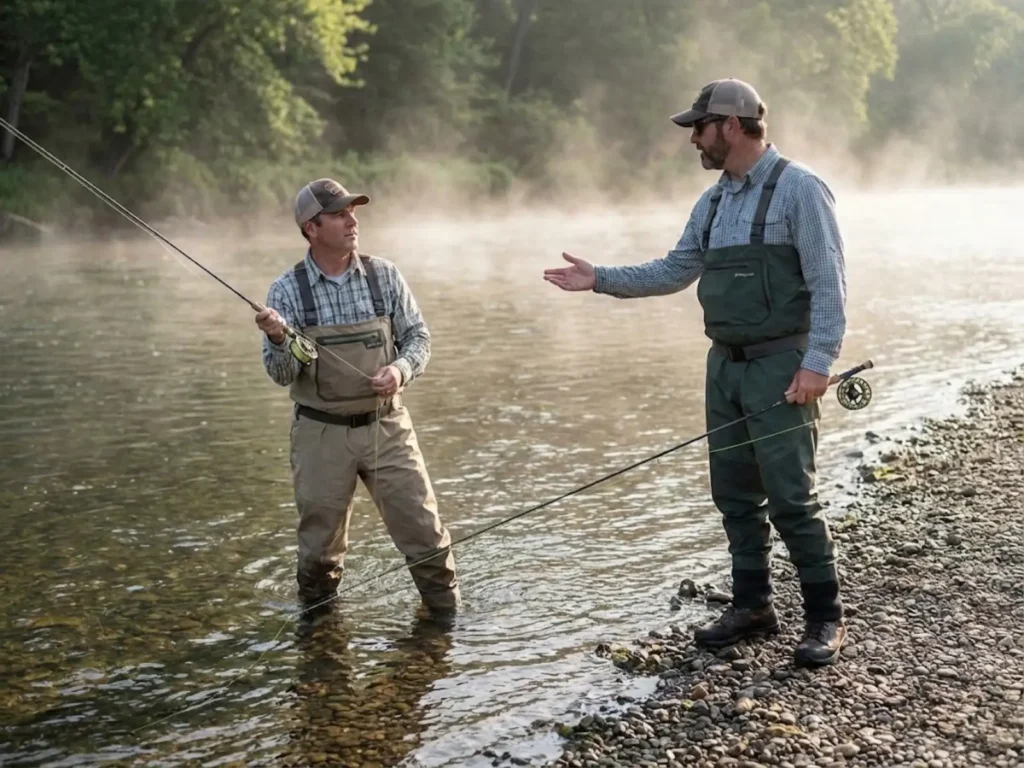
Veteran anglers note that many transgressions stem from lack of knowledge rather than ill intent. The recommended response to a breach of etiquette is polite education rather than aggression. “Hey, I’m swinging downstream—if you stand there, I’ll be casting over your head in five minutes. Want to jump in above me instead?”
If you arrive at a run and can’t tell if an angler is moving upstream or downstream, wait and watch for 2-3 casts before approaching. Their movement pattern will reveal their technique and intended path.
Circulate: Rotation Culture and Temporal Etiquette
In “rotation cultures” (common in Pacific Northwest steelhead/salmon waters), anglers move through runs sequentially. In “stationary cultures” (Southern Appalachian trout streams), anglers may fish a single pool for extended periods. Know the local custom.
The informal 30-minute rule: if you’ve been in the same 20-yard section for 30+ minutes without moving, you’re camping. This is frowned upon in high-pressure waters where other anglers are waiting.
A stationary angler (camping a hole) yields to no one but prevents others from fishing that specific spot. A mobile angler (working upstream or downstream) has the right to continue their progression—don’t step in their path.
Wade anglers always have right-of-way over vessels. Boats should pass behind the wade angler (between angler and bank) if depth allows, preserving the “fishing water” in front. If passing behind is impossible, move to the furthest opposite bank to minimize wake and visual intrusion. Rowers must lift oars or dip them silently.
If you’re in a run and another angler approaches, proactively communicate your plan: “I’m working upstream to that riffle, then I’ll be out of your way.” This signals you’re not camping and gives them a timeline. Efficient fighting a fish efficiently to minimize handling time is part of good circulation etiquette—land fish quickly to keep rotation moving.
The Cardinal Sins: Low-Holing and High-Holing
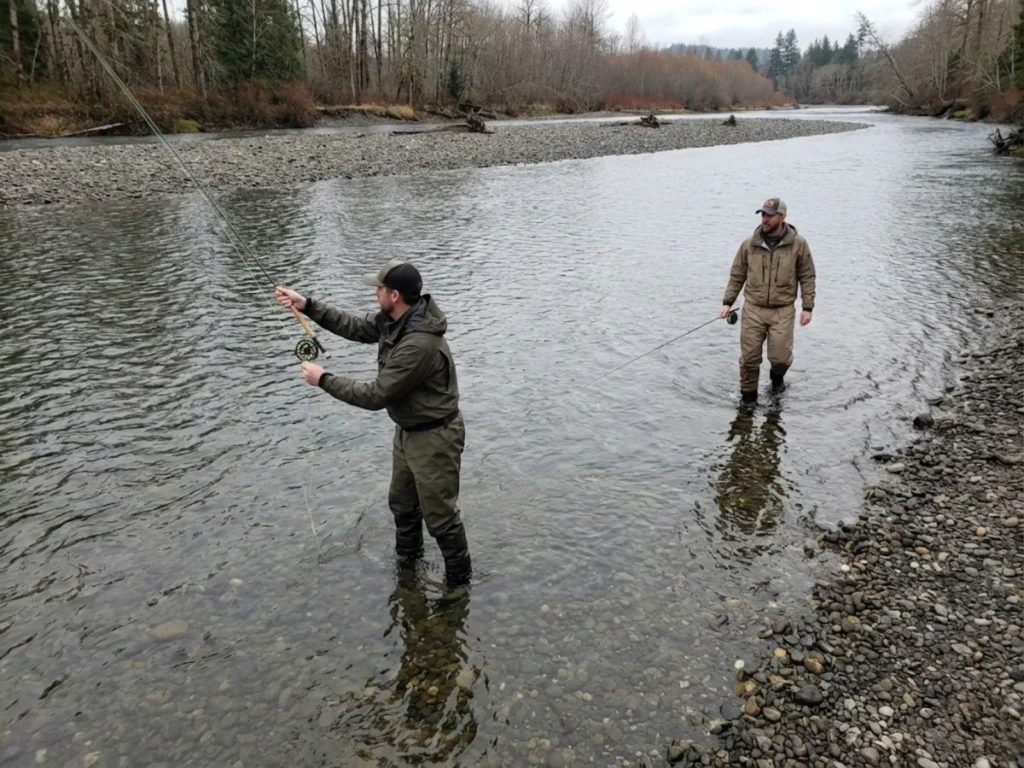
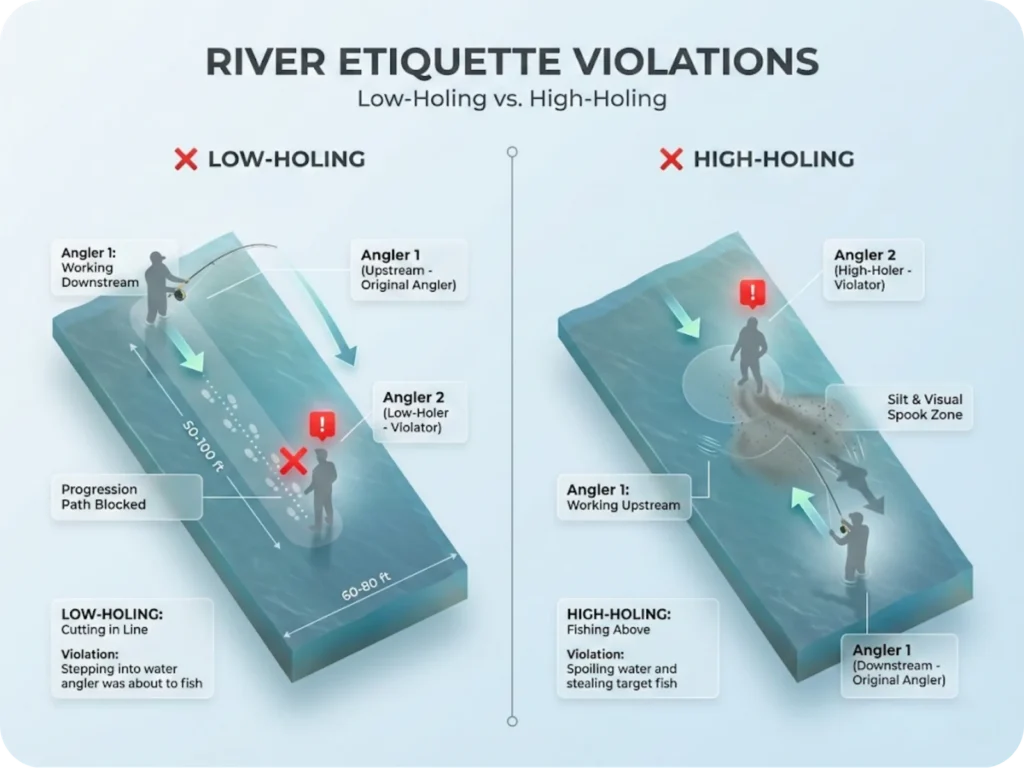
Low-holing is stepping into the water directly downstream of an angler who is working their way downstream, cutting them off from water they were about to fish. In swing fishing (spey/steelhead), where anglers cast across and down while moving downstream, a low-holer effectively blocks their progression and fishes water they were moments away from covering.
The angler isn’t just fishing where you’re standing—they’re fishing the drift lane that extends 30-50 feet downstream of their position. When you step into that lane, you’re not just close—you’re in their water.
Low-holing is viewed as “cutting in line” and is often described as the single most disrespectful act in river fishing. It breaks trust and ruins the planned water coverage that the upstream angler has been executing.
High-holing is entering the water directly upstream of an angler working upstream. This does two things: Spooking—you send silt, debris, and visual warnings (silhouettes) drifting down into the target fish’s vision. Resource Theft—you target the specific fish the downstream angler was stalking.
The required distance varies by water type but generally requires remaining out of sight or at least two full pools/runs away. On small streams, this might be 100+ yards. On large rivers, it could be 200+ yards.
In some regions where “camping” on a hole is more accepted (stationary bait fishing for catfish, carp, or stocked trout), the definition of low-holing is less rigid. However, in mobile fly fishing and steelhead cultures, it’s universally condemned.
I once watched a low-holer step into a run 20 yards below a spey caster. The spey angler didn’t yell—he just reeled up and walked off. That low-holer didn’t just take that angler’s water; he took his entire morning. That’s the cost of ignorance. Understanding steelhead float fishing techniques and water coverage strategies helps you recognize when you’re about to commit this violation.
Pro tip: If you’re unsure whether you’re low-holing, ask yourself: “Is this angler moving toward where I want to stand?” If yes, you’re about to low-hole. Move upstream instead.
The Hierarchy of Right-of-Way
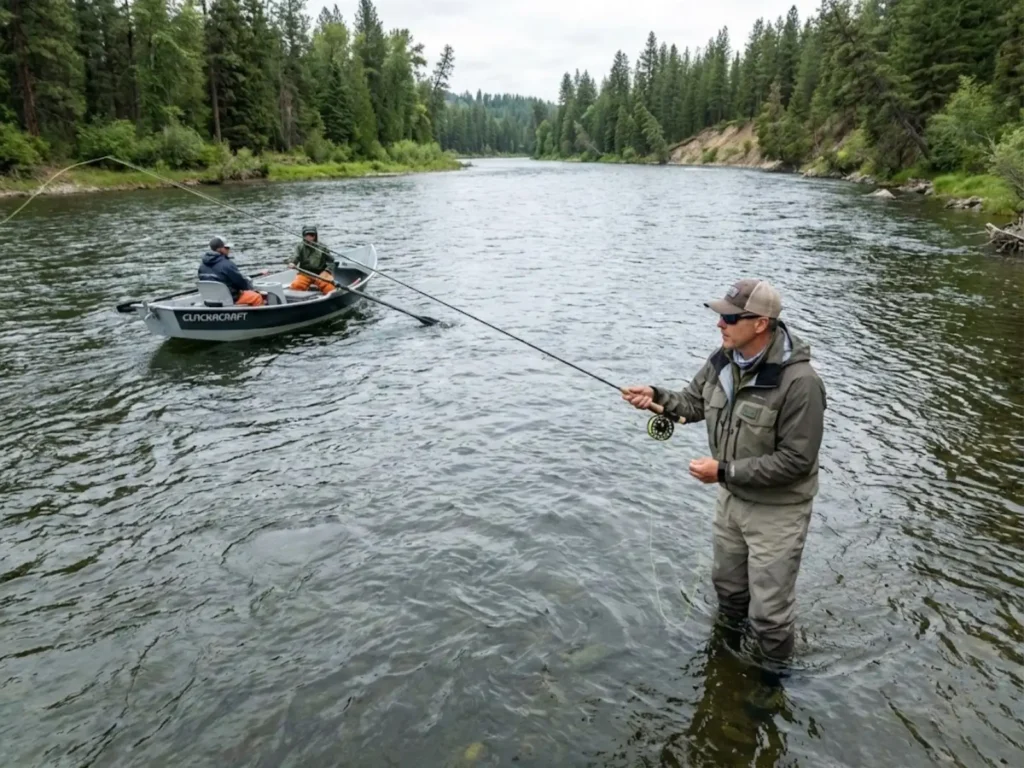
The wade angler always has the right of way over a vessel. Wading anglers are physically restricted to the riverbed and bank—they cannot easily relocate. Boats have the mechanical advantage of mobility and can access water waders cannot.
The first-arriver principle is the baseline rule. The angler who arrives at a run first has the right to fish it. If someone is already fishing a pool when you arrive, they have priority. You must either wait, ask to share the water, or move to different water.
The upstream-moving angler typically holds right-of-way over the downstream angler. However, this rule is contested in “swing water” (steelhead/salmon), where downstream progression is the standard. In mixed-use rivers, communication is the only resolution mechanism.
A stationary angler (camping a hole) yields to no one but prevents others from fishing that specific spot. This is often frowned upon in “rotation” cultures but accepted in some bait-fishing traditions.
Boat passing protocols are specific. Boat vs. Wade Angler: Boat passes behind wader or on opposite bank. Oars lifted/quiet. No wake. Boat vs. Anchored Boat: Moving boat gives wide berth to anchored boat. Drift boat vs. Power Boat: Power boats must yield to unpowered craft (drift boats/rafts).
I’ve been in a drift boat where the rower passed so close to a wade angler that our wake soaked his waders. The look on that angler’s face—pure disgust—was a lesson I never forgot. Wade anglers have nowhere to go. Boats do. Act accordingly. Kayak anchoring systems and safe positioning protocols help kayak anglers anchor responsibly in shared water.
Wade Anglers vs. Watercraft
Mobility asymmetry creates the rule: boats yield. Wading anglers are locked to the riverbed. Boats can move anywhere.
If depth allows, boats should pass behind the wade angler (between the angler and the bank). This preserves the “fishing water” in front of the angler—the drift lanes, current seams, and structure they’re targeting.
Rowers must lift oars clear of the water or dip them silently when passing to avoid acoustic disturbance. Splashing oars spook fish and disrupt the angler’s focus.
If passing behind is impossible (too shallow, obstructed), the boat should move to the furthest opposite bank to minimize wake and visual intrusion. A 3-foot wake in a wade angler’s face is a failure of etiquette.
If you’re in a boat and you see a wade angler, slow down before you’re close. Sudden course corrections at the last second create larger wakes and signal incompetence.
Upstream vs. Downstream Priority
The upstream-moving angler typically holds right-of-way over the downstream-moving angler. The logic: upstream anglers are targeting fish facing the current, and downstream movement sends silt and disturbance into their target zone.
In steelhead/salmon “swing water,” downstream progression is the standard technique. In these contexts, the downstream-moving angler may have priority because that’s the established local method.
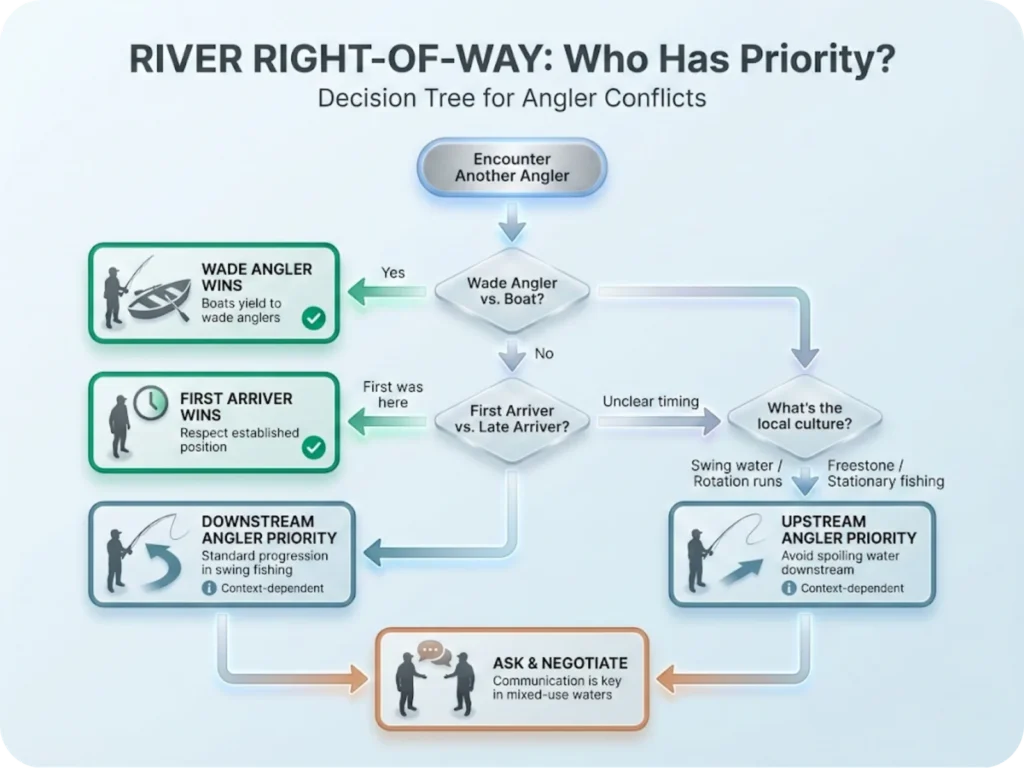
In mixed-use rivers (fly anglers, gear anglers, bait fishermen all present), there is no universal rule. The only resolution is to ask: “Are you working up or down?” and negotiate.
If you’re moving upstream and encounter a downstream angler, the polite move is to step out of the water, walk around them on the bank, and re-enter upstream of their position. This avoids crossing their drift lane and shows respect.
Crowding and Buffer Zones: How Close is Too Close?
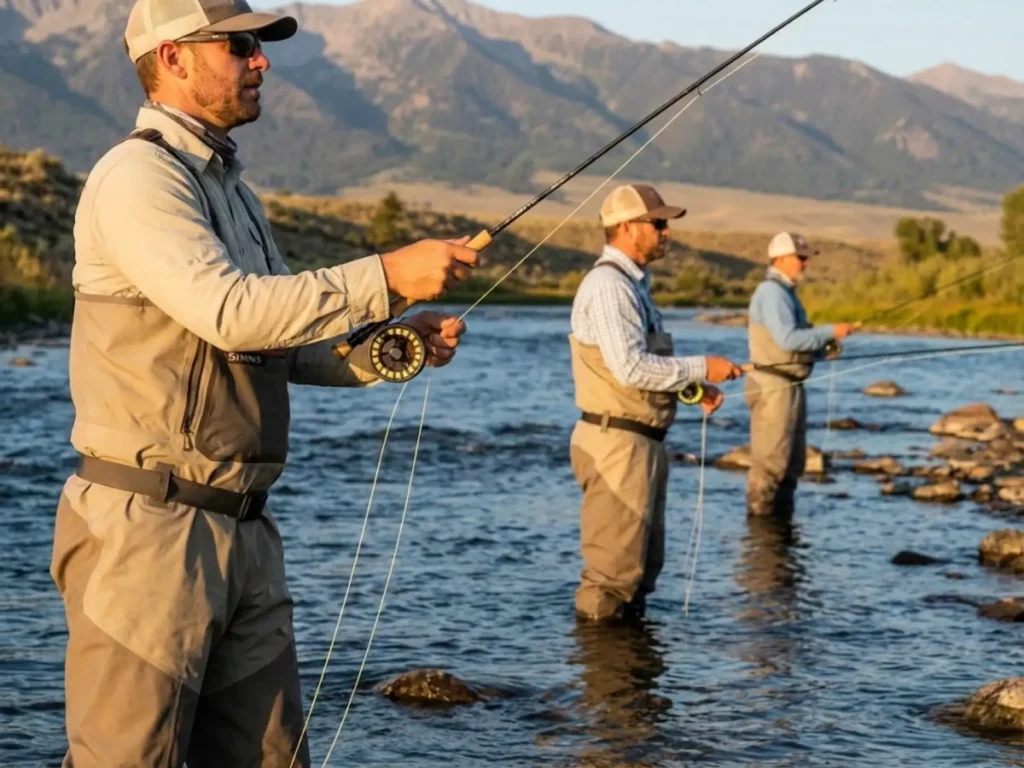
You don’t just own where you stand—you claim the water you can effectively fish. Intermediate cast: 30-60 feet. Advanced cast: 60-80+ feet. The drift (nymphing/dry flies) extends 20-40 feet beyond the landing point. Conclusion: Entering within 100 feet of a fly angler is physically interfering.
Rod weight buffer zones are measurable. A 2-3 weight (small trout/panfish) requires a 50-foot total buffer (20-30 ft cast + 10-15 ft drift). A 4-6 weight (general trout) requires 80-100 feet (30-50 ft cast + 20-30 ft drift). A 7-8 weight (steelhead/bass) requires 120-150 feet (50-70 ft cast + 30-50 ft swing). A spey rod (13’+, salmon/steelhead) requires 150-200+ feet (70-100+ ft cast + 40-60 ft swing).
The “two-hole rule” for freestone rivers: allow the current angler the pool they’re in, plus the next one upstream, before stepping in. This gives them room to progress without feeling crowded.
On tailwaters with defined runs (10-50 yard sections), the “geography of that spot” determines spacing. A 50-yard run can accommodate 2-3 anglers if they communicate and stagger their positions. A 10-yard pocket can only hold one.
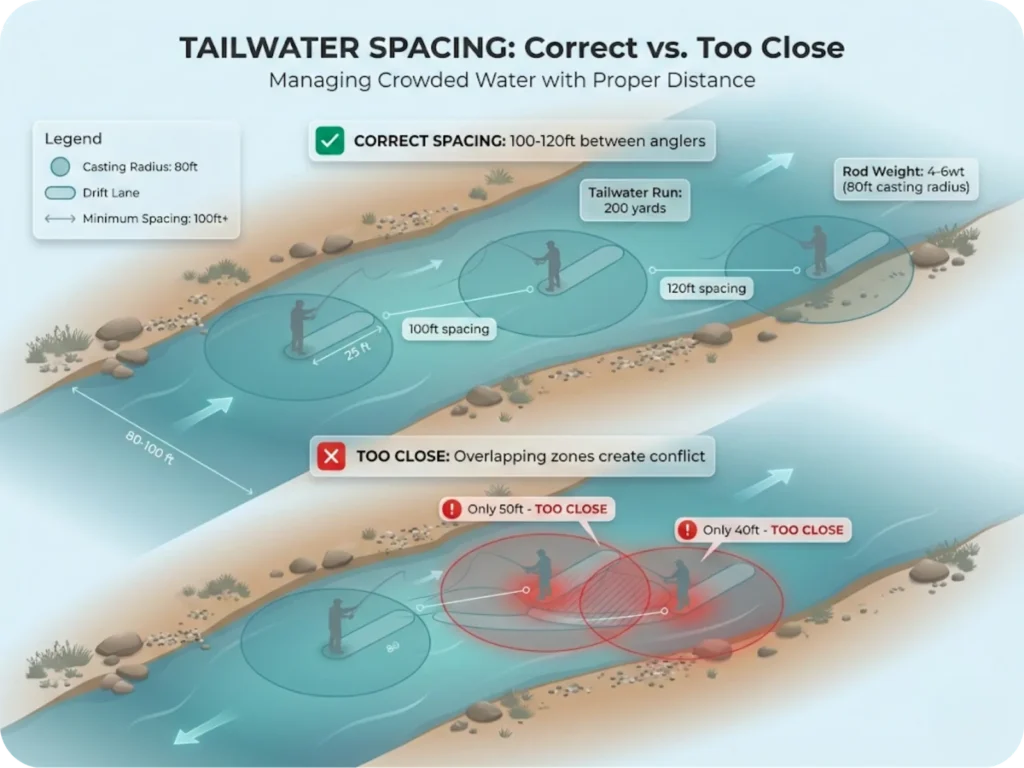
In specific high-pressure areas (Salmon River NY, Kenai AK during peak runs), traditional spacing collapses to “shoulder-to-shoulder” fishing. This is a context-specific exception, not the standard. Know where you are.
I’ve fished tailwaters where six anglers rotated through a 200-yard run in perfect harmony. I’ve also seen two anglers in a 100-yard pool create a shouting match because neither would communicate. The difference wasn’t the space—it was the willingness to talk. Better improving casting accuracy to maximize your effective fishing radius allows anglers to fish effectively within their claimed space without encroaching on others.
Pro tip: In crowded fishing spots, arrive early or be prepared to wait. The best runs fill up fast, and trying to squeeze into an already-packed stream creates friction for everyone.
Special Considerations: Tribal Fishers, Gender Dynamics, and Digital Ethics
The Boldt Decision (U.S. v. Washington, 1974) affirmed that treaty tribes reserved the right to 50% of the harvestable fish and the right to fish in “Usual and Accustomed” (U&A) grounds. Treaty fishing is a right; sport fishing is a privilege. Recreational anglers must yield space to tribal fishers (netting or hook-and-line) and never interfere with commercial gear.
For tribal members, fishing is often subsistence and cultural heritage, not merely recreation. Acknowledging this difference is foundational to ethical angling in treaty waters. The Puget Sound Institute’s analysis of the Boldt Decision and tribal fishing rights provides historical context.
Female anglers and guides frequently report unsolicited advice (“mansplaining”) and condescension from male anglers. Spatial intimidation is also documented—female anglers are more likely to be low-holed or encroached upon, with aggressors assuming they will not confront the behavior.
The etiquette rule: Treat female anglers with the exact same professional distance and respect accorded to men. Do not assume they need help. Do not assume they are novices. If they want advice, they will ask.
Spot burning is posting photos with recognizable landmarks or specific geotags that direct excessive pressure to sensitive ecosystems. A single viral post can turn a quiet creek into a parking lot circus in 48 hours. Use generic geotagging (e.g., tagging “Wyoming” instead of “Snake River at Mile Marker 12”).
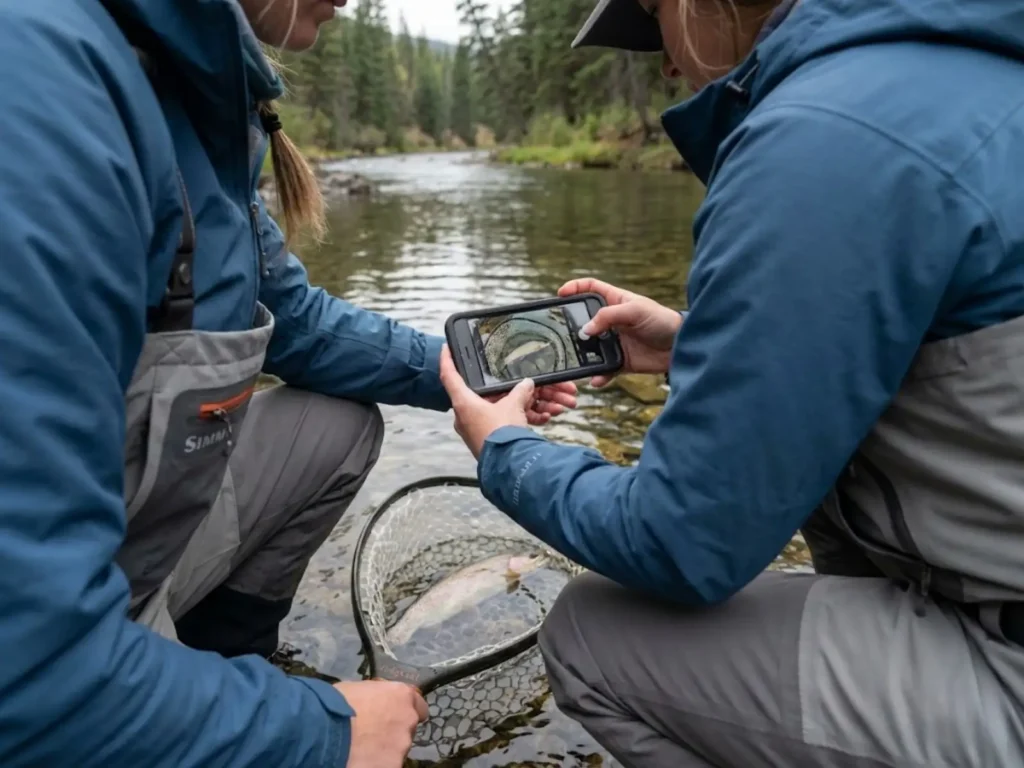
Social media incentivizes handling fish for the camera. Ethical etiquette demands that the welfare of the fish takes precedence over the “gram.” If a fish cannot be photographed safely (wet hands, quick release, minimal air exposure), it should not be photographed. Proper fish handling techniques for safe photography and release ensures the fish’s welfare is prioritized.
I’ve seen rivers destroyed by Instagram. A single viral post can turn a quiet creek into a parking lot circus in 48 hours. If you love a place, protect it—don’t broadcast it.
Pro tip: Before posting a fishing photo, ask yourself: “Will this post bring 100 more anglers to this spot?” If the answer is yes, reconsider. Protecting the resource is more important than likes.
Indigenous Treaty Rights and Sovereignty
The Boldt Decision (1974) affirmed that treaty tribes in the Pacific Northwest reserved the right to 50% of the harvestable fish. This isn’t a “special privilege”—it’s a treaty obligation upheld by federal courts.
If you encounter tribal fishers (netting, hook-and-line, or commercial gear), yield space. Do not interfere. Do not question their methods. Their right to fish predates your license by centuries.
Anglers fishing on tribal lands (Cherokee, Southern Ute, Colville) must adhere to specific tribal regulations, which may differ significantly from state rules (e.g., differing creel limits, gear restrictions, permit requirements).
If you’re fishing in the Pacific Northwest (Washington, Oregon, Idaho) or the Great Lakes region, familiarize yourself with local tribal fishing seasons and areas. Ignorance is not an excuse for interference.
Gender Dynamics and Spatial Intimidation
Female anglers and guides frequently report unsolicited advice and condescension from male anglers. This undermines their competence and creates an unwelcoming environment.
Reports indicate that female anglers are more likely to be low-holed or encroached upon, with aggressors assuming they will not confront the behavior. This is both unethical and cowardly.
Treat female anglers with the same professional distance and respect you would give to any experienced angler. Do not offer unsolicited advice. Do not assume they need help. If they want guidance, they will ask.
If you see another angler (male or female) being crowded or disrespected, speak up. Bystander intervention is part of good etiquette.
Digital Etiquette: Spot Burning and Social Media
Spot burning is posting photos with recognizable landmarks or specific geotags that direct excessive pressure to sensitive ecosystems. A single viral post can turn a quiet creek into a crowded circus in 48 hours.
Use generic geotagging (e.g., “Wyoming” instead of “Snake River at Mile Marker 12”). Campaigns like “Keep Jackson Hole Wild” advocate for this approach to protect fragile fisheries.
Social media incentivizes handling fish for the camera. Ethical etiquette demands that the welfare of the fish takes precedence. If a fish cannot be photographed safely (wet hands, quick release, minimal air exposure), it should not be photographed.
Before posting a fishing photo, ask yourself: “Will this post bring 100 more anglers to this spot?” If the answer is yes, reconsider. Protecting the resource is more important than likes. The science of fish slime coat protection and handling best practices explains the biological consequences of improper handling for photos.
Scenario Playbook: Applied Etiquette in Real Situations
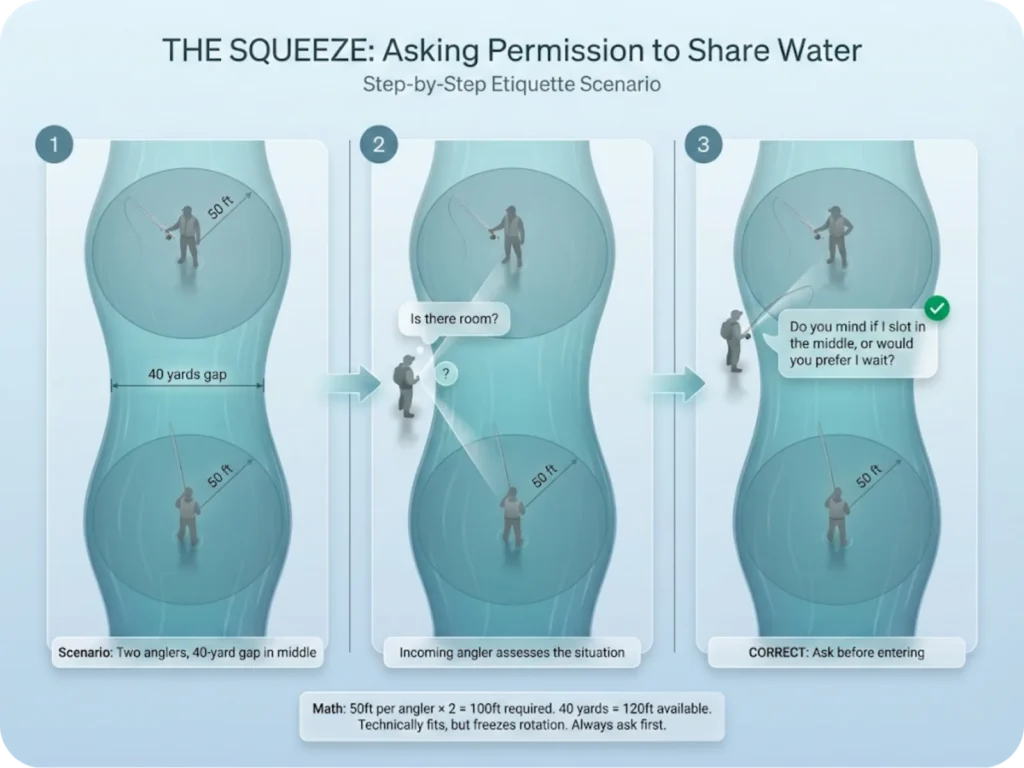
You arrive at a popular run. One angler is at the head, another at the tail. There’s a 40-yard gap in the middle. Is 40 yards enough?
Casting distance (30 ft) + Drift (20 ft) = 50 ft per angler. Two anglers = 100 ft required. 40 yards = 120 ft. Technically there’s space, but you’ll freeze the rotation. The top angler can’t move down; the bottom angler can’t move up.
Ask. “Do you mind if I slot in the middle, or would you prefer I wait?” If they’re rotating, do not enter. Sight fishing techniques for reading angler behavior and water conditions helps you observe before stepping into shared water.
You’re swinging a run. A novice angler walks in 20 yards below you and starts casting spinners upstream. Avoid yelling or aggressive posturing. Engage: “Hey there! I’m working my way down this run with a swing. If you stand there, I’m going to be casting right over your head in about 5 minutes. Want to jump in above me instead?” This educates on the mechanics (safety/casting) rather than just “rules.”
You’re wade fishing a run. A drift boat approaches. The rower doesn’t slow down or adjust course—he’s heading straight for your drift lane. Make yourself visible. Wave your rod. If they still don’t adjust, step toward the bank to avoid the wake. After they pass, if they were egregiously rude, consider a calm but firm comment: “Hey, wade anglers have right-of-way. Please pass behind next time.” Most boaters are ignorant, not malicious.
An angler has been in the same 15-yard pocket for 90 minutes. You’ve been waiting on the bank. Polite inquiry: “Hey, are you planning to move upstream, or are you settled in here for a while? Just trying to figure out if I should wait or head to different water.” This gives them a chance to either commit to leaving or acknowledge they’re camping (which may prompt them to yield).
I once had a drift boat rower pass so close that his oar clipped my fly line. I didn’t yell. I just said, “Wade anglers have right-of-way. Pass behind next time.” He apologized. Most conflicts are solved with calm, direct communication.
Pro tip: When approaching an occupied run, spend 30 seconds observing before you speak. Watch their casting rhythm, their movement pattern, and their body language. This tells you whether they’re mobile or stationary, and whether they’re likely to be receptive to sharing.
Conclusion
The 3C Code—Calculate, Communicate, Circulate—isn’t just a set of rules. It’s a framework for resource optimization. When anglers apply it, everyone catches more fish, enjoys the fishing experience more, and leaves the water with respect intact.
Calculate your spacing based on gear and technique. A fly rod claims 80-150 feet. A spey rod claims 200+. Know your radius and respect others’.
Communicate proactively. “Are you working up or down?” prevents 90% of conflicts. Silence breeds assumptions. Assumptions breed friction.
Circulate or yield. If you’re mobile, keep moving. If you’re stationary, acknowledge you’re camping and yield space when asked.
Next time you’re on the water and another angler approaches, don’t assume they know the rules. Model them. Ask the question. Give the space. Show the respect. The river doesn’t care about your ego—but the angler you just helped will remember you as the one who made their day better, not worse.
FAQ
What is low-holing in fishing, and why is it so disrespectful?
Low-holing is stepping into the water directly downstream of an angler who is working their way downstream, cutting them off from water they were about to fish. It’s considered the single most disrespectful act in river fishing because it cuts in line and ruins the upstream angler’s planned water coverage. In swing fishing (steelhead or salmon), where anglers cast across and down while moving downstream, a low-holer effectively blocks their progression and fishes water they were moments away from covering.
How much space should you give other anglers when fly fishing?
It depends on rod weight and technique. A 4-6 weight trout rod requires 80-100 feet of buffer (casting radius + drift). A 7-8 weight steelhead rod or spey rod requires 120-200+ feet due to swing mechanics. The general rule: if you can see the details of another angler’s face, you’re too close. Use the two-hole rule on freestone rivers—give them the pool they’re in, plus the next one upstream.
Do wade anglers always have right-of-way over boats?
Yes. Wade anglers are physically restricted to the riverbed and bank—they cannot easily relocate. Boats have the mechanical advantage of mobility and can access water waders cannot. Boats should pass behind the wade angler (between angler and bank) if depth allows, or move to the furthest opposite bank to minimize wake and visual intrusion. Rowers must lift oars or dip them silently to avoid acoustic disturbance.
What should you say when approaching an angler already fishing a run?
The incoming angler bears the burden of communication. Use specific phrases: Are you working up or down? or How much space do you need? or Do you mind if I step in below or above you? This removes ambiguity about your intentions and gives the current angler a chance to communicate their plan. Most conflicts arise from assumptions, not malice—asking prevents 90% of disputes.
Is it okay to fish the same spot for hours, or is that camping?
It depends on local culture and water pressure. In rotation cultures (Pacific Northwest steelhead or salmon waters), anglers are expected to move through runs sequentially. Staying in the same 20-yard section for 30+ minutes without moving is considered camping and is frowned upon. In stationary cultures (some Southern Appalachian trout streams, bait fishing for catfish), longer stays are more accepted. The ethical standard: if other anglers are waiting and you’re not actively catching fish, it’s time to move or yield space.
Risk Disclaimer: Fishing, boating, and all related outdoor activities involve inherent risks that
can lead to injury. The information provided on Master Fishing Mag is for educational and informational purposes
only. While we strive for accuracy, the information, techniques, and advice on gear and safety are not a substitute
for your own best judgment, local knowledge, and adherence to official regulations. Fishing regulations, including
seasons, size limits, and species restrictions, change frequently and vary by location. Always consult the latest
official regulations from your local fish and wildlife agency before heading out. Proper handling of hooks, knives,
and other sharp equipment is essential for safety. Furthermore, be aware of local fish consumption advisories. By
using this website, you agree that you are solely responsible for your own safety and for complying with all
applicable laws. Any reliance you place on our content is strictly at your own risk. Master Fishing Mag and its
authors will not be held liable for any injury, damage, or loss sustained in connection with the use of the
information herein.
Affiliate Disclosure: We are a participant in the Amazon Services LLC Associates Program, an
affiliate advertising program designed to provide a means for us to earn advertising fees by advertising and linking
to Amazon.com. As an Amazon Associate, we earn from qualifying purchases. We also participate in other affiliate
programs and may receive a commission on products purchased through our links, at no extra cost to you. Additional
terms are found in the terms of service.