
In this article
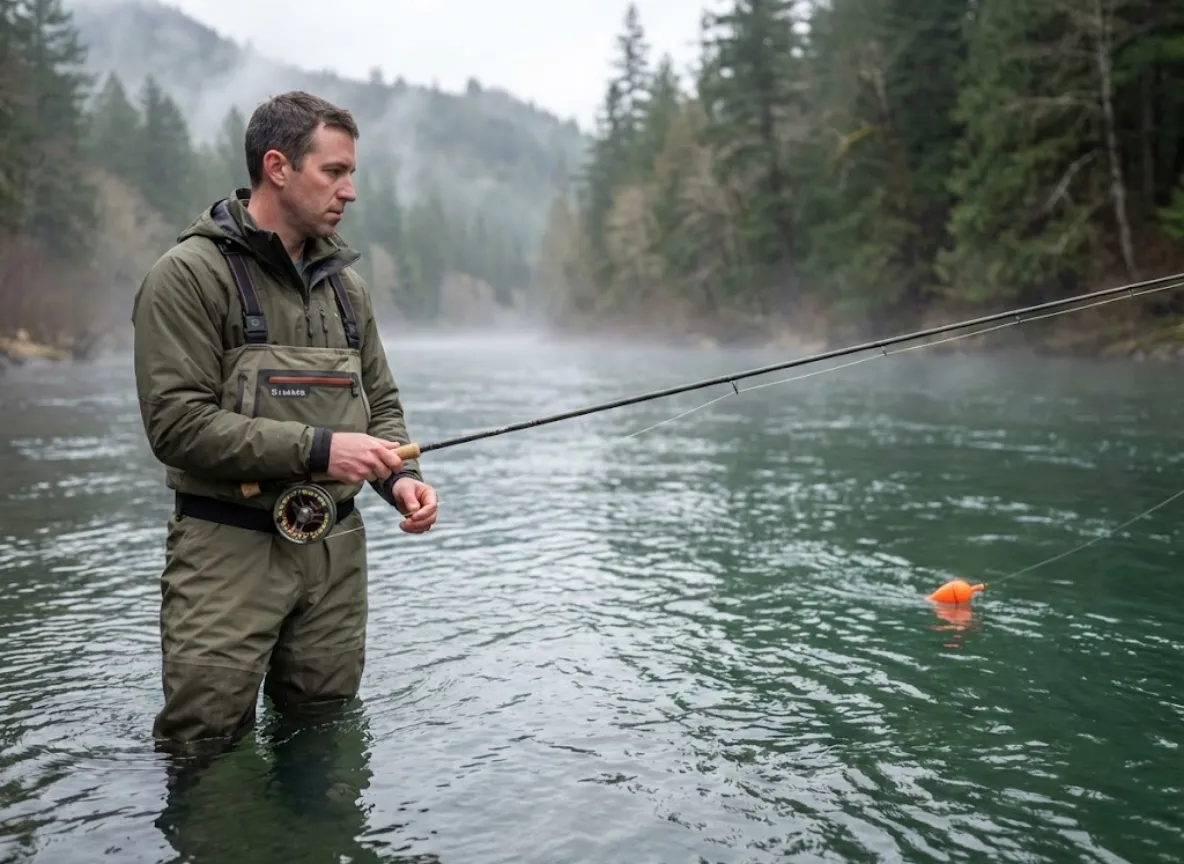
The float hesitates. Not a plunge—just a subtle pause, a quarter-inch dip in water running 37°F. You’ve been watching it drift for six hours in drizzle that feels like ice needles, and your brain almost dismisses it. Almost. But something in your wrist fires before conscious thought catches up, and the rod loads with the unmistakable weight of chrome. This is the moment float fishing is engineered to create.
After two decades chasing steelhead through Pacific Northwest rivers and Idaho’s wilderness waters, I’ve come to understand that this technique isn’t about luck—it’s about understanding the water. The relationship between current speed, water temperature, and shot pattern distribution isn’t folklore. It’s measurable, adjustable, and the difference between six-hour skunks and consistent hookups.
This guide breaks down float fishing for steelhead through that lens. You’ll learn why walking speed water holds more fish than faster runs, how to diagnose problems by reading your float’s angle, and why the Up is Down rule separates frustrated steelhead anglers from those who consistently land fish.
⚡ Quick Answer: Float fishing suspends your bait in a controlled strike zone—typically 12-24 inches above bottom—using a balanced float rig with weighted split shot patterns. Success depends on matching your drift speed to bottom current (not surface current), calibrating float weight to your shot and jig weight, and targeting water in the 40-45°F range where steelhead actively feed. Master these three elements, and you’ll hook more fish per hour on any river.
The Physics of Productive Water

Why “Walking Speed” Water Holds Fish
The universal heuristic among guides is simple: find water moving at walking speed. But what does that actually mean? It correlates to 1.0-3.0 feet per second—slow enough that you could wade through it at a comfortable walking pace without bracing against the current.
This isn’t arbitrary. Steelhead obey an energy-conservation equation whether they know it or not. Holding in fast water costs calories. Holding in slow water conserves them. The sweet spot—that walking-pace velocity—allows fish to maintain position with minimal tail-beat frequency while maximizing their encounter rate with drifting food. Scientific research on salmonid drift-feeding behavior confirms this velocity range optimizes prey capture efficiency.
Here’s a field test: float a leaf or stick downstream for 30 feet and time it. A 10-15 second drift over that distance indicates prime holding water. Faster than that, and fish will move to the margins. Slower, and you’re likely in frog water—the nearly stagnant pools where lethargic fish wait out cold snaps.
Understanding current seams and boundary layers adds another layer to this equation. Fish position themselves on velocity differentials where they can rest in slower water while watching food drift by in the faster adjacent current.
Pro tip: Carry a digital stream thermometer and check temperature throughout the day. A 3-degree rise from morning to afternoon can shift fish from dormant to aggressive—and change where they hold.
Temperature Thresholds That Control Behavior
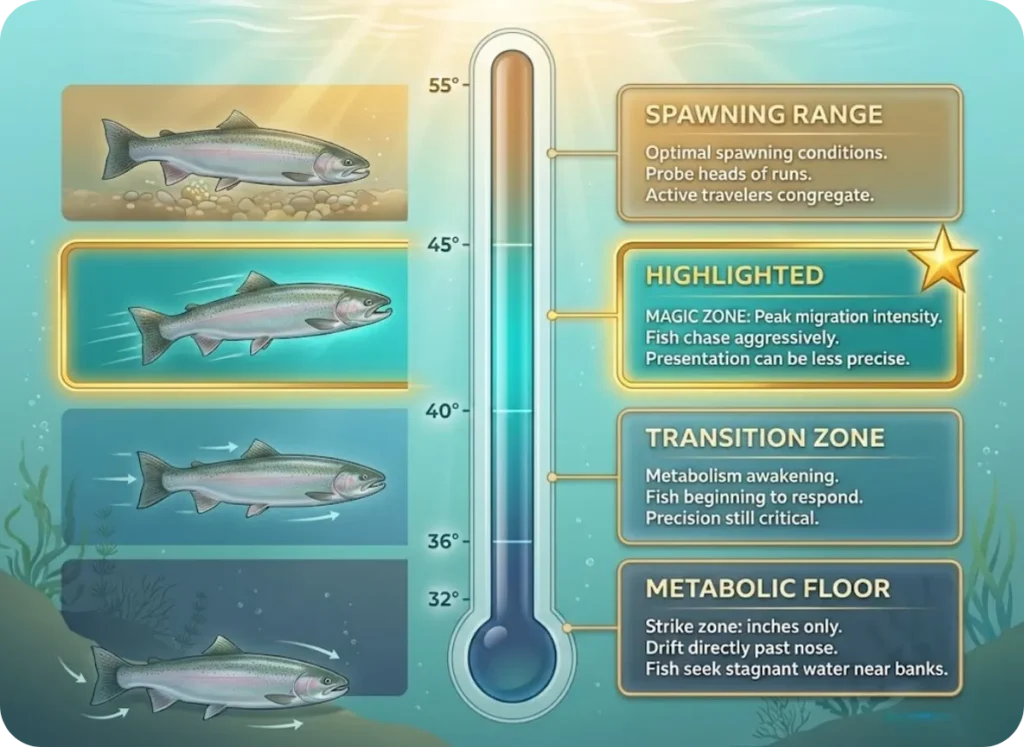
Water temperature acts as the master switch for steelhead metabolism. The Magic 40°F threshold isn’t just guide lore—it’s the demarcation between sluggish fish and aggressive ones.
Below 36°F, metabolism slows dramatically. Fish seek frog water: slow, nearly stagnant areas near banks or in tailout sloughs. Their strike zone shrinks to inches, meaning your bait must drift directly past their nose. Lateral movement to chase prey is energetically prohibitive in these conditions.
The 40-45°F range changes everything. This is the zone where water temperature dictates fish metabolism in ways that work in your favor. Migration intensity peaks. Fish become willing to move aggressively to intercept offerings. Your presentation can be less precise because fish will chase.
Above 42°F through 55°F represents optimal spawning conditions, as documented in the California Delta Stewardship Council’s steelhead research. Fish push onto gravel, and your float should probe the heads of runs where active travelers congregate.
Reading the Structure: Where Fish Hold Within a Run
A typical pool-riffle sequence contains three primary zones: the turbulent head (high oxygen, aggressive fish), the deep belly (moderate flow, resting fish), and the shallow tailout (staging area for upstream movement).
Temperature determines which zone produces. In water above 40°F, aggressive fish often sit in the choppy head where oxygen is highest. Many anglers walk past this productive water seeking the slower belly. That’s a mistake.
In cold water below 40°F, the pattern inverts. Fish drop into the slow belly and tailout, prioritizing energy conservation over oxygen. Work through a run systematically—head, seam, belly, tailout—to cover all behavioral phases.
Inside seams close to your bank often hold fish that anglers ignore while casting across to the far side. Steelhead aren’t always on the other bank. Sometimes they’re ten feet in front of you, and a short, controlled drift is all it takes.
Understanding pools, riffles, and runs as a connected system helps you predict where fish will position based on conditions rather than guessing.
Rigging the Float System
The Mainline-to-Swivel Connection
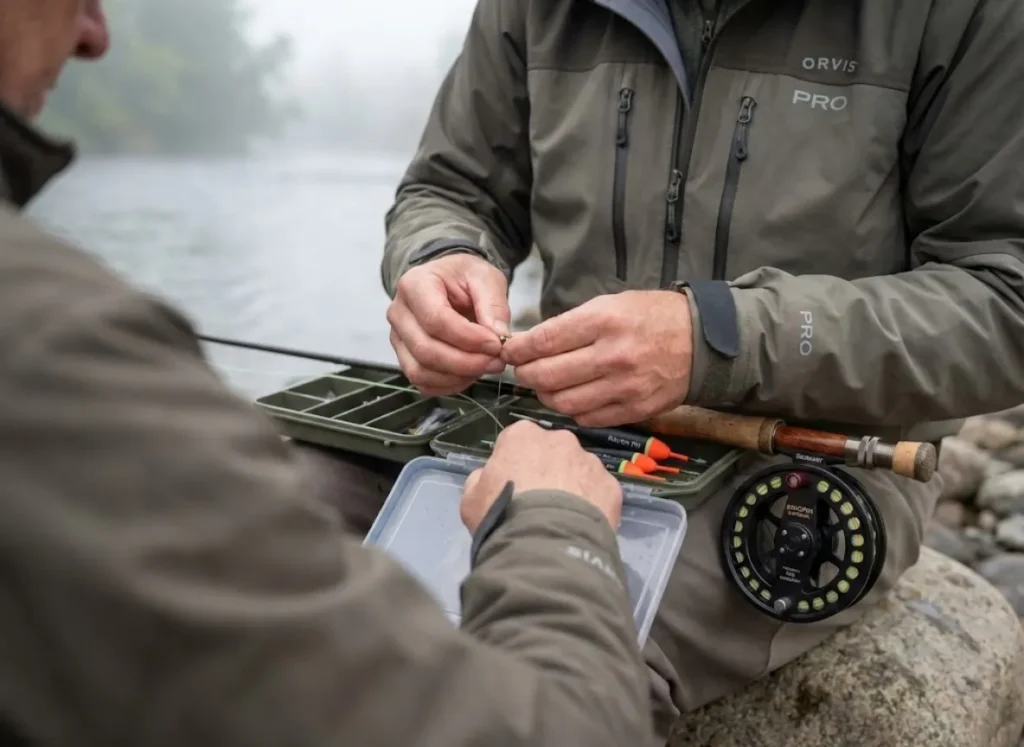
Centerpin rigs use 8-12 lb hydrophobic floating monofilament—critical for keeping mainline on the water’s surface where it can be managed. Spinning reel setups often employ 10-15 lb mainline with similar floating characteristics.
A bumper section—12-18 inches of mono or fluorocarbon—between your mainline and swivel serves as shock absorber and sacrificial link. Snag a rock, and you lose the bumper rather than re-rigging from scratch.
Thread your mainline through bobber stop, bead, then float before attaching the micro barrel swivel. This swivel prevents line twist from a rotating jig. For slip float setups (fishing depths exceeding rod length), the bobber stop knot slides through guides on the cast but catches at the float during the drift.
Fixed floats—attached top and bottom with silicone tubing—allow precise trotting control but limit fishable depth to roughly rod length.
Understanding tying braid-to-leader connections properly ensures your system holds together when chrome goes ballistic.
Float Selection and the Balancing Act
Float size matches water conditions: 6-11 grams for standard flows, 12-20+ grams for depths over 8 feet or heavy turbulence, 1-4 grams for stealth in low/clear water.
The buoyancy equation must balance perfectly. Total weight of split shot plus jig must equal the float’s rated displacement. When balanced correctly, only the float’s bright tip shows above water.
A float that isn’t shotted down properly offers resistance a taking fish will feel—and reject the bait before your float ever moves. Raven floats and Great Lakes Floats use silicone tubing attachment. The gram rating indicates how much weight is needed to cock the float into vertical position.
When the float cocks instantly upon hitting the water, your shotting is correct. If it hesitates or lies flat, adjust weight or check depth.
The Shot Pattern: Where Weight Distribution Becomes Science
The Up is Down Rule from Matt Straw at In-Fisherman sounds paradoxical but makes perfect sense: When water is up (high water), put weights DOWN near the hook to punch through turbulence. When water is down (low/clear), put weights UP near the float for a stealthy, natural leader drape.
Three primary shotting patterns cover most conditions. Shirt Button spacing increases between shots as you move down the line—versatile for all-purpose use. Bulk clustering places shots near the hook for fast sinking in deep holes. Geometric distributes shot evenly for moderate flows.
Advanced steelhead fishermen pre-tie multiple shot lines—leader sections with different weight distributions—and carry them as swap-ready fishing rigs. This saves valuable fishing time when conditions change.
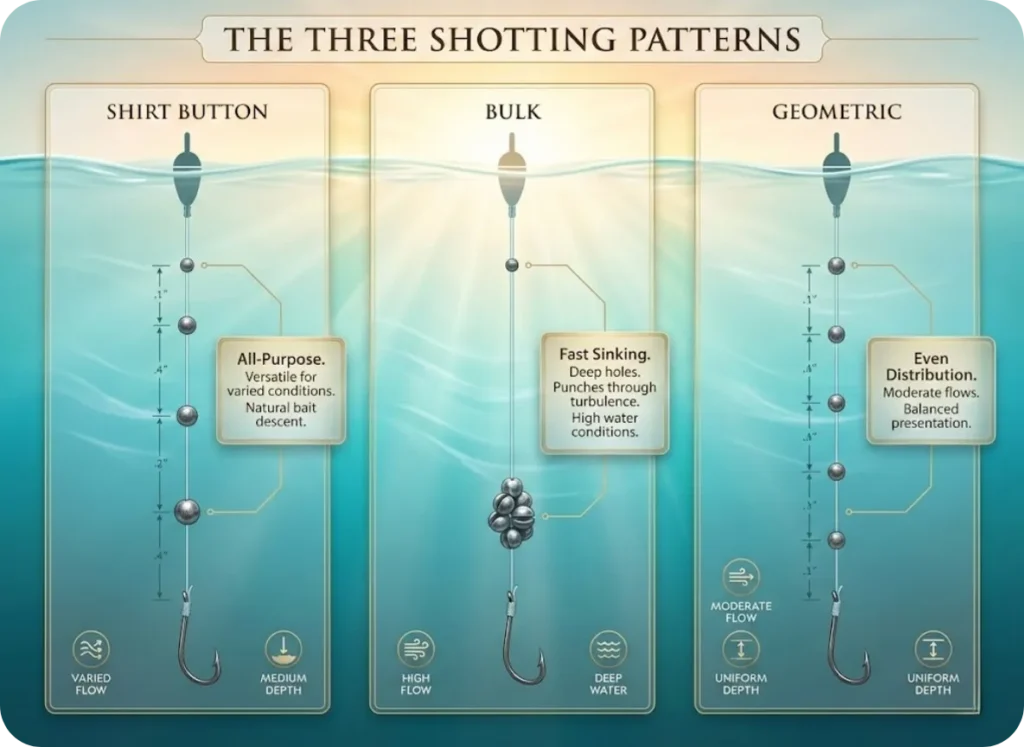
Understanding precision fishing weights and the difference between tungsten and lead helps dial in your presentation further.
Jigs, Beads, and Terminal Presentations
Jig weight standards: 1/8 oz is universal for walking-pace water. 1/4 oz handles deep plunging runs. 1/32-1/64 oz micro jigs work for low/clear conditions or pressured fish.
Marabou jigs breathe in the current, providing life-like movement even on a dead drift. This pulsing action triggers reaction strikes from lethargic fish when current alone won’t animate your offering.
Fluorocarbon leader (6-8 lb test, 18-24 inches) is standard for steelhead fishing. It’s nearly invisible underwater and sinks faster than nylon. Color follows visibility rules: bright (pink, cerise, chartreuse) in turbid water; natural (black, olive) in clear water. Glow beads provide an edge in truly off-color water with Hevi-Beads and TroutBeads being popular options.
Pro tip: In sub-freezing temperatures, fluorocarbon becomes brittle and commonly fails at the knot. Retie after every snag or fish. Run fingers along the leader every few drifts to detect microscopic abrasions before they cause break-offs.
Understanding fluorocarbon vs. monofilament differences helps you make informed leader material choices based on conditions.
The Mechanics of the Drift
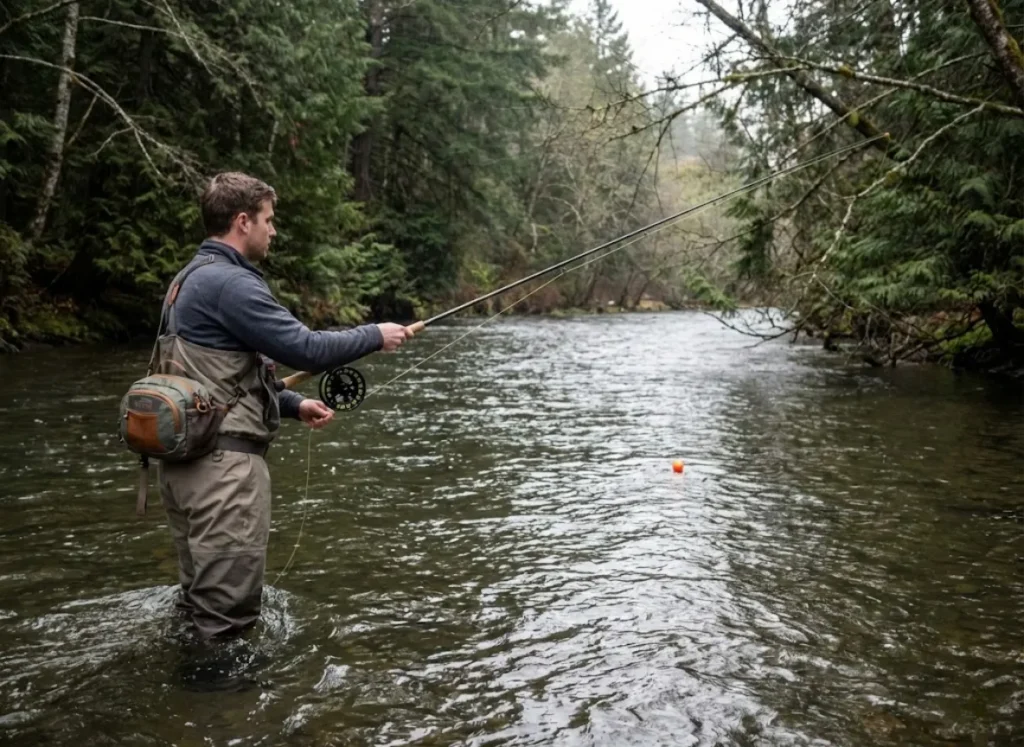
Casting and Initial Presentation
Cast upstream at a 15-45 degree angle relative to current flow. This positions the float to enter the target zone at proper depth with minimal splash disturbance.
The mending motion follows immediately: use the rod to flip mainline upstream, removing belly that would otherwise drag the float faster than bottom current allows. Allow weights and jig to sink fully before the float drifts over the target zone.
Avoid the hero cast to the far bank. Short, controlled drifts on the near seam often outproduce long casts with excessive line drag. Start with jig positioned 12-18 inches above bottom, then adjust based on float behavior.
Checking the Float: The Critical Technique
Checking means slowing line release so the float moves slower than surface current. This allows the bait to swing out ahead of the float, matching bottom current speed.
Here’s the key insight: surface water moves faster than bottom water due to friction against the riverbed. A float drifting at surface speed drags your bait unnaturally fast through the strike zone.
Visual confirmation is simple: leaves, twigs, and bubbles should be passing your float. If your float outruns surface debris, you’re not checking enough. The centerpin system advantage shows here—the free-spinning reel with no mechanical drag allows infinitely variable checking through light finger pressure.
Understanding reading current for fish-holding spots builds the foundation for knowing when and how much to check your drift.
Reading the Float: Diagnostic Signals
Your float tells you what’s happening underwater. Vertical orientation means proper drift with bait suspended in the strike zone. Float top tilting downstream means you’re dragging bottom—reduce depth adjustment or add shot to maintain suspension.
Wobbling or hesitation indicates passing over structure. This can signal productive water or an impending snag. An abrupt plunge is either a strike or a snag—set immediately.
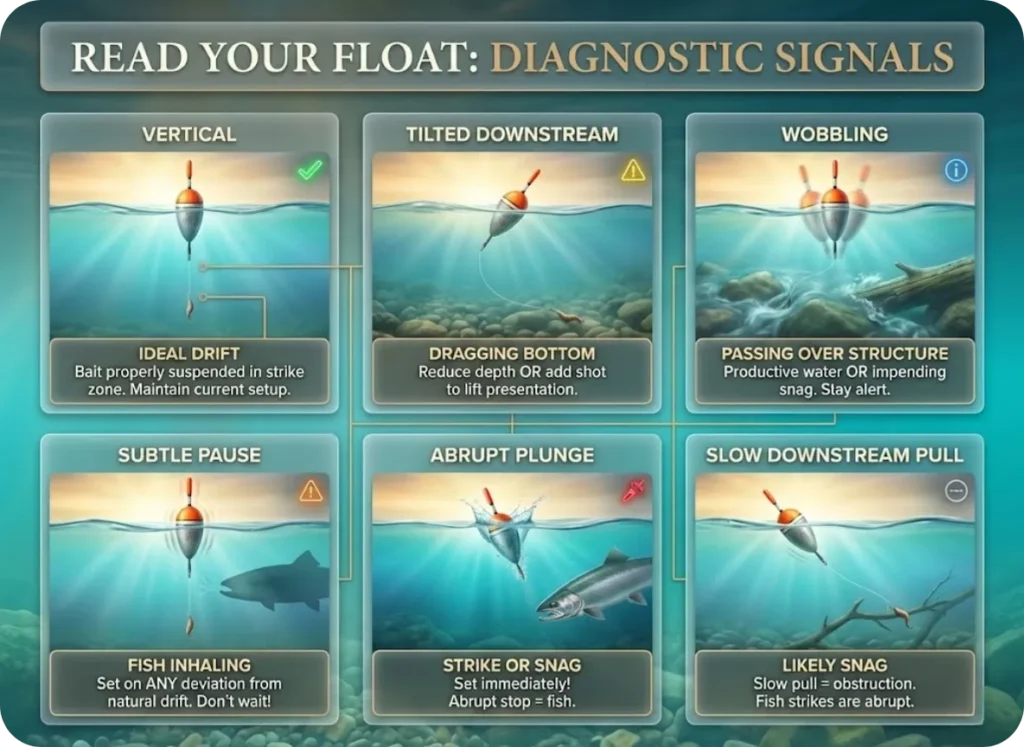
A subtle pause or shiver means a fish inhaling without committing—set on any deviation from natural drift. The snag-versus-bite distinction trips up beginners. A snag typically pulls the float downstream slowly. A fish strike is abrupt—a stop, a shiver, or a clean plunge.
Gear Systems: Centerpin vs. Spinning
The Centerpin Advantage
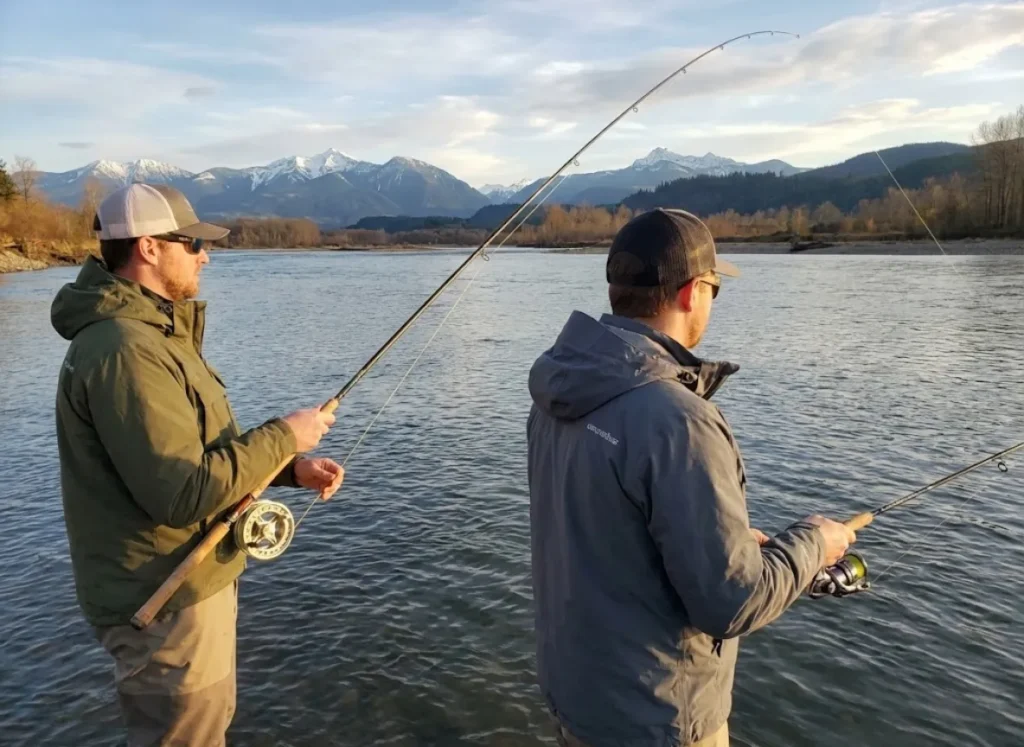
Centerpin reels operate at a 1:1 gear ratio with no mechanical drag. The spool spins freely on a center pin, allowing current to dictate line release. This creates a naturally drag-free drift impossible to replicate with fixed-spool spinning reels. USGS research on fish behavior demonstrates how salmonids respond to natural drift presentations in river environments.
Rod length of 11’6″ to 15′ (13′ is standard) serves two functions: keeping mainline off the water’s surface and providing soft, progressive shock absorption for light leaders. A 13-foot rod provides approximately 30-40% more line pickup per sweep than a 9-foot spinning rod, enabling faster hooksets at distance.
Disadvantages exist: steep learning curve for casting, not tolerant of brush or tight quarters, and higher cost. Brands to know include Islander, Kingpin, Okuma Raw II, and the Hartman Centerpin Reel.
When Spinning Gear Makes Sense
Spinning setups offer versatility. The same rod and reel works for float fishing, drift fishing, twitching jigs, or throwing spinners. Rod length of 9’0″ to 10’6″ balances line control with maneuverability in overgrown tributaries.
Mechanical drag systems provide insurance against sudden runs—helpful while learning to palm a centerpin. Modern reels in the 2500-3000 size class from brands like Shimano, Abu Garcia, and others provide sufficient line capacity and smooth drag for any steelhead. Pair them with quality rods from Fenwick or St. Croix for a reliable spinning combo.
Guide Todd Girtz advises mastering one technique thoroughly before adding others to your arsenal. Spinning is more forgiving for developing fundamental drift control.
Understanding rod action vs. power helps you select the right blank for your preferred system.
Common Mistakes and How to Fix Them
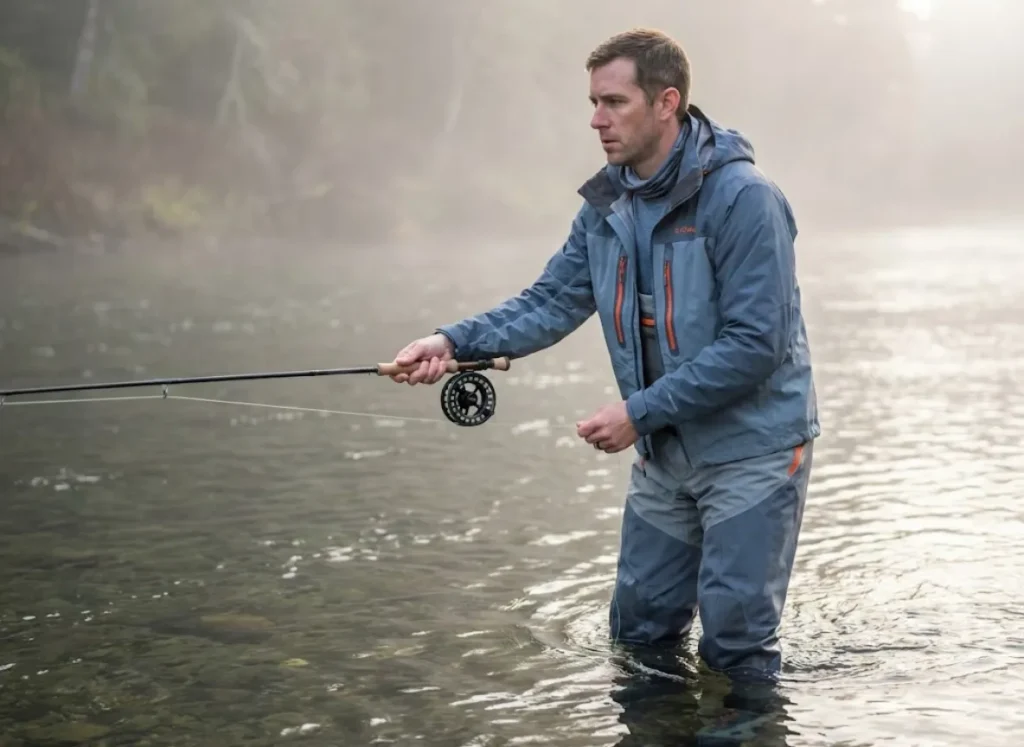
Fishing Too Heavy or Too Light
Over-weighting causes the jig to act as an anchor, pulling the float under or causing constant false strikes as the rig drags bottom. Under-weighting leaves the jig too high in the water column where fish won’t chase.
Diagnostic: if the float dips and tilts downstream, you’re dragging bottom. Reduce depth or add shot to achieve suspension. If strikes aren’t materializing despite good drift lanes, try adding weight for slightly faster drop.
Always match jig weight to float capacity. A 1/8 oz jig on a 3-gram float will sink the entire rig. The float size rating must exceed combined weight of shot plus jig.
The “Hero Cast” Fallacy
Long casts to the far bank feel productive but often aren’t. More line on water equals uncontrollable belly that accelerates the float past productive water.
Steelhead frequently hold in the inside seam close to your bank, especially in high water. Short, controlled drifts with tight line management consistently outproduce distance casting with compromised drift quality.
Think line control first, distance second. A 30-foot drift with perfect float control beats a 60-foot drift with belly drag every time.
Ignoring the Transition Water
Many fishermen walk past the turbulent head of a pool to fish the slower belly. But aggressive fish in water above 40°F often sit in the choppy head where oxygen is highest.
Similarly, tailouts—the shallow exit ramps of pools—are staging areas for fish preparing to move upstream. Don’t overlook them. Work through runs systematically to cover all behavioral phases rather than fixating on one perfect spot.
Advanced Tactics for Difficult Conditions
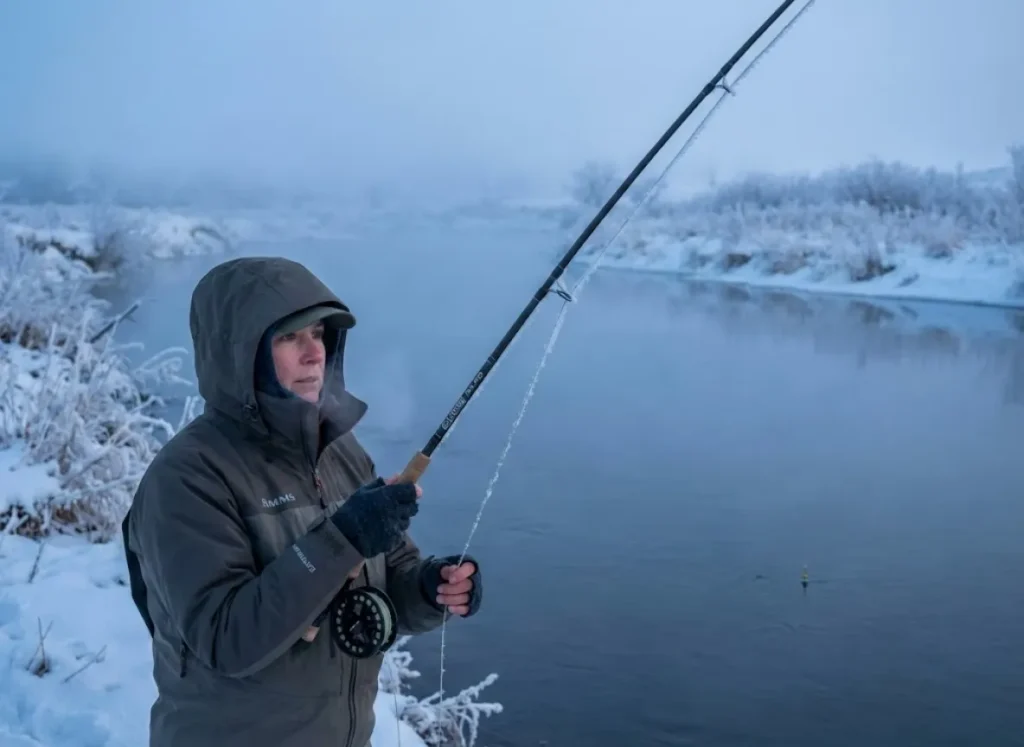
Cold Water Strategies (Below 40°F)
Below the Magic 40 threshold, fish hold in frog water: slow banks, tailout sloughs, inside eddies. Vertical presentations become mandatory as the strike zone shrinks.
Downsize everything: micro jigs (1/32-1/64 oz), smaller floats (1-4 grams), lighter leaders (4-6 lb). Slow the drift. Longer pauses. Minimal jig action. Patience between casts.
Fluorocarbon becomes especially important for invisibility in clear water. But remember the cold-brittleness warning—retie frequently in freezing conditions.
High and Turbid Water Adjustments
High water pushes fish to the margins. Focus on inside seams, backwater eddies, and slower pockets behind boulders. The Up is Down Rule applies: bulk shot DOWN near the hook punches through turbulence in cloudy rivers.
Increase float size (12-16+ grams) for visibility and line control. Bright colors become mandatory—fish hunt by lateral line and silhouette in low visibility. Upsize jigs (1/4 oz) to reach the strike zone fast in accelerated flows.
Understanding how water level changes affect fish behavior helps you adapt positioning as conditions shift.
Pro tip: In truly off-color cloudy water, phosphorescent beads and jig heads provide a visible target when natural light can’t penetrate. Charge them with a flashlight between drifts.
Conclusion
Float fishing translates the complexity of steelhead rivers into actionable decisions. Current velocity becomes a speed calculation—1.0 to 3.0 feet per second for optimal holding water. Temperature becomes a behavioral switch—the Magic 40°F threshold separating active fish from dormant ones. Shot pattern distribution becomes weight placement—the Up is Down Rule translating conditions into rigging decisions.
The technique rewards anglers who think in terms of precision rather than luck. When you understand why a float tilts downstream, why fish hold in the oxygen-rich head of a run, and why fluorocarbon leader outperforms mono, you stop guessing and start solving.
Test these principles on your next outing. Time your drift speed. Carry a stream thermometer. Pre-tie shot lines with different weight distributions. The steelhead don’t care about luck—they respond to the water around them. So should you.
FAQ
What is the best float size for steelhead fishing?
For standard walking-pace water, floats in the 6-11 gram range work for most situations. Size up to 12-16+ grams for deep runs over 8 feet or heavy turbulence. In low, clear conditions, downsize to 1-4 gram floats for stealth presentations.
How deep should I set my float for steelhead?
Start with your jig positioned 12-24 inches above bottom. If your float tilts downstream consistently, you’re dragging bottom—reduce depth until the float drifts vertically. In slower frog water, positioning 6-12 inches above bottom may be necessary.
What color jigs work best for steelhead?
Bright colors (pink, cerise, chartreuse) perform in turbid or stained water where fish hunt by silhouette. Natural colors (black, olive, brown) work in clear water. Glow-in-the-dark beads or jig heads provide an edge in truly off-color water.
Can I float fish for steelhead from the bank?
Absolutely—float fishing is one of the most bank fishing-accessible steelhead techniques. Long rods (9’6 to 13′) provide the reach and line control needed from stationary positions. Focus on inside seams and accessible runs.
What is the difference between float fishing and bobber dogging?
Float fishing suspends the bait above bottom using a balanced float rig and shot system, with the float moving at or slower than current speed. Bobber dogging is a hybrid technique (typically from a boat) using heavy weight that contacts bottom while the boat backs downstream. Different triggers, different applications.
Risk Disclaimer: Fishing, boating, and all related outdoor activities involve inherent risks that
can lead to injury. The information provided on Master Fishing Mag is for educational and informational purposes
only. While we strive for accuracy, the information, techniques, and advice on gear and safety are not a substitute
for your own best judgment, local knowledge, and adherence to official regulations. Fishing regulations, including
seasons, size limits, and species restrictions, change frequently and vary by location. Always consult the latest
official regulations from your local fish and wildlife agency before heading out. Proper handling of hooks, knives,
and other sharp equipment is essential for safety. Furthermore, be aware of local fish consumption advisories. By
using this website, you agree that you are solely responsible for your own safety and for complying with all
applicable laws. Any reliance you place on our content is strictly at your own risk. Master Fishing Mag and its
authors will not be held liable for any injury, damage, or loss sustained in connection with the use of the
information herein.
Affiliate Disclosure: We are a participant in the Amazon Services LLC Associates Program, an
affiliate advertising program designed to provide a means for us to earn advertising fees by advertising and linking
to Amazon.com. As an Amazon Associate, we earn from qualifying purchases. We also participate in other affiliate
programs and may receive a commission on products purchased through our links, at no extra cost to you. Additional
terms are found in the terms of service.