
In this article
I’ve snapped two graphite rods on blue catfish. One broke on the hookset, the other on a sustained run against a locked drag. Both times I was using rods that said “catfish” on the label and cost less than forty bucks. That’s when I stopped trusting labels and started paying attention to what a rod is actually made of, how the reel handles load, and whether the whole setup is built for the kind of fishing I do.
If you’re chasing blue catfish, flatheads, or big channels in heavy current, the rod and reel setup matters more than anything else in your tackle bag. Here’s what to look for, what to avoid, and how to match the whole system to the species, technique, and budget you’re working with.
Here’s how the main catfish rod and reel options compare at a glance:
| Catfish Rod & Reel Setup Guide | |||||
|---|---|---|---|---|---|
| Setup Type | Rod Material | Rod Power | Reel Type | Line | Best For |
| Budget bank ($50–70) | E-glass | Medium-heavy | Spinning 5000–6000 | 20–30lb mono | Channel catfish, ponds |
| Mid-range boat ($120–160) | E-glass composite | Heavy | Round baitcaster 6000 | 30–50lb braid | Blue catfish, drift fishing |
| Premium heavy duty ($200–300) | S-glass composite | Heavy | Baitrunner 6000–8000 | 50lb braid + leader | Trophy blues & flatheads |
Why “Catfish Rod” on the Label Means Nothing
The Big Box Store Problem
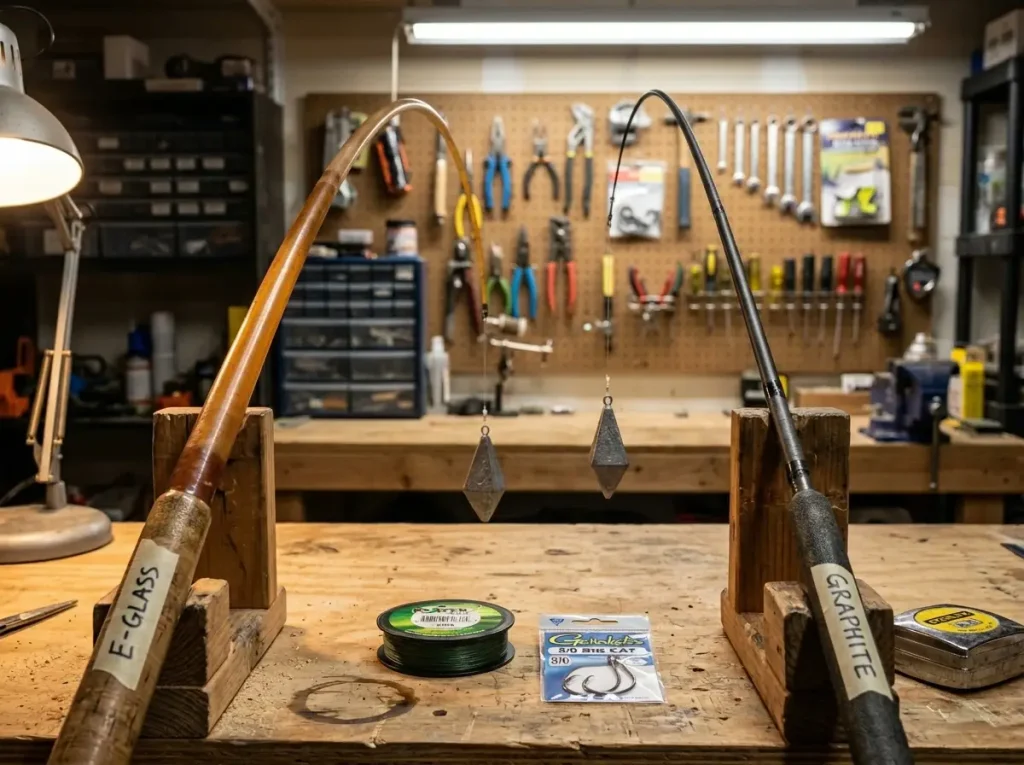
Walk into any sporting goods chain and you’ll find a rack of rods labeled “catfish” in big letters. Most of them are cheap graphite blanks with heavy power ratings, thick cork handles, and hardware that looks heavy duty from a distance. Pick one up and flex it. You’ll feel the problem immediately — the blank is stiff, brittle, and has almost no give through the midsection. That rod will cast a 3-ounce sinker just fine. It will also snap the first time a 30-pound blue makes a hard run with the drag set above five pounds.
The label means nothing. What matters is the blank material, and for heavy duty catfish work, that conversation starts and ends with glass.
E-Glass, S-Glass, and Composite — What Actually Survives
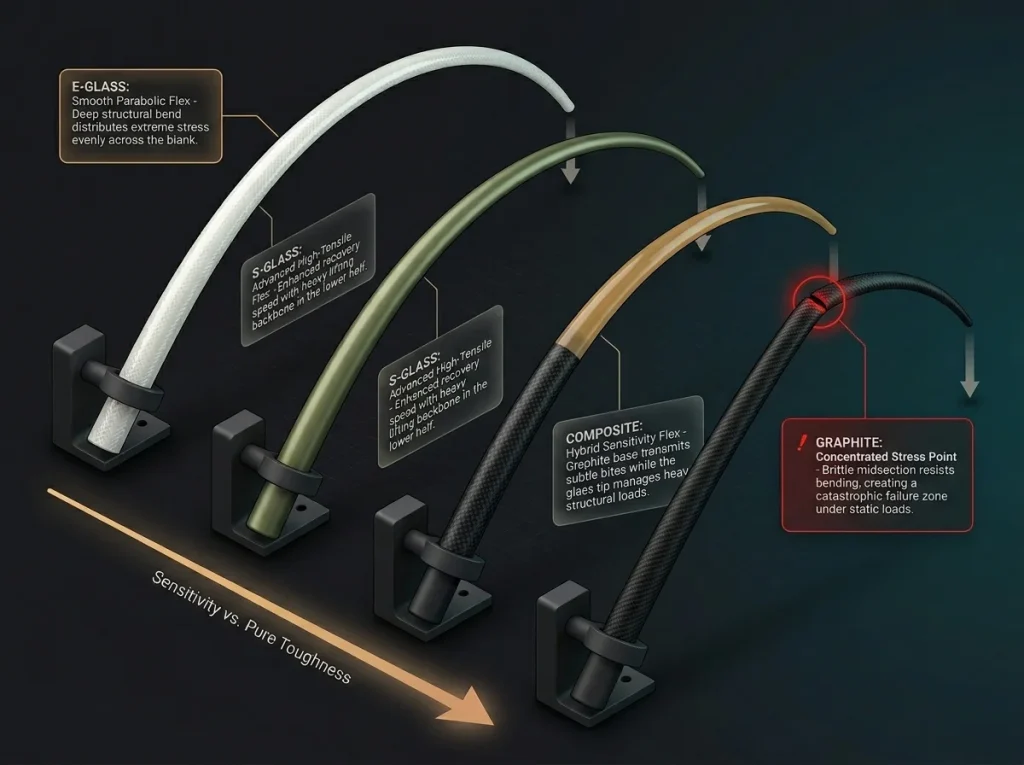
E-glass fiberglass is the workhorse of catfish rods. The fibers are thicker and more flexible than graphite, which means the blank bends deep under load without fracturing. When a big flathead surges, an E-glass rod absorbs the shock through the entire blank instead of concentrating stress at a single point the way graphite does. That’s why guides who fish 200 days a year run E-glass — it survives abuse that would retire a graphite rod in a season.
S-glass is the upgraded version. Stronger per weight than E-glass, slightly more sensitive, and it recovers faster after a deep bend. Whisker Seeker’s Hog Seeker uses an S-glass blank, and the difference is noticeable when you’re lifting a fish vertically from 40 feet of water — the rod loads and unloads with more authority. You pay more for it.
Composite blanks blend glass and graphite fibers. The glass handles the load. The graphite adds sensitivity so you can feel the thump of a channel cat mouthing cut bait at 60 yards. The B’n’M Silver Cat Elite and Catfish Pro 600CTS both use composite constructions. For most anglers targeting big catfish from a boat, composite hits the sweet spot between feel and toughness.
Pro tip: Flex any rod before buying it. Hold the tip against the ceiling of the tackle shop and press down slowly. An E-glass rod bends in a smooth parabolic arc through the upper third. A cheap graphite rod bends sharply at one point — that’s where it will break under a fish.
Why Graphite Fails on Big Catfish
Graphite isn’t weak. It’s brittle under sustained high load. A bass rod takes short bursts of force — a hookset, a headshake, a quick run. A blue catfish rod takes minutes of constant pressure while a 40-pound fish sits on the bottom and refuses to move. Graphite blanks fatigue under that kind of static loading, and the failure mode is sudden — a clean snap with no warning. If you fish for anything under 15 pounds, graphite works. Above that, you’re gambling with equipment that wasn’t built for the job.
Rod Power and Action — Matched to Species
Medium-Heavy vs Heavy Power
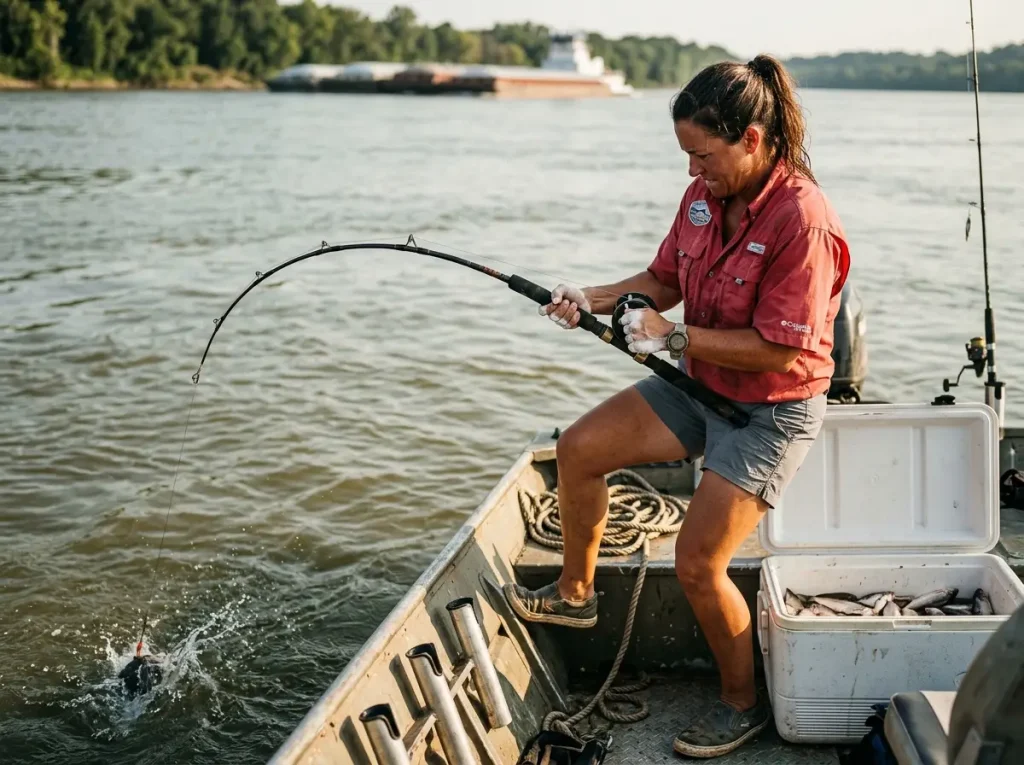
Rod power describes how much force it takes to bend the blank. Medium-heavy handles sinker weights up to about 4 ounces and fish up to roughly 30 pounds without feeling overgunned. Heavy power is built for 4–10 ounce sinkers and fish that regularly exceed 30 pounds. The distinction matters because an overpowered rod kills sensitivity on smaller fish, and an underpowered rod can’t turn a big blue away from a log jam.
For channel catfish in ponds and small rivers, medium-heavy is the right call. You’ll feel the bite better and enjoy the fight more. For blue catfish that use chemoreception and sound to locate bait in heavy current, or flatheads that sit in log jams and refuse to budge, go heavy. There’s no middle ground when a 50-pound fish decides to go back into the wood pile.
Moderate vs Fast Action — Why It Matters for Circle Hooks
Rod action describes where the blank bends. Fast action bends in the top third. Moderate action bends through the upper half. For catfishing, moderate to moderate-fast is the standard, and here’s why it matters: most serious catfish anglers use circle hooks, and circle hooks require a slow, steady pressure hookset — not a hard snap. A fast-action rod concentrates force at the tip and can yank the hook out of the fish’s mouth before the circle rotates into the corner of the jaw.
Moderate action lets the fish load the rod gradually. The hook slides into position, the fish turns, the rod bends deep, and the circle sets itself in the corner of the jaw where it belongs. That’s how circle hooks for catfish are designed to work — with patience, not force.
Pro tip: If you’re switching from J-hooks to circle hooks, slow down your hookset. When you feel the weight, just lift the rod and reel tight. The rod’s moderate action does the rest. Fighting the urge to cross their eyes is the hardest part of circle hook fishing.
Matching Power to Species
A quick reference that saves tackle shop confusion: channel catfish up to 15 pounds in lakes and ponds — medium-heavy, moderate action. Blue catfish 15–50 pounds in rivers — heavy, moderate-fast. Flathead catfish of any size around structure — heavy, moderate. Flatheads hunt at night and fight toward cover, so you need the backbone to turn them before they wrap your line around a submerged log.
Rod Length by Where You Fish
Boat Fishing — 7 to 8 Feet
From a boat, you’re typically within casting distance of the fish or drifting over them. A 7 to 7.5-foot rod gives you enough length to manage multiple rods in rod holders without them crossing, enough leverage to lift fish vertically, and enough backbone to fight a heavy cat at close range. An 8-foot rod adds casting distance for anchored presentations where you’re throwing upstream and letting the sinker settle into a current break.
Longer than 8 feet on a boat creates problems. The rods cross in tight rod holder spreads, they’re harder to lift out of holders on a hookup, and they crowd the deck on smaller aluminum boats. Most guides on the Mississippi and Missouri rivers run 7.5-foot rods and stay under 8.
Bank Fishing — 8.5 to 10 Feet
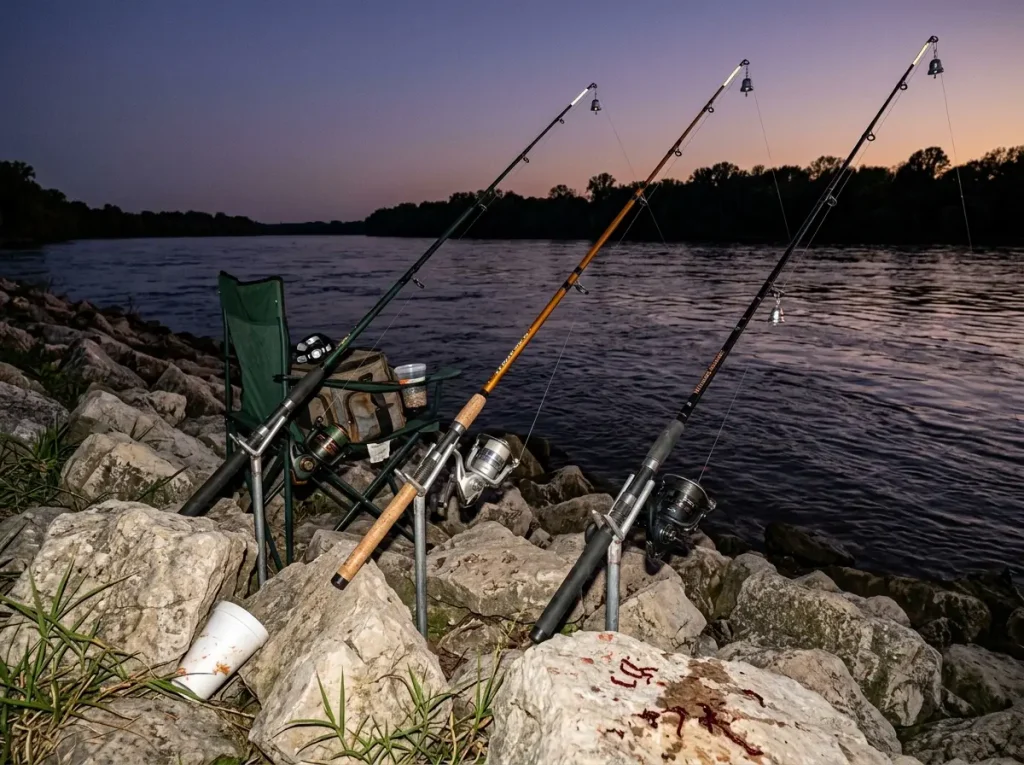
Bank fishing changes the equation. You need casting distance to reach the channel from shore, and you need rod height to keep your line above riprap, brush, and bank structure. A 9-foot rod handles both. The extra length loads more line into the cast for distance, and when you stand the rod in a bank holder at 45 degrees, the line angles up and over the rocks instead of dragging across them.
For bank fishing tight to structure, a 10-foot rod gives you the height to keep line clear of obstructions and the leverage to pull fish over boulders and up a steep bank. The trade-off is portability — a 10-foot one-piece rod doesn’t fit in a standard truck bed without hanging out the tailgate.
Two-Piece Rod Reality
Two-piece rods are fine for channels and small blues. The ferrule connection on modern rods is tight enough that you won’t feel a meaningful difference in sensitivity or power transfer. For trophy-class blues and flatheads over 40 pounds, a one-piece blank gives you a more consistent bend under extreme load — there’s no stress riser at the ferrule. If you have to transport a 9-foot one-piece rod, strap it to the roof rack or slide it diagonally in the truck bed. It’s worth the hassle for fish that test every component of the rig.
Baitcaster vs Spinning for Catfish
When Baitcasters Win
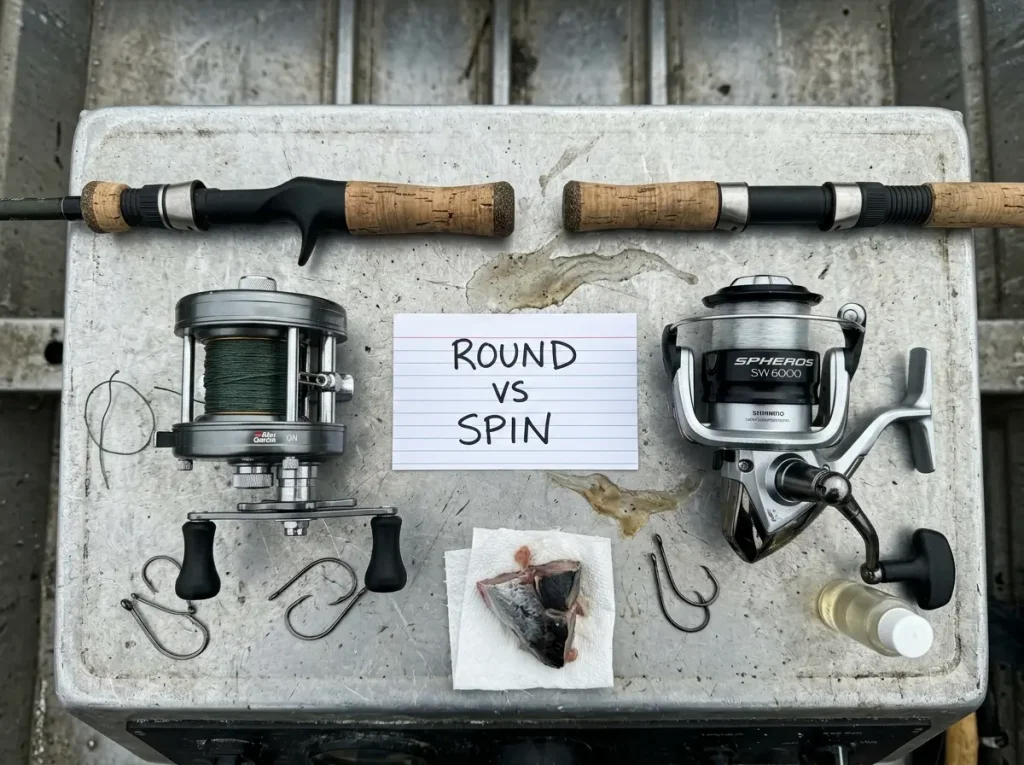
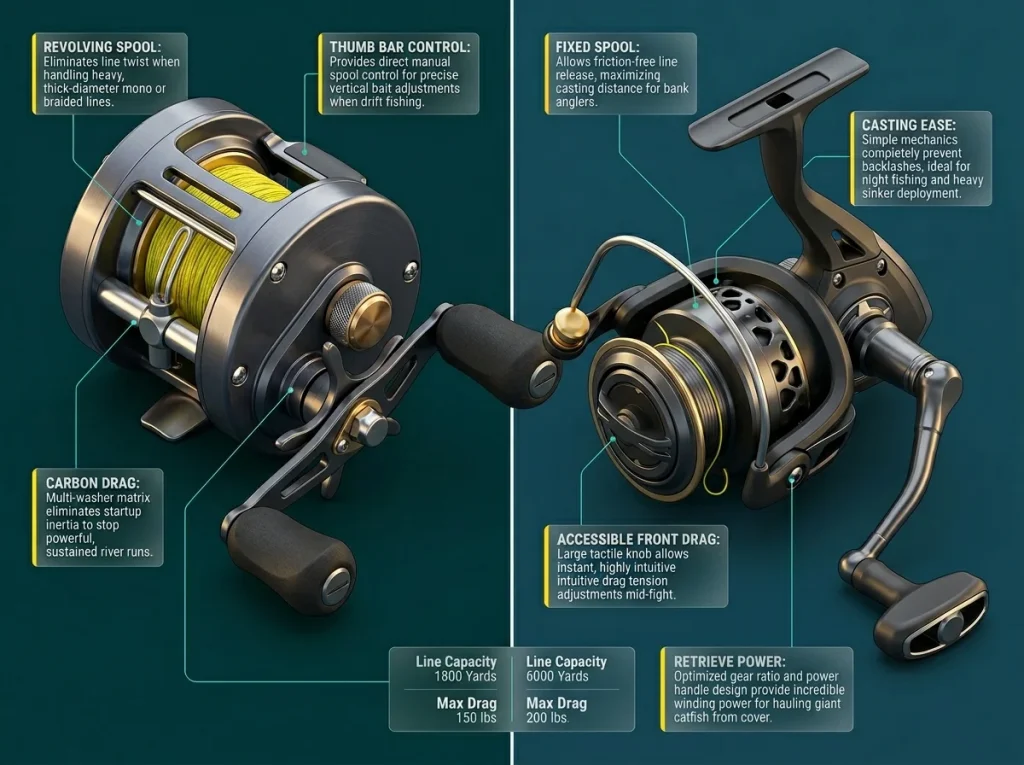
A baitcaster — specifically the round conventional style like the Abu Garcia Ambassadeur line — is the default for serious catfish anglers for three reasons. First, the round spool profile holds more line in a smaller package. A size 6000 round baitcaster holds 200+ yards of 50lb braid comfortably, where a spinning reel needs to be a size 8000 to match that capacity. Second, baitcasters handle heavier line better. Thick monofilament or braid lays evenly on a revolving spool but tends to twist on a spinning reel’s fixed spool over time. Third, the thumb bar gives you direct spool control when you’re lowering heavy sinkers straight down in current — something drift fishing requires constantly.
The gear ratio matters here. For catfishing, a 5.1:1 or 5.3:1 is fast enough to pick up slack and slow enough to winch a heavy fish off the bottom. Don’t chase high gear ratios — you’re not burning a jerkbait. You’re pulling dead weight.
When Spinning Reels Make More Sense
Spinning reels are easier to cast, period. If you’re new to catfishing or fishing with kids, a spinning reel eliminates backlashes entirely and casts lighter rigs farther. For bank fishing with 2–4 ounce sinkers, a spinning reel in the 5000–6000 range delivers better casting distance than a baitcaster of equivalent size because the line flows off the fixed spool with less friction.
A spinning reel’s drag system is also simpler to manage in the middle of a fight — front-drag adjustment is intuitive and accessible. Some of the best budget catfish combos pair an Ugly Stik E-glass rod with a mid-range spinning reel, and they catch plenty of big fish.
The Honest Answer
For channels and blues under 25 pounds from the bank, spinning is perfectly fine and probably better for most anglers. For drift fishing, anchored boat fishing, or targeting 40-pound-plus fish in current, a round baitcaster gives you control and capacity that spinning reels can’t match at the same price point. Run what you’re comfortable with and don’t let forum arguments talk you out of catching fish.
Reel Size, Drag, and the Baitrunner Question
How Much Reel Do You Need
For catfish, reel size comes down to two numbers: line capacity and max drag. You need at least 175 yards of your chosen line weight on the spool — a 50-pound blue in current can strip 80 yards on the first run. And you need a minimum of 15 pounds of max drag to control that run without the fish dictating the fight entirely.
For spinning reels, a 4000–5000 size handles channels and medium blues. A 6000–8000 size covers big blues and flatheads. For round baitcasters, the 6000 size (Abu Garcia Ambassadeur 6500 or Penn Squall 300) is the catfish standard.
Drag Systems — Why Carbon Fiber Wins
Not all drag systems are equal. Budget reels use felt washers that heat up under sustained pressure and lose holding power mid-fight — the fish suddenly accelerates because the drag faded, not because it surged. Carbon fiber drag washers dissipate heat better and maintain consistent pressure from the first run to the last. The difference shows up on fish over 20 pounds that put the drag under load for extended periods.
Startup inertia is the other factor nobody mentions. That’s the extra force required to get the spool moving from a dead stop. High startup inertia means the fish feels a jolt before the drag engages smoothly, which pops leader or straightens hooks. Quality reels — Penn Battle III, Shimano Spheros, Abu Garcia Ambassadeur — have low startup inertia by design. Cheap reels feel “sticky” at the start of a run. That stickiness loses fish.
Pro tip: Test drag smoothness at the store by pulling line off the spool by hand. It should come off in a steady, even pull with no stuttering. If you feel jerks or bumps, the drag washers are low quality or misaligned. Walk away.
Do You Need a Baitrunner?
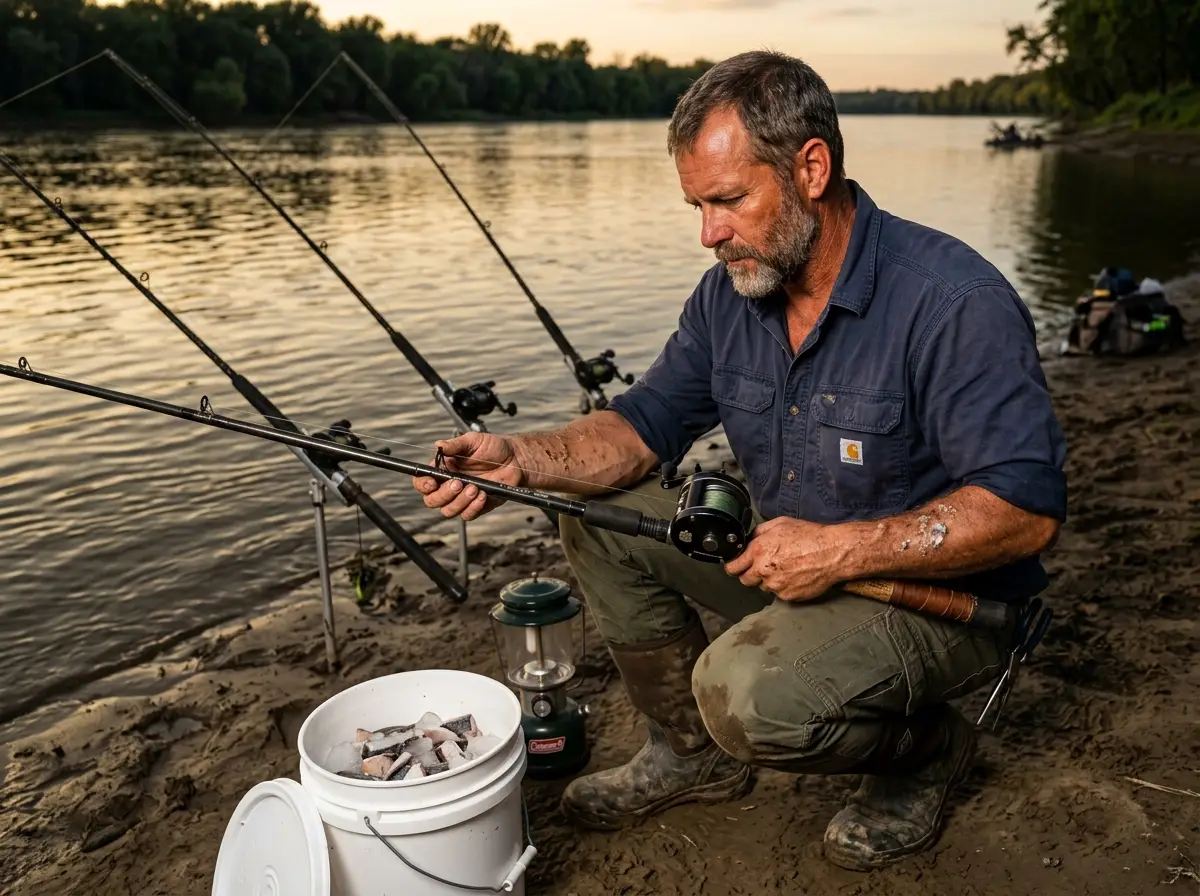
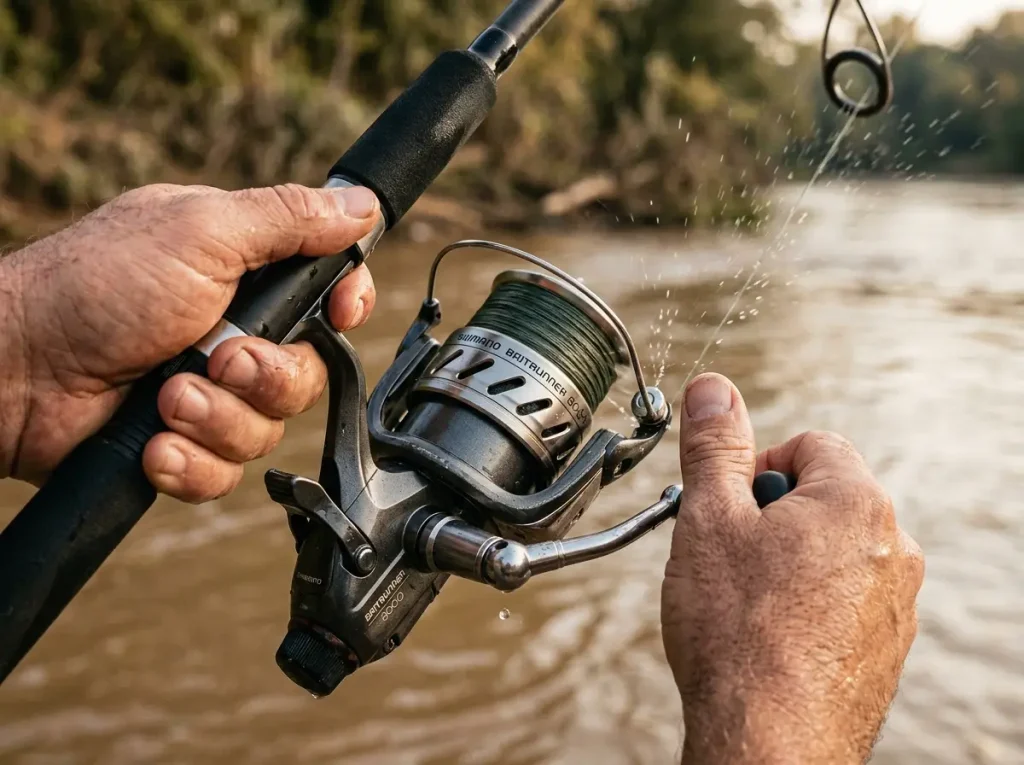
A baitrunner (or freespool) reel has two drag settings: a light secondary drag that lets fish take line freely, and the main drag that engages when you flip a lever or turn the handle. For catfishing, it solves a specific problem — when you’re bank fishing with rods in holders, a catfish can grab cut bait and run before you reach the rod. Without a baitrunner, the fish either feels resistance and drops the bait, or pulls the rod into the water.
If you bank fish with rods in holders, a baitrunner is worth the money. If you’re holding the rod or fishing from a boat where you’re next to your rods, skip it and save the cost. The Shimano Baitrunner line and Daiwa Bite N Run are the category standards. Don’t buy off-brand baitrunner reels — the secondary drag mechanism is the first thing to fail on cheap versions.
Line Type and Weight for Heavy Duty Catfish
Monofilament — The Forgiving Choice
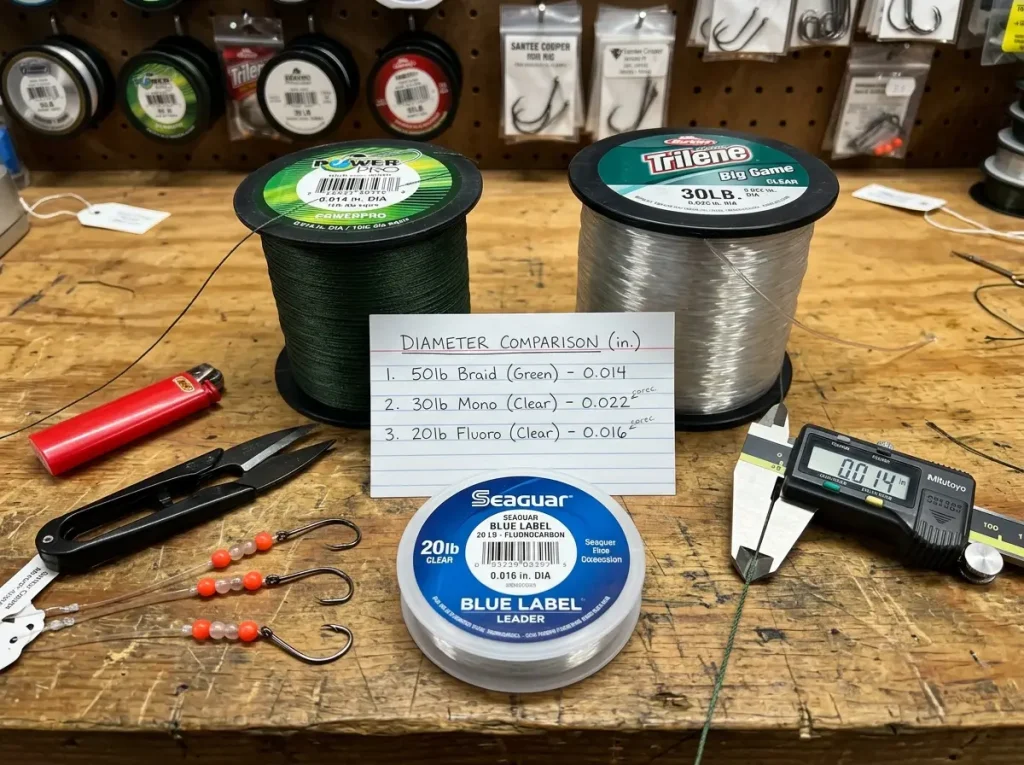
Monofilament in 20–30lb test is where most catfish anglers start, and plenty of experienced ones never leave. Mono stretches 15–25% under load, which acts as a shock absorber during headshakes and surges. That stretch forgives a slightly-too-tight drag, a sharp hookset on a circle hook, or a sudden change of direction. It’s also cheap — you can respool three rods for under $15.
For channel catfish and blues under 30 pounds, 20–25lb mono is plenty. For big blues in current or flatheads near structure, bump to 30lb. Anything heavier than 30lb mono gets thick enough to affect casting distance and can cause issues with line lay on spinning reels.
Braided Line — The Sensitivity Upgrade
Braided line transmits every vibration from sinker to rod tip because it has zero stretch. You feel the sinker bouncing along the bottom, you feel the tick of a cat testing the bait, and you feel the thump of the hookset. That sensitivity is why drift boat guides run braid — when you’re covering water at 1–2 mph, detecting a bite through 80 yards of line matters.
The trade-off is that braid’s zero stretch means there’s no shock absorption. A hard headshake goes straight to the hook. That’s why most braid anglers tie a 3–5 foot monofilament or fluorocarbon leader between the braid and the hook — the leader provides the stretch. The combination gives you sensitivity from the rod to the leader knot and forgiveness from the knot to the hook. A good line-to-leader connection makes the system work.
Run 30–50lb braid for blues and flatheads. The thin diameter of 50lb braid equals roughly 15lb mono in thickness, so you get massive strength without sacrificing line capacity or casting distance. Hi-vis braid in yellow or green helps you see your line angle, which matters when managing multiple rods.
What About Fluorocarbon?
Fluorocarbon as a main line for catfishing is a waste of money. It’s stiff, it has more memory than mono, and its primary advantage — invisibility underwater — doesn’t matter for catfish that find bait by smell and vibration, not sight. Use fluorocarbon as a short leader if you want, but spool your reels with mono or braid.
Three Setups by Budget and Species
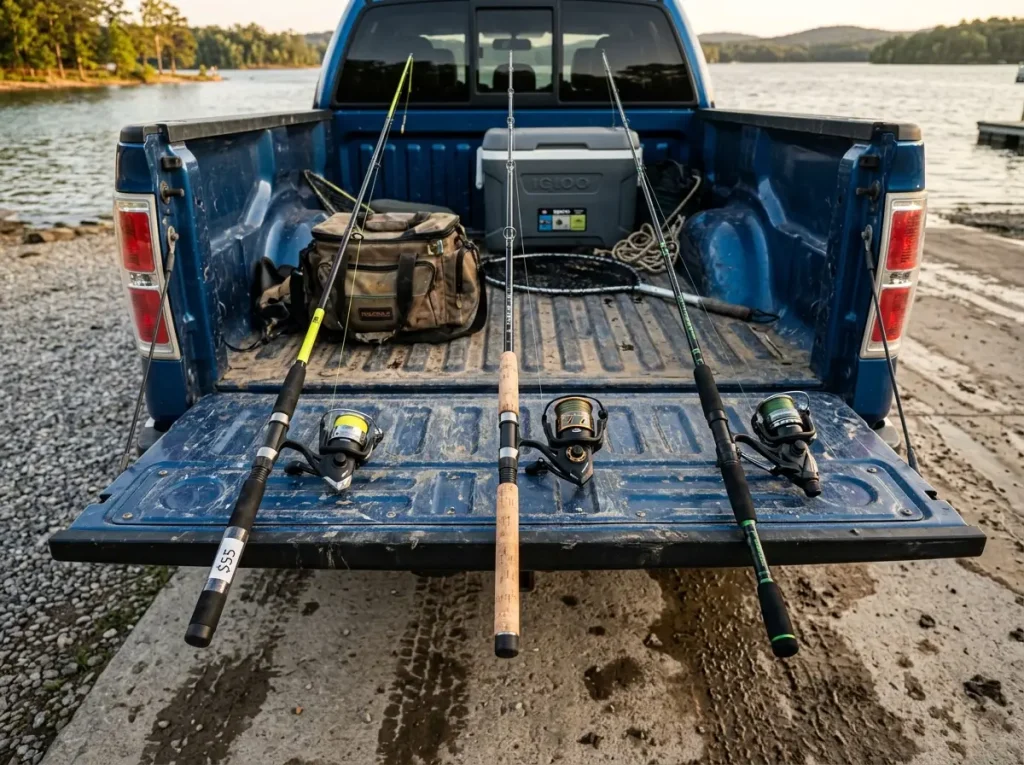
Budget Setup (~$50–70): Channel Catfish in Ponds and Small Rivers
Rod: 7-foot medium-heavy E-glass spinning rod — the Zebco Big Cat combo or an Ugly Stik Catch Ugly Fish combo. Both use fiberglass blanks that handle 10–25 pound fish without drama. The Ugly Stik has better guides and a smoother reel. The Zebco’s high-vis yellow tip section is a real advantage for night fishing.
Reel: The combo reel that comes with either rod is adequate for this tier. Size 5000–6000 spinning with at least 10 pounds of drag. Don’t expect butter-smooth retrieval or carbon fiber drag washers at this price. These reels handle channel cats and small blues fine, but they’ll struggle under a sustained 30-pound fight.
Line: 20lb monofilament. At this budget, mono is the right call — it’s forgiving, cheap to replace, and works well on spinning reels. Spool it fresh every season.
What you get: A setup that catches 90% of the catfish most anglers encounter. It handles channel catfish in ponds and lakes with authority and won’t disappoint on small river blues up to 20 pounds.
What you lose: Sensitivity, drag quality on big fish, and longevity. Budget combo reels need replacing after 1–2 seasons of heavy use.
Mid-Range Setup (~$120–160): Blue Catfish From a Boat
Rod: 7.5-foot heavy power E-glass or composite rod — the B’n’M Silver Cat Elite is the benchmark here. One-piece construction, stainless guides, and a blank that handles 50-pound blues. If you drift fish, this rod’s moderate action gives you the parabolic bend that keeps circle hooks planted during long fights.
Reel: A separate purchase at this tier. The Penn Battle III 5000 spinning or the Abu Garcia Ambassadeur 6500 baitcaster. Both have carbon fiber drag washers, strong gear trains, and enough line capacity for big river fishing. The Abu Garcia is the better choice for drift fishing and vertical presentations. The Penn is the better choice for bank fishing and long casts.
Line: 30–50lb braid with a 3-foot 30lb mono leader. The braid gives you sensitivity for detecting bites at distance. The leader provides shock absorption for circle hook sets.
What you get: A setup that a guide would use on a client trip. It handles blues up to 50 pounds, lasts multiple seasons with basic maintenance, and gives you real sensitivity improvements over budget gear.
What you lose: The premium drag smoothness and build quality of top-shelf reels. At this price you’re getting 80% of the performance at 50% of the cost, which is the best value tier for most anglers.
Premium Setup (~$200–300): Trophy Blues and Flatheads
Rod: 7.5-foot heavy power S-glass or premium composite — the Whisker Seeker Hog Seeker or Catfish Pro 600CTS. These blanks are rated for 30–60lb line and handle sustained fights with trophy fish without fatiguing the blank. The S-glass recovers faster than standard E-glass, which matters when you’re lifting a 60-pound fish from a deep river channel.
Reel: Shimano Baitrunner 6000 for bank fishing or Penn Squall 400 for boat fishing. At this tier, you get sealed bearings, precision-machined gears, and drag systems that don’t fade after 10 minutes of pressure. The baitrunner feature is worth the premium if you bank fish — it prevents the rod-in-the-river scenario that every bank catfish angler experiences at least once.
Line: 50lb braid with a 5-foot 40lb mono leader. The heavy braid handles structure brushoffs without nicking, and the longer leader provides maximum forgiveness during the sustained head-down pressure fights that trophy cats produce.
What you get: A setup that handles anything that swims in freshwater. Summer night catfishing sessions where you’re fighting 50-pound blues in the dark require equipment you can trust completely — this tier delivers that confidence.
What you lose: Money. The performance gap between mid-range and premium is smaller than the gap between budget and mid-range. If your budget is tight, put the extra cash toward bait and gas — the mid-range setup catches the same fish.
Pro tip: Buy the rod first and the reel second. A good E-glass rod paired with a mid-range reel outperforms a cheap rod paired with an expensive reel every time. The rod is the tool. The reel is the motor. A great motor can’t fix a bad tool.
Conclusion
Three decisions determine whether your catfish rod and reel setup holds up when it matters. Choose the blank material by how hard the fish fight — E-glass for anything over 15 pounds, S-glass or composite when you’re chasing trophies. Match the rod power to the species, not to the heaviest fish you’ll ever dream about catching. And build the reel and line around the technique — baitcaster with braid for drift fishing, spinning with mono for bank fishing.
Start at the mid-range tier if your budget allows. A $130 setup catches the same fish a $300 setup catches — it just won’t feel as smooth doing it. Put the leftover money into fresh cut bait that blue catfish can’t resist and a full tank of gas to reach the water where the big ones live.
Q1 What is the best rod and reel for heavy catfish?
A 7.5-foot heavy power E-glass rod paired with a round baitcaster in the 6000 size loaded with 30–50lb braid handles blues and flatheads up to 50 pounds. The Abu Garcia Ambassadeur 6500 and B’n’M Silver Cat rod is the most popular mid-range combination.
Q2 Is a baitcaster or spinning reel better for catfish?
Baitcasters give you more line capacity and better control for drift fishing and vertical presentations. Spinning reels cast farther and are easier to use for bank fishing. For fish under 25 pounds, spinning is fine. For trophy-class catfish from a boat, baitcasters are the standard.
Q3 What pound test line for blue catfish?
Run 30–50lb braided line with a 30lb monofilament leader for most blue catfish scenarios. In heavy current or around structure, bump to 50lb braid and 40lb leader. For bank fishing channels, 20–25lb monofilament handles everything you’ll encounter.
Q4 What rod power for 50 pound catfish?
Heavy power with moderate to moderate-fast action. Medium-heavy flexes too deep under a 50-pound fish and gives you no leverage to turn it away from structure. The rod needs backbone through the lower two-thirds of the blank to lift and control fish that don’t want to leave the bottom.
Q5 Do you need a baitrunner reel for catfish?
Only if you bank fish with rods in holders. The baitrunner lets a catfish take line freely without pulling the rod into the water, then you engage the main drag when you pick up the rod. If you hold the rod or fish from a boat, a standard spinning or baitcasting reel works and saves you $30–50.
Risk Disclaimer: Fishing, boating, and all related outdoor activities involve inherent risks that
can lead to injury. The information provided on Master Fishing Mag is for educational and informational purposes
only. While we strive for accuracy, the information, techniques, and advice on gear and safety are not a substitute
for your own best judgment, local knowledge, and adherence to official regulations. Fishing regulations, including
seasons, size limits, and species restrictions, change frequently and vary by location. Always consult the latest
official regulations from your local fish and wildlife agency before heading out. Proper handling of hooks, knives,
and other sharp equipment is essential for safety. Furthermore, be aware of local fish consumption advisories. By
using this website, you agree that you are solely responsible for your own safety and for complying with all
applicable laws. Any reliance you place on our content is strictly at your own risk. Master Fishing Mag and its
authors will not be held liable for any injury, damage, or loss sustained in connection with the use of the
information herein.
Affiliate Disclosure: We are a participant in the Amazon Services LLC Associates Program, an
affiliate advertising program designed to provide a means for us to earn advertising fees by advertising and linking
to Amazon.com. As an Amazon Associate, we earn from qualifying purchases. We also participate in other affiliate
programs and may receive a commission on products purchased through our links, at no extra cost to you. Additional
terms are found in the terms of service.