

In this article
You’re popping, the cork’s splashing, everything looks right — and nothing eats. I’ve watched it happen from the bow of the skiff more times than I can count. The angler is working hard, the rig looks passable from a distance, and the fish are there. But something in the setup is off by just enough to turn a productive flat into a dead zone.
After rigging hundreds of popping cork setups across Gulf Coast marshes and flats from Louisiana to central Florida, I keep seeing the same handful of mistakes costing anglers fish. Here’s how to set up a popping cork rig for redfish and trout that actually produces — and what to fix when yours stops working.
Quick Answer: To rig a popping cork for redfish and trout:
- Tie 10–20lb braid to the top of the cork with a Palomar knot
- Add a 15–18″ mono buffer between braid and cork to prevent tangles
- Tie 15–30lb fluorocarbon leader to the cork’s bottom wire loop
- Set leader length to match water depth (18″ shallow, up to 48″ deep)
- Attach a 1/16–1/4oz jighead with soft plastic or live shrimp to the leader end
What a Popping Cork Actually Does Underwater
The Sound Game — Why Fish Come Running
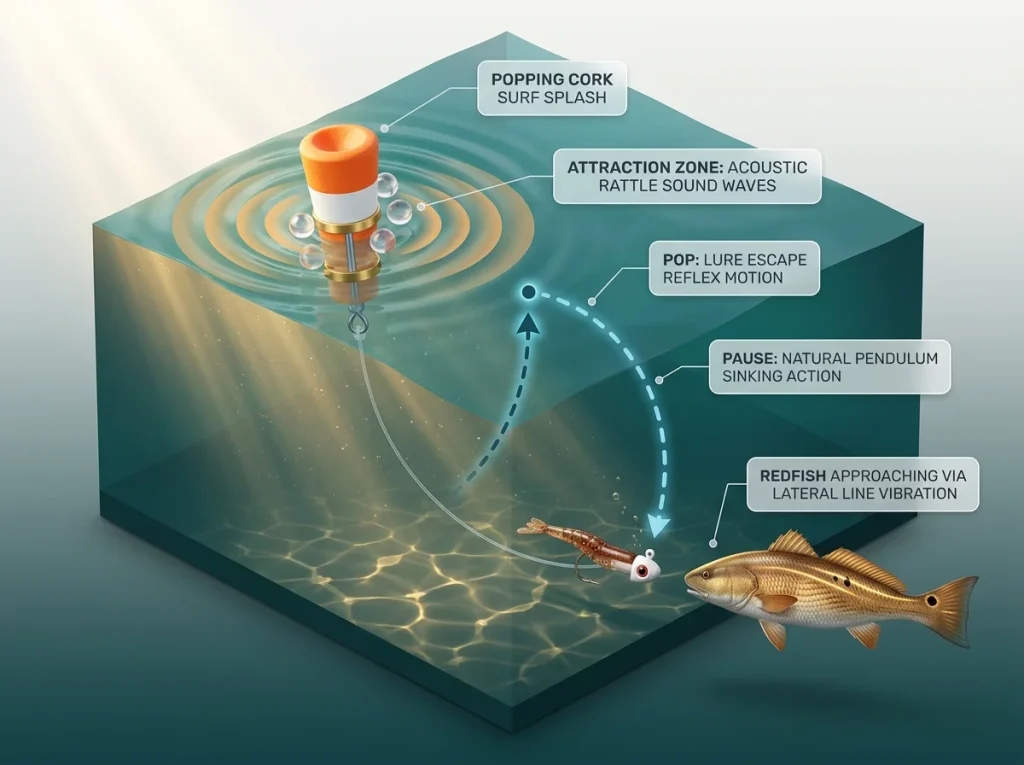
A popping cork isn’t a bobber. The comparison sells it short. When you snap the rod tip, the cupped face of the cork catches water and throws it forward with a loud chug. The beads slam against the cork body and wire, producing a rapid clicking rattle. Together, those two sounds — the chug and the rattle — mimic shrimp kicking at the surface, mullet schooling in a panic, or small fish getting run down by something bigger.
Redfish and spotted seatrout don’t need to see your bait to find it. Red drum rely heavily on sound and vibration to locate prey in turbid estuaries, and a popping cork triggers that response from surprisingly far away. I’ve watched bull reds change direction from 30 yards out and charge a cork that hadn’t been popped in ten seconds. The sound creates a feeding event that doesn’t exist until you make it.
How the Jig Moves When You Pop
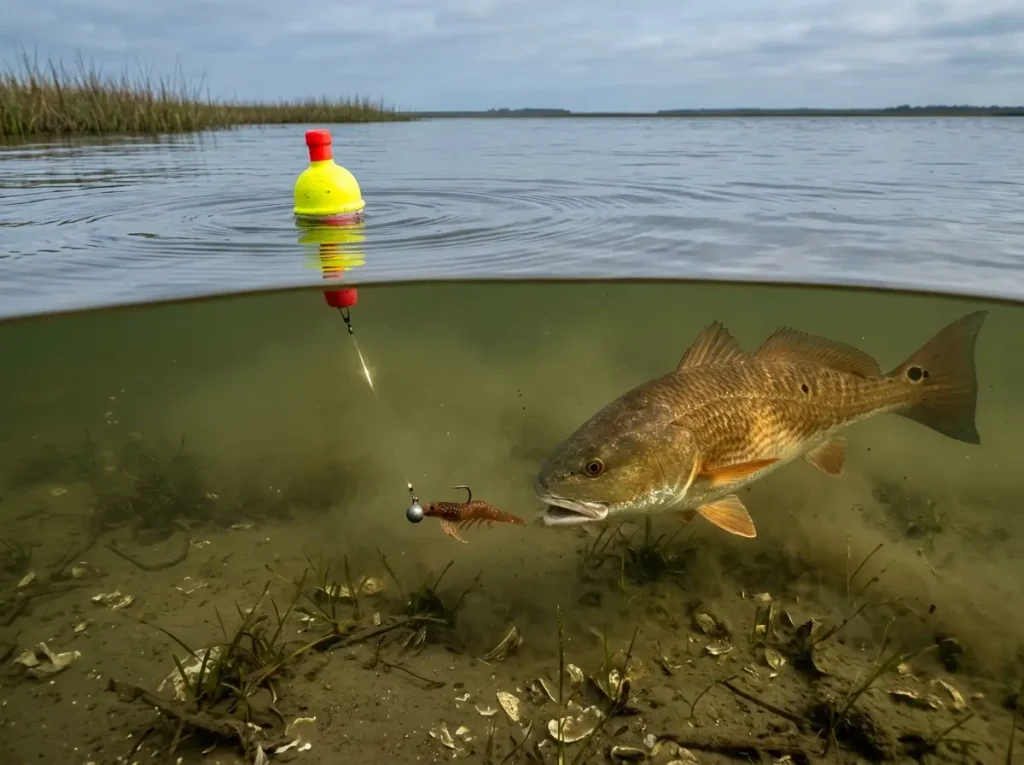
The pop does two things to the bait below the cork. First, the sharp upward motion yanks the jighead and soft plastic up through the water column, imitating a shrimp or baitfish trying to escape. Then, during the pause, the jig pendulums back down on the fluorocarbon leader, drifting and wobbling as it falls. That falling action is where most strikes happen. The fish hears the commotion, comes to investigate, and sees something that looks like wounded prey sinking right in front of it.
Pro tip: Watch your line during the pause, not during the pop. The strike almost always comes on the fall, and the cork going under is sometimes the only indication you’ll get. If you’re staring at the cork while you pop it, you’ll miss the subtle dip.
When the Cork Beats Every Other Rig
Popping corks aren’t for every situation. They earn their spot in three specific conditions. Turbid water is the obvious one — when visibility drops below a foot, fish are hunting by sound and lateral line more than sight, and the cork gives them something to home in on. Choppy surface conditions are the second — wind chop and boat wakes scatter the sound of a tight-lined plastic, but a cork cuts through the noise. And the third is pressured flats where fish have seen every paddle tail and spoon in the tackle shop. The cork changes the game by adding a surface component that triggers a different feeding response.
I fished a flat outside Buras, Louisiana, where four boats had already worked through throwing spoons and paddle tails. Tied on a popping cork with a Gulp! shrimp and caught five redfish tailing in the same grass beds those boats had drifted over. Same fish, same flat — different sound.
Choosing the Right Popping Cork Style
Cupped vs Flat-Top Corks
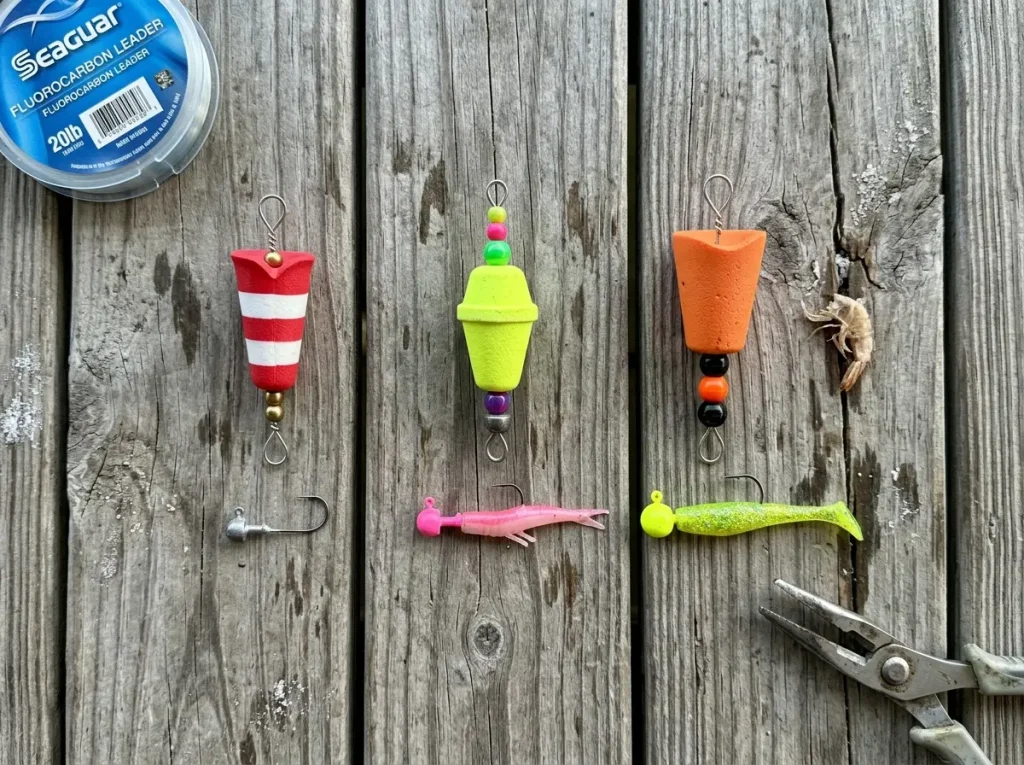
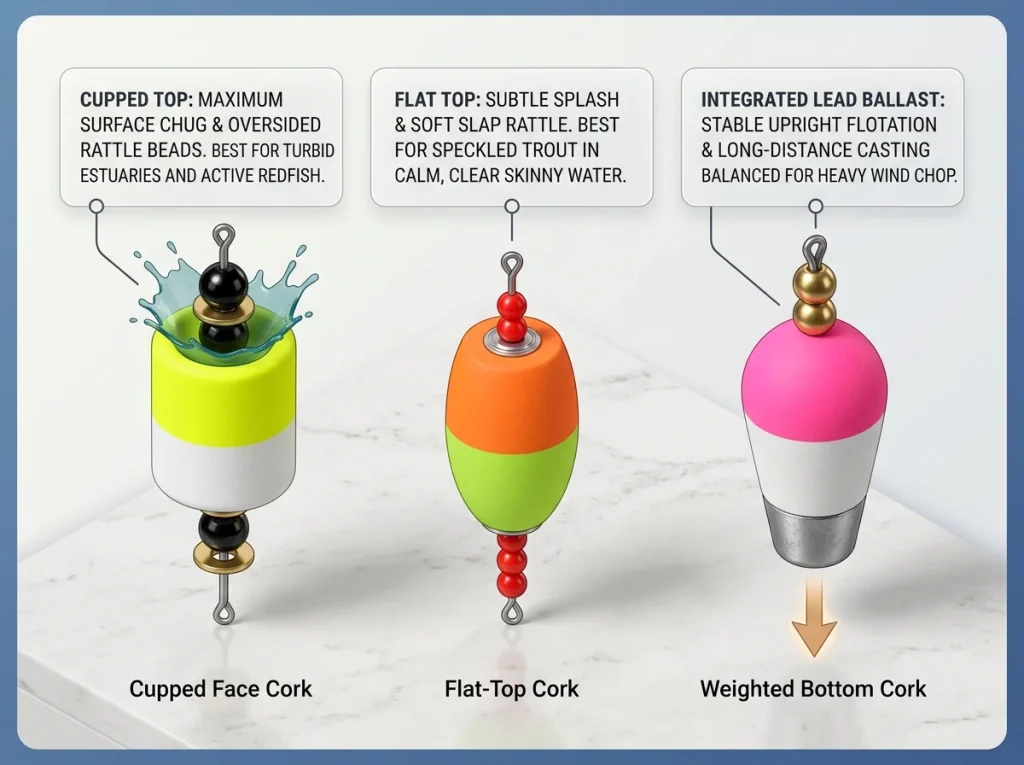
Walk into any coastal tackle shop and you’ll see a wall of corks that all look vaguely the same. They’re not. The cupped or concave top is the feature that matters most. A cupped face grabs water on the pop and throws it forward, producing a louder chug and more surface disturbance. Flat-top corks make noise too, but it’s more of a slap than a chug — less volume, less splash, less effective in rough or murky conditions.
For redfish in turbid marsh water, grab the loudest cork on the rack. For speckled trout on a calm morning flat, a subtler cork with a shallower cup works better. Trout spook more easily than reds, and a cannon-blast pop over two feet of clear water sends them running.
Weighted vs Unweighted — Why It Changes Your Cast
A weighted cork has lead or brass ballast in the tapered bottom end. That weight does two things: it keeps the cork riding upright in the water so the cupped face stays on top, and it adds mass for casting. With a 1/16oz jighead dangling below, an unweighted cork can be miserable to cast into any kind of wind. The weighted version loads the rod better and flies straighter.
The trade-off is that heavier corks create more splash on impact, which can spook fish in skinny water. If you’re fishing knee-deep flats in clear conditions, go lighter. If you’re bombing casts across a turbid bay, go heavy.
Rattling Beads and Wire Gauge
The beads on a popping cork aren’t decoration. Large plastic or glass beads slamming against each other and the cork body produce a rapid clicking that mimics mullet or pogies feeding at the surface. Bigger beads make more noise. The Four Horsemen cork uses oversized beads that produce a distinctive rattle most anglers can hear from the platform.
Wire gauge matters if you fish around jacks, ladyfish, or oversized reds that will try to eat the cork itself. Thin wire bends on a hard strike and the whole rig falls apart. Heavier gauge wire — the kind you can bend back by hand but a fish can’t crush — adds a dollar or two to the cork but saves the rig when a 30-inch red mistakes the cork for a mullet. That’s how fish use sound and vibration to locate food — they don’t always know exactly what’s making the noise until they bite it.
The Leader Setup That Actually Holds Fish
Fluorocarbon Weight and Length by Depth
Most fish lost on a popping cork aren’t lost to the fish. They’re lost to a bad knot, a frayed leader, or fluorocarbon that was too light for the structure around the strike zone.
Start with 20lb fluorocarbon as the baseline. That handles 3–10lb redfish on open flats without issue and has enough abrasion resistance for the occasional oyster bar encounter. Bump to 30lb if you’re fishing around docks, bridge pilings, or heavy oyster. In the Louisiana marsh chasing 40lb bull reds, guides run 50–60lb leader and still catch fish. Fluorocarbon’s refraction index keeps it less visible than mono even at heavier weights, and the stiffness helps the jig track straight below the cork instead of drifting sideways.
Leader length follows a simple rule: match the water depth, minus about six inches. You want the bait suspended just above the bottom, not dragging on it. In 2–3 feet of water, run 18–24 inches of leader. In 4–6 feet, stretch it to 30–36 inches. Cap at 48 inches regardless of depth — anything longer turns the rig into a helicopter on the cast and makes hook sets sloppy. Capt. Ray Markham, who guides out of St. Petersburg, puts it simply: “If you tie a leader much longer than six feet, casting is hard with 7- to 7½-foot rods.” He’s right, and most anglers hit problems well before six feet.
Pro tip: Carry two pre-tied leaders in your tackle bag — one at 18 inches and one at 36 inches. When you move from a shallow flat to a deeper channel edge, swap the whole leader instead of re-tying on the water. Saves ten minutes and keeps you fishing through the tide change.
The Mono Buffer Trick for Braided Line
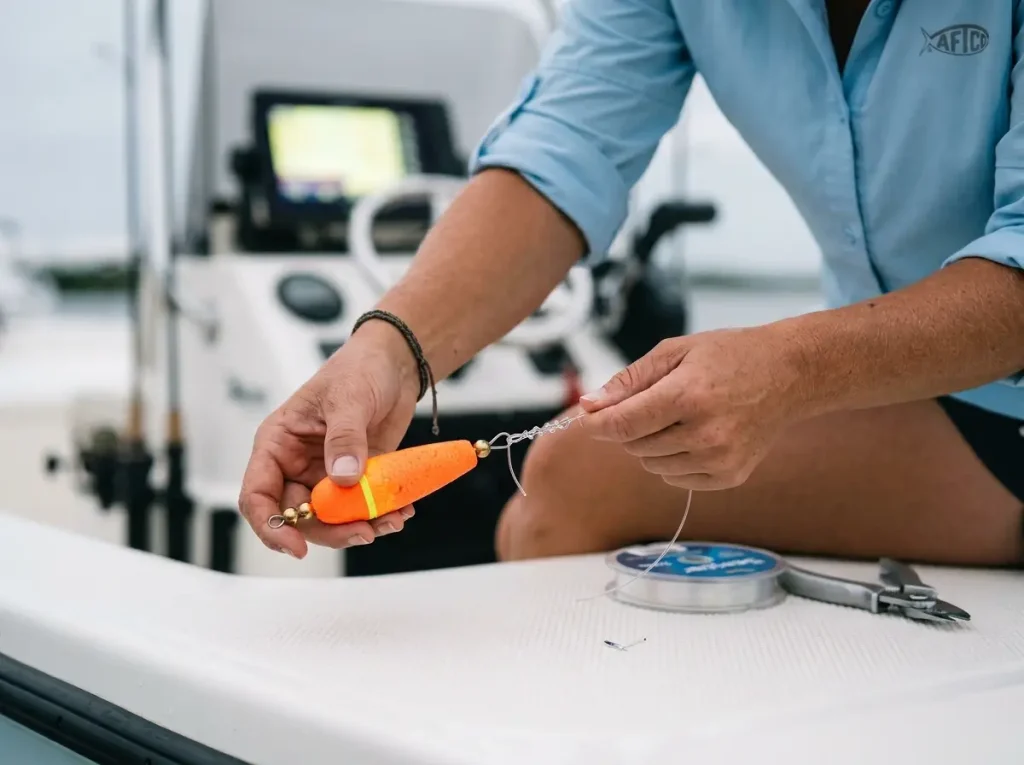
This is the fix that changed how I rig every popping cork, and almost nobody talks about it. Braided line has zero memory. It’s limp, thin, and doubles back on itself the moment tension drops. When you pop the cork, the braid goes slack for a split second before tightening again — and in that instant, the limp braid catches on the beads, wraps around the through-wire, or loops over the cork body. One bad tangle and you’re cutting line instead of catching fish.
The fix is a mono buffer — 15 to 18 inches of 20–30lb monofilament tied between the braided main line and the top of the cork. Mono has enough stiffness and memory to resist doubling back during the slack moment. It won’t wrap on the wire. It won’t catch on the beads. Capt. Mark “Hollywood” Johnson, who guides in the Florida Keys, ties this buffer on every cork rig he sets up. The FG knot works best for the braid-to-mono connection because it’s slim enough to pass through guides without catching.
This one change cut my tangle rate by about 80 percent. If you fish braid and you’ve ever spent five minutes picking a bird’s nest off a popping cork wire, tie the buffer.
Knots That Won’t Fail at the Cork
Keep it simple. The improved clinch knot handles both connections — leader to jighead and leader to cork bottom loop. It’s fast, it’s strong enough for 30lb fluoro, and you can tie it with cold fingers on a rocking boat. Wet the knot before cinching. Always.
For the mono buffer to cork top, the improved clinch works again. For the braid-to-mono buffer connection, the FG knot is the right call — it’s a flat knot that slides through guides without snagging, and it holds braid to mono without slipping under the sharp pops that stress the connection.
The Palomar knot is the backup option for any connection where you can pass the loop over the cork or jig. It’s arguably stronger than the clinch, but it requires passing the doubled line through the wire eye, which gets awkward with thick fluorocarbon. Use it when the clinch feels questionable — never hurts to have two knots in the rotation.
Best Baits and Lures Under a Popping Cork
Live Shrimp — The Default for a Reason
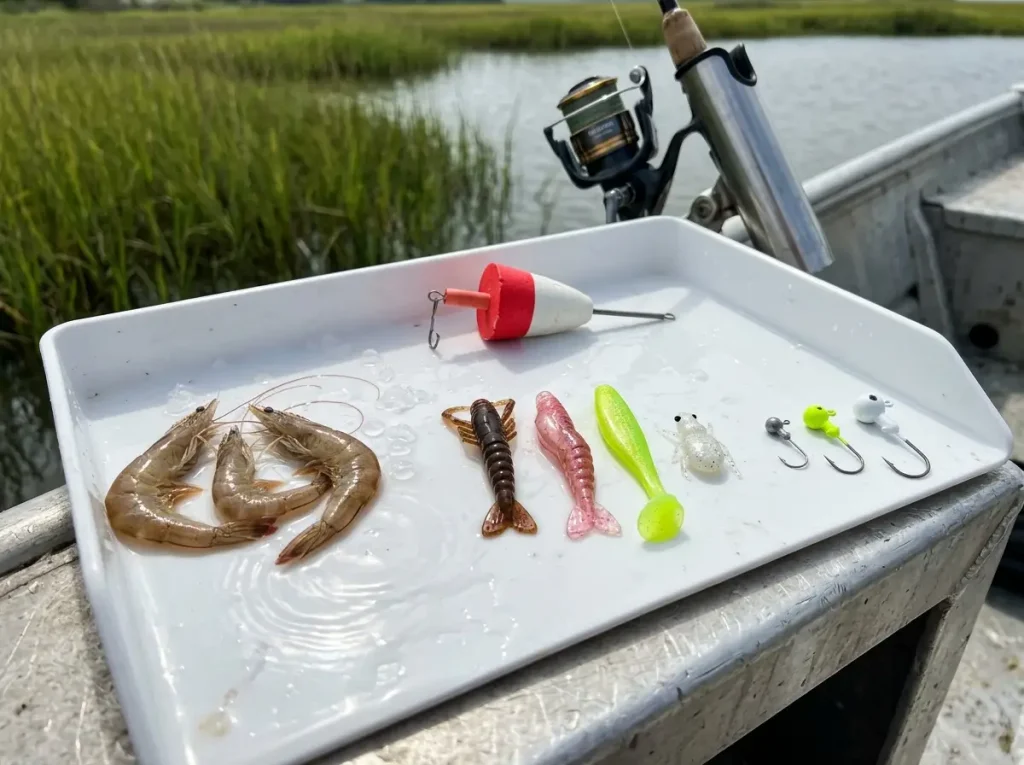
A live shrimp under a popping cork is close to an unfair advantage. The cork draws the fish in with sound. The shrimp seals the deal with scent, movement, and a profile that every inshore predator recognizes. Hook a medium shrimp through the horn — the hard spike between the eyes — with a #1 to 2/0 circle hook or light-wire J-hook. The horn hook keeps the shrimp alive and kicking for multiple casts.
The downside of live bait is logistics. You need a functioning live well or an aerated bucket, you’re stopping at the bait shop, and the shrimp won’t survive a full day in July heat without ice in the water. When live bait isn’t an option — or when you’ve burned through your last dozen shrimp by 10 AM — that’s when artificials earn their keep.
Soft Plastics That Match the Pop
The D.O.A. shrimp in root beer or new penny color is the closest artificial match to a live shrimp’s profile and action. It has a paddle tail that kicks on the fall, and the body is weighted enough to give the jig a natural descent rate. Berkley Gulp! shrimp adds scent to the equation — the Gulp formula disperses amino acids in the water column, which matters in turbid conditions where fish are hunting by smell as much as sound.
Z-Man paddletails work when you want a minnow profile instead of a shrimp. The ElaZtech material is nearly indestructible, which means you’re not re-rigging after every fish. H&H sparkle beetles in chartreuse are a Louisiana staple — every marsh guide from Dularge to Venice has a bag in the console. Match your soft plastic color to water clarity — bright chartreuse and pink for murky water, natural root beer and translucent for clear.
Jighead Weight — The Detail Everyone Gets Wrong
The jighead is the most overlooked variable in the rig, and getting it wrong changes everything about the presentation. Too heavy and the jig sinks straight to the bottom between pops, pulling the leader taut and killing the natural pendulum action. Too light and the jig floats mid-column without getting into the strike zone during the pause.
1/16oz is the starting point for calm, shallow water — it gives the softest fall and the most natural wobble. 1/8oz handles a light current and water in the 3–4 foot range. 1/4oz is the move when tidal current is running or you need the jig to punch through 5–6 feet of water to reach bottom-hugging reds. 3/8oz is the ceiling — any heavier and the jig overpowers the cork’s suspension and the whole rig rides nose-down.
Pro tip: If the cork keeps tilting or riding on its side, your jig is too heavy for that cork. Scale down the jighead or scale up the cork. The system only works when the cork floats upright and the jig hangs below it in a natural vertical line.
Rod, Reel, and Line for Popping Cork Fishing
Why Rod Action Matters More Than You Think
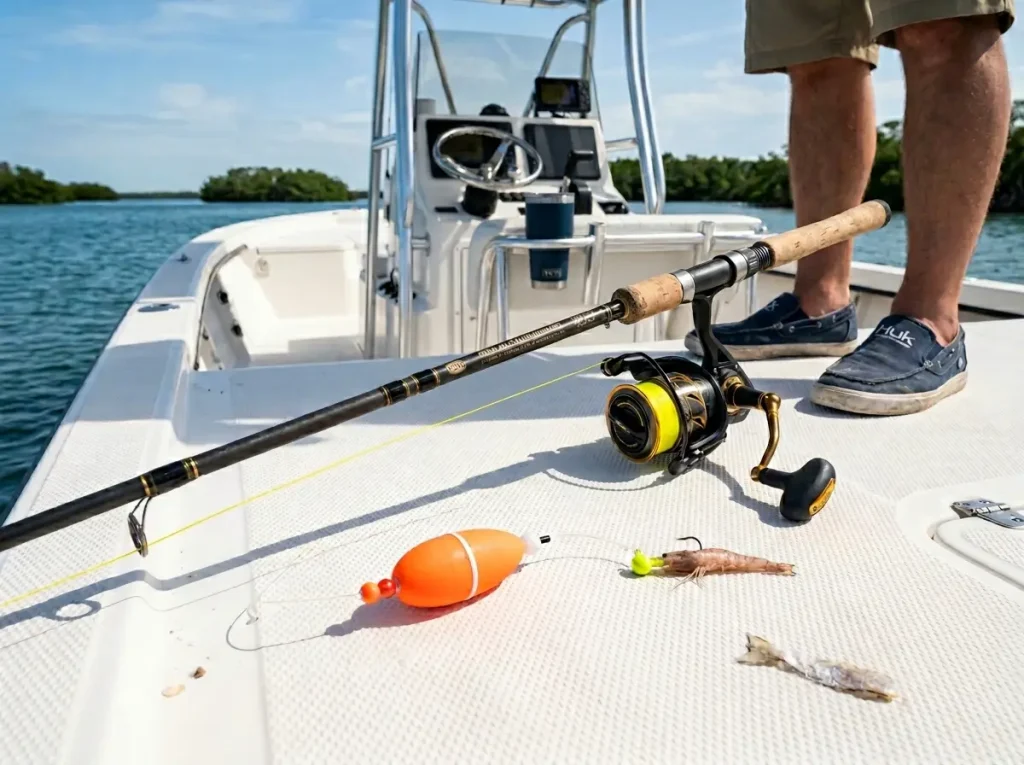
A popping cork rig asks the rod to do two contradictory things. The tip needs to be fast enough to snap the cork with a short wrist pop — a soft, slow-action rod turns the pop into a sluggish pull that barely moves water. But the rod also needs enough tip sensitivity to detect the subtle dip when a trout sucks the jig during the pause. Most mushy-tip rods do neither well.
A 7 to 7’6″ medium-heavy power rod with a fast or extra-fast tip threads the needle. The stiff lower section gives you backbone for hook sets on a redfish that’s heading for the oyster bar. The fast tip delivers a crisp snap for the pop and transmits the vibration of the cork hitting the water back through the blank, so you feel the rig working even when you can’t see it.
Spinning Reel Size and Drag for Inshore
A 2500 to 4000-size spinning reel balances a 7-foot inshore rod without making the whole setup feel front-heavy. The 3000 size is the sweet spot for most popping cork work — enough line capacity for long casts across a flat, smooth enough drag to let a red run without breaking 20lb leader.
Set the drag lighter than you think. A popping cork rig doesn’t give you a solid hook set the way a direct-tie jig does — the cork absorbs some of the hook-setting energy. If the drag is cranked tight, you’ll pull the jig out of the fish’s mouth instead of letting the circle hook rotate into the corner. A smooth, consistent drag lets the fish turn and load the rod before the hook finds purchase.
Braided Main Line — The Non-Negotiable
Braided line in the 10–20lb range is the only real option for popping corks. The zero stretch means your wrist snap translates directly into cork action — every pop is crisp and loud. With monofilament, the stretch absorbs most of the pop and the cork barely chugs. Braid also casts thinner for its strength, which means more distance on the cast, and more distance means you can reach fish that haven’t been spooked by the boat.
The one downside — the tangle problem — is solved by the mono buffer between braid and cork. Run 15lb braid for open flats, 20lb if you’re near structure. Hi-vis chartreuse or yellow braid helps you track the line angle between rod tip and cork, which is how you detect strikes during the pause on windy days when the cork is hard to see.
How to Work a Popping Cork Without Spooking Fish
The Pop-Pause Cadence That Produces
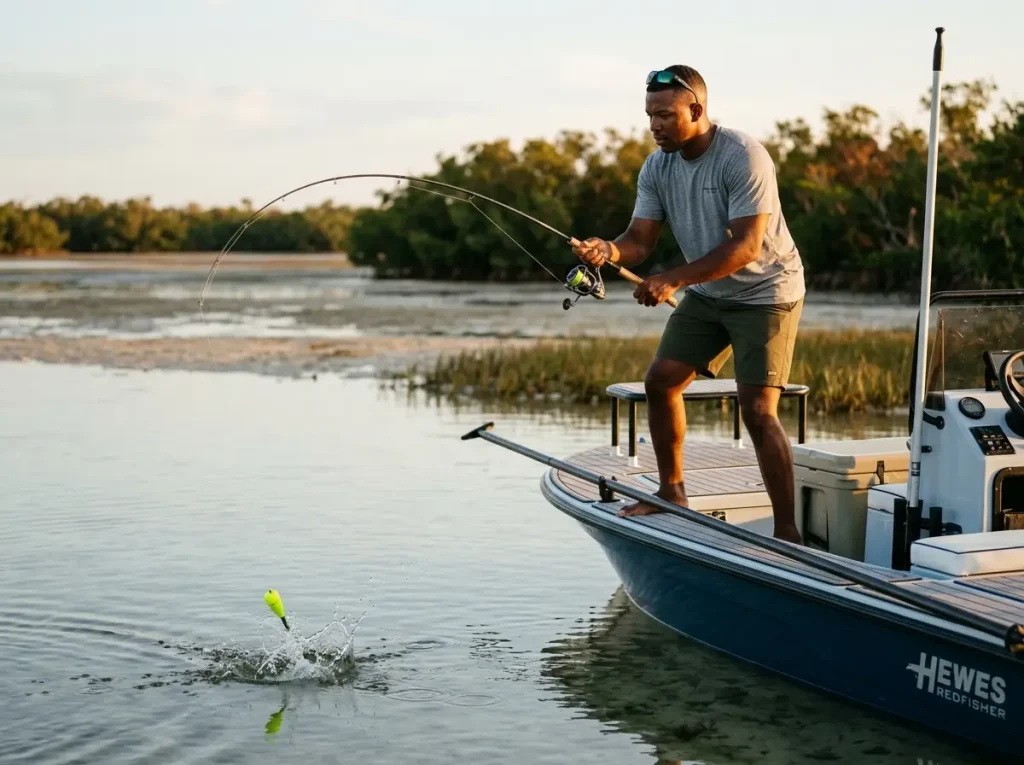
The number one mistake with a popping cork is popping too much. Constant popping looks and sounds like nothing in nature — no baitfish panics nonstop for three minutes straight. The pop creates the attention. The pause creates the opportunity. Fish need that quiet window to approach, identify the bait, and commit.
Start with a sharp snap of the rod tip — wrist only, not your whole arm — followed by a 7–10 second pause. Reel up the slack during the pause but keep the line semi-taut so you feel the strike. Pop twice, pause. Pop once, longer pause. Vary the cadence and let the fish tell you what they want. On a calm flat with speckled trout, I’ve gone as long as 15 seconds between pops. Sometimes the longest pause of the day produces the biggest fish.
Reading Water Conditions to Adjust Your Retrieve
The cadence isn’t fixed. It changes with the water. In rough, choppy conditions with current running, pop harder and more frequently — the ambient noise masks subtle pops, and the fish are already in feeding mode from the turbulent water pushing bait around. Three hard pops every 5 seconds works when the wind is blowing 15 knots across a bay.
In calm, clear skinny water, dial everything back. A gentle pop that barely breaks the surface, followed by a 10–15 second dead pause. The fish can see the rig in clear water, and a loud pop overhead will send trout bolting. Think of it like the difference between yelling across a crowded bar and whispering in a quiet room — match the volume to the environment.
Reading tidal velocity helps you time your casts to the peak current windows when fish are actively feeding. On an outgoing tide with moderate flow, position yourself up-current and let the cork drift naturally between pops — the current does half the work of making the presentation look alive.
Casting Angle and Distance
Two casting fixes eliminate most popping cork frustration. First, drop the cork farther from the rod tip before casting — 18 to 24 inches of line between the cork and the tip-top guide. Most anglers keep it too close, and the cork-and-leader assembly helicopters during the cast, tangling the leader around the main line.
Second, use a sidearm cast instead of an overhead lob. The sidearm keeps the rig on a flatter trajectory, which reduces the spinning problem and lays the cork down on the water with less splash. Cast past the target zone by 10–15 feet and pop the cork as you work it through the strike zone — don’t cast directly on top of where you think the fish are sitting.
Tuning the Whole Rig to Water Conditions
Murky Water — Go Loud, Go Short
When visibility drops below a foot — typical in Louisiana marsh bays after a rain, or any Gulf estuary on a strong outgoing tide — the entire rig shifts toward maximum sound and minimum subtlety.
Use the loudest cork you own. Large rattling beads, cupped face, heavy enough to cast into wind. Shorten the leader to 18 inches so the bait stays close to the sound source — fish homing in on the cork’s noise won’t search far below it in zero-visibility water. Bump the jighead to 1/4oz to keep the jig from drifting sideways in current. Bright colors: chartreuse, pink, or glow white soft plastics. Pop hard, pop frequently. The fish are hunting by sound and lateral line, and Louisiana marsh conditions shape your tackle choices from the leader up.
Clear Flats — Scale Everything Down
Clear water on a calm morning flat requires the opposite approach. The fish can see the rig, which means they can also see every flaw — a heavy cork splashing down, an oversized jig hanging unnaturally, a leader that’s too thick.
Switch to a smaller, lighter cork with a shallow cup. Extend the leader to 30–36 inches so the bait separates from the cork by enough distance that the fish focuses on the bait, not the float. Drop to 15lb fluorocarbon and a 1/16oz jighead with a natural-colored soft plastic — root beer D.O.A. shrimp or translucent Gulp in new penny. Pop gently. Pause long. Spotted seatrout prefer water clarity above 12 inches Secchi depth, and in those conditions they’re using their eyes more than their lateral line. The presentation has to look right, not just sound right.
Pro tip: In clear water, watch the fish’s reaction to the first pop. If it flinches and moves away, you’re popping too hard. If it turns toward the sound and approaches slowly, you’ve matched the volume. Adjust on the fly — the fish will coach you.
Current and Wind — When to Change Jig Weight
A running tide changes the jig weight calculation. In slack water, a 1/16oz jig hangs perfectly below the cork in a natural vertical line. Add a moderate tidal current and that same jig sweeps sideways, sitting at an angle that looks wrong and puts the bait above the strike zone instead of in it.
Bump the jig weight one step for each notch of current increase. Slack water = 1/16oz. Light current = 1/8oz. Moderate flow = 1/4oz. Strong rip = 3/8oz or switch to a different rig entirely — popping corks lose their advantage when the current is moving faster than you can manage the slack.
Wind affects the cork, not the jig. A crosswind pushes the cork sideways and creates a belly in the line that kills your ability to pop effectively. Cast with the wind — not into it — and position the boat so your casts travel downwind across the strike zone. Your casting distance doubles and your pops stay sharp instead of getting absorbed by a wind belly in the braid.
Conclusion
Three things separate a popping cork rig that catches fish from one that just makes noise. Match the leader length to the water depth so the bait sits in the strike zone, not above it or dragging bottom. Stop over-popping — the pause is where fish commit, and constant noise pushes them away in calm water. And treat the whole rig as a connected system where cork loudness, leader length, jig weight, and cadence all shift together when conditions change.
Rig up two setups before your next trip — one loud with a short leader and heavy jig for murky water, one subtle with a long leader and light jig for clear flats. Let the fish tell you which one they want. That’s how the rig was meant to be fished.
Q1 How long should the leader be on a popping cork rig?
Match the leader length to water depth minus about six inches. Use 18–24 inches for shallow water under three feet, 30–36 inches for four to six feet, and never exceed 48 inches or casting becomes difficult and hook sets turn sloppy.
Q2 What is the best bait to use under a popping cork?
Live shrimp hooked through the horn on a circle hook is the most consistent producer for both redfish and trout. For artificials, a D.O.A. shrimp or Berkley Gulp shrimp on a 1/8oz jighead matches the profile and adds scent that works in turbid water.
Q3 Do popping corks work in clear water?
They work if you scale down. Use a smaller, quieter cork with a longer leader of 30–36 inches of 15lb fluorocarbon and a light 1/16oz jighead. Pop gently with long pauses. In clear water, trout use sight more than sound, so the presentation has to look natural.
Q4 What size jighead for a popping cork?
Start at 1/16oz for calm shallow water and scale up by current strength. Light current calls for 1/8oz, moderate flow for 1/4oz, and strong rips for 3/8oz. If the cork tilts or rides sideways, the jig is too heavy for that float.
Q5 How do you pop a cork without spooking fish?
Use a short wrist snap — not a full arm sweep — and pause 7–10 seconds between pops. In calm skinny water, make the pop barely break the surface and extend pauses to 15 seconds. Match the pop intensity to ambient noise: loud in choppy water, quiet in calm conditions.
Risk Disclaimer: Fishing, boating, and all related outdoor activities involve inherent risks that
can lead to injury. The information provided on Master Fishing Mag is for educational and informational purposes
only. While we strive for accuracy, the information, techniques, and advice on gear and safety are not a substitute
for your own best judgment, local knowledge, and adherence to official regulations. Fishing regulations, including
seasons, size limits, and species restrictions, change frequently and vary by location. Always consult the latest
official regulations from your local fish and wildlife agency before heading out. Proper handling of hooks, knives,
and other sharp equipment is essential for safety. Furthermore, be aware of local fish consumption advisories. By
using this website, you agree that you are solely responsible for your own safety and for complying with all
applicable laws. Any reliance you place on our content is strictly at your own risk. Master Fishing Mag and its
authors will not be held liable for any injury, damage, or loss sustained in connection with the use of the
information herein.
Affiliate Disclosure: We are a participant in the Amazon Services LLC Associates Program, an
affiliate advertising program designed to provide a means for us to earn advertising fees by advertising and linking
to Amazon.com. As an Amazon Associate, we earn from qualifying purchases. We also participate in other affiliate
programs and may receive a commission on products purchased through our links, at no extra cost to you. Additional
terms are found in the terms of service.