In this article
The drag sounded perfect on the jetty. Smooth, steady, no hesitation. Six weeks later—after one lazy hose-down and a garage shelf—I cranked the handle and heard it: that sickening crunch. The Shimano Stradic I’d babied for three seasons was eating itself alive. Salt had found the gearbox, and it brought chemistry with it.
After 20 years guiding saltwater fishing trips and servicing my own reels through hundreds of post-trip cleanups, I’ve learned this the hard way: how you rinse matters more than how you fish. One bad freshwater rinse—too much pressure, wrong angle, wrong product—can do more damage in two minutes than twenty hours on the water.
This guide walks you through the exact 3-level maintenance system that keeps a mid-to-high tier reel performing like new—from the inside out. You’ll learn why salt destroys reels, which products actually protect them, which ones accelerate the damage, and the one braid salt retention habit that’s silently rotting your spool right now.
⚡ Quick Answer: After every saltwater trip, run this 30-second checklist: (1) Tighten the drag knob to seal the stack, (2) mist with warm freshwater from the top down—never high pressure, (3) shake off the excess and wipe with a microfiber cloth, (4) air dry completely, (5) loosen the drag for storage. This prevents salt intrusion into the gearbox and extends reel lifespan by years.
Why Salt Destroys Reels — The Chemistry You Need to Know
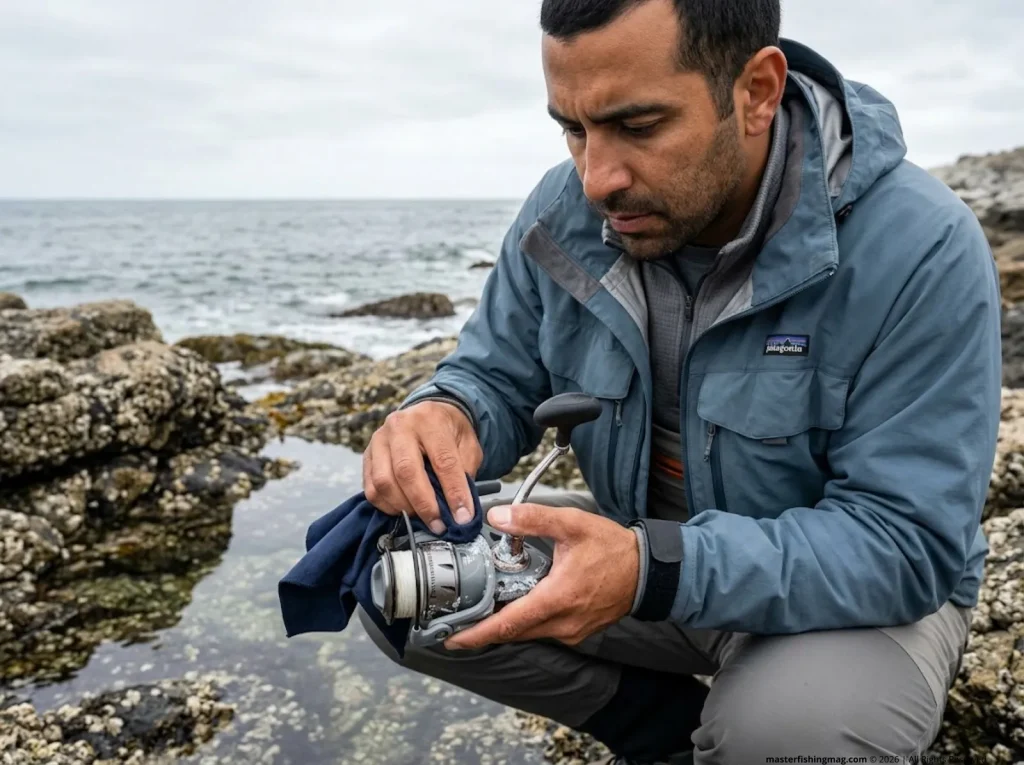
Every time your reel gets hit with ocean spray, something invisible starts happening. Saltwater isn’t just “dirty water.” It’s a conductor—a liquid that carries electrical current between metals. And your reel is packed with different metals touching each other in tight spaces. That’s where the damage begins.
Galvanic Corrosion — Your Reel Is a Self-Destructing Battery
Here’s what most anglers don’t realize: a spinning reel is a battery waiting to be activated. The moment saltwater bridges two different metals—say, a stainless steel screw threaded into an aluminum housing—a process called galvanic corrosion kicks in. The more active metal (aluminum) starts sacrificing itself to the more noble metal (stainless steel), atom by atom. In engineering terms, the aluminum acts as a sacrificial anode—it corrodes so the steel doesn’t.
That white, chalky powder you see forming around screw heads or where the handle meets the body? That’s aluminum oxide. It’s not dirt you can wipe off. It’s your reel dissolving.
The severity depends on the surface area ratio between the two metals. A tiny aluminum shim pressed against a large brass gear will vanish within weeks if salt is trapped between them. According to NOAA’s galvanic corrosion resource, this bimetallic effect is the primary mechanism of structural failure in any marine equipment where dissimilar metals sit together.
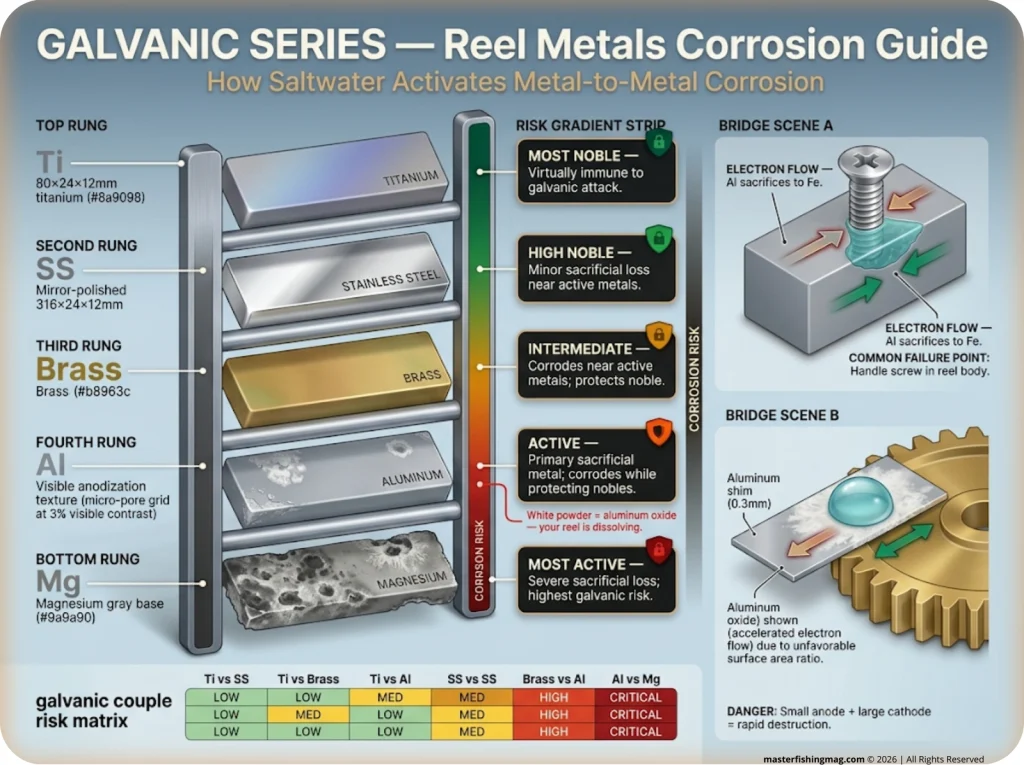
Pro tip: If you see white powder around screws or the handle junction, that’s not grime—that’s your reel housing dissolving. You’re already behind on corrosion prevention. Clean it immediately and apply a corrosion inhibitor.
Crevice Corrosion and Pitting — The Invisible Damage Under Your Drag
Galvanic corrosion happens where different metals meet. But there’s a second type of attack happening in the tight spaces your eyes can’t reach: under the drag washers, beneath the line roller, inside handle cap threads.
In these stagnant zones, trapped saltwater becomes oxygen-starved. The chemistry shifts acidic, and that acid eats through the protective oxide layer—a process engineers call passivation failure—on aluminum and stainless steel. The result is “pitting”: deep, localized craters that compromise the part from the inside out.
I’ve pulled apart reels that looked spotless on the outside. Pop the drag stack and you see craters in the washers like a lunar landscape.
Why Your Seals Aren’t Waterproof — They’re Water-Resistant
No reel is waterproof. Every sealing system has a failure threshold. Standard rubber O-ring seals work through compression—their effectiveness depends on how much water pressure they can handle before they flex and let water through.
Daiwa’s MagSeal uses magnetic ferrofluid to create a near-frictionless liquid barrier. It’s effective against spray, but it’s vulnerable to solvents and high-pressure water. Shimano’s X-Protect uses labyrinth seal channels plus water-repellent coatings for durability. Penn’s IPX-rated systems offer lab-verified resistance, but seals stiffen with age and UV exposure.
Understanding your reel’s seal integrity limits dictates your rinse method. For a broader look at protecting your entire setup, our guide to saltwater corrosion prevention for rods and reels covers the full framework.
The 2-Minute Post-Trip Protocol — Stop the Damage Before It Starts
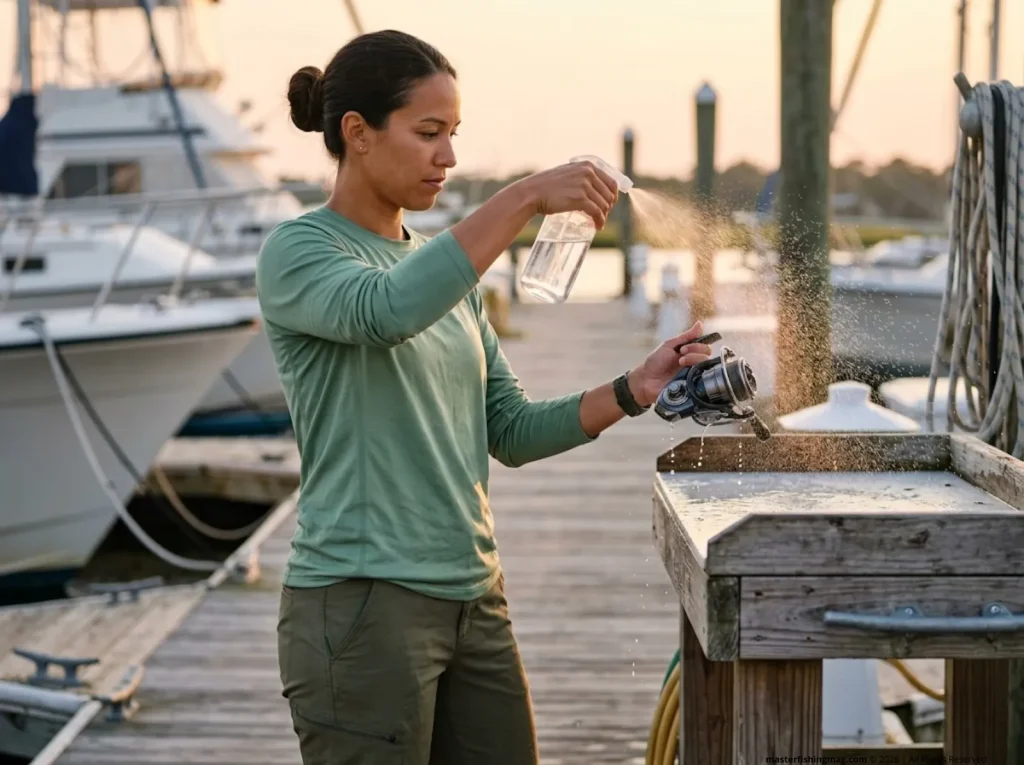
This is the core of the entire maintenance routine—the single habit that determines whether your gear lifespan is measured in seasons or in decades. Execute this after every saltwater session, even if the reel never touched the water.
Step 1 — Tighten the Drag Before Water Touches the Reel
Before any water goes near your reel, crank the drag knob down firmly. This compresses the drag system and internal seals, creating a watertight barrier that blocks freshwater from reaching the washers. Most guides skip straight to rinsing. That’s the mistake.
A loose drag during rinsing creates channels for water to reach the carbon fiber or felt washers, contaminating the grease and causing stiction—that jerky, inconsistent startup friction you feel on the next trip. Make this muscle memory. Reel hits the cooler? Tighten the drag. Before anything else.
Step 2 — Warm Mist Rinse, Top-Down Only
Use a spray bottle or a garden hose on the “fine mist” setting with warm water (around 30–40°C). Warm water dissolves dried salt faster because heat breaks down the crystal structure more efficiently than cold tap water.
Always rinse from the top down. This mimics the direction of natural rain and prevents water from being forced into the underside of the rotor where the anti-reverse bearing sits. This matters more than most people think.
Never—and I mean never—use high pressure. A garden hose nozzle on jet setting is a pressure vessel aimed at precision machinery. The force lifts seal lips, pushes past labyrinth barriers, and forces water into the gearbox. This is the “hydrolock” phenomenon: water enters the gears, emulsifies the reel grease, and strips lubrication from the gear teeth. A 30-second high-pressure blast can do more damage than 20 hours of fishing. That’s the high pressure risk nobody warns about on the reel box.
For the rest of your fishing gear care—rods, tackle, waders—the full post-trip gear washing protocol covers the complete system.
Step 3 — Shake, Wipe, and Decompress
Shake the reel firmly to eject trapped water from crevices. Then wipe the entire exterior with a clean microfiber cloth—pay special attention to the bail arm hinge, handle junction, and drag knob threads. These are trap zones for salt residue. A basic cleaning kit with two microfibers and a soft brush covers everything you need.
Once it’s fully dry, loosen the drag completely. Drag decompression for storage is critical. Storing with a tightened drag causes the drag washers to “set”—the carbon or felt takes a permanent shape and produces jerky, inconsistent performance next time out.
Pro tip: Keep a dedicated microfiber in your tackle bag. One cloth per reel, every trip. It takes 30 seconds and I haven’t had a crunchy reel sound since 2018.
The Braided Line Problem — Your Spool’s Silent Killer
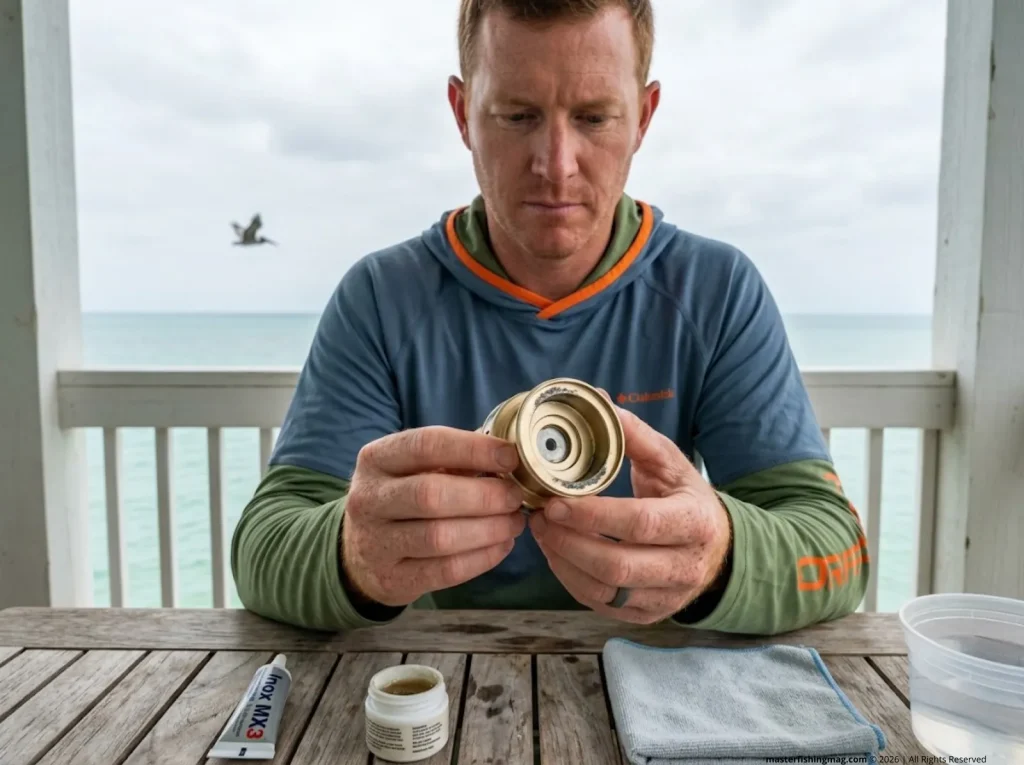
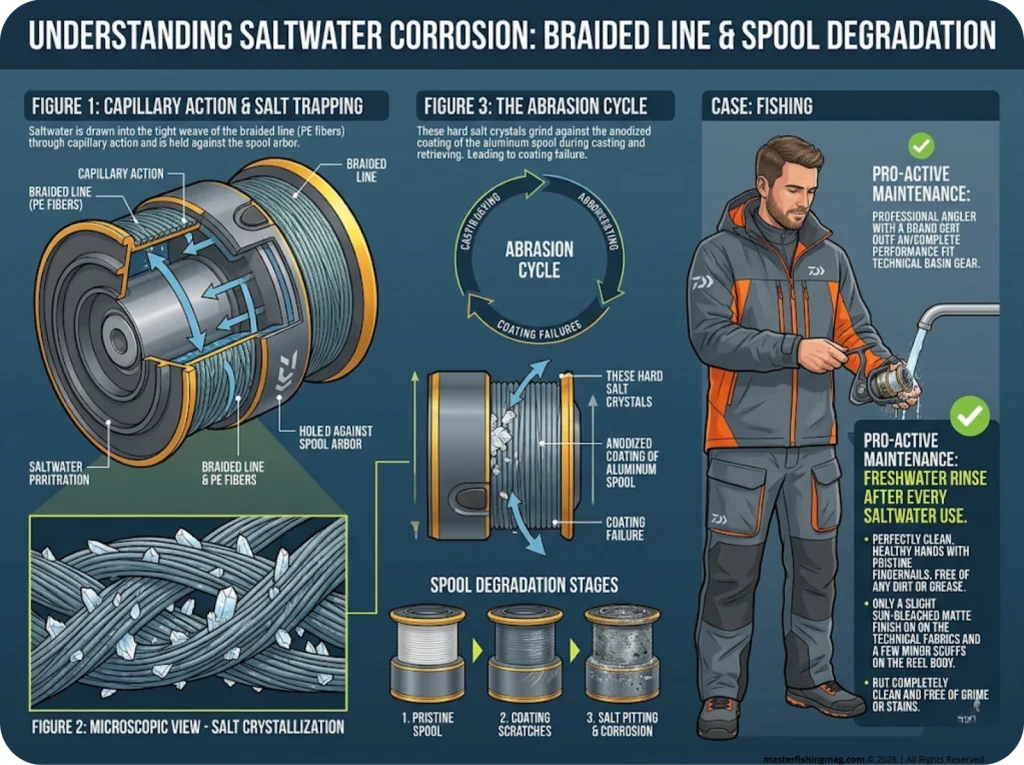
Here’s the gear maintenance gap almost nobody talks about. You rinse the reel, wipe it down, store it properly. But the braided line sitting on your spool? It’s been quietly depositing salt into your reel’s most expensive component for weeks.
Capillary Action and the Salt Reservoir Effect
Braided line is a woven structure—and its porosity is the problem. Through capillary action, saltwater gets pulled deep into the spool, far below the surface layers you can see. When the water evaporates between trips, it leaves behind concentrated salt crystals trapped within the weave and pressed directly against the aluminum spool.
This creates a “salt reservoir” sitting in contact with the metal for weeks or months. It’s the primary cause of “spool rot”—where the anodized coating fails and the metal beneath starts to pit and flake. And here’s the kicker: higher strand counts (8-strand, 12-strand) have tighter weaves that retain even more water. Premium PE lines are paradoxically higher-risk.
If the braid itself becomes compromised, knowing when it’s time to replace your fishing line prevents you from compounding the problem with worn-out line.
Pro tip: After every saltwater trip, spool off at least 50 yards of braid, soak the spool in warm freshwater for 10 minutes, then re-spool under light tension. It adds five minutes to your routine and five years to your spool.
The Freshwater Soak Method for Deep Cleaning Braid
A surface rinse cannot reach salt trapped inside braided line. The only effective method is full immersion. Remove the spool, submerge it in a bucket of warm freshwater for 10–15 minutes, agitate gently, then let it fully air dry before re-mounting.
For heavily fished reels—three or more saltwater trips a week—consider a dedicated braid rinse bucket as part of your gear care kit. Never use soap or detergent directly on braid. Surfactants can strip the fiber’s surface treatment and speed up UV breakdown.
If you’re also dealing with twist issues from the re-spooling process, understanding how line twist compounds spool damage ties the two problems together.
The WD-40 Trap and What Actually Works — Oil vs. Grease vs. Solvent
The internet says spray WD-40 on your reel. The internet is wrong. This is the oil vs grease debate settled with facts.
Why WD-40 Is a Reel Killer in Disguise
WD-40 stands for “Water Displacer, 40th formula.” It’s made of petroleum distillates—the same family of solvents used to strip paint. It’s an excellent penetrant. It is a terrible long-term reel lubricant.
The danger is what happens after the initial spray feels like it’s working. WD-40 penetrates into the gearbox, dissolves the factory grease, and leaves the reel gears running metal-on-metal. This is grease emulsification—and it’s irreversible without a full teardown and re-grease.
It gets worse. The solvents can swell or degrade the rubber O-ring seals that protect the internals, compromising the reel’s seal integrity. And if your reel has Daiwa MagSeal? WD-40 dissolves the magnetic ferrofluid and permanently destroys the seal.
The verdict: WD-40 has exactly one valid use in reel servicing—freeing seized screws during a full disassembly. It should never touch a functioning reel.
Grease vs. Oil — The Viscosity Rule
The fundamental rule of reel lubrication: grease for load-bearing gears, oil for high-speed rotational components. Getting this wrong is the second most common mistake after the high-pressure hose.
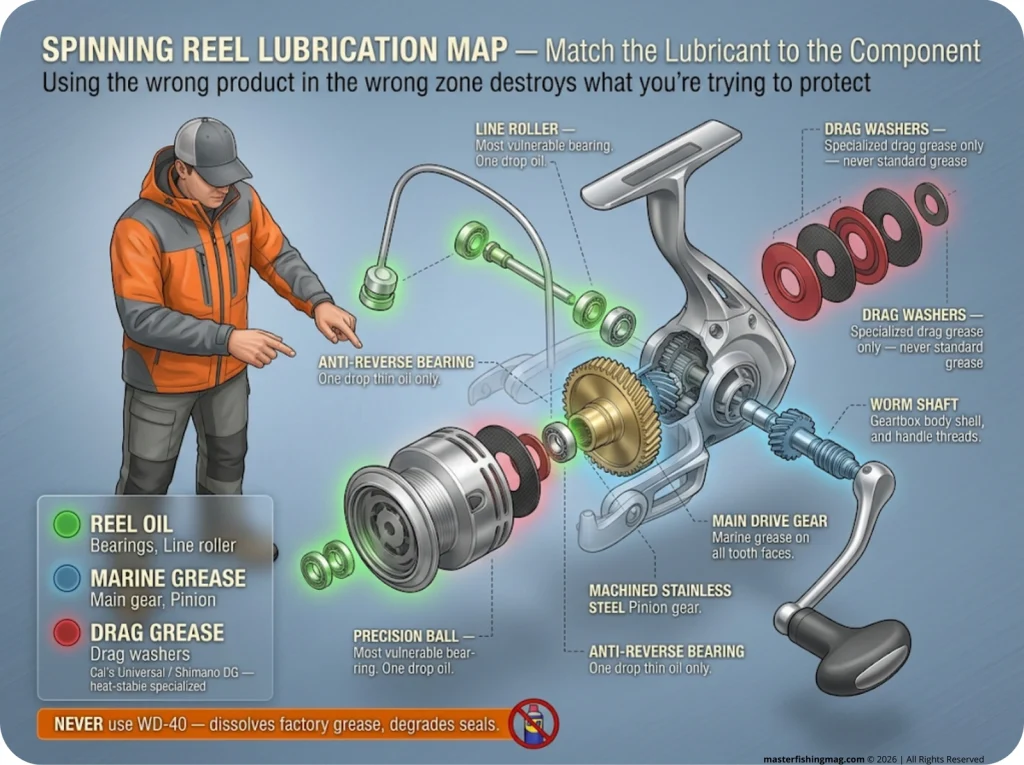
Reel grease is a semi-solid lubricant that stays in place on gear teeth even under high-speed spinning. Use marine-grade grease on the main drive gear and pinion gear. Reel oil is a thin fluid designed to reduce friction in reel bearings and on the main shaft. Cheap, hygroscopic greases actually attract and hold moisture from the air, leading to internal rust prevention failures. Choose marine-specific products that repel water instead of trapping it.
Using grease in bearings causes “gumming.” Using oil on gears causes wash-out. Match the lubricant to the component.
Drag washers require their own specialized grease—products like Cal’s or Shimano DG that maintain consistent grip under the heat generated during a long fight. Standard grease breaks down too fast.
For the complete visual breakdown of where each product goes, our visual reel greasing and lubrication map covers every application point.
Inox MX3 and MX5 — The Professional’s Choice
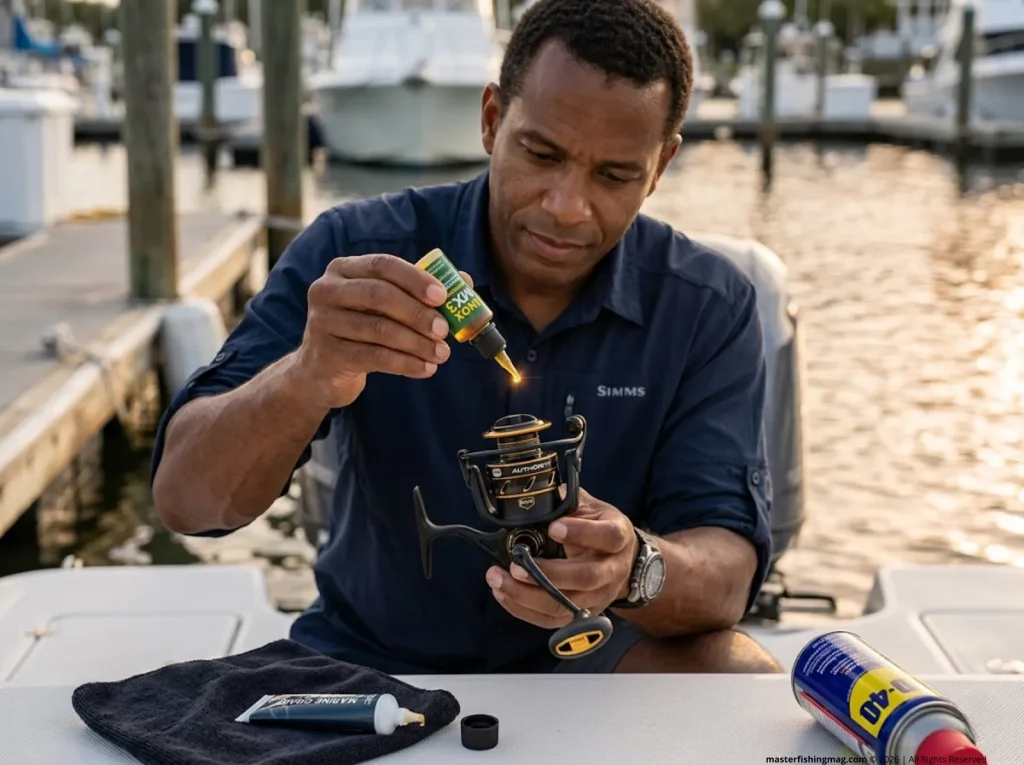
Inox MX3 is non-toxic, non-conductive, and contains no silicon, acid, or kerosene. It’s safe for all plastics and neoprene seals—and it qualifies as an eco-friendly lubricant, which matters if you’re cleaning gear near the water. The key advantage: it doesn’t dry out or turn “gooey” over time, unlike petroleum-based alternatives that eventually gum up the reel components they’re supposed to protect.
Inox MX5 adds PTFE (Teflon) for a “dry” lubrication layer that remains effective even if the liquid carrier evaporates. For routine external maintenance, one drop of MX3 on the line roller, bail arm hinges, and handle threads after the monthly clean is the professional standard.
I switched to Inox MX3 five years ago after a reel tech in Florida told me it’s all he uses on client reels worth $400+. Haven’t gone back. The science backs the switch—the University of Delaware’s technical overview of galvanic corrosion confirms that proper non-solvent lubricants create protective barriers rather than accelerating the corrosion process.
The Monthly Deep-Clean and the Annual Teardown
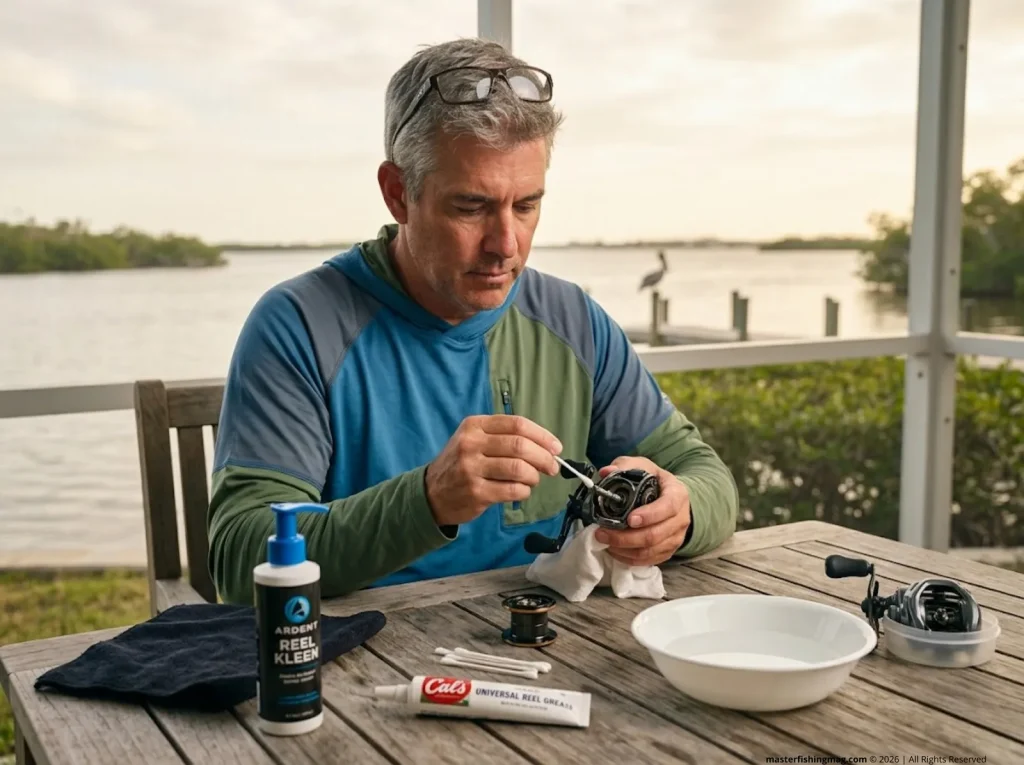
The 2-minute rinse handles the immediate threat. But for serious saltwater anglers, two deeper tackle maintenance tiers keep a reel performing at its best across seasons.
The Monthly External Lube (Level 2)
Every 4–6 weeks for frequent saltwater anglers: remove the spool and handle. Clean the main shaft and handle threads with a Q-tip and a mild degreaser like Dawn dish soap—the core of a solid monthly wipe-down.
The line roller is the most vulnerable bearing on a spinning reel. Apply a single drop of oil—Inox MX3 or Shimano Bantam oil—and test with a fingernail flick. It should spin freely and silently. A seized line roller causes catastrophic line twist that compounds every cast.
Hit the bail arm pivots with one drop of oil on each hinge. This prevents “lazy bail” syndrome—the sluggish bail trip common in salt-affected reels. Finish with a corrosion inhibitor wipe—Lanox or MX3 on a cloth—across the entire exterior to create a hydrophobic film that sheds future salt spray.
If the fingernail test reveals a rough, grinding roller, it may be time for a deeper intervention. Our guide on when to replace reel bearings vs. just cleaning them walks you through the diagnosis.
The Annual Professional Service (Level 3)
Modern mid-to-high tier reels—Monocoque bodies, MagSeal components, magnesium housing frames, precisely shimmed gear stacks—are built to tolerances that make DIY internal servicing impractical without specialized tools.
An annual deep clean by a professional includes ultrasonic cleaning of gears and reel bearings, identification and replacement of pitted “crunchy” bearings, shim tuning for gear mesh, and MagSeal ferrofluid renewal for Daiwa owners. This is what real professional servicing looks like—not a spray-and-pray with a solvent can.
The math is simple: a reel servicing appointment runs $40–$75. A replacement Penn Spinfisher or Shimano Stradic costs $300+. Schedule the service in the off-season—most reel techs have a 2–3 week backlog during peak summer. February is ideal.
If you’re noticing specific issues like back-play in the handle, understanding diagnosing anti-reverse failures can help you pinpoint whether it’s a bearing or a clutch problem before sending it in.
DIY vs. Pro — Where to Draw the Line
Here’s the decision rule that’s never failed me: if you can see the component without removing screws, you can maintain it yourself. If it requires a screwdriver, send it to a tech.
DIY-safe tasks include external rinse, spool removal, line roller cleaning, handle threads, bail arm pivots, and drag decompression. Pro-only tasks include gearbox disassembly, bearing lubrication replacement, MagSeal renewal, and shim adjustment. Opening the reel housing without proper shim records risks altering gear mesh—leading to noise, vibration, or premature wear.
The 5 Mistakes That Ruin Saltwater Reels (And What to Do Instead)
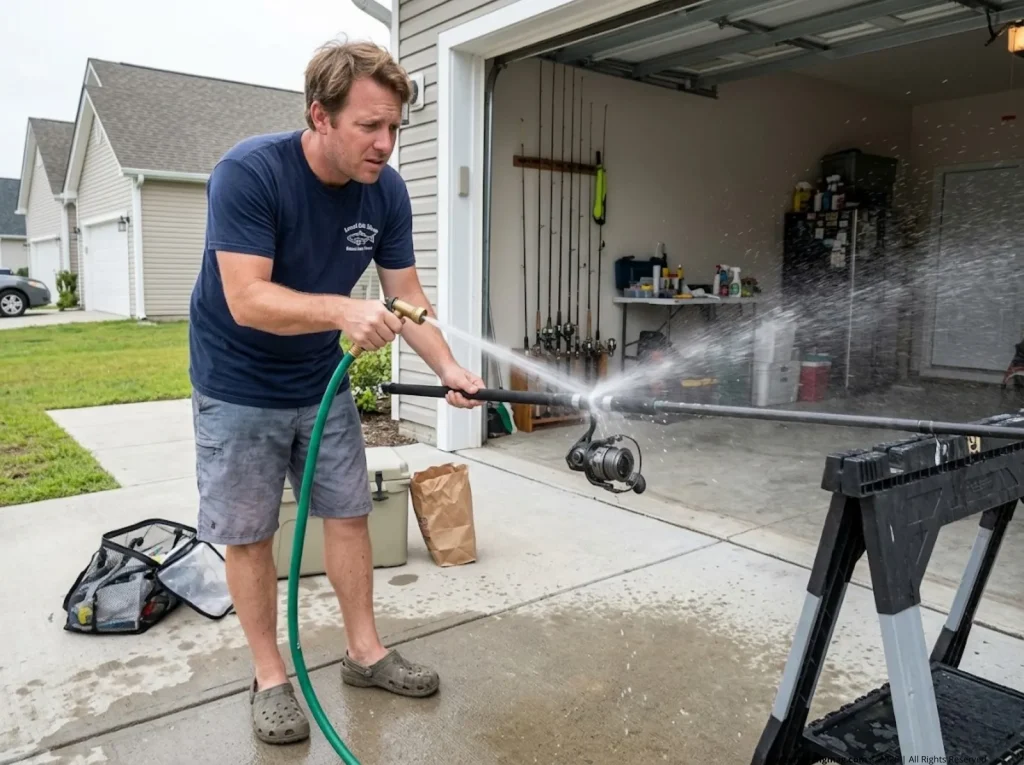
These are the habits I see destroy reels season after season. Every one of them is fixable in under a minute.
Mistake 1 — High-Pressure Hosing
The garden hose nozzle on jet setting creates enough force to lift seal lips and push water past labyrinth seals. The result is hydrolock—water emulsifies the grease and strips lubrication from the gears. Fix: spray bottle or mist setting only. Warm water rinse. Top-down spray only.
Mistake 2 — Spraying WD-40 Into the Reel
WD-40 dissolves factory grease, degrades elastomeric seals, and destroys MagSeal systems. The result is metal-on-metal contact and accelerated internal corrosion. Fix: Inox MX3 or manufacturer-recommended oil for external lubrication points only.
Mistake 3 — Storing With a Tight Drag
Compressed drag washers “set” over time—carbon fiber or felt takes a permanent shape. The result is jerky, inconsistent drag performance from stiction. Fix: loosen the drag completely after the reel is dry. Re-set before the next trip.
Mistake 4 — Ignoring the Braided Line as a Salt Source
Braid captures and stores salt crystals via capillary action, depositing them directly against the spool surface. The result is “spool rot”—anodized coating failure and aluminum pitting. Fix: soak the spool in warm water for 10–15 minutes after every saltwater session.
Understanding how line memory compounds salt damage shows why stiff, memory-locked coils press salt even deeper into the spool surface.
Pro tip: Write the date on a small piece of tape and stick it inside the spool cavity every time you re-spool. When you see that date and it’s been 6+ months of saltwater angling, it’s time for fresh braid—no matter how the old line looks. Keep a maintenance log and you’ll never guess again.
Conclusion
Three things keep a saltwater reel alive. The 2-minute post-trip rinse is non-negotiable. Tighten the drag, warm mist from the top, wipe dry, loosen and store. Get the pressure wrong and you’ve pushed salt deeper instead of washing it away. Your braided line is a salt reservoir. Until you address the braid sitting on your spool, no amount of external rinsing protects the aluminum underneath. Soak it, strip it, or replace it. Match the lubricant to the component. Grease for gears, oil for bearings, and nothing—absolutely nothing—from a can of WD-40.
Run the 2-minute rinse after your next saltwater trip. Then pull the spool off and look at the shaft. If you see white powder, you’ve found the problem—and now you know exactly how to fix it.
FAQ
Can I hose down my fishing reel after saltwater?
Only on a fine mist or shower setting with warm water, sprayed from the top down. High-pressure nozzles force salt past the seals and into the gearbox, causing hydrolock and grease emulsification. A spray bottle is even safer.
Is WD-40 good for fishing reels?
No. WD-40 is a solvent that dissolves factory grease, degrades rubber seals, and destroys Daiwa MagSeal systems. Use Inox MX3 or manufacturer-recommended reel oil instead. Its only valid reel use is freeing seized screws during a full teardown.
How often should you service a saltwater spinning reel?
After every trip: the 2-minute rinse and wipe. Monthly: external lubrication of the line roller, bail arm hinges, and handle threads. Annually: professional servicing with bearing inspection and grease replacement. That three-tier reel servicing frequency covers everything.
Should I take my reel apart to clean it?
Not unless you have experience with shim records and gear mesh. Removing screws risks altering internal tolerances. Stick to external spinning reel maintenance—spool removal, line roller cleaning, and bail pivots—and send the internals to a professional once a year.
What is the best grease for spinning reels?
Marine-grade reel grease for the main gear and pinion (high tack, shear-stable). Low-viscosity synthetic reel oil for bearings and the line roller. Specialized drag grease like Cal’s or Shimano DG for the drag washers. Never use one product everywhere—that’s the fastest path to gear maintenance failure.
Risk Disclaimer: Fishing, boating, and all related outdoor activities involve inherent risks that
can lead to injury. The information provided on Master Fishing Mag is for educational and informational purposes
only. While we strive for accuracy, the information, techniques, and advice on gear and safety are not a substitute
for your own best judgment, local knowledge, and adherence to official regulations. Fishing regulations, including
seasons, size limits, and species restrictions, change frequently and vary by location. Always consult the latest
official regulations from your local fish and wildlife agency before heading out. Proper handling of hooks, knives,
and other sharp equipment is essential for safety. Furthermore, be aware of local fish consumption advisories. By
using this website, you agree that you are solely responsible for your own safety and for complying with all
applicable laws. Any reliance you place on our content is strictly at your own risk. Master Fishing Mag and its
authors will not be held liable for any injury, damage, or loss sustained in connection with the use of the
information herein.
Affiliate Disclosure: We are a participant in the Amazon Services LLC Associates Program, an
affiliate advertising program designed to provide a means for us to earn advertising fees by advertising and linking
to Amazon.com. As an Amazon Associate, we earn from qualifying purchases. We also participate in other affiliate
programs and may receive a commission on products purchased through our links, at no extra cost to you. Additional
terms are found in the terms of service.