
In this article
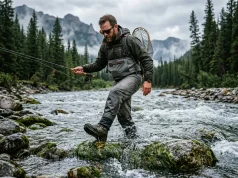
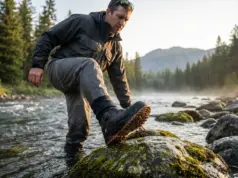
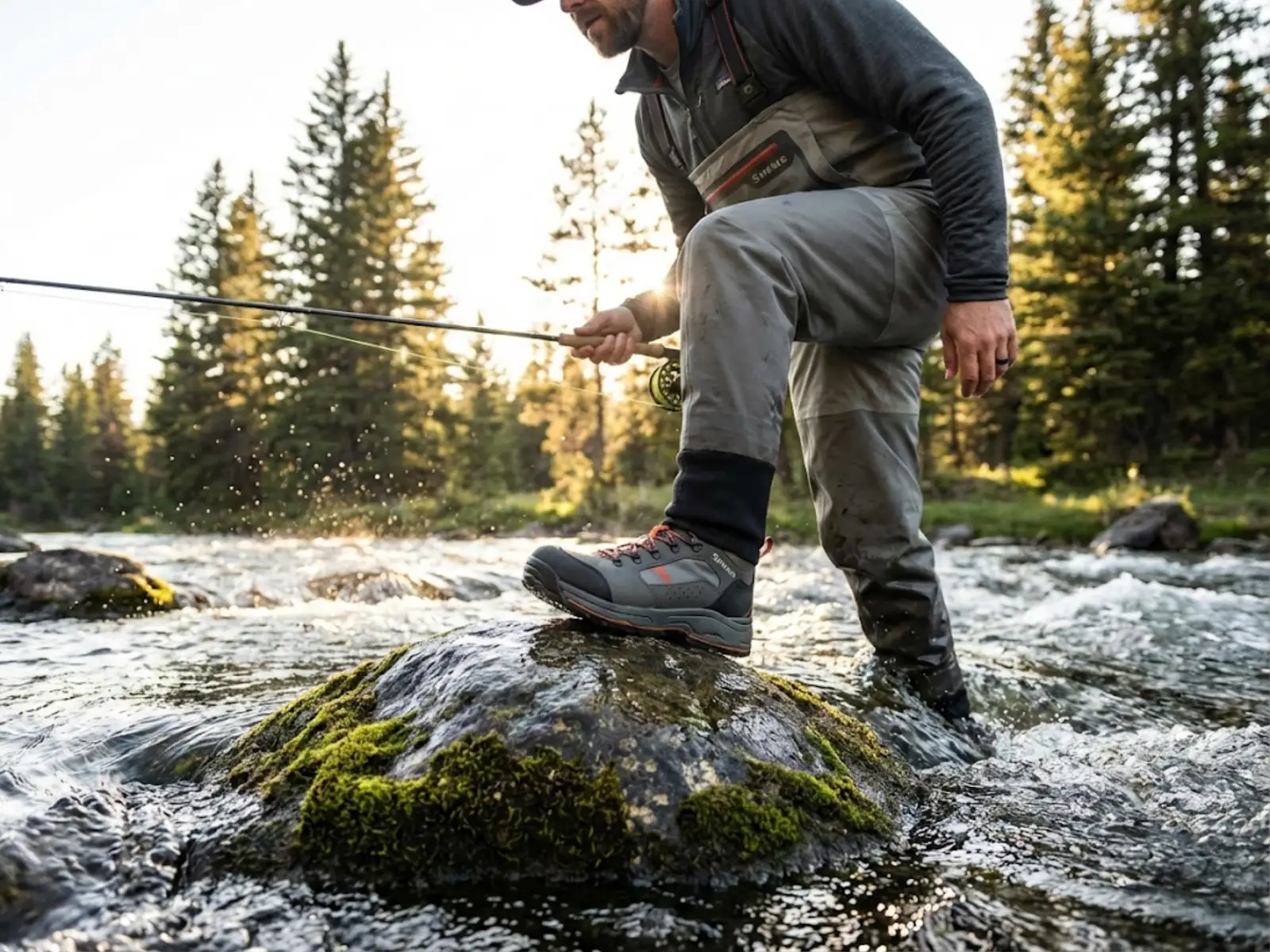
The current slammed against my shins, pushing me off balance on the Madison River. The algae-slicked boulders beneath my Simms G3 boots felt like greased bowling balls. One wrong step and I’d be swimming in 45-degree water with a thousand dollars worth of gear going downstream. After two decades of guiding on freestone rivers, coastal flats, and everything in between, I’ve learned that your traction is your lifeline. The wrong sole choice doesn’t just cost you fish—it can cost you a broken wrist or a cold swim you’ll never forget.
This guide breaks down the physics, the materials, and the regulations so you can pick the right grip for your ground. Whether you’re stalking permit on sandy flats in Belize or hopping slippery rocks in Montana, here’s what actually works.
⚡ Quick Answer: Felt soles grip better on algae-covered rock but are banned in many states due to invasive species. Rubber soles are legal everywhere, better on mud and trails, but need metal studs to match felt’s grip on slick surfaces. Choose based on your terrain, your local regs, and how much hiking you’ll do to reach the water.
The Biomechanics of Traction: Why You Slip
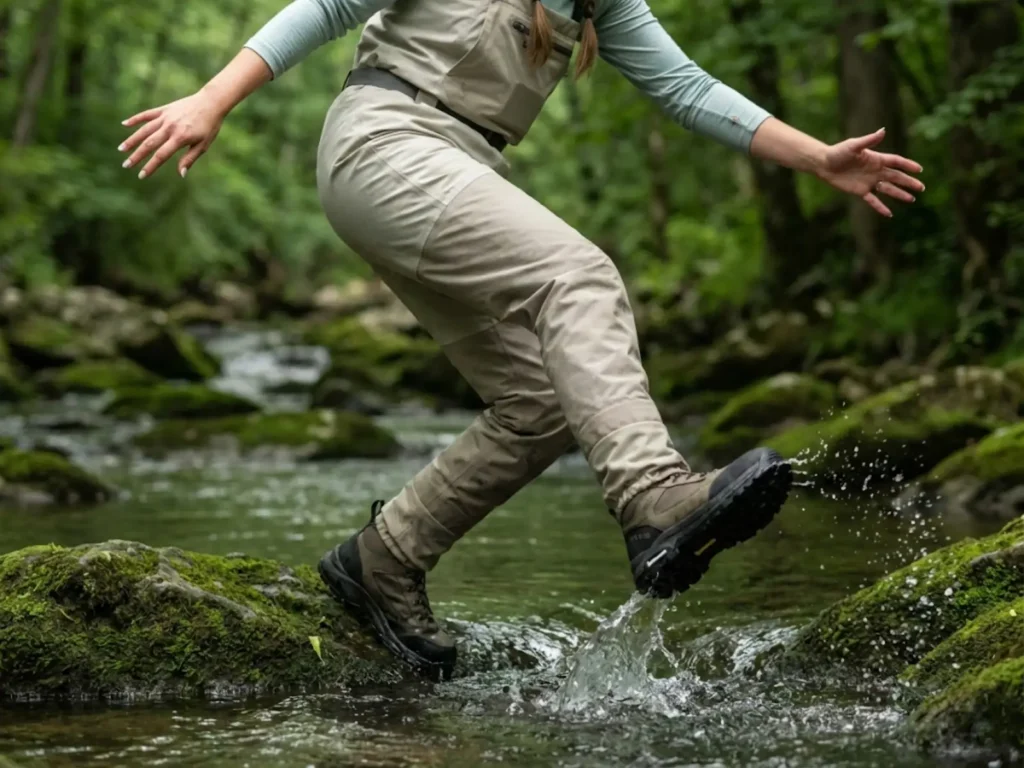
Understanding why you slip is half the battle. When you’re wading a river, you’re fighting more than just current—you’re dealing with a layer of slime that turns every boulder into a hockey rink.
The Physics of Adhesion vs. Hysteresis
Two forces keep you upright in water: adhesion and hysteresis. Adhesion is the molecular-level stickiness between your sole and the rock. Hysteresis is the energy absorbed when your boot material squishes into the rock’s microscopic grooves. Soft materials like felt and sticky rubber score high on both counts.
The problem? Water and biofilm break the adhesion bond. That layer of algae and diatoms—what old-timers call rock snot—acts like a lubricant, cutting your available grip by 30-50%. On a clean, wet rock, a sticky rubber sole might give you decent grip. Coat that rock in algae and you’re skating. That’s the difference between confident wading and a cold, dangerous swim.
Pro tip: Pay attention to the color of the rocks. That slimy green or brown film? That’s your enemy. If you can see it, you need maximum grip—felt, studs, or both.
The “Greased Glass” Effect of Algae
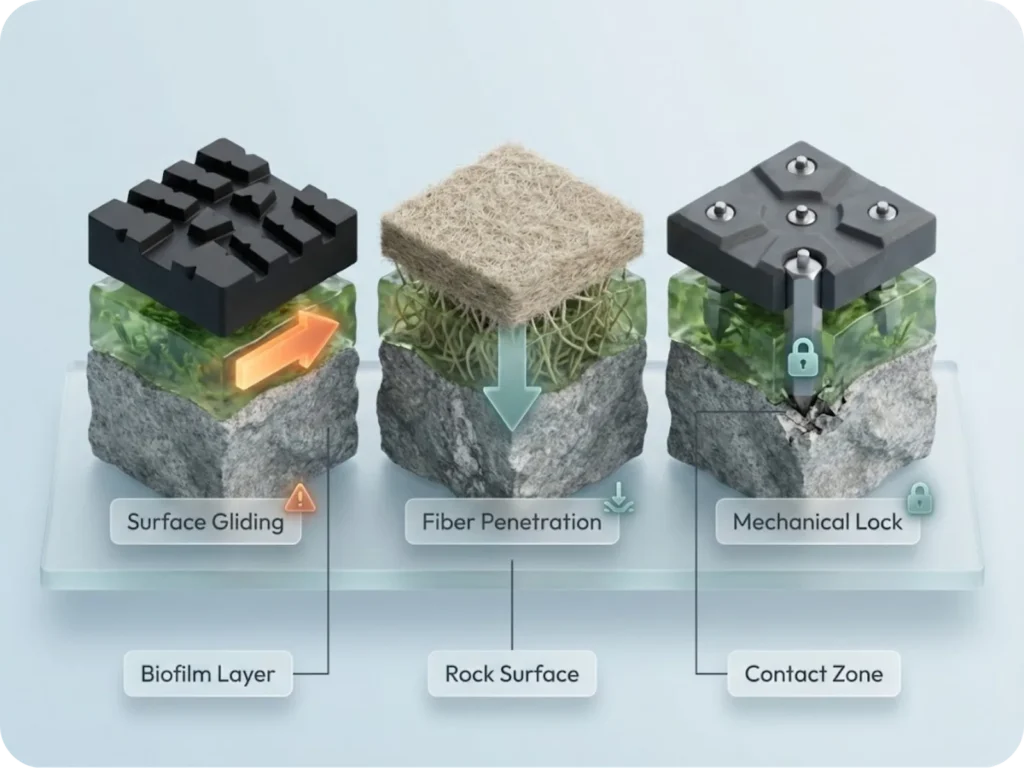
Here’s where things get specific. Periphyton—the biofilm of algae, diatoms, and bacteria on submerged rocks—is the nemesis of rubber. Hard rubber can’t penetrate this layer. It just skates across the top. Felt fibers, by contrast, are like a million tiny fingers that push through the slime to grab the rock beneath.
This is why an angler in Vibram Idrogrip boots feels rock-solid on a clean riffle but suddenly skating on a shaded, algae-covered ledge. The rubber didn’t change; the surface did.
Mud Suction and Vacuum Force
Mud flips the script entirely. On clay banks and muddy rivers, felt becomes a liability. Its flat surface collects silt and transforms into a smooth pad with zero bite. Worse, the interstitial spaces in felt fill with gunk, adding weight and reducing any remaining grip.
Rubber lugs, on the other hand, channel mud away with each step. Deep tread patterns self-clean—the flex of the sole expels the muck so your next footfall lands on rubber, not caked clay.
Pro tip: When stepping through deep mud, lift your heel first to break the vacuum seal before pulling your entire foot. This prevents losing your boot to suction.
Felt Soles: The Rock Specialist
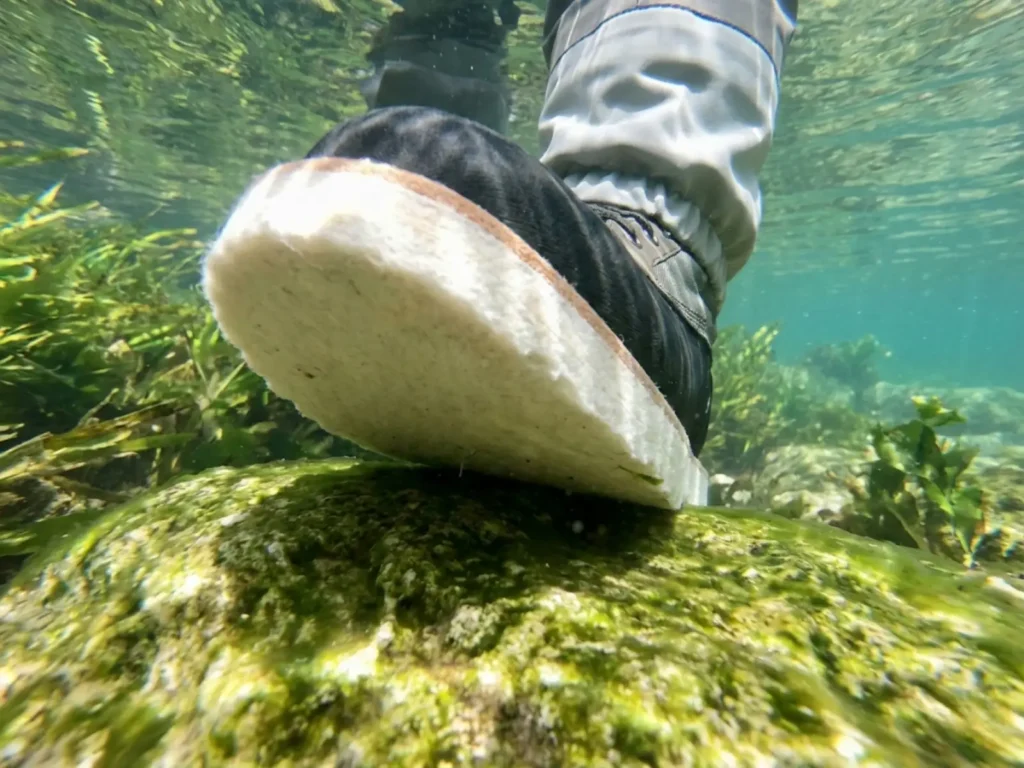
For pure slippery rock grip, felt remains the gold standard. The reason comes down to fiber mechanics.
Fiber Micro-Conformance
A felt sole wading boot is constructed from a dense mat of randomly woven synthetic or wool fibers. When you step on a rock, those fibers compress into every pit and crevice. They create millions of contact points that cut through biofilm to reach solid substrate. It’s like Velcro at a microscopic level.
This is why a brand-new pair of Miss May Fly Moxie wading boots or Simms Freestone felt soles will stick to a slimed boulder where bare rubber would skate. Field testing shows felt provides 30-50% more grip on algae-covered surfaces than naked rubber.
Superiority on Biofilm
If you fish rocky freestone rivers with heavy algae—think Pennsylvania limestone creeks, Montana spring creeks, or the tailwaters below dams—felt is hard to beat. The fiber structure conforms to irregular surfaces and doesn’t require metal studs to achieve maximum contact. For many wading guides, felt is still the first choice when winter trout fishing cold-water streams with slick bottoms.
The Snow and Mud Liability
The downside? Felt is a one-terrain tool. On wet grass, it’s skating rink. On mud, it’s a greased slide. And in snow, it’s a disaster—wet felt absorbs moisture, freezes, and builds into awkward platform shoes that make walking dangerous. If your day involves hiking through meadows, crossing muddy banks, or dealing with early-season snow, felt becomes dead weight.
Rubber Soles: The Multi-Terrain Generalist
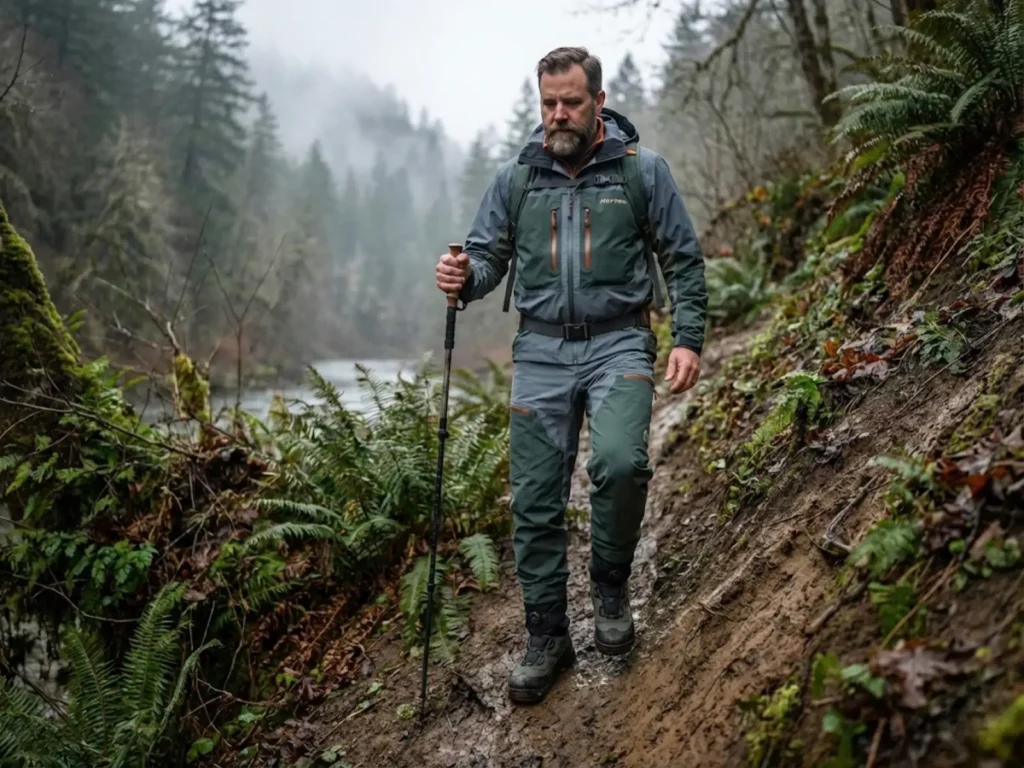
Modern rubber boots have closed much of the gap with felt, especially when combined with studs. The key is understanding which compounds work and which don’t.
Advanced Elastomer Compounds
Not all rubber is created equal. Standard hiking boot rubber is too hard for wading—it skates on wet rock like an ice cube. The good stuff comes from partnerships with tire companies.
Vibram Idrogrip, used by Simms and Korkers, is a soft, sticky compound engineered for wet-surface adhesion. It’s what you’ll find on boots like the Simms G3 Guide or the Korkers River Ops BOA. Michelin Outdoor Extreme, developed for Orvis PRO wading boots, borrows technology from agricultural tires—it offers 43% better wet-rubber traction than standard competitors.
These compounds hit a Shore hardness around 65-80, soft enough to mold into rock texture but hard enough to survive trail miles.
Self-Cleaning Tread Design
Rubber really shines on mixed terrain. Deep lugs channel water and mud away from the contact patch. With every flex of your foot, debris gets expelled. If you’re hiking into remote waters with miles of trail before you even see the river, rubber keeps you stable the whole way.
Unlike felt, rubber doesn’t absorb water, so it stays light. It dries fast. And it doesn’t become a habitat for invasive organisms between fishing trips.
Durability and Hiking Performance
On abrasive granite trails, rubber outlasts felt by years. Felt soles delaminate when they repeatedly soak and dry; rubber just keeps going. For anglers who split their time between wading and pursuing smallmouth bass on rocky banks, rubber’s versatility is tough to match.
The Equalizer: Studs, Cleats, and Bars
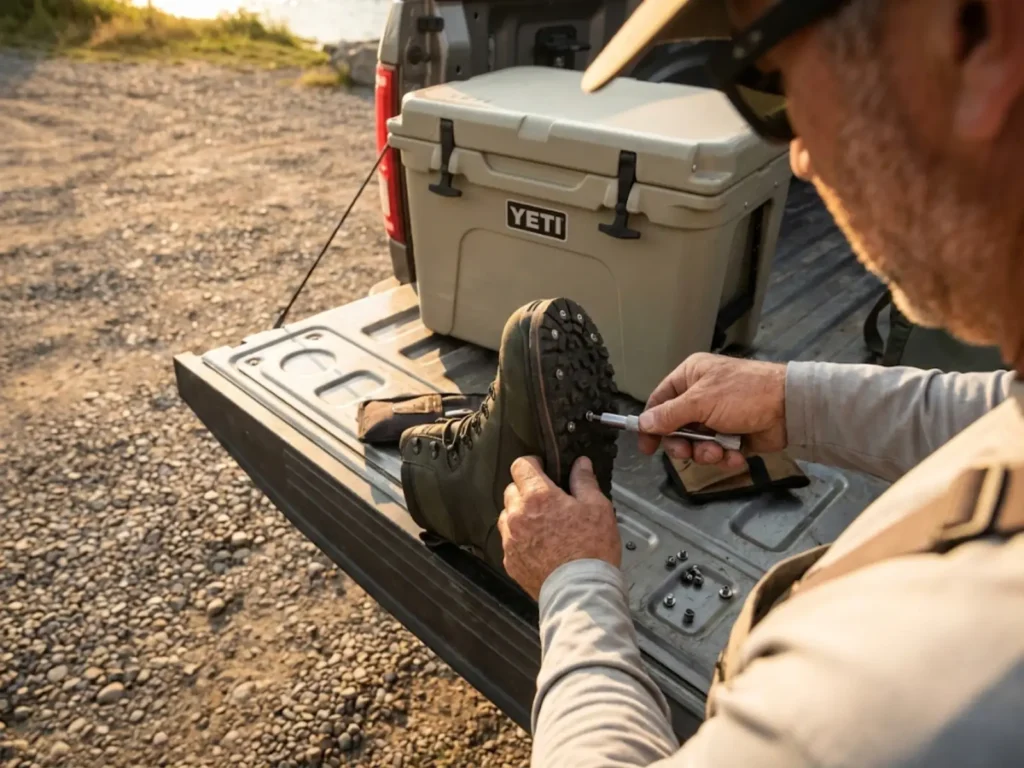
If rubber alone isn’t enough—and on algae-covered rocks, it often isn’t—metal accessories close the gap.
Physics of Point Pressure
A tungsten carbide stud concentrates your body weight onto a tiny point. The pressure formula is simple: smaller area equals higher pressure. That pressure punches through the biofilm layer to reach solid rock beneath. Studs convert a skating surface into something grippy.
But there’s a catch. Carbide is harder than most rock. On smooth, hard granite, studs can “skate”—the metal doesn’t bite if the rock is even harder. That’s where aluminum comes in.
Scuffing vs. Cutting: Aluminum vs. Carbide
Aluminum bars—made famous by Patagonia Foot Tractor boots—are sacrificial. The soft metal scuffs and abrades against hard rock, creating friction through deformation. It’s why guides who work slick granite boulders swear by aluminum: it “gives” and molds to the surface.
Carbide studs, by contrast, are designed to cut into softer rock like limestone, shale, or siltstone. They last for seasons but can slip on ultra-hard surfaces. The takeaway? Match your metal to your rock type.
Pro tip: On hard boulder fields, choose aluminum bars. On softer limestone creeks, go with carbide studs. The wrong choice negates the metal’s advantage.
Strategic Installation Patterns
More studs aren’t always better. If you stud the entire sole, you’re walking on points that can skate on smooth bedrock—a “bed of nails” effect. The best approach is perimeter placement: concentrate studs around the outside edge of the forefoot and heel. This catches slips before they become falls.
Keep the center of the arch clear. Studs there create an unstable pivot point and interfere with a natural walking stride. If you’re unsure, most manufacturers include stud pattern optimization diagrams; follow them. Proper stud placement is as critical as other wading safety essentials like belts and PFDs.
The Legal Landscape: Invasive Species & Bans
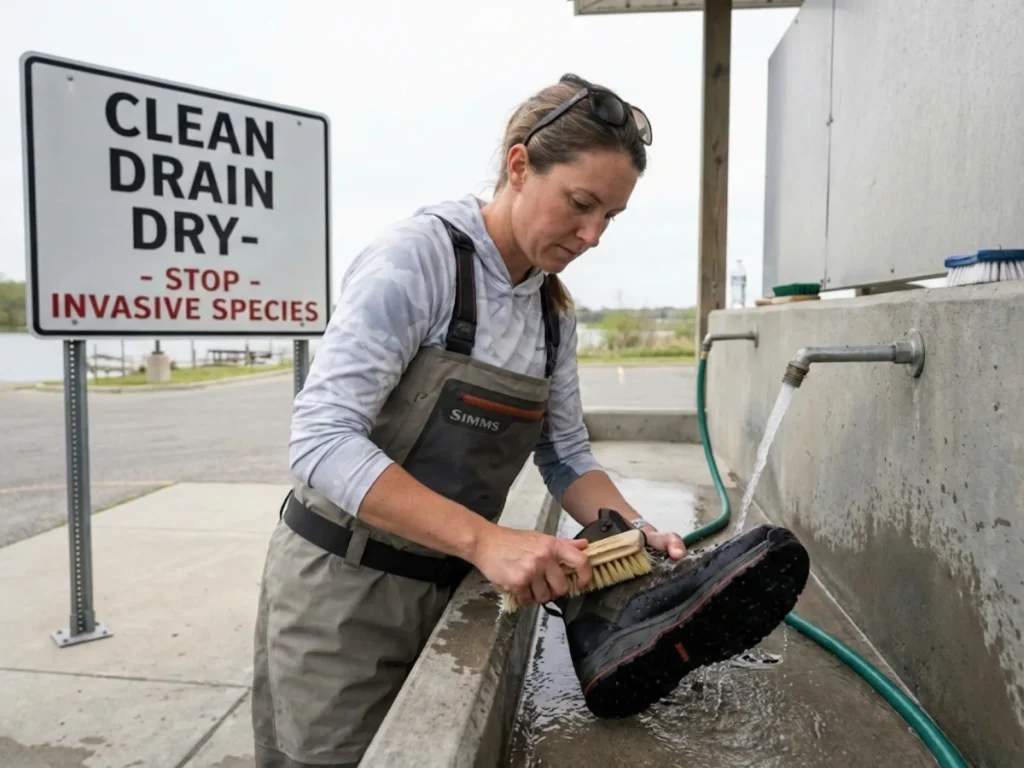
Here’s the part many anglers miss until they’re at a trailhead reading a warning sign. Felt soles transport invasive organisms, and invasive species regulations are tightening nationwide.
The Felt Vector: Didymo and Mudsnails
Felt is a sponge for microscopic hitchhikers. Studies show felt traps 100% of whirling disease spores it contacts, while rubber traps none. New Zealand mudsnails, tiny enough to hide in boot stitching, burrow deep into felt fibers where they survive for weeks. Didymo—that stringy “rock snot” diatom—can harbor nearly 3,000 times more live cells in felt than in rubber five hours after exposure.
Drying doesn’t guarantee safety. Felt retains moisture in its core, keeping organisms viable long after the surface appears dry. This is why agencies like the U.S. Fish & Wildlife Service recommend days of drying, not hours, and why some jurisdictions ban felt outright.
State-by-State Regulatory Analysis
As of 2025, felt sole bans exist in Alaska, Maryland, Missouri, Rhode Island, South Dakota, Nebraska, and all of Yellowstone National Park. New Zealand enacted the first national ban back in 2008. Fines range from $125 to over $1,000, and some jurisdictions can confiscate non-compliant gear.
States like Montana, Idaho, and Colorado rely on education rather than legislation—for now. The trend is toward stricter enforcement. If you fish multiple states or are traveling with fishing gear, interchangeable sole systems like Korkers OmniTrax let you swap between felt and rubber based on local rules.
Decontamination Protocols
If you do use felt—or even rubber—between different waters, cleaning protocols are essential. The three-step protocol is Clean, Drain, Dry: remove visible mud at the water, drain all standing water, and allow complete drying for at least five days. For felt, extend that to two weeks if possible.
Faster disinfection procedures include the freeze method overnight (kills mudsnails), a 10-minute soak in hot water at 140°F (kills most organisms), or a quaternary ammonia treatment. Bleach works but degrades boot materials. Pick your battles: kill the bugs without killing your gear.
This is part of total invasive species prevention that all responsible anglers should practice.
Decision Framework: Choosing Your System
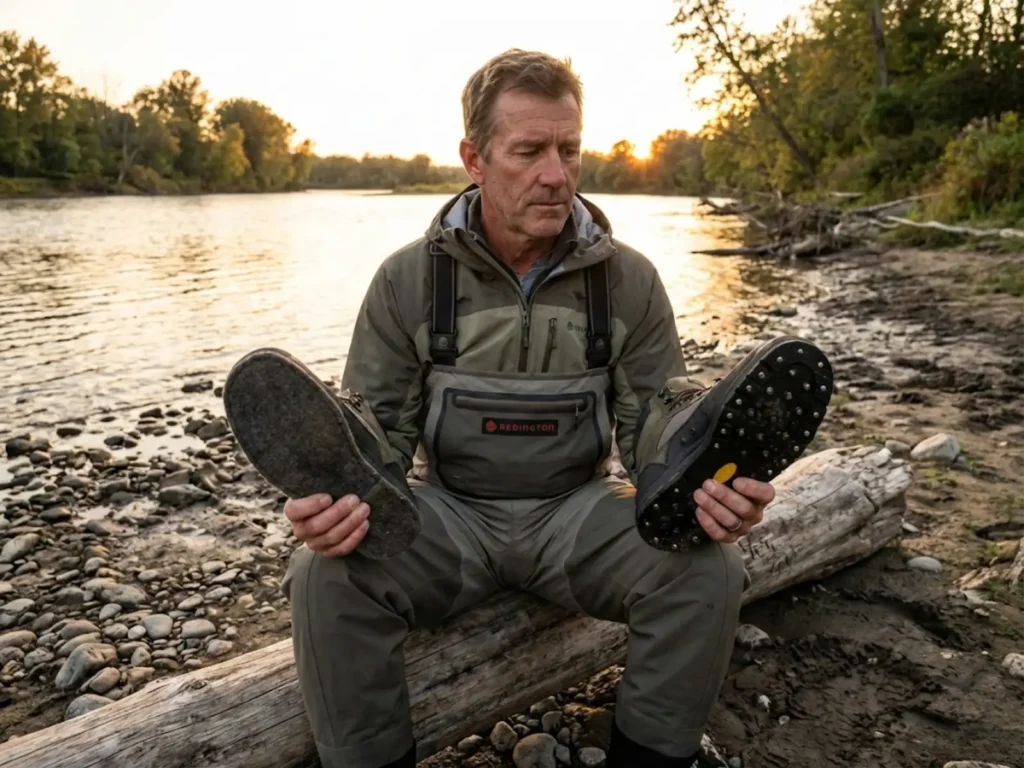
Knowing the science is one thing. Picking the right boot is another.
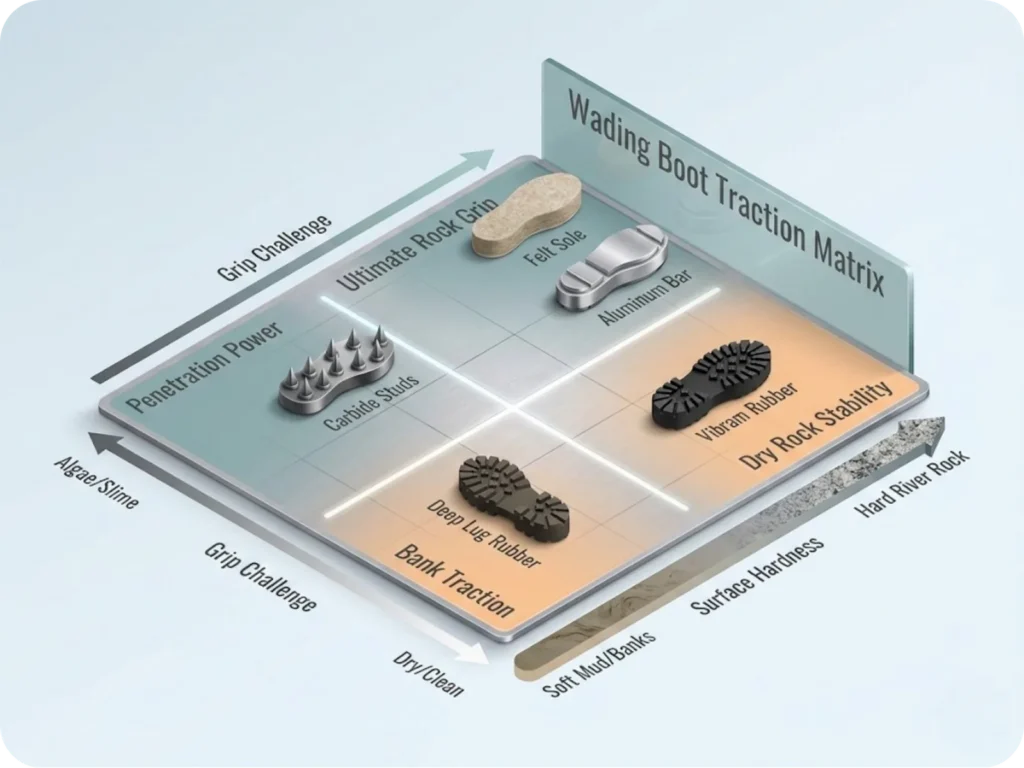
The Traction Matrix
Think about your primary terrain:
- Algae-covered rock + legal felt: Felt soles remain unmatched.
- Algae-covered rock + felt banned: Studded rubber with aluminum bars or carbide studs.
- Muddy banks + hiking access: Deep-lug rubber soles without studs.
- Mixed terrain + travel: Interchangeable sole systems with rubber base and stud-ready options.
Travel vs. Local Considerations
If you fish one river all season, optimize for that water. If you’re an expedition angler hitting different states—or countries—you need flexibility. Interchangeable systems let you pack one pair of boots with multiple sole options. Stash the felt for private waters where it’s legal; swap to studded rubber for national parks.
When sizing your wading gear, remember that boot rigidity affects comfort. A stiff, supportive boot like the Simms G3 provides great ankle support for heavy current but can cause secondary pain on long hikes. Lighter options trade some ankle protection for better walking feel.
Ankle Stability and Secondary Pain
Your feet connect to your knees connect to your hips. A stiff wading boot restricts natural ankle motion, which can cause compensatory strain higher up the chain. Research shows 67% of people wearing rigid ankle-limiting footwear report new pain in their lower back, hips, or knees within two weeks of regular use.
Choose a boot that balances protection with flex. If you’re covering serious ground before you even reach the water, consider lighter options with less aggressive ankle collars. If you’re standing in heavy current all day on boulders, prioritize support over walking comfort.
Conclusion
Don’t let gravity win. Whether you choose the fiber micro-conformance of felt for a limestone spring creek or aggressive studded rubber for multi-state travel, match the material to the mission. Slip-resistance isn’t a luxury—it’s what keeps you fishing instead of floating.
Check your local regulations before every trip. Inspect your studs for wear. Clean your gear between waters. And remember: the best sole is the one that gets you home upright with fish stories instead of emergency room paperwork.
FAQ
Are felt soles illegal in my state?
Felt soles are currently banned in Alaska, Maryland, Missouri, Rhode Island, South Dakota, Nebraska, and throughout Yellowstone National Park. New Zealand has a nationwide ban. Regulations change frequently, so check your state fish and game website before heading out.
Do I really need studs on rubber soles?
Yes, for safe wading on algae-covered rocks, bare rubber often isn’t enough. Adding tungsten carbide studs or aluminum bars dramatically increases your grip by penetrating through the biofilm layer to contact solid rock beneath.
Can I hike in felt wading boots?
It’s not recommended. Felt offers minimal traction on mud, wet grass, and snow, and the soft material wears down quickly on abrasive trails. For approach hikes, rubber soles are far more practical.
How do I clean felt boots to prevent invasive species?
The most effective methods are freezing for 24 hours or soaking in 140°F water for 10 minutes. A 10% bleach solution also works but may degrade boot materials over time. Allow felt to dry completely—ideally two weeks—between uses in different waters.
Risk Disclaimer: Fishing, boating, and all related outdoor activities involve inherent risks that
can lead to injury. The information provided on Master Fishing Mag is for educational and informational purposes
only. While we strive for accuracy, the information, techniques, and advice on gear and safety are not a substitute
for your own best judgment, local knowledge, and adherence to official regulations. Fishing regulations, including
seasons, size limits, and species restrictions, change frequently and vary by location. Always consult the latest
official regulations from your local fish and wildlife agency before heading out. Proper handling of hooks, knives,
and other sharp equipment is essential for safety. Furthermore, be aware of local fish consumption advisories. By
using this website, you agree that you are solely responsible for your own safety and for complying with all
applicable laws. Any reliance you place on our content is strictly at your own risk. Master Fishing Mag and its
authors will not be held liable for any injury, damage, or loss sustained in connection with the use of the
information herein.
Affiliate Disclosure: We are a participant in the Amazon Services LLC Associates Program, an
affiliate advertising program designed to provide a means for us to earn advertising fees by advertising and linking
to Amazon.com. As an Amazon Associate, we earn from qualifying purchases. We also participate in other affiliate
programs and may receive a commission on products purchased through our links, at no extra cost to you. Additional
terms are found in the terms of service.