
In this article
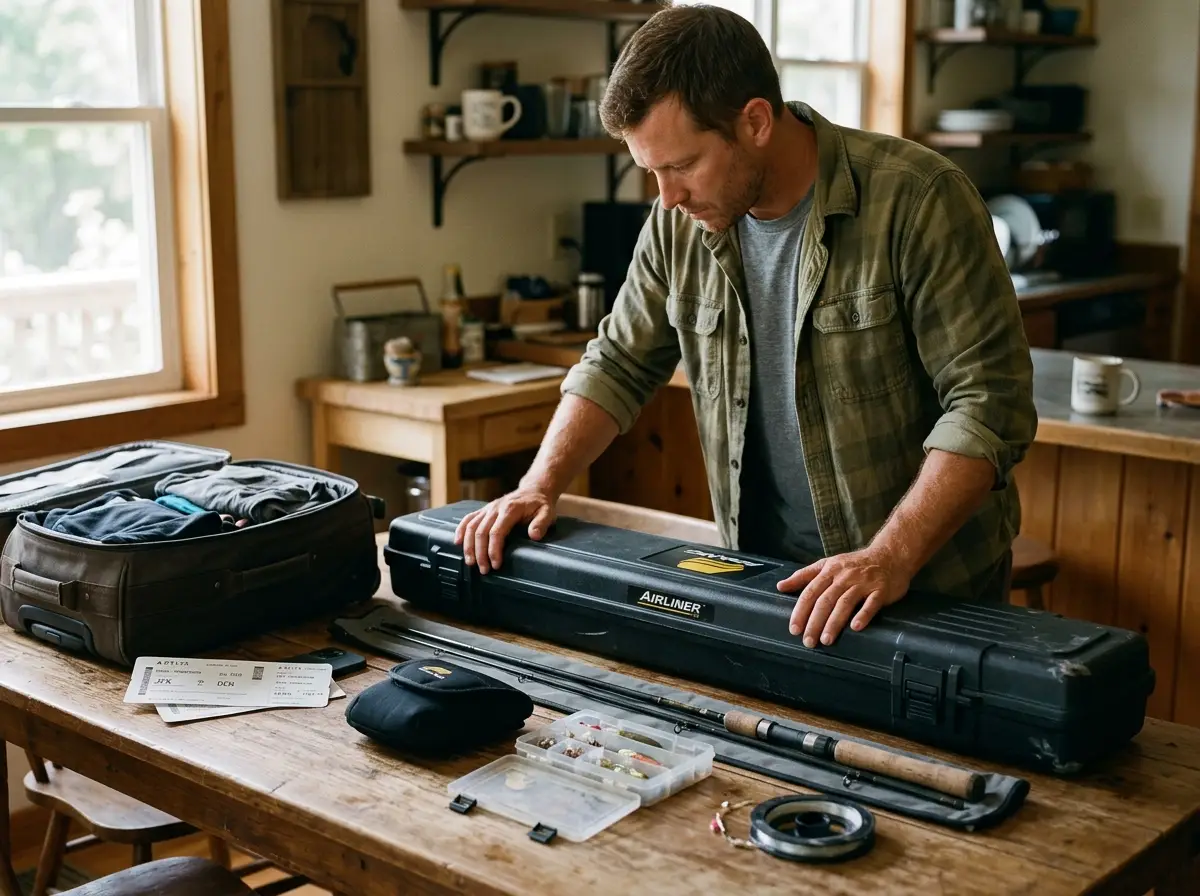
You have a flight booked, a trip you have been counting down to for weeks, and now the fishing bag is open on the bed while you try to guess what actually clears the checkpoint. Here is the reassuring part: the Transportation Security Administration (TSA) lets most fishing gear fly without a second look. Here is the part nobody tells you: a handful of specific items, a treble-hook lure, a loose spare battery, a taped-shut rod tube, are where trips go sideways at the belt, and those are the ones this guide zeroes in on. We will cover your rod, your reel, hooks and lures, the battery rules almost every other guide skips, how to pack so the tube survives baggage handling, airline fees, why an officer’s judgment beats the printed rule, international destinations, and a night-before checklist you can actually run.
Can You Bring a Fishing Rod on a Plane? (Carry-On vs. Checked)
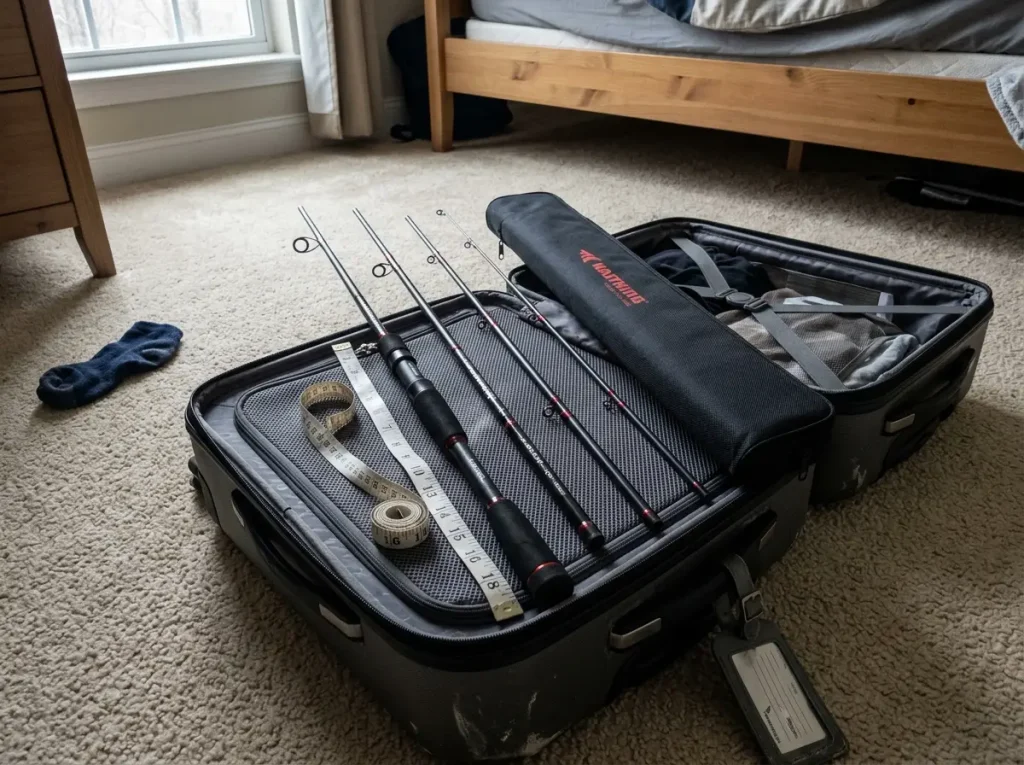
Here is where most people worry about the wrong thing. The rod itself is almost never the TSA problem. The airline’s carry-on tape measure is. Fishing rods are federally permitted in both carry-on and checked baggage, and no TSA rule bans a rod as a rod. What stops you is whether it physically fits the overhead-bin dimensions your airline sets, and a gate agent can refuse an oversized rod even after TSA waved it through.
That gap between what TSA allows and what fits an overhead bin is the whole game. A standard two-piece seven-footer will not fit a 21-inch to 22-inch roller no matter how you angle it, so carry-on length forces most true travel rods down to 20 to 25 inches broken down. That is why a travel rod means a blank engineered to break into four or more short sections, not just any takedown rod you already own.
Are Fishing Rods Allowed in Carry-On Baggage?
Yes, if it fits. A packable 4-piece rod slides into a roller or even a large backpack, and that is the cleanest way to keep a rod you care about in the cabin with you. If you want a budget-friendly rod built for exactly this, the KastKing Spartacus Passage 4-piece travel rod breaks down to airline-friendly length and ships with its own hard case. If you already own a multi-piece rod that packs short, use it. No need to buy a second one just to fly.
When Your Rod Has to Go in the Checked Bag
Longer one-piece and two-piece rods almost always ride checked, inside a tube. That is fine, and most of this guide’s packing advice exists for exactly that scenario. The risk is not TSA. It is the baggage handling between the counter and the belly of the plane, which is where soft bags and unprotected tips lose the fight.
Why a True Travel Rod Beats a Two-Piece for Flying
The common mistake is using a soft-sided rod bag with no rigid tube on a connecting itinerary. It survives one direct leg fine. Add two transfers and a belt-loading crew, and that is where tips snap. A rod that collapses short enough to stay in the cabin skips the whole problem, which is also the case for a telescoping rod that collapses for travel when you want the shortest possible packed length.
TSA Rules for Fishing Reels (and Why Handlers Are the Real Threat)
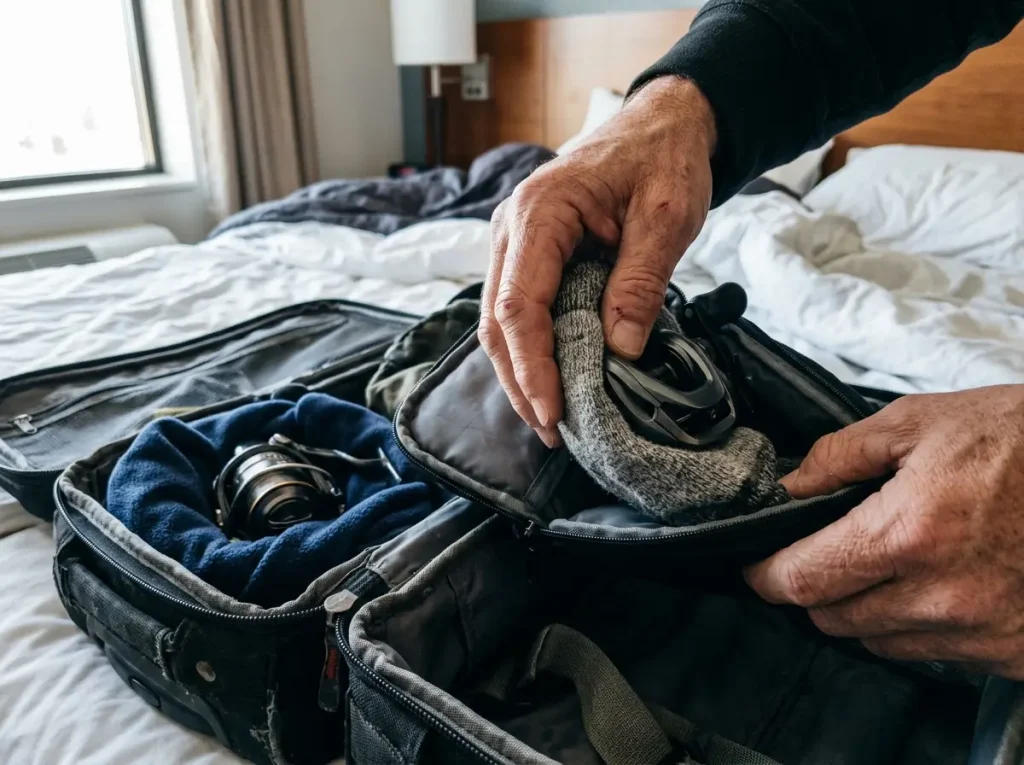
TSA does not care about your reel. Baggage handlers do. Reels are allowed in both carry-on and checked bags with no security restriction, so the decision is not about rules. It is about which reels you trust to a checked duffel and which ones you keep in your lap.
The pattern is always the same. The twenty-dollar spinning reel survives a checked bag fine. The sealed-drag baitcaster or the fly reel with a machined frame is the one that comes back with a bent bail or a seized drag after a rough transfer. Baggage handling is a leading cause of reel damage, which is why experienced traveling anglers carry the expensive reels on, padded, and separate from the rod.
Pull the reel off the rod before you pack. A reel bolted to a blank in a checked tube gives handlers a lever, and that leverage is what cracks reel feet and bends guides. Wrap the reel in a sock, drop it in your carry-on, and the rod tube travels lighter and safer.
Carry-On or Checked — Where Should Your Reel Go?
If the reel cost more than your rod, carry it on. If it is a beater you would replace without blinking, checked is fine. Simple as that.
Protecting Precision Reels From Baggage Handlers
The single most-cited way people ruin a good reel is checking it loose in a duffel with no padding. A wool sock, a fleece pouch, or a hard case is all it takes. The drag system is the fragile part, and it does not survive being crushed under a full bag on a loaded cart.
Should You Separate the Reel From the Rod?
Yes. Removing the reel reduces the stress on both pieces and lets each pack into its safest spot, the reel padded in the cabin and the rod cushioned in the tube.
TSA Rules for Hooks, Lures & Tackle Boxes
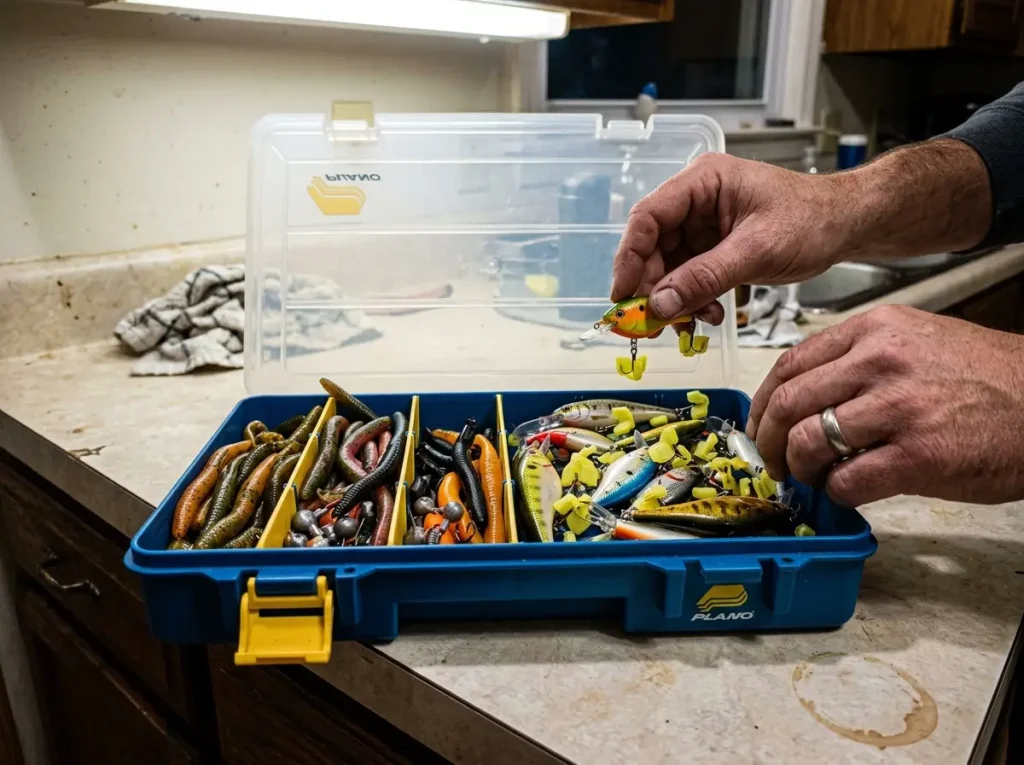
This is the section that actually gets people flagged. Everything above clears easily. Hooks and sharp lures are where a bag gets pulled. The rule is straightforward: small, non-sharp lures, mostly soft plastics, are permitted in carry-on, while anything with exposed sharp points or treble hooks goes in checked baggage, sheathed and securely wrapped.
Assume anything with an exposed point is a checked-bag item and you will rarely be wrong. Cap your trebles, keep the box easy to open, and let the officer see in two seconds that it is harmless. A compact latching tackle box does that job well, keeping hooks contained and opening flat for a hand inspection. The Plano 3600 ProLatch StowAway tackle box is small enough to pack and its latching lid keeps everything from spilling when an officer flips it open. If you want to dig deeper into travel-worthy options, here is a tackle box built to take a beating.
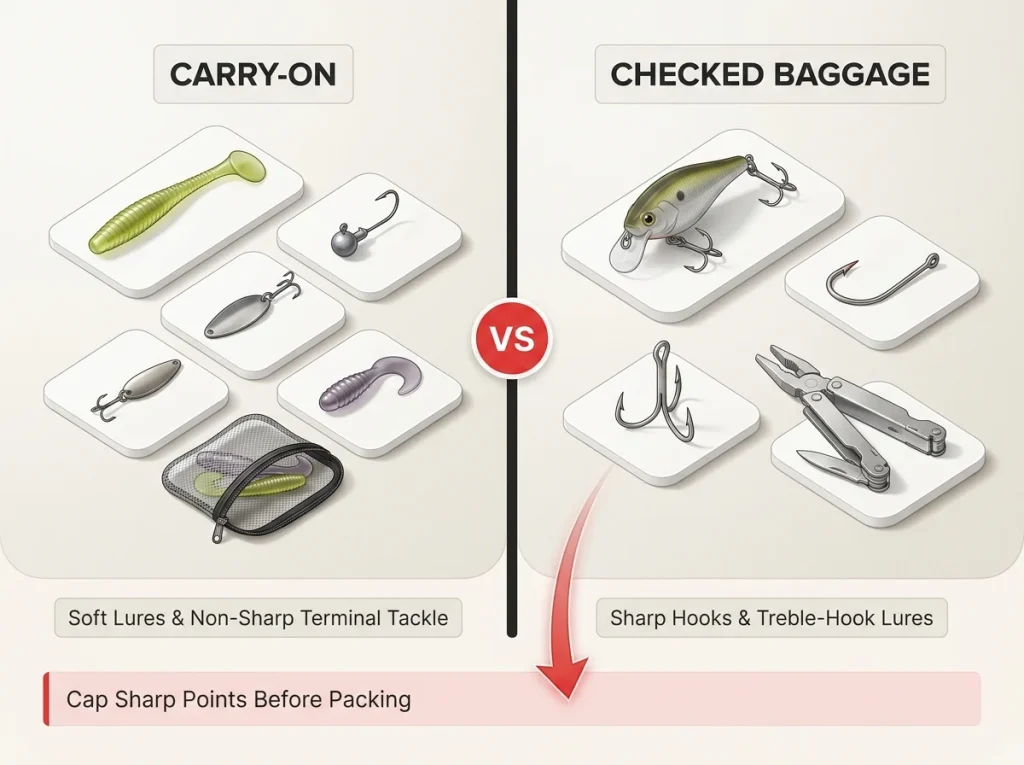
That carry-on-versus-checked split is worth spelling out at a glance, since it is the thing you sort the night before.
Which Lures Can Fly Carry-On (and Which Can’t)
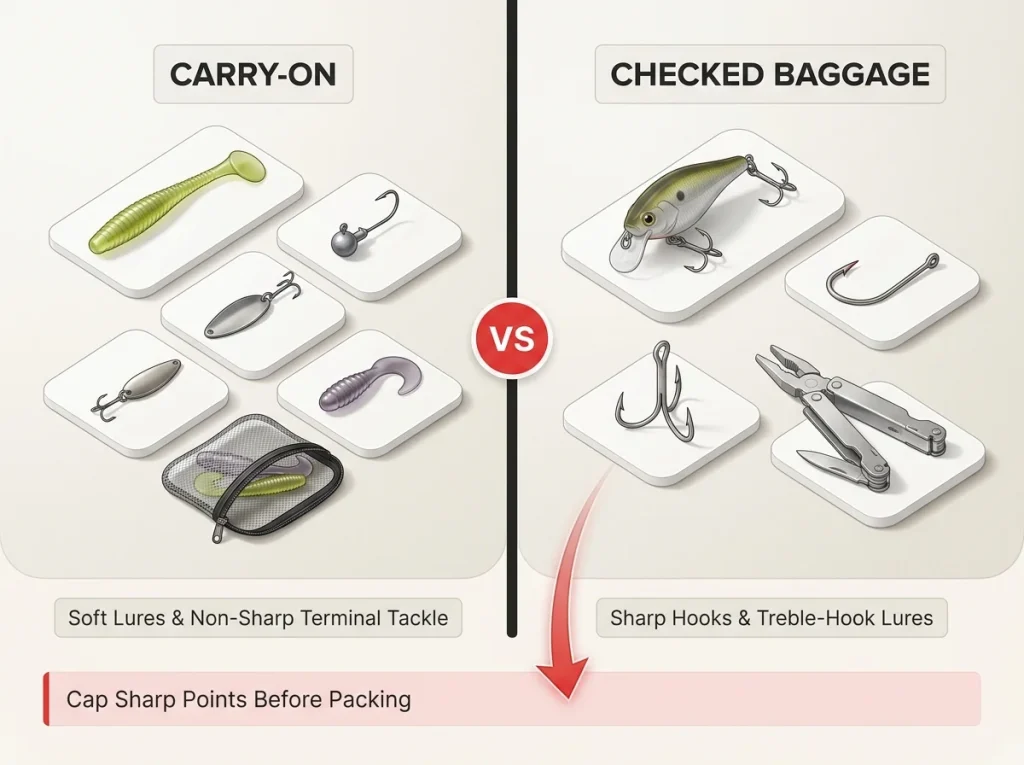
Soft-plastic worms, grubs, and small jig heads ride carry-on without drama. Hard lures like crankbaits, spinnerbaits, and topwaters, plus anything wearing a treble, belong in the checked bag. When in doubt, check it. According to TSA’s own fishing lures policy, small lures are allowed, but sharp ones are a checked-bag call.
Packing Hooks So They Clear Inspection
Hook bonnets, the little plastic caps that snap over a hook point, satisfy the sheathed-and-wrapped language TSA uses and speed up any manual bag check. An officer who can see at a glance that the points are contained is far less likely to dig through your whole box.
Tackle Box Setup for the Checkpoint
Keep the box you check easy to open, not taped into a brick. A box that opens flat lets an inspector confirm it is harmless and move on, which is exactly what you want when the line behind you is fifty people deep.
Lithium Batteries, Electric Reels & Electronics (What Other Guides Skip)
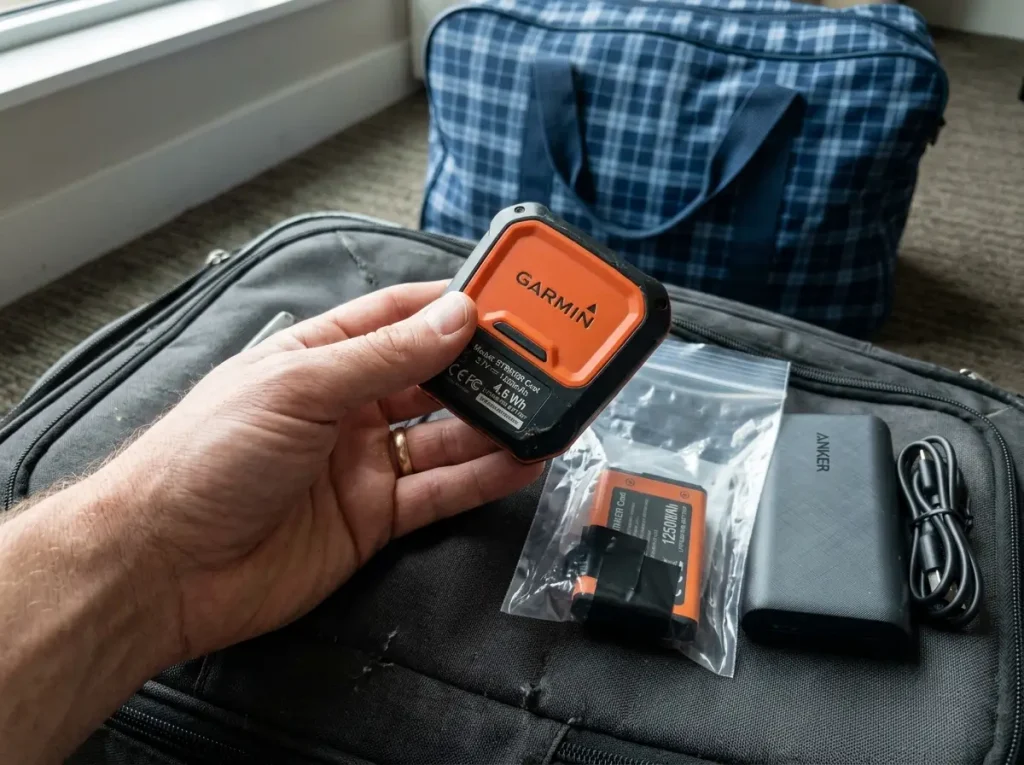
This is the one that surprises people at the jet bridge, and almost no other guide explains it. If you travel with an electric reel, a fish finder, a headlamp, or a power bank, the batteries have their own set of rules, and getting them wrong means confiscation or worse. The short version: spare lithium batteries and power banks fly in the cabin only, never in a checked bag, even inside a locked case.
Here is where the numbers matter. Rechargeable lithium-ion spares are capped at 100 watt-hours with no quantity limit for personal use. The 101 to 160 watt-hour band needs airline approval in advance and is capped at two spares per traveler. Anything over 160 watt-hours is banned outright. Most reel and fish-finder batteries sit comfortably under 100 watt-hours, but a big trolling-style battery or an oversized power bank can cross into ask-first or not-allowed territory, so read the rating printed on the battery before you pack. The thresholds are spelled out in TSA’s rule on lithium batteries over 100 watt-hours.
The carry-on-only rule has a second edge that catches people off guard. If your carry-on bag gets gate-checked because the overhead bins filled up, you have to pull every spare battery and power bank out and carry them into the cabin before the bag goes down the belt. Loose batteries are never allowed in the hold. Terminals also have to be protected from short-circuit, taped over, left in original packaging, or bagged individually, which matters because a bare battery rattling around a tackle bag full of hooks and split rings is exactly the short-circuit risk the rule exists for. The FAA’s PackSafe battery guidance covers the terminal-protection and carry-on-only requirements in detail.
Picture the traveler who gate-checked a backpack with a spare fish-finder battery still zipped inside, then had to dig through it at the jet bridge while the line stacked up behind him, all because nobody told him loose batteries cannot ride in the hold. That is the scramble this section exists to prevent.
Find the watt-hour number before you leave home, not at the checkpoint. It is printed on the battery itself, usually in small type near the model number. If yours lands in the 101 to 160 range, call your airline for approval days ahead. That is a phone call, not a checkpoint surprise.
The Watt-Hour Limits That Decide Everything
Under 100 watt-hours, you are clear with no quantity cap for personal use. Between 101 and 160, you need airline sign-off and a two-spare limit. Over 160, leave it home. That ladder decides your whole electronics kit.
Why Spare Batteries Can’t Go in Checked Bags
A fire in the cabin can be caught and put out. A fire in the cargo hold cannot, at least not by a person. That is the entire reason spare lithium cells live in the cabin, and it is a hard rule with no exceptions for a locked case.
Packing Electric Reels, Fish Finders & Power Banks
Keep the device and its installed battery together, and treat every loose spare as a carry-on item with taped terminals. The same cabin-only rule covers non-rechargeable lithium-metal batteries, the kind in some GPS units and cameras, which the FAA and IATA both keep out of checked bags. A headlamp you would actually take night fishing rides fine, but pack its spare cells the same way. If you are shopping for one, here is a headlamp you’d actually take night fishing.
How to Pack a Rod Tube and Tackle Box for Checked Baggage
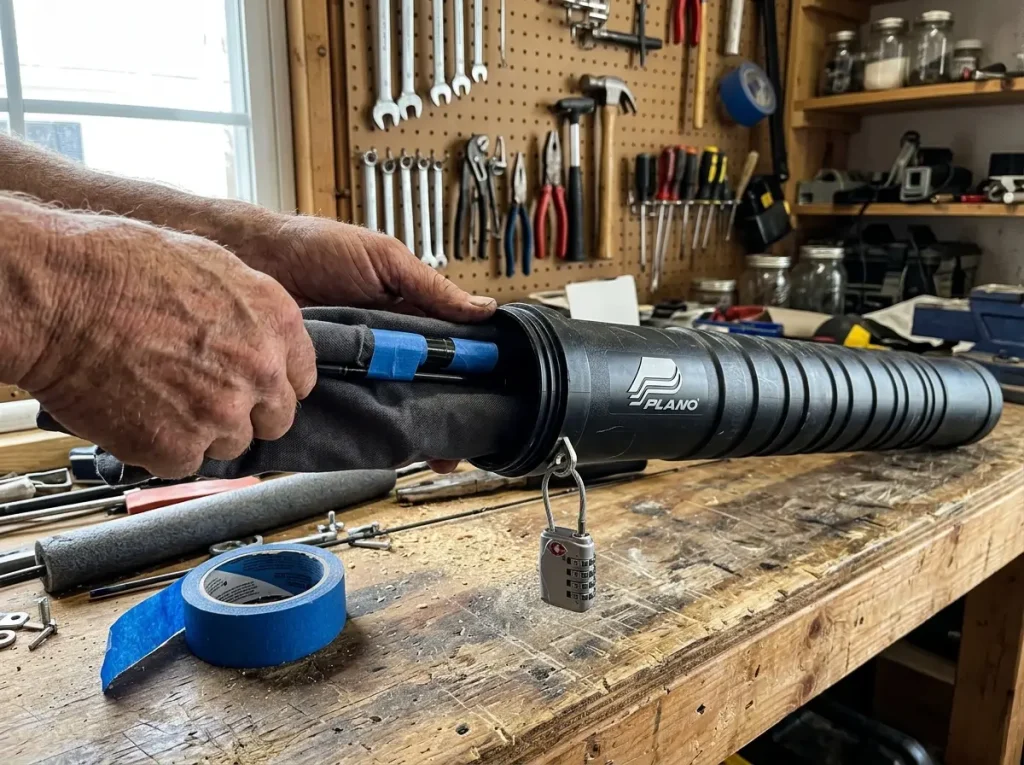
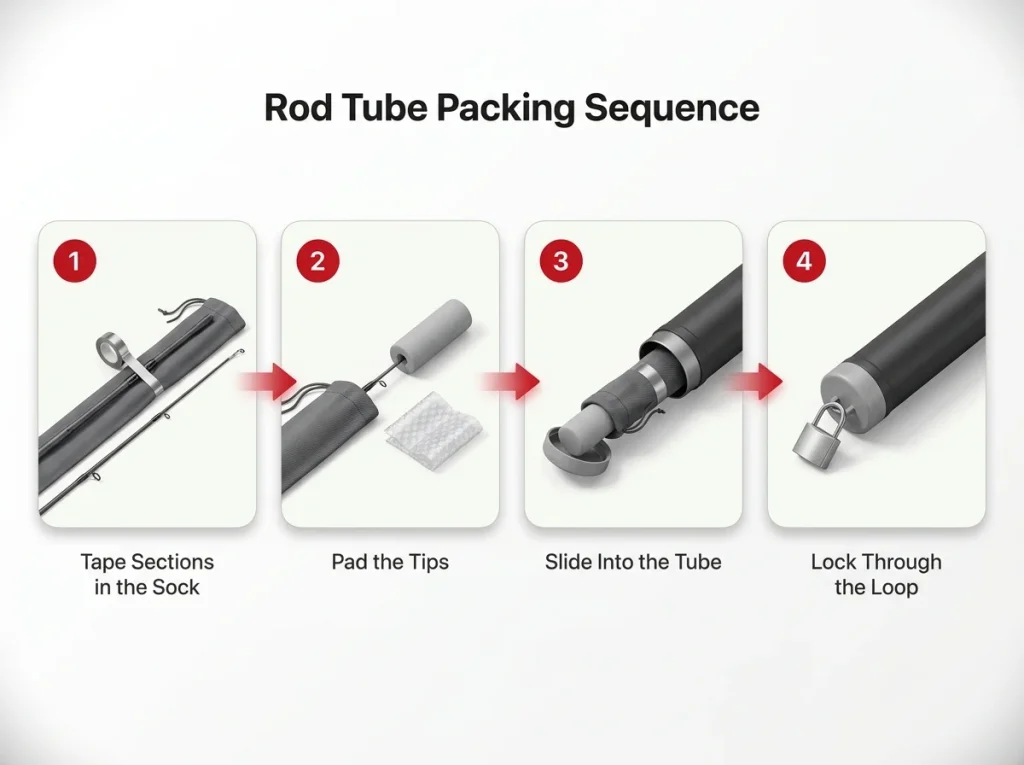
Gear that survives the hold is packed, not just placed. The method a veteran uses is simple: tape the sections together, pad the tips, lock the tube, and do not tape it shut like a mummy. Tape the rod sections together, or slide them into the original rod sock, before they go in the tube so the ferrules do not grind against each other and start a hairline crack during handling.
Then think about inspection. Pack the tube so it can be opened and re-closed if TSA wants to hand-inspect it, because a tube taped shut end to end forces a slower search that can nick your gear when they cut it open. A TSA-approved lock solves the security worry without inviting damage, since a recognized lock can be opened by an inspector instead of cut off.
Now the honest part about cases, because you do not always need the expensive one. A PVC tube with end caps from the hardware store, budget-friendly and easy to build, is genuinely fine for a single domestic hop with one connection. Step up to a padded, lockable hard case for international trips, multiple connections, or any rod worth protecting. The Plano Airliner telescoping rod case is the mid-range middle ground, a hard shell that telescopes to fit different rod lengths and accepts a lock. For maximum tip protection on long or multi-leg trips, the padded interior of the Plano Guide Series adjustable rod tube is the premium step up. To lock either one without giving a hand inspector a reason to cut it, the Forge TSA-approved cable luggage lock threads through a soft bag zipper or a hard tube’s lock loop and opens with the TSA master key instead of a bolt cutter. If you want to go deeper on case selection, here is a rod case that actually survives air travel.
The whole packing sequence is easier to follow as a set of steps than as a paragraph.
Prepping and Padding the Rod Sections
Sock or tape the sections together first, then wrap the tips with foam or bubble wrap. The tips are the weak point, and a half inch of padding is the difference between a rod that arrives ready to fish and one that arrives in pieces.
PVC Tube vs. Padded Hard Case — When Each Makes Sense
Short domestic trip, one connection, a rod you are not precious about: the PVC tube is honestly fine. International, multiple transfers, or a rod you would be sick to lose: pay for the padded, lockable case. The case earns its price in bent-tip prevention exactly when the trip has the most chances to go wrong.
Locking the Tube Without Getting It Cut Open
Use a TSA-recognized lock so an inspector opens it with their master key instead of cutting it off. Do not tape the tube shut as a substitute for a lock. That guarantees a rough hand search rather than preventing one.
Airline Baggage Fees and the Sporting Equipment Exemption
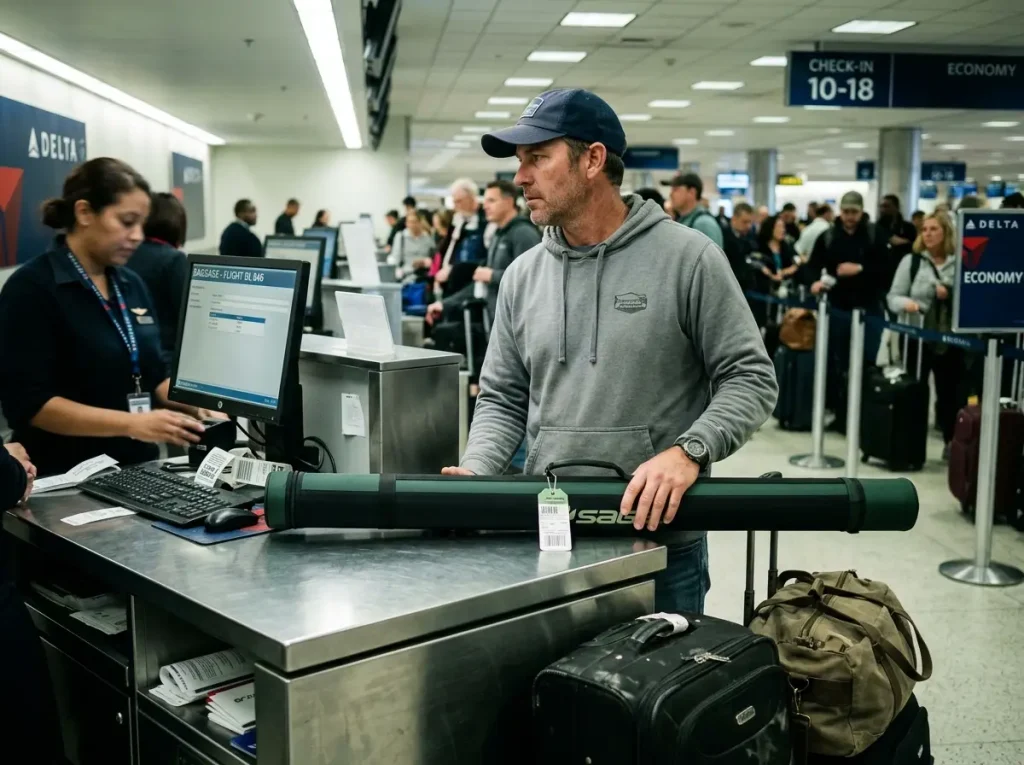
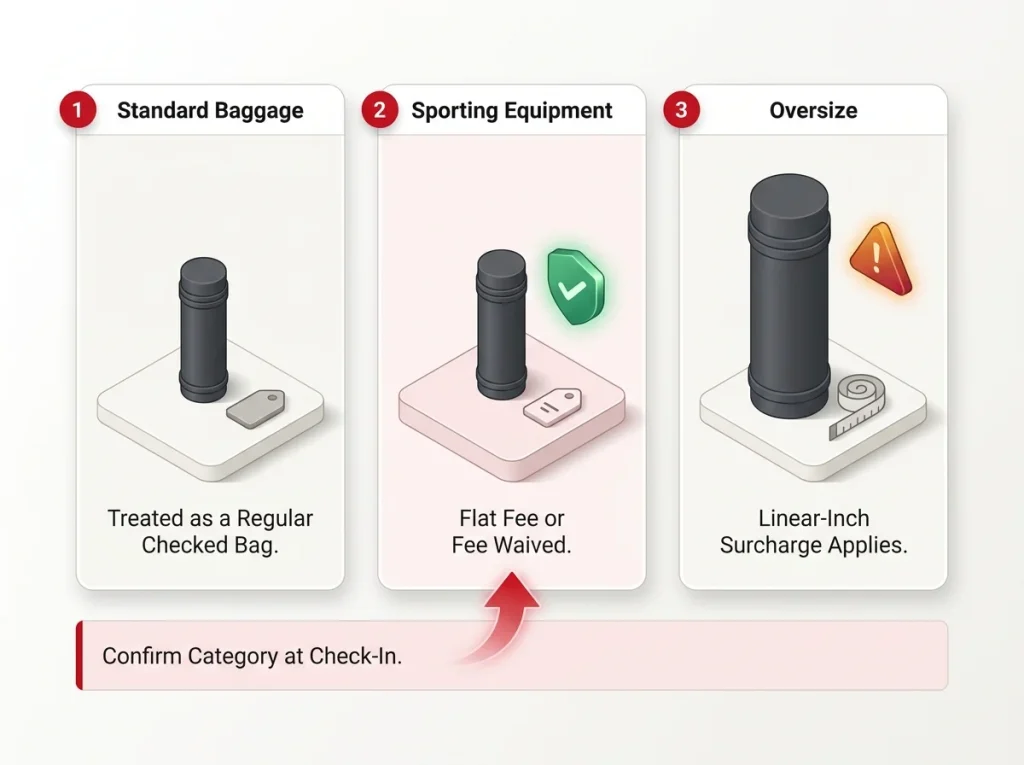
TSA is free. The airline is where the surprise bill lives. Airlines, not TSA, set baggage fees, and a rod tube can be treated as standard checked luggage, oversize, or under a sporting equipment category depending entirely on the carrier. Two people with identical tubes can pay very different amounts because they flew different airlines.
The category that helps you is the sporting equipment exemption, which on some carriers means a flat fee or even a waiver instead of oversize and overweight charges. The trap is oversize, measured in linear inches, length plus width plus height added together. Know your tube’s number before you fly, call it sporting equipment at the counter, and confirm your specific airline’s current sporting-goods page before you book checked gear, because these policies vary widely and change often.
Measure your loaded rod tube in linear inches at home and screenshot your airline’s sporting-goods policy before you leave. When the counter agent quotes you a number, you will know whether it is right. That five-minute check is the difference between a flat sporting-equipment fee and a surprise oversize charge.
How Airlines Categorize a Rod Tube
Some carriers wave a rod tube through as standard checked luggage. Others slot it into sporting equipment. Others hit it with oversize fees. The only way to know is to read your airline’s page, not a general rule.
Using the Sporting Equipment Exemption
When it applies, the sporting equipment category can save real money, sometimes replacing oversize charges with a single flat fee. Ask for it by name at check-in, and have your airline’s policy pulled up in case the agent is unsure.
Measuring Linear Inches to Dodge Oversize Fees
Add length, width, and height. That total is your linear-inch number, and it is what pushes a bag into oversize territory. Measure the tube loaded, not empty, because a packed case is what they weigh and measure.
Why “TSA Allowed” Doesn’t Guarantee It Gets Through
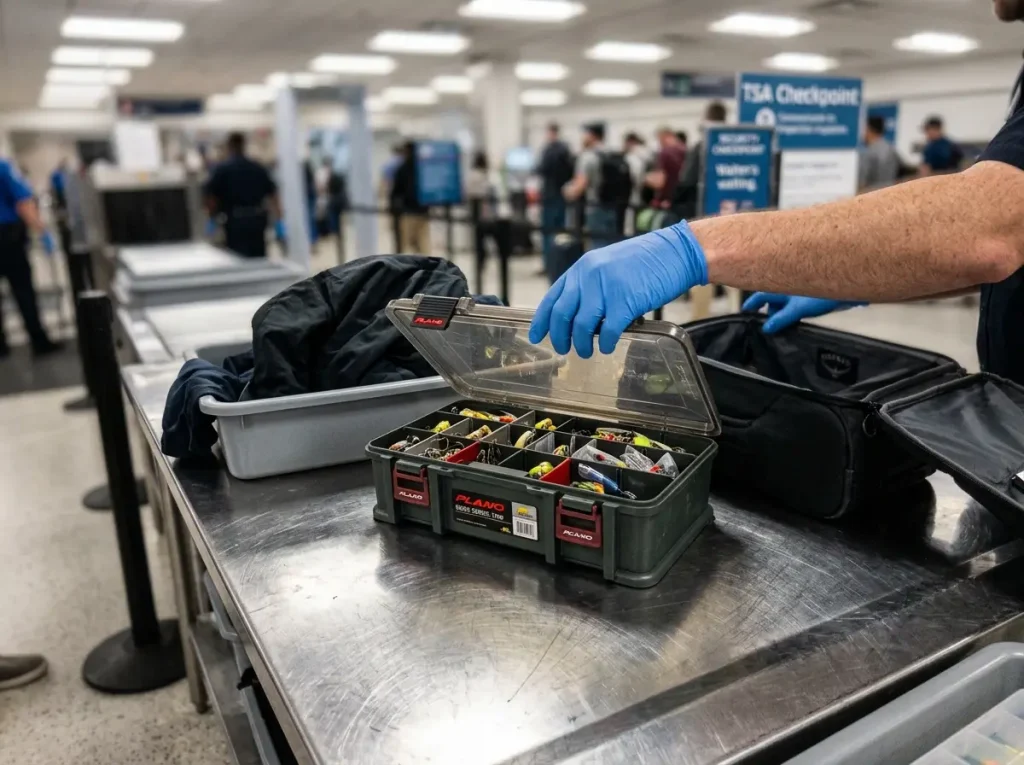
Here is the thing every other guide mentions as a footnote and never actually explains. The printed rule is a floor, not a guarantee. TSA officer discretion means the officer reading your bag on the X-ray that day has the final call, regardless of what the general policy says. TSA’s own item pages state this plainly: final screening judgment rests with the checkpoint officer.
That single fact is the mechanism behind every technically-compliant-item-still-got-pulled story. A small treble-hook lure that meets the size guidance can still read wrong on an X-ray image, and a compact multi-tool can look like something it is not in that grainy silhouette. The officer is not being difficult. They are making a fast call on limited information, and their job is to err toward caution. Once you understand that, you stop fighting the rule and start packing so your bag reads as obviously boring.
The way you do that is practical. Keep hooks sheathed or bonneted and visually contained so nothing looks loose or improvised. Keep the box and tube easy to open so an inspector can confirm and move on. Do not pack sharp terminal tackle into your carry-on even when it is technically under the size threshold, because every borderline item you carry on is another reason for a pull-aside. The goal is a bag that answers the officer’s question before they have to ask it.
When you are unsure about a borderline item, put it in the checked bag and skip the argument. A crankbait is not worth missing your flight over a secondary screening. Carry on only what you know reads clean, and let the checked bag absorb everything sharp or ambiguous.
The Officer Has the Final Call — Here’s Why
Screening is judgment under time pressure, and the policy hands that judgment to the person at the machine. A rule that says an item is generally allowed is not a promise it survives one officer’s read on one busy morning.
Packing So Your Bag Reads as Harmless
Contain the sharp stuff, keep containers openable, and avoid anything that throws an ambiguous shadow on the X-ray. A bag that is easy to scan and easy to open is a bag that gets waved through.
Does TSA PreCheck Change Anything for Fishing Gear?
TSA PreCheck speeds up your lane and lowers your odds of a pull-aside, but it does not change what is prohibited or override the officer’s authority over a flagged item. It is a faster line, not a different rulebook, so pack the same way whether you have it or not.
Flying Internationally With Fishing Gear

TSA is only the first checkpoint on an international trip. The country you land in has its own rules stacked on top, and foreign customs does not accept “I did not know” any more than TSA does. This section flags the categories you have to check, because the specifics change by country and by year, and the honest move is to verify current rules with the destination’s own agency rather than trust any blog’s numbers.
Take Mexico as the common example. Anglers heading to Cabo or Cancun consistently report a practical ceiling of around four rods and reels per person for personal recreational use at customs, and everyone aboard a vessel with fishing intent needs a valid Mexican fishing license regardless of who is holding the rod. Treat those as practical, angler-reported guidance rather than settled law, and confirm the current requirements with Mexican authorities before you fly, since simply carrying gear can flag you as intending to fish.
Biosecurity is the other category that catches people. Some destinations, New Zealand and Australia among them, require gear to arrive clean and dry to prevent moving invasive species, which means scrubbing mud off boots and drying waders before you pack them. Declare your gear, clean it beforehand, and you avoid both a fine and a confiscated pair of boots. For everything you cannot verify from home, the rule holds: confirm with the destination country’s customs or wildlife agency, and do not assume the US rules travel with you. If you are building a trip around all this, here is a guide to planning a fishing trip the whole family will enjoy.
Your Destination Country Has Its Own Rules
Clearing TSA gets you on the plane. It does not clear you into the country you land in. Every destination sets its own import, licensing, and biosecurity rules, and those are the ones that bite at the far end of the trip.
Import Limits and Licenses (Mexico as an Example)
Mexico’s practical four-per-person ceiling and its universal-license requirement are the pattern anglers report, not a guarantee. Sort your license before you land, keep gear counts reasonable for a group, and verify the current rules with Mexican customs rather than a forum post.
Biosecurity — Cleaning Gear Before You Fly
Clean, dry gear is a hard entry requirement in places like New Zealand and Australia. Scrub the soles, dry the waders, and declare everything. A ten-minute cleaning at home beats a biosecurity holdup and a possible fine at arrival.
Your Night-Before Pre-Flight Fishing Gear Checklist
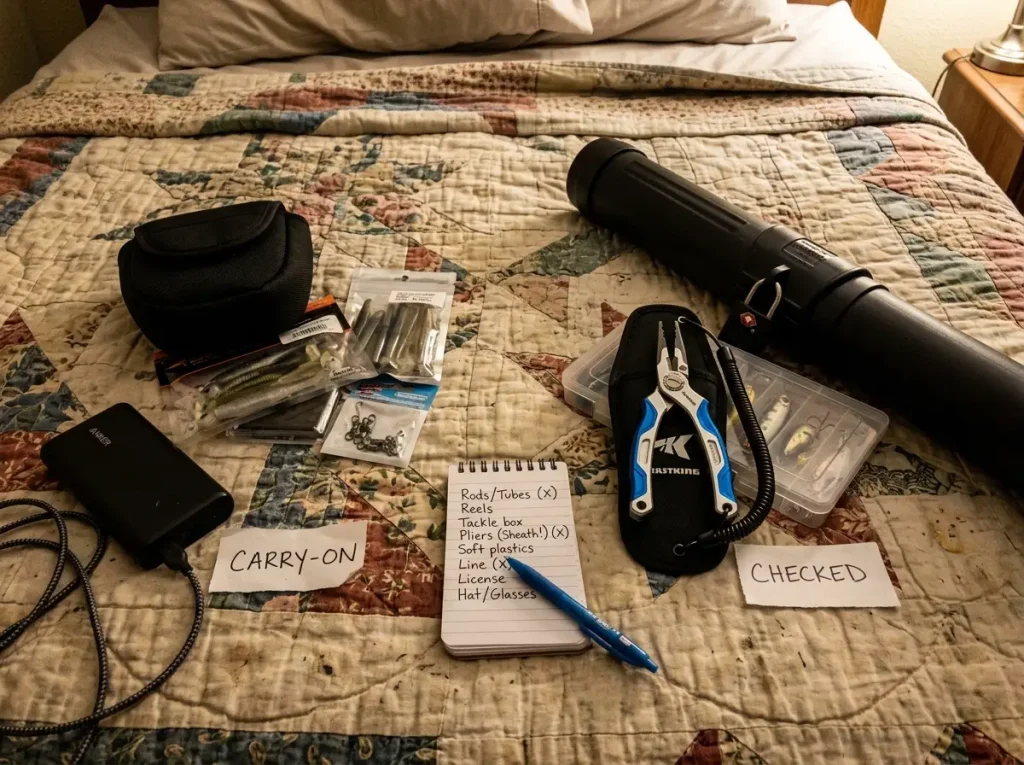
Everything above collapses into a five-minute check the night before. Run this list and you walk into the airport knowing nothing in your bag is going to get pulled. Sort your gear into two piles on the bed and work down the list.
Into your carry-on:
- Rods, if they break down short enough to fit airline dimensions
- High-value reels, padded in a sock or pouch, separate from the rods
- Spare lithium batteries and power banks, terminals taped, never checked
- Soft and small lures with no exposed sharp points
Into your checked bag:
- Sharp hooks and treble-hook lures, capped with hook bonnets and wrapped
- Pliers and any cutting tool, which never belong in carry-on
- The rod tube, padded and secured with a TSA-approved lock
A quick word on that pliers line, since it is the one people forget. Any cutting tool goes in the checked bag, full stop, and a pair like the KastKing Cutthroat 7-inch fishing pliers gets pulled from a carry-on every time because of the cutting edge. For a deeper look at options, here is a pair of pliers that won’t rust shut.
Before you zip anything, run three final verifications: confirm the watt-hour rating on every battery, confirm your airline’s sporting-equipment and linear-inch policy, and for an international trip, confirm the destination’s customs, license, and biosecurity rules. If you want the broader kit organized the same way, here is the full rundown of fishing tools and accessories.
Do the sort the night before, not the morning of. A groggy 4 a.m. pack is how a treble-hook box ends up in your carry-on and a spare battery ends up in your checked bag. Lay both piles out the night before, walk away, and glance at them once more before you zip up.
What Goes in Your Carry-On
The rule of thumb is simple. Anything expensive, fragile, or containing a loose lithium cell rides with you. That means your good reels, your electronics and their spare batteries, and any small non-sharp lures you want handy.
What Goes in Your Checked Bag
Anything sharp, heavy, or bulky goes below. Capped hooks, cutting tools, and the locked rod tube all belong in the checked bag, where a bent bail is the worst-case outcome instead of a missed flight.
Final Verifications Before You Leave
Three checks close it out: battery watt-hours, airline baggage policy, and destination rules for international trips. Knock those out the night before and the airport becomes a formality instead of a gamble.
Conclusion
Most fishing gear flies without trouble. The trip goes sideways over a short list of flagged items: sharp hooks in the wrong bag, a loose lithium battery in checked luggage, an oversized or taped-shut tube. Pack so your bag reads as obviously harmless and the officer’s judgment call goes your way. And remember that the airline and the destination country, not TSA, are where the surprise rules and fees actually hide.
Run the night-before checklist before your next trip, and you clear the checkpoint without leaving anything behind on the inspection table.
Frequently Asked Questions
01Does TSA allow fishing rods?
Yes, fishing rods are allowed in both carry-on and checked baggage. The only catch is your airline’s carry-on size limit, so a rod that breaks down short travels easiest in the cabin.
02Can I put a fishing reel in my carry-on?
Yes, reels are fine in carry-on or checked baggage. Keep high-value reels in your carry-on, padded, since baggage handling is the main cause of bent bails and seized drags.
03Can I bring fishing lures in my carry-on bag?
Small, non-sharp lures like soft plastics can ride carry-on. Anything with exposed treble hooks or sharp points goes in your checked bag, sheathed and securely wrapped.
04Can I pack a spare battery for my electric reel or fish finder?
Only in your carry-on, never checked. Spare lithium batteries and power banks must fly in the cabin, with terminals protected, and stay under 100 watt-hours unless your airline approves 101 to 160.
05How much does it cost to bring a fishing rod on a plane?
It depends on the airline, not TSA. A rod tube may fall under standard checked baggage, a sporting-equipment fee, or oversize charges by linear inches, so check your carrier’s current policy before you fly.
Risk Disclaimer: Fishing, boating, and all related outdoor activities involve inherent risks that
can lead to injury. The information provided on Master Fishing Mag is for educational and informational purposes
only. While we strive for accuracy, the information, techniques, and advice on gear and safety are not a substitute
for your own best judgment, local knowledge, and adherence to official regulations. Fishing regulations, including
seasons, size limits, and species restrictions, change frequently and vary by location. Always consult the latest
official regulations from your local fish and wildlife agency before heading out. Proper handling of hooks, knives,
and other sharp equipment is essential for safety. Furthermore, be aware of local fish consumption advisories. By
using this website, you agree that you are solely responsible for your own safety and for complying with all
applicable laws. Any reliance you place on our content is strictly at your own risk. Master Fishing Mag and its
authors will not be held liable for any injury, damage, or loss sustained in connection with the use of the
information herein.
Affiliate Disclosure: We are a participant in the Amazon Services LLC Associates Program, an
affiliate advertising program designed to provide a means for us to earn advertising fees by advertising and linking
to Amazon.com. As an Amazon Associate, we earn from qualifying purchases. We also participate in other affiliate
programs and may receive a commission on products purchased through our links, at no extra cost to you. Additional
terms are found in the terms of service.