

In this article
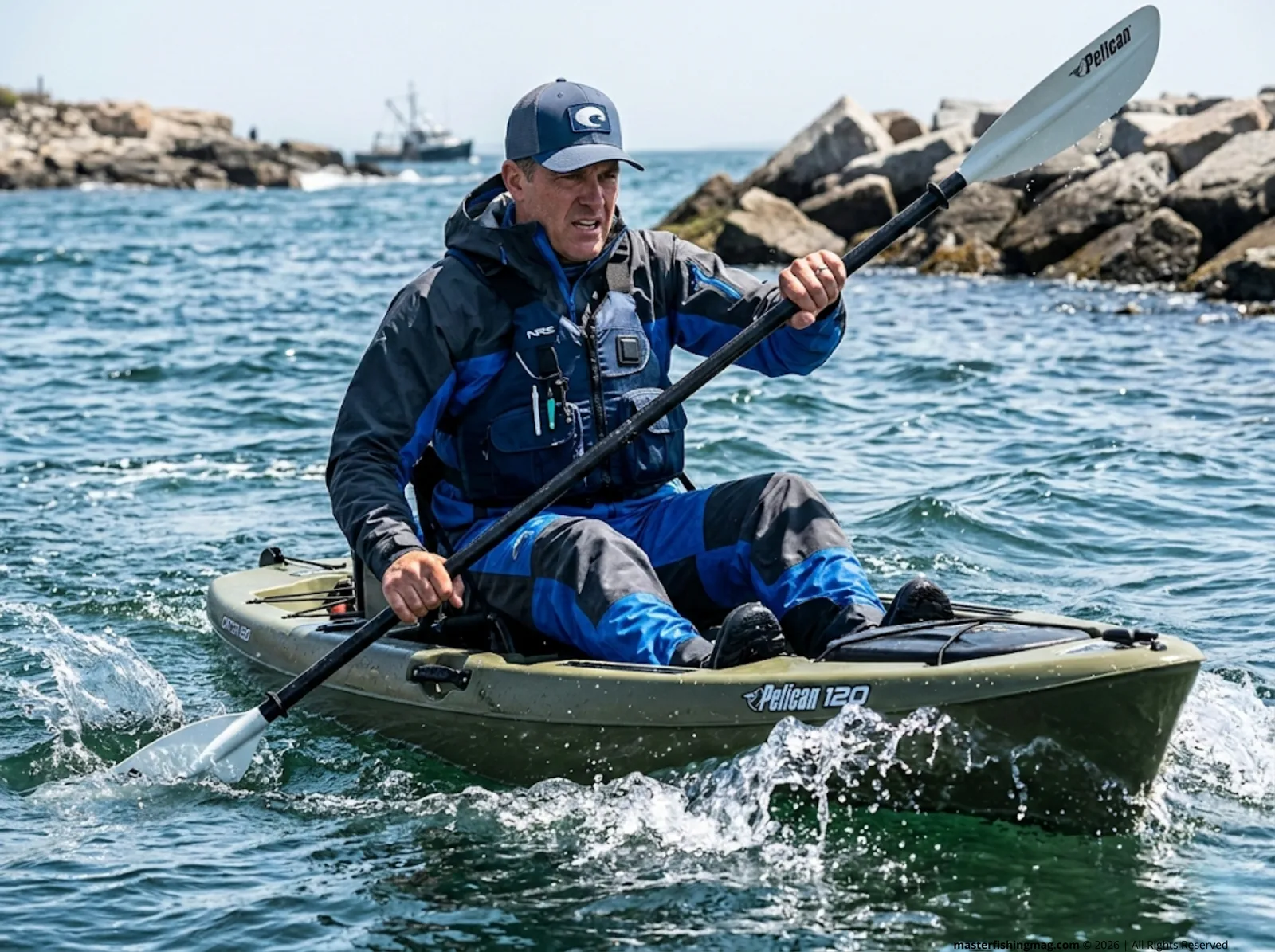
The incoming tidal current was ripping out of the inlet, and I was pedaling my thirty-eight-inch-wide fishing barge so hard my quads burned, barely making two knots against the flow. Meanwhile, an older angler in a sleek, twenty-eight-inch-wide touring hull sliced right past me with effortless, rhythmic paddle strokes, reaching the breaking fish twenty minutes before I did. I had fallen into the classic beginner trap: buying a kayak based entirely on how it felt sitting flat at the dock, completely ignoring the punishing water resistance I would have to fight on the open water. This guide breaks down kayak physics, revealing exactly why the features that give you massive stand-up stability are the same ones ruining your transit speed, draining your energy, and spooking your fish.
⚡ Quick Answer: The widest, flattest fishing kayaks grab the most water, making them incredibly slow and exhausting to paddle. To get a high speed-to-effort ratio, you need a narrower boat that cuts through the water instead of pushing it. You must trade some flat-water standing comfort for a hull that tracks straight, glides easily, and saves your shoulders for casting.
The Physics of Hull Resistance: Why Speed Has a Hard Limit
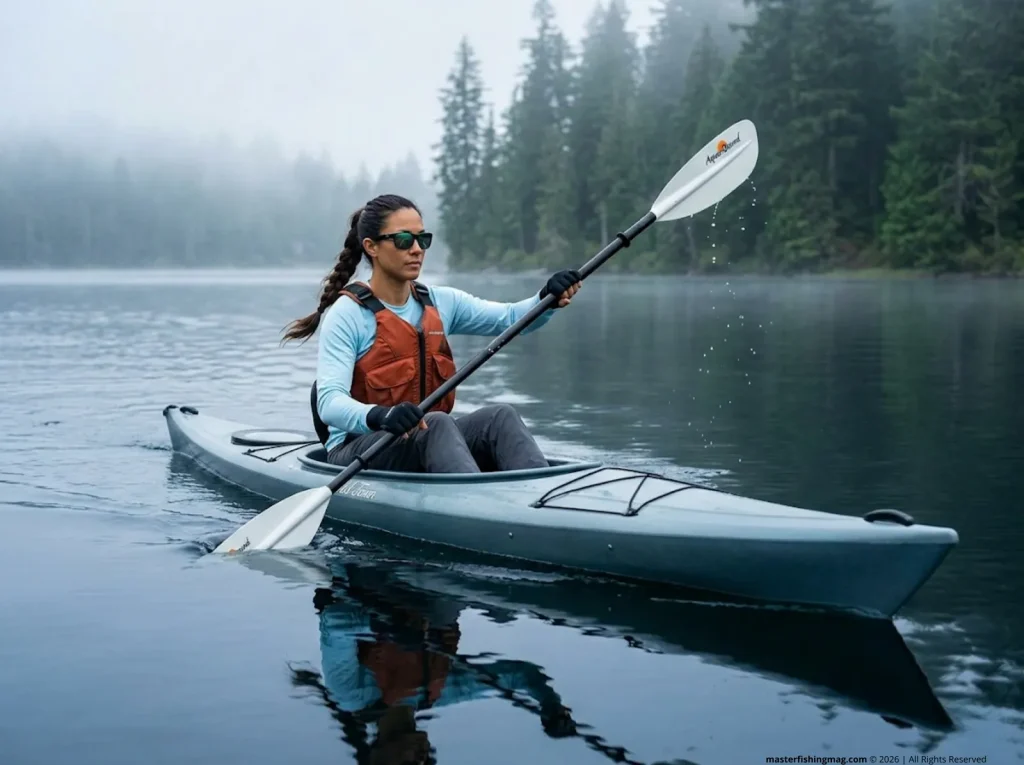
Most fishing kayaks don’t glide on top of the water; they plow right through it. To understand why your wide boat feels impossibly heavy to paddle, you have to look at the fluid dynamics happening right under your seat.
Measuring Viscous Drag and Wetted Surface Area
The moment you put a boat in the water, the water pushes back. This is called viscous drag, which is essentially water friction dragging along the plastic belly of your kayak. The amount of friction directly connects to your wetted surface area—meaning exactly how much of your hull physically touches the water.
If you paddle a wide pontoon hull, a massive amount of plastic sits submerged, creating huge friction. A narrow beam, on the other hand, minimizes this surface area, allowing the boat to glide freely. When you understand the basic fluid dynamics of water resistance, it makes perfect sense why wider boats tire you out so fast. Your arms and legs are literally dragging more plastic across more water with every single stroke.
The Bow Wave Barrier and Theoretical Hull Speed
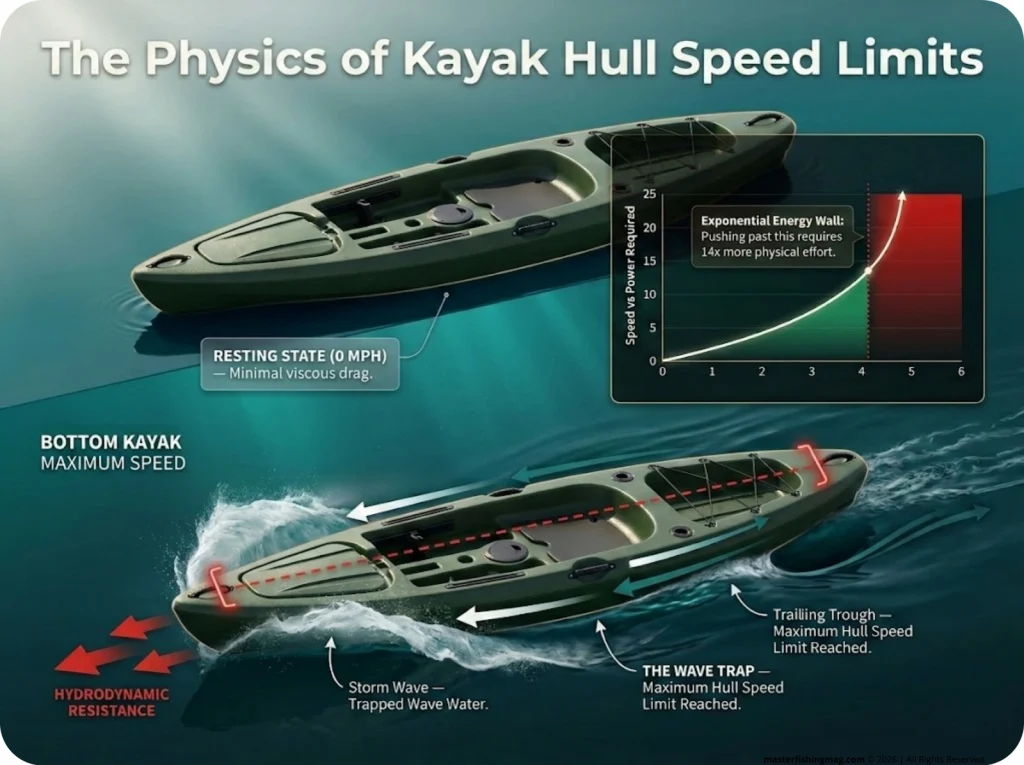
If you paddle hard enough, you will eventually hit an invisible wall where the kayak absolutely refuses to go faster. As you move forward, the boat pushes water at the front (creating a bow wave) and leaves a hole at the back (creating a stern wave). The distance between these two waves creates a trap based on your boat’s physical waterline length.
This trap defines your theoretical hull speed. For the average twelve-foot fishing kayak, your absolute top speed is roughly four and a half miles per hour. If you try to push past that speed, your boat physically tries to climb its own bow wave, pointing the nose toward the sky while the stern sinks deep. You are no longer moving forward; you are just fighting gravity and water pressure.
Why Pushing a Wide Beam Scales Energy Exponentially
I have watched countless anglers exhaust themselves trying to force a heavy, thirty-six-inch-wide Pelican or Lifetime barge past four miles per hour. The hull simply hits that bow wave and stops completely. Pushing past your maximum speed requires roughly fourteen times more physical effort, which is why research modeling kayak blade-hull interactions proves that brute strength cannot beat bad hull design.
This directly hurts your paddler effort. Instead of efficiently reaching the next spot, you burn all your calories just fighting the boat’s shape. Save your shoulders. Accept your hull speed, and if you need to travel long distances, you need a longer, narrower boat.
Pro tip: Stop checking your GPS to see how fast you are paddling. If the nose of your kayak starts lifting out of the water and the back starts bubbling, you have hit your maximum speed boundary. Ease up on your strokes to save energy.
The Stability Budget: Primary vs. Secondary Forces
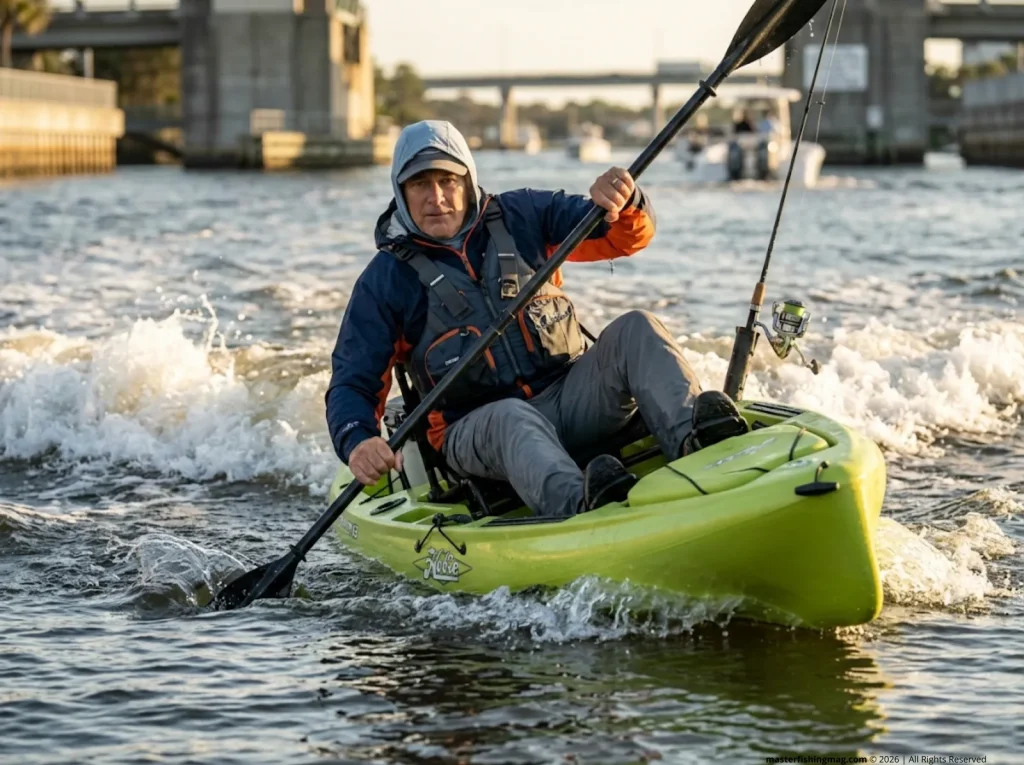
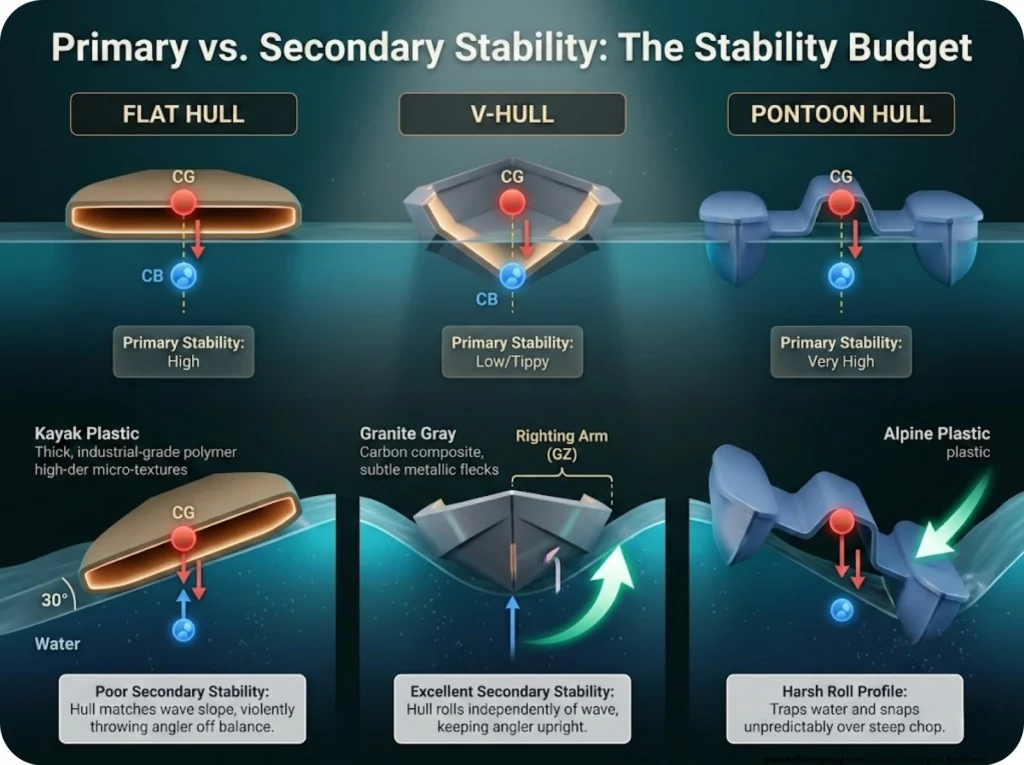
The biggest lie sold to beginner kayak anglers is that a perfectly flat boat is the safest boat. Boat designers actually look at stability as a finite currency—a stability budget. You can spend your budget on feeling rock-solid while sitting still, or you can spend it on staying upright when the water gets rough. You cannot have both.
Primary Stability: The Flat-Bottom Trap in Rough Water
When you test a flat hull on a calm pond, it feels incredibly secure. This initial, flat-water steadiness is called primary stability. It provides a massive stand-up confidence rating, allowing big guys to stand, turn, and cast without feeling tippy.
But take that flat bottom into an active ocean pass, and you will learn a terrifying lesson. A flat boat blindly matches the exact angle of the water beneath it. If a sharp two-foot boat wake hits your side, the flat hull snaps violently sideways to match the slope of the wave. You get thrown off balance instantly.
Secondary Stability: Why “Tippy” V-Hulls Save You
A sharp V-hull or a boat with a round hull feels loose and tippy the second you sit in it, meaning it has weak primary stability. However, as the boat leans over on its side, the hull shape pushes more volume into the water, fighting back aggressively against the tip. This is secondary stability.
When a harsh wave hits a boat with strong secondary stability, the boat gently rolls with the swell rather than snapping sideways. This allows your upper torso to remain perfectly upright and balanced while the hull rocks underneath you. It feels nervous at first, but it is vastly safer in rough conditions for coastal kayak fishing.
Metacentric Height (GM) and Roll Recovery Dynamics
The violence of how a boat snaps back to a level position is dictated by its center of gravity acting against its center of buoyancy. Naval architecture experts measure this using a concept called Metacentric Height. A flat boat has a very stiff metric here, which means it violently jerks back and forth in choppy water, ruining your lower back and burning out your core muscles.
If you get flipped in a flat boat with stiff recovery, getting back inside is a nightmare because the boat fights your weight. A rounder hull makes it much easier to recover from a secondary stability failure in deep water. You actually want a boat designed to meet the U.S. Coast Guard’s Simplified Stability Proof Test standards, which usually leans toward hull shapes that recover smoothly rather than aggressively.
Geometrical Asymmetry: Swedeform vs. Fishform Hulls
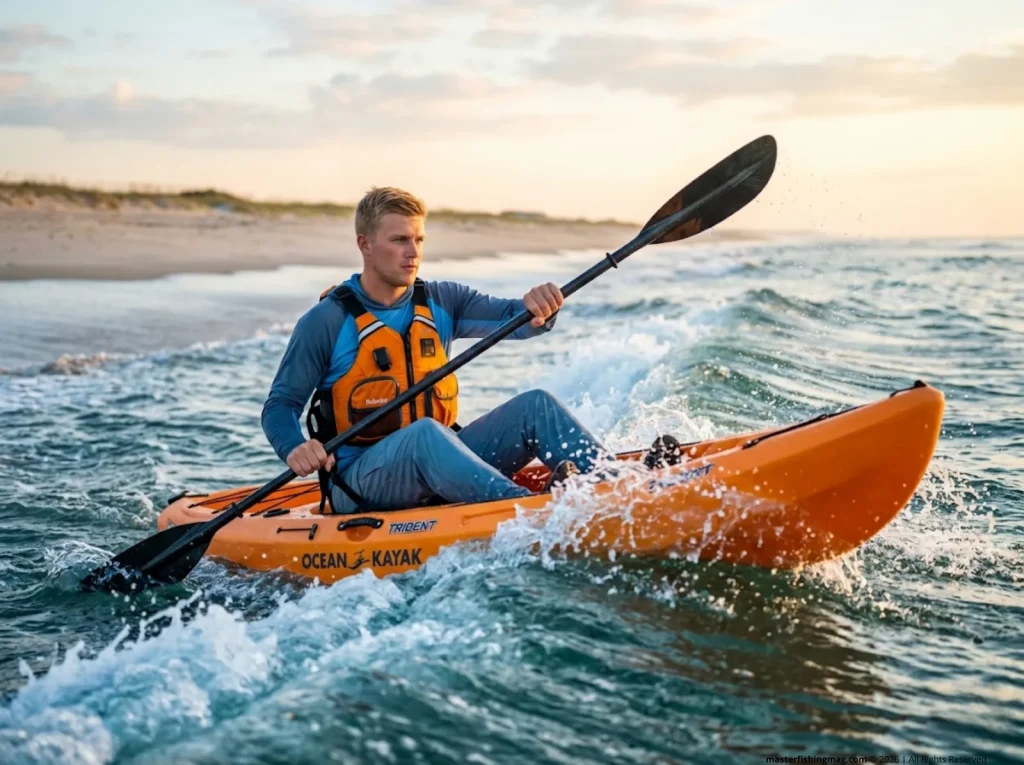
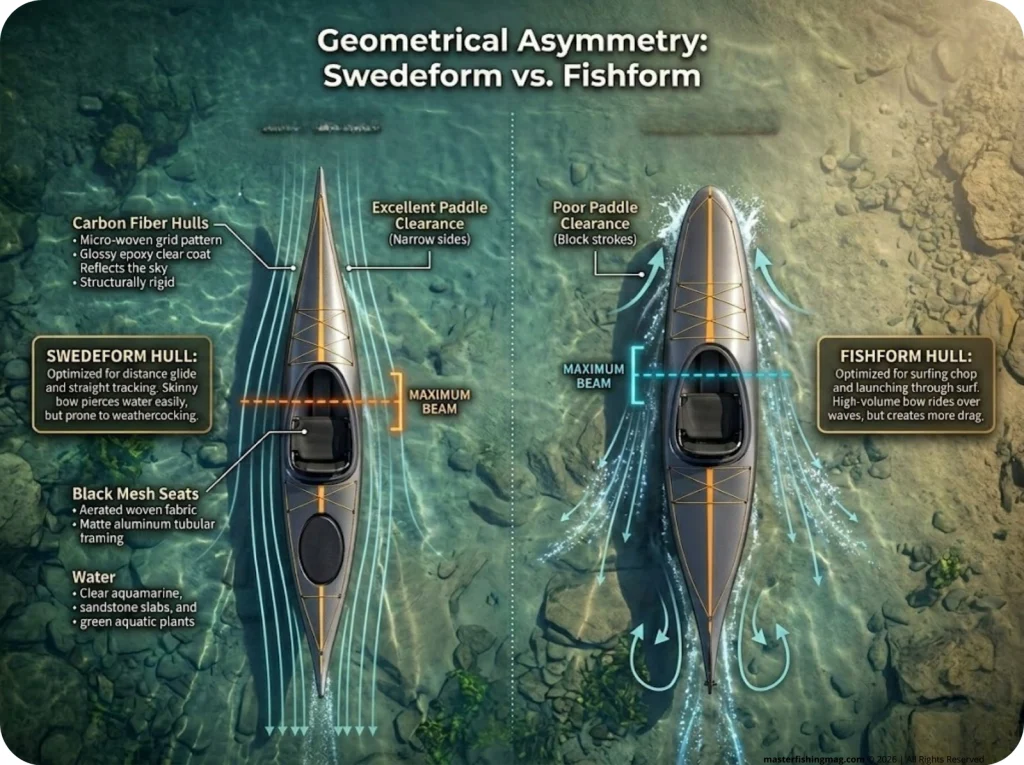
If you look down at a kayak from above, the wide point of the boat rarely sits perfectly in the middle. Where the manufacturer places the widest section dictates whether the boat is built for long-distance cruising or surviving heavy surf.
Swedeform Shapes: Optimizing the Bow for Distance Glide
A Swedeform design pushes the widest part of the kayak behind the seat. This creates a long, needle-like bow that pierces the water, drastically dropping wave-making resistance. The design gives you a brilliant tracking advantage on open water.
By pulling the width behind you, the boat also clears out space for your paddle stroke. You can use a high-end Aqua-Bound or Bending Branches paddle with a straight, vertical stroke right next to the boat without bashing your knuckles on the plastic edge. When I have to cover three miles of open water to reach a backwater marsh, I will take this shape every single time.
However, the long, skinny nose comes with a catch. These boats have a notorious tendency to weathercock in heavy crosswinds, meaning the wind pushes the back of the boat around, forcing you to constantly correct your steering.
Fishform Designs: Surfing Over Chop and Swells
A Fishform design does the total opposite, pushing the maximum width and volume into the front of the kayak, ahead of the angler. This adds immediate drag and slows the boat down, but it provides massive buoyancy right at the nose.
When you launch through a four-foot beach break, a Fishform bow rides up and over the crashing white water. If you tried that same launch in a Swedeform boat, the skinny nose would spear directly into the wave, burying the bow and flipping you backward. The extra volume up front prevents terrifying nose-dives when surfing back to the beach.
Why Symmetrical Hulls Are a Masterclass in Compromise
Most modern fishing kayaks run completely symmetrical or heavily flared designs. They sacrifice the sleek speed of a Swedeform and the surf-riding lift of a Fishform to support massive gear crates and heavy anglers standing near the bow. This symmetry works great for inland freshwater kayak fishing, but it creates a slower, louder boat that requires significantly more effort to move.
Pro tip: Always load your heavy gear (like batteries and coolers) exactly opposite of your boat’s volume. If you have a big, buoyant Fishform nose, put your battery in the back. Keeping the boat perfectly level in the water prevents the nose or tail from dragging and ruining your glide.
High-Density Polyethylene vs. Carbon Fiber Modulus

The material holding you above the water affects your speed just as much as the shape of the boat. Flexibility is the hidden enemy of kayak propulsion, secretly robbing you of the energy you put into every pedal or paddle stroke.
The Flex Penalty of Roto-Molded HDPE Inefficiencies
Standard one-hundred-pound roto-molded high-density plastic is incredibly tough on concrete boat ramps. You can drag it over rocks and oyster beds all day. But that tough plastic has a massive flaw: it bends under pressure.
Every time you take a powerful stroke, the plastic hull flexes slightly. The boat acts like a giant shock absorber, soaking up your kinetic energy instead of transferring it into forward momentum. This flex penalty forces you to work harder just to maintain your cruising speed.
Carbon Fiber and Epoxy: Shattering the Hull Speed Limit
Switching to a high-end composite material changes the rules of the game. A premium carbon fiber boat, like the Apex Watercraft Tyr, drops the hull weight to under forty-five pounds. This achieves a radical stiffness utilizing the same physics modulus that governs high-end rod blanks.
Because the hull does not flex, one hundred percent of your stroke energy translates directly into forward movement. The boat accelerates instantly. This rigid, ultra-light build requires drastically less draft, meaning the boat barely sinks into the water. Because it sits so high, it can actually approach true planing speeds that heavy plastic boats can never achieve under human power.
Why a 40-Pound Vessel Radically Alters Your Daily Range
Shedding sixty pounds from your boat changes everything about how you fish. You can easily lift a forty-pound hull over your head to load it onto a truck rack by yourself after a twelve-hour day under the hot sun.
On the water, the lack of weight means you can silently slide over a three-inch deep mud flat that would completely stop a loaded plastic barge. Heavy plastic boats get bogged down in extreme shallows, ruining your displacement advantage. Light boats open up miles of untouchable water where pressured fish hide.
The Acoustics of Stealth: Preventing the “Hull Slap”
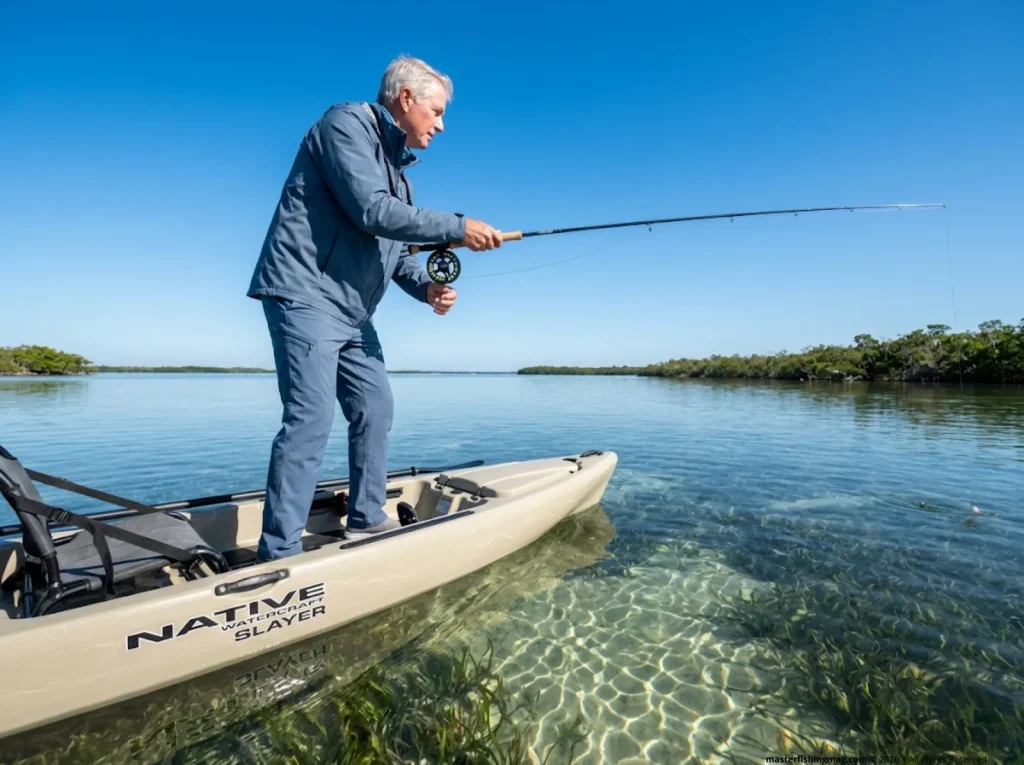
You can buy the quietest paddle on the market and wear camouflage from head to toe, but if your hull design is wrong, every fish in the bay knows you are coming. Wide, stable boats generate an acoustic footprint that ruins your chances before you ever pick up a rod.
The Trap of Tunnel Hulls and Repetitive Shockwaves
When the wind picks up and creates a light surface chop, the ripples repeatedly strike the flat, wide, flared entry points of big fishing kayaks. This creates hull slap. The impact of the water against the blunt plastic creates a repetitive shockwave that echoes through the hollow inside of the boat, effectively turning the kayak into a massive bass drum.
Boats with an aggressive tunnel hull are the worst offenders. They trap the choppy water beneath the wide front deck, creating a loud, rhythmic slapping noise as you move forward. You are trading immediate dockside steadiness for a complete loss of acoustic stealth.
Why Lateral Lines Detect Your Approach from 100 Yards
Sound travels roughly four and a half times faster in water than in air, and it does not lose its punch over distance. Fish do not need to see you to know you are there; they feel the vibration.
A fish relies heavily on its biological sensory system. Understanding how the biological lateral line interprets pressure explains why hull slap is an instant red flag. The unnatural rhythm of a slapping plastic hull triggers an immediate, panicked escape response in shallow-water targets like redfish and bonefish. I have watched entire schools of tailing reds scatter from eighty yards away simply because the wind pushed a small ripple against my wide, catamaran-style nose.
Customizing Your Trim to Silence a Noisy Bow
V-hulls and boats with a soft chine or hard chine designed for slicing will pierce through ripples silently, keeping your approach quiet. But if you already own a wide, slapping barge, you can fix the noise by adjusting your trim.
Trim simply means how the boat sits front-to-back in the water. Most anglers sit near the back and put their heavy tackle crates right behind their seat, causing the nose of the kayak to stick aggressively up into the air. This exposes the flat underside of the bow to the choppy waves. By moving heavy gear, batteries, or a cooler to the extreme front of the kayak, you push the bow deeper into the water, eliminating the air gap and silencing the hull slap completely.
Pro tip: Next time you are on a shallow grass flat with a light chop, pause and listen to the front of your boat. If you hear rhythmic slapping water, grab a twenty-pound dry bag or your anchor and throw it all the way forward into the bow hatch to pin the nose down. The silence is immediate.
The “Keel Effect” of Heavy Pedal Drives
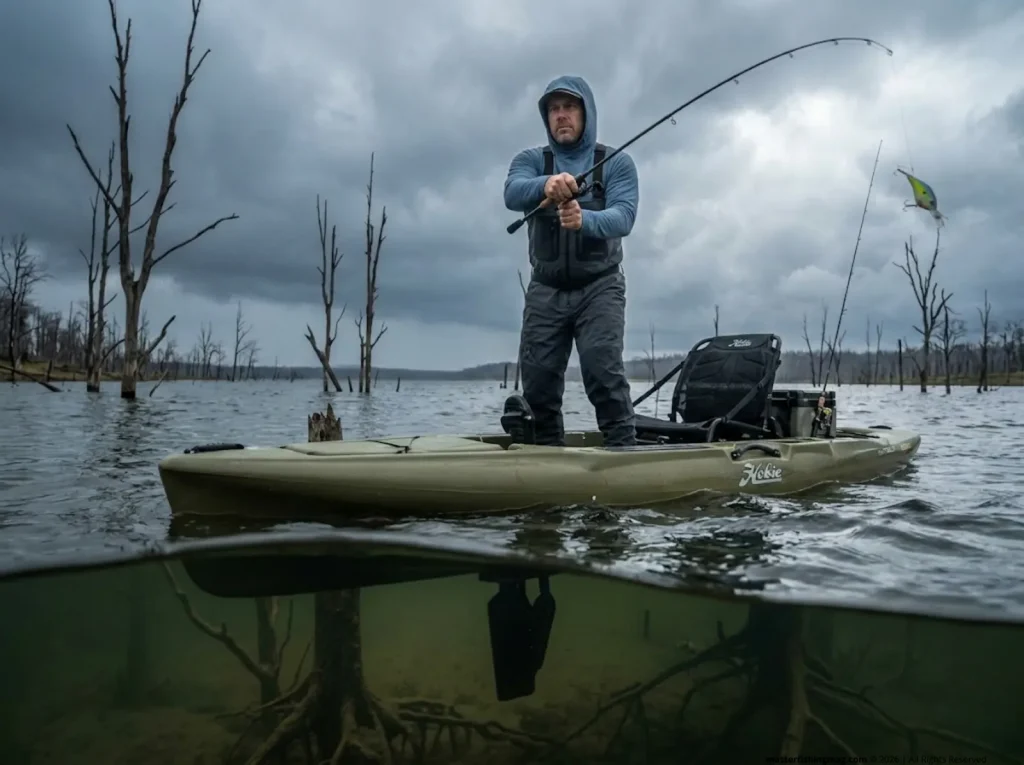
Adding a mechanical drive system to your boat does more than just free up your hands. Tying a massive piece of metal and plastic through the floor completely alters the structural physics of the boat, changing how it handles wind, waves, and turns.
How 20 Pounds of Mechanics Lowers Your Vertical Center of Gravity
Dropping an Old Town Sportsman drive or a Hobie MirageDrive down through the scupper hole acts exactly like the heavy ballast keel on a sailboat. This thick, heavy mechanical unit sits far below the waterline, drastically dropping the vertical center of gravity of the entire system.
This deep weight provides a massive pedal drive keel effect, artificially stabilizing hulls that would otherwise feel far too narrow and tippy to stand on. The drive acts as an anchor holding the bottom of the boat steady, greatly increasing the righting moments when a wave tries to push you sideways over your gunwales.
Creating Lateral Resistance Without a Traditional Skeg
The large, bulky housing of a pedal drive creates intense lateral resistance under the water. Because this huge piece of plastic blocks water from moving sideways, it acts like an oversized skeg right in the middle of your kayak.
This locks the boat on a rail, making it track perfectly straight, which is fantastic for fighting crosswinds. However, it severely hurts your turning radius. A boat with a deep pedal drive resists pivoting, requiring you to make wide, sweeping turns. This creates problems in tight, twisting backwater creeks where maneuverability is necessary.
The Hidden Cost of Parasitic Drag from Underwater Housings
All that underwater hardware comes with a severe speed penalty. When water flows under your boat, it crashes turbulently into the prop housing, the flippers, and the thick drive shafts. This generates massive parasitic drag, putting a brake on your momentum.
If your drive breaks on the water, you will instantly feel this resistance when you try to paddle the boat manually. When evaluating the biomechanical trade-offs of pedal drives, you have to realize that the drag makes paddling a pedal boat exhausting. You are essentially dragging a bucket underwater while trying to row yourself home.
Conclusion
Most anglers accept slow, sluggish boats because the retail salespeople convinced them that never tipping over is the only thing that matters on the water. By understanding your hull speed limits, respecting the delicate balance between primary and secondary stability, and eliminating the stealth-ruining acoustics of hull slap, you can choose a vessel tuned for real performance. Take a hard look at where you actually fish, calculate whether you truly need a thirty-six-inch-wide barge, and test paddle a sleeker hull. Your shoulders, and your catch rate, will thank you.
FAQ
What is the most stable hull shape for a fishing kayak?
A pontoon or completely flat Double-U hull provides the highest primary stability, allowing you to easily stand and cast on calm water. However, this same shape makes the kayak highly susceptible to rocking violently or rolling over in heavy ocean surf or choppy boat wakes.
Are V-hull kayaks faster than flat-bottom kayaks?
Yes. A V-hull slices through the water rather than pushing it like a plow, drastically reducing the wetted surface drag and wave-making resistance. This allows you to sustain higher cruising speeds with significantly less physical effort and strain on your shoulders and back.
What does the rocker of a kayak hull do?
Rocker refers to the upward curvature of the hull from the center toward the bow and stern, shaped much like the bottom of a rocking chair. A high rocker makes a kayak highly maneuverable in tight, twisting rivers, while a flat hull with zero rocker tracks perfectly straight on open lakes but is very difficult to steer.
Why does my wide fishing kayak slap the water so loudly?
Your kayak is experiencing hull slap, caused by surface ripples violently hitting the flat, wide entry angles of your bow. You can minimize this acoustic pollution—which actively scares fish through pitching vibrations—by shifting heavy gear forward to press the hull deeper and alter the impact angle.
Risk Disclaimer: Fishing, boating, and all related outdoor activities involve inherent risks that
can lead to injury. The information provided on Master Fishing Mag is for educational and informational purposes
only. While we strive for accuracy, the information, techniques, and advice on gear and safety are not a substitute
for your own best judgment, local knowledge, and adherence to official regulations. Fishing regulations, including
seasons, size limits, and species restrictions, change frequently and vary by location. Always consult the latest
official regulations from your local fish and wildlife agency before heading out. Proper handling of hooks, knives,
and other sharp equipment is essential for safety. Furthermore, be aware of local fish consumption advisories. By
using this website, you agree that you are solely responsible for your own safety and for complying with all
applicable laws. Any reliance you place on our content is strictly at your own risk. Master Fishing Mag and its
authors will not be held liable for any injury, damage, or loss sustained in connection with the use of the
information herein.
Affiliate Disclosure: We are a participant in the Amazon Services LLC Associates Program, an
affiliate advertising program designed to provide a means for us to earn advertising fees by advertising and linking
to Amazon.com. As an Amazon Associate, we earn from qualifying purchases. We also participate in other affiliate
programs and may receive a commission on products purchased through our links, at no extra cost to you. Additional
terms are found in the terms of service.