
In this article
Mid-February on a north-facing bluff wall. Water temp reads 42°F on the graph. I’ve been throwing the same jerk-jerk-pause for forty minutes, and the Garmin shows bass sitting three feet off the rock, watching my bait swim past like it doesn’t exist. I swap to a softer twitch and let the Megabass Vision 110 hang motionless for fifteen seconds. Third cast, the rod loads. That fish was never going to chase anything. It needed permission to eat.
After fifteen years of fishing jerkbaits across every season and water type I can reach, I’ve learned that cadence is the difference between a five-fish limit and a blank screen. Most anglers treat jerkbait fishing like a metronome, repeating the same rhythm cast after cast. But bass don’t work on a schedule. They respond to mood, temperature, and opportunity. And your job is to figure out which combination makes them commit.
This guide breaks down every variable that controls your jerkbait cadence, from water temperature and bass species to lure buoyancy and line choice. You’ll walk away with a system for dialing in the right retrieve instead of guessing your way through a cold front.
⚡ Quick Answer: There is no single best jerkbait cadence. In cold water below 50°F, start with 2-3 soft twitches and a 5-15 second pause. In warm water above 55°F, use 3-4 aggressive twitches with 2-3 second pauses. Change your cadence every 15-20 casts until you get a bite, then replicate it. Over 90% of strikes happen on the pause.
The Mechanics of a Proper Jerkbait Snap
Rod Tip Down, Slack In, Snap Hard
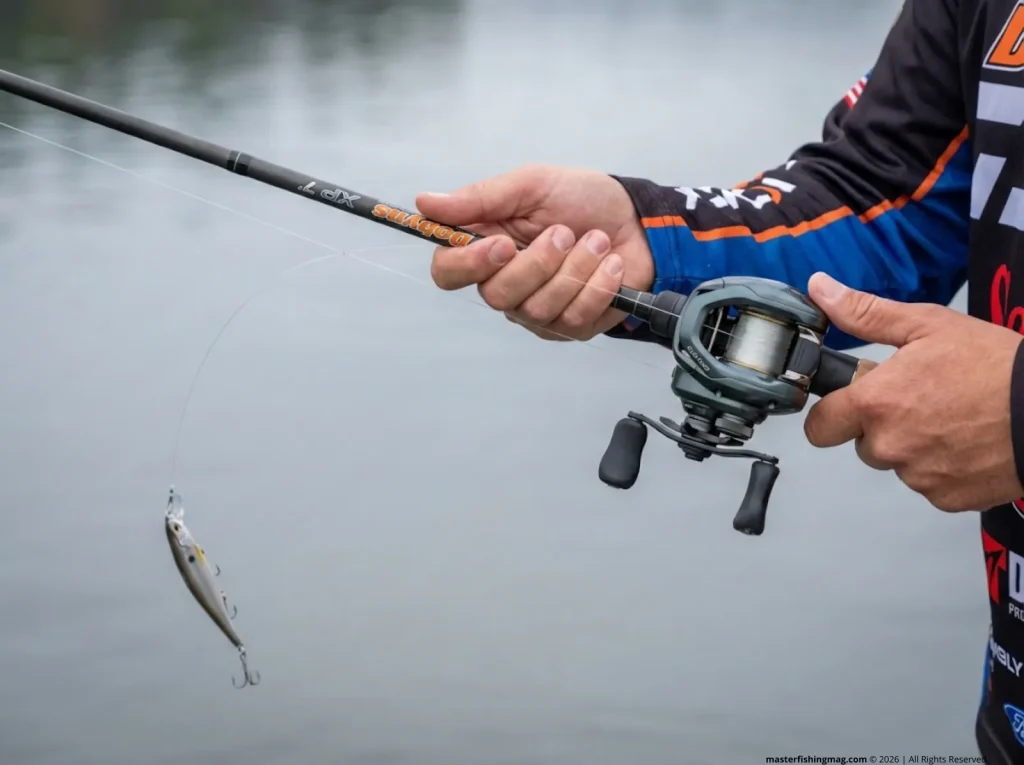
The single biggest mistake I see at the ramp is anglers reeling their jerkbait back like a crankbait. That’s not how these baits are designed to move. A jerkbait needs slack to dart, and slack comes from snapping the rod with the tip pointed at or near the water surface.
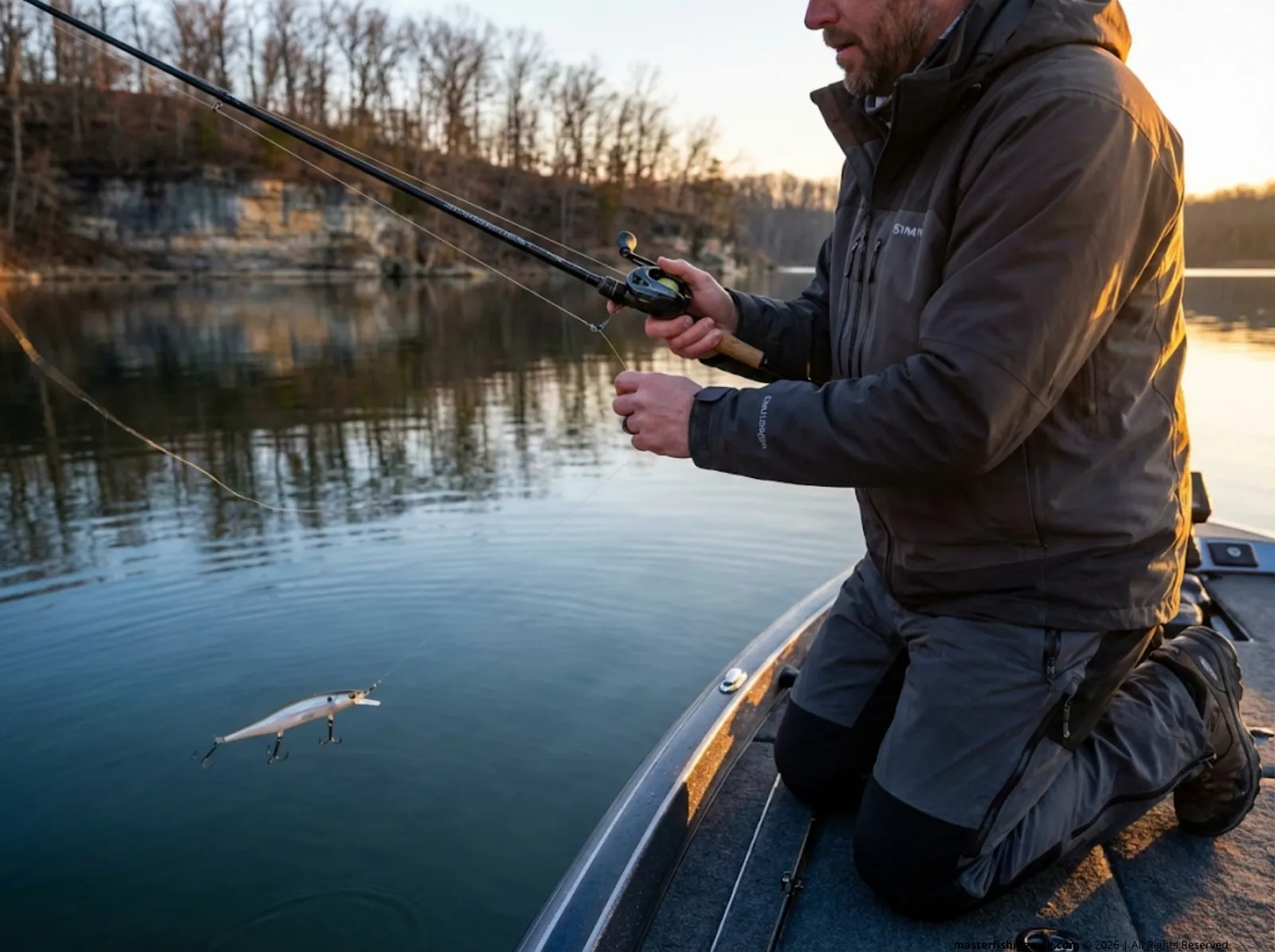
Here’s the mechanic: point your rod tip down to about 10 o’clock. Snap your wrist, not your forearm. That wrist snap creates rod-tip recoil that loads three to four feet of slack into the line. Now reel up only the slack. Never reel during the jerk itself.
Kevin VanDam put it best: he works his jerkbait harder than most people do, but he’s not moving the bait very far. He snaps it hard and puts three or four feet of slack in it. The bait dances in a small space instead of swimming toward the boat.
Pro tip: Jerk on slack line, never on tension. If your line is tight when you snap, the bait is swimming toward you, not hunting. You should see a visible loop of line between your rod tip and the water after every snap.
How Slack Line Creates the Dart
When you snap on slack line, water resistance acts on the bait’s diving lip and body while the line hangs loose. The bait pushes against still water at an angle, producing that characteristic erratic side-to-side darting that mimics a dying shad twitching its last.
More slack produces a wider dart. Less slack gives you a tighter wobble. This is where line choice starts to matter.
On fluorocarbon (10-12 lb), reduced stretch transmits the snap’s energy more efficiently so the bait darts sharper. On monofilament line, the stretch absorbs some of that energy. The bait floats higher and darts softer. That’s not always a bad thing. In very cold water, you might want that subtle, higher-riding presentation. Understanding why fluorocarbon isn’t truly invisible underwater helps you decide which line gets spooled for which conditions.
According to the Recreational Boating & Fishing Foundation’s jerkbait guide, the slender minnow-shaped body and diving lip are designed specifically to respond to rod-tip input. Without slack, you’re fighting the design.
Matching Cadence to Water Temperature
Cold Water (Below 50°F) — Go Slow, Go Long
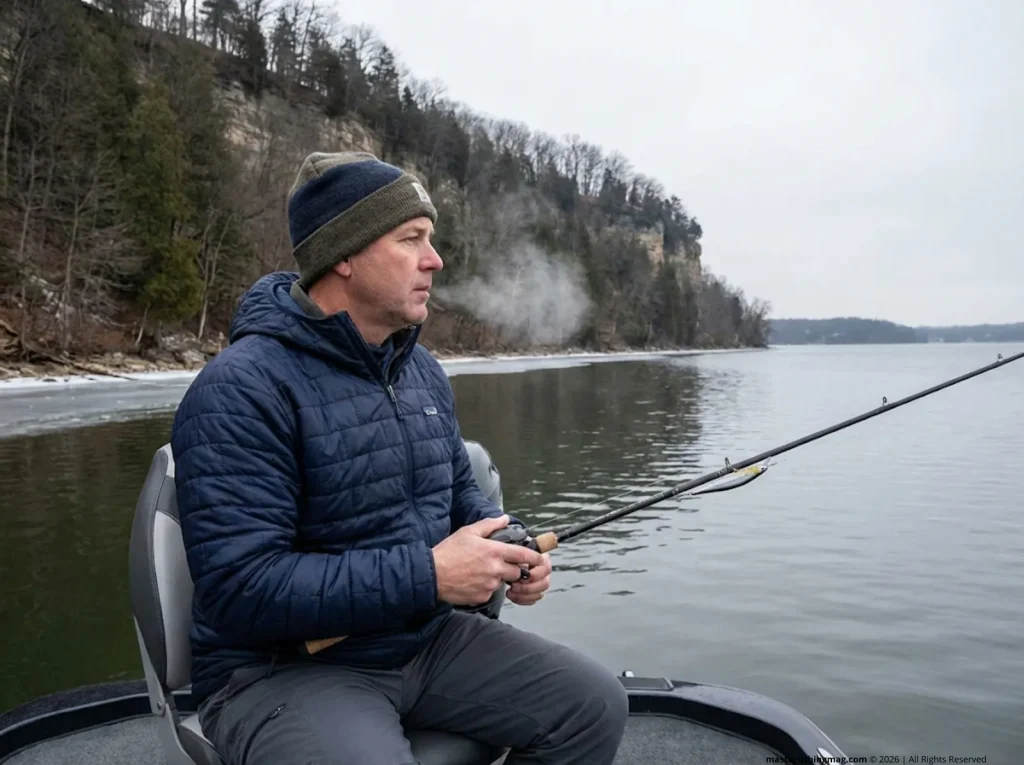
Bass are cold-blooded. When water temperature drops below 50°F, their metabolism slows to a crawl. They won’t chase an erratic bait across thirty feet of water. They need food delivered to their face with enough hang time to commit.
Start with David Mullins’ baseline: two soft jerks and a five-second pause. If nothing bites after fifteen or twenty casts, extend that pause to ten seconds, then fifteen. In water in the mid-30s to mid-40s, pauses of fifteen seconds or longer are where most of the big bites come from.
Mike Iaconelli changes his cadence every 15-20 casts until he gets a bite. “The colder the water temps,” he says, “the longer I let the bait pause and the softer I jerk it.” His 2013 Bassmaster Classic practice on Grand Lake proved it. Day one with a standard cadence got zero bites. Day two, softer twitches on the same lure produced fish immediately.
Jerkbaits produce more recorded bass catches in water under 50°F than in almost all warmer temperatures combined, with April as the peak month followed by March and January. That’s according to Lake Fork guide service data on cold-water jerkbait effectiveness. The fish are there. They’re just not willing to work for it.
Pro tip: Count your pauses out loud. It sounds ridiculous, but it keeps you honest. “One Mississippi, two Mississippi” all the way to fifteen. Most anglers think they’re pausing ten seconds when it’s really three. Discipline on the pause is what separates a good jerkbait day from a great one.
Warm Water (Above 55°F) — Get Aggressive
When the water pushes past 55°F, bass flip a switch. Their metabolic rate increases and they’re willing to chase erratic prey. This is where you switch to three or four harder twitches with two-to-three second pauses, or even a near-constant retrieve.
Travis Manson from SmallmouthCrush targets dock shade lines in warming water with quick twitches and a quick pause, barely giving the bait time to settle. The idea is to make the bait look panicked. Once water climbs past 65°F, jerkbait effectiveness typically falls off and you’re better served transitioning to topwater or soft plastics.
The Transition Zone (50-55°F) — Read and React
This five-degree window is where the biggest fish often feed. Bass are metabolically active but not fully competitive yet. Start moderate with three jerks and a five-second pause, then bracket up or down every 15-20 casts. Understanding how water temperature controls bass metabolism and feeding windows gives you the biological “why” behind these adjustments.
Watch for followers on your graph. If bass track your bait but won’t commit, soften the next set of twitches and add three to five seconds to your pause. The transition zone rewards patience and constant adjustment.
Species-Specific Cadence Adjustments
Largemouth Bass — Slower Retrieve, Pauses Matter
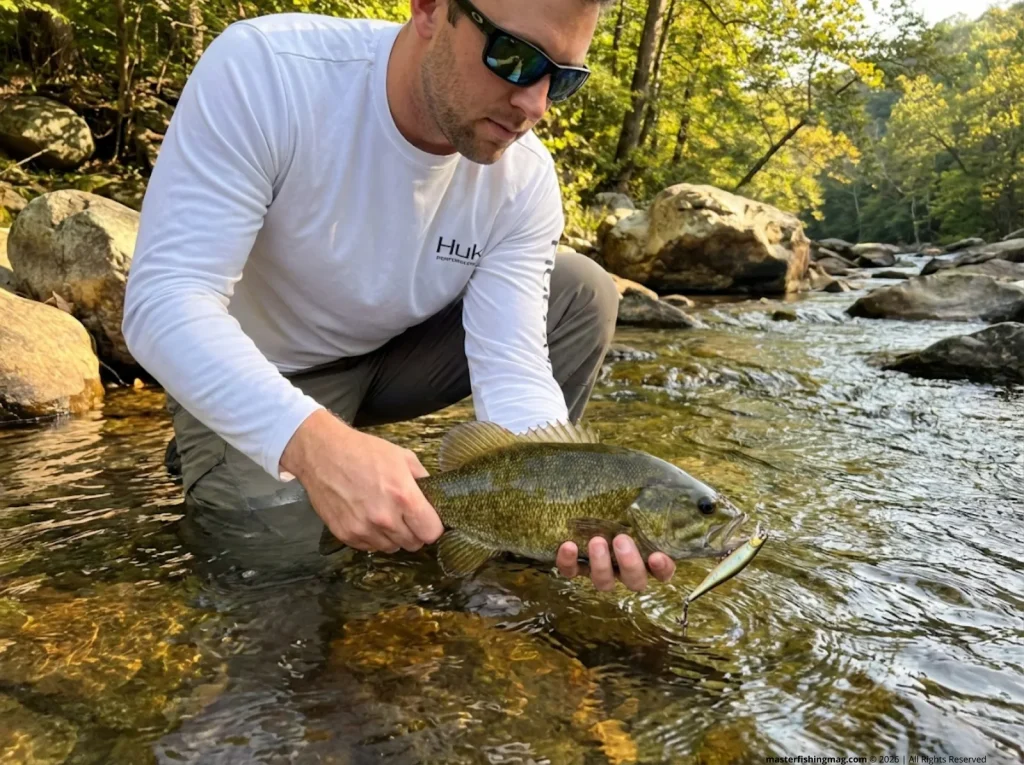
Largemouth bass are ambush predators. They prefer to intercept a bait that pauses in their strike zone rather than chase one down. A standard approach is two to three jerks followed by a three-to-eight second pause depending on conditions.
In clearer water, reduce your twitch intensity. Largemouth can see the bait from farther away, and heavy snaps can spook them before they commit. Let the bait do the work.
Spotted Bass — Fast, Erratic, Minimal Pause
Spotted bass are a different animal entirely. They’re current-oriented, schooling fish that chase baitfish aggressively. Sam Hanggi from Wired2Fish puts it clearly: spotted bass typically prefer a series of fast erratic jerks with little to no pause, while largemouth often prefer a slightly slower retrieve with intermittent pauses.
If you’re fishing water that holds both species, the approach laid out in the tactical differences between spotted bass and largemouth can save you hours of figuring out which pattern works on a given day.
When You’re Not Sure What Species You’re Targeting
Start moderate: three jerks, four-to-five second pause. Let the bite tell you. If you get hits during the pause, slow down. That’s a largemouth pattern. If you get chases or swipes during movement, speed up. That’s spotted bass telling you they want to chase. Mixed-species fisheries demand constant adjustment, and the fish will show you what they want if you’re willing to listen.
Beyond Jerk-Jerk-Pause — Dynamic Cadence Systems
Dustin Connell’s Mood-Matching Approach
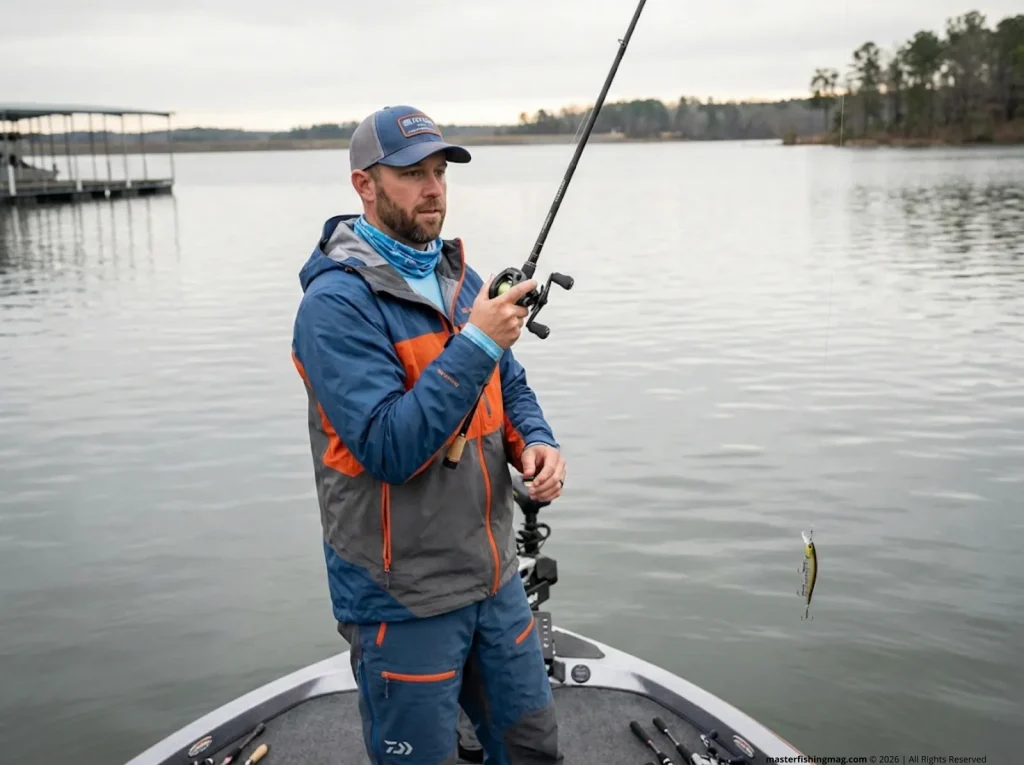
Dustin Connell ditches the fixed jerk-jerk-pause entirely. He treats each retrieve as a conversation with the fish, not a script. If bass are following but not committing, he snaps the rod upward, not sideways, to mimic a fleeing baitfish rising toward the surface. That upward snap often triggers an immediate reaction strike from fish that were content to just watch.
“Vary your cadence to match the mood,” Connell says. “Snap upwards to mimic a fleeing baitfish.” In post-spawn when bass are aggressive, he sometimes runs a constant retrieve with no pause at all, outperforming the traditional cadence that day.
The 15-20 Cast Experimentation Rule
Iaconelli’s rule is simple and it works: change cadence every 15 to 20 casts until a fish commits. Once you get that first bite, replicate the exact sequence for the next thirty or forty casts before the window shifts again.
Track what you’re doing. Count your jerks. Count your pause seconds. Note where in the retrieve the bite happened. The sweet spot, that deepest segment of the retrieve where the bait reaches maximum depth, is where most big bass strikes concentrate. Focus your best cadence there.
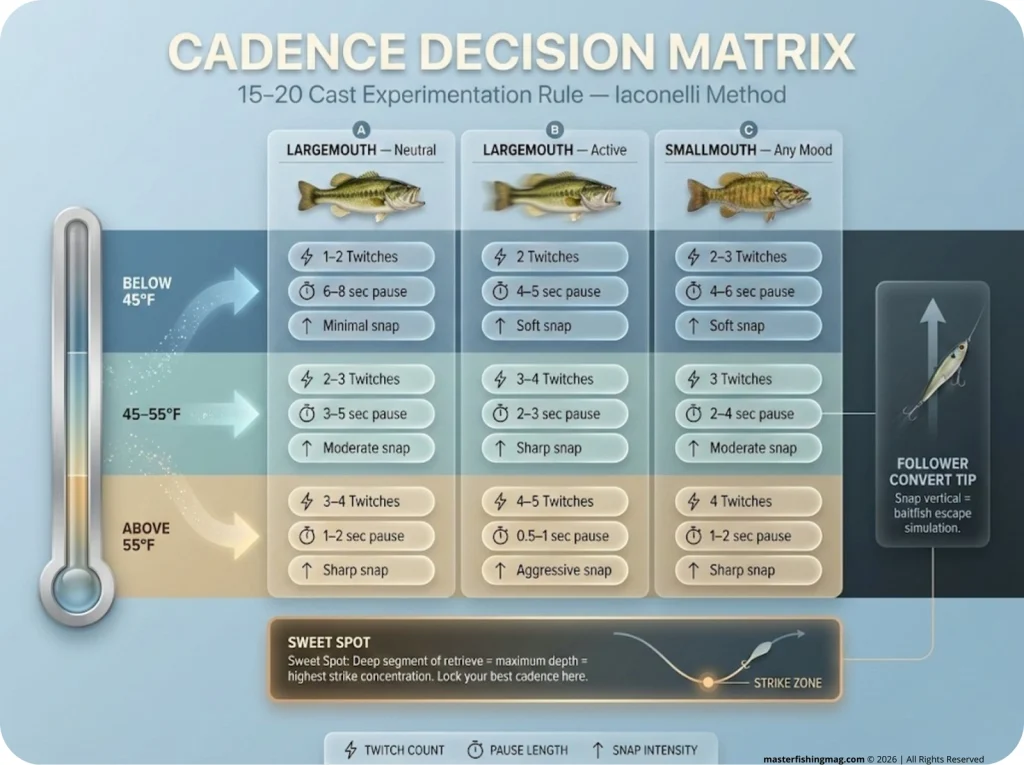
Pro tip: When you see a follower on your electronics, snap upward immediately. That vertical direction change looks like a baitfish making a last-ditch escape toward the surface, and it converts followers into committed strikes more than any other adjustment I’ve tried.
Tuning Your Jerkbait for the Right Suspend
Why Factory-Tuned “Suspending” Isn’t Always Neutral
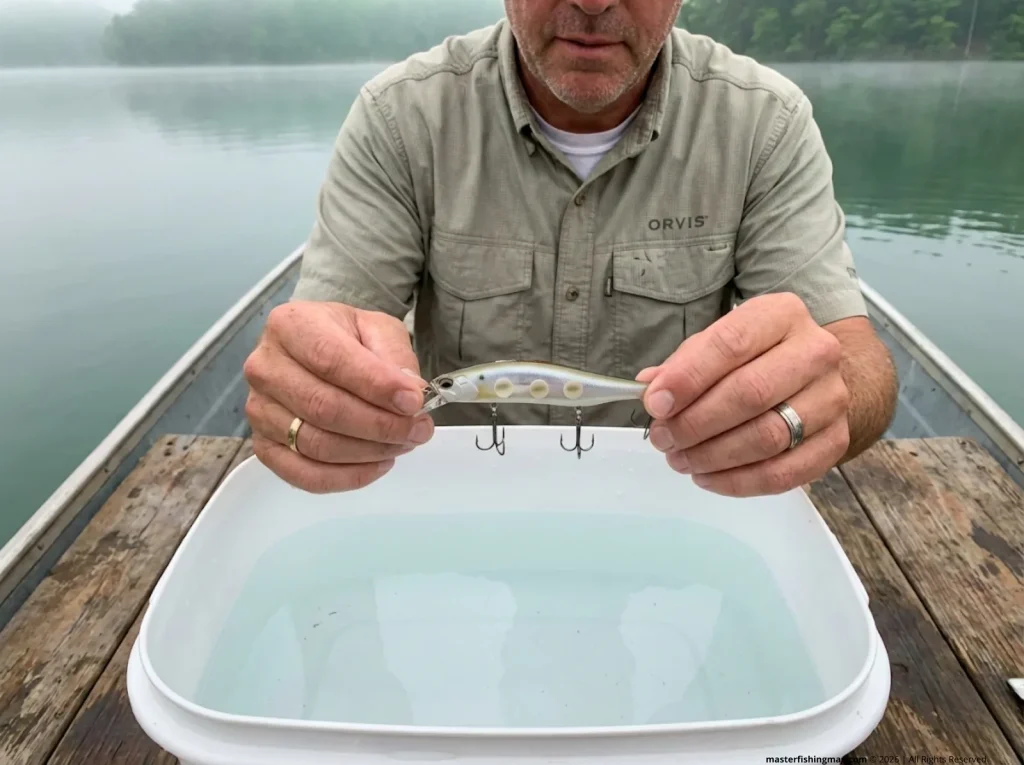
Most jerkbaits labeled “suspending” are tuned for water around 55-60°F. The problem is that cold water is denser. That same bait that hovers perfectly in October floats in January. A bait that slowly rises on the pause drifts out of the strike zone during those long cold-water pauses where the biggest fish eat.
Different treble hooks, split rings, and line diameter all change buoyancy. So does fluorocarbon versus monofilament. If you’re serious about the long-pause game in cold water, you need to tune your baits. Understanding the Archimedes-based physics of lure buoyancy makes the difference between a bait that sits in the strike zone and one that drifts out of it.
Suspend Dots, Split Rings, and Wire Wraps
Adhesive suspend dots from Storm add small increments of weight. Start with one on the belly and test. Upgrading to heavier split rings or larger treble hooks sinks the bait deeper and slower. Wire wraps around hook shanks, twisted three or four times, provide micro-adjustments when you need something between dot sizes.
Test in a sink or bathtub before you head to the lake. The bait should hover motionless or sink less than one inch every five seconds. That’s the sweet spot for a true suspending jerkbait.
This is where most anglers give up. They fish a factory bait that slowly rises and wonder why the long-pause approach doesn’t work. It’s not the cadence that’s failing. It’s the bait refusing to stay put.
Gear That Makes or Breaks Your Cadence
Rod Selection — Medium Power, Fast Action
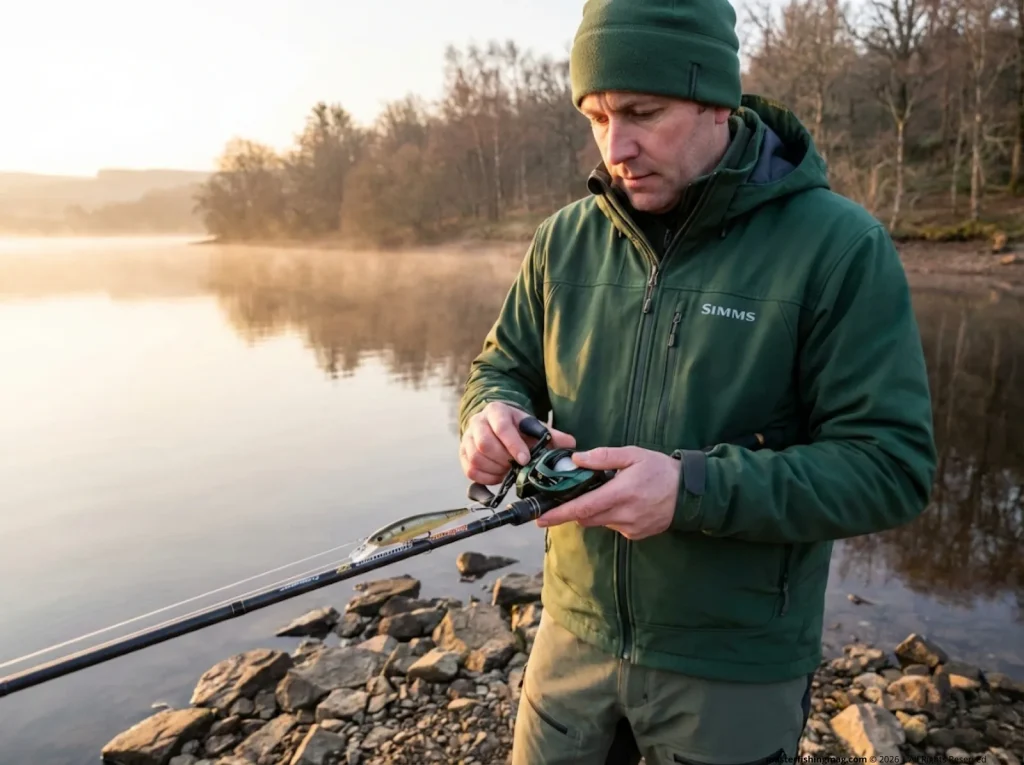
A medium power, fast action rod in the 6’8″ to 7′ range gives you the right combination of tip flex for snap control and backbone for treble hook penetration. The Dobyns Champion XP and similar jerkbait-specific rods are built for this exact application. Avoid heavy power rods. They overpower the bait’s action and rip trebles free on hooksets during the pause strike.
Line Choice — Fluorocarbon vs Monofilament
10-12 lb fluorocarbon is the consensus. Sunline Sniper and Berkley Trilene 100% Fluorocarbon are consistently recommended by tournament pros for the combination of low stretch, near-neutral buoyancy, and sensitivity. Monofilament has its place in extreme cold when you want a subtler, higher-riding presentation. Braid is rarely used because its zero stretch creates too-aggressive snaps that kill the natural darting action.
For more on how cold-water presentations combine with bank-accessible spots, see cold-water bank fishing tactics that pair with jerkbait cadence.
Reel Speed — Slower Is Better
A 6.2:1 to 6.6:1 gear ratio prevents you from reeling too fast. You should be reeling only to pick up slack between snaps, never to move the bait forward. The Shimano Curado in the 6.2 range is a solid baseline for jerkbait fishing.
Conclusion
Cadence isn’t a formula. It’s a conversation between you and the bass, and it changes every hour you’re on the water. Change your approach every 15-20 casts until they answer.
Water temperature is your first variable. Below 50°F, go soft and long. Above 55°F, get aggressive. In between, bracket.
Your bait’s buoyancy matters more than its paint job. A jerkbait that doesn’t truly suspend on the pause is leaving the biggest fish behind. Tune it, test it, and trust the pause.
Next time you pick up a jerkbait rod, forget what worked last trip. Start fresh. Count your pauses. Watch your graph. The fish will tell you the cadence, but only if you’re willing to keep changing until they do.
FAQ
What is the best jerkbait cadence for cold water?
Start with 2 soft twitches and a 5-second pause, then extend the pause up to 15 seconds if no bites come. In water below 45°F, most strikes happen on pauses of 10 seconds or longer because bass won’t expend the energy to chase erratic prey.
How long should you pause a jerkbait?
It depends on water temperature and bass activity. In winter below 50°F, pause 5-15+ seconds. In spring and fall between 50-60°F, pause 3-5 seconds. In warm water above 60°F, pauses of 1-3 seconds or a near-constant retrieve often produce the most bites.
Does line type affect jerkbait action?
Significantly. Fluorocarbon produces the sharpest darts because of its low stretch and near-neutral buoyancy. Monofilament adds a softer, higher-riding presentation that can outperform fluorocarbon in very cold water. Braid is almost never used for jerkbaits because its zero stretch kills the natural darting action.
Why won’t bass commit to my jerkbait even when they follow it?
Followers that don’t eat usually mean your cadence is too aggressive or your pauses too short. Extend your pause by 3-5 seconds, soften your twitches, or snap upward to trigger a fleeing-baitfish reaction. Also check that your bait truly suspends. A slowly rising jerkbait drifts out of the strike zone during long pauses.
What rod action is best for jerkbait fishing?
A medium-power, fast-action rod in the 6’8 to 7′ range gives you the right balance of tip flex for snap control and backbone for treble hook penetration. Avoid extra-fast or heavy-power rods because they overpower the bait and rip hooks during the pause strike.
Risk Disclaimer: Fishing, boating, and all related outdoor activities involve inherent risks that
can lead to injury. The information provided on Master Fishing Mag is for educational and informational purposes
only. While we strive for accuracy, the information, techniques, and advice on gear and safety are not a substitute
for your own best judgment, local knowledge, and adherence to official regulations. Fishing regulations, including
seasons, size limits, and species restrictions, change frequently and vary by location. Always consult the latest
official regulations from your local fish and wildlife agency before heading out. Proper handling of hooks, knives,
and other sharp equipment is essential for safety. Furthermore, be aware of local fish consumption advisories. By
using this website, you agree that you are solely responsible for your own safety and for complying with all
applicable laws. Any reliance you place on our content is strictly at your own risk. Master Fishing Mag and its
authors will not be held liable for any injury, damage, or loss sustained in connection with the use of the
information herein.
Affiliate Disclosure: We are a participant in the Amazon Services LLC Associates Program, an
affiliate advertising program designed to provide a means for us to earn advertising fees by advertising and linking
to Amazon.com. As an Amazon Associate, we earn from qualifying purchases. We also participate in other affiliate
programs and may receive a commission on products purchased through our links, at no extra cost to you. Additional
terms are found in the terms of service.