In this article
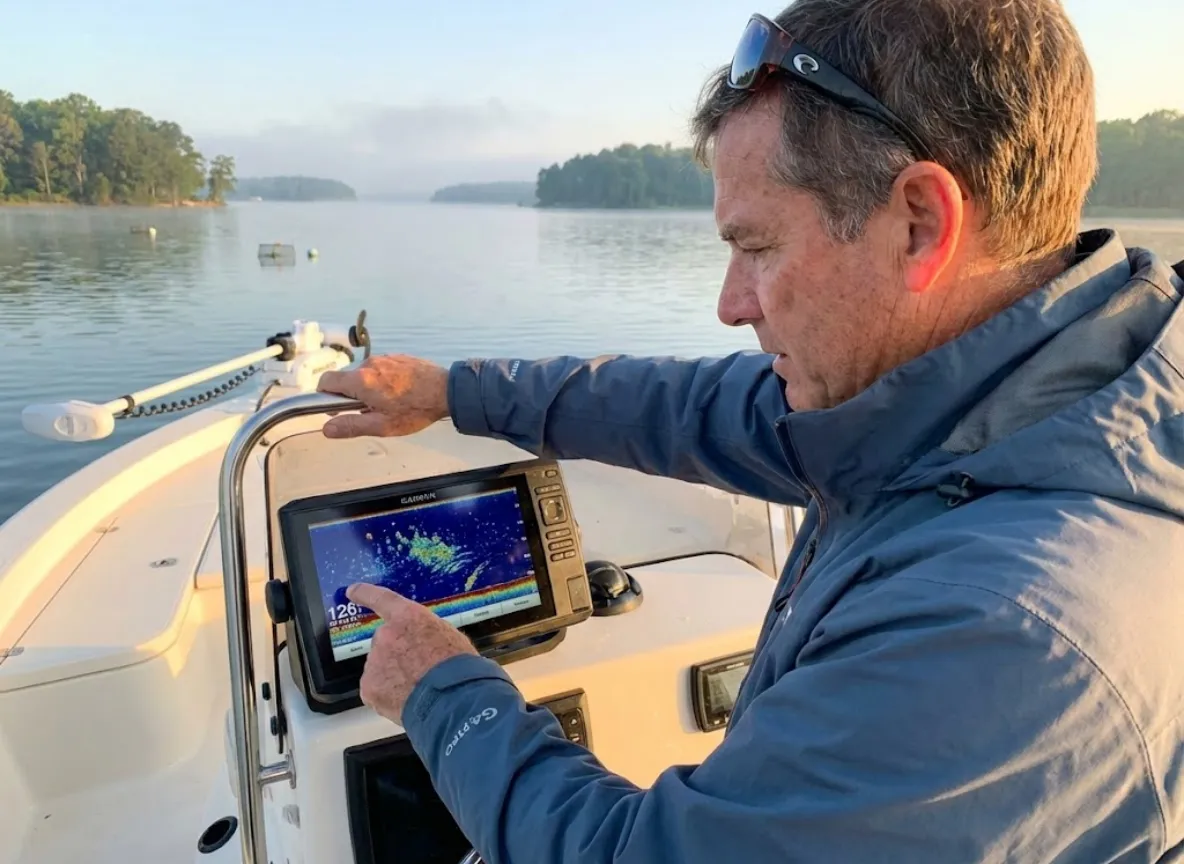
The sonar lit up with a dense cloud of marks suspended at 28 feet—right at the thermocline. Above them, the surface was a mirror, 79°F and lifeless. Below, the cold abyss showed nothing but the hazy line of oxygen-depleted water. These fish weren’t scattered; they were trapped.
After two decades of chasing Morone saxatilis from the Chesapeake tributaries to the boulder fields of Montauk, I’ve learned that striped bass don’t move randomly. Every migration, every vertical shift, every ambush position is a calculated response to forces most anglers never consider. Understanding why that school was precisely at 28 feet—and not 18 or 38—is the difference between a frustrating day and a limit.
Here’s the playbook: how to read temperature, oxygen, forage, and tides as a unified system—and turn vast, opaque water into a predictable map of fish.
⚡ Quick Answer: Striped bass location is controlled by three overlapping factors: temperature (adults prefer 48-59°F), dissolved oxygen (they need waters above 5 mg/L), and forage (primarily menhaden, river herring, and shad). In summer, they’re squeezed into a narrow thermocline band where these conditions overlap. Find that band on your fish finder, match your timing to forage movements, and position yourself on current seams—that’s where bass will be waiting.
The Bioenergetic Engine: Temperature and Oxygen Constraints

Striped bass are not random wanderers. Their location is dictated by what biologists call the fundamental thermal niche—a specific temperature range where the fish’s metabolic engine runs at peak efficiency. And this niche shifts as the fish ages.
Traditional fishing literature often cites optimal water temperature preferences of 64-75°F. That’s outdated. Recent telemetry studies show adult Atlantic striped bass actively select cooler water—48-59°F—when available. The reason comes down to basic metabolism.
The Fundamental Thermal Niche (And Why Bigger Fish Need Cooler Water)
As water temperature rises, a bass’s resting energy cost—the energy needed just to stay alive—increases sharply. Meanwhile, its maximum output capacity plateaus or drops. The gap between these two rates is the fish’s usable energy reserve, its ability to chase prey, fight current, or recover from exertion.
When warm water compresses this gap (a phenomenon scientists call metalimnetic hypoxia when oxygen gets involved), a 40-pound trophy becomes sluggish. It can’t sustain high-speed chases or recover quickly from a fight. This is why large adults drive the northward seasonal migration patterns in summer, seeking relief in ocean waters from New York to Maine. It’s also why they stack in the thermocline of stratified reservoirs—the only place left to breathe without overheating.
Understanding how water temperature dictates metabolic rate and lure cadence helps you adjust your presentation speed to match what the fish can actually handle.
Pro tip: A trophy striper in 77°F water is essentially a heat-stressed victim. It won’t chase a fast-moving lure, and if you catch it, the fight may kill it. Slow down your retrieve dramatically when fishing warm surface conditions.
The Oxy-Thermal Squeeze: Finding the Habitable Zone
Temperature preferences can’t be separated from dissolved oxygen saturation requirements. Striped bass need water with at least 5 mg/L of DO to function well. Below 3 mg/L, the water becomes hypoxic—essentially unbreathable.
In stratified water bodies—Chesapeake Bay in July, Lake Hartwell in August—the water separates into layers. The surface (epilimnion) is warm and oxygenated, but often too hot for adult bass. The bottom (hypolimnion) is cool, satisfying their thermal preference, but oxygen-depleted from decomposition. Striped bass get squeezed into the narrow band in between: the metalimnion or thermocline positioning zone.
On your sonar, this often appears as a hazy horizontal band between 20 and 35 feet deep. Fish marks below this line are often catfish, carp, or metabolically compromised stripers that won’t feed. The active bass hold just above or within the top of the thermocline.
Learning how to identify and fish the thermocline is the single most important skill for summer striper success. Without it, you’re fishing blind. The temperature-oxygen squeeze is the invisible driver behind every summer striper pattern.
Catch-and-Release Mortality: The Hidden Cost of Hot Water Fishing
The physiological rigidity of striped bass has serious implications for catch-and-release ethics. When you hook a bass holding in the cool thermocline, you pull it through warm surface water. The fight depletes its energy reserves and builds lactic acid. If released into warm, low-oxygen conditions, the fish may not recover.
Studies show recreational catch-and-release mortality averages 9% coastwide—but jumps to 11% or higher when water exceeds 77°F. That’s according to the 2024 ASMFC stock assessment’s findings on discard mortality. The overfished status of the stock makes every dead release count.
Using circle hooks dramatically improves striped bass survival by reducing gut-hooking. If you fish during thermal stress periods, minimize air exposure and handle time—or consider sitting out the hottest days entirely. This supports the ongoing rebuilding plan for the species.
The Great Migrations: Stock Dynamics and Seasonal Calendars
The Atlantic coastal population is a mixed-stock fishery—individuals from the Chesapeake Bay, Hudson River, and Roanoke River spawning populations intermingle during their oceanic residency. Understanding when each stock moves helps you predict the waves of fish traveling the coast.
The Chesapeake Bay Stock: 70-90% of the Coastal Fishery
The Chesapeake Bay is the primary nursery, contributing 70-90% of the Atlantic coastal migratory stock. The health of Chesapeake spawning triggers essentially dictates whether there will be fish from Virginia to Maine.
Spawning occurs in the tidal freshwater reaches of major tributaries—Potomac, Choptank, Nanticoke—when water temperatures hit 54-66°F, typically late March through May. The anadromous life cycle means these fish migrate from salt to fresh water specifically to spawn. After that, a critical split happens. Smaller males and juveniles often stay in the Bay as residents. But large, sexually mature females exit rapidly to escape summer heat, initiating the coastal migration.
Telemetry data shows these ocean emigrants can reach Cape Cod waters within 60 days of leaving the Chesapeake. If you’re fishing Massachusetts in early June, many of those fish launched from Maryland in April.
The troubling news: the Maryland DNR YOY (Young-of-Year) index hit 1.0 in 2023—far below the long-term average of 11.1. This signals a recruitment gap affecting juvenile behavior and population structure for years to come.
Understanding how landlocked striped bass fisheries developed from stocked Chesapeake/Santee-Cooper genetics puts the reservoir stocking program populations in context—same species, different playground.
The Hudson and Roanoke Stocks: Regional Contributors
The Hudson River stock enters from the ocean in April and spawns between West Point and Catskill from late April through early June. Unlike Chesapeake fish that may travel to the St. Lawrence River, many Hudson fish oscillate between the river estuary and the New York Bight, exploiting local menhaden schools.
The Roanoke River stock is famous for dramatic “rock fights”—visible surface spawning events triggered around 62°F in late April and May. Flow rates are critical here; if upstream dam retention drops flows too low, eggs sink and smother. Telemetry confirms that the largest Roanoke adults (over 35 inches) do migrate north to mix with other stocks before homing back to spawn.
California’s Pacific Population: Adaptation Under Stress
Striped bass were introduced to California in 1879 and now spawn in the Sacramento and San Joaquin river systems. Adults spend summer and fall in San Francisco Bay, exploiting cooler water and forage like Northern Anchovy. But California’s droughts have fundamentally stressed this population—reduced freshwater flows decrease spawning cues, and nursery habitat is compressed by salinity intrusion.
Forage as GPS: Tracking the Bait to Track the Bass
Within their physiological boundaries, striped bass go where the food is. Their movements sync with high-calorie, schooling prey—primarily menhaden, alewife, blueback herring, and various shad species.
Atlantic Menhaden: The Keystone Prey
Atlantic menhaden (bunker, pogies) are the keystone prey for trophy-class coastal stripers. Where menhaden go, big bass follow. The diet progression from juvenile to adult bass tracks this relationship closely.
Spring brings adult menhaden into estuaries, drawing post-spawn bass into bays like Raritan and Narragansett. But the most significant event is the fall run: juvenile menhaden (“peanut bunker”) exit nursery estuaries as water cools, and millions of migrating stripers intercept them. This triggers the famous blitzes—schools of bass crashing bait at the surface.
Timing is temperature-dependent. A warm autumn keeps bait and bass in the bays late into December. Cold fronts push them oceanward earlier.
Reading the birds tells you where it’s happening. Large gannets diving from 100+ feet indicate adult menhaden deep in the water column—and substantial predators below. Gulls sitting on rips, periodically picking at the water, signal a feeding event just beneath the surface.
Developing your sonar interpretation skills helps you find bass even when there’s no surface activity. Learning tactical patterns for targeting bass during shad-related feeding events gives you a parallel playbook when menhaden aren’t present.
River Herring and Sand Eels: Secondary Forage Systems
River herring (Alewife and Blueback Herring) provide critical spring and fall forage. Alewives enter rivers at about 52°F; Bluebacks follow at 59°F. This staggered entry sustains the food base for bass staging at river mouths. Bass set up ambush points at constrictions—dam tailraces, herring runs, narrow river mouths.
Sand lance (sand eels) represent a different game entirely. These bottom-dwelling baitfish bury in sandy shoals. Bass feeding on sand eels hold deep, often rooting near the bottom. You won’t see surface action. This requires vertical jigging or wire-line trolling—and when sand eels are present, bass can anchor on a single structure for weeks.
Pro tip: When birds are absent but your sonar shows bait marks tight to the bottom over sandy structure, switch to heavy slab spoons or chartreuse jigs fished vertically. Sand eel patterns are invisible from the surface but deadly below.
Winter Shad Kills: Cold-Water Concentration Events
In reservoirs, Gizzard Shad and Threadfin Shad are lethally sensitive to cold. When water drops below 39°F, significant shad mortality occurs. Striped bass congregate to scavenge these dying baitfish.
Finding thermal stress zones for shad—often where wind or current piles up dying bait—is the key to winter reservoir success. Knowing how water level fluctuations impact fish movements and forage displacement helps predict where these concentrations form.
Hydrodynamics and the Micro-Location: Tides, Wind, and Light
Once you’ve identified the general area—the right temperature layer, the right forage presence—what determines the exact spot where bass will hold?
Tides, Currents, and the “Seam”: Reading the Conveyor Belt
Striped bass are ambush predators engineered to exploit current. They position on the slow side of seams—the boundary between fast main current and slower eddy water—facing upstream, waiting for disoriented prey to sweep past. Understanding tidal feeding triggers transforms your catch rate.
Slack tide means inactivity. Feeding intensity peaks during moving water stages, especially mid-tide. In estuaries, the outgoing tide often flushes bait from marshes into deeper channels where predators wait. Along ocean beaches, the incoming tide may push cool, oxygenated water and pelagic baitfish shoreward.
Pro tip: The two hours before and after peak current velocity are your prime windows. Don’t waste time fishing dead slack—reposition or take a break.
Understanding the physics of current seams and boundary layer dynamics takes your water-reading skills to the next level. For fly fishing tactics, positioning yourself to drift a Clouser Minnow or Deceiver flies through these seams is the key presentation.
Wind as Ally: Why Rough Water Produces Fish
Conventional wisdom says fish the calm, sheltered shoreline. That’s often wrong.
Windward shorelines—where wind blows into your face—are frequently more productive. Surface turbulence aerates the water, boosting dissolved oxygen. Turbidity provides visual cover, letting bass hunt shallow without fear of birds. Wind-driven current also stacks warm surface water and plankton against the shore, concentrating baitfish.
Low-pressure systems and approaching storms are major feeding triggers. The drop in barometric pressure disorients bait and fires up aggressive feeding. The days immediately before and after a major gale are often the fall season’s best.
Learning how barometric pressure changes affect swim bladder and feeding behavior helps you use weather forecasts as fishing forecasts.
Photoperiod and Lunar Cycles: The Cover of Darkness
Striped bass have eyes adapted for low light—retinas packed with rod cells. Large adults in shallow water are largely nocturnal, moving onto flats and into shallows only under darkness. The climate shift indicators showing warming waters have pushed this pattern even more toward night feeding.
Spring tides (new and full moons) produce the strongest currents—maximum conveyor belt of bait. Full moon brightness can push fish deeper or later into the night, but overall, the current velocity creates better feeding. The new moon combines strong currents with maximum darkness—often the peak window for surfcasting shallow structure.
Exploring the science of solunar theory and lunar transit timing helps you plan trips around these cycles.
The Landlocked Laboratory: Reservoir Bass Behavior
Landlocked striped bass in reservoirs like Lake Hartwell and Lake Powell face the same physiological rules—with no oceanic escape route. They reveal what happens when the squeeze gets severe.
Stratification Survival: Navigating the Thermal Trap
In summer, deep reservoirs stratify. The surface is too hot. The bottom is too oxygen-depleted. Bass are squeezed into the metalimnion—often holding 30-60 feet deep. This is where thermocline positioning becomes critical for your photo opportunities and successful catch and release fishing.
Thermal refuges become critical: tributary creek inflows pushing cool water, tailraces below dams where hydroelectric generation aerates the deep zone. In the worst years, when the habitable zone collapses entirely, die-offs occur due to mycobacteriosis and thermal stress combining.
Knowing how dissolved oxygen controls the strike zone helps you understand why reservoir bass only bite in specific depth bands.
Pro tip: If you’re fishing summer reservoirs, ignore fish marks below the thermocline. Focus your lures in the 5-10 foot band just above that hazy line on your sonar. That’s where the feeding happens.
Behavioral Adaptations: Vertical Migration and Nocturnal Feeding
Without the option to swim north, landlocked bass migrate vertically and temporally. They hold deep during daylight, often in a semi-dormant state. Feeding becomes crepuscular or fully nocturnal—fish push shallow only under cover of darkness.
Movement is entirely tethered to shad schools. When winter drops water below 39°F and shad start dying, bass congregate near the carnage—providing predictable locations for patient anglers. This is where understanding proper fish handling and quick release techniques becomes essential for healthy fish survival.
Conclusion
Three rules control striped bass location:
The Squeeze Rules. Find the habitable zone where temperature and dissolved oxygen overlap. Everything else is noise.
Follow the Forage. Within that physiological envelope, bass align with menhaden, herring, and shad. Match your presence to the prey calendar.
Read the Flow. Tides, current seams, wind aeration, and lunar cycles dictate exact micro-positioning. Slack water equals slack fishing.
The next time you stare at flat, seemingly lifeless water, remember: those rockfish aren’t “not there.” They are precisely where their biology dictates. Think in gradients—temperature gradients, oxygen gradients, current gradients—and position your presentation where all three converge. That’s where you’ll find them waiting.
FAQ
What is the best water temperature for striped bass fishing?
Adult striped bass actively select water between 48-59°F when available—significantly cooler than older literature suggested. In warm months, they stack in the thermocline to avoid surface heat above 77°F.
How deep do striped bass swim in summer?
Depth is dictated by the thermocline—typically 20-35 feet in stratified systems. Fish hold just above or within this layer where cool water and adequate oxygen overlap. Fishing below the thermocline is usually unproductive.
Where do striped bass spawn?
Chesapeake Bay tributaries (Potomac, Choptank, Upper Bay) produce 70-90% of the Atlantic coastal stock. Additional spawning occurs in the Hudson River and Roanoke River. Spawning triggers when water reaches 54-66°F in spring.
What do striped bass eat the most?
Atlantic Menhaden (bunker) are the keystone forage for coastal stocks, driving trophy fish location. River Herring and Shad are critical seasonal supplements. In reservoirs, Gizzard Shad and Threadfin Shad are the primary prey, especially during winter die-offs.
Why is catch-and-release mortality so high for striped bass in summer?
High water temperature and low dissolved oxygen in the fish’s refuge zone mean it cannot recover from the lactic acid buildup during a fight. Discard mortality exceeds 11% when temps are above 77°F. Avoid targeting bass in these conditions, or minimize air exposure and fight time using treble hooks alternatives like circle hooks.
Risk Disclaimer: Fishing, boating, and all related outdoor activities involve inherent risks that
can lead to injury. The information provided on Master Fishing Mag is for educational and informational purposes
only. While we strive for accuracy, the information, techniques, and advice on gear and safety are not a substitute
for your own best judgment, local knowledge, and adherence to official regulations. Fishing regulations, including
seasons, size limits, and species restrictions, change frequently and vary by location. Always consult the latest
official regulations from your local fish and wildlife agency before heading out. Proper handling of hooks, knives,
and other sharp equipment is essential for safety. Furthermore, be aware of local fish consumption advisories. By
using this website, you agree that you are solely responsible for your own safety and for complying with all
applicable laws. Any reliance you place on our content is strictly at your own risk. Master Fishing Mag and its
authors will not be held liable for any injury, damage, or loss sustained in connection with the use of the
information herein.
Affiliate Disclosure: We are a participant in the Amazon Services LLC Associates Program, an
affiliate advertising program designed to provide a means for us to earn advertising fees by advertising and linking
to Amazon.com. As an Amazon Associate, we earn from qualifying purchases. We also participate in other affiliate
programs and may receive a commission on products purchased through our links, at no extra cost to you. Additional
terms are found in the terms of service.