
In this article
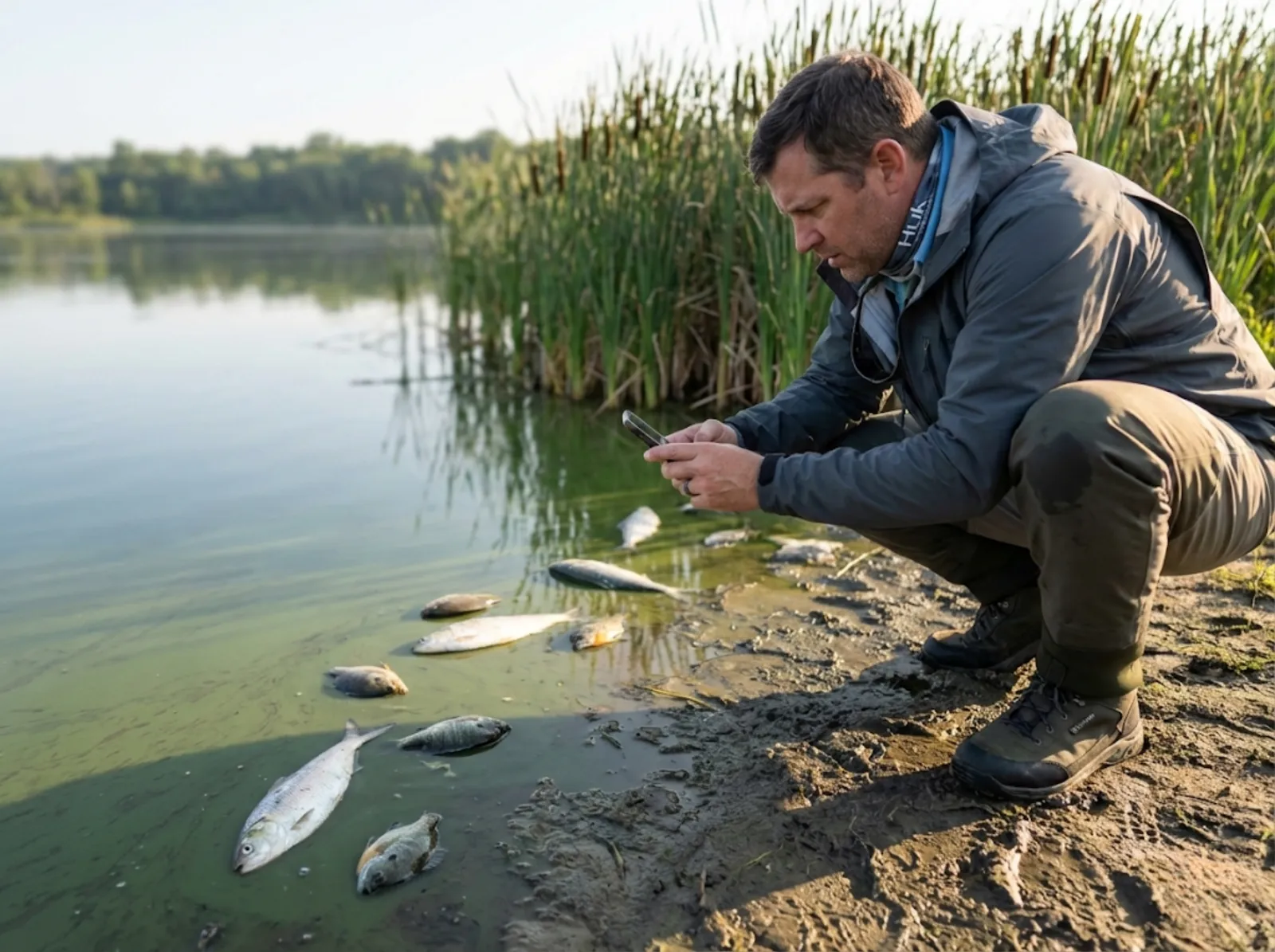
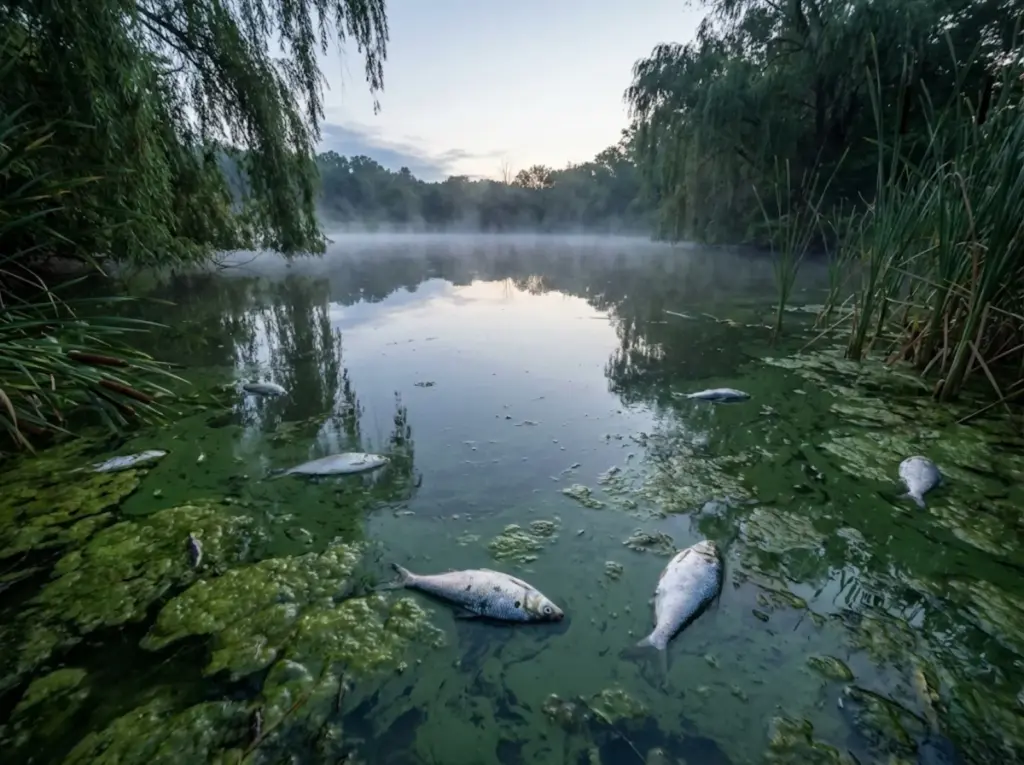
The stench hit me before I even cut the engine. That unmistakable, gut-punching mix of rotting fish and sulfur drifting across what should have been a perfect July morning on the water. I stepped out of the truck and saw them — belly-up shad stretching along sixty yards of shoreline, bluegill jammed into the cattails, a few bass floating farther out. Flies everywhere. Water the color of split-pea soup.
I’ve walked into this scene at least a dozen times across three states. The first time, I panicked and called 911. The dispatcher had no idea what to do with me. Since then, I’ve learned when a fish kill is a genuine emergency, when it’s nature doing what nature does, and exactly who to call either way.
That’s what this guide is for. You’ll learn how to read the scene, document it like the biologists want, find your state’s reporting hotline, and know whether it’s safe to fish and eat from those waters afterward.
⚡ Quick Answer: Call your state wildlife agency immediately if you see multiple species dying at once, notice a chemical odor or oily sheen on the water, or observe fish showing signs of poisoning like bleeding gills and erratic swimming. Single-species die-offs during hot summer months are usually natural low-oxygen events. Document everything — photos, GPS coordinates, species count — and report within 24 hours regardless. Your state’s fish kill hotline number is listed in the directory below.
Why Fish Kills Happen (And Why Most Are Not Emergencies)
The single biggest fish killer on the planet isn’t pollution. It’s low dissolved oxygen. And it happens naturally, all the time.
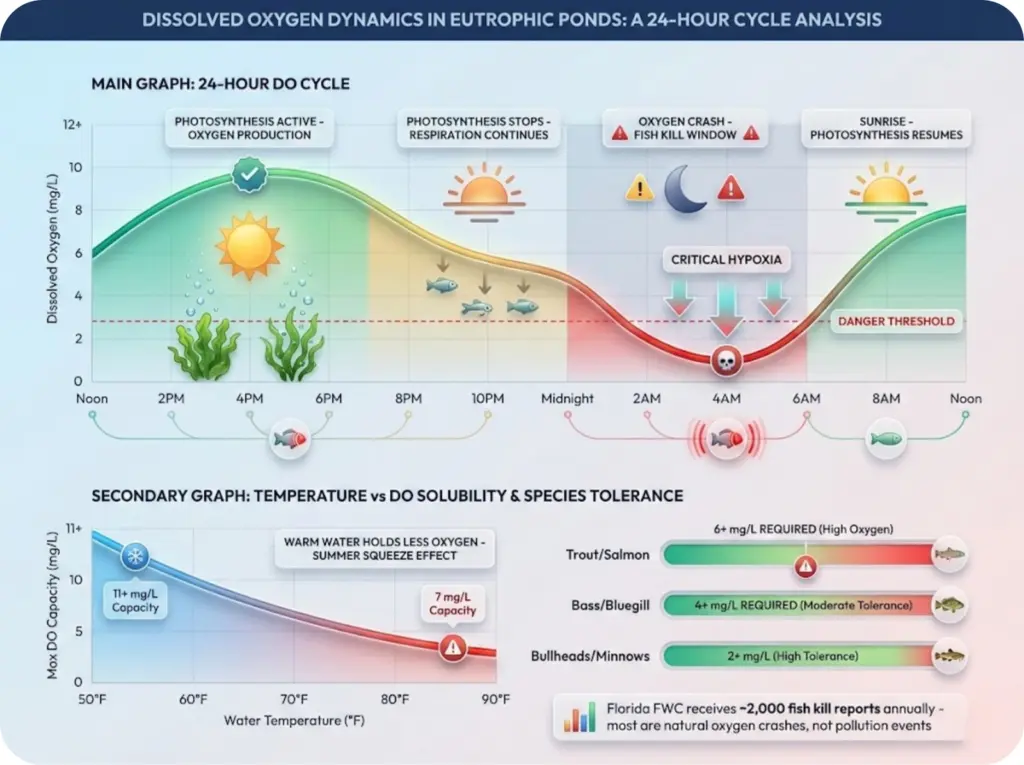
Here’s the basic science you need: warm water holds less oxygen than cold water. As summer temperatures climb, the water’s capacity to carry dissolved oxygen (DO) drops. At the same time, every fish in that lake is burning more oxygen because its metabolism speeds up in the heat. It’s a two-sided squeeze — less supply, more demand.
That squeeze hits hardest right before dawn. During the day, aquatic plants and algae pump out oxygen through photosynthesis. At night, photosynthesis stops but everything in the water — fish, plants, bacteria — keeps breathing. By 4 or 5 AM, oxygen levels hit their lowest point. That’s why most natural fish kills are discovered first thing in the morning.
Ponds and lakes choked with nutrients (eutrophic waters) are the most vulnerable. Excess fertilizer runoff feeds explosive algal blooms. All that algae produces oxygen during the day, but at night the same bloom consumes it. The resulting overnight oxygen crash can wipe out thousands of fish before sunrise.
How low is too low? Cold-water species like trout and salmon need high oxygen concentrations and start struggling when DO drops below safe thresholds. Warm-water species like largemouth bass and bluegill tolerate slightly lower levels but still suffocate under truly anoxic conditions. The tough ones — bullheads, fathead minnows — hang on a bit longer, but not forever.
The numbers tell the story: Florida’s FWC Fish Kill Hotline alone receives about 2,000 reports every year. The vast majority are natural events triggered by heat, algal blooms, or weather shifts. According to EPA fish kill investigation guidelines, evidence often washes away before professional teams arrive — which is exactly why your documentation matters.
Winterkill vs. Summerkill — The Seasonal Pattern
These two types of natural kills follow a predictable calendar.
Winterkill hits northern lakes between January and March. Heavy snow piles onto thick ice and blocks sunlight from reaching submerged plants. Without light, plants stop producing oxygen and start dying. Decomposing organic matter feeds bacteria that consume whatever oxygen remains. Fish suffocate under the ice. You often don’t discover the damage until ice-out in spring, when a line of decomposing carcasses appears along the shoreline.
Summerkill works differently. Deep lakes develop distinct temperature layers during warm months — a warm upper layer (epilimnion) and a cold, oxygen-depleted bottom layer (hypolimnion) separated by the thermocline. These layers don’t mix. Then a sudden cold front with high winds or a heavy storm causes the lake to “turn over,” slamming that oxygen-poor bottom water into the surface layer. Fish can die within hours.
Mark your calendar: winterkill peaks January through March, spawning stress kills May through June, summerkill July through August.
When One Species Dies vs. When Everything Dies
This distinction is the single most important diagnostic you’ll make.
Single-species die-offs are almost always natural. Post-spawn crappie, shad struggling through a heat wave, carp succumbing to bacterial infections — these events look scary but they’re part of the cycle. Larger fish within a species tend to die first in DO crashes because their bodies demand more oxygen.
Multi-species mortality is the red flag. When bass, bluegill, catfish, and shad are all floating together — and you see dead crayfish, snails, or frogs mixed in — something more sinister is happening. Pollution, chemical discharge, or catastrophic contamination doesn’t discriminate. It kills everything.
That’s your field rule: one species dead = probably natural. Everything dead = call immediately. Understanding basic fish conservation practices helps you recognize what’s normal and what isn’t.
The Kill-or-Not Diagnostic — Reading the Scene Like a Biologist
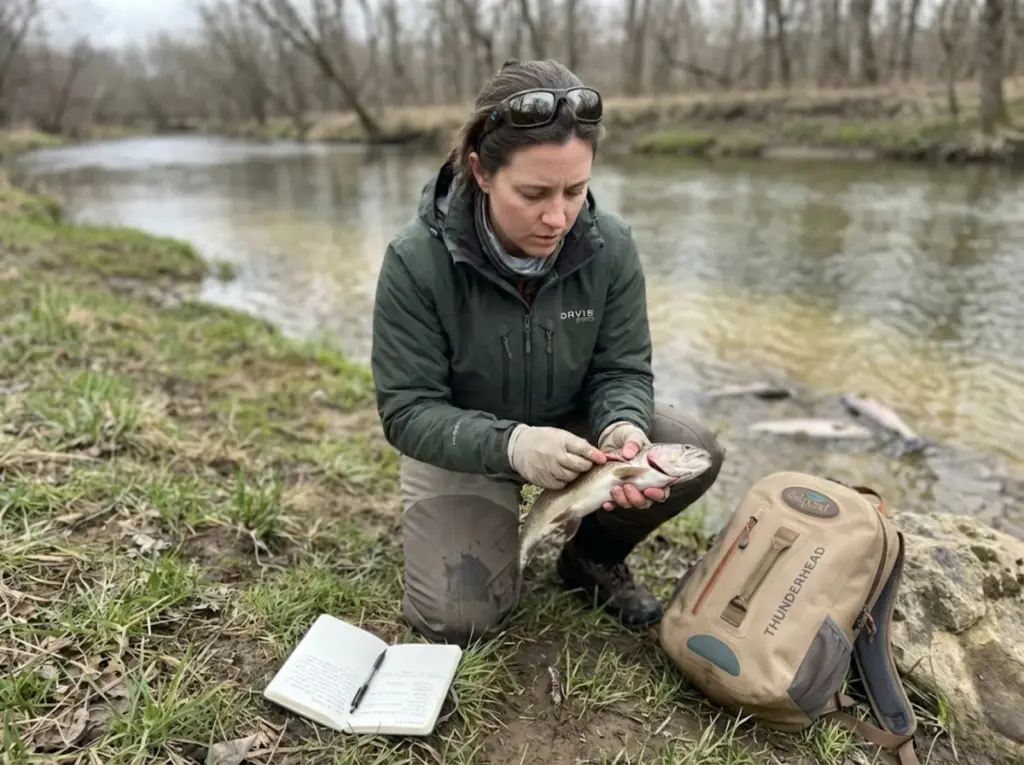
Once you know what to look for, you can triage a fish kill in about five minutes. Here’s a practical diagnostic framework built from what biologists actually use in the field.
Start with species selectivity. Check whether the dead fish are all the same species and roughly the same size, or whether you’re seeing a mix of everything. One species means nature. Multiple species plus dead invertebrates means trouble.
Next, consider timing and onset. Natural kills triggered by overnight oxygen crashes happen at dawn or shortly after a major weather shift. If fish are dying at noon on a calm, clear day with no weather change — that’s unusual and warrants an immediate call.
Check size patterns. In a dissolved oxygen crash, the biggest fish die first because they consume the most oxygen. If you’re seeing dead fry and fingerlings alongside adults, a chemical agent is more likely.
Finally, examine the water itself. Pea-soup green or black water that smells like decaying vegetation points to an algal bloom or organic decomposition — natural causes. An oily sheen, chemical odor, unusual foam, or any smell that doesn’t belong near water signals potential contamination. Minnesota DNR fish kill identification resources provide additional diagnostic guidance for anglers in northern climates.
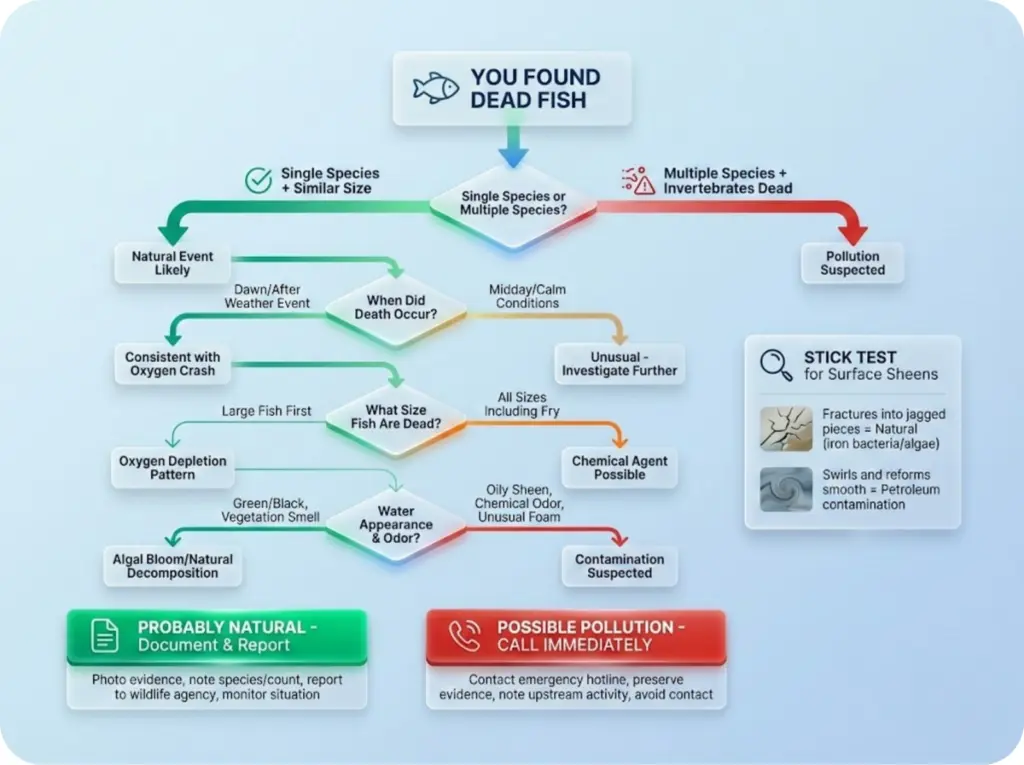
Pro tip: Learn the “Stick Test” for suspicious surface sheens. Poke the sheen with a stick. If it fractures into jagged pieces that stay separated, it’s likely biological — iron bacteria or algae producing natural oils. If it swirls and reforms into a smooth film, you’re looking at petroleum. That one observation can fast-track an investigation.
Rare Causes Most Anglers Don’t Know About
Some fish kills don’t fit the standard playbook.
Lightning strikes can kill surface-dwelling fish near conductive structures like communication towers. The electrical discharge travels along the water’s surface due to the “skin effect” and primarily hits fish in the upper water column. Carcasses sometimes display internal hemorrhaging and peculiar branching surface burns called Lichtenberg figures.
Gas Bubble Disease is the aquatic version of the bends. Below hydroelectric dams and spillways, water plunging into deep pools can trap air under extreme pressure, supersaturating the water with nitrogen. Fish breathing this water develop microbubbles in their blood vessels and tissues. Look for bulging eyes (exophthalmia) and visible bubbles trapped in the clear membrane between fin rays.
Botryococcus braunii blooms present one of the trickiest diagnostic challenges. This green alga produces liquid hydrocarbons — up to 40% of its dry cell weight — and during a bloom, it releases oils that create an iridescent, rainbow-colored sheen virtually identical to a diesel spill. It can also clog fish gills with oily colonies. That’s where the Stick Test earns its keep.
Spawning Stress — The Spring Kill That Worries Anglers Most
Spring fish kills are the ones that generate the most frantic phone calls, and understandably so. Seeing a shoreline full of dead crappie or carp right after ice-out is alarming.
But reproductive exertion takes a massive toll on fish. The physical trauma and energy expenditure of spawning drops their immune defenses, and naturally occurring bacteria like Aeromonas and Columnaris can cause sudden outbreaks in weakened populations. These events are species-specific, seasonal, and natural.
Still report them. Agencies track spawning mortality year over year to monitor overall population health. And while you’re documenting, watch for any aquatic invasive species identification opportunities — invasive species become more visible during die-offs, and some states legally require you to dispatch rather than release them.
How to Document a Fish Kill Like a Pro
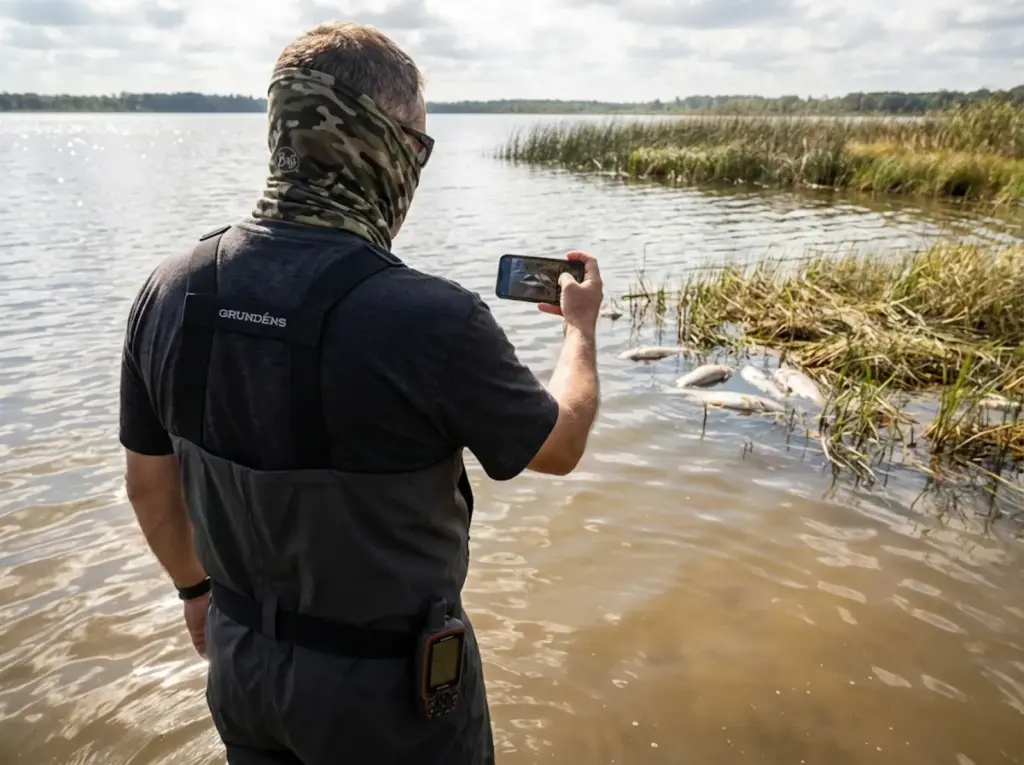
Your phone is the most powerful investigation tool on the scene. Here’s how to use it to build the kind of report that actually helps biologists do their job.
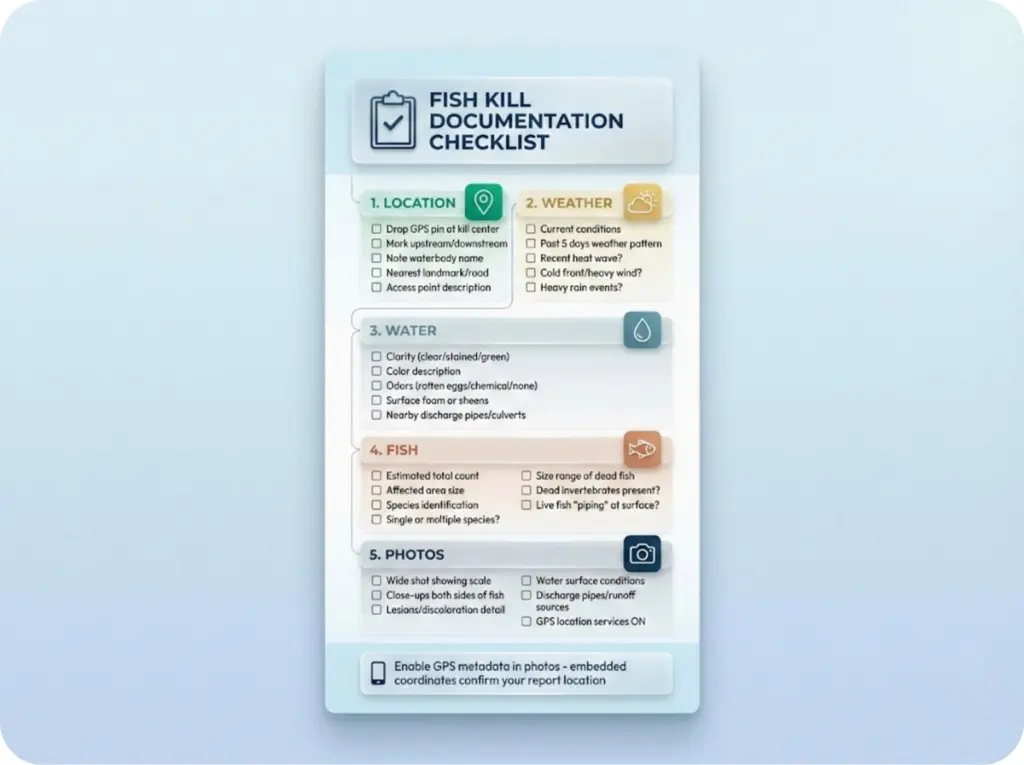
Location data first. Drop a GPS pin at the center of the kill. If you’re on a river, drop additional pins at the farthest upstream and downstream points where you see dead fish. Note the waterbody name, nearest road or landmark, and how you accessed the area. This spatial data helps biologists estimate the kill’s extent before they arrive.
Weather context matters. Record current conditions, but also think back through the past five days. Was there an extended heat wave? A sudden cold front with heavy wind? Heavy rain that could have flushed agricultural runoff? Dissolved oxygen crashes often follow specific weather patterns, and your memory of the past week gives biologists critical context.
Read the water. Is it clear, stained, or “pea-soup green”? What color? Any odors? “Rotten eggs” means hydrogen sulfide — a marker of severe oxygen depletion in bottom sediments. Note any foam, surface sheens, or discharge from pipes, culverts, or adjacent properties.
Count and identify the fish. Estimate the total number of dead fish and the affected area. Identify species if you can — or describe them (length, body shape, fin characteristics). Note whether mortality hits one species or many, and whether you see dead invertebrates like snails, crayfish, or frogs. Check whether any live fish are “piping” — gasping at the surface with their mouths breaking the waterline.
Photo protocol. Take a wide shot showing the overall scene and scale. Then get close-ups of individual fish from both sides, capturing any lesions, discoloration, or abnormalities. Photograph the water surface for sheens or foam. Snap any nearby discharge pipes, runoff channels, or anything that looks out of place.
Pro tip: Turn on your phone’s location services before snapping photos. The embedded GPS metadata in each image is exactly what biologists need to confirm your report coordinates.
Part of scouting fishing spots effectively is knowing a waterbody’s normal baseline. When you know what “healthy” looks like on your home water, you’re the first person to notice when something goes wrong.
Sample Collection — When Agencies Ask You to Go Further
Some agencies ask trained volunteers to collect physical evidence. If you’re asked, here are professional handling standards.
Live fish (3–6 individuals): bag them with source water, fill the bag with pure oxygen if available, double-bag, and place on ice. Never freeze fish intended for disease testing — freezing destroys the tissue structures pathologists need.
Freshly dead fish (5–10 individuals): wrap in aluminum foil with the dull side facing in for organic contaminant analysis, or use polyethylene bags for inorganic testing. Freeze these immediately.
Water samples (1 quart minimum): use amber glass bottles filled to overflowing with Teflon-lined caps for pesticide and hydrocarbon testing. Plastic bottles work for heavy metal analysis. Fill to the brim to minimize air exposure.
Always call the receiving diagnostic lab before shipping. Requirements vary by state, and improperly handled samples are useless evidence.
Who to Call — The 50-State Fish Kill Hotline Directory
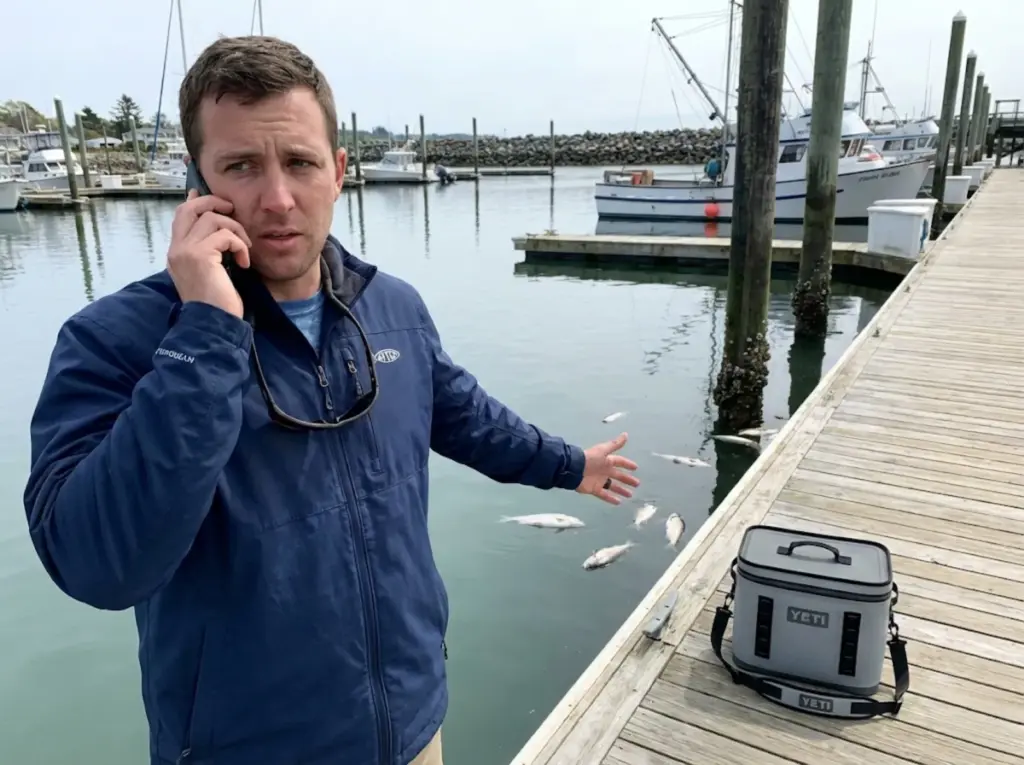
This is the section you bookmark.
If you suspect a federal-level incident — a spill crossing state lines, involving navigable waters, or originating from an industrial facility — call the National Response Center: 1-800-424-8802 (24/7). For marine incidents along the coast, contact the NOAA Enforcement Hotline: 1-800-853-1964 (24/7).
For everything else, your state wildlife agency is the first call. Here are the primary reporting hotlines for every state:
| State Environmental & Wildlife Hotlines | ||
|---|---|---|
| State | Primary Hotline | Alternate Contact |
| Alabama | 1-800-272-4263 | AL DNR / Game and Fish |
| Alaska | 1-907-269-3063 | NOAA Stranding Hotline |
| Arizona | 1-800-352-0700 | Operation Game Thief |
| Arkansas | 1-800-482-9262 | Game and Fish Commission |
| California | 1-888-334-2258 | CALTIP (24/7) |
| Colorado | 1-877-265-6648 | Operation Game Thief |
| Connecticut | 1-860-424-3333 | DEP Spill Response (24/7) |
| Delaware | 1-800-662-8802 | DNREC Hotline |
| Florida | 1-800-636-0511 | FWC Fish Kill Hotline |
| Georgia | 1-800-241-4113 | Ranger Hotline |
| Hawaii | 1-808-643-3567 | DLNR Hotline |
| Idaho | 1-800-632-5999 | CAP 24/7 |
| Illinois | 1-877-2DNRLAW | Conservation Police |
| Indiana | 1-800-847-4367 | Turn In a Poacher (TIP) |
| Iowa | 1-515-725-8694 | DNR Spill Hotline |
| Kansas | 1-785-291-3333 | KDWP |
| Kentucky | 1-800-252-5378 | KDFWR Hotline |
| Louisiana | 1-800-442-2511 | Operation Game Thief (24/7) |
| Maine | 1-800-253-7887 | Marine Patrol |
| Maryland | 1-800-628-9944 | MD DNR |
| Massachusetts | 1-800-632-8075 | Environmental Police (24/7) |
| Michigan | 1-800-292-7800 | Report All Poaching (RAP) |
| Minnesota | 1-800-652-9093 | DNR TIP Line |
| Mississippi | 1-800-237-6278 | MDWFP Hotline |
| Missouri | 1-800-392-1111 | Operation Game Thief |
| Montana | 1-800-847-6668 | TIPMONT Hotline |
| Nebraska | 1-402-479-4921 | State Patrol Dispatch |
| Nevada | 1-800-992-3030 | Operation Game Thief |
| New Hampshire | 1-800-344-4262 | Fish and Game |
| New Jersey | 1-877-927-6337 | DEP Hotline |
| New Mexico | 1-800-432-4263 | Operation Game Thief |
| New York | 1-877-457-5680 | TIPP DEC |
| North Carolina | 1-800-662-7137 | Wildlife Resources Commission |
| North Dakota | 1-701-328-5210 | DEQ Water Quality |
| Ohio | 1-800-762-2437 | TIP DNR |
| Oklahoma | 1-800-522-8039 | Operation Game Thief |
| Oregon | 1-800-452-7888 | State Police Wildlife |
| Pennsylvania | 1-855-347-4545 | PFBC |
| Rhode Island | 1-401-222-3070 | DEM Environmental Police |
| South Carolina | 1-800-922-5431 | SCDNR 24-Hour |
| South Dakota | 1-605-223-7660 | TIP Line |
| Tennessee | 1-800-831-1173 | TWRA |
| Texas | 1-512-389-4848 | TPWD Communications (24-Hour) |
| Utah | 1-800-662-3337 | DWR Hotline |
| Vermont | 1-800-752-5378 | Operation Game Thief |
| Virginia | 1-800-237-5712 | Wildlife Crime Line |
| Washington | 1-877-933-9847 | WDFW Enforcement |
| West Virginia | 1-304-558-2784 | WVDNR Law Enforcement |
| Wisconsin | 1-800-847-9367 | DNR TIP Line |
| Wyoming | 1-877-943-3847 | STOP POACHING |
Pro tip: Save your home state’s fish kill hotline as a phone contact right now. When you’re standing ankle-deep in dead shad, you don’t want to be Googling for a number.
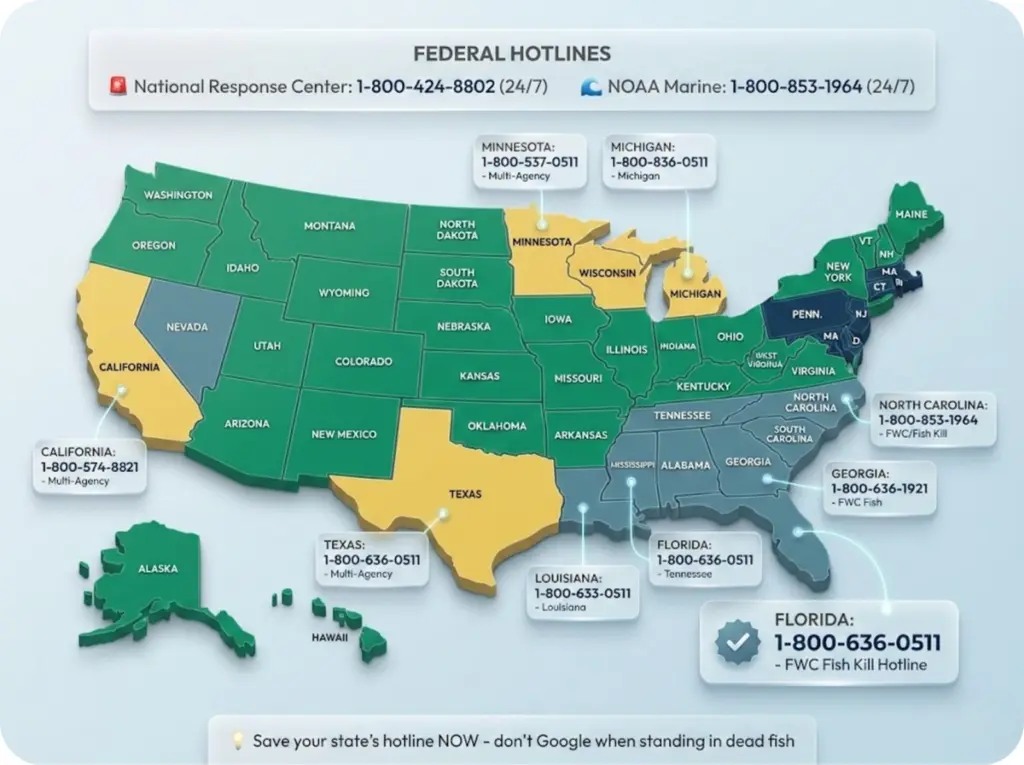
The same agencies that manage your fishing license regulations are the ones investigating fish kills. They already know your local waters. Your report feeds directly into their conservation database.
Understanding Agency Jurisdiction — Who Handles What
Knowing which agency does what saves time and gets the right people on-site faster.
State wildlife agencies (DNR, FWC, Game and Fish): these handle most fish kill investigations — natural mortality, disease outbreaks, and habitat-related events. They’re your default first call.
State environmental agencies (DEP, DEQ): they step in when chemical contamination, industrial discharge, or pesticide runoff is suspected. Some states have a single combined agency; others separate wildlife and environmental functions.
State health departments: they get involved when there are consumption safety concerns or public health hazards from contaminated water.
Federal agencies: the National Response Center (EPA) handles large-scale or interstate spill events. NOAA covers marine and coastal incidents. Minnesota’s multi-agency model — MPCA, DNR, MDA, and MDH working together — is considered a gold standard for complex investigations.
What Happens After You Call
Your report triggers a chain of events. The agency dispatches a field biologist — often within 24 to 48 hours for suspected pollution, sometimes longer for probable natural causes. The investigator assesses the kill’s extent, collects biological and water samples, and interviews anyone who witnessed the event.
Lab analysis follows. Water chemistry, fish pathology, and toxicology testing can take weeks. Results may lead to enforcement action, clean-up orders, long-term monitoring, or a classification of the event as natural.
Your report isn’t lost in a filing cabinet. It becomes part of databases that agencies use to track patterns over years and decades. FWC has leveraged citizen reports since 1995 to build one of the most comprehensive fish kill databases in the country.
After the Kill — Is It Safe to Fish and Eat?
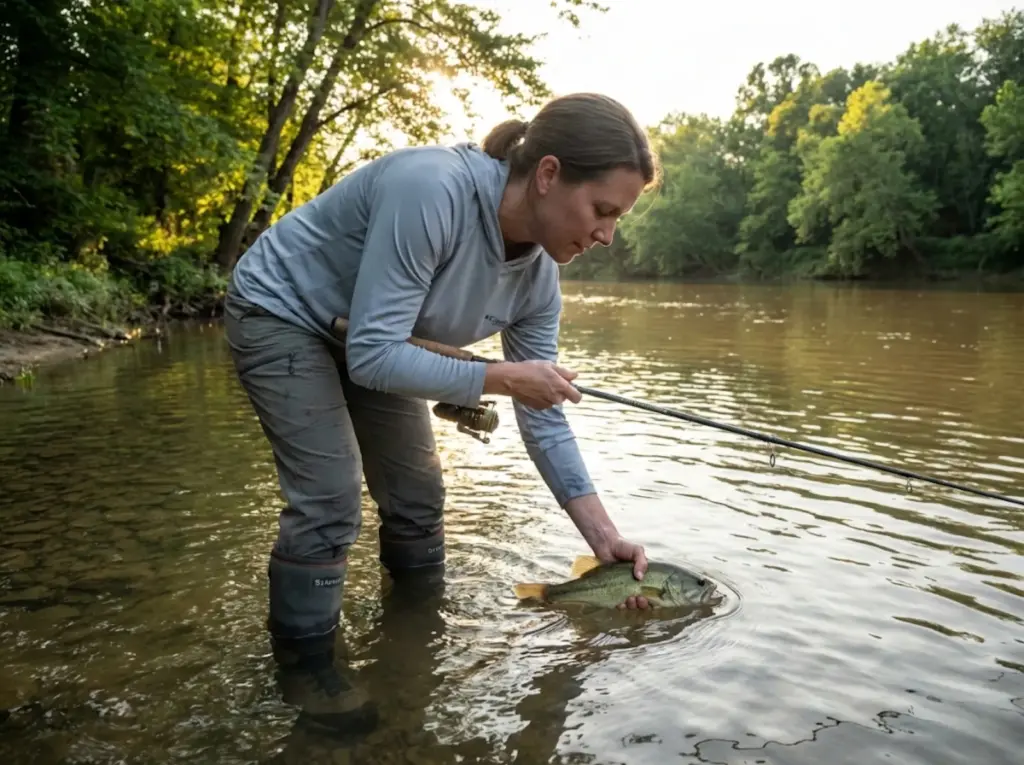
This is the question every angler asks, and almost no government resource answers directly.
Can you eat the fish? Never eat fish found dead or decomposing. Bacterial contamination and toxin buildup in dead fish aren’t eliminated by cooking. If you catch live fish from the same waterbody, check your state’s consumption advisories first. Most states publish these online and update them regularly.
Be aware of the chronic contaminants that exist independent of any single kill event. Mercury binds to muscle tissue — you can’t trim it away. It has a biological half-life of about 60 days in the human body, so spacing out fish meals helps your body clear it. PCBs and dioxins accumulate in body fat, so trimming the fat and skin from fillets significantly reduces exposure. Children and pregnant women should follow “Do Not Eat” advisories strictly.
Should you fish there? Avoid the immediate kill zone. Surviving fish are physiologically stressed, and their feeding response is suppressed. If you practice catch-and-release, switch to barbless hooks and use heavier tackle to land fish fast, minimizing the lactic acid buildup that stressed fish can’t recover from. Following proper catch and release techniques is even more critical when fish are already compromised.
According to NOAA catch-and-release best practices, minimizing air exposure and fight time gives stressed fish the best chance of survival.
When does the bite come back? Most waterbodies reach a new equilibrium within about three years if the underlying cause is addressed. Small ponds sometimes bounce back in a single season. Periodic winterkills in shallow northern lakes can actually benefit gamefish populations by thinning overabundant rough fish — less competition means faster growth for survivors.
Pro tip: If you’re fishing a lake recovering from a recent kill, skip the main basin. Key on tributary mouths, spring seeps, and aeration systems — that’s where survivors stack up in “oxygen refuges” where DO levels are highest.
Your Role in the Bigger Picture — Why Reporting Matters
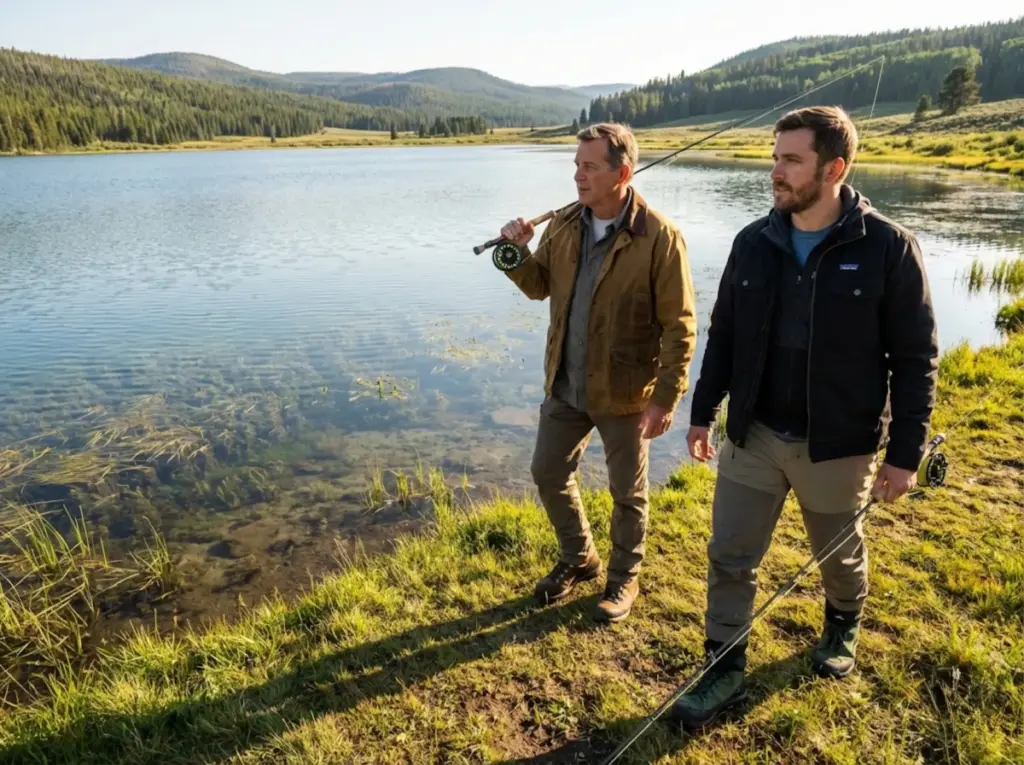
You cover more shoreline than any state agency biologist team. You fish more hours, more waterbodies, more seasons. That makes you the most effective early warning system fisheries managers have.
Florida’s FWC has collected over 40,000 fish kill reports since 1995 — the majority submitted by anglers and outdoor recreationists. That database has helped researchers distinguish between natural seasonal patterns, like thermal stratification turnovers, and emerging biological threats, like the spread of Viral Hemorrhagic Septicemia (VHS) across the Great Lakes.
Climate change is accelerating the problem. Rising water temperatures reduce oxygen carrying capacity and speed up bacterial decomposition of organic matter. Extreme weather events flush agricultural and urban runoff into waterways. Both summerkill and winterkill frequencies are trending upward across the northern United States.
During kill events, keep an eye out for invasive species that become more visible among the dead and dying. Some states legally require anglers to dispatch — not release — invasive species like Snakehead, Blue Catfish, or Asian Carp. Our guide to invasive fish species identification and removal covers what’s required in your area.
Every report you file, every photo you take, every GPS pin you drop feeds into a system designed to protect the fisheries you depend on. You’re not just a bystander. You’re a first responder.
Your Three Takeaways
Most fish kills are natural oxygen crashes — alarming but predictable. Single-species die-offs in hot weather rarely signal an emergency.
Multi-species mortality, chemical odors, and oily sheens that swirl back together after disturbance demand an immediate phone call to your state’s wildlife agency.
Your report — complete with GPS coordinates, photos, species counts, and water observations — gives biologists the data they need to protect your fishery for years to come.
Save your state’s hotline number today. The next time you smell that unmistakable waterfront stench, you’ll know whether to dial or document — and either way, you’ll be the one who helped keep that fishery alive for the next generation.
Frequently Asked Questions
What causes mass fish kills?
Low dissolved oxygen is the number one cause of fish kills worldwide. Rising water temperatures reduce oxygen capacity while increasing fish metabolic demand. Algal blooms, thermal stratification turnovers, and prolonged heat waves create the conditions for natural kills. Pollution, chemical spills, and pesticide runoff also cause kills but are significantly less common.
Are fish kills dangerous to humans?
Fish kills are generally not dangerous to touch, but never eat fish found dead or decomposing. Harmful algal blooms that trigger some kills can irritate skin and airways. Keep children and pets away from kill zones, and wash your hands thoroughly after any contact with dead fish or affected water.
How do I report a fish kill?
Call your state wildlife agency’s hotline listed in the 50-state directory above. Provide your location with GPS coordinates, the estimated number and species of dead fish, water conditions, and any unusual odors or sheens. Take photos before you call. For suspected federal-level spills, contact the National Response Center at 1-800-424-8802.
How long does a fishery take to recover after a fish kill?
Most waterbodies reach a new equilibrium within approximately three years if the underlying cause is removed. Small ponds may bounce back in one season. Recovery depends on species life history, availability of refuge areas, and whether the source of mortality has been eliminated permanently.
Should I fish in an area where a fish kill recently happened?
Avoid the immediate kill zone where surviving fish are stressed and not actively feeding. Focus on tributary inflows, spring seeps, and areas near aeration systems where oxygen levels remain higher. Use barbless hooks and heavier tackle to land fish quickly if practicing catch-and-release, and check your state’s consumption advisories before keeping any fish.
Risk Disclaimer: Fishing, boating, and all related outdoor activities involve inherent risks that
can lead to injury. The information provided on Master Fishing Mag is for educational and informational purposes
only. While we strive for accuracy, the information, techniques, and advice on gear and safety are not a substitute
for your own best judgment, local knowledge, and adherence to official regulations. Fishing regulations, including
seasons, size limits, and species restrictions, change frequently and vary by location. Always consult the latest
official regulations from your local fish and wildlife agency before heading out. Proper handling of hooks, knives,
and other sharp equipment is essential for safety. Furthermore, be aware of local fish consumption advisories. By
using this website, you agree that you are solely responsible for your own safety and for complying with all
applicable laws. Any reliance you place on our content is strictly at your own risk. Master Fishing Mag and its
authors will not be held liable for any injury, damage, or loss sustained in connection with the use of the
information herein.
Affiliate Disclosure: We are a participant in the Amazon Services LLC Associates Program, an
affiliate advertising program designed to provide a means for us to earn advertising fees by advertising and linking
to Amazon.com. As an Amazon Associate, we earn from qualifying purchases. We also participate in other affiliate
programs and may receive a commission on products purchased through our links, at no extra cost to you. Additional
terms are found in the terms of service.