In this article
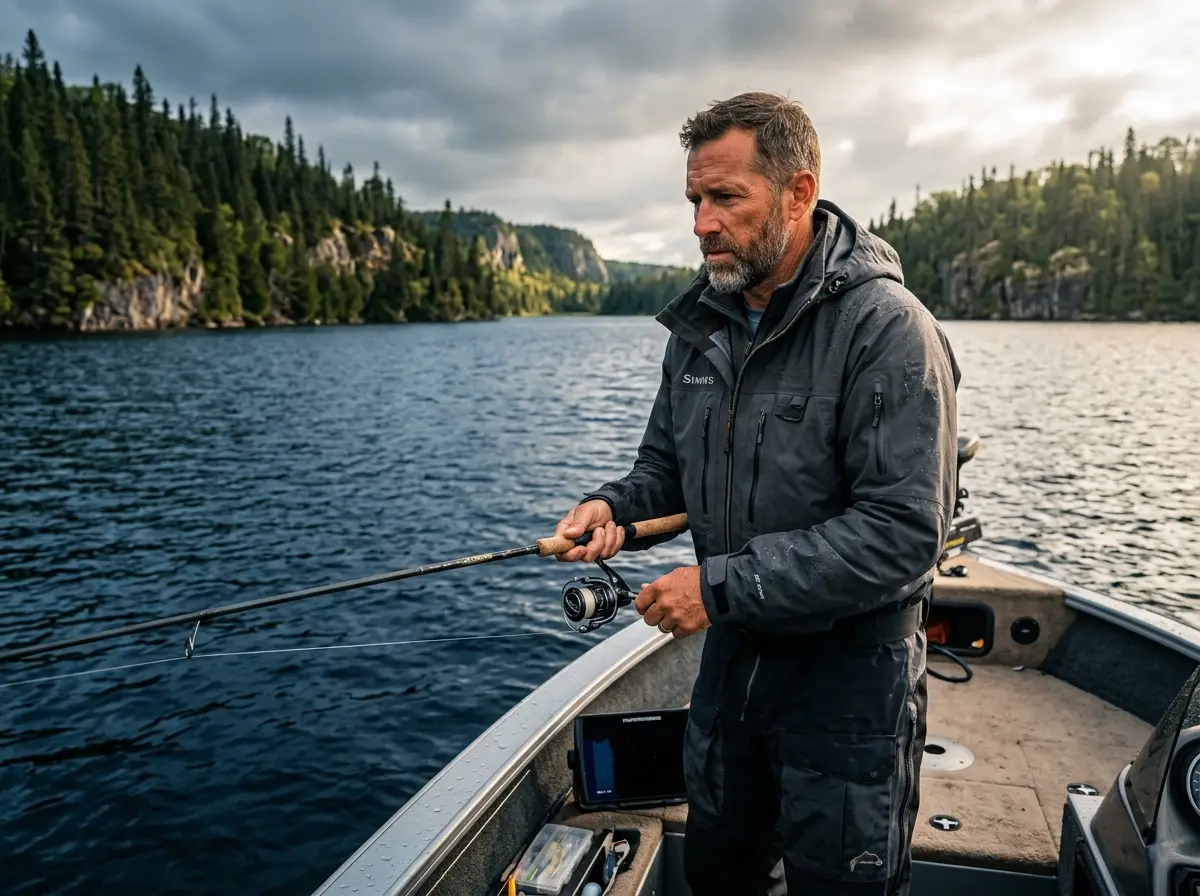
The sonar lit up with 14 separate marks at 88 feet. I watched them for a full minute — big arcs, slow-moving, staging right on the edge of the thermocline. Every jig drop got a follow. None of them converted. By noon I had burned through three different presentations, two rod setups, and half a thermos of coffee. Three years later, I can draw you a diagram of exactly what went wrong on that morning. It was not my cadence. It was not the lure color. It was physical constraints and a set of assumptions I had carried from shallower water that simply fail once you are past 80 feet.
This is the problem most lake trout guides never solve.
⚡ Quick Answer: Lake trout live where cold water and high dissolved oxygen overlap — not just at the bottom. Fish the cisco layer, not the floor. At 100 feet, monofilament absorbs up to 75% of your hookset force before the energy reaches the hook — switch to 10-20lb braided line. Position your lure 5-10 feet above fish on sonar, not at their marked depth. Slow your retrieve to 1-2 cranks per second on release to prevent fatal injury to the fish.
The Biology Most Guides Get Wrong
Lake trout are not actually trout. That is not a technicality — it is the most consequential misunderstanding in the guide industry. Lake trout are char, built for cold, high-oxygen water that most game fish would find uninhabitable. The moment you start fishing them like brown trout, you are already behind the curve.
Here is where the standard playbook breaks down: guides quote optimal water temperatures as the target range. That is accurate for a fish trying to grow, but that is not what you are fishing for. You are fishing for a feeding fish. And those two things are entirely different variables on the water.
Telemetry from trout behavior reveals a much wider temperature tolerance of lake trout than the old rules suggest. Trout regularly occupy warmer middle layers and make short feeding pushes into shallow water. The ability to run down a meal peaks in warmer water. Which means the most active, aggressive fish in your system are not necessarily holding in the coldest water you can find.
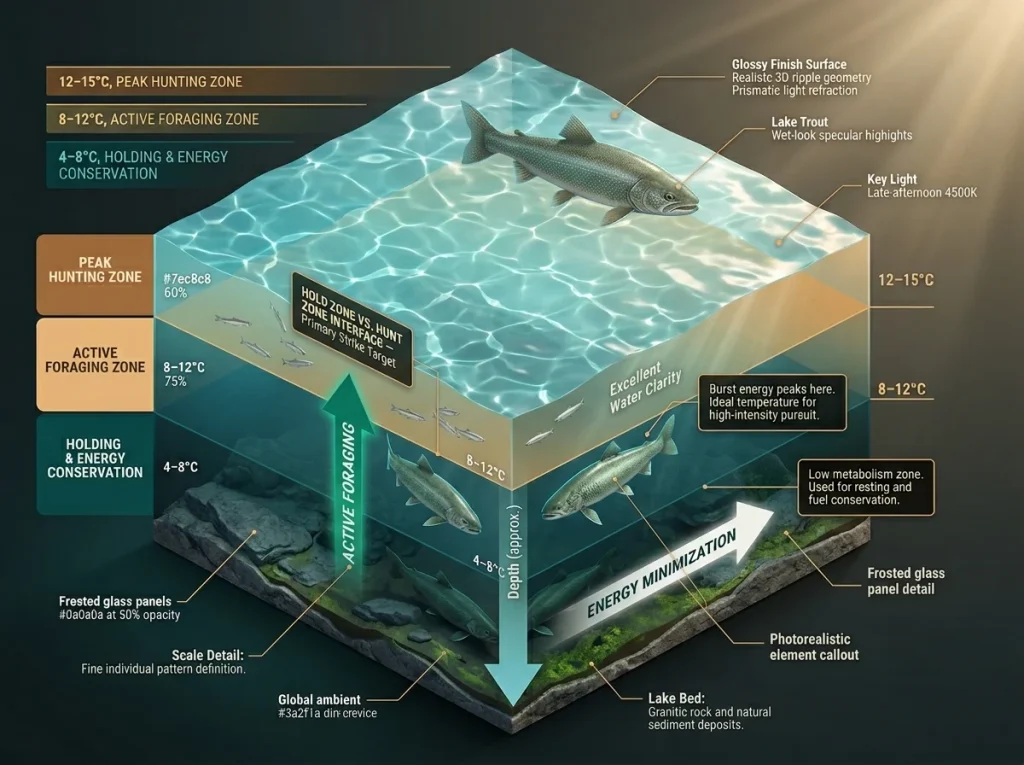
The dual-layer strategy works like this: trout park in the deep, cold bottom layer to keep their baseline energy requirement low. This conserves fuel and keeps them quiet. Then they push up into the middle layer when it is time to hunt, where their burst energy peaks and the fish can sustain a heavy pursuit. Understanding how water temperature directly controls a fish’s willingness to strike is what separates a tactician from a tour operator.
In shallow, warm water, the situation flips: their baseline energy needs triple while active hunting capacity shuts down. The fish is not being stubborn on your sonar. It is protecting itself from exhaustion and potential fatality.
Pro tip: If you are marking fish on the bottom in August and they are not eating, they are not lazy. They are in energy conservation mode. You need to find the layer they are actively hunting in, not the layer they are parked in.
The Oxygen Constraint
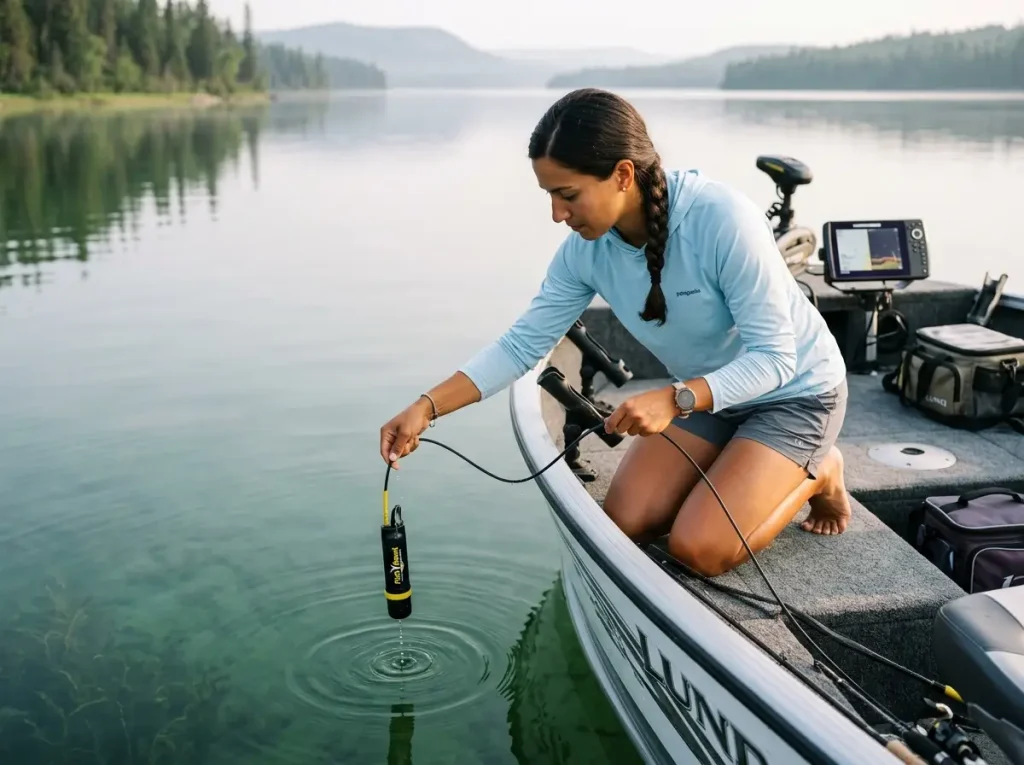
Temperature gets all the attention on the forums, but dissolved oxygen is doing half the work. Lake trout require high oxygen levels to sustain their activity. In late summer, stratified lakes often develop a mid-depth low-oxygen band caused by decomposition processes in the deep basin.
If your dissolved oxygen probe shows low readings near the floor, the fish have already moved. Finding them there is impossible. You are fishing an empty room.
This low-oxygen layer forces trout upward, compressing them into the zone between the stale bottom and the warm surface. When this happens, you should not be dragging the floor. Reading how thermoclines compress and redirect fish across the entire water column explains why you need to run a probe before you even rig a rod.
I run a probe to 80 feet before I touch my gear on unfamiliar water in midsummer. Temperature maps will lie to you. The oxygen line is the actual boundary you have to respect.
The Cisco Layer as a Reference Depth
Cisco are the organizing principle of the entire lake trout fishery. Where the cisco go, the predators follow. And cisco school at the thermocline boundary, drawn to the intersection of cold water and the rising columns of opossum shrimp that ascend during their nightly vertical routine.
On your sonar unit, the cisco layer appears as a diffuse cloud 10-20 feet above the thermocline. That bait cloud is your fishing target. Not the hard bottom. Not the 80-foot mark where you caught a fish in May. The cloud.
Structure that pinches the cisco school into confined space — saddles between islands, submerged reef edges, mountain transitions — creates the highest-probability scenarios on the lake. These are the waypoints you need. Everything else is just boat riding.
Reading the Deep Basin as a Hunting Grid
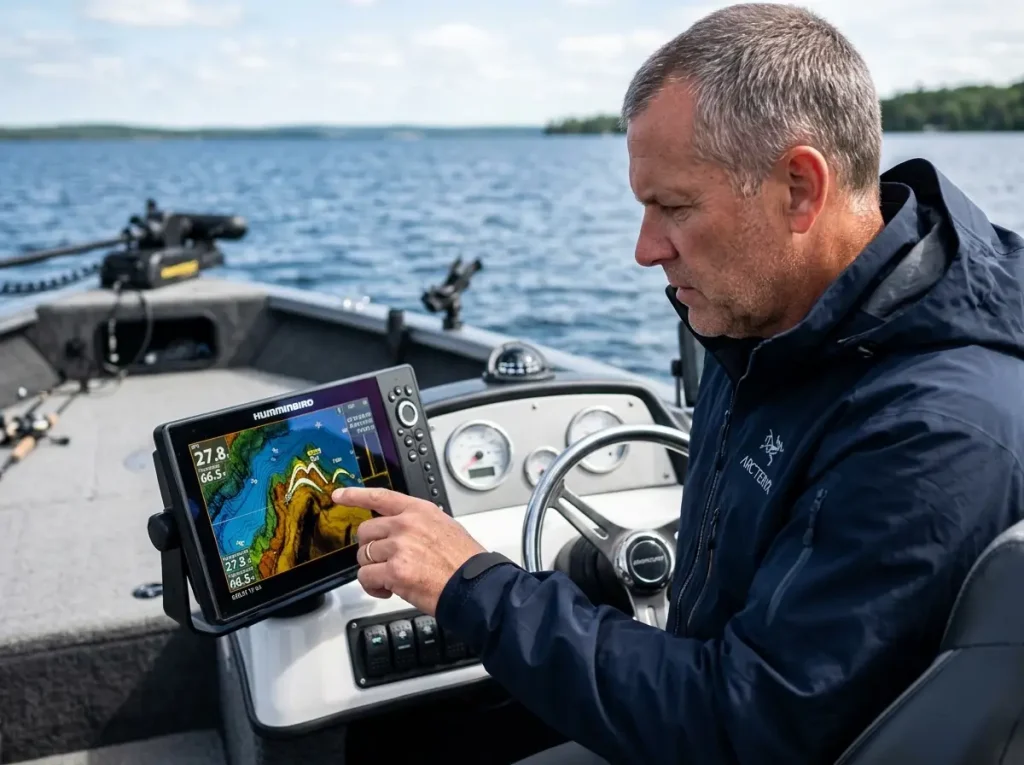
The best guide I ever shared a boat with never once dropped anchor. He ran an 11-waypoint circuit in 90 minutes, giving each set of structure exactly 20 minutes of honest attention. He called it a hunting session. That framing matters more than most weekend anglers realize.
Lake trout are nomadic hunters. They follow bait schools through deep basins along predictable routes. They do not live on a waypoint any more than a wolf lives in one specific clearing. Guides who anchor on a productive spot from last week and wait for fish to return are just hoping to get lucky.
There are four structure archetypes that matter for deep-basin hunters:
Reef complexes are boulder-strewn tops in 30-60 feet where baitfish funnel over at dusk. Trout wait below and burst upward, using surface backlighting to hide their approach from the cisco.
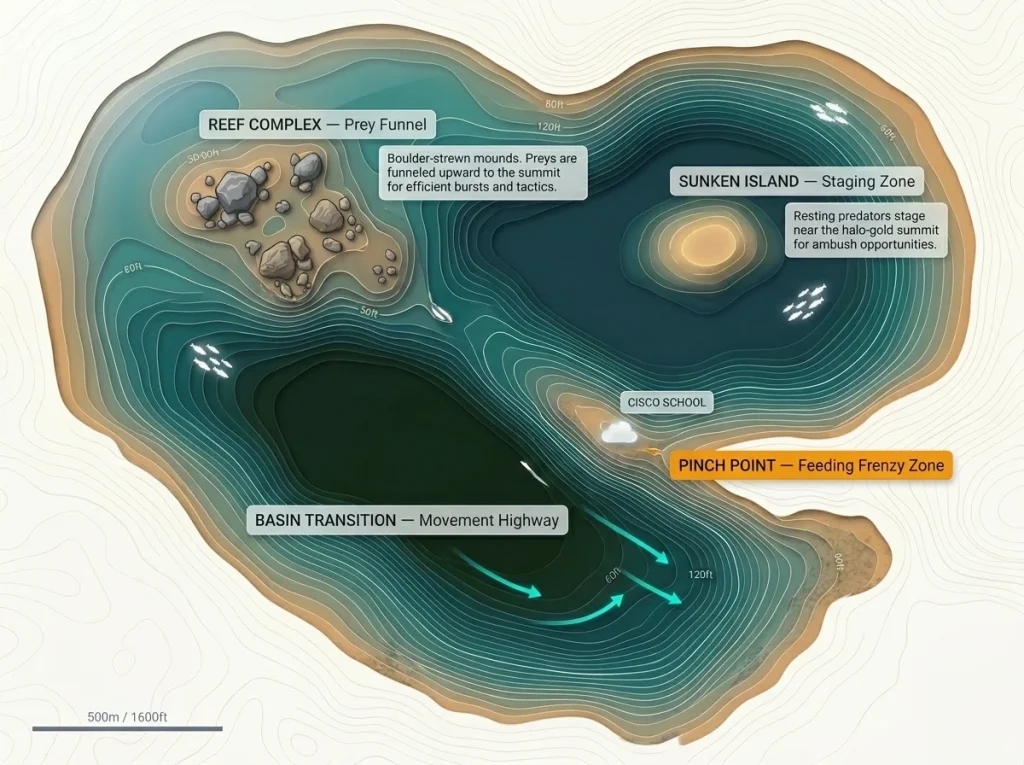
Sunken islands serve as staging areas — not ambush sites, but rendezvous zones where predators rest before moving to feeding grounds.
Basin transitions are where 60-80 foot contours compress into tight lines on a contour map, creating underwater highways for nomadic movement. Most anglers drive right over these.
Pinch points — where two pieces of structure nearly converge — squeeze bait into tight corridors and create the highest-density feeding frenzies in any system.
On a contour map, tight lines mean steep drop-offs, which means structure. Widely spaced lines mean a flat basin floor — which means nomadic travel territory, not ambush territory.
Pro tip: Program 8-12 GPS waypoints before you launch. Run them in sequence. Mark each stop’s temperature at the cisco layer, oxygen reading, and the result. After three trips, you will know exactly which structure types hold fish on specific wind conditions. That is data collection, not a guessing game.
Sonar technology has documented something inconvenient for every angler who likes to drop anchor: lake trout frequently dive 15-20 feet when a boat approaches. If your screen marks fish at 80 feet, and you drop a jig to 80 feet, you are fishing under them. The correct protocol is to target 65-70 feet, wait a few minutes for the fish to resettle, and then begin your cadence above them. Circle the target structure at idle first to let the marks settle.
The Presentation Mechanics Failing at 100 Feet
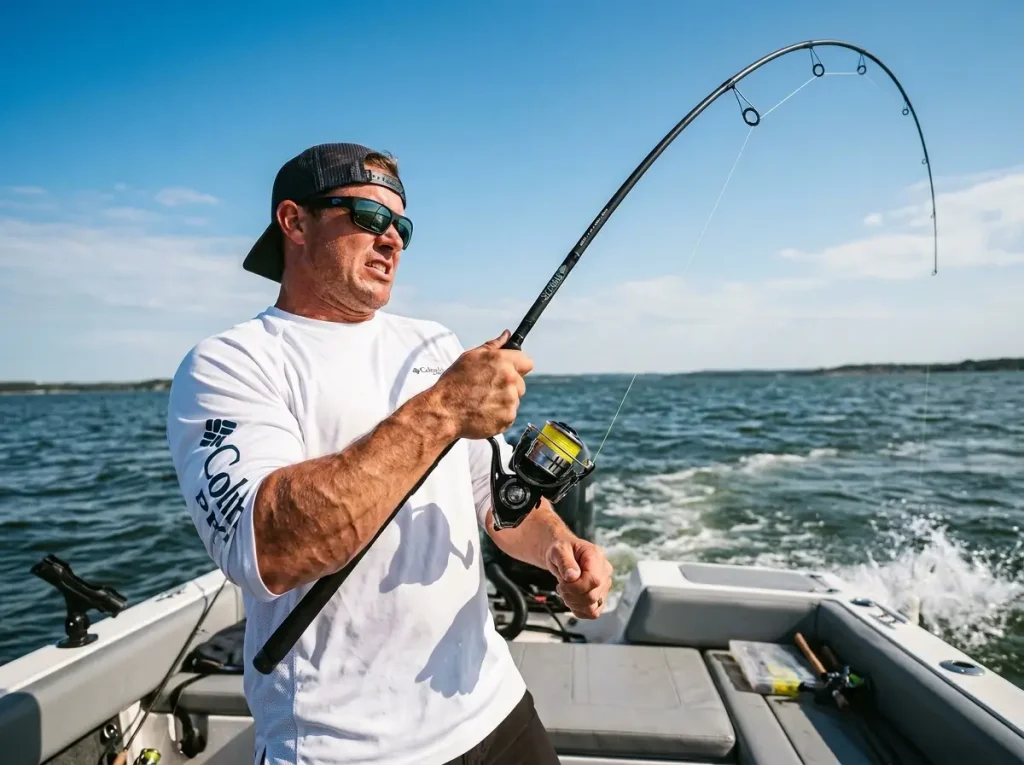
Here is what actually happened on that morning with 14 follows and zero hookups: I was running thick 17lb monofilament line.
At 100 feet of deployed line, monofilament stretches up to 30% before reaching its breaking strength. That represents hundreds of inches of absorbed force before a single fraction of an ounce reaches the hook point.
The straight engineering breakdown of braid versus fluorocarbon versus mono for deep-water applications shows how wide the gap is. Braided line at the same depth absorbs less than ten percent of your hookset energy. That is an enormous difference on the water. When a predator mouths a jig and rejects it in under a single second, the difference between a missed nibble and a heavy bend in your rod is whether your hookset actually arrived in time.
Monofilament also creates a severe bow in the line, even in relatively calm water. The connection to your lure is never truly straight. You are dealing with stretch and poor geometry at the exact same time. A violent rod sweep that should move the hook point three inches might move it zero inches.
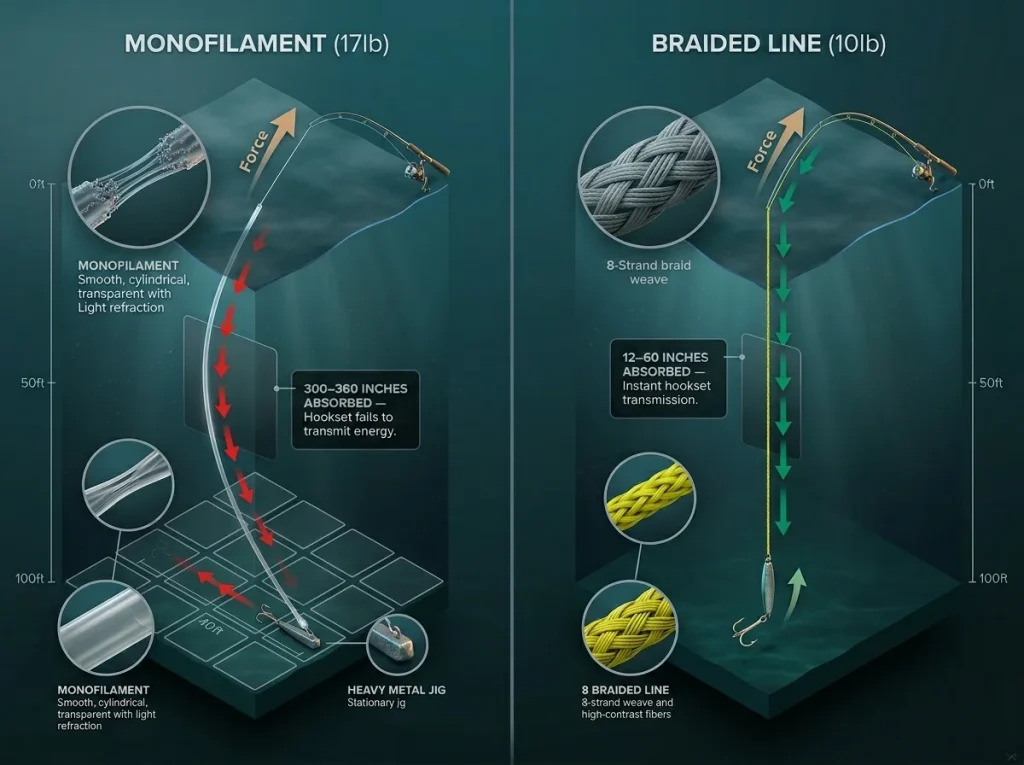
The up-strike is the clearest test of this flaw. A lake trout that inhales a heavy jig and swims upward produces a sudden loss of weight at the rod tip. It is the opposite of what you expect a strike to feel like. On braided line, this sudden slack registers in your hands instantly. On monofilament, the fish has already expelled the metal jig before you even notice the slack.
Fluorocarbon line sits directly in the middle of these extremes. It has far less stretch than mono, but still significantly more than braid at 100 feet. Fluorocarbon belongs exclusively at the leader end, where its low visibility in clear lakes hides your connection. It does not belong anywhere on your main spool for vertical work.
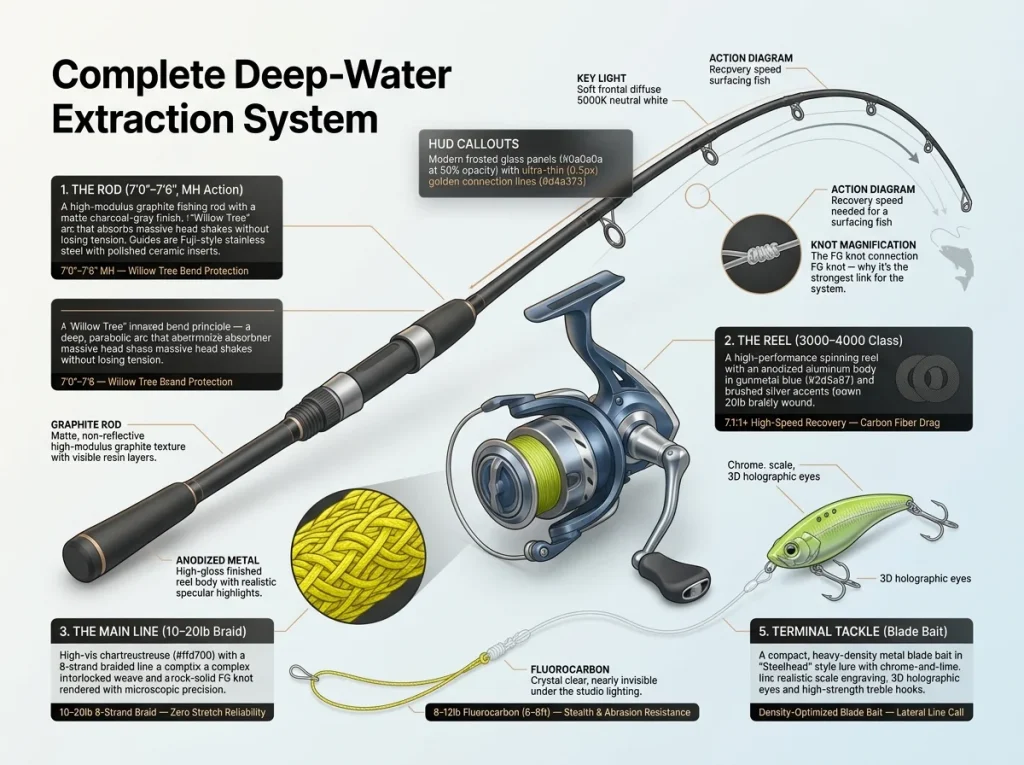
The specification for your main line is 10-20lb braided line. Choose an 8-strand braid to handle heat dispersion against the guides. Your leader should be 8-12lb fluorocarbon cut to 6-8 feet. Connect them with an FG knot or a clean Double Uni knot to slip through the rod guides. This is a system, not a suggestion.
The Thermal Load on Your Gear
During a sustained run from a heavy char, your rod guides and drag washers generate severe friction heat. Under heavy tension, cheap monofilament loses strength fast when heated. Standard felt drag systems lose their smooth operation under that exact same thermal load. You have already compromised the monofilament with distance stretch, and then the heat stress finishes the job.
Using 8-strand braid disperses that friction heat across more fibers, maintaining integrity when a lake trout rips 50 feet of line in one direction.
Engineering the Perfect Drop Speed
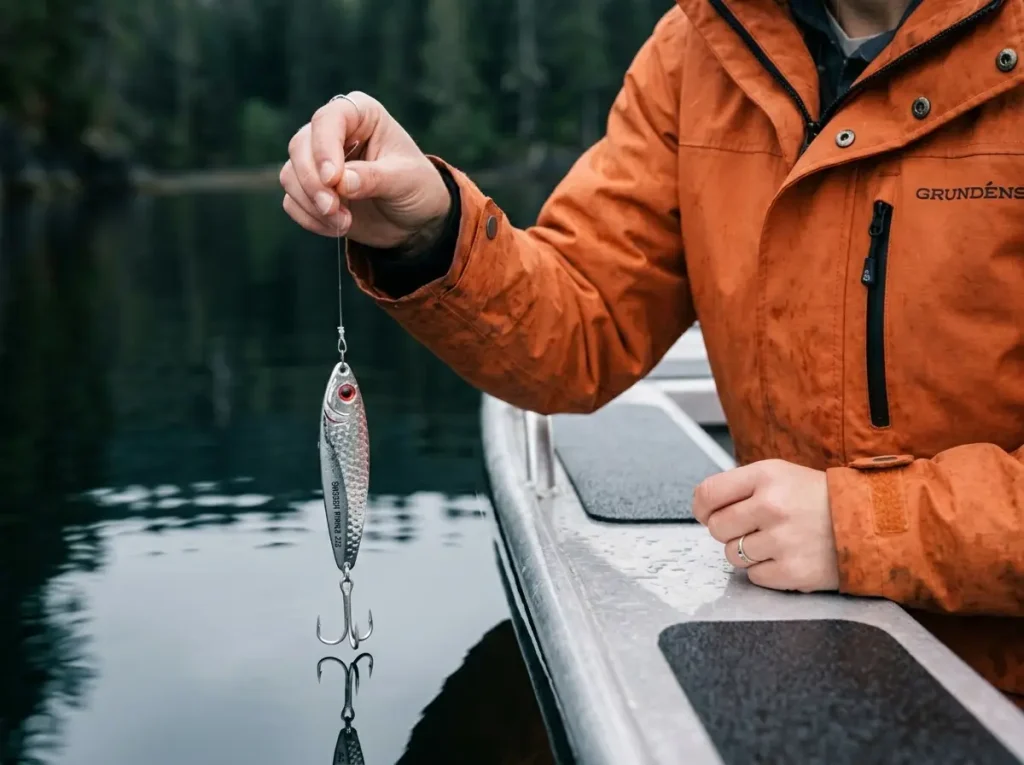
Most guys pick a lure based on what caught a fish last month. That is a fine strategy for 20 feet of water. But at 100 feet, you have to engineer how the lure gets down there.
The baseline starting point is one gram of jig weight for each foot of target depth in neutral current. At 100 feet deep with zero drift, you start at 100g. In the real world, current and boat drift change this math instantly. In a moderate current, you add 25%. In heavy river current or stiff wind drift, you might need to double the baseline weight.
A lure that is too light falls victim to the line bow — current pushes the line into a wide arc, moving the lure completely outside your sonar view and nowhere near your target fish. You think you are working a ledge at 90 feet, but your lure is actually 40 feet behind the boat waving in open water. Your jigging rhythm is useless at that point.
The simple field test: drop your jig and watch the sonar screen. If the descending streak does not appear clearly under your transducer beam, your lure has bowed out of the cone. Upsize your weight until you see it falling on screen.
Bait profile matters just as much as added weight. A bulky tube jig creates massive water resistance. A compact, dense metal spoon weighing the exact same amount hits 70 feet in a fraction of the time. Dense blade baits plunge through the column with minimal drag and reach the hit zone in under ten seconds. The tube jig takes twice as long. At 100 feet, that is a huge exposure gap.
The vertical jigging technique breaks down exactly how to manage sink rates and gear to stay connected on the deepest drops.
Deep water means low light. Your lure has to appeal to the fish’s lateral line, which detects pressure waves in the dark. Lures with heavy, aggressive pulsation call in fish from a distance. A heavy blade bait thudding against a rock bottom sends a wounded-organism signal spreading through the water.
And remember the downsizing rule: compact 3-inch white tube jigs consistently out-fish massive attractors at depth because they accurately imitate the young baitfish that make up the bulk of the forage base in northern waters.
Tipping a precision blade bait with a chunk of sucker meat is a habit many guides refuse to break. The meat adds water drag, dampens the high-frequency vibration, and kills the exact action designed to trigger non-feeding trout. Pick one mechanism — vibration or scent — and stick to it. Tipping hardware usually ruins the intended action.
Pro tip: After aggressively jigging your lure, abruptly stop and let it dead-fall for five to ten seconds. This slow, wounded oscillation triggers more hits than active movement on tough, post-frontal days. Chasing prey costs major energy in cold water, making the stationary target highly appealing.
The Proven Deep Water Gear Setup
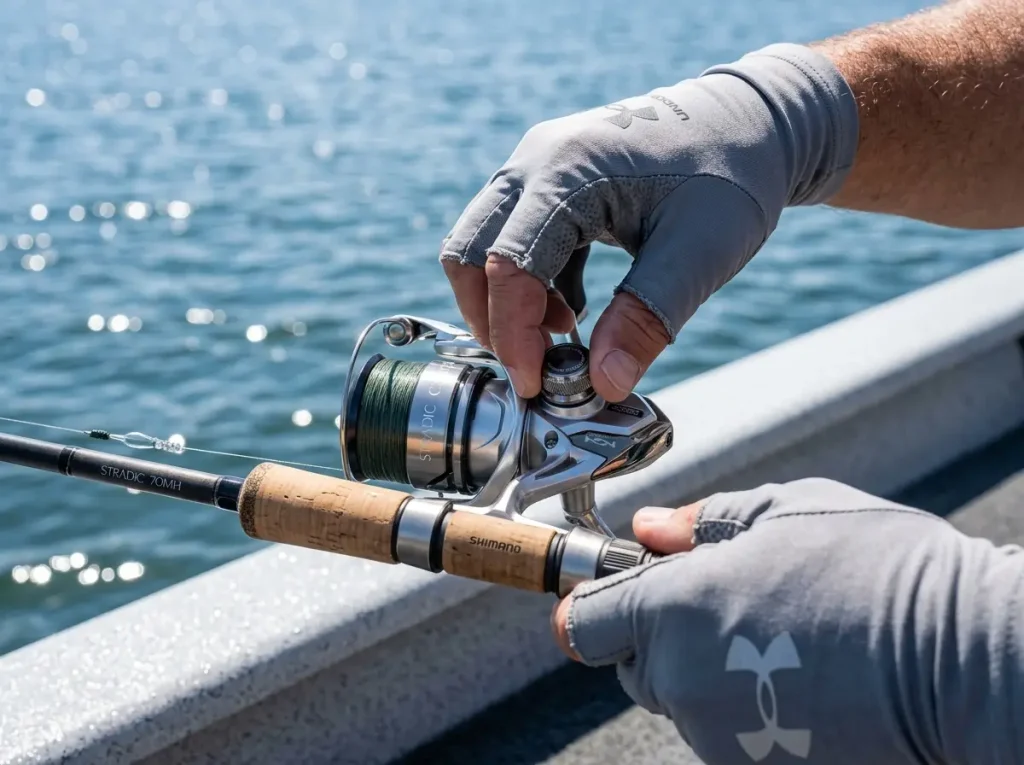
This is not a brand debate. It is about matching specifications to the hazards of deep-water extraction.
Your rod needs to be a 7’0″-7’6″ medium-heavy tool. You need backbone to drive a hook into a bony jaw 100 feet away, so a soft, parabolic rod is entirely wrong here. The ideal rod stays bent under the pressure of a fish, absorbing the massive head shakes without ever returning to a straight position. A stiff, fast-recovery tip snaps straight during a violent head shake. That snap throws a tiny loop of slack into your line. That split second of slack is exactly when the heavy metal jig falls out of the fish’s mouth.
You need a 3000-4000 class reel with at least a 7.1:1 gear ratio. Slower 5.4:1 reels belong on crankbait rods. When a heavy lake trout hooks up at 100 feet and charges straight up toward the surface, a slow reel cannot physically recover line fast enough. You will lose tension, and you will lose the fish. A high-speed reel pulls 30+ inches of line per rotation, keeping constant pressure on the hook.
Carbon fiber drag washers are non-negotiable. Traditional felt washers seize up and stutter when subjected to the friction heat of a sustained run. Carbon fiber remains smooth under intense thermal load, giving you level resistance when the fish decides to turn and dig for the bottom.
Releasing Lake Trout Without Fatality
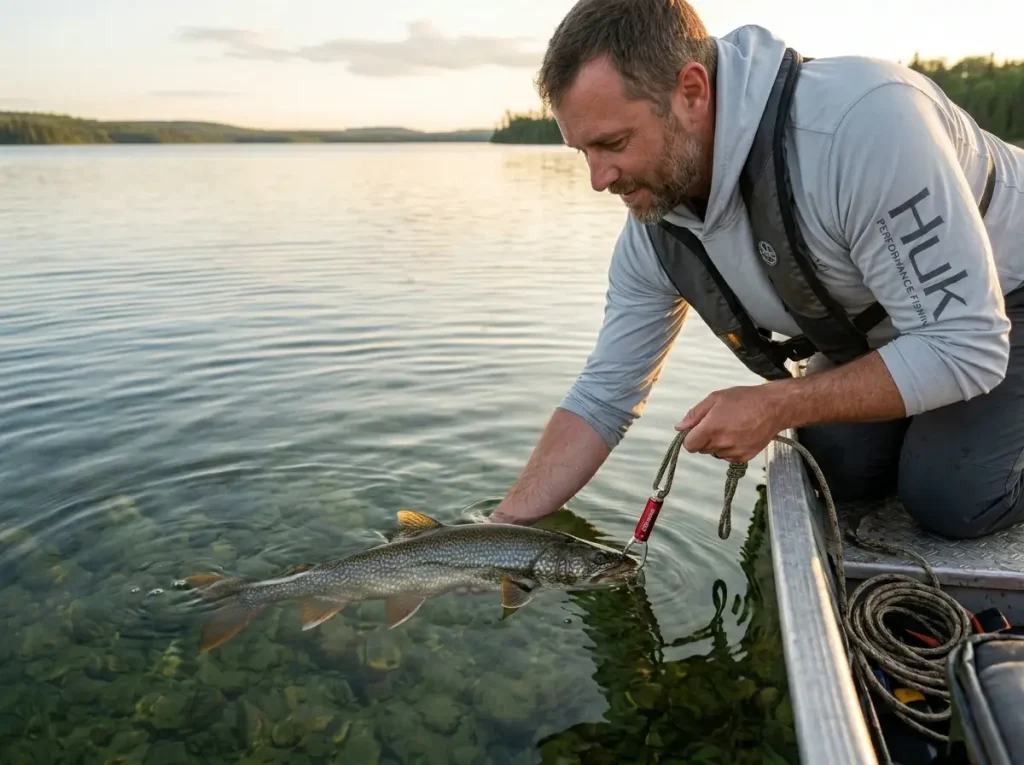
I once watched a caught lake trout swim back down strong from 40 feet after a slow fight and horizontal net hold. I also watched a similar fish float belly-up after an angler ripped it up from the same depth, threw it on the deck, and spent a minute taking photos. The difference between survival and a total loss was a basic understanding of pressure limits.
Lake trout are vent-capable fish. They possess an open swim bladder vent connecting directly to their throat. Under normal circumstances, they can voluntarily burp out expanding gas to regulate their buoyancy during a natural ascent. This makes them much more resilient than walleye if you handle them properly. The problem is that anglers get impatient and rush the fight.
For every 33 feet of depth, ambient pressure changes by a full atmosphere. A fish winched up from 100 feet experiences a severe and rapid pressure drop. If you crank the reel handle four times a second, that fish cannot vent air fast enough to compensate. The bladder expands past its natural limits, pushing organs out of place. The stomach pushes through the mouth, and internal injury is guaranteed.
The guide to barotrauma mitigation explains this process thoroughly. If you are catching fish past 33 feet, you must have a safety protocol ready before the first cast.
The single most effective strategy is a painfully slow retrieve. Keep it to one or two handle cranks per second. You have to give the fish time to manually vent gas as it rises. Once it hits the net, minimize air exposure to 10 seconds or less. A wet, horizontal hold is mandatory to protect the slime coat.
If you bring up a fish and it shows bulging eyes, a tight bloated belly, or a protruding stomach, it needs immediate intervention. Tossing a bloated fish back into the water and calling it conservation is irresponsible. It will float and expire.
You have to secure symptomatic fish to a weighted descending device instantly. These tools clip to the jaw and drag the fish back down to safe pressure depth before releasing them automatically. Every boat fishing deep water needs one rigged and ready.
Pro tip: The photography rule is absolute: if a fish shows any sign of barotrauma, the camera does not come out. You do not expose a symptomatic fish to the air. You secure it to a descending device and send it back to the bottom.
The habitat use predictions for Salvelinus namaycush by temperature and oxygen criteria confirms these fish occupy a very fragile, slow-growing niche. A trophy fish you lose to careless handling has spent a decade surviving in that lake. Do not end its run for a social media photo.
Final Thoughts
Stop dragging the bottom structure and start fishing the oxygen line. The prime strike zone in midsummer is exactly where cold temperatures, heavy dissolved oxygen, and bait schools overlap — and that is almost never the lake floor.
Ditch the stretchy monofilament mainline. Every inch of stretch is absorbing the force needed to secure your hook. Switch to a zero-stretch braided system to guarantee your hookset actually connects when a fish commits.
Every single fish you plan to release must be managed carefully back to depth. Treat your retrieve speed like a decompression stop, give them time to vent, and keep a weighted descending device tied on at all times.
FAQ
How deep do lake trout go in the summer?
Lake trout hold in the 50-120 foot range where temperatures are below 15°C and dissolved oxygen stays above 6 mg/L. In lakes with low bottom oxygen, they are pushed upward into the middle layer and suspend off the floor. Deepest water rarely holds the most active fish.
What is the best bait for deep lake trout?
Dense metal blade baits and 3-4 inch white tube jigs match the baitfish profile and sink fast with minimal resistance. Heavy blade baits pound the bottom, sending pressure waves that fish track using their lateral line in dark, deep water. Tipping these lures with bait strips dampens the erratic action that triggers strikes.
Can lake trout survive being pulled from deep water?
Yes, because their vent-capable anatomy allows them to burp out expanding gas if given enough time. The key is to reel at a slow, managed pace of 1-2 cranks per second to allow natural venting. Any fish showing a bloated belly requires an immediate ride down on a weighted descending device.
What temperature do lake trout prefer?
The 8-12°C range provides their optimal growth zone, but they are most capable of aggressive hunting between 12-15°C. They frequently rest in freezing bottom layers to save energy, then push up into warmer water to track schools of cisco. Finding the right mix of oxygen and temperature is always more critical than a single temperature reading.
Why do I keep seeing lake trout on sonar but can’t get them to bite?
You are likely fishing under them because boat presence forces trout to dive 15-20 feet away from the shadow. Target your drop 10 feet above the mark to bring the lure right into their strike window. Also, if your jig doesn’t show up on a vertical sonar drop, subsurface current has pushed it out of the zone and you need a heavier weight.
Risk Disclaimer: Fishing, boating, and all related outdoor activities involve inherent risks that
can lead to injury. The information provided on Master Fishing Mag is for educational and informational purposes
only. While we strive for accuracy, the information, techniques, and advice on gear and safety are not a substitute
for your own best judgment, local knowledge, and adherence to official regulations. Fishing regulations, including
seasons, size limits, and species restrictions, change frequently and vary by location. Always consult the latest
official regulations from your local fish and wildlife agency before heading out. Proper handling of hooks, knives,
and other sharp equipment is essential for safety. Furthermore, be aware of local fish consumption advisories. By
using this website, you agree that you are solely responsible for your own safety and for complying with all
applicable laws. Any reliance you place on our content is strictly at your own risk. Master Fishing Mag and its
authors will not be held liable for any injury, damage, or loss sustained in connection with the use of the
information herein.
Affiliate Disclosure: We are a participant in the Amazon Services LLC Associates Program, an
affiliate advertising program designed to provide a means for us to earn advertising fees by advertising and linking
to Amazon.com. As an Amazon Associate, we earn from qualifying purchases. We also participate in other affiliate
programs and may receive a commission on products purchased through our links, at no extra cost to you. Additional
terms are found in the terms of service.