

In this article
The wind shifts from the west to the northwest. The water turns a gunmetal gray, and the air suddenly feels heavy against your skin. This isn’t just a mood swing in the weather. It is a physical message regarding atmospheric instability.
While a beginner might just see rain coming, a veteran angler sees a schedule. The sky controls the water. When you understand this connection, the clouds stop being just a background. They become a dashboard that tells you exactly what to do next. You don’t need to be a professional nephologist to master reading the sky. This outdoor situational awareness transforms the cloud cover into a tactical map.
I have spent decades on the water, and I’ve learned that the difference between an empty boat and a great day often comes down to tracking pressure changes. In this guide, we will break down how barometric drops affect fish, which high clouds predict a bite 24 hours away, and how to spot dangerous storm intensity before it puts you in harm’s way.
Why does the atmosphere dictate angling success?
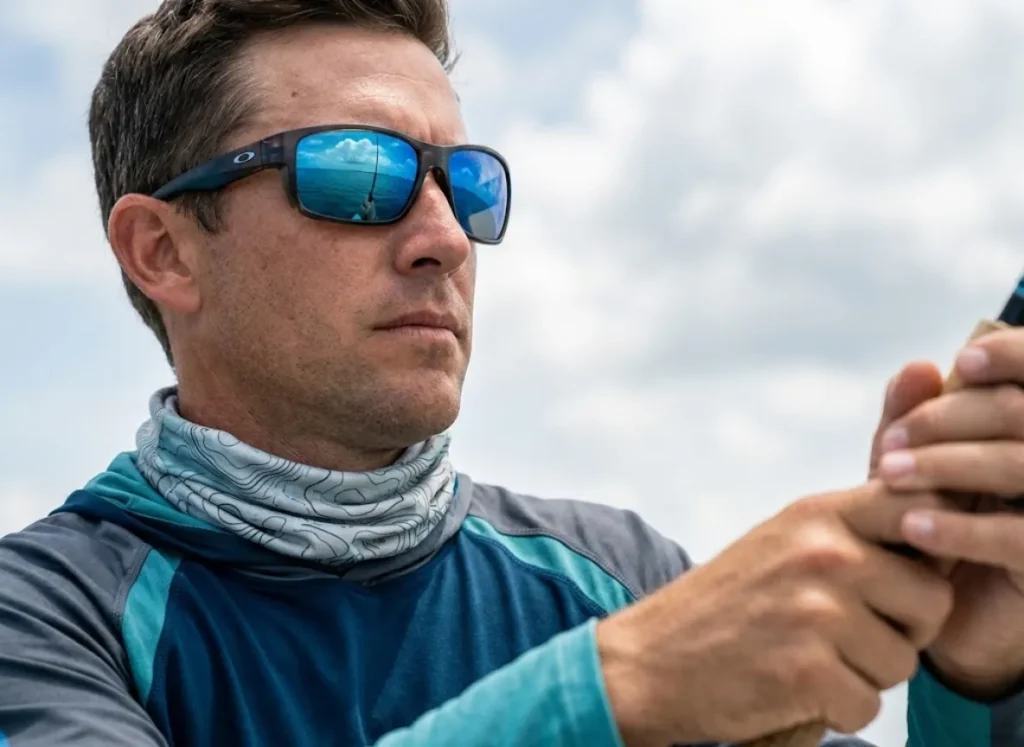
The link between the air above and the water below is absolute. To understand why clouds—essentially visual indicators of rising humidity and pressure—matter to fish, we first need to look at what is happening physically underneath the surface.
How does atmospheric pressure affect fish physiology?
Air pressure has weight. The troposphere presses down on the water’s surface, and that signal travels deep into the lake or river. Fish live in water, which is much heavier and denser than air. Because of this, they are incredibly sensitive to even small changes in that background pressure.
It usually isn’t the exact pressure number that matters. Instead, fish react to falling pressure or rapid trends. The main body part involved here is the swim bladder. Think of it like a gas-filled balloon inside the fish that helps them float.
When a storm system approaches, air pressure drops. This causes the gas in that “balloon” to expand. When the sky clears and pressure rises, the gas compresses. Scientific studies on the responses of the swim bladder to pressure changes show that fish have to work hard to stay balanced against these changes. That effort directly changes their mood and willingness to eat.
Pro-Tip: If you are unsure how to read barometric numbers (like 29.92 inHg), check out a comprehensive guide to fishing barometric pressure to get a baseline before heading out.
What is the biological difference between ‘Frenzy’ and ‘Lockjaw’?
Not all fish handle pressure changes the same way. Some species, like Trout, Pike, and Carp, have a direct tube connecting their swim bladder to their gut. This allows them to “burp” air to adjust quickly when weather fronts hit. They handle storms pretty well.
However, other fish like Bass, Walleye, Muskie, and Perch are built differently. They don’t have that tube. To understand the biological drivers of largemouth bass behavior, you need to know that they have to absorb gas slowly through their blood. This takes a long time.
Because they can’t adjust fast enough, they are very sensitive to quick shifts. Before a cold front or warm front arrives, the pressure drop might make them feel loose and active, leading to a feeding frenzy. But after the front passes and high pressure squeezes them, they feel heavy and bloated. This is “lockjaw.” They swim to the bottom to find stability and refuse to chase food, matching NOAA’s definition of air pressure dynamics regarding stable, high-pressure air.
What do high-altitude clouds tell us about future conditions?
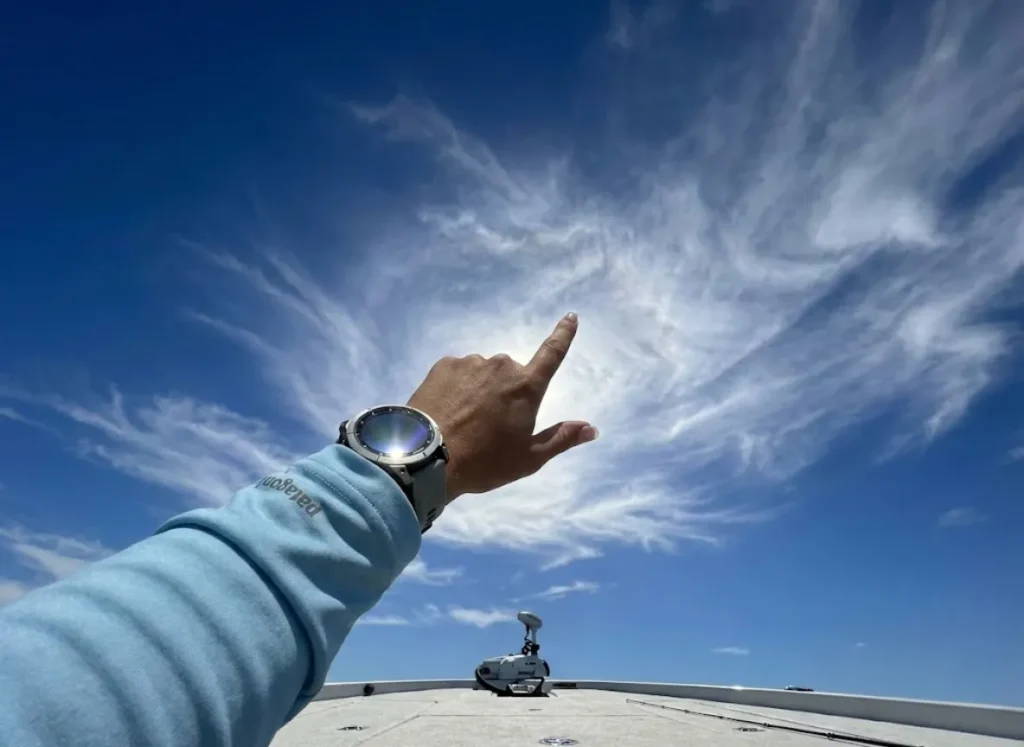
Long before the wind picks up, the upper atmosphere tells the story. We call this the “Strategic Warning Zone.” These are the high-altitude clouds you see way up at cruising altitude, signaling that weather is coming in 24 to 48 hours.
How do Cirrus clouds act as a 24-hour warning?
Cirrus clouds form very high up, above 20,000 feet. They are made entirely of ice crystals and look like wispy, delicate white strands. People often call them Mare’s Tails because they look like a horse’s tail sweeping across the sky.
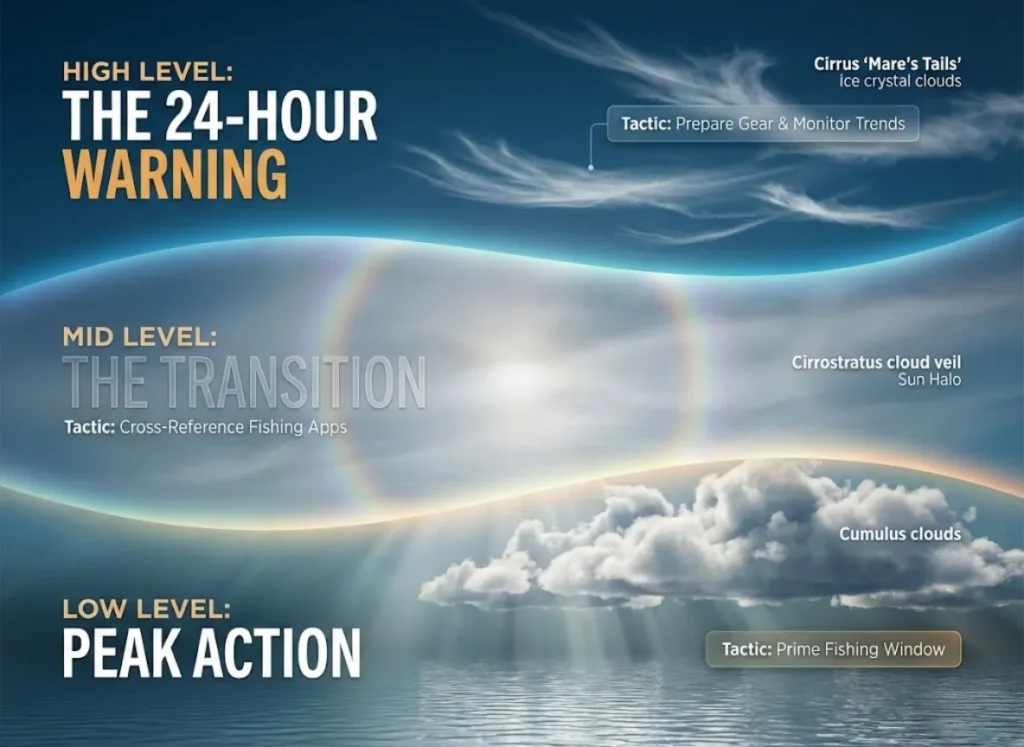
When you see these hair-like clouds in a clear blue sky, the weather is currently nice, but change is coming. This is your signal to get your gear ready. Sometimes, a thin veil of Cirrostratus clouds will follow, creating a visible sun halo or moon halo. The mechanisms of cloud development suggest that the best fishing will happen in about 24 to 36 hours. This lead time is the perfect window to start cross-referencing visual cues with fishing weather apps to plan your trip.
What does a ‘Mackerel Sky’ indicate for the bite?
As the weather gets closer, you might see Cirrocumulus clouds. These look like small, rippled white cotton patches that resemble the scales on a fish. This is often called a Mackerel Sky.
This visual texture means the air way up high is becoming unstable. Old sailors used to say, “Mackerel scales and mare’s tails make lofty ships carry low sails.” They were right—it means wind and winter storms or rain are approaching.
For the angler, high-level cloud instability patterns create broken, moving shadow lines underwater. This gives predators the confidence to roam around and ambush prey. It signals that the bite is about to turn on. This is often the ideal time for deploying topwater lures during pressure drops to catch aggressive fish on the surface.
How do mid-level clouds signal the tactical transition?
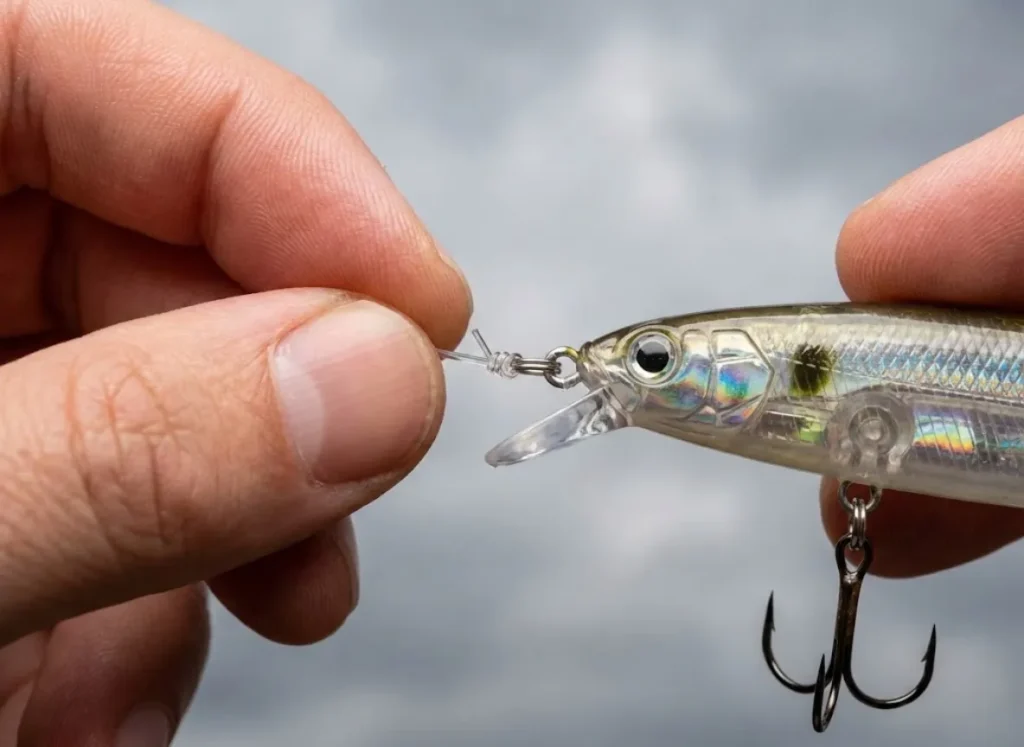
When mid-level clouds drop lower into the middle of the sky, the weather is only 6 to 12 hours away. This is when you need to change your lure color selection and how fast you are fishing.
Why are Altocumulus clouds the trigger for an ‘afternoon blitz’?
Altocumulus clouds look like gray or white sheets. Sometimes, they have little bumps sticking up that look like castle towers. If you see these “turrets” on a warm morning, it is a very strong sign that thunderstorms or squalls will hit in the afternoon.
This is a specific timer for you. The pressure is dropping into the danger zone, which triggers fish to eat. You should plan to be at your best fishing spot by mid-afternoon. Review identification of mid-level clouds so you can spot these middle clouds, and start adjusting tactics for summer fishing patterns to catch the fish before the storm chases you off the water.
How does Altostratus affect lure selection and optics?
Altostratus clouds form a flat, gray-blue sheet that covers the whole sky. The sun ends up looking like a dull, watery disk behind frosted glass. According to the National Weather Service cloud classification, these sheet-like clouds scatter the sunlight.
This light diffusion scatters the sun so much that underwater shadows disappear. Fish that rely on hiding in shadows lose their camouflage, so they leave their cover and roam around. This means you should switch to fast-moving baits to find them.
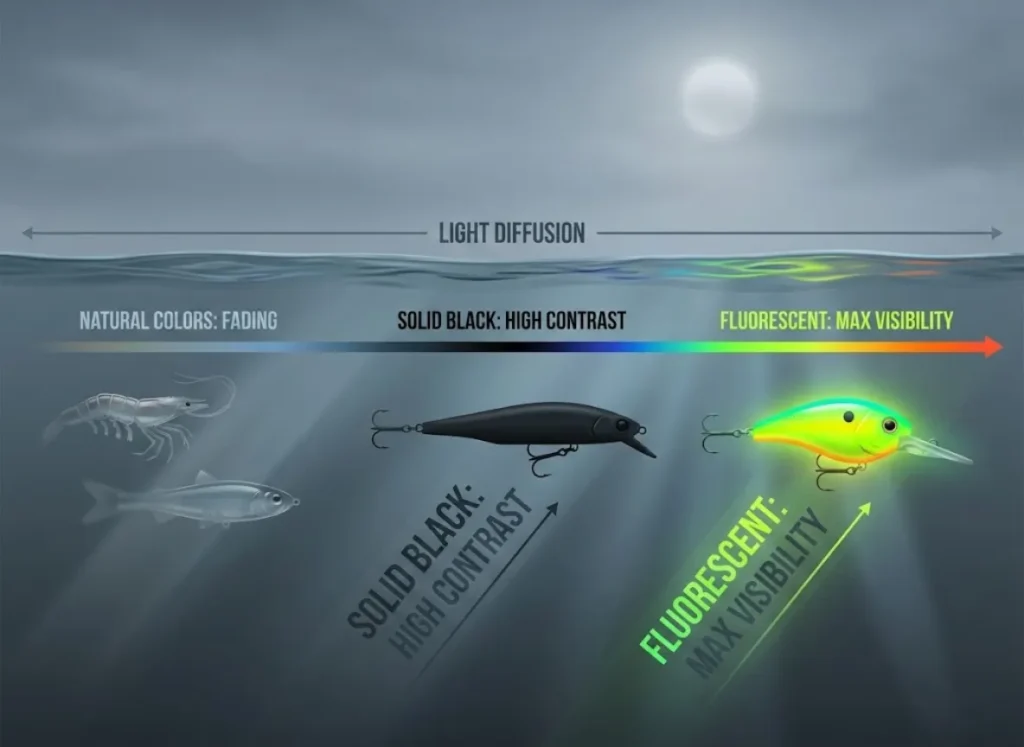
Also, understanding the science of fish vision is key here. Natural, see-through lure colors vanish in this gray light. You need to switch to solid blacks or bright fluorescent colors. These create a solid silhouette that fish can actually see against the dim surface. Treat the sky as a sonar—if the light is flat, the fish are roaming.
When do low-level clouds become an immediate threat?
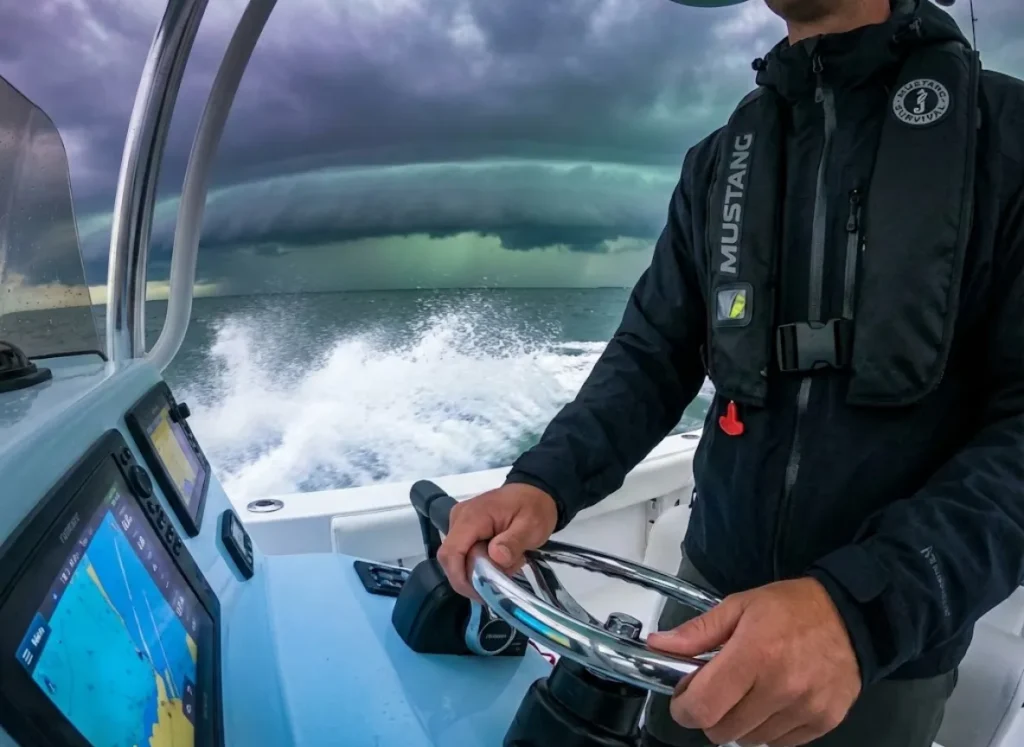
When the low-level clouds are dark and thickening, the conversation shifts. We stop worrying about catching fish and start focusing on marine safety.
What is the difference between a Shelf Cloud and a Wall Cloud?
Mixing up these two clouds can be dangerous. A Shelf Cloud is a long, wedge-shaped cloud on the front edge of a storm. It looks like a stack of plates or a terrifying horizontal tube.
A Wall Cloud is different. It is a smaller, compact lump that lowers from the back of a storm. It often looks like it is spinning.
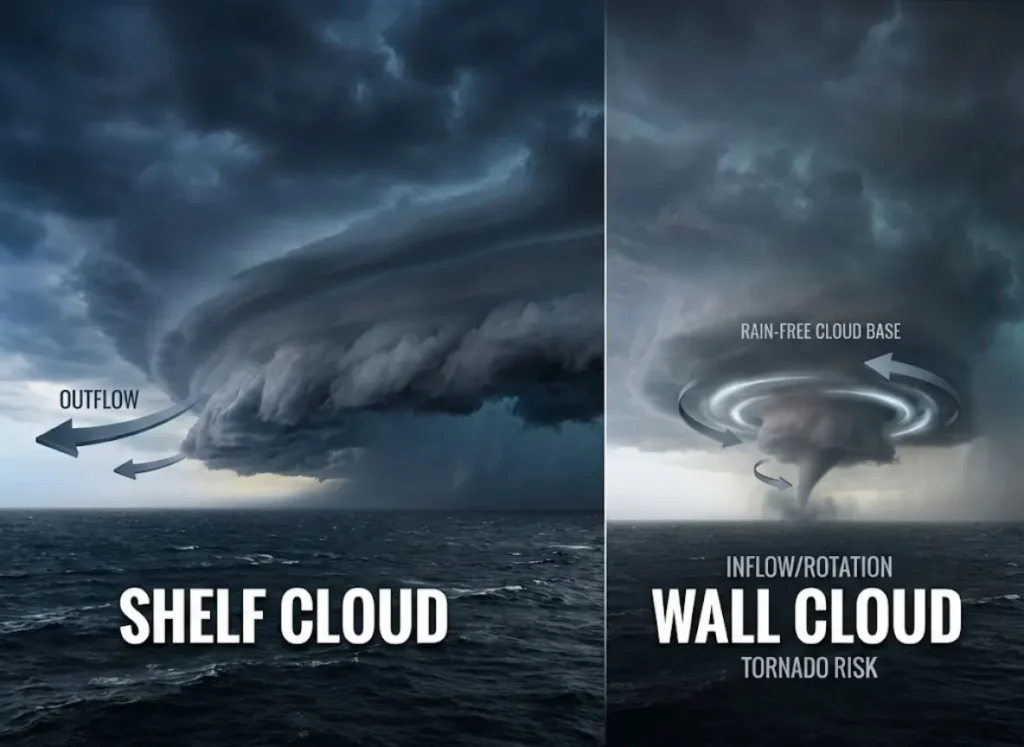
The Shelf Cloud brings dangerous straight-line winds and a sudden temperature drop. When you see it, secure your gear and point the bow into the wind. However, distinguishing shelf clouds from wall clouds is vital because the Wall Cloud signals a tornado might form. The only safe move for a Wall Cloud is to drive away immediately at a 90-degree angle from where the storm is going. This knowledge is the foundation of surviving unexpected thunderstorms on the water.
How should anglers react to Cumulonimbus development?
Cumulonimbus clouds, often called thunderclouds, are giant towers that show extreme vertical development. They often have a flat top called an anvil head. The point of that anvil usually points in the direction the storm is moving.
These clouds bring heavy rain, hail, and violent updrafts. Watch for ragged scud (or pannus) clouds hanging beneath the base, or pouch-like mammatus clouds, which indicate turbulence. Just before these storms hit, the pressure drops rapidly. This often triggers the most intense feeding frenzy of the day.
However, the risk of lightning on open water is too high. Even with fair weather cumulus (known as Cumulus humilis) turning into towering Cumulus congestus, the shift happens fast. It isn’t worth it. Safety must come first. Follow marine weather safety rules immediately. If you get caught in the wind, focus on maintaining boat control in heavy wind rather than trying to make one last cast.
How can anglers validate visual data with technology?
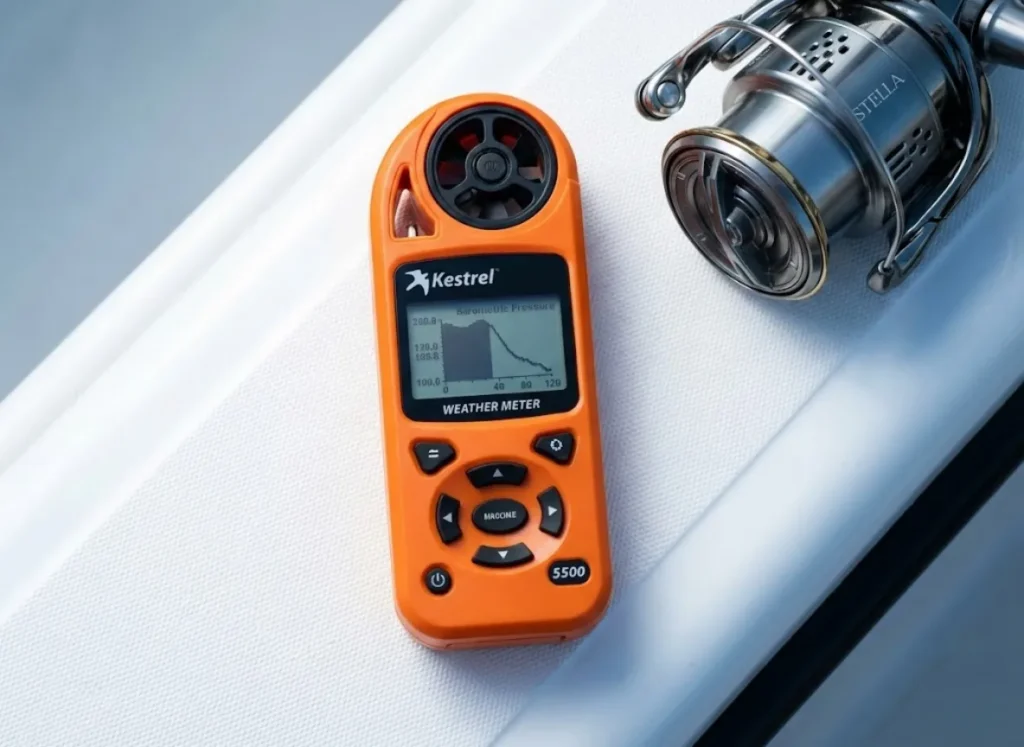
Your eyes are great tools, but modern technology can back up what you are seeing with hard numbers.
How do handheld meters quantify the pressure trend?
You might suspect a storm is coming, but digital sensors like a Kestrel weather meter can prove it. They show you exactly how fast the pressure is changing. You want to look at the “slope” of the graph. A steep line going down confirms a storm front is arriving better than just looking at the current number.
Generally, if the pressure drops more than 0.03 to 0.05 inHg per hour, that is the “Green Light.” The fish should be biting aggressively. While some people doubt old sayings, resources exploring red sky forecasting validity show that science often supports tradition. But technology offers precision.
Some watches can even vibrate when the pressure drops this fast. Consider using fishing watches with barometric sensors so you can fish hands-free while monitoring the optimal windows for fish activity. This helps confirm wind shifts or veering winds that your eyes might miss in the dark or fog.
Wrapping Up
Mastering the weather takes a mix of old-school weather observations and modern science. By watching for high-altitude Cirrus clouds, you get a 24-hour head start. By checking those cues with a barometer, you can pinpoint the exact moment the pressure drop triggers a feeding frenzy.
The most important skill is being adaptable. You must be willing to change from natural to high-contrast lures when the light gets flat due to thick clouds. You also need the discipline to slow down when high pressure gives the fish lockjaw. Above all, keep yourself safe by performing a risk assessment on the difference between wind clouds and tornado clouds.
Next time you hit the water, take a moment to write down the cloud formations next to your catch log. Share what you see in the comments to help us all learn more about this tactical cloud guide.
FAQ – Frequently Asked Questions
Is the saying Red sky at night, sailor’s delight actually true?
Yes, it is mostly true in places like the US where weather moves west to east. A red sunset means high pressure (good weather) is coming from the West. A red sunrise means the good weather has already passed and a storm is following behind it.
How does barometric pressure affect bass fishing specifically?
Bass have closed swim bladders, so they can’t adjust to pressure changes quickly. When pressure drops, their bladder expands and they feel active. When pressure rises fast, the bladder squeezes them, making them feel bloated and lethargic.
What is the most dangerous cloud formation for boaters?
The Wall Cloud is the most dangerous because it often creates tornadoes. Thunderstorms bring lightning, which is bad, but a Wall Cloud shows rotation. If you see one, you need to drive away from the storm’s path immediately.
Do fish really bite better before a storm?
Yes. The falling pressure makes their swim bladders feel better, and the darkening clouds give predators an advantage. This triggers them to feed heavily before the bad weather or precipitation hits.
Risk Disclaimer: Fishing, boating, and all related outdoor activities involve inherent risks that
can lead to injury. The information provided on Master Fishing Mag is for educational and informational purposes
only. While we strive for accuracy, the information, techniques, and advice on gear and safety are not a substitute
for your own best judgment, local knowledge, and adherence to official regulations. Fishing regulations, including
seasons, size limits, and species restrictions, change frequently and vary by location. Always consult the latest
official regulations from your local fish and wildlife agency before heading out. Proper handling of hooks, knives,
and other sharp equipment is essential for safety. Furthermore, be aware of local fish consumption advisories. By
using this website, you agree that you are solely responsible for your own safety and for complying with all
applicable laws. Any reliance you place on our content is strictly at your own risk. Master Fishing Mag and its
authors will not be held liable for any injury, damage, or loss sustained in connection with the use of the
information herein.
Affiliate Disclosure: We are a participant in the Amazon Services LLC Associates Program, an
affiliate advertising program designed to provide a means for us to earn advertising fees by advertising and linking
to Amazon.com. As an Amazon Associate, we earn from qualifying purchases. We also participate in other affiliate
programs and may receive a commission on products purchased through our links, at no extra cost to you. Additional
terms are found in the terms of service.