

In this article
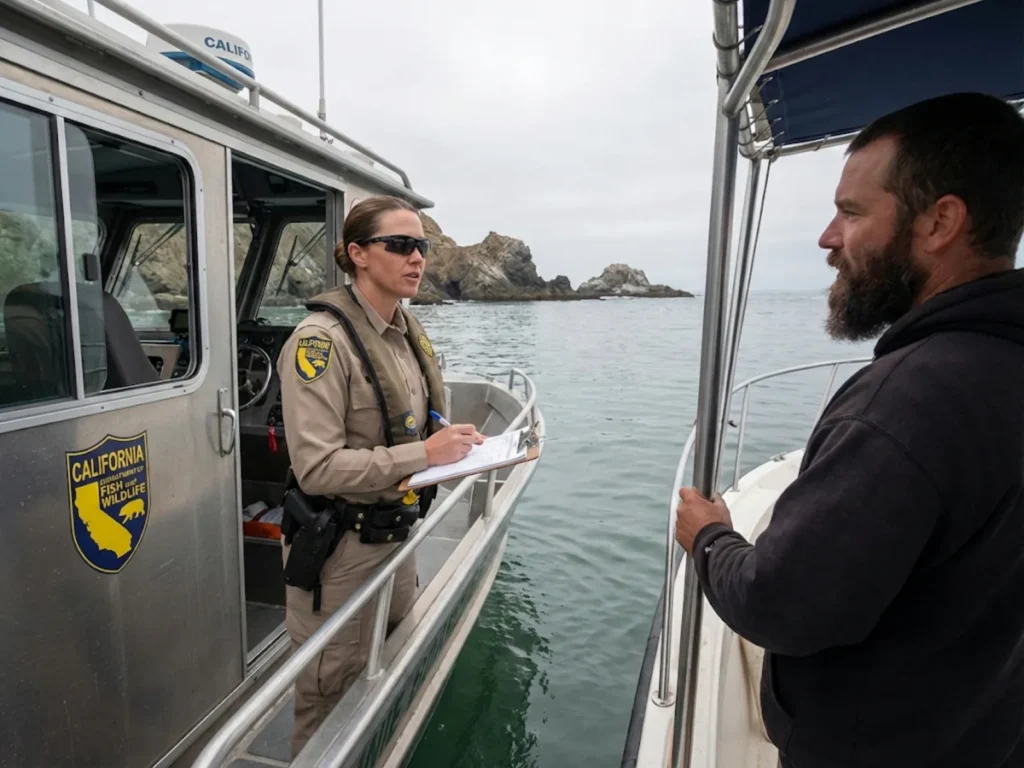
The ranger’s flashlight swept across my bow at 6:47 AM, and the first thing he asked wasn’t whether I had a fishing license—it was whether I could prove my GPS coordinates from the last 30 minutes. One mile out, a hundred feet of water clarity, and I was 0.17 nautical miles inside an invisible line I didn’t know existed. That morning cost me $5,000 and a season’s worth of humility.
After twenty years running charters along the California coast, I’ve learned that marine protected areas aren’t just colored zones on a map. They’re the difference between a clean day on the water and explaining to your wife why you can’t book clients for the next 90 days. Here’s how to stay on the right side of those invisible lines—what the regulations actually mean, how to navigate them, and what happens when you get it wrong.
⚡ Quick Answer: Fishing in and around MPAs requires knowing your zone type (SMR = no take, SMCA = species-specific, SMP = recreational only), maintaining GPS awareness of boundaries, and stowing all gear before transiting protected water. Use offline apps like FishLegal or Fish Rules to verify your position, and keep a 100-yard buffer from MPA edges to avoid drifting violations.
The Classification System: SMR, SMCA, SMP, and What They Actually Mean
The biggest mistake anglers make is treating all marine protected areas the same. They’re not. California alone has 124 MPAs, and each falls into one of four categories with completely different rules. Get the classification wrong and you’re fishing illegally without knowing it.
State Marine Reserves: The Zero-Extraction Zones
A State Marine Reserve is exactly what it sounds like—a complete no-take zone. You can’t fish. You can’t harvest. You can’t take a single mussel off a rock. The only exception is scientific research with a specific CDFW permit.
What trips people up is the definition of “take” under California law. It includes pursue, catch, capture, kill—or even attempt any of these actions. That means if you’ve got a line in the water inside an SMR boundary, you’ve already violated the law. Intent doesn’t matter. Position does.
I’ve seen anglers argue they were “just passing through” with gear deployed. The enforcement officer didn’t care. The moment your hook enters the water inside the boundary, you’re in violation.
State Marine Conservation Areas: The Species-Specific Rulebook
SMCAs are where things get complicated. These zones allow selective take, but the permissions vary wildly depending on location. Point Dume SMCA, for example, allows recreational take of white seabass and pelagic finfish by spearfishing. Commercial take of coastal pelagics by round haul net is also permitted. Everything else? Prohibited.
This is why you can’t just look at a map and assume you know the rules. Each SMCA has its own species-gear matrix. Before you deploy any equipment, you need to verify three things: the species you’re targeting, the gear you’re using, and whether that combination is allowed in that specific area.
Pro tip: Laminate a cheat sheet for the SMCAs in your home waters. Keep it in your tackle bag. When enforcement asks what you’re targeting and how, you want to answer without hesitation.
Understanding these distinctions requires more than just fishing license requirements beyond standard permits—it demands zone-specific knowledge that most recreational anglers never acquire until it’s too late.
State Marine Parks and Recreational Management Areas
State Marine Parks exist specifically to protect recreational fishing while eliminating commercial exploitation. If you’re trolling for salmon or casting for halibut recreationally, an SMP might be perfectly legal. But bring commercial gear or sell what you catch? Now you’ve got a problem.
SMRMAs add another layer. These zones protect specific recreational values—sometimes including legal waterfowl hunting. The managing agency can restrict any activity that compromises the area’s primary objectives. Special closures add seasonal restrictions on top of permanent protections, particularly during wildlife protection periods.
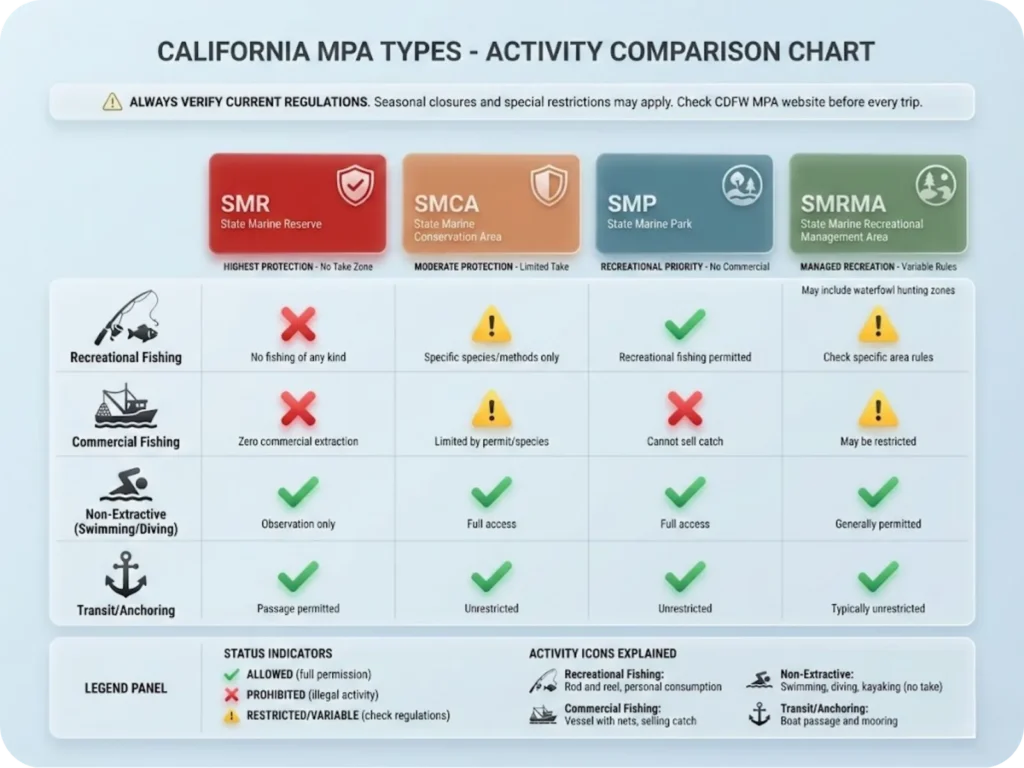
The takeaway: never assume. Check the specific zone before every trip, especially if you’re fishing new water. According to CDFW’s official MPA classification guide, regulations can change with seasonal closures that aren’t reflected in older charts.
Finding the Invisible Lines: GPS, Apps, and Boundary Identification
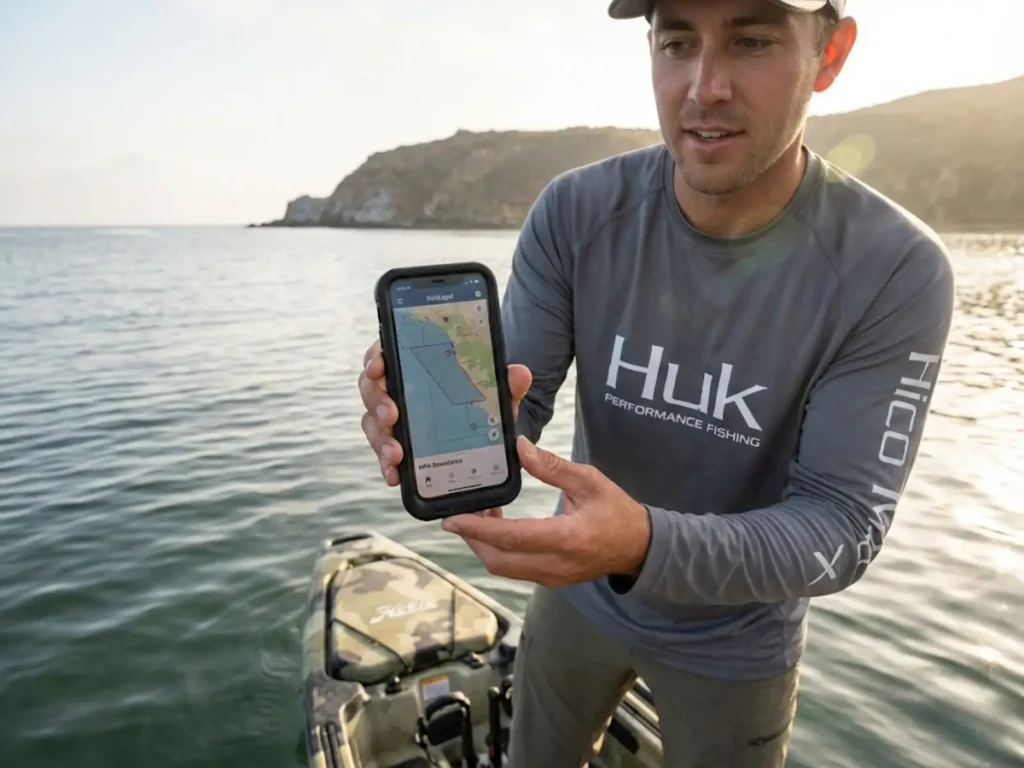
Here’s the brutal truth about MPA boundary identification: most protected areas have no physical markers. No buoys. No signs. The Pacific is too deep, the conditions too harsh, and the costs too high to maintain visible boundaries. Your compliance depends entirely on knowing where you are.
Why Physical Markers Don’t Exist
Most MPA boundaries follow simple due north/south or east/west lines, which makes them easy to program into a GPS but impossible to visualize on the water. Some areas have more complex geometries that require multiple waypoints to track accurately.
The “0.17 nautical mile” problem is real. I’ve seen documented cases where boats were fined for being fractions of a mile inside protected zones while hauling lines. The defense usually fails because the legal standard is strict liability—if your vessel or gear is inside the boundary, the violation has occurred regardless of intent.
GPS coordinates become your legal defense. Before approaching MPA edges, document your track. If enforcement ever questions your position, that digital trail is the only evidence that matters.
Essential Navigation Apps for Compliance
Two apps stand out for fishing compliance guidance. The Fish Rules App uses your phone’s GPS to display relevant state and federal California fishing regulations automatically. It shows bag limits, size restrictions, and season statuses, and it works offline—critical when you’re 20 miles from the nearest cell tower.
FishLegal focuses specifically on California’s MPAs and Groundfish Exclusion Areas. It provides accurate positioning relative to SMRs and SMCAs, ensuring you know exactly where you are without needing cellular signal.
For more options, check out these fishing apps with GPS and regulatory overlays. The investment in good navigation tools pays for itself with a single avoided citation.
Pro tip: I keep FishLegal running on a dedicated tablet with external GPS. Phone GPS can drift 20-30 meters—and that margin is the difference between legal and not when you’re working the edges.
Sample Boundary Coordinates (Los Angeles County)
Here are waypoints every Southern California angler should have loaded before fishing near Los Angeles County MPAs:
- Harrison Reef: 34° 02.05’N / 118° 56.55’W (near Point Dume SMCA)
- Point Dume Upcoast Boundary: 34° 02.04’N / 118° 52.85’W
- Point Vicente NW Boundary: 33° 44.80’N / 118° 24.80’W (No-Take SMCA)
- Abalone Cove Eastern Boundary: 33° 44.20’N / 118° 21.00’W
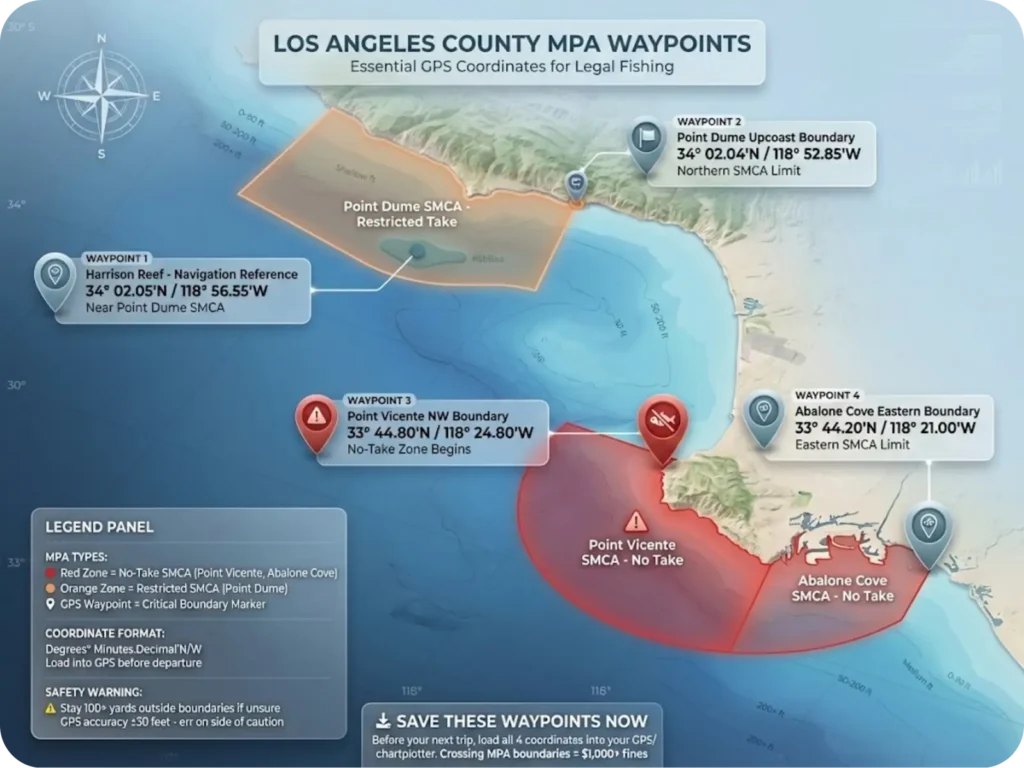
Load these as waypoints before your next trip. The LA County MPA fishing guide with boundary maps provides additional coordinates for the entire region.
Transit Rules: When You Can Pass Through Protected Water
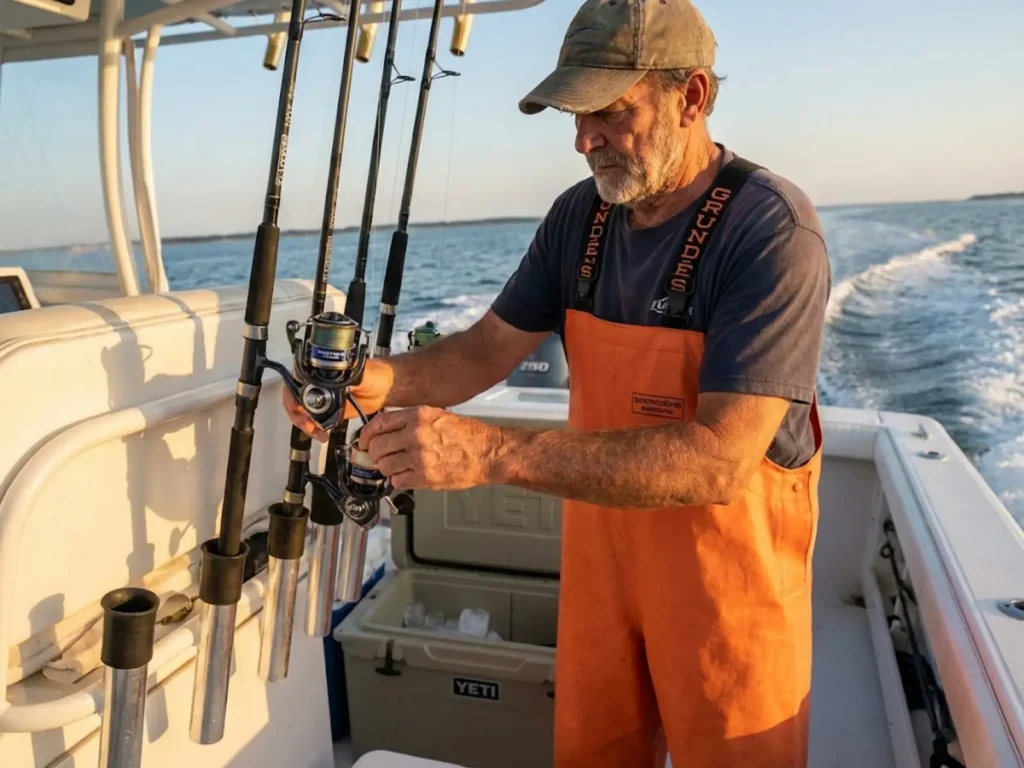
The most common question I get: “Can I drive through an MPA with fish I caught somewhere else?” The answer is yes—but only if you follow the gear stowage requirements precisely.
The Stowed Gear Requirement
Vessels can transit with catch on board through or anchor in MPAs with legally-caught fish aboard, provided gear meets “stowed” standards. In an SMR, no fishing gear may be deployed in the water at any time. In an SMCA or SMP, only gear used to take species identified as “allowed” for that specific area may be in the water.
For spearfishermen, transit rules tighten further. Gear must be unloaded, not carried in hand, and the diver must remain at the surface. These rules exist to prevent “quick dip” poaching of slow-growing species like rockfish or abalone.
The doctrine is simple: if you’re passing through, look like you’re passing through. Anything that suggests active fishing—lines deployed, spearguns in hand, divers below the surface—creates a violation.
Drifting Versus Anchoring Protocols
Drifting through an MPA with catch aboard is treated like transit, but the risk of a “gear in water” violation increases significantly. Your lines must be out of the water the moment the boundary is crossed. Currents don’t care about regulations, and neither does enforcement.
Anchor with gear stowed is permitted in most MPAs, but watch for drag. A 15-pot trawl can roll further than expected due to ocean surge. If your anchor jumps or parts off and you drift inside a protected zone, that’s still a violation. Emergency provisions for anchoring during mechanical failure or dangerous weather do not permit taking resources.
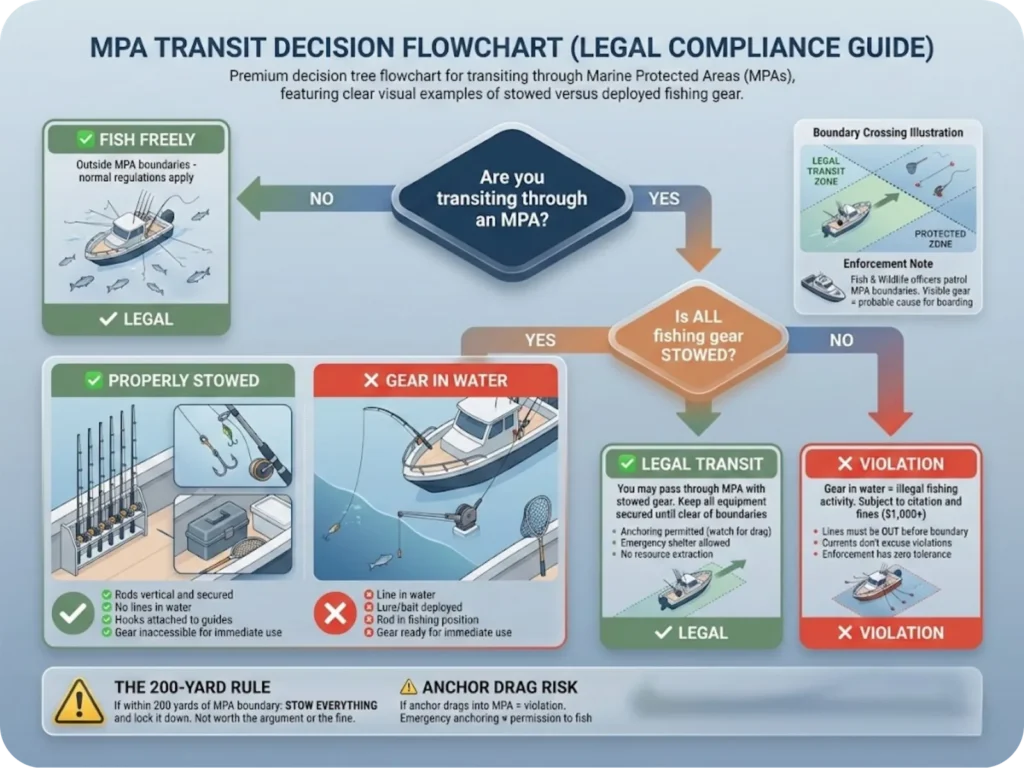
Pro tip: My rule: if I’m within 200 yards of an MPA line, everything is stowed and locked. It’s not worth the argument.
For more on staying in position, see managing boat drift in challenging conditions. The same principles that keep you on fish keep you out of trouble near boundaries.
The Cost of Mistakes: Fines, Penalties, and License Consequences

Let’s talk money. Because nothing clarifies the stakes like actual dollar amounts.
Recreational Violation Schedule
First conviction in Florida: $100-$500 fine, up to 60 days in jail. Second conviction within 12 months: $250-$1,000, up to six months. That’s for standard violations.
MPA violations in California are misdemeanors carrying potential $1,000 fines and one year in jail. But the real pain comes from specimen-level penalties. “Bucket poaching” of tidepool organisms has resulted in $5,000 fines per specimen. Rangers have written tickets exceeding $20,000 for families who didn’t understand that those tidepools were protected.
Fines compound per fish, per violation event. A bad day can cost thousands, according to Florida Statute § 379.407 penalty schedule, which details the escalation. Similar structures exist along every coast.
Commercial Operator Penalties
For commercial operators, the math is catastrophic. First major violation: $2,500 civil penalty plus 90-day license suspension. Third major violation within the specified timeframe: $5,000 fine, mandatory imprisonment, and lifetime revocation of all fishing privileges.
California’s Marine Life Protection Act adds another twist. The Department of Fish and Wildlife can defer the transfer of commercial permits while civil vs criminal violations are pending resolution. You can’t sell your license before revocation—the state anticipated that exit strategy.
Gear and vessel forfeiture are on the table for repeat offenders. For a complete overview of what’s at stake, see the state-by-state fishing regulation summary.
The “Accidental” Defense
Courts apply strict liability in most MPA cases. Intent doesn’t matter if you’re inside the boundary. I’ve seen the “drifting” argument fail in court when GPS data showed the vessel was stationary. The legal standard is position, not intention.
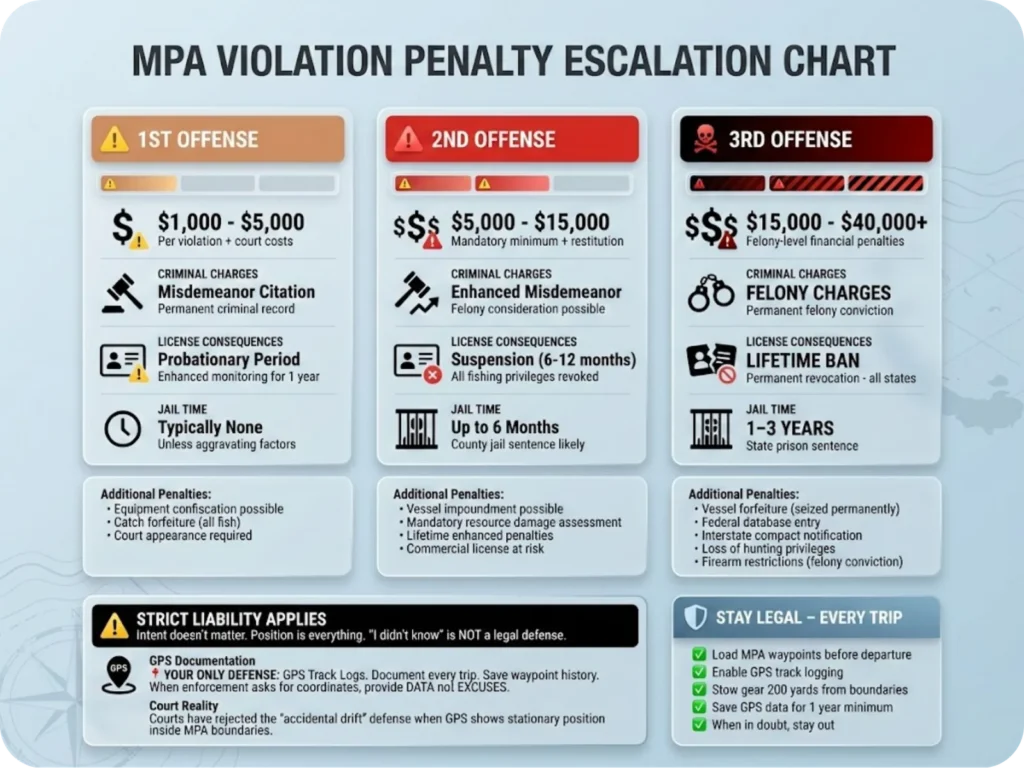
Your GPS track logs are your primary defense. Document everything. When the enforcement officer asks for your coordinates from the past hour, you want to hand over data, not excuses.
Compliance Technology: VMS, Sonar, and Digital Documentation
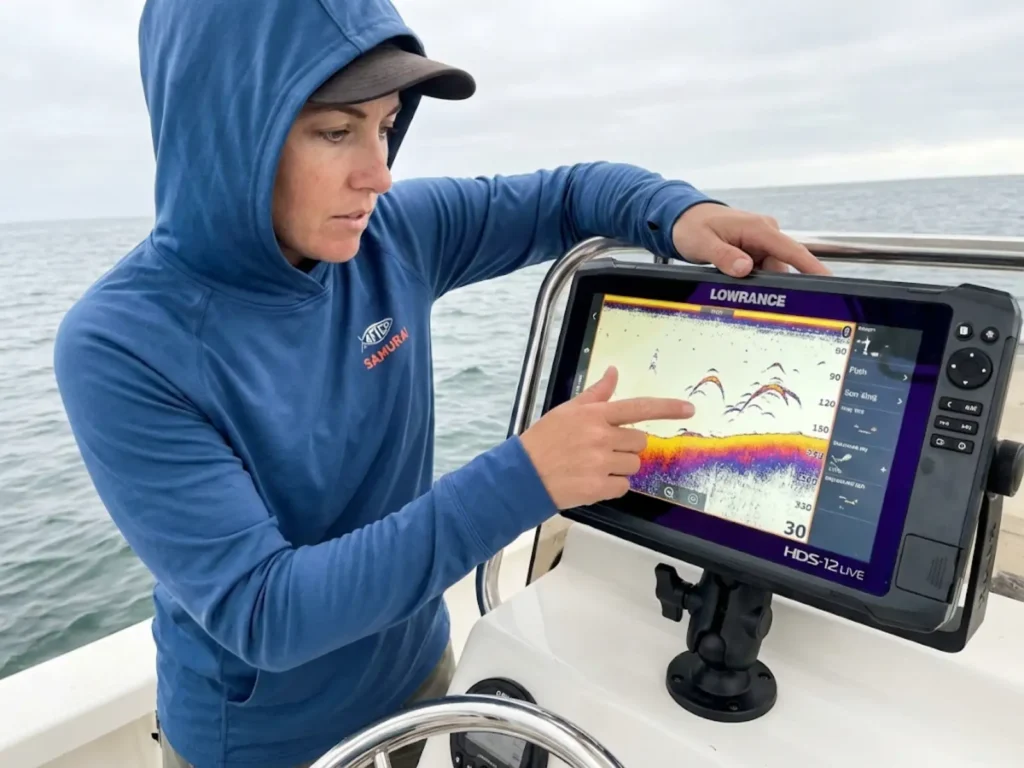
If you want to understand how enforcement works, look at the technology they use—and adopt it yourself.
Vessel Monitoring Systems for Commercial Operations
Commercial vessels with limited entry groundfish permits must operate Vessel Monitoring Systems—satellite-based tracking that pings 24 hours a day. Before leaving port, operators submit Declaration Reports identifying gear type and target fishery. NOAA’s Office of Law Enforcement uses this data to verify whether a vessel’s presence in a restricted area is transit or extraction.
Any gap in VMS data triggers investigation. The system creates a complete digital trail that’s nearly impossible to dispute. Recreational anglers don’t face this requirement, but the lesson applies: document your movements. Your chartplotter’s track log serves the same function.
Sonar and the Species Identification Problem
In SMCAs where only pelagic species are allowed, you need to distinguish bottom-dwellers from mid-water fish before you deploy. Advanced sonar units like the Lowrance HOOK Reveal show fish position relative to bottom structure. The right side of the screen displays current depth; the rest is historical data.
Reading sonar correctly is a compliance skill in mixed-regulation zones. If you drop a jig and hook a rockfish when you’re only permitted to take pelagics, that’s still a violation. The ability to read structure, identify suspended fish, and make informed decisions before your line hits water keeps you legal.
For a deeper understanding, see the complete guide to fish finder interpretation. This knowledge applies directly to MPA compliance, not just finding fish.
The Science Behind the Rules: Spillover, BOFFFs, and Why MPAs Work
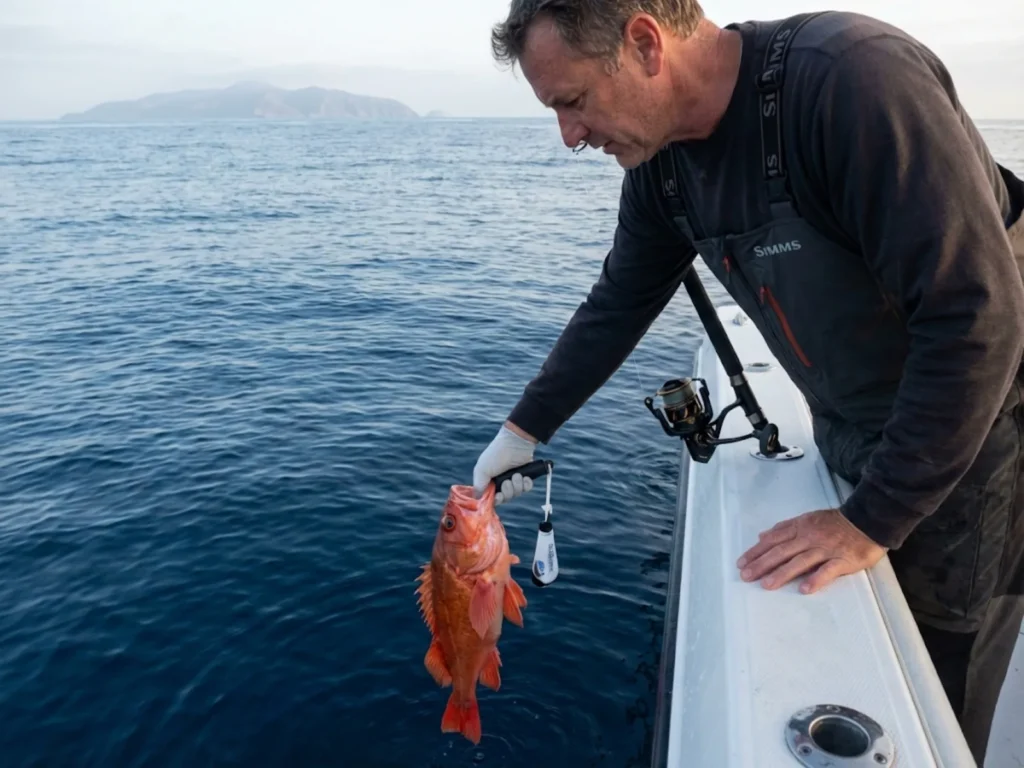
Here’s the part that turns grudging compliance into genuine buy-in. MPAs aren’t arbitrary political boundaries. They’re investment zones that pay dividends to every angler who fishes nearby.
The 20-Year Lag and Spillover Economics
Fully protected no-take zones increase fish population growth rates by 42% compared to areas with only gear restrictions. But the spillover effect—where fish from protected zones migrate into fishable waters—takes over 20 years to produce those trophy-size fish everyone wants.
That delay explains why many anglers oppose new MPAs. The benefits aren’t immediate. But long-term data from established marine reserves shows consistent patterns: larger fish, healthier populations, and better fishing in adjacent waters. The nursery protection function pays off across the entire region.
This isn’t theory. Research from the California Collaborative Fisheries Research Program demonstrates that MPA effectiveness correlates directly with fishing pressure outside their borders. Where fishing is heaviest, the protected zones make the biggest difference, according to this NIH study on MPA spillover benefits to recreational fisheries.
BOFFFs: Why Protecting Big Fish Matters
BOFFFs—Bigger Older Fertile Female Fish—are the reproductive engine of any fishery. Larger, older females produce eggs that are more viable and in significantly higher quantities than younger fish. A 20-pound bass releases more viable offspring than ten 2-pounders combined.
Reef fish like rockfish can live over 100 years and take decades to reach peak fecundity. MPAs protect the fish that seed the entire region. When you respect those boundaries, you’re investing in your future catches and supporting marine conservation goals that benefit all anglers.
For more on conservation-minded angling practices, the same principles apply whether you’re inside an MPA or out.
Conclusion
The law doesn’t care whether you knew where the line was. It cares where your GPS says you were when your gear was in the water. That’s the reality of fishing near marine protected areas in the 21st century.
Know your zone type. SMRs mean zero take. SMCAs require species-gear verification. Ignorance doesn’t hold up when the ranger pulls your track logs.
Navigate with buffer zones. Apps like FishLegal and Fish Rules work offline. Maintain 100-yard margins near boundaries, and stow everything when transiting protected water.
Think long-term. That MPA you’re grumbling about today is producing the trophy fish you’ll catch in ten years. The spillover is real. The science backs it up. Respecting boundaries isn’t just about avoiding fines—it’s about sustainable fishing for everyone who comes after us.
Before your next trip, load your regional MPA coordinates as waypoints. Verify your chartplotter data is current. Fifteen minutes of prep costs nothing. Drifting 50 yards past an invisible line costs thousands—and makes the argument for more restrictions, not fewer.
FAQ
Can I drive through an MPA with fish I caught somewhere else?
Yes, if your gear is properly stowed. In SMRs, no fishing gear can be deployed in the water at any time. Lines must be out of the water before you cross the boundary.
What happens if my boat drifts into an MPA while I’m fishing?
Drifting is treated like transit—but if your gear is in the water when you cross the boundary, you’ve violated the rule regardless of intent. Keep lines up when fishing near MPA edges.
Are there apps that work without cell service for MPA boundaries?
Yes. Fish Rules and FishLegal both offer offline mobile access functionality. Download the data for your region before leaving cell range.
Do tribal members have different fishing rights in MPAs?
In some zones, yes. California Code of Regulations Title 14 §632(b) addresses tribal fishing rights and indigenous fishing rights within certain protected areas. A tribal photo ID card may authorize activities not available to the general public.
How do I report an MPA violation I witnessed?
Use CalTIP (California Turn In Poachers) at 1-888-334-2258 or NOAA’s enforcement hotline. Reports can be anonymous.
Risk Disclaimer: Fishing, boating, and all related outdoor activities involve inherent risks that
can lead to injury. The information provided on Master Fishing Mag is for educational and informational purposes
only. While we strive for accuracy, the information, techniques, and advice on gear and safety are not a substitute
for your own best judgment, local knowledge, and adherence to official regulations. Fishing regulations, including
seasons, size limits, and species restrictions, change frequently and vary by location. Always consult the latest
official regulations from your local fish and wildlife agency before heading out. Proper handling of hooks, knives,
and other sharp equipment is essential for safety. Furthermore, be aware of local fish consumption advisories. By
using this website, you agree that you are solely responsible for your own safety and for complying with all
applicable laws. Any reliance you place on our content is strictly at your own risk. Master Fishing Mag and its
authors will not be held liable for any injury, damage, or loss sustained in connection with the use of the
information herein.
Affiliate Disclosure: We are a participant in the Amazon Services LLC Associates Program, an
affiliate advertising program designed to provide a means for us to earn advertising fees by advertising and linking
to Amazon.com. As an Amazon Associate, we earn from qualifying purchases. We also participate in other affiliate
programs and may receive a commission on products purchased through our links, at no extra cost to you. Additional
terms are found in the terms of service.