In this article
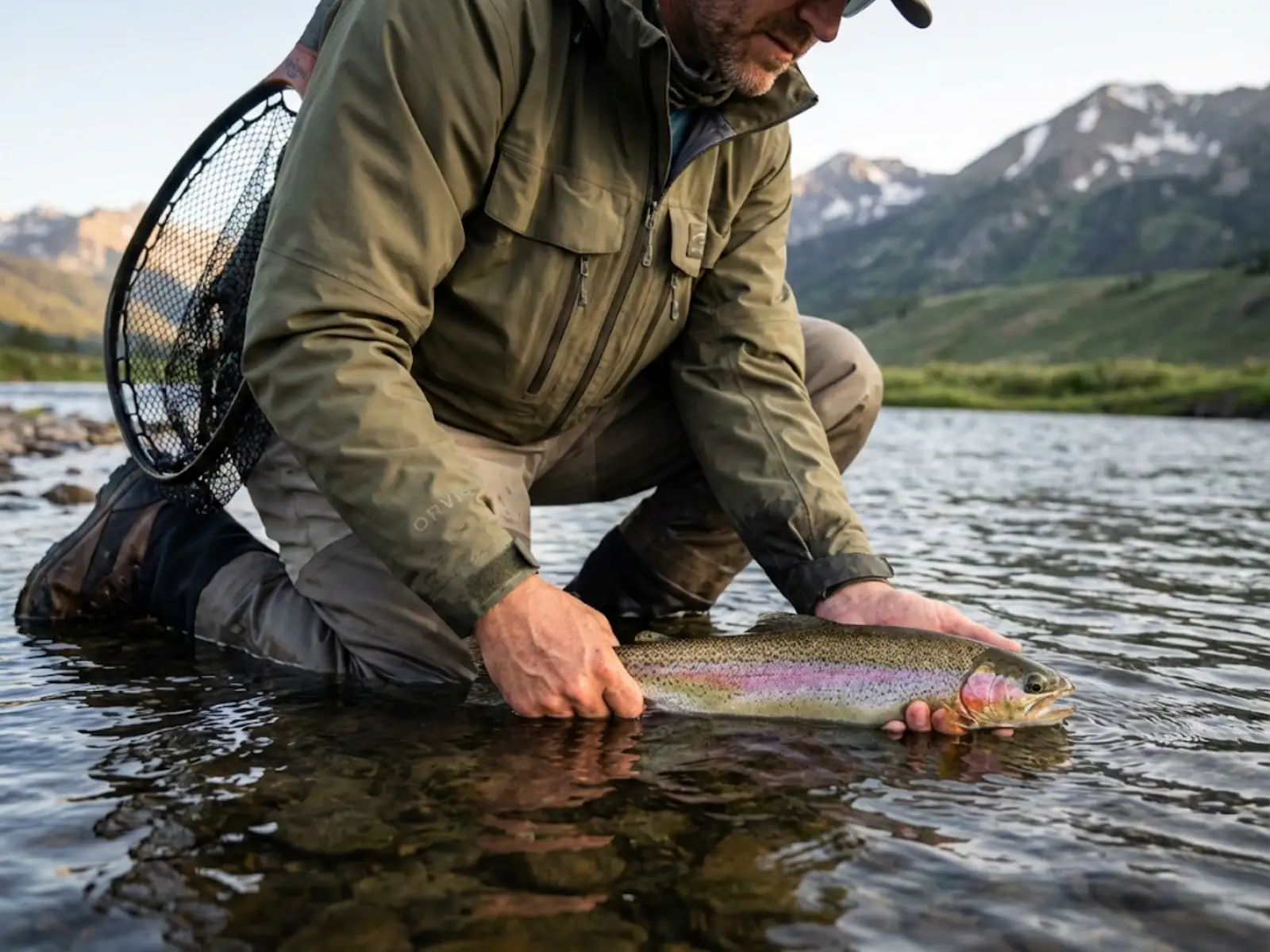
The fish fought like a wet sock. Three casts later, the same fly that fooled the first trout was ignored—no, actively avoided—by a sleek torpedo holding in the riffle upstream. Same river, same fly, same angler. Two completely different fish.
After two decades on the water, I’ve watched this confusion play out hundreds of times. Anglers who crush it on stocked water get humbled by wild fish. And the finesse masters who dead-drift size-22 dries get out-fished by beginners throwing pink worms at fresh stockers. The tactics that fill your net with hatchery “footballs” will empty your day on a wild-trout stream.
Here’s the fix: a systematic approach I call the Tactical Profiling System—four steps to identify, classify, adapt, and execute. You’ll learn to read the physical signatures of origin, understand the acclimation timeline that transforms stocker behavior, and apply the tactical adjustments each trout type demands.
⚡ Quick Answer: Stocked trout and wild trout require fundamentally different approaches. Stocked fish respond to aggressive presentations, high-contrast “junk” flies, and tolerate sloppy technique. Wild trout demand stealth, precise dead drifts, and subtle strike detection. The key is reading fin condition (rounded and eroded on stockers, sharp and translucent on wild fish) to identify your target, then adjusting your tactics accordingly.
The Morphometric Forensics: Physical Signatures That Never Lie
Fin Structure: The Most Reliable Field Marker
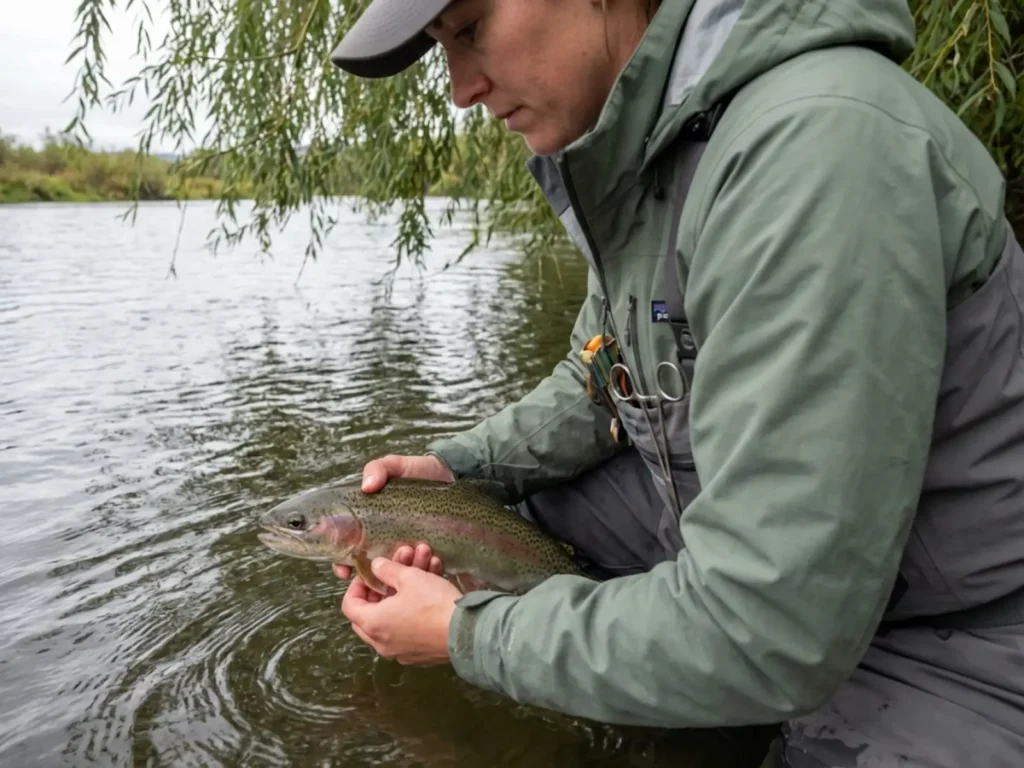
Your first look at a trout’s fins tells you more than an hour of watching its behavior. Pectoral fins are your primary diagnostic. A study on Brown Trout found that 99.1% of hatchery fish showed eroded pectorals just one day before stocking—and that accuracy held above 96% nearly a year later.
Wild rainbows carry straight leading edges on their pectorals, translucent membranes, and distinct rays you can count. Fresh stockers? Rounded, opaque, thickened nubs. The concrete raceways and high-density crowding grind those delicate control surfaces down through mechanical abrasion and aggressive nipping from tankmates.
The dorsal fin follows the same pattern. Wild fish display tall, straight, triangular dorsal fins. Stockers often show fins that are rounded, frayed, or even leaning to one side. The caudal fin (tail) provides another checkpoint—sharp corners and pristine lobes on wild fish versus eroded tips and split rays on hatchery stock.
Pro tip: Check the white tips on pelvic and anal fins. Wild fish have a sharp, distinct color boundary between the white edge and the darker fin. Stockers show a “muddy” or blurred transition from scar tissue and regrowth.
For a deeper look at salmonid biology, understanding brown trout biology for anglers helps explain why these fin erosion patterns persist across species.
Coloration and Pigmentation Patterns
Freshly stocked rainbows often look “washed out”—silvery, muted, lacking that vivid pink lateral stripe. They’ve spent their lives eating commercial pellets instead of the carotenoid-rich diet of wild trout: crayfish, scuds, and aquatic insects that build intense pigmentation.
Wild rainbow trout display pronounced counter-shading—deep olive or dark green backs for camouflage against the river bottom, brilliant white bellies to blend with the sky from below. Their spotting patterns pop with sharp contrast, while stocker spots often appear “muddy” and indistinct.
Here’s the catch: coloration is plastic. A holdover trout—a stocked fish that survives long enough to shift to a wild diet—will develop coloration that rivals native fish after several months. This makes color less reliable as a late-season marker. But fin damage persists. That rounded pectoral is a permanent badge of origin.
Body Shape and Composition
The “football” phenotype is hard to miss. Hatchery fish pack on weight fast in low-velocity raceways where food drops from above. They’re deep-bodied, thick-waisted, with disproportionately small heads relative to their mass. This pellet pig body shape develops because rapid somatic growth outpaces skeletal development.
Wild trout are athletes. Their fusiform “torpedo” shape minimizes drag and maximizes efficiency for holding in currents and intercepting drift. Heads are proportionally larger, matching the body scale of a fish that grew at nature’s pace.
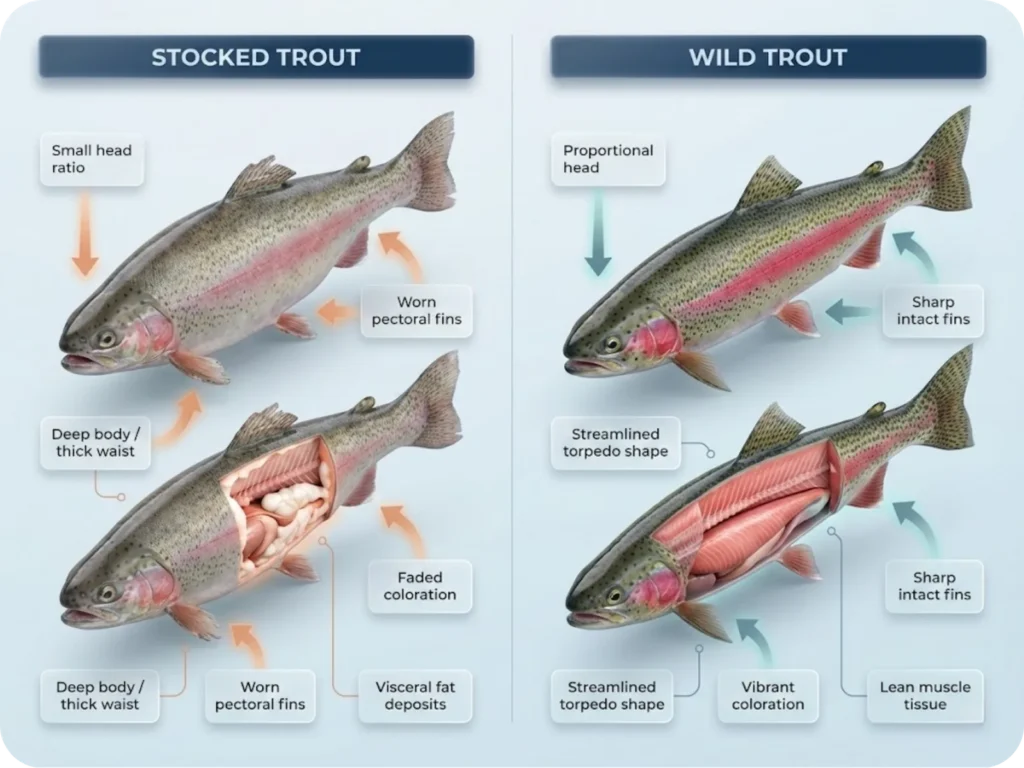
Cut a stocker open and you’ll find significant visceral fat deposits—white, waxy masses around the organs. Wild trout are lean inside. Their energy stores live in muscle tissue, not gut loading. Anglers who keep fish note that stockers need four to six weeks in-river before their flesh firms up for the table. The Virginia DWR hatchery trout identification guide provides additional visual references for these morphometric markers.
The Acclimation Timeline: Understanding “Stock Shock” Phases
The 72-Hour Cardiac Window
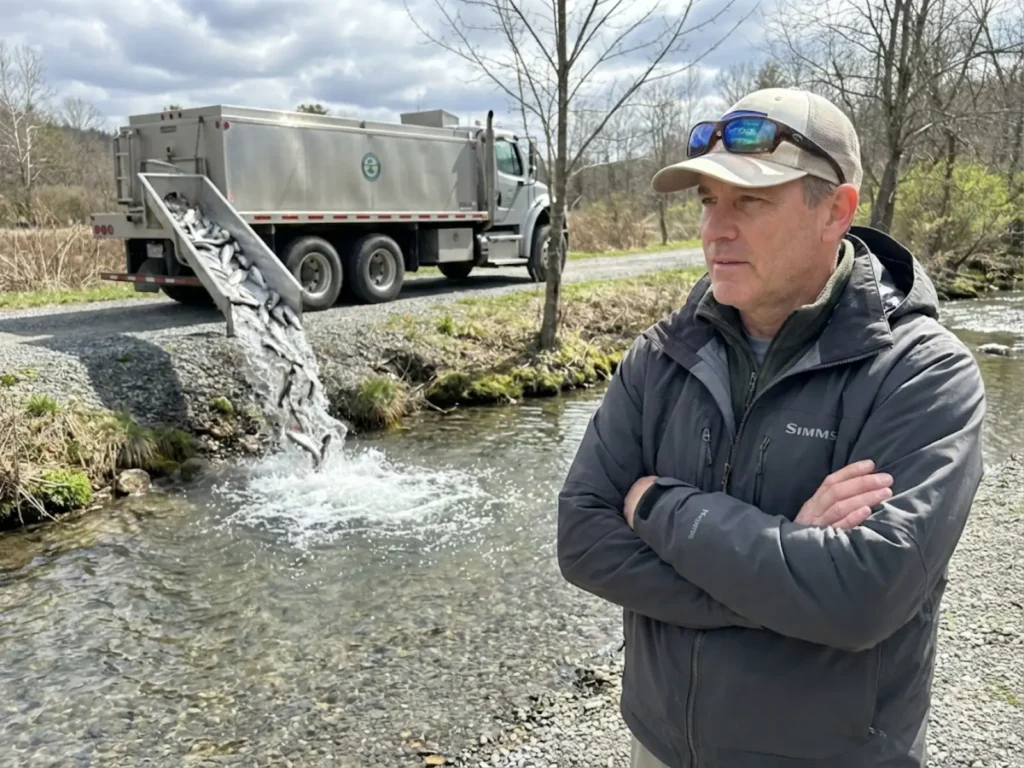
When a trout leaves a hatchery truck for a river, it faces a physiological crisis. Rainbow trout are ectotherms—their metabolic rate is directly tied to water temperature. Hatchery water often holds steady at 50–55°F year-round. Stocking day might dump them into water ten degrees warmer or colder.
Research on cardiac plasticity in rainbow trout found that roughly 50% of the reduction in maximum heart rate—a key indicator of thermal compensation—occurs within the first 72 hours post-transfer. During that window, the fish’s aerobic capacity is severely compromised. It can’t swim against current efficiently. It can’t digest food properly. It often appears sluggish or “zombie-like.”
This explains why creel surveys confirm a 3–5 day suppression of feeding behavior after stocking. The fish isn’t ignoring your fly because it’s smart. Its cardiovascular system is still catching up to its new reality. Understanding fish metabolism and water temperature relationships helps explain this thermal stress response.
Week-by-Week Behavioral Progression
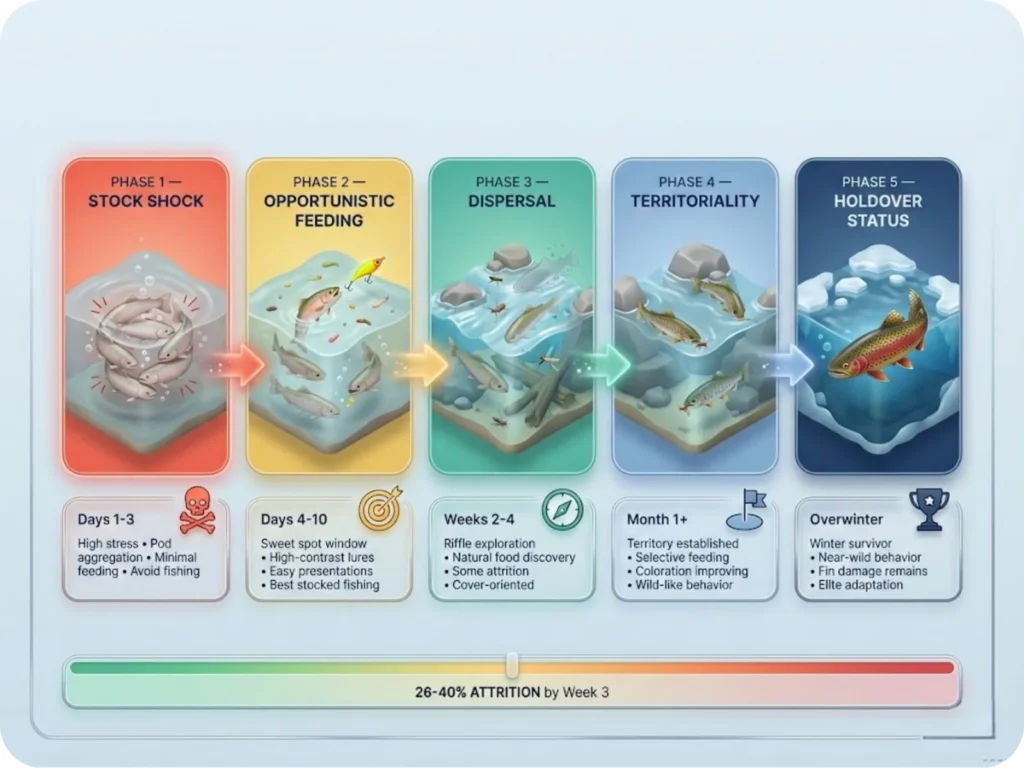
The acclimation timeline follows predictable phases:
Week 1: High stress dominates. Fish aggregate in “pods” in slow pools. They’ll eat only high-contrast, easy targets—if they eat at all. Survival instincts are rusty or absent.
Weeks 2–4: Dispersal begins. Survivors start exploring riffles and identifying natural food sources. Some mortality occurs as fish fail to find cover or avoid predators.
Month 1+: The remaining fish establish territories. Feeding becomes more selective. Coloration starts to improve as natural carotenoids enter the diet.
Overwintered (“Holdover”): Any fish that survives an entire winter has proven its ability to handle flow regimes, temperature swings, and predator pressure. These fish behave nearly indistinguishably from wild trout—though their fin damage remains.
Studies on Brown Trout show survival rates of only 26–40% within the first three weeks of stocking. That’s brutal attrition, driven by predation, emigration, and failure to acclimate. The cardiac plasticity research in rainbow trout documents this physiological transition.
Pro tip: Many experienced anglers wait 24–72 hours after stocking before fishing. The “Stock Shock” phase produces unpredictable results. The sweet spot for stocked trout often hits 5–10 days post-release—past the initial crash, but before full acclimation makes them wary.
The Feeding Competency Curve
Freshly stocked trout struggle to identify natural food. In the initial phase, they’ll ingest non-food items—sticks, detritus, even cigarette butts—because pellet conditioning trained them to strike at anything that lands in the water. Transition takes 2–6 weeks depending on temperature and food availability.
By the naturalized phase, a survivor’s dietary analysis looks indistinguishable from wild fish: primarily subsurface nymphs and drifting insects rather than surface-oriented pellet strikes.
The Behavioral Profile: Exploiting the Hatchery Imprint
The “Looking Up” Bias and Pellet Reflex
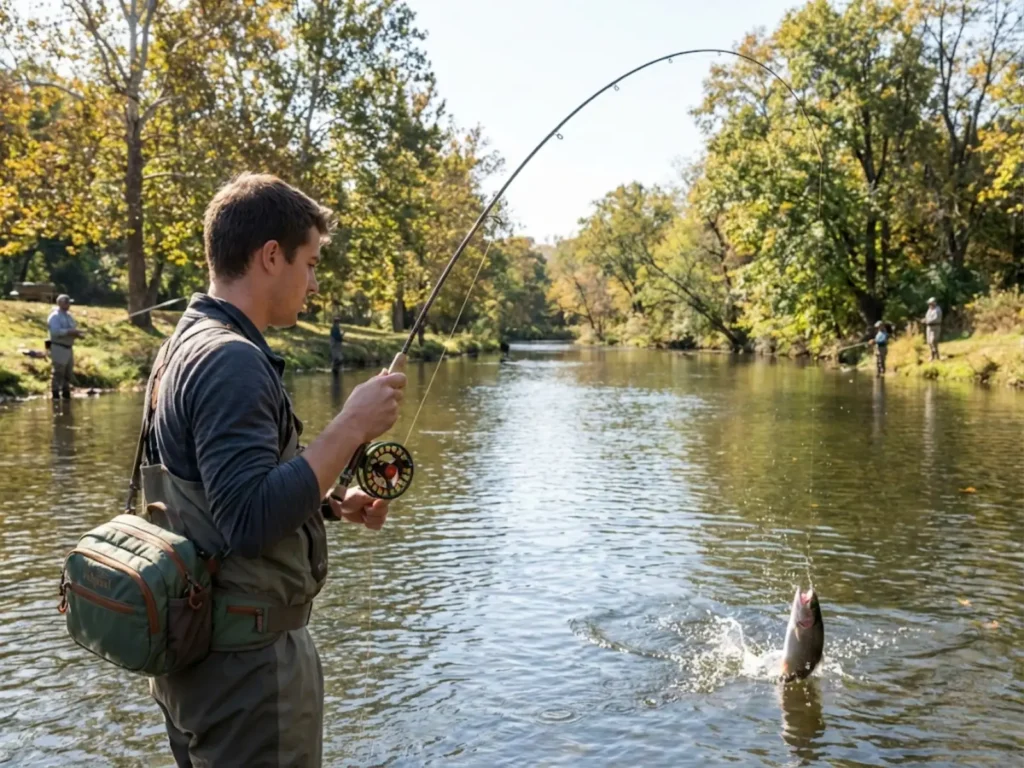
From the fry stage, hatchery trout eat floating pellets dropped from above. This conditions their neurological visual processing to prioritize the upper water column. Wild trout feed 90% of the time on subsurface nymphs. Stockers, by contrast, will rise to dry flies even when no hatch is present—a behavior wild fish rarely exhibit.
The “dinner bell” effect separates these two populations sharply. To a wild trout, a splash overhead signals predator (osprey, heron, bear). Their instinct says flee to cover. To a hatchery trout, that same splash means feeding time. The sound of your fly slapping the surface can actually attract fresh stockers rather than spook them.
George Daniel, a Penn State instructor and Fly Fishing Team USA member, notes that hooking a stocker and allowing it to thrash on the surface often attracts other fish in the pod rather than shutting down the bite. Understanding how the lateral line system detects prey explains why surface disturbance triggers such opposite responses.
Aggregation, “Podding,” and Cover Use Deficits
Raceways force trout to tolerate extreme proximity. Stockers lose their territorial instincts. When released, they clump in “pods”—stacking shoulder-to-shoulder in slow, deep pools rather than distributing across prime lies.
They also lack cover-use instincts. Wild trout hug structure—undercut banks, log tangles, boulder shadows. Stockers hold in “weird water”—mid-pool stagnation, exposed runs, open areas a wild fish would never occupy. Look for stockers where it doesn’t make sense to find trout.
Foraging Competency and Drag Tolerance
Wild trout are bio-energetic accountants. They won’t chase prey that costs more calories to catch than it provides. Stockers lack this calculus entirely. They’ll chase lures over long distances, triggered by food competition in crowded raceways.
The critical tactical insight: drag tolerance. Wild trout demand a dead drift—any tension causing unnatural movement acts as a red flag. Stockers are forgiving. They’ll strike a fly skating across the current that would send every wild fish bolting for cover. Understanding how predatory fish strike mechanics work connects this foraging behavior to the physics of prey capture.
The Tactical Matrix: Adapting Your Approach
Protocol Alpha: Engaging Stocked Trout
When your target is fresh stockers, throw finesse out the window.
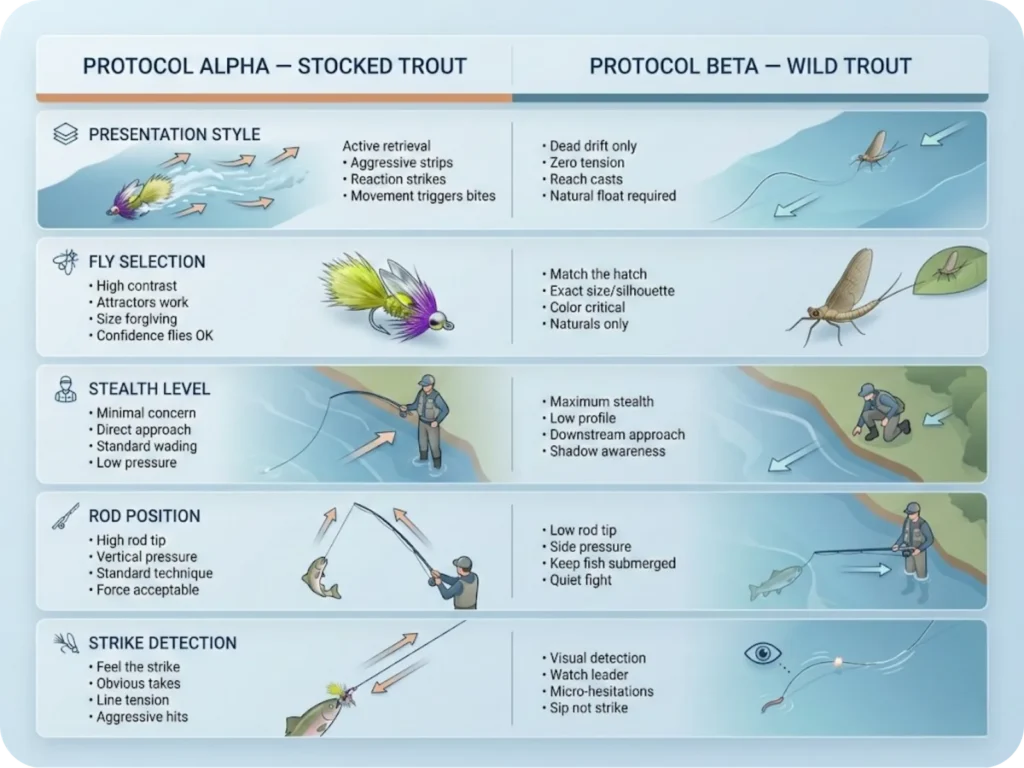
Fly Selection: “Junk flies” outperform match-the-hatch patterns. Egg patterns mimic the pellet shape and high-protein profile these fish remember. San Juan Worms in bright pink or red provide high-contrast visual triggers. Mop flies resemble large grubs and induce reaction strikes.
Presentation: Swings and active retrieval beat dead drifts. Cast downstream and let the fly swing across the current under tension—this keeps your offering high in the water column where stockers look. Strip Woolly Buggers with aggressive retrieves to trigger competitive aggression.
Fight Mechanics: Keep that rod tip high. Let the fish splash and thrash on the surface. This acoustic signaling draws other fish in the pod toward the commotion rather than scattering them.
For more on swing presentations, float fishing presentation techniques covers the mechanics in depth.
Pro tip: When you hook one stocker, don’t be subtle. The noise brings the others in. A splashing fish is a dinner bell, not an alarm.
Protocol Beta: Engaging Wild Trout
Wild fish demand the opposite approach.
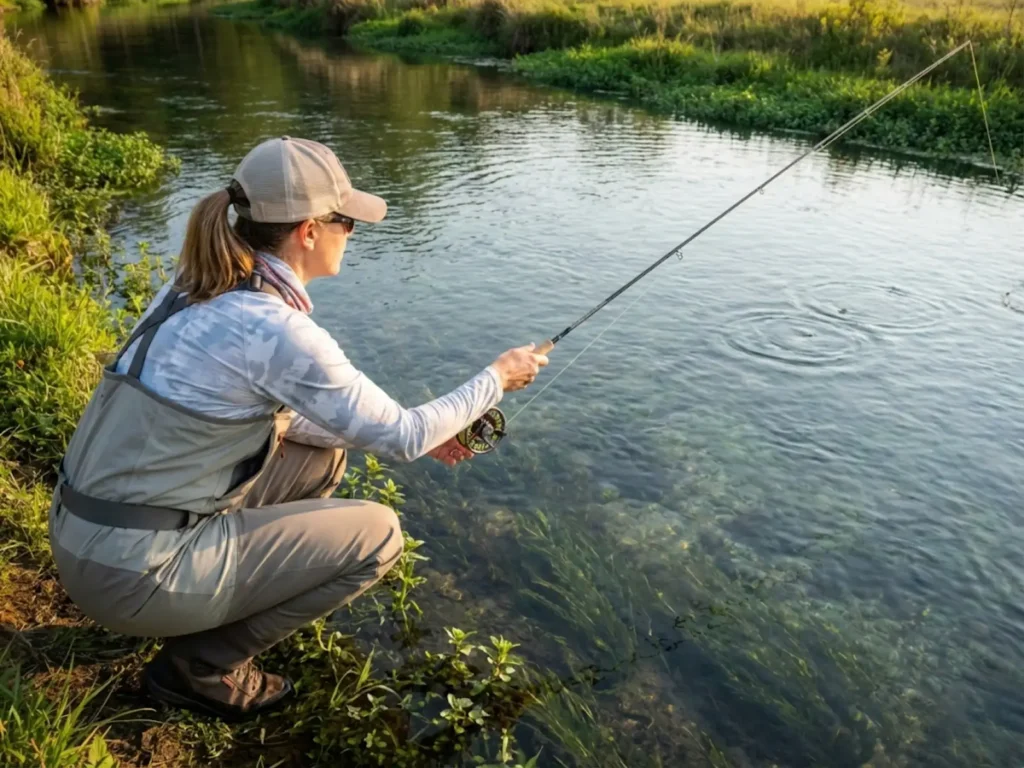
The Stealth Imperative: Low profile, slow wading, muted clothing. Wild trout perceive you as a predator. Approach from downstream. Avoid casting shadows over the water. Keep your silhouette below the skyline.
Presentation: Dead drift is non-negotiable. Any tension creating unnatural movement spooks these fish. Reach casts and mending introduce slack to prevent drag. Your fly must behave like a disconnected object floating with the current.
Fly Selection: Match the hatch precisely. Size, silhouette, color. Generalist attractors fail on educated fish. When the sulphurs are on, throw sulphurs—not a Royal Wulff because it’s your confidence fly.
Strike Detection: Wild takes are often visual, not felt. Watch your leader for microscopic hesitations. These fish sip rather than strike. The “tug” you expect from stockers never comes.
Fight Mechanics: Low rod tip. Side pressure. Keep the fish submerged and quiet. One panicked, splashing trout shuts down feeding for the entire pool. Knowing aquatic insect identification for fly selection helps you match the hatch accurately.
The Holdover Exception: Reading the Transitional Fish
Holdovers occupy a middle ground. They’ve naturalized behaviorally—selective feeding, wariness, cover use—but they carry physical hatchery markers. Those eroded fins don’t regenerate.
Tactical approach: skew toward wild protocols but allow for slightly less precision. A holdover won’t demand the same 6X tippet and size-22 imitation that pressured wild fish require, but it won’t tolerate the sloppy presentations that work on fresh stockers either.
When uncertain, default to stealth. You can always amp up aggression, but you can’t un-spook a fish.
The Ethical Framework: Conservation Through Profiling
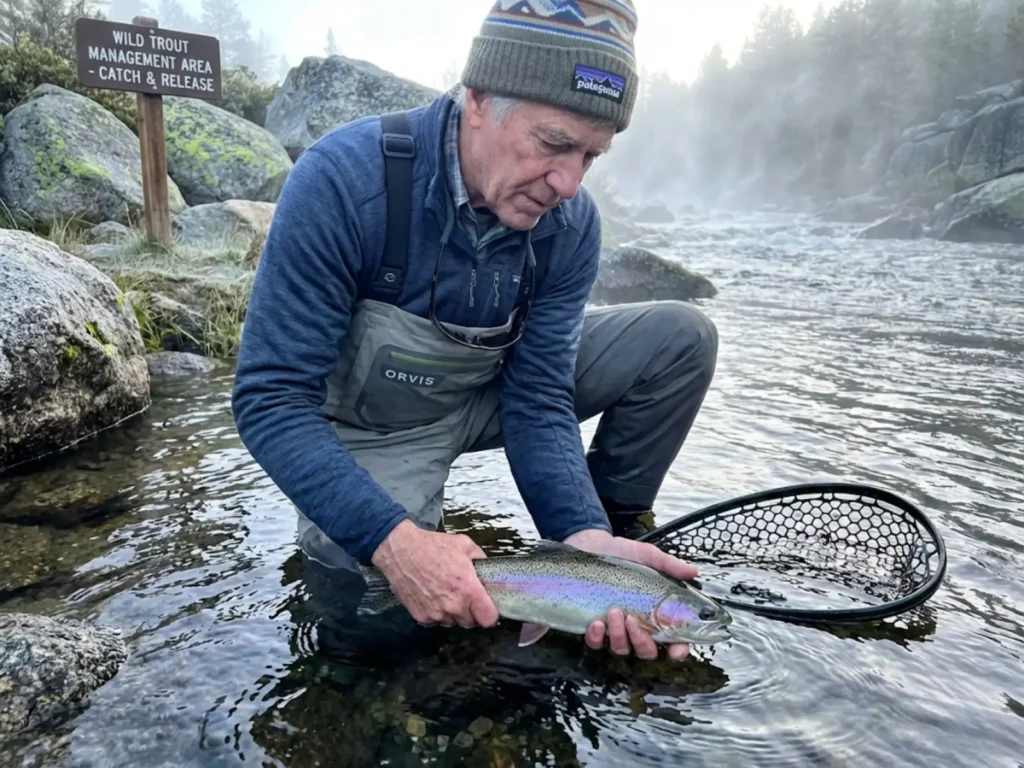
The Ecological Case Against Mixed Populations
Stocking isn’t just about recreation—it carries ecological weight. When hatchery fish interbreed with wild stocks, they introduce genes selected for raceway survival: aggression, surface feeding, tolerance for crowding. These traits are maladaptive in rivers. Genetic introgression reduces offspring fitness, producing fish less capable of surviving floods, droughts, and predators.
Larger stocked fish temporarily displace wild trout from prime lies. Even if wild fish reclaim those spots as stockers weaken, the stress takes a toll. Modern fisheries management increasingly recognizes uncontrolled stocking as ecologically hazardous, driving the trend toward “delayed harvest” and “wild trout water” designations.
The Hierarchy of Trout: A Value Framework
Anglers and biologists recognize an informal ranking:
Native Trout sit at the top—indigenous to the watershed (Brook Trout in the Appalachians, Redband Rainbows in the Cascades). These hold the highest conservation value.
Wild Trout are naturalized, self-reproducing populations. High sporting value due to their wariness and beauty.
Holdovers represent stocking “success”—survivors that made it through a year—but they’re not self-sustaining.
Stockers are put-and-take commodities. Recreational resources, not conservation assets.
Harvest Protocols: When Keeping Is Conservation
Here’s the counterintuitive truth: harvesting stocked trout benefits wild populations. Removing stockers reduces competition for food and prime lies. It prevents genetic mixing that dilutes wild adaptations.
On waters where stocked and wild fish coexist, conservation-minded anglers keep the stockers and release the wild fish. The wild trout’s genetic adaptation to its specific stream makes it irreplaceable. The stocker came from a truck. Another one’s coming next week.
Pro tip: On mixed waters, keeping a stocked fish is actually an act of conservation. You’re reducing competition and protecting the genetic integrity of the wild population.
Conclusion
The Tactical Profiling System reframes how you approach every trout stream. Instead of asking “What fly should I use?” the first question becomes “What fish am I targeting?”
Three takeaways to carry:
First, morphometrics don’t lie. Fin condition reveals origin when coloration deceives. Pectorals are your primary diagnostic.
Second, timing transforms behavior. The 72-hour cardiac window and multi-week acclimation timeline dictate which tactics apply when.
Third, aggression vs. stealth is the switch. High rod tip and junk flies for stockers. Side pressure and micro-mimicry for wild fish.
Next time you approach a stream, spend five minutes profiling before making a single cast. Read the fins. Note the lies. Then choose your protocol—Alpha or Beta—and watch your catch rate climb.
FAQ
How long after stocking do trout start feeding on flies?
Most stocked trout experience 3–5 days of Stock Shock where feeding is suppressed. Light feeding on high-contrast patterns typically begins by day 3–5, with aggressive takes on attractors peaking around days 5–10 post-stocking.
Can stocked trout eventually become wild in behavior?
Partially. Trout surviving an entire winter develop wild-like wariness and feeding selectivity. However, physical markers like eroded fins persist, and they remain genetically distinct from naturally reproduced populations.
Do wild trout fight harder than stocked trout?
Generally yes. Wild trout develop superior muscle conditioning from holding in currents and evading predators. Stocked fish often fight with less stamina due to sedentary hatchery life, though this improves as they acclimate.
Is catch-and-release always best, even for stocked fish?
Not necessarily. Conservation-minded anglers harvest stocked trout from waters where they coexist with wild populations. This reduces competition and prevents genetic introgression. On put-and-take waters, harvest is the system’s intent.
What’s the single most reliable visual marker for identification?
Pectoral fin condition. Research shows 96%+ accuracy even 322 days post-stocking. Rounded, opaque, thickened edges indicate stockers; straight, translucent edges with distinct rays indicate wild fish.
Risk Disclaimer: Fishing, boating, and all related outdoor activities involve inherent risks that
can lead to injury. The information provided on Master Fishing Mag is for educational and informational purposes
only. While we strive for accuracy, the information, techniques, and advice on gear and safety are not a substitute
for your own best judgment, local knowledge, and adherence to official regulations. Fishing regulations, including
seasons, size limits, and species restrictions, change frequently and vary by location. Always consult the latest
official regulations from your local fish and wildlife agency before heading out. Proper handling of hooks, knives,
and other sharp equipment is essential for safety. Furthermore, be aware of local fish consumption advisories. By
using this website, you agree that you are solely responsible for your own safety and for complying with all
applicable laws. Any reliance you place on our content is strictly at your own risk. Master Fishing Mag and its
authors will not be held liable for any injury, damage, or loss sustained in connection with the use of the
information herein.
Affiliate Disclosure: We are a participant in the Amazon Services LLC Associates Program, an
affiliate advertising program designed to provide a means for us to earn advertising fees by advertising and linking
to Amazon.com. As an Amazon Associate, we earn from qualifying purchases. We also participate in other affiliate
programs and may receive a commission on products purchased through our links, at no extra cost to you. Additional
terms are found in the terms of service.