
In this article
The screen on my Lowrance lit up like a disco ball—marks scattered from 8 feet down to 45, spread across the ledge like someone shook a snow globe. October on a Tennessee reservoir, and every pattern I’d dialed in over the summer had evaporated overnight.
After twenty years chasing bass through every season, I’ve learned that fall confusion isn’t a failure of skill. It’s a failure of framework. Those fish aren’t random—they’re responding to invisible forces most anglers never learn to read: the violent mixing of oxygen-starved deep water with the surface, the desperate migration of threadfin shad toward thermal refuge, and a metabolic clock inside every bass screaming “eat now or starve later.”
This playbook gives you what the generic “fall tips” don’t—a diagnostic system to decode YOUR lake’s transition stage and prescribe the exact depth, structure, and presentation to match. By the end, you’ll understand why a 55°F reading on your transducer is more valuable than any calendar date.
⚡ Quick Answer: Fall bass transition confusion happens because turnover destroys summer patterns overnight. Bass follow baitfish shallow as water cools from the 70s into the 50s, moving through three distinct phases: staging at creek mouths (early), wolf-packing in shallow flats (peak feed), and retreating to steep wintering holes (late). Track water temperature—not the calendar—and match your lure speed to their slowing metabolism.
The Physics of Chaos: What Turnover Actually Does to Your Lake
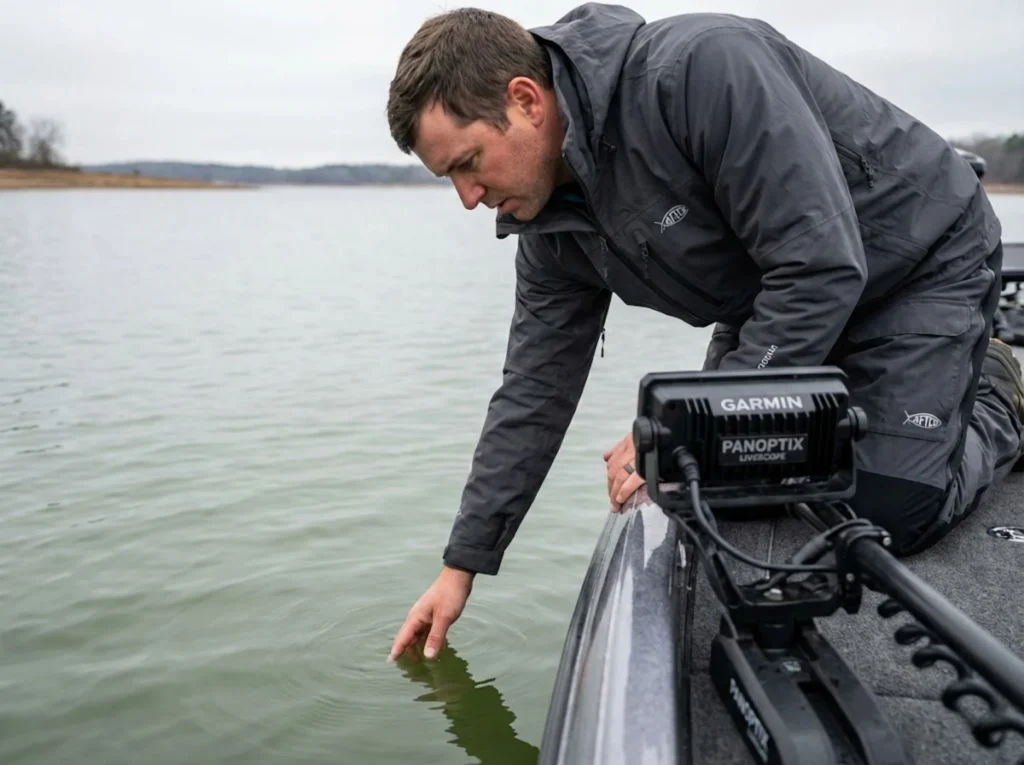
That “weird fishing” you experience every October has a name: lake turnover. Understanding what’s actually happening underwater is the first step to beating the chaos.
The Three-Layer Summer Prison (And How It Collapses)
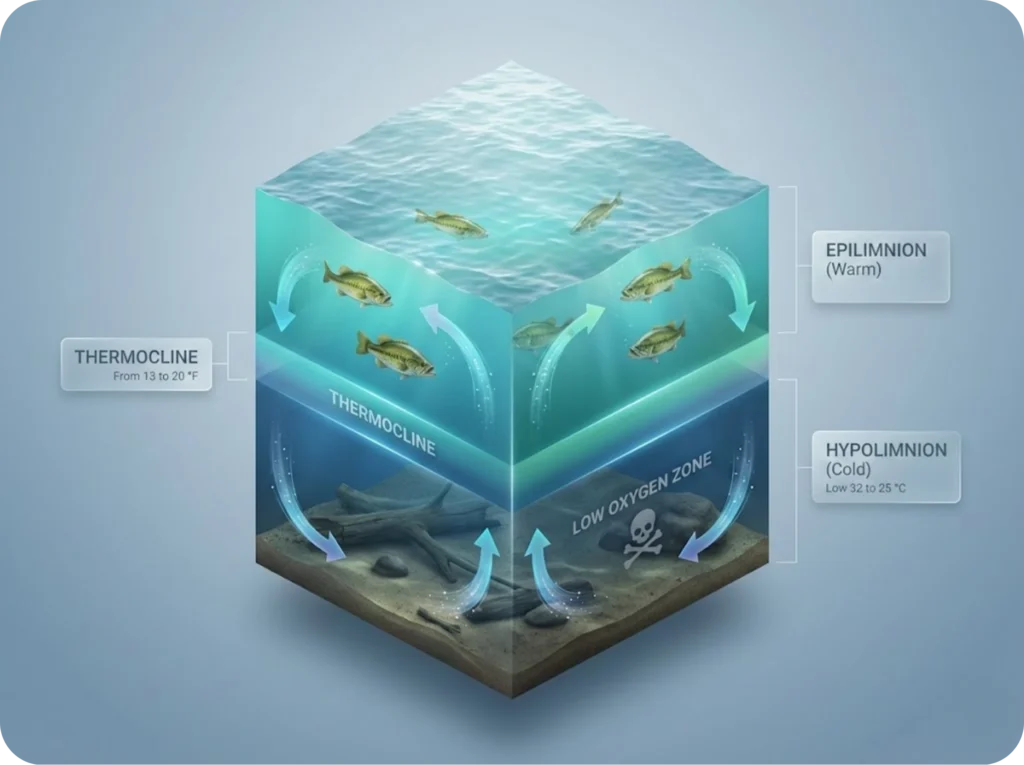
During summer, your lake splits into three invisible layers. The warm, oxygen-rich surface water (called the epilimnion) sits on top. Below that, a thin boundary layer called the thermocline acts like a lid—typically sitting between 15 and 25 feet deep. Everything below the thermocline (the hypolimnion) is cold, dense, and almost devoid of oxygen.
Bass spend summer trapped above that thermocline. They physically can’t go deeper because there’s nothing to breathe down there.
Here’s where fall chaos begins. As cold fronts arrive, surface water cools toward 39.2°F—the temperature where water reaches maximum density. That cooling surface water sinks, creating convection currents that slowly erode the thermocline barrier. Eventually, upper and lower layers equalize in temperature. One strong wind event later, and the entire lake mixes violently.
That rotten-egg smell you sometimes notice in October isn’t imagination. It’s hydrogen sulfide gas—decomposition byproduct from the lake bottom—finally reaching the surface. If you smell sulfur, you’ve found the thermodynamic process behind lake turnover. Understanding the complete physics of thermal stratification will change how you approach fall fishing entirely.
The Dissolved Oxygen Reset: Suddenly, Bass Can Go Anywhere
Here’s the critical shift most anglers miss: Once turnover completes, bass suddenly have access to depths that were death zones all summer. That oxygen-depleted 40-foot basin? Now it’s fishable. That deep channel swing? Wide open.
This habitat expansion is exactly WHY fall fishing feels random. Fish that were concentrated in specific summer spots are now spread across a massively expanded vertical range. Your fish density per acre just dropped dramatically.
Bass need at least 5 mg/L of dissolved oxygen for active feeding. Between 3-5 mg/L, they get stressed and lethargic. Below 3 mg/L, they evacuate or die. Post-turnover, deep water finally holds enough oxygen for bass to roam freely—which means finding them requires understanding how dissolved oxygen controls where bass feed.
Pro tip: During active turnover, fishing can be brutally tough for 24-48 hours. If the water looks milky or gray with suspended particles, run to a different section of the lake—creek arms often turn over at different times than the main lake.
Reading Turnover on Your Sonar (Before You Waste a Cast)
Your fish finder tells you exactly what phase your lake is in—if you know what to look for.
Pre-turnover: You’ll see a fuzzy horizontal band across your screen, usually between 15-25 feet. That’s the thermocline reflecting sonar waves. Fish will be above this line.
Active turnover: Your entire water column fills with static and clutter. That “snow” is particulate matter—debris, gas bubbles, and decaying organic material circulating through the water column. Fishing is usually poor.
Post-turnover: The screen clears dramatically. No distinct horizontal bands. Fish marks appear at all depths, including right on the bottom in deep basins you couldn’t reach before.
The Metabolic Clock: Why Water Temperature Trumps Calendar Date
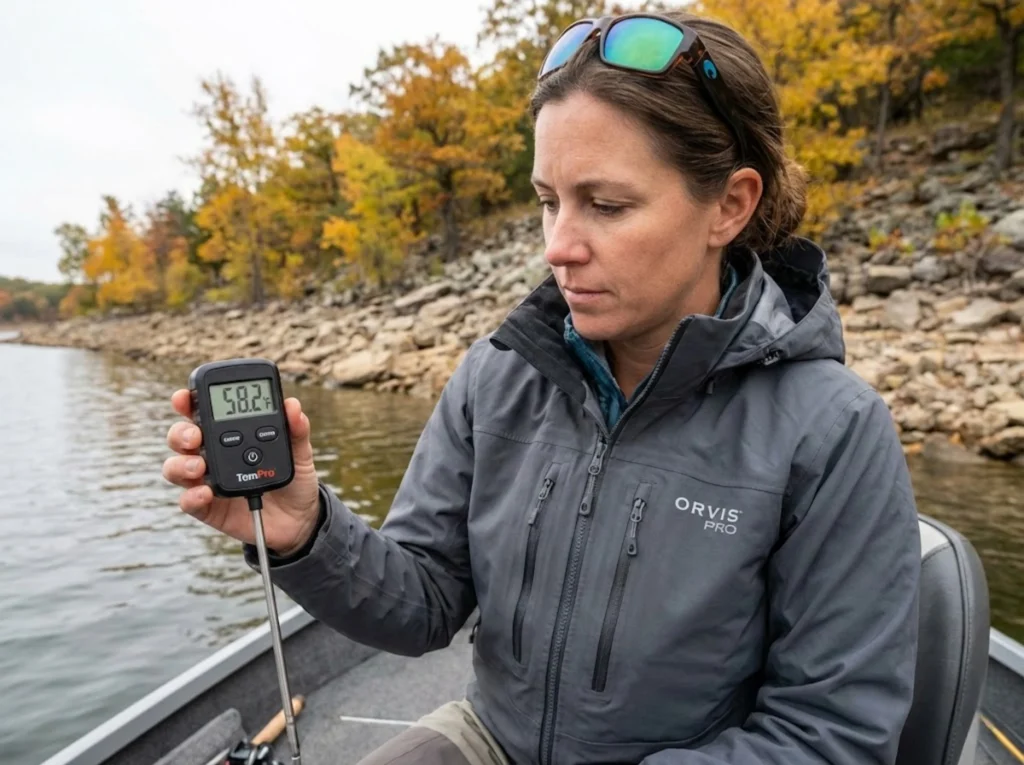
Here’s what separates good fall anglers from frustrated ones: They stop thinking in calendar dates and start thinking in water temperature thresholds.
The Digestion Curve Every Angler Should Memorize
Bass are cold-blooded. Their metabolism is completely tied to water temperature—which means the same fish behaves radically differently at 70°F versus 55°F.
At 80°F (summer), a bass digests a meal in 12-24 hours and needs to eat frequently to fuel its high metabolism. At 70°F (early fall), you hit the sweet spot—bass can move fast but burn fewer calories, creating the famous fall feed aggression. At 60°F-50°F (late fall), metabolism crashes by roughly a third for every 18-degree drop. A meal might take 4-5 days to digest. Below 50°F, that same meal can sustain a bass for a week or more.
The practical translation: A bass in 55°F water will NOT chase a fast crankbait. The energy expenditure exceeds the caloric return. You need to slow down dramatically—and understanding the relationship between water temperature and lure cadence makes you dangerous in cold water.
Hyperphagia: The “Gorge Now” Instinct Before Shutdown
Despite slowing metabolism, early fall triggers hyperphagia—an intense biological drive to eat heavily and store fat reserves for winter survival. This creates the paradox that defines fall fishing: bass are compelled to gorge, but their cooling bodies process food slower and slower.
The result? Fish eat massive meals followed by multi-day inactivity while digesting. They’re not feeding all day—you’re hunting short, violent windows. Understanding why cold-blooded fish eat differently than warm-blooded predators helps you predict when those windows open.
Pro tip: That giant you caught at 2 PM isn’t a midday exception—it’s a cold-water bass finishing a 4-day digestion cycle and finally ready to eat again. In late fall, the midday warming period (11 AM – 3 PM) often produces better than dawn.
The Three Phases of Fall: Your Migration Roadmap
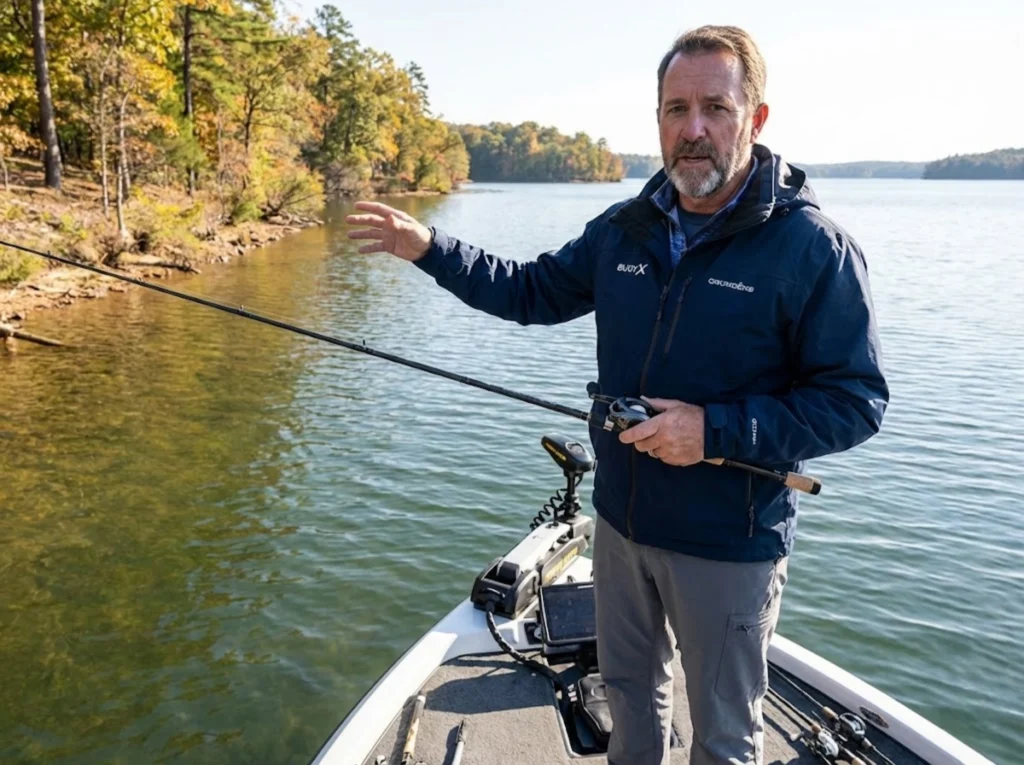
Forget vague advice like “fish shallow in fall.” Bass move through three distinct phases, each with specific temperature triggers and structural locations.
Phase 1: Early Transition (80°F → 70°F) — Staging on Secondary Points
As surface temps drop from summer highs into the 70s, bass abandon their deep summer ledges. But they don’t rush straight to the shallows—they stage at creek mouths and secondary points (the first prominent structure inside a creek arm).
Fish in this phase are suspended and scattered. They’re breaking summer patterns but not yet committed to shallow water. Schools are loose and disorganized. Your mission: cover water fast with search baits—topwater lures, medium crankbaits diving 6-10 feet, and fast-retrieved spinnerbaits.
Look for shad pods visible on main lake points at dawn. Those baitfish are your scouts—bass are close behind. Understanding how bass use points as transition highways applies here just like it does in spring.
Phase 2: The Fall Feed (70°F → 60°F) — Shallow Chaos and Wolf Packs
This is the phase every bass angler lives for. Water temps in the mid-60s trigger peak aggression as bass corral shad into dead-end areas—creek backs, shallow flats, and wind-blown pockets.
Bass form wolf packs during this phase, hunting cooperatively to drive baitfish against banks or the surface. Power fishing dominates: squarebill crankbaits deflecting off cover, lipless rattlebaits ripping through grass, slow-rolled buzzbaits, and heavy spinnerbaits.
One crucial detail most anglers miss: The 48-hour wind rule. It takes a consistent wind blowing from one direction for 24-48 hours to actually stack baitfish on a windblown bank. Wind that’s only been blowing for 4 hours hasn’t moved the food chain yet. Apps like Deep Dive App can map wind effects and predict which banks will hold concentrated forage. Understanding controlling your position in heavy fall winds becomes critical.
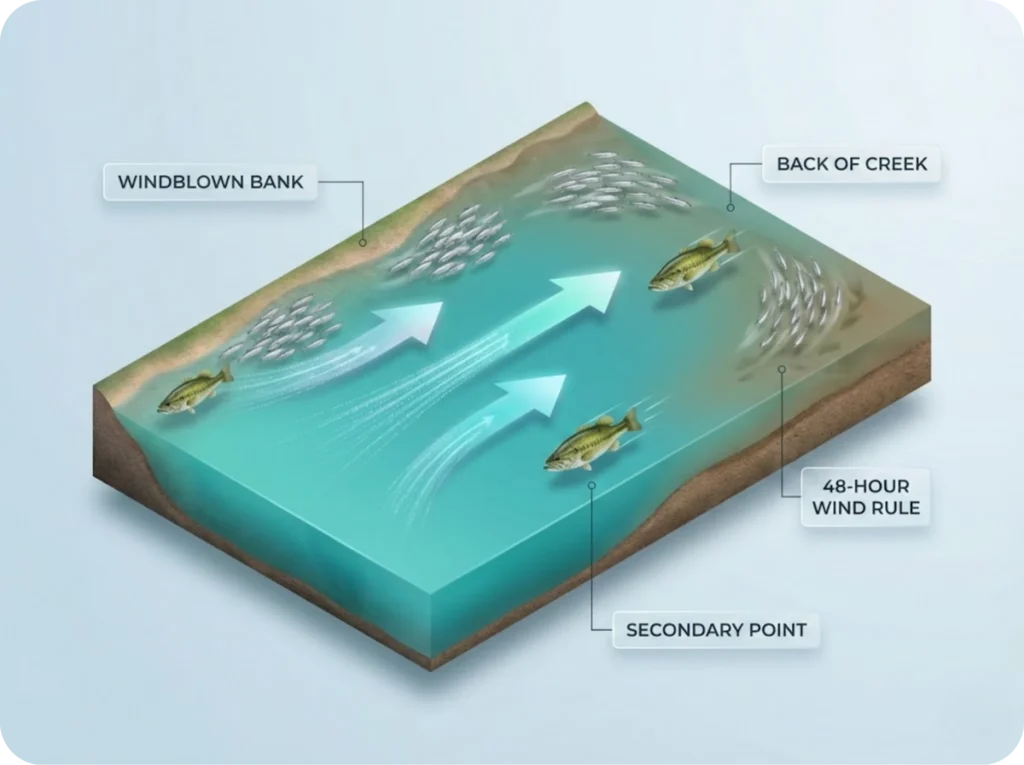
Pro tip: Find the muddiest water on a wind-blown flat—that’s where the shad got pushed, and the bass are right behind them.
Phase 3: Late Transition (60°F → 50°F) — Retreating to Wintering Holes
As water drops below 60°F, the party ends. Bass retreat from shallow flats—but they don’t return to summer locations. Instead, they move to wintering holes: steep breaks, channel swings, and deep basins located near creek mouths.
These fish seek vertical access—places where they can move up or down to adjust to conditions without swimming long horizontal distances. Metabolism has crashed. Feeding windows shrink to the warmest hours of the day.
Your lure physics must shift dramatically. Tight-wobble crankbaits like the Berkley Dime outperform wide-wobbling baits. Jerkbaits need 10+ second pauses between twitches. Jigs get dead-sticked on the bottom. Speed kills—and not in a good way. Deep diving crankbait success depends heavily on understanding the mechanics of depth-targeting crankbaits.
Regional Reality Check: North vs. South Timelines
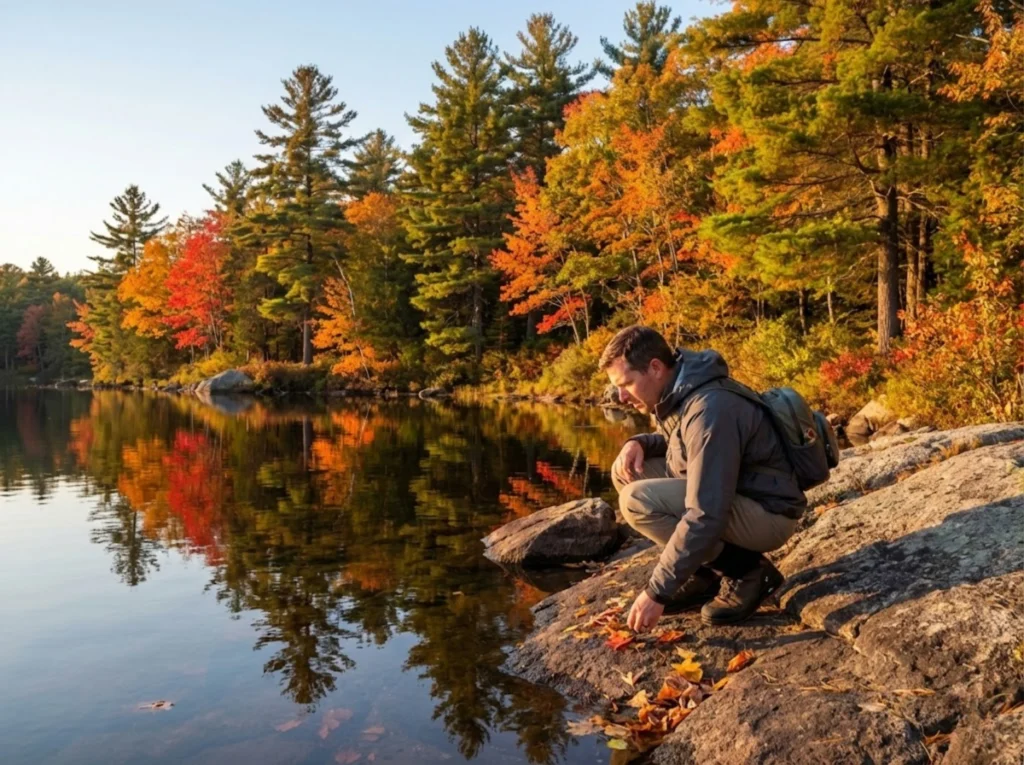
Generic fall advice fails because timing varies dramatically by latitude. A pattern that works in September in Michigan won’t apply until November in Florida.
Northern Natural Lakes: Rapid, Violent Turnover
Northern glacial lakes start transitioning in late August or September and finish by freeze-up in November. Turnover tends to be distinct and rapid—completing in days when a major cold front hits.
The forage base shifts away from shad toward perch, cisco, bluegill, and crawfish. Weed die-offs force bass off vegetation and onto rock and wood structure earlier than in southern waters. Smallmouth bass remain active well into the 40s—often schooling heavily offshore and chasing pelagic bait even in cold conditions. Targeting smallmouth-specific tactics for cold water pays dividends up north.
Southern Reservoirs: Prolonged, Subtle Shifts
Southern reservoirs don’t transition until October or November, and the process can stretch through December or even January. Turnover is often prolonged, subtle, or incomplete in systems with significant water flow.
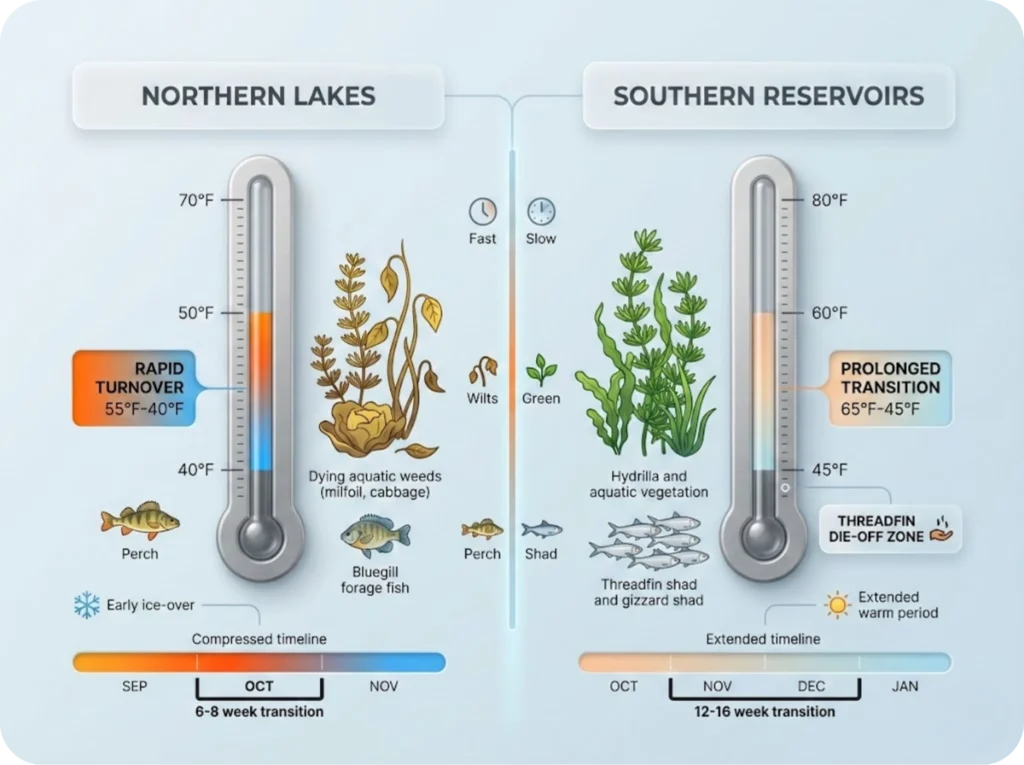
Threadfin shad and gizzard shad dominate the forage. When water temps finally crash below 45°F, threadfin die-offs create feeding bonanzas for opportunistic bass. Hydrilla and other aquatic vegetation persists longer, keeping some fish shallow well past when northern anglers have iced over. Largemouth activity drops more sharply below 50°F than smallmouth—they become more cover-oriented and ambush-focused.
Lure Selection by Phase: The “Match the Condition” Matrix
Forget the generic “fall bass lures” lists. Your selection should be temperature-driven, not calendar-driven.
Early Transition (70s): Speed and Flash
When bass are staged but scattered, you need search baits. Topwater walking baits and Whopper Ploppers cover dawn and dusk surface activity. Medium-diving crankbaits (6-10 feet) let you probe transition banks quickly. Fast spinnerbaits with willow blades flash through clearer water.
For suspended fish you’re marking on LiveScope or similar electronics, the mid-strolling setup shines: 1/8 oz jighead paired with a minnow-shaped soft plastic, shaken and slowly retrieved. Understanding the physics of topwater strikes helps you close more deals when they blow up.
Peak Feed (60s): Power and Deflection
Aggressive fish call for aggressive presentations. Squarebill crankbaits excel because they deflect off cover, triggering reaction strikes from competitive, schooling bass. Lipless crankbaits rip through remaining grass and cover shallow flats efficiently.
The Molix SS Super Squeaky buzzbait deserves special mention—its XXL blade generates enough lift to retrieve at ultra-slow speeds in cooling water, and the brass rivet adds an acoustic signature that helps bass locate it in choppy conditions. Heavy spinnerbaits with Colorado blades provide maximum vibration in stained water. How bill angle determines dive depth and deflection matters when you’re banging cover.
Late Transition (50s): Slow and Subtle
Cold-water bass won’t chase—you need to put baits in their face. The Berkley Dime crankbait series uses Flash Disc Technology to mimic the erratic, buoyant action of balsa baits in a durable plastic body. That tight wobble suits lethargic fish better than aggressive, wide-wobbling plugs.
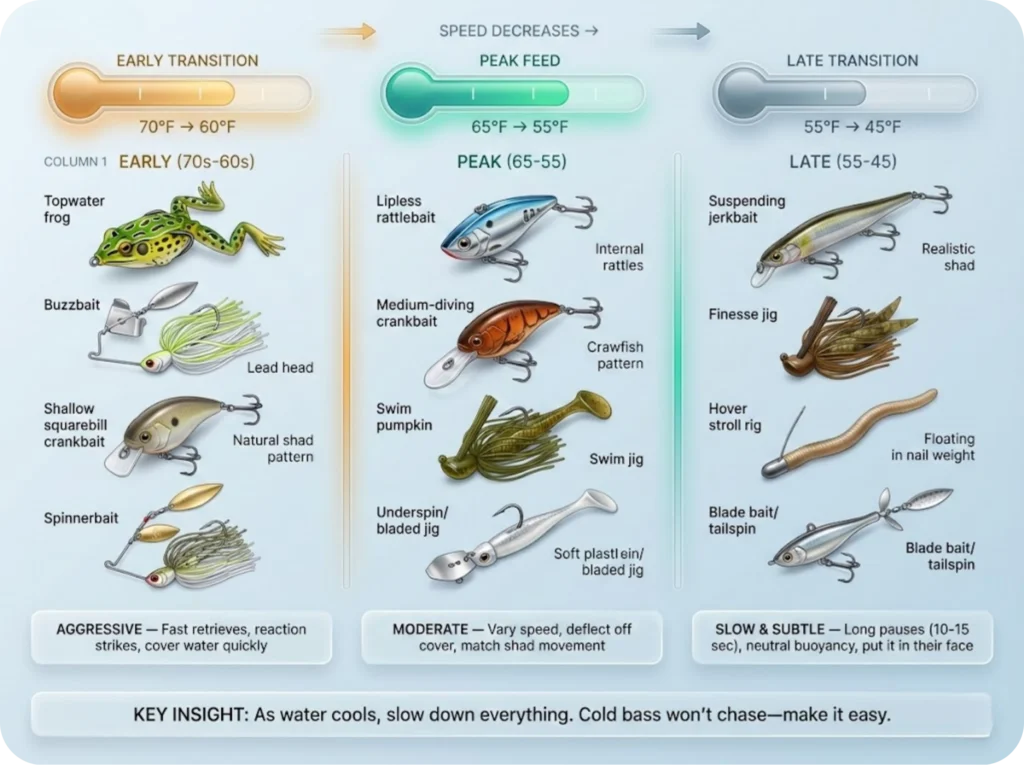
Jerkbaits become critical, but the cadence changes completely. Pause 10-15 seconds between twitches. Neutral suspension is mandatory—sinking baits fall out of the strike zone. Hover stroll rigs (nail weight plus floating worm) create baits that sink horizontally and hover in front of suspended fish.
When Everything Breaks: The Junk Fishing Mindset
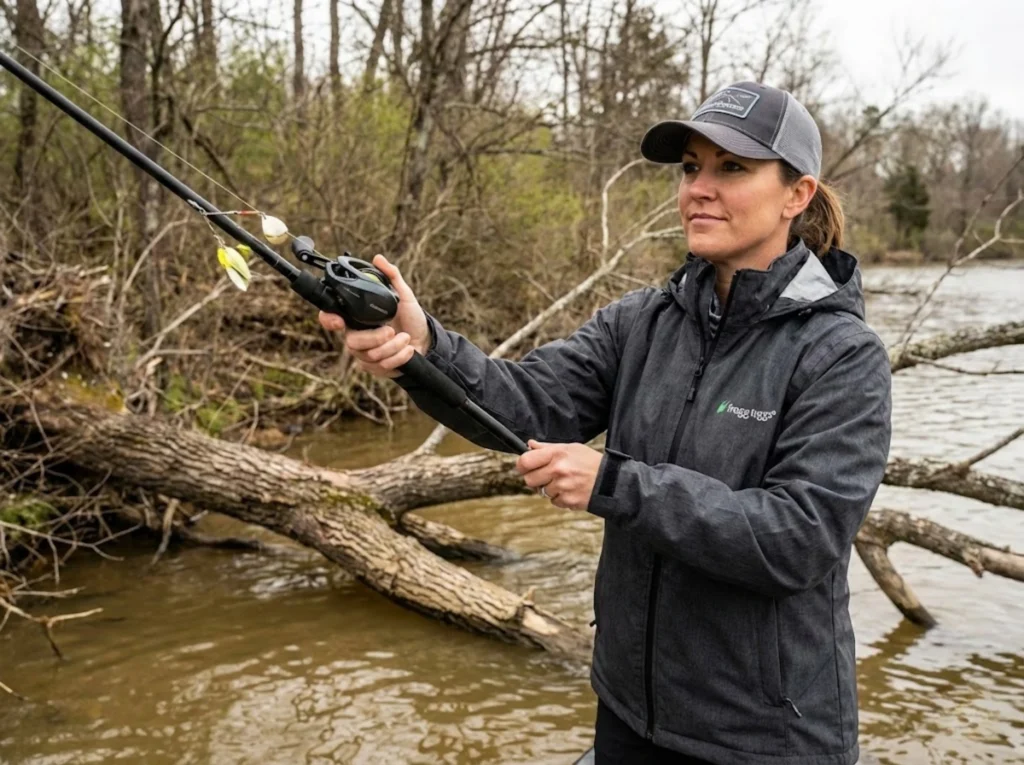
Some days, no pattern emerges. The lake is transitioning unevenly—one creek is turnover-toxic while another is holding fish shallow. This is when junk fishing stops being a joke and becomes a strategy.
Why “Junk Fishing” Isn’t Random (It’s Adaptive)
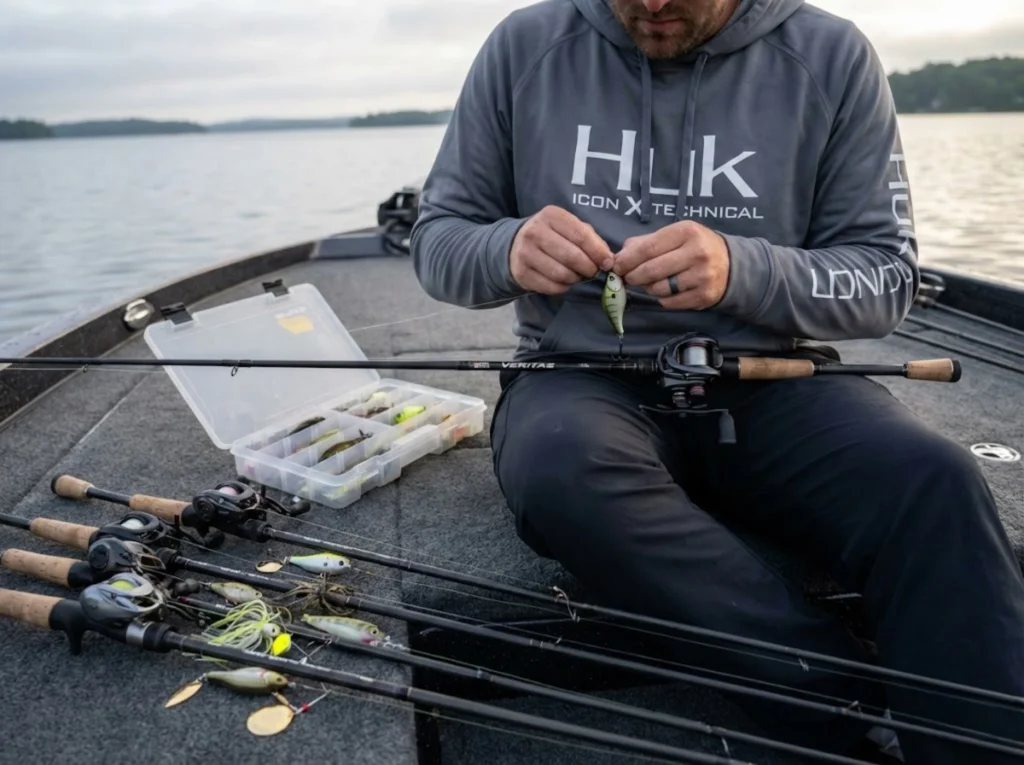
Junk fishing means keeping 10-15 rods rigged with different presentations and fishing “what’s in front of you.” Pass a laydown—pitch a jig. See a school busting—throw topwater. Cross a rocky point—wind a crankbait.
This isn’t laziness or lack of pattern. It’s strategic adaptation to unpredictable conditions. Tournament anglers like Mike Iaconelli have won major events junk fishing when no dominant pattern existed. The approach requires extensive rigging preparation—you can’t junk fish effectively if you’re retying every 10 minutes.
The goal is efficiency of opportunity. Instead of forcing a pattern on confused fish, you adapt instantly to micro-conditions every hundred yards down the bank. Cover water, stay versatile, and let the fish tell you what they want.
Pro tip: In October, I don’t look for a pattern—I look for feedback. The fish tell me what they want, one spot at a time. Stay ready for anything.
Conclusion
The fall transition rewards anglers who stop asking “where are the fish?” and start asking “what stage is my lake in?”
Three diagnostic keys to carry with you:
Temperature over calendar—65°F in Georgia and 65°F in Michigan trigger the same bass physiology, regardless of the month.
Sonar literacy is mandatory—Learn to read thermocline signatures, turnover static, and the cleared screen of isothermal conditions. The answers are on your fish finder.
Wind history wins—Don’t fish the bank wind is hitting NOW. Fish the bank it’s been hitting for 48 hours. That’s where the food chain stacked.
Stop hunting blind. Start diagnosing. Those bass are following rules—now you know them too.
FAQ
What water temperature do bass start moving shallow in fall?
Bass begin significant shallow movement when surface temperatures drop from the low 70s into the mid-60s. This triggers the Fall Feed phase where they corral baitfish in creek arms and flats. Temperature matters more than calendar—68°F produces similar behavior whether it’s September up north or November down south.
How long does the fall transition last?
The transition typically spans 6-10 weeks, depending on latitude and weather patterns. Northern natural lakes compress this into September through November, often ending abruptly at freeze-up. Southern reservoirs extend the process through October to January with more gradual phase changes.
Where do bass go when a lake turns over?
During active turnover, bass often suspend or relocate to unaffected areas like creek arms that haven’t turned yet. After turnover completes, they gain access to deep structures (40-60+ feet) that were oxygen-depleted all summer. This vertical habitat expansion is why fall fishing feels random—fish are no longer concentrated by environmental barriers.
Is fall turnover good or bad for bass fishing?
Both. Active turnover (murky water, sulfur smell, sonar static) makes fishing extremely difficult for 24-48 hours. Post-turnover is often excellent—bass spread out but feed actively, and deep structure becomes accessible. The key is identifying whether your specific lake section is pre-turnover, mid-turnover, or post-turnover.
What are the best lures for fall transition bass?
Selection depends on phase. Early transition (70s): topwater walkers, medium crankbaits, fast spinnerbaits. Peak feed (60s): squarebills, lipless cranks, slow-roll buzzbaits. Late transition (50s): tight-wobble crankbaits like the Berkley Dime, long-pause jerkbaits, and hover stroll rigs for suspended fish.
Risk Disclaimer: Fishing, boating, and all related outdoor activities involve inherent risks that
can lead to injury. The information provided on Master Fishing Mag is for educational and informational purposes
only. While we strive for accuracy, the information, techniques, and advice on gear and safety are not a substitute
for your own best judgment, local knowledge, and adherence to official regulations. Fishing regulations, including
seasons, size limits, and species restrictions, change frequently and vary by location. Always consult the latest
official regulations from your local fish and wildlife agency before heading out. Proper handling of hooks, knives,
and other sharp equipment is essential for safety. Furthermore, be aware of local fish consumption advisories. By
using this website, you agree that you are solely responsible for your own safety and for complying with all
applicable laws. Any reliance you place on our content is strictly at your own risk. Master Fishing Mag and its
authors will not be held liable for any injury, damage, or loss sustained in connection with the use of the
information herein.
Affiliate Disclosure: We are a participant in the Amazon Services LLC Associates Program, an
affiliate advertising program designed to provide a means for us to earn advertising fees by advertising and linking
to Amazon.com. As an Amazon Associate, we earn from qualifying purchases. We also participate in other affiliate
programs and may receive a commission on products purchased through our links, at no extra cost to you. Additional
terms are found in the terms of service.