
In this article
The worm had been sitting motionless on the bottom for twenty seconds when I noticed it — not a thump, not a pull, just the faintest tick in the line. Three feet of fluorocarbon had telegraphed something no amount of folklore could have prepared me for: a largemouth bass had inhaled a 5-inch ribbon-tail worm so quietly that the rod never moved. The only proof was a 0.3 mm lateral jump in the slack. I drove the hook. The fish was there.
Most anglers lose fish not because of bad luck, but because of a mismatch between the fish’s biology, the line’s physics, and the rod’s mechanics. This guide decodes the full signal chain — from the bass’s buccal cavity to your fingertips — so you stop guessing and start knowing.
⚡ Quick Answer: A subtle bass bite on soft plastics almost always arrives as one of four signals: a sharp “tick” during the fall, sudden unexpected slack where the lure stops dropping naturally, a “mushy” heaviness on retrieve, or a line jump you see before you feel anything. Your gear — specifically the combination of line type, weight material, and rod modulus — determines whether any of those signals survive the trip from the fish’s mouth to your hand. Run a fluorocarbon leader, a tungsten weight, and a 50-million-modulus fast-action rod to preserve the impulse. When something feels different, set the hook immediately. Hooksets are free.
The Biomechanics of the Suction Strike
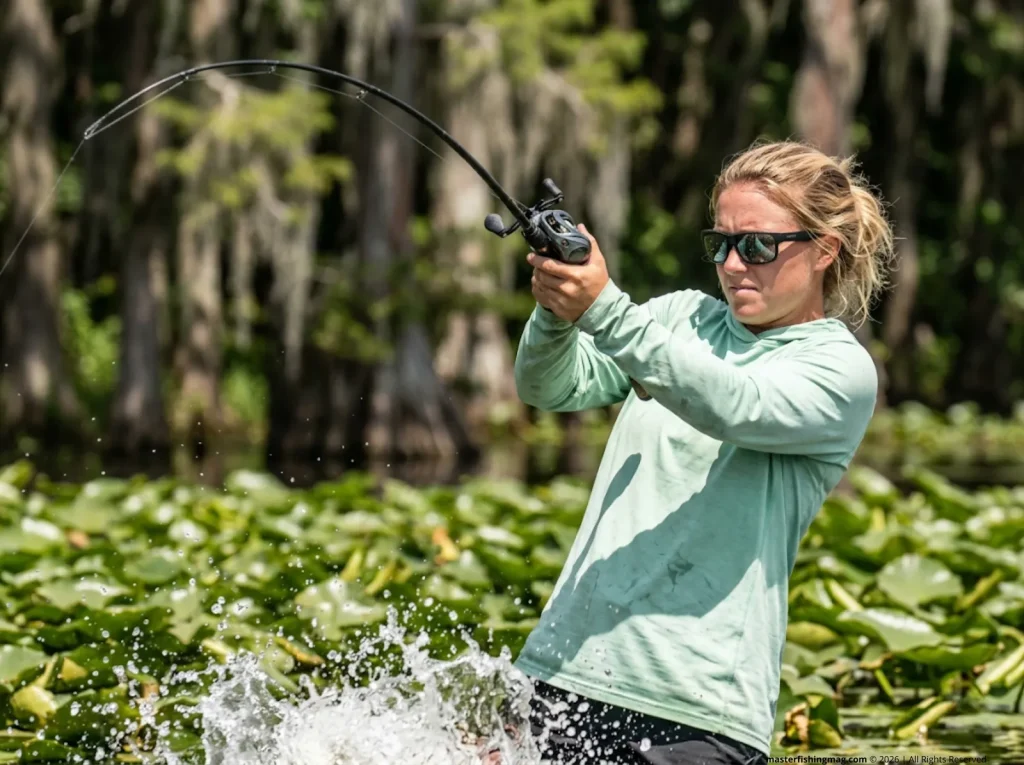
Here’s where everyone starts wrong: they picture a bass clamping down on a worm the way a dog grabs a sock. That’s not what happens.
A largemouth bass (Micropterus salmoides) doesn’t grab. It inhales. When it decides to eat, it fires the same massive axial muscles that power its entire body through water — and uses that explosive contraction to blow its buccal cavity open by an average of 247%, creating a localized pressure drop that pulls water (and your lure) inward at nearly 800 cubic centimeters per second. The whole event peaks in 50 to 100 milliseconds. Your pain reflex takes 250 milliseconds. You are already behind the fish before your brain knows the bite happened.
That initial event — the pressure drop, the lure displacement — creates a sharp impulse that travels through the line as a longitudinal vibration. That’s “the tick.” It’s not random noise. It’s the mechanical signature of a biological event that lasts less than a tenth of a second. To understand how bass actually eat and what that means for your hookset reaction time, the key insight is that swimming muscles power suction feeding in largemouth bass — not cranial muscles, which would be far too weak to move water that fast.
The “mushy” feeling most anglers describe as a weak bite is actually the opposite. It means the fish has already completed inhalation and is holding the lure stationary in its partially-closed mouth. The impulse has passed. What you’re feeling is dead weight, not an active signal.
Pro tip: If you’re waiting to feel “weight,” you’re waiting for the fish to already have the hook deep. Set on the tick, not the pull. And weight-check every 5–7 seconds on a slack retrieve — any resistance that wasn’t there on the last check is a fish.
The Suction Impulse — Why the Bite Window Is Shorter Than You Think
The math works against you. The bass’s suction event finishes in under 100 ms; human tactile reaction time averages 250 ms. You cannot out-reflex a largemouth. What you can do is engineer your gear to extend the duration of the detectable event — meaning the impulse has to leave enough trace in the line and rod that you catch it even a half-second later when you finally feel it.
That requires zero slack. The impulse spends its energy straightening any bow in the line before it ever reaches the rod tip. Every inch of slack is a signal reducer.
The “Mushy” Bite Decoded
When a bass holds a worm motionless after inhaling it, the lateral line stops generating new signals. The problem isn’t the fish — it’s that you’ve lost active contact with the lure. The fix is the weighting technique: periodically lift the rod from 10 o’clock to 11 o’clock, applying light upward pressure. Any resistance that shouldn’t be there means something biological is holding it. You’re not waiting for the fish to signal you. You’re interrogating the system.
Material Dynamics — The Fishing Line as a Signal Conduit
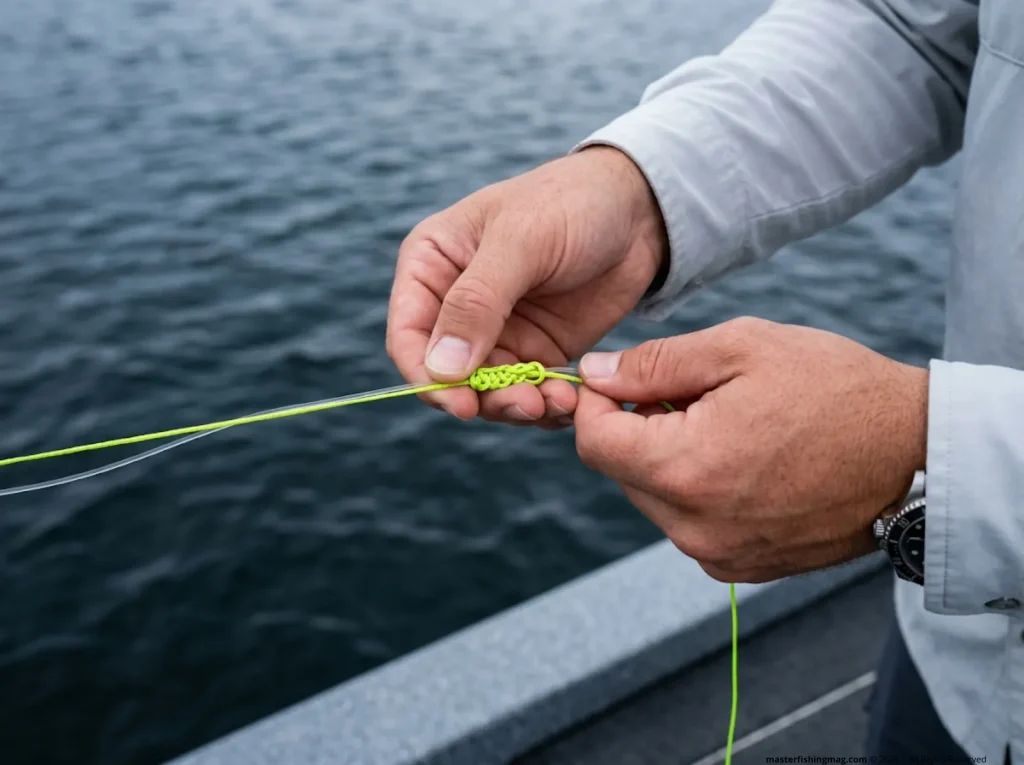
I switched from straight 12 lb monofilament to a braid-to-fluoro setup mid-tournament and started feeling bites on a Neko rig I hadn’t detected all morning. Same fish, same depth, same rod. The line was the only variable that changed.
Three materials dominate the market, and they interact with a strike impulse in fundamentally different ways.
Fluorocarbon — made from polyvinylidene fluoride (PVDF) — has a specific gravity of 1.76, which means it sinks. That sinking rate matters because it keeps the line on a straighter, tauter path between rod and lure, reducing the bow that reduces signals. Its tightly packed PVDF molecules also transmit vibrational energy more efficiently than nylon. The critical detail is that fluorocarbon’s initial elongation is very low — it resists stretching during the first few ounces of pressure, which is precisely the window when a subtle bite registers. You can read the acoustic impedance properties of fluorocarbon materials if you want the physical explanation, but the field version is simpler: fluoro telegraphs the tick better than mono.
Braided line (High-Modulus Polyethylene, or HMPE) has less than 5% stretch. Near-zero attenuation. Best raw sensitivity of any line on the market. But its specific gravity of 0.97 means it floats — and in any wind or current, that floating line arcs in the water column. That arc functions as a mechanical filter: it absorbs the high-frequency tick (the bite) while passing only the lower-frequency pull that comes too late. Fishing braid straight to the hook in open water on a windy day eliminates the entire sensitivity advantage.
The answer is a hybrid system: 30–40 lb braided mainline for deep-water sensitivity and instant signal transfer, with a 10–15 ft fluorocarbon leader to sink the terminal end below the wind line and provide stealth via fluorocarbon’s refractive index of approximately 1.42 — close enough to water’s 1.33 that the leader essentially disappears subsurface. For the mechanics of building a clean, low-profile braid-to-leader connection for finesse applications, see the only fishing line-to-leader connection methods worth trusting.
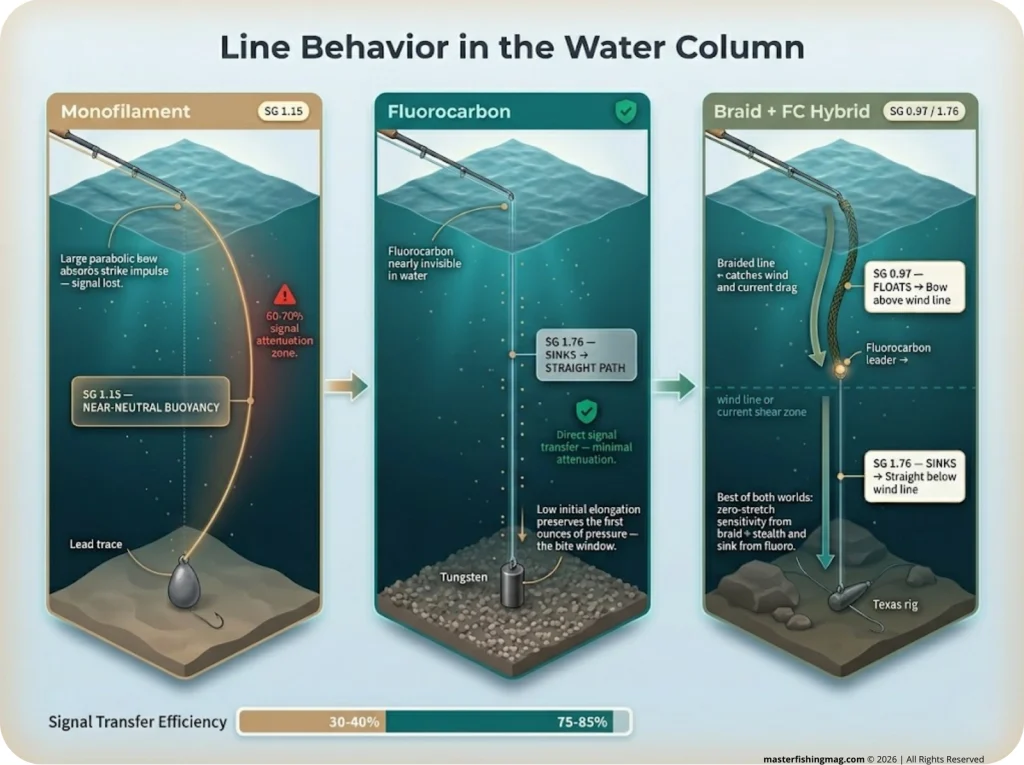
Pro tip: Use 8–12 lb fluorocarbon straight to the lure on calm days with no wind — the sink rate keeps you in direct contact with the bottom. When wind picks up, drop to an FC leader on braid. That 10-ft leader needs to extend below the depth of the bow the braid creates. In a 3 mph wind, that bow can reach 8–12 ft before the line transitions to the leader. Size accordingly.
The Weight Factor — Why Tungsten Changes What You Hear
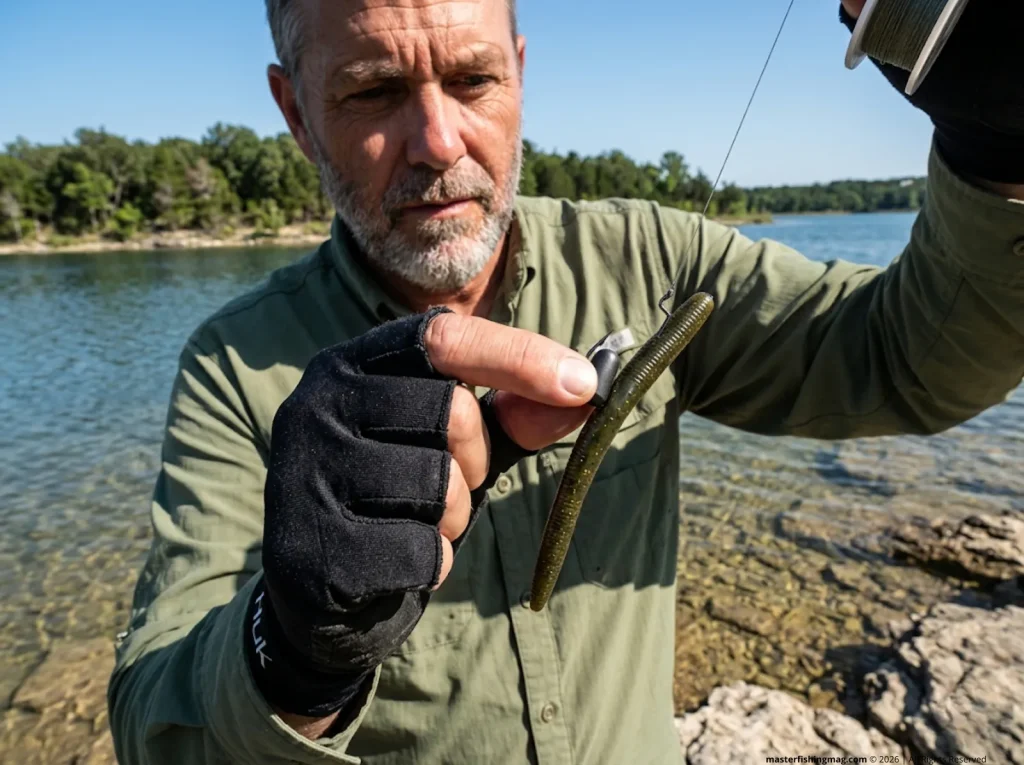
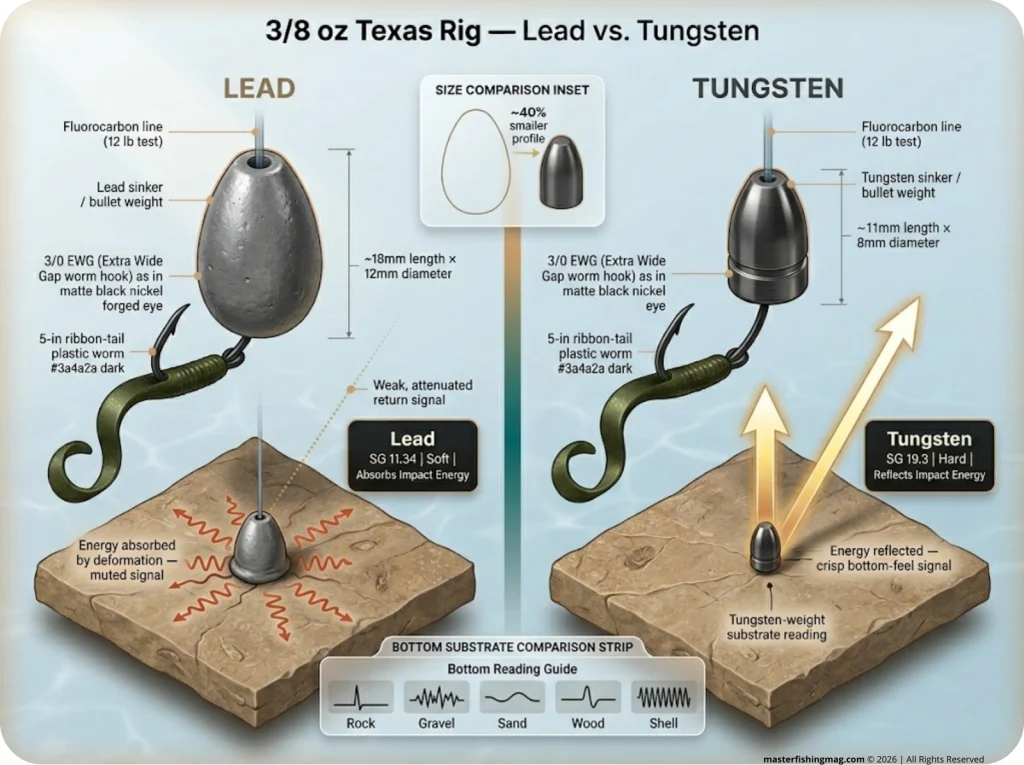
The first time I fished a 3/8 oz tungsten weight on a Texas rig over gravel bottom, I could tell the exact moment the lure crossed from sand to limestone. I’d been fishing for 25 years. I’d never felt that distinction before. That information — knowing the exact bottom substrate in real time — is worth more on a tough day than any sonar reading.
Tungsten (Wolfram) has a specific gravity of 19.3 g/cm³ versus lead’s 11.34. That density means tungsten reaches the same mass as lead in roughly 60% of the physical size — a smaller profile, less hydrodynamic drag, faster and more vertical fall. But the real difference isn’t size. It’s hardness.
Lead is soft and malleable. When it contacts rock, it deforms slightly, converting the impact energy into heat. That deformation absorbs the signal. Tungsten is extremely hard — it reflects nearly all impact energy back through the line as a crisp, sharp click. That click isn’t noise. It’s tactical data. You can read the bottom through it: rock is a sharp, high-frequency tick; gravel is rapid irregular ticking; sand is smooth drag; wood gives a soft thud with some sticky resistance; shell gives high-frequency chattering. A bass’s jaw closing around the lure registers as the weight going “soft” — the downward pressure signal disappears momentarily as the fish holds still.
For a practical look at tungsten jig head selection matched to specific presentations, see the guide to the best tungsten jig heads for bass fishing.
There’s also a conservation argument here. Lead lost in the water can be ingested by loons and waterfowl, causing lead poisoning. Tungsten is non-toxic. That’s not a footnote — that’s a reason to make the switch permanent. For a deeper look at this issue, the buccal cavity pressure data during suction feeding from the UC Davis Fish Lab also contextualizes why good gear choices matter for earlier hooksets and safer catch-and-release outcomes.
Pro tip: Start one weight class lighter than you think you need when first switching to tungsten. The fall rate is faster and the bottom feedback is stronger than you’re used to. You’ll over-feel the bottom initially. Give it a session to recalibrate before going heavier.
Transducer Engineering — The Rod as a Signal Amplifier
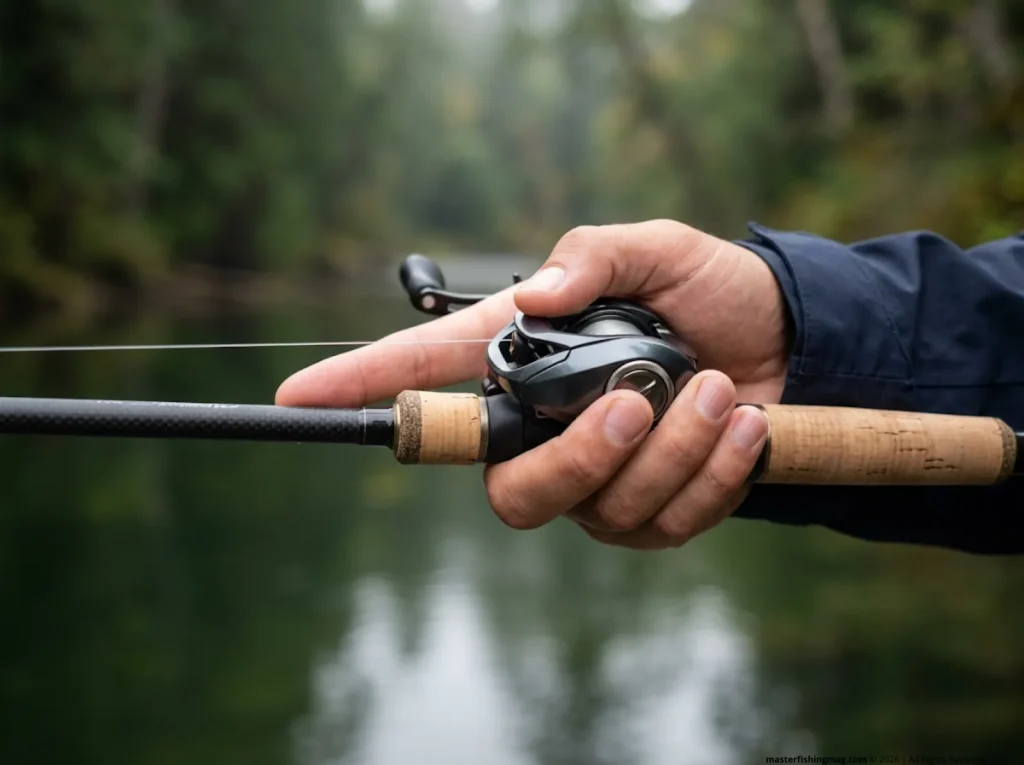
A fishing rod is a transducer. That’s not a metaphor — it’s the correct engineering term for a device that converts one form of mechanical energy into another. The rod converts the impulse that traveled through the line into a tactile stimulus in your hand. How efficiently it does that conversion depends on the rod’s modulus of elasticity — a measure of how stiff a material is relative to its weight.
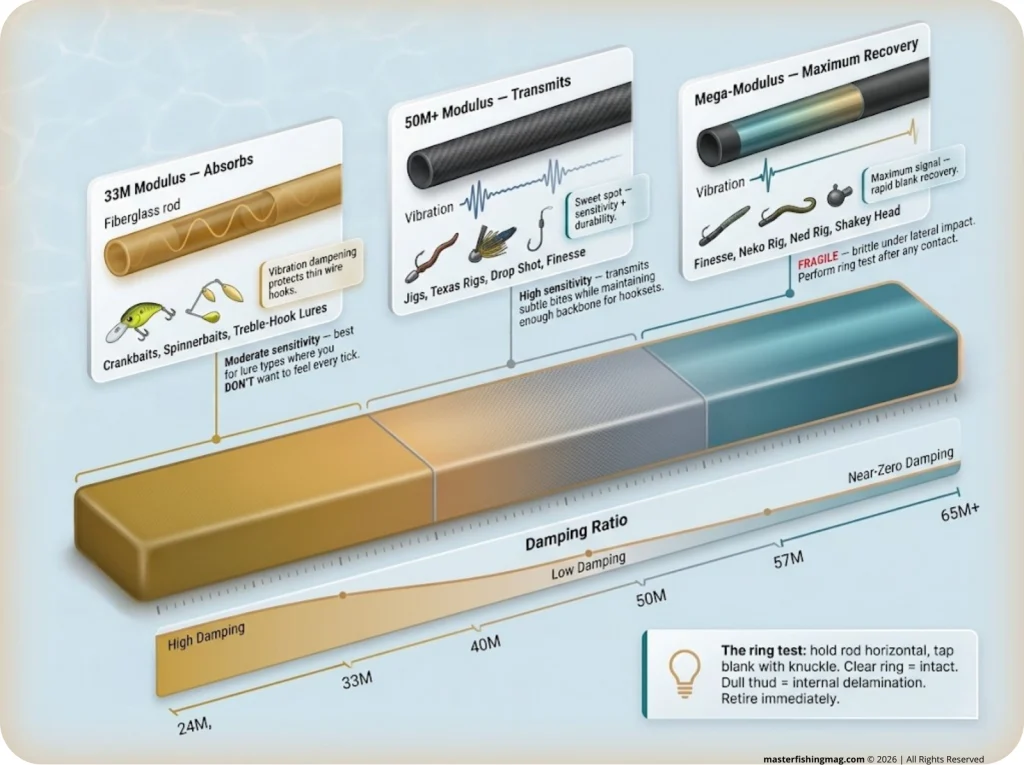
High-modulus graphite rods — 50 million modulus and above — are stiffer and lighter than lower-modulus alternatives. That stiffness means energy propagates through the blank with minimal loss. The low mass means the blank resonates at a higher frequency, which happens to match the frequency range of subtle bite signals. When the tick travels up the blank, a high-modulus rod vibrates in response; a fiberglass rod absorbs and dampens it.
Modern systems like the G. Loomis NRX+ use advanced resin matrices (GL8) to achieve rapid “Dynamic Recovery” — the blank returns to neutral almost instantly after any deflection, preventing the tip from smoothing out subsequent vibrations. I handed a 50-million-modulus rod to a guy who’d been fishing 17 lb monofilament on a fiberglass rod all day. He touched the blank and asked if the reel was vibrating. It wasn’t — he was feeling the wind and current for the first time.
Fiberglass rods and low-modulus composites are designed exactly the opposite way — to dampen vibration, not transmit it. That’s why they’re ideal for crankbaits (where you don’t want to feel every rock) and completely wrong for soft plastics. Fishing a Texas rig on a “moderate” action fiberglass rod is like listening to a radio with the volume muted. The signal is there. The hardware isn’t cooperating.
For a practical guide to matching graphite modulus to target species and presentation, see selecting graphite rod modulus by species and technique.
One critical caution: high-modulus graphite is strong under linear load — fighting a fish on a straight line — but brittle under lateral impact. High-sticking, resting the rod against a gunwale, and accidental impacts cause micro-fractures in the carbon fiber weave that don’t show externally. The rod looks fine. It fails months later under normal load. After any accidental impact, do the ring test: hold the rod horizontal and tap the blank gently with a knuckle. A clear ring means intact. A dull thud means internal delamination. Retire it before it breaks on your biggest fish of the year.
Sensory Mastery — The Human Signal Processing System
Gear gets you to the threshold. This gets you over it.
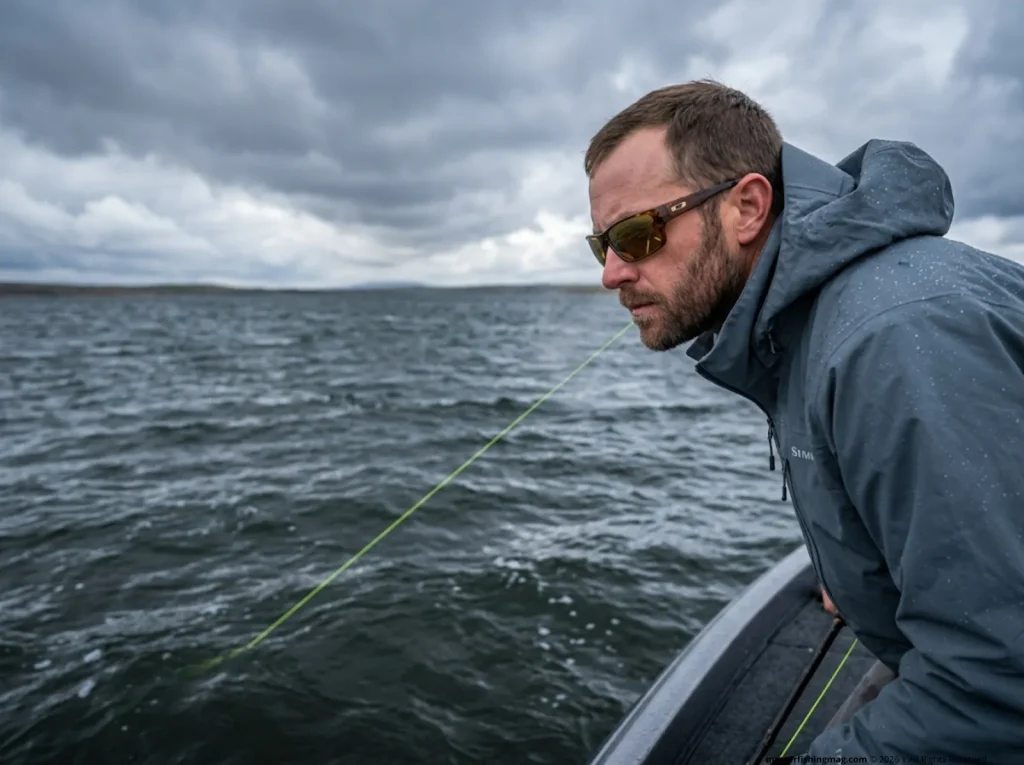
The professional standard for subtle bite detection is a dual-channel system: tactile feedback through the blank, and visual detection by watching the line. Neither alone is enough. At least 50% of subtle bites show up visually before they register in your hand. If you’re watching the water and not the line, you’ve cut your detection ability in half before the fish even bites.
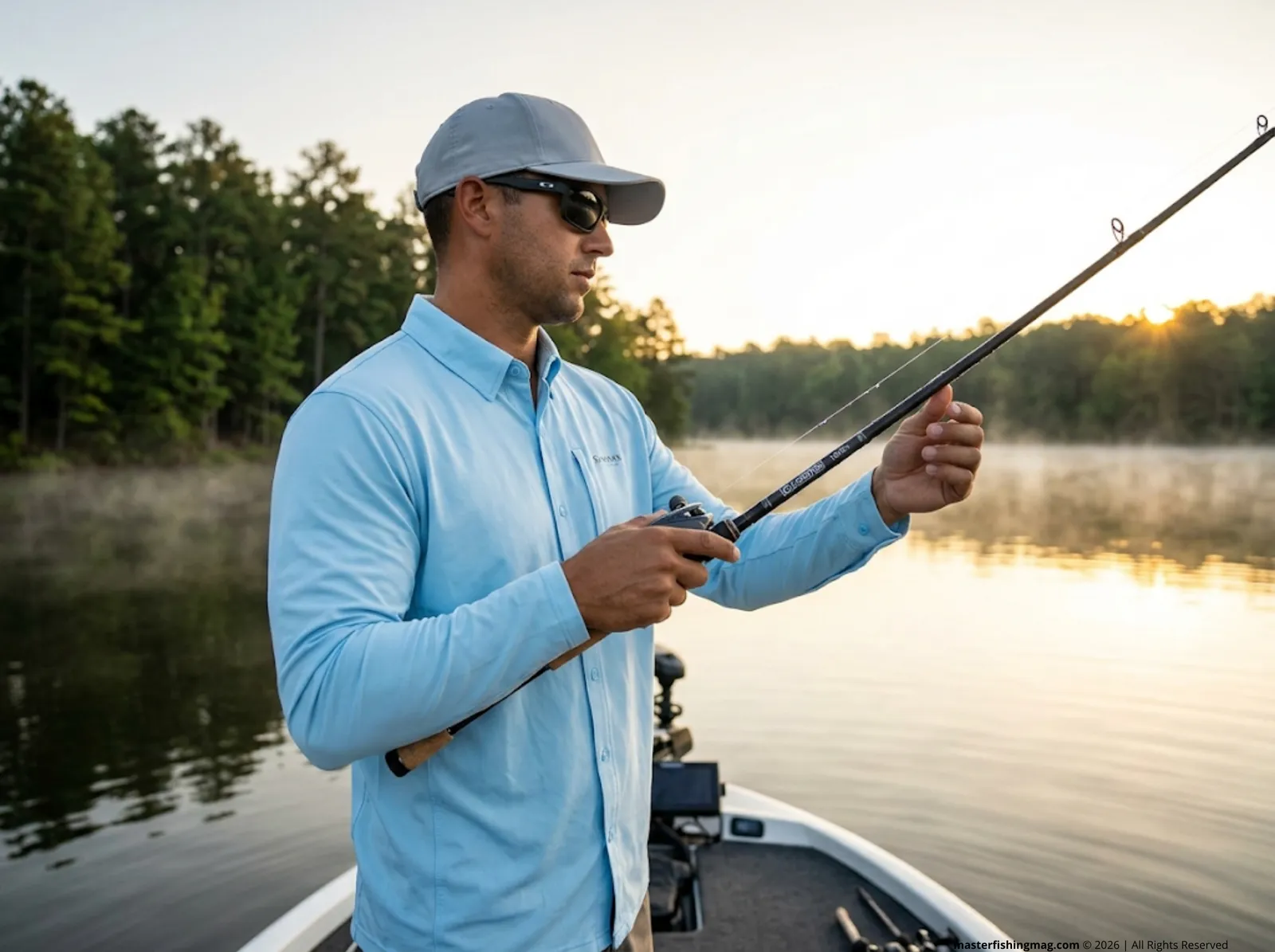
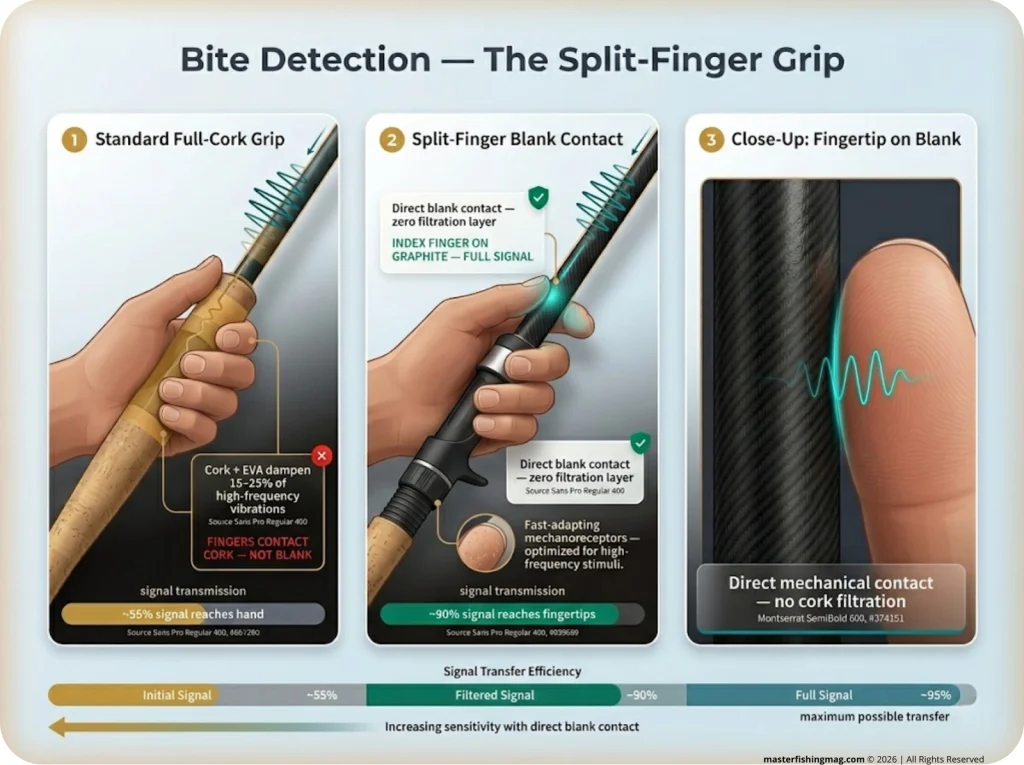
The split-finger grip is the most impactful single change you can make with existing gear. Two fingers below the reel seat in standard position, index finger resting directly on the exposed graphite blank below the reel seat. Cork and EVA foam dampen 15–25% of high-frequency vibrations. The blank doesn’t. Your fingertip has a high concentration of fast-adapting mechanoreceptors optimized for brief, high-frequency stimuli — exactly the kind a subtle suction bite produces. Moving your finger from the cork to the blank is like removing a filter from a speaker. The signal was always there. You just couldn’t hear it.
For the visual channel: run chartreuse or hi-vis yellow braided mainline, even with a 12-ft fluorocarbon leader. The hi-vis section at the surface acts as a visual strike indicator. Any lateral jump, twitch, or sudden slack drop at the line’s water entry point warrants an immediate hookset. Line suddenly going from 45 degrees to near-vertical means the fish has moved toward you with the bait. That’s a bite. Drive the hook.
For the deeper visual work — especially in clear water — see the visual bite detection system for clear water and finesse presentations.
The neurological side of this is worth knowing, not as theory but as motivation: Glenn May’s “Homework Drill” from BassResource is the fastest way to build the pattern library your brain needs. Split-shot rig, 4-inch ribbon tail worm, shallow summer water, and the goal is to catch 30–50 small bass in a session. Not trophies — volume. Each fish teaches your nervous system the difference between the mushy bite, the tap-tap of a closing jaw, and the slack-line take. You can’t read about this. You have to experience it until the recognition becomes automatic.
Pro tip: Do the homework drill once on still water and once on moving water. Current introduces new background noise. Train in both environments. The drift creates false signals your brain needs to learn to filter before it can recognize the real one.
Common Mistakes and the Signal-to-Noise Protocol
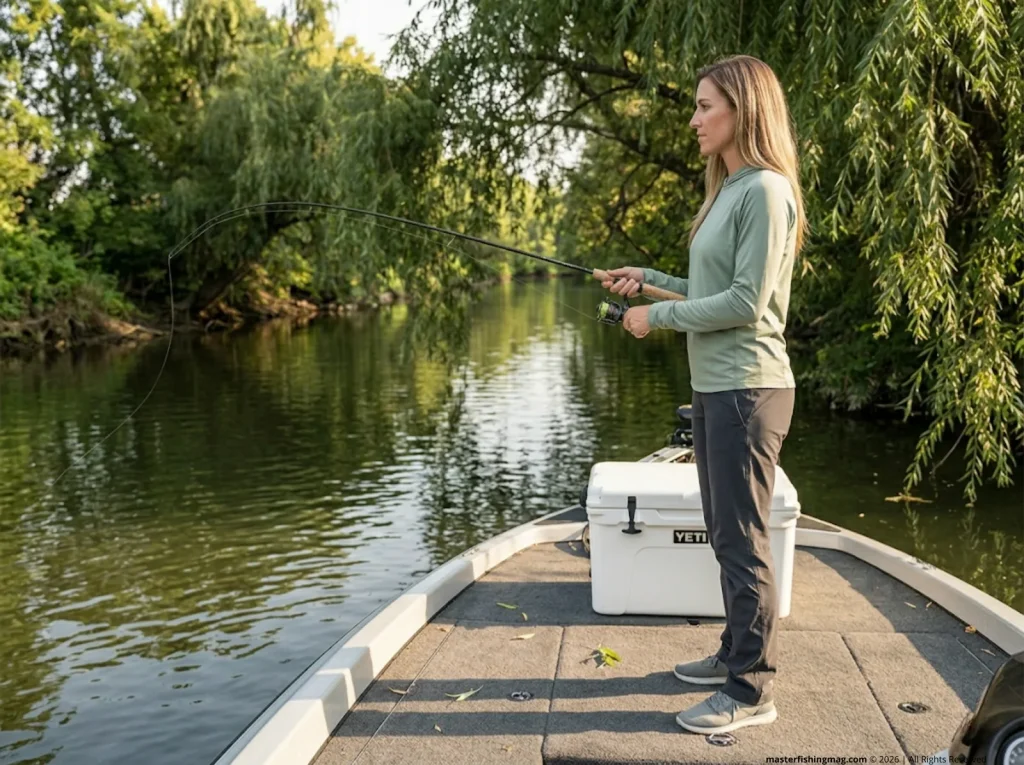
Here’s where people go wrong. Most of the time, it’s not a single error — it’s a system failure across three linked variables.
Gear mismatch is the most common. Fiberglass rod plus monofilament represents maximum signal attenuation at both ends of the chain. The monofilament absorbs the first few ounces of pressure — precisely the bite window — and the fiberglass absorbs whatever survives. Combined, you lose roughly 60–70% of the impulse before it reaches your hand. The result isn’t “hard to detect.” It’s undetectable.
Over-tensioning is subtler and more destructive. Beginners who feel a slight resistance often pull back instinctively — and in doing so, yank the lure away from the fish during the 50–100 ms suction event before the bass has completed inhalation. The mechanics of suction expansion in ray-finned fishes explain why: the peak pressure drop in the buccal cavity occurs before maximum gape. The lure needs a brief window of non-resistance to be pulled inward. Tight line tension during that window is why you get a tap and no fish.
Slack management gets confused with “losing contact.” There’s a real difference between controlled slack — where the lure falls freely while you track the line angle visually — and dead slack, where you’ve lost all sensory contact. Controlled slack is intentional geometry. Dead slack is just fishing blind. Keep the rod tip at the 10 o’clock position, not pointed at the water. Every inch of rod tip elevation reduces the line in contact with the water surface and decreases bow formation. Your rod tip is the final amplifier in the chain — keep it elevated.
The “Hooksets Are Free” rule is the professional consensus across tournament bass fishing. Set whenever the lure feels different — heavier, softer, sideways. The cost of a false hookset is marginally disturbing the lure’s position. The cost of hesitation is a gut-hooked fish you felt too late, or no fish at all. I’ve set the hook on leaves, rocks, mussel beds, and a golf ball. I’ve also caught fish on what I was certain was a snag. Bias toward early hooksets. Always. For a full breakdown of Carolina rig bite detection and hookset timing where these same rules apply, see the Carolina rig setup guide and the physics behind the bite.
Pro tip: The rod test for sensitivity: hold your current rod by the grip, close your eyes, and tap the tip section with a fingernail. If you can’t feel that tap in your grip, your blank is dampening your bites. Consider the upgrade before the season starts, not after you’ve lost fish all spring.
Conclusion
Three things, applied consistently, change how you fish soft plastics:
The bite is physics before it’s feeling. A bass fires its axial swimming muscles to inhale your lure in under 100 milliseconds. Your gear has to preserve that impulse across the entire signal chain — weight to line to rod to hand — or it disappears before you know it was there.
Line, weight, and rod aren’t separate gear decisions. They’re one system. Fluorocarbon sinks the terminal end and reduces bow. Tungsten reflects bottom vibration with precision instead of absorbing it. High-modulus graphite oscillates at the frequency range where subtle bites live. Swap one element out and the chain degrades.
Visual detection is your first channel, not your backup. At least half of all subtle bites show up in the line before they register tactilely. Run hi-vis braid at the surface and watch the water entry point on every fall.
On your next session — whether a Texas rig over rock, a Ned rig on finesse water, or a drop shot in deep structure — spend the first 30 minutes fishing with your eyes only. Watch the line. Ignore the rod tip. Reset your baseline. You’ll set hooksets on events you would have called nothing before. Then add the tactile channel. That combination is what professionals call being in the zone. Now you know the physics behind why it works.
FAQ
What does a bass bite feel like on a plastic worm?
On a Texas-rigged plastic worm, a bass bite arrives as one of four sensations: a sharp tick during the fall (the suction impulse), sudden unexpected slack where the lure stops dropping naturally, a mushy heaviness when you lift — the fish is holding it — or no felt sensation at all while the line jumps or angles sideways. Any of these four signals is a bite. Drive the hook.
Is braid or fluorocarbon more sensitive for soft plastic fishing?
Braid is more sensitive in absolute terms — less than 5% stretch means near-instant signal transfer. But braid floats, and in wind or current that creates a bow in the line that cancels the sensitivity advantage entirely. The professional answer is both: 30–40 lb braid as the mainline for deep-water sensitivity, with a 10–15 ft fluorocarbon leader on the terminal end to sink below the current line and provide stealth.
How do you tell the difference between a rock and a bite on a soft plastic?
Rock gives consistent, repetitive feedback matched to your retrieve cadence. A bite interrupts cadence. Specifically: tungsten on rock produces a sharp high-frequency click; a fish produces the weight going soft, sudden slack, or line acceleration toward the fish. The most reliable diagnostic is the weight check — if the lure doesn’t rise freely when you apply slight upward pressure, something biological is holding it.
Why can’t I feel my lure on the bottom when fishing soft plastics?
Three engineering failures cause this in combination. Lead weight instead of tungsten absorbs the bottom signal rather than reflecting it. Monofilament absorbs the first ounces of pressure — precisely the only pressure a subtle bite produces. Low-modulus or fiberglass rod dampens whatever survives. Fix the entire chain: tungsten weight, fluorocarbon or braid-to-FC leader, and a 50M+ modulus fast-action rod.
When should I set the hook if I’m not sure it’s a bite?
Set it. The cost of a false hookset is a slightly disturbed lure. The cost of hesitation is a gut-hooked fish or no fish at all. Tournament consensus is clear on this: develop a bias toward early hooksets, not late ones. If the lure feels different — heavier, softer, sideways — drive the hook immediately. The hook is thin. It doesn’t take much.
Risk Disclaimer: Fishing, boating, and all related outdoor activities involve inherent risks that
can lead to injury. The information provided on Master Fishing Mag is for educational and informational purposes
only. While we strive for accuracy, the information, techniques, and advice on gear and safety are not a substitute
for your own best judgment, local knowledge, and adherence to official regulations. Fishing regulations, including
seasons, size limits, and species restrictions, change frequently and vary by location. Always consult the latest
official regulations from your local fish and wildlife agency before heading out. Proper handling of hooks, knives,
and other sharp equipment is essential for safety. Furthermore, be aware of local fish consumption advisories. By
using this website, you agree that you are solely responsible for your own safety and for complying with all
applicable laws. Any reliance you place on our content is strictly at your own risk. Master Fishing Mag and its
authors will not be held liable for any injury, damage, or loss sustained in connection with the use of the
information herein.
Affiliate Disclosure: We are a participant in the Amazon Services LLC Associates Program, an
affiliate advertising program designed to provide a means for us to earn advertising fees by advertising and linking
to Amazon.com. As an Amazon Associate, we earn from qualifying purchases. We also participate in other affiliate
programs and may receive a commission on products purchased through our links, at no extra cost to you. Additional
terms are found in the terms of service.