
In this article
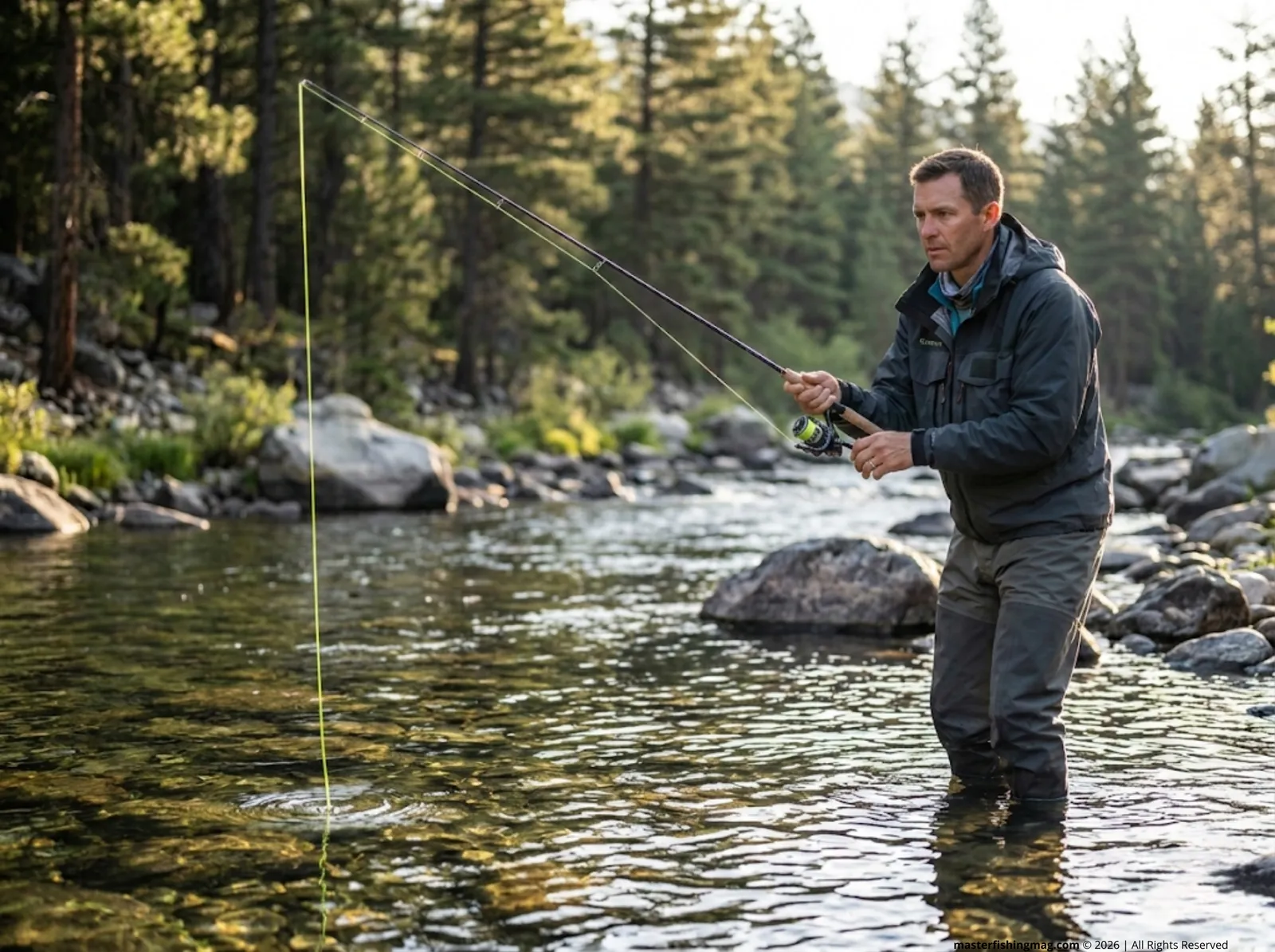
The line twitched sideways. Barely a finger’s width. I almost missed it because I was staring at the rod tip like I’d done for twenty years. Fifteen feet of gin-clear water between me and a pressured smallmouth that had already inspected my Ned rig three times without committing. No tap on the rod. No bump in my fingers. Just that one subtle lateral slide where the chartreuse braid met the surface.
I swept the rod low and felt weight. Three-pound smallie on 6lb fluoro in water so clear I could count rocks on the bottom.
That fish never would have made it to the net if I’d been waiting to feel the bite. After two decades of finesse fishing in clear water, I can tell you that your eyes will catch what your hands miss every single time. This guide breaks down the complete system for visual bite detection through line watching — the gear setup, the four signals to read, and a practice framework that turns missed strikes into landed fish.
⚡ Quick Answer: Line watching means focusing your eyes on the point where your fishing line enters the water instead of watching the rod tip. Any sudden jump, lateral slide, or unexpected stop in the line signals a fish has taken the bait. Pair high-vis braid with a fluorocarbon leader matched to water clarity, and set the hook immediately on any unnatural movement — even if you never felt a thing.
Why Your Rod Can’t Tell You Everything
The Physics of Slack-Line Blind Spots
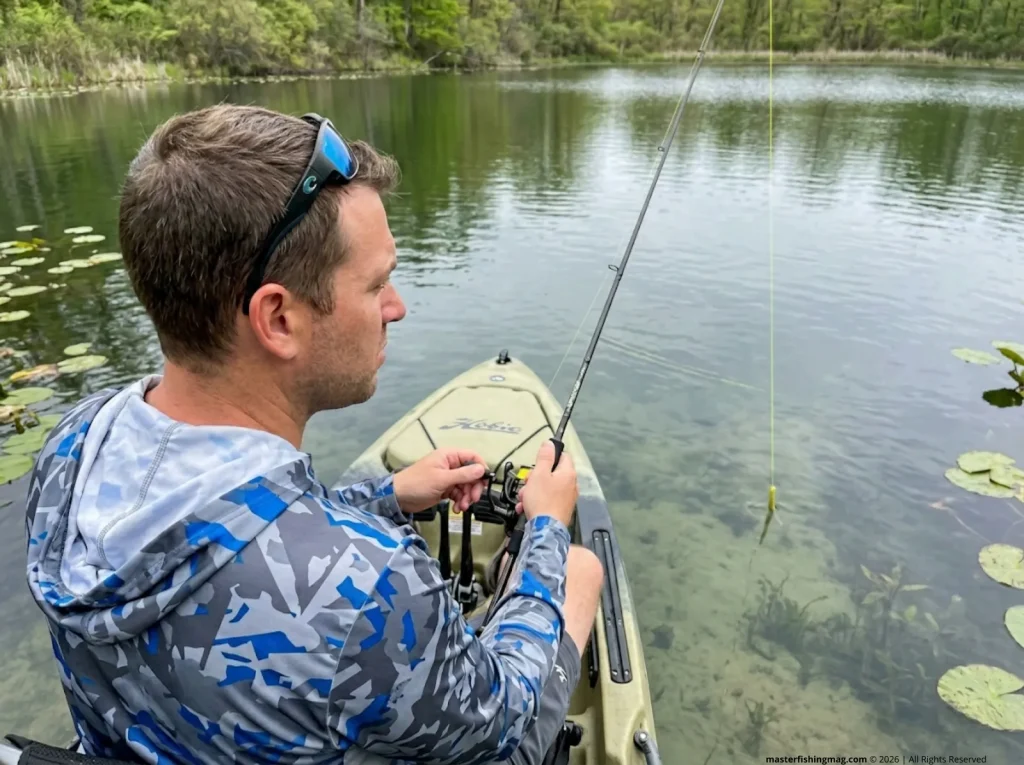
Here’s a truth most anglers figure out too late. On a wacky rig, Ned rig, or drop-shot falling on semi-slack line, the connection between your rod tip and the bait is basically dead air. Vibrations from a strike dissipate before they ever reach your hand.
Low-stretch braided line transmits vibration better than monofilament, sure. But only under tension. The moment your line goes slack — and it has to go slack for a natural presentation — that advantage vanishes. You could be holding the most sensitive fishing rod on the market and you’d still miss the fish that quietly picks up your bait and swims toward you.
Cold-water and clear-water bass make this worse. They produce lighter mouth pressure during the strike. Often just enough suction to move the line without loading the rod at all. As the New York State Department of Environmental Conservation notes, sometimes you can see the hit on your line before you feel it.
Pro tip: If you’re only feeling for the bite, you’re probably missing 70 percent of your takes on falling presentations. Train your eyes first, and your hands become a backup system.
When Line Watching Beats Everything Else
Vertical fall presentations are where line watching earns its keep. Wacky rig Senkos, Ned rigs, and shaky heads all produce bites during the descent — before the fishing line ever tightens against the rod. Cold or lethargic fish that mouth the bait without aggressive head shakes? Your rod won’t register them. But your line will jump, slide, or stop.
Wind makes it worse for feel but can actually help your eyes. Wind noise on the rod tip masks subtle vibrations, while the line entry point on the water surface still shows movement clearly. And in clear water with 3+ feet of visibility, bass commonly approach a bait three to five times before committing. Each approach creates micro-movements on the line that most anglers never notice because they’re watching the wrong thing.
What Clear Water Changes About Fish Behavior
In gin-clear water — the kind where you can see bottom at ten feet or more — everything changes. Bass get cautious. They circle. They nose the bait. They back off. Each inspection creates a faint line twitch that you’ll never feel in the rod but can absolutely see if you know where to look.
Pressured clear water fish also approach from the side more often than from below or behind. Lateral approaches move the fishing line sideways rather than pulling it down, which is exactly the kind of movement your rod tip averages out and your eyes catch instantly. This is why light line finesse techniques built around visual detection outperform feel-based systems in high-visibility conditions.
Reading the Four Signals Your Line Sends
Line Jump — The Classic Strike on the Fall
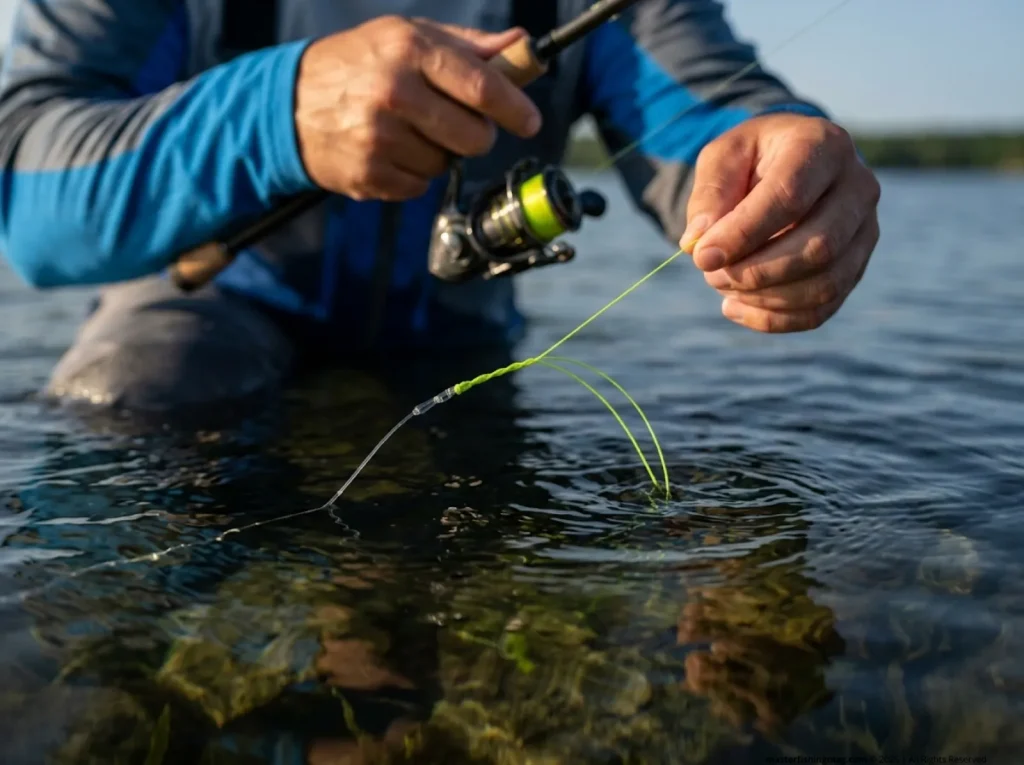
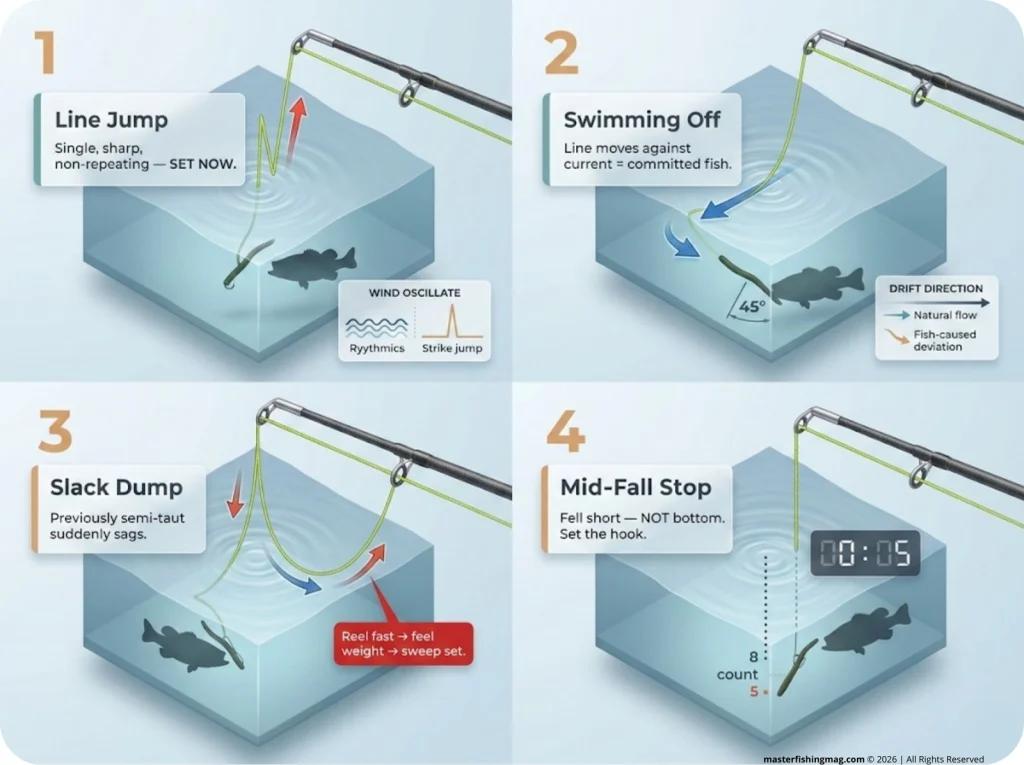
The line jump is the signal most anglers learn first, and it’s the easiest to spot. A sudden vertical twitch or pop in the line while your lure is sinking on a semi-slack presentation almost always means a fish hit from below, pushing the lure — and the line — upward.
You’ll see this most often on wacky rig falls and Ned rig drops when bass intercept from underneath. With high-vis braid, it shows as a sharp hop at the water entry point. One critical distinction to learn early — wind creates rhythmic, repeating oscillation. A bite jump is a single, sharp, non-repeating movement. Once you learn the difference, you’ll never confuse them.
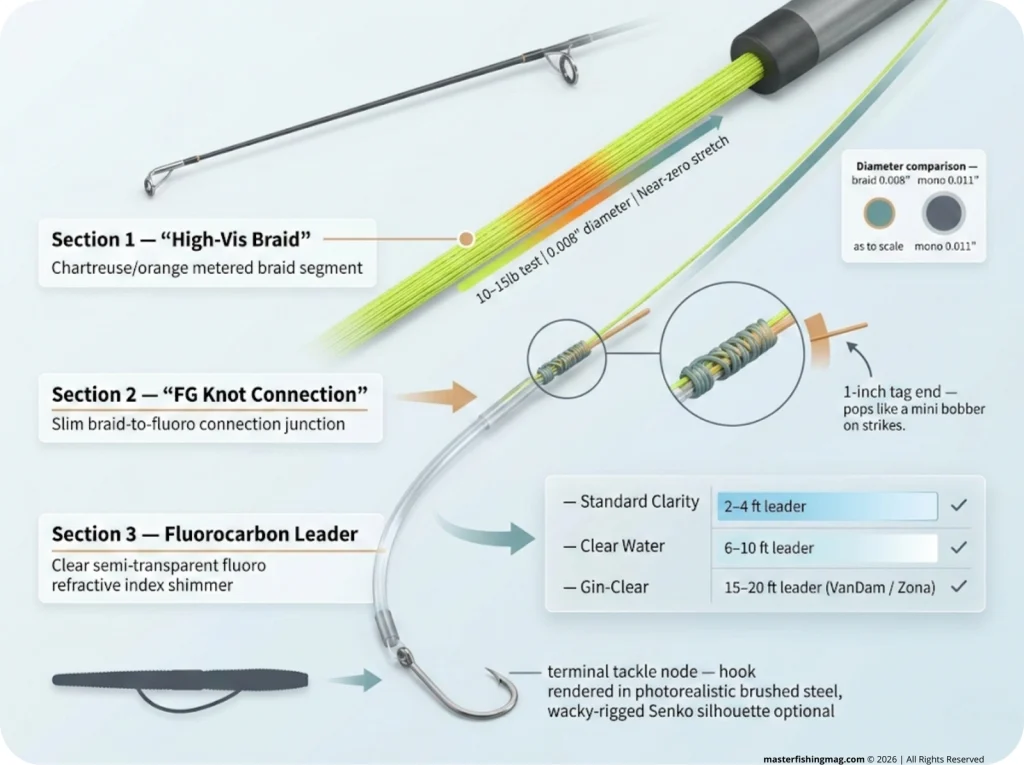
Pro tip: Leave a 1-inch tag end past your FG knot where the braid meets the leader. That short tag-end knot jumps like a miniature bobber on strikes and amplifies the visual indicator more than you’d expect.
The tag-end trick is something I picked up from a guide on a pressured reservoir, and it’s one of those small adjustments that makes a disproportionate difference. When your wacky rig Senko flutter gets intercepted on the fall, that little tag pops upward and gives you a half-second head start on the hookset.
Swimming Off — The Lateral Carry
When the line at the water entry point slides left, right, or moves faster than the natural drift, a fish has the bait and is moving with it. This is the swimming off signal, and in zero-current conditions like ponds or sheltered coves, any lateral movement in the line is fish-caused. Period.
In current, you need to distinguish natural drift from a take. The tell is direction — a fish swimming off moves the line against the current or perpendicular to it. Set the hook immediately when you see it. A fish that’s swimming off with your lure has committed and will spit quickly once it feels tension building.
Slack Dump — The Fish Comes to You
This one is sneaky. Your line suddenly goes slack when you had semi-tight tension. It sags. It relaxes. It looks like absolutely nothing happened. But what actually happened is a fish picked up the bait and swam straight toward you, killing all tension in the line.
The slack dump is the hardest signal to detect because your brain interprets the lack of input as “nothing is happening.” In reality, a fish already has your bait in its mouth. When you see it, reel fast until you feel weight, then sweep set. Community forums are full of anglers who describe this as “the line just stopped” or “it swam at you.”
The Mid-Fall Stop — Your Lure Hit Something That Wasn’t There
Your lure should reach bottom in a predictable amount of time based on weight and depth. If the line stops sinking early, something intercepted it. This is the most subtle signal of all four, and it requires knowing your lure’s normal fall rate at various depths.
Practice counting the fall at a known depth until you can predict when the bait sinks to bottom. Any deviation — the line stops sinking a count early, or the descent rate changes — means set the hook. This is where shaky head and drop-shot bite detection in the 8-to-20-foot zone gets separated from luck and turned into skill.
Build Your Line-Watching Rig From Rod Tip to Leader
High-Vis Braid Selection — See Every Twitch
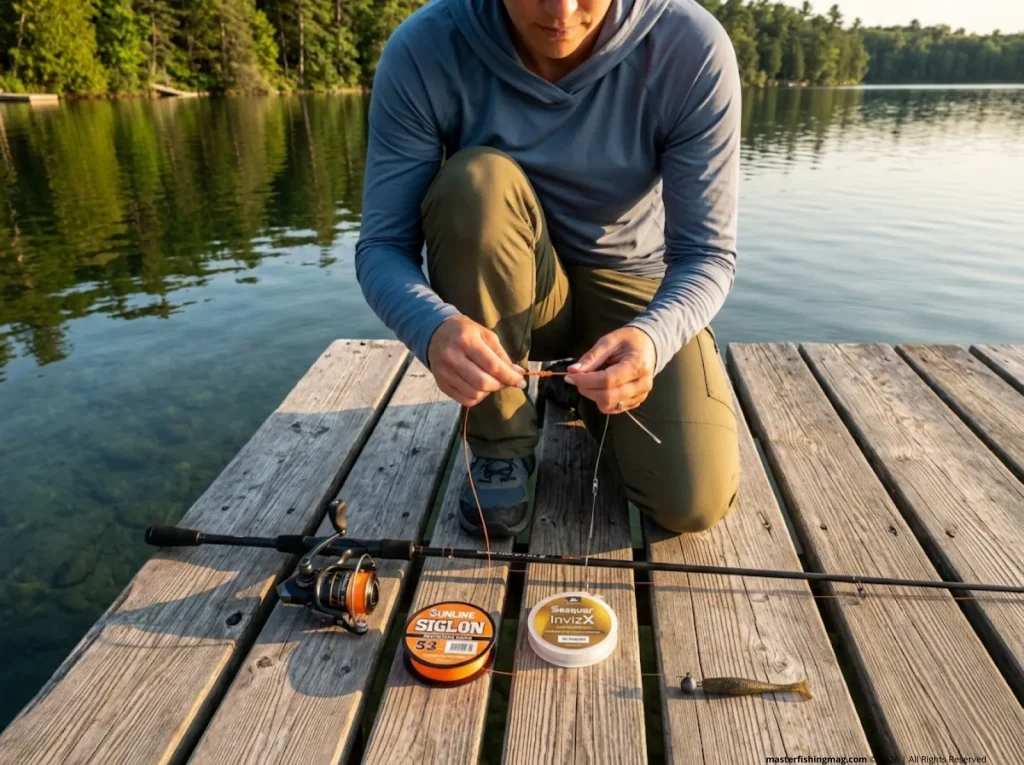
Your mainline needs to be visible above water and thin enough to maintain sensitivity. Chartreuse braid, safety orange, or hi-vis yellow in 10 to 15lb test hits both marks. According to the Oklahoma Department of Wildlife Conservation line-diameter comparisons, 10lb braided line runs about 0.008 inches in diameter versus 0.011 inches for monofilament at the same test. Thinner profile, brighter color, and near-zero stretch — that’s your detection foundation.
Sunline Overwatch in metered chartreuse and orange is my go-to. The color changes along the spool give you a rough depth reference on the fall while staying easy to track at the surface. Avoid dark green or camo braid for any application where line watching matters. You’re defeating the entire purpose.
Fluorocarbon Leader Length — The Clear-Water Stealth Variable
Leader length is where most anglers get lazy, and it costs them fish in clear water. A standard 2 to 4 foot fluorocarbon leader works in moderate clarity. But gin-clear pressured water with 8 to 15 feet of visibility demands 10 to 20 foot stealth leaders to distance your bright braid from the strike zone.
Kevin VanDam runs longer leaders as water clarity increases. Mark Zona has talked about going 15 to 20 feet of fluoro on Dale Hollow-type gin-clear smallmouth lakes. The reason is straightforward — fluorocarbon’s refractive index makes it less visible underwater than braid or mono, and a longer leader means a bigger buffer between your visible line and the fish’s window of detection.
Connecting Braid to Leader — The Tag-End Trick
The FG Knot or Double Uni are the standard connections for braid-to-fluoro, and for good reason. Both produce slim knots that pass through guides cleanly and create minimal water disturbance. If you haven’t yet built confidence with the three line-to-leader connections I trust, the Double Uni is the fastest to learn while the FG is the slimmest.
Remember the tag-end knot visual indicator from earlier. Trim the tag just long enough to be visible in your peripheral vision at the line entry point, but not so long it catches weeds.
The Clear-Water Practice Protocol
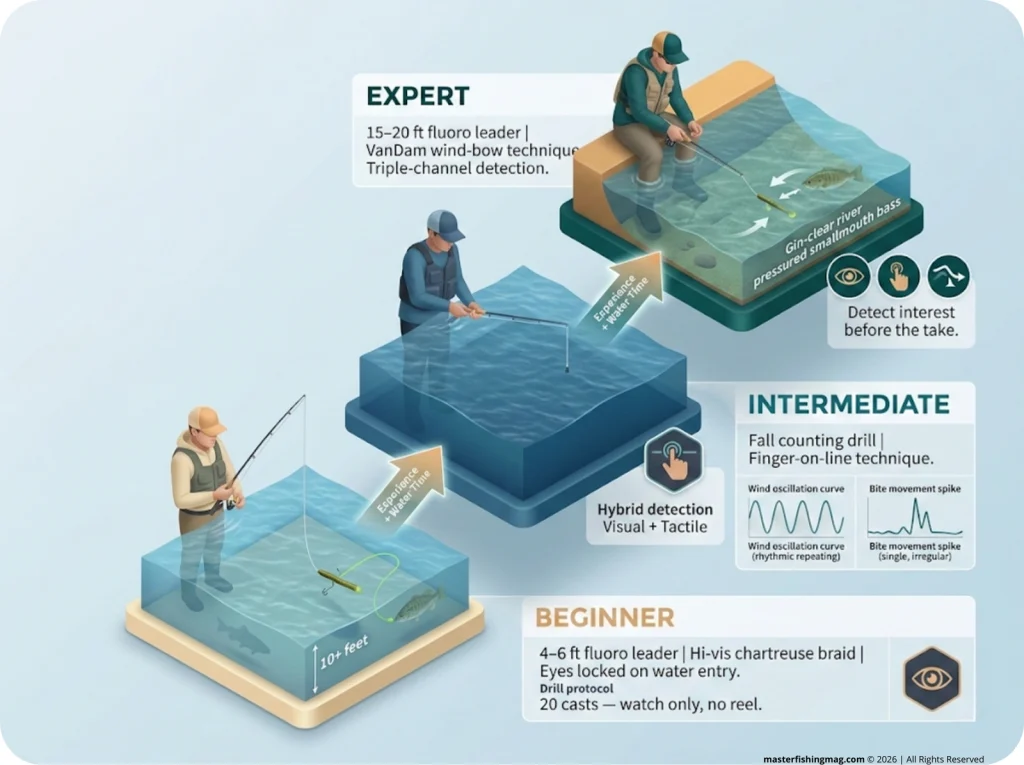
Beginner Drills — Train Your Eye in 10-Foot Visibility
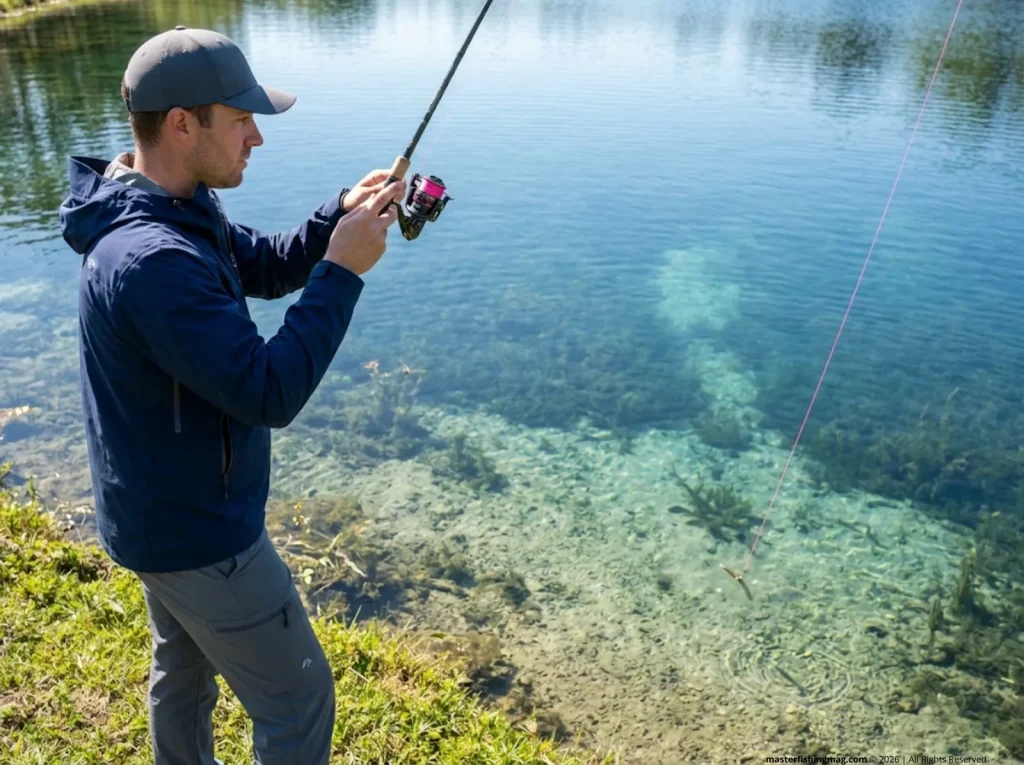
Most anglers try to learn line watching in murky waters on pressured fish. That’s backwards. Start in the clearest water you can find — 10+ ft visibility or more — where you can see both the fish and the line at the same time. You’ll connect movement to cause, and the learning curve compresses dramatically.
Use a wacky rig Senko on 4 to 6 feet of fluoro leader with hi-vis chartreuse braid. Cast to visible structure. Don’t look at the rod tip. Lock your eyes on the line-to-water entry point. Practice 20 casts in a row without touching the reel — just cast, watch, and set on any movement.
Pro tip: Cast into 10+ foot visibility water on purpose to train your eye. It’s the single best investment in your finesse game, and most anglers never think to do it deliberately.
Intermediate Skills — Reading Micro-Movements
Once you’re comfortable watching for the big four signals, graduate to situations where you can’t see the fish — deeper open water in the 8 to 15 foot range with clear conditions. This is where you learn to distinguish wind oscillation from bite movement. Wind is rhythmic and repeating. A bite is single and irregular.
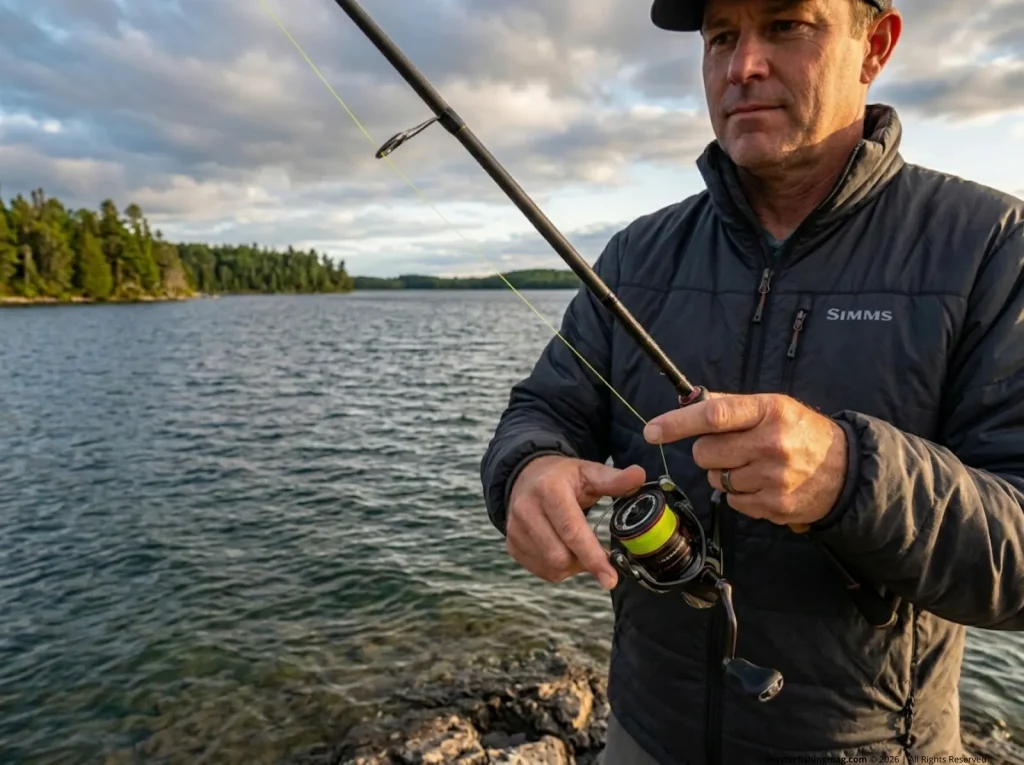
Add the finger-on-line technique here. Rest your index finger under the line between the reel and the first guide. This creates a hybrid detection system — tactile plus visual — that catches more subtle bites, especially in windy conditions where visual-only monitoring gets noisy.
Expert Level — Pressured Smallmouth in Gin-Clear Rivers
This is where everything comes together. Extend fluorocarbon leader lengths to 15 to 20 feet. Learn to read the micro-twitches during multiple pre-commit approaches. Use Kevin VanDam’s wind-bow technique. And combine all three detection channels — visual, tactile, and wind-bow — simultaneously.
At this level, you’re not just detecting bites. You’re detecting interest. Every faint line twitch tells you a fish is there, inspecting, and deciding. When the actual take comes, you’re already expecting it. That’s what sight fishing in clear water looks like when you can’t see the fish but can read every signal the line gives you.
Five Mistakes That Cost You Fish Every Session
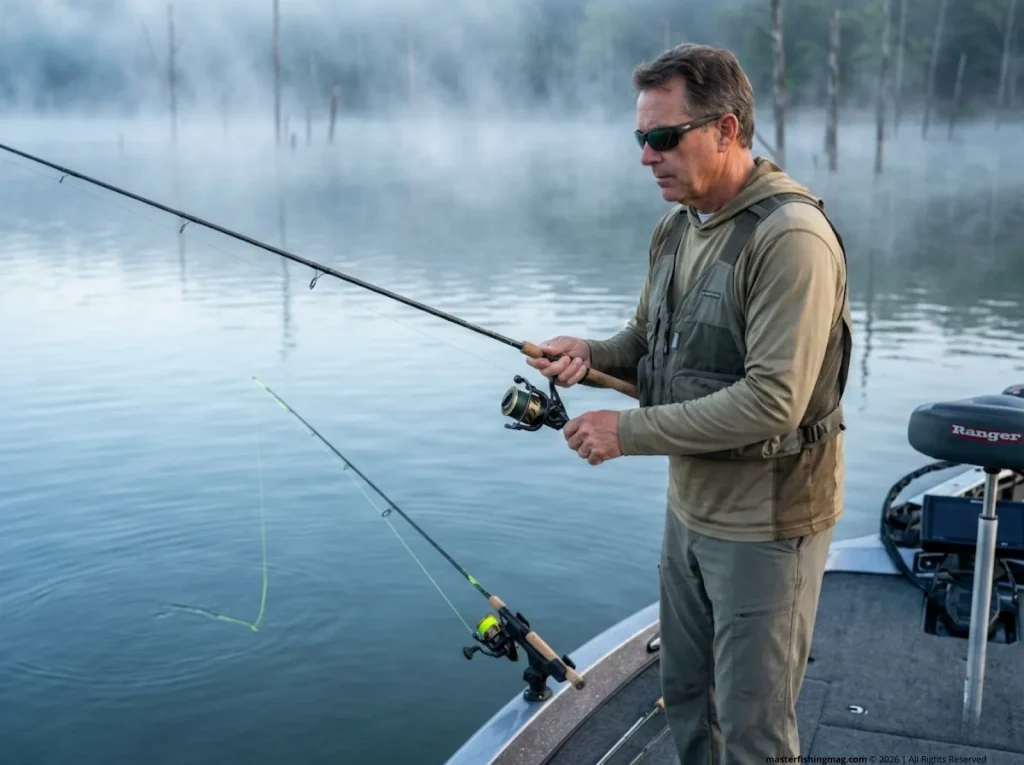
Watching the Rod Tip Instead of the Line
The rod tip averages out subtle movements. It mixes wind, current, and bite signals into one muddy picture. The line entry point on the water surface isolates bite movement from everything else. Retrain your eyes — lock your gaze on the spot where line enters water and use peripheral vision for rod position.
Setting the Hook Too Late on Visual Cues
When you see line movement, the fish already has the bait. You have one to two seconds before it spits. Kevin VanDam’s rule applies here — “I always set the hook when unsure. I do a reel/pull set until the rod loads.” A missed hookset costs one cast. A missed bite costs one fish. The math is simple.
Using the Wrong Line Color for Conditions
Chartreuse braid excels against overcast sky and dark water backgrounds. Orange or pink braid works better against bright sky. Dark green or camo braid defeats line watching entirely — save it for reaction-bait applications where cold water line performance differences matter more than line visibility.
The KVD Wind-Bow System and Advanced Hybrid Detection
How the Wind-Bow Works
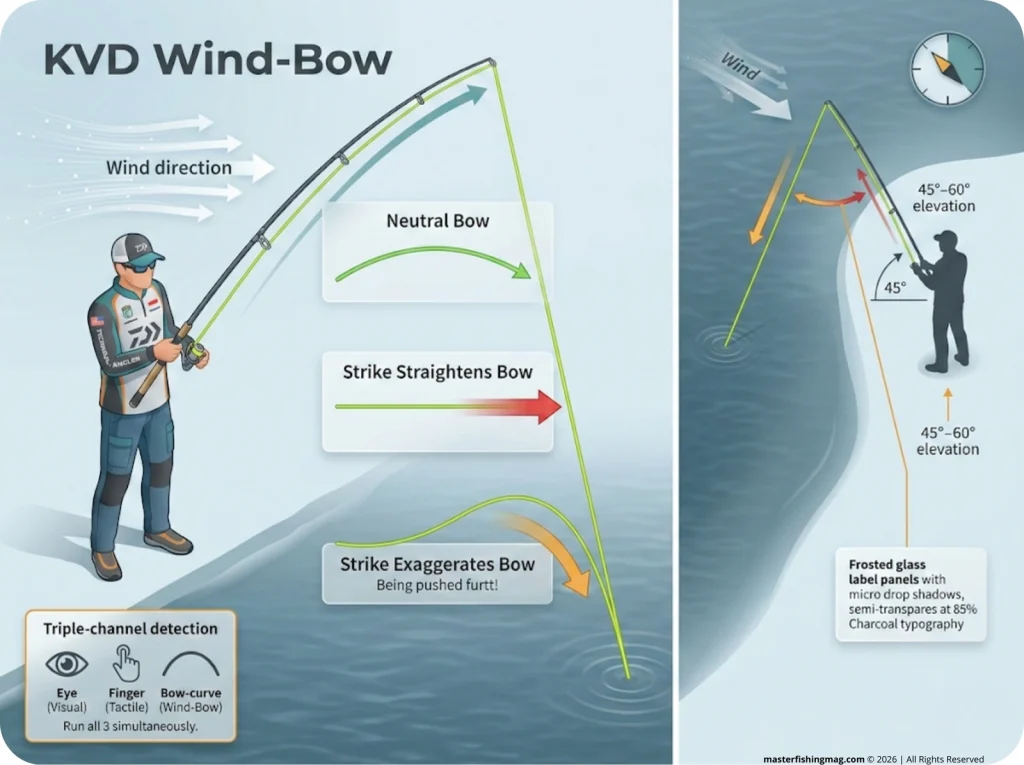
Hold your fishing rod high at 45 to 60 degrees and angle it quarter into the wind. Let the wind push a controlled curve into the line between the rod tip and the water. That bow acts like a visual spring bobber — any strike movement straightens or exaggerates the curve, making it instantly visible even at distance.
Kevin VanDam developed this for open-water panfish in cold water conditions, where delicate bites are so subtle that neither rod feel nor standard line watching caught them consistently. According to Noble Research Institute guidelines on Secchi disk visibility, the type of high-clarity water where this technique shines most is measurable — and predictable.
Combining Three Detection Channels
The ultimate bite detection setup runs three channels at once. Visual — watch the line at the entry point for jumps, swims, stops, and slack dumps. Tactile — index finger under the sensitive line between reel and first guide. Wind-bow — the controlled curve acts as a visual indicator amplifier for any movement.
Running all three simultaneously creates a detection system that catches fish strikes other anglers never knew happened. It takes practice to manage all three inputs without overloading your attention, but once it clicks, you’ll wonder how you ever fished finesse without it.
Pro tip: Index finger under the line while watching — the hybrid feel plus sight combination is the deadliest bite detection setup I’ve ever used in pressured clear water.
Conclusion
Your rod tip lies to you on slack-line presentations. The line at the water entry point tells the truth — every jump, lateral slide, and slack dump is a fish talking to you if you know how to listen with your eyes.
High-vis braid plus a long fluorocarbon leader is not a compromise. It’s a system. Line visibility above the surface, stealth below it. Match leader length to water clarity and you’ve solved half the equation.
Line watching is a trainable skill, not a talent. Start in 10-foot visibility water. Practice 20 watched casts per session. Graduate to micro-movements. The fish you’ve been missing were never unfair — you just weren’t looking in the right place.
Next time you’re on clear water with a Ned rig or wacky Senko, force yourself to watch the line instead of the rod tip for one full hour. Count how many movements you see that you never felt. That number is the fish you’ve been leaving behind.
FAQ
How do you watch your fishing line for bites?
Focus your gaze on the point where your fishing line enters the water, not on the rod tip. Any sudden jump, lateral slide, or unexpected stop signals a fish has taken the bait. Set the hook immediately on any unnatural movement, even if you didn’t feel a thing through the rod.
What is the best line color for line watching?
Chartreuse or hi-vis yellow braid in 10 to 15lb test gives the strongest contrast against most backgrounds. Use orange or pink braid against bright sky conditions. Always pair it with a fluorocarbon leader — 6 to 20 feet depending on water clarity — to keep things stealthy below the surface.
Line watching vs feeling the bite — which is better?
Neither is universally better. Rod feel catches aggressive fish strikes under tension. Line watching catches subtle bites on slack-line presentations like falling baits, cold water fish, and finesse rigs. The best anglers use both simultaneously with the finger-on-line technique for hybrid detection.
How long should your fluorocarbon leader be in clear water?
Match leader length to water clarity. Standard clarity at 3 to 6 feet of visibility needs a 2 to 4 foot leader. Clear water with 6 to 10 feet of visibility calls for a 6 to 10 foot leader. Gin-clear pressured conditions with 10+ feet of visibility demand 15 to 20 foot stealth leaders. The longer the leader, the more distance between your visible line and spooky fish.
Can you line watch with monofilament instead of braid?
Monofilament makes line watching harder because stretch absorbs movement and dampens the visual signal. It also comes in fewer high-visibility colors. Braided line’s near-zero stretch transmits line movements crisply, and hi-vis braid colors make detection reliable even at distance. If you must use mono, choose bright yellow and fish shorter distances.
Risk Disclaimer: Fishing, boating, and all related outdoor activities involve inherent risks that
can lead to injury. The information provided on Master Fishing Mag is for educational and informational purposes
only. While we strive for accuracy, the information, techniques, and advice on gear and safety are not a substitute
for your own best judgment, local knowledge, and adherence to official regulations. Fishing regulations, including
seasons, size limits, and species restrictions, change frequently and vary by location. Always consult the latest
official regulations from your local fish and wildlife agency before heading out. Proper handling of hooks, knives,
and other sharp equipment is essential for safety. Furthermore, be aware of local fish consumption advisories. By
using this website, you agree that you are solely responsible for your own safety and for complying with all
applicable laws. Any reliance you place on our content is strictly at your own risk. Master Fishing Mag and its
authors will not be held liable for any injury, damage, or loss sustained in connection with the use of the
information herein.
Affiliate Disclosure: We are a participant in the Amazon Services LLC Associates Program, an
affiliate advertising program designed to provide a means for us to earn advertising fees by advertising and linking
to Amazon.com. As an Amazon Associate, we earn from qualifying purchases. We also participate in other affiliate
programs and may receive a commission on products purchased through our links, at no extra cost to you. Additional
terms are found in the terms of service.