
In this article
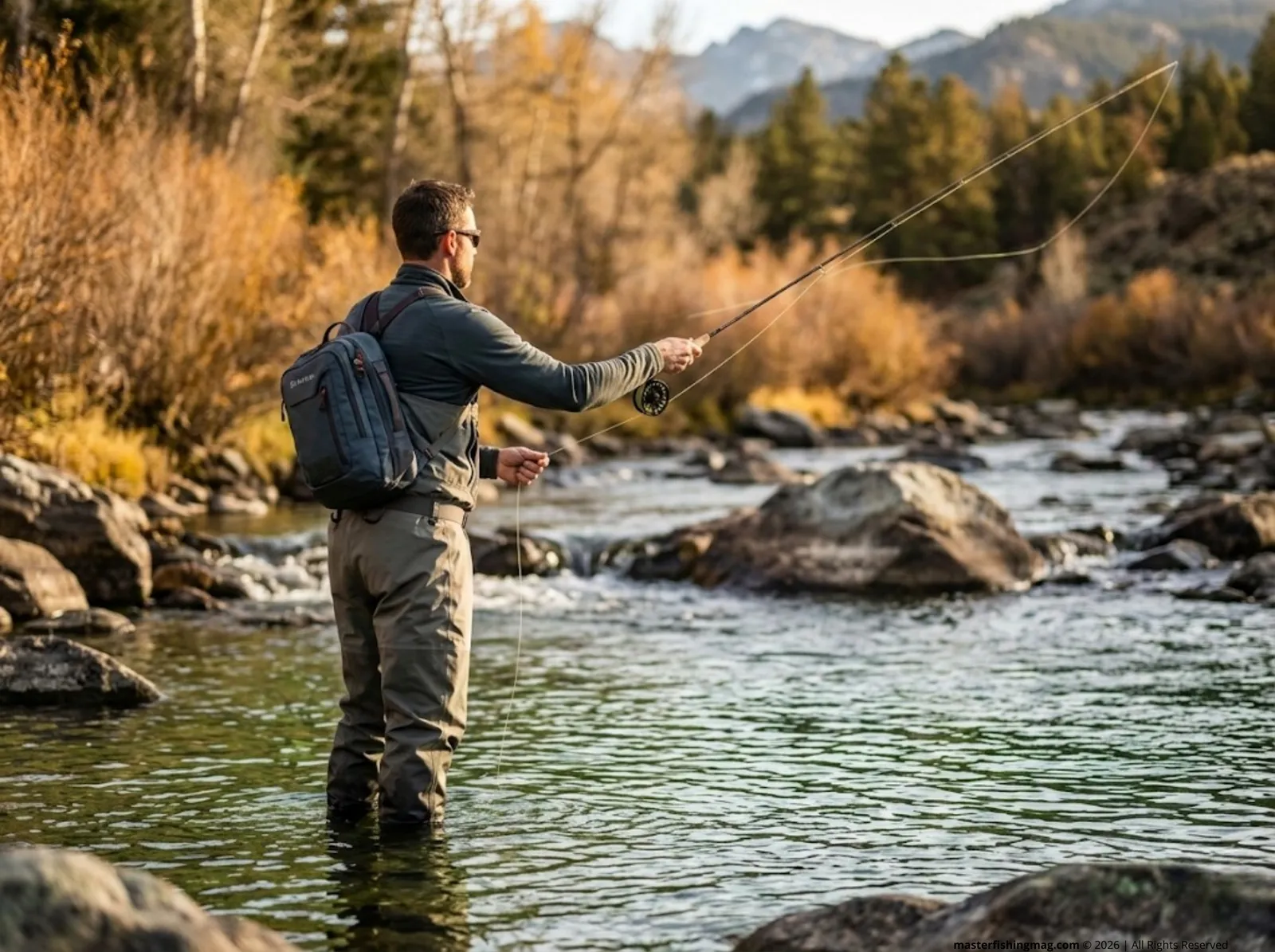
Four hours into a late-October wade on the Madison, my right shoulder locked up mid-mend. Not the sharp kind of pain you notice—more like someone had slowly poured concrete into the joint while I wasn’t paying attention. My roll casts started dying two feet short. My mends barely moved the indicator. I blamed fatigue, water temperature, bad luck. Then I swapped my 8-pound sling pack from my right shoulder to my left and felt the difference within twenty casts. That day cost me a dozen clean drifts I’ll never get back—all because I’d never thought about how my fishing pack sits on my body.
After years of testing both hip packs and shoulder strap slings across dozens of rivers, I’ve learned that your pack choice isn’t just about storage. It directly affects your casting endurance, your wading safety, and how long you can stay effective on the water. This article breaks down the real trade-offs between hip belt and sling pack systems so you can match your carry setup to your casting style, your typical wading depth, and the actual demands of your water.
⚡ Quick Answer: Hip-belt packs keep both shoulders free for casting and work best for short wades with minimal gear. Sling packs ride higher for deeper crossings and offer faster access, but load one shoulder and can cause casting-arm fatigue after 3-4 hours. Neither is universally better—match your pack to your wading depth, session length, and gear volume.
The Physics of Where Your Pack Sits
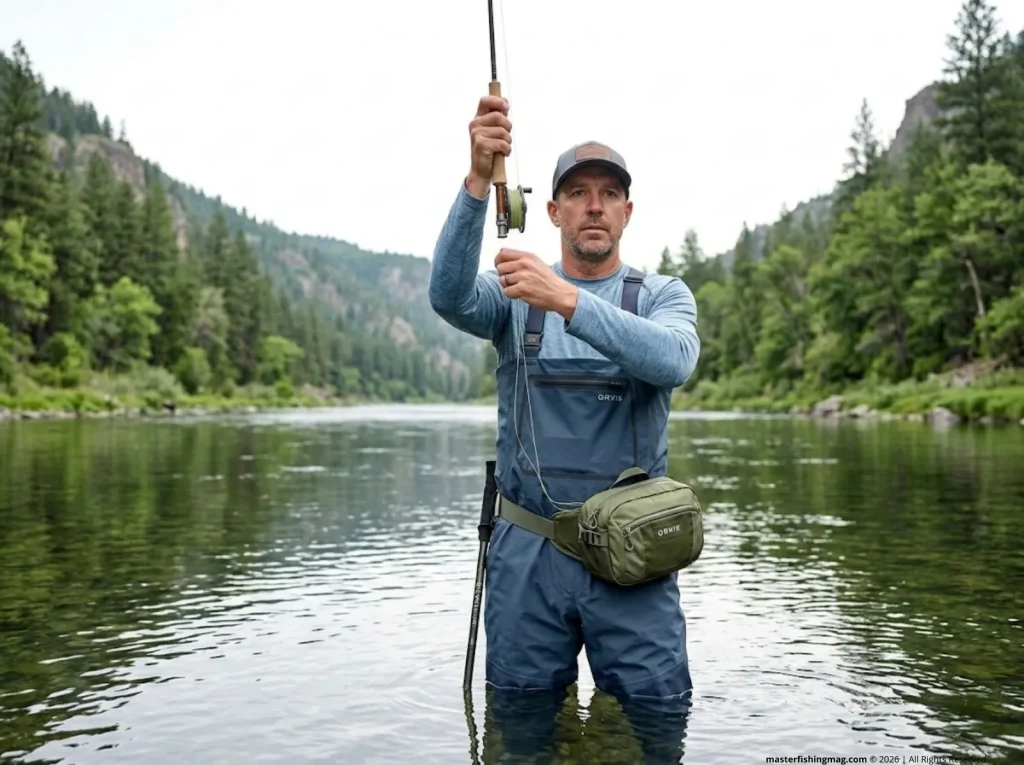
How Asymmetric Load Degrades Your Cast Over Time
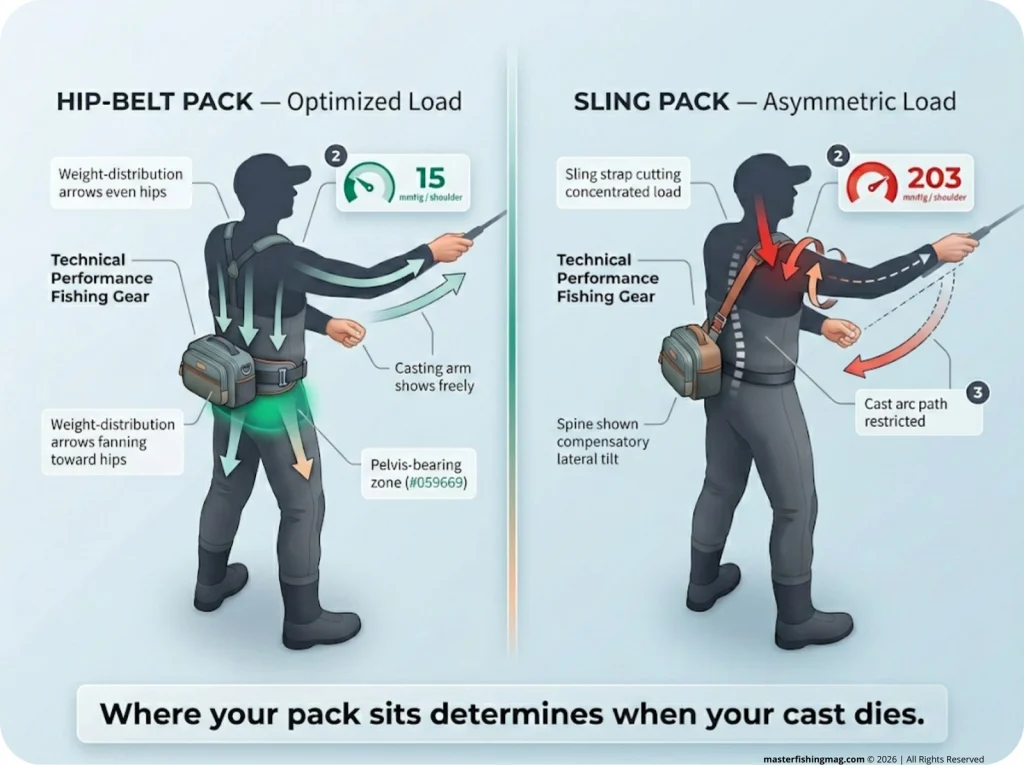
Here’s what most anglers never consider. A sling pack riding on your casting shoulder creates a constant one-sided pull that accumulates over hours, not minutes. Your body compensates with micro-adjustments in posture, shoulder tension, and arm movement—and every one of those adjustments chips away at your casting stroke.
Hip belts redistribute roughly 70-80% of pack weight from the shoulders down to the pelvis. That translates to a massive drop in shoulder pressure—from around 203 mmHg bearing down on one shoulder to roughly 15 mmHg when the load sits on your hips instead. For a fishing pack weighing 5-8 pounds, those numbers might sound irrelevant. But asymmetric placement on a single shoulder amplifies the effect far beyond what the raw weight suggests.
The UC Davis ergonomics guidelines on load distribution recommend keeping carried loads under 15% of body weight—about 22.5 pounds for a 150-pound angler. Your pack is well under that. The problem isn’t the weight itself. It’s where you put it. For anyone dealing with tackle ergonomics and repetitive strain prevention, pack placement matters as much as rod balance.
Pro tip: Before committing to a pack style, load it with your actual gear and do 50 roll casts and mends. Note exactly when fatigue kicks in. That number tells you more than any product review.
Why Hip Belts Protect Your Casting Shoulder
Hip pack designs transfer the entire load to your pelvis, leaving both shoulders completely free and symmetrical. This matters most during high-sticking nymphs and sustained mending, where your shoulder joint rotates repeatedly under tension.
Mike Mansfield, a Montana guide with over 20 years on the water, put it simply: “When I’ve layered up in the colder months, I prefer not to have anything over my shoulders due to the bulk.” Cold-weather layering creates friction between jacket shells and pack straps. A hip pack eliminates the shoulder-strap-over-jacket problem entirely.
The Casting-Side Sling Problem Nobody Talks About
Right-handed casters wearing a sling pack on their right shoulder experience compounded fatigue. You’re adding pack weight on top of the repetitive casting motion—a double load on the same joint.
The fix is straightforward: wear the sling on your non-casting shoulder or choose ambidextrous convertible models. John Kreft, a veteran fly fisherman, reported chronic shoulder pain specifically from dominant-side wear. Models like the Patagonia Stealth Switch allow reversible wear, but most anglers never think to switch sides. If your sling pack only rides on one shoulder and that’s your casting side, you’re working against yourself every trip.
Hip Pack Strengths and Where They Fall Short

When a Hip Pack Is the Right Call
For minimal gear days—one to three fly boxes, tippet, floatant—a hip pack keeps weight low and completely out of your casting plane. Both arms stay free for overhead casts, double hauls, and tight-loop presentations. No strap fighting with your wading jacket.
The Orvis Guide Hip Pack delivers 9L of capacity at just 1.54 pounds, built with recycled ECO CORDURA and featuring the Tippet Whippet docking station for one-handed tippet access. For short morning wades with a minimalist loadout, it’s hard to beat the simplicity of a well-designed hip belt system.
The Submersion Problem at Waist-Deep Crossings
Hip packs ride at belt level. Waist-deep water puts your gear underwater unless the pack is fully waterproof. Standard water-resistant zippers fail in any submersion above the hips. One angler on a forum captured it perfectly: lost a box of dries when he slipped in what was supposed to be knee-deep water.
The Fishpond Ledges ZS2 650 Waist addresses this with fully waterproof construction, but adds weight and cost. If you regularly cross water above mid-thigh, a standard hip pack will eventually dunk your flies. That’s not a question of if—it’s when.
Pro tip: For deep wades with a hip pack, keep your most valuable flies in a waterproof chest pocket as insurance. Your sling carries them above the waterline, but your hip pack doesn’t.
The Wader Wedgie and Rotation Problem
The hip belt pulls wader material uncomfortably when you twist to reach the pack behind you—what Due West Anglers calls “the wedgie in waders effect.” The wider the belt, the worse the rotation restriction. You’re spinning the pack to the front rather than swinging it under your arm, and that difference in gear access speed adds up over a full day of fly changes.
Some anglers add an optional shoulder strap for heavy loads, but this creates an awkward hybrid that delivers neither pure hip stability nor sling accessibility. Properly setting your wader suspenders at the right height helps reduce belt-wader interference, but it doesn’t eliminate it.
Sling Pack Strengths and Where They Fall Short
The Swing-Access Advantage Mid-River
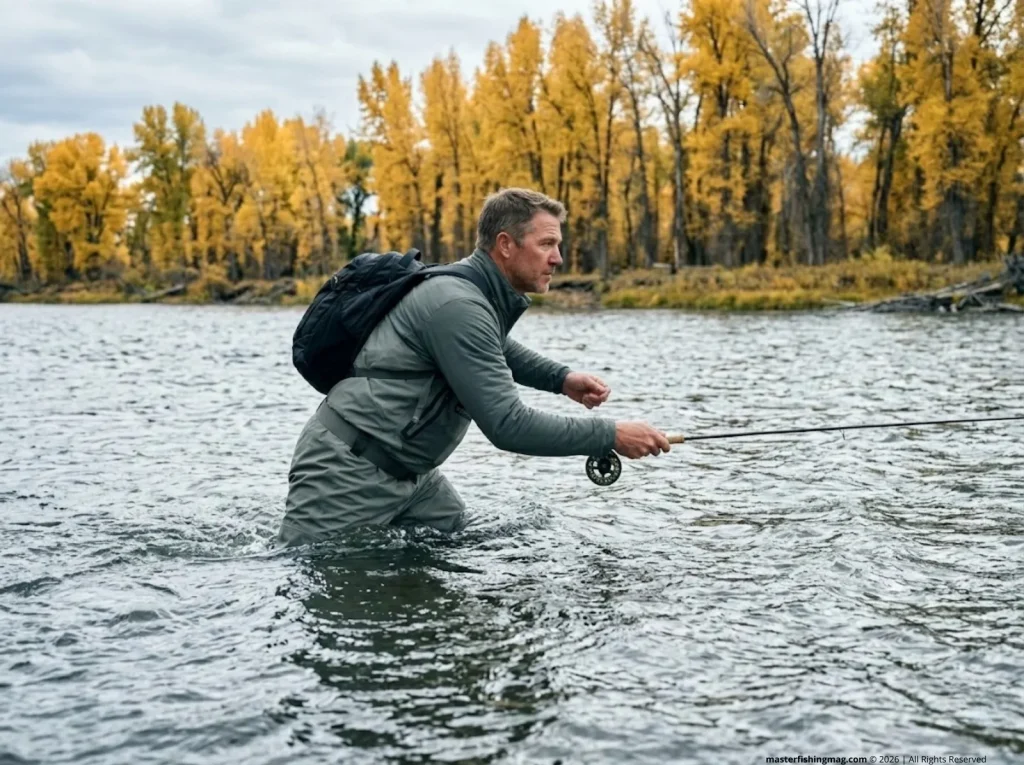
Sling packs rotate from back to front under the arm in one motion. No twisting, no reaching behind you. Mid-river fly changes become ten-second operations instead of thirty-second fumbles with numb fingers and a hip pack you can’t see.
Net holster integration works better on slings, too. The pack’s higher position keeps the net handle accessible at shoulder level without release mechanisms. Scott Dickson, a Colorado wade-fishing guide, explained his preference: “It’s comfortable on my back, easily keeps my net secure, and rides a little higher for those deeper river crossings.” Joe Demalderis, Orvis Guide of the Year 2010, confirmed: “When I plan on wading for a day… I prefer to use a sling pack.”
Higher Ride Position for Deep Wading
This is the sling’s critical advantage over hip packs in chest-deep water. Sling packs sit higher on the back, keeping your gear above the waterline in crossings that would submerge a hip design.
The Fishpond Thunderhead Submersible Sling offers 13L of capacity with 900D TPU-coated NewStream fabric and TRU Zip for full submersion protection. The Simms Dry Creek Z Sling holds 12L at just 19.17 ounces. Even non-waterproof slings survive deeper crossings simply by riding above where hip packs go under. Capacity ranges from 8-18L versus a hip’s typical 5-9L—enough room for extra layers, water, and food on all-day trips.
The Shoulder Fatigue Clock Starts at Hour Three
Single-shoulder load creates cumulative fatigue on that side regardless of which shoulder you choose. Due West Anglers reported “shoulder fatigue after a week of hard fishing” as a primary complaint among sling pack users. The pattern holds across Reddit r/flyfishing threads—dominant-side sling pain after multi-day use is one of the most common gripes.
Heavier slings loaded to 8+ pounds accelerate the problem. Lighter setups under 5 pounds extend the fatigue window. Experienced anglers who already focus on balancing their rod and reel for all-day comfort understand this instinct—weight placement affects endurance. And the data on hip-belt load transfer in backpack systems backs up what your sore shoulder already tells you.
Pro tip: Swap your sling to the opposite shoulder every 2 hours if your model allows it. A convertible design that switches sides mid-day extends your effective casting window significantly.
The Head-to-Head Comparison No Review Gives You
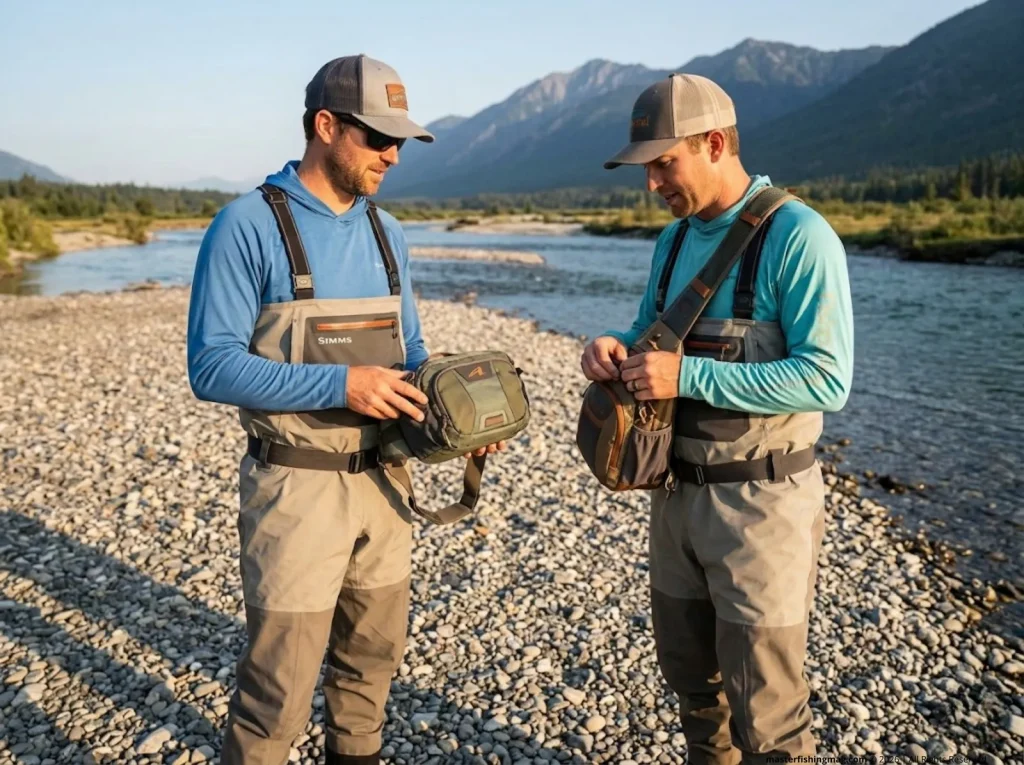
Seven Criteria That Actually Matter
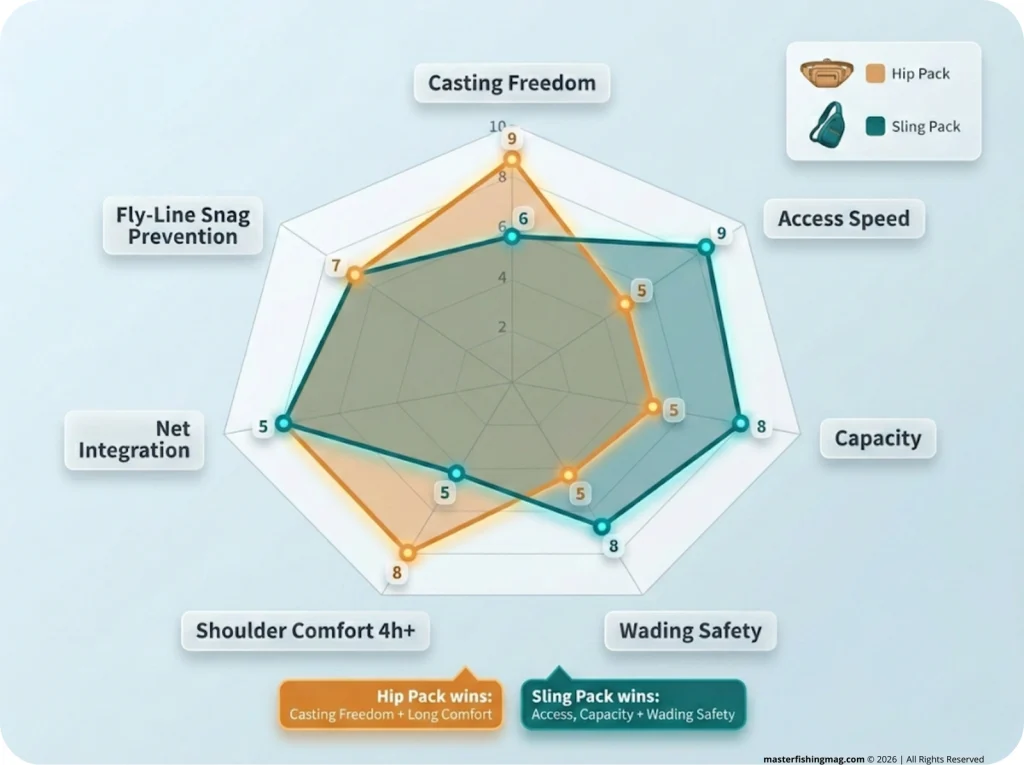
Every other comparison you’ll find online gives you separate bulleted pros and cons lists. Nobody publishes a direct scored comparison. Here’s the breakdown across seven criteria that actually determine which pack wins for your specific situation:
- Casting Freedom — Hip 9/10, Sling 6/10
- Access Speed — Hip 5/10, Sling 9/10
- Capacity — Hip 5/10, Sling 8/10
- Wading Safety — Hip 5/10, Sling 8/10
- Shoulder Comfort (4+ hours) — Hip 8/10, Sling 5/10
- Net Integration — Hip 5/10, Sling 8/10
- Fly-Line Snag Prevention — Hip 7/10, Sling 7/10
Hip packs win on casting freedom and long-session comfort. Sling packs win on access speed, capacity, and wading safety. Neither dominates. It’s a trade-off, and anyone telling you otherwise is selling something.
When Each Style Wins by Scenario
Short morning wade with minimal gear? Hip pack. Free casting, low profile, zero shoulder load. All-day wade with 3+ fly boxes and deep crossings? Sling. Higher ride, more capacity, quick swing access.
Cold weather with heavy layering? Hip wins—no strap fighting over bulk. Multi-day trip with layers, food, and a camera? Sling or a convertible hybrid. The Patagonia Stealth Switch (9L, sling-to-hip design with integrated net holster and magnets) comes closest to a “best of both” solution.
Self-test before you buy: wear your loaded pack for 50 casts of your most-used technique. If fatigue sets in before 45 minutes, reassess. That simple check, combined with solid casting accuracy through proper mechanics, will tell you everything a product page cannot.
Waterproofing, Zippers, and What Survives Deep Wades
Water-Resistant vs Fully Submersible Designs
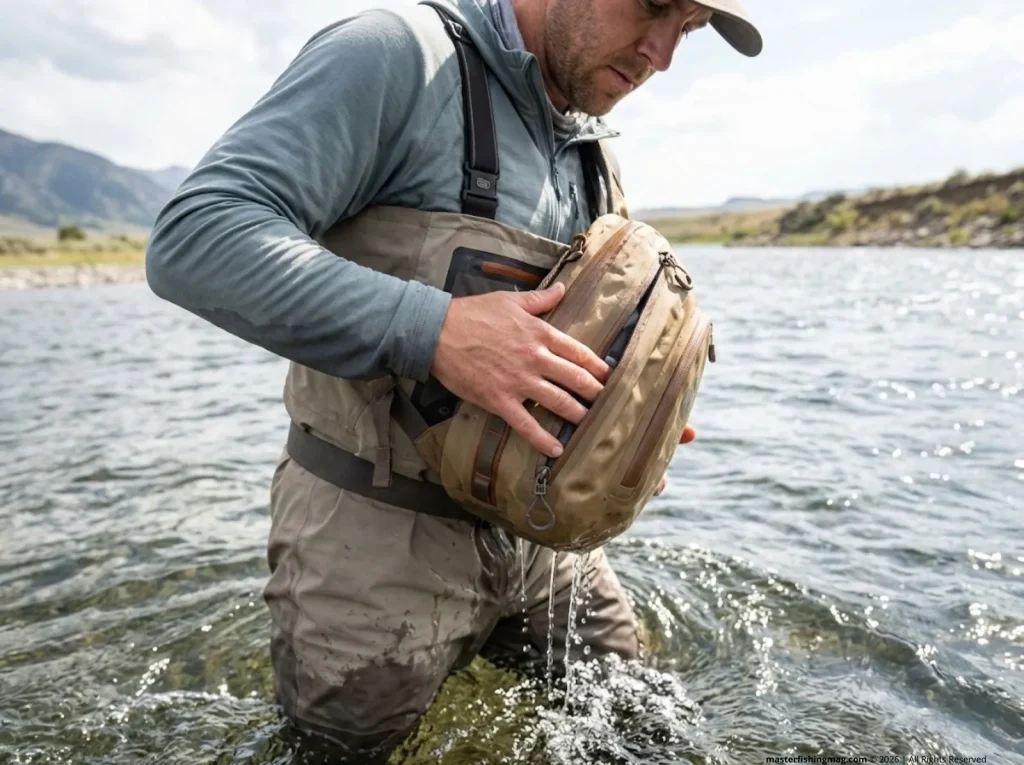
“Water-resistant” means DWR coating plus standard zippers. It handles rain and splashes. It fails on any submersion. “Fully submersible” means TPU-coated fabric plus airtight waterproof zippers like TRU Zip or YKK Flexseal—rated for complete immersion without water getting in.
The Fishpond Thunderhead uses 900D TPU-coated NewStream fabric with TRU Zip and sets the gold standard for submersible wade-fishing packs. Understanding how waterproof breathable fabrics actually work helps you cut through marketing claims. The price premium for genuine waterproofing runs about $80-120 above equivalent water-resistant models. That premium is either critical insurance or money wasted depending entirely on your typical wading depth.
Matching Your Pack to Your Typical Wading Depth
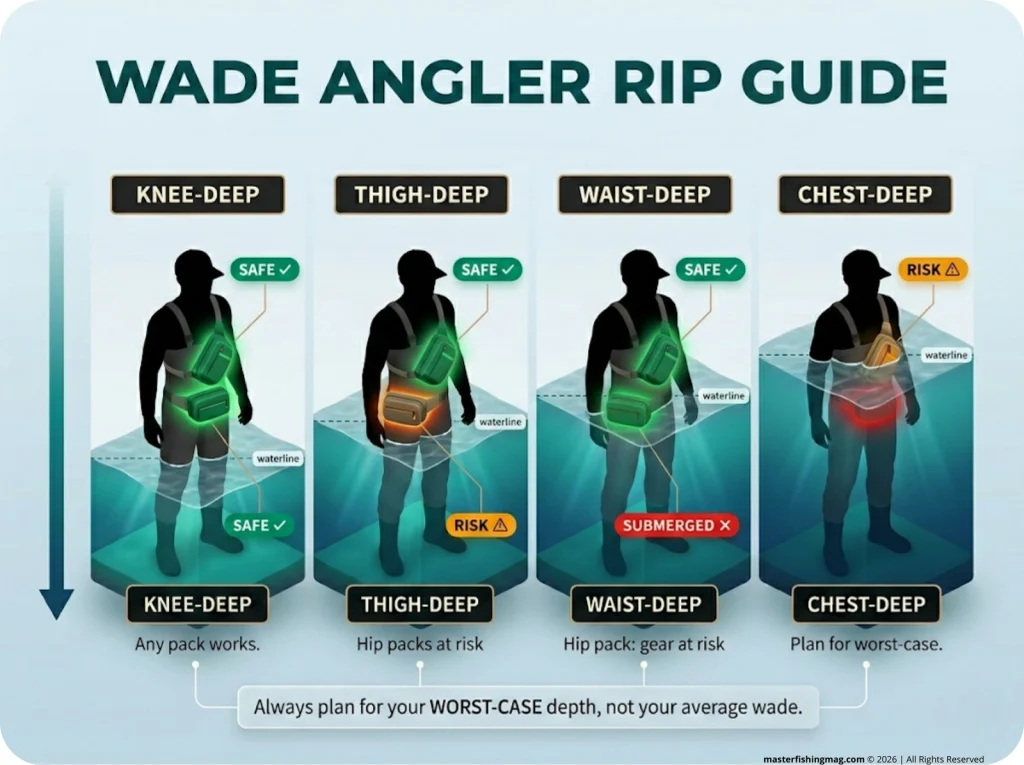
Knee-deep and below? Any pack works. Waterproofing is optional. Thigh-deep? Hip packs submerge periodically; slings stay dry most of the time. Waist-deep and above? Only submersible designs or slings riding above the waterline keep your gear safe.
Consider your worst-case wading depth, not your average. One slip turns a knee-deep crossing into a waist-deep submersion. Smart anglers follow OSHA ergonomics guidance on cumulative strain and plan for the unexpected—both for their body and for the box of parachute adams they spent all winter tying.
Picking the Right Pack for Your Specific Water
The Three-Question Decision Framework
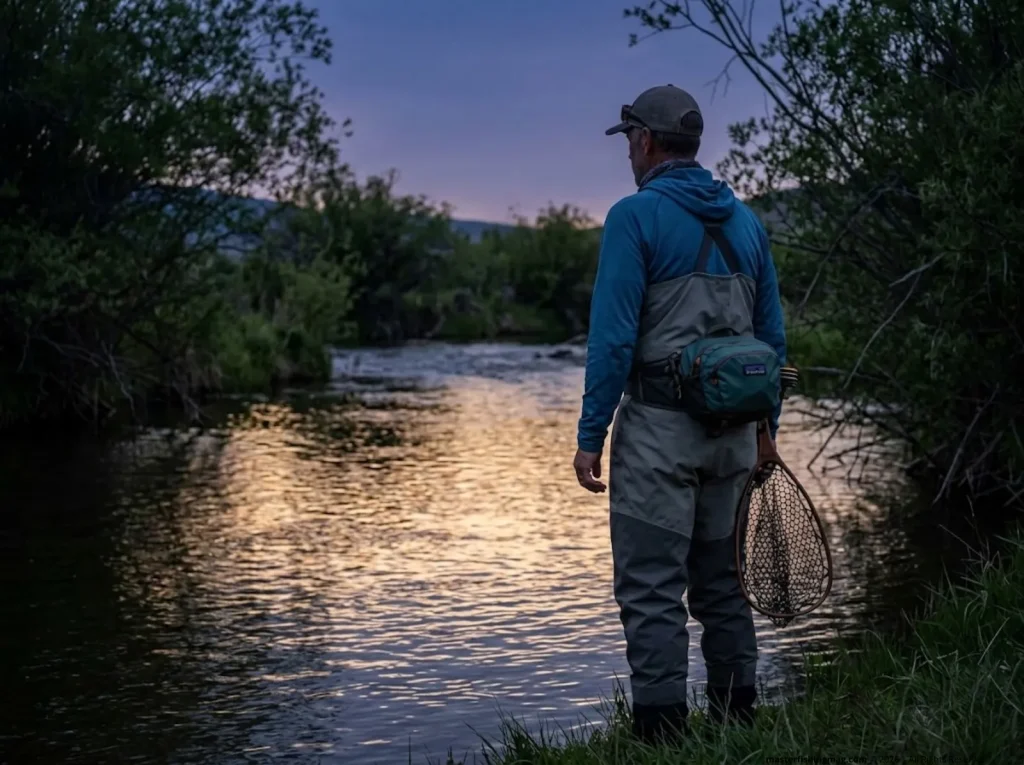
Three questions decide your pack. How deep do you regularly wade? How long are your typical sessions? How much gear do you carry?
If you answered thigh-deep or more, 4+ hours, and 6+ fly boxes plus layers—sling is your pack. If you answered knee-deep, under 3 hours, and minimal gear—hip is your pack. Everything in between? A convertible design like the Patagonia Stealth Switch (9L, sling-to-hip) gives you the most flexibility without owning two packs. Understanding why your wading belt could save your life adds another layer to this decision when you’re choosing between waist-level and shoulder-level systems for deep water crossings.
Beginner to Expert Progression Path
Start with a hip pack if you’re building your first wade-fishing kit. It forces you to carry only what’s essential and keeps your casting mechanics clean from day one. Graduate to a sling when you fish all-day sessions, need more capacity, or wade deeper water regularly.
The expert option? Own both. Use the hip for short technical sessions where casting freedom matters most. Use the sling for expedition-length wades where access method and capacity take priority. And skip the most expensive fully-waterproof sling if you only wade knee-deep creeks—you’d be paying $120+ for capability you’ll never use.
Sustainability and Materials Worth Knowing
If two packs score equally for your needs, choose the one built with recycled materials. The Orvis Guide Hip Pack uses recycled ECO CORDURA—same durability, reduced environmental footprint. Fishpond’s NewStream fabric is TPU-coated recycled nylon. Both brands repair rather than replace through their warranty programs, extending pack life and keeping one more piece of nylon out of a landfill.
Conclusion
Your pack placement directly affects your casting endurance. A sling on your casting shoulder creates measurable fatigue that no amount of willpower fixes. Switch sides or switch packs.
Hip packs win for short, technical sessions with minimal gear. Sling packs win for all-day, deep-wading trips with full loadouts. Neither is universally better. Match the pack to the water, not to someone else’s recommendation.
Waterproofing claims mean nothing without TRU Zip or Flexseal. “Water-resistant” will fail the first time you slip in thigh-deep water. Plan for your worst crossing, not your average.
Before your next trip, load your current pack with everything you actually carry and do 50 casts of your go-to technique. Time when your shoulder or hip starts complaining. That number—not any review—tells you whether your fishing pack is helping or hurting your time on the water.
FAQ
Does a hip pack get wet when wading?
Yes, any hip pack submerges in waist-deep or deeper water because it rides at belt level. Standard water-resistant models leak on full submersion—only fully submersible designs with TRU Zip or Flexseal zippers survive complete dunking. If you regularly wade above mid-thigh, go submersible or go sling.
Is a sling pack better than a vest for fly fishing?
For wade fishing, slings offer more capacity and better wading-depth safety than vests. Vests distribute weight across both shoulders (less fatigue) but trap heat, interfere with casting in layered cold weather, and provide less organized storage. Slings have replaced vests as the dominant choice among active wade guides.
How do I carry a landing net with a hip pack?
Most hip packs use belt-mounted magnetic net holsters that sit at your lower back. The downside is the net handle bounces during walking and is harder to reach mid-fight. Sling packs allow shoulder-level magnetic holsters that keep the net within arm’s reach for quick deployment.
Can I wear a sling pack on either shoulder?
Not all slings are reversible. Models like the Patagonia Stealth Switch allow both-side wear, but many are fixed to one side. If you’re a right-handed caster, verify the sling rides on your left shoulder before buying. Wearing it on your casting side accelerates shoulder fatigue and degrades cast accuracy after 3-4 hours.
What’s the best all-around fishing pack for someone who wades different water types?
A convertible design like the Patagonia Stealth Switch (9L, sling-to-hip with integrated net holster and magnets) gives the most flexibility. Use hip mode for short, shallow sessions and switch to sling for deep water crossings or all-day trips. If budget allows, owning a dedicated hip pack and a dedicated sling is the most versatile setup.
Risk Disclaimer: Fishing, boating, and all related outdoor activities involve inherent risks that
can lead to injury. The information provided on Master Fishing Mag is for educational and informational purposes
only. While we strive for accuracy, the information, techniques, and advice on gear and safety are not a substitute
for your own best judgment, local knowledge, and adherence to official regulations. Fishing regulations, including
seasons, size limits, and species restrictions, change frequently and vary by location. Always consult the latest
official regulations from your local fish and wildlife agency before heading out. Proper handling of hooks, knives,
and other sharp equipment is essential for safety. Furthermore, be aware of local fish consumption advisories. By
using this website, you agree that you are solely responsible for your own safety and for complying with all
applicable laws. Any reliance you place on our content is strictly at your own risk. Master Fishing Mag and its
authors will not be held liable for any injury, damage, or loss sustained in connection with the use of the
information herein.
Affiliate Disclosure: We are a participant in the Amazon Services LLC Associates Program, an
affiliate advertising program designed to provide a means for us to earn advertising fees by advertising and linking
to Amazon.com. As an Amazon Associate, we earn from qualifying purchases. We also participate in other affiliate
programs and may receive a commission on products purchased through our links, at no extra cost to you. Additional
terms are found in the terms of service.