
In this article
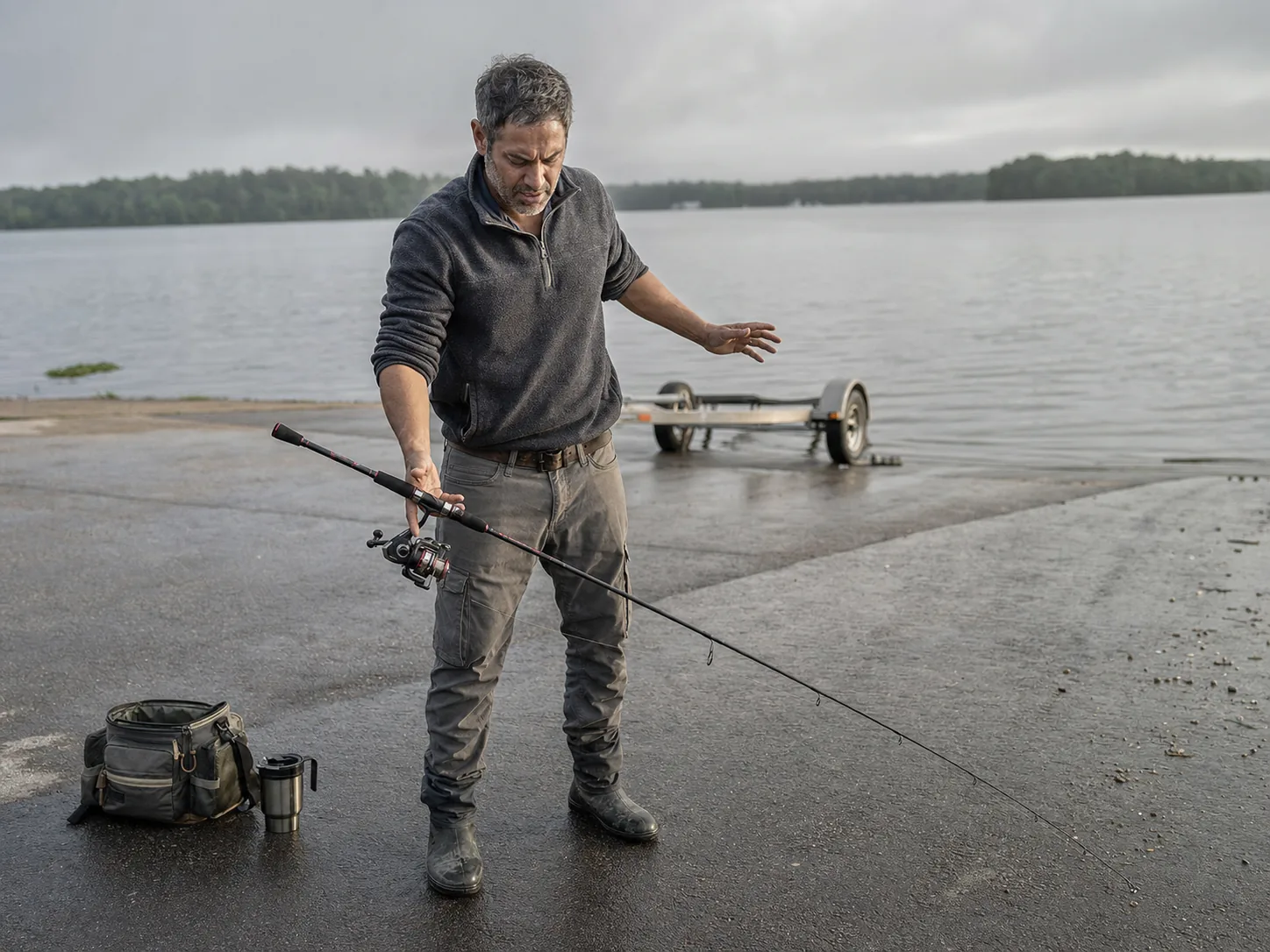
You carry the new combo down to the ramp, take your second hand off the grip to reach for your coffee, and the rod noses straight at the gravel. That moment shows up in fishing forums constantly, usually from someone who bought the thing an hour earlier and hasn’t made a single cast yet. Here’s the part nobody tells you: the three mistakes behind it aren’t about the rod being cheap, and two of them happen before you ever spool up. Test it right, start from the right numbers, and fix it in the right order.
What a Balanced Rod and Reel Actually Means
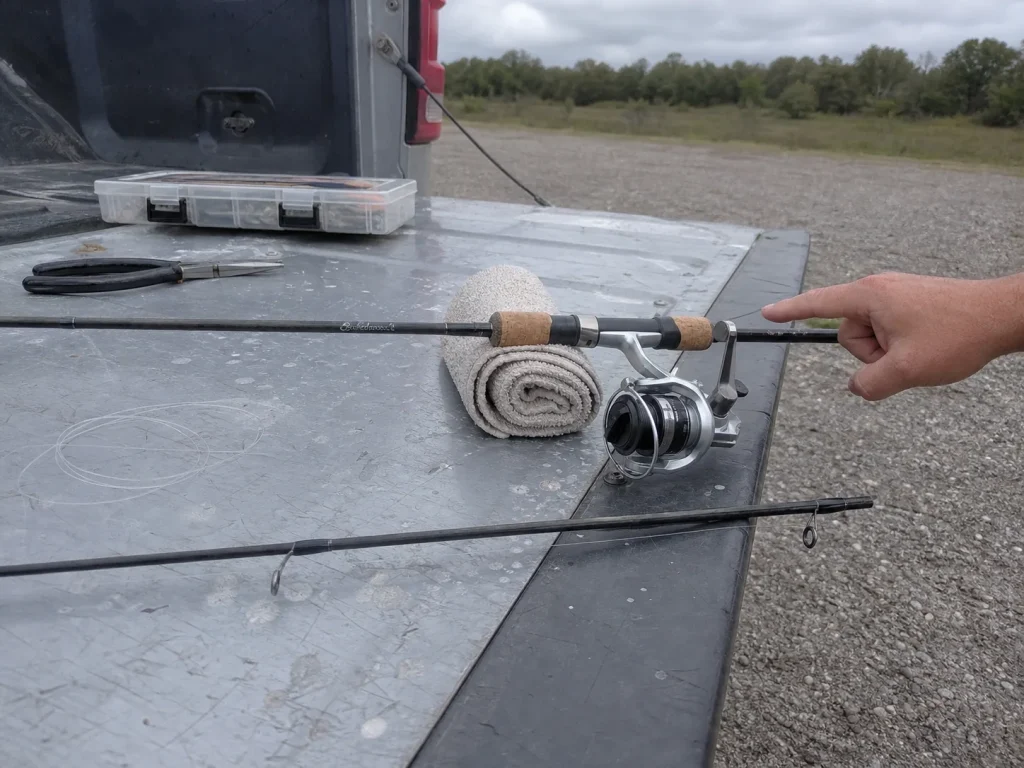
Most people assume balance is a feature you buy. It isn’t. It’s an accident of where the weight lands, and nobody at the factory promised you it lands under your hand. If you’re still choosing what to buy, the way to pick a fishing rod without overpaying starts with understanding that the rod is only half the equation.
Balance is a see-saw problem. Your rod, your reel, and the line on it form one system with one center of gravity, and that point either sits where your hand grips or it sits somewhere out toward the tip making your wrist do the work. Equilibrium here means exactly what it means on a playground: the weight on one side of the pivot cancels the weight on the other. Your hand is the pivot, and the tip is a long way from it. That lever, more than any spec on the label, is what decides how a setup feels after a few hundred casts.
None of this is about what the rod is made of, either. A graphite blank and a carbon fiber blank can both hang nose-down under the wrong reel, because balance is about weight distribution, not material.
A properly matched pair balances at or slightly in front of the reel seat once it’s assembled. That’s the target zone, not a vague sense that it feels about even. And sharing a box guarantees you nothing. Forum threads open the same way over and over: somebody realizes their factory combo is badly tip-heavy straight out of the packaging.
How to Find Your Balance Point With One Finger
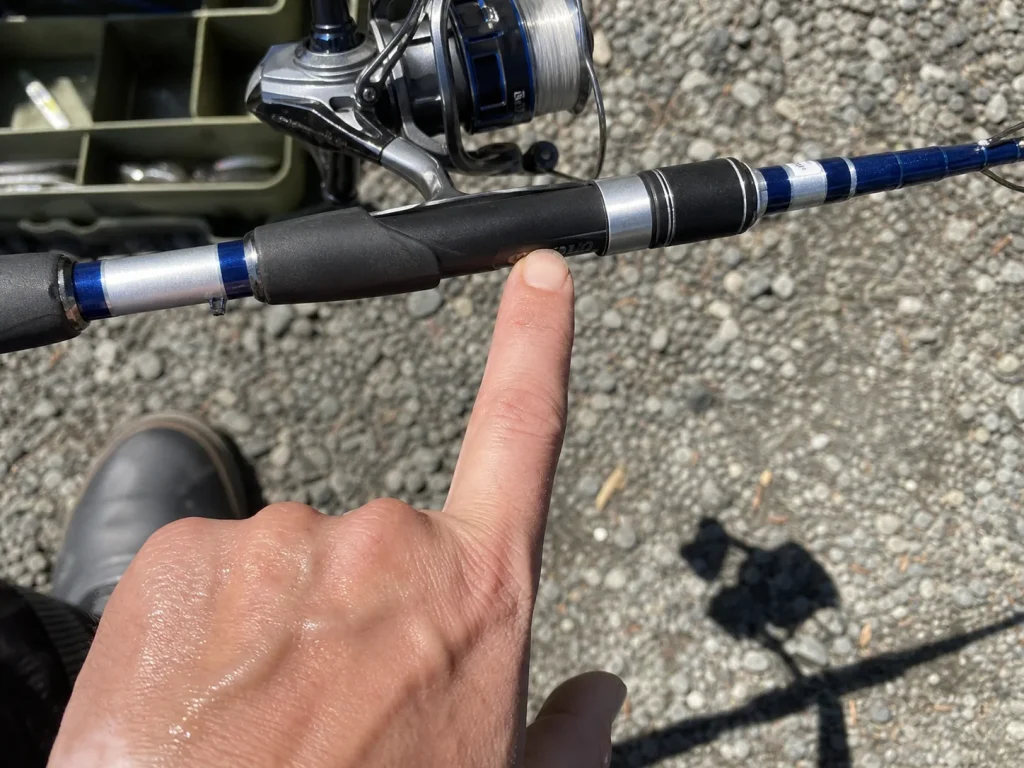
This is the ten-second test, and half the people who run it run it on the wrong spot. Spinning and baitcasting don’t get tested at the same place. Get that wrong and the test lies to you.
The Test on a Spinning Setup
Put one finger at the point where the reel is seated on the rod, right under the hood of the reel seat where the reel stem meets the blank, and let go with your other hand. That’s the landmark anglers instinctively reach for, and on a spinning rig it’s the correct one. Keep your grip hand relaxed while you do it. You’re testing the rod, not your forearm.
The Test on a Baitcaster
Same test, different landmark. Your index finger goes just in front of the reel, not underneath it. That one shift catches a lot of people who learned the test on spinning gear and carried the habit over.
Reading Which Way It Falls
The direction is the diagnosis. If the tip dives, your center of gravity is too far forward and you’re tip-heavy. If the handle drops instead, the reel is too light for the rod and you’re butt-heavy. That’s it. No scale, no math. It’s also worth knowing what rod you’re holding in the first place, since you can’t decode what the label is telling you about the rod half without understanding power and action.
What Imbalance Actually Costs You
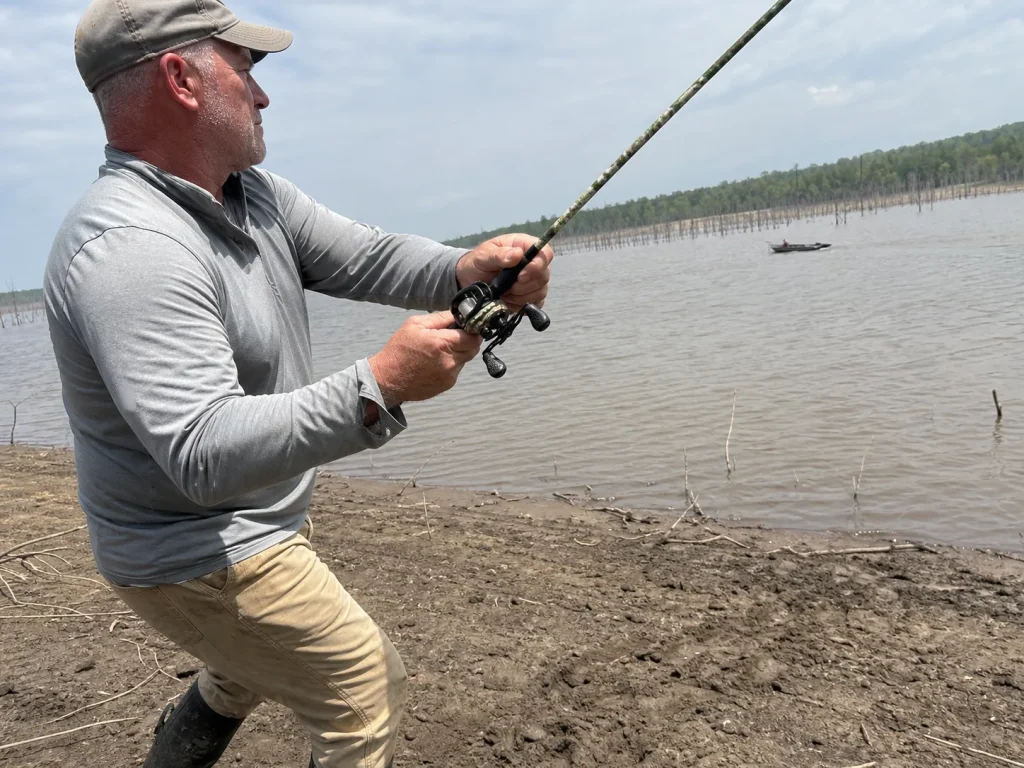
Nobody quits fishing because their combo is nose-heavy. They just cast a little shorter, miss a few more bites, and blame themselves by hour four.
Casting Distance and Accuracy
An unstable tip wanders on the cast. You’re correcting for it without noticing, which costs you both distance and casting accuracy, the ability to put a bait where you meant to. A badly mismatched pairing isn’t only a comfort problem either. Bolt a 5000-class reel onto an ultralight rod and you’re stressing the blank on top of everything else, and the line fouling that follows a sloppy cast is its own tax on the day.
Bite Detection Goes Dull
A tip-heavy setup means your hand is fighting the rod’s own weight while you’re trying to feel a fish. Sensitivity is the first thing it eats: you notice the rod before you notice the take. On finesse presentations that’s the difference between a hookset and a shrug.
The Hour-Four Problem
Casting a longer, heavier rod all day raises wrist leverage and physical demand, which is why a longer rod isn’t automatically a better rod. This isn’t angler folklore. NIOSH’s own ergonomics guidelines for selecting hand tools point to the same two culprits: tool weight and where its center of gravity sits. Cornell’s hand-tool design research lists center of gravity among the measurable factors that decide whether a tool feels comfortable or exhausting after hours of use.
The moment it clicks for most anglers isn’t a fish fight or a hero cast. It’s noticing the rod dove tip-first every single time they let go of the grip with one hand.
How to Fix a Tip-Heavy Rod Without Ruining It
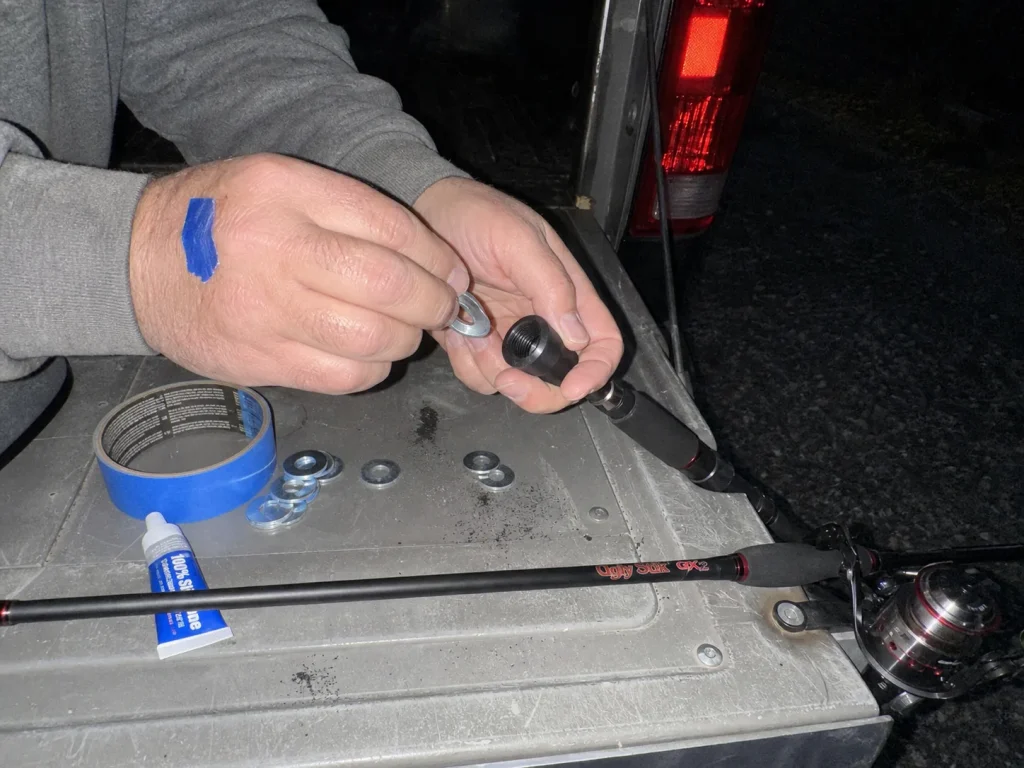
The fix is weight at the butt. The mistake is committing to it permanently before you’ve found the right amount.
Start Removable, Always
Several threads warn about the same order-of-operations error: reaching for a glue-in weight before trying a removable test weight first. Once it’s epoxied in, your only tuning knob is gone. Tape the test weight on, run the finger test again, adjust, and only then decide whether it earns permanence. Silicone glue holds a weight and comes back off. Epoxy is a decision, not an adjustment.
The cheapest version of this is a roll of quarters taped to the butt, and it works fine as a diagnostic even if you’d never fish it that way.
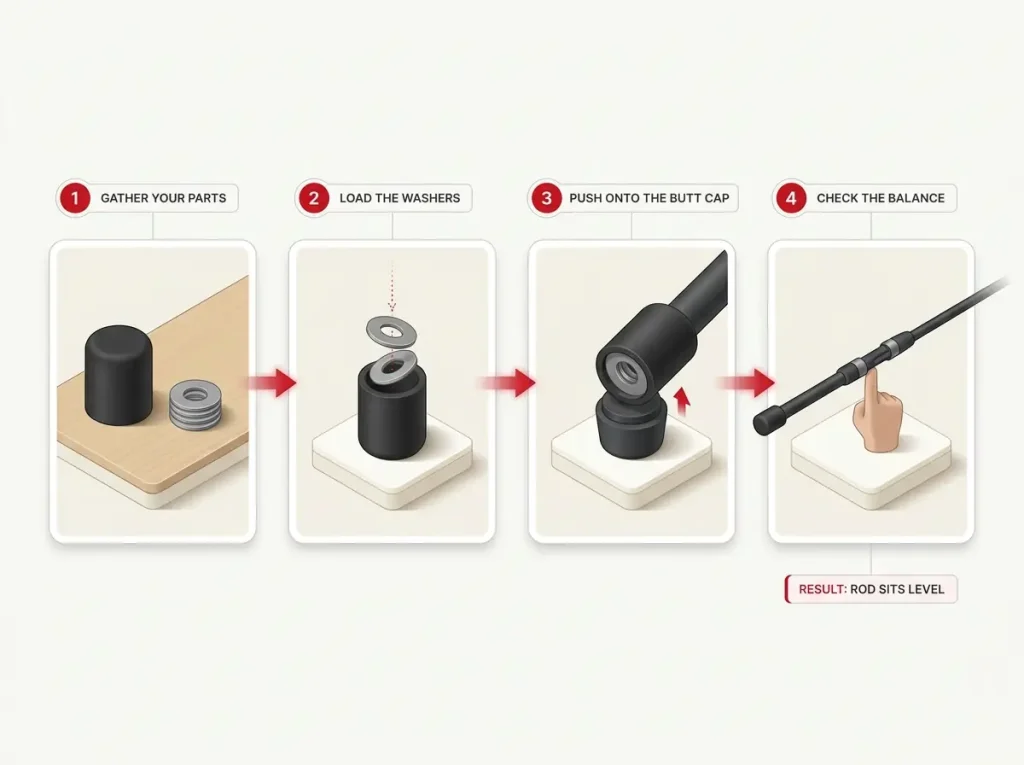
The hardware-store fix beats the tackle-shop one here. Slip a rubber floor protector over the butt cap and drop metal washers inside it. Fully removable, costs almost nothing, and you tune it washer by washer until the rod sits level on your finger.
How Much Weight to Start With
Anglers converge on 4 to 6 ounces of added butt weight as the practical starting range on a tip-heavy rod. That’s a start-here number, not a prescription. Long rods with heavy reels land at the top of it; a 6-foot rig might need half that.
When It’s Worth a Real Balance Kit
Once you know your number, a purpose-built balance weight kit or a crutch butt cap turns the washer pile into something that looks like it belongs on the rod. Both do the same job your hardware-store rig already did. You’re paying for finish, not physics.
If you’re counterweighting the same rod over and over and still not happy, the rod might be the problem rather than the weight. At that point a custom pairing built from the blank up gets you balance designed in instead of bolted on, right down to the rod guides and where the reel seat sits.
Your Technique Changes What Balanced Should Feel Like
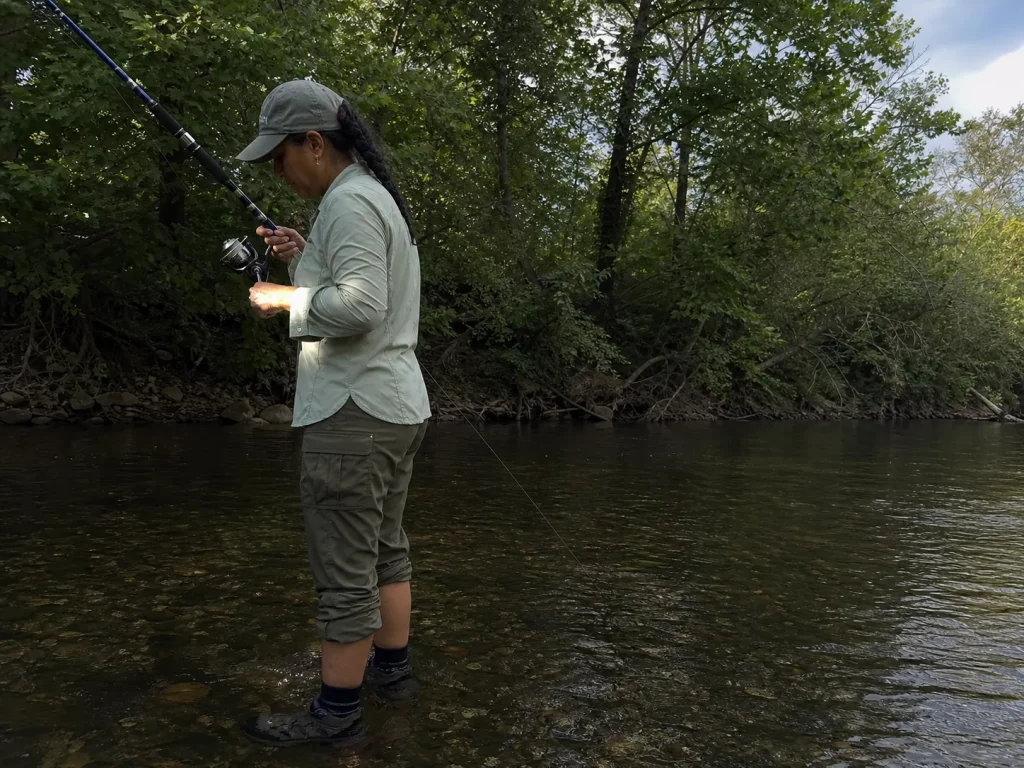
Here’s where “balance it and you’re done” falls apart. A finesse rig and a crankbait rod want different things, and chasing one universal balance point costs you on both.
Tip-Up Presentations Want True Balance
Jigs, worms, drop shot, Neko rig, wacky rig. You’re holding the rod tip-up and reading your line for a bite that happens on the fall. A nose-heavy tip masks exactly the signal you’re watching for, so this is the setup where true balance at the grip earns its keep. It’s also where a fast action blank pays off, since the tip has to telegraph the take before your hand feels it.
Tip-Down Moving Baits Forgive a Nose-Heavy Rod
Crankbaits, spinnerbaits, swimbaits, and to a point a topwater lure worked on a steady cadence. The rod’s already pointed down and the fish largely hooks itself against a moving bait, so a little forward weight is tolerable. You notice this the first time you switch from a worm rod to a crank rod mid-day and the crank rod feels wrong for ten casts, then fine. It wasn’t wrong. It was tuned for a different job.
One thing not to confuse here: reel size is a weight variable, gear ratio isn’t. Baitcast ratios run roughly 5.0:1 to 9.1:1 and spinning reels mostly sit between 5.2:1 and 6.2:1, and none of that moves your balance point. Same goes for the drag system, which decides what happens after the hookset, not how the rod hangs before it.
The Rod Length and Reel Size Chart to Start From
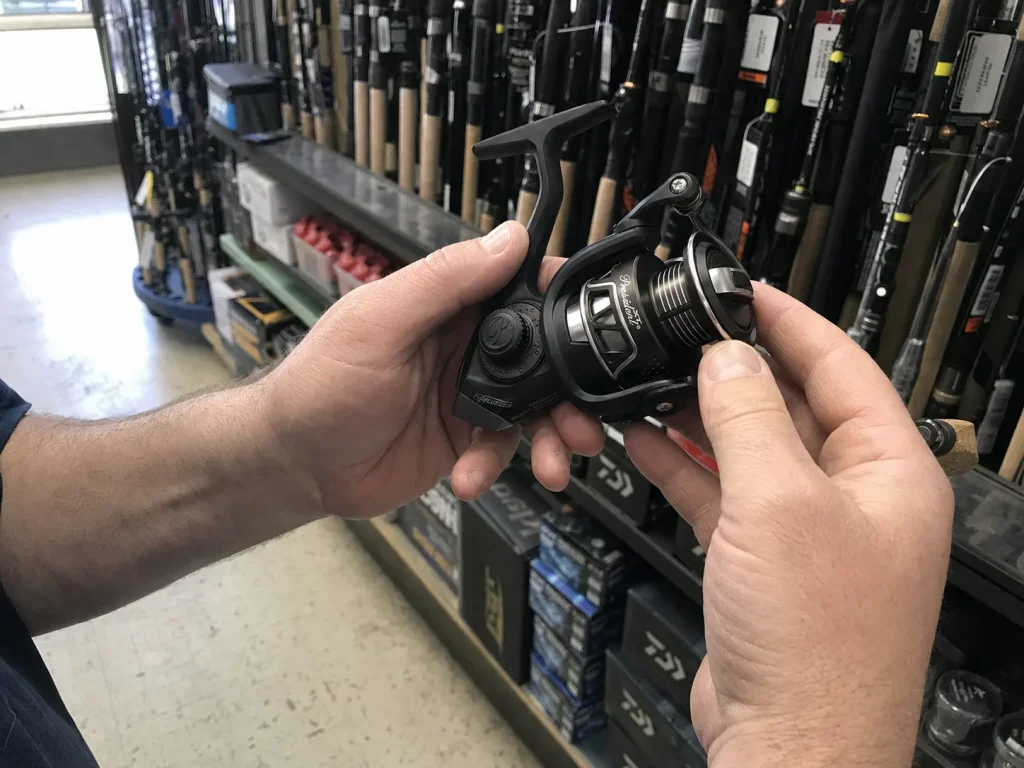
Every article on this topic teaches you to test balance after you’ve already bought the wrong reel. Walk in with two numbers instead and you’re close before you touch anything.
Freshwater, Panfish and Trout Tier
1000 to 2500 class reels pair best with rods up to about 6 to 7 feet in ultralight or light power. This is your trout, crappie, and bluegill water. Once those reel size numbers actually stand for something, the pairing stops feeling like guesswork.
Freshwater and Light Inshore, the General Tier
3000 to 4000 class reels pair with 7 to 8.5 foot rods in medium to medium-heavy power. This is the bass, walleye, and light inshore range where most anglers live. A Pflueger President XT 30X is the worked example: the 30 in the name is the 3000 class, which is why it lands under a 7-footer without a fight. Choosing the length itself is its own decision, and picking the rod length for the water you actually fish comes before choosing the reel that balances it.
Surf and Heavy Inshore
Bigger classes on 10 to 12 foot medium-heavy to heavy rods. The physics don’t change, only the scale does, and saltwater fishing punishes a mismatch faster because everything in the system is heavier to begin with. If that’s your water, surf rods and what actually makes them cast covers the rod side properly.
Cross-Checking Against Line Rating
The chart works from either axis. Rod power maps to line-rating bands: Ultralight 2 to 6 lb, Light 4 to 8 lb, Medium 8 to 12 lb, Medium-Heavy 12 to 20 lb, Heavy 15 to 30 lb. So if you know your line, you know your power, and you’re back to a reel size.
It’s worth understanding why the two numbers track each other at all, because then you can reason your way out of the edge cases the chart doesn’t cover. A longer rod puts more blank in front of your hand, which means more leverage working against you, which means it takes more weight at the back to cancel it out. A bigger reel is that weight. That’s the entire relationship. The chart isn’t a lookup table handed down from somewhere, it’s just that arithmetic already done for the pairings most people actually fish.
Which also tells you when to ignore it. Hang a heavy reel on a short rod and you don’t get “extra balanced,” you get butt-heavy and a rod that fights you the other direction. The chart gets you close. The finger test confirms it. Neither one replaces the other.
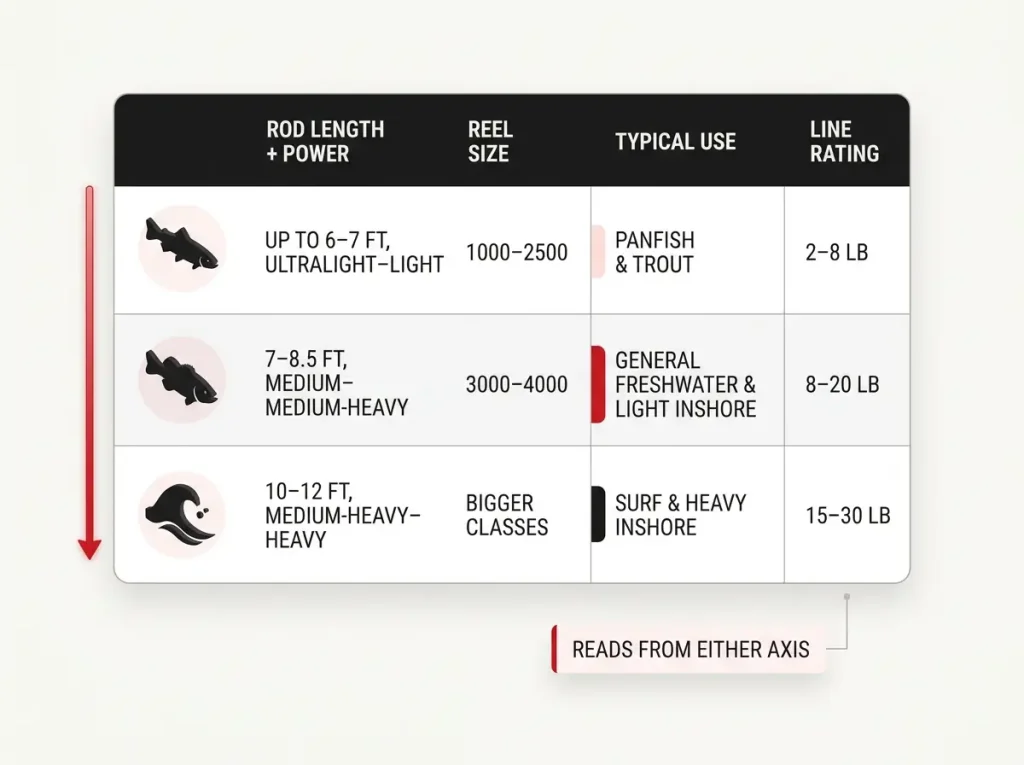
Test It With the Line Actually Spooled On
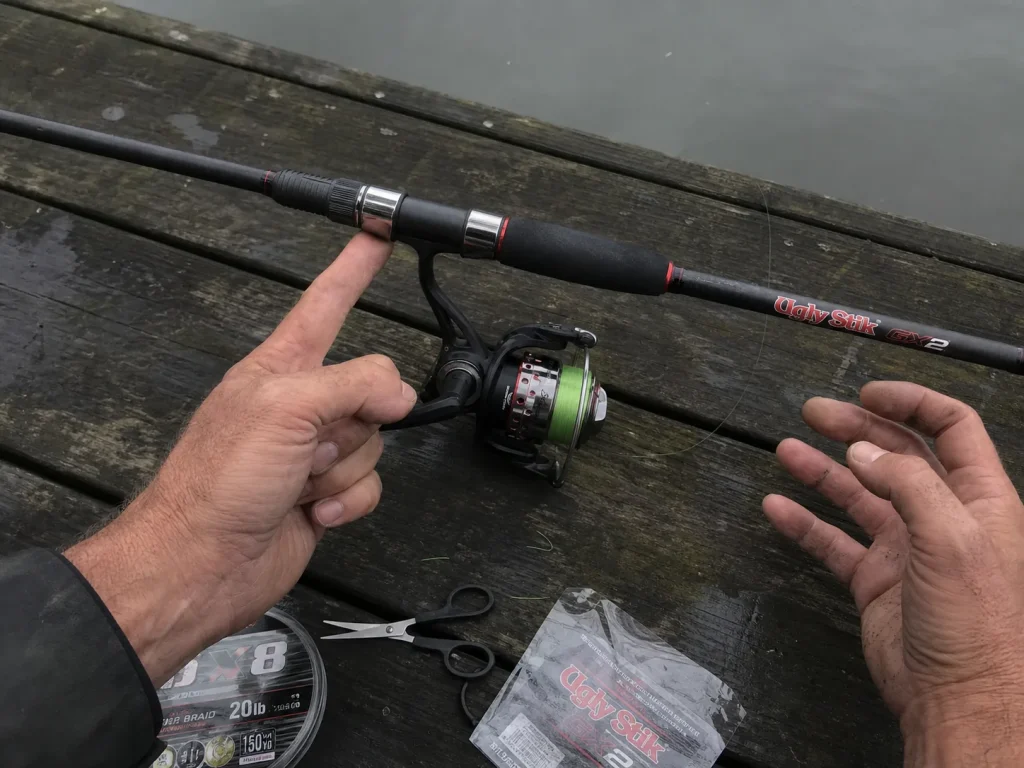
This is the mistake nobody warns you about. Every balance tutorial you’ve read describes the finger test on a bare, unspooled combo. That’s not the rod you fish.
A Full Spool Is Weight, and It’s Weight at the Front
A loaded spool is real mass, and it sits forward of your hand where leverage multiplies it. Test the combo bare, and you’ve measured a configuration that will never exist on the water. This is where line capacity stops being a number on the box and starts being weight: a reel rated for more line holds more of it, and a bigger spool diameter carries that weight further out.
Braid, Mono and Where They Differ
A full spool of dense braid and a half-empty spool of light mono are not the same weight, and fluorocarbon sits somewhere in between with a density all its own. Two reels of the same size, filled by two anglers with different line, are two different balance problems.
Nobody publishes a precise figure for how far the balance point shifts once line goes on, and you should be suspicious of anyone who hands you one. The honest answer is that it depends on your reel, your line, and how full you filled it, which is exactly why a number would be useless even if someone had measured it. The instruction that survives all three variables is simpler and more useful anyway: retest, don’t assume.
Retest, Don’t Assume a Number
The anglers who get this right tape their test weights on after the reel is already spooled. Everyone else tests once on a bare combo, buys, and then complains about the wrong feel afterward. The test wasn’t wrong. It was run on the wrong rod. Get the line on cleanly first, without twist built into it, then test.
Your spool empties during a long run, which means the balance you tuned at the truck isn’t the balance you’re holding with fifty yards out. That’s not a problem to fix. It’s just a thing to know before you chase perfection with washers.
Factory Combos vs Building Your Own Pairing
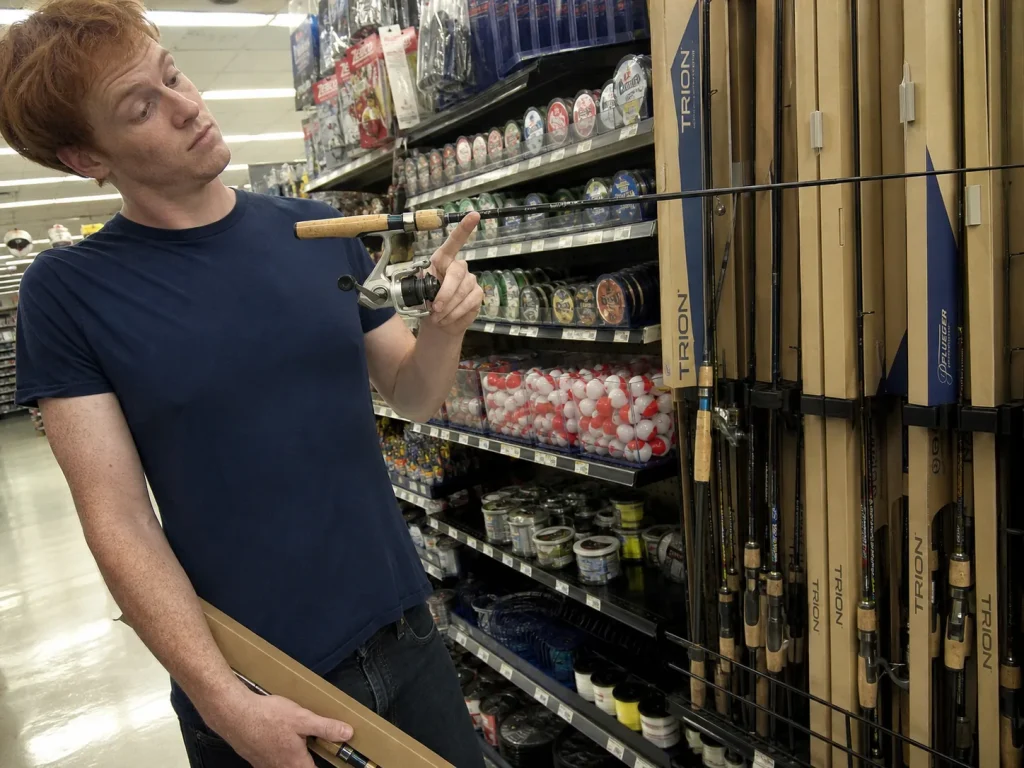
Some combos are a legitimately balanced shortcut. Others are whatever reel was cheapest to bundle with that rod. There’s a spot-check that separates them, and you can run it in the aisle before you spend anything.
The In-Store Spot-Check
Take it out of the sleeve and run the finger test right there. A genuinely matched combo balances at or slightly in front of the reel seat. A bundled mismatch is visibly off, and it’s often an oversized reel on an undersized rod. The tell isn’t the price tag or the packaging copy. It’s that a mismatch fights your finger the second you take your other hand off it.
When a Combo Is the Right Call
The beginner case is real. One decision instead of two, and a matched pair removes the variable you’re least equipped to judge on day one. The Ugly Stik GX2 spinning combo in the 7-foot one-piece is the budget-friendly version of a pair that’s actually matched rather than just boxed together. Step up a tier and the Pflueger Trion 6’6″ combo gives you a shorter two-piece graphite setup, with the ferrule joint being the trade you accept for a rod that fits in a trunk.
When to Build Your Own Pairing
You pick the rod for the water and the reel for the rod, in that order. It costs more thinking and usually less regret. Pair the President XT 30X above with something like the KastKing Compass telescopic rod in 7-foot medium-heavy and you’ve built a travel-friendly rig around a reel you chose on purpose. Just go in knowing a telescopic blank trades away some feel for packability, which is a fair deal for a truck rod and a bad one for a finesse stick.
Run the aisle test on the two or three combos in your price bracket, not just the one you came for. Takes ninety seconds, costs nothing, and it’s the only comparison the packaging can’t fake.
How Imbalance Shows Up Differently on Baitcasters and Spinning Reels
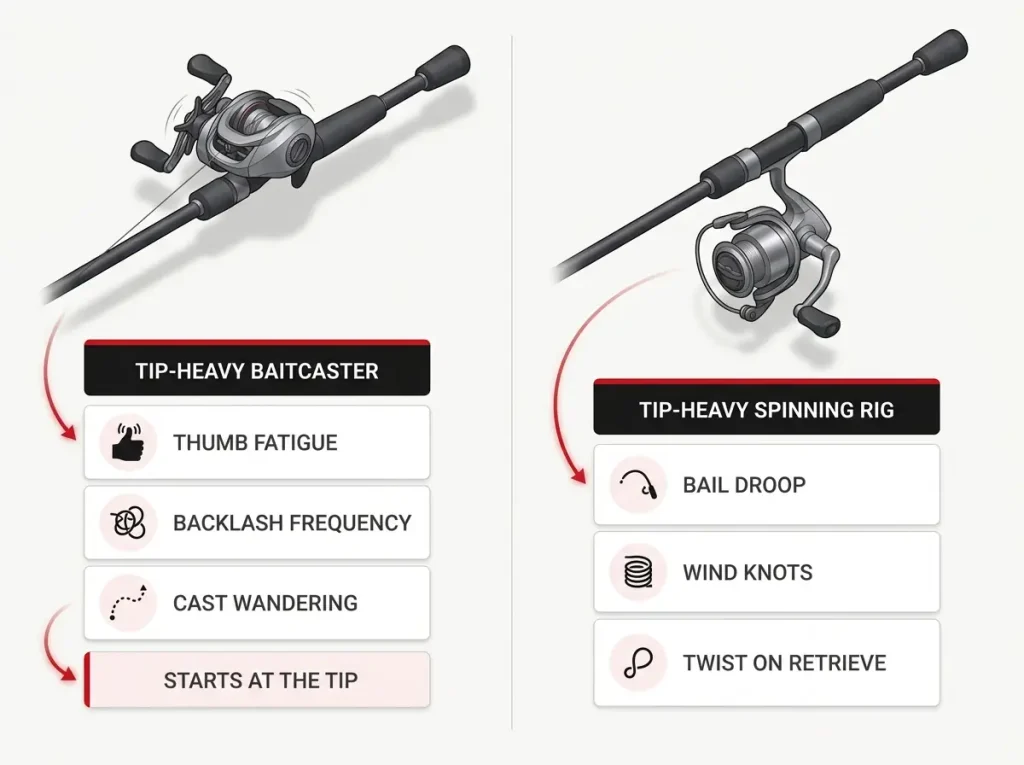
Everyone lists the same generic symptoms. But a tip-heavy baitcaster and a tip-heavy spinning rig fail in completely different ways, and if you switch between them you’ll misread one as the other.
On a Baitcaster, Thumb Overwork and Backlash
A baitcaster’s spool spins in line with the rod, so the whole cast depends on the line leaving the spool at roughly the speed the spool is turning. An unstable, tip-heavy rod moves the tip during the stroke, which changes that relationship mid-flight. Your thumb ends up doing stabilization work on top of thumb control of the spool, correcting for a rod that won’t hold its line.
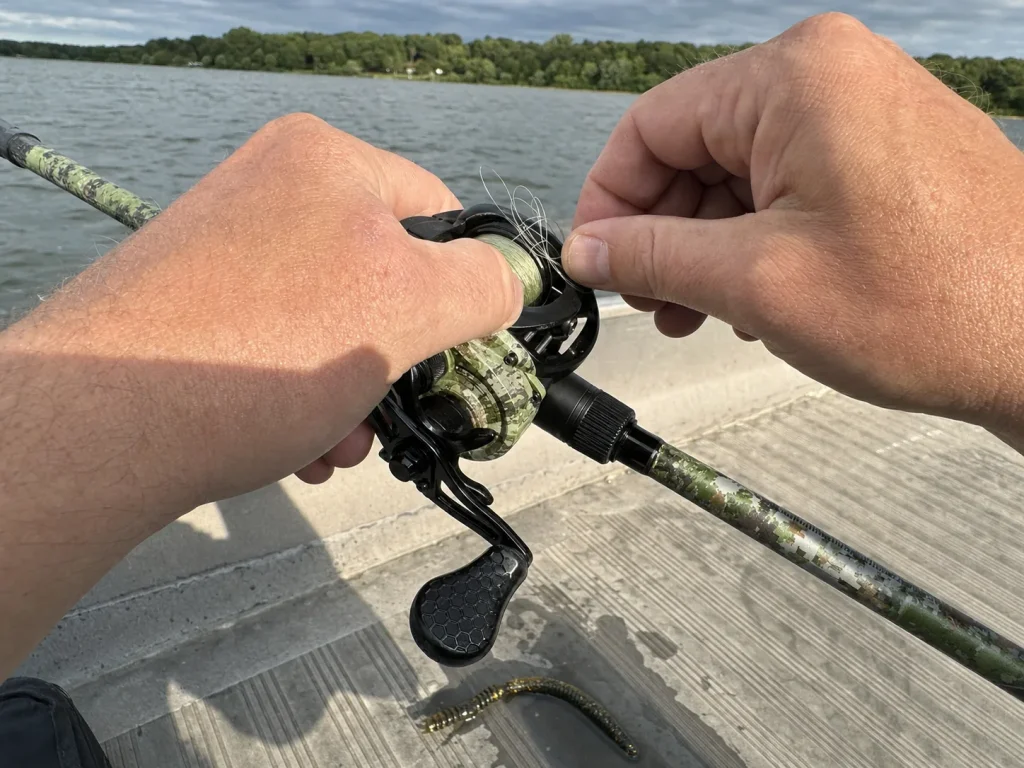
Overworked thumb, and backlash risk climbs with it. The bird’s nest you pick out at the third guide didn’t start at the spool. It started at the tip. Most anglers blame their thumb technique, which is why the problem survives so long. A Lew’s American Hero camo baitcast combo in 7-foot medium-heavy is a reasonable read on this: a mid-range factory pairing where the reel has enough mass to sit under your hand instead of hanging off a nose-heavy tip. When one does get away from you, clearing a backlash in about a minute is the fix.
On a Spinning Reel, Bail Droop and Line Twist
Same root cause, completely different symptom. A spinning reel works the opposite way: the spool stays put and the rotor wraps line around it, so what matters isn’t spool speed, it’s the angle the line takes coming onto that spool. A tip-heavy rig lets the tip sag through the retrieve, and a sagging tip changes that angle every single crank.
The result is bail-arm droop and line twist or wind knots building up where you can’t see them yet. You find out two casts later when a loop jumps off the spool on its own. That’s the tell, and why a spinning reel twists line and the fixes that hold covers it from the other direction.
Diagnosing It Mid-Trip
Here’s the trap. An angler moving from spinning to casting reads their new backlash problem as “I can’t thumb a baitcaster,” when the rod is the actual variable. They spend a season fixing their hands and never touch the thing that’s actually wrong.
So run the diagnosis by symptom, not by blame. Backlashes clustering on your longest casts point at the tip, not your thumb, because that’s where the stroke is most violent and an unstable tip has the most room to move. Twist showing up in the first stretch of line off the spool points at the retrieve angle. Both trace back to the same finger test. And don’t blame gear ratio either, no matter how often it gets accused. It changes retrieve speed, not weight distribution.
The Three Fixes Worth Remembering
The box didn’t promise you balance. Run the finger test yourself, at the right landmark for your reel type, and read which way it falls.
Test it with line on. A bare combo is not the rod you fish, and every tutorial that skips this step is testing a configuration that doesn’t exist.
Start with a removable weight. Washers in a floor protector cost nothing and tell you the number. Epoxy is a decision, not an adjustment.
Go grab whatever’s leaning in the garage right now and rest it on one finger at the reel seat. That’s the whole test. You’ll know inside ten seconds whether any of this applies to you. And if the fatigue stops being about casting and starts being about your joints, that’s when angler’s elbow becomes its own conversation.
Frequently Asked Questions
01How do you know if your rod and reel are balanced?
Rest the assembled, spooled rod on one finger, at the reel seat for spinning or just ahead of the reel for a baitcaster. It should sit level or tip only slightly forward. Which way it falls is your diagnosis: tip down means tip-heavy, handle down means the reel is too light.
02What size reel goes with a 7-foot rod?
A 7-foot medium to medium-heavy rod pairs with a 3000 to 4000 class spinning reel for general freshwater and light inshore work. Cross-check it against the rod’s line rating, then confirm with the finger test once the reel is mounted and spooled.
03Do I have to test balance again after I put line on?
Yes. A full spool of braid is real weight sitting forward of your hand, so a bare-combo test doesn’t reflect the rod you actually fish. Retest after spooling, and expect the feel to shift again as the spool empties on a long run.
04Can I add weight to a fishing rod to balance it?
Yes, at the butt end, starting in the 4 to 6 ounce range and tuned from there. Use a removable test weight first, like washers inside a rubber floor protector, and only make it permanent once the finger test confirms the amount.
05Is a rod and reel combo already balanced?
Not automatically. Sharing a box is a packaging decision, not a balance spec. A genuinely matched combo balances at or slightly in front of the reel seat, so run the finger test in the aisle before you buy.
Risk Disclaimer: Fishing, boating, and all related outdoor activities involve inherent risks that
can lead to injury. The information provided on Master Fishing Mag is for educational and informational purposes
only. While we strive for accuracy, the information, techniques, and advice on gear and safety are not a substitute
for your own best judgment, local knowledge, and adherence to official regulations. Fishing regulations, including
seasons, size limits, and species restrictions, change frequently and vary by location. Always consult the latest
official regulations from your local fish and wildlife agency before heading out. Proper handling of hooks, knives,
and other sharp equipment is essential for safety. Furthermore, be aware of local fish consumption advisories. By
using this website, you agree that you are solely responsible for your own safety and for complying with all
applicable laws. Any reliance you place on our content is strictly at your own risk. Master Fishing Mag and its
authors will not be held liable for any injury, damage, or loss sustained in connection with the use of the
information herein.
Affiliate Disclosure: We are a participant in the Amazon Services LLC Associates Program, an
affiliate advertising program designed to provide a means for us to earn advertising fees by advertising and linking
to Amazon.com. As an Amazon Associate, we earn from qualifying purchases. We also participate in other affiliate
programs and may receive a commission on products purchased through our links, at no extra cost to you. Additional
terms are found in the terms of service.