
In this article
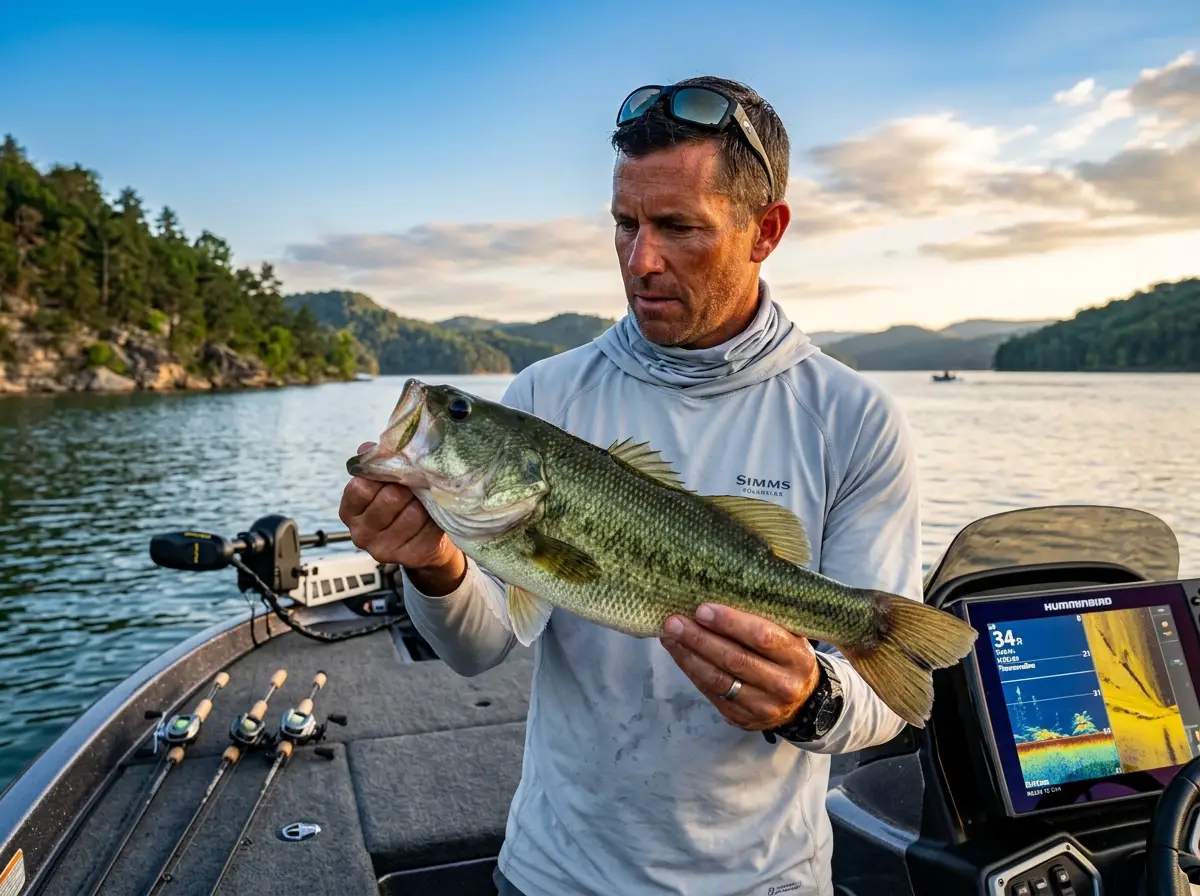
The Fish Hawk probe read 89°F at the surface. The Humminbird screen showed zero arches above 8 feet and zero below 26. A whole reservoir—hundreds of acres of water—and every fish in it was crammed into a 4-foot band somewhere in between. If you didn’t know where that band was, you were going home empty.
That’s the dog days. Not bad luck. Not some mystical slowdown. A physics problem with a measurable answer.
I’ve spent enough late-July mornings running sonar grids on lakes in the Southern Tier to stop believing in coincidences. The fish are there. They’re just not where 90% of anglers are fishing. Thermal stratification forces bass, walleye, and crappie into a survival band so narrow that casting anywhere else is burning fuel.
This guide gives you the science behind why dog days summer fishing collapses, the sonar protocol to find the band fast, and the rigging physics that actually connect at thermocline depth.
⚡ Quick Answer: Fish don’t stop biting in the dog days—they compress into a narrow thermal refuge at the thermocline’s upper edge, typically between 18 and 30 feet, where dissolved oxygen stays adequate and water temps are survivable. Most anglers fish the wrong depth all day. Use sonar to locate the thermocline, rig a drop-shot or Carolina rig on 10 lb braid with a fluorocarbon leader, slow your presentation by 50%, and fish nothing that doesn’t intersect that specific depth. Dawn is your best window—water temperature is at daily minimum and aerobic scope is briefly expanded.
The Limnology of the “Slump”: Why Fish Vanish in July and August
Water hits maximum density at exactly 39.2°F. Every degree above that makes it lighter. By the time July rolls in, the sun has been hammering the surface for months, and those top layers have turned warm enough to float like a lid on a pot.
The result is a stratified lake that behaves like three separate bodies of water stacked on each other. Fisheries scientists call this thermal stratification, and the Illinois EPA guide to lake stratification and oxygen dynamics lays it out clearly: once stratification locks in, the layers don’t mix. They just sit there all summer, each with its own temperature and oxygen profile. Understanding how surface temperature readings mislead you when fish are holding deeper is the first thing you need to accept before any summer strategy makes sense.
The Three-Layer Lake: Epilimnion, Metalimnion, Hypolimnion
The top layer—the epilimnion—is warm, well-mixed by wind, and oxygenated. It’s also where 95% of casual anglers are casting. Water temps hit 86–91°F during peak summer. Bass are not here. Not by choice, not by accident.
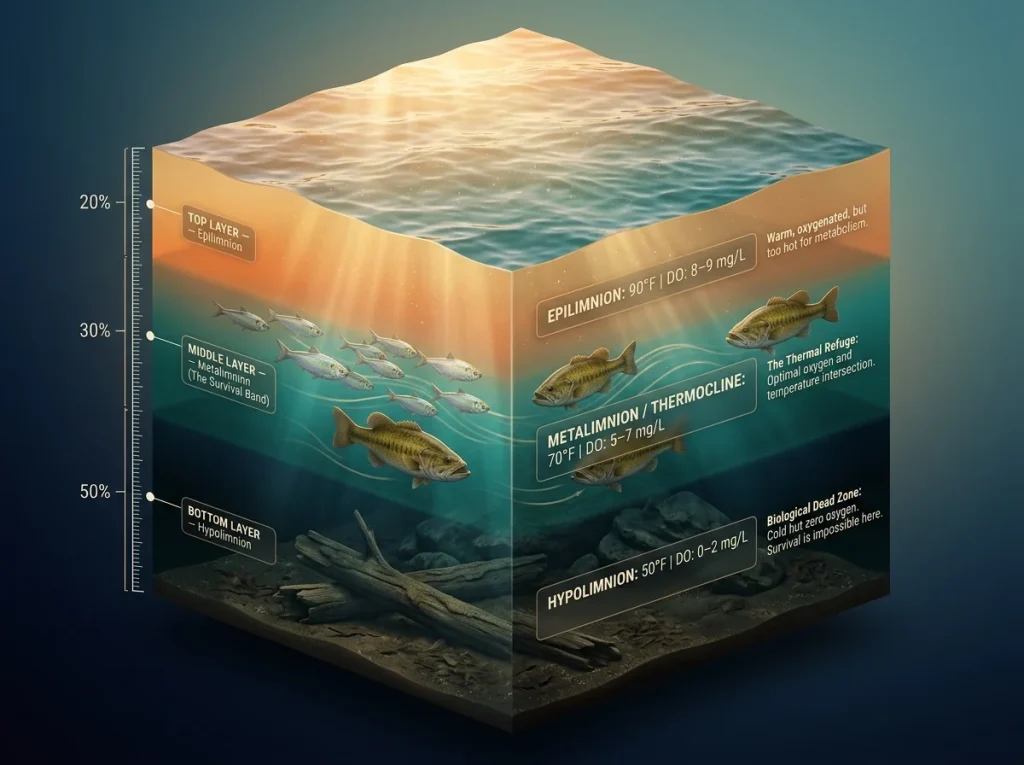
The middle zone—the metalimnion—is where the temperature drops fast over a short vertical distance. Inside that transition zone sits the thermocline: the specific plane where temperature falls most rapidly. This is the thermal refuge. It’s where oxygen levels are still viable, temps have dropped to something workable, and every fish in the lake has been pushed.
Below that is the hypolimnion. In eutrophic reservoirs—the farm-country reservoirs and nutrient-loaded lakes most of us fish—the hypolimnion is biologically dead from late June through mid-August. Decomposing organic matter at the bottom burns through every molecule of oxygen. Dissolved oxygen drops to 0–2 mg/L. Nothing lives there voluntarily.
Pro tip: If your fish finder shows zero arches above 10 feet and zero arches below 25 feet, the thermocline is the band in between. Stop guessing—crank your gain up and find the line.
The Thermocline as a Hard Floor: Why Fish Can’t Go Deeper
Below the thermocline, dissolved oxygen crashes below 2 mg/L—the hypoxic threshold. Fish aren’t choosing to avoid the hypolimnion. They physically can’t survive there. Their gills can’t extract enough oxygen from water at those levels.
In murky, nutrient-loaded reservoirs, this hard floor can sit as shallow as 12–15 feet in August. In clear highland reservoirs, it may not form until 35–40 feet. The critical lesson: thermocline depth changes lake to lake, and you can’t assume it. You have to measure it.
The highest-percentage summer spots are where structure intersects the thermocline—rocky points, channel swings, bridge pilings—at exactly the right depth. Find those intersections first.
Bioenergetics: The Metabolic Trap That Kills the Bite
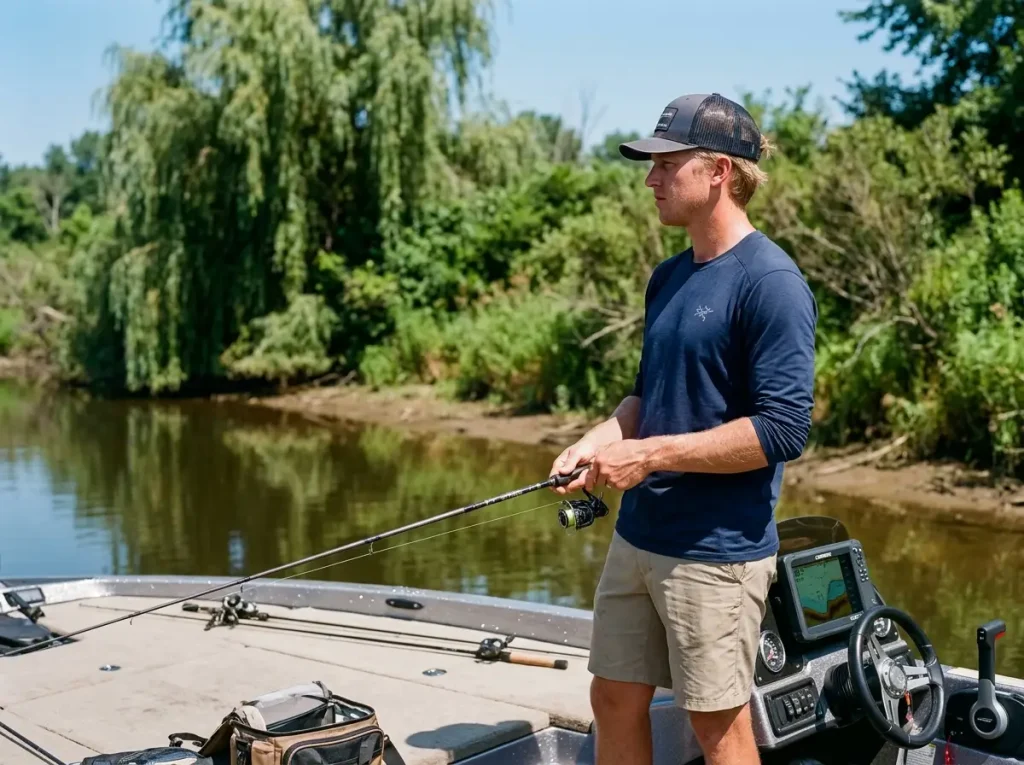
Fish are ectotherms. Their body temperature is whatever the water tells it to be. That’s not just a biology footnote—it’s the reason your crankbait retrieves need to change in July.
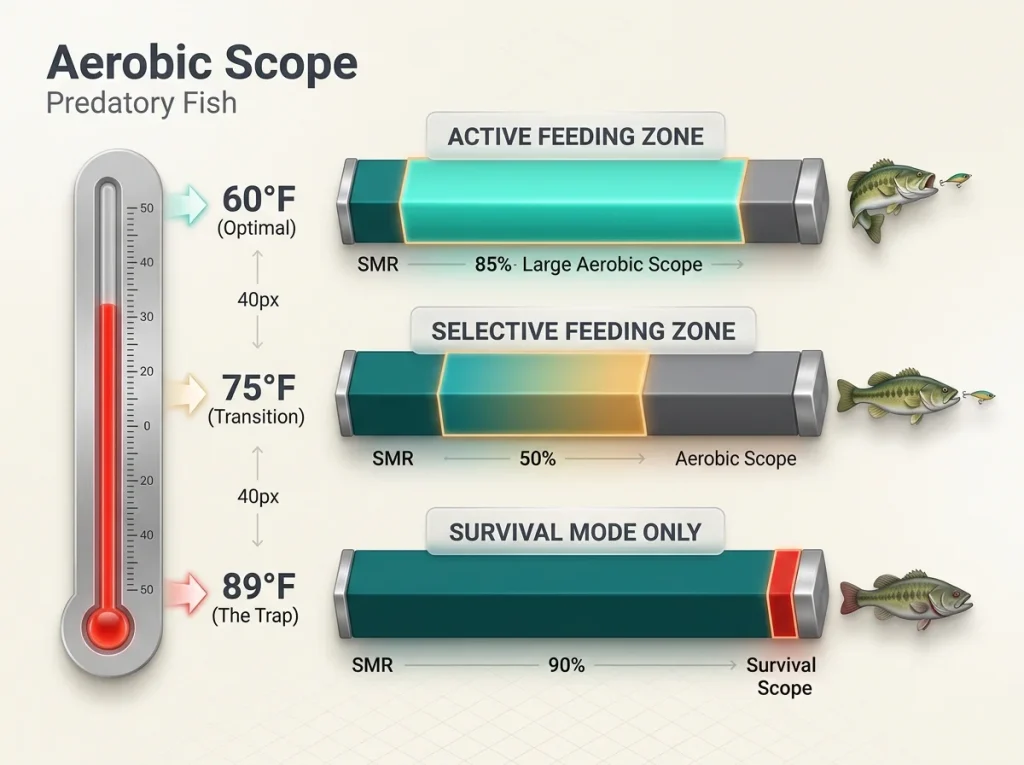
The Q10 rule in biochemistry states that reaction rates roughly double for every 10°C increase in temperature. For fish, this means metabolic rates skyrocket as summer water climbs. At 75°F, a largemouth bass has meaningful aerobic scope—the surplus energy available after basic survival functions. At 89°F, peer-reviewed research on temperature effects on fish feeding and digestive processes shows that standard metabolic rate has consumed 70–80% of available aerobic capacity. The fish has almost nothing left in the tank for a chase.
Standard Metabolic Rate vs. Maximum Metabolic Rate: The Math Behind Lockjaw
Think of it this way: Maximum Metabolic Rate is the energy ceiling. Standard Metabolic Rate is the cost of keeping the lights on—heart beating, gills moving. Aerobic scope is whatever’s left over.
At 86°F and above, SMR eats nearly all of MMR. The fish has almost no budget left for a high-energy chase. It’s not lazy. It’s not lockjaw for no reason. It’s physiologically unable to burn fuel on a fast-moving crankbait.
You can see this same Q10-governed metabolic pattern at the extremes by looking at how thermal pollution affects fish behavior and aerobic scope—the mechanism is identical whether the heat source is industrial discharge or an August afternoon. A fish in metabolic depression responds to slow, stationary, or hovering presentations—not reaction baits burning through the strike zone.
Pro tip: Water above 85°F and you’re getting half-hearted follows or short strikes? Slow your presentation by 50%. Hold the bait in place for 3–5 extra seconds after each pause. The strike will be a pressure bite—barely a tick on the line—not a thump.
The Diurnal Dissolved Oxygen Cycle: The Window Inside the Window
Dawn isn’t just tradition. There’s a real biological reason it outperforms mid-afternoon in summer. At night, aquatic plants stop photosynthesizing and switch to respiration—they consume oxygen instead of producing it. In weed-choked bays with heavy hydrilla or coontail mats, dissolved oxygen can crash below 1 mg/L by 4 a.m., forcing fish to push toward edges or current.
By first light, the night’s minimum temperature has hit and oxygen has begun recovering. It’s the sweet spot: coolest water of the day, dissolved oxygen on the rise. That’s your feeding window. The same dissolved oxygen mechanics that compress panfish into basin refugia all winter—documented in the oxygen squeeze that drives winter panfish positioning—are mirror-image forces at work during the summer slump. Your enemy in winter is oxygen depletion under ice; your enemy in summer is oxygen depletion in the hot upper column.
Weed mat interiors are a trap. Manning’s n roughness values for dense vegetation (0.070–0.100) block current intrusion, creating interior dead rooms where oxygen doesn’t recover. Fish those outer edges, not the inside.
Locating the Thermocline with Sonar: Stop Guessing, Start Fishing
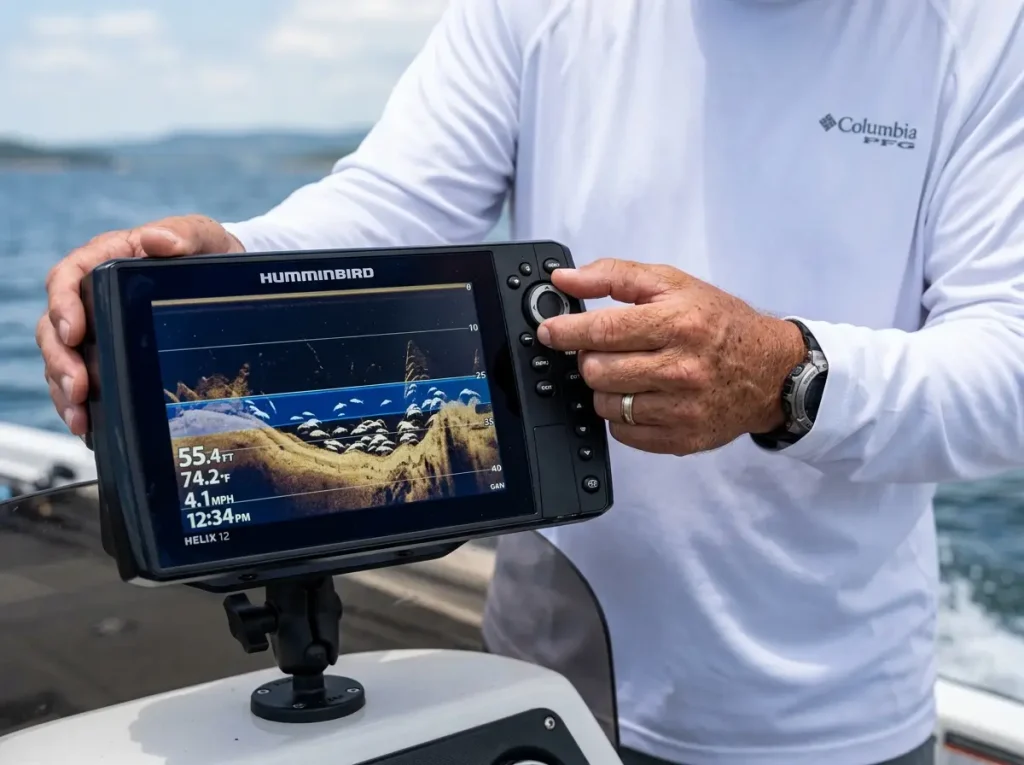
The thermocline is a physical density boundary between warm and cool water. Modern sonar systems—both 2D broadband and Down Imaging—can see it because that density change reflects acoustic signals. The problem is that default factory settings are designed to filter it out.
Per Humminbird’s official guide to seeing thermoclines on their sonar units, those auto settings are specifically designed to remove “clutter”—and the thermocline reads as clutter on a signal-processed display. You have to turn that processing off to see it.
Sonar Settings Protocol: Disabling the Filters That Hide the Thermocline
Run this sequence every time you hit a new lake in summer:
- Navigate to the deepest basin. Stratification needs vertical room to fully develop. A 6-foot flat won’t show it.
- Disable Noise Filters, Surface Clarity, and TVG (Time Variable Gain). These three filters are the enemy. TVG specifically is marketed as a quality-of-life feature—it removes scatter artifacts. The thermocline IS a scatter artifact you need to see.
- On 2D broadband: slowly increase gain until a faint, grainy horizontal line appears in the lower half of the water column. That’s your thermocline depth.
- On Down Imaging: push Contrast and Brightness to 100%. The thermocline appears as a thin, sharp horizontal line with fish arches pinned directly to its upper edge.
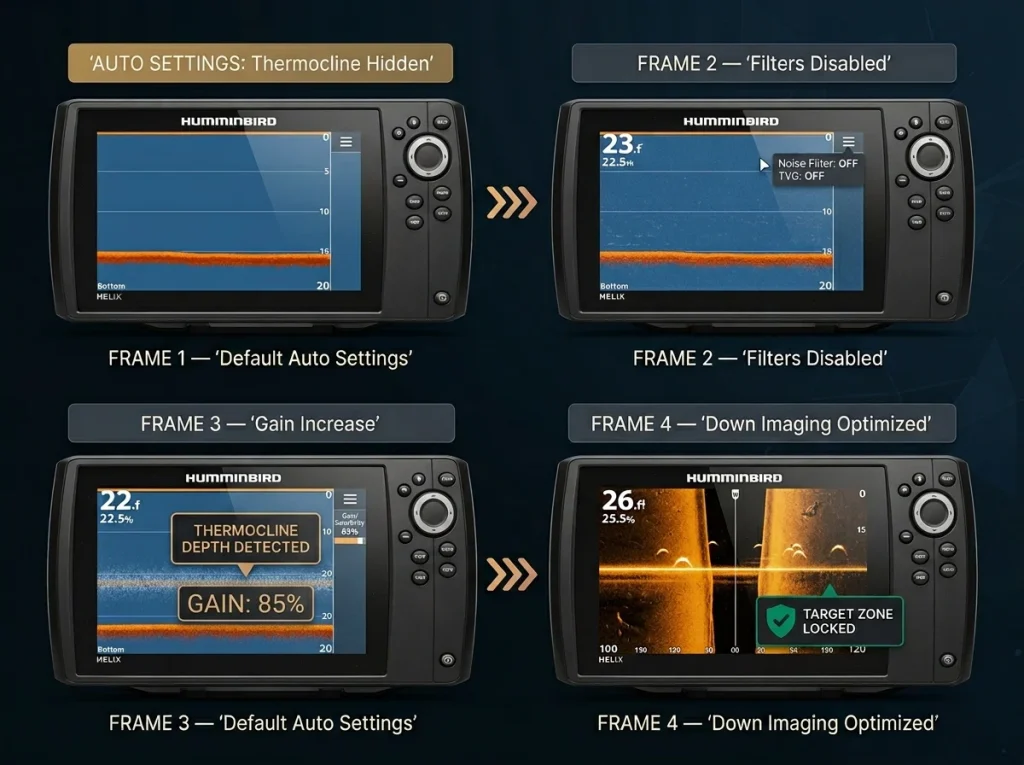
Once you’ve confirmed the thermocline sits at, say, 22 feet, you can ignore every piece of structure that doesn’t intersect 18–26 feet. You’ve just eliminated 90% of unproductive water.
Pro tip: If the thermocline doesn’t appear after increasing gain, move to a different basin. Local inflows, shading from bluffs, or cove orientation can delay stratification in isolated areas. The main basin stratifies first.
Reading the Display: Fish Arches at the Thermal Ceiling
Fish arches pinned to the top of the thermocline line are actively using the thermal refuge—highest probability targets in the lake. Arches above that line are scattered bait fish. Arches below it don’t exist, because oxygenation fails below the hard floor.
One nuance worth knowing: in murky late-summer water, the euphotic zone—the depth light penetrates—may be shallower than the thermocline. When that happens, fish can’t see color well. Silhouette and vibration matter more than lure color. Adjust accordingly.
Rigging Physics for Deep, Lethargic Fish
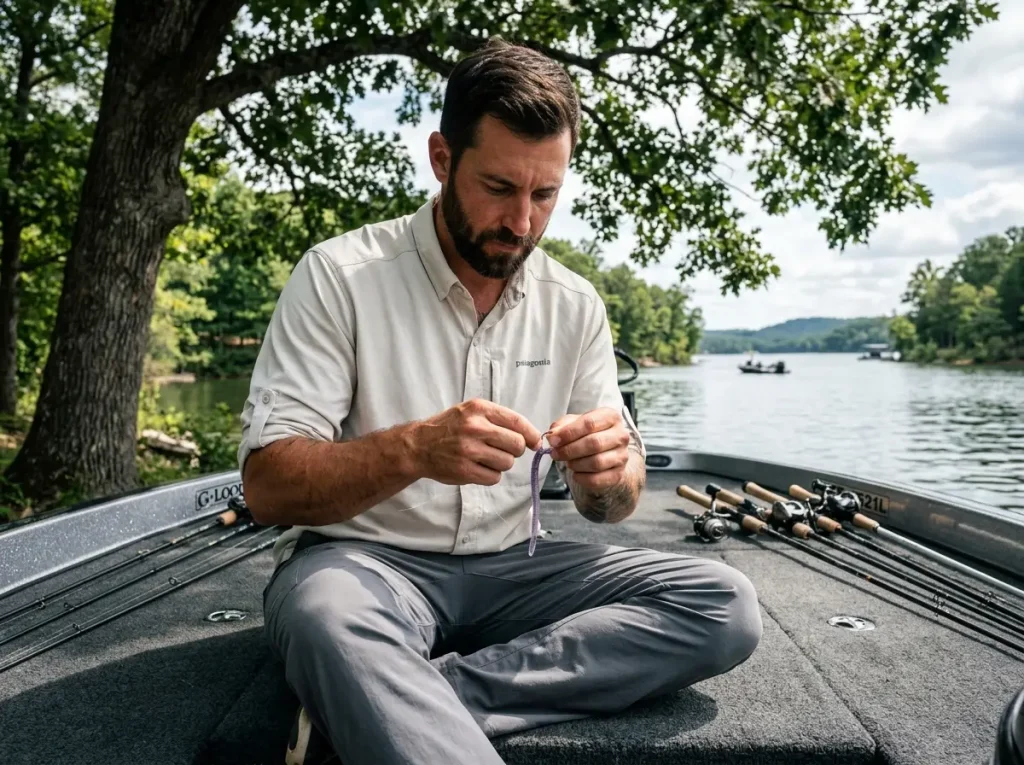
Line choice at thermocline depth is not a preference question. It’s physics.
At 22 feet with monofilament, you’re dealing with 25–30% line stretch and a massive drag vector—the arc your line makes as water resistance curves it away from vertical. A summer bass at thermal maximum delivers a pressure bite, maybe 1–2 lb of pressure signal. By the time that signal travels up a mono arc, it’s gone. You felt nothing. You missed the bite you were waiting all morning for.
Braided line (1–3% stretch) changes that equation entirely. 10–15 lb braid mainline with a 6–10 foot fluorocarbon leader at 6–8 lb is the standard summer deep-water system. Fluorocarbon sinks (density 1.78 g/cm³ versus water’s 1.0), meaning the leader helps your rig reach rated depth faster and hold it. It also transmits pressure signals to the braid, which transmits them directly to your fingertips. For a complete breakdown of how to detect those subtle bites on soft plastics once you have the right line system in place, detecting subtle bites on soft plastics walks through the rod and line sensory chain in detail.
The short version: mono is out for summer deep-water work. Full stop.
Drop Shot Physics: Maintaining Vertical Contact at Thermocline Depth
The drop-shot rig’s advantage is vertical orientation. The line runs straight down, minimizing drag vector. A 1/4 oz. tungsten sinker keeps bottom contact. A 6–12 inch fluorocarbon leader suspends a Roboworm, Zoom Trick Worm, or similar 4-inch finesse bait neutrally at exactly thermocline depth.
Hook angle matters here. A Palomar-knotted drop shot hook at 90° keeps the bait horizontal—essential for the slow, subtle swimming action that moves lethargic fish. A nose-diving bait loses most of its seductive motion and looks dead in the water.
Finesse tactics are not a style preference during the dog days. They’re a function of the fish’s energy budget. That lethargic bass can’t commit to a fast-moving bait. A 4-inch worm hovering at 22 feet, barely twitching, is something it can actually respond to.
The Anti-Sell on Deep-Diving Crankbaits
Deep-divers rated 18–20 feet are a legitimate option—sometimes the right one—but they have a physics problem most anglers ignore. When a crank hits structure and deflects, the bill geometry launches the lure 2–4 feet away from where the fish was holding. A bass at high temperature with near-zero aerobic scope physically cannot chase a bait that just jumped out of its strike window.
If you’re using deep-divers in summer, look for circuit board bills over plastic. They stay at depth longer through the retrieve, deflect shorter distances on contact, and allow slower cranking speeds while maintaining depth. Slow-rolling a lure rated for 20 feet in 15 feet of water keeps it in continuous bottom contact across the entire retrieve—that’s the right approach.
One trick worth keeping: when a crankbait deflects off structure and a fish misses it, stop the lure completely and let it rise on a semi-slack line. That sudden buoyancy change—bait popping up and floating slowly—triggers a second strike from a fish that couldn’t commit to the initial pass.
Tactical Locations: Where the Thermocline Meets Structure
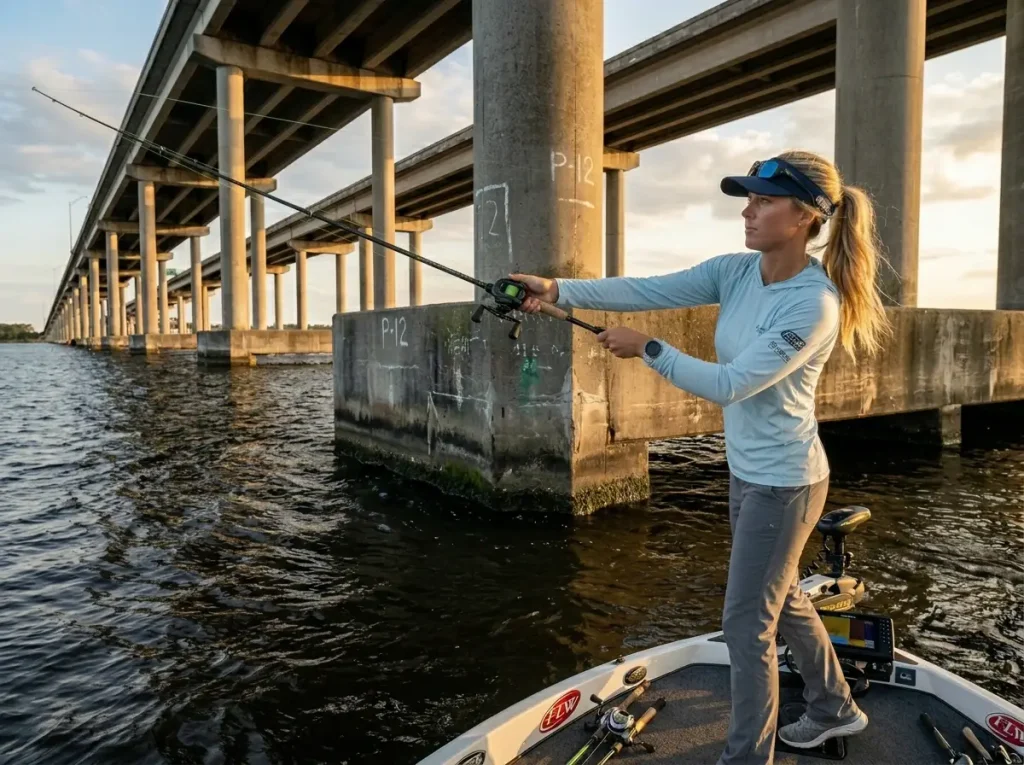
A 22-foot thermocline on a 22-foot flat is useless. The fish have nowhere to go but up or nowhere with any cover. You need vertical structure that intersects thermocline depth—the intersection is the whole game.
Current and inflow multiply everything. Moving water oxygenates the thermocline band and concentrates bait, which pulls predators. Creek channel mouths, dam tailwaters, wind-blown points, main-lake channel swings: all of these outperform static cover during peak stratification. Read more in a complete tactical breakdown of mid-summer offshore bass structure.
Mud lines from summer inflows deserve your attention. Bass position on the clean-water side of turbidity boundaries, where oxygenation is better and bait concentrates. Barometric pressure before summer storms creates a brief, intense feeding window—1–3 hours of accelerated activity that temporarily overrides thermal depression. When the glass drops fast before a front, get on the water.
Current Seams and Oxygenated Inflows
Inflow points create turbulence that re-aerates water near the thermocline. During peak stratification, these may be the only spots where dissolved oxygen gradients improve enough to pull fish off their deep holding positions. Creek mouths and dam spillways are worth checking first thing every morning.
The mud lines these inflows create are essentially current seams. Bass know exactly where the oxygen gradient changes. Position a slow-rolled swimbait or Carolina rig on the clean-water side, and work it parallel to the boundary. The fish are already lined up on that edge.
Wood on Current: The Better Summer Cover
Bridge pilings and standing timber over channel swings have lower hydraulic roughness than dense weed mats. Current can still flow through them, delivering oxygen without the interior dead-room problem that dense vegetation creates. Wood on a current break—especially where a channel swings under a bridge or alongside a standing timber flat—is often the most reliable summer structure.
One correction on shade as structure: it modifies local surface temperature by 2–4°F. That’s real but minor. The actual advantage of woody structure is current-delivered oxygen. Shade alone does not solve the thermocline problem.
Conservation: The Ethics of Dog Days Angling
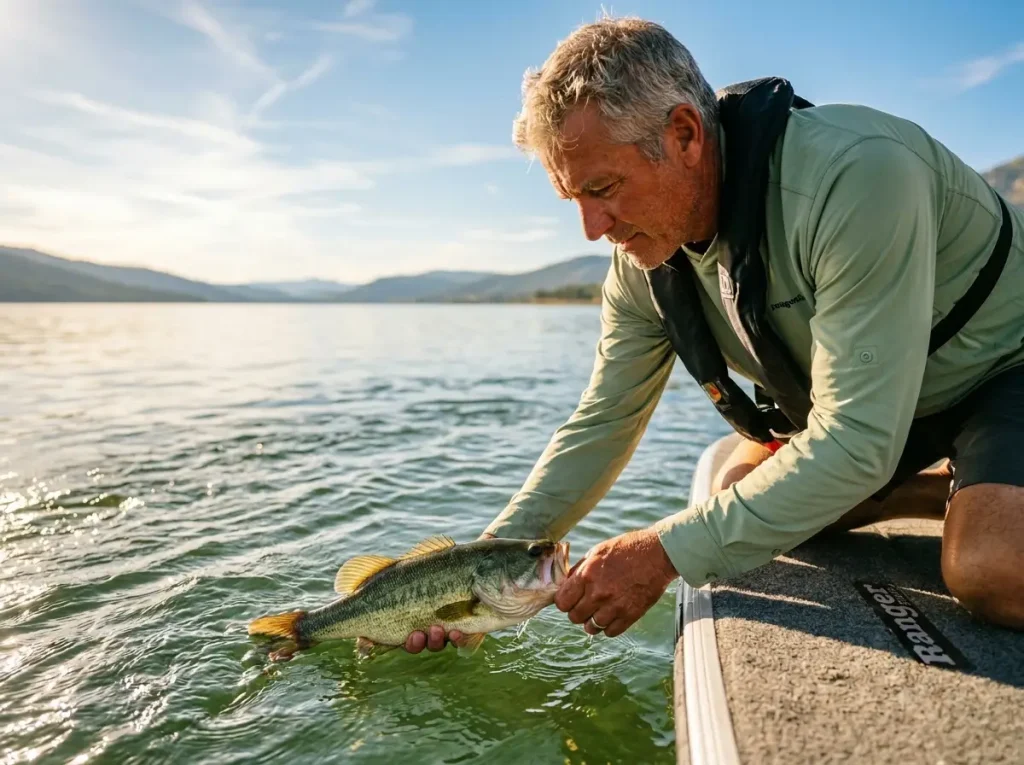
At 89–90°F water, a fish you’ve fought for 3 minutes has accumulated an oxygen debt it may not recover from. An Oxford Academic study on water temperature and largemouth bass survival after angling shows statistically significant reductions in survival rates as temperatures approach 86°F. At 90°F with dissolved oxygen already at 7.4 mg/L—the maximum the water can hold at saturation—there’s almost no margin for recovery.
Every extra minute fighting a fish burns oxygen it cannot replace fast enough. In the already marginal-dissolved-oxygen conditions of peak summer, prolonged fight time is not sporting. It’s a conservation liability.
Oxygen Debt and the Summer Fight: How Long Is Too Long?
This is where the warm-water release protocol that actually reduces summer mortality becomes non-negotiable. Use 15 lb braid on structure where leverage matters. A faster landing means less oxygen debt. Light line at thermocline depth on heavy cover is not a virtue—it’s the reason more fish die post-release than most tournament anglers want to admit.
Largemouth bass are more vulnerable than smallmouth in these conditions. Smallmouth have marginally lower preferred thermal ranges and slightly wider aerobic scope at high temperatures. Target them with more confidence in extreme heat; handle largemouth with maximum urgency.
Catch and Immediate Release. Zero air exposure—15 seconds maximum. Revival facing into current or held stationary over the side of the boat until the fish kicks and swims strong on its own. That’s the standard. Anything less in 89°F water is gambling with the fish’s life.
Pro tip: Use 15 lb braid when fishing heavy structure in summer. The faster you land a fish, the less oxygen debt it accumulates. “Sporting” light line at thermocline depth on hard cover is a conservation problem, not a fishing virtue.
Cyanobacteria and Bloom Identification
Pea-soup green or blue-green surface scum, sometimes with a petroleum-like sheen—that’s cyanobacteria (blue-green algae). These blooms produce microcystin and related toxins that stress fish, livestock, and pets. When a bloom expires and bacterial decomposition kicks in, it strips dissolved oxygen from the water fast, causing localized fish die-offs.
If you see surface activity suddenly go dead quiet in a bloom area, dissolved oxygen may have crashed. Get out of there. The fish have too. There are no quality fish in hypoxic bloom water, and the ones you handle may already be in physiological distress.
Conclusion
The summer slump is a precision problem, not a productivity problem. Three things separate consistent July and August anglers from everyone else:
The thermocline is the only address that matters. Use sonar—disable TVG, Surface Clarity, and noise filters—find the depth, and fish nothing that doesn’t intersect it. Everything else is noise.
Aerobic scope collapse demands slow presentation. A lethargic bass at 88°F is physiologically unable to commit to a fast retrieve. Drop-shot, Carolina rig, slow-rolled finesse—match your cadence to what the fish’s energy budget can afford.
Fast landing equals better survival. Appropriate tackle, quick fight, zero air exposure. That’s the standard in dog-day heat.
Next time you’re on the water in late July and the surface is glass-calm and dead, resist the urge to move every 20 minutes. Drop the transducer, find the thermocline, and fish the 6-foot band where the biology actually is. That’s the discipline that separates consistent summer anglers from the rest.
FAQ
What months are the dog days of summer for fishing?
The dog days traditionally run July 3 through August 11, coinciding with peak thermal loading in Northern Hemisphere freshwater lakes and reservoirs. For practical fishing purposes, the summer fishing slump window typically extends from mid-June through early September any time surface temperatures exceed 85°F and thermoclines are fully established.
Do fish bite in 90-degree water temperatures?
Fish continue to feed in 90°F surface water—but not at the surface. They concentrate along the thermocline at 18–30 feet where water is cooler and dissolved oxygen is adequate. The feeding window narrows to dawn and dusk when aerobic scope briefly expands. Presentations must be extremely slow; metabolic depression at those temperatures means the fish cannot sustain a high-speed chase.
What is the best bait for summer bass fishing in extreme heat?
Drop-shot rigs with 4-inch finesse worms—Roboworm, Zoom Trick Worm—on 6–8 lb fluorocarbon leaders at thermocline depth are the most reliable producers. The vertical presentation minimizes drag vector, the slow-falling action matches the fishs available energy, and the bait stays at the exact depth where bass are compressed. Carolina rig is the second-tier option for covering more bottom efficiently.
How do you find the thermocline without a fish finder?
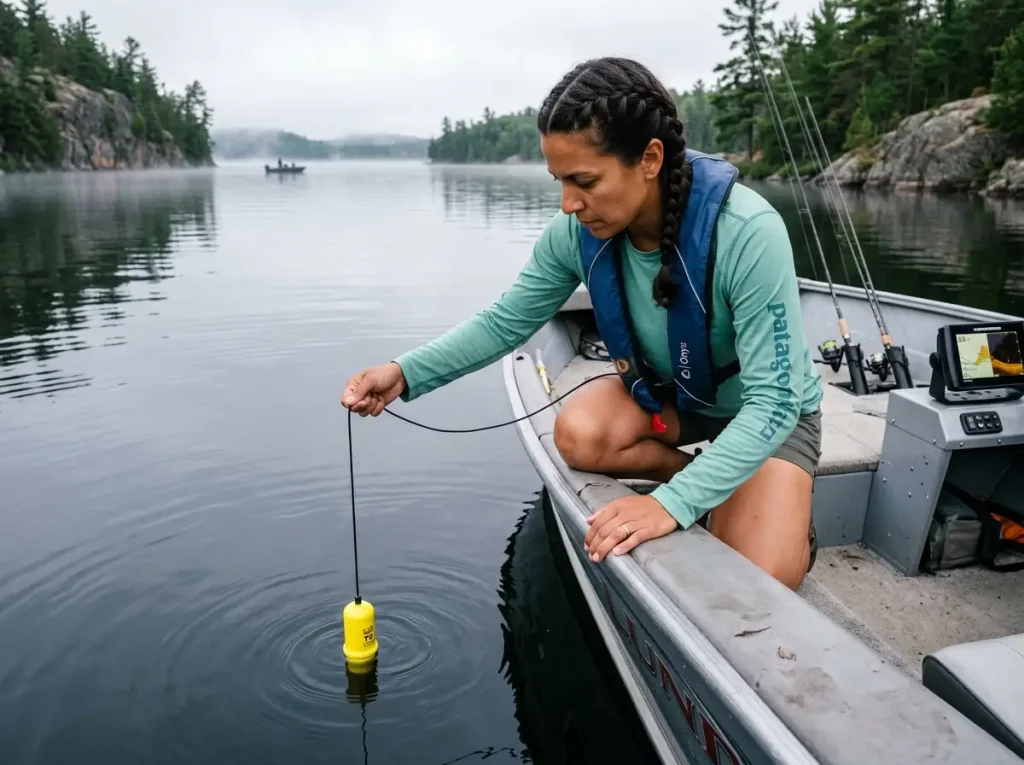
Without sonar, lower a temperature probe on a line—a Fish Hawk or similar device—and identify the zone where temperature drops most rapidly, typically 1°F per foot or more. Alternatively, suspend a thermometer at different depths using a drop-shot sinker and wait 5 minutes per reading. The depth showing the steepest temperature gradient is your thermocline. Slow method, same data.
Is fishing in extreme summer heat hazardous to fish?
Yes—significantly. At or above 86°F, the oxygen debt created by a fight may exceed what fish can recover from in low-dissolved-oxygen summer water. The Oxford Academic research on largemouth bass demonstrates statistically reduced survival rates at these temperatures. Ethical practice means appropriate tackle to land fish quickly, air exposure under 15 seconds, and considering staying off the water entirely during extreme thermal events when surface temps exceed 90°F.
Risk Disclaimer: Fishing, boating, and all related outdoor activities involve inherent risks that
can lead to injury. The information provided on Master Fishing Mag is for educational and informational purposes
only. While we strive for accuracy, the information, techniques, and advice on gear and safety are not a substitute
for your own best judgment, local knowledge, and adherence to official regulations. Fishing regulations, including
seasons, size limits, and species restrictions, change frequently and vary by location. Always consult the latest
official regulations from your local fish and wildlife agency before heading out. Proper handling of hooks, knives,
and other sharp equipment is essential for safety. Furthermore, be aware of local fish consumption advisories. By
using this website, you agree that you are solely responsible for your own safety and for complying with all
applicable laws. Any reliance you place on our content is strictly at your own risk. Master Fishing Mag and its
authors will not be held liable for any injury, damage, or loss sustained in connection with the use of the
information herein.
Affiliate Disclosure: We are a participant in the Amazon Services LLC Associates Program, an
affiliate advertising program designed to provide a means for us to earn advertising fees by advertising and linking
to Amazon.com. As an Amazon Associate, we earn from qualifying purchases. We also participate in other affiliate
programs and may receive a commission on products purchased through our links, at no extra cost to you. Additional
terms are found in the terms of service.