In this article
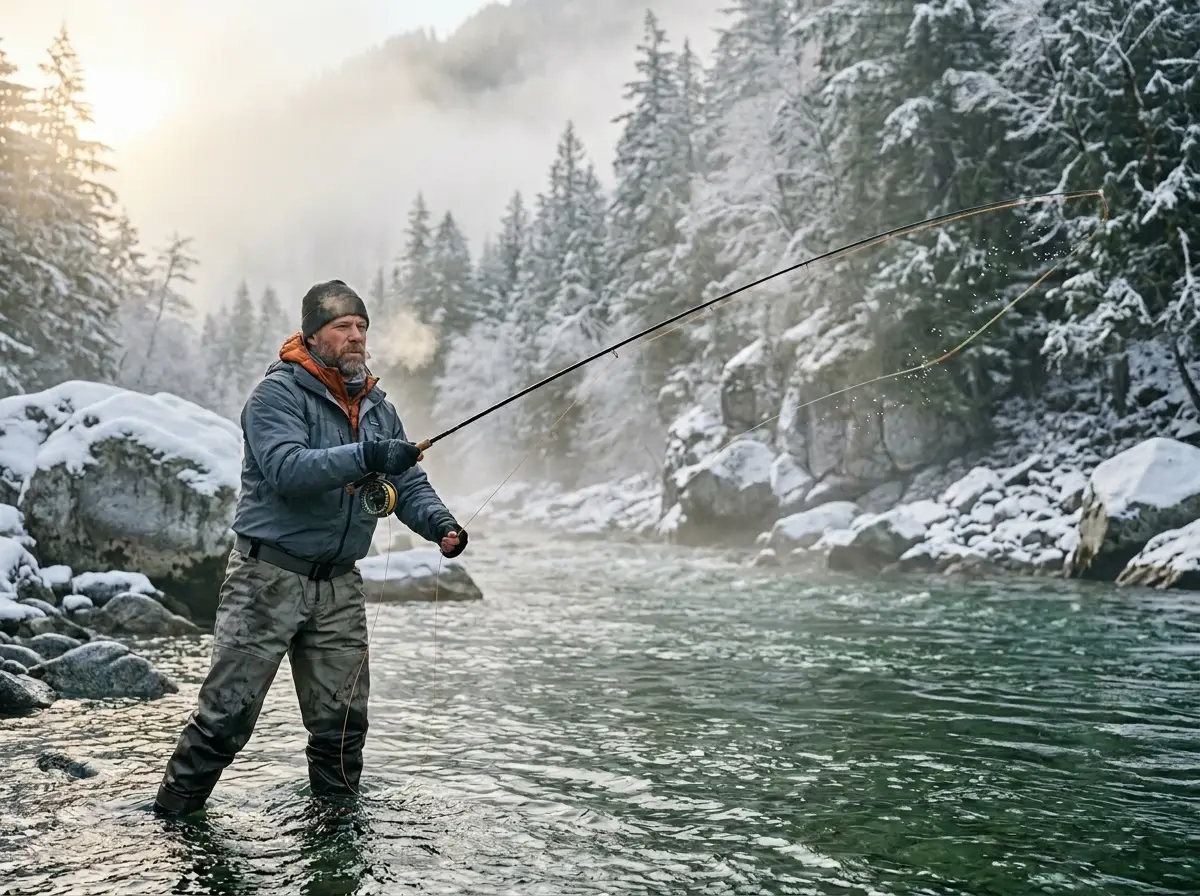
You’re standing in a tailout at 7 AM, water at 36°F, line freezing in your guides within three casts. You’ve worked this same seam for four straight mornings — same depth, same bead color, same drift angle — and you haven’t moved a single fish. Then two hundred yards upstream, some guy lands his third steelhead before noon.
He’s not luckier than you. He’s solving a different problem.
Winter steelheading isn’t about reading water the way your guide taught you. It’s about understanding the hydraulics, metabolic biology, and materials physics that govern where a cold fish sits, how close your presentation must be, and why your tackle is failing you before the fish even sees the hook. That’s what this article is about.
⚡ Quick Answer: In water between 39–45°F (4°C–7°C), steelhead are most active during the midday window from 11 AM to 3 PM. Target boulder-bedded runs where boundary layer flow and hydraulic dead zones let fish hold with near-zero energy expenditure. Your presentation must pass within 12 inches of the riverbed. Use a Trilene knot on your fluorocarbon leader — it holds 92% of rated strength in cold conditions versus 64% for a Clinch knot. Apply Stanley’s Ice Off Paste before your guides freeze, not after.
Reading the River — Hydraulic Physics of Holding Water
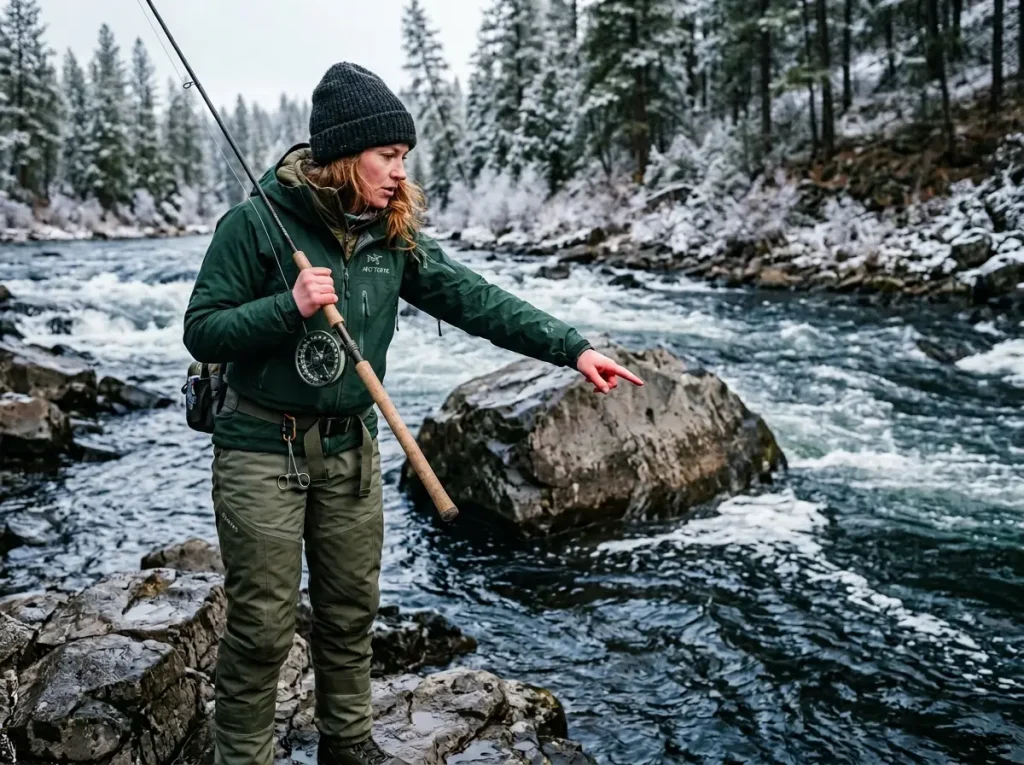
Most anglers think about holding water in terms of tradition: the gut of the run, the slot behind the boulder, the tailout before the riffle. Those aren’t wrong — but they’re descriptions without a mechanism. If you understand the mechanism, you stop guessing.
The variable that controls where a steelhead can hold without burning calories is called Manning’s roughness coefficient — a number that describes how much friction a riverbed generates against moving water. You don’t need to calculate it. You need to know what it tells you: boulder-bedded reaches produce n values as high as 0.42, and those extreme roughness values create something called dead zones — areas of near-zero flow that form in the downstream wake of large rocks, hydraulically detached from the main current. That’s where the fish live in winter. Not tucked against the boulder itself, but in the low-velocity shadow downstream, where the water is still and the main current delivers oxygen and drifting food without requiring the fish to fight it. The Manning’s roughness coefficient standards for natural channels are well-documented for different substrate types, and the data confirms that boulder substrate produces the most extreme roughness values found in natural river systems.
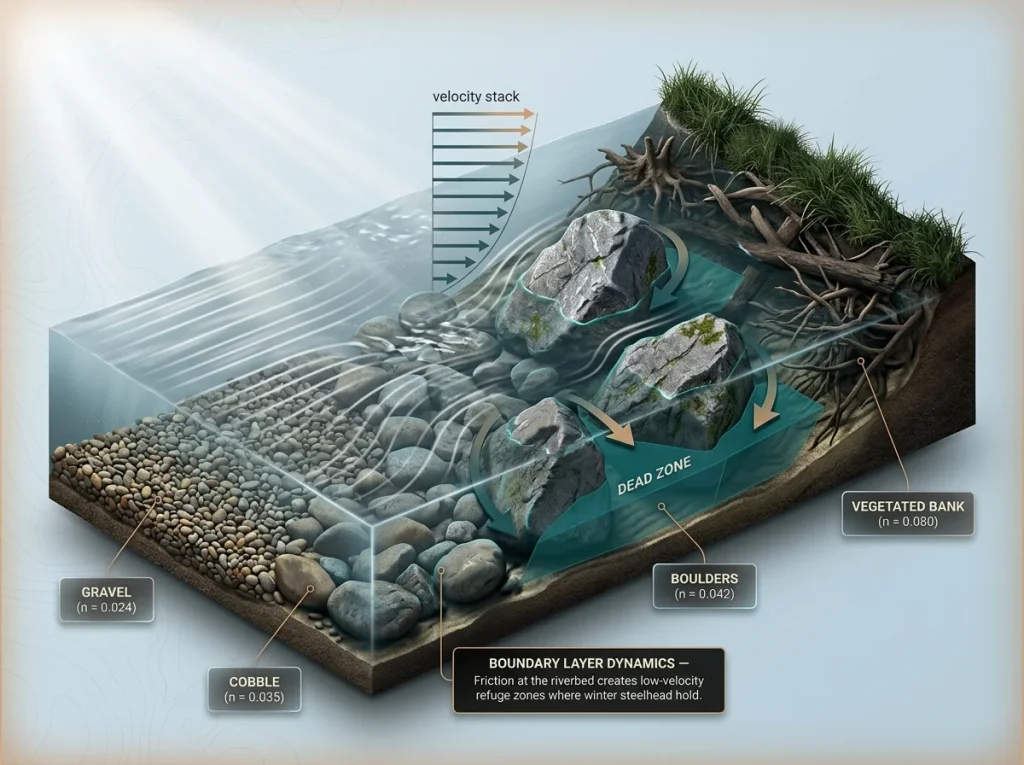
When boulder wakes overlap — what hydraulic engineers call the wake interference regime — the whole river bottom becomes a matrix of connected low-velocity patches. A steelhead can string these patches together across an entire run and barely expend any energy. That’s the actual reason fish prefer boulder substrate in winter. Not because it’s structure for cover. Because it’s an energy-free highway.
Pro Tip: If you can see surface boils and eddies from a position upstream, the riverbed is generating dead zones. Glassy, featureless surface water typically means smooth substrate and almost nothing to hold a metabolically stressed winter fish.
For reading the river at a glance, three surface signatures point directly at hydraulic dead zones: the foam line (where surface drift accumulates marks the fast-to-slow water transition), inside bends where centrifugal force pushes the thalweg outside and leaves a hydraulic shadow on the convex bank, and velocity discontinuities where tributaries or channel necking create compression-expansion pairs. For a deeper breakdown of current seam hydrodynamics and how Kármán vortex streets shape fish holding positions, that’s worth a separate read.
High water changes the equation. When flows rise, Manning’s n partially drowns out — the relative effect of substrate roughness drops as velocity increases. Fish compress to bank structure and vegetated margins where root wads, fallen timber, and overhanging debris create what ecohydraulic models call composite roughness. The bank becomes the dead zone matrix. In flood conditions, start close — within 10–15 feet of shore — before you touch anything in the mid-river gut.
In winter, steelhead favor runs 4–8 feet deep with a current that matches a human walking pace. That depth provides hydrostatic cover while maintaining enough flow for oxygenation. Once you recognize the speed — not fast, not slack, just purposeful — you’ll start seeing through the water instead of at it. The foam line is your GPS. Stand upstream and follow it with your eyes. It leads directly over every productive dead zone in the run.
The Metabolic Equation — Why Cold Fish Don’t Chase
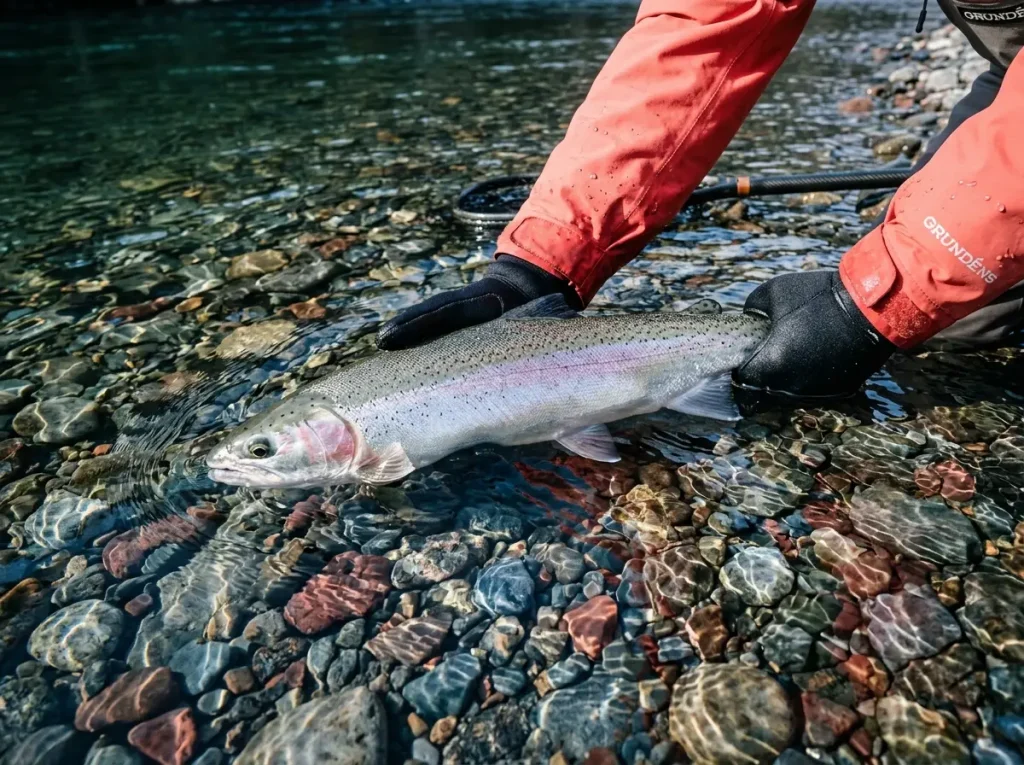
Here’s the part nobody explains properly. Yes, steelhead hold deep in winter. Yes, you need to slow down your presentation. But the reason isn’t behavioral preference — it’s hard biology locked to water temperature.
Steelhead are ectotherms. Their Standard Metabolic Rate (SMR) — the energy they burn just staying alive — is a direct function of water temperature. At 36°F (2°C), their SMR is near minimum. Aerobic capacity drops to roughly 20% of summer levels. That fish sitting in the dead zone behind your target boulder is running on almost nothing. It cannot afford to break from that hydraulic refuge to intercept a lure that’s two feet off the bottom and three feet away. The metabolic cost exceeds the caloric value of the meal.
That shrinks the strike window to something most anglers never truly account for: at 36°F, your presentation must pass within 6 inches of the fish’s position, not the 3-foot intercept radius you’d expect in warmer water. The fish isn’t being selective. It’s being physically constrained. According to NOAA research on steelhead metabolic rate and temperature, SMR and life-history behavior in Oncorhynchus mykiss are directly linked to thermal regimes — a fish in cold water is operating on a biological budget with almost no margin.
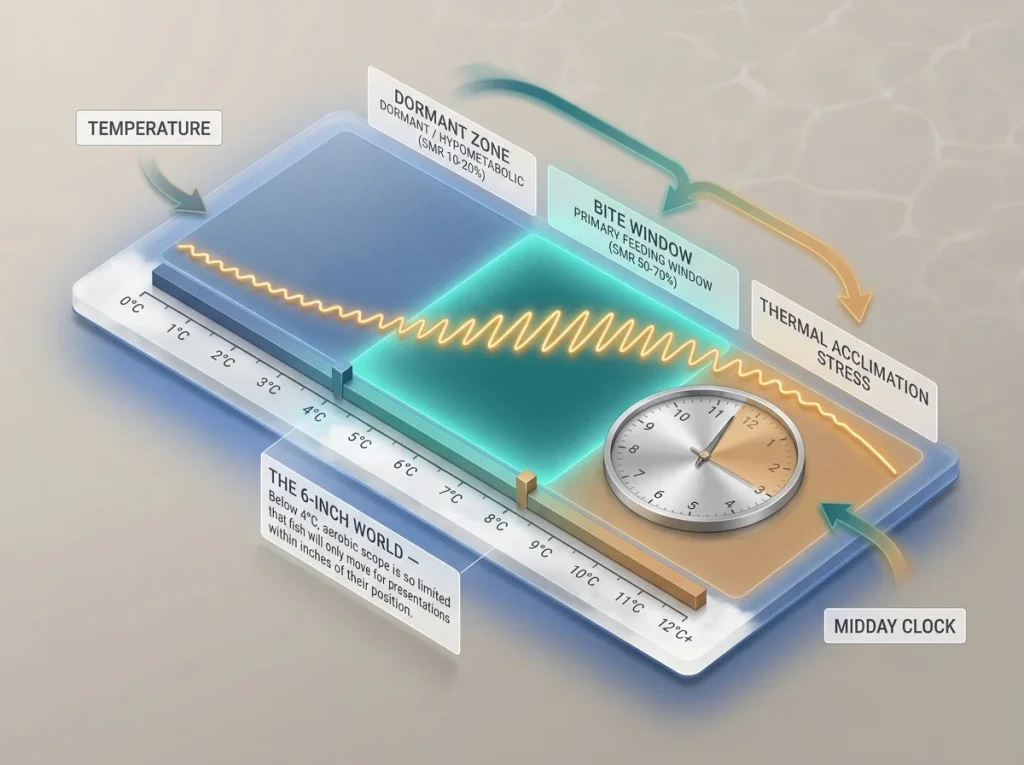
The 4°C–7°C sweet spot (39–45°F) is where enzyme activity recovers enough to trigger movement. Below that, you’re fishing to a near-dormant animal. Even a 1–2°F thermal gain in this range can matter — sunny midday periods warm riffles briefly, and fish respond. This is why the midday window from 11 AM to 3 PM is the primary productive slot in sub-40°F conditions, not dawn. Check fish metabolism and water temperature data before you plan your start time.
The logarithmic velocity profile explains the 12-inch rule precisely: velocity in a river increases sharply with height above the riverbed. A fish holding 2 inches off the substrate is in far slower water than a fish at 18 inches off the bottom. If your presentation runs higher than the fish’s holding depth, exiting that low-velocity zone costs the fish more energy than the potential reward. The “tick-tick” of your weight tapping bottom isn’t just a sign you’re deep enough — it’s proof your presentation is inside the biological strike window.
Pro Tip: Check USGS or NOAA river gauge water temperature data the night before. If overnight temps drop below 34°F, plan for a 10 AM start. The midday thermal window often doesn’t open until the sun has been on the water for two hours.
One more thing handlers miss: post-fight survival in cold water. A steelhead played to exhaustion at 36°F faces a metabolic recovery timeline far longer than at 50°F. Aerobic scope — the gap between SMR and maximum metabolic rate — is compressed in winter. The fish has almost no buffer. Keep it submerged during the entire release. Five seconds of air exposure on a 36°F morning can trigger a cortisol cascade the fish may not recover from. I’ve watched guides hold fish for photos in that temperature range. The fish swam off looking fine. Some of them didn’t make it. You can’t see the metabolic debt from the bank.
Reading the Hydrograph — NOAA Data and the Falling Window
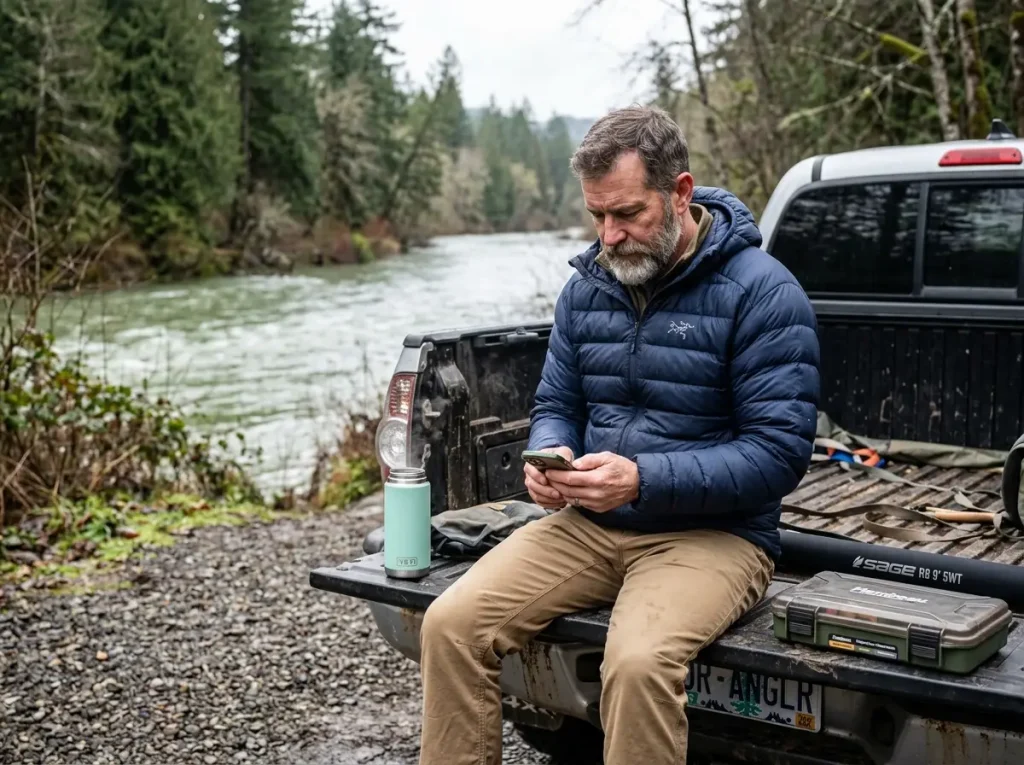
The single best day in winter steelheading isn’t when the weather breaks or the stars align. It’s days two through four after a rain event — the falling hydrograph.
Here’s the mechanism: as the river drops from peak flood stage, flow velocity decreases. When velocity drops, the river loses its capacity to carry suspended sediment — the water clears progressively as the hydrograph descends. Simultaneously, the number of viable hydraulic dead zones decreases as water levels fall, which concentrates fish into the remaining efficient holding patches. More fish per square foot of dead zone. Easier to find, easier to present to.
Migration timing compounds the advantage. Steelhead often push upstream on the rising limb of the hydrograph — the spate triggers movement. Then they settle into holding water as flows stabilize. The falling hydrograph catches freshly arrived fish that haven’t seen a bead or a spinner yet.
How to read a river for fishing — including thalweg positioning, pool-riffle sequencing, and laminar flow behavior — gives you the physical framework that ties the hydrograph strategy to where you’re actually casting once you get to the water.
Dual-frequency identification sonar (DIDSON) deployments on California’s Scott Creek and Oregon tributaries have confirmed what Pacific Northwest guides have observed for decades: steelhead runs correlate with broad-scale climatic patterns, including atmospheric rivers. The NOAA DIDSON steelhead monitoring study provides run composition timing data that lets you anticipate pulses rather than simply react to them. Anglers who cross-reference NOAA gauge data with DIDSON run models are planning trips, not hoping for them.
Pro Tip: Bookmark your local USGS gauge and check it daily during winter storm season. The falling hydrograph window often opens and closes within 48 hours. The anglers who catch fish aren’t always better — they’re just prepared to move on the right day.
Visibility determines presentation priority. In clear water over 4 feet, natural colors and sparse presentations outperform. At 1–3 feet, move to contrast colors — pink or orange beads, spinner blades — where the fish’s lateral line sensitivity starts to supplement or replace visual detection. Below 1 foot of clarity, vibration and hydraulic pressure pulses are primary, and a Blue Fox Vibrax spinner or skip-beat Mag Lip plug becomes your best option. For a deeper look at how fish process visual and vibrational information across different water clarity conditions, check the guide on fish lateral line system and how steelhead switch between sensory inputs as turbidity changes.
Tactical Physics — Presentation Methods That Actually Work
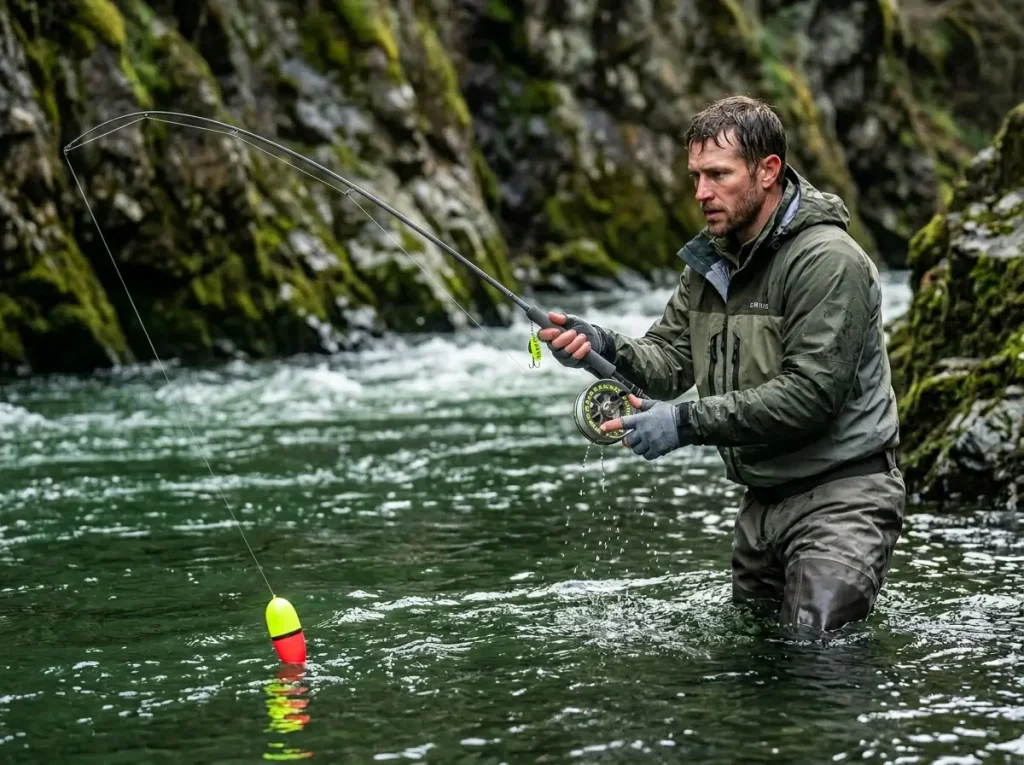
All three core winter presentation methods — the swing, float fishing, and hardware — share one goal: delivering the lure within 12 inches of the riverbed. They differ only in how they manipulate line drag and current to put it there.
The Physics of the Swing — Mending as a Braking System
The swing works when it’s slow. The standard 45° downstream cast lets the fly arc across the current, but the line itself generates drag that pulls the fly too fast for a lethargic winter fish. Line mending is the solution — not an aesthetic choice, but a braking mechanism. When you mend upstream, you reduce the current-surface area of the line, cutting drag tension and slowing the arc. Type 6 sink tips penetrate fast-water guts; Type 3 in tailouts. The hang at the end of the swing — when the fly sits nearly stationary and broadside in the current — is often the most productive moment of the entire cast.
At 36°F, what feels dead-slow to you is probably still too fast for a fish running on 20% aerobic capacity. There’s no elegant way to learn this except to consciously fish slower than feels right, every single time. Veterans call it “fishing to the fish’s world, not yours.”
Float Fishing — Cracking the Drift Speed Problem
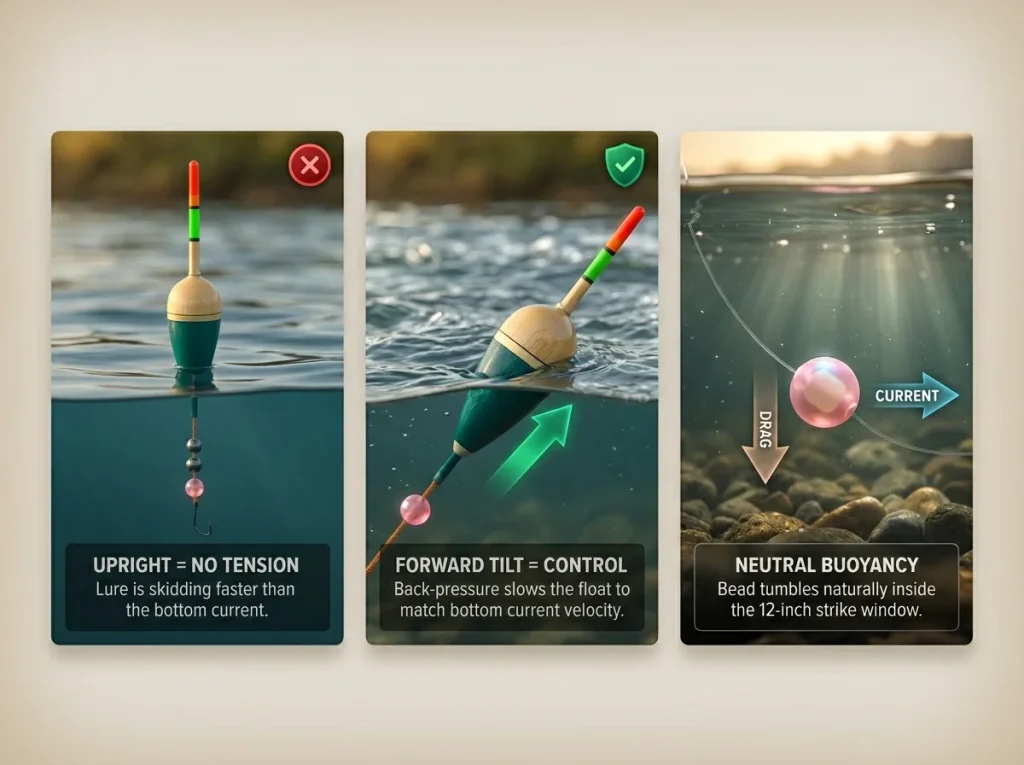
Float fishing aims for a dead drift — the lure moving at the exact speed of the current at the fish’s depth. The problem is that surface water moves faster than bottom water because of the boundary layer. Float with the surface current and your bead is skidding, not drifting.
The fix is the “lead the float” technique: apply slight back-pressure against the surface current, slowing the float until it matches the slower bottom current speed. Your bead should be within 6 inches of the substrate. Soft 10–20mm beads achieve neutral buoyancy and tumble naturally along the riverbed, mimicking a loose salmon egg with almost no mechanical tell. A slight forward lean on the float tells you the rig is dragging at depth — that’s what you’re after.
For the full breakdown of float fishing physics for steelhead — boundary layer mechanics, centerpin setup, the Up is Down rule — that section goes deep into the mechanics. For split shot placement, put your closest weight nearest the bead as an anchor and taper secondary weights up the leader to minimize surface drag.
Hardware Selection — Vibration and Frequency in Dirty Water
Blue Fox Vibrax spinners produce low-frequency vibrations correlated with injured baitfish. In turbid water under 2 feet of clarity, a steelhead detects those pressure waves before it sees anything — lateral line sensitivity takes over entirely from visual detection. Mag Lip plugs use an erratic skip-beat action that creates hydraulic pressure pulses disrupting the current enough to trigger predatory response in a fish that otherwise wouldn’t move.
In very clear water, hardware noise can spook fish. In dirty water, it’s often your only productive tool. Start with a Vibrax size 3 in chartreuse/orange. If you get follows but no strikes, switch to a Mag Lip — the erratic oscillation disrupts the fish’s hesitation response where a steady spinner spin fails.
Watch this breakdown of the three most effective winter techniques before your next trip:
Cold-Weather Gear Integrity — The Materials Science Nobody Talks About
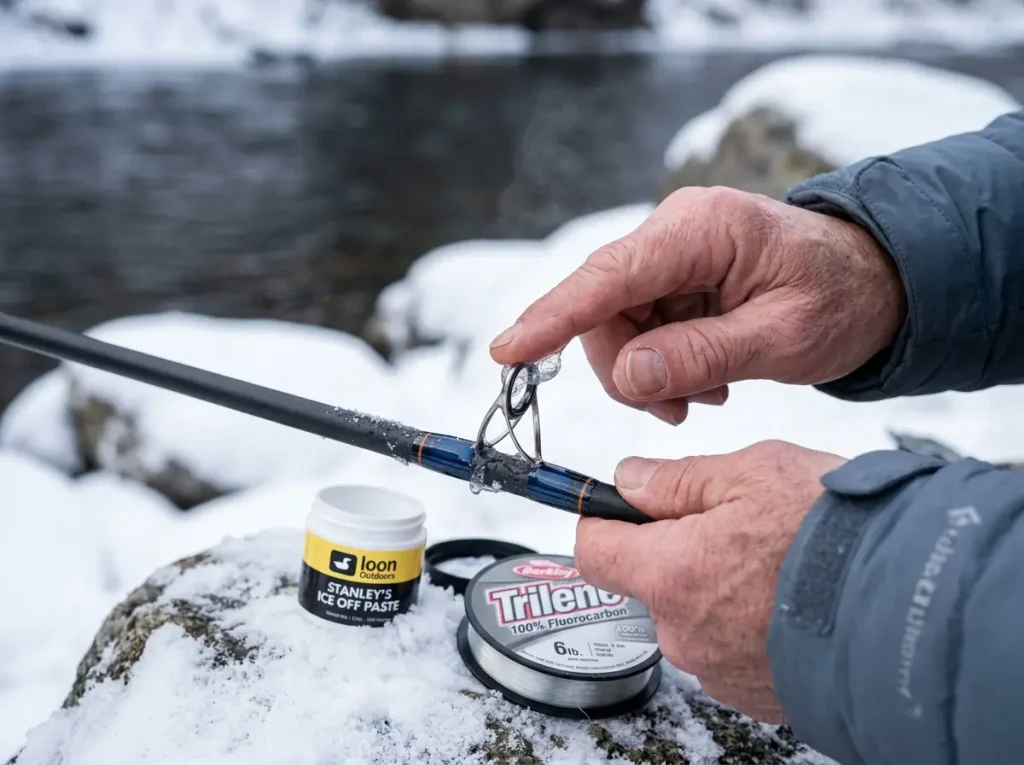
Your tackle is degrading faster than you think in 32°F air. This isn’t pessimism — it’s polymer chemistry.
Fluorocarbon becomes stiffer as temperatures drop. Polymer chain mobility decreases, which means the friction generated during knot seating increases sharply. If you cinch a knot fast or without lubrication, that friction creates micro-abrasion at the bend — the knot fails before you ever hook a fish. The numbers are unambiguous: a Clinch knot on fluorocarbon delivers only 64% of rated test strength in cold conditions. A Trilene knot delivers 92%. The double-loop through the hook eye widens the bend radius and reduces stress concentration at the tightest point. The Palomar is acceptable at 85–91% and easier to tie with cold, numb fingers. Avoid the Clinch and the Uni knot on fluorocarbon in winter, full stop. For a deeper look at knot strength physics in cold conditions, the friction and failure mechanics are worth understanding before you get to the water.
Nylon monofilament has its own winter problem: it swells 3–5% as it absorbs water. The wetting-freezing-drying cycle creates internal stresses on tightly wound knots, producing kinks and structural weaknesses that don’t resolve. That peculiar “springy” behavior on your first casts of the morning means your leader has already taken some damage from the overnight freeze. For a head-to-head comparison of how each line type holds up in the cold, cold-water line performance comparison runs through monofilament, fluorocarbon, and braid under real winter conditions.
High-modulus graphite rods — IM8, 44M modulus — are more sensitive but more brittle. In cold temperatures, the epoxy resin binding the carbon fibers loses flexibility. If you smack a cold rod against the water to clear ice, or snap it sharply while guides are frozen solid, the resin fails to distribute stress and you get a clean break. The fix for guide ice is thermal, not mechanical: submerge the rod tip in the river. At 34°F, river water is still warmer than the metal guide surfaces, and the thermal transfer melts ice without any mechanical load. According to research on rainbow trout thermal acclimation capacity, thermal stress parameters in salmonids parallel the material stress responses in cold-exposed equipment — cold degrades everything on a biological or mechanical timeline.
Pro Tip: Pre-tie your fluorocarbon leaders the night before, indoors. Cold, numb fingers make bad knots. A Trilene knot tied at 68°F holds more consistently than the same knot tied at 32°F, even with correct technique.
Guide ice builds through nucleation: microscopic water droplets carried off wet line freeze on contact with the metal guide surface. Ice accretes with each cast. Stanley’s Ice Off Paste creates a hydrophobic barrier that prevents droplets from adhering and forming nucleation sites. The critical detail most anglers miss: apply it before guides ice, not after. Once nucleation sites have formed, retroactive application is 60% less effective. Reapply every 20 minutes in active icing conditions — the hydrophobic barrier degrades with repeated casting and needs maintenance.
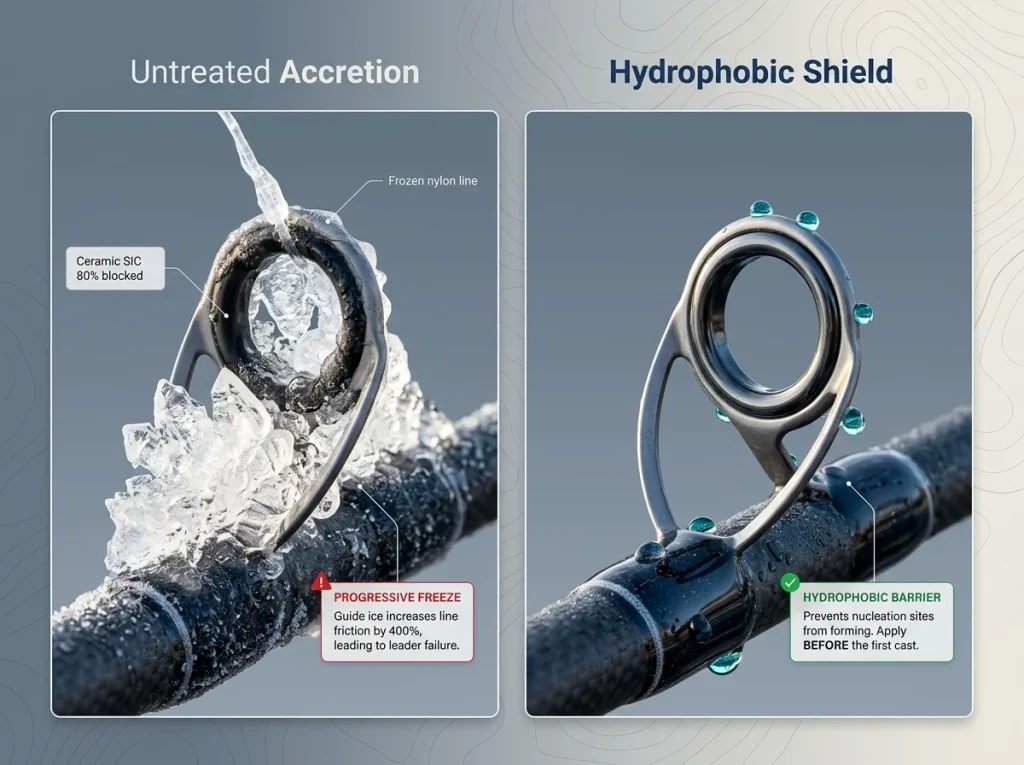
A mono rig with a long leader is a structural mitigation strategy, not just a tackle preference. Thinner leader line carries less water to the guides with each retrieve, slowing ice buildup mechanically. That’s the “mono rig advantage” that guides in the Pacific Northwest lean on every winter — not about stealth or presentation, but about keeping your guides clear long enough to fish properly.
Run Strategy — From Bank to Bubble Line
The hydraulic knowledge is useless if you burn the run on your first three casts. Most anglers wade in, throw to mid-river, step forward, repeat. Here’s where that goes wrong.
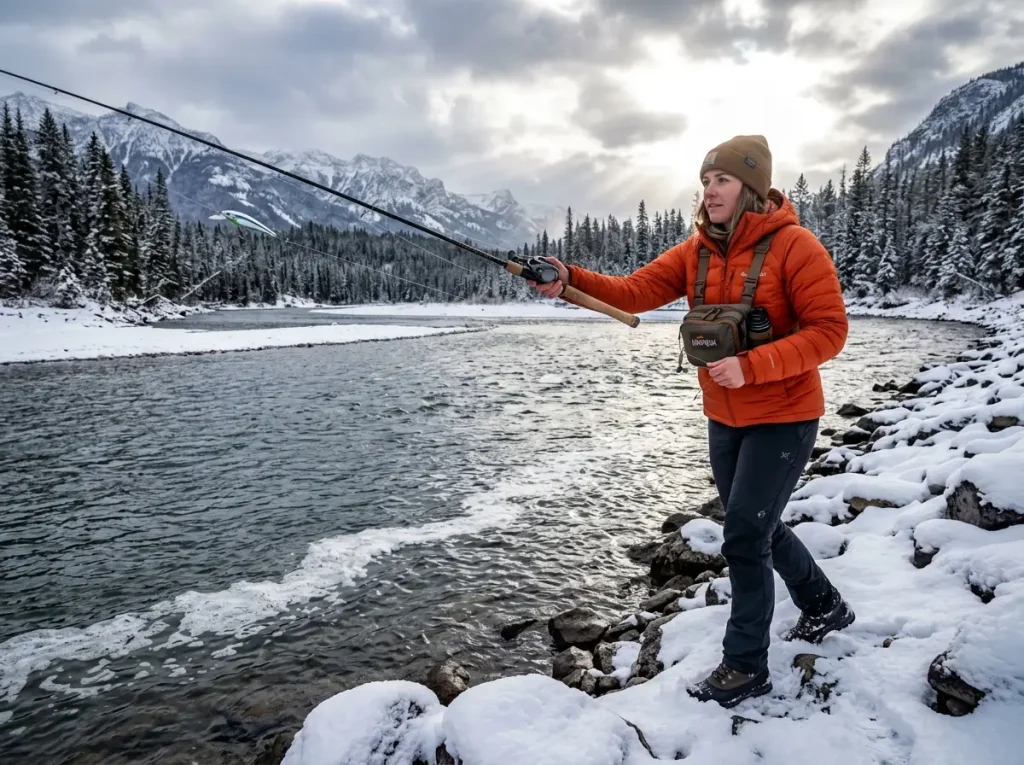
Start close. In high water and off-color conditions, lethargic winter fish compress to within 15 feet of the bank where composite roughness from bank structure creates the lowest available current velocity. A fly line landing over a near-bank fish before you’ve presented to it is a lost fish. First cast should land 8 feet from the bank. Third cast at mid-river. Cover the inside before you throw to the bubble line.
Cast rotation follows a systematic pattern: advance 2–3 steps downstream after each complete lane coverage. This ensures the presentation covers every square foot of the dead zone matrix without repeat passes that alert stationary fish. In winter, a cold steelhead has less caloric incentive to re-enter a disturbed zone than it does in warmer months — cold-water fish are more sensitive to disturbance, not less. You’re not dealing with indifferent fish. You’re dealing with fish that made a precise energy calculation and chose that hydraulic pocket deliberately.
After 15–20 casts without contact, rotate presentation before abandoning the spot. The fish is likely still there — stationary fish don’t leave unless disturbed. A repeated identical presentation drops response probability with each successive drift. Standard rotation: natural/subtle first (pink bead, sparse marabou) → contrast (orange, chartreuse) → dark silhouette (dark stonefly nymph, dark jig). Fish often respond to a color change after ignoring the same presentation for 10+ drifts. If you see a flash or follow under the float, change color before size — nine times out of ten, color is the adjustment. For bottom contact mechanics and weight adjustment in drift speed and bottom ticking for river steelhead, that article covers the weight tapering approach in detail.
Pro Tip: In mixed-population rivers, start at wild fish depth — deeper, in hydraulically complex pockets — and adjust shallower if you’re not connecting. Wild steelhead hold deeper and require more precise presentations; hatchery fish often hold shallower and respond more readily to repeat drifts. Cover both populations without starting shallow and spooking the bottom fish first.
Wild steelhead, identifiable by their intact adipose fin, hold deeper and show more behavioral wariness — they’ve been subject to natural selection pressure on wariness that hatchery fish haven’t. Where both populations coexist, check current regulations; mark-selective rules may apply and they change year to year. The Columbia River system is a good example: fishing the Columbia for salmon and steelhead covers the mark-selective rule framework and how to adapt your run strategy for mixed-population water.
The last thing most anglers skip: the first five minutes at the water. Before the first cast, read the hydraulics. Surface boils, foam line position, bank structure — the river is telling you exactly where the dead zones are. Spend those five minutes at the tailout looking upstream before you wade in. You’ll see the run differently. The fish doesn’t move to the cast. The cast has to move to the fish.
Conclusion
Three things matter more than everything else in winter steelheading.
Location is hydraulics, not instinct. Manning’s roughness coefficient and boundary layer dynamics define exactly where a fish sits in winter. Follow the dead zones — boulder substrate, foam lines, inside seams — and you’re working with the physics of the river, not against it.
Cold fish have a 6-inch world. At 36°F, a steelhead’s metabolic rate is 20% of summer capacity. The 12-inch rule isn’t a suggestion — it’s biology. Your presentation either enters the fish’s behavioral radius or it doesn’t. That radius is not negotiable.
Your tackle is degrading faster than you think. Fluorocarbon knots lose more than 30% of rated strength if improperly seated in cold. Graphite rods crack when guide ice is removed mechanically. Apply the materials discipline before you get to the water, not after you’ve lost a fish.
Next time you wade in, spend the first five minutes reading the hydraulics — surface boils, foam line behavior, bank structure — before your first cast. The river is telling you exactly where to go. You just have to know how to listen.
FAQ
What is the best water temperature for winter steelhead fishing?
The most productive bite window is 4°C–7°C (39–45°F), when enzyme activity is elevated enough to trigger movement and feeding behavior. Below 2°C (35.6°F), steelhead approach metabolic dormancy and are unlikely to intercept any presentation that isn’t within inches of their position.
Where do steelhead hold in high water?
In high water, steelhead compress to hydraulic refuges near the bank — within 10–15 feet of shore — where root wads, fallen timber, and bank vegetation create composite roughness and significantly lower current velocity. The mid-river gut that holds fish in normal flows is often too energetically costly in flood conditions.
What color lures work best for winter steelhead?
Color follows water clarity. In clear water over 3 feet, natural colors — pink beads, peach or orange — are most effective. In turbid conditions from 1–3 feet, high-contrast colors like chartreuse and orange paired with vibration (spinner blade) outperform. In chocolate-brown water under 1 foot of visibility, lure profile and hydraulic vibration matter far more than color.
Do steelhead bite in the snow?
Yes. Snowfall doesn’t shut down steelhead, but it often accompanies conditions that do — dropping air temperatures causing guide icing, brief dips in water temperature, or the tail end of a rain or snowmelt hydrograph. Fish the hydrograph timing, not the precipitation type. The falling hydrograph window stays productive in active snowfall as long as water temperature holds in the 4°C–7°C range.
What’s the best knot for fluorocarbon leaders in cold weather?
The Trilene knot — it delivers 92% of rated test strength on fluorocarbon in cold conditions versus 64% for the standard Clinch knot. The double-loop through the hook eye increases the bend radius and reduces stress concentration at the tightest point. The Palomar is an acceptable alternative at 85–91% and easier to tie with cold fingers. Avoid the Clinch knot and the Uni knot on fluorocarbon in winter.
Risk Disclaimer: Fishing, boating, and all related outdoor activities involve inherent risks that
can lead to injury. The information provided on Master Fishing Mag is for educational and informational purposes
only. While we strive for accuracy, the information, techniques, and advice on gear and safety are not a substitute
for your own best judgment, local knowledge, and adherence to official regulations. Fishing regulations, including
seasons, size limits, and species restrictions, change frequently and vary by location. Always consult the latest
official regulations from your local fish and wildlife agency before heading out. Proper handling of hooks, knives,
and other sharp equipment is essential for safety. Furthermore, be aware of local fish consumption advisories. By
using this website, you agree that you are solely responsible for your own safety and for complying with all
applicable laws. Any reliance you place on our content is strictly at your own risk. Master Fishing Mag and its
authors will not be held liable for any injury, damage, or loss sustained in connection with the use of the
information herein.
Affiliate Disclosure: We are a participant in the Amazon Services LLC Associates Program, an
affiliate advertising program designed to provide a means for us to earn advertising fees by advertising and linking
to Amazon.com. As an Amazon Associate, we earn from qualifying purchases. We also participate in other affiliate
programs and may receive a commission on products purchased through our links, at no extra cost to you. Additional
terms are found in the terms of service.