
In this article
It was a $28 jerkbait — a jointed swimbait rigged with Owner ST-36 trebles — and when I opened the tackle box three weeks after a saltwater trip, the hooks weren’t black anymore. They were orange. Not “a little surface stain” orange. Deep, pitted, structurally compromised orange. The kind of rust that didn’t happen because I was careless — it happened because I didn’t understand what I was actually dealing with.
Treble hook rust is not random and it is not bad luck. It’s a predictable electrochemical process started by chloride ions, moisture, and the specific alloys your manufacturer chose. This article explains the chemistry, identifies the points of failure most anglers never address, and gives you a replicable, science-backed protocol to stop corrosion before it costs you your best hooks and your best fish.
⚡ Quick Answer: Treble hooks rust because high-carbon steel — the material that makes them sharp — is inherently reactive when exposed to moisture and salt. Saltwater accelerates oxidation by orders of magnitude through chloride ion penetration. Rinsing alone won’t fix it: older hooks trap salt in micro-pockets that freshwater can’t reach. The fix is a four-step protocol — rinse, neutralize with Salt-X at 10:1 dilution, air-dry only, then store in a VCI-rated tackle box like the Plano Edge or Flambeau Zerust. Separate hooks by alloy type to prevent galvanic corrosion between compartments.
The Metallurgy Problem: Why High-Carbon Steel Hooks Are Built to Rust
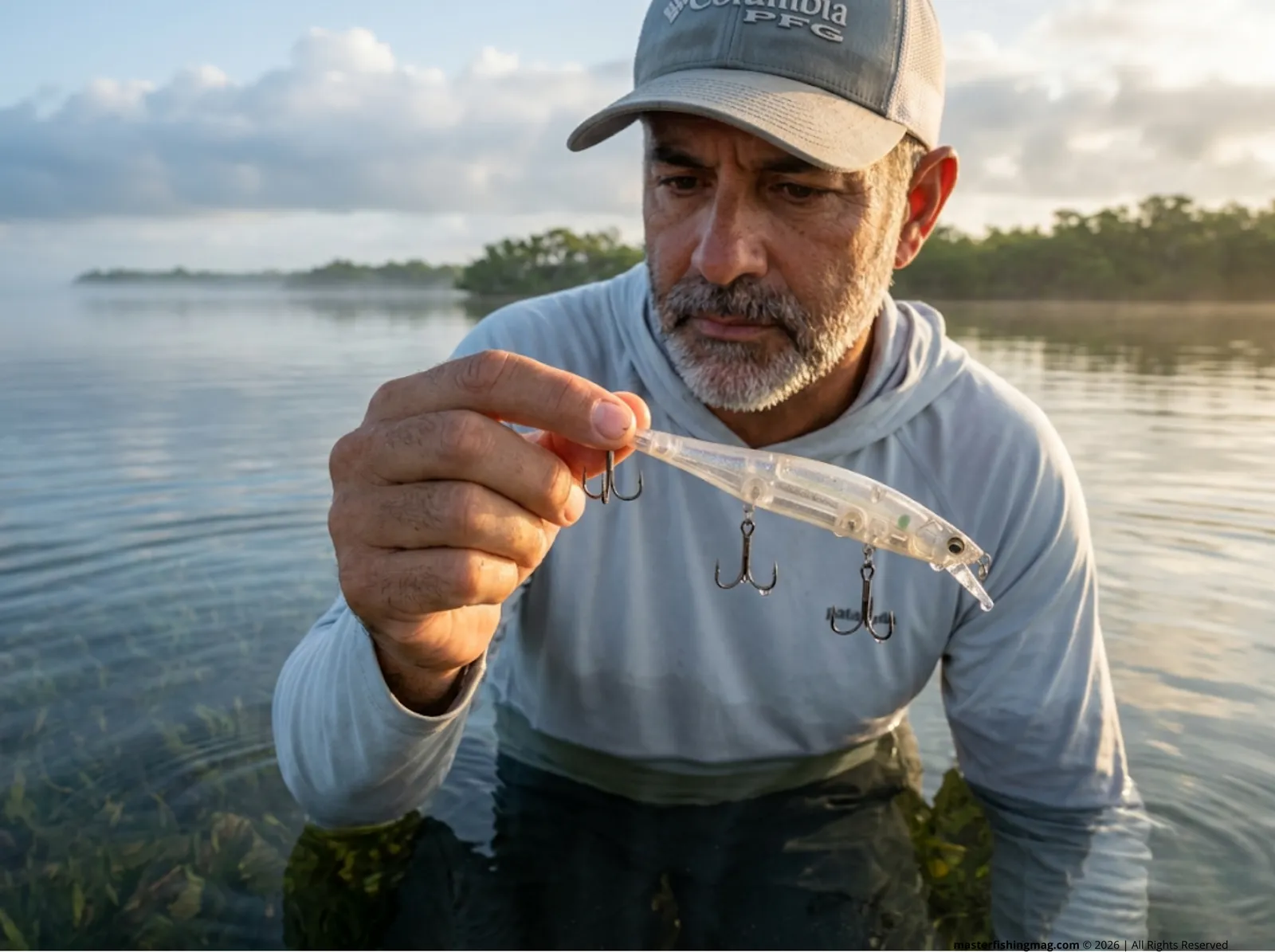
Most premium treble hooks — the ones worth buying — are made from high-carbon steel with a carbon content of 0.60% to 1.0%. That’s the precise range that allows the wire to be tempered hard enough to punch through bony jaw structures on a hard hook set. It’s also the reason they rust.
Here’s where everyone gets it wrong: they assume rust is a manufacturing defect or a storage failure. It’s neither. It’s a trade-off baked into the design. The same metallurgical properties that give you a chemically sharpened point sharp enough to catch skin with a light touch also strip the hook’s protective coating at the tip — the exact site where corrosion starts first.
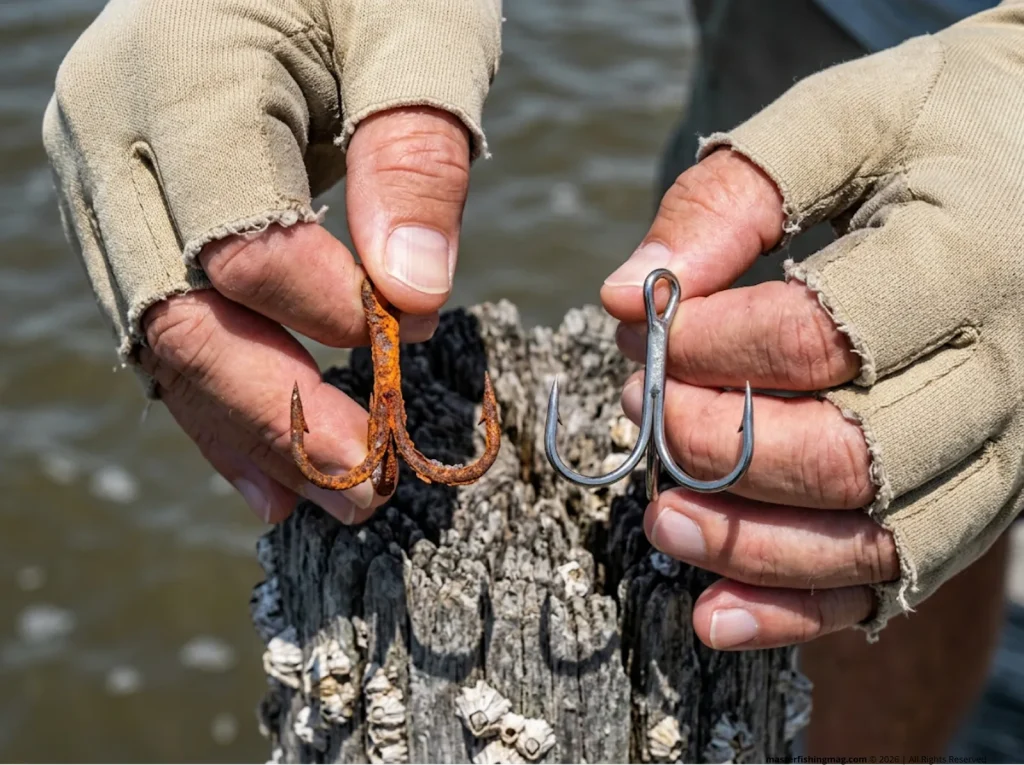
Chemical sharpening puts the hook point in an acid bath. The result is a tip finer than mechanical grinding can produce. The cost is raw, unprotected steel at the most exposed site on the hook. Every time that point drags across gravel or bounces off a dock piling, the unprotected zone grows. If you see rust only on the hook tip of a newer hook, you’re watching chemical-sharpening exposure failure — not bad storage.
Gamakatsu uses thinner wire for maximum rigidity. Less surface area means thinner coating, which means faster corrosion onset when that coating is breached. Owner’s “Cutting Point” geometry creates multiple edges where coatings wear quickly. Mustad’s “Duratin” finish and BKK’s Super Slide Teflon-based coating are the current durability ceiling — but understanding why they work is the starting point for protecting everything else in your box.
For help choosing which hook to put on your lures in the first place, the guide on upgrading to the right treble hook size and material covers the specific materials question by application.
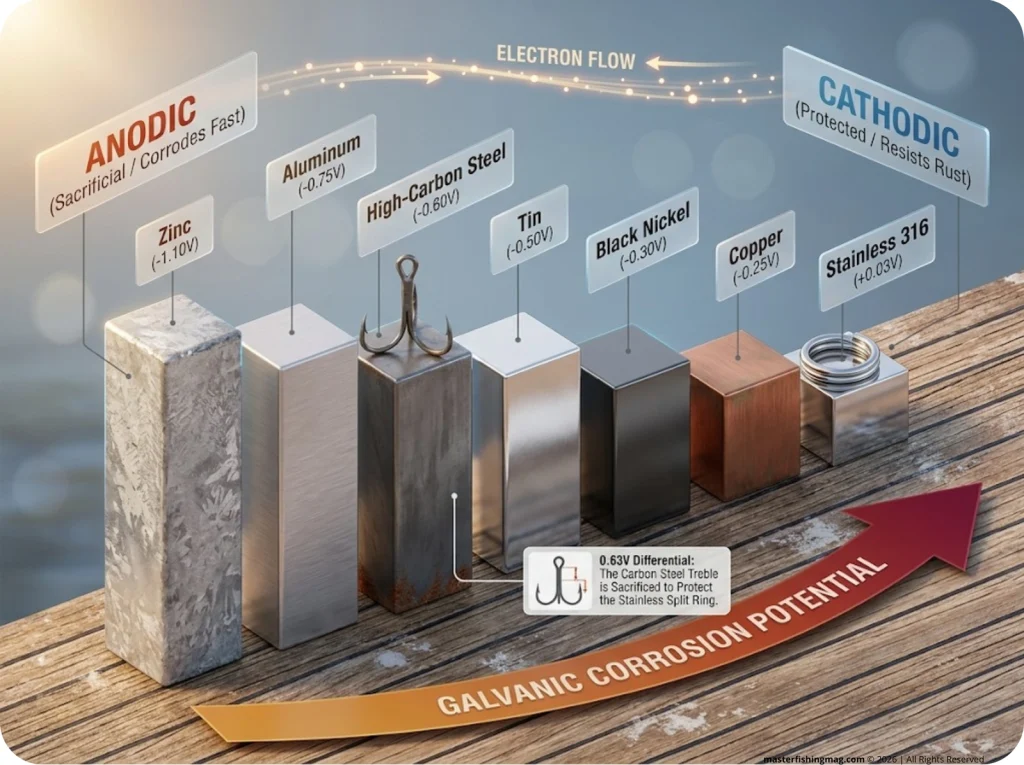
Pro-Tip: Check your trebles at the split ring junction after every saltwater trip. Early pitting there is the canary in the coalmine. It’s not cosmetic damage — it’s the galvanic reaction already running.
High-Carbon vs. Stainless — The Sharpness-vs-Survival Trade-off
Stainless steel (Type 304 or 316) resists oxidation through a passive chromium oxide layer. On paper, that sounds like the obvious choice. In practice, there’s a catch that catches most anglers off guard: stainless steel depends on oxygen to maintain that passive layer. Seal it in a damp, oxygen-depleted tackle box, and it goes “active” — meaning it corrodes fast, the opposite of what you’d expect.
There’s a second problem anglers rarely think about. The stainless split rings clipped to every lure sit near the cathodic end of the electro-chemical series. High-carbon steel sits firmly in the anodic zone. The moment moisture bridges them — which happens every time you fish — the carbon steel becomes the anode. It donates electrons. It corrodes. This is why hooks rust at the bend and the eye first: those are the contact points with stainless hardware.
The Coating Hierarchy — Tin, Zinc, Black Nickel, and What “Noble” Means
Tinned hooks are nearly four times more durable than blued hooks in salt-spray tests — 26.9 mpy corrosion rate versus 106.3 mpy for blued hooks, according to peer-reviewed corrosion resistance data for fishing hooks. That’s not a marginal difference. Bluing gives up in real saltwater environments. Tin holds.
The nuance: tin is more “noble” than iron on the redox potential of coatings scale. A scratch on a tinned hook makes the underlying iron the anode, and the tin actually accelerates corrosion at that exact point. This is galvanic tunneling — a small scratch becomes a focused attack. Zinc-coated hooks work differently: zinc is more anodic than iron, so it corrodes itself to protect the exposed steel. Sacrificial protection continues even after the coating is scratched.
Black nickel is one of the most misunderstood finishes on the market. Its matte texture retains more salt in micro-pockets than polished tin or nickel — it’s not the corrosion-resistant premium product it’s priced as. It’s a stealth hook, which is a different value proposition entirely.
Coating Wear Maps — Know Which Zones Fail First
Coating failure follows a predictable pattern based on how and where you fish. The highest-failure zones: hook tips (chemical sharpening removes the coating there first), the bend exterior (rock and structure contact), the barb base (mechanical stress from fish-jaw extraction), and the eye-to-split ring junction (galvanic contact with stainless hardware).
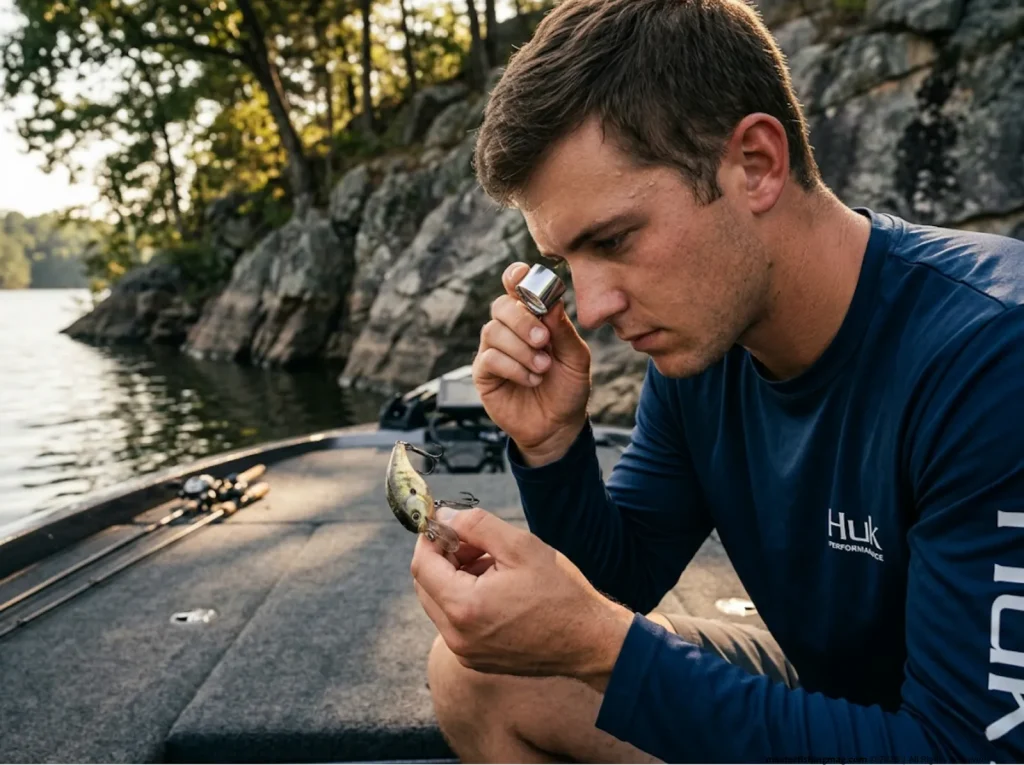
The shank interior between points is the lowest-failure zone — it receives the least mechanical abrasion. Visual inspection should focus on those four high-failure zones, not on overall hook appearance. A hook that looks clean from two feet away may have already started pitting at all four critical points.
The Electrochemistry of Rust — What’s Actually Happening on Your Hook
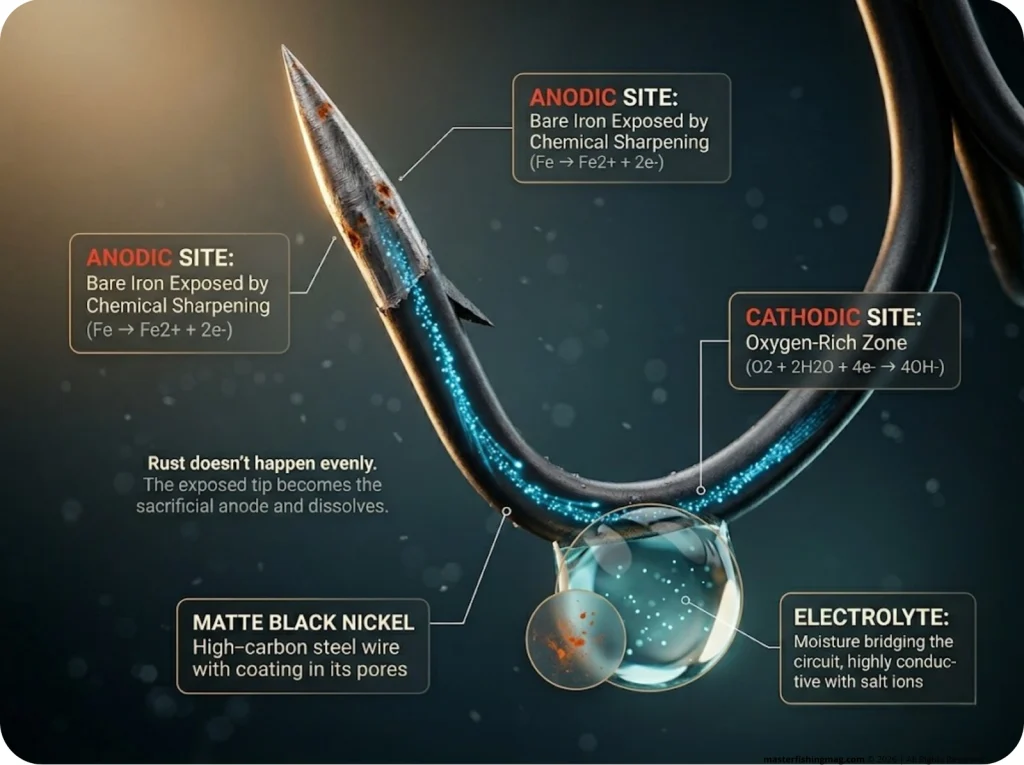
Rust isn’t a surface stain. It’s a spontaneous reaction — meaning it runs automatically once the conditions are right, requiring no ongoing input from you. Four components must be present simultaneously: an anodic site where metal is lost, a cathodic site where oxygen is reduced, a metallic electron path through the steel, and an electrolyte (water) to allow ion movement.
Remove any one of those four, and the reaction stops. That’s the entire logic behind every protection strategy in this article — moisture management, VCI technology, alloy isolation. You’re not cleaning a hook. You’re eliminating one leg of a four-legged stool.
When a drop of water lands on a hook, it creates a functional miniature battery. Iron atoms at the anodic site lose electrons; those electrons migrate through the steel to cathodic sites where oxygen concentration is higher — typically at the edge of the water droplet, not the center. The resulting iron compounds oxidize through stages to produce red rust. Rust is porous and hygroscopic: it absorbs atmospheric moisture on its own, self-fueling the process.
Saltwater (3.5% dissolved salts, primarily NaCl) doesn’t just make the electrolyte wetter. It increases ionic conductivity dramatically, accelerating iron dissolution by orders of magnitude. This is why a hook that rinsed clean after a freshwater trip can look orange three weeks after a saltwater one stored under identical conditions — a pattern documented in NIH-published data on marine atmospheric corrosion of carbon steel.
The part that competitors almost never cover: even microscopic salt residue dried onto a hook continues to attract atmospheric moisture through hygroscopic action. The hook looks dry. It isn’t. The corrosion cycle is still running. Rinsing that doesn’t chemically neutralize salt ions doesn’t actually stop the process — it just slows it down slightly. This is the trapped moisture paradox, and it’s why the “rinse and dry” approach fails anglers in humid coastal regions every winter.
For context on how this same galvanic chemistry attacks rods and reels, see the same galvanic corrosion chemistry that destroys rods and reels.
Pro-Tip: After rinsing, place a hook on a cool glass surface for 30 seconds. If a salt-haze condensation ring forms, there’s still salt residue on the hook. This is the condensation test — simple and reliable.
The Trapped Moisture Paradox — Why Sealed Boxes Can Be Worse
Here’s the counterintuitive part. Many anglers seal their tackle box after a trip feeling confident the hooks are protected. In humid coastal regions — Florida, Pacific Northwest, Gulf Coast — if any salt residue is inside that box, you’ve just created an incubator. Salt pulls moisture from the air. The sealed environment concentrates that humidity directly around the hygroscopic deposits.
Anglers who report “sudden” rust after winter storage aren’t discovering a manufacturing defect. They’re watching the conclusion of a slow-motion process that started the first time they closed that box without chemical decontamination.
The fix isn’t “leave the box open.” That exposes every hook to full ambient humidity. The fix is chemical neutralization before sealing — then VCI technology to interrupt the reaction even if trace moisture remains.
Heat Drying — The Mistake That Accelerates Rust
Using a hair dryer to dry saltwater hooks is worse than doing nothing. Heat accelerates the corrosion reaction if salt ions remain on the surface — you’re speeding up anodic dissolution. If the water evaporates but the chloride crystal remains, the next moisture contact starts an accelerated cycle.
The only safe heat application is final evaporative drying after full chemical decontamination — after the salt ions have been neutralized or rinsed with treated water. Heat before decontamination is a shortcut to faster failure.
Surface Finish Physics — Manning’s n and Why Some Hooks Never Come Clean
A concept from hydraulic engineering explains something no fishing article has bothered to apply to hooks before. Manning’s n describes a surface’s resistance to fluid flow. On a hook, a low value means saltwater and salt particles sheet off easily during a rinse. A high value means they trap in micro-pockets where surface tension blocks freshwater from penetrating.
New polished nickel hooks have an n value around 0.011 — water sheets off carrying most salt with it. Electroplated tin sits around 0.014–0.016. Matte black nickel: 0.018–0.022. Corroded or pitted steel: 0.025–0.035. The progression matters because used hooks don’t stay at their factory n value. Mechanical abrasion from rocks, fish teeth, and dock contact increases surface roughness continuously.
This is why rinsing fails for older gear: the salt is physically shielded by degraded surface geometry, not just sitting on top waiting to be washed off. Once a hook’s surface roughness is elevated, pure water cannot access the salt. A chemical surfactant (to reduce water’s surface tension) or an ionic neutralizer is required. This is why experienced reel technicians distinguish between “rinsing” and “neutralizing.” The same standard applies to terminal tackle.
The connection between surface condition and hook sharpening affects surface geometry and subsequent rust vulnerability runs in both directions — mechanical sharpening increases surface roughness values and salt retention, which is worth knowing before you start stoning those edges.
Inside the Tackle Box — Galvanic Series and Cross-Contamination
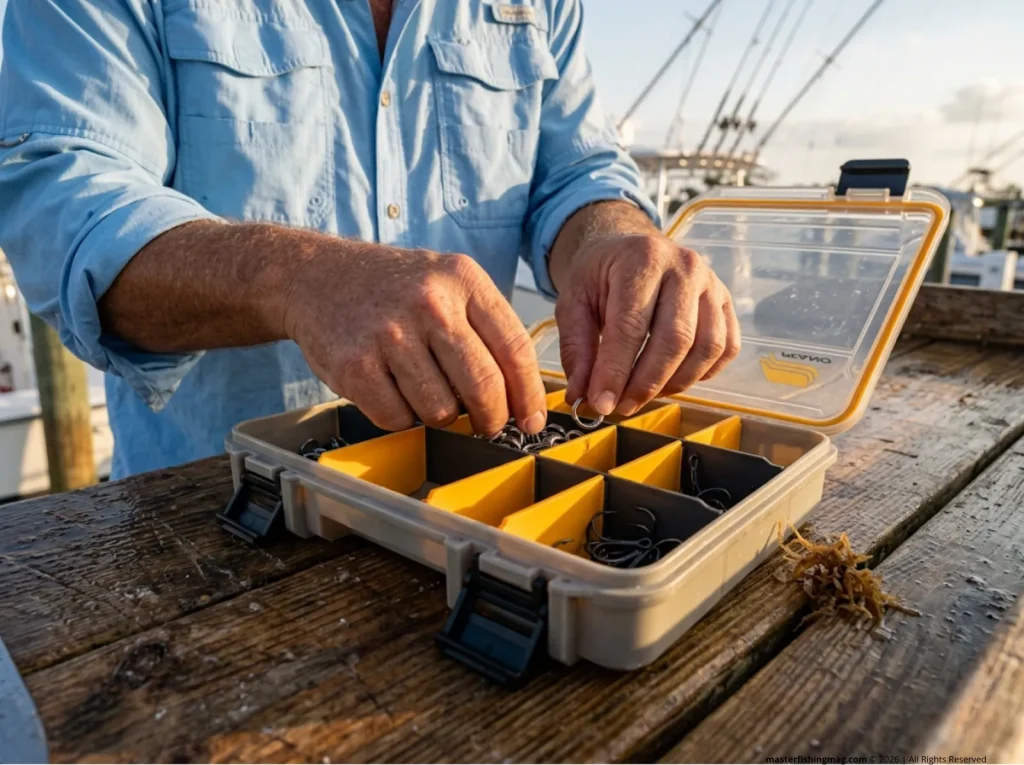
“Why do some hooks in the same box rust and others don’t?” That’s the question I hear most from anglers who think they’re doing everything right. The answer is almost always the same: they’re mixing brands.
Owner ST-36 trebles (high-carbon, black nickel) stored in the same tray as Mustad Ultra Point tinned hooks creates a battery. Not a metaphor — a functional electrochemical cell. The moisture inside the box (often containing trace salt) is the electrolyte. High-carbon steel is more anodic than stainless hardware or nickel. It gets sacrificed.
The Galvanic Series orders metals by electrochemical potential in seawater: Zinc → Aluminum → Mild Steel/Iron → Tin → Nickel → Copper → Stainless 316. The further apart two metals are on that list, the more aggressive the galvanic reaction when they share moisture. High-carbon steel sits between the active and tin positions — attacked by anything above tin, protected by nothing.
The voltage differential between high-carbon steel and Stainless 316 (the most common split ring material) is approximately 0.63V in saltwater. That’s enough to sustain measurable anodic dissolution of iron. And the reaction rate worsens with surface area ratios: one large stainless split ring touching one small treble hook is an uneven fight. The treble loses. For more on selecting boxes that interrupt this bimetallic reaction at the design level, the review of VCI-rated tackle boxes designed to interrupt this exact bimetallic reaction covers the field options in detail — per galvanic corrosion mechanics explained by Canada Parks official document.
Cross-Contamination — The Rusted Hook That Infects Its Neighbors
A rusted hook in a compartment is not an isolated problem. Think of it the way food safety professionals think about cross-contamination. A single rusted hook is a reservoir for hygroscopic iron oxide and trapped chlorides. When it touches a pristine hook, it transfers both.
Path 1: physical transfer of chlorides that immediately initiate pitting on any coating breach. Path 2: the rusted hook (bare iron, anodic) bridged by moisture to a clean hook with nickel or tin coating (cathodic) creates galvanic coupling that bypasses the new hook’s barrier protection entirely.
Pro-Tip: Quarantine protocol — any hook showing active rust (orange, not just dark patina) should come out of the main box immediately. Do not return it after rinsing. One $1 hook left in a $20 lure’s tray can initiate failure of four adjacent hooks within 30 days in a high-humidity environment.
VCI Technology and Chemical Decontamination — The Molecular Protocol
Vapor Corrosion Inhibitors work at the molecular level inside the air space of a tackle box. The VCI molecules sublimate from a solid carrier — the impregnated plastic dividers in Plano Edge boxes or foam inserts in Flambeau Zerust — and diffuse throughout the enclosure. They bond to polar metal surfaces and form a nanocoating 4–6 nanometers thick. Invisible. No effect on hook sharpness or lure action.
The protection mechanism has three parts: electronic passivation (interrupts electron flow between anodic and cathodic sites), a hydrophobic barrier (repels water molecules, preventing the electrolyte film from forming), and acid neutralization — some VCI formulations scavenge chlorides and acidic pollutants before they reach metal. A sealed box takes 2–24 hours to reach saturation. When you open the box briefly, the molecular layer bonded to the hooks persists. The VCI source replenishes when closed — per Penn State’s open chemistry textbook on corrosion mechanisms.
The critical advantage over oils: VCI penetrates inaccessible crevices. The interior of a treble hook’s eye. The gap between hook shank and split ring where crevice corrosion initiates. Oil can’t reach those spaces; vapor does.
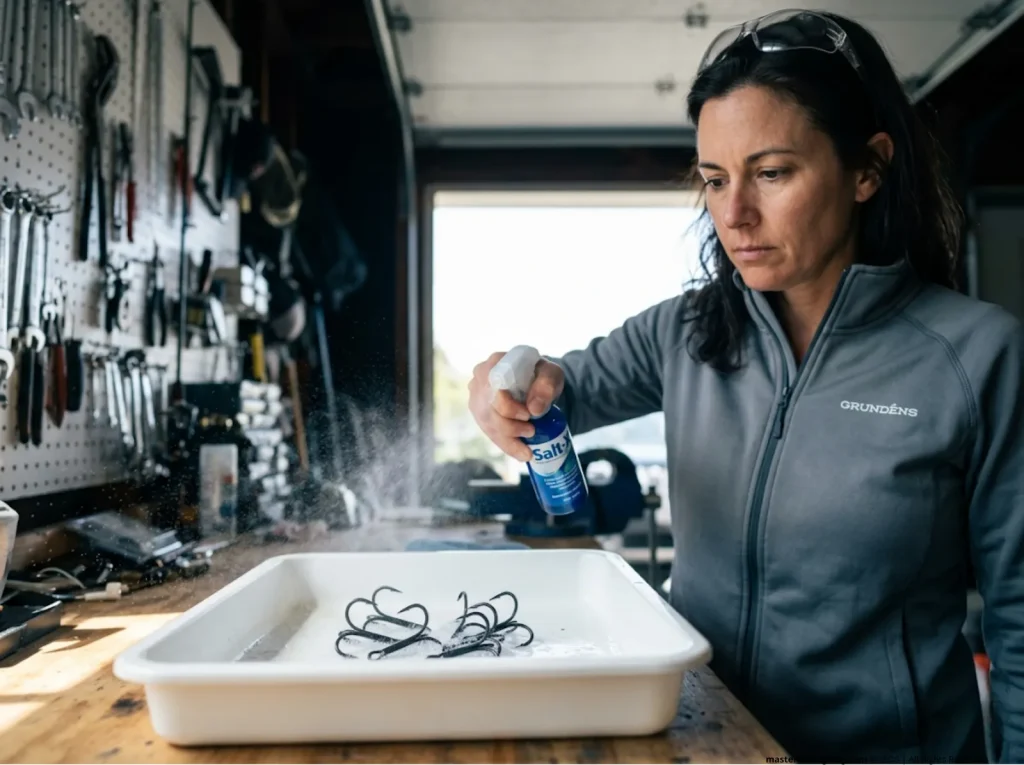
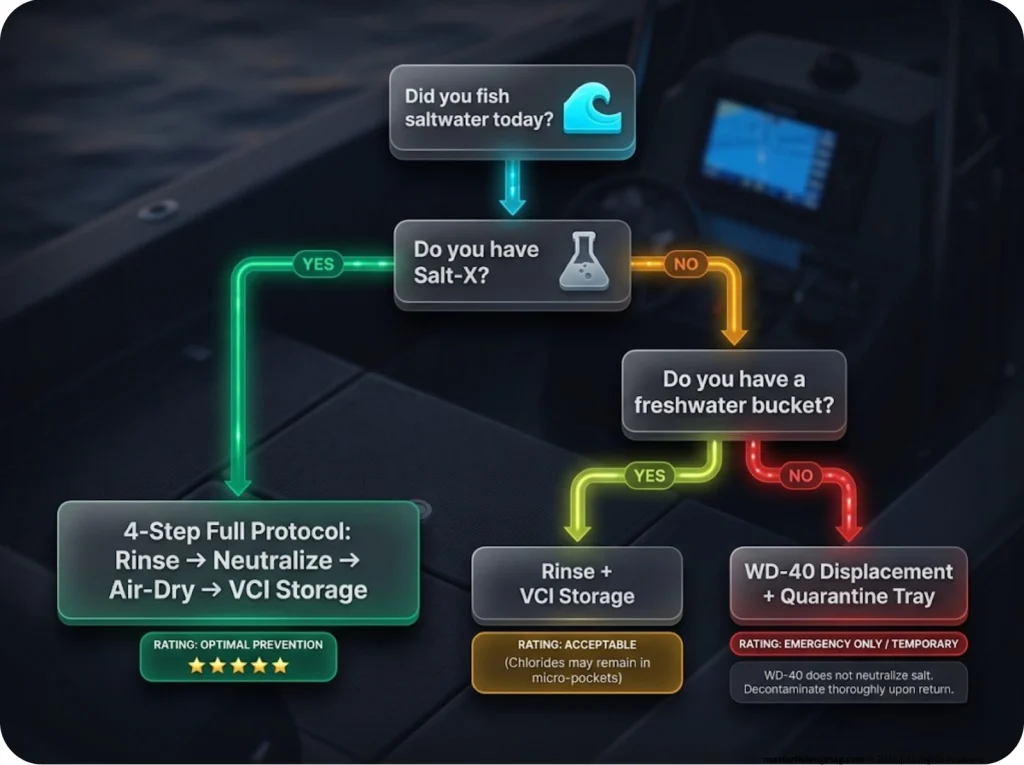
Salt-Away vs. Salt-X — they do different things, and confusing them costs money. Salt-Away is a surfactant at 500:1 dilution. It reduces water surface tension to allow high-volume flushing of large surfaces like outboard engines or rod guides. It requires a freshwater rinse afterward, and long-term testing has shown some bubbling after 18 months. Salt-X is an ionic neutralizer — it chemically cleaves the bond between chloride ions and the metal surface, something water alone cannot do. Long-term testing showed Salt-X stopping active corrosion for over four years. For terminal tackle on high-value lures, there’s one right answer: a 10:1 Salt-X soak, air-dried, then into VCI storage.
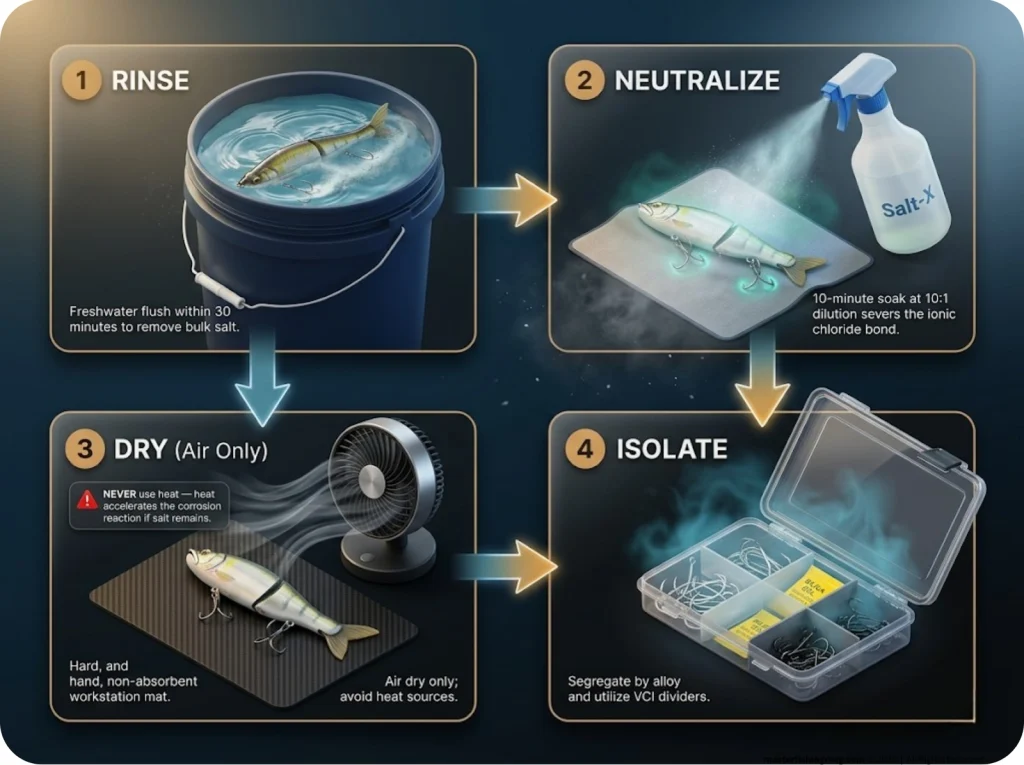
The Scientific Decontamination Protocol — Four Steps, No Exceptions
This is the protocol. Run it after every saltwater session.
- Step 1 — RINSE: Freshwater flush within 30 minutes of saltwater exposure. This doesn’t finish the job alone, but it reduces chloride load before chemical treatment. Use a dedicated rinse bucket, not the bait well.
- Step 2 — NEUTRALIZE: 10-minute soak in Salt-X solution at 10:1 dilution. This severs the ionic bond between chloride and metal surface — the step water skips entirely.
- Step 3 — DRY (Air Only): Air-dry completely on a non-absorbent surface in moving air. No heat. No toweling, which redisperses concentrated salt as residue forms.
- Step 4 — ISOLATE: Separate by coating type — tinned with tinned, black nickel with black nickel, hard hardware away from trebles. Store in VCI-treated compartments. Add silica gel in humid coastal climates as desiccant backup. Datemark your silica gel packets; in coastal Florida they saturate in 4–6 weeks.
Field Protocol — Multi-Day Trips Where Full Drying Is Impossible
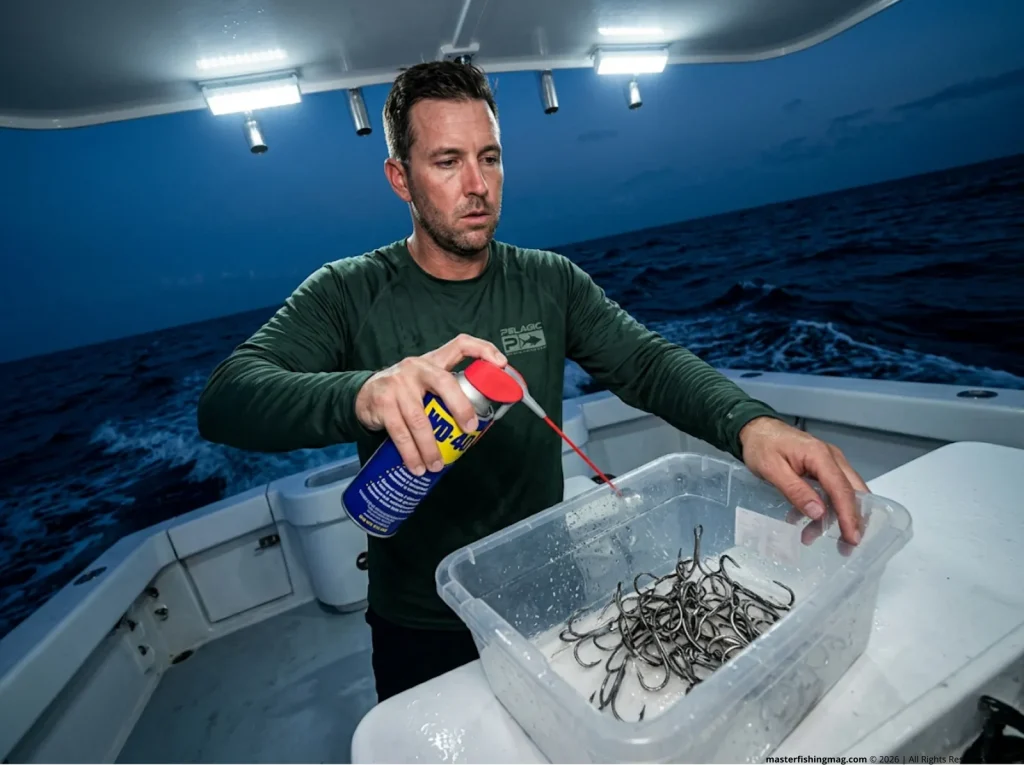
This is the scenario nobody writes about. You’re four days offshore. You’ve got saltwater, a bucket, maybe a bottle of Salt-Away you remembered to pack, and a tackle box. Full decontamination is not happening between sessions. What’s the floor?
The minimum viable field standard: bucket rinse immediately post-use, pat dry with a clean cloth, store in a VCI box. That’s the floor, not the ceiling. If you have Salt-Away at 500:1 dilution — a small bottle is practical on any boat — a 60-second spray-and-contact significantly reduces surface chloride load compared to water alone. For the same post-saltwater discipline applied to another piece of gear, the same post-saltwater field rinse protocol that protects breathable waders covers the urgency with comparable detail.
WD-40 in the field: it’s a water displacer, not a corrosion inhibitor. It pushes water off the surface temporarily, but the salt residue stays. After WD-40 evaporates, the chloride is still there. Suitable for emergency overnight protection, nothing more. As for whether WD-40 repels fish — at typical application amounts, that concern is largely a myth. The hydrocarbons dilute rapidly and don’t affect strike rate at those concentrations.
The system professional offshore guides use: a dedicated “dirty hook” compartment. All used trebles from a given day go into one unlined tray. End-of-trip bulk decontamination, then redistribution to VCI storage. This prevents cross-contamination during the trip while keeping the lure swap speed you need in the moment.
Pro-Tip: On multi-day trips, cycle hooks — day 1 hooks into the “used/wet” tray, day 2 starts with fresh hooks from the “clean/VCI” supply. By trip end, used hooks get bulk decontamination. Clean-hook supply maintained throughout.
Post-Trip Priority Ranking — Which Gear Needs Treatment First
You have 30–60 minutes after arriving home before salt residue crystallizes and begins adsorbing humidity. Prioritize in this order:
- High-carbon steel trebles on high-value lures ($20+)
- Any hook that contacted structure (maximum coating damage, elevated surface roughness)
- Hooks on lures stored during the trip (high-humidity exposure)
- Split rings and swivels (stainless has lower immediate corrosion risk, but inspect for galvanic coupling damage at contact points)
Fluorocarbon and braid degrade over seasons. Hook corrosion begins within hours. When time is short, protect metal first.
Conclusion
Three things to take off the water with you.
First: rust is a managed system, not an event. The reaction that destroys treble hooks requires four simultaneous conditions — remove any one and it stops. Your maintenance protocol is a component-elimination strategy, not a cleaning ritual.
Second: rinsing is not decontamination. Surface roughness physics explain why freshwater alone cannot reach salt trapped in micro-pockets of used hooks. You need Salt-X at 10:1 to chemically sever the chloride bond — especially on any hook that has contacted structure or been used more than once.
Third: your storage box is either protecting your hooks or attacking them. Mixed-alloy storage creates galvanic batteries inside compartments. VCI technology interrupts the electrochemical cycle at the molecular level. The dedicated angler treats their tackle box as a controlled atmosphere, not a container.
Before your next saltwater trip, audit the box. Separate hooks by coating type. Add VCI inserts and silica gel. Pack a small bottle of Salt-X in the boat bag. Run the four-step protocol on your best lures after this trip and compare them to the untreated hooks in six weeks. The data speaks.
FAQ
Can you fix rusted treble hooks, or is rust always permanent?
Surface rust — uniform orange patina without visible pitting — can be reduced with fine steel wool or a rust eraser followed by Salt-X treatment and VCI storage. But the coating is permanently compromised at that point. Any hook showing pitting (small, discrete holes in the wire surface) has structural degradation and should be replaced before use on a high-value lure or target species. Don’t fish a structurally compromised hook at the moment of a trophy-class strike.
Does WD-40 repel fish, and is it actually useful for rust prevention?
WD-40 (Water Displacement, Formulation 40) is a water displacer and light lubricant — not a corrosion inhibitor. At concentrations applied to terminal tackle, field testing shows it doesn’t measurably repel fish. However, it does not neutralize chloride ions. It delays corrosion temporarily if salt residue remains. For anything beyond overnight emergency storage, use Salt-X or VCI technology.
What is the best anti-rust tackle box — are VCI boxes actually worth it?
VCI-impregnated boxes like Plano Edge and Flambeau Zerust create a sustained molecular protection atmosphere inside compartments — a fundamentally different mechanism than claiming waterproof or airtight. They’re worth the price premium for any angler using $15+ lures with high-carbon steel trebles. Caveat: VCI inserts have a service life of 2–3 years. When hooks begin rusting in a previously effective box, replace the inserts — not the box.
Does black nickel finish actually protect better than standard finishes?
Black nickel is one of the most marketed — and most misunderstood — hook finishes. Its matte texture has a higher Manning’s n roughness value than polished tin or nickel, meaning it retains more salt in micro-pockets and requires more thorough chemical decontamination. The finish provides aesthetically stealthy presentation and moderate barrier protection. It’s not the corrosion-resistant choice its price implies. For maximum saltwater durability backed by data, tinned hooks outperform black nickel in standardized salt-spray tests: 26.9 mpy versus higher failure rates for matte finishes.
Is there actually a risk from mixing different hook brands in the same tackle box compartment?
Yes — and it’s electrochemical, not theoretical. When hooks of different alloys or coatings share a compartment with any moisture present, they form a galvanic cell. The more anodic metal corrodes to protect the more cathodic one. Mixing high-carbon trebles with stainless hardware creates a voltage differential of approximately 0.63V in saltwater — enough to accelerate the dissolution of carbon steel. Separate by alloy type to eliminate this battery effect. Tinned with tinned, black nickel with black nickel, stainless hardware isolated from trebles.
Risk Disclaimer: Fishing, boating, and all related outdoor activities involve inherent risks that
can lead to injury. The information provided on Master Fishing Mag is for educational and informational purposes
only. While we strive for accuracy, the information, techniques, and advice on gear and safety are not a substitute
for your own best judgment, local knowledge, and adherence to official regulations. Fishing regulations, including
seasons, size limits, and species restrictions, change frequently and vary by location. Always consult the latest
official regulations from your local fish and wildlife agency before heading out. Proper handling of hooks, knives,
and other sharp equipment is essential for safety. Furthermore, be aware of local fish consumption advisories. By
using this website, you agree that you are solely responsible for your own safety and for complying with all
applicable laws. Any reliance you place on our content is strictly at your own risk. Master Fishing Mag and its
authors will not be held liable for any injury, damage, or loss sustained in connection with the use of the
information herein.
Affiliate Disclosure: We are a participant in the Amazon Services LLC Associates Program, an
affiliate advertising program designed to provide a means for us to earn advertising fees by advertising and linking
to Amazon.com. As an Amazon Associate, we earn from qualifying purchases. We also participate in other affiliate
programs and may receive a commission on products purchased through our links, at no extra cost to you. Additional
terms are found in the terms of service.