In this article
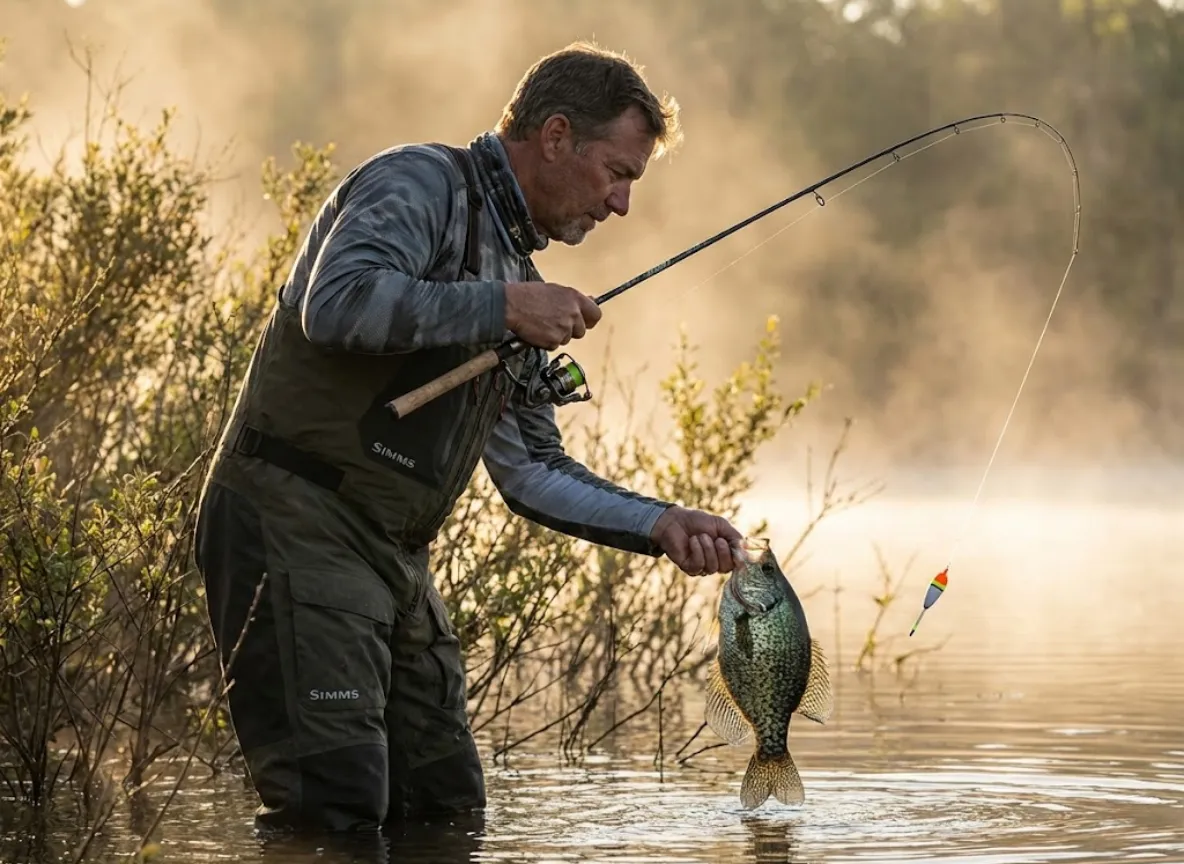
The slip bobber dipped once, hesitated, then slid sideways beneath the buckbrush. I’d been watching that Thill float for what felt like an eternity in 52°F water—no action, no movement, just the slow torture of prespawn fishing. Then, in the span of three heartbeats, the rod loaded, the drag sang, and I was connected to the kind of slab that makes you forget about the cold altogether.
That crappie didn’t appear by accident. It was exactly where the water temperature said it would be—staging on a transition bank, two feet shallower than it had been the week before. After twenty years chasing these panfish through every phase of the spring crappie spawn, I’ve learned one truth that separates the limits from the skunks: the fish don’t care what your calendar says. They move by degrees.
This guide breaks down the crappie spawning progression into precise thermal phases—from the first 45°F stirrings through the 70°F post-spawn recovery. You’ll know exactly where fish hold, what triggers their movement, and which tactics dominate at each temperature threshold.
⚡ Quick Answer: Crappie spawn when water temperatures stabilize between 55-65°F, typically peaking at 60-62°F. Track the 3-day temperature trend—not daily highs—to predict movement. Pre-spawn fish (45-55°F) hold in 12-18 feet on creek channels; spawning fish (60-65°F) move to 2-6 feet in shallow coves near brush or dock pilings. Match your presentation to the phase: spider rigging for suspended pre-spawn schools, slip bobber rigs for shallow spawners.
The Meteorological Spawn Framework: Why Temperature Trumps Calendar
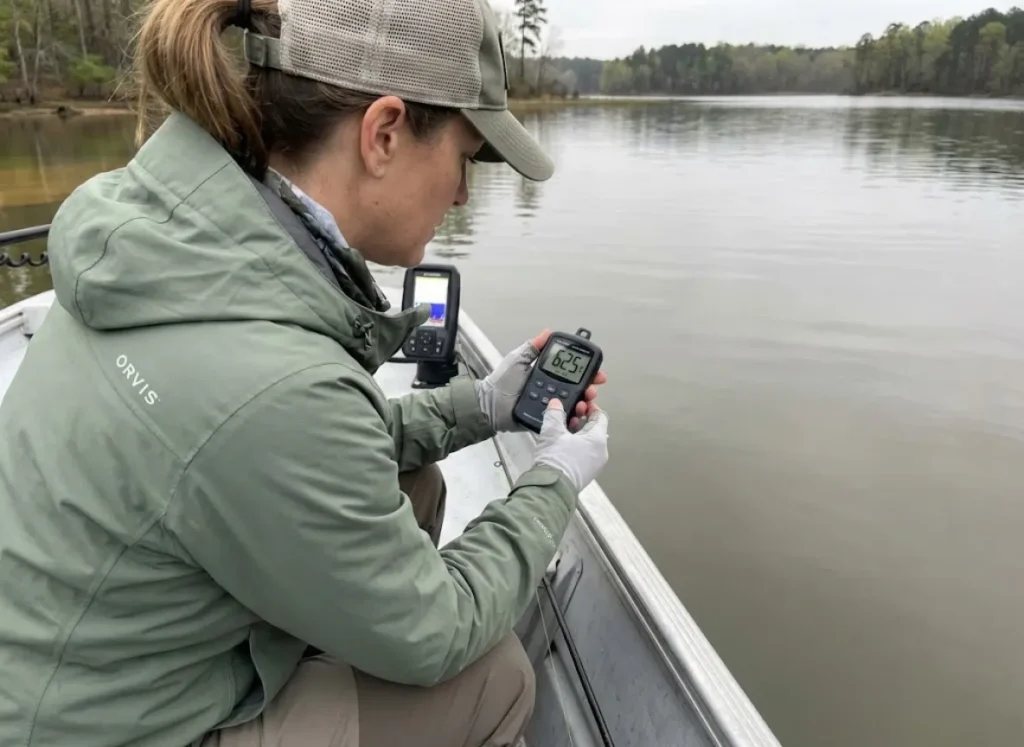
The annual crappie spawn isn’t a single event—it’s a progression measured in degrees, not dates. Most anglers get this wrong. They mark March 15th on their calendar, show up at the lake, and wonder why the shallow coves are empty.
Here’s what the spawning fish actually respond to: sustained thermal mass. The EPA’s research on aquatic spawning thresholds introduced the concept of Maximum Weekly Average Temperature (MWAT)—and it changes everything about how you should approach barometric pressure’s impact on fish activity.
The MWAT Principle: Reading Trend Lines, Not Daily Highs
One warm afternoon doesn’t trigger the spawn. The fish need consistent heat. When that 3-day moving average climbs 5 degrees, the migration starts. This means a single 65°F day amid a week of 50°F weather won’t push crappies shallow—they’re waiting for stability.
Pro tip: Check the water temp at the same spot every morning for a week straight before the spawn. When that 3-day average climbs 5 degrees, you know the staging fish are moving.
Barometric Pressure: The 6-Hour Shutdown Window
Falling barometric pressure before a front triggers aggressive feeding—this is your strike window. But high-pressure conditions after a cold front passes shut down the bite for 6-8 hours. During that window, fish bury themselves tight to the bottom structure or the thickest available brush piles.
The 24-hour period before a cold front passage often produces the best fishing of the entire spring crappie spawn. I’ve had days where we caught limits before noon, then watched the barometer spike and went three hours without a bite.
Water Clarity Dynamics: Solar Absorption and Depth Response
Stained or muddy water—common in spring runoff—heats faster than clear water because it absorbs solar radiation more efficiently. In turbid conditions, crappie often spawn 4-8 feet deep instead of the typical 2-6 feet. They move shallower to compensate for reduced light penetration.
At Rend Lake, when visibility drops below 18 inches after a rain, I start my search in 3-4 feet. The fish push up faster than you’d expect. In ultra-clear waters like parts of Kentucky Lake, spawning can occur as deep as 20 feet.
Phase I & II: The Awakening and Pre-Spawn Pulse (45°F – 55°F)
The 45-55°F water temperature range is where most anglers give up too early. The fish are there—they’re just not where you expect them.
Phase I (45-50°F): Deep Verticality and the Finesse Requirement
During this window, crappie hold near secondary river channels on ledges, channel swings, and deep brush piles—often 20-30 feet down over 30-40 foot bottoms. At Kentucky Lake, they gravitate toward mouths of creeks but stay suspended deep.
The metabolic rate of crappie in cold water is slow. Their feeding windows are short and weather-dependent, and the strike zone may be as small as 6 inches. This demands finesse.
Presentation matters more than lure selection here. Dead-sticking—holding the bait completely still or imparting only microscopic quivers—is the primary technique. Downsize your profile to 1.5-1.75 inches (small tube jigs, hair jigs). Those 2.5-inch shad profiles are too aggressive for lethargic fish.
Vertical jigging or extremely slow trolling at 0.3-0.5 mph keeps bait in the strike zone long enough to trigger a scientific crappie fishing guide reaction bite.
Phase II (50-55°F): The Great Migration and Spider Rigging Dominance
Once the water crosses 50°F, hormonal activation begins. Male crappie darken in color—the first sign of their spawning plumage. Females complete final egg development. The fish detach from deep main-lake wintering holes and migrate into major creek arms and tributaries.
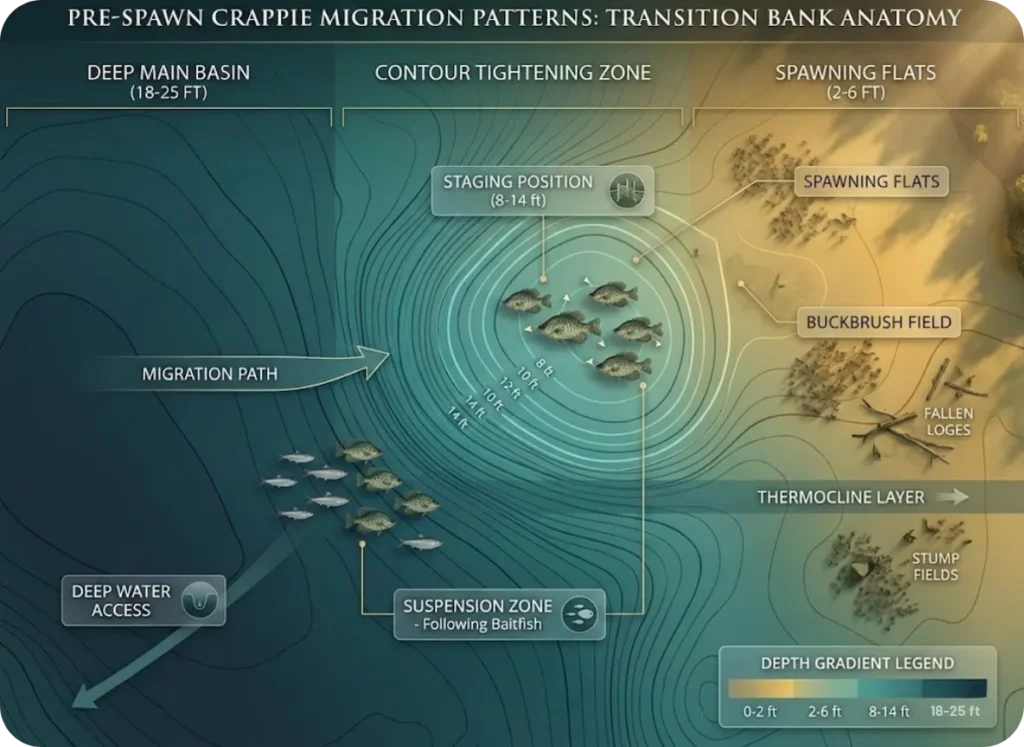
Look for transition zones—shorelines where contour lines tighten, offering immediate deep-water access adjacent to shallow spawning grounds. At Rend Lake, fish move from the main basin toward outer edges of buckbrush fields, holding in 8-14 feet on stumps and stake beds.
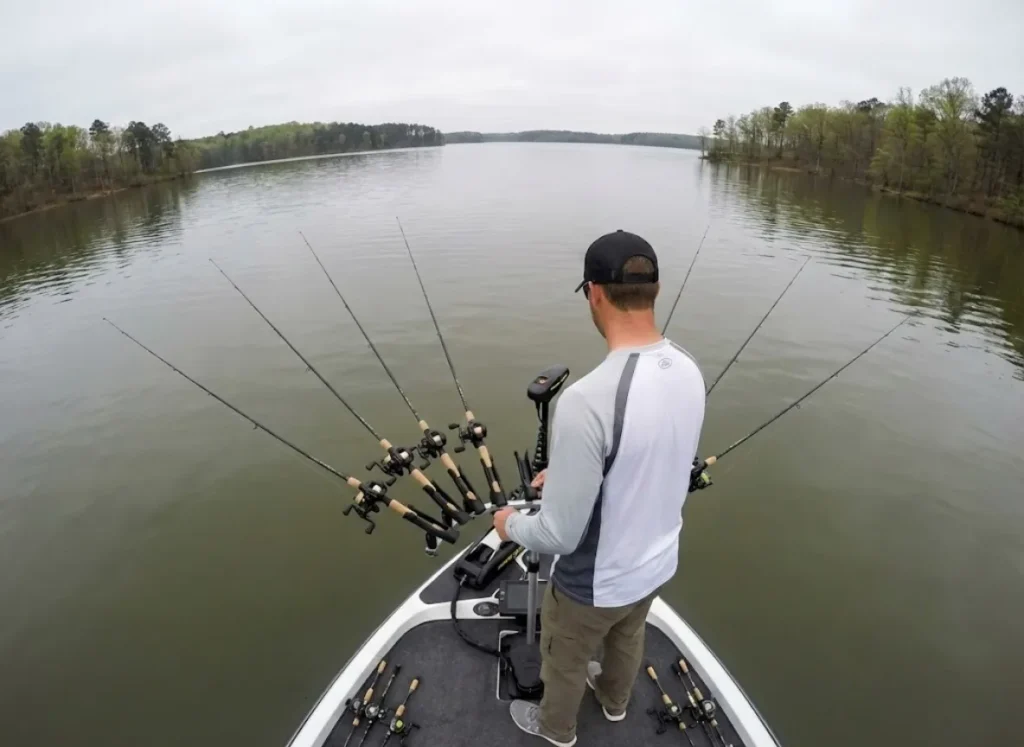
Spider rigging becomes the dominant tactic. This technique involves pushing multiple long rods (8-16 feet) from the bow, presenting baits at exact depths simultaneously. Set two rods at 10 feet, two at 12 feet, two at 14 feet—and let the fish tell you where they’re holding.
Pro tip: Suspension behavior is critical in this phase. Crappie often suspend over open water following shad schools. They’re relating to the thermocline and baitfish depth, not bottom structure. Your Garmin or forward-facing sonar helps find them.
Phase III: The Hard Pre-Spawn (55°F – 60°F)
This is when the 55-65°F water temperature band starts cooking. Male crappie (bucks) separate from main schools to scout shallow nesting sites. Females (roes) hang back in staging areas—slightly deeper water at 8-15 feet—waiting for temperature stability.
The North Bank Rule: Following the Warmth
Northern shorelines receive the most direct sunlight from the south and protection from cold north winds. These banks warm fastest and attract the first wave of scouting males. At Lake of the Ozarks, crappie move to pea gravel banks and secondary points, holding 10-15 feet deep over 20-foot bottoms.
This is the Law of V’s and north-facing banks in action—a principle that applies across species when water temperatures are rising.
Long-Lining: Intercepting Roaming Schools
To intercept roaming schools of staging females, pull jigs 30-50 feet behind the boat using long-line trolling. This covers vast staging flats efficiently. Control boat speed at 0.8-1.2 mph for optimal jig action.
Dock Shooting: Reaching the Shadows
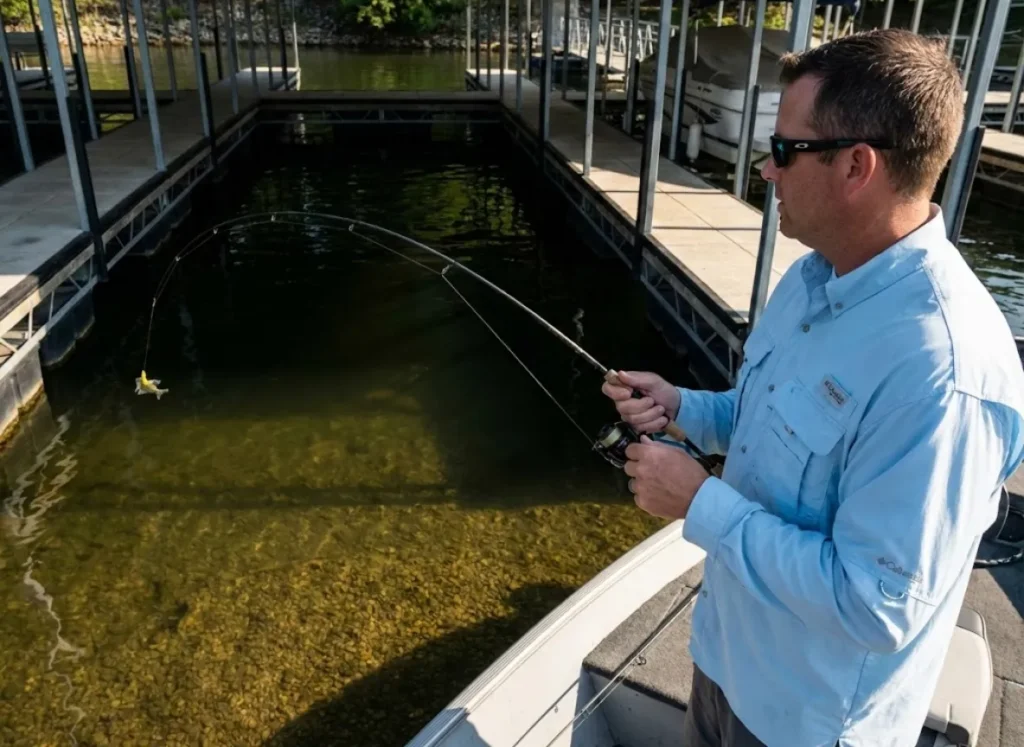
As fish move shallower but seek cover, they congregate under dock pilings. Shooting docks involves loading your rod like a bow to skip lures into the darkest recesses. This technique requires an extra-fast action rod—something like a 7’0″ Medium-Light St. Croix Panfish—for that wrist-snap loading motion.
In stained runoff water typical of this phase, high-visibility colors like Chartreuse, Pink, and Glow are essential. When skipping jigs under docks, the darkest corner will often hold the largest staging fish.
Phase IV: The Primary Spawn (60°F – 65°F)
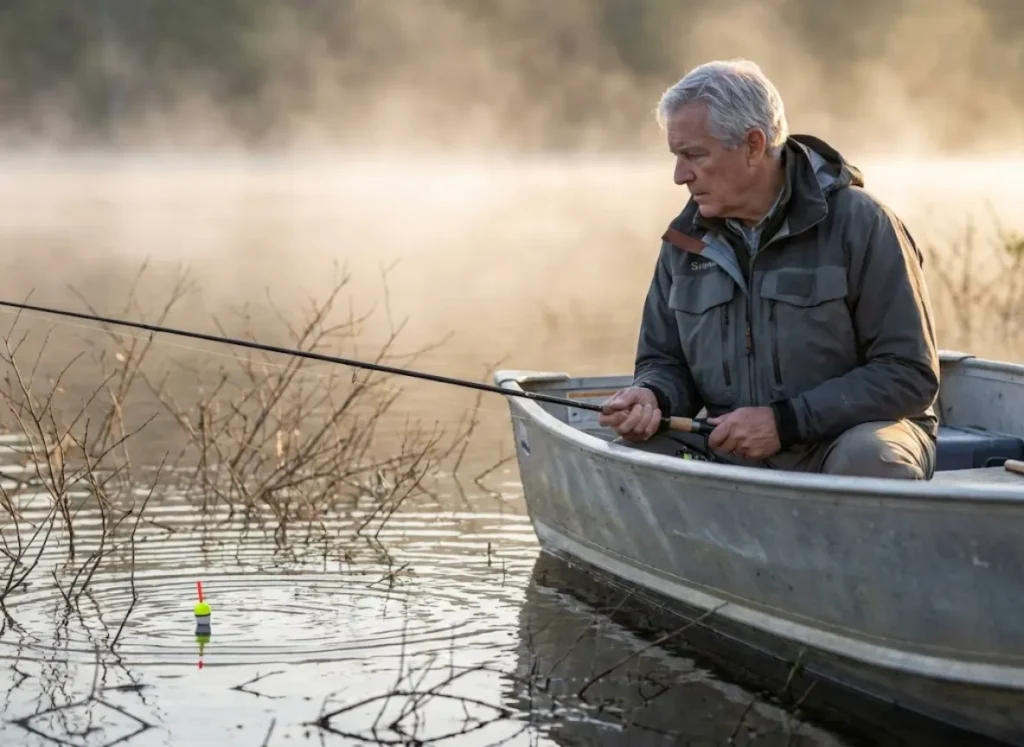
This is the magic window—when crappie stack in shallow waters and even bank fishermen can get in on the action.
The Magic Window: Species Timing and Sequential Spawning
Black crappie (Pomoxis nigromaculatus) typically initiate spawning activity first at around 60°F. White crappie (Pomoxis annularis) follow as temperatures stabilize between 62-65°F. According to Missouri Department of Conservation crappie spawning data, males sweep out nests on hard bottoms—gravel, firm sand, or clay—near root wads or submerged vegetation.
The standard spawning zone is 1-6 feet deep. In muddy water, fish may spawn in as little as 12 inches to ensure eggs receive sunlight. In ultra-clear water, nesting can occur as deep as 20 feet.
Location by Lake: Matching Cover to Structure
At Rend Lake, the buckbrush (Buttonbush) is the primary target. Fish move into the center of bushes as soon as green buds appear. If water floods the bushes, the crappie will be there.
At Grenada Lake—the “Crappie Capital of the World”—trophy fish move into flooded cypress trees and backwater sloughs. Wading is a lethal tactic here for silent approach.
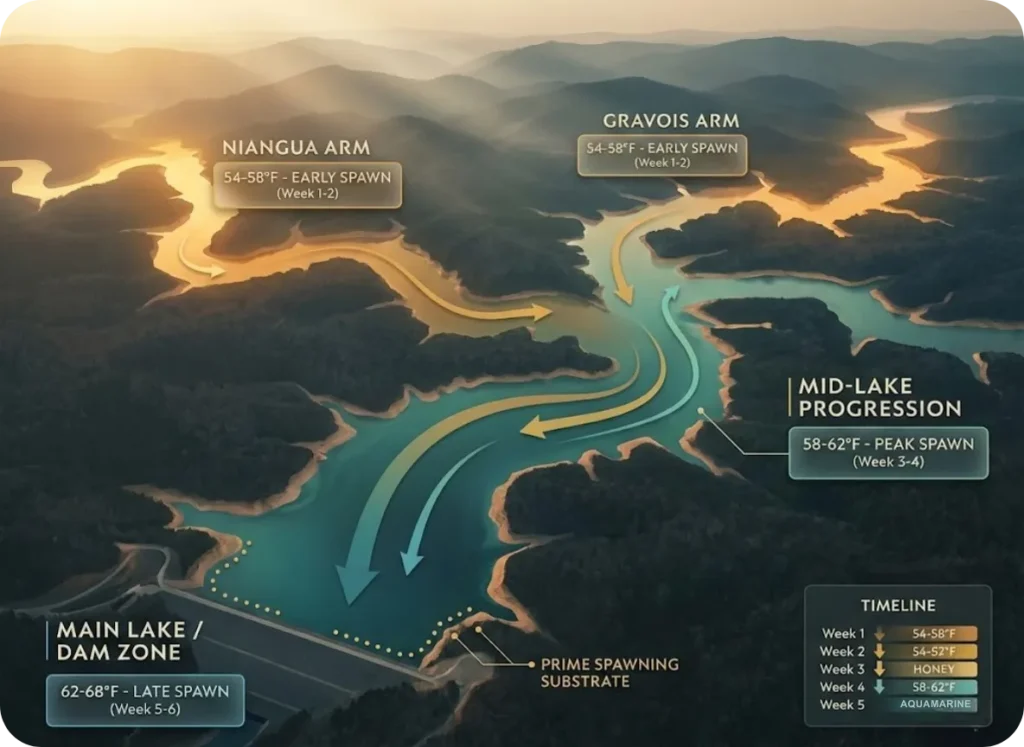
At Lake of the Ozarks, pea gravel pockets behind docks are prime real estate. The spawn migrates from river arms (Niangua, Gravois) toward the dam over several weeks—you can literally follow it down the lake.
Shallow Tactics: Float Fishing and Dipping
Males guarding nests are hyper-aggressive—they’ll strike anything threatening the brood. Females move in only to deposit eggs and then retreat.
Shallow float fishing with Thill bobbers allows precise depth control above nests. The balsa wood construction registers the “lift bite”—when the float lays horizontal as a fish swims upward with the bait—better than plastic corks.
“Dipping” with long rods (10-12 feet) lets you drop baits vertically into heavy cover without spooking fish. This is the dominant Grenada Lake technique. Use a 1/16 oz jighead with a #2 or #4 sickle hook to optimize sink rate and reducing gut-hooking with proper hook selection.
Phase V & VI: Post-Spawn Recovery and the Summer Transition (65°F – 75°F)
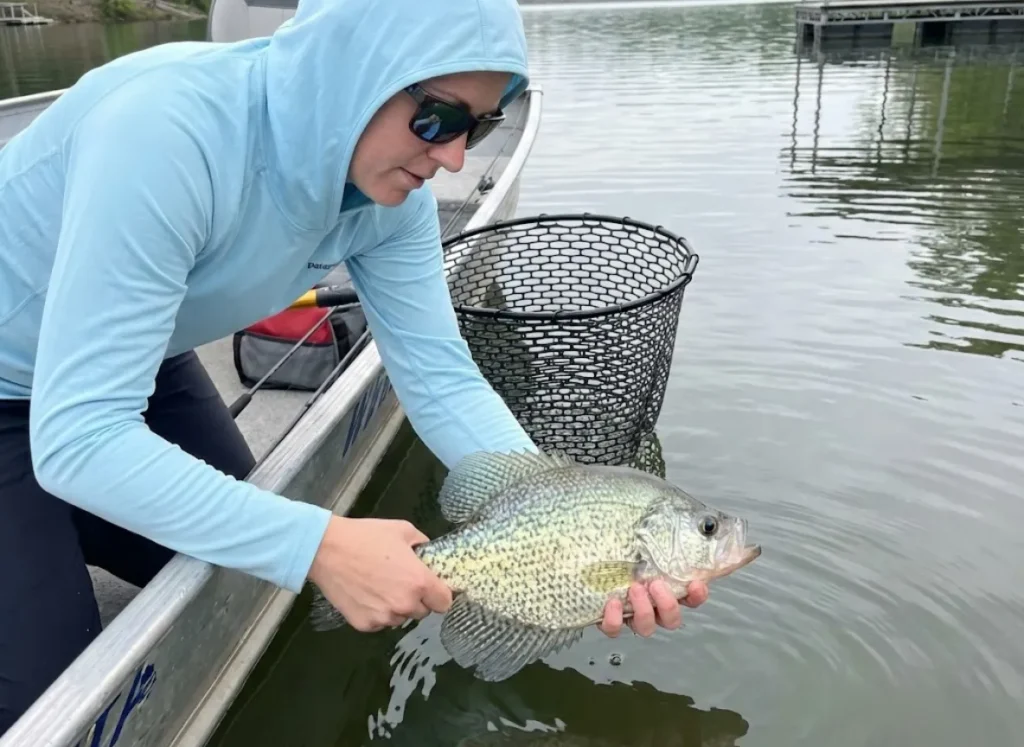
Most anglers pack it in once the beds empty. That’s a mistake. The female crappie recovery phase is one of the most overlooked windows of the entire season.
Phase V (65-70°F): The Female Recovery Phase
Following the spawn, females are physically depleted. They retreat to “recovery zones” to recuperate—often suspending in open water near spawning grounds or burying themselves deep inside brush piles.
This period is marked by a “funk” where bites are subtle. Expect light “thumps” rather than aggressive strikes. The post-spawn recovery window lasts 3-5 days, and trophy females stage at mid-depths where competitors rarely target them.
Pro tip: The biggest mistake I see is anglers giving up when the spawn “ends.” Those trophy females are still there—just 8 feet deeper and tighter to shade.
Targeting Shade: The Dock Shooter’s Second Season
Recovering fish seek shade to lower metabolic cost. Shooting docks becomes the premier pattern at Lake of the Ozarks and other developed lakes. The darkest corner of a dock will often hold the largest recovering females.
Downsize presentations to micro-baits. A 2-inch Bobby Garland Baby Shad in translucent “Monkey Milk” excels in post-spawn conditions.
For selective harvest, consider releasing large post-spawn females to maximize future spawn success. Keep smaller males (10-11 inches) for the table. This aligns with conservation-focused catch-and-release fishing physiology principles.
Phase VI (70-75°F): The Summer Shift
As water climbs past 70°F, the spawn concludes. The lake stratifies and thermocline formation begins, dictating the maximum depth fish can inhabit based on oxygen levels.
Crappie school up by size and relocate to main-lake river channel ledges, deep brush piles (15-25 feet), and bridge pilings. Feeding becomes crepuscular—fish are most active at dawn and dusk. Understanding thermocline formation and fishing depth helps you transition from horizontal presentations to vertical jigging over deep structure.
Gear Optimization: Matching Tackle to Thermal Phase
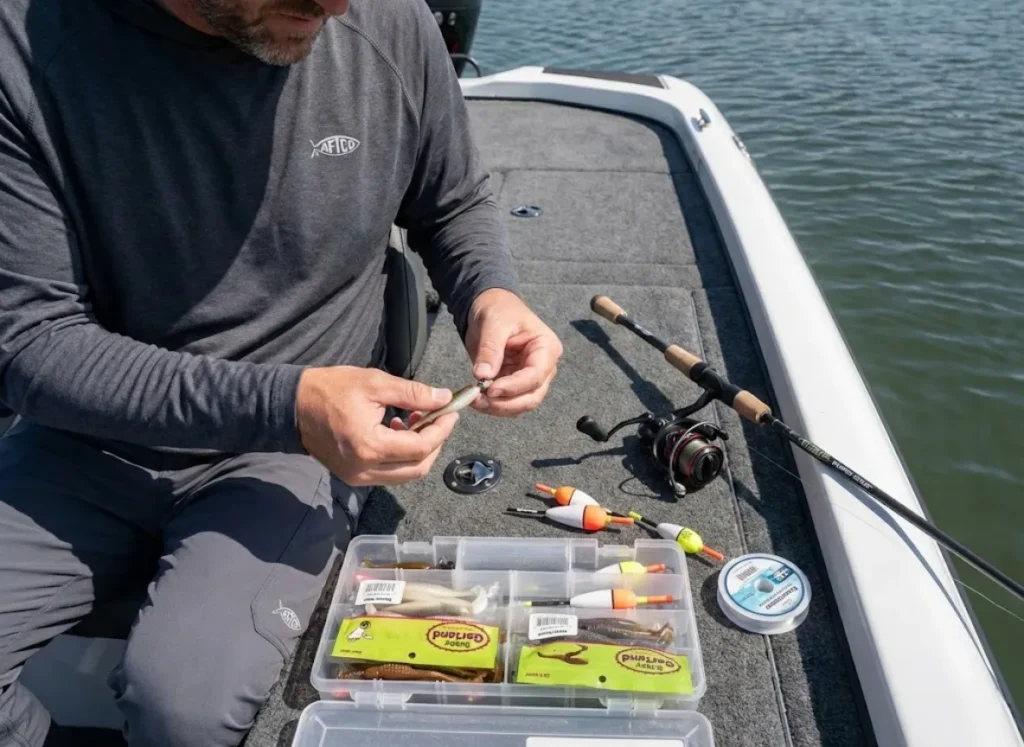
The right tackle matters more during the spawn than any other time of year. You’re fishing everything from 25-foot channels to 2-foot buckbrush—that requires intentional gear choices.
The Sensitivity Equation: Rod Selection by Phase
Cold-water phases (45-55°F) demand maximum sensitivity. SCII/SCVI carbon blanks with FRS (Fortified Resin System) detect the subtle “up-bite” of lethargic pre-spawn fish. A St. Croix Panfish PNS70MLXF (7’0″ Med-Light Extra-Fast) excels at shooting docks—the extra-fast action loads energy for the wrist-snap skip.
For spider rigging, longer rods (9’0″+) with moderate-fast action provide reach and parabolic fish-fighting power. Understanding rod action vs power explained helps you match the tool to the technique.
Reel Balance and Drag Physics
The Piscifun Carbon XT (5.6 oz) balances perfectly with featherweight panfish rods. The carbon fiber body and rotor reduce wrist fatigue during 8-hour sessions. High bearing count (8+1 shielded stainless) ensures low startup inertia—when slow-rolling for 45°F fish, any gear “grittiness” masks bites.
Lure Selection: Profile, Color, and Rigging
The Bobby Garland Baby Shad (2″) is the standard. The thin spear-tail quivers with minimal rod movement—perfect for dead-sticking in cold water.
For lure color selection: use translucent “Monkey Milk” in clear to lightly stained water (mimics threadfin shad fry), and high-contrast “Cajun Cricket” (orange/chartreuse/black) for stained or muddy conditions. Understanding how water distorts fishing lure colors helps you make smart color choices.
Rig with a 1/16 oz jighead and #2 or #4 sickle hook. Double-jig rigs let you test different colors or depths simultaneously.
Conservation and Ethics: Selective Harvest for Sustainable Slabs
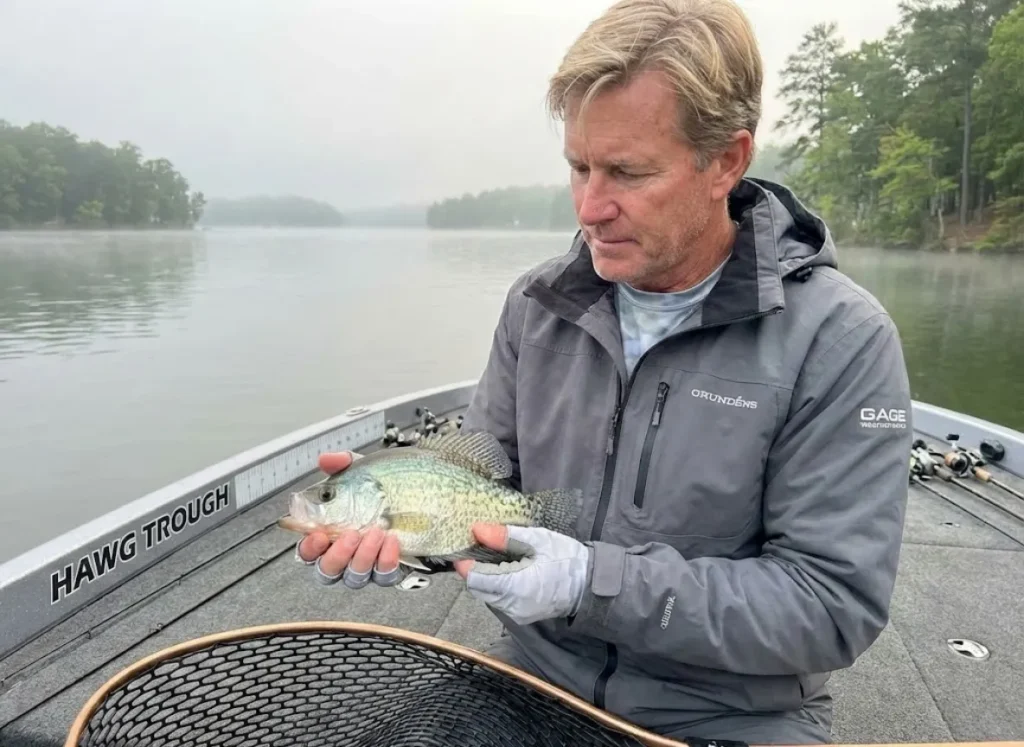
The spawn aggregates the largest specimens in the lake, making them vulnerable to overharvest. While high creel limits exist (30 fish in some states), keeping limits of large females removes millions of potential eggs from the system.
Large females (12″+) produce significantly more eggs than smaller fish—a 15-inch female can produce over 100,000 eggs versus approximately 20,000 from an 11-inch specimen.
Practice selective harvest: keep smaller males (10-11 inches) for the table and release large females to sustain population genetics. Males can be identified by darker, nearly black coloration during spawn; females maintain lighter, silver-olive coloring.
When handling spawning fish, use a rubber net to preserve the slime coat and minimize air exposure to under 30 seconds. Cradle horizontal holds support the fish’s weight properly—understanding the safety and survival matrix for holding fish prevents spine and jaw stress.
Conclusion
The spring crappie spawn isn’t a single event—it’s a progression measured in degrees, not dates. By tracking the 3-day temperature trend rather than the calendar, you’ll intercept fish at every transition point.
Three takeaways to put into practice:
- Watch the MWAT, not daily peaks—sustained thermal trends trigger movement, not single warm days
- Match depth to degree—your 50°F presentation (spider rigging at 12 feet) is completely wrong for 62°F conditions (float fishing at 4 feet)
- Release the big females—those 14-inch trophy roes are the genetic engine of next year’s spawn
The next time that slip bobber dips beneath the buckbrush, you’ll know exactly why that fish is there—and you’ll have the tactics to connect.
FAQ
At what temperature do crappie spawn?
Crappie spawn when water temperatures reach 55-65°F, with peak activity typically occurring between 60-62°F. Black crappie generally initiate spawning first at around 60°F, while white crappie follow as temperatures stabilize between 62-65°F.
How deep are crappie during the spawn?
Spawning depth depends on water clarity. In stained or muddy water, crappie spawn in 1-4 feet; in clear water, they may nest 6-20 feet deep. Generally, expect active spawn behavior in 2-6 feet with males guarding nests on hard bottoms near cover.
What is the best bait for crappie during the spawn?
A 2-inch soft plastic like the Bobby Garland Baby Shad on a 1/16 oz jighead is the standard. Use translucent colors (Monkey Milk) in clear water and high-visibility colors (Cajun Cricket, Chartreuse) in stained conditions. Live bait (minnows) under a slip bobber remains effective year-round.
Why do crappie stop biting after a cold front?
High barometric pressure following cold front passage causes crappie to become lethargic and tight to cover. The bite typically shuts down for 6-8 hours post-front. Downsize lures, slow presentations significantly, and target the thickest available brush or dock shade.
Should you keep crappie during the spawn?
Practice selective harvest—keep smaller males (10-11 inches) for the table and release large females (12+). Trophy females produce significantly more eggs, and removing them during the spawn has a disproportionate impact on future year-class strength. CPR practices help sustain the fishery.
Risk Disclaimer: Fishing, boating, and all related outdoor activities involve inherent risks that
can lead to injury. The information provided on Master Fishing Mag is for educational and informational purposes
only. While we strive for accuracy, the information, techniques, and advice on gear and safety are not a substitute
for your own best judgment, local knowledge, and adherence to official regulations. Fishing regulations, including
seasons, size limits, and species restrictions, change frequently and vary by location. Always consult the latest
official regulations from your local fish and wildlife agency before heading out. Proper handling of hooks, knives,
and other sharp equipment is essential for safety. Furthermore, be aware of local fish consumption advisories. By
using this website, you agree that you are solely responsible for your own safety and for complying with all
applicable laws. Any reliance you place on our content is strictly at your own risk. Master Fishing Mag and its
authors will not be held liable for any injury, damage, or loss sustained in connection with the use of the
information herein.
Affiliate Disclosure: We are a participant in the Amazon Services LLC Associates Program, an
affiliate advertising program designed to provide a means for us to earn advertising fees by advertising and linking
to Amazon.com. As an Amazon Associate, we earn from qualifying purchases. We also participate in other affiliate
programs and may receive a commission on products purchased through our links, at no extra cost to you. Additional
terms are found in the terms of service.